

You're probably doing one of two things right now. You're either staring at photos of glowing green hills and wondering if summer in Ireland is really as dreamy as it looks, or you've already booked flights and you're trying to work out what “mild” means when Irish people say it.
The honest answer is that an Irish summer can feel magical and practical at the same time. You can spend an evening by the sea in soft golden light, hear music drifting out of a pub, and still need a rain jacket in your bag. You can get long days, lovely temperatures, and a sky that stays bright late into the night. You can also get grey cloud, drizzle, and weather that changes its mind before lunch.
That mix is part of the charm. It's also why summer in Ireland rewards travellers who arrive with the right expectations. If you understand the weather, choose your regions well, and learn even a few words of Irish, the whole trip starts to feel less like sightseeing and more like stepping into the country properly.
Table of Contents
- Welcome to an Irish Summer Evening
- Understanding the Irish Summer Climate
- Top Festivals and Events to Experience
- Essential Outdoor Adventures and Activities
- Exploring Irelands Regions in Summer
- Sample Itineraries for Your Summer Trip
- Packing and Travel Tips for Every Scenario
- Speaking the Lingo A Pocket Guide to Irish Phrases
Welcome to an Irish Summer Evening
You finish dinner, step outside, and for a second your body assumes it is early. The lane is still bright. A few gulls are still calling. Someone is walking home from the shop without any hurry at all. Then you check the time and realise the evening has stretched much further than you expected.
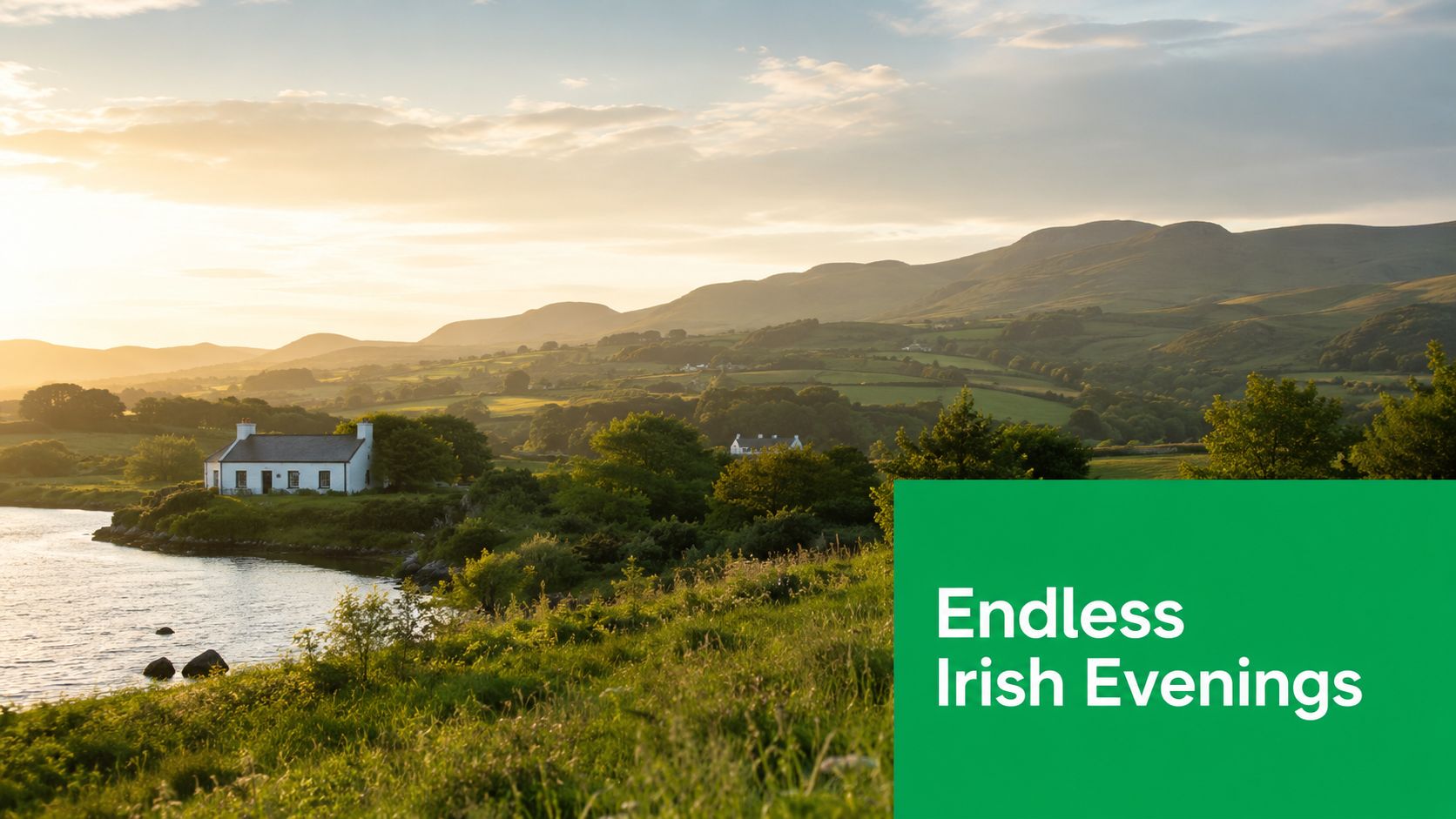
That lingering light shapes summer in Ireland as much as the scenery does. In the west, it can wash stone walls, bogland, and low hills in a soft silver-blue. In a village, it means children still kicking a ball long after dinner, neighbours talking at the gate, and music starting in the pub while the sky still looks half awake. Along the coast, the sea keeps catching the last of the brightness, so sunset can feel less like a switch being flipped and more like a candle burning down slowly.
The feeling visitors remember
Many visitors arrive with a list of headline sights. What often stays with them is quieter than that. It is the extra hour that turns a short stop into a walk on the strand, or the slow fade of light over a harbour when you thought the day was already done.
Around the summer solstice, Ireland has very long evenings and only a short period of full darkness. Met Éireann's overview of Irish daylight patterns notes how extended summer daylight is at Irish latitudes, and timeanddate's sunrise and sunset data for Dublin shows just how late evening light lasts in June. If you are used to a firm line between day and night, that can feel pleasantly strange at first.
It also changes how you travel. A summer evening here works like a little bit of borrowed time. You do not have to cram every good thing into the afternoon. You can visit a beach after dinner, sit outside with tea or a pint, or take a small detour because the light is still there.
If you want to deepen that experience, listen for the language around you as the evening settles. In parts of the west, especially near Gaeltacht areas, you may hear “Dia dhuit” for hello or “Go raibh maith agat” for thank you. Even a few words of Irish can shift your trip from sightseeing to participation. You are no longer only looking at Ireland. You are starting to hear how it understands itself.
There is romance in that, of course. There is also honesty. Some evenings glow. Some arrive under a blanket of grey cloud with a breeze that sends you back inside for a jumper. Irish summer is generous with light, not guaranteed sunshine. Once you understand that difference, the season makes much more sense, and becomes much easier to enjoy.
Understanding the Irish Summer Climate
Irish summer makes more sense once you stop treating it like a smaller version of Spain or southern France. It behaves more like a changeable roommate. Often pleasant, sometimes generous, occasionally awkward, and never fully under your control.
What summer usually feels like
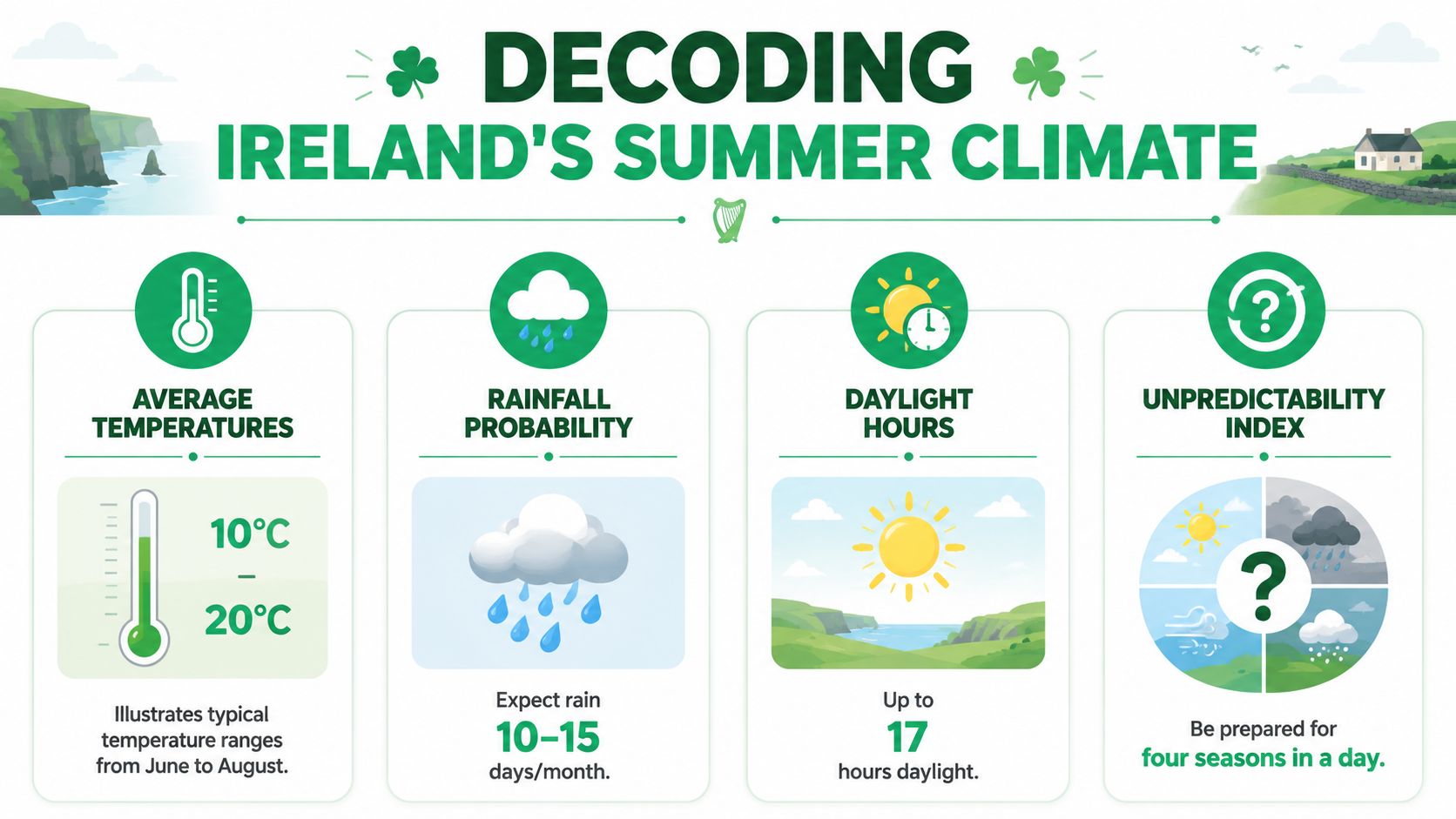
The basic idea is simple. Irish summer is usually mild rather than hot, bright in terms of daylight, and variable in terms of actual weather.
Met Éireann's seasonal climate material and long term summaries are the best starting point for this, because they come from Ireland's national meteorological service. Their climate and average weather data for Ireland shows a pattern of moderate summer temperatures rather than intense heat. On many days, that feels ideal for walking, driving scenic routes, visiting towns, or spending a few hours outdoors without getting drained by heavy heat.
That said, “mild” can mislead visitors. If you hear 16°C or 18°C and picture a chilly day, the actual experience may feel better than the number suggests, especially if the air is calm and you are moving about. If you hear the same number and picture sunbathing weather, you may be disappointed. Ireland usually sits in the comfortable middle.
Warm spells do happen. Met Éireann's monthly climate summaries and long term records also show that recent years have included notable warm periods and occasional high temperature events. They are still episodes, though, not the reliable foundation of the season.
Why grey skies matter as much as temperature
This is the part many travellers only understand after they arrive.
A day can be warm enough for a coastal walk and still look silver rather than blue. A forecast can say “dry” and still give you drifting mist, sea breeze, or a light shower that passes before you find your rain jacket. Irish summer asks you to read the weather in layers, not in simple categories.
The Irish Road Trip guide to weather by month is useful here because it combines rainfall and sunshine patterns in one place. The result is a clearer picture. Summer brings long usable days, but not constant sunshine, and cloud cover is a normal part of the experience.
That is why visitors sometimes feel confused. The clock says evening, the temperature says summer, but the sky can feel closer to early autumn. Once you expect that mix, the season becomes much easier to enjoy.
| What to expect | What it means for your trip |
|---|---|
| Mild temperatures | Walking, touring, and day trips are comfortable on many days |
| Frequent moisture | A waterproof layer matters, even for short outings |
| Long daylight | You have more flexibility if plans change with the weather |
| Cloud and grey skies at times | Judge the day by what you can do, not only by sunshine |
One local habit will help. Dress for the second half of the day, not only the first. A sunny morning in Connemara or Kerry can turn cool by late afternoon, especially near the coast.
If you want to connect weather with language as well as travel, that shift becomes part of the fun. In Irish speaking areas, even a simple phrase like Tá sé ag cur báistí (it's raining) stops being textbook vocabulary and starts matching the air around you. That is one reason a beginner-friendly summer Gaeltacht immersion guide can be such a useful companion before a trip. It helps you prepare for the place as it is, not as postcards present it.
Practical rule: Pack for change. Light layers, a waterproof jacket, and shoes that can handle a wet path will serve you better than planning around one perfect forecast.
Top Festivals and Events to Experience
A summer trip gets richer when you time it around gatherings that locals care about. Ireland does festivals well because the best ones don't feel staged. They feel lived in. Music, storytelling, horse fairs, street performance, food, and community all tend to overlap.
Big gatherings with real atmosphere
Galway International Arts Festival suits travellers who want a city break with energy. Galway already feels lively in summer, and a strong arts programme gives the streets even more momentum. You'll find the sort of atmosphere where seeing one planned event often leads to two unplanned ones, whether that's a busker, a pop-up performance, or a late pub session.
Fleadh Cheoil na hÉireann is one of the best ways to hear traditional music at full strength. Even if you don't know the difference between a reel and a jig yet, you'll feel the pull of it. Tunes spill out of formal competitions and informal sessions alike, and that combination matters. It shows Irish music as both craft and social life.
If you're curious about connecting music and language before you travel, this guide to a summer Gaeltacht experience for beginners gives helpful context on how cultural events can become language moments too.
Smaller traditions that stay with you
Puck Fair in Killorglin stands apart because it feels old in the bones of the place. It isn't polished in the way some modern festivals are. That's part of its draw. You get a stronger sense of local rhythm, local humour, and the way Irish towns can still rally around custom.
Bloomsday in Dublin is a treat for readers, but it's also enjoyable if you have a fondness for the theatrical side of Irish culture. You don't need to be a literary scholar to enjoy people leaning into costume, quotation, and ritual with a straight face and a wink at the same time.
A few types of events are especially worth watching for when you plan:
- Traditional music festivals: Best for pub sessions, dancing, and hearing regional styles.
- Town fairs: Best for seeing how local identity still shapes public celebration.
- Arts festivals: Best if you want theatre, visual art, and a younger city buzz.
- Food events: Best for slowing down and talking to producers, bakers, brewers, and market stallholders.
If a festival programme looks slightly chaotic on paper, that often means it'll be good in person.
The trick is not to overbook yourself. Pick one major event as the spine of the trip, then leave breathing room around it. In summer in Ireland, a festival day can expand on its own. One concert becomes a walk. The walk becomes a pint. The pint becomes music you hadn't planned to hear.
Essential Outdoor Adventures and Activities
The best outdoor days in Ireland aren't always the ones with perfect blue skies. Some of the most memorable are breezy, slightly wild, and full of changing light. The scenery doesn't ask you to conquer it. It asks you to be present in it.
For walkers and wanderers
If you like your movement gentle, start with a coastal path, a woodland trail, or a lake loop. Places like Wicklow, Connemara, Kerry, and Donegal all offer walks where the reward arrives early. You don't need to spend hours climbing before the view opens up.
A good Irish walking day often unfolds in layers. First there's the smell of damp grass or salt. Then the wind changes and you pull on a fleece. Then the cloud lifts for ten minutes and the whole bay flashes silver. That rhythm is part of why hiking here feels so different from walking in a dry summer climate.
For stronger hikers, mountain routes and ridge walks give you the drama many travellers come seeking. Just treat the weather seriously and know your limits. A route that looks straightforward in a photo can feel very different in mist.
Try matching the outing to your energy rather than your ambition:
- Low effort, high reward: Clifftop strolls, forest walks, harbour loops
- Half-day adventure: Hill walks, island cycling, long beach walks
- Full-day challenge: Mountain hikes, long-distance trail sections, exposed coastal routes
For water lovers and slow travellers
Water changes the mood of a trip. A kayak on a calm lough, a boat trip to an island, or even a lazy afternoon by a river gives summer in Ireland a softer pace. Families often do well with these days because everyone gets fresh air without needing to commit to a hard hike.
Cycling works particularly well too, especially on greenways and quieter rural roads. You move slowly enough to notice small things. Fuchsia hedges. Hand-painted signs. A cottage garden in full colour. Sheep standing in the road as if they own it.
A picnic can be an activity in itself here. That isn't a joke. Find a beach with shelter from the wind, a bench over a harbour, or a field edge with a broad view, and suddenly lunch becomes part of the day's memory.
Bring snacks, bring an extra layer, and don't wait for a “perfect” forecast to go outside. Some of Ireland's loveliest summer moments arrive in between showers.
Exploring Irelands Regions in Summer
Ireland feels small on a map and varied on the road. Summer makes those differences sharper. One region gives you cliffs and Atlantic weather. Another gives you ruined monasteries and slow rivers. A city gives you galleries, pubs, and buses at your elbow. A Gaeltacht gives you language, local culture, and a different relationship to place.
Where the landscape leads the trip
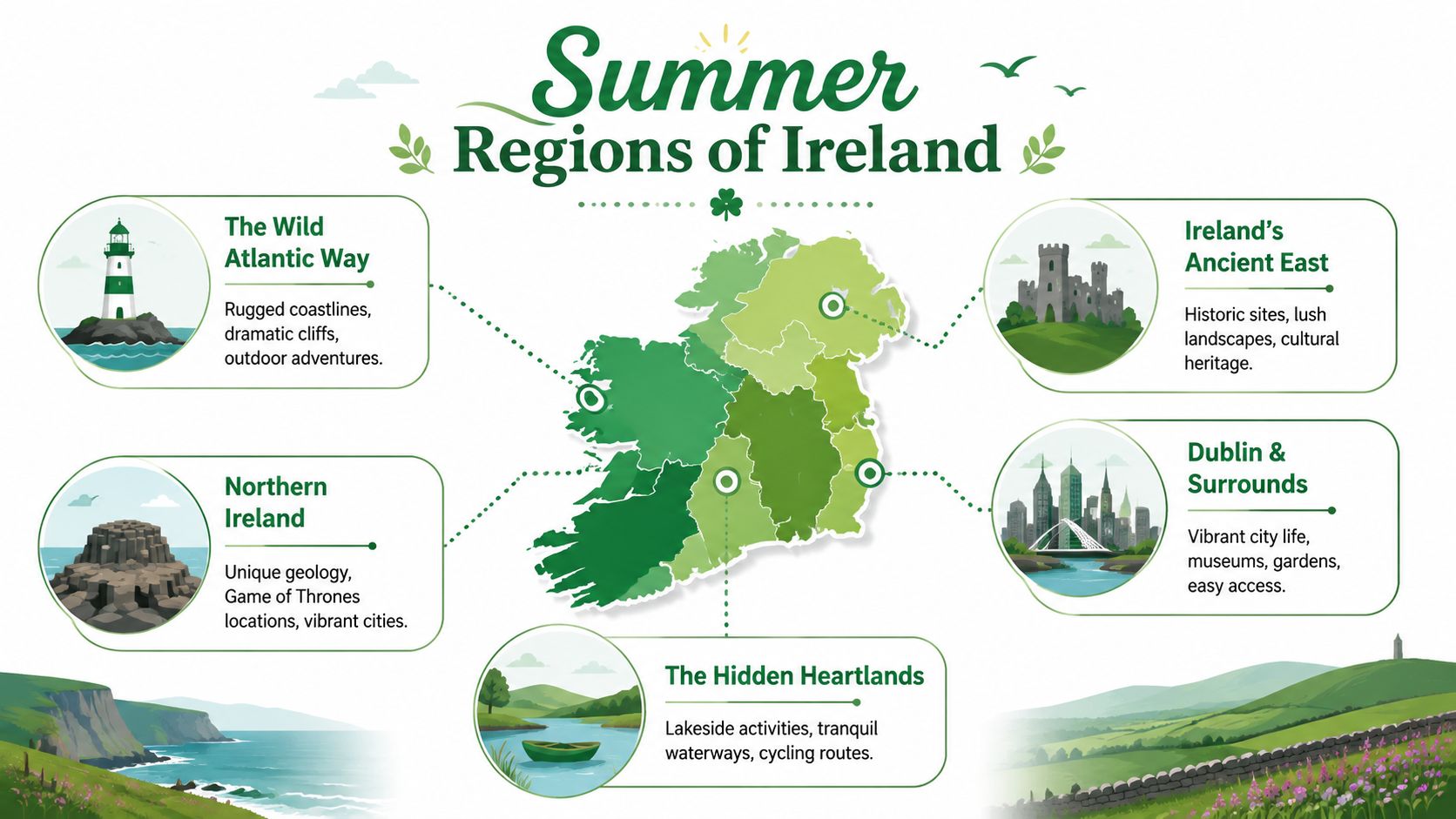
The Wild Atlantic Way is the classic summer route for a reason. The west coast delivers the postcard material people imagine before they arrive. Cliffs, islands, winding roads, surf beaches, tiny harbours, and long views that change by the hour. It works best if you don't try to “complete” it. Choose a stretch and let yourself linger.
The Ancient East suits travellers who want history folded into easy touring. Monastic ruins, old estates, castles, gardens, and market towns sit close enough together that you can build satisfying days without huge drives. The scenery is softer than the far west, but no less beautiful.
Dublin and the surrounding counties work well if you want a trip with less driving and more flexibility. You can combine museums, parks, coastal villages, and day trips without changing hotel every night. If you like structure with room for spontaneity, this is a smart base.
For readers who want a broader planning resource with a more selective style, this guide to Ireland travel for discerning travelers is useful for refining priorities rather than trying to see everything.
A county-by-county view also helps when you're narrowing options, especially if place names are still new. This guide to the counties of Ireland is handy for getting your bearings before you start plotting routes.
Here's a quick visual overview to keep the regions straight:
Where language becomes part of the journey
The Gaeltacht regions deserve far more attention in travel guides than they usually get. These are Irish-speaking areas, found in places such as Donegal, Mayo, Galway, Kerry, and Waterford. They are not museum pieces. They are living communities where the language still shapes everyday life.
That changes the texture of a trip. Road signs look different. Place names carry older meanings. You hear Irish spoken naturally in shops, cafés, and local conversation. Even if you only know a few phrases, you start to notice sounds and patterns that would otherwise pass you by.
| Region type | Best for | What stands out |
|---|---|---|
| Wild Atlantic coast | Scenery and adventure | Big views, sea air, dramatic roads |
| Ancient East | History and ease | Heritage sites, gardens, compact touring |
| Dublin and surrounds | Culture and convenience | Museums, food, day trips |
| Gaeltacht areas | Cultural depth | Irish language, strong local identity |
| Hidden Heartlands | Quiet pace | Lakes, waterways, cycling, slower travel |
If you want the most textured version of summer in Ireland, combine a famous scenic route with at least one Gaeltacht stop. You still get the views, but you also get a deeper sense of the country's own voice.
Sample Itineraries for Your Summer Trip
A good Ireland itinerary should feel like a route, not a race. Distances can look short, but narrow roads, scenic stops, weather changes, and spontaneous detours all slow things down. That's not a flaw. It's usually where the fun starts.
A one week west coast taster
This version suits first-time visitors who want scenery, village life, and a strong sense of atmosphere.
Days 1 to 2
Arrive in Dublin or Shannon, then move west without trying to do too much on day one. Spend your first full day in Galway or nearby. Walk the city, listen for music in the evening, and keep the pace gentle.
Days 3 to 4
Base yourself in Connemara or south Mayo. Use one day for a scenic drive and short walks. Use the next for a boat trip, beach time, or a visit to a Gaeltacht area where you can hear Irish in everyday use.
Days 5 to 6
Head into Clare or Kerry. Pick one big scenic day. Cliffs, a peninsula drive, or a national park all work. Keep one evening completely unplanned so you can stay somewhere longer if the light is good.
Day 7
Return by the most direct route that still leaves room for one final stop, perhaps a coastal village or a historic site.
This itinerary works because it avoids the common mistake of trying to fit the entire island into a single week.
A longer trip with culture and contrast
If you have closer to two weeks, build contrast into the route.
- Start in Dublin for city energy, museums, and an easy landing.
- Move into the Ancient East for monastic sites, gardens, and slower inland touring.
- Cross to the southwest or west for classic summer scenery and outdoor days.
- Add a Gaeltacht stay so the trip includes language and local culture, not only scenery.
- Finish in a compact city such as Galway, where the last days can stay flexible.
That pattern gives you different versions of Ireland instead of more of the same.
If your trip planning extends into another season later on, this guide to preparing for a cozy Dublin city break is a useful contrast because it shows how differently the capital feels outside summer.
How to keep the route realistic
A simple planning rule helps. Don't change base every night unless you love unpacking and repacking more than travelling. Two-night stays often work better than one-night stays, especially in the west.
Also leave room for weather swaps. If one day turns wet, move the city, museum, or heritage stop there and save the big coastal view for the clearer spell. Summer in Ireland rewards travellers who can reshuffle without stress.
Packing and Travel Tips for Every Scenario
You step out after breakfast in light cloud, peel off a layer by noon in a patch of sun, then pull the waterproof back on when Atlantic mist drifts in. That rhythm catches first-time visitors off guard. Packing well for Ireland means packing for change, not for a single forecast.
Why layers beat forecasts
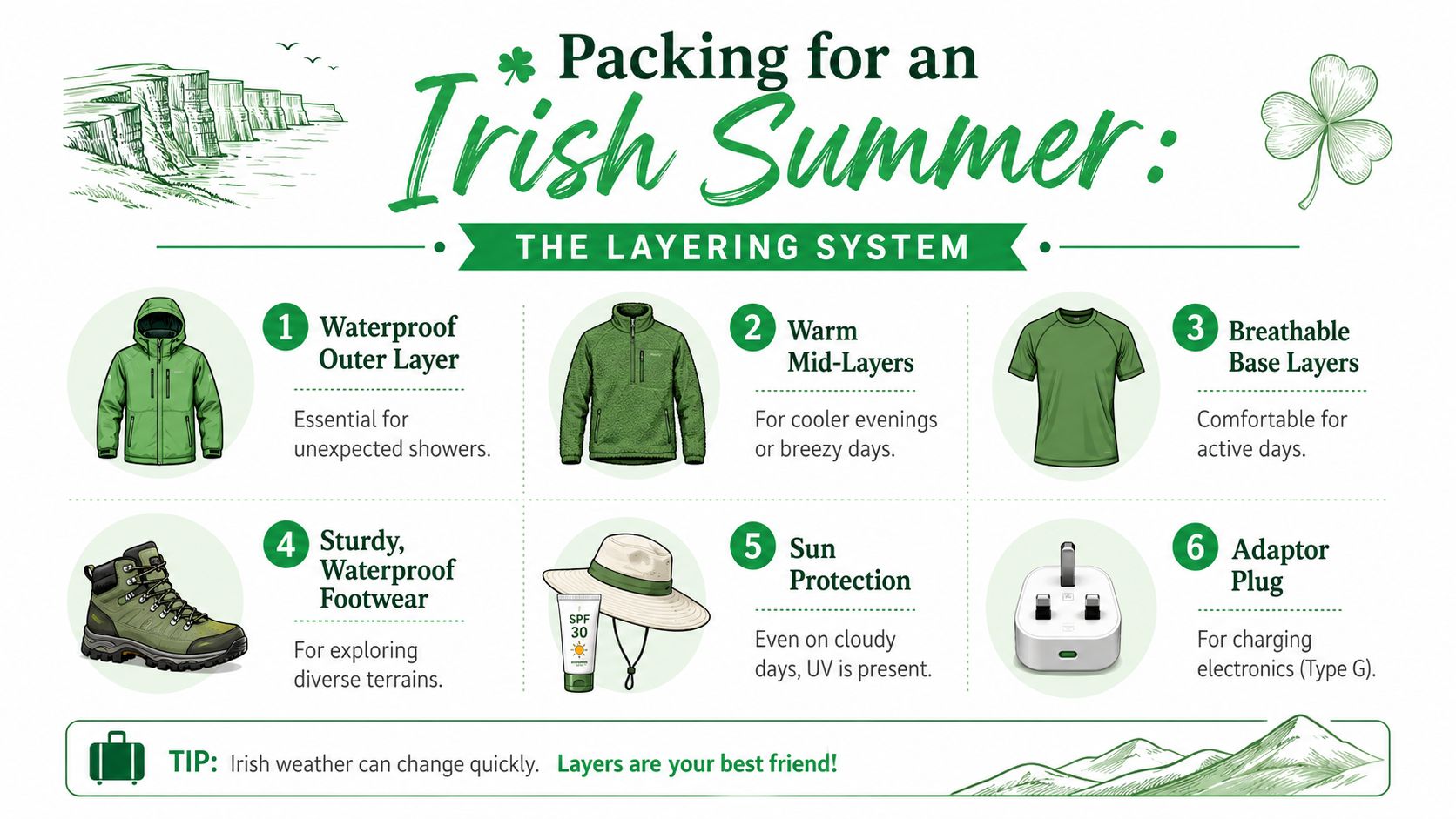
Layers work like a thermostat you control by hand. A breathable base layer keeps you comfortable while walking. A fleece, light knit, or thin insulated layer helps once the wind rises or the evening cool settles in. A waterproof shell finishes the job by handling showers, sea spray, and the damp air that can make a mild day feel colder than the temperature suggests.
That three-part system usually serves travellers better than one heavy coat or a suitcase filled with single-purpose outfits.
Shoes matter just as much. Coastal paths, town lanes, grassy heritage sites, and car parks after rain can all be slick underfoot, even in July. Water-resistant walking shoes or trainers with decent grip will get more use than dressier pairs. If you tend to bring too many options, this guide on how to strategically pack your shoes is useful.
A practical packing list for an Irish summer usually includes:
- Waterproof jacket: For short showers, longer damp spells, and windy ferry crossings.
- Warm mid-layer: A fleece, cardigan, or knit for evenings and exposed viewpoints.
- Comfortable walking shoes: Best for cobbles, wet grass, and uneven ground.
- Small day bag: Handy for layers, water, snacks, and a compact umbrella.
- Type G plug adaptor: Needed for charging phones, cameras, and power banks.
- Sunscreen and sunglasses: Grey skies can still come with strong UV.
The small things people forget
A sleep mask is one of them.
Irish summer evenings can stay bright for a surprisingly long time, especially from late May into July. In the north and west, the lingering light can make bedtime feel earlier than the clock says. If you are sensitive to light, a sleep mask can make the first few nights much easier. It sounds minor until you are lying in a guesthouse room at 5 a.m. wondering why it already feels like morning.
A compact umbrella helps too, but your jacket matters more. Wind can make umbrellas unreliable along the coast.
One more useful habit is to pack for spontaneity. Summer in Ireland often rewards the traveller who can switch plans without fuss. If the morning turns wet, you might swap a cliff walk for a museum, a café, or a heritage site. If the sky clears after dinner, you may suddenly have the perfect evening for a beach stroll or a harbour walk.
A few final tips save hassle:
- Book early: Popular coastal areas, festivals, and rental cars fill quickly.
- Bring one smarter outfit: Handy for a concert, a good restaurant, or a wedding-style family event.
- Keep a reusable water bottle: Tap water is safe to drink.
- Pack a few words of Irish with your clothes: If your route includes a Gaeltacht area, even simple greetings can change the tone of an interaction. This short guide to Irish travel phrases for beginners is a good place to start before you zip the suitcase.
That last point matters more than it may seem. The right jacket keeps you comfortable. A few words of Gaeilge can help you feel less like a spectator and more like a guest.
Speaking the Lingo A Pocket Guide to Irish Phrases
You don't need Irish to travel around Ireland. English will carry you everywhere. But a few words of Gaeilge can change the feeling of your trip, especially in Gaeltacht areas where the language is woven into daily life.
A few words go a long way
Using even a simple greeting shows interest and respect. It tells people you're not only passing through for photos. You're paying attention. That often opens warmer conversations, especially when you ask about place names or try a phrase with good humour.
If you're new to it, this beginner-friendly guide to essential Gaelic phrases is a good place to start before your trip.
Simple phrases worth learning before you go
Here are a few that are easy to use:
Dia duit
HelloGo raibh maith agat
Thank youSlán
GoodbyeSláinte
CheersLe do thoil
PleaseAn bhfuil Béarla agat?
Do you have English?Cá bhfuil… ?
Where is… ?
A nice way to use Irish on the road is with place names. Learn the Irish version of where you're going and say it out loud. You start noticing that names aren't decorative labels. They describe rivers, hills, churches, inlets, and old settlements. The surroundings become more legible.
That's the profound gift of learning a little before you go. Summer in Ireland stops feeling like a sequence of stops on a map. It becomes a place you can listen to, not just look at.
If you'd like to arrive with more than a handful of phrases, Gaeilgeoir AI is a smart way to prepare. It helps beginners start speaking Irish through guided, real-world conversations, pronunciation support, and practical travel situations, so you can do more than recognise words on road signs. You can put them to use.