You've just landed in Ireland, picked up the rental car, and pulled out of the airport feeling fine until the first sign appears. It has two place names. One looks familiar. The other doesn't. A few minutes later, you see a triangle, then a red-bordered circle with km/h, then a word like Scoile or Géill Slí and suddenly the road feels harder to read than it should.
That moment catches a lot of people. It also catches learner drivers who know the theory but haven't yet connected signs on a page with signs on a real road. In Ireland, road signs do more than control traffic. They also carry language, place, and culture in everyday form. Once you understand the system, they become much easier to read, and much more interesting too.
Table of Contents
- Your Guide to Navigating Ireland's Roads and Language
- How to Read Irish Road Signs A Quick Guide
- Regulatory Signs What You Must and Must Not Do
- Warning Signs Navigating Potential Hazards
- Information and Directional Signs
- Understanding Bilingual Signs Gaeilge for Drivers
- Practical Tips for Learners and Tourists
- Frequently Asked Questions About Driving in Ireland
Your Guide to Navigating Ireland's Roads and Language
The first bilingual sign usually creates the same reaction. You spot the English place name, then your eyes jump to the Irish version above it, and for a second you wonder if they're two different destinations. They aren't. They're the same place shown through Ireland's two public languages.
That small moment matters because it changes how you read Irish road signs. You're not only decoding traffic instructions. You're also learning to recognize common Irish words in the wild, where they are important. That's far more useful than memorizing isolated vocabulary from a worksheet.
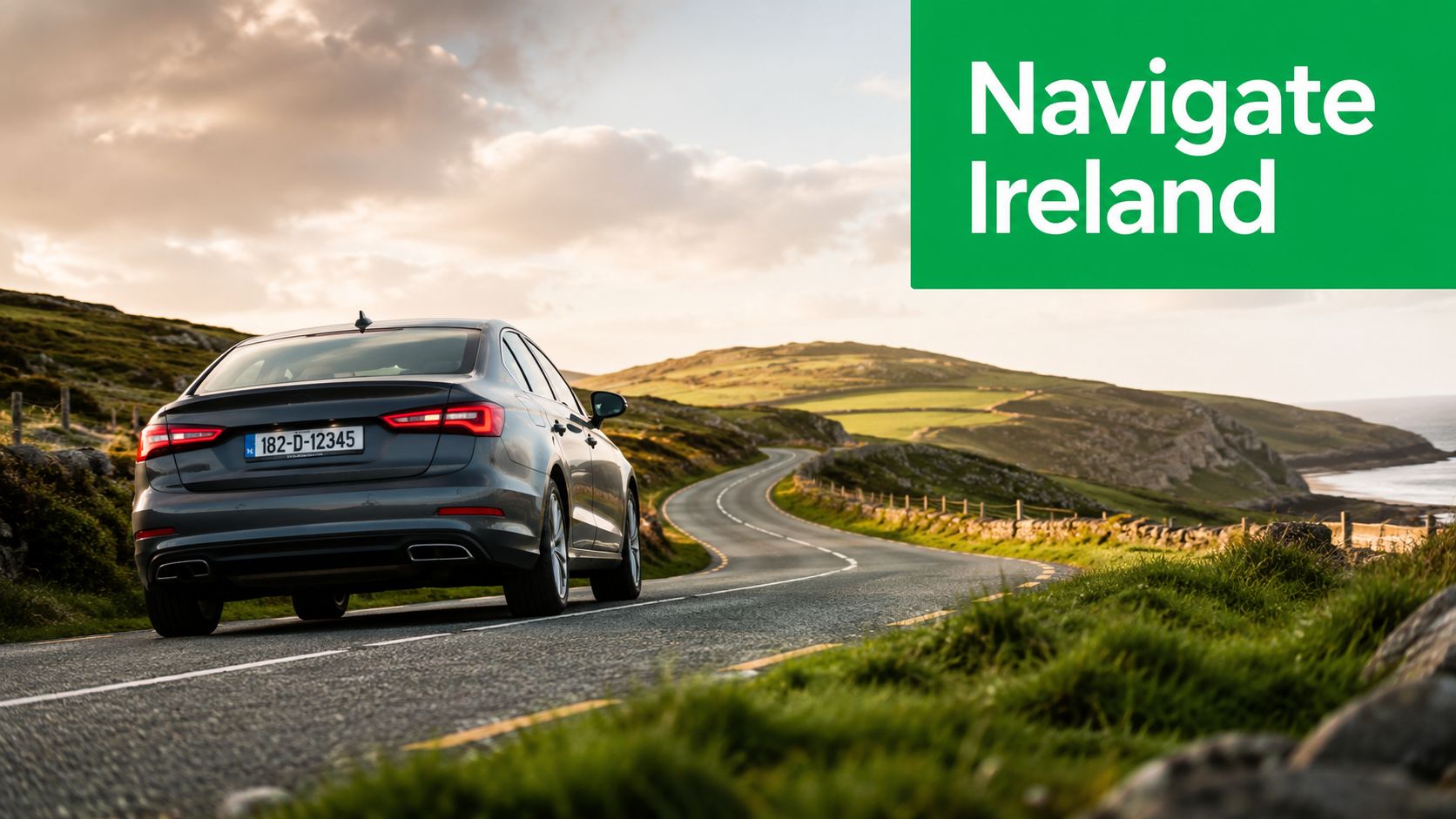
Many guides treat the language side as a minor detail. That misses a big part of the full experience. One useful point from an Irish road signs cheat sheet is that over 60% of new Irish learners struggle with reading real-world text because they only practice with textbook phrases, not authentic signage like “Scoile” and “Bóthar.” That rings true on the road, where recognition has to happen quickly.
Why signs feel harder at first
A road sign asks you to do several things at once:
- Notice the shape: Is it a warning, an order, or guidance?
- Read the color: Red, blue, white, brown, or green each points you in a different direction mentally.
- Process the language: You may need to match an Irish place name to the English version you expected.
- React safely: You don't get to pause the road while you think.
That's why beginners often feel overloaded. The fix isn't to memorize hundreds of signs one by one. The fix is to learn the system.
Irish road signs become manageable when you stop reading every sign as a block of text and start reading shape, color, and context first.
A better way to learn them
I tell learners to treat Irish road signs like a set of fast clues.
A triangle means your attention should rise. A circular sign with red tells you something is restricted or prohibited. A blue circular sign tells you an instruction must be followed. Then the words add detail. If you also learn a few common Irish terms, the whole network starts to feel less foreign.
That's also what makes signs a surprisingly good language tool. They repeat key words. They connect vocabulary to place. They train your eye to recognize Irish in practical settings, not just academic ones. For anyone reconnecting with the language, that's a much friendlier entry point than formal grammar tables.
How to Read Irish Road Signs A Quick Guide
If you only remember one thing, remember this. Start with the sign's shape and color before you read the words. That habit makes Irish road signs much easier to understand at speed.
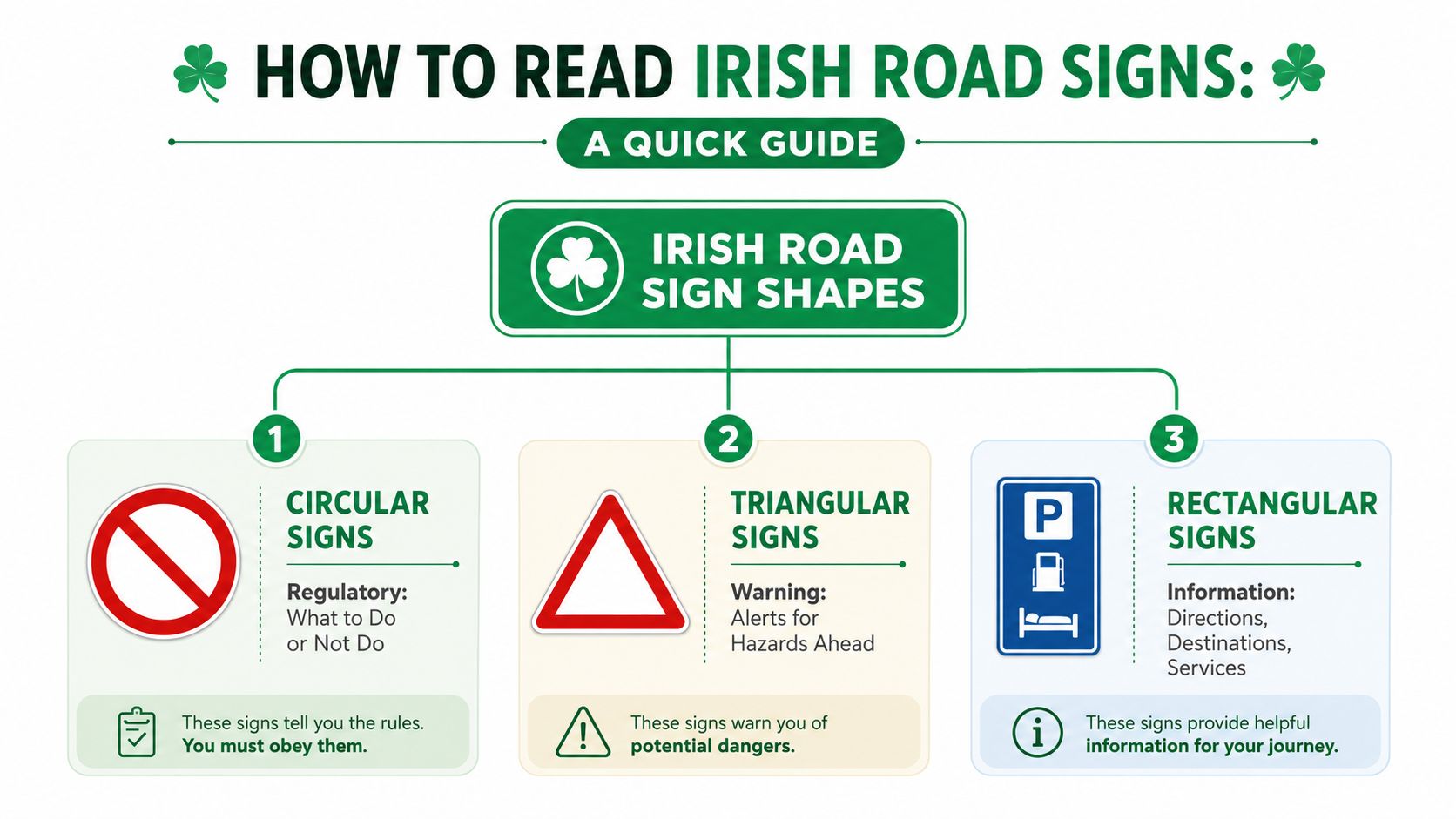
The broad pattern is simple. A sign's design tells you its job. According to this guide to road traffic signs in Ireland, tourist information appears on brown signs, regulatory signs use circular forms with red borders, warning signs are triangular, and informative directional guidance uses blue circular signs with white symbols.
The fastest decoding method
Use this three-step check when a sign appears:
Shape first
Triangle means warning. Circle usually means regulation or instruction. Rectangular signs usually give directions or information.Color second
Red signals prohibition or caution depending on the sign type. Blue often signals instruction or route guidance. Brown points to tourist information.Words last
Once you know the category, the text becomes easier to interpret.
A simple mental map
| Sign clue | What it usually means | Your response |
|---|---|---|
| Triangle | Warning about a hazard ahead | Slow down and scan |
| Red-bordered circle | A rule limiting or forbidding something | Check what you must not do |
| Blue circle | A required action | Follow the instruction |
| Rectangular direction sign | Route or place information | Read early and plan ahead |
| Brown sign | Tourist or heritage destination | Informational, not a command |
Many learners often misunderstand road signs. They see a circle and assume every circular sign means the same thing. It doesn't. The color changes the meaning.
Why this matters in practice
Suppose you're driving on a narrow rural road. A triangle appears. You don't need to read every detail immediately to know one thing. A hazard is coming. That buys you time to adjust.
Then imagine a circular blue sign. That's different. It isn't warning you about what may happen. It's telling you what action to take. This distinction matters for safe driving and for theory test preparation.
If you want a beginner-friendly comparison with broader examples, A-1 Driving School has a helpful explainer on the meaning of common road signs.
Quick rule: On Irish roads, signs work best when you read them as symbols first and language second.
Regulatory Signs What You Must and Must Not Do
Regulatory signs carry legal weight. These are the signs that set limits, ban actions, or require a specific maneuver. If warning signs tell you to be alert, regulatory signs tell you what the law expects from you right now.
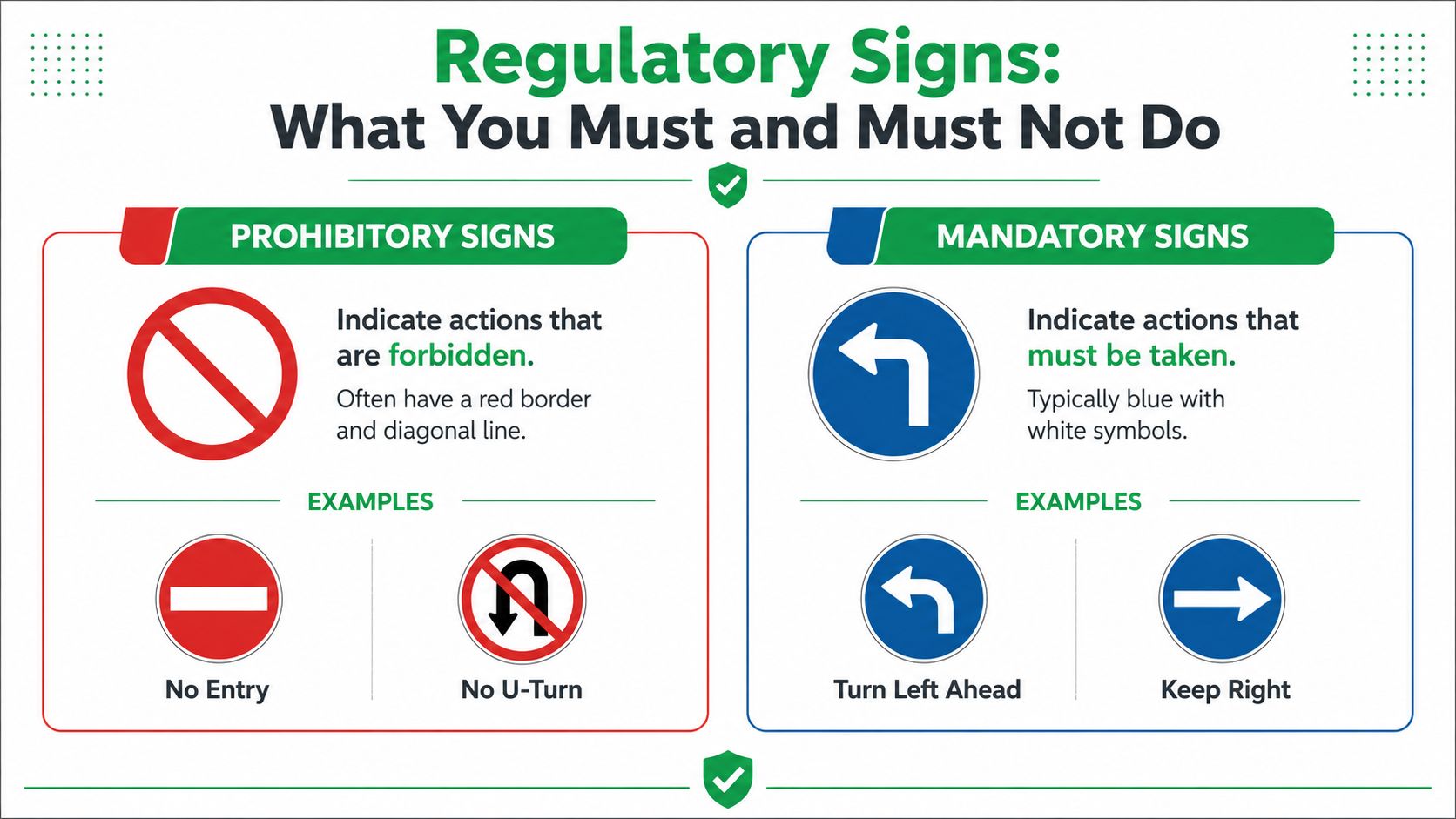
A useful distinction here comes from regulatory sign guidance in Ireland. Prohibitory signs are circular with a red border and white background, while mandatory signs are circular with a blue background and white symbol. Red means “must not.” Blue means “must.”
Prohibitory signs
These signs stop you from doing something. They don't suggest. They prohibit.
Common examples include:
- No Entry: You must not enter that road from your direction.
- Speed limit signs: The number sets the legal maximum.
- No U-turn: You can't turn the vehicle around in that location.
- No parking or stopping signs: Restrictions apply even if the road looks quiet.
A beginner mistake is focusing only on the icon. Train yourself to notice the border too. The red border is part of the message.
What these signs ask from you
- Read early: Don't wait until you're beside the sign.
- Act smoothly: Slow or change course in good time.
- Avoid assumptions: A quiet road can still have a legal restriction.
Mandatory signs
Mandatory signs tell you what you must do. Their blue background is the clue.
Typical examples include:
- Keep left
- Turn left ahead
- Pass on a particular side
- Proceed in the direction shown
These signs matter most where traffic needs structure. Junctions, islands, split carriageways, and lane controls often rely on them.
A red circular sign closes an option. A blue circular sign leaves you with one.
Why speed signs catch visitors out
Speed signs deserve special attention because many visitors bring habits from countries using miles per hour. Ireland's system doesn't do that. Under the Road Traffic (Signs) Regulations 1997-2004, Ireland completed the transition from miles per hour to kilometres per hour, and speed limit signs explicitly use the “km/h” suffix.
That small suffix matters. A driver from the UK or US may see a familiar number and react too quickly or too slowly if they forget the unit has changed.
Here's the safe habit:
| What you see | What to remember |
|---|---|
| 30 km/h | It's a low-speed zone. Think slow streets, schools, or calm local areas |
| 50 km/h | Urban pace, not a target if conditions are poor |
| 100 km/h | A maximum, not a promise that the road is suitable for that speed |
Another source of confusion is the difference between a maximum and a recommended pace. A speed limit sign sets the legal ceiling. It doesn't tell you that driving at that exact speed is always safe. Wet roads, poor visibility, sharp bends, or farm traffic can all make a lower speed the sensible choice.
A learner's legal mindset
For theory tests and real driving, it helps to sort regulatory signs into two mental drawers:
- Forbidden actions: entering, turning, overtaking, parking, exceeding a posted speed
- Required actions: keeping left, following a lane direction, turning as instructed
That split sounds basic, but it sharpens your reaction time. Once you know whether a sign is closing a behavior or requiring one, the road feels far less ambiguous.
Warning Signs Navigating Potential Hazards
Warning signs don't order you to do something specific. They prepare you for what's ahead. In Ireland, these are typically triangular with a red border, and they matter a lot on rural roads where conditions can change quickly.
The best way to learn them is by pattern. Hazards tend to fall into familiar groups. When you group them that way, you stop memorizing isolated signs and start recognizing families of risk.
Road layout warnings
Some warning signs tell you the road itself is about to become more demanding.
You might meet signs for:
- Bends or a series of bends
- Roundabouts ahead
- Junctions
- Road narrows
- Steep gradients
These signs don't all require the same response, but they share one principle. You should adjust before you arrive at the hazard, not at the last second.
A bend warning on a dry open road may only call for a modest speed reduction. The same sign on a hedge-lined country road with poor visibility calls for much more caution. That's why warning signs always work together with the road around them.
Surface and roadside hazards
A second group points to the physical condition of the road or roadside.
Examples include warnings for:
- Slippery road
- Loose chippings
- Falling rocks
- Uneven surface
- Roadworks or temporary disruption
These are easy to underestimate because the road may look normal from a distance. But the point of the sign is to tell you that conditions can change before your eyes fully confirm it.
If a warning sign feels early, that's good. It gives you time to drive deliberately instead of react suddenly.
When I coach nervous drivers, I often say this: don't argue with a warning sign. If the sign says the surface may be slippery, drive as if grip could disappear sooner than you expect.
People animals and shared spaces
This group is especially Irish in feel because rural roads often bring you into close contact with farm life and mixed road use.
Watch for signs warning about:
- Pedestrians
- Cyclists
- Children near schools
- Sheep or cattle crossing
- Wild animals
These signs matter because the hazard moves. A bend stays where it is. A flock or a child doesn't. Your job is to lower speed, widen attention, and expect something unpredictable.
A cattle crossing sign is a good example. Even if you see no animals immediately, the right response is still caution. Farm gates, slow-moving vehicles, and animals close to the road can appear with little notice.
How to respond well
Instead of trying to memorize a separate script for every warning sign, use a short decision process:
- Lift your attention level
- Check speed
- Scan wider than usual
- Look for the hazard the sign predicts
- Leave extra space if the hazard can move
That's what warning signs are really for. They help you switch from ordinary driving to prepared driving.
A strong learner doesn't just identify a warning sign correctly. A strong learner shows the right change in behavior after seeing it.
Information and Directional Signs
Information and directional signs are the ones that help you get somewhere. They don't usually feel as dramatic as a warning sign or as strict as a regulatory sign, but they shape almost every journey. Read them well, and driving gets calmer. Read them late, and junctions become stressful.
What the colors tell you
Color is the first shortcut.
In Ireland, you'll commonly see directional and information signs using a road-type logic. Brown signs point toward tourist attractions and heritage destinations. White signs are commonly used for more local direction. Blue and green are widely used to separate different route contexts.
For a beginner, the exact shade matters less than the habit of noticing that background color is part of the message. Don't wait until you're close enough to read every destination. Start by asking what type of route or destination the sign is introducing.
A useful way to think about it is this:
- Brown: places you might visit
- White: local direction and nearby places
- Blue or green: bigger route guidance and onward travel
How bilingual place names work
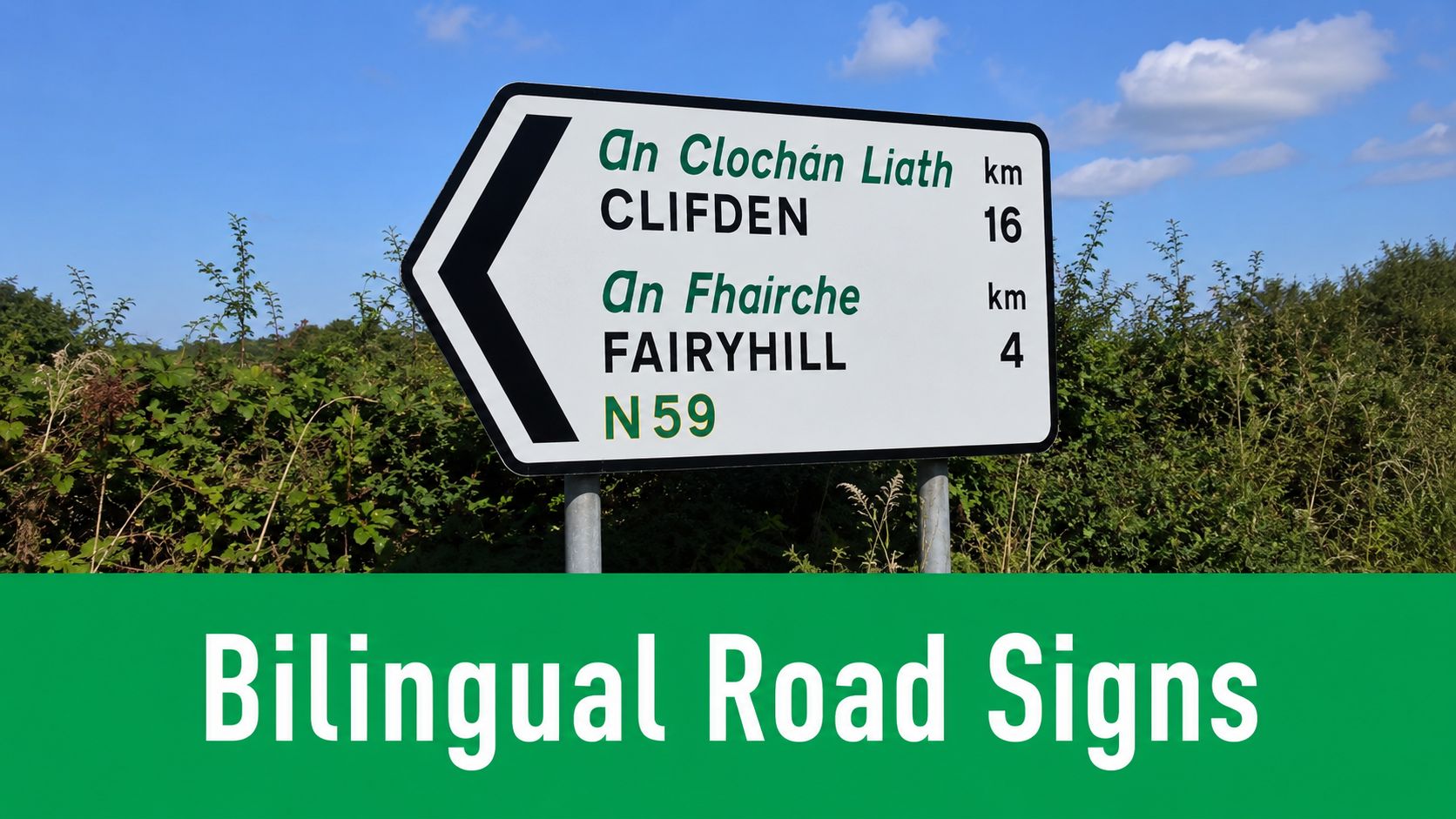
Official place names on Irish information signs are subject to a legal bilingual requirement. The statutory rule on official languages in signage requires place names on official Irish information signs to appear in both Irish and English.
That means you're often reading the same destination twice, not two separate places. For returning heritage learners, this can be surprisingly moving. For nervous drivers, it can feel like extra clutter until the pattern becomes familiar.
If you want extra help matching counties and places across English and Irish forms, this counties of Ireland guide is a useful companion while you study.
Reading route clues quickly
When you approach a sign, try this sequence:
| What to notice first | Why it helps |
|---|---|
| Background color | Tells you the broad category |
| Place names | Shows your intended direction |
| Symbols | Flags services like parking or fuel |
| Route labels | Helps confirm you're following the correct road |
This approach prevents a common driving error. People often stare at the text and miss the larger clue the sign gives at a glance.
Another practical habit is to read directional signs in two passes. First pass, identify whether the sign is relevant to your route. Second pass, confirm the destination and lane or turn you need. That split-second discipline keeps your eyes moving and your steering steadier.
Understanding Bilingual Signs Gaeilge for Drivers
For many people, the bilingual element is the part that makes Irish road signs memorable. It's also the part that causes hesitation. You may know what the sign category means, but the Irish words still slow you down.
That's normal. The answer isn't to become fluent before you drive. The answer is to learn a compact set of high-frequency words that show up again and again.
Common Irish words you'll meet on signs
Here are useful words to recognize on sight:
| Irish | English | Simple pronunciation |
|---|---|---|
| Bóthar | Road | BOH-her |
| Scoil / Scoile | School | SKUL / SKUL-eh |
| Géill Slí | Yield | gale shlee |
| Go Mall | Slow | guh mahl |
| Lár | Centre | lahr |
| Siopa | Shop | SHUP-ah |
| Eolas | Information | OL-us |
| Páirc | Park | PAWRK |
| Bealach | Way or route | BYAL-akh |
| Baile | Town or home place in many names | BAL-eh |
You don't need perfect pronunciation to benefit from these. Recognition is enough at first. Over time, saying them out loud helps them stick.
For extra practice with everyday Irish found in public life, this page on Irish signs and common public wording is a handy study resource.
Language shortcut: Learn the words that repeat in public spaces first. They pay off faster than rare vocabulary.
Why Irish-only signs appear in some areas
Most drivers expect bilingual signs everywhere, so an Irish-only sign can feel startling the first time it appears. On some western roads, though, that isn't a mistake. It's formal policy.
According to this guide to driving rules in Ireland, specific western roads feature Irish-only signage in Gaeltacht regions, reflecting Irish as the primary language of daily communication there. That matters because it changes how you prepare. You're not looking at a missing translation. You're entering a place where Irish has public priority.
How to stay confident in Gaeltacht areas
A few habits help immediately:
- Match by place shape: Even if the word is unfamiliar, the overall look of the destination name becomes recognizable after a few sightings.
- Use route planning early: Know your next major stop before you set off.
- Expect known words in new forms: Irish place names may not resemble the English version closely.
- Trust the system: If the sign is Irish-only, that's part of the official road environment.
Irish road signs move beyond a simple driving topic. They become a real, low-pressure form of language immersion. You see the words in place, linked to movement, geography, and memory. That's a powerful way to learn.
Practical Tips for Learners and Tourists
By the time one feels overwhelmed by Irish road signs, the issue isn't the sign itself. It's timing. They notice it late, try to read it all at once, and then make a rushed decision. Better habits solve most of that.
A smart driving checklist
Use this on every unfamiliar journey:
- Scan early: Signs are easier to process when you spot them at a distance.
- Read in layers: Shape first, then color, then wording.
- Slow your eyes before your car: Mentally prepare before you brake or turn.
- Watch for temporary wording: Roadworks may introduce terms such as Obair Bóthair, so expect local language in practical settings.
- Don't chase a missed turn: If you miss one, continue safely and reroute.
Tourists often struggle most on narrow roads where hedges, curves, and local traffic reduce thinking time. Learners, on the other hand, often know the sign when parked but hesitate when moving. Both problems improve if you train the same habit. Read the sign category before the full detail.
Common theory-style sign questions
Learner drivers should be ready for questions like these:
| Question type | What you should know |
|---|---|
| What does a red-bordered circle mean | It signals a prohibition or limit |
| What does a blue circular sign mean | It gives a mandatory instruction |
| What shape is a warning sign | Triangle |
| Why do some signs show Irish only | Because of Gaeltacht language policy |
| What does km/h tell you | The speed is shown in kilometres per hour |
This kind of revision also helps tourists. It sharpens your reactions without requiring you to memorize a huge catalog.
One more practical idea. If you're visiting during a longer trip and want cultural context alongside navigation, this summer in Ireland guide can help you get used to travel language, place names, and seasonal movement around the country.
On unfamiliar roads, the safest driver isn't the one who knows every sign by heart. It's the one who recognizes the system quickly and stays calm.
Frequently Asked Questions About Driving in Ireland
What if I don't know the Irish word on a sign
Don't panic. Read the sign category first. Shape and color usually tell you whether it's a warning, a rule, or directional guidance. Then use nearby symbols, route context, and any familiar place names to confirm meaning.
Are road signs in Ireland hard to learn
Not once you stop treating them as isolated facts. Most confusion comes from trying to read everything as text. Irish road signs become much simpler when you learn the visual code and a small bank of common Gaeilge words.
What should I focus on first
Start with the essentials:
- Warnings: triangles
- Prohibitions: red-bordered circles
- Mandatory instructions: blue circles
- Directional signs: read color and destination together
- Language: learn the most repeated Irish words on signs
If you master those five areas, you'll already be driving with more confidence than many first-time visitors.
Driving in Ireland gets easier when the surroundings stop feeling like a puzzle. The signs begin to repeat. The Irish words begin to look familiar. And the road starts to feel readable instead of rushed.
If you'd like to turn road-sign recognition into practical language learning, Gaeilgeoir AI is a smart next step. It helps you build real-world Irish through guided conversation, pronunciation support, and everyday scenarios like asking for directions. You can also start directly at Learn Gaeilgeoir AI.