
You've probably had this moment already. You open a language app, complete the lesson streak, answer the review cards, and still freeze when someone speaks quickly or asks you a simple question in the language. That gap is why the best language learning resources aren't duplicates of each other, they solve different jobs, like building a habit, explaining grammar, drilling pronunciation, feeding you authentic input, or giving you live feedback.
For Irish learners, that distinction matters even more. A beginner returning to Gaeilge needs a different setup from a Leaving Cert student preparing for the oral, and both need a different routine from someone who just wants to keep a family language alive. That's why this comparison looks at ten tools by the learning job they solve, with Gaeilgeoir AI included as the Irish-focused option for speaking practice, structured progression, and exam prep. If you're also shopping for speech-focused study tools on iPad, this expert iPad app guide is a useful companion read.
The strongest setup is rarely one app. A practical mix usually includes one structured course, one source of listening input, one review system, and one place to speak out loud with feedback. That's the lens here.
Table of Contents
- 1. Gaeilgeoir AI
- 2. Duolingo
- 3. Babbel
- 4. Rosetta Stone
- 5. Pimsleur
- 6. Busuu
- 7. Memrise
- 8. italki
- 9. Mango Languages
- 10. LingQ
- Top 10 Language Learning Comparison
- Build a Routine That Uses More Than One Resource
1. Gaeilgeoir AI
Gaeilgeoir AI is the most clearly Irish-specific option in this group, and that matters because Irish learners often need something more focused than a general app. It starts from a simple idea, build usable vocabulary first, then turn that vocabulary into spoken Irish through guided conversation, pronunciation support, and review. The result is a learning path that feels practical rather than academic.
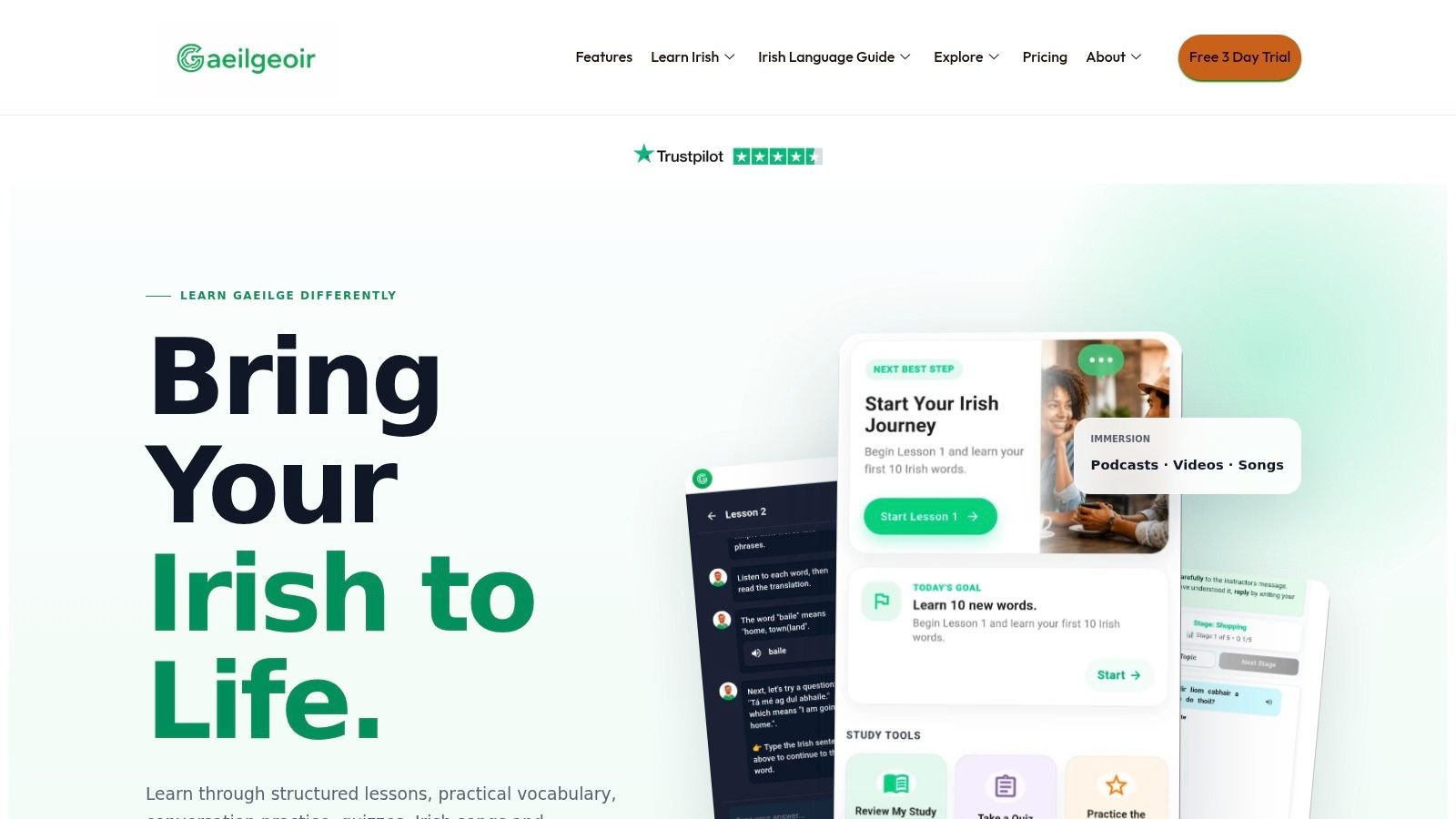
The 1,000 Word Way gives beginners a visible structure, which is useful when Irish feels abstract or overwhelming. You can tap words to see translations, save them to a personal study list, replay native pronunciation audio, and reinforce what you learned with adaptive quizzes that give instant feedback. That mix is important because it doesn't leave vocabulary floating in isolation, it keeps bringing it back into use.
Why it stands out for Irish learners
The app's biggest strength is its conversation-first practice. Instead of treating speaking as an advanced stage, it prompts you into everyday situations, like social life, travel, work, ordering food, and asking for directions. It also includes Leaving Cert oral exam simulations, which makes it especially relevant for students who need targeted rehearsal rather than generic Irish drills.
Practical rule: if you're learning Irish and you can't yet hold a short conversation, choose tools that force output early. Passive study alone won't close that gap.
The immersion side is equally useful. Gaeilgeoir AI blends structured lessons with podcasts, videos, and song-based lessons, including material around Mo Ghile Mear, Óró, and ’Sé do Bheatha ’Bhaile. That helps you hear Irish across different voices and contexts, which is exactly what many learners miss when they rely only on grammar notes. The site's testimonials also point to fast progress, growing confidence, and a format that suits busy schedules.
Pricing is straightforward. Month-to-month is €14.99/month, and annual membership is billed €119.88, which works out to €9.99/month. There's a free 3-day trial, a START25 promo code for 25% off plans, and members can cancel anytime. Android is available now, with iOS listed as coming soon, so it currently fits Android and web users best.
For beginners, returning learners, Leaving Cert students, and busy adults, it's a strong fit. The limits are real too, advanced or highly academic learners may want to pair it with deeper reading, tutoring, or specialist materials. The direct link is Gaeilgeoir AI.
Best fit in a routine
Use it as the core Irish practice tool when you want speaking, pronunciation, and review in one place. It works best when paired with real listening and occasional live conversation, not as a standalone replacement for everything else.
2. Duolingo
A learner who opens Duolingo before breakfast is usually looking for one thing, an easy way to keep the language in view. The app is built for that habit. Short lessons, streaks, and a pushy onboarding flow reduce the friction of starting, which helps complete beginners turn study into a daily routine.
The free core app covers structured courses across many languages. Paid tiers, Super and Max, remove ads and add features like AI-powered practice, Explain My Answer, Roleplay, Video Call, and GPT-4-powered lessons. Those tools make the app more interactive, but the stronger speaking value usually sits behind the higher tier.
Its strength is engagement, not depth. Duolingo is good at making a learner feel they have done something today, and that consistency-building is its main value. That matters in a wider learning context where participation is often low. UNESCO's GRALE 4, as summarized by Business of Apps, notes that in almost one-third of countries, fewer than 5% of adults aged 15 and above take part in education and learning programmes. Frictionless products win attention because many people need a simple entry point.
Where it works and where it doesn't
Duolingo works well for first contact, basic vocabulary, and keeping momentum. It gives less help when a learner needs detailed grammar explanation, real speaking pressure, or careful correction. Free users can also hit a ceiling quickly, especially if they want more than recognition exercises.
For Irish learners, the app is useful as a daily check-in, and it pairs well with a more focused Irish study tool. If you are choosing beginner-friendly apps, the best language learning apps for beginners list is a useful place to compare what each one does well. A learner who uses Duolingo for routine and Gaeilgeoir AI for actual Irish conversation gets a better balance for day-to-day study.
Use it for daily momentum and pair it with a speaking-focused tool for real conversation practice.
3. Babbel
Babbel works best for learners who want order. Its lessons are level-structured, the dialogues feel practical, and the grammar explanations are clearer than what many app-first learners are used to seeing. That makes it a good choice for people who get frustrated when a course jumps around or assumes too much.
The app leans into short conversation-based lessons, so it doesn't feel like reading a textbook in disguise. It also stays ad-free in the core experience, which helps if you want fewer interruptions and a cleaner study flow. For households, the Group Plan is useful because it supports up to 6 learners, so families or shared homes can keep everyone on one system.
Babbel's main value is structure. A learner who wants to know what comes next, and why a phrase is formed a certain way, usually gets on well with it. That's especially helpful if you've tried more gamified apps and felt like they were too random.
Who should pick it
Babbel suits learners who want practical phrases plus explanation. It's a good bridge between app convenience and classroom-style clarity, without the clutter of a bigger platform.
Its weakness is language range. Compared with some rivals, it doesn't cover as many niche or long-tail languages, so it's not the first stop for Irish-specific study or rare-language exploration. For mainstream European languages, though, it can be a calm, steady base.
If you're trying to build a routine around work and family, Babbel fits neatly into a 10 to 15 minute block. It won't hand you deep spontaneous speaking ability on its own, but it gives you enough structure to know what you're practising and why.
4. Rosetta Stone
Rosetta Stone still has a clear identity, and that helps. It goes hard on immersion, using image-driven lessons and a very clean interface that keeps the focus on pattern recognition instead of explanation. For some learners, that simplicity is exactly what makes it effective.
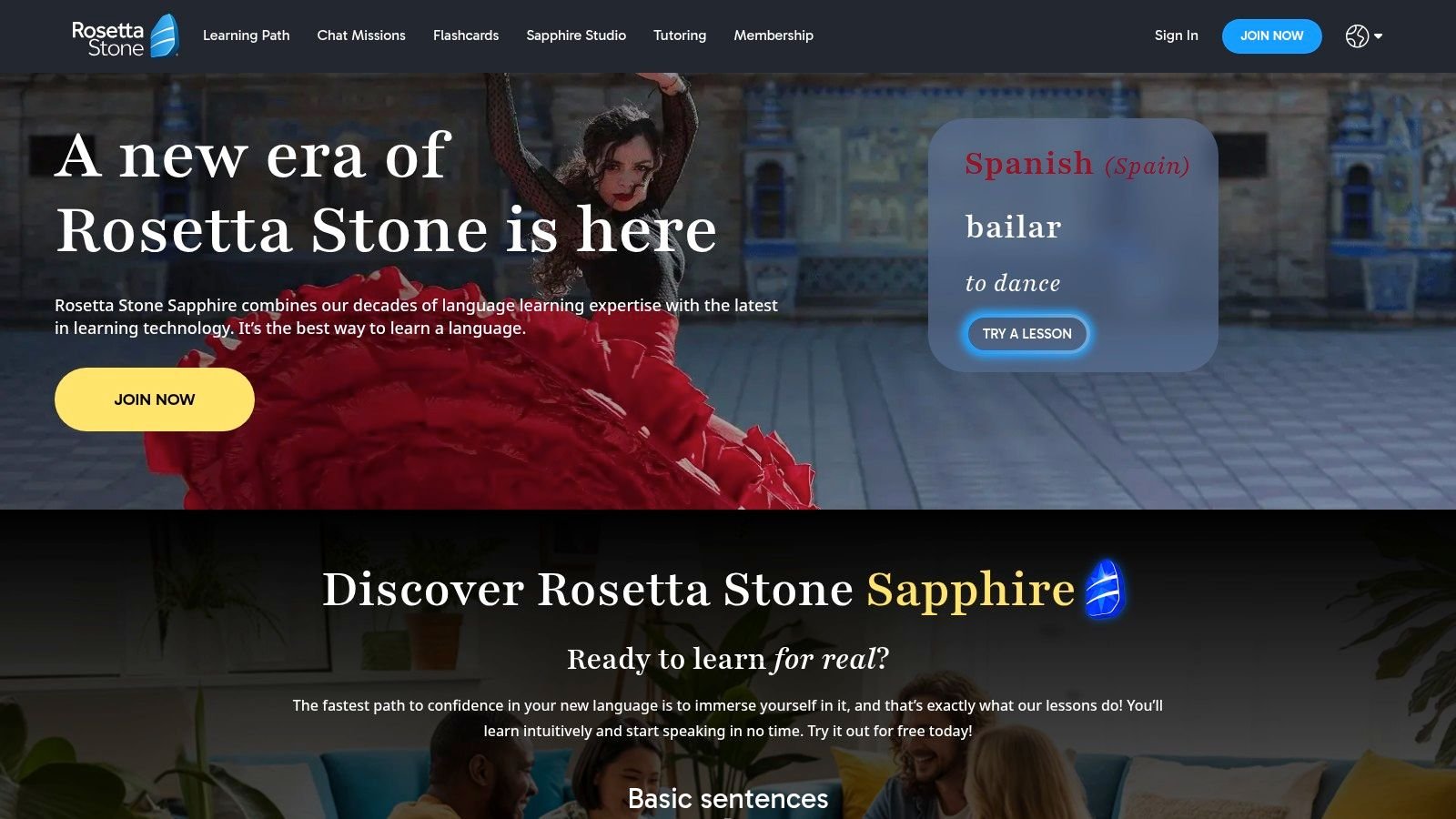
The platform is available through mobile and desktop apps with synced progress, so you can move between devices without losing your place. It's now mainly subscription-based, and a commonly offered Lifetime option still exists for access to multiple languages. That can appeal to learners who dislike recurring commitments and want one purchase path for long-term use.
Rosetta Stone's biggest strength is that it stays distraction-free. There's not much clutter, which helps if you learn better when you're forced to infer meaning from context. Beginners who like steady, linear progression often feel comfortable here.
What to expect in real study
You won't get much explicit grammar instruction. That's the main trade-off, and it matters for learners who like to know why a sentence works before they repeat it. The method can be effective, but it demands patience.
The lifetime licence also deserves a practical note. It's typically for one person and non-transferable, so households shouldn't assume it functions like a shared family account.
Rosetta Stone is a good match for learners who want immersion without distraction and don't mind filling grammar gaps elsewhere. It's less ideal if you want detailed explanations, exam-specific preparation, or a coach-like learning path. Pair it with a reference tool or a tutor if you need to talk through mistakes instead of just seeing correct patterns again and again.
5. Pimsleur
Pimsleur is built for the ear and the mouth. Its daily lessons are audio-first, about 30 minutes long, and designed around graduated recall, which makes it one of the most practical tools for speaking rhythm and pronunciation. If you commute, walk, or cook while studying, that format is hard to beat.

The app includes premium features such as reading practice and Speak Easy, and the All Access plan covers 50+ languages with easy switching. That makes it a useful option for learners who move between languages, or for households with different language goals.
Pimsleur is one of the few tools that suits hands-free study. You don't need to stare at a screen, and the lesson design pushes you to answer out loud before you've had time to second-guess yourself. That can be especially helpful for shy learners who need a private place to practise speaking.
Practical rule: if your study time happens in the car, on foot, or during chores, choose audio-first tools before you choose another visual app.
The limit is equally clear. Pimsleur doesn't give much room for detailed grammar work or writing practice, so it isn't a complete system. Use it to build speaking reflexes, then add a richer course or tutor if you want explanation and correction.
For Irish learners, Pimsleur's model is a useful reminder that speaking has to be trained directly. Even if the exact language isn't available in the format you want, the workflow is worth copying, listen, repeat, answer, review, then speak again in a different setting.
6. Busuu
Busuu is useful for learners who want structure without a heavy course feel. It combines dialogues, grammar review, spaced practice, and community feedback, so you can work on understanding, recall, and correction in one place. That makes it practical once the first burst of novelty has passed.
The premium tiers, Premium and Premium Plus, remove ads and add tools like AI Conversations, Mistake Repair, pronunciation feedback in select languages, and offline downloads. The community feature matters just as much. You can submit writing or speaking tasks and get corrections from other users, which is useful if you want to spot awkward phrasing before it becomes a habit.
Best use case
Busuu fits learners who want a steady routine and do not want to switch between several apps every time they study. It works well for people who need to write as well as speak, because community feedback exposes weak grammar and unnatural phrasing quickly.
The trade-offs are straightforward. The full AI and speaking feature set is limited to selected languages and mobile, and some of the most helpful tools sit behind premium access. For Irish learners, that means checking whether your target language is fully supported before you commit. If you are working through Gaeilge, or preparing for Leaving Cert language study, the value comes from how well the app fits your goals, not from the feature list alone.
A realistic routine uses Busuu as the middle layer between a structured course and live conversation. Start with dialogues, move into review and correction, then bring the same phrases into real speaking practice with a teacher, classmate, or exchange partner. For Leaving Cert learners, it can support sentence building and written accuracy. For self-directed learners, it is better as a clean-up tool than as a complete system.
Busuu lacks the flashiness of some competitors, but its balance of structure and community feedback makes it practical for learners past the novelty phase.
7. Memrise
Memrise works well when your goal is to make useful conversational chunks automatic. It uses native-speaker video clips and spaced repetition, so the phrases you meet stay close to real speech and return often enough to stick.
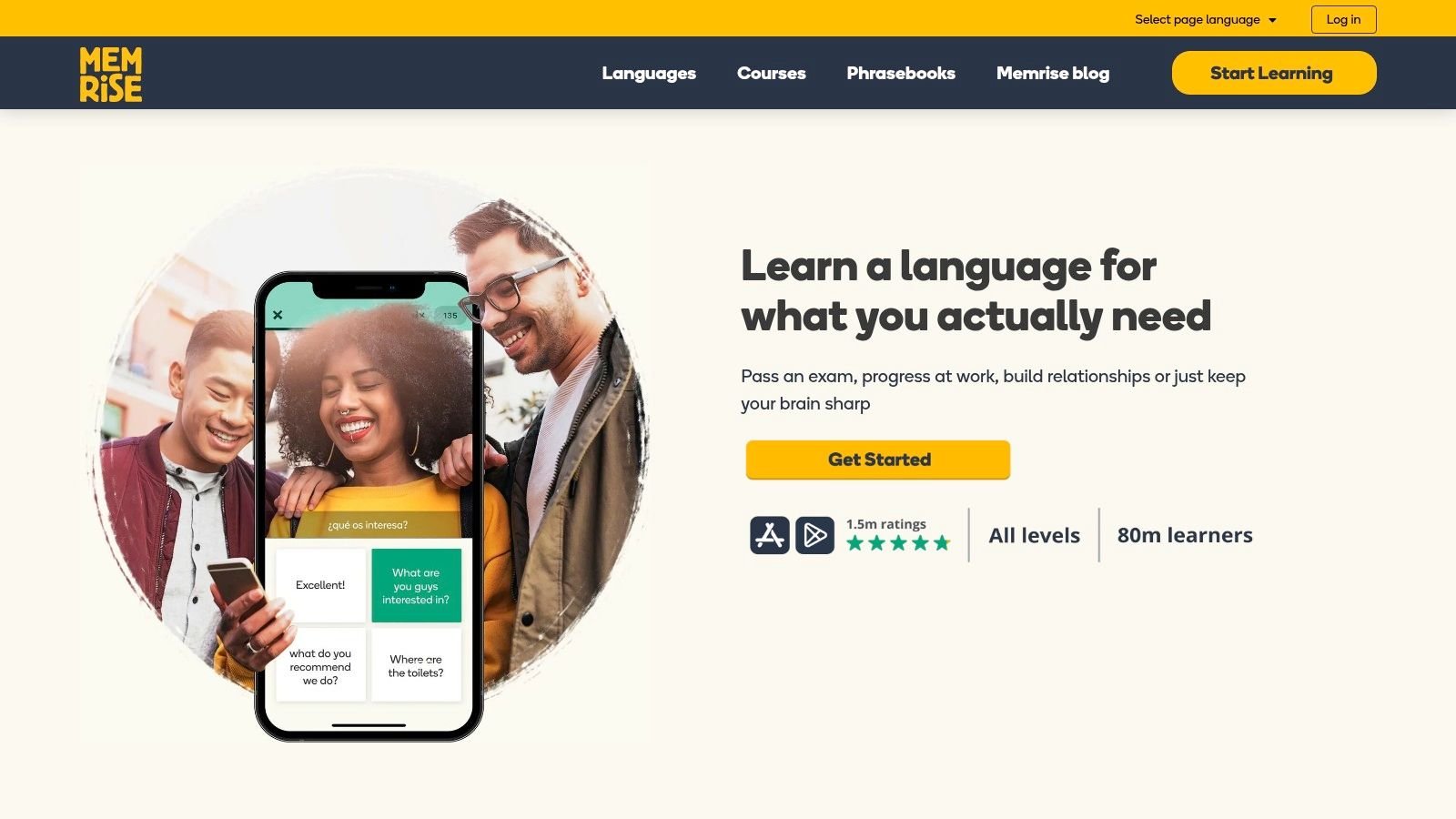
The format is short and easy to revisit, which suits vocabulary you want ready without much setup. That matters because spaced review generally beats cramming for retention. A 2021 study found that four spaced learning sessions produced 24.7 percentage points higher recall than one massed session, and that spacing plus corrective feedback and testing raised learning by 29 percentage points versus non-optimal conditions spaced learning study. A separate review of spaced learning in language teaching also supports the same basic point, since spreading study over time usually holds words better than a single long session review of spaced learning.
Memrise fits that pattern. It focuses on making common phrases easier to recall, while reading, grammar, and conversation belong in other tools.
How to use it well
- Use it for phrase survival: Put in greetings, directions, classroom language, and social exchanges you will need.
- Keep sessions short: Regular returns work better than occasional marathons.
- Pair it with speaking: Memrise helps with recognition and recall, but speaking out loud is what turns those phrases into usable language.
- Use the right support for your route: For learners building a spaced-review habit alongside a structured plan, spaced repetition for language learning explains how to fit review into a normal study routine.
The trade-off is depth. Memrise is not a grammar course, and long-form reading is outside its strengths. For Gaeilge, or any language with active classes and community use, it works best as a vocabulary reinforcement layer, not the main system.
It is a practical choice for learners who want something light but still meaningful. That makes it useful in a routine where one app handles recall, while other resources handle input, grammar, and live use.
8. italki
A self-study app can carry you through vocabulary and drills, then stall the first time you need a real reply. italki fills that gap with live 1:1 lessons from professional teachers and community tutors across hundreds of languages, so you can choose the kind of help you need.
It works well for pronunciation, exam prep, confidence building, and correction. You can buy classes one at a time or in packages, then pick a teacher who fits your target, schedule, and budget. That flexibility is why many learners add a tutor layer once they have a basic routine in place.
Where it earns its keep
The main value comes from the feedback loop. A good tutor gives corrective feedback that shows why a sentence sounds unnatural, what to say instead, and which errors you need to stop repeating. Speaking time alone cannot do that.
Quality still varies by tutor, and finding the right match can take time. Treat it as a marketplace, not a guaranteed course. Read profiles closely, book a trial lesson if you can, and choose for the task in front of you, not price alone. For learners who also want conversation partners, this guide to finding language exchange partners can help you decide when a peer exchange is enough and when a paid lesson is worth it.
For Irish learners, it is most useful after you have built basic confidence elsewhere. italki can support oral exam rehearsal, pronunciation work, and conversation practice in ways self-study tools cannot fully copy. For Gaeilge, that matters when you need a real listener who can react, correct, and keep the exchange moving.
Use it when you need focused accountability. The best sessions feel less like general classes and more like problem-solving with someone who can respond in the moment.
9. Mango Languages
Mango Languages is a strong practical option for learners who want broad language choice and clean structure. It covers 70+ languages and dialects, and in many places it's often free through participating US public libraries, which makes it unusually accessible for households that already have library access.
The lessons are structured and mobile-friendly, with synced progress across devices. It also supports family sharing for library-linked accounts, which can be handy if more than one person in the house wants to study. That makes it a practical low-cost option for families and casual learners.
Where it fits
Mango is especially good for travel basics and early confidence. The structure is easy to follow, and the app feels designed for steady progress rather than endless browsing.
Its trade-off is depth. It's not the most advanced option for intermediate or advanced learners, and it won't usually replace a specialist platform once you need richer speaking or reading material. Still, for people who want a clear path and possibly free access through a library, it's a smart first stop.
For Irish learners abroad, Mango isn't the obvious match for Gaeilge, but it's useful as a model of what good entry-level structure looks like. The important lesson is that accessibility matters. A resource only helps if people can use it regularly.
If you're building a multilingual routine, Mango can be the quiet workhorse in the background.
10. LingQ
LingQ is built for learners who want to study through real content. It turns articles, transcripts, and other media into lessons, which makes it especially useful if you learn best from authentic input rather than prewritten app scripts. That input-heavy approach is one of the cleanest ways to move from textbook understanding to real-world comprehension.
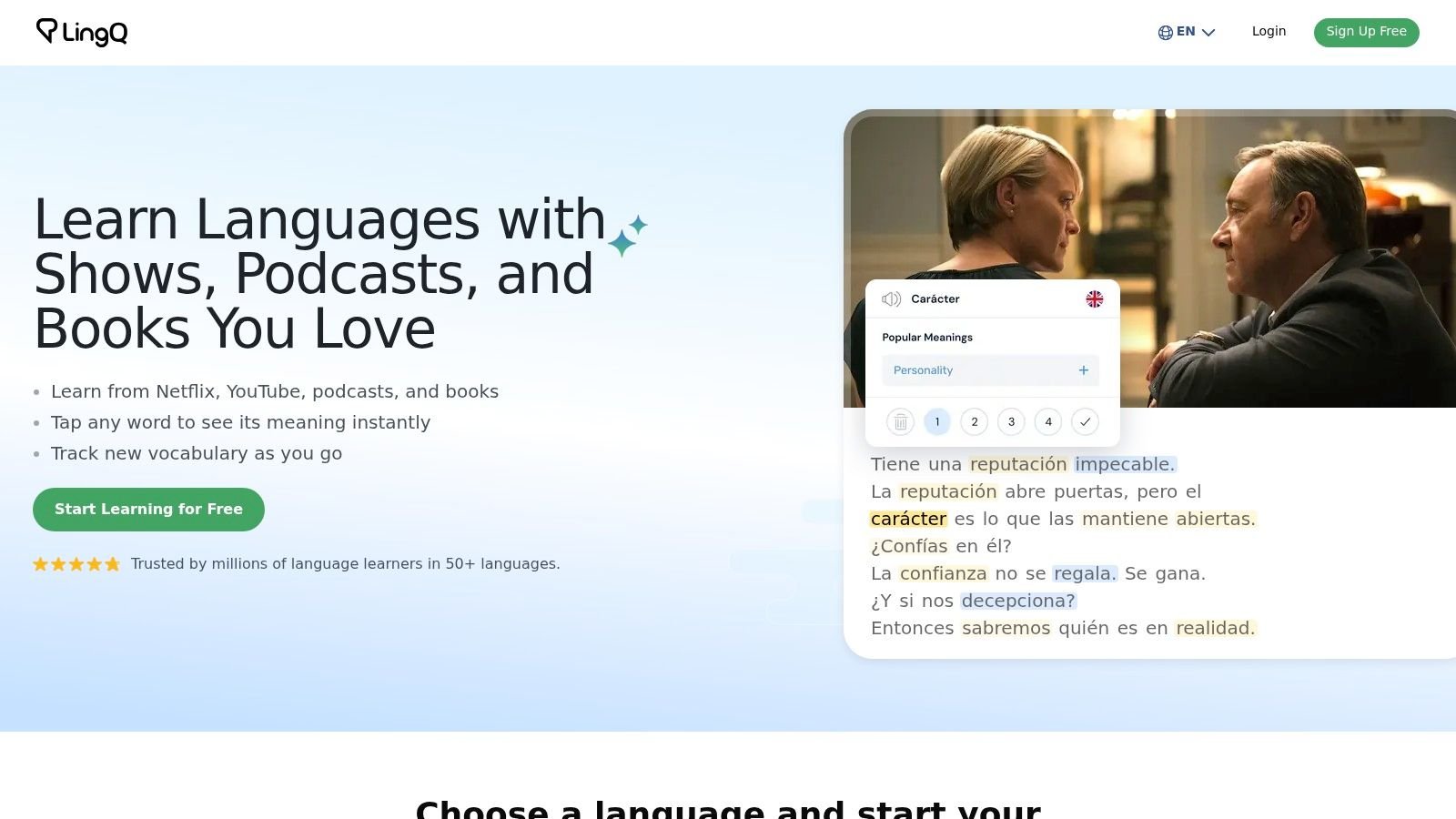
You can save words as LingQs, import lessons, and on paid plans gain access to more imports, saved words, AI voices, transcription boosts, and chat tools on Premium Plus. The platform supports 40+ languages and syncs across mobile and desktop, which makes it easy to keep studying whatever format you're in.
Why input learners like it
LingQ is excellent for extensive reading and listening. It lets you study content you care about, then converts the unknown bits into reusable vocabulary. That's a big deal, because motivation rises when the language connects to something interesting rather than to generic drills.
Its weakness is guidance. Learners who want step-by-step grammar teaching may feel under-supported, and it's best paired with speaking practice. LingQ helps you understand more, but understanding alone doesn't train production.
For Irish, it can pair well with other tools when you want more listening and reading exposure after your core speaking work. It's especially useful if you're the kind of learner who likes saving words and returning to them later, instead of grinding through fixed lessons.
If you already know how to stay curious, LingQ gives that curiosity somewhere productive to go.
Top 10 Language Learning Comparison
| Product | Core features | User experience ★ | Value / Price 💰 | Target audience 👥 | Unique selling points ✨ |
|---|---|---|---|---|---|
| 🏆 Gaeilgeoir AI | 1,000‑Word Way; scenario conversations; pronunciation audio; adaptive quizzes; podcasts & songs | 4.7★, immersion‑first; gamified (XP, leaderboards) | 💰 €14.99/mo or €119.88/yr (~€9.99/mo); 3‑day trial; START25 | 👥 Beginners→Intermediate; Leaving Cert students; heritage learners; busy adults | ✨ Conversation‑first practice; click‑to‑translate & save words; Leaving Cert sims; pronunciation support; 🏆 |
| Duolingo | Structured bite‑size lessons; AI Roleplay & GPT features (Max) | 4.3★, best onboarding; strong habit‑forming gamification | 💰 Free core; Super/Max paid tiers | 👥 Casual learners; absolute beginners; daily practice seekers | ✨ Massive content catalog; rapid feature updates; AI conversation (Max) |
| Babbel | Short dialogue lessons; clear grammar explanations; level paths | 4.0★, structured, focused lessons | 💰 Subscription (monthly/annual); Group plans | 👥 Beginners who want grammar clarity; learners preferring structure | ✨ Strong grammar clarity; useful phrase focus; family/group plans |
| Rosetta Stone | Immersion, image‑driven lessons; sync across devices | 4.1★, clean, distraction‑free interface | 💰 Subscription or occasional Lifetime offers | 👥 Beginners preferring steady immersion | ✨ Deep immersion method; synced mobile/desktop progress |
| Pimsleur | Audio‑first 30‑min daily lessons; graduated recall | 4.2★, excellent pronunciation & speaking rhythm | 💰 Per‑course or All‑Access plan | 👥 Commuters; speaking/pronunciation focused learners | ✨ Hands‑free audio focus; strong spoken fluency gains |
| Busuu | Dialogues, grammar review, spaced practice; community feedback | 4.0★, balanced, social features | 💰 Premium / Premium Plus subscriptions | 👥 Learners wanting feedback & structured practice | ✨ Community corrections; AI Conversation & Mistake Repair (premium) |
| Memrise | Native‑speaker video clips; spaced‑rep vocab practice | 4.0★, short, motivating sessions | 💰 Free + paid tiers (monthly/annual/lifetime) | 👥 Vocabulary & phrase learners; visual/audio learners | ✨ Real native videos; strong SRS for conversational vocab |
| italki | Marketplace for 1:1 lessons; pay‑per‑class booking | 4.5★, real teacher feedback; highly personalized | 💰 Pay per lesson (varies by tutor) | 👥 Learners seeking live tutoring; exam/pronunciation prep | ✨ Real human conversation & tailored corrections |
| Mango Languages | Structured travel & conversation units; library access | 3.9★, clear, travel‑ready lessons | 💰 Often free via public libraries; subscription otherwise | 👥 Travellers; families using library access | ✨ Widely available via libraries; family sharing for library accounts |
| LingQ | Input‑based reading/listening; save words as LingQs; import tools | 4.1★, ideal for comprehension & vocab growth | 💰 Free tier; Premium plans for unlimited imports | 👥 Learners focused on reading/listening & vocab | ✨ Turn authentic media into lessons; strong import & vocab tracking |
Build a Routine That Uses More Than One Resource
The cleanest way to use language learning resources is to assign each tool a job. One resource should give you structure, another should feed listening input, another should handle spaced vocabulary review, and a final one should force speaking or writing with feedback. That model fits the reality of adult learning, especially when time is limited and consistency is the main challenge.
For Irish learners, a practical setup is straightforward. Use Gaeilgeoir AI as the core speaking and progression tool, then add real listening, short review sessions, and occasional live conversation. The app's scenario-based practice, pronunciation support, saved-word lists, and Leaving Cert oral simulations make it a strong base for beginners, heritage learners, and exam students who need a more directed path than passive study can offer.
If you're preparing for the Leaving Cert, don't treat oral exam practice as a separate panic phase. Build it into weekly study, rehearse common topics aloud, listen back to pronunciation, and use targeted simulations to expose weak spots early. That's where a tool like Gaeilgeoir AI can do work that generic apps usually miss, because the practice stays close to the exam task instead of drifting into broad language trivia.
For adult self-learners, the best routine is usually smaller than you think. A structured app gets you through the door, audio or authentic media keeps your ear active, spaced repetition locks in vocabulary, and a tutor or guided conversation tool gives you corrective feedback. That combination matches what works in real study routines, not just what looks impressive in a download folder.
A practical takeaway from the evidence on spaced learning is simple, too. Review over time instead of cramming, because retention improves when sessions are separated and reinforced with feedback spaced learning study, review of spaced learning. For Irish specifically, the goal isn't to collect more resources, it's to choose the few that make you speak, listen, and return tomorrow.
If you want a focused Irish study path that combines immersion, pronunciation support, conversational prompts, and exam-oriented rehearsal, explore Gaeilgeoir AI. The publishing plan disables pingbacks and comments, so the article can stay focused on useful study choices instead of thread management.
Gaeilgeoir AI gives you a practical way to build spoken Irish from day one, with conversation practice, pronunciation audio, adaptive quizzes, and Leaving Cert oral support in one place. If you want a language tool that matches the jobs in this article, visit Gaeilgeoir AI and see how it fits into your own study routine.