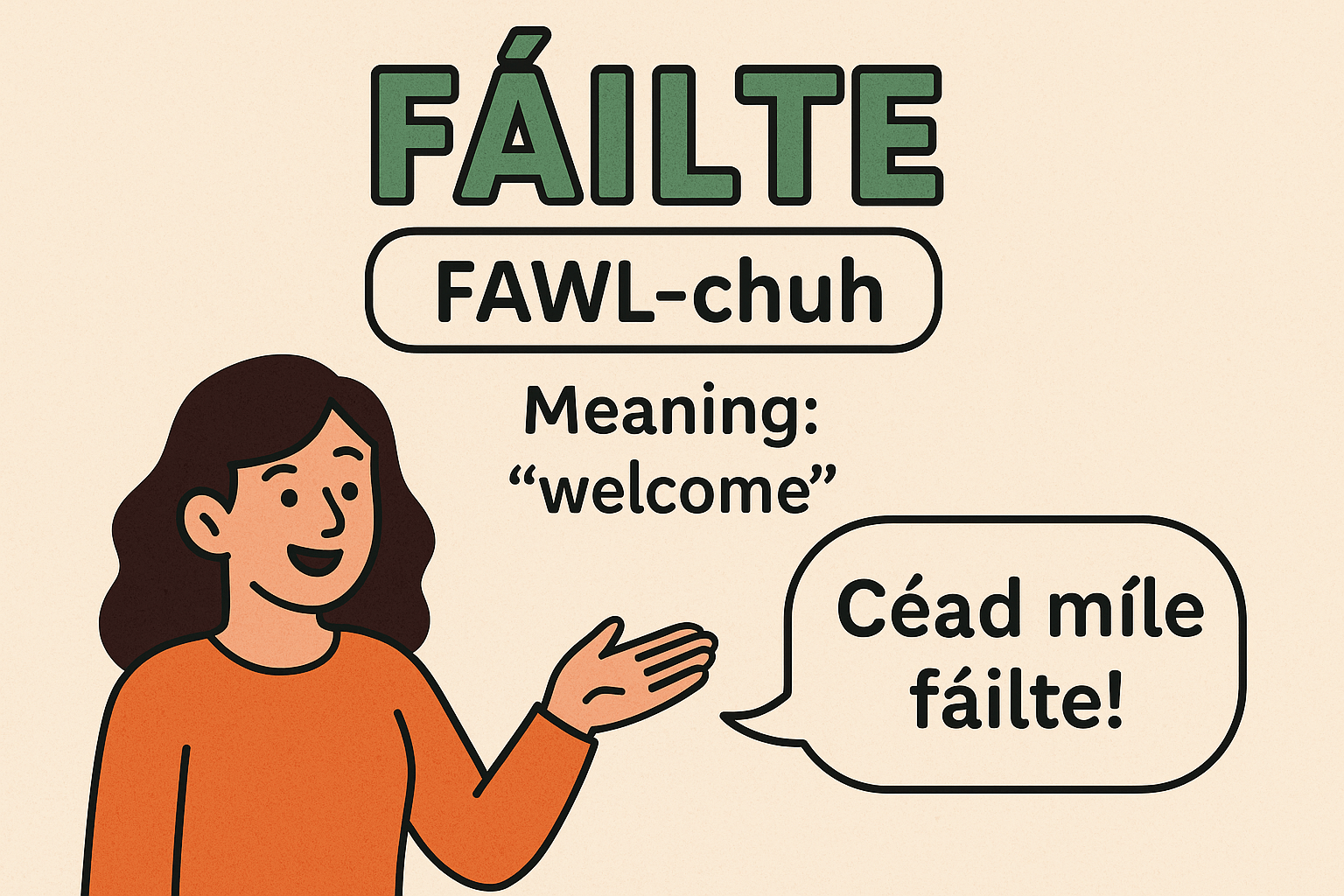
Fáilte

Fáilte means “welcome” in Irish. If you see failte without the accent, people are almost always referring to the same word, but the correct Irish spelling is fáilte with a fada on the á. The direct meaning, pronunciation, and the forms learners need in real situations are: a simple welcome, welcoming one person or a group, welcoming someone to Ireland, and the best Irish equivalent for “welcome back.”


How We Chose the Examples and Forms in This Guide

We built this guide from standard dictionary entries, native-audio references, and common beginner situations rather than from awkward word-for-word translations. In practice, that means we checked headword forms in sources such as Wiktionary’s entry for fáilte and pronunciation audio in Teanglann, then selected examples you are likely to hear on signs, in classrooms, or when greeting visitors.

We also excluded some literal English-style phrasing where it sounds forced in modern Irish. Our team regularly sees beginners over-translate expressions like “you’re welcome” and “welcome back,” so this article favors the forms that are most natural to say, not just the ones that map neatly onto English.

What Does Fáilte Literally Mean?

Fáilte is the Irish word for “welcome.” You’ll see it used as a greeting, on signs, and in set expressions of hospitality. If someone types failte without the fada, they are usually looking for the same word, but the standard Irish spelling is fáilte.

Historically, the word is old: Wiktionary notes that fáilte goes back through Old Irish and cites an early medieval example from The Tale of Mac Da Thó’s Pig, showing that the word has been part of Irish for roughly a millennium. That long history matters because this is not a modern slogan or tourism phrase; it is a core Irish noun with deep roots.

It also helps to separate the single word fáilte from the well-known phrase Céad míle fáilte. The first means “welcome.” The second is an emphatic cultural expression meaning “a hundred thousand welcomes,” a phrase whose documented literary history is traced in this note on céad míle fáilte.

Pronunciation Guide: How to Say Fáilte

The safest quick guide is this: fáilte is roughly FAWL-chuh or FAWL-tyuh, depending on dialect and how narrowly you are listening. For native recordings, Teanglann remains one of the best quick checks: hear the word on Teanglann. For a dictionary-style confirmation of the modern pronunciation, Wiktionary’s IPA entry gives the modern standard form as /ˈfˠaːlʲtʲə/.

The fada over á matters because it lengthens and changes the vowel quality: you are aiming for a longer aw/aah sound, not a short flat vowel. The ending can trip learners up even more. Because Irish consonants change quality depending on whether they are broad or slender, the final -lte does not sound like plain English “tee.” In many speakers’ pronunciation, that last part lands closer to a soft ch or tyuh sound.

Closest English approximation: FAWL-chuh. Not like this: FAIL-tee. That is the mistake our team hears most often, and in our experience it usually comes from reading the spelling through English phonics.

There is some natural variation by dialect, so you may hear a slightly clearer ty quality from one speaker and a more affricated ch quality from another. That is normal. When we test beginner audio, the bigger issue is usually not dialect variation but the final consonant cluster getting flattened into English “tee,” so correcting that will improve your pronunciation faster than chasing tiny regional differences.

Using Fáilte in Everyday Sentences

Fáilte means “welcome,” but the full phrasing changes depending on what you are doing. You can use the single word as a general greeting, expand it with a prepositional form when welcoming a person or group, and use a place phrase when welcoming someone to a country or event. English speakers also often over-literalize “you’re welcome”: in Irish, that idea is not always expressed with fáilte in everyday conversation, so context matters.

Simple welcome

  • Fáilte! — “Welcome!”
    Use this as a direct greeting at a door, event, class, or sign.
  • Céad míle fáilte! — “A hundred thousand welcomes!”
    More expressive and culturally loaded than plain Fáilte!; common on signage and in ceremonial welcomes.

Welcoming one person or several people

  • Fáilte romhat., “Welcome” / “welcome before you” (singular).
    Use this when addressing one person directly.
  • Fáilte romhaibh., “Welcome” (plural).
    Use this when greeting more than one person.
  • Is mór an fáilte romhat., “You are very welcome.”
    A warmer, fuller version that suits speeches, hosts, and formal welcomes.

One thing we watch for in learner writing is the temptation to memorize only the dictionary headword and stop there. In actual use, romhat and romhaibh are the forms that make the phrase sound directed at real people.

Welcoming someone to a place

  • Fáilte go hÉirinn.: “Welcome to Ireland.”
    This is the straightforward modern form.
  • Fáilte go h-Éireann.: “Welcome to Ireland.”
    You will also see this on signage and in established public wording; it is a familiar written form even if learners first encounter go hÉirinn in lessons.
  • Fáilte go dtí ár rang Gaeilge.: “Welcome to our Irish class.”
    Useful for classrooms, communities, and events.
  • Fáilte go Baile Átha Cliath.: “Welcome to Dublin.”
    Swap in the place name you need.

“Welcome back” in Irish

A literal calque of English “welcome back” is not always the most natural choice. In many contexts, Irish speakers are more likely to say something like:

  • Tá áthas orm tú a fheiceáil arís. (“I’m happy to see you again.”) Natural for greeting one person returning.
  • Tá áthas orainn sibh a fheiceáil arís. (“We’re happy to see you again.”) Natural for welcoming back a group.
  • Fáilte ar ais. (“Welcome back.”) This can work, especially in announcements or friendly speech, but it is not the only option and not always the most idiomatic one.

“You’re welcome” after thanks

Beginners often try to use fáilte every time they want to say “you’re welcome” after go raibh maith agat. Sometimes that works, but conversational Irish often prefers other replies such as Ná habair é (“don’t mention it”) or Tá fáilte romhat in a more explicit “you’re welcome” sense. In our experience, this is one of the first places where English speakers become too literal, so it helps to learn both the hospitality sense of fáilte and the conversational reply patterns separately.

Useful model sentences

  1. Fáilte romhat go dtí an óstán. (“Welcome to the hotel.”)
    Good for one guest in a hosted setting.
  2. Fáilte romhaibh go léir. (“Welcome, everyone.”)
    Natural for a group opening.
  3. Céad míle fáilte go hÉirinn. (“A hundred thousand welcomes to Ireland.”)
    Warm, public-facing, and common in an Irish cultural context.
  4. Tá áthas orm tú a fheiceáil arís. (“I’m glad to see you again.”)
    Often better than forcing a stiff literal “welcome back.”

Grammar & Related Forms of Fáilte

Gender & Declension

The noun fáilte is feminine. According to Wiktionary: singular nominative fáilte, plural fáiltí. Wiktionary

Mutations may affect adjacent words in a sentence. For example: le fáilte (“with welcome”) uses the base form.

Related verbs and adjectives

  • Fáiltigh (verb) – to welcome. Wiktionary
  • Fáilteach (adj.) – welcoming, hospitable.
  • Fáilteoir (noun) – someone who welcomes (e.g., a host, receptionist).

Common collocations

  • Fáilte romhainn/romhat/romhaibh – welcome to us/you(plural)/you(plural).
  • Go bhfáilte – that may welcome (used in speeches).
  • Is mór an fáilte atá romhaibh – “You have a great welcome before you.”

Why Fáilte Matters for Irish Learners

1. High-frequency word

Because fáilte is common, you’ll see and hear it often. Learning it early means you’re less likely to feel lost in basic conversation.

2. Cultural connection

Irish culture is known for hospitality—fáilte is emblematic of that. Using the word helps you connect authentically with Irish speakers.

3. Builds confidence

Simple as it is, fáilte lets you greet or respond positively in Irish from the start. That builds confidence, encouraging you to learn more.

Practice Tips for Using Fáilte

Instead of drilling the word in isolation, practice it in short real-life exchanges. We chose the examples below from common beginner situations—greeting one person, greeting a group, welcoming someone to Ireland, and replying after thanks—because those are the contexts learners meet first.

✅ Flashcard activity

Use one card for the headword and a few for the set phrases you will say. If you want a quick way to generate study prompts, see Ivory Mind for an example of instant flashcard terms, then keep your Irish cards focused on full expressions rather than isolated vocabulary.

Try these cards:

  • Front: fáilte, Back: “welcome”
  • Front: Fáilte romhat, Back: “welcome (to one person)”
  • Front: Fáilte romhaibh, Back: “welcome (to more than one person)”
  • Front: Fáilte go hÉirinn, Back: “welcome to Ireland”

✅ Mini practice drill

1. Greeting one person
A: Dia duit.
B: Fáilte romhat!
“Hello.” / “Welcome!”
Note: good for receiving a single guest or learner.

2. Greeting a group
A: Dia daoibh.
B: Fáilte romhaibh go léir.
“Hello, everyone.” / “You are all welcome.”
Note: useful for classes, tours, and events.

3. Welcoming someone to Ireland
A: Is é seo mo chéad turas anseo.
B: Fáilte go hÉirinn.
“This is my first trip here.” / “Welcome to Ireland.”
Note: simple, public, and easy to remember.

4. Replying after thanks
A: Go raibh maith agat.
B: Tá fáilte romhat.
“Thank you.” / “You’re welcome.”
Note: acceptable and clear, though everyday Irish may also use other replies depending on tone.

✅ Integration with other study material

You can integrate this with broader learning:

✅ Real-world usage

When you meet someone who is also learning Irish, greet them with:

“Fáilte! Tá tú ag foghlaim Gaeilge freisin?”

(“Welcome! Are you learning Irish too?”)

In our testing, beginners remember fáilte faster once they attach it to a real social moment instead of a standalone vocabulary list.

Common Mistakes & How to Avoid Them

  • Missing the fada: Typing failte without the accent is common but inaccurate—use fáilte.
  • Pronunciation mis-stress: Avoid saying “FALL-tee” with English stress; it should be closer to “FAWL-tchuh”.
  • Wrong context: Fáilte is for arrival/welcome; don’t use it for “goodbye” (that’s slán).
  • Incorrect mutation: In phrases like fáilte romhat, note the preposition roimh (“before”) combined with the mutated form. Learning our Understanding Irish Prepositions guide helps correct this.

Bringing Fáilte Into Your Language Journey

A better weekly goal than repeating the single word is to use one new welcome phrase in context. Try Fáilte romhat for one person, Fáilte romhaibh for a group, and Fáilte go hÉirinn when practicing place phrases. That gives you a usable mini-set instead of a single memorized item.

If you want to go one step further, pair fáilte with related vocabulary such as fáiltigh and fáilteach. That helps you recognize the word family when you meet it outside beginner dialogues.

Ready to keep building your Irish vocabulary and confidence? Visit our platform at learn.gaeilgeoir.ai and continue your journey with fáilte as one of your first true companions in Gaeilge.

Frequently Asked Questions

What does fáilte mean in Irish?

Fáilte means “welcome.” It is used on its own, in direct greetings, and in set phrases such as Céad míle fáilte. The correct Irish spelling includes the fada: fáilte, not failte.

How do you pronounce fáilte?

A practical approximation is FAWL-chuh or FAWL-tyuh. The long á comes from the fada, and the ending is not pronounced like English “tee.” You can compare native audio on Teanglann and the IPA on Wiktionary.

Is fáilte Scottish or Irish?

Fáilte is distinctly Irish, but it belongs to a wider Gaelic family. Scottish Gaelic has fàilte and Manx has Failt, both meaning “welcome,” which reflects their shared Celtic heritage; this comparison is outlined in this Gaelic-language overview. If you are asking about the Irish word specifically, the form in Irish is fáilte.

What does Céad míle fáilte mean in Irish?

It means “a hundred thousand welcomes.” The phrase is much warmer and more emphatic than plain fáilte, and it is one of the best-known expressions of Irish hospitality. It is often used on signs, in tourism, and in ceremonial welcomes.

Is failte without the accent acceptable?

People will usually understand what you mean, especially when typing on an English keyboard, but it is not the correct Irish spelling. The fada matters because it changes the vowel sound and is part of the standard written form. If you need help typing it, use this Fada Keyboard Shortcut Guide.

How do you say “welcome to Ireland” in Irish?

A clear standard form is Fáilte go hÉirinn. You may also see Fáilte go h-Éireann in public wording and signage. Both are associated with welcoming people to Ireland, but beginners should start by learning one form confidently and using it consistently.

How do you say “welcome back” in Irish?

Sometimes Fáilte ar ais works, especially in announcements or a friendly greeting. But in many natural conversations, Irish speakers may prefer a phrase like Tá áthas orm tú a fheiceáil arís (“I’m happy to see you again”), which sounds less like a direct English calque. That is why context matters more here than with plain fáilte.
Casadh an tSúgáin: Meaning, Story and Irish Song Guide

Casadh an tSúgáin is a traditional Irish-language song whose title refers to the twisting of a súgán, a rope traditionally made from straw, hay or rushes.

The phrase has a strong connection with rural life, but the song itself is remembered for much more than rope-making. It combines everyday work, courtship and storytelling in the way many traditional Irish songs do: something ordinary becomes the setting for a memorable human encounter.

For learners, it is also a useful example of Gaeilge being carried through music rather than studied as isolated vocabulary.

If you enjoy exploring the language through music, our Irish songs hub brings together more traditional and contemporary Gaeilge songs, along with their meanings and cultural context.

What Does Casadh an tSúgáin Mean?

The title can be translated roughly as:

Casadh an tSúgáinThe Twisting of the Straw Rope

The key words are:

casadh — twisting, turning, winding

súgán — a rope or cord traditionally made from twisted straw, hay or rushes

So the phrase describes a familiar piece of traditional rural work: twisting plant material together to form a rope.

That literal meaning is important because it provides the setting for the song.

It is tempting to turn every element into a grand metaphor, but the song is better understood first through the world that produced it.

What Was a Súgán?

A súgán was a practical rope made by twisting together straw, hay or rushes.

It could be used for a variety of domestic and agricultural purposes.

Perhaps its best-known cultural association today is with the súgán chair, a traditional chair whose seat is woven from twisted rope.

Making this kind of rope required repeated twisting to bind relatively weak individual strands into something stronger.

For people living in rural communities, this would have been an ordinary and recognisable activity rather than an exotic craft.

That everyday setting is part of what gives the song its character.

What Is Casadh an tSúgáin About?

The song centres on an encounter between a man working at twisting the súgán and a young woman.

Different performances and versions can vary, which is normal in traditional song.

The important point is that the song develops through conversation, courtship and personal interaction rather than through an abstract philosophical story.

This puts it within a much wider Irish song tradition in which everyday encounters become the basis for humour, romance, disappointment or social commentary.

The work itself provides the setting.

The people provide the story.

Is Casadh an tSúgáin a Love Song?

Broadly, yes.

The song is often discussed as a courtship or love song, although reducing it simply to a tragic tale of unrequited love can flatten the different versions and performances that exist.

Traditional songs are rarely frozen texts.

They can change as they move between singers, communities and generations.

Verses may differ.

Emphasis may change.

A singer may make the song sound playful, reflective or more emotionally serious.

That flexibility is one of the defining characteristics of oral tradition.

Why Is the Title Important?

The title does more than identify the task being performed.

Casadh is a useful Irish word because it can relate to turning, twisting or changing direction in several contexts.

But we should be careful not to assume every possible dictionary meaning is deliberately operating as a hidden metaphor in the song.

The strongest reading is the most immediate one:

someone is casadh an tsúgáin — twisting the straw rope — when the encounter takes place.

The physical task gives the scene specificity.

That is enough to make the title memorable.

Casadh and Irish Vocabulary

The word casadh appears in several useful Irish contexts.

Depending on grammar and context, forms connected with cas can express ideas such as:

  • turning
  • twisting
  • meeting or encountering
  • changing direction

This is one of the reasons songs can be useful for language learners.

You encounter a word inside an actual scene rather than as a disconnected dictionary entry.

Once you hear the word elsewhere, the song gives you something to attach it to.

Why Traditional Songs Help With Irish

A song like Casadh an tSúgáin gives learners several things at once.

You hear pronunciation.

You experience Irish rhythm.

Vocabulary repeats.

Words appear inside a story.

And because a melody makes repetition enjoyable, you may hear the same language many times without feeling as though you are drilling it.

That makes music particularly useful for moving vocabulary from recognition toward familiarity.

Exploring different Irish songs can expose you to new vocabulary, voices and regional traditions while keeping listening practice connected to something meaningful.

Don’t Worry About Understanding Every Word

Traditional Irish-language songs can be challenging.

They may contain unfamiliar vocabulary, regional pronunciation, older expressions or poetic constructions.

You don’t need to translate every line before you’re allowed to enjoy the song.

A better approach is to work in stages.

First, listen.

Then identify any words or phrases you recognise.

Next, look at the meaning of the passage.

Then listen again.

The second or third listen will often sound much clearer because you now know what to expect.

Casadh an tSúgáin and Sean-Nós Singing

The song is strongly associated with Ireland’s traditional singing culture and has been performed in different traditional and arranged styles.

Sean-nós singing is an unaccompanied Irish-language vocal tradition particularly associated with Gaeltacht areas.

It often features:

  • ornamentation
  • individual interpretation
  • flexible rhythm
  • strong attention to the words and story

Not every recording of Casadh an tSúgáin will be performed strictly as sean-nós.

Some versions use instrumental accompaniment or more formal arrangements.

That variety is useful because it shows how one traditional song can live in several musical settings.

Different Versions of the Song

There is no reason to expect one definitive performance.

Traditional songs are transmitted through people.

Singers remember, adapt and interpret material differently.

That can produce variations in:

  • melody
  • verses
  • wording
  • pronunciation
  • tempo

This doesn’t necessarily mean one version is wrong.

Variation is part of the tradition.

For learners, listening to more than one performance can be especially valuable because it trains your ear to recognise familiar words when they are sung differently.

The Song and Rural Irish Life

Casadh an tSúgáin preserves a small image of a world where the materials of everyday life came directly from the surrounding landscape.

A rope made from straw or rushes was useful because communities made practical use of what was available.

The song does not need to turn that craft into a universal symbol of “Irish resilience” for it to be culturally interesting.

The detail itself is valuable.

It tells us something about work, material culture and the kind of scene an audience would immediately have recognised.

That is often where traditional songs are strongest: in the specificity of ordinary life.

Is the Rope a Symbol?

It can certainly invite interpretation.

A modern listener might see the twisting rope as suggesting relationships, complications or the turns of a story.

That can be an enjoyable reading.

But it is better described as interpretation rather than established historical meaning.

We don’t need to assume the rope was deliberately created as a coded symbol of fate, national identity or emotional entanglement.

Traditional songs often become richer because generations of listeners bring their own associations to them.

That doesn’t mean every later interpretation was intended by the original singer.

Casadh an tSúgáin in Modern Performance

The song has continued to appear in Irish traditional music through both singers and arranged performances.

Different artists have approached it with different vocal and instrumental styles, helping keep the song in circulation beyond the communities where it was originally transmitted.

That is one of the strengths of traditional music.

A song does not have to remain stylistically frozen to remain recognisable.

New performers can reinterpret it while the underlying Irish text and story continue to connect listeners with an older tradition.

How to Learn Irish With Casadh an tSúgáin

If you’re using the song as Gaeilge practice, don’t begin by trying to memorise everything.

Choose one short section.

Listen to it several times.

Then:

1. Identify the words you already recognise.

2. Read an explanation or translation.

3. Pick two or three useful words.

4. Listen again.

5. Repeat one short phrase aloud.

That gives you listening, vocabulary and pronunciation without turning the song into a homework assignment.

Learn the Chorus or Repeated Section First

Repeated sections are usually the easiest place to start with any song.

Once a phrase becomes familiar, you begin anticipating it.

That makes the Irish easier to hear.

Then other words around it gradually become clearer too.

You can use the same technique with other Irish-language songs.

Find the repeated phrase first.

Let that become familiar.

Then work outward.

Music and Irish Pronunciation

Songs can help you notice how written Gaeilge becomes spoken Gaeilge.

But there is one limitation worth remembering.

Singing changes speech.

Vowels may be held longer.

Words may be stretched to fit a melody.

Rhythm may differ from ordinary conversation.

So songs are excellent for familiarity and listening, but they should be combined with normal spoken Irish if pronunciation is your goal.

Use the song to become comfortable with sounds, then compare those words with spoken audio.

What Makes Casadh an tSúgáin Worth Learning?

For Irish learners, the song has several advantages.

It is culturally significant without being inaccessible.

Its title introduces useful vocabulary.

Its rural setting gives the language context.

Different recordings expose you to variation.

And the story reminds you that Gaeilge has always been used to express ordinary human experiences.

Irish isn’t only the language of grammar exercises, political slogans or ancient mythology.

It is also the language of work, attraction, conversation, humour and song.

Traditional Irish Songs as Language Resources

There is a tendency to treat traditional songs as historical artefacts.

They are certainly historical sources, but for a learner they can also be practical language resources.

A good Irish song gives you:

Vocabulary in context

You see where words actually belong.

Repeated listening

The melody encourages you to return.

Cultural context

You learn something about the world surrounding the language.

Pronunciation exposure

You hear Gaeilge rather than just reading it.

Memory cues

Melody and rhythm make phrases easier to remember.

That’s why song-based learning can complement more structured study so well.

Explore More Irish Songs

Casadh an tSúgáin is one doorway into a much larger musical tradition.

You can move from traditional songs into sean-nós singing, rebel songs, love songs, comic songs and contemporary artists making music through Gaeilge today.

Explore our Irish songs guide to discover more Irish-language music, lyric meanings and the stories behind the songs.

The more Irish you hear through music, the more likely familiar vocabulary is to begin appearing outside the lesson where you first learned it.

Frequently Asked Questions

What does Casadh an tSúgáin mean?

It means roughly “the twisting of the straw rope.” A súgán is a rope traditionally made by twisting straw, hay or rushes.

Is Casadh an tSúgáin an Irish song?

Yes. It is a traditional Irish-language song associated with Ireland’s folk and singing traditions.

What is the song about?

The song develops around an encounter involving a man engaged in twisting a súgán and a young woman. It is generally associated with courtship and relationships, although versions can vary.

What is a súgán?

A súgán is a rope or cord traditionally made from twisted straw, hay or rushes.

Is Casadh an tSúgáin a sean-nós song?

It is associated with Irish traditional singing and has been performed in sean-nós contexts, although modern recordings may also use instrumental arrangements.

Does the rope symbolise love?

It can be interpreted that way, but that should be presented as a reading of the song rather than a proven original meaning.

Can Irish songs help you learn Gaeilge?

Yes. Songs are particularly useful for listening, vocabulary recognition, pronunciation familiarity and repeated exposure to Irish phrases.

Final Thoughts

Casadh an tSúgáin begins with something very ordinary: twisting straw into rope.

From that everyday task comes a song that has lasted across generations.

That’s part of the appeal of traditional Irish music.

It doesn’t need an enormous dramatic setting.

A piece of work, a meeting and a few lines of Gaeilge can be enough to carry a story.

For learners, the song offers something equally useful.

Listen to it often enough and words that initially seem unfamiliar begin to stand out.

Then a phrase becomes recognisable.

Then another.

Eventually, you’re no longer simply listening to an Irish song.

You’re hearing Irish.

The Gaelic Harp: Ireland’s Timeless Symbol of Heritage

Few symbols are as deeply woven into the fabric of Ireland’s identity as the Gaelic harp. From ancient bardic courts to modern coins and passports, the harp stands as a living emblem of Irish pride, resilience, and creativity. Known in Irish as the cláirseach (pronounced klar-shakh), the Gaelic harp is not only an instrument but a bridge to Ireland’s musical and linguistic past — a past that companies like Gaeilgeoir AI strive to preserve and revitalize through language and culture.

In this article, we’ll explore the origins, evolution, and symbolism of the Gaelic harp, its role in Irish culture, and why it remains a cherished icon today. You’ll also learn how engaging with Irish traditions like harp music can enrich your Irish language learning journey.


The Ancient Roots of the Gaelic Harp

The Gaelic harp (or Irish harp) is one of Europe’s oldest string instruments, dating back over 1,000 years. Early versions of the harp were played by filí (poets) and harpers who were revered in Gaelic society for preserving oral tradition, history, and music.

Archaeological evidence — including carvings on 9th-century stone crosses and manuscripts — shows that the harp held both spiritual and social importance. It was associated with royal courts, where harpers entertained kings and chieftains, chronicling their reigns through song and poetry.

Distinct Features of the Gaelic Harp

Unlike modern concert harps, the traditional Gaelic harp had unique characteristics:

  • Wire strings (often made of brass or bronze), giving it a bright, resonant tone.
  • Curved forepillar and soundbox, carved from a single block of willow or oak.
  • Played with fingernails, producing a distinctive ringing sound unlike gut- or nylon-strung harps.

These features made the Gaelic harp’s sound unmistakable — a shimmering echo that symbolized both Ireland’s joy and sorrow.


Historical Significance: The Harp of Kings and Poets

In Gaelic Ireland, the harp was more than an instrument — it was a symbol of status, culture, and connection. Harpers were highly respected, often second only to poets in rank.

The Harpers’ Legacy

Harpers such as Turlough O’Carolan (1670–1738), Ireland’s most famous composer and harper, blended ancient Gaelic melodies with Baroque influences, creating timeless works that bridged eras. His compositions, like Sí Bheag, Sí Mhór, continue to be played across the world, keeping Gaelic music alive.

The Gaelic harp also became a symbol of resistance during English rule. As Ireland’s native culture faced suppression, harpers carried the soul of the nation in their music — a quiet act of cultural defiance.


The Symbolism of the Gaelic Harp

Today, the Gaelic harp is the official emblem of Ireland, appearing on:

  • The Presidential seal and Irish passport
  • Euro coins and Irish government documents
  • Guinness logo, one of the most recognized symbols worldwide

Meaning Behind the Symbol

The harp embodies:

  • Harmony between past and present — linking modern Ireland to its Gaelic roots
  • Resilience — a testament to Ireland’s survival through colonization and cultural loss
  • Creativity and pride — celebrating the arts, storytelling, and the Irish spirit

For a deeper look into the linguistic roots of Irish symbolism and mythology, explore our Ancient Irish Language Guide, where history and language meet.


Revival and Rediscovery: The Harp in Modern Ireland

By the 18th century, the decline of Gaelic nobility and patronage led to the near disappearance of traditional harpers. The once-proud Gaelic harp almost vanished — until a cultural revival rekindled its flame.

1. The Belfast Harp Festival (1792)

Held in Belfast, this landmark event gathered the few surviving Irish harpers, including Denis Hempson, to preserve their music. Edward Bunting, a young musician, recorded their melodies and published collections that became vital for future generations.

2. The Celtic Revival

In the late 19th and early 20th centuries, the Gaelic Revival movement reawakened national pride. The harp returned as a central symbol — appearing in literature, art, and politics.

3. Modern Harpists and Innovation

Today, artists like Laoise Kelly, Gráinne Hambly, and Michael Rooney have elevated the harp’s status once again. They blend traditional Irish melodies with contemporary sounds, proving that the Gaelic harp still sings with relevance.

The instrument now features prominently in festivals, film scores, and Irish schools, ensuring a new generation continues the music of their ancestors.


The Gaelic Harp and the Irish Language: A Shared Heritage

The Irish language (Gaeilge) and the Gaelic harp share intertwined histories. Both endured centuries of decline — and both are now experiencing revival through passion, technology, and education.

In Irish tradition, music and storytelling were inseparable from the spoken word. Harpers often accompanied poets (filí), and together they kept the oral histories of clans and kingdoms alive.

Many harp tunes carry Irish names and expressions, such as:

  • Eleanor Plunkett (Eibhlín Pluincéid)
  • Sí Bheag, Sí Mhór (“Small Fairy Hill, Big Fairy Hill”)
  • Bí Im’ Shuí (“Be at Rest”)

Learning Irish helps you uncover the deeper meanings in these songs — not just the music, but the cultural heartbeat behind it.

If you’re beginning your language journey, explore our Irish Language Lessons for Beginners to connect your learning with Ireland’s music and traditions.


Anatomy of the Gaelic Harp: Understanding Its Design

To appreciate its craftsmanship, it helps to know the harp’s core parts:

PartIrish TermFunction
SoundboxBosca fuaimeAmplifies sound
StringsTeadaíProduces pitch
ForepillarTaca tosaighProvides tension
NeckMuineálHolds tuning pins
Harmonic CurveCuair armónachGives resonance

Each harp is unique — handmade by artisans who continue centuries-old traditions. Modern versions are often built from Irish woods like willow and cherry, connecting craftsmanship to the land itself.


Famous Harps of Ireland

Several historical harps survive as national treasures:

  1. The Brian Boru Harp (Trinity College Dublin) – The oldest surviving Gaelic harp, dating to the 14th or 15th century. It inspired Ireland’s official emblem.
  2. The Downhill Harp – Once played by Denis Hempson, the last traditional wire-strung harper.
  3. The Queen Mary Harp (Scotland) – A close relative of the Irish harp, showing the shared heritage of Gaelic music across Ireland and Scotland.

Learning About the Gaelic Harp Through Gaeilgeoir AI

At Gaeilgeoir AI, our mission is to make Irish language and culture accessible through technology. Whether you’re curious about Irish music, myths, or grammar, our AI tools adapt to your level and guide you through interactive lessons and cultural insights.

By studying the Gaelic harp’s role in Irish history, you gain more than knowledge — you build a deeper emotional connection to the Irish language.

Gaeilgeoir AI helps you:

  • Master pronunciation of Irish terms like cláirseach and sí bheag, sí mhór.
  • Learn vocabulary tied to music, art, and culture.
  • Use AI-driven exercises that make language practice fun and immersive.

Start your journey today with a free trial at learn.gaeilgeoir.ai.

Why the Gaelic Harp Still Matters Today

The harp endures not only because of its beauty, but because it tells Ireland’s story — one of artistry, resilience, and rebirth. It represents a language and culture that refused to fade away, and continues to inspire through melody and meaning.

For modern learners, the Gaelic harp is a reminder that learning Irish isn’t just about words — it’s about understanding a way of seeing the world through art, sound, and tradition.

As you learn to say cláirseach na hÉireann (“the harp of Ireland”), you’re connecting with a thousand years of poetry, pride, and music.


Conclusion: The Living Voice of Ireland

The Gaelic harp remains Ireland’s most beloved symbol — not as a relic, but as a living voice of the nation. Its strings echo stories of kings, poets, and common folk alike, reminding us that culture survives through creativity and care.

By exploring Irish through music, and by embracing tools like Gaeilgeoir AI, you’re helping ensure that both the language and its melodies continue to thrive.

So next time you see the harp on an Irish passport, coin, or pint glass — remember: it’s not just an emblem, but a song still being played.

Teacht in Irish: Meaning, Pronunciation & Everyday Use

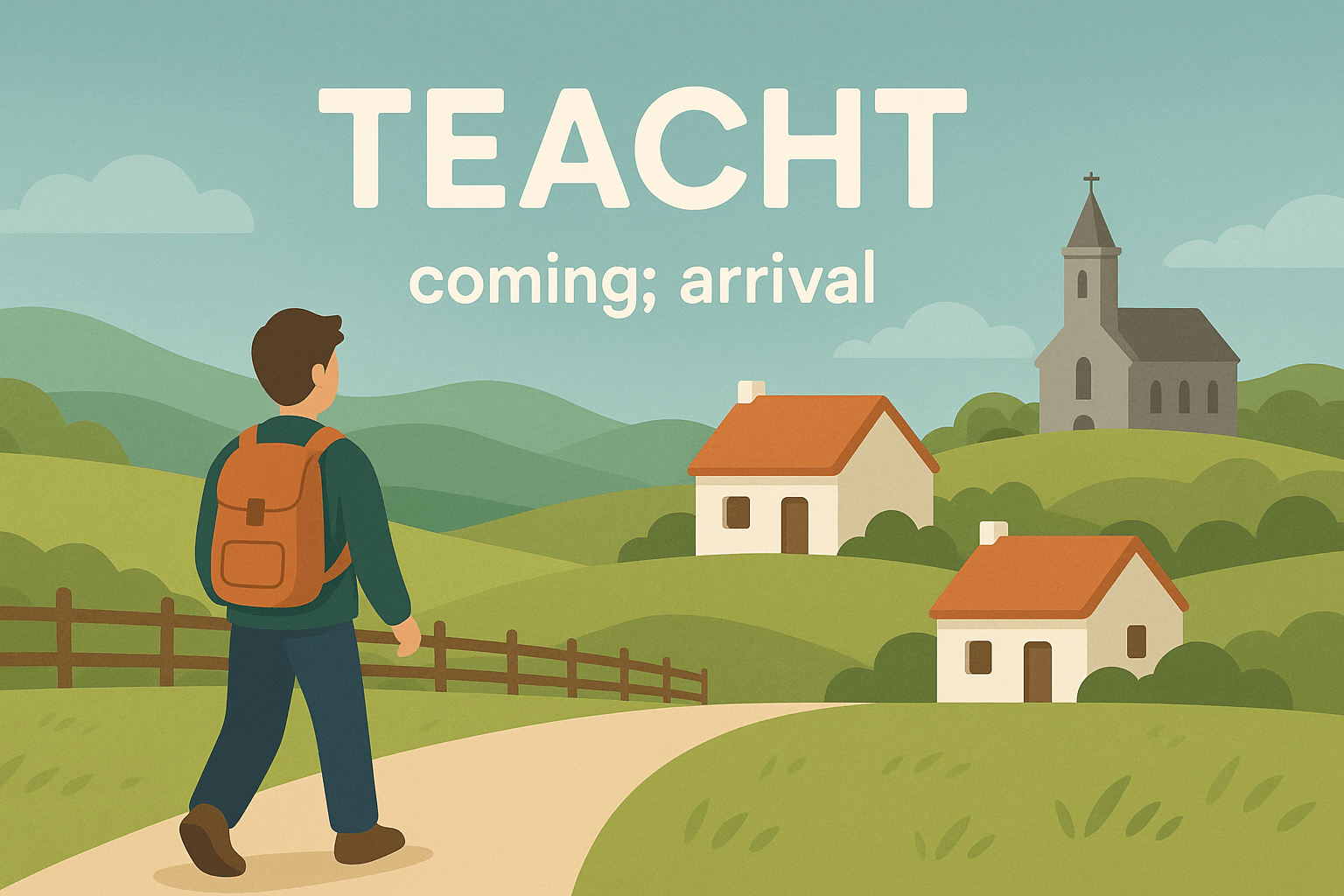
The Irish word teacht (pronounced tyahkt) means “coming” or “arrival.”
It’s one of the most common words you’ll come across when learning everyday Irish. You’ll often hear it in phrases like:

  • Tá sé ag teacht — He is coming
  • Bhí sí ag teacht abhaile — She was coming home
  • Roimh theacht an gheimhridh — Before the coming of winter

In other words, teacht is used whenever someone or something is on the way or arriving — a simple but powerful word for learners to master.


Breaking Down the Word “Teacht”

Part of Speech:

  • Teacht can act as a noun meaning arrival or coming.
  • It’s related to the verb “tar” (to come) — the root of many everyday phrases.

Pronunciation:

  • In most dialects, teacht sounds like “tyahkt.”
  • The “ea” has a short “a” sound, and the “cht” is that typical Irish throat sound — a soft clearing of the throat.

If you’re unsure how to pronounce it, you can listen to native examples on Teanglann.ie to hear the different regional pronunciations.


How to Use “Teacht” in Simple Sentences

To help you get comfortable, here are a few common examples you can start practising today:

IrishEnglish
Tá sé ag teacht.He is coming.
Tá siad ag teacht níos déanaí.They are coming later.
Roimh theacht an tsamhraidh.Before the coming of summer.
Tar éis teacht abhaile.After coming home.
Tá fáilte roimh do theacht.Your arrival is welcome.

Notice how the word teacht can appear both on its own and as part of phrases with ag (at), roimh (before), or tar éis (after).


Related Words and Phrases

Understanding teacht can help you learn other common Irish expressions around movement and arrival:

  • Tháinig — came (past tense of “tar”)
    • Tháinig mé go luath. → I came early.
  • Tiocfaidh — will come (future tense)
    • Tiocfaidh siad amárach. → They will come tomorrow.
  • Téigh — go (the opposite direction of “come”)
    • Téim go dtí an scoil gach maidin. → I go to school every morning.

If you’re curious about how these motion verbs connect, check out our Irish Pronouns Guide — it’ll help you form sentences correctly as you start to build confidence in Irish grammar.


Common Expressions Using “Teacht”

You’ll see teacht used not just in literal movement, but also in expressions describing events, opportunities, or even emotions. For example:

  • Teacht an lae — the coming of the day
  • Teacht na Nollag — the coming of Christmas
  • Teacht chugam féin — coming to myself (recovering)

It’s a flexible, everyday word that works for physical arrival or figurative change — something arriving, beginning, or happening.


Why “Teacht” Is a Great Word for Beginners

Learning teacht early helps you:

  1. Understand basic sentence patterns in Irish.
  2. Recognize motion verbs and how they’re formed.
  3. Build real, useful phrases that sound natural in conversation.

Irish can feel complex at first, but focusing on small, high-frequency words like teacht gives you quick wins. Every time you say tá mé ag teacht (“I’m coming”), you’re not just learning a word — you’re speaking Irish confidently.


Practice Tips for Learners

Here are a few easy ways to practise using teacht daily:

  1. Say it aloud — Repeat simple sentences:
    “Tá mé ag teacht.” / “Tá sí ag teacht.” / “Tá siad ag teacht.”
  2. Write a short diary entry
    Bhí mo chairde ag teacht go Gaillimh inniu. (“My friends were coming to Galway today.”)
  3. Use Gaeilgeoir AI to test pronunciation and get feedback on your sentence construction.
    The platform uses AI to help you practise speaking and listening — sign up for free here.

Grammar Tip: “Ag Teacht” vs “Teacht”

  • Ag teacht literally means “at coming” → used for ongoing actions (is coming / are coming).
  • Teacht on its own is the noun (“arrival / coming”).

Examples:

  • Tá an traein ag teacht. → The train is coming.
  • Fan go dtí teacht an traein. → Wait until the arrival of the train.

That small difference shows how flexible Irish can be once you get familiar with word forms!


Similar Words to Explore Next

Once you’ve learned teacht, here are a few related words to help expand your Irish vocabulary:

  • Imeacht — going, departure
  • Tagairt — reference
  • Tús — beginning
  • Críoch — end

You can explore more Irish words and their meanings in our Irish Idioms Language Learning Guide — it’s a great next step after learning teacht.


Conclusion: A Small Word with Big Importance

Teacht might seem simple, but it’s one of those essential Irish words that opens the door to everyday fluency.
It’s used in greetings, conversations, storytelling, and even traditional songs — always expressing something that’s on its way or about to begin.

Whether you’re talking about teacht an gheimhridh (the coming of winter) or saying Tá sé ag teacht anois (He’s coming now), you’re connecting directly with how Irish speakers think about time and movement.

So the next time you practise, try saying a few sentences out loud — you’ll feel the rhythm of the language.

And if you’d like to keep building your Irish step-by-step, join our community and start practising with AI-powered Irish tools at Gaeilgeoir AI.

Creideamh: Understanding Faith and Culture in Irish

If you’ve ever come across the Irish word creideamh (pronounced crej-uv), you’ve already touched one of the most profound and multifaceted words in the Irish language. At its simplest, creideamh means faith or belief, but its deeper meanings reach into trust, spirituality, loyalty, and identity.

In Ireland, creideamh has long been more than just a religious concept. It represents how people connect to each other, to their heritage, and to something greater — whether that’s spiritual, cultural, or personal.

In this post, we’ll explore what creideamh means, its origins in Irish culture, how it shaped Irish identity, and why understanding it can enrich your language learning journey with Gaeilgeoir AI — a platform that blends technology and tradition to help learners master the Irish language.


What Does Creideamh Mean?

The word creideamh comes from Old Irish, originally signifying belief, trust, or conviction. It’s related to the Latin credere, meaning to believe — which also gives us the English word creed.

But in Irish, creideamh holds layers of meaning that go beyond dogma or organized religion. Depending on context, it can mean:

  • Faith or religion: Tá creideamh agam i nDia – “I have faith in God.”
  • Belief or trust: Tá mo chreideamh agat – “You have my trust.”
  • Conviction or principle: Tá sé ag gníomhú de réir a chreidimh – “He acts according to his beliefs.”

So while creideamh often refers to religion, it’s also a reflection of personal values, trust, and confidence — ideas deeply woven into Irish thought and expression.


The Historical Roots of Creideamh

Pre-Christian Beliefs

Before Christianity arrived, the Irish had their own spiritual system based on nature, cycles, and deities. Their creideamh was intertwined with Celtic mythology, reverence for the land, and a deep respect for the unseen world.

Deities such as Brigid, Lugh, and Danu embodied different aspects of life and creativity. Faith in these deities wasn’t limited to temples — it was a living spirituality connected to everyday activities like farming, healing, and storytelling.

You can learn more about these traditions in our guide to the Celtic Deities of Ireland.


The Christian Transformation

In the 5th century, Christianity reshaped Ireland’s creideamh, blending with existing Celtic traditions rather than replacing them entirely. Figures like Saint Patrick, Saint Brigid, and Columba helped establish a faith that was uniquely Irish — spiritual yet earthy, universal yet deeply local.

This blending gave rise to expressions like creideamh na nGael (“the faith of the Irish”) — not just a religion, but an identity rooted in resilience and storytelling.

Monks who recorded ancient manuscripts preserved both the Christian and pre-Christian worlds side by side. This duality remains a defining trait of Irish spirituality — an openness to mystery and meaning.


Creideamh in Irish Language and Expression

In Irish, creideamh appears in many idioms, sayings, and phrases that reveal how the concept extends beyond religion.

Here are a few examples:

Irish PhraseTranslationMeaning
Gan chreideamh ná creideamh aigeHe has no faith or beliefUsed to describe skepticism or doubt
An creideamh sin a choinneáil beoTo keep that faith aliveCan mean preserving hope or tradition
Creideamh i bhféinFaith in oneselfExpresses confidence or self-belief
Creideamh na nGaelThe faith of the IrishCultural and historical identity rooted in belief

Notice how creideamh can mean spiritual belief, but also trust, perseverance, and identity — values that define the Irish mindset.


Faith and Language: The Cultural Connection

Language is never separate from belief. In Irish, words like creideamh reveal how faith shaped communication and worldview. For centuries, Irish speakers blended language and spirituality seamlessly — prayers, blessings, and poetry all carried linguistic beauty and depth.

1. Blessings and Everyday Speech

Expressions such as:

  • Go mbeannaí Dia duit – “God bless you.”
  • Le cúnamh Dé – “With God’s help.”

are examples of creideamh woven into daily life. Even secular Irish speakers still use these phrases — not always religiously, but as gestures of goodwill and hope.


2. The Irish Sense of Trust

The concept of creideamh also extends to human connection. To say Tá creideamh agam ionat means “I have faith in you.” It’s a reminder that language carries emotional weight — one reason Irish is so rich for expressing care and sincerity.

When learning Irish through Gaeilgeoir AI, you’ll encounter real-life phrases like these in context. The platform uses AI-driven immersion tools that teach as Gaeilge (in Irish), helping learners understand tone, culture, and meaning, not just vocabulary.


Creideamh as Resilience: A National Identity

Through famine, colonization, and social change, Ireland’s creideamh became a symbol of endurance. Even when the language itself was suppressed, the faith — both spiritual and cultural — remained unbroken.

For many, speaking Irish today is itself an act of creideamh: a belief in the value of identity, heritage, and hope.

At Gaeilgeoir AI, we see learning Irish as more than mastering grammar — it’s an expression of trust in cultural renewal. Every learner becomes part of a living tradition that began long before apps or classrooms.

If you’re just beginning your journey, check out our Irish Language Lessons for Beginners to build that foundation of faith and confidence.


AI and the Future of Creideamh in Language Learning

It may seem odd to connect creideamh — a concept of faith — with technology, but both share something important: trust in potential.

AI-powered learning platforms like Gaeilgeoir AI are transforming how people connect with endangered and minority languages. Using natural language processing, speech recognition, and adaptive feedback, the platform personalizes learning experiences while maintaining cultural authenticity.

According to UNESCO’s AI in Education Report, artificial intelligence can “enhance language preservation and democratize access to learning for all.”

That aligns perfectly with the Irish spirit of creideamh — belief in the future while honoring the past.


Expressions of Creideamh in Irish Poetry and Proverb

Irish literature has long reflected the emotional and spiritual dimensions of creideamh. From ancient bards to modern poets, the word appears often as both literal faith and metaphorical endurance.

Examples:

“Bíodh creideamh agat i do chroí, mar ní bhíonn sé i gcónaí le feiceáil leis na súile.”
Have faith in your heart, for it is not always visible to the eyes.

And from a traditional seanfhocal (Irish proverb):

Is fearr creideamh gan fhianaise ná fianaise gan chreideamh.
Better faith without proof than proof without faith.

Such lines remind us that creideamh is not blind — it’s active, living, and deeply human.

For more Irish proverbs, explore Exploring Seanfhocail: Irish Proverbs.


Creideamh in Modern Ireland

Ireland today is a diverse, evolving country where faith takes many forms — religious, personal, and cultural. Creideamh now often represents:

  • Faith in oneself and others
  • Belief in community
  • Trust in new beginnings
  • Pride in Irish language and heritage

Young Irish speakers see learning Gaeilge as both a creative act and a connection to roots. Every time someone says “Tá creideamh agam i mo Ghaeilge” (“I have faith in my Irish”), it’s an affirmation that the language — and the culture — continue to thrive.


Building Your Own Creideamh Through Irish Learning

Learning a language takes patience, courage, and — yes — creideamh. Here are simple ways to cultivate both faith and skill:

  1. Practice Daily: Even 10 minutes of immersion as Gaeilge strengthens neural memory and confidence.
  2. Use Real Contexts: Practice Irish phrases in conversation, songs, or stories — like a modern seanchaí.
  3. Trust the Process: Progress can be slow, but each new word is a victory of belief.
  4. Learn with Support: Use AI-driven tools and join a community of learners who share your passion.

Start your free journey today at learn.gaeilgeoir.ai and let your creideamh sa Ghaeilge — faith in the Irish language — guide you forward.


Conclusion: Creideamh as a Living Word

Creideamh isn’t just about religion or spirituality — it’s about trust, perseverance, and the courage to keep learning.

In the Irish language, it’s a word that bridges the ancient and the modern, the divine and the human. Whether spoken in a prayer, a proverb, or an AI-driven language lesson, creideamh reminds us to believe — in ourselves, in others, and in the enduring power of Gaeilge.

So, as you continue your Irish learning journey, remember:
Bíodh creideamh agat — agus lean ort ag foghlaim!

Óró Mo Bháidín: Meaning, Lyrics, and Irish Heritage

Among Ireland’s vast collection of traditional songs, few are as charming and evocative as “Óró Mo Bháidín” — a lilting Irish tune that celebrates the sea, travel, and homecoming. The phrase Óró Mo Bháidín translates roughly to “Oh, my little boat!”, and like many Gaelic songs, it captures both the poetic spirit and musical rhythm of the Irish language.

Whether sung in classrooms, at gatherings, or during traditional seisiúin ceoil (music sessions), Óró Mo Bháidín has been passed down through generations as a song of joy, longing, and connection to the sea — themes deeply rooted in Irish identity.

In this post, we’ll explore the meaning, history, Irish lyrics, and translation of Óró Mo Bháidín, as well as how it can help learners practice pronunciation and vocabulary. We’ll also show how tools like Gaeilgeoir AI make it easier than ever to understand and enjoy Irish songs like this, even if you’re just starting your Gaeilge journey.


The Meaning of Óró Mo Bháidín

At its core, Óró Mo Bháidín is a folk song celebrating the sea voyage of a small boat (báidín means “little boat”). Versions of the song have been found in both Connemara and Donegal, with slightly different lyrics, but the tone is consistent — joyful, rhythmic, and filled with love for Ireland’s coastal life.

The refrain “Óró, mo bháidín” expresses affection, similar to saying “Oh, my little boat!” or “My dear little boat!” It reflects the Irish poetic tradition of personifying nature — in this case, giving emotional weight to the boat as a symbol of freedom, adventure, and return.

Irish seafaring songs often carry deeper meanings: a báidín might represent the spirit, the homeland, or even one’s faith, depending on the singer’s perspective.


Irish Lyrics of Óró Mo Bháidín

Óró mo bháidín, báidín, báidín,
Óró mo bháidín, báidín bán.
Óró mo bháidín, báidín, báidín,
Óró mo bháidín, báidín bán.

Báidín Fheidhlimidh d’imigh go Tír Chonaill,
Báidín Fheidhlimidh is Feidhlimidh ann.
Báidín Fheidhlimidh d’imigh go Tír Chonaill,
Báidín Fheidhlimidh is Feidhlimidh ann.

English Translation

Oh, my little boat, boat, little boat,
Oh, my little boat, my little white boat.
Oh, my little boat, boat, little boat,
Oh, my little boat, my little white boat.

Feidhlimidh’s little boat went to Tír Chonaill,
Feidhlimidh’s little boat with Feidhlimidh in it.
Feidhlimidh’s little boat went to Tír Chonaill,
Feidhlimidh’s little boat with Feidhlimidh in it.


Who Was Feidhlimidh?

The name Feidhlimidh (Phelim) is an old Irish name meaning “ever good” or “constant.” While the exact Feidhlimidh of the song’s lyrics isn’t known, the name appears in several Gaelic tales and historical records — including Feidhlimidh Fionn mac Ghuill, a legendary figure of Irish lore.

In the context of Óró Mo Bháidín, Feidhlimidh is often seen as a symbolic or archetypal traveler, embodying the adventurous Irish spirit and the connection to the sea that defines much of Ireland’s culture.

For readers interested in similar cultural and linguistic histories, see our Ancient Irish Language Guide for how these early names and expressions shaped modern Irish.


Origins and Historical Context

Like many Irish folk songs, Óró Mo Bháidín likely originated in oral tradition, passed down through Gaeltacht (Irish-speaking) communities. Its repetitive structure made it easy for children to learn, which is why it’s often taught in Irish schools today.

The melody, in 6/8 time, is lively and danceable, giving it a distinctive Celtic swing that makes it popular at cultural events and Irish language gatherings.

Musical Heritage

  • The song likely emerged along Ireland’s Atlantic coast, where maritime life was central to daily survival.
  • It celebrates both the journey and the return home, reflecting Ireland’s history of emigration and reunion.
  • The phrase “báidín bán” (little white boat) may refer to the curragh, a small Irish boat made of wooden frame and canvas — an enduring symbol of Irish craftsmanship and endurance.

For more insight into traditional Irish maritime culture, check out our feature on Irish Bagpipes and Traditional Instruments, which explores how songs and instruments evolved together in Irish heritage.


Language Notes: Understanding the Irish in Óró Mo Bháidín

Songs like Óró Mo Bháidín are an excellent entry point for learning Irish grammar and pronunciation. Let’s break down some key linguistic elements:

1. The Diminutive Suffix “-ín”

The word bád means “boat,” but adding -ín makes it “little boat” (báidín). This is a common feature in Irish:

  • Cailín = little girl (from cail – woman)
  • Péintín = little painting

2. The Vocative Particle “Mo”

Mo bháidín means “my little boat.” Notice that bád changes to bháid — this is lenition, a softening of the initial consonant after possessive pronouns like mo (my).

3. Repetition for Musical Effect

Irish songs often use repetition for rhythm and emotion. The recurring “báidín, báidín, báidín bán” gives a melodic, hypnotic feel — perfect for teaching pronunciation and rhythm to new learners.

To better understand these grammatical features, try our Irish Pronouns Guide for a breakdown of how small words like mo, do, and a change surrounding words.


Cultural Meaning and Symbolism

The song may seem simple, but its deeper meanings reveal much about Irish worldview and identity.

1. The Sea as a Metaphor

Ireland’s connection to the sea runs deep. The báidín represents not only physical travel but also emotional or spiritual journeys — love, loss, and return.

2. The Journey Home

The recurring theme of traveling to Tír Chonaill (modern-day Donegal) speaks to the idea of coming home — a powerful image in Irish music, reflecting centuries of migration.

3. Community and Continuity

Singing Óró Mo Bháidín links modern Irish speakers to their ancestors. The song’s endurance across generations shows the living continuity of the Irish language, still sung and celebrated today.


How Óró Mo Bháidín Helps You Learn Irish

Learning through song is one of the most natural and effective ways to absorb a new language, and Óró Mo Bháidín is an ideal example. Here’s why:

1. Repetition Builds Retention

Because of its rhythmic structure, you’ll naturally remember phrases like mo bháidín and báidín bán without rote memorization.

2. Melody Reinforces Pronunciation

Irish has sounds not found in English (like bh and ch). Singing helps you train your ear to these patterns in an enjoyable way.

3. Cultural Context Makes Learning Engaging

Understanding the story behind songs connects you emotionally to the language — turning study into cultural exploration.

If you’re new to Irish and want to start learning through authentic cultural content, check out our Irish Language Lessons for Beginners.


How Gaeilgeoir AI Enhances Irish Language Learning

At Gaeilgeoir AI, we believe technology should amplify tradition — not replace it. Our platform combines AI-powered language tools with cultural content like songs, idioms, and proverbs to create an immersive learning experience.

With Gaeilgeoir AI, you can:

  • Practice pronunciation using speech recognition tuned to Irish phonetics.
  • Learn vocabulary in real-world contexts, like songs or poetry.
  • Get instant feedback and explanations from an AI tutor trained in Irish grammar.
  • Connect with a community of learners passionate about preserving Irish heritage.

Start learning Irish through songs like Óró Mo Bháidín by signing up at learn.gaeilgeoir.ai.


Singing the Soul of Ireland

Óró Mo Bháidín may seem simple, but within its lilting melody lies centuries of Irish history, language, and emotion. Each time it’s sung, the song connects learners, musicians, and communities across Ireland and beyond — a living thread in the tapestry of Gaeilge.

By learning and singing Óró Mo Bháidín, you’re not just memorizing words — you’re participating in a centuries-old tradition that keeps Irish language and culture alive.

So the next time you hum Óró Mo Bháidín, let it remind you of Ireland’s poetic heart and the journey of learning Irish — one beautiful word (and song) at a time.

Seanchaí: Keepers of Ireland’s Ancient Stories

Before Netflix, books, or even newspapers, Ireland had the seanchaí—the master storytellers who carried history, myth, and wisdom in their hearts and voices. Pronounced shan-uh-kee, the seanchaí (plural: seanchaíthe) were the living libraries of Gaelic Ireland. They preserved the oral traditions that shaped Irish culture long before the written word.

But the seanchaí was more than a mere storyteller. They were historians, poets, teachers, and cultural guardians. Their tales, told in rich Irish Gaelic, formed a golden thread that connects today’s learners with Ireland’s ancient past.

In this article, we’ll explore who the seanchaí were, what made their stories unique, and how the tradition continues—especially through AI-powered Irish learning platforms like Gaeilgeoir AI, which give a modern voice to this timeless art of storytelling.


What Is a Seanchaí?

The Irish word seanchaí comes from:

  • Sean – meaning old
  • Scéal or scéalaí – meaning story or teller of tales

So, a seanchaí literally means an “old storyteller” or “keeper of old lore.”

In ancient Ireland, seanchaíthe were respected members of the community. They memorized epic tales, genealogies, and historical events, passing them from generation to generation through spoken word. Long before books were common, the seanchaí ensured that Ireland’s identity—its heroes, gods, and people—was never forgotten.


The Role of the Seanchaí in Irish Society

The seanchaí held an honored place similar to that of poets (filí) and historians (ollamhs) in Gaelic society. They performed several key roles:

1. Preservers of History

They memorized long genealogies of Irish clans, ensuring that family histories and noble lineages were kept intact. A seanchaí might recount 20 generations by heart.

2. Custodians of Myth and Legend

Tales of Cú Chulainn, Fionn mac Cumhaill, and the Tuatha Dé Danann were passed down through them. These stories formed part of the Mythological Cycles of Ireland—epic narratives that still inspire literature today.

3. Entertainers and Moral Teachers

Their stories entertained, yes—but also taught lessons about courage, kindness, and respect for nature. A seanchaí could make a crowd laugh one moment and reflect deeply the next.

4. Carriers of the Irish Language

By telling stories as Gaeilge (in Irish), the seanchaí helped preserve the language itself. Their rhythm, wordplay, and idioms influenced how Irish was spoken and remembered.


How the Seanchaí Told Their Stories

A seanchaí’s art was oral and performative. They didn’t read from books—they spoke from memory, using rhythm, repetition, and voice to bring stories to life.

They performed in village halls, at kitchen firesides, and during gatherings called céilí. The seanchaí might start with a slow, measured tone, building up to excitement with expressive gestures and vivid imagery.

Each storyteller developed their own style:

  • Some emphasized humor and exaggeration.
  • Others focused on spiritual or heroic tales.
  • All seanchaíthe shared one trait: the ability to make words dance.

Famous Seanchaí and Their Legacy

Even after written literature became common, the seanchaí continued to thrive—especially in rural Ireland and the Gaeltacht (Irish-speaking) regions.

Here are a few notable figures who carried the seanchaí torch into modern times:

  • Éamonn a’ Búrc (Éamonn Bourke) – a 19th-century Connemara seanchaí, famous for his long, musical recitations of folklore.
  • Seán Ó hEochaidh (1902–2002) – a collector and storyteller who helped record Ireland’s oral traditions for the Irish Folklore Commission.
  • Eddie Lenihan – a contemporary seanchaí who continues to tell stories of fairies, myths, and rural Ireland in both English and Irish.

Their recordings, transcriptions, and live performances show that seanchaíthe are not relics of the past—they’re living voices still shaping Irish identity.


The Seanchaí and the Oral Tradition

Irish storytelling is different from most European traditions because of its oral origins. The seanchaí relied on memory, rhythm, and formulaic phrases—similar to ancient Greek bards like Homer.

Key traits of the seanchaí’s craft include:

  • Repetition and rhythm: To aid memory and create musicality.
  • Imagery: Vivid descriptions of nature, emotion, and character.
  • Dialogue and humor: Making listeners feel part of the story.
  • Cultural context: Stories reflected community life, beliefs, and landscapes.

Learning Irish through these oral traditions reveals not just vocabulary—but also how Irish thinks and feels.

For example, phrases like:

  • Bhí sé chomh sean le scéal. – “He was as old as a story.”
  • Is maith an scéalaí an aimsir. – “Time is a good storyteller.”
    show how deeply storytelling is woven into the Irish worldview.

The Seanchaí and Gaeilge Today

The Irish storytelling tradition faced challenges during colonization, when English replaced Irish in many areas. Yet, thanks to seanchaíthe, countless stories survived in oral form—later written down by folklorists and scholars.

Today, a new generation of learners and digital creators is reviving these traditions. Irish-language podcasts, YouTube channels, and AI-powered tools like Gaeilgeoir AI bring the seanchaí’s spirit to the modern age.

At Gaeilgeoir AI, our mission is simple:
To make the Irish language accessible and alive through storytelling, technology, and community.

By integrating traditional content like folklore and idioms into AI-assisted lessons, learners can hear, feel, and speak Irish the way seanchaíthe once did.

👉 You can start your journey for free at learn.gaeilgeoir.ai.


Becoming a Modern Seanchaí: Storytelling for Language Learners

Anyone learning Irish can become a modern seanchaí. You don’t need centuries of training—just curiosity, creativity, and love for the language.

Here’s how to channel your inner storyteller:

1. Learn Irish Phrases for Storytelling

Study expressions that seanchaíthe used to capture emotion and pace.
Explore idioms in our Irish Idioms Language Learning Guide.

2. Practice Telling Short Tales

Start with simple fables or local legends. Use as Gaeilge whenever possible, even mixing a few English words if needed—this mirrors how Irish evolved organically.

3. Record and Listen

Record yourself speaking Irish stories aloud. Gaeilgeoir AI’s speech recognition tools can help you refine pronunciation and rhythm.

4. Learn Through Legends

Reading about Irish myths can boost both vocabulary and cultural knowledge. For example:

  • The Ulster Cycle (stories of Cú Chulainn)
  • The Fenian Cycle (Fionn mac Cumhaill and the Fianna)
    These stories teach grammar and idiom in memorable ways. You can dive deeper into them at Ulster Cycle: Irish Myths.

AI Meets the Seanchaí: Technology as a Storyteller

While the seanchaí used voice and memory, today’s storytellers have a new companion—artificial intelligence.

AI doesn’t replace the storyteller—it empowers them. By using natural language processing and voice synthesis, AI can:

  • Preserve endangered dialects
  • Recreate authentic Irish pronunciation
  • Generate interactive language-learning stories

According to UNESCO’s Digital Language Preservation Initiative, AI technology plays a vital role in safeguarding minority languages by making them accessible to younger generations online.

That’s exactly what Gaeilgeoir AI is doing—bridging the gap between seanchaí tradition and 21st-century innovation.


The Spiritual Role of the Seanchaí

Beyond entertainment, the seanchaí served a spiritual and social purpose. Their stories reinforced:

  • Community identity
  • Moral lessons
  • Connection to land and ancestry

Irish folklore often blurred the line between history and myth. A seanchaí might recount a saint’s miracle and a fairy tale in the same evening, weaving them together seamlessly.

This blending of truth and imagination is a hallmark of Irish creativity—a trait learners can embrace when speaking or writing in Irish themselves.


The Continuing Magic of Storytelling

Today, festivals like the Cape Clear Storytelling Festival and Listowel Writers’ Week celebrate the art of the seanchaí. Modern storytellers use microphones instead of hearths, but their goal is the same: to connect people through words.

As Ireland’s language and culture evolve, AI and education work hand in hand to keep this oral heritage alive. Through Gaeilgeoir AI’s immersive lessons, learners don’t just study Irish—they experience it.

You can learn greetings, proverbs, and even how to describe your own stories as Gaeilge through our interactive modules. Explore topics like Ancient Irish Language Guide to understand how these stories began.


Carrying the Torch of the Seanchaí

The seanchaí stands as a timeless symbol of Ireland’s creativity and resilience. Through their words, entire generations found identity, laughter, and wisdom.

And today, that same tradition continues through you. Every time you speak a word of Irish, share a proverb, or learn a new phrase, you’re keeping that storytelling flame alive.

So, gather your words, trust your voice, and begin.

Bí i do sheanchaí.
(Be a storyteller.)

👉 Start learning Irish and craft your own stories today with Gaeilgeoir AI.

Meán Fómhair: Understanding the Irish Word for September

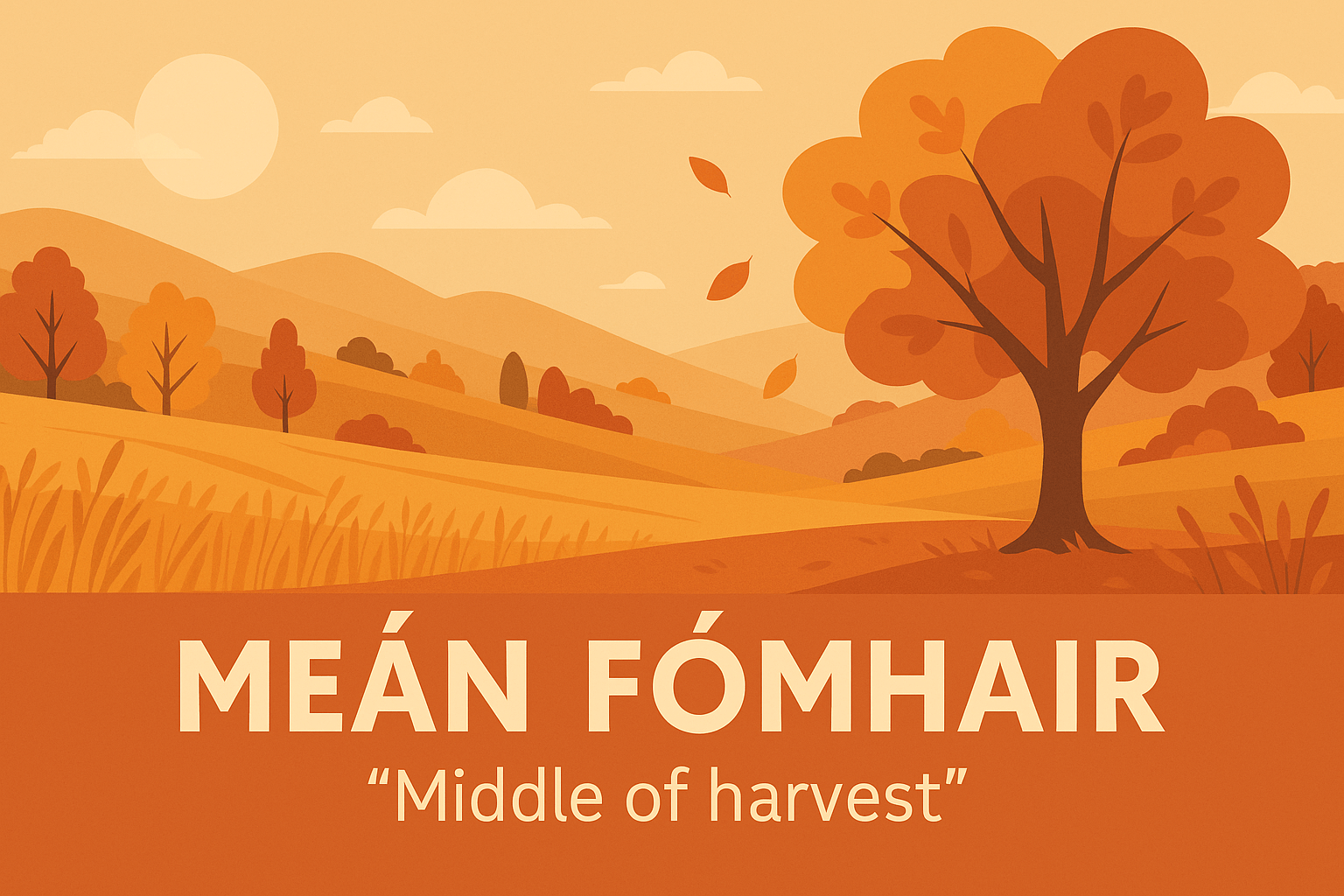
The Irish phrase meán fómhair holds a special place in the calendar—it’s the word for September in Irish and literally translates to “middle of harvest”. In this article we’ll look at meán fómhair, its meanings, pronunciation, grammar uses and how you can integrate it into your Irish language learning journey. Whether you’re using resources from Gaeilgeoir AI or simply exploring Gaelic, understanding meán fómhair gives your vocabulary a seasonal and cultural edge.


What Does Meán Fómhair Literally Mean?

Word-by-Word Breakdown

  • Meán means “middle” or “mid-”.
  • Fómhair comes from fómhar, which means “harvest” or “autumn”. teanglann.ie+3blogs.transparent.com+3Wiktionary+3
    So meán fómhair = “middle (of) harvest” → the harvest period around September.

Etymology & Seasonal Connection

In the traditional Irish calendar, meán fómhair marks the middle of the harvest season (between harvest beginning and end). For example, the following month is deireadh fómhair meaning “end of harvest”. blogs.transparent.com+1
This gives the word deeper meaning than simply “September” — it connects language to agriculture, season and tradition.

Usage in Irish

As illustrated in Irish dictionaries, meán fómhair is the standard term for September:

“The fifth day of September, an cúigiú lá de mhí Mheán Fómhair.” teanglann.ie
It can appear in phrases like:

  • i mí Mheán Fómhair – in the month of September
  • an chéad lá de mhí Mheán Fómhair – the first day of the month of September blogs.transparent.com+1

Pronunciation Guide: Saying Meán Fómhair Correctly

Pronunciation is key when learning Irish. Here’s how to say meán fómhair:

  • Meán → roughly MYAWN (the “ea” sounds like “aw”, slender “n”)
  • Fómhair → roughly FOH-irh (genitive fómhair with “mh” silent, “air” rh-ish) blogs.transparent.com+1
    So together: MYAWN FOH-irh
    You can practise this alongside other month-names to build rhythm and familiarity.

Grammar Notes: How Meán Fómhair Works in Sentences

Genitive Usage

Because fómhair is the genitive form of fómhar, the full phrase meán fómhair literally means “middle of harvest”. blogs.transparent.com
In sentences you may see:

  • I mí Mheán Fómhair… (“In the month of September…”)
  • An chéad lá de mhí Mheán Fómhair. (“The first day of the month of September.”)

Capitalisation & Usage

  • As a month name, Meán Fómhair is often capitalised in Irish.
  • When speaking about months in general you’ll see mí Mheán Fómhair (the month of September).
  • Use the preposition i for “in”, as in i mí Mheán Fómhair.

Related Terms

  • Fómhar – harvest, autumn.
  • Deireadh Fómhair – the month of October (“end of harvest”). blogs.transparent.com+1
  • An fómhar – the harvest itself; e.g., an fómhar i bhfad níos fearr i mbliana.
    Understanding these helps your vocabulary go beyond one word.

Why Meán Fómhair Matters for Learners of Irish

Cultural and Seasonal Relevance

Using meán fómhair is a chance to link vocabulary with the seasons and culture: the harvest, autumn, mythology and language come together.

Vocabulary Enrichment

Learning meán fómhair helps you:

  • Remember month names in Irish.
  • Understand root words like fómhar.
  • Recognise genitive forms and seasonal vocabulary.

Practical Application

You can practise the word with simple sentences:

  • Tá siad ag obair idir Meán Fómhair agus Deireadh Fómhair.
  • I mí Mheán Fómhair, tagann an bhfómhar go hiomlán.
    And integrate it into your language practice.

If you’re just starting, explore our Irish Language Lessons for Beginners to build strong foundations.


Ways to Use Meán Fómhair in Your Study Routine

Here are practical tips to include this word in your learning plan:

✅ Flash-card Technique

  • Front: Meán Fómhair
  • Back: “September / middle of harvest”
    Do one card per week for months, tie each to meaning and season.

✅ Sentence Builder

Create sentences incorporating the word:

  1. I mí Mheán Fómhair, casfaidh siad an rothair gach maidin.
  2. An chéad lá de Mhí Mheán Fómhair is ea mo lá breithe.
  3. Is aoibhinn liom an fómhar idir Meán Fómhair agus Deireadh Fómhair.

✅ Culture-Link Exercise

Research traditional harvest activities in Ireland during Meán Fómhair. Link words like fómhar, meán, ag baint féir, grainneach. This breathes life into the vocabulary you’re studying.

✅ Monthly Reflection

At the publication of Meán Fómhair (September), write a short journal entry in Irish saying something like:

“Táimid i mí Mheán Fómhair anois. Tagann an fómhar go géar. …”
It uses the word contextually and helps commit it to memory.


Seasonal Themes: Meán Fómhair and Autumn Vocabulary

Exploring meán fómhair opens the door to a rich set of autumn-and-harvest vocabulary:

  • earrach / samhradh / fómhar / geimhreadh – spring / summer / harvest/autumn / winter
  • bailiúchán – harvest
  • fómhar beag – little harvest / Indian summer blogs.transparent.com
  • leathar/leath-fómhair – late harvest (less common)
  • seanfhocail – old sayings related to harvest or Meán Fómhair

By studying meán fómhair, you link not only a calendar term, but seasonal culture and idioms.


Common Mistakes Learners Should Avoid

  1. Spelling mistakes: Always use the fada (accent) on méan and fómhair.
  2. Mispronunciation: Avoid saying the “mh” in fómhair like “v” unless dialect dictates.
  3. Month confusion: Don’t mix up meán fómhair (September) with mí Mheán Fómhair (the month of September) or deireadh fómhair (October).
  4. Using without article: In many contexts you need (month) before: mí Mheán Fómhair.

To avoid these, you may wish to check our Fada Keyboard Shortcut Guide to type Irish accents correctly.


Bringing It All Together: A Seasonal Step in Your Irish Journey

Learning one word like meán fómhair may seem small, but it represents a meaningful step. It connects you to the calendar, the seasons, agriculture, language structure and culture. As you progress with Gaeilgeoir AI’s resources and interactive games, phrases like this enrich your vocabulary and deepen your contextual understanding.

Here’s a quick recap:

  • Meaning: literally “middle of harvest”, standard Irish for September.
  • Pronunciation: MYAWN FOH-irh
  • Grammar: uses genitive fómhair, common in month names.
  • Study tips: flash-cards, sentences, season-link exercises.
  • Why learn it: seasonal relevance, cultural connection, vocabulary builder.

So as the autumn leaves begin to fall and harvest time continues, embrace the word meán fómhair in your learning. Write a short line in Irish today:

“Seo í mí Mheán Fómhair. Tá an fómhar ag tosú go hiomlán.”
(“Here is the month of September. The harvest is beginning fully.”)


Ready to build more Irish vocabulary and engage with real-life phrases tied to culture? Head over to learn.gaeilgeoir.ai and explore interactive lessons, fun vocabulary sets and seasonal modules like meán fómhair. Let your Irish learning grow with the seasons—starting this September.

Go n-éirí le tú! May your Irish journey flourish this Meán Fómhair and beyond.

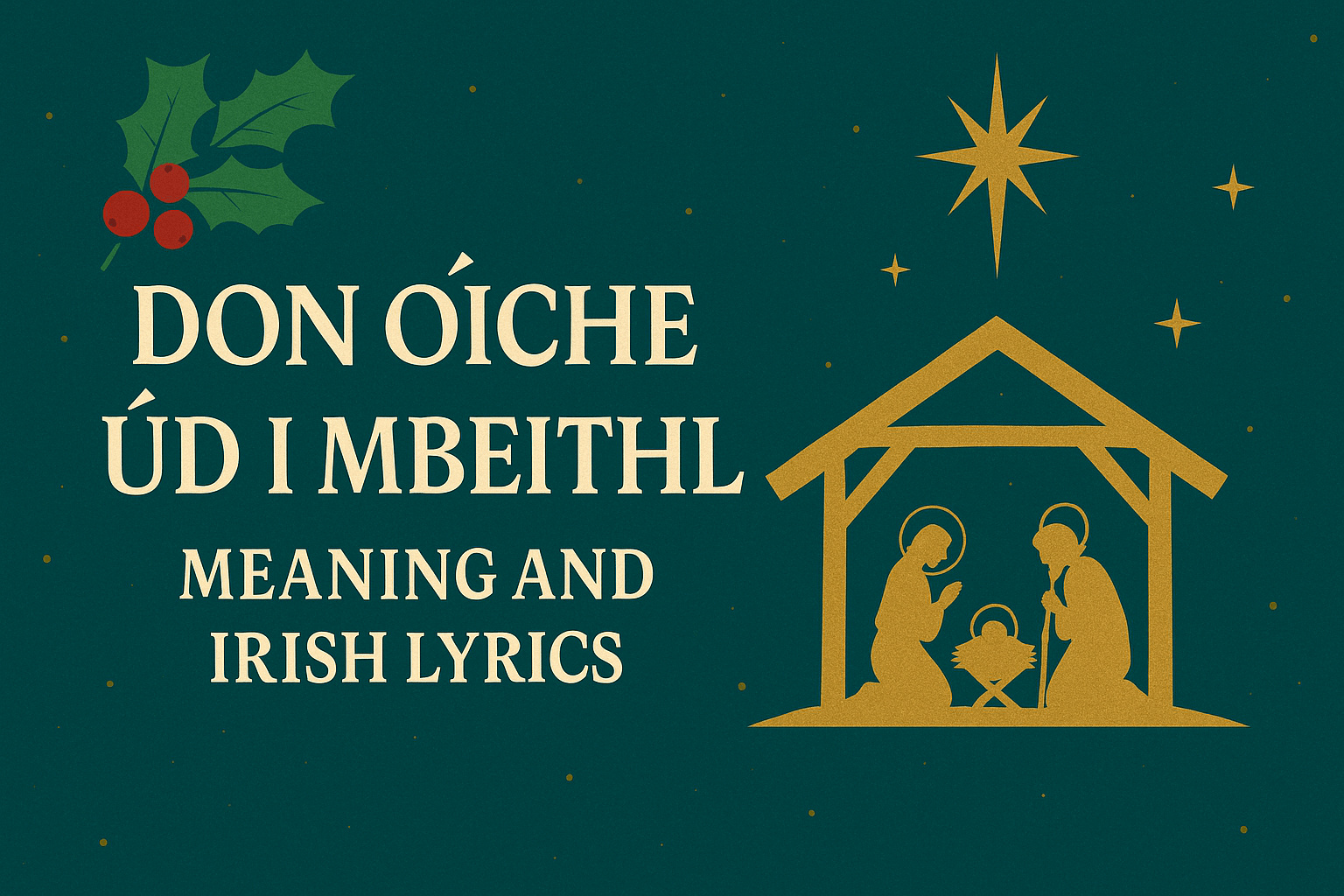
Don Oíche Úd i mBeithil: Meaning and Irish Lyrics

There are few Irish Christmas songs as beloved and evocative as “Don Oíche Úd i mBeithil” — a hauntingly beautiful carol that captures both the tenderness and mystery of Christmas Eve. The title translates to “That Night in Bethlehem,” and the song tells the story of Christ’s birth through the lyrical beauty of the Irish language (Gaeilge).

This timeless hymn is cherished not only for its gentle melody but also for its linguistic and cultural depth. Sung across Ireland during the festive season, Don Oíche Úd i mBeithil represents the enduring bond between faith, heritage, and the Irish tongue — a language that continues to thrive today thanks to modern learning tools like Gaeilgeoir AI, which helps learners practice Irish through intelligent technology.

In this article, we’ll explore the meaning, history, lyrics, and cultural significance of Don Oíche Úd i mBeithil, along with guidance on pronunciation and tips for learning Irish through traditional songs.


The Origins of Don Oíche Úd i mBeithil

The origins of Don Oíche Úd i mBeithil are somewhat mysterious. While many assume it is an ancient carol, the earliest known written versions date from the 17th or 18th century. However, its style and phrasing suggest it may have originated as part of Ireland’s oral folk tradition, passed down through generations of singers and storytellers before being written down.

The melody’s simplicity — often performed in a lilting 3/4 time — reflects the musical traits of Irish traditional airs, while the lyrics showcase classical Irish syntax and poetic rhythm.

The title phrase, Don Oíche Úd i mBeithil, literally means “That night in Bethlehem,” referring to the birth of Christ. Yet, beyond its religious theme, it captures the spirit of community and peace central to the Irish celebration of Christmas (Nollaig).


Irish Lyrics of Don Oíche Úd i mBeithil

Here are the traditional Irish lyrics, often sung a cappella or accompanied by harp, fiddle, or uilleann pipes:

Don oíche úd i mBeithil,
bhí geantrai is gair i ngach tí,
agus ornaí na spéartha
ag canadh ‘do chroíthe glé-ghiúmar.
Bhí maighdean ag caoineadh,
is leanbh a ghaoil á rugadh í,
don oíche úd i mBeithil,
go dtáinig an saor don tsaol.

English Translation

That night in Bethlehem,
there was music and laughter in every home,
and the ornaments of the heavens
were singing joyfully in your heart.
There was a maiden crying softly,
while her beloved child was being born,
that night in Bethlehem,
when the savior came into the world.


Understanding the Meaning and Message

The song is simple but profound. It evokes the quiet intimacy of Christmas night, focusing on the humble birth of Christ and the universal emotions of love, awe, and hope.

Let’s explore its key themes:

  • Humility and Humanity: The imagery of a maiden weeping while her child is born conveys both sorrow and joy — a recognition of the humanity of Mary and Jesus.
  • Celestial Joy: The “ornaments of the heavens” (ornaí na spéartha) symbolize the stars and angels, celebrating this sacred night.
  • Peace and Renewal: Like many Irish carols, it reflects the longing for spiritual peace and unity — themes especially resonant in Irish history.

For those interested in learning more about traditional Irish symbolism and language structure, our Ancient Irish Language Guide explores how Irish conveys layered meaning through poetic phrasing.


Pronunciation Guide for Learners

Irish pronunciation can be a challenge for beginners, but singing songs like Don Oíche Úd i mBeithil helps learners develop a natural rhythm and sound pattern.

Here’s a simplified pronunciation (in English phonetics):

  • Don Oíche Úd i mBeithilDun ee-ha ood i meh-hil
  • Bhí geantrai is gair i ngach tívee gyan-tree iss gair i ngach tee
  • Agus ornaí na spéarthaah-gus or-nee na spay-er-ha
  • Bhí maighdean ag caoineadhvee my-den egg kee-nah

Each syllable carries its own rhythm, and when sung slowly, the words flow naturally.

If you want to build pronunciation skills and master Irish sounds like bh, ch, th, and mh, try our Irish Pronunciation Guide.


Cultural Significance in Ireland

1. A Christmas Tradition

Don Oíche Úd i mBeithil is a staple of Irish Christmas celebrations, sung at midnight Mass, school concerts, and carol services throughout the country. Unlike many Western carols, it’s performed in Irish, symbolizing the preservation of cultural and linguistic heritage.

2. A Symbol of Revival

During the Irish language revival movement in the 20th century, carols like Don Oíche Úd i mBeithil became important tools for education and national pride. Singing the song helped young people reconnect with their ancestral language in an emotional and accessible way.

3. A Song of Peace

Because of its gentle melody and universal message, the carol is also performed in multilingual or interfaith Christmas services, representing Ireland’s identity as both ancient and inclusive.

For more on how Irish traditions connect language and spirituality, see our article on Irish Fairies and Folklore Traditions.


Learning Irish Through Music

Music is one of the most enjoyable and effective ways to learn a language. Songs like Don Oíche Úd i mBeithil provide learners with memorable vocabulary, clear pronunciation patterns, and emotional engagement.

Here are a few ways to make the most of learning Irish through music:

1. Listen and Repeat

Find a recording of Don Oíche Úd i mBeithil — for instance, beautiful renditions by The Chieftains, The Dubliners, or Cór Na nÓg — and sing along. The repetition helps reinforce pronunciation and rhythm.

2. Break Down Vocabulary

Identify words and phrases to build your vocabulary:

  • Oíche — night
  • Beithil — Bethlehem
  • Leanbh — child
  • Saor don tsaol — savior of the world
  • Croí — heart

3. Translate Actively

Try translating Irish carols or folk songs line by line. This builds comprehension skills and gives you a deeper sense of Irish grammar and syntax.

For a structured learning experience, explore our Irish Language Lessons for Beginners — a perfect starting point for understanding Irish through culture.


The Beauty of Faith and Language in Harmony

Don Oíche Úd i mBeithil is not just a Christmas carol — it’s a linguistic bridge between faith, poetry, and national identity. When sung in Irish, it reminds us how language shapes our understanding of joy, compassion, and the divine.

The Irish language (Gaeilge) is uniquely expressive, with phrases that carry warmth, humility, and a deep connection to nature and emotion. Singing as Gaeilge allows you to experience these nuances directly, rather than through translation.

For many learners, mastering a song like Don Oíche Úd i mBeithil becomes a moment of pride — a milestone in their journey to fluency.


How Gaeilgeoir AI Helps You Learn Songs Like Don Oíche Úd i mBeithil

Gaeilgeoir AI combines artificial intelligence with linguistic expertise to help learners understand and speak Irish naturally. Using voice recognition, pronunciation feedback, and interactive lessons, the platform enables you to:

  • Practice pronunciation using real Irish recordings
  • Learn vocabulary in cultural context (like through carols and idioms)
  • Get instant translation support for Irish phrases
  • Track your progress with adaptive learning tools

You can start your Irish journey or continue improving by signing up for free at learn.gaeilgeoir.ai.

Conclusion: Keeping the Spirit Alive

Don Oíche Úd i mBeithil endures because it’s more than a song — it’s a window into the heart of Ireland. Through its gentle melody and poetic Irish lyrics, it connects listeners across generations and borders.

For learners of the Irish language, this carol is a beautiful reminder that every word, phrase, and sound carries a piece of living history. Whether you sing it at Christmas or study its meaning year-round, Don Oíche Úd i mBeithil will deepen your love for Irish and the culture it represents.

So light a candle, press play, and sing Don Oíche Úd i mBeithil with pride — keeping both language and tradition alive.

Start your journey with Gaeilgeoir AI today at learn.gaeilgeoir.ai — where Irish learning meets innovation and community.

focloir irish dictionary guide

If you’ve ever tried to look up an Irish word, you’ve probably encountered the term foclóir (pronounced fuk-lor). foclóir means dictionary in Irish, but it represents much more than that. It’s the key to unlocking the rich tapestry of Gaeilge, connecting past and present, and empowering new generations to learn and use the Irish language confidently.

A useful Irish dictionary guide should do more than define the word. It should help you choose the right tool, read entries properly, and avoid the common mistake of treating one translation as the whole story. In practice, that usually means starting with the official Focloir.ie dictionary from Foras na Gaeilge, then using other tools only when you need extra context, practice, or explanation.

How I Evaluated Irish Dictionary Resources

Resources were judged by the things learners need during a lookup: search accuracy for headwords and inflected forms, clarity on verbs and grammar, pronunciation help, quality of example sentences, dialect labeling, and whether the tool is official or free to use. That matters because an Irish dictionary is not just a word list; it is often your first source for gender, register, usage, and whether a phrase is natural at all.

I also gave extra weight to resources that help beginners recover from imperfect searches. In my own testing, the biggest frustration was not obscure vocabulary — it was simple cases like entering a conjugated verb or a mutated form and needing to work backward to the base entry. Tools that make that path obvious are far more useful day to day than tools that merely return a translation.

Cost and authority mattered too. The official Foras na Gaeilge dictionary site states that its dictionaries are free of charge and adapted for desktop and mobile devices, which makes it a strong default for most learners. And the historical depth behind any foclóir is not trivial: according to Conradh na Gaeilge facts and figures, the earliest surviving written Irish appears on Ogham stones from the 5th and 6th centuries, with Irish written in the Roman alphabet before the beginning of the 7th century.

What Does Foclóir Mean?

The Irish word foclóir derives from two parts:

  • focal – meaning word
  • lóir / lóir – from lóramh, meaning collection or array

Put together, foclóir means a collection of words, which perfectly describes a dictionary.

In modern usage, foclóir refers to both printed dictionaries and digital resources. It’s also used metaphorically to describe a person’s vocabulary — so when someone says mo fhoclóir féin (my own foclóir), they’re talking about their personal store of words, not a book.

The History of the Irish Foclóir

Early Word Lists and Glossaries

The concept of a foclóir in Irish goes back over a thousand years. Irish monks were among the earliest lexicographers in Europe, creating glossaries of difficult words in manuscripts such as the Sanctan Foclóir and the O’Mulconry Glossary (c. 1200s).

These early foclóirí (plural) were more than word lists — they were cultural bridges, explaining Old Irish terms, Latin borrowings, and theological vocabulary. They helped preserve Irish literacy during centuries of social and linguistic change.

The Rise of Printed Foclóirí

By the 18th and 19th centuries, Ireland saw the emergence of printed dictionaries aimed at bilingual readers. Notable among these was “Foclóir Gaoidhilge-Sacs-Bhéarla” by Rev. Edward O’Reilly (1817), a monumental Irish-English dictionary that set the foundation for modern lexicography.

Later came works such as:

  • Dinneen’s Foclóir Gaedhilge agus Béarla (1904) — an invaluable resource for early 20th-century learners.
  • Foclóir Póca — the handy pocket dictionary that many Irish schoolchildren still use.

These dictionaries didn’t just translate — they captured idioms, dialects, and poetic expressions, keeping Irish alive across generations.

The Digital Revolution of Foclóir

Today, foclóir.ie, developed by Foras na Gaeilge, stands as the official digital Irish-English dictionary, freely accessible to learners worldwide. It offers audio pronunciation, grammar notes, and real examples of usage.

This online foclóir shows how technology continues the Irish tradition of linguistic innovation. It’s no surprise that AI-powered learning platforms like Gaeilgeoir AI are now taking this digital transformation even further.

How Gaeilgeoir AI Elevates the Modern Foclóir

The better question is not whether an AI tool replaces Focloir.ie. It does not. The useful question is when an official dictionary is enough, and when an AI-assisted tool adds something the dictionary does not.

For straightforward lookups, Focloir.ie should usually be your first stop. It is the official Irish-English dictionary site, it is free, and it is built for reference work: base meanings, parts of speech, grammar cues, pronunciation, and examples. If you want to check whether a noun is masculine or feminine, compare two senses of a common word, or confirm a standard translation before using it in writing, this is the cleaner option.

AI-assisted tools become more helpful after the dictionary stage. If the entry gives you the right word but you still do not understand why one example sounds natural and another does not, an AI tutor can explain patterns, generate extra practice, or turn the result into drills. I find this especially useful when a dictionary answer is correct but still not memorable.

Three common lookup scenarios make the difference clear:

  • Checking a verb form: If you meet an inflected form in reading, the dictionary helps you identify the lemma and meaning. An AI tool can then explain what tense or person you saw and give two or three parallel examples.
  • Comparing multiple meanings: A word with several English equivalents is best checked in the official entry first. After that, AI can help you sort which sense fits a conversation, schoolwork, or storytelling context.
  • Testing an idiom: A dictionary can confirm whether the phrase is attested or whether the key words belong together. AI is useful afterward for paraphrasing, practice sentences, or explaining why a literal translation sounds off.

The limitations matter too. Dictionaries are excellent at authority and precision, but they do not always hold your hand through confusion. AI tools are excellent at explanation and practice, but they can sound confident about phrasing that is merely plausible. In my own use, the safest workflow is simple: verify with the dictionary first, then use AI to deepen understanding rather than to invent vocabulary from scratch.

That also makes independent study more sustainable. If you like listening-based practice alongside lookups, there is a useful overview of language-learning audio formats over at SparkPod, which pairs well with dictionary-first study.

Why Foclóir Is the Key to Irish Fluency

A foclóir isn’t just for translation — it’s a roadmap to thinking in Irish. Here’s why mastering it matters:

1. Builds Natural Vocabulary

The Irish language doesn’t always map directly onto English. For example:

  • Fáilte means welcome but conveys a whole cultural warmth.
  • Craic can mean fun, news, or banter, depending on tone.

A good foclóir teaches meaning in context — not just literal translations.

2. Reveals Cultural Layers

Irish words often carry centuries of storytelling. Learning through foclóir helps you uncover the soul of Irish culture — from mythology to modern slang.

3. Improves Grammar Understanding

In Irish, words shift depending on gender, lenition, and case. Quality foclóirí explain these grammatical nuances clearly, helping learners avoid common mistakes.

For more guidance on avoiding pitfalls, check out Common Mistakes in Irish.

4. Empowers Independent Learning

With tools like Gaeilgeoir AI’s built-in foclóir, you can explore words at your own pace and style — making language learning self-directed and rewarding. Used well, that means checking an official entry first, then turning the result into your own notes, review prompts, or listening practice.

Using Foclóir as a Daily Learning Tool

The most effective way to use an Irish dictionary is to treat each lookup as a small reading lesson, not a one-word transaction. A good routine is: search the headword, inspect the grammar, listen to pronunciation, read at least one example sentence, and then save the result in your own notes with one phrase you would realistically use.

1. Search the headword first

If you already know the base form, begin there. A strong dictionary entry should tell you the part of speech, main senses, and whether the word has more than one common translation. Focloir.ie is especially useful; it is built for quick confirmation rather than broad guesswork. When I check a familiar word, I usually look first at the examples rather than the first translation line, because the examples reveal register and normal collocation faster.

2. If the form looks odd, work backward

Irish learners often meet words in mutated or inflected forms before they know the dictionary headword. Verbs are the classic example. If a form does not look like the one you memorised, do not assume it is a different word; try to identify the base verb and then confirm it in the dictionary. The same goes for plural nouns, possessive forms, and lenited spellings.

A practical habit is to ask four questions during a difficult lookup:

  • What is the base form?
  • What part of speech is this?
  • What does the example sentence show that the plain translation does not?
  • Is this form standard, regional, or tied to a specific context?

3. Read the example sentences, not just the gloss

Example sentences are where a dictionary stops being a list and starts becoming a teacher. They show whether a word sounds formal, conversational, idiomatic, or restricted to one type of context. In my experience, learners who skip examples tend to memorise English pairings; learners who read examples start noticing how Irish builds meaning.

4. Save the result in a personal vocabulary list

Do not save single words alone. Save the headword with one pronunciation note, one grammar cue, and one real phrase. That makes review much easier later.

A simple entry might look like this:

  • Headword: bris
  • What to note: verb; watch for changed forms in context
  • Pronunciation help: listen to the audio on the dictionary entry rather than guessing from spelling
  • Useful phrase: save one short example sentence from the entry

Worked example: from search to usable phrase

Suppose you meet an unfamiliar word in a sentence and trace it back to a headword on Focloir.ie. Your next steps should be deliberate:

  1. Open the headword entry and identify whether it is a noun, verb, or adjective.
  2. Play the pronunciation audio so your first memory of the word is sound plus spelling.
  3. Check grammar notes for gender, irregularity, or verb behavior.
  4. Read one example phrase and ask what extra information it gives you beyond the translation.
  5. Save that phrase into your own vocabulary list, not just the isolated word.

That workflow is slower than copying a translation, but it produces better retention. I have found that one carefully read entry is worth more than ten rushed lookups.

5. Turn lookup results into review

Once you have a small list, revisit it later in the day. Say the words aloud, cover the English, and try to recall the example phrase. If you use Gaeilgeoir AI after the dictionary step, this is the moment to turn those saved items into flashcards or short quizzes rather than beginning with AI guesses.

6. Connect dictionary work to real Irish

A foclóir becomes much more useful when you meet the same word in songs, proverbs, or articles. That is where meaning stops feeling abstract.

You can explore examples in Exploring Seanfhocail: Irish Proverbs.

How Foclóir Differs Across Dialects

Irish dictionary entries do not erase dialect difference; they help you notice it. The key skill for learners is not memorising every regional variant at once, but learning how to read labels and examples without assuming that one familiar form is the only correct one.

For beginners, dialect labels matter most in three cases: when a pronunciation differs noticeably, when a common everyday word has a regional preference, and when you are studying with teachers or media rooted in one Gaeltacht tradition. If you are still building core vocabulary, you do not need to panic every time you see variation. What matters is recognising that variation exists and noting which form your course, teacher, or listening material tends to use.

Authoritative reference tools often signal this through usage labels, examples, or alternative forms rather than long explanations. The tearma.ie language resources from Foras na Gaeilge are a helpful reminder that standardisation and real usage are not the same thing: a term can be standardised for one context while spoken Irish still shows regional preference.

Here is a more useful way to think about dialect examples:

Example area What you may notice What the learner should do
Common noun choice One region may prefer a different everyday word or form Note the form, but do not mark other regional variants as wrong unless your source clearly says they are nonstandard
Pronunciation The spelling may stay the same while the sound shifts by region Listen to audio or native speech from your target dialect before trying to imitate it
Verb or phrase preference Two versions may both be understandable, with one sounding more local Follow the pattern used in your class or chosen dialect, and keep the other as passive recognition

A practical example is this: a dictionary may give you a standard form, but a song, radio clip, or native speaker from Ulster may prefer a different pronunciation or phrasing. That is not a contradiction; it is part of how Irish lives across regions. I have seen beginners lose confidence here because they think the dictionary has "corrected" the dialect out of the language. A better approach is to treat the entry as a map, then let real usage show you the terrain.

For more on dialectal distinctions, visit Dialectal Differences in Irish.

English Munster Connacht Ulster
Girl Cailín Cailín Nighean
Quick Sciobtha Tapaidh Luath
Talk Caint Caighdeán Labhairt

Beyond Translation: The Living Power of Words

Irish isn’t just a system of grammar — it’s a worldview. Every foclóir captures a piece of that worldview:

  • Grá (love) embodies emotion beyond romance.
  • Tírghrá (love of country) reflects Irish identity and belonging.
  • Dóchas (hope) holds spiritual depth shaped by centuries of resilience.

When learners interact with words on this level, they connect emotionally with the language — and that’s where true fluency begins.

The Role of AI in Modern Irish Learning

AI can make Irish study more responsive after the reference stage: it can explain patterns, generate review material, and adapt practice to the learner. But its value is strongest when it follows authoritative dictionary work rather than replacing it.

Platforms like Gaeilgeoir AI are useful in that follow-up role, blending the enduring value of a foclóir with interactive practice and explanation.

Foclóir in Everyday Expressions

This is the point where dictionary users need to be cautious. Idioms, collocations, and attractive-sounding phrases are exactly where learners memorise bad Irish if they rely on unsourced lists. A foclóir is useful here, but not always by giving a single neat definition. More often, it helps you verify whether the key words belong together, whether the phrase appears in example usage, and whether the wording is standard or tied to one context.

A safer method is:

  1. Check the main word in the dictionary.
  2. Look for example sentences or linked phrases.
  3. Confirm the wording in a second authoritative source if the phrase looks fixed or proverbial.
  4. Only then save it for study.

Two good places to cross-check are the official Focloir.ie dictionary for examples and teanglann.ie resources for supporting lexical and pronunciation context. When I am unsure whether a phrase is current or just plausible, I do not memorise it until I have seen it used by a reliable source.

Here are a few grounded examples of what to notice:

  • Fáilte roimh, the individual word fáilte is easy enough, but the phrase pattern matters. A dictionary example helps show that the welcome is expressed with a following structure, not just by translating word for word from English.
  • Tabhair aire …, this is a good example of a common expression where the verb-noun pairing matters more than the English gloss. You want to learn the phrase as a unit, not merely the separate words.
  • Seanfhocail and fixed sayings, with proverbs especially, verify the whole expression in a reliable source rather than trusting an AI-generated paraphrase. Proverbs often survive in established wording that should be learned as a set phrase.

The practical lesson is simple: memorise expressions that are evidenced, not merely imaginable. That habit saves a lot of later correction.

Frequently Asked Questions

What is a focloir?

A foclóir is a dictionary. In Irish, the word refers both to a dictionary as a reference book or website and, in some contexts, to a person’s vocabulary more generally. In everyday learner use, it usually means an Irish dictionary such as Focloir.ie.

Is Focloir free to use?

Yes. The official about page for Focloir.ie says the available dictionaries are free of charge and adapted for desktop and mobile devices. That makes it one of the best first-stop resources for learners who want an official reference without a subscription.

How do I use Focloir.ie for Irish words?

Start by searching the base form of the word if you know it. Then check the part of speech, listen to the pronunciation, read at least one example sentence, and note any grammar guidance. If your result is an inflected or mutated form, work backward to the headword before memorising anything.

How is Focloir.ie different from a general translator?

Focloir.ie is a dictionary resource, not a general-purpose sentence translator. Its strength is reliable word-level and phrase-level reference: meanings, examples, pronunciation, and usage clues. A translator tries to produce a whole sentence, which can be convenient, but it may hide uncertainty and give learners phrasing they cannot yet evaluate.

When should I use an AI tool instead of an Irish dictionary?

Use the dictionary first when accuracy matters: checking a headword, comparing meanings, confirming grammar notes, or verifying whether a phrase is standard. Use AI after that when you want explanation, extra examples, flashcards, or personalised practice. The strongest workflow is dictionary for verification, AI for follow-up learning.

Do dialect labels matter for beginners?

Yes, but not at every lookup. They matter most when a word or pronunciation differs clearly by region, or when you are trying to follow a teacher, textbook, or media source rooted in one dialect area. Early on, the goal is awareness rather than mastery: recognise the label, note the variant, and keep moving.

Build Your Own Foclóir Today

Building your foclóir pearsanta is one of the most fulfilling ways to grow in Irish. With Gaeilgeoir AI, you can:

  • Create your own smart word lists
  • Hear authentic Irish pronunciation
  • Test yourself with AI-powered quizzes
  • Connect with a community of learners

👉 Start your free journey today at learn.gaeilgeoir.ai — and let your foclóir grow with you.

Final Thoughts: The Future of Foclóir

The foclóir has always been a mirror of the Irish mind — reflecting history, humor, and heart. From monastic glossaries to AI-driven apps, it continues to evolve, proving that Irish is as vibrant and adaptable as ever.

So next time you open a dictionary or search a word on Gaeilgeoir AI, remember: you’re not just learning vocabulary — you’re part of a living tradition that celebrates every focal (word) and every beatha (life) that speaks it.

Bíodh do fhoclóir agat. Bíodh do Ghaeilge beo.

(Have your dictionary. Keep your Irish alive.)

Start Speaking Irish Today — 25% Off
Use code START25

Learn real Irish for real life with guided practice, pronunciation support, and everyday conversations.

Get 25% off any plan with code START25

Start Speaking Irish Today — 25% Off