How to Say Merry Christmas in Irish Perfectly

The holiday season is a time of warmth, joy, and cultural richness, and what better way to immerse yourself in Irish traditions than by learning to say “Merry Christmas in Irish”? Whether you’re visiting Ireland during the festive season or just wish to add a touch of Irish flair to your holiday greetings, knowing the proper expression can make all the difference. Here at Gaeilgeoir AI, we are dedicated to helping you embrace Irish phrases and their correct usage with ease, ensuring your festive wishes are both authentic and heartfelt.

Understanding “Merry Christmas in Irish”

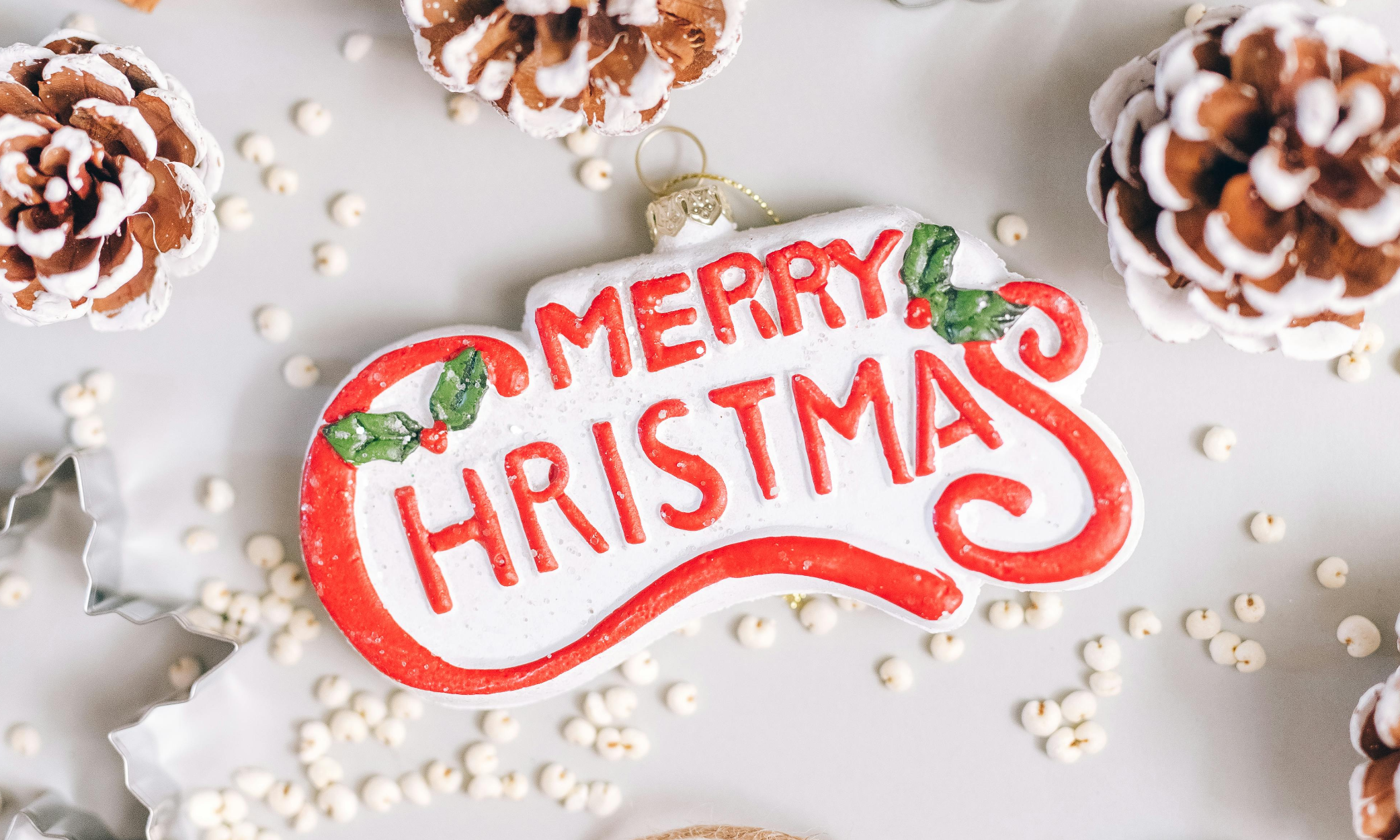
The classic Irish greeting for “Merry Christmas” is “Nollaig Shona Dhuit!” (pronounced Null-ig Hona Ghwitch). This vibrant phrase is more than just a festive greeting; it’s a direct reflection of Ireland’s rich linguistic heritage and the joyous spirit of its people during the holiday season.

Pronunciation and Usage

Proper pronunciation is key to ensuring your holiday greeting is well-received:

  • Nollaig: Sounds similar to “Null-ig,” where ‘Noll’ rhymes with ‘toll’.
  • Shona: Pronounced as “Hona,” with a soft, almost silent ‘h’.
  • Dhuit: Sounds like “Ghwitch,” with ‘Dh’ producing a soft ‘gh’ sound, almost like the ‘ch’ in the Scottish “loch”.

Cultural Significance of Christmas Greetings in Irish

In Ireland, Christmas is not just a time for festivity but also for cultural reflection and Gaelic pride. Using the phrase “Nollaig Shona Dhuit” not only shows respect for the language but also enhances your bonding with Irish speakers. It reflects an appreciation of Irish traditions and the broader Celtic heritage, making your interactions deeper and more meaningful.

Practical Tips for Using “Nollaig Shona Dhuit”

  • Personal Greetings: Use this phrase when meeting friends and family during the holiday season or when attending gatherings and parties.
  • Cards and Emails: Incorporate “Nollaig Shona Dhuit” in your holiday cards and emails to bring an authentic Irish touch to your written communications.
  • Social Media: Share your holiday spirit and new language skills with friends online using this festive Irish greeting.

How Gaeilgeoir AI Helps You Master Holiday Phrases

Our AI-powered platform is designed to offer you an engaging learning experience with:

  • Interactive Pronunciation Tools: Practice saying “Nollaig Shona Dhuit” with instant feedback from our AI system.
  • Cultural Insight Lessons: Learn about Irish Christmas traditions and how language plays an integral role in the celebrations.
  • Holiday-Themed Practice Sessions: Engage in simulated conversations to gain confidence in using holiday phrases appropriately.

Incorporating “Merry Christmas in Irish” into Your Celebrations

To make “Nollaig Shona Dhuit” a natural part of your festive vocabulary:

  • Daily Language Practice: Start each day by saying “Nollaig Shona Dhuit” to your family or even your pets.
  • Cultural Immersion Activities: Watch Irish Christmas movies or listen to Celtic holiday music to hear the phrase used in context.
  • Community Engagement: Participate in Irish language meet-ups or online forums where holiday greetings can be practiced and appreciated.

Beyond “Merry Christmas”: Other Irish Holiday Phrases

Once you’ve mastered “Nollaig Shona Dhuit,” expand your festive lexicon with other Irish holiday phrases. Our Guide to Learning Gaelic includes more seasonal expressions that are perfect for every festive occasion.

Conclusion

Expressing “Merry Christmas” in Irish is a wonderful way to celebrate the season while honoring Ireland’s cultural heritage. With Gaeilgeoir AI, you’re not just learning a phrase; you’re embracing a piece of Irish holiday spirit. Allow the charm of the Gaelic language to infuse your festivities with a unique warmth this year.

Ready to learn more?

Ready to fill your holidays with the magic of Ireland? Sign up for a free trial at Gaeilgeoir AI and start learning today! Join our community of language learners and make this festive season beautifully bilingual.

Understanding the Meaning Behind ‘Slán go fóill’

“Slán go fóill” means “goodbye for now” in English. In everyday use, it carries the sense of “see you later” rather than a final farewell, so it fits best when you expect to speak again soon.

That direct meaning matters because learners often see the phrase written in several ways online, including accented and unaccented forms. In standard Irish, the usual spelling is slán go fóill; in casual typing, people may drop the fada and write slan go foill. That spelling variation causes confusion, so it helps to answer it upfront.

How We Interpreted and Checked ‘Slán go fóill’

To update this page, we checked the phrase against beginner-friendly Irish references, pronunciation guidance, and examples of real teaching usage rather than relying on unsourced dictionary snippets. For meaning and learner usage, we compared explanations from Irish-learning materials such as Bitesize Irish on slán go fóill, and for spoken rhythm we cross-checked video pronunciation rather than trusting loose English spellings alone.

We also treated weak evidence cautiously. A claim counted as useful only if it matched standard Irish spelling, common teaching practice, or a clear audio example; vague forum paraphrases and decorative “Gaelic quote” posts did not. The most common problem is not the translation itself but the jump from literal meaning to real-life use: learners may know it means goodbye, but not why it sounds softer and more temporary than a plain slán.

As context, Irish is not a niche curiosity phrase bank: the 2022 Census recorded roughly 1.87 million people in Ireland with some ability in Irish. That makes everyday farewells like slán go fóill especially worth explaining clearly.

Understanding the Meaning Behind ‘Slán go fóill’

Slán go fóill means “goodbye for now,” and a natural English equivalent is often “see you later.” The literal pieces point to safety and temporary parting, but in normal conversation the phrase is less poetic than that sounds: it is a warm way to end an interaction when the relationship continues.

The key nuance is that it is not as final as a plain “goodbye.” If you are leaving a call, finishing a visit, or ending a work chat with the expectation of meeting again, slán go fóill fits naturally. Once you stop translating each word in isolation and start hearing it as a temporary farewell, the phrase becomes much easier to use correctly.

It also appears in teaching material very early. The phrase is introduced as “goodbye for now” in this video explanation, and it shows up often in beginner resources because it is practical, common, and easy to reuse in conversation. If you are studying with digital tools, this broader guide from Cramberry is a useful reminder to use AI for repetition and checking, not as a substitute for listening to real speech.

Let’s break down the phrase into its main parts:

1. Slán

  • Root meaning: “safe,” “well,” or “goodbye” in farewell use
  • Can stand on its own as a simple parting word
  • Keeps the sense of wishing someone well as they leave

2. Go

  • Links the parts of the phrase together
  • In this expression, helps carry the sense of “for” or “until”
  • Works as the bridge between the farewell and the temporary time frame

3. Fóill

  • Means “for now” or “for the time being” in this fixed phrase
  • Signals that the separation is temporary
  • Adds the idea that contact or meeting will happen again

Put together, the phrase gives you a farewell with an implied return: “goodbye for now,” “bye for the moment,” or “see you later.” That is why slán go fóill usually sounds warmer than a bare slán.

Here are a few concrete examples:

  • Use it: After coffee with a friend — “I’ll text you later. Slán go fóill.
  • Use it: At the end of a phone call with family — “Talk tomorrow. Slán go fóill.
  • Usually don’t use it: In a permanent goodbye or a solemn parting where “for now” would sound too light.

You may also see spelling variants in informal writing, especially slan go foill without accents. The standard Irish form uses fadas — slán go fóill — and that is the form worth learning, even if text messages and quick typing often strip accents.

Mastering the Pronunciation of ‘Slán go fóill’

A clear learner-friendly pronunciation is: slawn guh FOH-il. The strongest stress usually falls on slán first, then lightly on fóill, with go kept short in the middle.

If you want a slower careful version, say it in three beats: SLAWN / guh / FOH-il. In faster natural speech, the middle word often reduces further, so the phrase can sound closer to slawn-guh-FOH-il said in one smooth movement. Many English-style phonetic spellings overcomplicate the last word; saying it too much like “foil” in English usually sounds off.

Phonetic Breakdown

  • Slán = “slawn” (rhymes closely with lawn)
  • go = “guh” or a very short unstressed “go” sound
  • fóill = approximately “FOH-il,” with the vowel held longer than beginners expect

Stress Pattern

  • Main emphasis on slán
  • go stays brief and unstressed
  • Secondary emphasis on fóill
  • The whole phrase should sound connected, not chopped into three isolated words

Common Learner Mistakes

  1. Saying fóill like English “foil.” The Irish word in this phrase is not best learned as a one-syllable English foil sound.
  2. Making go too strong. It should pass quickly; if you stress it, the phrase sounds stiff.
  3. Ignoring the long vowels. Shortening slán or fóill too much makes the phrase sound clipped.

How the Accents Change the Sound

The fada matters because it signals a long vowel. In slán, the á gives you the longer “aw” sound. In fóill, the ó lengthens the opening vowel, which is why the word starts with a fuller “foh” rather than a quick flat “fo.”

Unaccented spellings such as slan go foil or slan go foill are common online, but standard Irish keeps the accents. For pronunciation, it helps to remember that the written fada is a sound clue, not decoration.

Practice Methods

  1. Say each word separately three times.
  2. Join them slowly: slánslán goslán go fóill.
  3. Record one careful version and one faster natural version.
  4. Compare your recording with a native or teaching audio source.

Helpful Learning Resources

A simple self-check helps: if your version sounds like three separate English words, slow down and reconnect the rhythm. If it feels too dramatic, shorten the middle word and let the phrase flow as one unit.

Video Tutorial: Learning to Say ‘Slán go fóill’ Like a Pro!

Use the video below as a listening drill, not just a one-time watch. First, listen for where the speaker places the stress; then repeat the phrase 5 to 10 times, starting slowly and matching vowel length before you worry about speed. A useful self-check is to pause after each model pronunciation, record yourself once, and compare whether your slán is long enough and your go is short enough.

It also helps to listen for meaning while you practice. Because slán go fóill means “goodbye for now,” the tone should feel warm and temporary, like ending a call or leaving a short visit, not delivering a dramatic farewell.

The Cultural Significance Behind ‘Slán go fóill’ in Irish Society

The Irish language carries deep emotional meaning, and reflections on grief, memory, and place in pieces like The Geography of Sorrow show why parting expressions feel culturally resonant. Phrases like slán go fóill convey the warmth of Irish social connection without becoming overly sentimental.

The Importance of Community

Irish people value maintaining strong bonds within their communities. When someone says slán go fóill, they’re not merely saying goodbye – they’re expressing hope for the other person’s wellbeing until their next meeting. This sentiment mirrors the importance of everyday care, conversation, and return visits in Irish social life.

A Heartwarming Example

“Every morning, Mrs. O’Brien would stop by for her tea, chatting with everyone present. As she’d leave, her warm slán go fóill would echo through the room, making each person feel personally acknowledged and valued. The phrase wasn’t just a goodbye – it was her way of knitting the community together, one farewell at a time.”

The Broader Impact of Slán go fóill

The cultural impact of slán go fóill extends beyond casual interactions:

  • Family gatherings: Parents teaching children this phrase pass down not just words, but cultural values
  • Neighborhood connections: Regular use strengthens community bonds
  • Business relationships: Even professional settings benefit from this touch of warmth

What Slán go fóill Represents

This simple phrase embodies key aspects of Irish social culture:

  1. Genuine interest in others’ wellbeing
  2. Recognition of shared community bonds
  3. Promise of future connections

The use of slán go fóill in daily life demonstrates how language shapes social relationships and preserves cultural values. Each utterance reinforces the Irish commitment to maintaining meaningful connections, making every goodbye a bridge to the next hello.

Using ‘Slán go fóill’ Appropriately in Different Contexts

The easiest way to use slán go fóill well is to think in contrasts. Use it when the parting is temporary and the relationship is ongoing; skip it when a simpler farewell is enough or when the context calls for a different expression. If you want a broader reflection on endings in language and storytelling, this explanation of “the sense of an ending” is a useful parallel.

With Friends and Family

This is one of the most natural settings for the phrase. After a visit, a meal, or a casual chat, slán go fóill sounds warm and unforced because it suggests, “we’ll talk again soon.” It is often the context where the phrase feels most intuitive even to beginners.

With Colleagues and in Everyday Work Talk

You can use it with colleagues, especially later in the day, after a meeting, or when signing off an Irish-language message. It is friendly without being overly intimate, though in very formal contexts some speakers may prefer slán.

In Phone or Video Call Sign-Offs

This is an especially good fit. When the conversation is ending but the connection clearly continues, slán go fóill neatly matches the moment.

When a Simple Slán May Be Better

Sometimes the shorter farewell is more natural. If you are ending a brief transaction, leaving quickly, or keeping things neutral and simple, slán often does the job without the extra “for now” nuance.

How It Differs From Slán Abhaile

Learners often confuse slán go fóill with slán abhaile, but they are not interchangeable. Slán go fóill means “goodbye for now,” while slán abhaile means “safe home” or “have a safe journey home,” so it is specifically tied to someone going home. Informal discussion threads such as this Reddit conversation about Irish warmth also show how often friendliness and leave-taking are linked in everyday perceptions of Irish culture.

Dialogue Examples

  • Friend after coffee:

    • A: “I’ll see you on Friday.”
    • B: “Great, slán go fóill.”
    • Gloss: “See you later / goodbye for now.”
  • Phone call with family:

    • A: “Talk tomorrow?”
    • B: “Of course. Slán go fóill.
    • Gloss: “Goodbye for now.”
  • Someone leaving for home:

    • A: “I’m heading home now.”
    • B: “Slán abhaile!
    • Gloss: “Safe home / have a safe trip home.”

Beyond the Basics: Expanding Your Irish Vocabulary

Once comfortable with basic phrases like “Slán go fóill,” consider exploring more complex expressions and idiomatic sayings that enrich your conversational depth. Gaeilgeoir AI offers structured modules in our Guide to Learning Gaelic that cater to advancing learners looking to broaden their linguistic and cultural understanding.

Conclusion

“Slán go fóill” is best understood as a practical, warm Irish way to say “goodbye for now.” If you remember its temporary tone, standard spelling, and the difference from phrases like slán abhaile, you will already be using it more naturally than many beginner guides prepare you for.

Frequently Asked Questions

What does slan go foill mean in Gaelic?

It means “goodbye for now.” In standard Irish spelling, it is written slán go fóill, and the phrase is used when the parting is temporary rather than final.

What does ‘Slán go fóill’ mean in English?

The closest plain-English translations are “goodbye for now” and “see you later.” The exact wording depends on context, but both capture the idea that you expect to meet or speak again.

How do you pronounce ‘Slán go fóill’?

A practical learner version is slawn guh FOH-il. Keep slán long, go short, and avoid saying fóill exactly like the English word “foil.”

Do the accents matter in ‘Slán go fóill’?

Yes, because the accents mark vowel length and help guide pronunciation. People often type slan go foill without accents online, but the standard written form is slán go fóill.

Is ‘Slán go fóill’ formal or informal?

It is flexible rather than strongly formal or informal. You can use it with friends, family, and colleagues when the situation is warm and the goodbye is temporary.

What does ‘slán abhaile’ mean in Irish?

Slán abhaile means “safe home” or “have a safe journey home.” Unlike slán go fóill, it is specifically used when someone is heading home.

Join Gaeilgeoir AI Today!

Ready to master slán go fóill and countless other Irish phrases? Gaeilgeoir AI brings the richness of Irish language learning right to your fingertips.

Start your free trial today and get:

  • Interactive pronunciation guides with native speakers
  • Personalized learning paths designed to match your pace
  • Real-time feedback on your pronunciation
  • Cultural context for every phrase you learn
  • Community forums to practice with fellow learners

Our immersive platform goes beyond basic phrases – we’re here to help you achieve true fluency in Irish. With Gaeilgeoir AI, you’ll discover a learning experience that combines cutting-edge technology with traditional teaching methods.

Don’t just learn Irish – live it. Sign up now and join thousands of learners who’ve already discovered the magic of learning Irish with Gaeilgeoir AI. Your journey to mastering slán go fóill and the beautiful Irish language starts here.

Start Your Free Trial Now

Congratulations in Irish with Authenticity

Celebratory occasions are perfect opportunities to connect deeper with any culture, especially through language. Saying “congratulations in Irish” not only enhances your linguistic skills but also shows genuine respect towards Irish heritage. Gaeilgeoir AI, with its cutting-edge tools, offers an engaging way to master such essential expressions, ensuring your Irish greetings are both heartfelt and culturally accurate. Whether it’s a wedding, graduation, or a new job, expressing your joy in Irish can make those moments even more special.

Understanding “Congratulations in Irish”

The common phrase for “congratulations” in Irish is “Comhghairdeas” (pronounced ko-raid-as). It’s a powerful word that conveys joy and commendation. Learning to use this phrase appropriately not only enriches your vocabulary but also deepens your appreciation for the occasions that matter to the Irish community.

Usage and Pronunciation

Correct pronunciation and appropriate usage are key to effectively integrating this phrase into conversation:

  • Pronunciation: Focus on the softness of the ‘gh’ and the crispness of the ‘d’ in “Comhghairdeas.”
  • Contextual Use: Use it during any celebratory event, from personal achievements like passing exams to communal festivities such as local sports victories.

Celebrations That Merit a “Comhghairdeas”

Personal Milestones:

  • Birthdays
  • Graduations
  • Weddings
  • Anniversaries

Professional Achievements:

  • Promotions
  • Retirement
  • Successful project completions

Cultural and Community Events:

  • Winning local competitions
  • Celebratory national holidays
  • Achievements within local community groups

How Gaeilgeoir AI Facilitates Irish Language Learning

Gaeilgeoir AI’s platform is designed not just to teach but to immerse:

  • Interactive Learning Experiences: Engage with real-time, practical usage scenarios for phrases like “Comhghairdeas,” making your learning experience lively and relevant.
  • Pronunciation Assistance: Utilize our AI-empowered pronunciation tools to learn how to say “congratulations” authentically.
  • Cultural Insight Tools: Understand the social and cultural contexts of the phrases, enhancing your connection with the language.

Daily Practice Made Easy with Gaeilgeoir AI

Incorporate and practice “congratulations in Irish” into your daily routines:

  • Practice with Peers: Utilize the Gaeilgeoir AI community platforms to exchange congratulatory phrases.
  • Simulation Technology: Engage in simulated digital interactions designed by Gaeilgeoir AI, catering to various celebratory contexts.

Celebratory Irish Expressions Quiz

Test your knowledge and understanding of Irish congratulatory phrases with Gaeilgeoir AI quizzes:

  1. What is the celebration phrase for wishing someone ‘good luck’ in their future endeavors?
  2. How do you say ‘best wishes’ in a wedding context?
  3. Differentiate between ‘congratulations’ used for personal and professional contexts, if applicable.

Expanding Your Greeting Skills

Beyond celebrations, mastering greetings for various occasions can greatly improve your conversational Irish. Explore more about daily greetings, festive phrases, and formal expressions through our Guide to Learning Gaelic.

Conclusion

Mastering how to say “congratulations in Irish” is more than memorizing a word; it’s about embracing and participating in Irish cultural traditions authentically. With Gaeilgeoir AI’s innovative platform, dive deeper into the Irish language, discovering its richness and enhancing your ability to connect at every celebratory occasion.

Ready to learn more?

Ready to elevate your Irish language skills and celebrate every life event with authenticity? Sign up for a free trial at Gaeilgeoir AI today and join a community passionate about Irish language and culture!

Essential Irish Language Greetings Phrases You Should Know

Greetings are the first step to forging connections and conversations. In the case of learning a new language, knowing how to say hello and other basic pleasantries is not just about being polite—it’s about immersing yourself in a new culture and way of life. For the Irish language, there are specific greetings that can help you sound like a native speaker from the get-go. Gaeilgeoir AI is here to guide you through the essentials of Irish language greetings phrases, smoothing your path to learning this beautiful and historic language.

The Importance of Greetings in Irish Culture

In Ireland, where conversation and community life hold a place of high esteem, knowing the proper greetings is crucial. These Irish language greetings phrases are more than mere words—they carry the weight of cultural identity and interpersonal warmth that is quintessential to the Irish way of life.

Key Irish Language Greetings Phrases

Basic Greetings:

  1. Hello – “Dia dhuit” (dee-ah gwit)
    Literally translates to “God be with you,” the most common greeting used in Ireland for centuries.
  2. How are you? – “Conas atá tú?” (kun-ass ah-taw too?)
    An essential follow-up to ‘hello’, used to express genuine concern for the other person’s well-being.
  3. Good morning – “Maidin mhaith” (mah-jin wah)
    Start the day right by greeting someone with these cheerful words.
  4. Good night – “Oíche mhaith” (ee-hah wah)
    Used when parting in the evening or before going to bed.

Other Useful Phrases:

  1. Please – “Le do thoil” (leh duh hull)
    Politeness is key in all interactions, and knowing how to say ‘please’ is fundamental.
  2. Thank you – “Go raibh maith agat” (guh rev mah ugut)
    Express gratitude with this phrase, one of the most important in any language.
  3. You’re welcome – “Tá fáilte romhat” (taw faw-il-teh row-at)
    A gracious response to ‘thank you’, reflecting the hospitable nature of the Irish.

How Gaeilgeoir AI Enhances Your Learning Experience

With Gaeilgeoir AI’s cutting-edge tools, mastering these greetings becomes simple and fun:

  • AI-Powered Pronunciation Assistant: Our technology provides instant feedback, helping you perfect your accent and pronunciation.
  • Interactive Practice Sessions: Apply what you’ve learned in virtual conversations simulated by AI, preparing you for real-world interactions.
  • Cultural Context Lessons: Understand the situations and manners where each greeting is appropriate, enriching your learning curve.

Incorporating Greetings in Daily Practice

Embedding these phrases into your daily routine is key to mastery:

  • Morning Rituals: Greet your family or pets with “Maidin mhaith” each morning.
  • Journal Entries: Start your diary entries with a different Irish greeting each day.
  • Digital Communication: Use Irish greetings in your emails or social media interactions to become more comfortable using them.

Learning Resources and Community Interaction

To dive deeper into the Irish language, explore our Guide to Learning Gaelic. Additionally, joining the Gaeilgeoir AI community can significantly enhance your learning experience. Participate in forums, engage in discussions, and practice your newfound skills within a supportive environment.

Conclusion

Mastering these Irish language greetings phrases with Gaeilgeoir AI not only sets the foundation for your language learning journey but also deepens your connection to Irish culture. Each greeting is a step closer to understanding the community’s way of life and possibly, a gateway to lifelong friendships and meaningful interactions within Irish-speaking circles.

Ready to learn more?

Ready to greet the world in Irish? Sign up now for your free trial at Gaeilgeoir AI and start your journey with our advanced learning tools. Join a vibrant community of learners and explore the rich tapestry of the Irish language and culture with confidence!

Say Hi in Irish Like a Native Speaker!

Greeting someone in their native language can open doors to a deeper cultural connection. For those beginning their journey with the Irish language, knowing how to say “Hi in Irish” is an essential step. At Gaeilgeoir AI, we simplify this learning process using advanced AI-powered tools, enabling you to greet like a native and start conversations with confidence. Let’s delve into how you can effortlessly integrate this simple yet impactful greeting into your Irish language proficiency.

What Does “Hi” Mean in Irish?

In Irish, the closest equivalent to “Hi” is “Dia dhuit” (pronounced ‘Jee-ah ghwitch’) which translates to “God be with you.” This traditional greeting is used widely across Ireland and embodies the warmth and friendliness inherent to Irish culture. Understanding and using such greetings not only helps in everyday communication but also enriches your interaction within Irish communities.

Mastering the Pronunciation and Usage

Pronunciation Guidelines:

  • Dia dhuit: The ‘Dia’ is pronounced as ‘Jee-ah’, and ‘dhuit’ sounds like ‘ghwitch’, with the ‘dh’ producing a soft ‘g’ sound.

Practical Usage:

  • In Person: Whether you’re meeting someone new or greeting friends and acquaintances, “Dia dhuit” is your go-to expression.
  • In Digital Communication: Starting an email or a message with “Dia dhuit” can add a personal touch to your digital interactions.

Check out our video below to learn how to pronounce “Hello” like a native speaker!

Why Greet in Irish?

Greeting in Irish not only showcases respect for the language but also:

  • Enhances Cultural Appreciation: It shows appreciation and respect towards Irish heritage.
  • Builds Connection: Using native greetings can make conversations warmer and more personal.
  • Aids in Language Learning: Starting with simple phrases like “Hi in Irish” encourages regular language usage, reinforcing learning.

How Gaeilgeoir AI Supports Your Learning Journey

At Gaeilgeoir AI, we believe in making language learning accessible and enjoyable. Here’s how we help you master greetings in Irish:

  1. AI-Powered Pronunciation Tools:
    • Practice “Dia dhuit” with instant feedback on your accent and pronunciation to ensure you sound just like a native speaker.
  2. Interactive Role-playing Games:
    • Engage in simulated conversations that allow you to use “Dia dhuit” in various social settings, enhancing your comfort and familiarity with the phrase.
  3. Customizable Learning Experiences:
    • Tailor your learning paths based on your progress and preferences to make learning “Hi in Irish” as efficient and effective as possible.

Engaging with the Community

Learning in isolation can be challenging. Join the Gaeilgeoir AI community to:

  • Practice Regularly: Engage in language practice sessions with peers and fluent speakers.
  • Share Insights: Exchange tips and cultural nuances about the Irish language with fellow learners.
  • Receive Support: Get encouragement and feedback from a community that is as enthusiastic about learning Irish as you are.

Conclusion

Mastering how to say “Hi in Irish” is more than learning a phrase—it’s the first step towards embracing Irish culture and building relationships through language. With Gaeilgeoir AI, you have all the tools necessary to start your journey with confidence and authenticity.

Ready to learn more?

Eager to start greeting in Irish and exploring more of this beautiful language? Sign up for a free trial at Gaeilgeoir AI today! Join our thriving community of learners and immerse yourself in the joy of learning Irish. Let’s say “Dia dhuit” to new adventures together!

Learn How to Say “New Year” in Irish Gaelic

Celebrating the New Year is a universal joy, and extending greetings in Irish Gaelic can add a touch of cultural richness to your festivities. If you’re curious about expressing New Year wishes in Irish Gaelic, you’re in the right place. Gaeilgeoir AI offers a comprehensive guide on how to say New Year in Irish Gaelic, ensuring you can share your holiday cheer authentically and affectionately. Let’s explore the traditional Irish phrases for New Year’s greetings and how you can incorporate them into your celebrations.

The Significance of New Year Greetings in Irish Gaelic

The Irish language, rich with history and tradition, embraces the New Year as a momentous occasion, just as in many cultures around the world. Saying “Happy New Year” in Irish Gaelic not only enhances your language skills but also connects you deeper with the heritage of Ireland.

How to Say New Year in Irish Gaelic

The phrase “Athbhliain faoi mhaise duit” (pronounced ah-vlee-an fwee vah-sha gwit) translates to “Happy New Year” in English and is the most traditional way to extend new year wishes in Irish Gaelic. Here’s how you can use this phrase:

  • In person: When meeting friends or family over the New Year.
  • In writing: On New Year cards, emails, or social media posts to Irish-speaking friends.

Check out our video below to learn how to pronounce “Athbhliain faoi mhaise duit” in Irish like a native speaker!

Celebrating with Irish New Year Traditions

Incorporating traditional Irish customs into your New Year celebration can enrich the experience:

First Footing

In this ancient tradition, the first person to enter your home after midnight should carry a gift such as salt or coal, symbolizing good fortune for the house. Saying “Athbhliain faoi mhaise duit” enhances this meaningful tradition.

The Bells of Shandon

If you’re near Cork, listening to the bells while saying “Athbhliain faoi mhaise duit” can be a magical way to ring in the New Year.

Engaging Gaelic Activities for the New Year

To further immerse yourself in the language this festive season, consider:

  • New Year Resolutions in Gaelic: Make a list of your New Year resolutions in Irish Gaelic.
  • Host a Themed Party: Invite friends for a New Year’s celebration where everyone tries to speak only in Irish.

Learning More with Gaeilgeoir AI

For those looking to expand their knowledge beyond seasonal greetings, Gaeilgeoir AI provides an array of learning tools. Our AI-powered platform includes features like:

  • Interactive Courses: Focused on holiday vocabulary and phrases.
  • Pronunciation Guides: To ensure you’re not just saying the phrases but saying them correctly.
  • Cultural Insight Sessions: Offering deeper understanding of the Irish traditions associated with the New Year and other celebrations.

Explore our Guide to Learning Gaelic for a broader understanding and richer command of the language.

Conclusion

Knowing how to say New Year in Irish Gaelic allows you to add a uniquely Irish flavor to your holiday greetings. Whether you’re celebrating quietly at home or amid the festive cheer of a large gathering, your knowledge of Irish Gaelic will surely impress and delight. This New Year, embrace the language and traditions of Ireland with confidence and joy.

Learn more with Gaeilgeoir AI

Ready to enhance your Irish Gaelic this festive season and beyond? Sign up for a free trial at Gaeilgeoir AI today and start your journey with the best resources at your fingertips. Join our community of learners and celebrate every occasion with a touch of Gaelic charm!

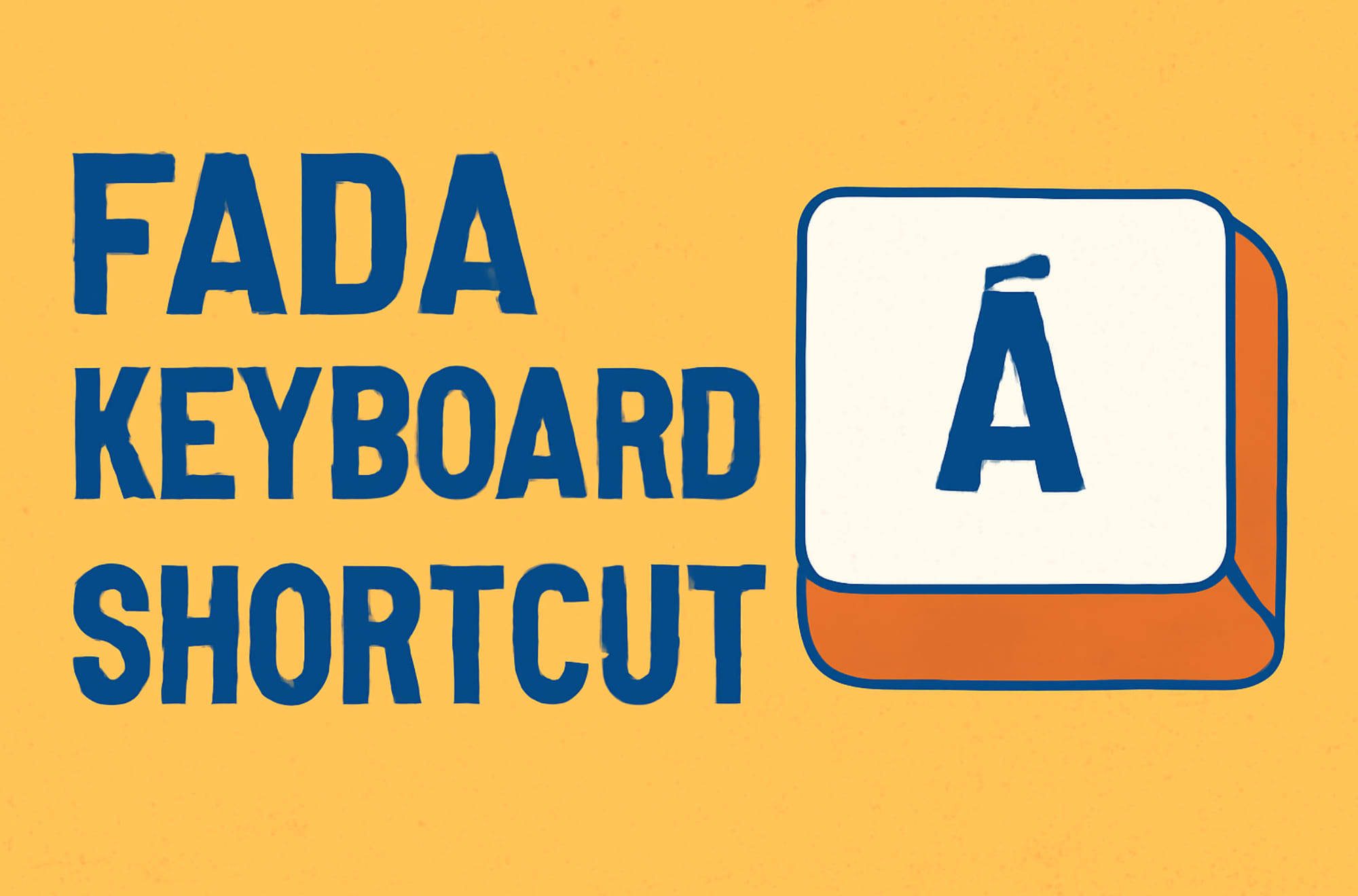
Fada Keyboard Shortcuts: Mastering Accurate Irish Typing

Typing in Irish can be tricky, especially when it comes to inserting the fada accent (´) over vowels. A fada changes the pronunciation and meaning of words, making it a crucial part of the Irish language. For instance, “a” and “á” are two different words with distinct meanings. This guide will teach you how to type vowels with fadas using shortcuts on various devices, helping you master the fada keyboard shortcut for accurate Irish typing.


Understanding the Fada in the Irish Language

In Irish, the fada is an accent mark placed over vowels (á, é, í, ó, ú). This simple accent changes the sound and meaning of a word, which is why it’s essential in proper Irish grammar.

For example:

  • “bád” (boat) vs. “bad” (a form of the adjective bad)
  • “té” (heat) vs. “te” (a dialectal form)

Understanding when and how to use the fada is crucial in distinguishing between words that might otherwise be confusing. The fada isn’t just a typographical symbol; it carries meaning in the Irish language.


Why Using Fada Keyboard Shortcuts Matters

Learning how to use fada keyboard shortcuts is important for anyone typing in Irish. Fadas influence the meaning, pronunciation, and flow of the language. Missing a fada can result in incorrect words, leading to confusion and miscommunication.

For example:

  • Missing the fada in “cúnamh” (help) makes it “cunamh,” which could be misunderstood.
  • Correct use of the fada helps with readability and accuracy in written communication, ensuring proper pronunciation in spoken conversations.

Using fada keyboard shortcuts can significantly improve your learning experience, making it easier to master Irish and communicate fluently in both writing and speech.


How to Type Fada Characters on Different Devices

Typing fadas on various devices is easier than you might think! Here are the shortcuts for typing the vowels with fadas across different platforms.

Windows Fada Keyboard Shortcuts

On a Windows device, there are two main ways to type fadas: using the Alt code method or by changing your keyboard layout.

  • Alt code method: Hold the Alt key and type the appropriate number code for the letter you want. For example:
    • á = Alt + 0225
    • é = Alt + 0233
    • í = Alt + 0237
    • ó = Alt + 0243
    • ú = Alt + 0250

Alternatively, you can add a dedicated Irish keyboard layout to make the process even easier.

Mac OS Fada Keyboard Shortcuts

On a Mac, typing fadas is simple. Use the Option key along with a letter to insert the fada:

  • á = Option + e, then a
  • é = Option + e, then e
  • í = Option + e, then i
  • ó = Option + e, then o
  • ú = Option + e, then u

These shortcuts let you easily add a fada without changing the keyboard layout.

Mobile Devices (iOS & Android) Fada Keyboard Shortcuts

On mobile devices, it’s easy to type fadas by long pressing the vowel key:

  • Hold down a, e, i, o, or u until the accented characters appear.
  • Slide your finger to select the letter with the fada.

This method works on both iOS and Android, making it simple to type in Irish on the go.


Setting Up Your Device for Easy Fada Typing

For regular use of Irish characters, setting up your device to make fada typing more efficient is a good idea. Here’s how you can do it:

  • On Windows: Add an Irish keyboard layout from the language settings.
  • On Mac: Set your keyboard to Irish or use the Option + e method.
  • On Mobile: Enable the Gaelic keyboard in your settings.

Having an Irish keyboard setup ensures you can easily type fadas without constantly relying on shortcuts.


Common Mistakes When Typing Fadas and How to Avoid Them

Learners often make mistakes by either forgetting to include fadas or placing them incorrectly. Common mistakes include:

  • Skipping fadas: This can lead to confusion between words like “bád” (boat) and “bad” (bad).
  • Incorrect placement: Sometimes, fadas are placed incorrectly on letters. Be sure to double-check that the correct letter has the fada.

To avoid these mistakes:

  • Always proofread your work.
  • Use tools like Irish spelling checkers or apps that detect missing fadas.

Incorporating Fada Usage into Learning Resources for the Irish Language

Mastering the fada is essential for learning Irish effectively. Here are some resources to help you along the way:

These resources will help you not only with fadas but also with mastering grammar and pronunciation in Irish.


Advanced Tips for Mastering Fada Usage in Writing and Conversation

To reach a higher level of fluency in Irish, focus on these tips:

  • Mastering adjectives: Many Irish adjectives change when a fada is added. For example, “glas” (green) becomes “glás” (a more intense shade of green) when a fada is added.
  • Verb tense changes: The fada plays a crucial role in verb tense, especially in the future tense.
  • Engage in conversations: To truly master the fada, use it in regular conversations and written exercises. Apps like Duolingo or Rosetta Stone provide a good foundation.

Conclusion

Mastering the fada keyboard shortcut is essential for anyone learning or using the Irish language. Using the correct accent marks ensures accurate pronunciation and comprehension, and enhances the quality of written communication. By following this guide and incorporating the fada into your daily writing and speaking, you’ll be well on your way to mastering Irish Gaelic.

Ready to start your Irish language learning journey? Start a Free Trial with Gaeilgeoir AI and get access to tools designed to help you perfect your Irish typing skills!


Related Reading:

Irish Language Flashcards

How to Count in Irish Language

Irish Pronunciation Guide

Essential Gaelic Phrases for Everyday Use

Diving into the world of the Irish language enriches your communication and connects you deeply with Irish culture. Essential Gaelic phrases are the building blocks for anyone beginning their journey or hoping to polish their conversational skills. At Gaeilgeoir AI, we facilitate this journey with AI-powered tools designed to make learning Gaelic phrases engaging and effective. Whether you’re planning a trip to Ireland, connecting with heritage, or simply expanding your linguistic skills, mastering these phrases will greatly enhance your ability to engage authentically in Gaelic.

Importance of Learning Gaelic Phrases

Learning Gaelic phrases isn’t just about adding words to your vocabulary; it’s about embracing an integral part of Irish identity. It allows you to:

  • Connect with Irish speakers in a meaningful way.
  • Enhance your travel experiences in Ireland.
  • Participate fully in Irish cultural and community events.

Gaelic Phrases for Beginners

Start your Gaelic learning journey with these fundamental phrases that are ideal for everyday interactions:

  1. Hello – Dia dhuit (Dee-ah gwit)
    • This is the standard greeting in Gaelic, meaning “God be with you.”
  2. Thank you – Go raibh maith agat (Guh rev mah agut)
    • An essential phrase in any language, expressing gratitude.
  3. How are you? – Conas atá tú? (Kun-as ah-taw too?)
    • A common conversational opener, useful in many social settings.
  4. I don’t understand – Ní thuigim (Nee hig-im)
    • Useful for beginners in any new language.
  5. Please – Le do thoil (Leh duh hull)
    • Politeness can open many doors in any culture.
  6. Goodbye – Slán (slawn)
    • Knowing how to exit a conversation gracefully is as important as entering it.

Using Gaelic Phrases in Context

Knowing a phrase is only part of the skill; understanding when and how to use it appropriately is key. Here’s how you can use these phrases effectively:

  • Traveling: Use basic greetings and polite expressions in shops, restaurants, and hotels to show respect and appreciation for the culture.
  • At Cultural Events: Engage with others using simple questions and conversational phrases to enhance your experience and show your interest in the culture.
  • In Learning Settings: Practice these phrases in your classes or study groups to build fluency and confidence.

How Gaeilgeoir AI Enhances Language Acquisition

Our platform uses sophisticated AI technology to provide:

  • Real-time Pronunciation Feedback: Hone your accent and pronunciation to sound more like a native speaker.
  • Interactive Learning Scenarios: Apply Gaelic phrases in virtual scenarios that mimic real-life interactions, improving your language use in context.
  • Progress Tracking: Monitor your learning journey with detailed feedback on your progress, helping you focus on areas that need improvement.

Deepening Your Gaelic Knowledge

As you become comfortable with basic phrases, consider exploring more about the language’s structure and other useful expressions. Visit our Guide to Learning Gaelic for resources and tips to advance your skills.

Community and Continued Learning

Join the Gaeilgeoir AI community to connect with other learners, participate in discussion groups, and practice your Gaelic in a supportive environment. Engaging with the community can greatly accelerate your learning and offer practical experience.

Conclusion

Mastering Gaelic phrases is your first step towards fluency in the Irish language. With Gaeilgeoir AI, you are equipped with the tools and support necessary to make your learning effective and enjoyable. Embrace the challenge and enjoy the process as you unlock new ways to connect with Irish culture.

Learn more with Gaeilgeoir AI

Ready to start speaking Gaelic with confidence? Sign up for a free trial at Gaeilgeoir AI today and gain access to premium learning materials and a vibrant community of language enthusiasts. Let’s bring Gaelic phrases to life together!

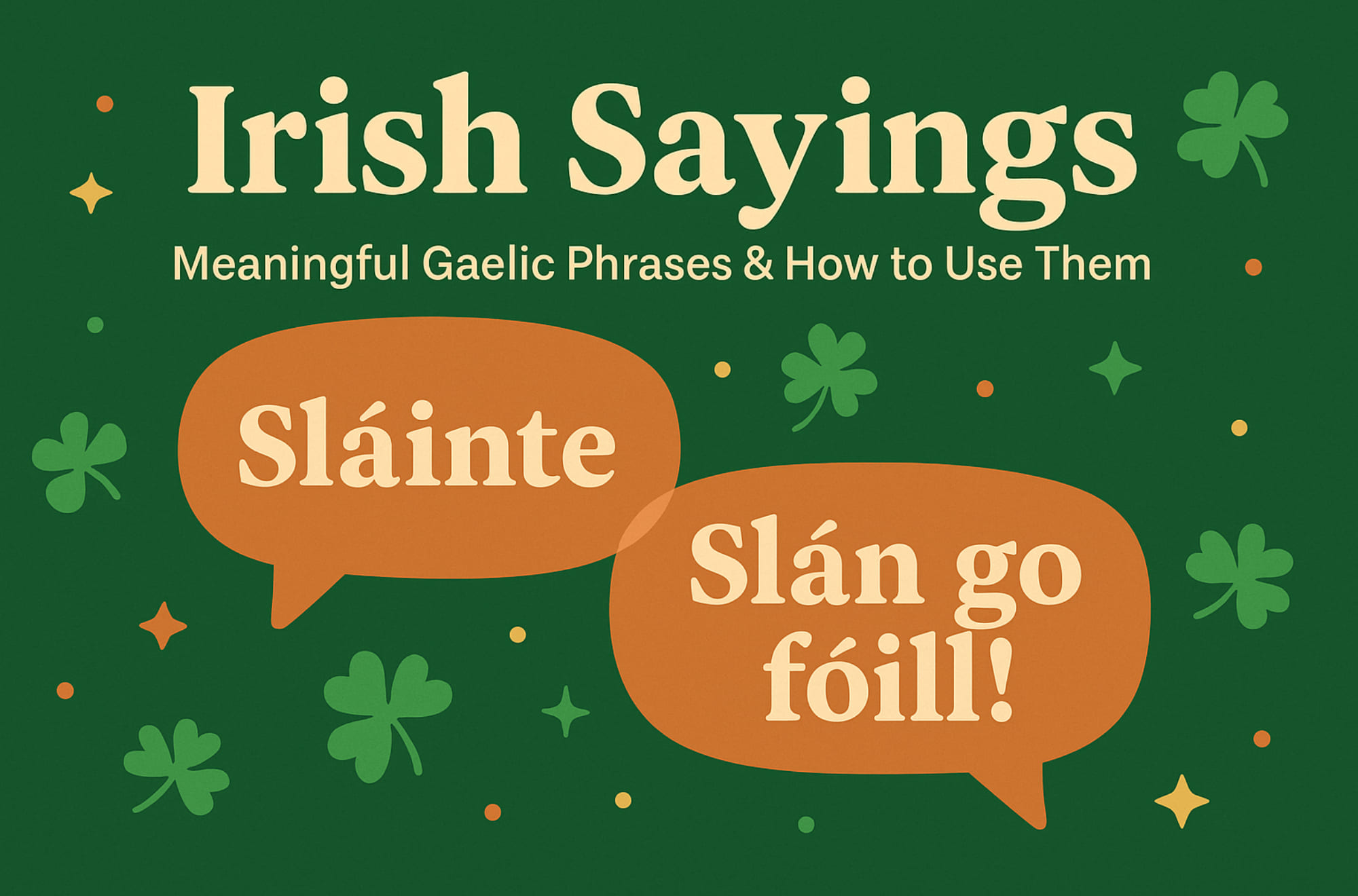
Irish Sayings: Meaningful Gaelic Phrases & How to Use Them

Irish sayings are more than just charming phrases — they are reflections of the Irish spirit, humor, and wisdom. Known as seanfhocail (old words), these Gaelic sayings often carry deep cultural significance. Understanding these phrases helps learners appreciate not only the language, but also the traditions and values of Ireland.


Understanding the Irish Language Context

The Irish language, or Gaeilge, is one of the oldest written languages in Europe and has seen a significant revival in recent decades. While many people confuse Irish with Scottish Gaelic or the broader term Celtic, Irish is a distinct Goidelic language with a rich oral tradition.


Common Irish Sayings and Their Meanings

Here are a few beloved Irish sayings:

  • “Slán go fóill”Goodbye for now
  • “Sláinte is táinte”Health and wealth
  • “Níl aon tinteán mar do thinteán féin”There’s no place like home
  • “Is fearr Gaeilge briste, ná Béarla cliste”Broken Irish is better than clever English

These sayings express warmth, practicality, and wit — all hallmarks of Irish culture.


Using Irish Sayings in Everyday Conversation

To make Irish sayings a natural part of your speech, start with simple greetings:

  • “Dia dhuit!” (Hello!)
  • “Go néirí an t-adh leat” (Good luck!)
  • “Grá mo chroí” (Love of my heart)

Incorporate phrases into toasts, farewells, and friendly chats to bring a bit of Gaeilge into your day.


Pronunciation Tips for Mastering Gaelic Sayings

Pronunciation in Irish is different from English. The fada (accent) alters the sound and meaning of vowels dramatically. For example:

  • “Seán” vs. “Sean” (pronounced “Shawn” vs. “Shan”)

Use resources like our Irish pronunciation guide to master the subtleties.


Learning Resources to Explore More Gaelic Phrases

Whether you’re a beginner or brushing up on fluency, here are helpful tools:

Engage with podcasts, language apps, and quizzes to make learning more interactive.


Dialectal Variations in Irish Sayings Across Ireland

Sayings may vary slightly depending on region:

  • Ulster Irish tends to be more phonetically distinct.
  • Connacht Irish is commonly taught in schools.
  • Munster Irish has unique expressions and rhythms.

Understanding dialects helps contextualize phrases in real-world settings.


Cultural Significance and Usage of Traditional Proverbs (Seanfhocail)

Seanfhocail often carry centuries of wisdom. Examples include:

  • “Túisce a léiríonn téad a bhriseadh”A chain is only as strong as its weakest link
  • “Is minic a bhris béal duine a shrón”Often a person’s mouth broke their nose

These proverbs are a beautiful way to explore Irish heritage and perspective.


Celebratory and Seasonal Sayings in Gaeilge

Popular festive greetings include:

  • “Athbhliain faoi mhaise duit!”Happy New Year!
  • “Nollaig Shona Duit!”Merry Christmas!
  • “Beannachtaí na Féile Pádraig!”St. Patrick’s Day Blessings!

Use these during holidays to connect with Irish traditions in a meaningful way.


Conclusion

Irish sayings are an invitation into the heart of Irish identity. They carry emotion, wisdom, and humor in just a few words. By learning these phrases and using them in everyday life, you not only deepen your language skills but also share in the legacy of a rich cultural tradition.

Ready to start your journey with Irish?

🚀 Join Gaeilgeoir AI and explore more ways to master Irish with fun, flexible lessons.


Related Resources:

Irish Sayings Guide

Saying Good Morning in Irish

Explore Irish Proverbs

Expand Your Irish Vocabulary with Effective Tools

Building a bigger Irish vocabulary is important, but simply collecting more words isn’t enough.

You might recognise dozens of Irish words when you see them and still struggle to remember them when you want to speak or write. That’s because recognising vocabulary and being able to retrieve it are different skills.

The aim shouldn’t be to learn as many Irish words as possible. It should be to build a vocabulary you can recognise, remember and actually use.

Whether you’re a complete beginner, returning to Gaeilge after school or trying to become more confident in conversation, these strategies will help you expand your Irish vocabulary without turning your study time into endless word lists.

Start With Useful Irish Vocabulary

Not every word deserves equal attention when you’re beginning.

Learning unusual animals, obscure household objects or enormous themed lists may feel productive, but it doesn’t necessarily help you communicate.

Start with vocabulary you’re likely to encounter repeatedly.

Useful early themes include everyday greetings, family, food and drink, numbers, weather, common places, work, feelings, travel and frequently used verbs.

You might begin with words such as:

uisce — water
bia — food
teach — house
madra — dog
obair — work
ceol — music
cara — friend

But don’t stop at memorising the English equivalent. Ask yourself how each word might actually appear in something you would say.

That shift from word collection to usable language is one of the biggest improvements you can make to your vocabulary learning.

If you’re building your Irish from the beginning, you can also learn Irish online for free and combine vocabulary with phrases, grammar and other foundations instead of studying words in isolation.

Learn Vocabulary in Groups That Make Sense

Random vocabulary is difficult to connect.

Learning related words gives your brain more context and makes it easier to use them together later.

For example, instead of learning ten unrelated words, spend a few days around food and drink:

arán — bread
uisce — water
bainne — milk
caife — coffee
tae — tea

Then move to weather:

báisteach — rain
gaoth — wind
grian — sun
fuar — cold
te — hot

This makes it easier to start producing connected ideas rather than carrying around a mental dictionary of unrelated vocabulary.

Weekly themes can work particularly well because they give you enough time to encounter the same words repeatedly without spending months on a single topic.

Don’t Just Read a Word — Retrieve It

One of the simplest ways to improve vocabulary retention is to make yourself recall the answer before looking at it.

Reading:

madra — dog

is recognition.

Seeing:

dog → ?

and trying to remember madra requires retrieval.

That effort is useful.

Flashcards, quizzes and vocabulary exercises are most effective when they make you retrieve an answer rather than repeatedly showing it to you.

You can also practise in both directions. Sometimes start with Irish and recall the meaning. At other times start with English and produce the Gaeilge.

The second version is especially useful if your goal is speaking or writing, because real communication requires you to retrieve Irish yourself.

Put New Irish Words Into Sentences

This is where vocabulary starts becoming a language.

Suppose you’ve learned:

caife — coffee

Instead of stopping there, use it:

Is maith liom caife.
I like coffee.

Or:

Ba mhaith liom caife.
I would like coffee.

With madra:

Tá madra agam.
I have a dog.

With ceol:

Is maith liom ceol.
I like music.

The sentences don’t need to be complicated. Their job is to connect the vocabulary with patterns you can reuse.

Once you become familiar with Is maith liom…, for example, every new word that fits the pattern gives you another sentence you can create.

That’s much more useful than memorising every sentence independently.

Say Your Vocabulary Out Loud

Irish vocabulary shouldn’t exist only on a screen or notebook.

Say new words aloud when you learn them.

Then say the sentences you build with them.

This helps connect written Gaeilge with its sound and prevents you from becoming very good at recognising Irish while feeling uncomfortable actually saying it.

Irish spelling follows patterns that may initially be unfamiliar to English speakers, so listening is particularly valuable.

When possible, combine the written word with reliable audio rather than guessing pronunciation from English spelling conventions.

Review Words Before You Forget Them Completely

Vocabulary disappears when you encounter it once and never return to it.

You don’t need to repeat every word twenty times in one sitting. It’s more useful to revisit vocabulary over a longer period.

For example, a new word might appear in your study today, again tomorrow, a few days later and then the following week.

Words you remember easily need less attention.

Words you repeatedly forget need more.

This is one reason personalised study is more efficient than constantly working through the same fixed vocabulary list.

Inside Gaeilgeoir, learners can build personalised study lists and work through the 1,000 Word Way, giving vocabulary a more structured place within their wider Irish learning.

You can start learning Irish with Gaeilgeoir and combine vocabulary practice with lessons, quizzes, conversation and review.

Connect Vocabulary With Things You Already Care About

The easiest vocabulary to remember is often vocabulary that matters to you.

If you love football, learn enough Irish to talk about football.

If you enjoy music, learn words connected with songs, instruments and listening.

If you’re learning Irish because of your family, prioritise family relationships, places and everyday conversations.

If you’re preparing for travel, learn practical vocabulary around food, directions, transport and accommodation.

Personal relevance gives words somewhere to attach.

You’re much more likely to remember a word you’ve tried to use in a sentence about your own life than one you encountered once in a generic list.

Use Irish Vocabulary in Conversations

At some point, words need to leave the flashcard.

You don’t need advanced Irish to begin practising conversation.

Even simple exchanges make you retrieve vocabulary under slightly different conditions.

Instead of simply recalling:

aimsir — weather

you might need to understand or produce:

Tá an aimsir go deas.
The weather is nice.

Instead of recalling:

obair — work

you might begin talking about what you do or where you work.

Conversation exposes gaps too.

Sometimes you won’t realise you’re missing a useful word until you try to express something and discover you can’t.

That’s useful information. Add the word to your study list and return to it later.

Learn From Irish Songs, Podcasts and Videos

Vocabulary becomes more memorable when you encounter it outside an exercise.

Listen to Irish songs. Watch short videos. Explore podcasts. Pay attention to words you’ve recently been studying.

You won’t understand everything, especially at the beginning.

That’s not the point.

Suppose you’ve been learning the word ceol and suddenly recognise it in a podcast or song. That real encounter strengthens the word in a way another vocabulary list often doesn’t.

Over time, you begin noticing familiar words appearing in different contexts, accents and sentence structures.

Gaeilgeoir includes access to dozens of podcasts and videos alongside Irish song-based learning, so structured vocabulary study can lead directly into this kind of immersion.

The goal isn’t just to study Gaeilge.

It’s to start noticing Gaeilge around you.

Keep a Personal Irish Vocabulary List

Generic vocabulary lists are useful for getting started, but eventually your vocabulary should become increasingly personal.

Whenever you encounter a word that seems useful, save it somewhere.

That might be a notebook, flashcard deck or personalised digital study list.

But be selective.

Don’t save every unfamiliar word you encounter.

Ask:

Am I likely to see or use this again?

Does this word help me talk about something relevant to my life?

Does it belong to a topic I’m currently learning?

A smaller, well-reviewed personal vocabulary list is usually more useful than hundreds of forgotten words.

Learn Common Irish Word Patterns

As your vocabulary grows, start noticing relationships between words rather than treating everything as completely separate information.

You’ll encounter common roots, grammatical changes and recurring spelling patterns.

Irish also changes the beginning of words in certain grammatical situations through processes such as lenition and eclipsis.

At first, that can make familiar vocabulary look unfamiliar.

The solution isn’t to memorise every possible form as a completely new word. Gradually learn to recognise the patterns causing the change.

That way, when a word appears differently in a sentence, you’re more likely to recognise what’s happening rather than assuming you’ve encountered entirely new vocabulary.

Don’t Translate Everything Literally

Vocabulary learning can become frustrating if you assume every Irish word should have one perfect English equivalent.

Languages don’t divide meaning in exactly the same way.

Sometimes the best way to learn a word or expression is through several examples rather than one translation.

Pay attention to how the Irish is actually used.

As your level improves, context becomes increasingly important. You’ll begin understanding words through the sentences around them rather than mentally translating everything into English.

That is an important step toward more natural comprehension.

Try This 15-Minute Irish Vocabulary Routine

You don’t need a huge vocabulary session every day.

A simple 15-minute routine could look like this:

Minutes 1–4: Review previously learned words and try to retrieve them before revealing the answer.

Minutes 5–8: Introduce three to five new words around one theme.

Minutes 9–11: Take difficult words and practise them again.

Minutes 12–15: Build sentences using several of the words you’ve reviewed.

On another day, replace the final few minutes with listening and see whether you can notice any of your vocabulary in a podcast, song or video.

The important thing is that your routine moves beyond simply reading word lists.

How Many Irish Words Should You Learn?

There isn’t a magic number.

A vocabulary of 1,000 genuinely familiar and useful words is vastly more valuable than a list of 5,000 words you’ve technically “studied” but rarely recognise.

Think about depth as well as quantity.

For a word you know well, you may understand its meaning, recognise it when listening, pronounce it comfortably and use it in a sentence without much effort.

That’s very different from having seen a translation once.

So instead of constantly asking:

“How many Irish words do I know?”

occasionally ask:

“How many of these words can I actually use?”

That is a much better measure of progress.

What to Do When a Word Won’t Stick

Everyone has stubborn vocabulary.

If a word refuses to stay in your memory, don’t simply reread it ten more times.

Change how you’re interacting with it.

Put it into a funny sentence. Associate it with an image. Say it aloud. Write it down from memory. Find it in a song or video. Connect it with another word you already know.

And then leave it alone for a little while before testing yourself again.

The difficulty of retrieving a word can actually be useful. Each successful retrieval makes the memory stronger.

Build Vocabulary as Part of Your Irish, Not Separately From It

Vocabulary is essential, but vocabulary alone isn’t a language.

Words become useful when you combine them with grammar, pronunciation, listening, reading and conversation.

That’s why the strongest vocabulary routine doesn’t end with flashcards.

You learn a word.

You retrieve it.

You hear it.

You put it into a sentence.

Eventually, you use it without having to deliberately remember that you studied it.

That’s the goal.

Expand Your Irish Vocabulary With Gaeilgeoir

Gaeilgeoir gives vocabulary a structured place within the rest of your learning.

You can build useful vocabulary through the 1,000 Word Way, maintain personalised study lists, review what you’re learning through quizzes and then put that vocabulary into practice through lessons and conversation activities.

Songs, podcasts and videos give you another important layer: the opportunity to encounter Irish being used rather than seeing vocabulary only as isolated translations.

You can start learning Irish with Gaeilgeoir and begin building vocabulary alongside the rest of your Gaeilge.

Or, if you’re at the beginning of your journey and want to explore first, you can learn Irish online for free and start developing your vocabulary without committing to a membership.

Final Thoughts

Expanding your Irish vocabulary isn’t a race to memorise the longest possible list.

Start with useful words. Group them around meaningful themes. Retrieve them rather than just rereading them. Say them aloud. Put them into sentences. Listen for them in real Irish. Then keep bringing the difficult ones back.

Over time, something changes.

A word that once required deliberate effort becomes familiar. Then it starts appearing naturally when you’re listening or reading. Eventually, you find yourself using it without translating first.

That’s when vocabulary stops being something you’ve studied and starts becoming Irish you actually know.

Go n-éirí leat!
Start Speaking Irish Today — 25% Off
Use code START25

Learn real Irish for real life with guided practice, pronunciation support, and everyday conversations.

Get 25% off any plan with code START25

Start Speaking Irish Today — 25% Off