
You know the feeling. You've prepared the words, maybe even practiced them in your head on the walk to class, the meeting, or the oral exam, and then your mouth opens and everything changes. Your voice tightens, your pace doubles, and the first sentence comes out sounding nothing like the calm version you rehearsed. That moment is why building confidence in speaking has less to do with “being naturally confident” and more to do with learning how to stay functional when your body gets loud.
That matters because speaking anxiety is common, and avoidance keeps the cycle going. A widely cited benchmark says about 75% of people feel speech anxiety before a presentation or public speech, while only 8% seek professional help, and the average audience attention span is only 8 to 10 minutes. Those numbers make a simple point, confidence has to show up early, under pressure, and without perfect conditions. For readers who don't have a safe audience on demand, that's where the work begins.
Table of Contents
- The Moment Your Voice Refuses to Cooperate
- Why Confidence Is a Skill, Not a Personality
- The Graduated Exposure Ladder You Can Climb This Week
- A Daily Practice Routine That Actually Fits
- Frameworks That Make You Sound Confident on Demand
- When You Don't Have a Real Audience Yet
- Tracking Progress and Handling Setbacks
The Moment Your Voice Refuses to Cooperate
You know the answer, but the opening sentence won't arrive. Your throat feels narrow, your tongue feels too big, and you begin with a sentence you'd never choose if you had one more second. Then you hear yourself rushing, so you rush harder, and the room starts to feel larger than it did a moment ago. That isn't ignorance, it's an activation problem.
What the body is actually doing
The speaker in that moment usually has the material. What they don't have is enough automaticity to keep the speech stable while stress rises. That's why a learner can do fine in rehearsal, then freeze in a classroom or workplace setting where the stakes feel higher. A resource on public-speaking nerves, manage toast and eulogy nerves, captures the same basic truth, the body often reacts before the mind has finished organizing the message.
When learners tell me they “forgot everything,” I usually look for a different explanation. They didn't forget everything. Their attention narrowed, their breathing changed, and their first few seconds lost structure. That's why speaking confidence grows through repetition in realistic conditions, not through more self-criticism.
Practical rule: if the opening feels shaky, don't ask, “Why am I like this?” Ask, “What is my first sentence, and what do I do with my hands?”
For language learners dealing with fear, the pattern is familiar enough that it shows up across many contexts, including language-learning anxiety. The point isn't to eliminate nerves before speaking. It's to make speaking possible while nerves are still present.
A better way to think about the problem
Once you frame the issue as a performance activation gap, the solution becomes layered instead of vague. You need mindset work so the fear isn't interpreted as proof of failure. You need exposure so speaking stops feeling alien. You need short practice blocks so the skill sticks. And you need feedback so each attempt gives you usable information.
That's also why “just be more confident” is useless advice. Confidence isn't a switch. It's the result of surviving small speaking moments often enough that your body stops treating every one of them like a threat. The sections below build that path one rung at a time, including a practical option for people who don't have a live audience waiting for them.
Why Confidence Is a Skill, Not a Personality
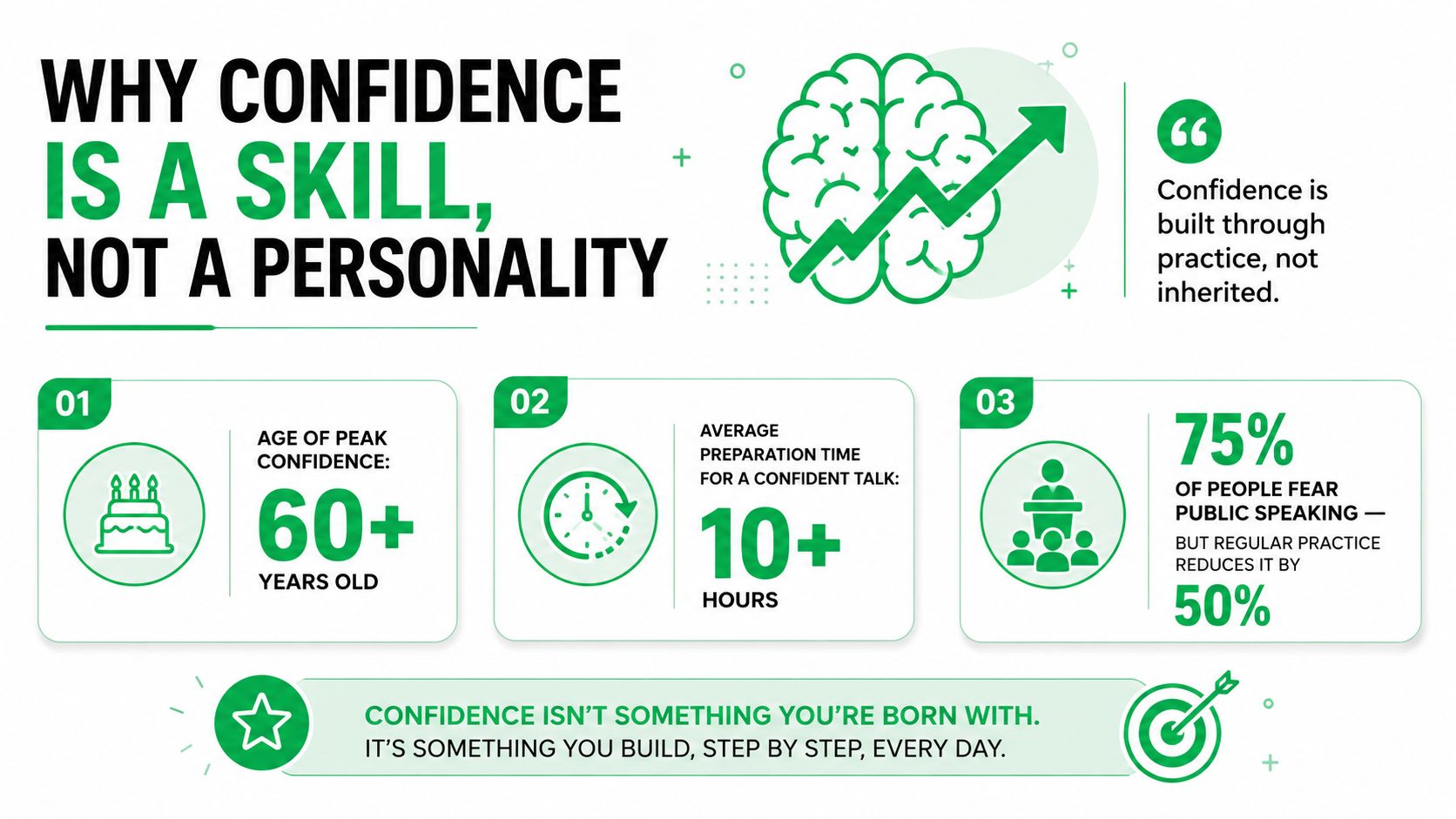
The most stubborn myth around speaking is that confident people were born with a different nervous system. The data point in the opposite direction. A benchmark in communication training says about 75% of people experience speech anxiety before a presentation or public speech, while only 8% of those who fear public speaking seek professional help. That gap matters because it shows how often people try to outwait the problem instead of training through it.
Experience changes confidence
One 2026 compilation reports that only 25% of people aged 16 to 24 feel confident speaking, compared with 69% of people aged 45 and over. That doesn't prove older people are magically calm. It suggests that confidence often rises with repeated exposure, familiarity, and practice over time. In other words, confidence tends to behave like a learned response.
Preparation matters just as much. The same report says 90% of anxiety before making a presentation comes from a lack of preparation, and 91% of presenters feel more confident when they use a well-designed slide deck. Taken together, those figures point to one plain conclusion, preparation is not cosmetic. It's one of the strongest levers you can pull before you ever face an audience. For readers who want a deeper look at how speech anxiety can overlap with broader discomfort in social settings, social anxiety disorder is a useful related topic.
Why this changes the way you practice
If confidence were a personality trait, practice would only help a little. But if confidence is something that grows from repeated, mostly manageable attempts, then practice becomes central. That's the more useful model for learners who are preparing for classroom speaking, interviews, oral exams, or workplace updates.
Confidence usually follows evidence. You give your brain evidence by speaking, not by waiting.
There's also a caution here. Confidence doesn't come from feeling ready first. It comes from enough exposure that the next attempt no longer feels like a cliff edge. That's why the exercises later in this article are deliberately specific. They're not motivational filler. They're ways of creating evidence your body can trust.
The Graduated Exposure Ladder You Can Climb This Week
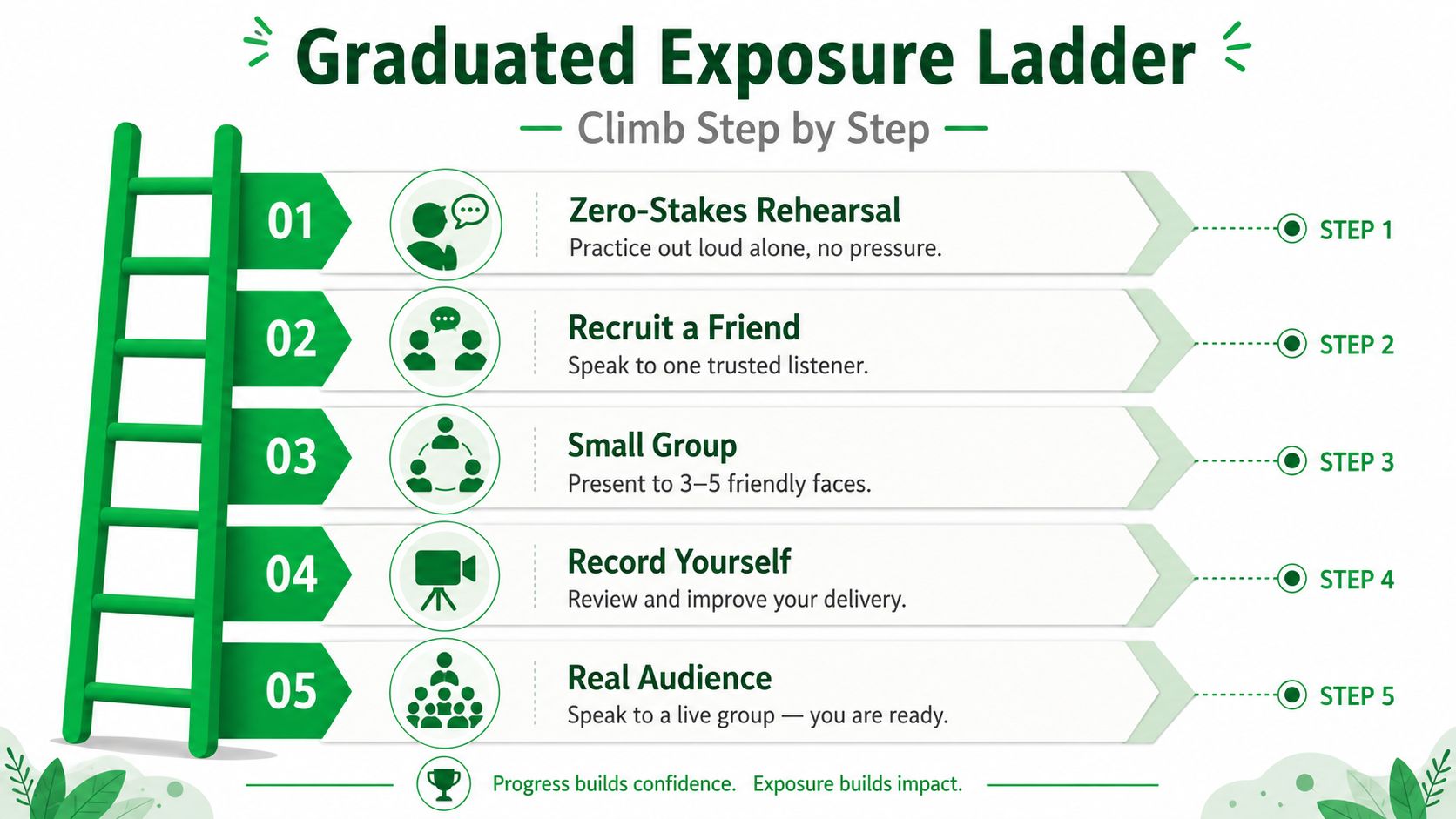
Confidence grows best when each step is small enough to repeat. That's the logic behind the graduated exposure ladder, start low, repeat until it feels routine, then move up. A practical benchmark from the exposure-ladder approach is to keep each step small enough that you can complete it repeatedly without high distress before advancing, like a 2-minute summary or one question in a meeting.
Rung one, speak when no one is judging
Start with a 2-minute self-recording. Pick one topic, set a timer, and talk out loud without rewriting every sentence. The goal isn't polish, it's getting your voice used to carrying meaning while you hear yourself in real time.
After that, listen once and note only one thing that helped or hurt clarity. If you try to fix everything, you'll probably fix nothing. That's one of the main pitfalls of this ladder, too much correction too early makes people freeze.
Rung two, add one trusted listener
Next, speak to one person who knows what you're doing. A friend, tutor, study partner, or family member works if they can give you one piece of feedback and stop there. The point is to experience a little social pressure without turning the session into a test.
A completed version might be a short explanation of a hobby, a class topic, or an exam answer. You say it once, ask one follow-up question, and finish. If you can repeat that comfortably, you're moving in the right direction.
Rung three, bring in a small group
At this stage, try a 5-minute update to a small study group or ask one question in a team meeting. The speech should still be brief enough to survive, but social complexity rises. You're learning how to stay clear while other people are present and thinking.
Useful standard: if you can recover from a stumble without abandoning the message, you're gaining confidence.
Skip levels and the process breaks. Practice only in your head and the skill won't transfer. Try to “fix everything” at once and you'll lose the chance to notice what improved. The ladder works because each rung gives you a finished success, not just an intention.
A Daily Practice Routine That Actually Fits

A routine falls apart when it feels endless. The most usable version is short, repeatable, and specific enough that you don't have to decide what to do each day. Several expert guides recommend 10 to 15 minute daily practice, plus a more reflective weekly session, and that's the right size for most learners who already feel busy.
The daily block
Start with a 60-second breath and posture reset. Use slow exhale breathing, or box-breathing if that works better for your body, until your shoulders settle and your mouth stops feeling dry. This isn't relaxation theater, it's a way to keep the first sentence from arriving in a rush.
Then rehearse your scripted opening for 2 minutes until it feels automatic. The first 30 seconds are the highest-anxiety segment, so treat them like a launch sequence. After that, speak freely on one topic for 5 minutes, even if the wording is rough.
Finish with a 30-second recording review. Don't review the whole impression. Pick one dimension only, pace, posture, or sentence endings. That one-dimension-at-a-time rule makes improvement measurable instead of vague.
The weekly block
Once a week, spend 30 minutes recording a slightly longer piece and reviewing it with more care. One internal practice tool that fits this rhythm is this daily Irish practice plan, which aligns well with short, repeated speaking sessions. If you're using recordings, listen for whether your opening is steady, whether your pauses help the listener, and whether you're drifting into filler sounds.
The key warning is simple. Don't over-rehearse in isolation and call it progress. Speaking confidence needs live exposure, even if the first live audience is tiny. Practice blocks build readiness, but real speaking moments prove it.
Small daily practice sessions are powerful because they keep speaking from feeling foreign.
If you want a simple version to start tomorrow, use this order: reset, opening, free talk, review. Keep it short enough that you'll do it again the next day. Consistency beats dramatic effort that disappears after one week.
Frameworks That Make You Sound Confident on Demand
Unstructured speaking is where many learners freeze, because they have content but no shape. Frameworks help because they reduce decision-making under pressure. They don't make you less authentic, they make your answer easier to follow.
Two structures worth keeping ready
PREP works well for opinions and points. It stands for Point, Reason, Example, Point. STAR works well for stories and achievements. It stands for Situation, Task, Action, Result.
A practical tool for this kind of timed practice is Pretty Progress timer for Mac, especially if you like clear countdowns for repeated runs. Timed practice matters because it keeps your answer within a shape, not a drift.
| Framework | Best For | Components | Example Trigger |
|---|---|---|---|
| PREP | Opinions, exam answers, quick workplace views | Point, Reason, Example, Point | “Do you think uniforms are useful?” |
| STAR | Stories, achievements, interview answers | Situation, Task, Action, Result | “Tell me about a time you solved a problem.” |
Finished examples you can copy in spirit
A student answering a Leaving Cert oral topic with PREP might say, “I think group learning helps because you remember more when you explain ideas aloud. For example, I used to revise vocabulary with a classmate, and I noticed I could recall it faster in the oral. So yes, I'd choose group study when the topic is difficult.” That answer is short, structured, and easy to expand.
A professional answering a behavioral interview question with STAR might say, “In my last role, our team had a deadline shift. My task was to keep the client updated. I reorganized the weekly check-in, clarified next steps, and shared a simple progress summary. As a result, the client stayed informed and the team avoided confusion.” The listener hears the shape immediately.
One useful drill is to keep 5 to 7 personal stories and practice each one at 30 seconds, 1 minute, and 2 minutes. That gives you a bank of material that can shrink or expand depending on the setting. For oral exam prep, filler support for the Irish oral exam can help you sound less trapped when you need a moment to think.
When You Don't Have a Real Audience Yet
A lot of advice assumes you already have a class, a meetup, or a workplace meeting waiting for you. Many learners don't. Shy students, busy adults, heritage speakers returning to Irish, and people learning a new language often need a practice space before they're ready for live conversation.
Why the missing rung matters
That access problem changes the whole confidence equation. If you can only practice when another person is available, you may go too long between speaking reps to build momentum. Scenario-based AI practice fills that gap by letting you complete a low-distress rep many times before you ever face a real listener.
That doesn't replace human conversation. It acts like the rung before it. You can rehearse a restaurant order, a self-introduction, a travel question, or an exam-style response, then repeat it until the words stop feeling fragile.
What this kind of practice gives you
Tools with pronunciation support and instant feedback shorten the path from understanding to speaking. They also let you test a phrase, correct it, and try again without waiting for another person to be free. In the context of building confidence in speaking, that matters because confidence often needs repetition more than reassurance.
Gaeilgeoir AI is one platform that offers scenario-based practice, pronunciation support, and interactive speaking exercises for Irish, which can be useful when you want a safe place to rehearse before real conversation. The main point is not that technology replaces people. It's that a low-stakes practice partner can make the next human conversation less intimidating.
If you don't have an audience, create a rehearsal environment first.
That shift changes what “ready” means. Ready doesn't have to mean fearless. It can mean you've already spoken the same idea several times in a controlled setting, so the live version feels familiar instead of shocking.
Tracking Progress and Handling Setbacks
Confidence feels fragile when there's no proof. A simple log solves that. Use three columns each week, situation, what went well, and one thing to adjust. That gives you evidence that speaking is changing, even if progress is uneven.
A record that keeps you honest
Once a month, replay a 60-second recording from earlier in the month and compare it with a new one. Listen for steadier openings, clearer pauses, or fewer moments where you abandon your thought mid-sentence. Small differences count, because they show your nervous system that speaking isn't as dangerous as it once felt.
Setbacks belong in the log too. A bad question in class, a stumble on an oral exam, or a freeze in a meeting doesn't erase progress. Recovery from a mistake is part of confidence, because it teaches you that you can stay in the room after things go wrong.
The weekly rhythm that works best is simple, mindset, exposure, daily practice, and one structured framework. Keep the log open beside those habits so you can see what changed, not just what felt hard. That mix is what turns isolated practice into real speaking trust.
If you want a place to rehearse before the live moment arrives, visit Gaeilgeoir AI and start with a scenario you'd normally avoid. It gives you a structured place to speak, hear feedback, and try again without pressure. If confidence has felt out of reach, this is a practical way to begin today.