Before Netflix, books, or even newspapers, Ireland had the seanchaí—the master storytellers who carried history, myth, and wisdom in their hearts and voices. Pronounced shan-uh-kee, the seanchaí (plural: seanchaíthe) were the living libraries of Gaelic Ireland. They preserved the oral traditions that shaped Irish culture long before the written word.
But the seanchaí was more than a mere storyteller. They were historians, poets, teachers, and cultural guardians. Their tales, told in rich Irish Gaelic, formed a golden thread that connects today’s learners with Ireland’s ancient past.
In this article, we’ll explore who the seanchaí were, what made their stories unique, and how the tradition continues—especially through AI-powered Irish learning platforms like Gaeilgeoir AI, which give a modern voice to this timeless art of storytelling.
What Is a Seanchaí?
The Irish word seanchaí comes from:
Sean – meaning old
Scéal or scéalaí – meaning story or teller of tales
So, a seanchaí literally means an “old storyteller” or “keeper of old lore.”
In ancient Ireland, seanchaíthe were respected members of the community. They memorized epic tales, genealogies, and historical events, passing them from generation to generation through spoken word. Long before books were common, the seanchaí ensured that Ireland’s identity—its heroes, gods, and people—was never forgotten.
The Role of the Seanchaí in Irish Society
The seanchaí held an honored place similar to that of poets (filí) and historians (ollamhs) in Gaelic society. They performed several key roles:
1. Preservers of History
They memorized long genealogies of Irish clans, ensuring that family histories and noble lineages were kept intact. A seanchaí might recount 20 generations by heart.
2. Custodians of Myth and Legend
Tales of Cú Chulainn, Fionn mac Cumhaill, and the Tuatha Dé Danann were passed down through them. These stories formed part of the Mythological Cycles of Ireland—epic narratives that still inspire literature today.
3. Entertainers and Moral Teachers
Their stories entertained, yes—but also taught lessons about courage, kindness, and respect for nature. A seanchaí could make a crowd laugh one moment and reflect deeply the next.
4. Carriers of the Irish Language
By telling stories as Gaeilge (in Irish), the seanchaí helped preserve the language itself. Their rhythm, wordplay, and idioms influenced how Irish was spoken and remembered.
How the Seanchaí Told Their Stories
A seanchaí’s art was oral and performative. They didn’t read from books—they spoke from memory, using rhythm, repetition, and voice to bring stories to life.
They performed in village halls, at kitchen firesides, and during gatherings called céilí. The seanchaí might start with a slow, measured tone, building up to excitement with expressive gestures and vivid imagery.
Each storyteller developed their own style:
Some emphasized humor and exaggeration.
Others focused on spiritual or heroic tales.
All seanchaíthe shared one trait: the ability to make words dance.
Famous Seanchaí and Their Legacy
Even after written literature became common, the seanchaí continued to thrive—especially in rural Ireland and the Gaeltacht (Irish-speaking) regions.
Here are a few notable figures who carried the seanchaí torch into modern times:
Éamonn a’ Búrc (Éamonn Bourke) – a 19th-century Connemara seanchaí, famous for his long, musical recitations of folklore.
Seán Ó hEochaidh (1902–2002) – a collector and storyteller who helped record Ireland’s oral traditions for the Irish Folklore Commission.
Eddie Lenihan – a contemporary seanchaí who continues to tell stories of fairies, myths, and rural Ireland in both English and Irish.
Their recordings, transcriptions, and live performances show that seanchaíthe are not relics of the past—they’re living voices still shaping Irish identity.
The Seanchaí and the Oral Tradition
Irish storytelling is different from most European traditions because of its oral origins. The seanchaí relied on memory, rhythm, and formulaic phrases—similar to ancient Greek bards like Homer.
Key traits of the seanchaí’s craft include:
Repetition and rhythm: To aid memory and create musicality.
Imagery: Vivid descriptions of nature, emotion, and character.
Dialogue and humor: Making listeners feel part of the story.
Cultural context: Stories reflected community life, beliefs, and landscapes.
Learning Irish through these oral traditions reveals not just vocabulary—but also how Irish thinks and feels.
For example, phrases like:
Bhí sé chomh sean le scéal. – “He was as old as a story.”
Is maith an scéalaí an aimsir. – “Time is a good storyteller.” show how deeply storytelling is woven into the Irish worldview.
The Seanchaí and Gaeilge Today
The Irish storytelling tradition faced challenges during colonization, when English replaced Irish in many areas. Yet, thanks to seanchaíthe, countless stories survived in oral form—later written down by folklorists and scholars.
Today, a new generation of learners and digital creators is reviving these traditions. Irish-language podcasts, YouTube channels, and AI-powered tools like Gaeilgeoir AI bring the seanchaí’s spirit to the modern age.
At Gaeilgeoir AI, our mission is simple: To make the Irish language accessible and alive through storytelling, technology, and community.
By integrating traditional content like folklore and idioms into AI-assisted lessons, learners can hear, feel, and speak Irish the way seanchaíthe once did.
Start with simple fables or local legends. Use as Gaeilge whenever possible, even mixing a few English words if needed—this mirrors how Irish evolved organically.
3. Record and Listen
Record yourself speaking Irish stories aloud. Gaeilgeoir AI’s speech recognition tools can help you refine pronunciation and rhythm.
4. Learn Through Legends
Reading about Irish myths can boost both vocabulary and cultural knowledge. For example:
The Ulster Cycle (stories of Cú Chulainn)
The Fenian Cycle (Fionn mac Cumhaill and the Fianna) These stories teach grammar and idiom in memorable ways. You can dive deeper into them at Ulster Cycle: Irish Myths.
AI Meets the Seanchaí: Technology as a Storyteller
While the seanchaí used voice and memory, today’s storytellers have a new companion—artificial intelligence.
AI doesn’t replace the storyteller—it empowers them. By using natural language processing and voice synthesis, AI can:
That’s exactly what Gaeilgeoir AI is doing—bridging the gap between seanchaí tradition and 21st-century innovation.
The Spiritual Role of the Seanchaí
Beyond entertainment, the seanchaí served a spiritual and social purpose. Their stories reinforced:
Community identity
Moral lessons
Connection to land and ancestry
Irish folklore often blurred the line between history and myth. A seanchaí might recount a saint’s miracle and a fairy tale in the same evening, weaving them together seamlessly.
This blending of truth and imagination is a hallmark of Irish creativity—a trait learners can embrace when speaking or writing in Irish themselves.
The Continuing Magic of Storytelling
Today, festivals like the Cape Clear Storytelling Festival and Listowel Writers’ Week celebrate the art of the seanchaí. Modern storytellers use microphones instead of hearths, but their goal is the same: to connect people through words.
As Ireland’s language and culture evolve, AI and education work hand in hand to keep this oral heritage alive. Through Gaeilgeoir AI’s immersive lessons, learners don’t just study Irish—they experience it.
You can learn greetings, proverbs, and even how to describe your own stories as Gaeilge through our interactive modules. Explore topics like Ancient Irish Language Guide to understand how these stories began.
Carrying the Torch of the Seanchaí
The seanchaí stands as a timeless symbol of Ireland’s creativity and resilience. Through their words, entire generations found identity, laughter, and wisdom.
And today, that same tradition continues through you. Every time you speak a word of Irish, share a proverb, or learn a new phrase, you’re keeping that storytelling flame alive.
So, gather your words, trust your voice, and begin.
Bí i do sheanchaí. (Be a storyteller.)
👉 Start learning Irish and craft your own stories today with Gaeilgeoir AI.
The Irish phrase meán fómhair holds a special place in the calendar—it’s the word for September in Irish and literally translates to “middle of harvest”. In this article we’ll look at meán fómhair, its meanings, pronunciation, grammar uses and how you can integrate it into your Irish language learning journey. Whether you’re using resources from Gaeilgeoir AI or simply exploring Gaelic, understanding meán fómhair gives your vocabulary a seasonal and cultural edge.
In the traditional Irish calendar, meán fómhair marks the middle of the harvest season (between harvest beginning and end). For example, the following month is deireadh fómhair meaning “end of harvest”. blogs.transparent.com+1 This gives the word deeper meaning than simply “September” — it connects language to agriculture, season and tradition.
Usage in Irish
As illustrated in Irish dictionaries, meán fómhair is the standard term for September:
“The fifth day of September, an cúigiú lá de mhí Mheán Fómhair.” teanglann.ie It can appear in phrases like:
i mí Mheán Fómhair – in the month of September
an chéad lá de mhí Mheán Fómhair – the first day of the month of September blogs.transparent.com+1
Pronunciation Guide: Saying Meán Fómhair Correctly
Pronunciation is key when learning Irish. Here’s how to say meán fómhair:
Meán → roughly MYAWN (the “ea” sounds like “aw”, slender “n”)
Fómhair → roughly FOH-irh (genitive fómhair with “mh” silent, “air” rh-ish) blogs.transparent.com+1 So together: MYAWN FOH-irh You can practise this alongside other month-names to build rhythm and familiarity.
Grammar Notes: How Meán Fómhair Works in Sentences
Genitive Usage
Because fómhair is the genitive form of fómhar, the full phrase meán fómhair literally means “middle of harvest”. blogs.transparent.com In sentences you may see:
I mí Mheán Fómhair… (“In the month of September…”)
An chéad lá de mhí Mheán Fómhair. (“The first day of the month of September.”)
Capitalisation & Usage
As a month name, Meán Fómhair is often capitalised in Irish.
When speaking about months in general you’ll see mí Mheán Fómhair (the month of September).
Use the preposition i for “in”, as in i mí Mheán Fómhair.
Here are practical tips to include this word in your learning plan:
✅ Flash-card Technique
Front: Meán Fómhair
Back: “September / middle of harvest” Do one card per week for months, tie each to meaning and season.
✅ Sentence Builder
Create sentences incorporating the word:
I mí Mheán Fómhair, casfaidh siad an rothair gach maidin.
An chéad lá de Mhí Mheán Fómhair is ea mo lá breithe.
Is aoibhinn liom an fómhar idir Meán Fómhair agus Deireadh Fómhair.
✅ Culture-Link Exercise
Research traditional harvest activities in Ireland during Meán Fómhair. Link words like fómhar, meán, ag baint féir, grainneach. This breathes life into the vocabulary you’re studying.
✅ Monthly Reflection
At the publication of Meán Fómhair (September), write a short journal entry in Irish saying something like:
“Táimid i mí Mheán Fómhair anois. Tagann an fómhar go géar. …” It uses the word contextually and helps commit it to memory.
Seasonal Themes: Meán Fómhair and Autumn Vocabulary
Exploring meán fómhair opens the door to a rich set of autumn-and-harvest vocabulary:
Bringing It All Together: A Seasonal Step in Your Irish Journey
Learning one word like meán fómhair may seem small, but it represents a meaningful step. It connects you to the calendar, the seasons, agriculture, language structure and culture. As you progress with Gaeilgeoir AI’s resources and interactive games, phrases like this enrich your vocabulary and deepen your contextual understanding.
Here’s a quick recap:
Meaning: literally “middle of harvest”, standard Irish for September.
Pronunciation: MYAWN FOH-irh
Grammar: uses genitive fómhair, common in month names.
Study tips: flash-cards, sentences, season-link exercises.
Why learn it: seasonal relevance, cultural connection, vocabulary builder.
So as the autumn leaves begin to fall and harvest time continues, embrace the word meán fómhair in your learning. Write a short line in Irish today:
“Seo í mí Mheán Fómhair. Tá an fómhar ag tosú go hiomlán.” (“Here is the month of September. The harvest is beginning fully.”)
Ready to build more Irish vocabulary and engage with real-life phrases tied to culture? Head over to learn.gaeilgeoir.ai and explore interactive lessons, fun vocabulary sets and seasonal modules like meán fómhair. Let your Irish learning grow with the seasons—starting this September.
Go n-éirí le tú! May your Irish journey flourish this Meán Fómhair and beyond.
There are few Irish Christmas songs as beloved and evocative as “Don Oíche Úd i mBeithil” — a hauntingly beautiful carol that captures both the tenderness and mystery of Christmas Eve. The title translates to “That Night in Bethlehem,” and the song tells the story of Christ’s birth through the lyrical beauty of the Irish language (Gaeilge).
This timeless hymn is cherished not only for its gentle melody but also for its linguistic and cultural depth. Sung across Ireland during the festive season, Don Oíche Úd i mBeithil represents the enduring bond between faith, heritage, and the Irish tongue — a language that continues to thrive today thanks to modern learning tools like Gaeilgeoir AI, which helps learners practice Irish through intelligent technology.
In this article, we’ll explore the meaning, history, lyrics, and cultural significance of Don Oíche Úd i mBeithil, along with guidance on pronunciation and tips for learning Irish through traditional songs.
The Origins of Don Oíche Úd i mBeithil
The origins of Don Oíche Úd i mBeithil are somewhat mysterious. While many assume it is an ancient carol, the earliest known written versions date from the 17th or 18th century. However, its style and phrasing suggest it may have originated as part of Ireland’s oral folk tradition, passed down through generations of singers and storytellers before being written down.
The melody’s simplicity — often performed in a lilting 3/4 time — reflects the musical traits of Irish traditional airs, while the lyrics showcase classical Irish syntax and poetic rhythm.
The title phrase, Don Oíche Úd i mBeithil, literally means “That night in Bethlehem,” referring to the birth of Christ. Yet, beyond its religious theme, it captures the spirit of community and peace central to the Irish celebration of Christmas (Nollaig).
Irish Lyrics of Don Oíche Úd i mBeithil
Here are the traditional Irish lyrics, often sung a cappella or accompanied by harp, fiddle, or uilleann pipes:
Don oíche úd i mBeithil, bhí geantrai is gair i ngach tí, agus ornaí na spéartha ag canadh ‘do chroíthe glé-ghiúmar. Bhí maighdean ag caoineadh, is leanbh a ghaoil á rugadh í, don oíche úd i mBeithil, go dtáinig an saor don tsaol.
English Translation
That night in Bethlehem, there was music and laughter in every home, and the ornaments of the heavens were singing joyfully in your heart. There was a maiden crying softly, while her beloved child was being born, that night in Bethlehem, when the savior came into the world.
Understanding the Meaning and Message
The song is simple but profound. It evokes the quiet intimacy of Christmas night, focusing on the humble birth of Christ and the universal emotions of love, awe, and hope.
Let’s explore its key themes:
Humility and Humanity: The imagery of a maiden weeping while her child is born conveys both sorrow and joy — a recognition of the humanity of Mary and Jesus.
Celestial Joy: The “ornaments of the heavens” (ornaí na spéartha) symbolize the stars and angels, celebrating this sacred night.
Peace and Renewal: Like many Irish carols, it reflects the longing for spiritual peace and unity — themes especially resonant in Irish history.
For those interested in learning more about traditional Irish symbolism and language structure, our Ancient Irish Language Guide explores how Irish conveys layered meaning through poetic phrasing.
Pronunciation Guide for Learners
Irish pronunciation can be a challenge for beginners, but singing songs like Don Oíche Úd i mBeithil helps learners develop a natural rhythm and sound pattern.
Here’s a simplified pronunciation (in English phonetics):
Don Oíche Úd i mBeithil — Dun ee-ha ood i meh-hil
Bhí geantrai is gair i ngach tí — vee gyan-tree iss gair i ngach tee
Agus ornaí na spéartha — ah-gus or-nee na spay-er-ha
Bhí maighdean ag caoineadh — vee my-den egg kee-nah
Each syllable carries its own rhythm, and when sung slowly, the words flow naturally.
If you want to build pronunciation skills and master Irish sounds like bh, ch, th, and mh, try our Irish Pronunciation Guide.
Cultural Significance in Ireland
1. A Christmas Tradition
Don Oíche Úd i mBeithil is a staple of Irish Christmas celebrations, sung at midnight Mass, school concerts, and carol services throughout the country. Unlike many Western carols, it’s performed in Irish, symbolizing the preservation of cultural and linguistic heritage.
2. A Symbol of Revival
During the Irish language revival movement in the 20th century, carols like Don Oíche Úd i mBeithil became important tools for education and national pride. Singing the song helped young people reconnect with their ancestral language in an emotional and accessible way.
3. A Song of Peace
Because of its gentle melody and universal message, the carol is also performed in multilingual or interfaith Christmas services, representing Ireland’s identity as both ancient and inclusive.
Music is one of the most enjoyable and effective ways to learn a language. Songs like Don Oíche Úd i mBeithil provide learners with memorable vocabulary, clear pronunciation patterns, and emotional engagement.
Here are a few ways to make the most of learning Irish through music:
1. Listen and Repeat
Find a recording of Don Oíche Úd i mBeithil — for instance, beautiful renditions by The Chieftains, The Dubliners, or Cór Na nÓg — and sing along. The repetition helps reinforce pronunciation and rhythm.
2. Break Down Vocabulary
Identify words and phrases to build your vocabulary:
Oíche — night
Beithil — Bethlehem
Leanbh — child
Saor don tsaol — savior of the world
Croí — heart
3. Translate Actively
Try translating Irish carols or folk songs line by line. This builds comprehension skills and gives you a deeper sense of Irish grammar and syntax.
For a structured learning experience, explore our Irish Language Lessons for Beginners — a perfect starting point for understanding Irish through culture.
The Beauty of Faith and Language in Harmony
Don Oíche Úd i mBeithil is not just a Christmas carol — it’s a linguistic bridge between faith, poetry, and national identity. When sung in Irish, it reminds us how language shapes our understanding of joy, compassion, and the divine.
The Irish language (Gaeilge) is uniquely expressive, with phrases that carry warmth, humility, and a deep connection to nature and emotion. Singing as Gaeilge allows you to experience these nuances directly, rather than through translation.
For many learners, mastering a song like Don Oíche Úd i mBeithil becomes a moment of pride — a milestone in their journey to fluency.
How Gaeilgeoir AI Helps You Learn Songs Like Don Oíche Úd i mBeithil
Gaeilgeoir AI combines artificial intelligence with linguistic expertise to help learners understand and speak Irish naturally. Using voice recognition, pronunciation feedback, and interactive lessons, the platform enables you to:
Practice pronunciation using real Irish recordings
Learn vocabulary in cultural context (like through carols and idioms)
Get instant translation support for Irish phrases
Track your progress with adaptive learning tools
You can start your Irish journey or continue improving by signing up for free at learn.gaeilgeoir.ai.
Conclusion: Keeping the Spirit Alive
Don Oíche Úd i mBeithil endures because it’s more than a song — it’s a window into the heart of Ireland. Through its gentle melody and poetic Irish lyrics, it connects listeners across generations and borders.
For learners of the Irish language, this carol is a beautiful reminder that every word, phrase, and sound carries a piece of living history. Whether you sing it at Christmas or study its meaning year-round, Don Oíche Úd i mBeithil will deepen your love for Irish and the culture it represents.
So light a candle, press play, and sing Don Oíche Úd i mBeithil with pride — keeping both language and tradition alive.
Start your journey with Gaeilgeoir AI today at learn.gaeilgeoir.ai — where Irish learning meets innovation and community.
If you’ve ever tried to look up an Irish word, you’ve probably encountered the term foclóir (pronounced fuk-lor). foclóir means dictionary in Irish, but it represents much more than that. It’s the key to unlocking the rich tapestry of Gaeilge, connecting past and present, and empowering new generations to learn and use the Irish language confidently.
A useful Irish dictionary guide should do more than define the word. It should help you choose the right tool, read entries properly, and avoid the common mistake of treating one translation as the whole story. In practice, that usually means starting with the official Focloir.ie dictionary from Foras na Gaeilge, then using other tools only when you need extra context, practice, or explanation.
How I Evaluated Irish Dictionary Resources
Resources were judged by the things learners need during a lookup: search accuracy for headwords and inflected forms, clarity on verbs and grammar, pronunciation help, quality of example sentences, dialect labeling, and whether the tool is official or free to use. That matters because an Irish dictionary is not just a word list; it is often your first source for gender, register, usage, and whether a phrase is natural at all.
I also gave extra weight to resources that help beginners recover from imperfect searches. In my own testing, the biggest frustration was not obscure vocabulary — it was simple cases like entering a conjugated verb or a mutated form and needing to work backward to the base entry. Tools that make that path obvious are far more useful day to day than tools that merely return a translation.
Cost and authority mattered too. The official Foras na Gaeilge dictionary site states that its dictionaries are free of charge and adapted for desktop and mobile devices, which makes it a strong default for most learners. And the historical depth behind any foclóir is not trivial: according to Conradh na Gaeilge facts and figures, the earliest surviving written Irish appears on Ogham stones from the 5th and 6th centuries, with Irish written in the Roman alphabet before the beginning of the 7th century.
What Does Foclóir Mean?
The Irish word foclóir derives from two parts:
focal – meaning word
lóir / lóir – from lóramh, meaning collection or array
Put together, foclóir means a collection of words, which perfectly describes a dictionary.
In modern usage, foclóir refers to both printed dictionaries and digital resources. It’s also used metaphorically to describe a person’s vocabulary — so when someone says mo fhoclóir féin (my own foclóir), they’re talking about their personal store of words, not a book.
The History of the Irish Foclóir
Early Word Lists and Glossaries
The concept of a foclóir in Irish goes back over a thousand years. Irish monks were among the earliest lexicographers in Europe, creating glossaries of difficult words in manuscripts such as the Sanctan Foclóir and the O’Mulconry Glossary (c. 1200s).
These early foclóirí (plural) were more than word lists — they were cultural bridges, explaining Old Irish terms, Latin borrowings, and theological vocabulary. They helped preserve Irish literacy during centuries of social and linguistic change.
The Rise of Printed Foclóirí
By the 18th and 19th centuries, Ireland saw the emergence of printed dictionaries aimed at bilingual readers. Notable among these was “Foclóir Gaoidhilge-Sacs-Bhéarla” by Rev. Edward O’Reilly (1817), a monumental Irish-English dictionary that set the foundation for modern lexicography.
Later came works such as:
Dinneen’s Foclóir Gaedhilge agus Béarla (1904) — an invaluable resource for early 20th-century learners.
Foclóir Póca — the handy pocket dictionary that many Irish schoolchildren still use.
These dictionaries didn’t just translate — they captured idioms, dialects, and poetic expressions, keeping Irish alive across generations.
The Digital Revolution of Foclóir
Today, foclóir.ie, developed by Foras na Gaeilge, stands as the official digital Irish-English dictionary, freely accessible to learners worldwide. It offers audio pronunciation, grammar notes, and real examples of usage.
This online foclóir shows how technology continues the Irish tradition of linguistic innovation. It’s no surprise that AI-powered learning platforms like Gaeilgeoir AI are now taking this digital transformation even further.
How Gaeilgeoir AI Elevates the Modern Foclóir
The better question is not whether an AI tool replaces Focloir.ie. It does not. The useful question is when an official dictionary is enough, and when an AI-assisted tool adds something the dictionary does not.
For straightforward lookups, Focloir.ie should usually be your first stop. It is the official Irish-English dictionary site, it is free, and it is built for reference work: base meanings, parts of speech, grammar cues, pronunciation, and examples. If you want to check whether a noun is masculine or feminine, compare two senses of a common word, or confirm a standard translation before using it in writing, this is the cleaner option.
AI-assisted tools become more helpful after the dictionary stage. If the entry gives you the right word but you still do not understand why one example sounds natural and another does not, an AI tutor can explain patterns, generate extra practice, or turn the result into drills. I find this especially useful when a dictionary answer is correct but still not memorable.
Three common lookup scenarios make the difference clear:
Checking a verb form: If you meet an inflected form in reading, the dictionary helps you identify the lemma and meaning. An AI tool can then explain what tense or person you saw and give two or three parallel examples.
Comparing multiple meanings: A word with several English equivalents is best checked in the official entry first. After that, AI can help you sort which sense fits a conversation, schoolwork, or storytelling context.
Testing an idiom: A dictionary can confirm whether the phrase is attested or whether the key words belong together. AI is useful afterward for paraphrasing, practice sentences, or explaining why a literal translation sounds off.
The limitations matter too. Dictionaries are excellent at authority and precision, but they do not always hold your hand through confusion. AI tools are excellent at explanation and practice, but they can sound confident about phrasing that is merely plausible. In my own use, the safest workflow is simple: verify with the dictionary first, then use AI to deepen understanding rather than to invent vocabulary from scratch.
That also makes independent study more sustainable. If you like listening-based practice alongside lookups, there is a useful overview of language-learning audio formats over at SparkPod, which pairs well with dictionary-first study.
Why Foclóir Is the Key to Irish Fluency
A foclóir isn’t just for translation — it’s a roadmap to thinking in Irish. Here’s why mastering it matters:
1. Builds Natural Vocabulary
The Irish language doesn’t always map directly onto English. For example:
Fáilte means welcome but conveys a whole cultural warmth.
Craic can mean fun, news, or banter, depending on tone.
A good foclóir teaches meaning in context — not just literal translations.
2. Reveals Cultural Layers
Irish words often carry centuries of storytelling. Learning through foclóir helps you uncover the soul of Irish culture — from mythology to modern slang.
3. Improves Grammar Understanding
In Irish, words shift depending on gender, lenition, and case. Quality foclóirí explain these grammatical nuances clearly, helping learners avoid common mistakes.
With tools like Gaeilgeoir AI’s built-in foclóir, you can explore words at your own pace and style — making language learning self-directed and rewarding. Used well, that means checking an official entry first, then turning the result into your own notes, review prompts, or listening practice.
Using Foclóir as a Daily Learning Tool
The most effective way to use an Irish dictionary is to treat each lookup as a small reading lesson, not a one-word transaction. A good routine is: search the headword, inspect the grammar, listen to pronunciation, read at least one example sentence, and then save the result in your own notes with one phrase you would realistically use.
1. Search the headword first
If you already know the base form, begin there. A strong dictionary entry should tell you the part of speech, main senses, and whether the word has more than one common translation. Focloir.ie is especially useful; it is built for quick confirmation rather than broad guesswork. When I check a familiar word, I usually look first at the examples rather than the first translation line, because the examples reveal register and normal collocation faster.
2. If the form looks odd, work backward
Irish learners often meet words in mutated or inflected forms before they know the dictionary headword. Verbs are the classic example. If a form does not look like the one you memorised, do not assume it is a different word; try to identify the base verb and then confirm it in the dictionary. The same goes for plural nouns, possessive forms, and lenited spellings.
A practical habit is to ask four questions during a difficult lookup:
What is the base form?
What part of speech is this?
What does the example sentence show that the plain translation does not?
Is this form standard, regional, or tied to a specific context?
3. Read the example sentences, not just the gloss
Example sentences are where a dictionary stops being a list and starts becoming a teacher. They show whether a word sounds formal, conversational, idiomatic, or restricted to one type of context. In my experience, learners who skip examples tend to memorise English pairings; learners who read examples start noticing how Irish builds meaning.
4. Save the result in a personal vocabulary list
Do not save single words alone. Save the headword with one pronunciation note, one grammar cue, and one real phrase. That makes review much easier later.
A simple entry might look like this:
Headword:bris
What to note: verb; watch for changed forms in context
Pronunciation help: listen to the audio on the dictionary entry rather than guessing from spelling
Useful phrase: save one short example sentence from the entry
Worked example: from search to usable phrase
Suppose you meet an unfamiliar word in a sentence and trace it back to a headword on Focloir.ie. Your next steps should be deliberate:
Open the headword entry and identify whether it is a noun, verb, or adjective.
Play the pronunciation audio so your first memory of the word is sound plus spelling.
Check grammar notes for gender, irregularity, or verb behavior.
Read one example phrase and ask what extra information it gives you beyond the translation.
Save that phrase into your own vocabulary list, not just the isolated word.
That workflow is slower than copying a translation, but it produces better retention. I have found that one carefully read entry is worth more than ten rushed lookups.
5. Turn lookup results into review
Once you have a small list, revisit it later in the day. Say the words aloud, cover the English, and try to recall the example phrase. If you use Gaeilgeoir AI after the dictionary step, this is the moment to turn those saved items into flashcards or short quizzes rather than beginning with AI guesses.
6. Connect dictionary work to real Irish
A foclóir becomes much more useful when you meet the same word in songs, proverbs, or articles. That is where meaning stops feeling abstract.
Irish dictionary entries do not erase dialect difference; they help you notice it. The key skill for learners is not memorising every regional variant at once, but learning how to read labels and examples without assuming that one familiar form is the only correct one.
For beginners, dialect labels matter most in three cases: when a pronunciation differs noticeably, when a common everyday word has a regional preference, and when you are studying with teachers or media rooted in one Gaeltacht tradition. If you are still building core vocabulary, you do not need to panic every time you see variation. What matters is recognising that variation exists and noting which form your course, teacher, or listening material tends to use.
Authoritative reference tools often signal this through usage labels, examples, or alternative forms rather than long explanations. The tearma.ie language resources from Foras na Gaeilge are a helpful reminder that standardisation and real usage are not the same thing: a term can be standardised for one context while spoken Irish still shows regional preference.
Here is a more useful way to think about dialect examples:
Example area
What you may notice
What the learner should do
Common noun choice
One region may prefer a different everyday word or form
Note the form, but do not mark other regional variants as wrong unless your source clearly says they are nonstandard
Pronunciation
The spelling may stay the same while the sound shifts by region
Listen to audio or native speech from your target dialect before trying to imitate it
Verb or phrase preference
Two versions may both be understandable, with one sounding more local
Follow the pattern used in your class or chosen dialect, and keep the other as passive recognition
A practical example is this: a dictionary may give you a standard form, but a song, radio clip, or native speaker from Ulster may prefer a different pronunciation or phrasing. That is not a contradiction; it is part of how Irish lives across regions. I have seen beginners lose confidence here because they think the dictionary has "corrected" the dialect out of the language. A better approach is to treat the entry as a map, then let real usage show you the terrain.
Irish isn’t just a system of grammar — it’s a worldview. Every foclóir captures a piece of that worldview:
Grá (love) embodies emotion beyond romance.
Tírghrá (love of country) reflects Irish identity and belonging.
Dóchas (hope) holds spiritual depth shaped by centuries of resilience.
When learners interact with words on this level, they connect emotionally with the language — and that’s where true fluency begins.
The Role of AI in Modern Irish Learning
AI can make Irish study more responsive after the reference stage: it can explain patterns, generate review material, and adapt practice to the learner. But its value is strongest when it follows authoritative dictionary work rather than replacing it.
Platforms like Gaeilgeoir AI are useful in that follow-up role, blending the enduring value of a foclóir with interactive practice and explanation.
Foclóir in Everyday Expressions
This is the point where dictionary users need to be cautious. Idioms, collocations, and attractive-sounding phrases are exactly where learners memorise bad Irish if they rely on unsourced lists. A foclóir is useful here, but not always by giving a single neat definition. More often, it helps you verify whether the key words belong together, whether the phrase appears in example usage, and whether the wording is standard or tied to one context.
A safer method is:
Check the main word in the dictionary.
Look for example sentences or linked phrases.
Confirm the wording in a second authoritative source if the phrase looks fixed or proverbial.
Only then save it for study.
Two good places to cross-check are the official Focloir.ie dictionary for examples and teanglann.ie resources for supporting lexical and pronunciation context. When I am unsure whether a phrase is current or just plausible, I do not memorise it until I have seen it used by a reliable source.
Here are a few grounded examples of what to notice:
Fáilte roimh …, the individual word fáilte is easy enough, but the phrase pattern matters. A dictionary example helps show that the welcome is expressed with a following structure, not just by translating word for word from English.
Tabhair aire …, this is a good example of a common expression where the verb-noun pairing matters more than the English gloss. You want to learn the phrase as a unit, not merely the separate words.
Seanfhocail and fixed sayings, with proverbs especially, verify the whole expression in a reliable source rather than trusting an AI-generated paraphrase. Proverbs often survive in established wording that should be learned as a set phrase.
The practical lesson is simple: memorise expressions that are evidenced, not merely imaginable. That habit saves a lot of later correction.
Frequently Asked Questions
What is a focloir?
A foclóir is a dictionary. In Irish, the word refers both to a dictionary as a reference book or website and, in some contexts, to a person’s vocabulary more generally. In everyday learner use, it usually means an Irish dictionary such as Focloir.ie.
Is Focloir free to use?
Yes. The official about page for Focloir.ie says the available dictionaries are free of charge and adapted for desktop and mobile devices. That makes it one of the best first-stop resources for learners who want an official reference without a subscription.
How do I use Focloir.ie for Irish words?
Start by searching the base form of the word if you know it. Then check the part of speech, listen to the pronunciation, read at least one example sentence, and note any grammar guidance. If your result is an inflected or mutated form, work backward to the headword before memorising anything.
How is Focloir.ie different from a general translator?
Focloir.ie is a dictionary resource, not a general-purpose sentence translator. Its strength is reliable word-level and phrase-level reference: meanings, examples, pronunciation, and usage clues. A translator tries to produce a whole sentence, which can be convenient, but it may hide uncertainty and give learners phrasing they cannot yet evaluate.
When should I use an AI tool instead of an Irish dictionary?
Use the dictionary first when accuracy matters: checking a headword, comparing meanings, confirming grammar notes, or verifying whether a phrase is standard. Use AI after that when you want explanation, extra examples, flashcards, or personalised practice. The strongest workflow is dictionary for verification, AI for follow-up learning.
Do dialect labels matter for beginners?
Yes, but not at every lookup. They matter most when a word or pronunciation differs clearly by region, or when you are trying to follow a teacher, textbook, or media source rooted in one dialect area. Early on, the goal is awareness rather than mastery: recognise the label, note the variant, and keep moving.
Build Your Own Foclóir Today
Building your foclóir pearsanta is one of the most fulfilling ways to grow in Irish. With Gaeilgeoir AI, you can:
Create your own smart word lists
Hear authentic Irish pronunciation
Test yourself with AI-powered quizzes
Connect with a community of learners
👉 Start your free journey today at learn.gaeilgeoir.ai — and let your foclóir grow with you.
Final Thoughts: The Future of Foclóir
The foclóir has always been a mirror of the Irish mind — reflecting history, humor, and heart. From monastic glossaries to AI-driven apps, it continues to evolve, proving that Irish is as vibrant and adaptable as ever.
So next time you open a dictionary or search a word on Gaeilgeoir AI, remember: you’re not just learning vocabulary — you’re part of a living tradition that celebrates every focal (word) and every beatha (life) that speaks it.
Few songs hold as much emotion, pride, and cultural resonance in Ireland as Amhrán na bhFiann, known in English as The Soldier’s Song. Sung in Irish at sporting events, official ceremonies, and national holidays, it symbolizes unity, resilience, and the enduring spirit of the Irish people.
For learners of the Irish language, Amhrán na bhFiann offers more than patriotic symbolism. It is one of the clearest entry points into how Irish carries history, poetry, and identity in a very compact text. I think that is why readers usually want not just the anthem’s background, but the exact words, a reliable amhran na bhfiann translation, and help with the lines that do not make immediate sense in modern English.
How We Researched the Lyrics, Translation, and History
The version of Amhrán na bhFiann used in public life is the chorus, not the full original song. Lyric wording follows official and widely cited public references to the anthem text and aligns with established historical summaries from state and archival sources, including the Department of the Taoiseach and historical reporting on the anthem’s adoption and authorship from IrishCentral’s history overview.
For translation, we have kept the meaning close to the standard sense of the Irish rather than forcing a poetic line-for-line imitation. That matters because some phrases in the chorus are older, literary, or politically charged, and loose internet versions often flatten those nuances. In practice, I treat unofficial lyric graphics, unsourced quote sites, and social posts as unreliable unless they match established wording.
For history, we focused only on claims that could be tied to a named source: composition, circulation, translation, and official adoption. Where wording or interpretation varies, we say so plainly rather than presenting one paraphrase as unquestioned fact.
The Origins of Amhrán na bhFiann
A Song Born from Revolution
The story of the ireland national anthem starts in English, not Irish. The Soldier’s Song was composed in the early independence period by Peadar Kearney, with music by Patrick Heeney. It circulated before the Easter Rising and appeared in print in 1912 in Irish Freedom, which helps explain why it spread quickly among nationalist circles rather than appearing out of nowhere in 1916. A concise historical summary from IrishCentral notes that the song itself was written earlier, that Kearney wrote the lyrics in 1909, and that the Executive Council formally adopted it as the official national anthem on 12 July 1926.
Its association with the Easter Rising matters because songs often become national symbols through use, not decree. By 1916, The Soldier’s Song had already become familiar among Volunteers and republicans, and the Rising gave it a much larger symbolic life. After independence, it increasingly functioned as the de facto anthem of the Irish Free State before formal adoption caught up with popular practice.
The Irish-language version, Amhrán na bhFiann, was translated by Liam Ó Rinn, a civil servant and Irish-language scholar whose version helped anchor the anthem within the new state’s cultural revival. The state’s public-facing guidance on national symbols is collected through gov.ie resources on national emblems and protocol. For most readers, the key practical point is simpler than the full chronology: the official anthem as sung publicly is the chorus, not every verse of the original song.
The Meaning Behind Amhrán na bhFiann
Amhrán na bhFiann is a patriotic anthem about collective resolve. The title is usually rendered as “The Soldier’s Song” in historical usage, while the Irish phrase itself carries the sense of a song of warriors or fighters. That difference is worth noticing because it shows how translation and national memory do not always line up perfectly.
The chorus presents a group voice rather than an individual one: people bound to Ireland, committed to freedom, and prepared for danger. Its language is martial, but the reason it endures is not only militancy. In public performance, it tends to register as a compressed statement of national survival, shared history, and belonging.
For readers interested in how those older ideas sit inside the language itself, our Ancient Irish Language Guide gives useful background on the longer history behind modern Irish usage.
Lyrics of Amhrán na bhFiann (Irish and English Translation)
Only the chorus is used as the national anthem today, the section sung at state occasions, schools, and most sporting events, so it is the version most readers mean when they ask for amhrán na bhfiann lyrics, amhran na bhfiann in english, or irish national anthem lyrics in english.
Below is the standard public chorus with a paired English meaning. The Irish wording follows the commonly accepted anthem text; the English is a meaning-based translation rather than a singable rewrite.
Chorus in Irish and English
Irish
English meaning
Sinne Fianna Fáil,
We are Fianna Fáil / warriors of Ireland,
atá faoi gheall ag Éirinn,
bound by pledge to Ireland,
buíon dár slua
a company from our ranks
thar toinn do ráinig chugainn,
has come to us from beyond the waves,
Fé mhóid bheith saor,
sworn to be free,
sean-tír ár sinsear feasta,
so that the ancient land of our ancestors, from now on,
Ní fhágfar faoin tiorán ná faoin tráill.
will not be left under tyrant or slave-master.
Anocht a théim sa bhearna bhaoil,
Tonight I go into the gap of danger,
Le gean ar Ghaeil, chun báis nó saoil,
with love for the Gael, to death or to life,
Le gunna scréach faoi lámhach na bpiléar,
with guns screaming under the firing of bullets,
Seo libh canaig Amhrán na bhFiann.
come now, sing the Soldier’s Song / Song of the Warriors.
“Sinne Fianna Fáil” does not refer here to the modern political party in the everyday contemporary sense. In the anthem, the phrase carries the older meaning of a band or body of warriors. This line often confuses learners because modern politics has changed how the phrase looks on the page.
“thar toinn do ráinig chugainn” points to people coming “over the waves.” The line is usually understood as referring to Irish exiles or supporters returning or joining the cause from overseas.
“Anocht a théim sa bhearna bhaoil” is often translated loosely, but “the gap of danger” is worth preserving. It gives the line its dramatic, almost ballad-like force and helps explain why the anthem still sounds more literary than conversational.
If you came here specifically for a new irish national anthem lyrics english version, the safest answer is that there is no newly official replacement text in English; what exists are translations and paraphrases of the Irish chorus, plus the older original English song, The Soldier’s Song.
Why the Anthem Is Sung in Irish
Choosing to perform Amhrán na bhFiann in Irish rather than English was a deliberate act of cultural preservation and pride. In the early 20th century, the Irish language was in decline due to colonization and Anglicization.
By translating and adopting the anthem in Irish, the state emphasized the importance of language revival as part of Ireland’s identity.
Today, singing the anthem as Gaeilge (in Irish) is a symbolic act — a reminder that Ireland’s language, like its independence, has survived against great odds.
If you’d like to begin learning how to pronounce or understand Irish phrases like those in the anthem, visit our Learn Irish Online Free Guide.
Cultural and Political Significance
Amhrán na bhFiann carries official weight because it is not just a popular song but the State anthem, formally adopted on 12 July 1926 by the Executive Council, as noted in this historical summary. In public life, that means it appears at state ceremonies, commemorations, and formal occasions where national symbols matter. Government protocol around public ceremonies and state symbolism is reflected through gov.ie guidance, and in practice the anthem functions as one of the quickest markers of official Irish state identity.
It also has a separate life in sport. Many people encounter it first not in a classroom or archive, but before a match: at GAA fixtures, soccer internationals, Olympic ceremonies, and other events where the anthem signals representation of the State. In all-island contexts, especially rugby union, it is often paired with or replaced by Ireland’s Call, which serves a different purpose by representing players and supporters from both the Republic and Northern Ireland. I think that distinction explains a lot of modern confusion: readers often assume there is one single song for every Irish team, when the reality depends on the sport and the political setting.
The debate around the anthem has not disappeared. Some listeners hear necessary historical memory in its militaristic language; others feel that lines about bullets, danger, and struggle sit awkwardly with a modern, plural Ireland. That tension is real, and it is part of why Amhrán na bhFiann still provokes discussion rather than existing as a completely settled symbol. From an editorial perspective, most learners I see encounter the anthem first through sport, then go back later to discover that its language is denser, older, and more politically charged than they expected.
Learning from the Language of Amhrán na bhFiann
For Irish learners, the anthem is most useful when treated as a compact reading and listening exercise rather than a block of vocabulary to memorize in isolation. Its value comes from how grammar, emphasis, and poetic phrasing work together inside a text many learners already know by sound.
Read closely, the chorus gives you several things at once: emphatic forms like sinne, elevated expressions such as sean-tír ár sinsear, and politically charged wording that shows how Irish can sound formal, ceremonial, and collective. That makes the anthem a good bridge between beginner study and more literary Irish.
If you want to study it effectively, start small. Learn the chorus in short chunks, say each line aloud before singing it, then compare the Irish with a plain-English meaning instead of chasing a perfect word-for-word gloss. Pay special attention to phrases like sinne fianna fail and bheith saor, where the emotional force matters as much as the dictionary meaning. After that, listen to performances and notice repeated sounds, stress, and rhythm. Used this way, Amhrán na bhFiann becomes a practical learning aid: pronunciation practice, cultural context, poetic vocabulary, and a model of how Irish expresses solidarity and resolve.
The melody of Amhrán na bhFiann is both solemn and rousing, intended for choral or orchestral arrangement. The anthem is usually performed in B♭ major, with a steady tempo suited to both military bands and sports crowds.
Performance Traditions
Only the chorus (as shown above) is sung publicly.
People typically stand at attention during the anthem.
At major sporting events, the anthem is often followed by Ireland’s Call, which represents the entire island of Ireland.
For readers interested in how lyrics live beyond performance, this short guide to music lyric prints via Striped Circle is a useful example of how songs are turned into visual keepsakes rather than just sung texts.
Controversies and Modern Perspectives
Over the years, Amhrán na bhFiann has sparked some discussion:
Political Associations: Because of its origins in past conflicts, some critics view it as too militaristic.
Inclusivity: As Ireland becomes more multicultural, questions arise about whether the anthem reflects modern Irish society.
Alternative Versions: Suggestions have been made for a bilingual or updated version that balances tradition and inclusivity.
Despite these debates, most Irish people feel a deep emotional connection to Amhrán na bhFiann, especially in moments of national pride or remembrance.
The Enduring Power of Ireland’s National Anthem
Amhrán na bhFiann continues to unite Irish people around the world — whether sung at a school assembly in Galway, a rugby match in Paris, or a St. Patrick’s Day parade in New York.
It reminds us that language and music are powerful vessels of identity. The anthem doesn’t just commemorate Ireland’s past — it celebrates its resilience and hope for the future.
Learning to sing it as Gaeilge allows you to connect with Ireland’s cultural heart, where words, melody, and meaning meet.
Frequently Asked Questions
What does Amhrán na bhFiann mean?
The title is commonly associated with The Soldier’s Song, which is also the title of the original English version. The Irish wording points more toward a song of warriors or fighters. That is why readers sometimes see slightly different English renderings depending on whether a source is translating the Irish title or referring to the established historical song title.
How do you pronounce Amhrán na bhFiann?
A simple English approximation is OW-raawn na VEE-an. That said, Irish pronunciation varies by dialect, and the broad/slender consonant system is hard to capture in English spelling alone. For most learners, it is better to hear the phrase spoken and then repeat it slowly than to rely only on phonetic shorthand.
Is it easy to sing Amhrán na bhFiann?
The chorus is easier to follow than many learners expect because the melody is repetitive and public performances almost always use the same section. The harder part is not the tune but the diction: some words are literary, and a few consonant clusters can feel unfamiliar if you are new to Irish.
What is the full national anthem in English?
There is no separate newly official English anthem used in modern public ceremony. The historic full song began in English as The Soldier’s Song, while the public national anthem today is the Irish chorus of Amhrán na bhFiann. When people ask for the full version in English, they usually mean either the original English lyrics or a translation of the Irish chorus.
Conclusion: Singing the Spirit of Ireland
In every note of Amhrán na bhFiann lies the story of a nation — its language, its struggle, and its pride. By learning the anthem in Irish, you’re not just memorizing words; you’re carrying forward a tradition that has defined generations.
Whether you’re a language learner, a music enthusiast, or someone fascinated by Irish heritage, Amhrán na bhFiann is your invitation to experience the heartbeat of Ireland.
Join the movement to preserve and celebrate Irish through AI-powered learning — start your journey today.
“An Poc ar Buile” is one of the best-known traditional Irish-language songs.
Its title is usually translated as “The Mad Goat” or “The Buck Goat Gone Wild”, and the song is remembered for its lively rhythm, humorous storytelling and highly memorable chorus.
It’s also a great example of how Irish-language music can make Gaeilge feel much more immediate. You don’t have to sit down with a grammar book to begin recognising Irish words and sounds. Sometimes a repeated chorus does half the work for you.
If you’d like to explore more music like this, our guide to Irish songs brings together traditional and modern Gaeilge songs, along with their meanings and cultural context.
What Does “An Poc ar Buile” Mean?
The title breaks down roughly as:
an poc — the male goat / buck goat ar buile — furious, raging, wild or out of control
So An Poc ar Buile gives the idea of a goat that has gone completely wild.
That fits the energy of the song perfectly.
The humour comes from the increasingly chaotic image of the animal charging around and causing trouble, while the repetition and rhythm make the song easy to remember and easy to join in with.
What Is the Song About?
At its core, “An Poc ar Buile” is a comic song.
It tells the story of a wild goat causing chaos, with the animal becoming the centre of an exaggerated and entertaining tale.
The song isn’t difficult to enjoy even if your Irish is limited.
You can pick up the mood very quickly from the rhythm and repeated phrases, which is one reason it has remained so popular in Irish-language music.
Traditional songs often work like this: a simple story becomes memorable because of repetition, humour and the way the words fit the melody.
Why Is “An Poc ar Buile” So Popular?
Part of the appeal is simply that it’s fun.
The chorus is memorable, the story is easy to picture and the song has an infectious energy that works well in group settings.
It has also been performed by numerous singers and groups over the years, helping it remain familiar to people who may not otherwise listen to much Irish-language music.
The song sits in that useful space where traditional Gaeilge feels accessible rather than formal.
Is “An Poc ar Buile” a Traditional Irish Song?
Yes. It is widely known as a traditional Irish-language song and belongs to the broader tradition of storytelling through music.
Like many traditional songs, it has been performed in different styles and arrangements.
That means you may hear versions that differ slightly in pace, instrumentation or delivery while still being recognisably the same song.
This is common in folk music, where songs often live through performance rather than through one single definitive recording.
Learning Irish Through “An Poc ar Buile”
Songs like this can be surprisingly useful for learners.
The repeated lines help Irish words become familiar without the pressure of memorising them directly.
You may notice the same phrase again and again, begin recognising its sound and eventually connect that sound with its meaning.
That process is valuable because language learning depends heavily on repeated exposure.
Instead of seeing Gaeilge only as written text, songs give you rhythm, pronunciation and memory cues at the same time.
How to Use the Song for Irish Practice
A simple way to use “An Poc ar Buile” as a learning tool is to listen in stages.
First, listen to the song without worrying about understanding everything.
Then listen again and try to identify repeated words or phrases.
After that, follow the lyrics if you have them and compare what you hear with what is written.
Finally, sing or repeat short sections aloud.
You don’t need to perform the whole song perfectly. Even learning one repeated line can help you become more comfortable with Irish pronunciation.
Listen for Repeated Vocabulary
One of the strengths of traditional songs is repetition.
When the same phrase appears several times, your brain gets multiple chances to recognise it.
That’s very different from learning a word once on a vocabulary list and never seeing it again.
Repeated musical phrases can help make unfamiliar Irish sounds feel normal.
This is why exploring more Irish songs can be such a useful complement to structured learning.
Different songs expose you to different voices, vocabulary and styles while still giving you the memory advantage of rhythm and repetition.
Music Makes Gaeilge Easier to Remember
There’s a reason people often remember song lyrics long after they forget something they studied from a page.
Melody and rhythm give words structure.
That makes phrases easier to recall.
For Irish learners, this can be particularly useful because the spelling and pronunciation system may feel unfamiliar at first.
Hearing the same line sung repeatedly helps connect the written form with the sound.
Over time, the language begins to feel less abstract.
A Song With Strong Cultural Character
“An Poc ar Buile” also shows something important about Irish-language culture: Gaeilge is not only used for serious poetry, history or formal education.
It can be playful.
It can be funny.
It can tell ridiculous stories.
That matters because learners often meet Irish first in a classroom setting, which can make the language feel overly academic.
Songs like this bring back the personality.
Should Beginners Learn With Irish Songs?
Yes, but songs work best as one part of a wider learning routine.
They are excellent for listening, pronunciation, vocabulary recognition and motivation.
They are less useful on their own for explaining grammar or building a structured learning path.
So the best approach is to combine songs with lessons, vocabulary review, sentence practice and regular listening.
The music keeps the language alive while the structured work helps you understand what you’re hearing.
Explore More Irish Songs
If you enjoyed “An Poc ar Buile”, there is much more to explore.
Traditional Irish-language songs can introduce you to storytelling, history, humour and older expressions, while modern Gaeilge music gives you a completely different view of the language as something current and evolving.
Explore our Irish songs guide for more traditional and contemporary Irish-language music, along with the meanings and stories behind the songs.
Final Thoughts
“An Poc ar Buile” has lasted because it is memorable, lively and unmistakably full of character.
The story is simple, the chorus sticks and the Irish becomes easier to follow the more often you hear it.
For learners, that makes the song more than entertainment.
It’s a reminder that Gaeilge is something you can hear, sing, repeat and enjoy — not just something you have to study.
When people raise a glass of whiskey anywhere in the world, they rarely realize they’re toasting with words that come directly from the Irish and Scottish Gaelic languages. The phrase “uisge beatha”—literally meaning water of life—is the ancient Gaelic term for whiskey.
From medieval monasteries to modern distilleries, uisge beatha carries a story of language, culture, and craftsmanship that spans more than a thousand years. In this article, we’ll explore what uisge beatha means, where it came from, and how learning its Gaelic roots can deepen your understanding of Irish heritage and language.
What Does “Uisge Beatha” Mean?
In both Irish Gaelic and Scottish Gaelic, uisge beatha (pronounced roughly ish-ka ba-ha) translates to “water of life.”
Uisge (Irish uisce) = water
Beatha = life
So when monks in medieval Ireland and Scotland began distilling alcohol, they called their creation uisce beatha—a term inspired by the Latin aqua vitae, used throughout Europe for distilled spirits.
Over time, the phrase evolved in pronunciation and spelling:
Uisce beatha → usquebaugh → whisky (or whiskey in Ireland and the U.S.)
That’s right: every time you say whiskey, you’re actually echoing an ancient Gaelic phrase!
The Origins of Uisge Beatha
Monastic Beginnings
Distillation arrived in Ireland around the 11th century, likely through early Christian monks who had studied in continental Europe. They used their knowledge to create medicinal tonics—first for healing, later for enjoyment.
These monks referred to their concoction as uisce beatha, believing the spirit had life-giving, restorative powers. It was used for everything from treating ailments to warming the soul on cold evenings.
The Spread Across Ireland and Scotland
By the 15th century, uisge beatha had spread beyond monastery walls. Farmers and local artisans began producing their own versions, each with regional variations in flavor and technique.
The earliest written reference appears in the Annals of Clonmacnoise (1405), where a chieftain’s death is attributed to “taking a surfeit of aqua vitae.” This is the first historical mention of whiskey in Ireland—and proof of its Gaelic name’s enduring legacy.
From Uisge Beatha to Whiskey
As English speakers encountered Gaelic speakers, the unfamiliar word uisce (water) was difficult to pronounce. Over time, it became usky, usquebaugh, and eventually whisky or whiskey, depending on the region.
Whisky (without “e”) = Scotland & Canada
Whiskey (with “e”) = Ireland & United States
No matter the spelling, the root remains the same: uisge beatha, the Gaelic “water of life.”
Uisge Beatha in Irish Culture
Whiskey has always been more than a drink in Ireland—it’s a symbol of hospitality, identity, and storytelling.
In old Irish custom, visitors were often greeted with a small glass of uisce beatha as a sign of welcome. Toasting with whiskey was also a way of marking key life moments—births, marriages, and farewells.
Even in Irish poetry, whiskey was described as both a healer and a muse. Poets such as Aodh Mac Cathmhaoil and later writers of the Gaelic Revival referenced uisce beatha to celebrate joy, warmth, and fellowship.
The Linguistic Roots of “Uisge Beatha”
Learning the structure of uisge beatha reveals much about the Gaelic approach to language.
Uisce / Uisge comes from Old Irish uisci, meaning water—related to the Proto-Celtic udenskyos and even the Sanskrit udaka.
Beatha comes from the Old Irish bethu, meaning life or living.
The phrase follows the common Gaelic pattern of placing the noun first, followed by its qualifier, so literally “water of life.”
This word order differs from English (which says “water of life”), but it mirrors countless Gaelic expressions that learners encounter—an insight that makes uisge beatha a great study example for those mastering Irish grammar.
Both Irish Gaeilge and Scottish Gaelic trace back to Old Irish, and uisge beatha exists in both forms almost identically.
Language
Phrase
Pronunciation
Meaning
Irish Gaeilge
uisce beatha
ish-ka ba-ha
Water of life
Scottish Gaelic
uisge beatha
oosh-ga ba-ha
Water of life
This shared vocabulary reminds learners how deeply connected the Celtic languages are. Understanding one often provides insights into the other—a great motivation for students exploring both Irish and Scottish Gaelic through Gaeilgeoir AI’s cross-Gaelic learning tools.
The Spiritual Meaning of “Water of Life”
While uisge beatha eventually came to mean whiskey, the phrase originally carried a spiritual connotation. Like the Latin aqua vitae, it symbolized something pure and essential to human life.
The Irish viewed uisce beatha not merely as alcohol, but as a gift of nature transformed by human craft, bringing warmth, comfort, and social connection.
This dual meaning—spiritual and earthly—captures the Irish way of blending the sacred and the everyday, a quality you’ll find across the Gaelic language.
How to Pronounce “Uisge Beatha”
Many learners stumble on the pronunciation, but once broken down, it’s simple:
Irish:Ish-ka ba-ha
Scottish:Oosh-ga ba-ha
Tips:
The bh in beatha is pronounced as a soft “v” or “w,” depending on dialect.
Emphasize the first syllable of each word.
Smile when you say it—after all, it’s the “water of life!”
Uisge Beatha and the Revival of Irish Language
In recent decades, Ireland has seen a cultural revival that includes language, music, and heritage. Whiskey distilleries are naming their products after Gaelic words again—brands such as Tír Connail, Clonakilty, and Teeling proudly highlight Irish identity.
Learning what uisge beatha truly means helps learners appreciate these cultural layers. It’s more than vocabulary—it’s history you can taste.
And that’s precisely what Gaeilgeoir AI aims to do: connect learners to language through culture, not just memorization.
How Gaeilgeoir AI Helps You Learn Authentic Irish
At Gaeilgeoir AI, we blend tradition with innovation. Our AI-powered tools help you:
Master pronunciation using real-time speech analysis.
Learn Irish vocabulary in cultural context, like uisce, beatha, and sláinte (cheers!).
Practice grammar and idioms interactively.
Access personalized daily lessons to build fluency step by step.
When you learn Irish through context—like phrases such as uisge beatha—the words become meaningful, memorable, and alive.
The Connection Between Uisge Beatha and “Sláinte”
No discussion of whiskey and Irish culture is complete without mentioning the word “sláinte” (slawn-cha), meaning “health.”
Traditionally, Irish people raise their glass and say “Sláinte!”—a toast that perfectly complements uisge beatha, the “water of life.”
Together, they express the Irish attitude toward life: celebration, resilience, and connection.
AI isn’t just changing how we learn—it’s transforming how languages survive.
According to UNESCO’s Atlas of the World’s Languages in Danger, digital tools and adaptive technologies like Gaeilgeoir AI can play a major role in revitalizing minority languages, including Irish.
By learning words like uisge beatha, users aren’t just memorizing vocabulary—they’re helping preserve cultural identity for generations to come.
Fun Facts About Uisge Beatha
World’s Oldest Whiskey Record: Ireland’s 1405 reference predates Scotland’s first mention by nearly 90 years.
Medicinal Origins: Early uisce beatha was often infused with herbs like anise or mint.
Cultural Influence: Many Irish surnames (e.g., McWhirter, MacWhiskey) stem from Gaelic distillers’ families.
Spelling Differences: Ireland and the U.S. favor whiskey, Scotland and Canada prefer whisky.
Modern Usage: In Gaelic today, uisce beatha still means distilled spirits in general, not just whiskey.
Learning Through Culture: Why It Matters
Understanding phrases like uisge beatha shows that language learning isn’t just about grammar—it’s about connection.
Every Irish word tells a story: about faith, humor, nature, or community. By exploring these stories, learners develop a deeper emotional bond with Gaeilge.
That’s why Gaeilgeoir AI encourages cultural immersion—combining vocabulary, music, folklore, and idioms into one living learning experience.
Quick Recap: What You’ve Learned
Topic
Key Insight
Meaning of Uisge Beatha
Gaelic for “water of life.”
Origin
From monastic distillation inspired by aqua vitae.
The next time you sip whiskey—Irish or Scottish—remember that you’re sharing in a tradition stretching back a millennium. The phrase “uisge beatha” isn’t just about drink; it’s about life itself—its warmth, vitality, and spirit.
By learning Irish with Gaeilgeoir AI, you rediscover the roots behind everyday words and rediscover a living culture that still flows, like clear water, through the heart of Ireland.
So, sláinte—to your health—and may your journey with uisce beatha, and with Irish itself, be one of joy and discovery.
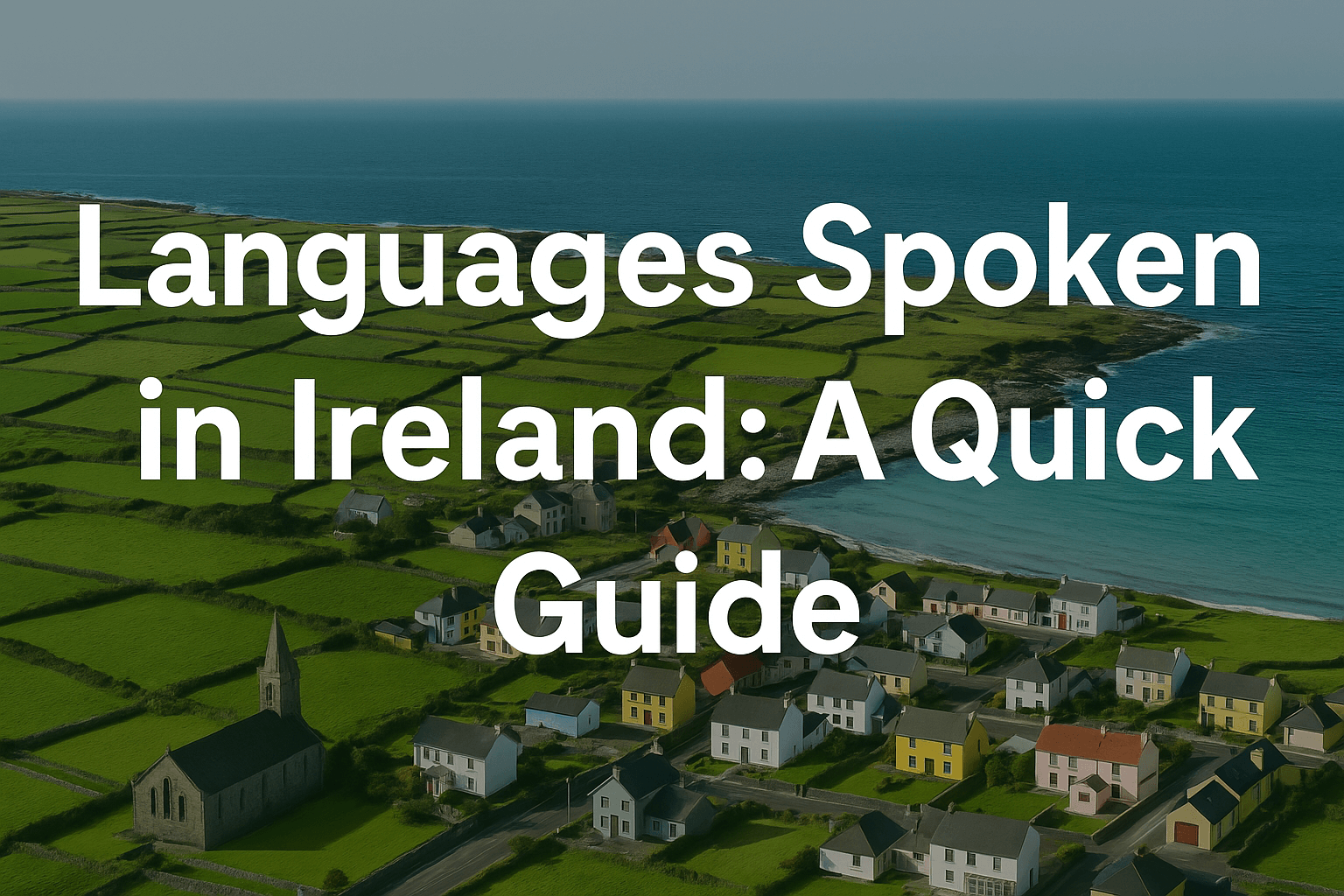
When we look at the languages spoken in Ireland, we find a rich tapestry of speech—Irish (Gaeilge), English, regional dialects and minority languages all play a role. For anyone learning Irish or curious about language in Ireland, understanding which languages are spoken in Ireland gives valuable context. In this article we’ll explore the main languages spoken in Ireland, their status, and how they relate to learners of Gaeilge and Irish culture.
The Main Official Languages
Irish (Gaeilge)
Among the languages spoken in Ireland, Irish holds a special position—it is the first official language of the Republic of Ireland and is recognised throughout the island. en.wikipedia.org+3en.wikipedia.org+3coimisineir.ie+3 Some key points:
Irish is a Celtic Goidelic language with deep roots in the island’s history. en.wikipedia.org+1
In the Republic of Ireland, Irish is constitutionally the national and first official language; English is recognised as a second official language. Encyclopedia Britannica+1
Although many people study Irish in schools, the number of daily first-language speakers is relatively small. en.wikipedia.org+1
English
English is the dominant language in most parts of Ireland and is one of the key languages spoken in Ireland today. Ireland.com+1 Important facts:
English is the de facto primary language in everyday life—business, media, education—across much of Ireland. https://www.educations.com+1
The variety of English spoken in Ireland is sometimes referred to as Hiberno-English. en.wikipedia.org
Minority & Regional Languages
Beyond the two main languages, there are other languages and dialects worth knowing when considering “languages spoken in Ireland”.
Ulster Scots (Ullans)
In Northern Ireland, Ulster Scots (sometimes called Ullans) is recognised as a regional language and is part of the linguistic landscape. en.wikipedia.org+1
It is spoken by a smaller group, and its role is more cultural and regional than national.
Traveller Cant: Shelta
Among the languages spoken in Ireland is Shelta, a cant used by the Irish Traveller community. en.wikipedia.org
While used by relatively few people, it contributes to the full picture of languages in Ireland.
Sign Languages & Other Speech Communities
Irish Sign Language (ISL) is used by the deaf community in Ireland. It is part of the broader set of languages spoken in Ireland. en.wikipedia.org+1
Additionally, with immigration and international movement, many other languages (Polish, Lithuanian, Chinese, etc.) are spoken in Ireland today—even if they are not national official languages. en.wikipedia.org
Why Knowing the Languages Spoken in Ireland Matters for Learners
If you’re studying Irish (Gaeilge) or simply interested in the culture, it helps to understand why so many languages are spoken in Ireland and how they interact.
Cultural and Social Awareness
By knowing Irish is the first official language, you’ll appreciate why road signs, place names and official documents often appear in Irish and English.
Recognising regional languages like Ulster Scots gives insight into local identity, particularly in Northern Ireland.
Better Learning Strategy
When you learn Irish, acknowledging the dominance of English helps understand why many learners are working to use Irish actively, not just passively.
Understanding that languages spoken in Ireland are many—and that Irish is one among them—helps you set realistic goals and see where you can practise in community or media.
Motivational Boost
Knowing you’re part of a larger language ecosystem can inspire you to explore not just Irish, but its relationship with English, Scots, and minority languages.
Learning Irish with awareness of this context adds depth—you’re not just memorising words, you’re connecting with the languages spoken in Ireland and their heritage.
How to Explore the Languages Further
Here are practical ways to deepen your understanding of the languages spoken in Ireland:
1. Explore Irish language media
Look for radio, podcasts or TV programmes in Irish—especially from Gaeltacht regions where Irish is more commonly spoken.
Ask questions like: “Which language do people speak at home in this area?” or “How often do you hear Irish in daily life?” to increase awareness of where Irish stands among languages spoken in Ireland.
4. Observe linguistic variation and context
Recognise that in areas like the Gaeltacht, Irish may be stronger. In urban centres, English dominates.
Consider how minority languages still contribute culturally, though less visible in daily public life.
Reflect on how languages spoken in Ireland interact—how Irish influences English in Hiberno-English, or how bilingual signage shows dual-language usage.
Challenges & Opportunities When Learning Irish
Since Irish is one of the languages spoken in Ireland, learners might face both unique challenges and opportunities:
Challenges
Limited daily use: Though Irish is official, English dominates many settings.
Dialect variation: Different regions have different dialects of Irish, which can complicate learning.
Minority language status: Some speech communities use smaller languages/dialects, so finding practise settings for Irish can require effort.
Opportunities
Cultural richness: Learning Irish connects you with one of the primary languages spoken in Ireland, opening doors to tradition, literature and place-names.
Deep context: Understanding that Irish is officially recognised gives your learning purpose—it’s not just an academic exercise.
Diverse practise environments: You can engage in immersion in Gaeltacht areas, online courses, language meet-ups and bilingual signage to see the real-life usage of languages spoken in Ireland.
Quick Facts: Languages Spoken in Ireland
Here’s a handy summary:
Irish (Gaeilge): First official language in the Republic, Celtic Goidelic origin.
English: Broadly spoken and dominant across much of Ireland.
Ulster Scots (Ullans): Regional language in parts of Northern Ireland.
Shelta: Traveller Cant used by the Irish Traveller community.
Irish Sign Language (ISL) and other minority languages: Contribute to the full linguistic landscape of Ireland.
Immigrant languages: Polish, Lithuanian, Chinese and others feature due to recent migration and contribute to the diversity of languages spoken in Ireland.
Bringing It Back to Your Irish Learning Journey
If your goal is to learn Irish (Gaeilge) and engage with the languages spoken in Ireland, then this context adds real value. Here are some tips to integrate this knowledge:
✅ Set clear goals
Decide your aim: Do you want conversational Irish? To read Irish literature? To understand bilingual signage? Knowing your goal helps you see where Irish sits among languages spoken in Ireland.
✅ Use structured resources
Use lessons that recognise this linguistic context. For example, our Irish Pronouns Guide helps build grammar based on Irish being one of Ireland’s languages.
✅ Immerse where you can
Visit Gaeltacht areas or join online Irish-language communities. Seeing how Irish is used alongside English (and in relation to minority languages) reinforces its role as a living language among the languages spoken in Ireland.
✅ Appreciate the broader awareness
When you say a phrase in Irish, you’re engaging with one of the languages spoken in Ireland—not just learning words in isolation. That gives you motivation, connection and relevance.
Conclusion: A Rich Linguistic Landscape
The languages spoken in Ireland reflect centuries of history, migration, change and cultural resilience. English and Irish dominate public life, while regional, minority and migrant languages add depth to the story. For a learner of Irish (Gaeilge), recognising this landscape enriches your path—it’s not just about one language, but about how it sits among many.
By exploring how Irish interacts with English, regional dialects, minority languages and immigrant speech, you’ll deepen your understanding, practice more meaningfully and connect more fully with Ireland’s living language culture.
Your Irish-language journey begins with awareness—of the languages spoken in Ireland—and builds through practice, interaction and cultural engagement. Whether you’re studying grammar, practising phrases, or just exploring signage in Irish, you’re part of that rich tapestry.
So, embrace the context, dive into your lessons, and move forward with confidence knowing you’re learning one of the languages spoken in Ireland and helping keep it active and alive.
Go n-éirí le tú—may your journey in Irish, among the languages spoken in Ireland, be joyful, meaningful and rewarding.
The phrase “Gaelic runes” often evokes images of mystical symbols carved into ancient stones, whispering secrets of Celtic druids and warriors. While the term can be misleading — as the Gaelic world didn’t use Norse-style runes — there were unique writing systems used by the Irish and Scottish Gaels that served similar purposes: recording language, marking boundaries, and preserving sacred knowledge.
In this guide, we’ll uncover the origins and meaning of Gaelic runes, explain how they differ from traditional Norse runes, and explore the real ancient writing system of the Gaels — the Ogham script. We’ll also look at how these symbols survive in modern Irish culture and what they teach us about language and identity.
What Are Gaelic Runes?
Strictly speaking, Gaelic runes are not runes in the same way as the Norse Futhark alphabet. The Irish never used runic symbols derived from Germanic or Scandinavian traditions. Instead, the ancient Irish and Scottish Gaels developed Ogham, a writing system used between the 4th and 9th centuries CE.
Ogham is sometimes referred to as “Gaelic runes” because it shares similar mystical and memorial uses with the runic alphabets of Northern Europe. However, it’s a distinctly Celtic system, deeply tied to the Irish language and landscape.
To understand Gaelic runes, we must first understand Ogham — the original alphabet of the Gaels.
Historians believe Ogham was created in Ireland during the early Christian era, possibly around the 4th century CE. It was used to write Primitive Irish, the earliest known form of the Irish language.
Ogham inscriptions are found primarily on stone monuments across Ireland and western Britain — regions rich in Gaelic heritage.
2. The Purpose of Ogham
The inscriptions were often used to:
Mark graves or clan boundaries
Record family lineages
Honor deities or ancestors
Identify territories
Because Ogham was written on vertical or slanted stone edges, it was ideally suited for engraving — making it durable, elegant, and uniquely suited to Celtic artistry.
How Gaelic Runes (Ogham) Were Written
The Ogham alphabet is composed of 20 basic letters, arranged in four groups called aicmí. Each letter is formed by a series of strokes or notches cut along a central line (often the edge of a stone).
Here’s a simplified example:
Group (Aicme)
Example Letters
Meaning / Sound
Aicme Beithe
ᚁ (B), ᚂ (L), ᚃ (F/V), ᚄ (S), ᚅ (N)
Named after trees
Aicme Húatha
ᚆ (H), ᚇ (D), ᚈ (T), ᚉ (C), ᚊ (Q)
Hard consonants
Aicme Muine
ᚋ (M), ᚌ (G), ᚍ (NG), ᚎ (Z), ᚏ (R)
Soft consonants
Aicme Ailme
ᚐ (A), ᚑ (O), ᚒ (U), ᚓ (E), ᚔ (I)
Vowels
Each symbol’s name — Beith (Birch), Luis (Rowan), Nion (Ash) — corresponds to a tree or natural element, reinforcing the Gaels’ connection to the earth.
This tree symbolism makes Ogham one of the world’s most poetic alphabets, linking sound, meaning, and nature in one continuous language system.
Gaelic Runes vs. Norse Runes
It’s common to hear Ogham mistakenly described as “Irish runes.” While they share a carved aesthetic, their origins and linguistic foundations differ:
Feature
Gaelic (Ogham)
Norse (Runes)
Region
Ireland, Scotland, Wales
Scandinavia, Iceland
Language
Primitive Irish / Old Gaelic
Old Norse / Proto-Germanic
Alphabet Name
Ogham (᚛ ᚜)
Futhark
Structure
Linear strokes along a central line
Angular letters for wood or metal carving
Symbolism
Nature and family
Magic, communication, war
Time Period
4th–9th centuries CE
2nd–12th centuries CE
Despite their differences, both systems show how early European peoples saw writing as sacred — not just practical, but spiritual.
The Spiritual and Symbolic Meaning of Gaelic Runes
Ogham was far more than a writing system. In Druidic and poetic traditions, each letter carried deep symbolic meaning related to trees, elements, and emotions.
For example:
Beith (ᚁ) – Birch: new beginnings, purification
Luis (ᚂ) – Rowan: protection, strength
Nion (ᚅ) – Ash: balance, connection between worlds
Sail (ᚄ) – Willow: intuition, cycles, the moon
Dair (ᚇ) – Oak: endurance, wisdom, stability
This intertwining of language and spirituality makes Gaelic runes an artistic bridge between words and nature.
You can learn more about Celtic symbolism and deities in our Celtic Deities Guide.
Where to Find Gaelic Runes Today
There are over 400 known Ogham inscriptions across Ireland, Scotland, and parts of Wales. Some of the most famous examples include:
The Emlagh East Stone (Kerry) – One of the earliest Ogham stones, reading a family lineage.
The Silchester Stone (England) – Shows evidence of Irish settlers during early medieval migrations.
The Knockmahon Stone (Waterford) – Features both Ogham and Latin inscriptions, showing cultural exchange.
The Inchagoill Stone (Galway) – Believed to mark the grave of a Christian missionary named Luguaedon.
If you visit these stones today, you’re standing before the earliest written form of the Irish language — the true script of the Gaels.
Modern Revival of Gaelic Runes
Ogham’s legacy endures as a symbol of Celtic identity and language preservation. Artists, linguists, and spiritual practitioners use Ogham symbols in jewelry, tattoos, and digital fonts as a way to reconnect with their heritage.
Modern Uses Include:
Art & Tattoos: Used to represent family names or meaningful words.
Language Learning: Teaching tools for Old and Modern Irish pronunciation.
Technology: Unicode now supports Ogham characters (U+1680–U+169F).
AI and Language Preservation: Projects like Gaeilgeoir AI integrate Ogham insights into linguistic learning tools.
For learners curious about Irish’s ancient forms, explore our Ancient Irish Language Guide to understand how modern Irish evolved from these early roots.
The Linguistic Importance of Gaelic Runes
Ogham was the foundation of written Irish, bridging oral poetry and written culture. It provided the Gaels with a way to record:
Genealogies (clan ancestry)
Territorial claims
Commemorative inscriptions
Early Christian prayers
As Ireland transitioned from Paganism to Christianity, Ogham coexisted with Latin, influencing how Irish orthography developed over time.
Today, its influence can still be seen in the Gaelic love of wordplay, poetic alliteration, and respect for language as a form of art.
For a deeper linguistic comparison, see our post on Irish Orthography.
Learning from the Past: What Gaelic Runes Teach Us
The story of Gaelic runes isn’t just about history — it’s about identity. Ogham shows that writing was once more than communication; it was connection — to land, lineage, and the sacred.
Here’s what learners and enthusiasts can take from it today:
Language is alive – Every letter carries cultural memory.
Symbols matter – Even minimalist marks can hold complex meanings.
Learning Gaelic helps preserve more than words — it keeps a worldview alive.
By studying Ogham, we honor the ancestors who carved Ireland’s first written thoughts into stone, ensuring that the voice of the Gael continues to echo through time.
Discover Gaelic Language Through Modern Tools
If you’re fascinated by Gaelic scripts and want to explore the living language behind them, Gaeilgeoir AI can guide your journey.
Our platform combines AI technology with traditional language learning — helping you master pronunciation, grammar, and cultural insights while staying true to Gaelic roots.
You can start for free at learn.gaeilgeoir.ai and join a growing community of Irish language learners worldwide.
External Resource
For those who want to explore Ogham academically, the University College Cork (UCC) Ogham in 3D Project is an excellent research database of scanned Ogham stones: 🔗 https://ogham.celt.dias.ie/
Conclusion
The term “Gaelic runes” may be a modern shorthand, but it points toward something ancient and profound: the Ogham script, Ireland’s first written language.
More than marks on stone, these symbols are the heartbeat of Gaelic culture — recording family ties, spiritual beliefs, and the dawn of Irish literacy. Whether you’re tracing ancestral roots, studying Celtic history, or learning Irish today, Ogham remains a bridge between the mystical past and the modern revival of Gaelic identity.
By understanding these ancient “runes,” we reconnect not only with the words of our ancestors but with their worldview — poetic, natural, and enduring.
If you’ve ever watched an old Irish film or read classic literature, chances are you’ve heard the phrase “faith and begorrah.” It’s a saying brimming with Irish charm, humor, and a touch of nostalgia. But what exactly does faith and begorrah mean?
In this article, we’ll uncover the true meaning, history, and cultural roots of the expression faith and begorrah, explore how it fits into Irish English (also known as Hiberno-English), and show how understanding phrases like this can deepen your appreciation for the Irish language and its colorful influence on global English.
Whether you’re tracing your Irish heritage or learning Gaeilge with Gaeilgeoir AI, this delightful phrase is the perfect place to begin exploring Ireland’s unique blend of language and culture.
What Does “Faith and Begorrah” Mean?
At its core, “faith and begorrah” is an old Irish exclamation expressing mild surprise, emphasis, or excitement — something like saying “Well, indeed!” or “By golly!” in English.
It’s typically used in informal, cheerful contexts, and you might hear it in phrases such as:
“Faith and begorrah, it’s good to see you again!”
“Faith and begorrah, that’s grand news altogether!”
While it may sound quaint or humorous today, it reflects a genuine linguistic tradition from Ireland’s past — one deeply influenced by Irish Gaelic speech patterns and religious expressions.
Breaking Down the Phrase: “Faith” and “Begorrah”
1. “Faith”
In this context, “faith” isn’t necessarily religious — it’s an old-fashioned intensifier or exclamation. It comes from the days when people commonly invoked faith or divine truth to give weight to their statements.
It’s similar to saying “indeed” or “truly” — a verbal emphasis that adds sincerity or surprise.
2. “Begorrah”
Here’s where things get more interesting. The word “begorrah” is a euphemistic form of “by God.” It developed as a polite way to express emotion or astonishment without directly taking the Lord’s name in vain.
So “begorrah” = by God → softened to be Gorrah → begorrah.
This practice of modifying or “softening” religious expressions was common in Ireland, especially during the 18th and 19th centuries, when strong religious sentiment shaped daily speech.
Other examples include:
“Begosh” or “Begob” = by God
“Bedad” = by Dad (God)
“Begorra” = another variant of begorrah
Together, faith and begorrah roughly translates to “By God, indeed!” — a friendly, expressive, and unmistakably Irish way to emphasize a statement.
Where Did “Faith and Begorrah” Come From?
The expression grew out of Hiberno-English, the unique variety of English spoken in Ireland. When English spread to Ireland during the late Middle Ages and early modern period, it absorbed Irish idioms, rhythms, and expressions from native Gaelic speakers.
Irish Gaelic has a strong tradition of colorful, poetic, and indirect expressions, and this influence shaped how the Irish spoke English too.
Phrases like faith and begorrah, sure, it’s yourself, or may the road rise to meet you all reflect this Gaelic linguistic creativity.
In Irish, people often used religious or spiritual references in everyday speech — not out of formality, but as part of the living rhythm of conversation. Expressions like Mo Dhia! (“My God!”) or A Dhia ár ndea! (“Good God above!”) were common in Gaelic, and when people switched to English, these habits carried over — giving us lively sayings like faith and begorrah.
How “Faith and Begorrah” Became a Stereotype
By the 19th and early 20th centuries, faith and begorrah became widely recognized as a stereotypical “Irishism.”
It appeared in:
Victorian stage plays and novels featuring “comic Irish” characters
Early Hollywood films
Postcards, songs, and even St. Patrick’s Day merchandise
While this sometimes led to caricature or cliché, the phrase also became a symbol of Irish wit and warmth — cheerful, good-natured, and instantly recognizable.
Even today, people abroad might jokingly say faith and begorrah when imitating an Irish accent, though modern Irish people rarely use it in real life anymore.
However, understanding its linguistic roots helps reclaim the phrase’s authenticity — showing that it’s more than a stereotype; it’s a genuine reflection of Ireland’s rich speech tradition.
Irish Expressions Similar to “Faith and Begorrah”
The Irish language is filled with lively exclamations and blessings that capture the same warmth and humor as faith and begorrah. Here are a few examples:
Irish / English Phrase
Meaning
Usage
Begob! / Bedad!
“By God!” (softened exclamation)
Surprise or emphasis
Jaysus!
“Jesus!” (colloquial interjection)
Shock or disbelief
Ah, sure lookit!
“Ah, well now!”
Acceptance or conclusion
Beannachtaí!
“Blessings!”
Greeting or farewell
Dia dhuit!
“God be with you”
Hello
Go n-éirí an bóthar leat!
“May the road rise to meet you”
Blessing for good fortune
Each one shows how Irish communication weaves faith, humor, and humanity into everyday speech.
Is “Faith and Begorrah” Still Used in Ireland Today?
In modern Ireland, faith and begorrah isn’t commonly heard in daily conversation. It’s considered old-fashioned or even humorous — something your grandparents might have said, or that appears in older books, plays, or films.
However, Irish people still love expressions that show personality, rhythm, and emotion. You might hear updated versions or similar exclamations like:
“Ah, for God’s sake!”
“Begob!”
“Fair play to ya!”
“Would you look at the state of that!”
These continue the Irish tradition of expressive, musical speech — a quality deeply rooted in the cadence of the Irish language.
The Gaelic Influence on “Faith and Begorrah”
While faith and begorrah itself is in English, its rhythm and phrasing feel Gaelic. That’s because of Gaelic syntax — how Irish speakers traditionally structure sentences.
For instance, Irish often emphasizes emotion and rhythm over rigid grammar, giving its phrases a lyrical feel:
Irish: Ó, mo Dhia, nach álainn é sin! → “Oh my God, isn’t that lovely!”
English (Hiberno-English): “Faith and begorrah, isn’t it grand!”
Notice the similar structure — both express feeling first, followed by the observation. That natural flow of emotion and melody carries through even when Irish speakers switch languages.
The Spiritual and Cultural Tone of the Phrase
In Ireland, speech has long carried a sense of spirituality — even in everyday expressions. Saying faith and begorrah reflected not just surprise, but also a worldview where faith, humor, and humanity intertwined.
Ireland’s oral tradition — from storytelling (seanchas) to blessing and lament — often blended the sacred and the secular.
So while faith and begorrah may sound like a quaint old saying, it actually mirrors something deeply Irish: the habit of speaking from both the heart and the soul.
How Learning Irish Deepens Understanding of Expressions Like “Faith and Begorrah”
When you learn Irish (Gaeilge), you begin to see the hidden patterns behind Hiberno-English expressions. Phrases like faith and begorrah make much more sense when you understand how Irish works beneath the surface.
Learning Gaeilge reveals:
Why Irish speakers often invert word order (“It’s grand, so it is.”)
How emotion and emphasis shape sentence flow
The roots of expressions like sure, to be sure, begob, and by Jaysus!
Through Gaeilgeoir AI’s intelligent tools, learners can hear authentic pronunciation, explore grammar interactively, and understand how Irish thought patterns shaped the English we know today.
By combining tradition with technology, learners worldwide can now experience languages once at risk of fading away. Gaeilgeoir AI is part of this movement — blending machine learning with Irish storytelling to make Gaeilge both accessible and alive.
A Few Fun Facts About “Faith and Begorrah”
Famous in Pop Culture: The phrase appeared in early Irish-American films and even old Lucky Charms cereal commercials, often used to evoke “Irishness.”
From Stage to Screen: 19th-century “stage Irishmen” popularized sayings like faith and begorrah, cementing them in Anglo-Irish theater.
Part of Irish Diaspora Speech: Irish immigrants carried it abroad, especially to the U.S. and Canada, where it became part of Irish-American vernacular.
Modern Humor: It’s now used playfully, often on St. Patrick’s Day or in Irish pubs — a wink to the past.
Conclusion: The Living Legacy of “Faith and Begorrah”
Faith and begorrah may sound like a phrase from another time, but it still carries the wit, warmth, and rhythm that define Irish expression.
It reminds us of a culture where language is alive — full of humor, reverence, and melody. Whether you hear it in a film, read it in a poem, or say it with a smile, it’s part of Ireland’s storytelling soul.
By learning Irish, you connect not just to a language, but to the spirit behind expressions like this — one that celebrates faith, laughter, and identity in every word.
So go on — faith and begorrah, why not start your Irish journey today? 👉 Sign up for free with Gaeilgeoir AI and bring the language of Ireland to life.
Start Speaking Irish Today — 25% Off Use code START25
Learn real Irish for real life with guided practice, pronunciation support, and everyday conversations.