You know the feeling. You sit down with a list of Irish words, you rehearse a few grammar rules, and then the moment you need to speak, everything feels slippery again. That frustration is exactly why content based language instruction matters, because it asks a different question, not “Can you remember the rule?” but “Can you use the language to do something real?”
For a lot of learners, that shift changes the whole experience. A heritage beginner might want to talk about family, food, or where they grew up. A Leaving Cert student might need to handle oral exam topics without freezing. A busy adult might just want practice that feels useful instead of abstract. Content based language instruction gives those learners a way in, because the language is tied to meaning from the start.
Table of Contents
- Why Learning Through Real Content Changes Everything
- What Content Based Language Instruction Really Means
- Theoretical Foundations That Shaped CBI
- Three Main Models of Content Based Instruction
- How CBI Compares to Other Language Teaching Methods
- Putting CBI Into Practice in Class and at Home
- Your Next Steps With Content Based Irish Learning
Why Learning Through Real Content Changes Everything
A learner can memorise “I'm hungry” in Irish and still struggle to order lunch. The missing piece is context. When the lesson grows out of a real situation, like making a sandwich, planning a trip, or describing a favourite place, the language has somewhere to go, and memory has something concrete to hold on to.
That is the quiet strength of content based language instruction. It treats language like a tool in use, not a museum piece behind glass. You learn the words while using them for a purpose, the way you learn to fix a leaking tap by repairing it, not by reading the manual from start to finish and never touching the spanner.
Who benefits most
This approach helps different learners in different ways. Beginners get structure, because the content gives them a clear path. Intermediate learners get depth, because the topic pushes them to say more. Returning learners get a bridge back into the language through familiar subjects rather than isolated drills. In Irish, that might mean building a lesson around bia, taisteal, or a family conversation instead of starting with a page of unrelated verbs.
It also gives motivation a steadier base.
If the topic is something you care about, like food, travel, work, or the Leaving Cert oral, the lesson feels less like a test and more like a task you can finish. That makes practice easier to repeat. Repetition is where confidence starts to grow.
Practical rule: if the language never helps you do anything meaningful, it is too easy to forget.
The approach also suits self-study better than many people expect. A short session on weather, a café menu, or directions to the station can feel like real progress because the content is concrete. That is much easier to return to than a random vocabulary list with no story attached.
What Content Based Language Instruction Really Means
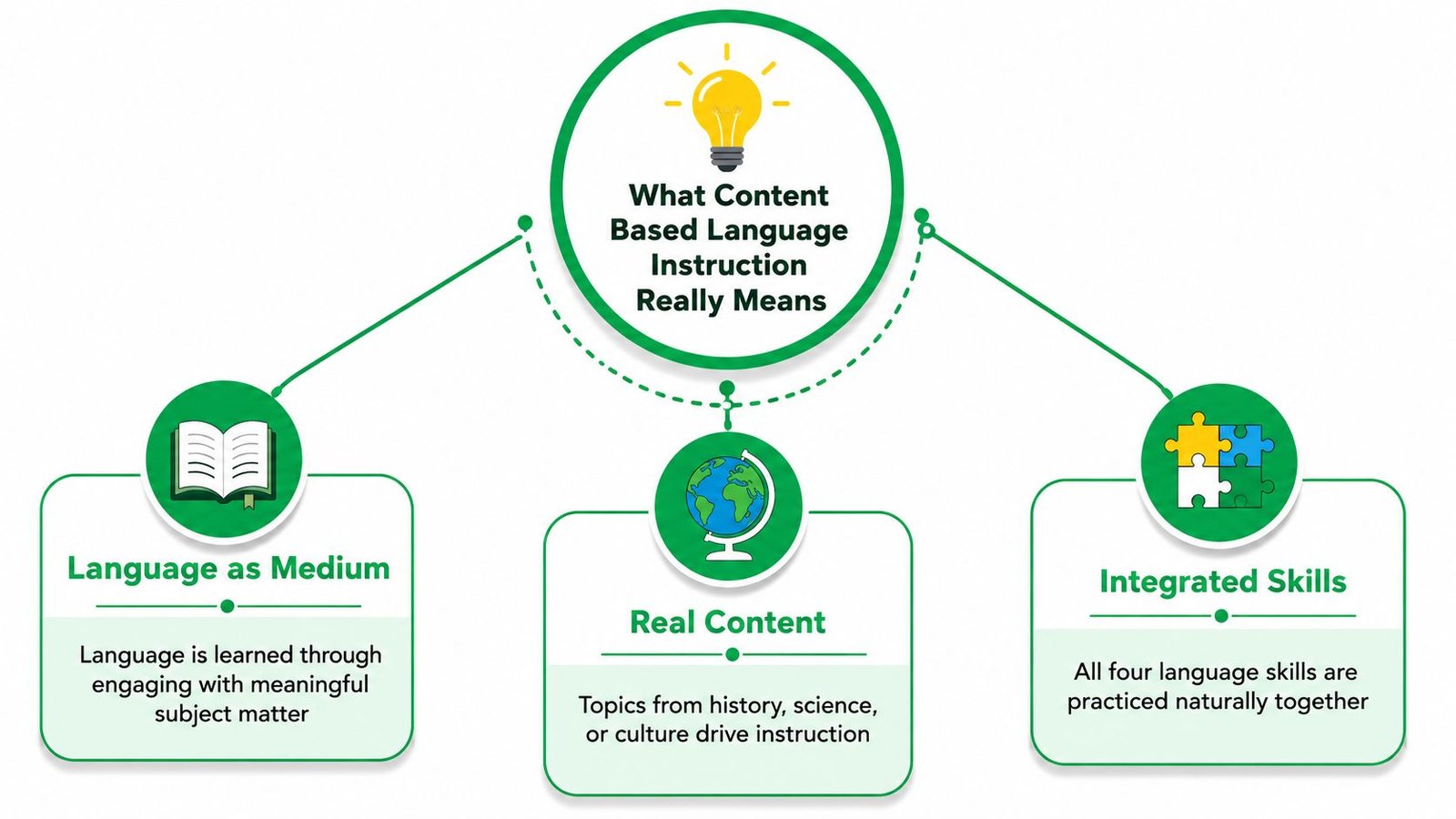
Content based language instruction means the target language becomes the medium for learning something else. Instead of studying Irish as an isolated subject, you use Irish to understand a topic, complete a task, or work through a lesson with an academic or practical goal. That shift is simple, but it changes the feel of the whole lesson.
A beginner who hears this idea for the first time may assume the language work disappears into the background. It does not. The classroom is still teaching Irish, but it does so through meaning, purpose, and use. The lesson might revolve around a topic such as food, travel, or school life, while the learner is also practising question forms, listening for detail, or building short spoken answers.
How the pieces fit together
In strong CBLI lessons, language sits inside real tasks, content-obligatory language, and integrated skill use. If the topic is shopping, the learner needs words for quantities, preferences, and polite requests. If the topic is travel, the learner needs directions, transport terms, and ways to ask follow-up questions. The content gives the language a job to do.
That is why scaffolding matters so much. Visuals, modelling, sentence starters, and graphic organisers reduce the load on working memory, so learners can focus on the meaning of the task instead of getting lost in unfamiliar language. Pair work and small-group work help too, because speaking to another person gives the language a live purpose. A map, a menu, or a short dialogue sheet can do the same work as a long explanation, and often more clearly.
Meaningful context makes repeated language use feel natural, and repeated use helps new academic language stick.
The same logic appears in subject classes too. Teachers use materials, tasks, and techniques from academic content areas as the vehicle for developing language, content, cognitive, and study skills, so learners acquire language while using it to learn school content, as described in CAL's overview of content-centered language learning. The point is to embed language work inside something the learner can do.
For a simple Irish example, a lesson on bia might begin with pictures of a lunch tray, a short model response, and a task like asking what someone wants to eat. A learner does not need a grammar lecture before speaking. The content gives the lesson shape, and the language grows inside that shape.
Theoretical Foundations That Shaped CBI
The history matters because it explains why this method looks the way it does today. Early definitions, later summarised by the University of Minnesota's CARLA centre, framed content based language instruction as an approach that integrates subject matter and second-language skills, including the idea of the concurrent teaching of academic subject matter and second language skills in 1989 and a 1990 definition that drew on tasks from classes such as math and social studies (CARLA's CBI overview). That framing moved language out of the “standalone subject” box.
Once language was treated as a tool for learning content, other models followed. Immersion, CLIL, and related integrated approaches all built on that basic insight, even if they looked different in practice. For Irish learners, that history is useful because it explains why a lesson on travel, family, or school life can still count as serious language learning.
From theory to research
A 2012 review of K to 12 content-language integration research found that the field had already spread across a wide range of contexts, from highly content-driven to more language-driven models (CARLA's research summary). That matters because it shows this wasn't a fringe idea sitting on the edge of language teaching. It had become a recognised research area with different classroom forms.
This language acquisition research overview is a helpful companion if you want to connect classroom practice with broader learning theory without getting lost in jargon.
The long view also helps with a common beginner worry. Many learners assume that if a lesson doesn't look like traditional grammar teaching, it must be less serious. The history points the other way. The field developed precisely because teachers saw that language sticks better when it's tied to meaningful content, not detached from it.
Why the historical shift still matters
That older shift still shapes Irish classrooms, online lessons, and self-study tools. It's why a topic-based lesson about food feels so different from a page of detached verbs. It's also why a good CBI lesson doesn't just “include content”, it uses content to structure the learning itself.
Three Main Models of Content Based Instruction
Different classrooms need different shapes, so it helps to separate the main models clearly. In the broadest sense, the label is used inconsistently across contexts, and CARLA notes that it's “commonly used to describe approaches to integrating language and content instruction,” but “it is not always used in the same way” (CARLA on content-based decisions). That's why the model matters more than the label.
Theme-Based, Sheltered, Adjunct
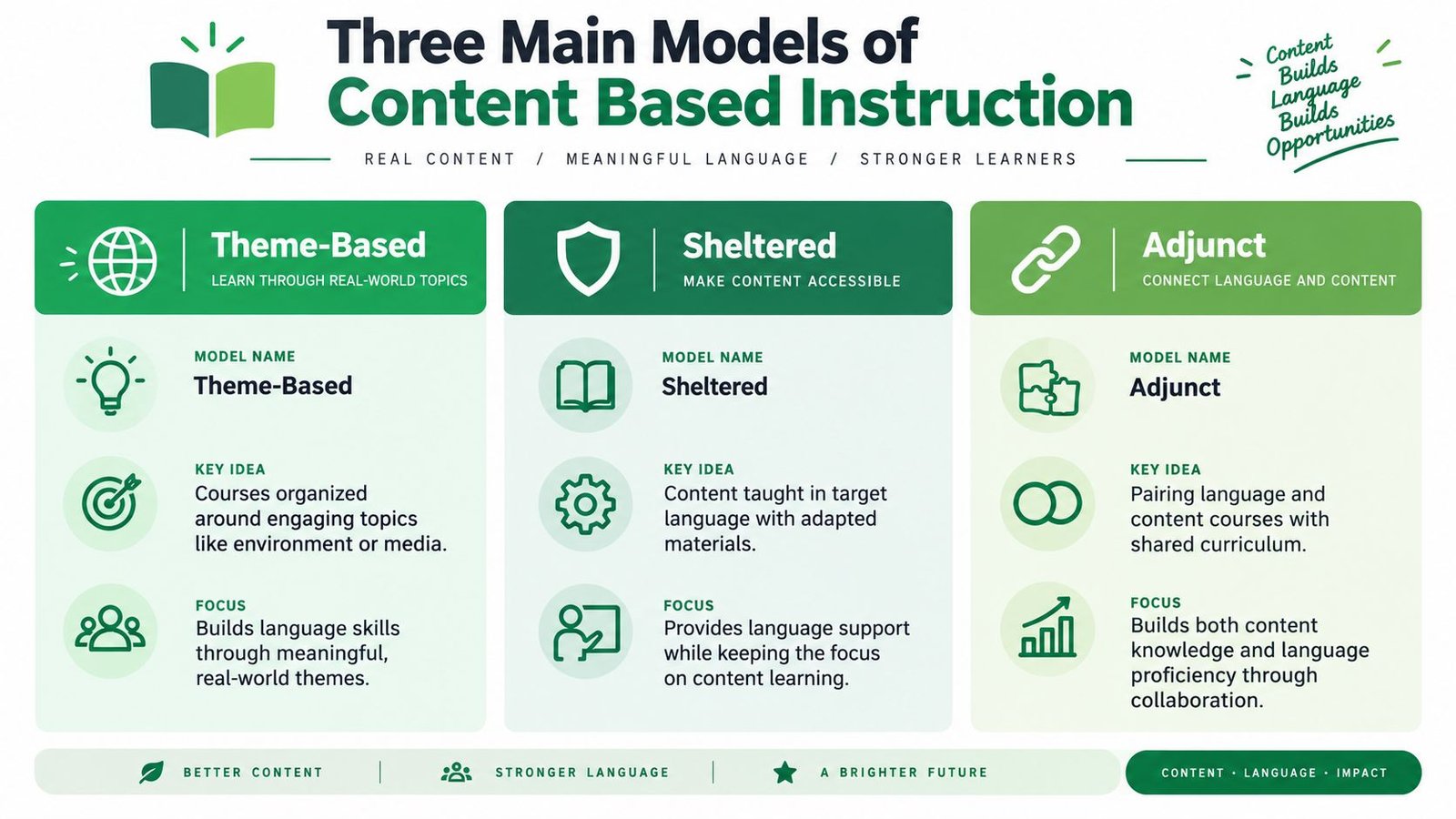
A theme-based course is organised around a topic. In Irish, that could be bia, scoil, teaghlach, or taisteal. The teacher chooses language tasks that grow out of that topic, so the content gives the sequence its shape.
A sheltered model teaches content through the target language with adapted supports. The CAL resource describes this as using academic content materials, tasks, and techniques as the vehicle for building language and study skills, with instruction delivered by a language teacher alone or by a combination of language and content teachers (CAL's content-centered language learning overview). That setup works well when the class needs more guidance, visuals, and controlled language input.
An adjunct model pairs language and content courses so the two classes reinforce each other. That's a useful shape for older students who can handle more complexity, because one teacher can focus on the content and another can support the language needed to access it.
| Model | How It Works | Best For |
|---|---|---|
| Theme-Based | Lessons follow a topic such as food, travel, or media | Beginners to intermediate learners who need structure |
| Sheltered | Content is taught in the target language with supports | Learners who can handle subject matter with scaffolding |
| Adjunct | Language and content courses are linked | Older learners or programmes with coordinated teaching |
A quick Irish classroom picture
A Leaving Cert oral prep unit might use a theme-based model for describing holidays. A sheltered lesson might use Irish to explore a simplified geography topic. An adjunct setup could link a language class with a content class so vocabulary from one supports discussion in the other.
The best model is the one that fits the learner's language level, the teacher's role, and the amount of support available.
How CBI Compares to Other Language Teaching Methods
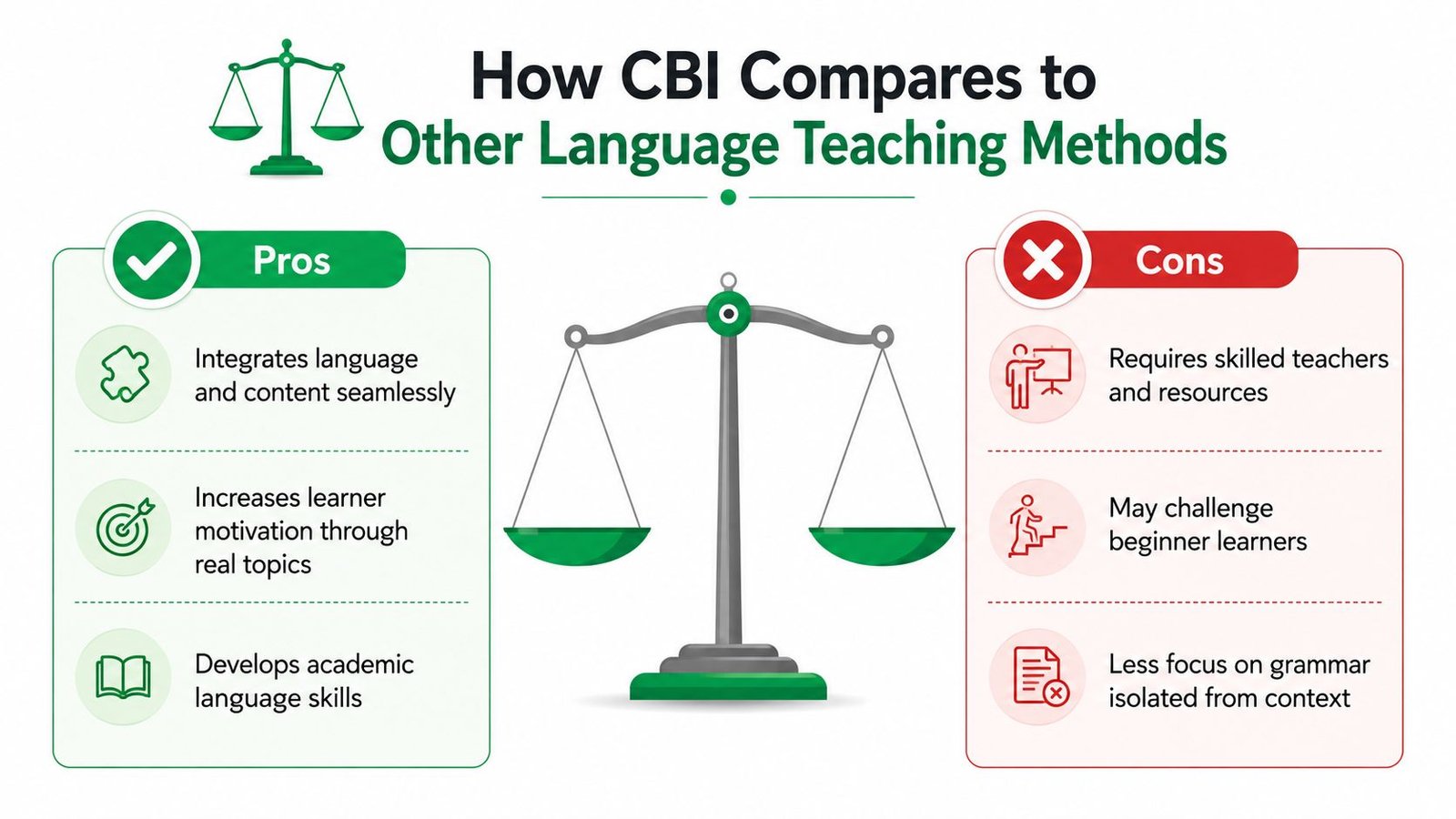
People often group content based language instruction with communicative teaching, CLIL, or immersion, but the terms do different jobs. CBI keeps language growth tied to learning something specific, while other methods may give more weight to interaction, subject delivery, or general fluency. That difference matters in an Irish class, because a lesson on food, travel, or the Leaving Cert oral needs both the topic and the language work to stay visible.
Grammar-translation sits at a very different point. It usually organises learning around rules, word lists, and translation. That can help learners study forms in a controlled way, but it does not naturally push them to use Irish to complete a task or understand a topic.
Where it overlaps, and where it doesn't
Communicative language teaching shares CBI's interest in meaningful language use, but it often centres functions such as asking, describing, or agreeing rather than a content sequence. Immersion and CLIL move further into teaching subject matter through the target language, so they sit close to CBI, even though they are not the same thing in every classroom.
The term is broad, and classroom practice changes from setting to setting (CARLA's definition note). That is why it helps to ask what the lesson is built around, not only what label it carries.
A practical way to judge a lesson comes from strong CBLI guidance. The content goal and the language goal both need to be explicit, and learners need scaffolding such as modelling, visuals, sentence starters, and graphic organisers, because those supports lower the strain of the task and make output more manageable (Texas EL CBLI guidance).
The myth that CBI is just immersion
It is more structured than that. Strong CBI combines content with planned language objectives, collaboration, and support for beginners, so the lesson feels closer to a carefully shaped bridge than to silent exposure.
That distinction matters for Irish learners. A complete beginner does not need uncontrolled speech pouring over them. They need content that is simple, meaningful, and supported, like a short food menu, a travel role-play, or a small oral-prep prompt with a frame to lean on. A stronger learner can handle more open work, but the content still has to drive the lesson, not sit in the background.
Putting CBI Into Practice in Class and at Home
A learner sits in an Irish lesson with the words in front of them, but the task still feels blurry. They can read a menu, or hear a short dialogue, yet they do not know what to do with it. That frustration usually comes from missing structure, not missing ability. Strong CBLI gives the learner a clear content goal and a clear language goal, so they know both the topic and the kind of language they are expected to use. Without that clarity, beginners often guess and then stall. With it, they can spend their attention on the right part of the task.
Classroom moves that make output possible
Start with modeling. Show one example response before asking for independent work. Add visuals, sentence starters, and a short word bank. Then let learners work in pairs or small groups, because speaking to one another makes the language feel less like a performance and more like something they can handle step by step.
A simple Irish lesson on ordering food might begin with a menu, a few pictures, and a short teacher model. Learners first match items. Then they ask and answer in pairs. After that, each learner places an order using a sentence frame. The class finishes by listening for one useful phrase and reusing it.
That structure helps mixed-level groups. The stronger learner can stretch an answer a little further. The beginner can still take part with a frame. Everyone works on the same topic, but the language demand shifts to fit the learner.
Teachers who want a planning template can use Learniverse teaching resources to see how a topic becomes a lesson with a clear sequence, then adapt that shape for Irish content instead of another subject.
A sheltered lesson works in much the same way as a well-marked walking route. The destination is shared, but the signs appear one at a time, so no one is left guessing where the path goes next. In a theme-based lesson on food, that might mean simple vocabulary, a short listening task, and a spoken exchange about what someone would like to eat. In task-based work, the task itself, like arranging a meal order or planning a visit, gives the language its purpose.
Self-study that feels like real use
At home, the same principle still holds. Build a small theme, like ag ordú caife, ag cur treoracha, or ag caint faoin scoil, and gather only the language you need to complete one real task. Then speak it aloud, read it, and write it back in slightly different forms. The point is to make the language do something, not to leave it sitting in a list on the page.
Self-study also needs scaffolding, because beginners can get stuck if they try to do everything from memory at once. A simple sequence helps: read or listen first, check the hard parts, rehearse the task aloud, then repeat it later with one small change. For learners who want a clearer way to set that up on their own, how to learn a language on your own gives a practical starting point for building a routine around real use.
A tool like Gaeilgeoir AI fits naturally into that routine because it gives learners conversational practice in Irish around everyday scenarios, with pronunciation support and adaptive quizzes built into the process. It works best when the learner treats each session like a content task, not a memorisation drill.
Avoid this mistake: introducing too many new academic words at once. Chunk the language, then come back to it in a new context.
Feedback should stay close to the task. If a learner uses the wrong word order, correct the version they need for that situation, then let them try again. That kind of repetition, inside a real topic, helps the language settle far better than a long explanation detached from use.
Your Next Steps With Content Based Irish Learning
A learner who opens a lesson with a real purpose usually holds onto the language more easily. Ordering a meal, describing a journey, or preparing for an oral exam gives Irish a clear job to do, and that job keeps the words from feeling empty on the page.
CBI still needs a careful boundary. Beginners and mixed-level groups often need more than exposure alone, because hearing Irish in context does not automatically turn into usable speech. The stronger versions of content based instruction pair theme-based input with language goals, scaffolding, and structured interaction, so learners can understand the topic and practise the Irish needed to talk about it.
A simple filter helps before you choose a lesson or a study topic. Pick a theme that feels familiar in daily life. Keep the task small enough to finish in one sitting. Add one support for comprehension, one support for speaking, and one chance to reuse the language in a fresh sentence or short exchange. If the topic is too wide to handle that way, it needs to be narrowed before you start.
Self-study works better with a steady sequence. Read or listen first. Translate the difficult parts. Speak the task aloud. Return to it later and change one detail. That kind of scaffolding matters because it keeps the learner moving through a task instead of trying to hold everything in working memory at once. For learners who want help setting up that routine, AI language tutors can fit into a real-topic study habit when they are used for guided practice rather than random chat.
Irish learners often do well with content that already has a clear shape, like food, travel, or Leaving Cert oral preparation. A sheltered lesson can simplify the language, a theme-based lesson can keep the topic familiar, and a task-based lesson can push the learner to use the language in a concrete outcome. That sequence gives the beginner a path in, then gives the intermediate learner a reason to stretch.
Keep the first step modest. One well-scaffolded topic, used again in a slightly different form, does more for long-term progress than a pile of disconnected vocabulary lists.