
About 40% of learners globally, more than 250 million students, don't receive education in a language they speak and understand fluently, according to UNESCO estimates reported in the World Bank Independent Evaluation Group review of basic education. That single fact reframes linguistic diversity in education. It's not mainly a celebration of culture. It's a question of whether a child can understand the lesson in front of them, and whether the exam at the end lets them show what they know.
Table of Contents
- What Linguistic Diversity in Education Really Means
- How Language of Instruction Shapes Learning Outcomes
- Comparing Multilingual Models Side by Side
- How to Sequence Languages in a Lesson
- Assessing Learners Across Their Full Language Repertoire
- Policy Lessons from Irish as a Heritage Language
- How Platforms Can Support Immersion-First Pedagogy
- Start Immersion-First Irish Practice Today
What Linguistic Diversity in Education Really Means
Think of a child's home language as a bridge. On one side sits everything the child already understands from family life, stories, play, and everyday talk. On the other side sit new school concepts. When teaching starts from the home language, the bridge carries understanding across. When it starts in an unfamiliar language, the child must build the bridge and cross it at the same time.
That's the plain meaning of linguistic diversity in education. Learners bring many languages into school, including national and regional languages, minority and heritage languages, dialects, creoles, and sign languages, and school policy has to account for them rather than pretend they're not there. Say a class includes children who speak a regional language at home, one child who uses sign language with family, and others who speak the national language. The diversity is already in the room. The school's choices decide whether it becomes a resource or a barrier.

Three kinds of benefit
The benefits fall into three groups, and it helps to keep them separate.
- Cognitive benefits: Concepts are grasped faster when learners understand the words used to explain them, because attention goes to the idea rather than to decoding.
- Social benefits: Learners feel their families and identities belong in school, which supports participation, confidence, and family engagement with homework and reading.
- Academic benefits: Literacy and retention built in a familiar language carry into later grades, so early comprehension becomes a foundation rather than a gap to repair.
The global scale
The gap between languages people speak and languages schools use is large. The UNESCO languages in education page, drawing on the World Atlas of Languages, documents 8,324 spoken or signed languages worldwide, with approximately 7,000 still in active use, yet only 351 languages are used as media of instruction in education. As a result, about 40% of people globally, more than a quarter of a billion learners, lack schooling in a language they speak fluently, and that proportion can reach 90% in some low and middle income countries.
Three terms readers often mix up are worth separating now. Multilingualism means a person speaks several languages. Multilingual education means teaching through more than one language. Language of instruction is the specific language a lesson is delivered in. A multilingual child can still sit in a monolingual classroom, and that mismatch is the core problem.
Self check: List the home languages in your classroom or family, then write beside each one the language your lessons currently use. Any name with no match is a bridge you haven't built yet.
How Language of Instruction Shapes Learning Outcomes
The language used to explain a concept can change what an assessment score measures. When learners decode an unfamiliar language while also working out fractions, a science process, or a story, working memory must serve both tasks. A low score may then reflect the language burden as well as understanding of the subject.
What the reading evidence shows
UNESCO research on multilingual education reports that, in upper-middle- and high-income countries, children who speak the language of instruction are 14% more likely to read with understanding by the end of primary school than children who do not. By the end of lower secondary education, adolescents who speak the instructional language are more than 40% more likely to demonstrate reading comprehension. The reporting also cites a World Bank estimate: 37% of students in low- and middle-income countries are required to learn in a language different from the one they speak at home.
These figures describe broad patterns, not a diagnosis of any individual learner. They also point to a practical distinction: a reading assessment delivered in the instructional language measures both comprehension and the learner's access to that language. Teachers need to consider the two together.
The equity consequence
A low score can reflect a language mismatch rather than weak ability. If schools treat the score as a direct measure of subject knowledge, learners may receive easier content and less challenging reading. That response can turn an initial language barrier into a lasting knowledge gap.
Assessment language matters most at the point of transition. A learner may understand a concept when it is taught in a familiar language, yet struggle to show that understanding when asked to explain it in another. Tracking comprehension alongside response time, errors, and retention can help distinguish a language-processing delay from a misunderstanding of the concept.
That distinction guides the next teaching move: revisit the concept, pre-teach vocabulary, or explain the idea in the learner's stronger language before returning to the target language.
Comparing Multilingual Models Side by Side
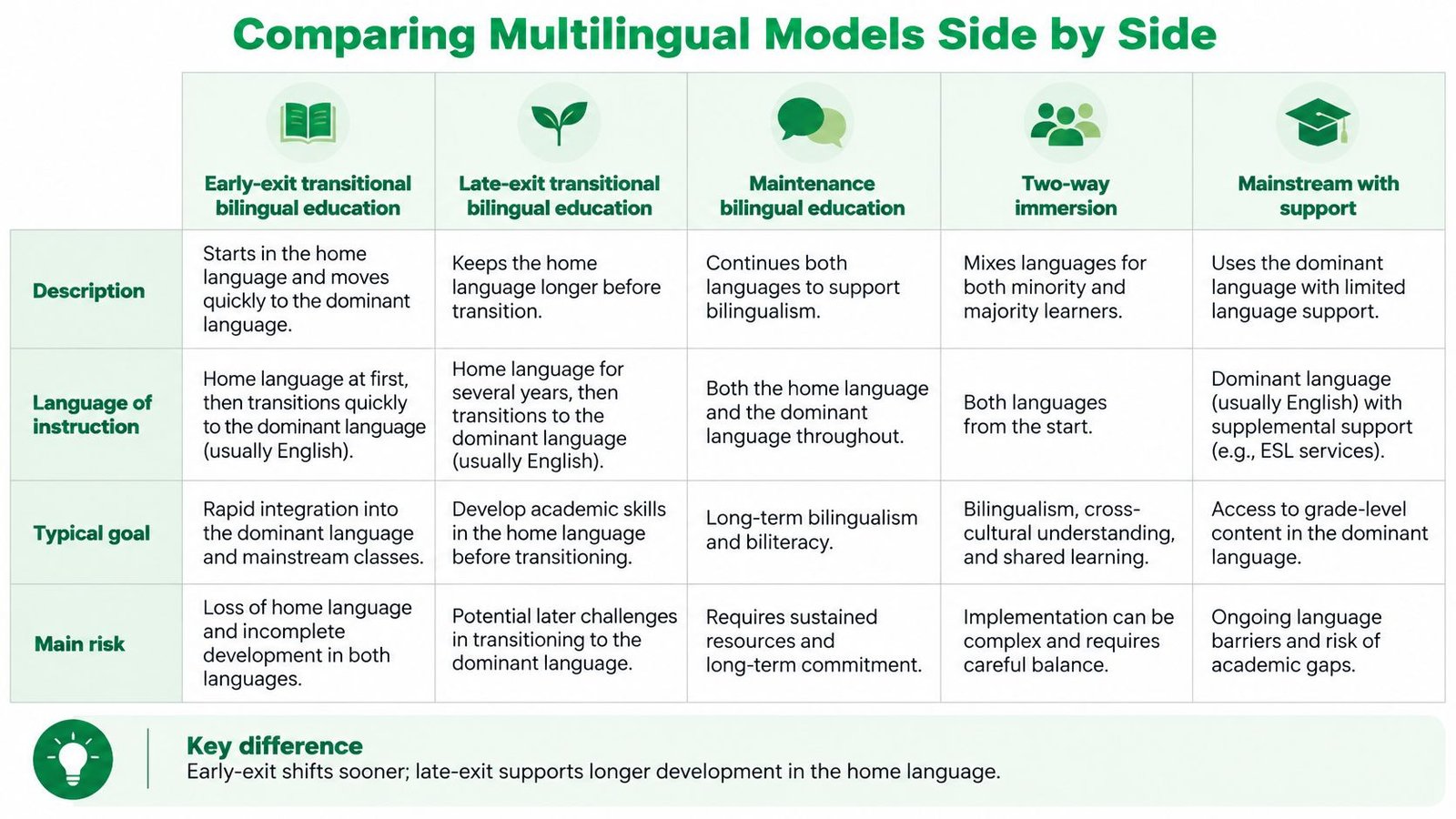
The table below compares five models on the language used, the typical goal, and the main risk. Its main lesson is simple. The model label matters less than the sequence and the support around the switch.
| Model | Language of instruction | Typical goal | Main risk |
|---|---|---|---|
| Submersion in national language | Only the national or dominant language from the start | Fast transition to the majority language | Learners fall behind while decoding unfamiliar language |
| Early-exit transitional | Home language briefly, then dominant language by early grades | Move quickly to the majority language | Gaps appear when the switch comes before literacy is secure |
| Late-exit transitional | Home language for longer, then dominant language | Build concepts before the switch | Requires teachers who are confident in both languages |
| Mother-tongue-based multilingual | Home language through primary, additional languages added progressively | Literacy and concept mastery, then bilingual proficiency | Needs trained teachers and materials in several languages |
| Immersion and heritage revitalisation | Minority language as main medium, with majority-language support | Restore intergenerational use of the language | Limited exposure outside school hours |
Early exit versus late exit
Teachers often ask whether the difference is just timing. It's timing relative to literacy. Early-exit moves learners before reading and writing in the first language are secure, so they must rebuild literacy in a second language. Late-exit keeps the home language longer, so skills transfer instead of restart. UNESCO reporting on languages in Africa states that 31 of Africa's 55 countries have adopted bilingual or multilingual education policies, although 23 of those countries switch to a second language before Grade 5. That early switch is where mother tongue gains are most often lost.
Match the model to the context. Monolingual national language instruction can work where most homes already use that language. Mother tongue based multilingual education suits early primary grades where home and school languages differ, provided the transition is planned. Immersion suits heritage language revitalisation where school may be the main place the language is spoken. For teams adapting whole courses across languages, the global course adaptation tips from LearnStream are a useful reminder that translation alone doesn't localise examples, images, or assessment formats.
Ask any school three questions. Which language is used in Grade 1? When does the switch happen? Who is responsible for teaching the bridge between them? Then check the scheme of work. Map each unit's key concepts to the language of instruction in advance, and mark which units carry a parallel bridge vocabulary list, so the model is visible in planning rather than left to individual teachers.
How to Sequence Languages in a Lesson
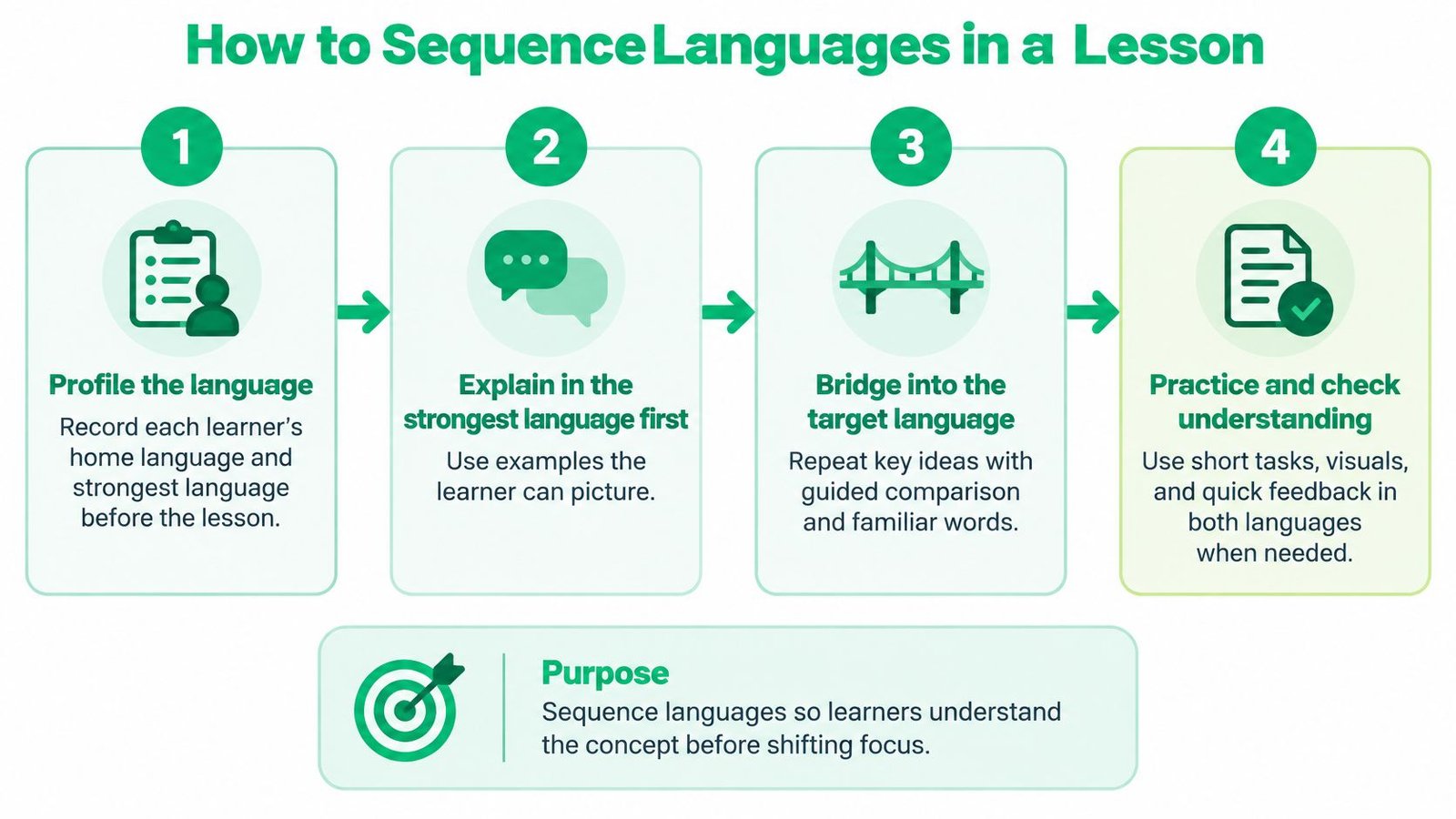
A good sequence separates two jobs that struggling learners are often asked to do at once. First they understand the concept. Then they learn to say it in the target language. The infographic summarises the flow before the detailed steps.
Six steps that keep concept and language apart
- Profile the language. Record each learner's home language and strongest language before the lesson. Don't guess from surnames or nationality, because siblings in one family can differ.
- Explain in the strongest language first. Use examples the learner can picture, such as sharing food for fractions. Skipping this step makes concept gaps look like language gaps.
- Attach target language vocabulary in parallel. Put each new word beside a meaning the learner already holds. Staying here too long, though, turns the lesson into translation and delays real speaking.
- Retrieve with a fallback. Ask for answers in the target language, but accept the home language when a learner is stuck, then recast the answer correctly.
- Produce in short scenarios. Move to brief target language only speaking, for example explaining the fraction problem to a partner. Short and successful beats long and silent.
- Track four things separately. Record receptive vocabulary, productive fluency, pronunciation, and subject mastery in different columns, so one weak strand doesn't drag down your judgement of the others.
The short video below shows this kind of staged practice in action, with explanation giving way to learner production.
Why the order matters
Malaysia offers a cautionary test of abrupt switching. UNESCO's summary of what you need to know about languages in education describes a World Bank analysis of Malaysia's unanticipated change from Bahasa Malaysia to English in mathematics and science, using a synthetic control method on TIMSS data. Students performed worse after the transition, and the negative effect was especially pronounced when a non native language was used throughout schooling rather than introduced later.
This is also where teaching content through the target language needs care. Our guide to content based language instruction works through how subject teaching and language goals can support each other instead of competing. The trade off is real. More target language exposure builds fluency, but exposure without comprehension builds silence.
The readiness sign is clear. A learner can explain the concept unaided in the target language. Only then does the lesson move to the next stage. If the explanation collapses, return one step, not to the beginning.
Assessing Learners Across Their Full Language Repertoire
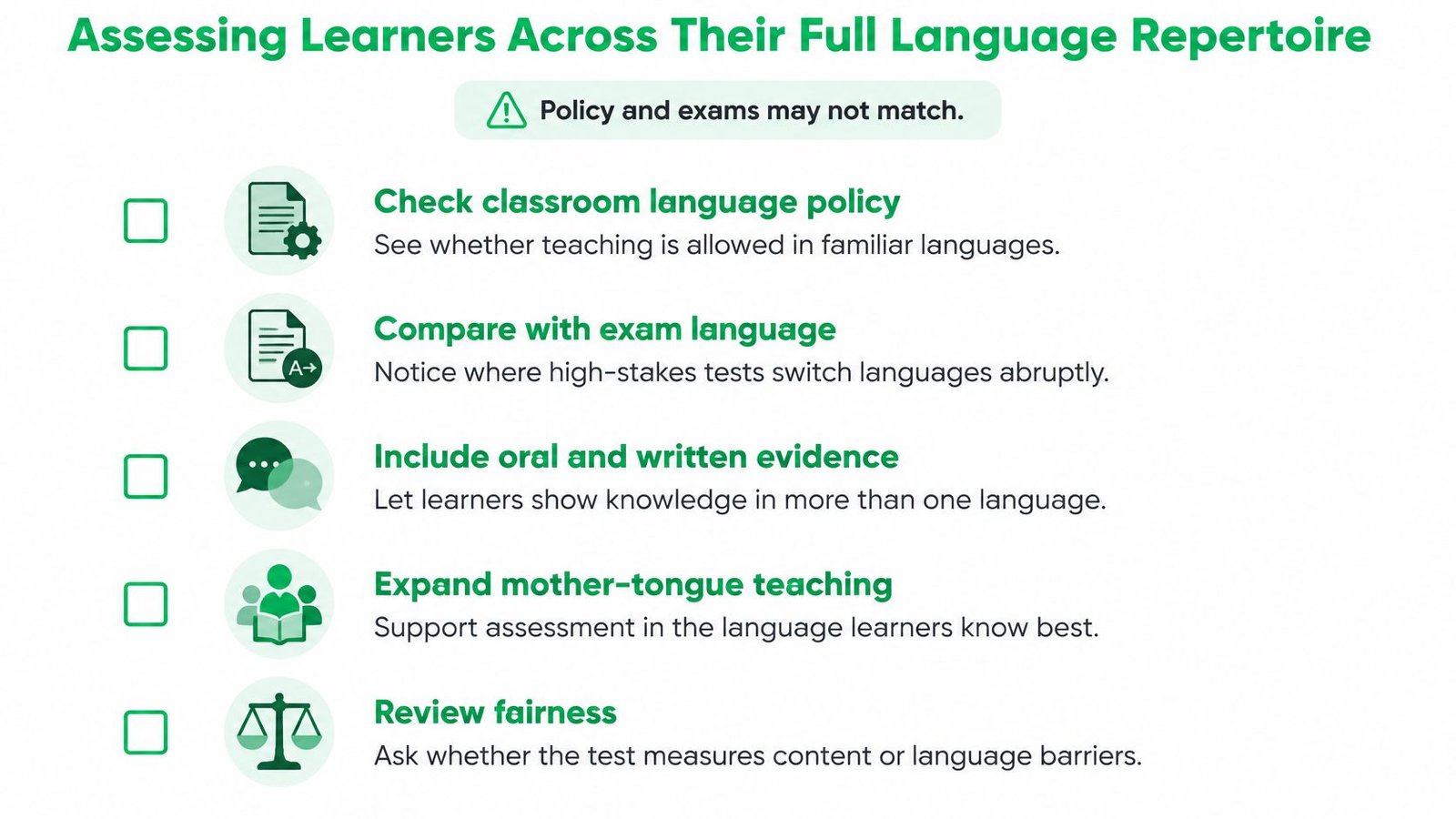
Most guidance on linguistic diversity in education stops at teaching. It says to start in a familiar language, then goes quiet about the exam. That's where policy and practice break apart. If high stakes tests switch languages abruptly, expanding mother tongue teaching alone may not close achievement gaps, because learners are still judged in a language they're still acquiring.
UNESCO's report calling for multilingual education to unlock learning and inclusion notes that only 351 of roughly 7,000 languages still in use serve as instructional languages. When assessment narrows further to one dominant language, three practical questions stay unanswered. How should bilingual knowledge be evaluated fairly? When should learners transition between languages? Can oral performance, translanguaging, and culturally specific ways of explaining concepts count as evidence of mastery?
A fairer way to score
The approach is to score subject knowledge separately from language proficiency. Allow concept answers in the learner's strongest language where the concept is what's being measured. Mark target language items for language only where language is the skill being tested. A correct science answer in the home language is evidence of science knowledge, whatever else it tells you.
Use this checklist before your next test cycle.
- State the assessment language on each item, so learners aren't guessing which language you expect.
- Allow oral responses, especially where writing in the second language would hide understanding.
- Don't penalise productive cross language transfer, such as a home language word used precisely inside a target language answer.
- Align teaching materials with the exam language, and teach exam specific vocabulary explicitly rather than assuming it transfers.
Equity is the heart of this. A monolingual test that penalises a correct answer given in another language lets home background, not ability, decide the result.
A physics test that mainly measures English reading distorts both results. You learn neither who understands physics nor who is progressing in English, and you may act on both errors.
Policy Lessons from Irish as a Heritage Language
Irish offers a clear example of how assessment can shape language policy. It is both a national language and a minority language in daily use, and many learners encounter it mainly at school. If exams reward spoken ability, classrooms need to make room for speaking practice.

Speaking is formally examined
Ireland's Leaving Certificate includes oral and aural examinations for language subjects, so speaking and listening count alongside writing. The Citizens Information guide to the Leaving Certificate lists Gaeilge among subjects with oral components, alongside French, German, Spanish, Italian, Russian and Japanese. Oral examinations are held during the spring exam period and conducted by examiners appointed by the State Examinations Commission.
Preparation should therefore include interactive speaking, listening comprehension and practice under exam conditions. A learner who completes worksheets confidently but has rarely responded to an unexpected spoken question may be underprepared. Timed pair conversations, recordings with varied speakers and mock orals with an unfamiliar adult help learners practise different parts of the task.
Dialects belong in the plan
Irish has three main dialects: Munster, Connacht and Ulster. Pronunciation and some everyday forms vary. Teachers can state which dialect models they use and check current exam guidance on accepted forms. Otherwise, learners may be confused when a recording or examiner sounds different from the textbook.
The policy lesson extends beyond Ireland: oral assessment gives spoken proficiency a formal place, while dialect awareness helps learners understand the forms they encounter. Heritage-language learners may also need opportunities to turn familiarity into active speech. Gaeilgeoir's language revitalization programs connect classroom learning with community use.
Ask three practical questions: Does oral practice begin before exam classes? Does the curriculum name dialects? Do teaching materials reflect the exam's language and format? Each question points to a design choice that can be addressed in teaching.
How Platforms Can Support Immersion-First Pedagogy
A platform can't replace a teacher, but it can carry the staged sequence into the gaps between lessons. That's where linguistic diversity in education often fails in practice. The classroom plan is sound, yet learners get too little speaking time, feedback arrives late, and review depends on memory.
Three design principles
- Separate concept from language. Give explanations in the learner's language and practice in the target language, so comprehension comes first and production follows.
- Keep a clear session order. Learners shouldn't have to decide what to do next. A fixed rhythm lowers friction and makes short sessions productive.
- Build review loops. Vocabulary and patterns should return at intervals, because one successful answer isn't retention.
Our sessions follow that logic. Each session follows four steps: learn, speak, listen and remember. The learn step introduces meaning, speak moves to out loud production, listen tests understanding with real voices and pacing, and remember brings material back for review. It's the same sequence you'd use in class, compressed into a routine a learner can repeat daily. For learners who want that structure in a course format, our Irish immersion courses organise practice around immersion first progression.
How to judge credibility
Immersion first doesn't mean unchecked. Our learning content is reviewed and approved by qualified Irish language teachers and university linguists. Lessons, vocabulary, grammar explanations, and conversation material are checked for accuracy, natural usage, and pronunciation before learners see them. That matters for a minority language, where confident sounding errors can spread quickly and are hard for beginners to spot.
Ask any platform these questions before you recommend it.
- Who reviews the content, and what are their qualifications?
- What happens when a learner needs help, in the form of a translation or hint, mid conversation?
- Can speaking practice run in a chosen dialect, and is that choice consistent across audio and text?
- Can learners save vocabulary they meet and return to it later?
- Does reporting separate receptive vocabulary, productive fluency, pronunciation, and subject mastery?
Place the platform where it belongs. It's one tool in a wider school or family plan, useful for daily speaking volume, listening exposure, and review. The teacher still profiles learners, sequences concepts, and decides when a child is ready to move on.
Start Immersion-First Irish Practice Today
Start with one small routine today. Pick a single concept, explain it to yourself in your strongest language, then say it aloud in Irish inside a short everyday scenario, such as ordering food or describing your morning. One concept, spoken out loud, beats a page of silent translation.
Our Speak With Your Tutor practice is built for exactly that step. Learners choose their teacher and pick the dialect, Connacht, Munster, or Ulster, then talk to their tutor out loud in practical, everyday situations. Translations and hints are available whenever you need them, so a missing word doesn't end the conversation. You can use the platform online or on the app wherever you are, which makes short daily practice realistic.
You can begin your Irish practice at Learn Gaeilgeoir in a few minutes. You now have a working definition, models to compare against your context, a lesson sequence, and an assessment check. The next step is to speak.
If you want structured, immersion first Irish practice that supports real linguistic diversity in education, Gaeilgeoir AI offers guided conversation, dialect choice, and teacher reviewed lessons you can use anywhere. Start speaking aloud today and build the confidence that classroom only study rarely provides.