

You've read the Irish sentence. You know the words. You may even be able to translate it comfortably on paper. Then a native speaker says the same thing at ordinary conversational speed, and the sentence seems to vanish before your ear can hold on to it.
That experience is frustrating, but it isn't evidence that you're bad at Irish. Native speech changes familiar words through linking, reduction, rhythm, and accent variation. Once you learn to hear those changes, listening becomes a practical skill you can train, not a mysterious talent that other learners somehow possess.
Table of Contents
- Why Native Speakers Sound Impossible to Follow
- The Vocabulary Coverage Threshold You Need to Reach
- Decoding Connected Speech in Real Irish Conversations
- Building Comprehension Through Shadowing and Dictation Drills
- Choosing the Right Practice Environments and Resources
- Your Weekly Practice Plan for Real-World Irish Comprehension
Why Native Speakers Sound Impossible to Follow
Most learners first blame speed. Speed matters, of course, but it's rarely the whole problem. A native speaker doesn't usually pronounce each word as a neat item separated by silence. Sounds run together, unstressed parts become less prominent, and word boundaries are signalled by rhythm and phrasing rather than by clean pauses.
That creates a painful mismatch between written Irish and spoken Irish. On the page, you can inspect a phrase at your own pace. In conversation, your brain has to identify sounds, locate word boundaries, interpret grammar, connect the message to the situation, and prepare a response while the speaker continues. If one familiar word arrives in an unfamiliar spoken shape, the next few words may already be gone before you recover.
Practical rule: If you recognise a phrase in writing but miss it in speech, train the sound pattern. Don't automatically add more vocabulary.
Irish learners often experience this in ordinary situations. You might understand the words connected with ordering food, asking for directions, or greeting someone, yet freeze when the phrase arrives with natural linking and a regional accent. The problem may not be that the speaker is speaking impossibly fast. Your ear may still be listening for dictionary forms and isolated words that native speakers don't produce in isolation.
A predictable listening problem
Research on second-language listening identifies connected speech, including reduction and elision, as a major obstacle. Learners can know a word's written or dictionary form and still fail to recognise it when surrounding sounds reshape it in real conversation. Research on the comprehension gap caused by connected speech also links listening comprehension closely with syntactic knowledge and the ability to recognise words inside connected speech.
The history of language teaching reflects this change in understanding. By the late 1960s, behaviourist views of language learning were being challenged, and during the 1970 to 1980 period, listening moved towards the centre of language instruction because comprehension was treated as a primary step in acquisition. James Asher's 1977 Total Physical Response work also reinforced the value of substantial spoken input before expecting fluent oral responses. This historical review of listening instruction documents that shift.
The encouraging part is that your difficulty has identifiable causes. You can practise hearing chunks, predicting grammar, checking transcripts, and repeating reduced forms until your brain stops treating natural Irish as an undivided stream of noise.
The Vocabulary Coverage Threshold You Need to Reach
Ear training can't compensate for every missing word. If too much of a spoken sentence is unfamiliar, you'll have no material to use when the audio is unclear. Vocabulary knowledge gives your listening system enough context to recognise imperfectly heard forms and predict what might come next.
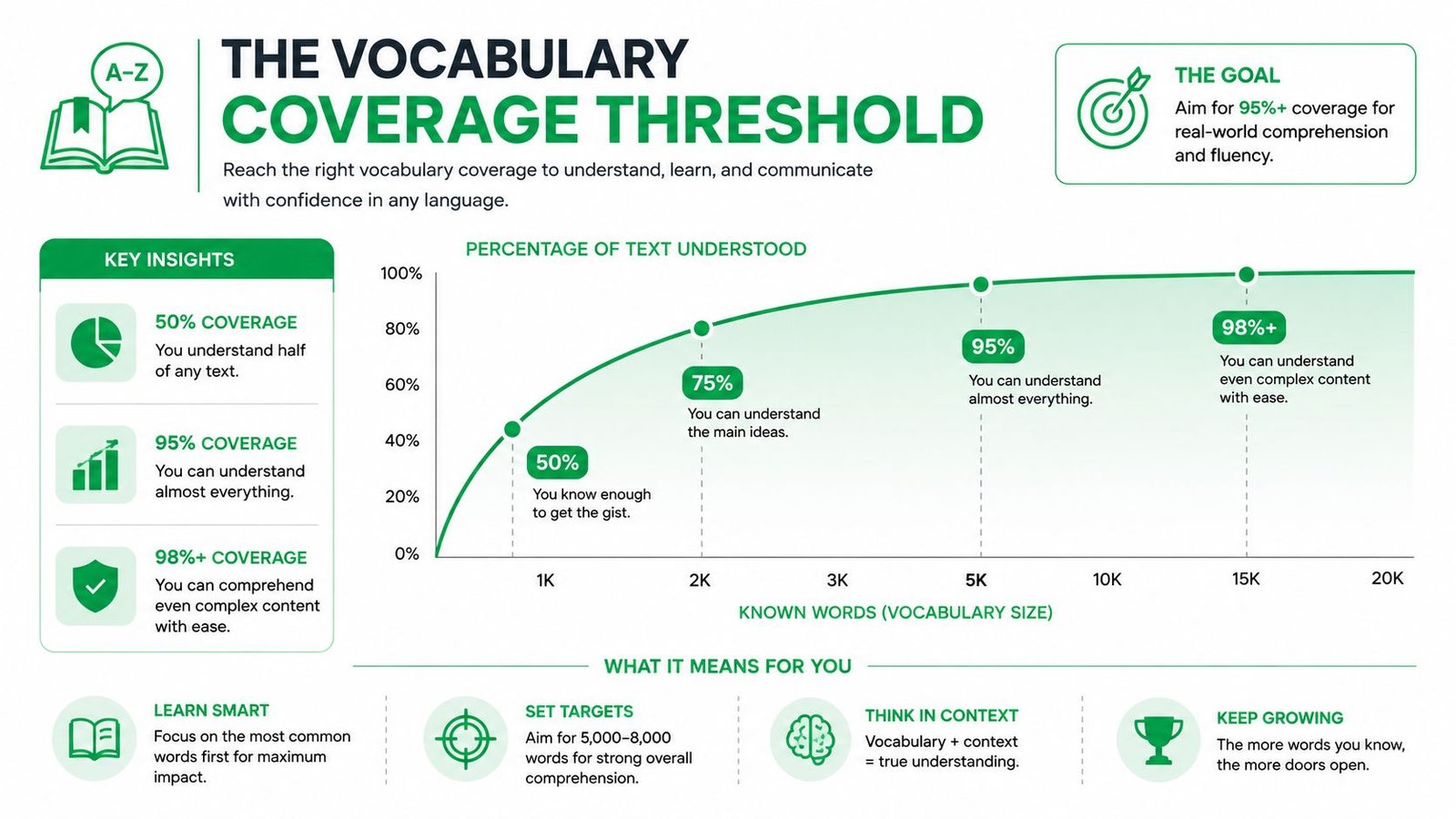
A review of spoken-input comprehension places acceptable understanding around 95% to 98% word coverage, with 98% coverage associated with high comprehension. The practical implication is important. You don't need to know every word before you start listening, but you do need a broad base of frequent vocabulary if you want everyday speech to feel manageable. Review of vocabulary coverage and comprehension explains this threshold.
Why frequent words come first
Corpus research on English podcasts found that the most frequent 3,000 word families, alongside proper nouns, marginal words, transparent compounds, and acronyms, produced 96.75% coverage. Extending knowledge to 5,000 word families raised coverage to 98.26%. The same analysis treats 95% coverage as good listening comprehension and 98% as high-level comprehension. The podcast vocabulary coverage analysis gives useful context for setting a realistic target.
A separate vocabulary-size study reports that the most frequent 1,000 word families plus exclamations covered 87.48% of listening material, while 2,000 word families reached 94.74% and 3,000 word families reached 97.57%. Its conclusion is that 3,000 to 4,000 word families are needed to approach the 98% coverage level. The vocabulary target study shows why a small high-frequency foundation is useful, but not sufficient on its own.
For Irish, start with the words you're most likely to need in actual interactions. Gaeilgeoir AI's focus on the 1,000 most-used Irish words is a sensible foundation because frequent vocabulary gives you useful grammatical and conversational building blocks. Treat that foundation as a launch point, then add words from the situations you regularly encounter, such as family conversations, school topics, work, travel, food, and local community life.
You can also use vocabulary acquisition strategies for Irish to organise new words around phrases rather than isolated translations. Learn the word in a sentence, hear it spoken, and revisit it in more than one context. That approach helps you recognise it when a native speaker gives it a different rhythm from the version you first memorised.
Here's a short listening sample to use alongside your vocabulary work:
Decoding Connected Speech in Real Irish Conversations
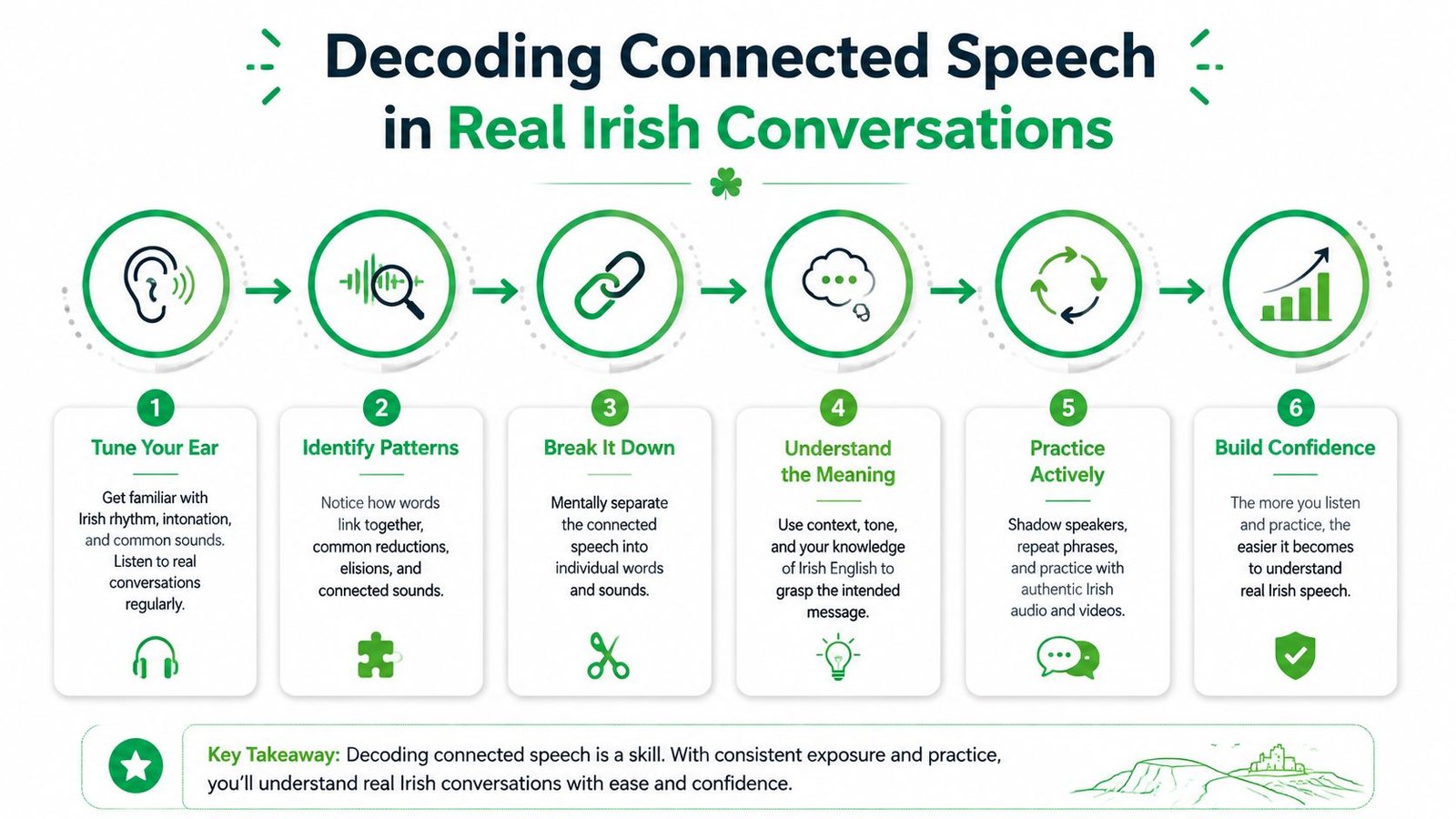
The first useful shift is to stop trying to catch every word separately. Native listeners usually process speech in meaningful groups, guided by syntax, stress, pauses, and intonation. You can develop the same habit by training your ear to locate boundaries in the sound stream.
A study comparing native and fluent second-language English listeners found that both groups segmented authentic speech in similar ways when they combined prosodic and syntactic cues. Comprehension rates were 92.9% for L1 listeners and 93.0% for L2 listeners, with average chunks of about 7 words. Agreement between listeners was moderate, at approximately κ 0.58 for L1 listeners and κ 0.54 for L2 listeners, which is a useful reminder that even native listeners don't always divide speech identically. The study on continuous-speech segmentation supports chunking as a trainable listening method.
A practical decoding sequence
Take a short Irish recording with a transcript. Don't begin by reading along. Listen once and mark only the words or ideas you catch. Then listen again and draw slashes where you think the speaker groups the phrase.
Find the stressed centre. Listen for the word or syllable carrying the strongest emphasis. Unstressed material often becomes less distinct around it, so the stressed centre gives you an anchor.
Predict the grammar. If you hear a familiar verb pattern, question form, or prepositional phrase, use it to anticipate the next piece. Syntax helps you interpret sounds that aren't fully clear.
Mark boundaries by meaning. A pause isn't the only boundary cue. A change in intonation, a completed phrase, or a grammatical transition may show where one chunk ends.
Replay a small section. Loop a difficult phrase rather than replaying the entire recording. Ask yourself whether two words are blending, whether a weak sound has disappeared, or whether you've placed the boundary incorrectly.
Check the transcript. Compare your version with the written phrase. Circle places where you heard separate words but the speaker grouped them, and places where you expected a pause that wasn't there.
Repeat the phrase naturally. Say the whole chunk aloud. Avoid restoring exaggerated pauses between words, because that creates a pronunciation pattern unlike the input you're trying to understand.
What to listen for
Irish speech can feel difficult because spelling doesn't give you a complete picture of conversational rhythm. Watch for vowel sounds that become less prominent, consonants that meet at word boundaries, and phrases delivered as one rhythmic unit. Don't invent fixed rules from one speaker. Recordings vary by dialect, speaking style, topic, and mood.
A useful exercise is to write the phrase exactly as you expect it to sound, even if your spelling is rough. Then write the standard form beside it. The gap between those two versions shows you what your ear needs to learn. Over time, you'll build a personal collection of recurring sound patterns instead of treating every conversation as a new emergency.
Building Comprehension Through Shadowing and Dictation Drills
Passive listening has a place, but it often lets the brain guess without examining the sounds. Shadowing and dictation force closer attention. One trains your mouth and ear together, while the other reveals precisely which sounds and word boundaries you're failing to perceive.
Shadowing without racing
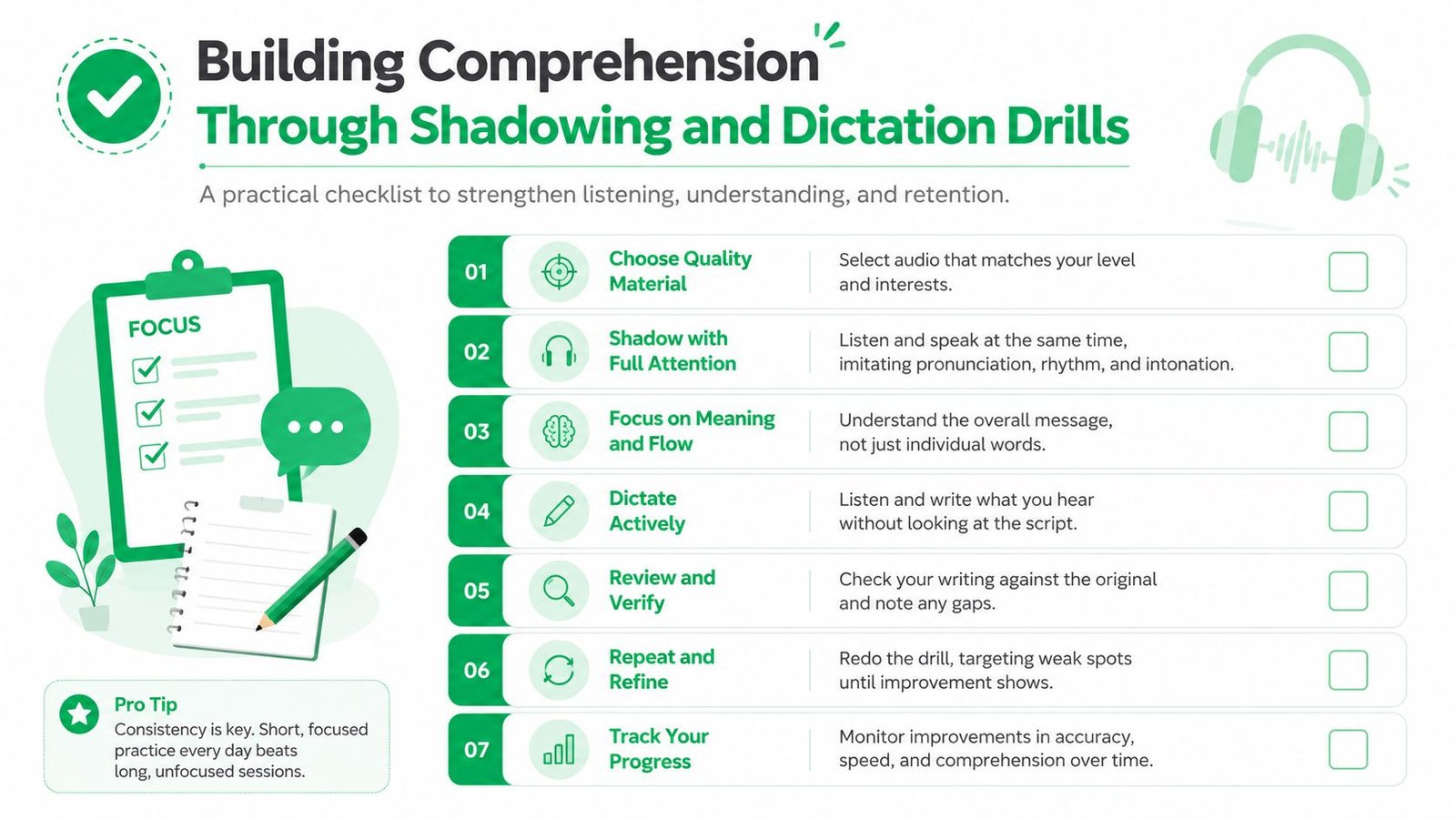
Choose a short recording with a reliable transcript. Listen once for the general meaning, then play a manageable phrase and repeat immediately after the speaker. At first, pause between repetitions. As the phrase becomes familiar, speak slightly behind the recording and copy its rhythm, stress, linking, and intonation.
Don't focus on sounding perfect on the first attempt. Your job is to notice the physical shape of the phrase. If the speaker reduces a weak syllable or joins neighbouring sounds, reproduce the grouping rather than carefully pronouncing every written word as though you were reading aloud.
A useful progression looks like this:
- First pass: Listen and identify the topic.
- Second pass: Read the transcript and underline unfamiliar words.
- Third pass: Shadow short chunks with pauses.
- Fourth pass: Shadow the passage continuously.
- Final pass: Record yourself and compare your rhythm with the original.
The research is encouraging, but it also gives a warning about level. In an 18-session intervention with 78 Japanese high-school students, dictation combined with shadowing produced significant listening gains for middle- and lower-proficiency groups, while the highest-proficiency group showed no significant progress, suggesting a ceiling effect for that material. The dictation and shadowing intervention supports targeted drills, not endless repetition at one difficulty.
Dictation that diagnoses the problem
For dictation, use a short Irish extract. Play one phrase several times, write what you hear, and leave blanks when you're unsure. Don't look at the transcript until you've committed to your best attempt. Then classify every error:
- Vocabulary gap: You didn't know the word.
- Sound-recognition gap: You knew the word but didn't recognise its spoken form.
- Boundary error: You joined or separated words incorrectly.
- Grammar prediction error: You heard the sounds but expected a different construction.
That classification matters. A vocabulary gap calls for study. A sound-recognition gap calls for more listening and shadowing. A boundary error needs chunking practice. A grammar prediction error suggests you should revisit the sentence pattern, not just replay the audio.
Use online pronunciation practice for Irish when you need built-in audio and immediate support for saying phrases aloud. Keep sessions short enough that concentration stays sharp. Consistent, attentive work will do more for your ear than hours of unfocused audio playing in the background.
Choosing the Right Practice Environments and Resources
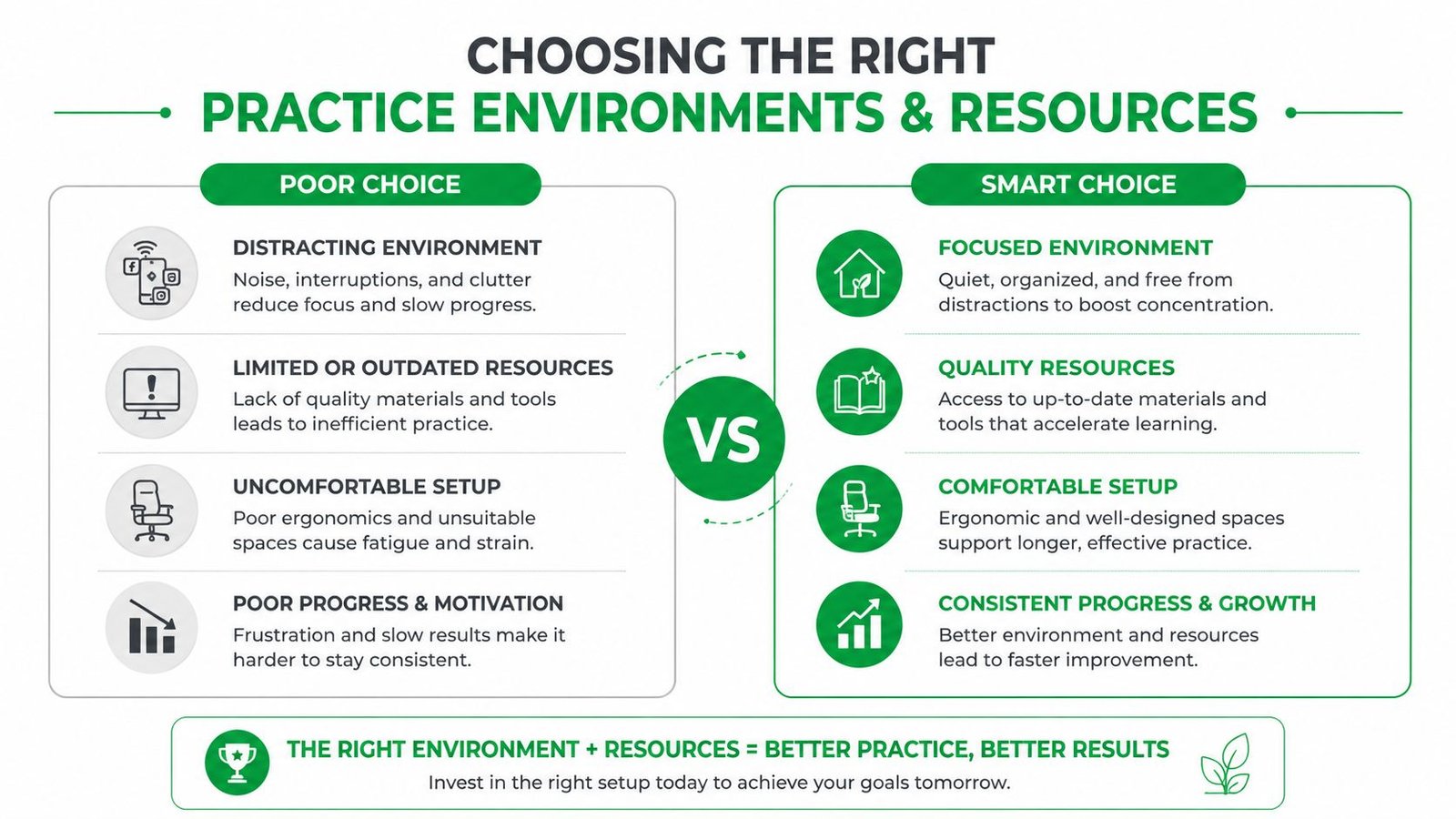
Different listening environments develop different abilities. Scripted audio gives you control and a transcript. Slowed audio helps you identify unfamiliar sounds. Authentic conversation exposes you to interruptions, unfinished phrases, varied rhythm, and speakers who don't adjust every sentence for a learner.
The mistake is treating one resource as a complete solution. Slowed speech can help you inspect pronunciation, but it may create comfort that disappears when the pace returns to normal. Scripted dialogue can clarify useful structures, but spontaneous interaction forces you to handle variation and incomplete information.
Match the resource to the job
| Practice environment | What it develops | How to use it well |
|---|---|---|
| Scripted dialogue | Clear phrase recognition and grammar prediction | Study with audio and transcript, then remove the text |
| Slowed recording | Careful sound discrimination | Use it briefly, then return to natural speed |
| Authentic conversation | Adaptability and tolerance of uncertainty | Listen for the message first, then analyse selected phrases |
| Scenario-based practice | Transfer into everyday situations | Rehearse ordering food, directions, introductions, and social exchanges |
| Multiple speakers | Accent and voice adaptation | Rotate voices instead of relying on one familiar speaker |
Accent familiarity has a direct relationship with listening comprehension, and higher-proficiency learners can benefit from becoming familiar with different accents. Evidence summarised in research on proficiency, accent familiarity, and comprehension also points towards exposure to multiple speakers of an accent as a particularly useful way to improve understanding. In other words, slowing every speaker down isn't the only answer. Your ear also needs variety.
Build situations, not just sound recognition
Practise the kind of exchange you need. Ordering food has predictable vocabulary and social routines. Asking for directions requires listening for place names, sequence, and clarification. A casual conversation may include topic changes and references that aren't stated fully.
For extra transcript-based work, use these dialogue examples to study with ClearAudio. Read the dialogue once, listen for the overall meaning, then return to specific lines for chunking and shadowing. The same method works with Irish material, provided the audio reflects the pronunciation and register you want to understand.
Gaeilgeoir AI is one possible practice environment, offering guided Irish conversations for everyday scenarios, built-in pronunciation audio, adaptive quizzes, and instant feedback. Use it alongside recordings from different speakers, not as a replacement for varied real-world input.
Your Weekly Practice Plan for Real-World Irish Comprehension
A workable plan should touch several skills without making every session exhausting. You're trying to build a listening habit that includes vocabulary, sound decoding, spoken production, and adaptation to different voices.
Use this pattern as a starting point:
Monday, vocabulary in context: Learn a small group of high-frequency Irish words through complete phrases. Hear each phrase, read it, and say it aloud. Save words that repeatedly block your understanding.
Tuesday, connected-speech listening: Choose a short recording. Listen without the transcript, mark likely chunks, then check the text. Focus on one boundary or reduction pattern rather than trying to explain everything.
Wednesday, shadowing: Repeat selected phrases immediately after the speaker. Record yourself if possible. Compare rhythm and grouping, not just individual consonants.
Thursday, dictation: Work from a short extract. Write what you hear, compare it with the transcript, and label each error as vocabulary, sound recognition, boundary, or grammar.
Friday, speaker variety: Listen to a different voice or accent. Accept partial understanding and note which phrases become difficult when the speaker changes.
Saturday, scenario practice: Rehearse an interaction such as ordering food, asking for directions, or introducing yourself. Respond aloud instead of only recognising the model answer.
Sunday, review: Replay material from the week and test yourself without subtitles or transcripts. Keep phrases that still cause trouble for another cycle.
Track progress through observable signs rather than a vague feeling. You're ready for harder material when you can identify the topic quickly, recover after missing a phrase, recognise familiar words in altered sound patterns, and follow chunks without translating every item.
If you want a more detailed routine, use this daily Irish practice plan to keep your sessions consistent. Gaeilgeoir AI can fit into the scenario-practice part of the week, giving you guided conversations, pronunciation feedback, adaptive review, and a convenient way to practise when a conversation partner isn't available. Keep the work regular, raise difficulty gradually, and return to transcripts whenever native speech turns into blur.
Gaeilgeoir AI gives you guided Irish conversations, pronunciation support, and scenario-based practice for situations such as food orders, directions, and everyday social exchanges. Visit Gaeilgeoir AI and start practising the sound patterns that native speakers use, so your next conversation feels like something you can join rather than something you have to survive.