
You've revised your Irish vocabulary, learned answers about your family and hobbies, and practised reading your poem aloud. Then the examiner asks a slightly different question, changes direction, or follows up on one small detail you mentioned. Suddenly, the answer you memorised no longer fits.
That moment is what makes the Leaving Cert Irish oral questions so challenging. The exam rewards more than recall. You need to listen carefully, respond in real time, expand your ideas, and recover calmly when your Irish doesn't come out exactly as planned. This guide focuses on those skills, with practical answer structures, question patterns, pronunciation advice, and a preparation method that turns practice into genuine conversation.
Table of Contents
- Why the Irish Oral Exam Feels Different From Every Other Test
- Understanding the Exam Format and Marking Breakdown
- How to Structure High-Scoring Answers Under Pressure
- Common Question Themes and Model Response Patterns
- Pronunciation and Delivery Tips That Actually Help
- Building a Practice Schedule and Using AI Simulation
- Your Final Checklist for Exam Day Confidence
Why the Irish Oral Exam Feels Different From Every Other Test
On a written paper, you can stop halfway through a sentence, change a word, and check whether your answer makes sense. In the oral, the interaction keeps moving. You hear the question, decide what it means, select vocabulary, build a sentence, and deliver it while the examiner is already listening for the next opening.
A student can know plenty of Irish and still struggle in that environment. For example, you might prepare a polished answer about your school subjects, only to be asked why you chose a particular subject, whether your opinion has changed, or what you'd like to study after school. Memorisation helps you begin, but it can't carry the whole conversation.
The oral is also separate from the written Irish papers in the exam calendar. In 2024, it ran from Saturday 23 March to Thursday 28 March. In 2025, it ran from Saturday 12 April to Thursday 17 April, and in 2026, it ran from Friday 27 March to Thursday 2 April, with the State Examinations Commission specifying six active examining days. The official 2026 arrangements also state that candidates affected by illness or bereavement may be accommodated later in May, subject to evidence. You can check the State Examinations Commission's 2026 examination information for the published arrangements.
The real challenge is conversational control
Students often ask for a list of “guaranteed” Leaving Cert Irish oral questions. Common themes do exist, including family, school, sport, hobbies, and future plans, but the examiner controls the route through those themes. A prepared paragraph becomes much less useful if you can't adapt it to a new angle.
Examiners are listening for whether you can:
- Answer the actual question: Don't deliver a memorised paragraph that only partly matches what you've been asked.
- Develop an idea: Add a reason, example, comparison, or personal detail.
- Handle follow-ups: Stay with the topic when the examiner asks “why”, “when”, “with whom”, or “what do you think”.
- Repair communication: Rephrase a sentence or correct yourself without abandoning the answer.
- Keep speaking naturally: Use a short pause or familiar filler instead of freezing.
Practical rule: Prepare flexible ideas and sentence patterns, not one perfect paragraph for every possible prompt.
The strongest preparation therefore combines topic knowledge with spontaneous speaking. You want enough language ready to support you, but you also need repeated practice in listening and reacting. That's the difference between reciting Irish and using it.
Understanding the Exam Format and Marking Breakdown
The oral is a 240-mark assessment worth 40% of the overall Irish grade, according to the NCCA research project on the Leaving Certificate Irish oral. Its four parts test different forms of performance, so treating every minute as if it carries equal value isn't an efficient preparation strategy.
The current breakdown is clearly set out in the Institute of Education's Leaving Certificate Irish masterclass material. The approximate timing for each part follows official-style guidance from the Professional Development Service for Teachers oral examination circular.
| Subtest | Marks | Approximate Time | Key Skills Assessed |
|---|---|---|---|
| Greeting or fáilte | 5 | About 1 minute | Basic confidence, polite interaction, clear opening |
| Poetry reading | 35 | About 2 minutes | Pronunciation, accuracy, rhythm, expression |
| Conversation or comhrá | 120 | About 7 to 8 minutes | Fluency, listening, grammar, vocabulary, expansion |
| Picture sequence or sraith pictiúr | 80 | About 3 to 4 minutes | Description, sequencing, relevant detail, connected speech |
Where preparation creates the greatest return
The conversation section carries 120 marks, which is half of the oral marks. That weighting makes sustained conversational practice the central priority. You need to rehearse answers that can grow beyond a first sentence, especially when the examiner asks for your opinion or invites you to explain a personal experience.
The picture sequence deserves focused preparation too. Students often know the vocabulary for individual objects but struggle to connect events into a clear account. Practise linking words, time phrases, causes, and consequences so that your answer sounds like a story rather than a collection of labels.
Poetry reading requires a different kind of attention. The examiner isn't assessing whether you can discuss every possible topic. They're listening to how accurately and clearly you read, including pronunciation, phrasing, pace, and expression.
The greeting is short, but it establishes your first impression. Learn the routine, practise making eye contact where appropriate, and begin at a controlled pace. You don't need to rush because the section is brief.
For a broader overview of preparation priorities, use this Leaving Cert Irish study guide, then organise your speaking practice around the marks rather than dividing your time evenly across every topic.
How to Structure High-Scoring Answers Under Pressure
A weak oral answer often ends before it has shown what the student can do. The examiner asks about your favourite subject, you say “Is maith liom an stair,” and the answer stops. Grammatically, that may be fine, but it gives the conversation nowhere to go.
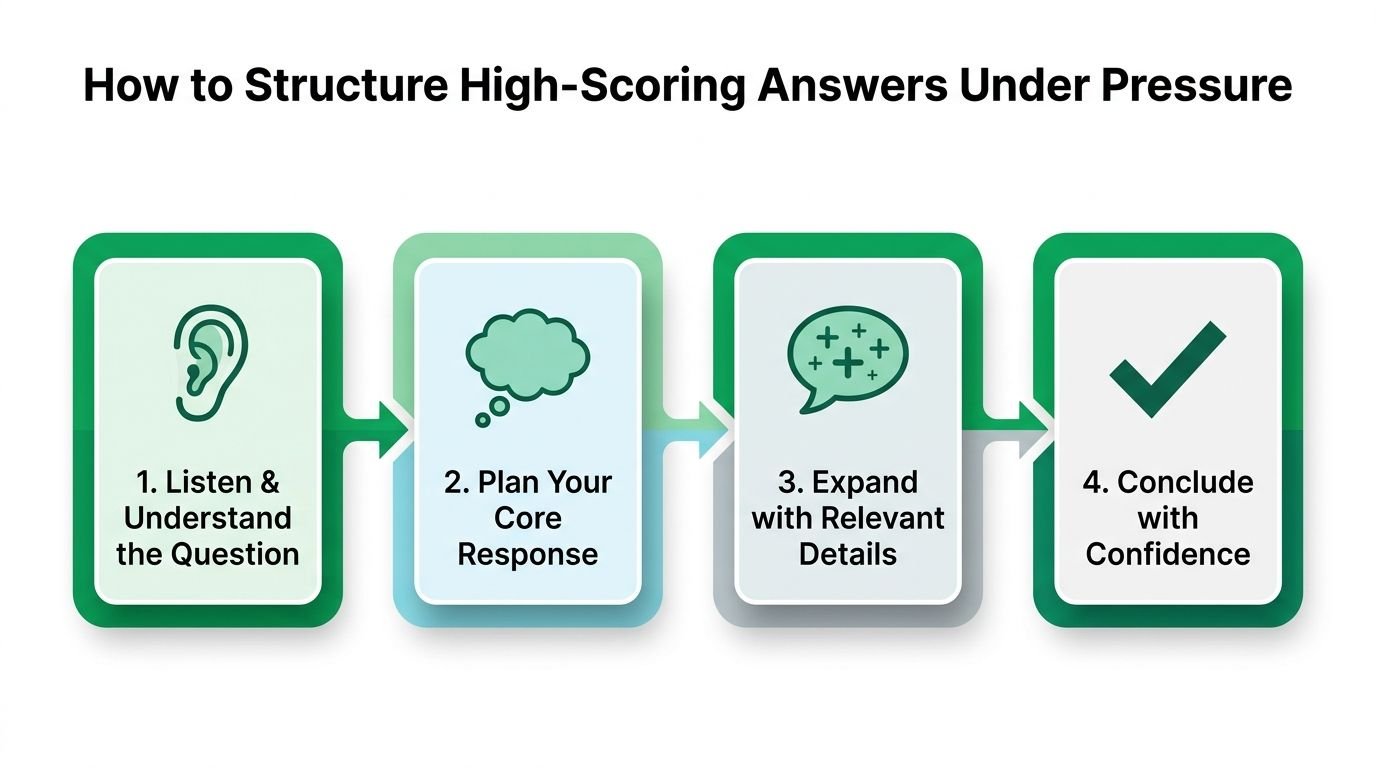
A stronger response has a simple shape. Start with the direct answer, explain why, add a specific detail, and finish with an opinion or consequence. This structure gives you enough room to demonstrate language without forcing you to memorise a long speech.
A four-part response pattern
Use this mental sequence for personal questions:
- Answer directly: State your main point immediately.
- Give a reason: Explain why you feel that way.
- Add a detail: Mention a person, place, activity, time, or example.
- Extend the idea: Offer an opinion, contrast, or future possibility.
For a question about sport, the answer might develop like this:
- Direct answer: You enjoy playing football.
- Reason: It keeps you active and helps you relax.
- Detail: You play with friends after school or at the weekend.
- Extension: You think team sports are valuable because they teach cooperation.
You don't need to use exactly the same sentence order every time. The point is to create a response with movement. A direct answer reassures the examiner that you understood the question, while the added material reveals your range.
How to deal with unexpected follow-ups
Examiners often follow the detail you provide. If you mention a sibling, be ready for questions about your relationship, shared activities, or differences between you. If you say you dislike a subject, the examiner might ask whether the teacher, the workload, or the topic causes the problem.
When the question changes direction, avoid trying to drag the conversation back to your prepared paragraph. Listen for the key word, take a brief pause, and use a familiar opening such as “Dar liomsa,” “Is dóigh liom,” or “Go pearsanta.” These phrases give you thinking time while keeping the interaction active.
If you make a grammatical mistake, don't restart the entire answer. Correct the important part and continue. A short self-correction shows control, while repeatedly stopping to search for perfection can damage your fluency more than a minor error.
A fluent answer isn't a flawless answer. It's an answer that keeps communicating when something goes wrong.
Use the same framework for the picture sequence. Say what's happening, identify who is involved, explain the setting, and connect the events. Aim for connected sentences rather than isolated descriptions. This is also where prepared linking phrases can make your speech easier to follow.
The process is easier to observe when you practise with a spoken example. Use the video below as a prompt, pause before the response, and try to build your own answer using the four steps.
Common Question Themes and Model Response Patterns
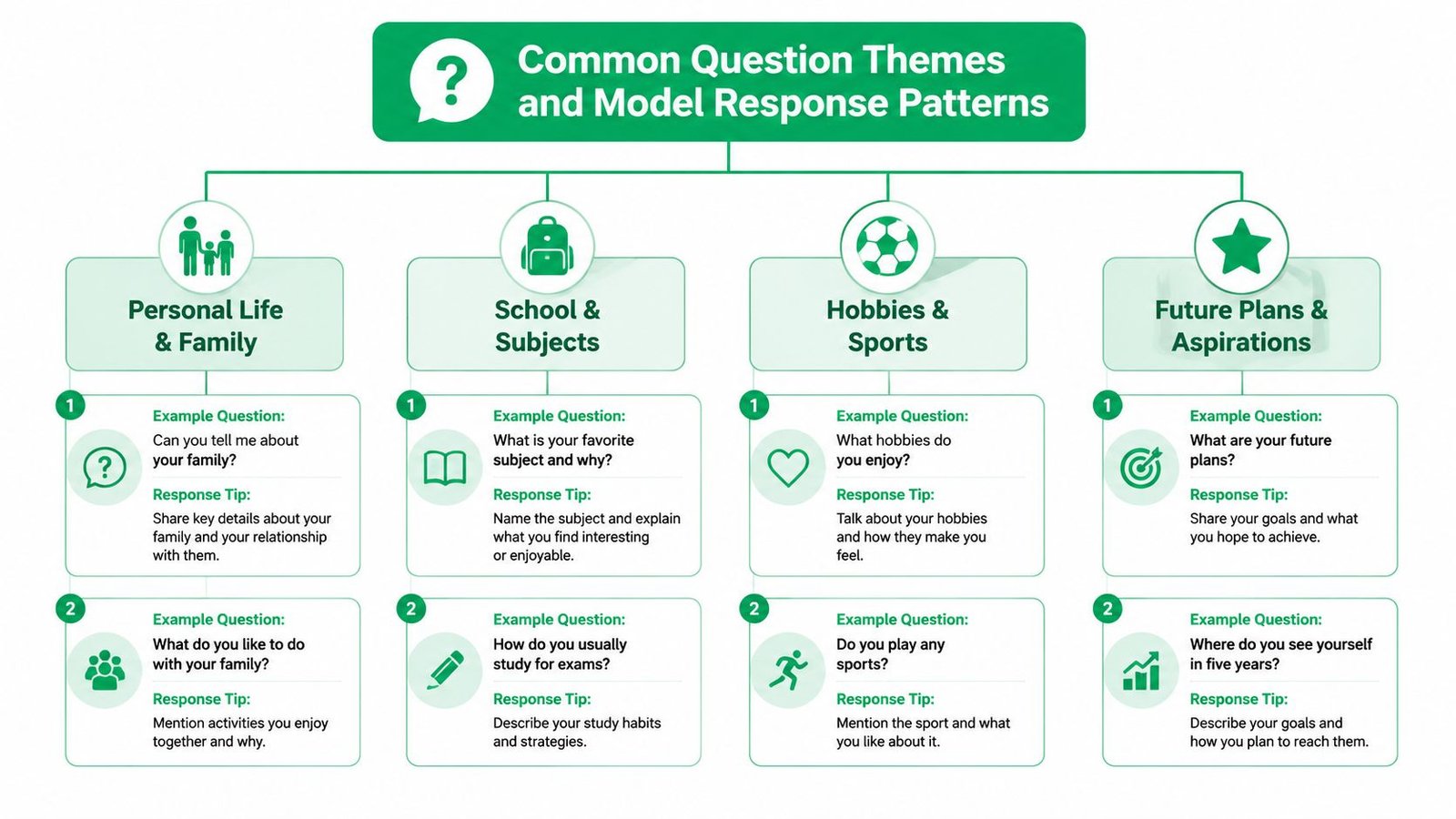
The most useful way to prepare Leaving Cert Irish oral questions is to group them into conversation families. Examiners may phrase a question differently, but the underlying task usually remains familiar. You're being asked to describe your life, explain a preference, give an opinion, or discuss a future possibility.
Personal life and family
Typical prompts include:
- “Tell me about your family.”
- “Who are you closest to in your family?”
- “What do you do together?”
Build the response from the household outward. Begin with who lives with you, add one relationship or shared activity, then include an opinion about family life. If your circumstances are complicated, prepare a truthful but comfortable version that you can discuss without becoming distracted.
Useful language includes “Tá cónaí orm le…”, “Caithimid am le chéile…”, “Táimid gar dá chéile…”, and “Is maith liom an tacaíocht a fhaighim ó mo theaghlach.” Learn alternatives for “because”, “however”, and “in my opinion” so that your answer doesn't depend on one repeated connector.
School and subjects
Questions may include:
- “What subjects do you study?”
- “Which subject do you prefer?”
- “What would you change about school?”
A reliable pattern is subject, reason, example, and comparison. Don't just name a favourite subject. Explain what you enjoy about it, refer to a topic or classroom activity, and compare it with a subject you find more difficult.
For vocabulary, prepare terms such as ábhar, múinteoir, obair bhaile, scrúdú, suimiúil, dúshlánach, and úsáideach. You can also prepare balanced opinions. Saying that a subject is difficult but worthwhile gives the examiner more language to work with than saying only that you like or dislike it.
Hobbies and sports
Common prompts include:
- “What do you do in your free time?”
- “Do you play sport?”
- “Why are hobbies important?”
Use a clear contrast if your interests are varied. You might explain that you enjoy a team sport for the social side but prefer reading or music when you want quiet time. That contrast naturally creates opportunities for comparison and opinion.
Practise verbs as well as nouns. “I play football” is useful, but you'll need language for how often you play, where you practise, who joins you, and how the activity makes you feel. “Ar an drochuair”, “ar an taobh eile”, and “mar gheall air sin” can help you move from one idea to the next.
Future plans and aspirations
Possible questions include:
- “What would you like to do after school?”
- “Would you like to travel?”
- “What kind of work interests you?”
Avoid presenting one brittle plan that becomes difficult if the examiner asks for alternatives. Prepare a preferred option, a reason for it, and a second possibility. You can discuss skills you'd like to develop, places you'd like to visit, or the kind of working environment that would suit you.
Useful structures include “Ba mhaith liom…”, “Tá suim agam i…”, “Tá sé i gceist agam…”, and “Níl mé cinnte fós, ach…”. That final phrase is valuable because uncertainty is easy to discuss when you have language prepared for it.
Current topics and personal opinions
An examiner may move from your own life to a broader issue, such as the environment, technology, young people, or the Irish language. Prepare opinions rather than speeches. State your view, give one reason, offer an example, and acknowledge another perspective.
That approach sounds more natural than a memorised essay and makes it easier to adapt when the wording changes. The key question isn't whether you can predict the exact prompt. It's whether you can express a clear idea and support it in Irish.
Pronunciation and Delivery Tips That Actually Help
Good delivery makes your Irish easier to understand and gives you more time to think. Nervous students often speed up, flatten their intonation, and run several ideas together. Slow down enough to separate phrases, especially at the start of the exam.
Build a delivery routine
Read your poetry aloud regularly, but don't treat reading as silent vocabulary revision. Mark difficult words, practise them separately, then return to the complete line. Pay attention to punctuation and meaning so your voice doesn't sound like it's moving from word to word.
Recording yourself is especially useful. Listen for rushed endings, unclear broad and slender consonants, and places where you lose the rhythm of the sentence. You don't need to criticise every error. Choose one pronunciation target and one delivery target for the next recording.
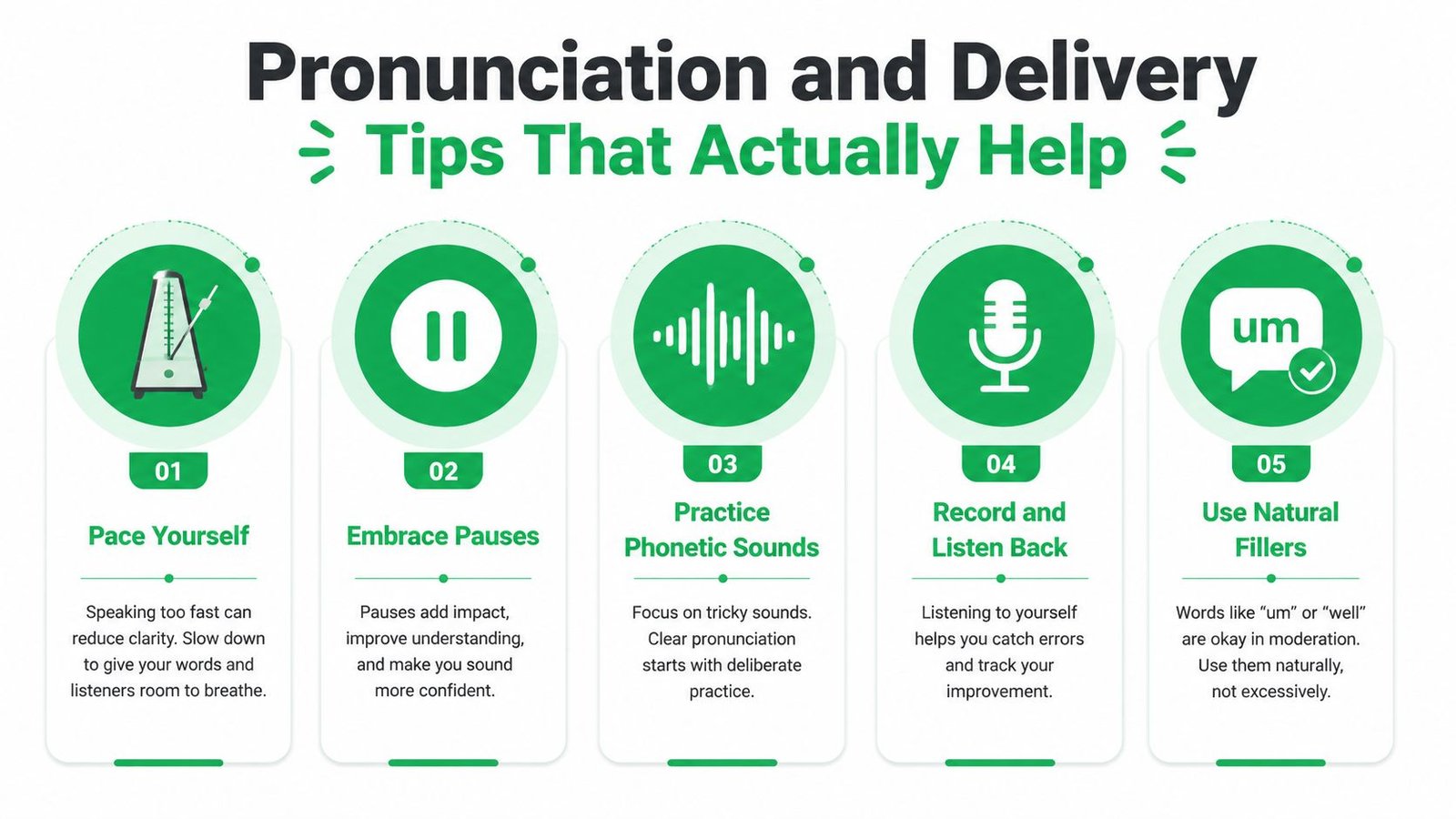
Try these habits:
- Pace yourself: Begin slower than your nervous instinct suggests.
- Use pauses: A short pause between ideas sounds controlled, not empty.
- Practise sounds in context: Repeat difficult words inside complete sentences.
- Record and review: Compare several recordings to notice recurring habits.
- Use natural fillers: Keep a small bank of phrases that gives you thinking time.
Irish oral preparation materials are available in both Southern and Northern dialect versions, and some include native-speaker audio. That variation matters because you may hear familiar vocabulary pronounced differently from the model you've used at home or in class. Listen to more than one speaker where possible, and focus first on understanding the meaning before worrying about copying every accent feature.
If you don't understand a question, ask politely for repetition or clarification. It's better to check the meaning than to answer a different question confidently. You can find further phrases for managing pauses and hesitation in this guide to fillers for the Irish oral exam.
For students creating audio practice materials, an AI voiceover for videos can help produce spoken prompts to listen to, although it should complement rather than replace authentic Irish speech and live interaction.
The assessment environment is also changing. Under the 2026–2028 arrangements, reduced sraith pictiúr continues before the format is phased out as new Senior Cycle specifications arrive. Check the current official guidance for your year, and don't let older preparation packs become your only source of practice.
Building a Practice Schedule and Using AI Simulation
Static notes have a clear limit. They can help you collect vocabulary and organise ideas, but they don't force you to understand a question you weren't expecting or respond before you've translated every word in your head.
A useful preparation cycle has three phases. Begin by building topic coverage, then move into timed responses, and finish with unpredictable simulations. Keep a record of the errors that interfere with communication, rather than rewriting every answer until it sounds artificially perfect.
A practical progression
At the foundation stage, prepare the main themes and create flexible sentence banks. Speak aloud about family, school, hobbies, sport, plans, and opinions. Change one detail each time so you practise adapting instead of reciting.
During the development stage, add follow-up questions. After every answer, ask yourself what an examiner could reasonably ask next. If you mention a football match, practise discussing the result, the people involved, the importance of sport, and what you'd do differently.
In the final simulation stage, practise complete interactions under time pressure. Mix familiar and unfamiliar prompts, include picture-sequence description, and review your recording afterwards. The important measurement is whether you stayed engaged, not whether every sentence was flawless.

Gaeilgeoir AI can be used as one practice option for this stage. Its Leaving Cert preparation provides targeted simulations of typical oral topics, while the wider platform combines guided conversations, pronunciation support, adaptive quizzes, instant feedback, and scenario-based speaking activities. Use it to create repeated examiner-style interaction when a teacher, tutor, or speaking partner isn't available.
You can also browse Polychat's AI guide for broader ideas about using conversational technology in language learning. Whichever tool you choose, keep active speaking at the centre. An app should make you speak, listen, adjust, and try again, not just allow you to read model answers.
For students who want guided digital interaction, AI language tutors can provide another way to practise responding aloud and building confidence between live sessions.
Your Final Checklist for Exam Day Confidence
The final preparation should reduce decisions, not add more material. Review your core vocabulary, practise opening exchanges, and rehearse ways to ask for repetition or correct yourself. Don't spend the last days trying to memorise every possible wording of every question.
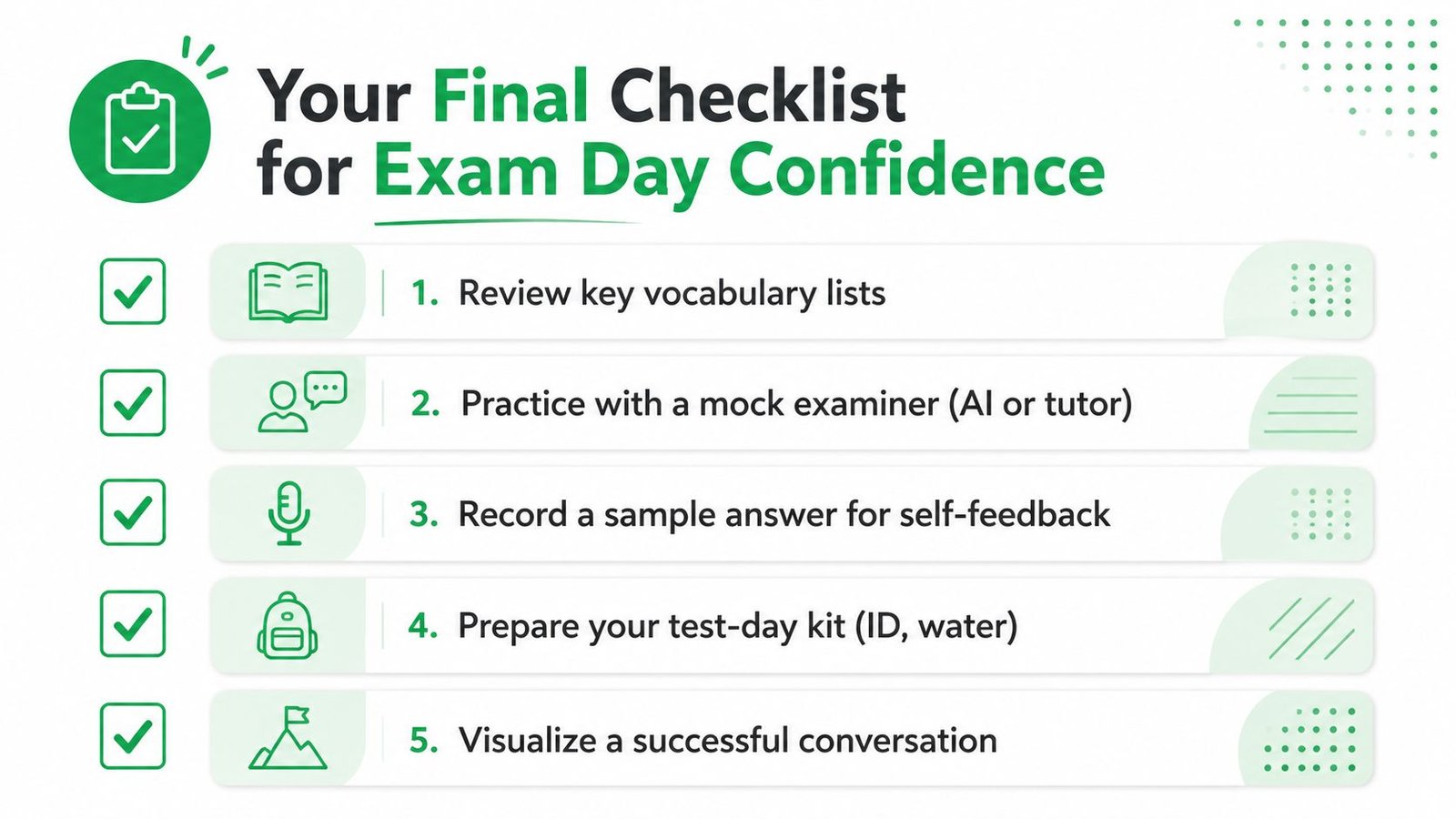
Before entering the room, check that you have your essentials, including identification and water. Use the waiting time to breathe slowly and repeat a few reliable opening phrases, not to cram an entirely new topic.
During the first moments, listen fully before answering. Start calmly, give a complete response, and let the examiner's follow-up guide the conversation. If nerves interrupt your sentence, pause, repair the phrase, and continue.
Keep these reminders close:
- Review useful vocabulary: Prioritise words you can use across several themes.
- Practise a mock interaction: Use an AI simulation, tutor, or speaking partner.
- Record one answer: Listen for pace, clarity, and unfinished ideas.
- Prepare your test-day items: Have your identification and water ready.
- Visualise communication: Focus on handling the conversation, not predicting every question.
The exam isn't asking you to perform a memorised script. It's asking you to communicate with the Irish you've prepared. That shift gives you something dependable to fall back on when the wording changes.
Gaeilgeoir AI offers guided Irish conversations, pronunciation support, adaptive feedback, and Leaving Cert-focused simulations for common oral topics. Visit Gaeilgeoir AI to practise responding to realistic questions and build the conversational control you'll need on exam day.