
Repeating a phrase until an app accepts it isn't always good language-learning advice. You might improve your pronunciation, but you might also spend the session changing perfectly understandable speech to satisfy a recognizer. Speech recognition language learning works better when you treat a failed match as a question, not a verdict.
For Irish beginners and returning heritage speakers, the useful question is whether a listener can follow what you're saying. A transcript can help you notice a missing sound or an unclear word. It can't, by itself, decide whether your accent belongs.
Table of Contents
- What Speech Recognition Actually Measures
- How the Recognizer Turns Your Voice into Text
- Set a Week of Speaking Goals
- Protect Your Voice Recordings
- Run One Session and Read the Feedback Fairly
- Fix the Microphone Before You Blame Yourself
- Rehearse a Leaving Cert Prompt Today
What Speech Recognition Actually Measures
You say Tá mé go maith, meaning I'm well. Your teacher understands you, but the app produces something unrelated. That mismatch doesn't make either response mysterious: the teacher interpreted your message, while the software tried to match recorded sound to likely words.
Automatic speech recognition, usually shortened to ASR, produces text from speech. A pronunciation-learning tool may add a separate assessment layer, but a successful transcript and good pronunciation aren't interchangeable.
What speech recognition tends to get right
The recognition figures below come from a review of automatic speech recognition and pronunciation learning, which reports about 90% recognition for first-language speech, about 70% for second-language speech, roughly 95% human understanding of that same second-language speech, and results above 90% for Google Voice Typing on some later second-language tasks.
The learning-effect rows reflect a meta-analysis of ASR-supported pronunciation instruction, which found Hedges' g = 0.69 across 15 studies, alongside the differences between feedback types, sound features, and practice formats shown below.
| Signal | Typical figure | How to use it |
|---|---|---|
| First-language recognition | About 90% | A ceiling, not your personal target |
| Second-language recognition | About 70% | Expect misses even when people understand you |
| Human listeners on the same L2 speech | About 95% | Judge success by being understood |
| Some newer dictation tools on L2 speech | Above 90% in cited tests | Compare tools instead of trusting one score |
| Overall pronunciation learning effect | Hedges' g 0.69 from 15 studies | Practise for weeks, not one session |
| Single sounds versus rhythm and stress | Large effect versus small effect | Drill consonants and vowels; check melody with a person |
| Explicit correction versus a bare transcript | Largely effective versus moderate | Ask for one specific change |
| Peer practice plus ASR versus solo ASR | Large effect versus small effect | Add one human repetition each week |
Treat the first-language figure as a reminder that recognition isn't perfect, not as a universal technical ceiling. Likewise, a learning effect isn't a percentage improvement or a promise about your next lesson.
Separate intelligibility from imitation
The strongest learning evidence here concerns adults and intermediate English learners. It doesn't establish identical outcomes for complete beginners learning Irish. Irish also has less available training audio than widely represented languages, so a missed match deserves particular caution.
A useful correction identifies something you can change: preserve a long vowel, make a consonant audible, or distinguish a broad consonant from its slender counterpart. A bare score leaves you guessing.
For example, lón means lunch and lon means blackbird. That vowel-length contrast deserves attention because it can change meaning. Making every feature of your voice resemble a particular recording is a different objective.
Practical rule: Work on contrasts that help a listener recover your intended word. Don't accept native-accent imitation as the definition of successful speaking.
A heritage pronunciation may sound different from the lesson model without being defective. Ask whether the difference creates confusion before trying to remove it.
How the Recognizer Turns Your Voice into Text
A transcript is a guess about your speech, not a direct measure of how well you spoke. After you talk, the recognizer estimates which words best fit the audio and the language patterns it has learned. Like a listener filling in a phrase from context, it can choose a plausible word that you did not say.
From sound to a likely sentence
The system processes the audio. It examines short stretches of sound and compares their features with patterns learned during training. Many systems rely heavily on native-accented examples. An unfamiliar vowel or consonant may therefore match poorly, even when a person understands you.
It weighs possible words and sequences. Language expectations help the recognizer choose between candidates. If Irish is not selected, or automatic language detection struggles, a familiar English sequence may win over the Irish phrase you intended. For example, a recognizer might return English text for Dia duit if it has not identified the spoken language correctly.
It returns a transcript, sometimes with confidence information. Confidence describes how certain the system is about a match. It is not automatically a pronunciation grade. A polished percentage cannot establish that the tool assessed your accent fairly, or that a listener would misunderstand you.
Recognition and translation are separate operations, so inspect the recognized words before trusting any translated result. If you use multilingual voice tools, you can compare English to Chinese voice translators, but a translation does not tell you whether the first transcript captured your Irish accurately.
What a teaching tool should add
A useful learning workflow gives you a specific word or phrase to say, transcribes your recording, and compares it with the target. It should distinguish a correct attempt from a near match or an inaccurate one, then offer an actionable correction and a chance to try again.
A red mark alone leaves you guessing. Was a word missing? Was the vowel unclear, or did the recognizer choose an unrelated candidate? Treat the mismatch as uncertain evidence. Check the audio and the intended phrase before deciding what to practise.
A weak machine match is a reason to investigate. It isn't a complete account of what you said.
Look for feedback that names an audible feature, such as a vowel or consonant, rather than merely asking you to improve your score. The aim is to help a listener recover your intended words, not to imitate one narrow accent model.
Set a Week of Speaking Goals
Start with a purpose and a manageable weekly list. For example, choose 20 survival lines, a work greeting, or three oral-exam answers, then cap new material at 8 to 12 real words or short phrases on a study day. These are suggested planning limits, not scientifically established requirements.
Choose phrases you'll use. Dia duit is a greeting, Go raibh maith agat expresses thanks, and Ba mhaith liom tae, le do thoil lets you ask for tea politely. Save each phrase with its meaning and a reliable audio model.
Give recall time to develop
An approximate replication study of spaced vocabulary learning involved 69 Japanese students learning English and 48 pseudowords; spaced practice improved explicit vocabulary knowledge, but neither schedule effectively developed implicit knowledge. The same article discusses a broader meta-analysis covering 48 experiments and 3,411 participants, supporting review over time without establishing that spacing alone creates fluent conversation.
The distinction matters. Recognizing a phrase on a screen isn't the same as retrieving it while someone waits for your reply.
Use a same-day retake, followed by later reviews, as a practical schedule. Include recall before playback: try saying the phrase first, then consult the model.
A seven-day speech practice plan
The timings below are a suggested routine, not a measured optimum.
| Day | Focus | Minutes | Success check |
|---|---|---|---|
| Day 1 | 8-12 new high-frequency words or one oral answer | 12-15 | Three retakes on one target |
| Day 2 | Same items, no new list | 12 | Recall without reading the script |
| Day 4 | A small new set plus mixed review | 12-15 | One short real scenario |
| Day 7 | Full prompt or short conversation | 15 plus one peer | A person can follow you |
| Busy-day fallback | One saved phrase only | 10 | One clear retake and a note |
Keep the remaining days flexible. Listening, resting, or briefly recalling a saved phrase can be more manageable than adding another compulsory lesson.
Arrange the solo sessions alongside a peer or tutor conversation. Ask your partner to respond to your meaning rather than inspect every sound: if you order tea, they should confirm the order or ask a follow-up question.
For independent learners, these ways to practise speaking skills can help turn saved vocabulary into spoken tasks. Teachers coordinating learner appointments can consider scheduling resources such as Tutorbase for language schools, keeping lesson administration separate from pronunciation assessment.
On Sunday, put away the script. Can you greet someone, make the request, or answer the prompt so a person follows you? That's a more useful pass test than collecting accepted transcripts.
Protect Your Voice Recordings
Treat the microphone as a recorder, not just a tutor. Before practising personal answers, find out what happens to the audio after you finish speaking.
Check before recording
- Storage: Does the service retain your voice recording, only a transcript, or just a score?
- Access: Can a teacher, account owner, administrator, or another user replay it?
- Retention: How long does it remain available, and can you change that?
- Deletion: Can you remove a single attempt as well as your whole history?
Test the controls with a throwaway greeting such as Dia duit. Record it, locate the saved attempt, and delete it before trusting the tool with anything personal.
Practise in a room you can close, using a device only you can access. Wear headphones if playback could expose your answers to others, and disable extra assistants that might activate while you're speaking.
Keep practice content ordinary
Don't test recognition with your address, account numbers, school identification details, or another person's full name. Invent harmless details when a prompt asks for information you don't want stored.
On a school or family account, ask who can replay recordings. Check before saving an exam answer containing personal circumstances, and don't assume that closing the practice window deletes the clip.
Privacy gate: If you can't find the delete control or understand the retention policy, don't start your speaking plan on that tool.
A pronunciation exercise doesn't need a detailed personal biography to be useful.
Run One Session and Read the Feedback Fairly
Choose a single target and give it a short, focused session. A suggested 12 to 15 minutes is enough time to listen, record, make a deliberate adjustment, and use the phrase without turning practice into an argument with the app.
The sequence below keeps the learning task separate from the recognition result.
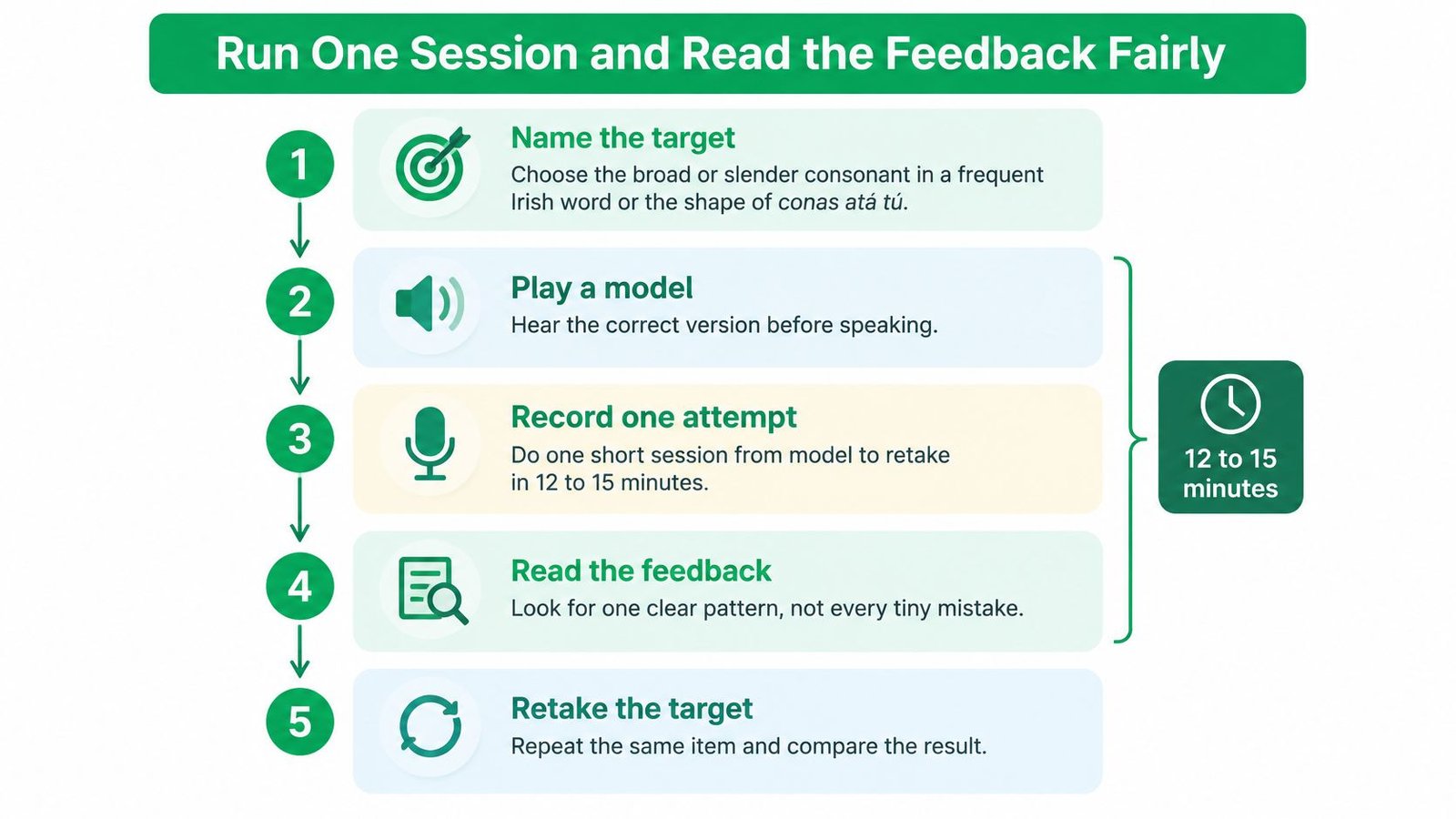
A focused model-to-retake session
Name the target. Choose the broad or slender consonant in a frequent Irish word, a long vowel, or the shape of Conas atá tú?, meaning how are you? Make the objective specific enough that you can hear whether you've changed it. Don't attempt to repair your entire accent.
Play a clear model. Listen at natural speed, then use slowed playback if available. Follow a model from the dialect you're learning rather than switching between recordings without noticing regional differences. Listen before reading an English-style pronunciation spelling, which can pull you toward English sound patterns.
Record controlled attempts. Try the word, then a short sentence containing it. For example, place lón inside Tá mé ag ithe lóin, meaning I'm eating lunch. Keep the task predictable so you can concentrate on the sound rather than inventing vocabulary while recording.
Read and classify the result. Use clear, close, and off as working labels. Clear means the intended phrase was captured and sounds appropriate when you compare recordings. Close means something needs checking, perhaps a substituted word or an uncertain vowel. Off means the output or recording is too far from the target to interpret confidently, not that you've failed as a speaker.
Change one audible feature. Replay your clip beside the model. If the vowel sounds shortened, work on its duration; if a consonant disappeared, make that consonant easier to hear. When the app offers only a score, don't invent a diagnosis. Ask a teacher or use the model to identify a concrete difference.
Retake immediately. Say the same item again while holding that adjustment in mind. Keep the original clip briefly so you can compare what changed. An accepted transcript is useful evidence, but listen for the intended correction rather than celebrating acceptance alone.
Use the line for a tiny task. Greet someone with Conas atá tú? and respond to their answer, or practise making a request and receiving a reply. End with communication, not another isolated score. Save a different target for your next session.
Interpret misses without overcorrecting
In a study of speech recognition for pronunciation learning, the system recognized 88.33% of target-like productions, while transcription accuracy for nonword items fell to 8.33%. These are task-specific findings, not Irish accuracy estimates, but they support a practical choice: begin with frequent real words and contextual phrases, not invented sound strings.
An unfamiliar transcript can reflect the task as well as the speaker. Check whether the tool expected a particular sentence, whether it supports Irish input, and whether your target word is in the exercise.
A perception-based study of intelligibility and ASR feedback reports that only 16% of word-level unintelligibility in one English speaking test was attributable to obvious mispronunciations. That finding cautions against treating every misunderstood word as an isolated sound error.
If a friend follows your sentence and the app doesn't, note the disagreement, make a deliberate retake, and continue. Don't practise an unnatural replacement just because the software prefers it.
Use online pronunciation practice to organize the model, recording, and comparison work. Ask a human listener about rhythm and intonation, especially when an exam answer sounds correct word by word but remains difficult to follow as a whole.
Fix the Microphone Before You Blame Yourself
A recognizer can mishear an ordinary phrase when your phone is below your chin, a television is playing, or another voice assistant is listening. Before repeating the sentence, check the room and microphone. A recognition failure is a clue to investigate, not proof that your Irish needs fixing.
Start somewhere quiet and keep the microphone steady. Place it at a comfortable distance, slightly away from the direct stream of your breath. If the recording sounds faint or distorted, adjust its position and listen again. The goal is a clear, natural recording, not a special voice for software.
Missed lines and the fix to try first
Treat these as possible causes, not diagnoses. Change one condition at a time so you can tell whether the setup helped.
| Symptom | Likely cause | Fix |
|---|---|---|
| Random words in the wrong language | Noise, a second voice tool, or a weak mic | Quiet the room, position the mic comfortably away from your breath, and turn off other listeners |
| Only the first word is caught | Speech is too fast or the sentence is too long | Say one short, real sentence, then try it again more slowly |
| A clear word still fails | A rare word, name, or nonword | Put a frequent real word into a sentence |
| Score drops for a regional or learner accent | The model may not represent that speech well | Ask a listener whether the sentence is understandable before changing your accent |
| Same clear phrase fails across three quiet takes | Language or model limit | Stop repeating it and ask a human listener to check |
Check the input language, too. When practising Irish, keep the test sentence in Irish unless the activity explicitly supports switching into English.
Speak deliberately enough for each word to be heard, but keep the sentence natural. Stretching every syllable or pausing between words can make your practice less like the speech you need in conversation or an exam. A recognizer's score can help you notice a possible problem; it cannot, by itself, tell you whether a listener understands you.
Know when the mismatch isn't yours to solve
A study of dictation-based automated assessment found that systems favoured test takers aged 29 or younger and highlighted the underrepresentation of less commonly spoken languages and regional dialects. That finding cannot predict an individual result, but it is a reason to read automated scores cautiously, especially when the speaker's language or accent may be less represented.
A larger model is not automatically a fairer assessor for second-language speakers. Language background and the speech represented in training material still matter, including for people whose first languages are tonal. A mismatch may come from the recognizer's limits rather than from a phrase that needs to be changed.
Munster, Connacht, and Ulster varieties are legitimate differences for learners to encounter. A returning heritage speaker may use family pronunciations unlike the lesson's chosen voice. A beginner may carry familiar English vowel patterns into Irish. Those features are not automatically errors. Ask whether they make the meaning difficult for a listener to follow, rather than trying to erase them to satisfy an unexplained score.
Use the table's three-quiet-take stopping rule as a practical boundary, not a scientific threshold. Once the setup is checked and the same phrase keeps failing, a teacher can help distinguish a pronunciation issue from a recognition limit. That is more useful than making unchanged recordings until the software accepts one.
Rehearse a Leaving Cert Prompt Today
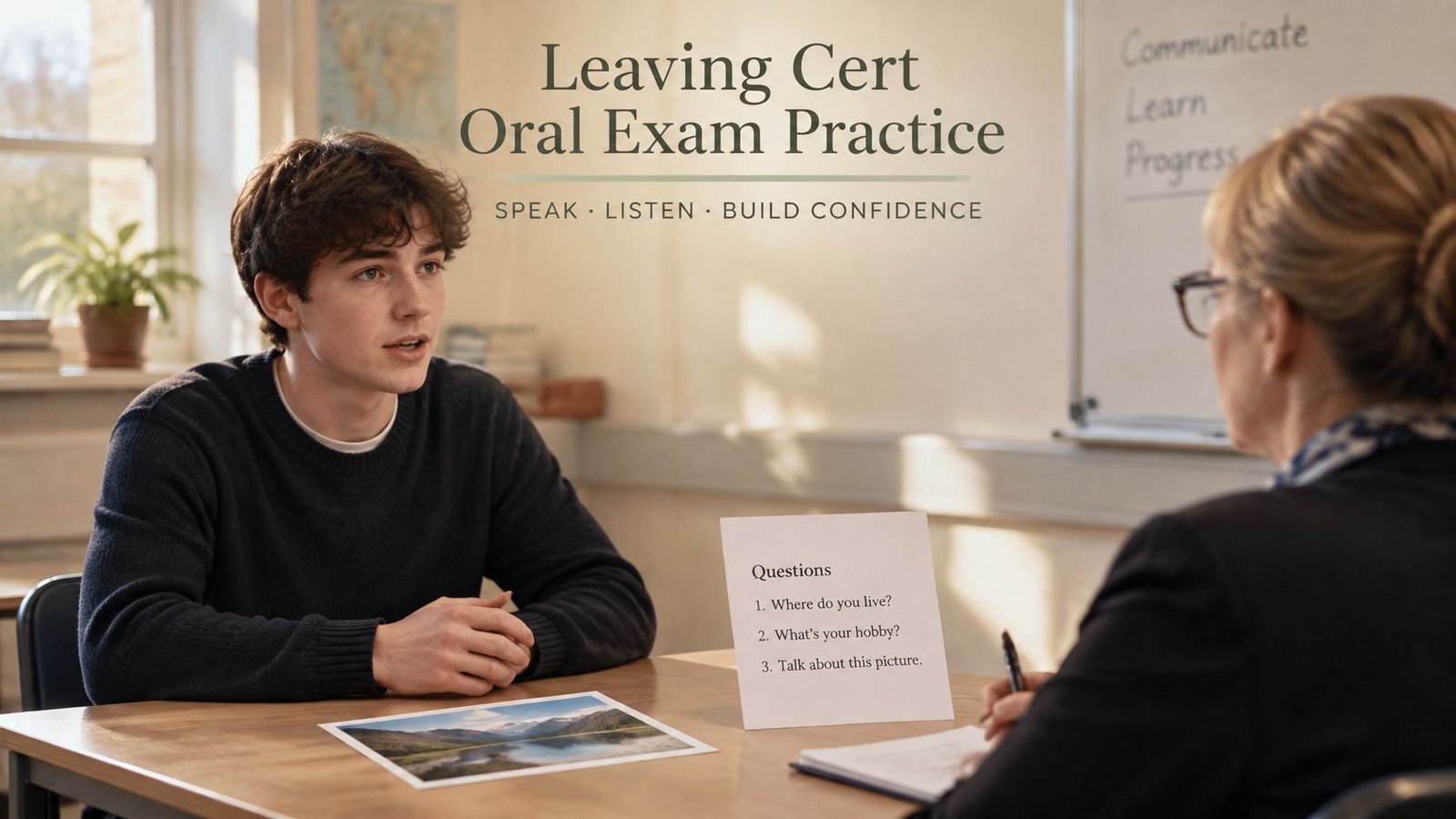
A familiar topic can feel different when an examiner asks about it aloud. Start with a sentence you can say comfortably: Tá mé i mo chónaí i mBaile Átha Cliath, meaning I live in Dublin. Then practise the exchange aloud with a teacher or partner, rather than rehearsing alone in writing.
Build an answer you can actually deliver
For a suggested 90-second rehearsal, use a simple shape instead of memorizing a dense essay:
- Opening: Say where you live.
- Concrete details: Describe something nearby and something you do locally.
- Opinion: Explain what you like or would change.
For example, Tá páirc in aice le mo theach means there's a park near my house. Add Is maith liom an ceantar mar tá sé ciúin, meaning I like the area because it's quiet. Use details that are true for you, then prepare for a follow-up question. A conversation may move somewhere your script does not cover, so practise answering naturally rather than steering back to memorized lines.
The Leaving Certificate includes graded written and oral Irish papers. The Citizens Information Leaving Certificate guide provides official information about the qualification and its grading. Those grades describe exam performance, not a speech-recognition score or a direct conversion for a practice answer.
Choose a topic from these Leaving Cert Irish oral questions and prepare a relevant response. A recognizer may miss a word because of its own limitations, so treat its text as one clue, not a verdict on your Irish. Work on the pronunciation of words carrying your main meaning, then try the whole answer without looking. The aim is to be understood by a listener, not to imitate one narrow accent.
Use the video as another opportunity to pause and rehearse aloud.
If you're not sitting the exam, practise ordering food or asking for directions instead. Keep the same goal: another person should understand your request and be able to respond.
Gaeilgeoir AI offers guided Irish conversations, pronunciation support, and targeted Leaving Cert practice for learners who want to speak aloud. Open a guided Irish conversation and spend your first 12 minutes on one oral topic, making one specific correction before trying the answer without your script.