General models can sound polished and still miss the target. A clinical note, a legal clause, a support ticket, or a learner sentence in a low-resource language all demand different vocabulary, constraints, and error tolerance. In those settings, domain specific language models are not a nicer wrapper around a general LLM, they are the model class that is trained and judged against a narrower task, a narrower vocabulary, and a narrower definition of correctness.
That narrower focus is becoming a real market category, not just a research idea. Mordor Intelligence estimates the market at USD 3.85 billion in 2025, rising to USD 4.78 billion in 2026 and reaching USD 18.25 billion by 2031, with North America holding 41.55% of revenue in 2025 and Asia-Pacific growing fastest at 30.98% CAGR through 2031 market estimate.
The deeper point is that training is only half the job. A domain model can have the right architecture and the right corpus, yet still fail if evaluation is vague, if the test set is too easy, or if the language itself is underrepresented, as happens with low-resource languages such as Irish. That is why a practical guide has to treat evaluation and small, curated domain models as first-class parts of the workflow, not as an afterthought once the model already sounds fluent.
Table of Contents
- What Domain Specific Language Models Are
- Domain Models vs General LLMs in Plain English
- Core Techniques Behind Every Domain Specific Model
- Building and Curating the Right Dataset
- Evaluating a Domain Model the Way It Deserves
- Deployment, Cost, and the Case for Smaller Domain Models
- Risks, Limits, and How to Mitigate Them
- Putting It All Together With Gaeilgeoir AI
What Domain Specific Language Models Are
A learner opens Gaeilgeoir AI on a Tuesday evening, types a simple request, and wants one thing, a sentence that sounds natural in Irish, not a literal translation assembled from fragments. That is the everyday purpose of domain specific language models, they turn a general language engine into something that understands a narrow world well enough to answer like it belongs there.
A working definition without the jargon
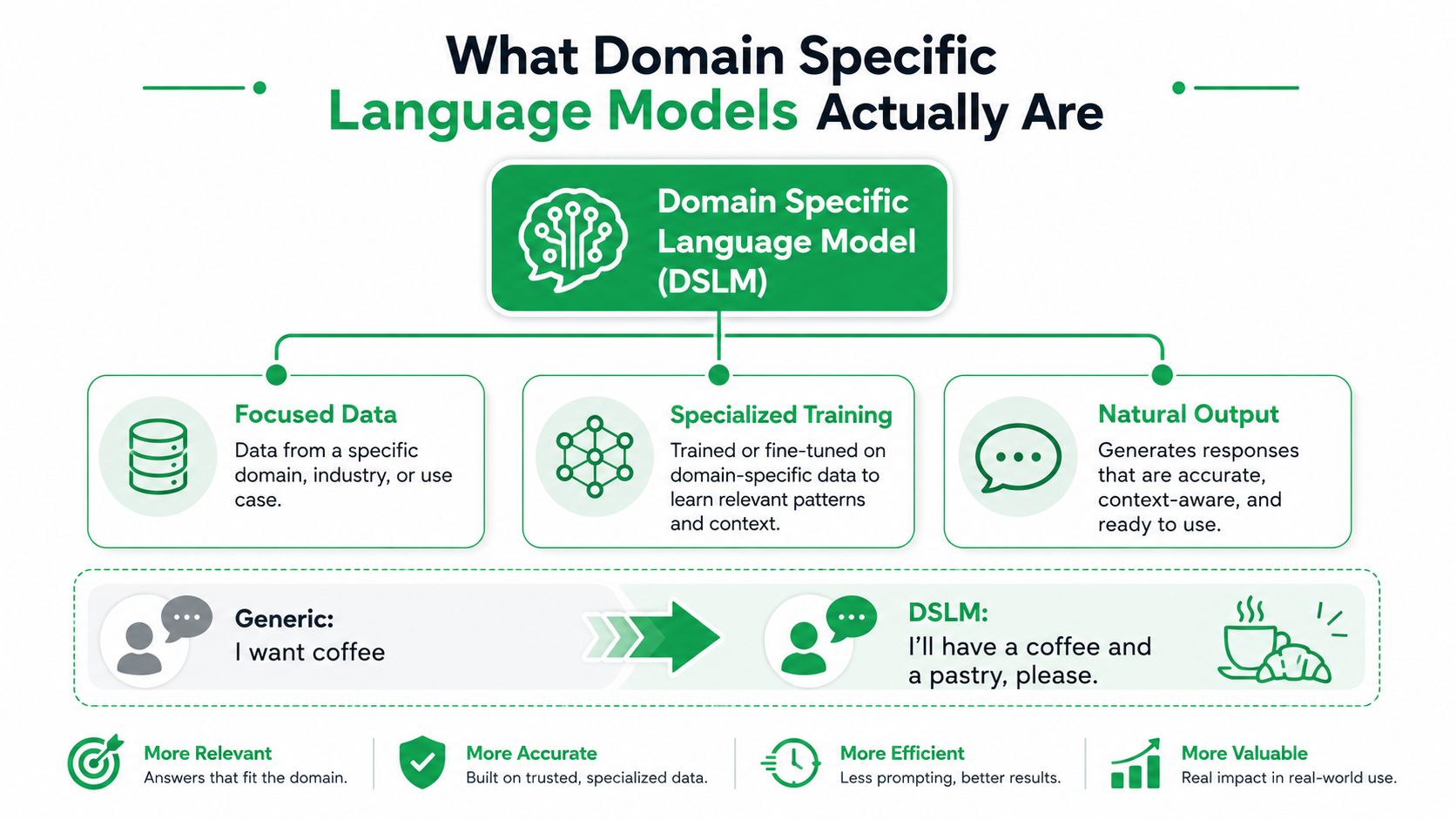
A DSLM is a language model, large or small, that has been deliberately adapted for a specific field. That field could be law, medicine, finance, software, customer support, or Irish-language learning. The important point is that the model does not just learn more words, it learns the vocabulary, reasoning patterns, and constraints that matter in that domain model adaptation overview.
A useful way to separate it from a general model is to ask a simple question. If the answer needs domain fluency to be correct, the model has to be trained for that domain, not merely exposed to it.
The 2021 paper Learning Domain Specific Language Models is a useful historical marker because it formalized the idea that pretraining on in-domain corpora can materially change behavior and performance paper. Since then, the field has settled around a simple reality, a model can sound fluent and still be wrong for the task at hand.
Practical rule: if accuracy changes the user's outcome, the model is no longer “just a chatbot.” It is part of the product.
The four ingredients that make a model domain-specific
A survey on domain specialization describes four ingredients that show up again and again. First, customizing a general-purpose model with domain contextual data. Second, augmenting it with domain knowledge. Third, optimizing it toward the domain's objective. Fourth, regulating it with domain-specific constraints survey.
That framing matters because it separates a DSLM from a smaller general model. A smaller model can still be broad and generic. A DSLM is narrow on purpose. It is shaped by the domain's language, rules, and failure modes, which is why the category now sits in a distinct commercial market rather than a research footnote. It also explains why teams building products like master AI features in apps often care less about raw model size and more about whether the model stays useful inside a specific workflow.
Domain Models vs General LLMs in Plain English
The key difference is how the model behaves when the task gets specific and the stakes go up. A general LLM can sound fluent across many topics. A domain-specific model is built to stay accurate inside one lane, keep terminology consistent, and produce outputs that fit a narrow workflow without extra cleanup.
| Dimension | General LLM | Domain-Specific Model |
|---|---|---|
| Accuracy on target task | Broadly capable, less consistent in a narrow workflow | More reliable on one domain's tasks |
| Hallucination risk | Can drift when the prompt gets specific | More likely to stay anchored to the domain |
| Operational cost | Can rise through retries, prompt work, and review | Often cheaper to run in a narrow lane |
| Control over outputs | More open-ended, less constrained | Easier to shape around policies and terminology |
A quick way to read that table is to separate “can answer almost anything” from “can answer this one thing well.” A general model is useful when the request is wide open. A domain model is useful when the answer has to match a business rule, a professional register, or a fixed vocabulary.
What the benchmark numbers mean in practice
One industry analysis reports domain accuracy of 88–96% for fine-tuned DSLMs versus 70–82% for generalist LLMs, and in-domain hallucination rates of 2–5% versus 8–15% for generalists. In practice, that gap shows up as fewer corrections, less back-and-forth, and less time spent checking whether the model drifted away from the task.
The useful mental model is a restaurant order. A general model may understand the request and still improvise the phrasing, while a domain model is more likely to keep the request in the right register, with the right words, and without unnecessary variation. That difference matters even more in workflows where wording itself carries meaning, including specialized customer support, legal review, or a narrow language task such as learning Gaeilge with technology.
The same logic applies in regulated or high-stakes work. A general model can still be fine for brainstorming, creative writing, or casual chat. A domain model earns its place when a wrong answer creates extra review, extra rework, or a trust problem that is expensive to fix.
A model that needs three retries, two prompt rewrites, and one human correction is rarely cheaper just because the API call itself was small.
When general models still make sense
A general model makes sense when the task is broad, exploratory, or low-stakes. It also fits early-stage teams that are still learning what their users need, because the model gives them room to test ideas before they commit to a narrower system.
A DSLM makes more sense when the language is narrow, the terminology matters, or the system has to respect rules a generic model will not reliably keep in memory. For low-resource languages and smaller curated domains, that distinction becomes even sharper, because the question is often whether the model can be evaluated and trusted at all, not whether it can produce a fluent answer.
Core Techniques Behind Every Domain Specific Model
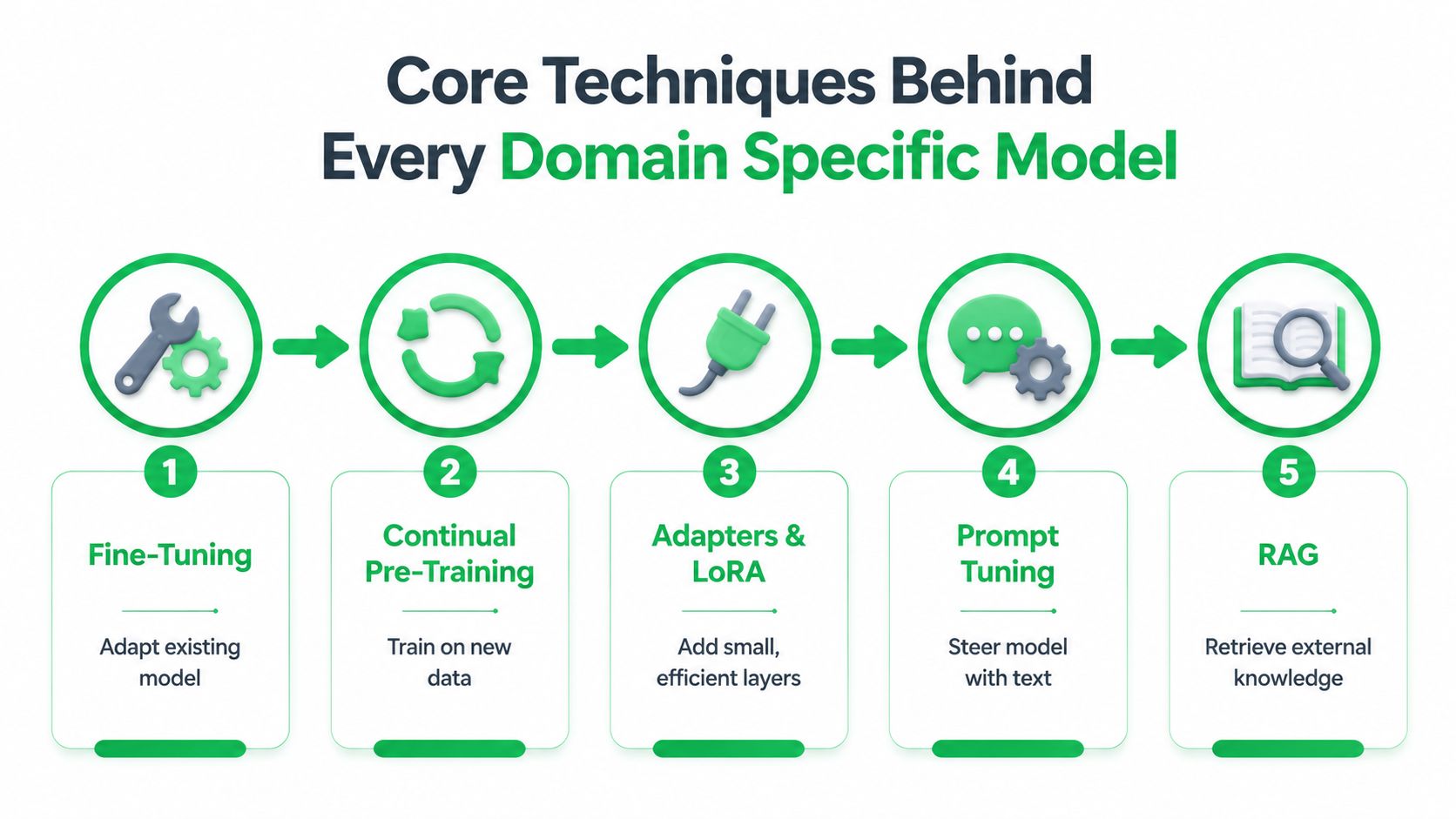
The main levers are easy to confuse because they all sit under the same umbrella. They don't do the same job. Each one changes the model in a different place, and the right one depends on whether you want better task fit, fresher knowledge, lower cost, or stricter grounding.
The five common levers
Fine-tuning changes model weights using curated input-output examples. It's the most direct way to teach a model how your domain should answer.
Continual pre-training exposes the model to large volumes of domain text so its internal representations shift toward the new language patterns. That's useful when the model needs deeper exposure to the domain's vocabulary and style.
Adapters and LoRA keep the base model frozen and train smaller side modules. That makes them attractive when you want specialization without rewriting the whole model.
Prompt tuning uses learned soft prompts to steer behavior. It's lighter-weight and can be helpful when you need a small nudge rather than a full retrain.
RAG leaves the weights alone and retrieves verified documents at inference time. It's the best fit when freshness and grounding matter more than changing the model itself adaptation tradeoffs.
Picking the lever that fits the job
A useful mental model is language tutoring. Fine-tuning is like drilling a student on the exact kind of answer you want. Continual pre-training is like immersing them in the subject until the vocabulary starts to feel native. LoRA and adapters are like giving them a focused workbook instead of a new textbook. RAG is the trusted reference book on the desk.
If you're building AI features inside apps, the same tradeoff shows up in product design. A good overview of how developers master AI features in application workflows appears in this AppLighter guide on prompt engineering for developers, especially when you're deciding whether the behavior should come from prompts, retrieval, or model adaptation.
The key is not to stack techniques blindly. Start with the lightest method that gives you enough accuracy, then move heavier only if the task needs it.
Building and Curating the Right Dataset
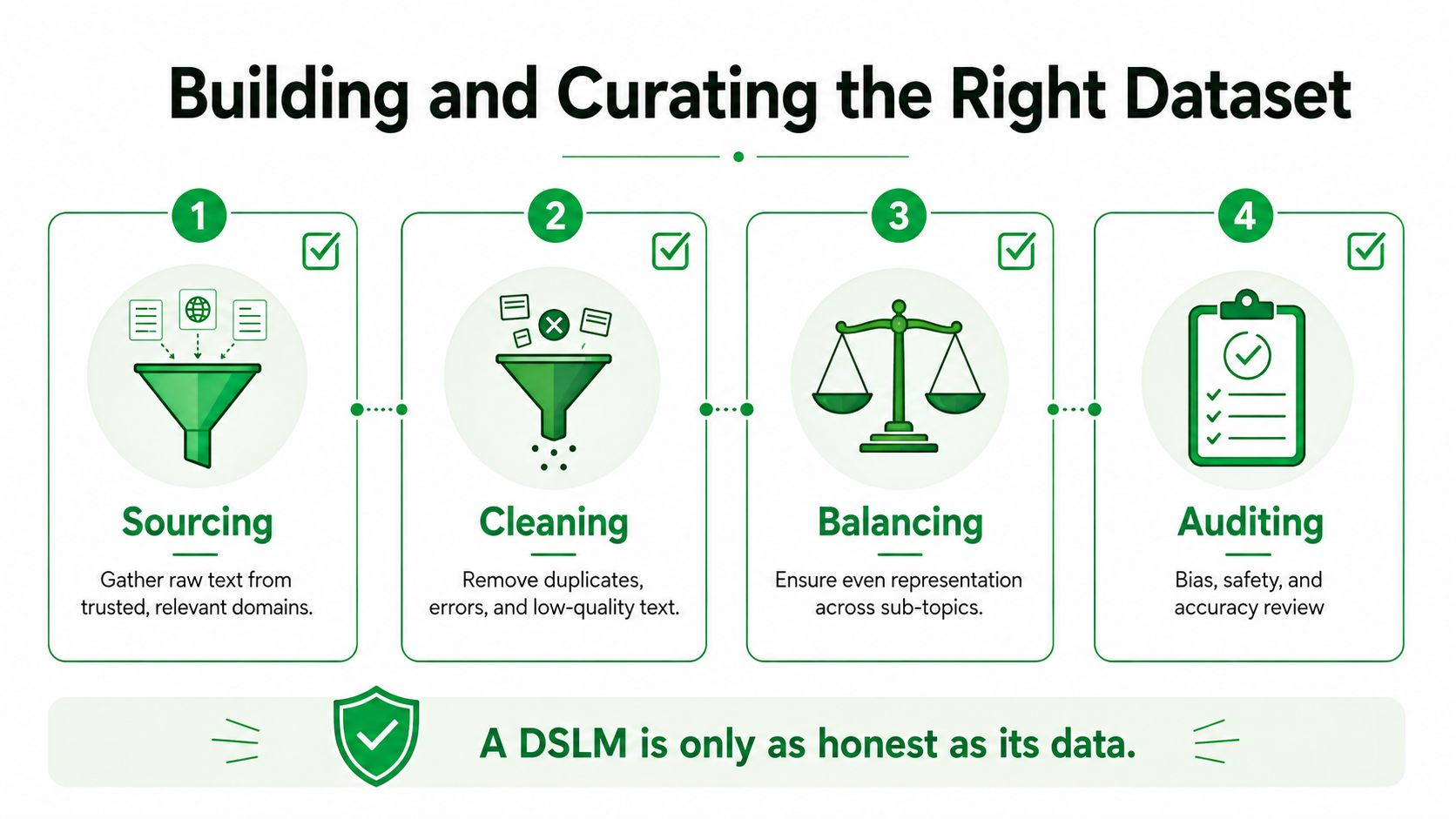
A domain model is only as honest as the text you feed it. If the corpus is noisy, duplicated, skewed toward one subtopic, or stale, the model learns those flaws just as faithfully as it learns the useful parts. That is why dataset work is not a setup chore, it is part of the model itself.
Sourcing, cleaning, balancing, auditing
Sourcing means gathering raw text from trusted, relevant places. In legal or medical settings, that source list needs to be deliberate, not opportunistic, because the wrong document can teach the model the wrong habit.
Cleaning removes duplicates, broken formatting, and low-quality passages. A model will happily memorize repeated noise if nobody removes it, the same way a student will repeat a mistake if the same bad example keeps showing up.
Balancing keeps one topic from taking over the dataset. If one subdomain appears everywhere, the model will overfit to it and become narrow in places where you expected flexibility.
Auditing checks for bias, safety problems, and mismatched examples before training starts. This step gets skipped when teams move quickly, but it is also the step that reveals whether the dataset really matches the product.
An audit can surface concrete imbalances that are easy to miss in a spreadsheet. For example, it might show that most of your conversational data is about ordering food, which would bias the model away from travel, work, or support scenarios. It might also show that your “general” examples are drawn from one region or one writing style, which can make the model sound oddly repetitive once users start asking broader questions.
A useful language-learning example is a curated Irish corpus for everyday conversation. The goal is not all Irish text on the internet. It is the right slice of Irish for the product's users, beginner phrases, common conversational patterns, oral exam topics, and culturally appropriate phrasing. A practical reference point for that kind of learning workflow is the Gaeilgeoir AI learning page, where the product focus is clearly on guided language practice rather than open-ended generation.
Why small and clean often beats large and messy
In niche domains, the corpus is often limited, and every line matters more than people expect. The literature on small, efficient domain models emphasizes guided data curation and staged training, especially where the language is underrepresented or the domain has specialized vocabulary small model research. Irish is a good example of the broader point, because language-equity gaps make careful selection more useful than raw scale.
Rule of thumb: if you can't explain why a sentence belongs in the dataset, it probably shouldn't be there.
That discipline also helps avoid domain drift. When user questions change but training data does not, the model starts answering yesterday's problems. The answer is a living dataset, with regular review, targeted additions, and removal of examples that no longer match how people use the system.
Evaluating a Domain Model the Way It Deserves
A domain model can look polished in a demo and still fail the people who need it most. Teams train, fine-tune, and ship, then wait to see whether the model fits a real workflow, a real culture, or a real learner path. That gap is where evaluation has to do real work.
Three layers of proof
The first layer is automatic checks. Use task accuracy where it fits, hallucination checks where answers must stay grounded, and retrieval quality for RAG systems. These checks are fast, repeatable, and useful for catching regressions early, but they only cover part of the picture.
The second layer is a domain-specific test set. Generic benchmarks miss the cases that matter in practice. A model for law needs contract language and edge-case phrasing, a model for medicine needs safe handling of symptoms and treatment terms, and a model for Irish-language learning needs beginner forms, common classroom phrases, and the kinds of mistakes learners make repeatedly.
The third layer is human review. That matters most when answers touch cultural norms, ethical constraints, regulatory language, or pedagogy. Research on domain specialization says the hard part is often deciding what “good” means inside the domain, especially when the constraint is social, cultural, or linguistic rather than purely technical evaluation challenge.
A 2024 thesis on specialized-domain modeling points to another problem, the shortage of datasets that fit narrow domains, with the gap even wider outside English thesis note. That is why “just benchmark it” breaks down so quickly. A generic score can miss the kind of error that matters in a classroom, a clinic, or a public service setting.
A practical review loop for your team
Build a gold set with domain experts. Run automated checks on a schedule. Sample real outputs for human review. Feed failures back into the next training round. The model becomes trustworthy because the team keeps testing it against the situations that matter, not because a dashboard looked healthy once.
For Irish learning, that review loop should check beginner phrasing, oral exam prompts, and common learner mistakes. It should also check cultural and pedagogical fit. A generic benchmark might reward a translation that is grammatically plausible but strange in a classroom, such as a phrase that sounds too literal for everyday use or a response that ignores the learner's level and gives an advanced construction when a simpler one would be better. In that case, the model has not just made a language error, it has failed the teaching moment.
The safest outputs are not always the most confident ones. A model that says it is unsure and offers two common alternatives is often more useful than a model that produces one polished but unnatural phrase. That is the kind of distinction human reviewers catch, and the kind of distinction domain evaluation should be built to surface.
Deployment, Cost, and the Case for Smaller Domain Models
Once the model is trained, deployment becomes the primary product decision. You're choosing where the model runs, who controls it, how fast it feels, and how much friction the team adds every time it answers.
Where the model runs changes the product
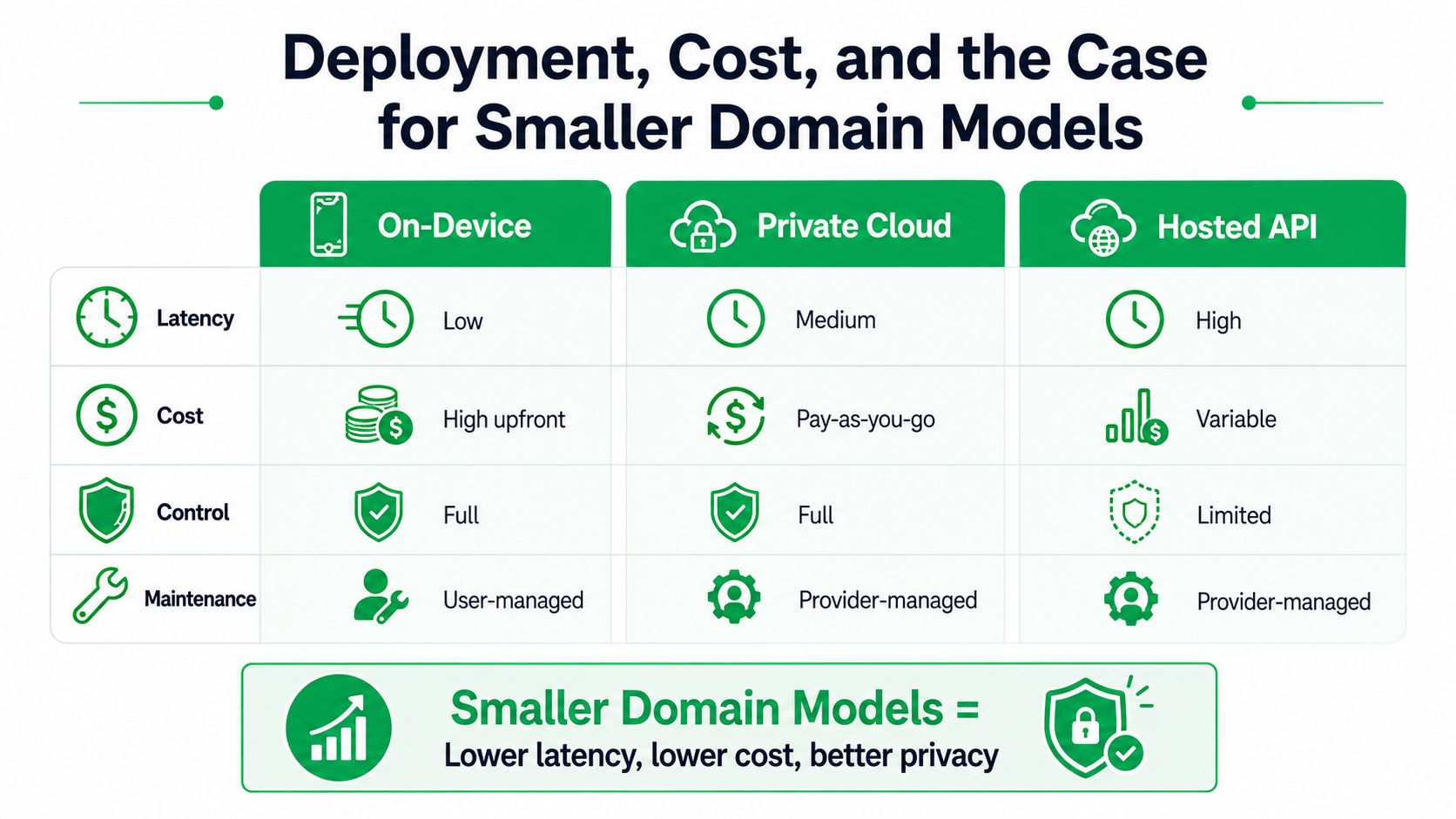
On-device deployment gives the most control and the best privacy posture because the interaction stays local. It also works well when you want lower latency and a smoother feel on mobile.
Private cloud keeps control high while centralizing operations. That's a practical middle path for teams that want governance without fully giving up flexibility.
Hosted API is the simplest path to launch, but it gives you less control and can create a hidden cost trail once retries, guardrails, and review steps start piling up.
A useful design principle for learner products is to keep the core interaction close to the user. A platform like Gaeilgeoir AI can benefit from that because conversational practice works best when responses feel immediate and the experience stays tightly managed.
Why smaller models can win in niche settings
The strongest case for smaller domain models isn't hype, it's fit. When the language is narrow and the task is specific, a smaller curated model can be easier to deploy, easier to review, and less expensive to keep honest. That matters even more when the product needs privacy, low latency, or predictable behavior.
A practical deployment stack often adds quantization, batching, prompt caching, and fallbacks when the model is uncertain. Those aren't glamorous features, but they're the difference between a demo and a product.
If the domain is narrow enough, spending less on a smaller model can buy you more reliability than spending more on a broad one.
Risks, Limits, and How to Mitigate Them
A good DSLM still fails in familiar ways. The most common problem is silent overconfidence on questions outside the training slice, where the answer sounds clean but doesn't belong in the domain. The second is cultural or ethical blind spots inherited from narrow data. The third is drift, because the domain itself changes. The fourth is the old product mistake of treating the model as finished instead of monitored.
Four mitigations that hold up in practice
Use confidence thresholds and graceful refusals so the model can say it's unsure. That's better than inventing a neat answer that nobody asked for.
Bring in diverse reviewer panels when the domain touches culture, language, or community norms. A narrow reviewer set will miss narrow failures.
Schedule re-evaluation against fresh domain data. A model that passed last quarter can still be off-target now.
Close the loop by turning user corrections into new training signal. That's how the system stays honest as the domain shifts.
These habits matter because the business logic for DSLMs is constraint handling as much as raw accuracy. A domain model makes sense when the cost of being wrong touches revenue, compliance, safety, or user trust, and when the deployment context rewards privacy or low latency.
Putting It All Together With Gaeilgeoir AI
A learner-facing Irish product shows the whole pattern in miniature. A curated corpus supports everyday conversation, the model is tuned for domain use instead of open-ended chatter, and evaluation has to cover beginner mistakes and Leaving Cert oral topics, not just generic fluency. That kind of design also fits the broader trend toward smaller, more honest models and evaluation as a first-class product feature.
For a direct Irish-learning example, learn Gaelic language with AI points to the same idea in product form. The lesson is simple, when the language is narrow and the stakes are real, a carefully built domain model often has more value than a bigger generic one.
If you want to see how that feels in practice, try Gaeilgeoir AI. It applies domain-specific AI to Irish conversation practice, with lessons built around the kind of language learners need.