You've picked a language, you're motivated, and now you're staring at a wall of apps. Every one promises fluency, shows a streak counter, and claims its method is different. You download two, tap through matching exercises for a week, and still freeze when you try to say a full sentence out loud. That gap, between feeling busy inside an app and speaking in real life, is where most choices go wrong.
Table of Contents
- Why This Language Learning Software Comparison Matters
- Key Evaluation Criteria for Language Learning Software
- Feature Matrix of Leading Language Learning Apps
- Pros and Cons for Different Learner Personas
- How to Choose Software Based on Your Learning Goal
- Gaeilgeoir AI for Irish Learners and Leaving Cert Prep
- Final Recommendations and Getting Started
Why This Language Learning Software Comparison Matters
A learner I see often in research on self-directed study looks like this. She studied Irish at school, can recognize plenty of words on screen, and wants to hold a basic conversation with family. She installs a polished global app because it has the best store rating. Three weeks later she's excellent at tapping the correct translation and no better at ordering food, asking directions, or answering an unexpected question.
That outcome isn't a motivation problem. It's a selection problem. Most comparison pages rank polish, lesson counts, and feature lists. They rarely ask whether the software forces you to produce language under mild pressure, corrects your pronunciation in a way you can act on, or revisits material before you forget it.
The Question Most Rankings Skip
A useful language learning software comparison starts from a different question. Which tool builds durable speaking ability for a specific person, at a specific level, in a specific language? A beginner who needs structure, a heritage learner who understands more than she can say, and a student facing an oral exam don't need the same product, even if marketing pages treat them as one audience.
Judge software by the spoken output it extracts from you each session, not by the content it displays at you.
Evidence supports that shift in focus. Technology-supported instruction can outperform instruction without technology, but the benefit depends on design, not on the mere presence of an app. In a meta-analysis of educational technology in English teaching, researchers reported an effect size of 1.68 under a fixed-effects model and 0.91 under a random-effects model compared with non-technology methods, a result described in the meta-analysis of educational technology in English language teaching. The more conservative 0.91 figure matters more for you, because it allows effects to vary across learners and implementations. In plain terms, some tools and contexts work much better than others.
What a Better Comparison Gives You
Three practical payoffs follow from comparing this way.
- You stop paying for engagement dressed as progress. Points and streaks can keep you returning, but they don't prove you can speak.
- You match the tool to the bottleneck. If pronunciation is your weak point, feedback quality outranks a large vocabulary library.
- You spot minority language blind spots. Software built for major global languages may have thin dialect coverage, weaker speech recognition, and less accurate feedback for Irish.
By the end of this guide you'll have criteria you can apply to any product, a matrix for side by side judgments, and persona based trade-offs. You'll also see how one Irish-specific platform performs against those same criteria, with its limits stated plainly.
Key Evaluation Criteria for Language Learning Software
Personalization is not a fashionable extra. It is already how many teachers work. A 2024 European School Education Platform survey of 1,109 teachers found that 60% adapted instruction to individual student needs and 58% used language learning apps or online platforms, while only 26% identified AI as a language learning tool. That gap tells you two things. Digital platforms are established, but AI-specific claims deserve extra scrutiny because classroom adoption was still low in that snapshot. The survey was voluntary and concentrated in Italy, Spain, Türkiye, and Greece, so treat it as a benchmark, not a global estimate.
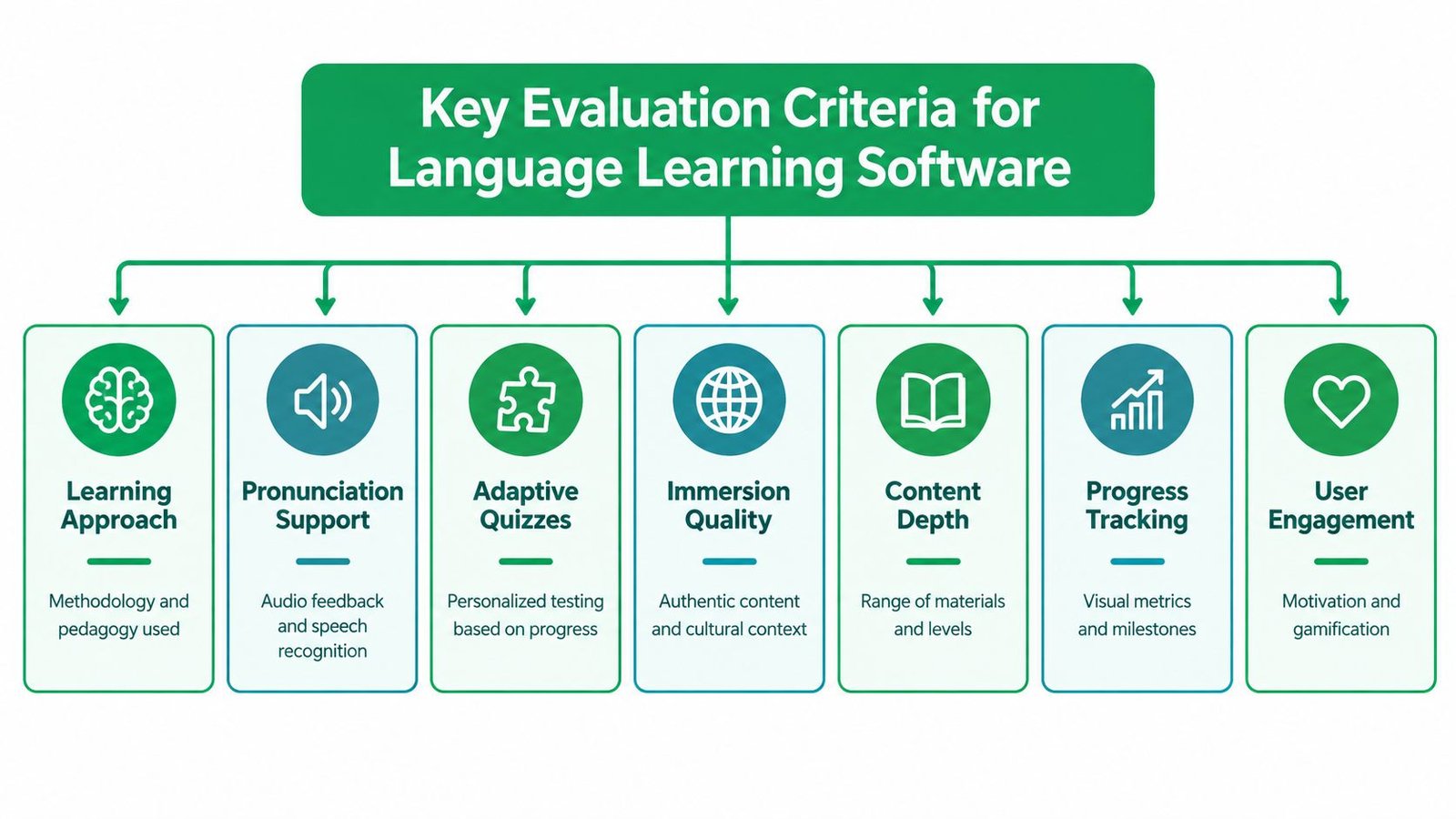
Use these seven criteria in order of learning impact, not marketing visibility.
Learning Approach and Pronunciation Support
Learning approach describes what the software asks you to do minute by minute. Recognition tasks, such as matching words, build familiarity. Production tasks, such as answering aloud in a scenario, build retrieval. Strong products sequence both, but they don't let recognition dominate once you're past the first lessons.
Pronunciation support needs a sharper test than checking whether a microphone icon exists. Ask whether feedback tells you which sound was wrong, separates individual sounds from fluency, and lets you retry immediately. A score with no location for the error gives you little to fix.
Adaptive Practice and Immersion Quality
Adaptive quizzes should change based on your errors, not just get harder as you advance. Good systems resurface words you miss, vary the format so you can't guess from position, and explain the correction. If you're evaluating this layer in depth, the discussion of adaptive learning algorithms is a useful reference for how sequencing decisions are made.
Immersion quality is about context, not volume. Authentic dialogues, cultural notes that affect word choice, and scenarios you'll face beat long lists of isolated sentences. For Irish, that includes everyday social exchanges rather than only classroom vocabulary.
Content Breadth, Pricing, and Exam Preparation
Content breadth matters after the first two criteria are satisfied. Check level coverage, skill balance across listening, speaking, reading, and writing, and whether advanced material exists before you commit for a year.
Pricing should be judged against output, not features. A cheaper tool that makes you speak daily can deliver more value than a premium library you passively browse.
Exam preparation is a specialist criterion. Students need timed practice, likely oral topics, and correction aligned with how examiners judge fluency. General conversation apps rarely provide that structure, however good they are for casual learners.
Practical rule: If a product can't explain how it corrects a spoken error, downgrade its pronunciation claims regardless of its feature list.
Feature Matrix of Leading Language Learning Apps
Mobile delivery itself has credible support. A synthesis of 80 experimental and quasi-experimental studies found mobile-assisted language learning produced an overall effect size of 0.722 versus conventional instruction, while another meta-analysis reported g = 0.88 for mobile language applications. Those are pooled averages across many designs. They justify taking apps seriously, but they don't certify any single interface, streak system, or AI conversation feature as superior. You still need the matrix below, and you should read it as a guide to tendencies by product type, not as laboratory scores for individual brands.
Language Learning Software Feature Comparison
| Platform | Learning Approach | Pronunciation Support | Adaptive Quizzes | Immersion | Content Breadth | Pricing | Exam Prep |
|---|---|---|---|---|---|---|---|
| Gamified mobile apps such as Duolingo style products | Short recognition heavy lessons, frequent rewards | Basic speech checks, limited error detail | Moderate, mostly level progression | Light context, sentence based | Broad for major languages, thinner for Irish | Free tier with paid upgrade | Weak, not exam aligned |
| Structured course apps such as Babbel style products | Grammar led units with dialogues | Record and compare, some feedback | Moderate review cycles | Stronger cultural context | Deep for supported languages | Subscription | General, rarely oral exam specific |
| Audio first programs such as Pimsleur style products | Listening and repetition, spoken recall | Model based, self judged accuracy | Low quiz variety | Conversational scenarios | Narrower written content | Subscription or purchase | Weak |
| Tutor marketplaces such as italki style services | Human led conversation, variable method | Human correction, quality varies by tutor | Depends entirely on tutor | High, real interaction | Depends on tutor materials | Per lesson cost | Can be strong if tutor knows the exam |
| Irish specific AI platforms such as Gaeilgeoir AI | Scenario conversation from the start | AI pronunciation support for Irish practice | Adaptive quizzes with instant feedback | Everyday Irish scenarios | Focused, Irish only | Single subscription model | Dedicated Leaving Cert oral preparation |
If exams are your main filter in another language, a focused comparison can help you find the right app for exams rather than relying on a general ranking.
How to Read the Differences
The most important column is pronunciation support, because it's the easiest to overclaim. Research summarized earlier in this field shows automatic speech recognition can help, but explicit corrective feedback beats indirect feedback such as simple transcription. A platform that only shows you what it heard leaves you guessing. A platform that pinpoints the sound, models it, and asks you to try again gives you a training loop.
The second fault line is recognition versus transfer. Gamified apps are efficient at teaching you to recognize correct answers. That skill doesn't automatically transfer to producing a sentence when someone is waiting for a reply. Tutor marketplaces solve the transfer problem with real humans, but they introduce cost per session, scheduling friction, and uneven quality.
Structured course apps sit in the middle. They explain grammar clearly and suit learners who like order. Their weakness is pacing of spoken output, since understanding a rule and using it in conversation are different abilities.
Audio first programs deserve more credit than they usually get for speaking confidence. Repetition and recall build automatic phrasing. Their limits show up in reading, writing, and detailed correction, and self-judged pronunciation can let errors settle.
For minority languages, the matrix has a hidden row. Coverage quality drops fast outside major global languages on broad platforms. An Irish specific product can go deeper on relevant scenarios and oral exam topics, but it will never match a global app on language choice. That's a trade-off to choose deliberately, not a flaw to discover later.
Pros and Cons for Different Learner Personas
Software that's ideal for one learner can actively slow another down. A 2025 analysis of digital language learning resources used in UK schools found software was strongest for engagement and language input but weaker for learner output and social learning, and that higher ratings did not correlate with price or usage frequency. Free and paid products also showed no statistically significant difference in measured feature ratings in that analysis. Price and polish, in other words, are unreliable proxies for speaking gains.
Complete Beginners
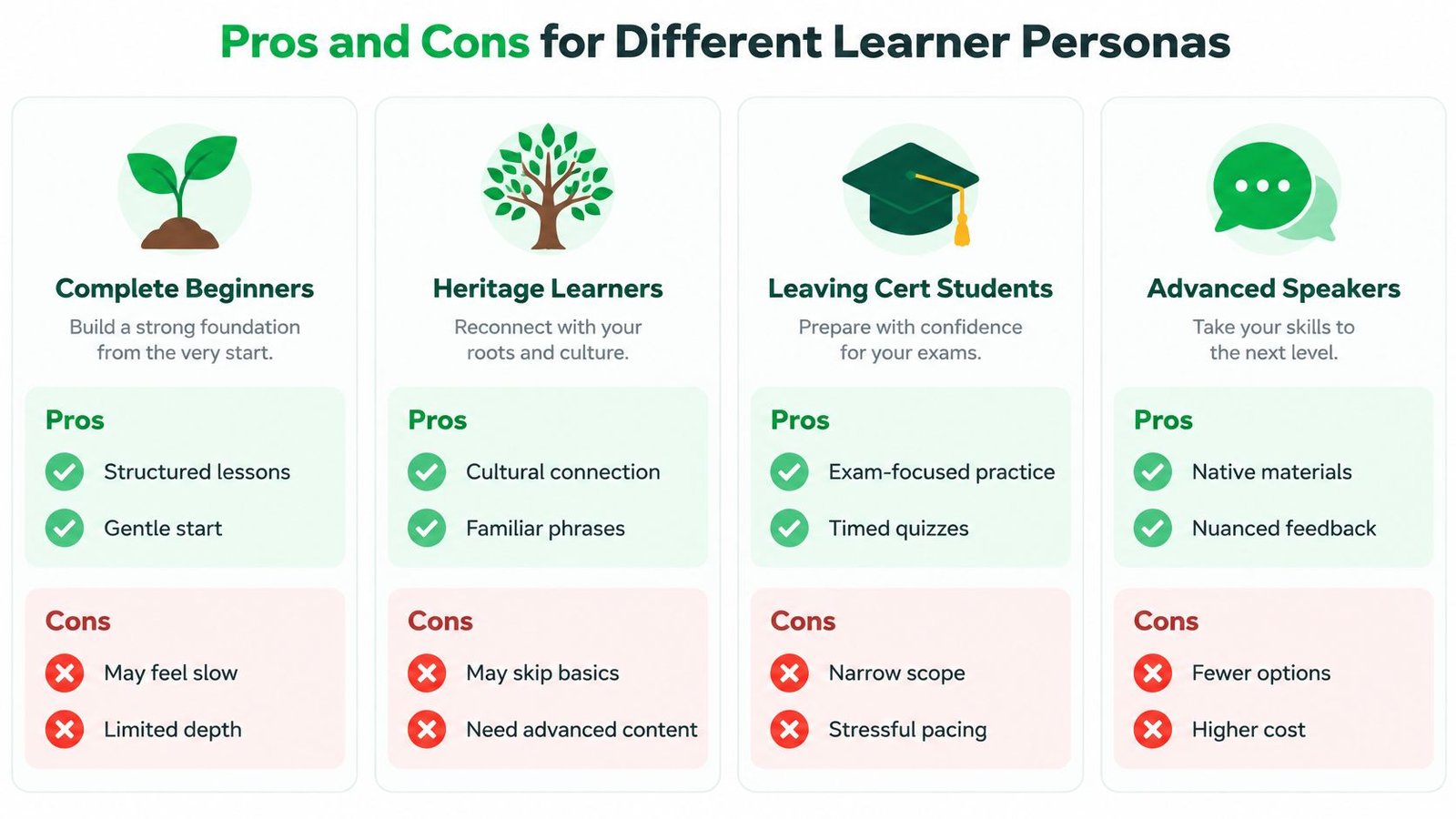
Beginners benefit most from structured sequencing and low embarrassment practice. Software gives them repetition without an audience, clear first steps, and immediate correction on basic errors. Busy, game-like design helps at this stage because showing up daily is the main challenge.
The con is false confidence. A beginner can feel fluent inside predictable exercises and then stall in an unscripted exchange. Beginners should look for products that introduce short spoken answers early, not after months of vocabulary work.
Heritage Learners Returning to Irish
Heritage learners often understand phrases, songs, and family expressions but can't build their own sentences reliably. Their advantage with software is targeted reactivation. Scenario practice and adaptive review can turn passive familiarity into usable speech without forcing them through childish starting material for long.
The risk is misleveling. Generic placement tests may overcredit recognition and skip grammar gaps, or undercredit listening and bore them. They need diagnostics that test production, plus culturally accurate content that respects why they're learning.
Leaving Cert Students
Students need exam shaped output, including timed responses, common oral topics, and feedback on fluency under pressure. Software is valuable here because it provides repeat practice between classes, exactly when school timetables leave little speaking time.
The downside is scope mismatch. A general app may improve vocabulary while leaving oral exam technique untouched. Narrow exam tools can also create stress if pacing is rigid, so students should pair simulation with lower stakes conversation practice.
Busy Adults
Adults with jobs and families need short, resumable sessions and practice that survives interruptions. Mobile software fits commutes and lunch breaks, and progress tracking helps restart after gaps.
Their main con is shallow practice. Five minutes of matching exercises fits a schedule but may not move speaking ability. Adults should protect at least some sessions for speaking aloud, even if those sessions are brief.
The best persona fit is usually the product whose weaknesses fall on skills you can get elsewhere, not on the skill you bought it to build.
How to Choose Software Based on Your Learning Goal
Start by naming the outcome in observable terms. Not fluency in general, but a behavior. Hold a five minute conversation with a relative. Answer oral exam questions without long pauses. Handle travel interactions without switching to English. Each outcome points to different criteria, and vague goals lead to vague purchases.
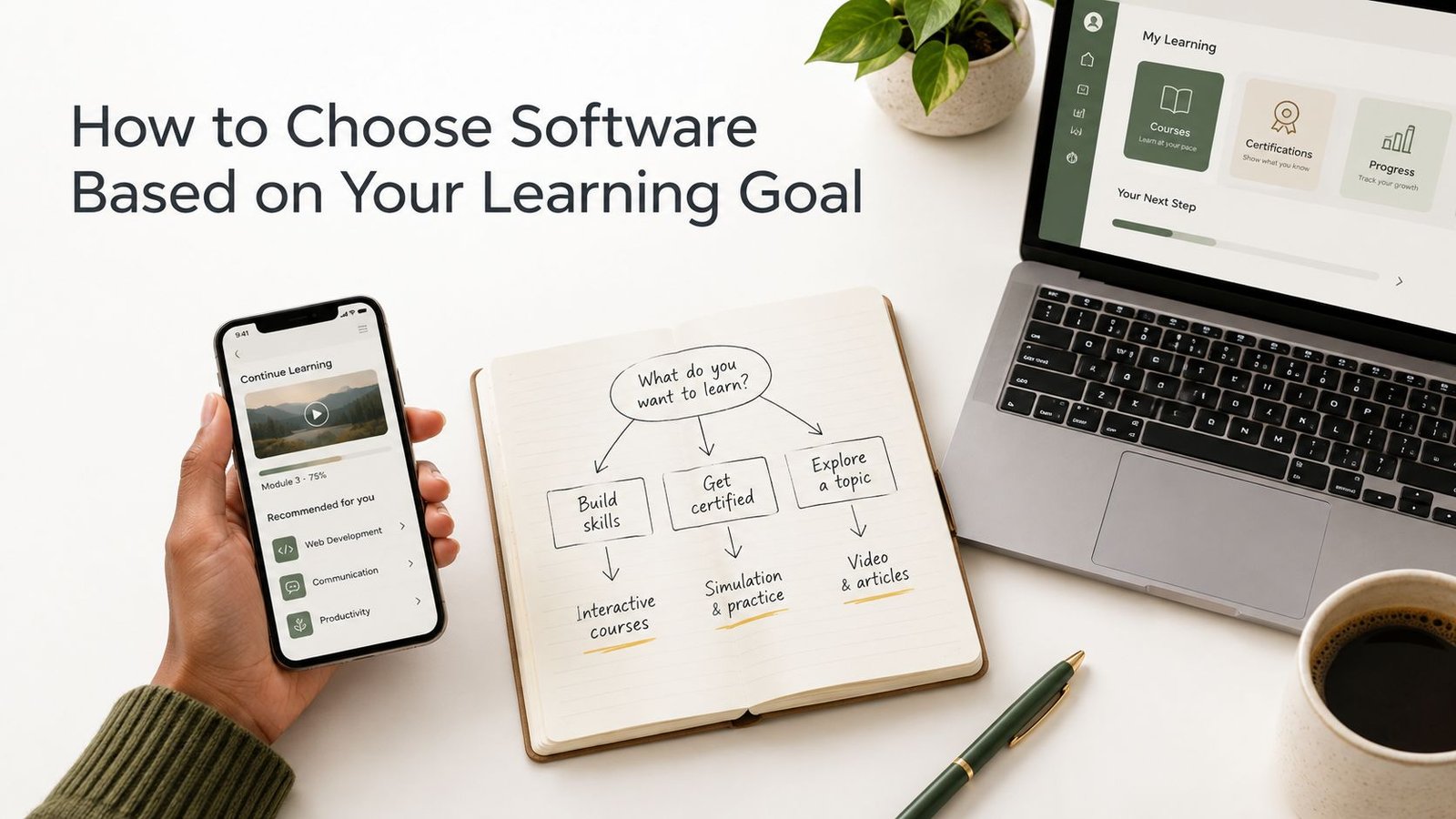
Work through these steps before you pay.
A Practical Decision Sequence
- Define the speaking task. Write down the exact situation you want to handle, then check whether the software practices that situation or only related vocabulary.
- Test the feedback loop. Deliberately mispronounce a word during a trial. Useful software identifies the problem and gives you a model and a retry. Weak software accepts almost anything or rejects without explanation.
- Check production ratio. Time one session. How much of it did you spend speaking or writing your own sentences versus tapping choices? Conversation goals need a high production ratio.
- Inspect review behavior. Miss a few items on purpose and return the next day. Adaptive systems resurface those items in new formats. Static systems move on as if you'd mastered them.
- Verify level exit. Look at the most advanced material now. If you'll outgrow it within your subscription period, the low starting price isn't a saving.
Pronunciation research reinforces step two. A meta-analysis covering 15 studies and 38 effect sizes found automatic speech recognition produced a medium overall pronunciation learning effect of g = 0.69, with large effects for segmental features such as individual consonants and vowels and small effects for suprasegmental features such as rhythm, stress, and intonation. Longer interventions outperformed short exposure, and practice involving peers produced larger gains than working alone. So expect software to fix specific sounds more readily than overall musicality, and plan human or peer conversation alongside it if natural rhythm matters to you.
Matching Goals to Priorities
For conversational fluency, weight pronunciation support, scenario realism, and production ratio highest. Content breadth can wait.
For exam preparation, weight topic alignment, timed simulation, and corrective feedback on complete answers. Gamification is secondary, and it can even distract if rewards favor speed over accuracy.
For heritage maintenance, weight cultural context, listening variety, and flexible entry points. You need material that respects existing knowledge while filling production gaps.
For travel, weight practical scenarios and listening comprehension for replies you'll hear. Deep grammar sequencing matters less than reliable phrases you can retrieve under stress.
On cost, be skeptical in both directions. The UK schools analysis noted earlier challenges the assumption that premium pricing signals better measured features. Trial the cheapest tool that passes your feedback and production tests, upgrade only when you hit a specific ceiling, and measure progress with a recorded speaking sample each month. Completion percentages won't tell you whether you're improving. Your own recordings will.
Gaeilgeoir AI for Irish Learners and Leaving Cert Prep
Irish presents a specific version of the recognition trap. The 2022 Census figures on Irish speakers recorded 1,873,997 people who said they could speak Irish, but only 623,961 (33%) spoke it daily, down from 36% in 2016, and 55% said they did not speak it well. Ability on paper is widespread. Confident daily use is not. Software for Irish therefore has to create frequent speaking opportunities for people who may have no Irish speakers around them, rather than add more recognition exercises to an already recognition heavy school experience.
The screenshot below shows the platform interface learners use for guided practice.
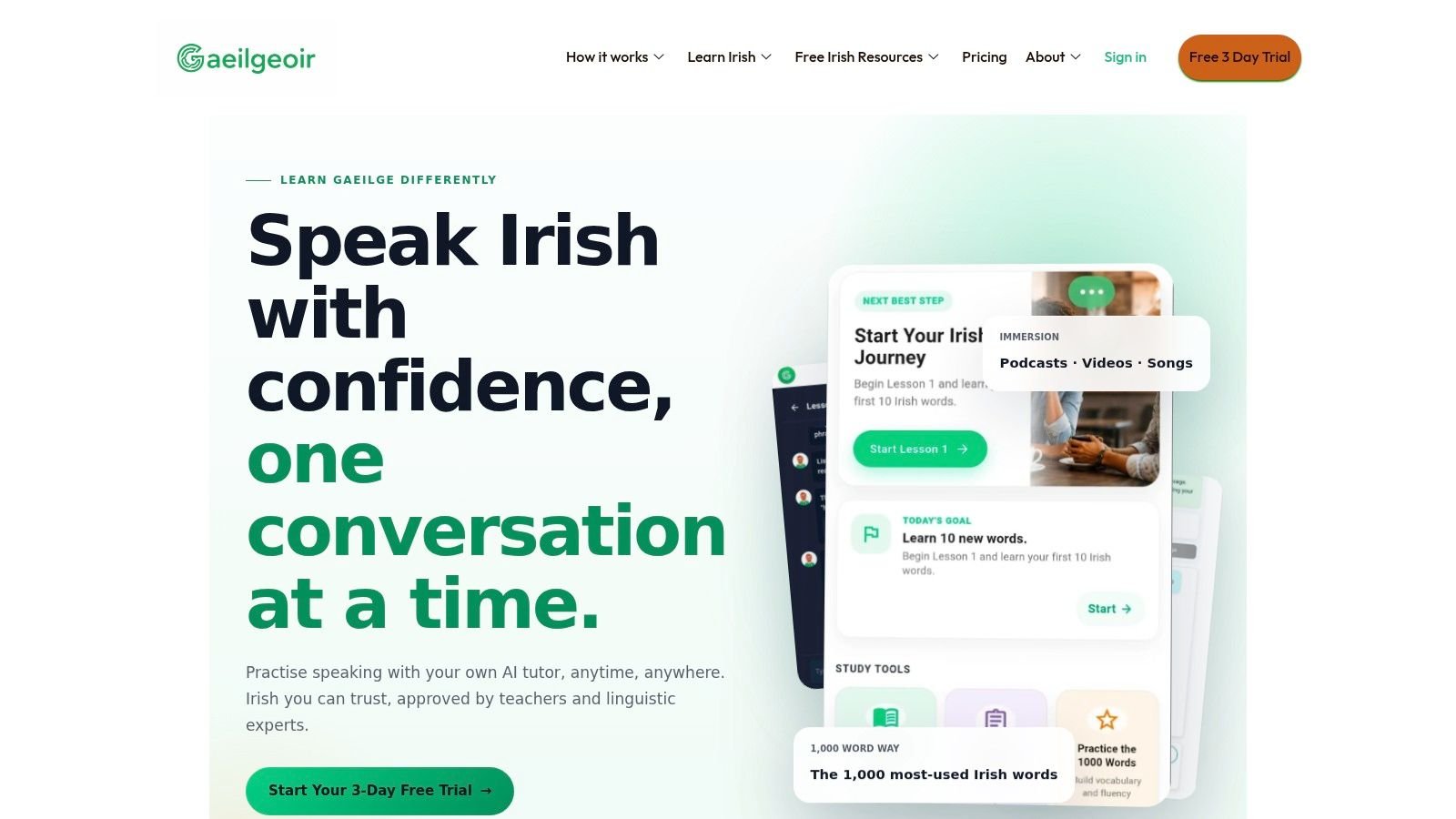
Against the criteria in this guide, Gaeilgeoir AI is built around guided real world conversations from day one, covering social interactions, work, travel, ordering food, and asking for directions. That design targets the production gap directly. Its immersion-first approach is grounded in the 1,000 most used Irish words, which gives beginners a bounded, high value foundation instead of an undifferentiated word list. Learners can click any word across the platform to see translations and save items to a personalized study list, a small feature with real review value because it turns exposure into a personal queue.
Adaptive quizzes with instant feedback handle the review layer, and points, multipliers, and leaderboards supply motivation. Treat that gamification correctly. A systematic review of gamification in English as a foreign and second language instruction treats mechanics such as points, progress feedback, challenges, and rankings as elements to assess separately from instructional content. Rewards are useful if they pull you back into speaking practice. They aren't evidence of learning by themselves, on this platform or any other.
For students, dedicated preparation simulates typical oral exam topics, and learners preparing specific answers can work through Leaving Cert Irish oral questions as part of that practice. A specialist product has a structural advantage over global apps, which rarely align to a single national exam.
The video below demonstrates how a practice session runs in practice, so you can judge production ratio and feedback style yourself.
Honest limits apply. AI feedback for a minority language should be held to the trust tests discussed in recent reviews of privacy, bias, access, and cultural nuance, summarized in a review of responsible AI adoption in language learning. Irish has less training data behind automated systems than English, Spanish, or French, so dialect coverage and speech recognition accuracy need ongoing checking, and learners should value transparent limits and culturally accurate feedback over feature volume. Gaeilgeoir AI also can't replace live conversation in Gaeltacht or community settings. Census reporting noted just over 20,000 daily Irish speakers in Gaeltacht areas, described in the Census 2022 press statement on Irish language and education, which is precisely why simulated daily exchanges matter for learners elsewhere. Used as daily speaking practice between real conversations, rather than as a substitute for them, the platform fits the evidence based priorities in this comparison.
Final Recommendations and Getting Started
Choose by bottleneck, not by brand. If you recognize more than you can say, prioritize spoken production and corrective feedback. If you understand little, prioritize structured input with early short answers. If an exam sets your deadline, prioritize aligned simulation. In every case, separate engagement from learning by recording yourself speaking on the same prompt at regular intervals and comparing fluency, accuracy, and range.
Cost should follow that test. A tool that passes your feedback and production checks at a modest subscription beats a polished library you browse passively, and reviewing the terms of a language learning subscription before committing helps you compare trial length, cancellation, and what is included. For Irish specifically, Gaeilgeoir AI is priced at €9.99 per month with a free 3-day trial and cancel anytime flexibility, which makes a structured trial realistic. Use those trial days deliberately. Mispronounce words, miss quiz items, and check whether review resurfaces them.
Set a small schedule you won't break, speak aloud even when tapping would be easier, and add human conversation as soon as you can. Software is strongest as the daily practice layer between real interactions. Pick the product that makes that layer demand the most from your voice, and you'll have made the comparison correctly.
If you're learning Irish and want daily speaking practice built around real conversations, pronunciation support, and Leaving Cert oral preparation, explore Gaeilgeoir AI and start your trial at learn.gaeilgeoir.ai. Test it against the criteria in this guide during the trial, record yourself on day one, and keep it only if your speaking, not just your streak, is moving.