
A language learning subscription is worth paying for when it creates regular speaking practice, not merely a longer streak. The market reached $6.34 billion in 2024 and is projected to reach $24.39 billion by 2033, but a large market doesn't guarantee that any individual app will help you speak. Quantumrun's language-learning app market overview gives useful context for that expansion.
You've probably been in this situation: three language apps sit on your phone, each downloaded with good intentions, and none has survived a busy month. You want a subscription that helps you speak, perhaps for travel, work, family, or the Leaving Cert, but you don't want to pay for confetti, streaks, and vocabulary taps that never transfer into a real conversation.
The right choice depends on your goal, target language, and available schedule. A subscription built for Spanish may offer extensive listening and speaking content, while one aimed at Irish can have a much narrower library and a different standard for pronunciation support. That difference matters more than a polished interface.
Table of Contents
- What a Language Learning Subscription Looks Like in 2026
- Defining the Language Learning Subscription Model
- Core Features That Matter Most
- Subscriptions vs Classes and One-Off Purchases
- Matching a Subscription to Your Learner Profile
- Realistic Study Plans and Weekly Time Estimates
- How Gaeilgeoir AI Fits the Criteria
- Pricing, Trials, and Frequently Asked Questions
What a Language Learning Subscription Looks Like in 2026
A working adult downloads three apps after deciding to learn Irish. One offers attractive daily challenges, another has a large vocabulary bank, and the third promises artificial-intelligence conversation. After a few weeks, the notifications become background noise. The problem isn't necessarily motivation. The learner never found a product that connected short sessions with actual speaking outcomes.
A modern language learning subscription should deliver more than access to isolated lessons. It typically combines an updated course library, progress tracking, speech recognition, review systems that respond to forgetting, and speaking drills designed for a phone. The strongest products make it easy to move from recognition to production. You don't just identify a phrase. You say it, receive useful feedback, and meet it again when your recall needs reinforcement.
Why language coverage changes the buying decision
The market is crowded for major languages such as Spanish and French. Irish is different. A subscription may use the same premium label, but the depth of its Irish content, dialect coverage, pronunciation guidance, and conversation practice can vary sharply.
For a learner comparing tools, content availability is a practical issue. Check whether the app supports the variety of Irish you expect to hear, whether it includes audio from native speakers, and whether its speaking tasks reflect your intended situations. A tool designed for broad multilingual reach may be excellent for common tourist phrases but weak for sustained Irish conversation.
Practical rule: Judge a subscription by what it makes you say aloud during an ordinary week, not by how many lessons appear in its library.
Digital language products also increasingly depend on media workflows. If you create short clips or translated learning material alongside your study, resources such as expand reach with Klap can help adapt video for broader audiences. That can support immersion, but it doesn't replace a course sequence or corrective speaking practice.
The rest of your decision should stay simple. Pay for a plan only when it removes a real obstacle, creates a repeatable routine, and gives you evidence that your spoken output is improving.
Defining the Language Learning Subscription Model
A language learning subscription is a recurring payment that provides ongoing access to lessons, progress records, and product updates. You usually choose monthly or annual billing. The service uses that continuing revenue to maintain content, run speech-recognition features, store learner data, and provide support.
That recurring structure explains why a subscription feels different from buying a textbook. A printed course remains fixed after purchase. An app can add exercises, revise explanations, improve audio, and adjust the learning path. Those benefits matter only if the provider maintains the product, so don't assume that every subscription delivers meaningful updates.
The common access ladder
Most apps organise access around a free tier, an individual premium tier, and a broader family or bundle tier. The free version may include introductory lessons, advertising, or usage limits. Premium normally removes some friction and opens more content. Family plans spread access across multiple users, while student offers and annual billing can change the effective monthly price.
| Tier | Price Range (Monthly) | Core Access | Typical Limits |
|---|---|---|---|
| Free | Varies by provider | Introductory lessons and selected practice | Ads, locked content, usage limits |
| Premium individual | Varies by provider | Full course path, progress tracking, and premium practice | One learner, renewal commitment |
| Family or bundle | Varies by provider | Multiple learners or language access | Higher total payment, bundle features may go unused |
Don't confuse an annual plan with a better learning method. It may reduce the monthly equivalent, but it also increases the cost of a poor fit. A lifetime deal can look attractive, yet it may provide less protection if the platform changes direction or stops serving your target language well.
What you are actually buying
A subscription buys access and continuity, not guaranteed fluency. It can give you a structured path, reminders, adaptive practice, and a convenient place to review. It won't force you to speak when you avoid speaking tasks.
Tutor marketplaces sell scheduled human feedback. One-off courses sell a fixed body of material. A subscription sits between those options, offering more flexibility than classes and more ongoing guidance than a static course. Choose it when you need regular practice that fits around life, rather than an external appointment that creates accountability.
Core Features That Matter Most
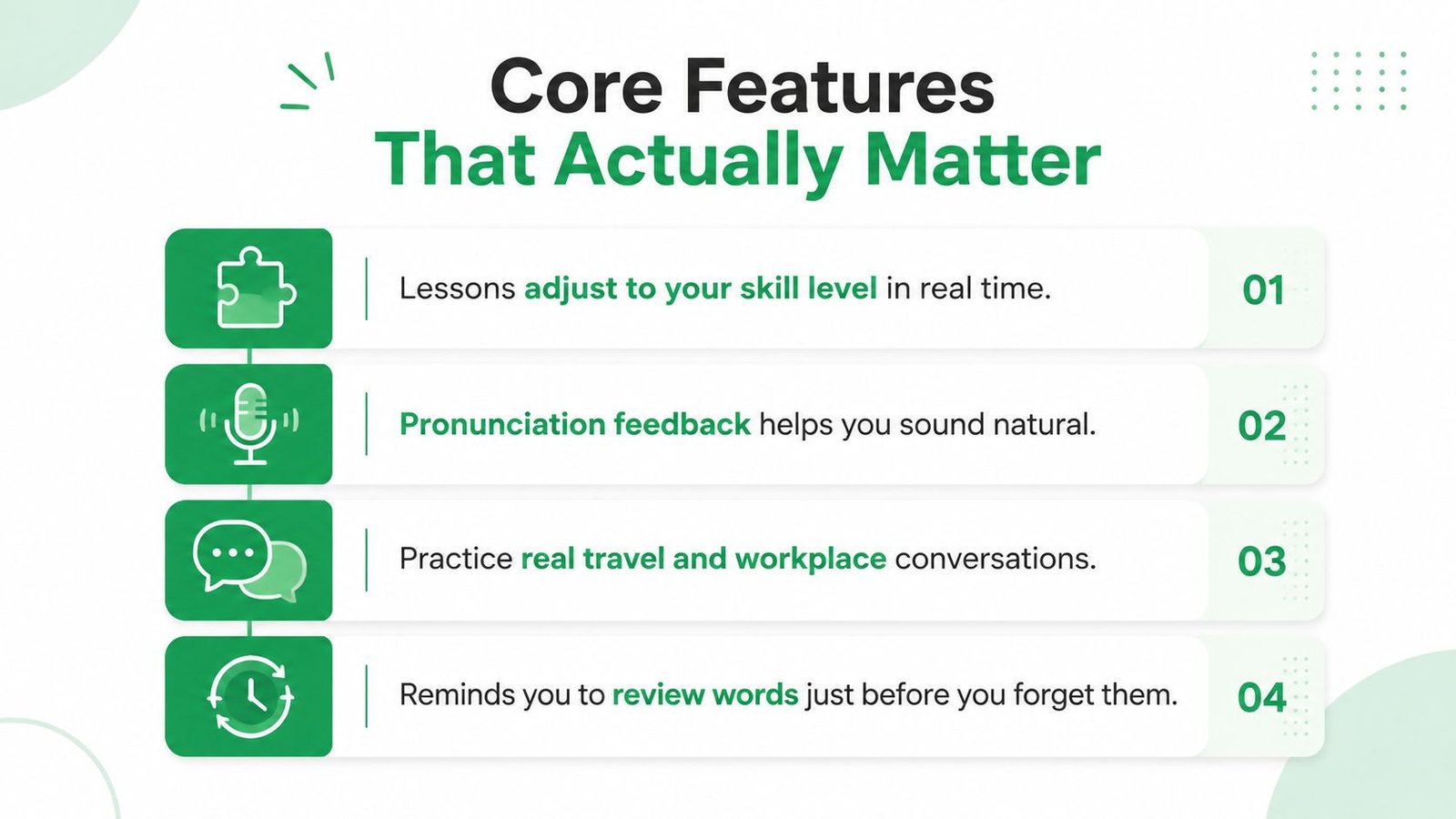
A paid plan earns its place through repeated use and measurable learner progress. Look for adaptive lessons that respond to your errors, pronunciation tools that identify meaningful problems, role-play that demands retrieval under pressure, and review queues that return material before you forget it. These standards matter even more for Irish, where generic tools may offer limited language-specific support.
Features that earn a paid plan
Adaptive lessons should change the next task according to your answers, recall, and recurring errors. A fixed sequence can suit beginners, but advanced learners lose time repeating material they already know. For Leaving Cert preparation, adaptive practice should also expose gaps in the topics and forms your course requires.
Speech recognition needs close scrutiny. Many systems detect broad pronunciation patterns, while an Irish learner needs feedback beyond general stress. Check whether the tool responds to features relevant to Irish pronunciation, including sounds affected by séimhiú, instead of accepting any close approximation.
Scenario-based role-play converts passive knowledge into retrieval. Ordering food, introducing yourself, asking for directions, discussing school, and handling a workplace exchange require different vocabulary and response patterns. Selecting an answer from a dialogue is weaker practice than producing the response from memory.
Spaced repetition has value when the queue reflects your errors. A phrase you repeatedly miss should return for another useful encounter. Identical lists on identical schedules can carry an adaptive label without adapting to your needs.
Features that add little learning value
Leaderboards, points, avatars, and streaks may encourage you to open an app regularly. They do not build speaking ability by themselves. A streak shows product use, not conversational skill.
Use this checklist before subscribing:
- Speaking output: You record or produce language, rather than only tapping answers.
- Useful correction: Feedback identifies an error you can fix.
- Relevant contexts: Practice matches your goal, including school, travel, or everyday Irish.
- Personal review: Difficult material returns at a suitable time.
- Progress evidence: You track completed scenarios or spoken tasks.
Pay for the first four. Treat cosmetic rewards as optional motivation, not the subscription's main value.
Subscriptions vs Classes and One-Off Purchases
A subscription wins when your schedule changes often. You can study before work, during a commute, or at home without arranging another person's availability. Classes win when you need a fixed appointment, immediate human correction, and social pressure to attend. One-off purchases work for a narrow objective, such as preparing phrases for one trip, but they often leave you without a durable review system.
Retention evidence supports the convenience argument. One independent benchmark reports that flat-rate subscribers stayed engaged 22% longer, with 12-week retention of 78% for subscription users versus 56% for pay-per-lesson users. The same benchmark reports that bundled subscriptions combining tutoring, AI practice, and progress dashboards retained users 18% more effectively than interaction-based billing. The benchmark's language-learning subscription analysis provides those comparisons.
| Route | Typical year-one cost | Weekly time needed | 12-month retention | Best for |
|---|---|---|---|---|
| Monthly or annual subscription | Depends on provider and billing term | Flexible, short sessions possible | Stronger in the cited subscription benchmark | Learners who need convenience and repetition |
| Group or private classes | Depends on frequency, tutor, and materials | Fixed attendance plus homework | Varies by course and learner | People who need accountability and live feedback |
| One-off course or textbook bundle | One initial purchase, plus possible extra materials | Self-directed | Varies widely | A narrow, time-boxed goal |
Don't accept invented precision from a provider's sales page. Compare the full first-year commitment, including tutor top-ups, replacement books, cancellation terms, and unused bundle features. The subscription price is only cheap if you use it.
Ireland-focused buyers can also consult this guide to the best language learning apps for beginners before deciding whether a general app offers enough structure.
Choose a subscription when flexibility matters more than external structure. Choose classes when a scheduled teacher is the only thing that gets you to practise. Buy a one-off course only when the finish line is narrow and obvious.
Matching a Subscription to Your Learner Profile
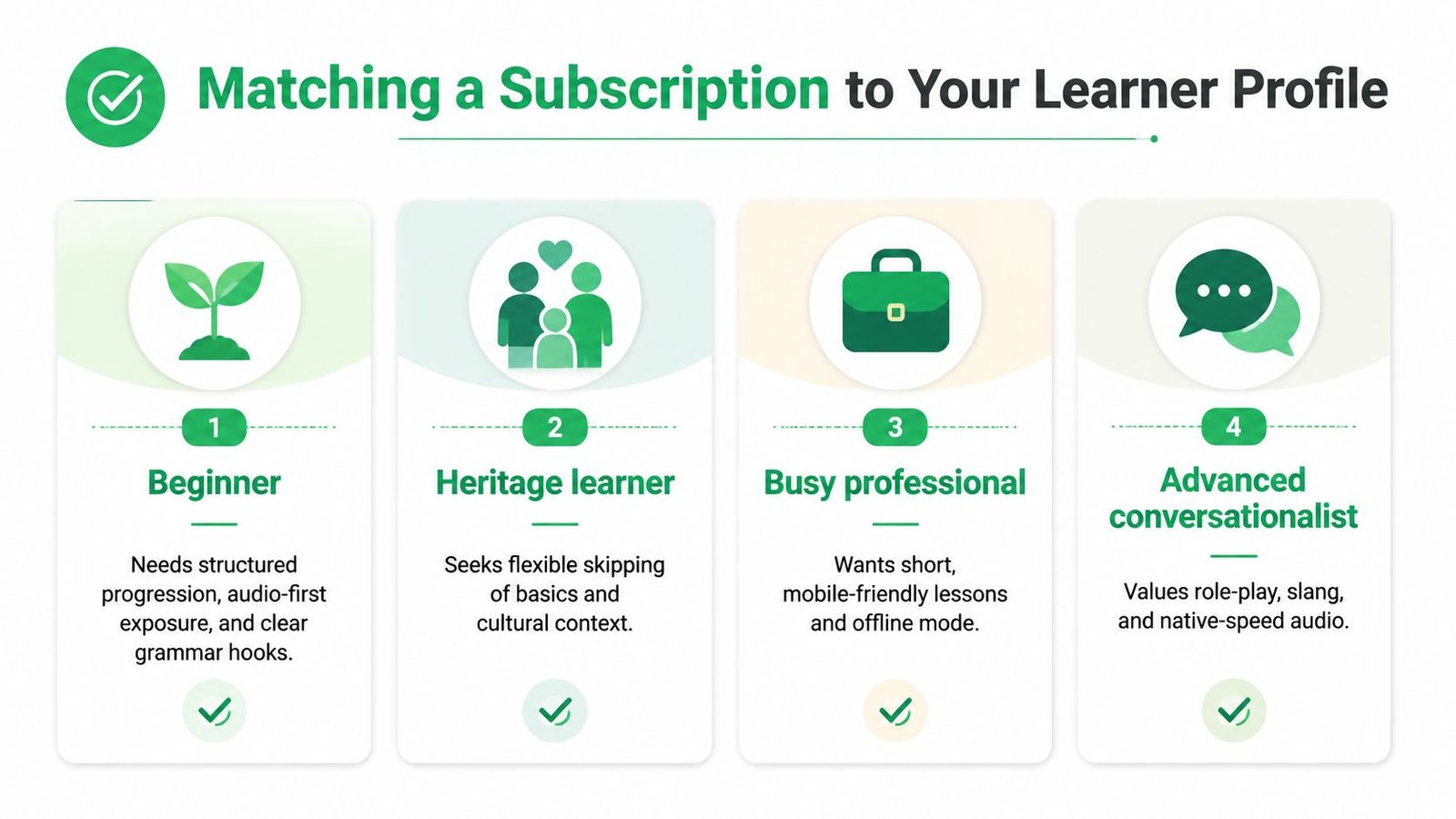
The best subscription depends on the learner standing in front of the screen. A complete beginner needs a guided sequence and generous audio exposure. A heritage learner needs a way to skip familiar basics without losing cultural context. A Leaving Cert student needs exam-relevant oral work, while a busy adult needs lessons that survive a disrupted week.
Beginners
Look for structured progression, audio-first exposure, clear grammar explanations, and frequent low-pressure speaking. Avoid paying extra for advanced conversation rooms before you can form basic sentences. A large vocabulary catalogue won't help if the app doesn't tell you what to learn next.
Heritage learners
You may already recognise family phrases, names, or sounds, so a rigid beginner path can become frustrating. Prioritise placement, flexible skipping, cultural context, listening variety, and writing refreshers. Don't pay for decorative beginner rewards that force you through material you already understand.
Leaving Cert students
Your subscription needs to support oral preparation, not just general Irish vocabulary. The Institute of Education's Leaving Certificate Irish masterclass identifies conversation areas including yourself, family, your area, school, hobbies, current affairs, life in Ireland today, and young people, along with questions about last and next summer and last and next weekend. Look for exam-mapped prompts, recording practice, corrections, and feedback that resembles the demands of oral preparation.
Busy adults
Short units, mobile access, offline study, and forgiving progress mechanics matter more than an enormous syllabus. A product that lets you recover after a missed week is more useful than one that punishes you with an intimidating backlog.
Run every plan through this check:
- Does it make you speak during normal sessions?
- Can you study at your actual available times?
- Does it support your target variety of Irish?
- Can you see output beyond a streak?
- Can you cancel without an avoidable renewal surprise?
For a more customized route, use personalized learning paths as a reference point when comparing how platforms adapt content.
A subscription should also respect the learner's starting point. Irish learners often need a bridge between classroom knowledge, family connection, and active speech. That bridge won't come from a generic badge system alone.
Realistic Study Plans and Weekly Time Estimates
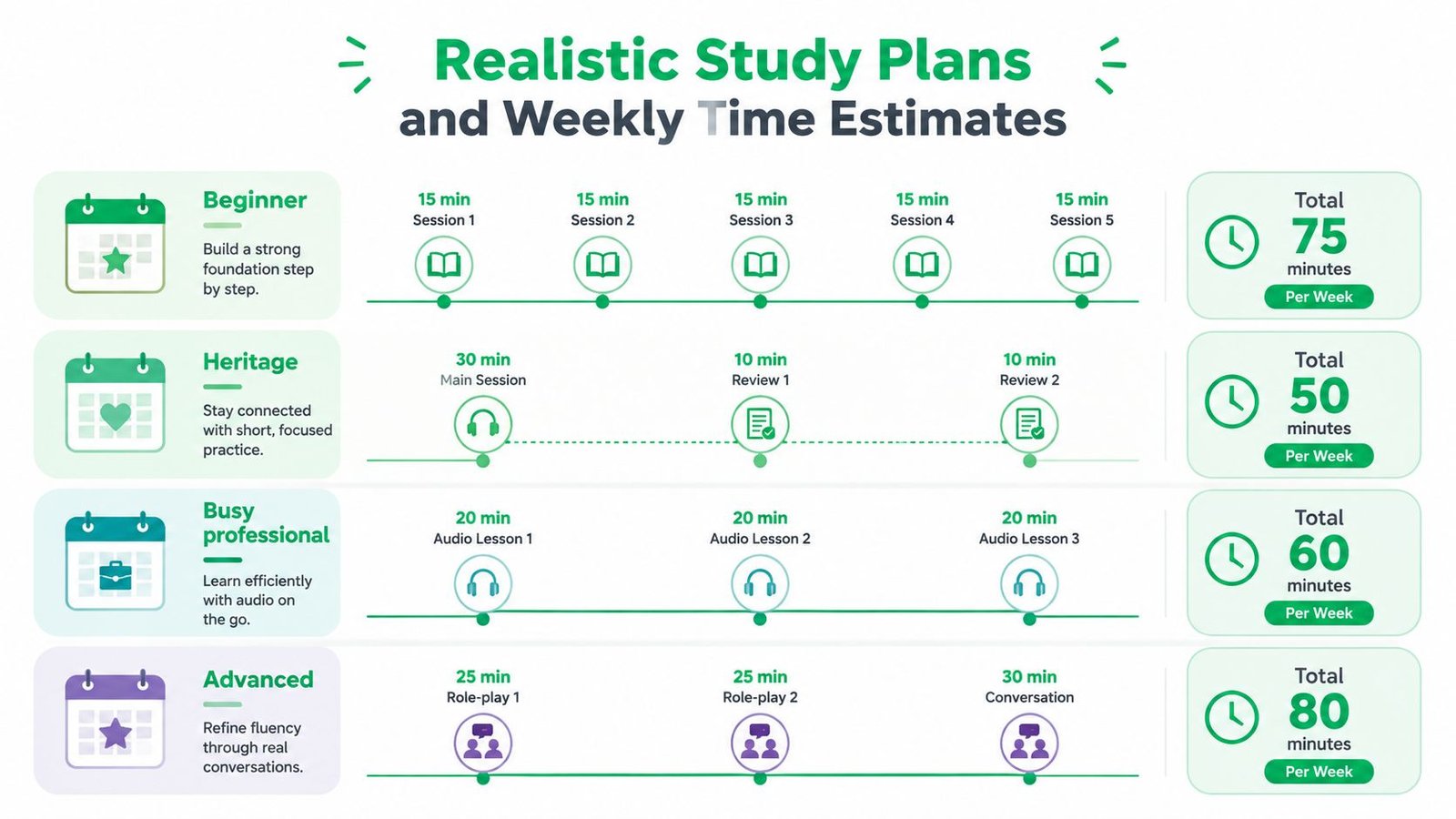
A workable plan is small enough to repeat and specific enough to measure. Don't build a heroic schedule that depends on perfect weeks. Put speaking, listening, review, and exam work into separate slots so you can identify what is improving.
Beginner plan
Complete five 15-minute sessions and one 20-minute review each week. Use the short sessions for guided lessons, pronunciation, and basic responses. Use the longer review to speak through familiar topics without looking at the answer.
After four weeks, you should recognise your core phrases and produce simple introductions. After eight weeks, you should handle familiar prompts with less hesitation. After twelve weeks, record yourself answering everyday questions and compare whether your responses are becoming longer and more automatic.
Heritage learner plan
Use three 25-minute sessions for listening and production, then add one weekend cultural module. Spend the first session on listening, the second on speaking from prompts, and the third on correcting gaps in vocabulary or writing.
At four weeks, note which familiar phrases you can actively produce. At eight weeks, test whether you can discuss a family or local topic without translating every sentence. At twelve weeks, choose a cultural subject and explain it aloud using language you have studied.
Leaving Cert plan
Schedule six 30-minute sessions across reading, writing, listening, and oral practice. Keep oral work in the weekly rotation instead of leaving it until the final stretch. Reserve space in the final term for past-paper work and timed preparation.
After four weeks, you should have a clear list of weak oral themes. After eight weeks, practise answering tense-based prompts with fewer pauses. After twelve weeks, record full responses and review accuracy, range, pronunciation, and fluency separately.
Busy-adult plan
Start with two 10-minute core sessions and add one optional weekend catch-up. Make the core sessions audio or speaking-led, not passive browsing. If you miss one, resume at the next available slot rather than trying to recover every skipped activity.
At four weeks, look for a dependable routine. At eight weeks, check whether you can complete a short scenario without abandoning it. At twelve weeks, measure the number of situations you can handle, not the number of notifications you opened.
How Gaeilgeoir AI Fits the Criteria
A learner preparing for the Leaving Cert needs more than vocabulary drills. Gaeilgeoir AI combines structured lessons with guided conversations, pronunciation support, adaptive quizzes, and instant feedback. Practice covers ordering food, introductions, work, travel, and asking for directions, while Leaving Cert preparation targets common Irish oral topics.
Its immersion-first approach centres on the 1,000 most-used Irish words. Click-to-translate support and personalised study lists help heritage learners refresh language without losing track of useful phrases. Points, multipliers, and leaderboards encourage regular practice, but the platform keeps speaking and comprehension at the centre.
| Learner Need | Gaeilgeoir AI Feature |
|---|---|
| Beginner structure | Guided lessons, adaptive quizzes, and instant feedback |
| Pronunciation work | Pronunciation support and audio practice |
| Everyday speaking | Scenario-based conversations for social, work, travel, and practical situations |
| Heritage refresh | Click-to-translate tools and saved personalised study lists |
| Leaving Cert preparation | Targeted simulations for typical Irish oral themes |
| Flexible adult study | Mobile, self-paced access with short practice activities |
Irish subscriptions deserve closer scrutiny than their major-language counterparts because reported ability does not guarantee active use. Ireland's 2022 census recorded 1,873,997 people aged three and over who could speak Irish, representing 40% of that population group, while nearly 473,000 people with that reported ability said they never used Irish. The Central Statistics Office census release and its results statement support a clear buying rule: prioritise active speaking practice over passive content libraries.
Use the free trial to test real fit. Complete placement, practise relevant scenarios, and assess the spoken output you can produce. The AI language tutors are worth testing if responsive conversation is a deciding factor. Choose an annual commitment only after the trial proves that the platform supports your goals.
Pricing, Trials, and Frequently Asked Questions
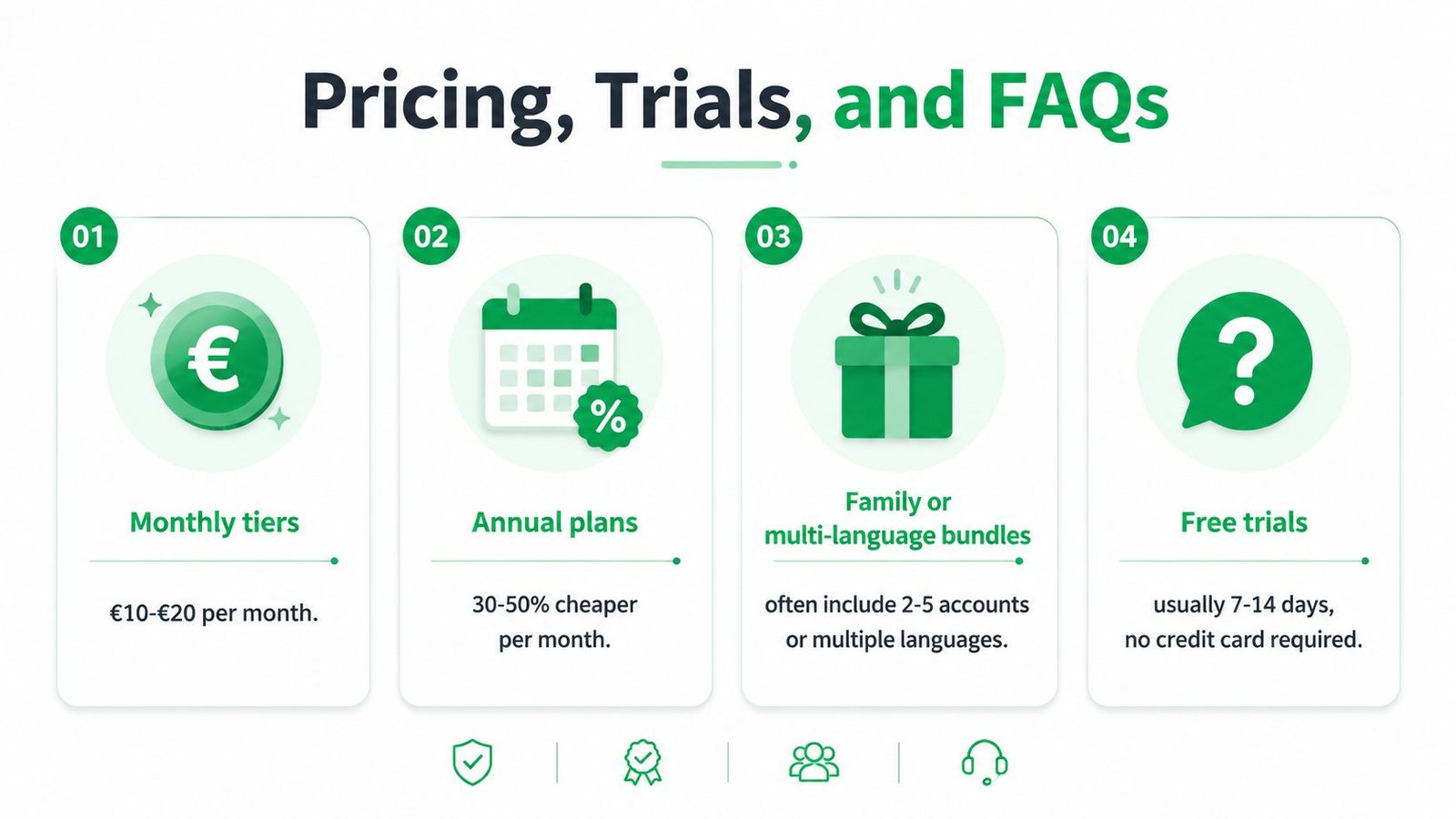
For 2026, language app prices vary by provider, billing term, language coverage, and access to tutors or artificial-intelligence practice. Compare what each plan includes, not only its monthly figure. Use this overview of subscription pricing approaches to compare recurring billing structures before committing.
Gaeilgeoir AI is listed at €9.99 per month, with a free three-day trial and cancel-anytime flexibility. Its platform provides guided lessons, pronunciation support, adaptive quizzes, scenario practice, and Leaving Cert preparation. Because Irish learners need speaking practice and exam-relevant work, test those features directly rather than judging the app by its lesson count.
Trial questions worth answering
- When should you cancel? Set a calendar reminder before the renewal date in the provider's terms.
- Does pausing work? Check the account settings and cancellation policy. Do not assume a pause option exists.
- How does it compare with a tutor? A subscription gives repeated, flexible practice. A tutor gives live human feedback and scheduled accountability.
- What happens after expiry? Providers differ. Progress may remain visible while premium activities become unavailable, so read the lapse policy.
Complete the placement test on day one. Track words spoken, scenarios completed, and corrections you can make independently. Streaks matter only when they represent real Irish practice.
Pay monthly while testing fit. Choose annual billing after the content, speaking feedback, and study schedule have proved useful in your routine. For a focused Irish option, review Gaeilgeoir AI after testing the trial.