You know the moment. You can read an Irish phrase, you understand what it means, and then the second you try to say it aloud, your mouth slows down and the word feels unfamiliar. That hesitation is exactly where a good Irish pronunciation app earns its place, because it gives you a place to hear, copy, test, and correct speech without waiting for the next class or the next conversation.
A useful app is more than a pile of audio clips. It should help you move through a loop of listening, imitation, recording, and feedback, so you can hear how Irish sounds, try it yourself, and adjust before the mistake hardens into habit. For learners who are outside Irish-speaking communities, that kind of repeatable practice matters even more, because pronunciation has to be built deliberately rather than picked up by exposure alone, especially when learners are spread across regions and often studying Irish as a second language Irish learners on Duolingo.
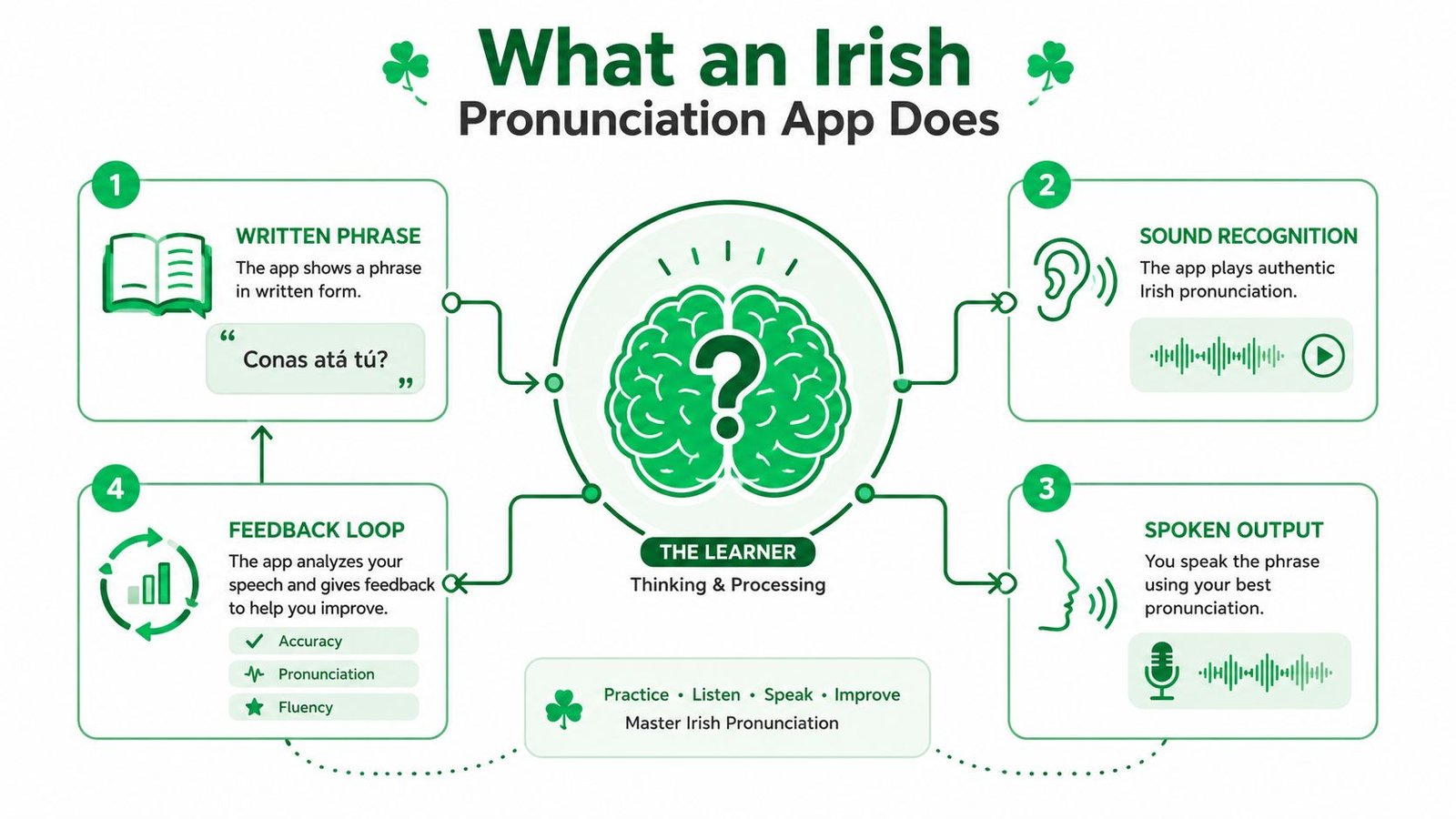
Table of Contents
- What an Irish Pronunciation App Does
- Understanding Irish Sounds and Spelling
- Choosing Features That Improve Speech
- Matching App Types to Learner Goals
- Building a Daily Pronunciation Routine
- Using Feedback Without Building Bad Habits
- How Gaeilgeoir AI Meets the Checklist
- Start Speaking With a Clear Plan
What an Irish Pronunciation App Does
A pronunciation app should behave like a practice room, not a static reference page. You look at a written phrase, listen to it, say it out loud, and get something back that helps you improve. That cycle is the value, because Irish learners often know a word in reading but freeze when they have to produce it cleanly in speech.
The best way to think about it is simple. Written phrase gives you the target, sound recognition helps you notice what the target should sound like, spoken output lets you test your own voice, and the feedback loop tells you what to try next. If an app only plays audio once, it's helpful. If it lets you repeat, compare, and retry, it's a learning tool.
A pronunciation app is also different from translation, grammar drills, or general vocabulary training. Those tools can support learning, but they don't replace focused work on mouth position, rhythm, and sound habits. That's why learners often need a system that keeps returning them to the same phrase until the shape of it feels natural.
Practical rule: if you can't record yourself, compare your attempt with a model, and immediately try again, the app is closer to a listening aid than a pronunciation coach.
For a learner looking for a guided practice flow, pronunciation practice online is useful when it's tied to actual speech, not just passive playback. That's the standard to keep in mind when you judge any Irish pronunciation app.
Understanding Irish Sounds and Spelling
Irish spelling can look straightforward until you try to say the word aloud. The letters are real, but they're not always route signs in the English sense. A better image is that the letters point you toward a sound journey, and the journey depends on what sits beside each letter.
Broad and slender consonants
In Irish, nearly all consonants except /h/ have two pronunciations, broad and slender. Broad consonants are described as velarized or backed, and slender consonants are palatalized or forward-tongued Irish consonant system. That means your tongue position matters, not just the letter itself.
A simple practice move helps here. Pick one consonant, say it with a broad vowel context first, then with a slender one, and listen for the change in colour. You're not memorizing a rule in the abstract, you're training your mouth to feel where the sound lives.
The fastest way to hear the difference is to exaggerate it once, then soften it back toward normal speech.
Irish stress works the same way. It's generally on the first syllable, but a later fada can shift or redistribute that stress stress guide. That's why a word can look short and still feel rhythmically different from English.
For a speech coach-style explanation of how sound patterns fit together, speech pattern analysis overview is a helpful way to think about repetition, contrast, and timing. Once you start listening for broad versus slender sounds and first-syllable stress, your ear gets less confused by the spelling.
The easiest drill is a tiny one. Read one word, mark the stressed syllable in your mind, say it once slowly, then again in a smoother rhythm. If the word contains a later fada, notice whether the stress feels more even across the syllables.
You can also use Irish vowel sounds to isolate the vowel shape before you try the full word. That keeps the practice specific instead of overwhelming.
Choosing Features That Improve Speech
A pronunciation app is worth paying attention to when it gives you something concrete to work with after you speak. A microphone icon alone doesn't mean much. What matters is whether the app can hear your attempt, compare it with a trustworthy model, and tell you what changed.
What to look for in the feedback loop
Speech recognition is most useful when it responds to the learner's actual attempt instead of just lighting up a recording screen. The more specific the response, the better. If feedback stays at the level of a vague global score, you can't tell whether the problem was one consonant, one vowel, or the rhythm of the whole phrase.
Dialect labels matter too. Irish pronunciation isn't one flat sound system, so a good app should be clear about whether it's presenting Connacht, Ulster, or Munster forms, or whether it's using a mixed reference model. Teanglann's pronunciation database, with native-speaker recordings across the three dialects, shows what transparent audio reference can look like in practice Teanglann pronunciation database.
A strong app also gives you a way to compare your own recording with the target. That comparison is where real learning happens, because you can hear whether the issue is timing, a broad/slender contrast, or a stressed syllable that landed in the wrong place. In technical terms, Irish ASR systems are most useful when they combine acoustic models, pronunciation lexicons, and language models, because that hybrid structure is what supports meaningful correction rather than simple playback ABAIR-ÉIST system.
The checklist that separates useful from flashy
- Accurate speech recognition: the app should respond to what you said, not just what you tapped.
- Targeted feedback: you need an error that points to a sound, a word, or a clear next step.
- Customizable lessons: if you can't choose what to work on, repeated trouble spots stay buried.
- Progress tracking: review history matters more than a single score.
One caution is important. Product architecture can look impressive while still missing Irish-specific accuracy, so never confuse a speech feature with reliable pronunciation coaching. Current app discussions also show that learners are wary of weak AI voices and want word-level correction, not only a broad score, which is why transparent audio and actionable feedback matter so much Speak Irish NowFluency listing.
If you're testing a trial, speak the same phrase several ways, repeat one difficult word, and see whether the app still gives you something useful after the first attempt. A good system keeps the correction available after the exercise, not just during it.
Matching App Types to Learner Goals
Different tools solve different problems, and that's where a lot of buyers go wrong. A learner who wants to nail a sound needs a different product from someone who wants to get through a spoken exchange without freezing. If you treat every app like the same kind of tool, you'll end up paying for features you don't need.
| Irish Pronunciation App Categories | Primary strength | Best fit | Important limitation |
|---|---|---|---|
| Recognition-led pronunciation tools | Focused speech feedback and repeatable correction | Learners who want to fix specific sounds and stress patterns | Can feel narrow if you also need broad lesson content |
| Pronunciation references | Reliable audio for checking a word or phrase | Learners who need a trusted model before speaking | Often stop at reference audio and don't guide practice |
| Conversation-led platforms | Realistic prompts and speaking practice in context | Learners preparing for everyday interaction or oral response | May not diagnose sound-level problems in detail |
A reference tool can answer a narrow question quickly. If you want to know how one word should sound, clear audio and dialect-aware models matter more than a big lesson library. A conversation platform, by contrast, is more useful when you need to keep talking, recover from mistakes, and build confidence in a live exchange.
Use the tool that matches the problem in front of you, not the one with the longest feature list.
For broader app shopping, 10 best iPad speech apps 2026 is a useful reminder that speech tools come in different shapes, from drills to communication aids. The right Irish pronunciation app may be only one part of your stack, especially if you want both sound accuracy and realistic speaking practice.
The smartest setup is often a combination. Use one tool for trusted pronunciation reference, another for guided speaking, and a third only if it gives you feedback you can act on. That keeps you from confusing audio exposure with actual improvement.
Building a Daily Pronunciation Routine
A good routine beats a long random session. Five focused repetitions of one hard sound are more useful than twenty minutes of passive listening, because your mouth needs to rehearse the exact movement, not just the general idea. The goal is to create a pattern you can repeat when you're tired, busy, or short on motivation.
A short daily sound workout
Start with one phrase and move through six steps. Listen to the model, notice the sound that feels different, imitate it slowly, record yourself, compare the two versions, then revise and say it again. If the same trouble appears twice, isolate that part before you return to the full word.
A second drill works better when you want speaking to feel more natural. Learn a prompted phrase, record yourself saying it, then answer a guided follow-up with the same key sound still in play. That makes the practice feel less like pronunciation homework and more like a real interaction.
Adapting the routine to your situation
- Busy adult: one phrase, one correction, one replay. Keep the session short enough that you'll return tomorrow.
- Returning heritage learner: start with words that feel familiar, then test the places where family speech and standard spelling don't quite line up.
- Leaving Cert student: use prompt-based replies, especially for oral topics, so pronunciation and recall develop together.
Saved items help here. On daily language practice, you can keep a small review set and revisit what you already struggled with instead of starting from scratch each day. That makes your practice more intentional and less random.
For tracking progress, don't depend on a single score. Record the same phrase at different times and listen for better vowel shape, steadier stress, and less hesitation. Those changes are easy to hear, and they matter more than a number that doesn't explain itself.
Using Feedback Without Building Bad Habits
A lot of learners assume that hearing AI audio is enough. It isn't. You still need a trustworthy model, deliberate imitation, and a chance to test whether your own mouth can make the same sound under pressure.
Turn feedback into a correction routine
When the app flags a problem, don't rush past it. Identify the target, replay the model, isolate the difficult sound, record again, and then put the corrected sound back into the word and sentence. That sequence keeps the correction small enough to manage and large enough to stick.
Recognition and production are different skills. You might hear that a pronunciation is wrong and still be unable to produce the fix right away. That gap is normal, and it's why passive listening alone doesn't build reliable speech.
Microphone handling matters too. Too much background noise, awkward distance, or speech that's rushed and clipped can make feedback less dependable. Slow down, speak clearly, and make the test easy for the app to hear before you judge the result.
For readers who want to understand speech tooling more broadly, Vocuno audio recognition offers a useful frame for thinking about what recognition software can and can't do. The main lesson is simple, technical accuracy matters, but learner trust matters just as much.
Don't treat one good result as proof that the sound is fixed. Say it again in a fresh sentence and see if the correction still holds.
Dialect choice deserves attention as well. If the app presents one version as the only correct one, that can cause confusion instead of confidence. Irish learners need to know what variety they're hearing and why it sounds that way, especially when they're still building basic speaking habits.
How Gaeilgeoir AI Meets the Checklist
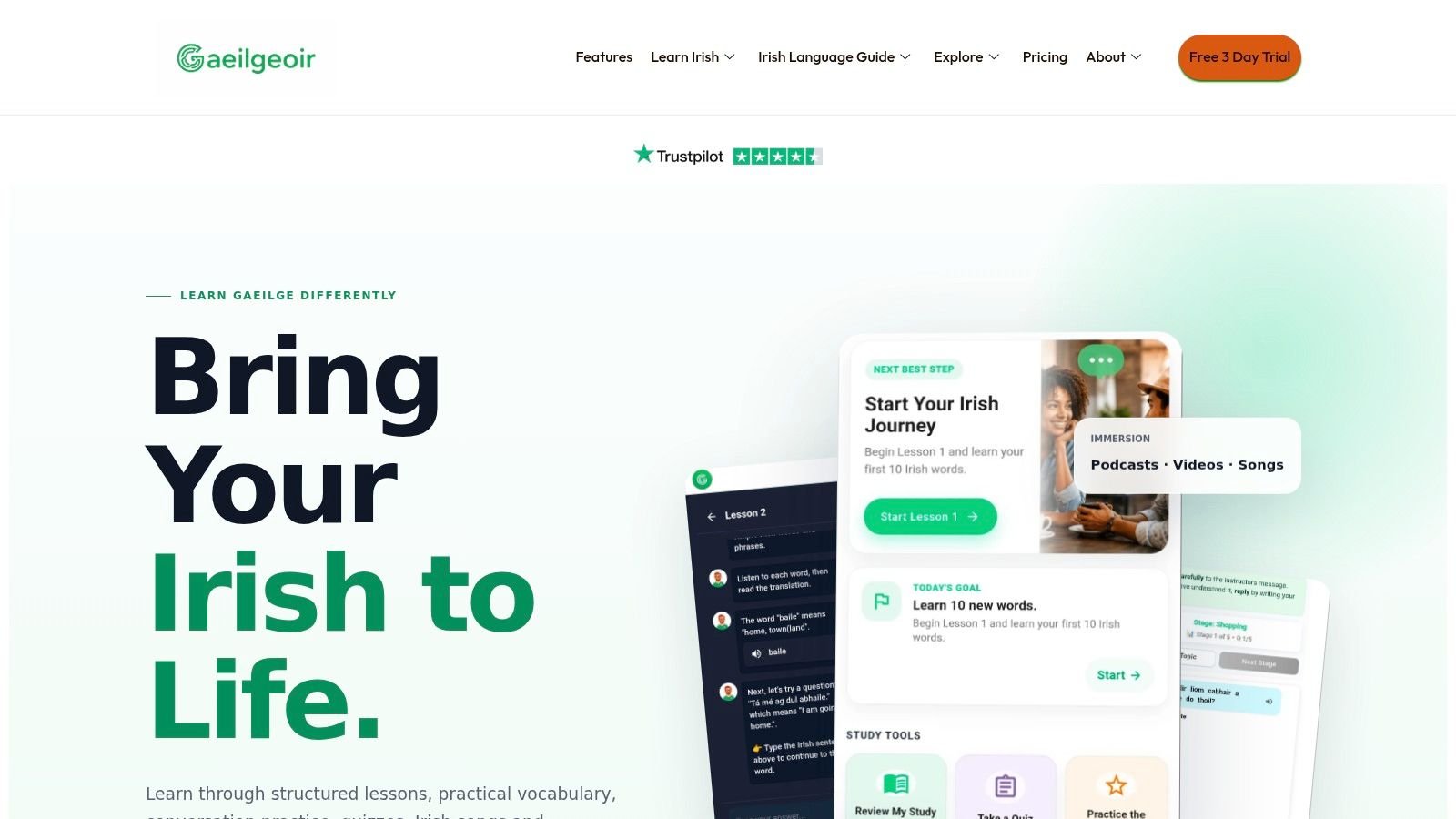
A learner opening Gaeilgeoir AI should see a full speaking system, not a shelf of prompt cards. The platform gives guided, real-world conversations, pronunciation support, adaptive quizzes with instant feedback, and scenario-based practice for social situations, work, travel, ordering food, and asking for directions. It also supports beginners through intermediate learners, so the range is clear from the start.
The learning path centers on the 1,000 most-used Irish words, and each word can be opened, translated, and saved to a personalized study list. That setup matters because pronunciation work sticks better when it is tied to words you will reuse. Audio clips by themselves can feel like a one-way street. Repeated word-level practice gives the learner something to hear, say, and check again. Points, multipliers, and leaderboards add motivation, but the value is the repeated exposure they encourage.
The product description says Gaeilgeoir AI includes pronunciation support and feedback. That makes it a fair fit for a pronunciation-first comparison, as long as you still test whether the feedback is specific enough for your own needs. For Leaving Cert learners, the dedicated prep works like guided practice for common oral-exam topics, without any outcome guarantees.
The pricing page lists €9.99 per month with a free three-day trial and the option to cancel anytime Gaeilgeoir AI pricing. That makes it straightforward to compare it against the checklist above without a long commitment.
The fit is clear enough. If you want always-available speaking practice, review support, and a guided way to keep pronunciation tied to useful phrases, the platform itself is worth a trial, especially for beginners, busy adults, returning learners, and exam students.
Start Speaking With a Clear Plan
Start with one real situation, such as greeting someone, ordering food, or introducing yourself. Choose five to ten phrases, listen for the target sounds and stress, record your first attempt, then repeat the same phrase until the correction feels steady. Like tuning one string before playing a song, this keeps your ear focused on one pattern at a time. After that, move into a short exchange so the sound holds up beyond a single word.
| Day | Main activity | What to evaluate |
|---|---|---|
| Day 1 | Guided practice with one small set of phrases | Whether the model is clear and the feedback is easy to understand |
| Day 2 | Return to saved words and corrected attempts | Whether the same issue still appears and whether you can fix it faster |
| Day 3 | A realistic scenario with longer spoken turns | Whether pronunciation holds up in a more natural exchange |
What matters most is consistency. An app earns its place when it helps you hear, copy, and correct the same sound without guessing. The strongest systems also give word-level correction, some awareness of dialect, realistic speaking practice, and a way to judge progress that you can trust.
If you want a guided place to start, take the free three-day trial at Gaeilgeoir AI and test it against the speaking, feedback, and review standards in this guide. Use it one phrase at a time. Judge it by whether it clearly improves your speaking, rather than by interface polish.