
You know more Irish than you can use. You've studied words such as caife, bainne, and go raibh maith agat, but when someone speaks to you in real time, the vocabulary seems to disappear. You recognize a phrase on a page, yet ordering a coffee, introducing yourself, or asking for directions still feels like a high-pressure test.
That gap between remembering language and using language is where AI can help. It can give you a patient conversation partner, immediate pronunciation practice, and exercises that respond to your mistakes. Used thoughtfully, AI in language learning doesn't replace teachers, native speakers, books, or communities. It gives you more opportunities to prepare for those human interactions.
Table of Contents
- Why Language Learning Feels Hard (And How AI Helps)
- The Core AI Technologies Behind Modern Language Apps
- How to Build an AI-Powered Study Routine
- Comparing AI Language Learning Platforms
- What Research Tells Us About AI and Language Acquisition
- Navigating Privacy, Accuracy, and Over-Reliance Risks
- Getting Started with AI for Irish Language Learning
Why Language Learning Feels Hard (And How AI Helps)
A learner walks into a café in Galway with a short order written on a phone. They know the words. They've reviewed them several times. But when the server asks a follow-up question in Irish, the learner freezes, switches to English, and leaves feeling that studying hasn't worked.
This reaction is normal. Vocabulary lists build recognition, but conversation demands several skills at once. You need to retrieve a word, arrange it in a sentence, pronounce it clearly, understand the response, and decide what to say next. A textbook can explain each part, but it usually can't respond to your exact hesitation in the moment.

Turning private practice into active language
An AI conversation partner lets you rehearse that café scene repeatedly without embarrassment. You might type or say, Ba mhaith liom caife, le do thoil, then ask the tool to reply as a server. If you struggle, it can slow the exchange, translate one phrase, or offer a simpler response instead of ending the conversation.
That low-pressure repetition matters because learners need to make mistakes before they can make language automatic. AI can also ask you to repair an answer rather than just reveal the correct one. For example, after you write an incorrect Irish sentence, ask for a hint first, then try again before viewing the explanation.
Personalization is central to this approach. If you're unfamiliar with the idea, this practical guide to what is adaptive learning explains how learning systems can adjust content to a learner's performance, pace, and needs.
Practical rule: Use AI to create more chances to speak, not to avoid speaking with people.
The most useful shift is simple. Instead of asking, “How do I memorize this list?” ask, “What real situation do I want to handle?” Then use AI to practise the words, questions, and likely replies connected to that situation.
The Core AI Technologies Behind Modern Language Apps
Modern language apps combine several technologies, and each solves a different learning problem. Understanding those roles makes it easier to choose tools instead of treating every AI feature as if it does the same job.
Four tools with four jobs
Large language models work like conversation partners who don't tire of repetition. You can ask for a beginner-level Irish dialogue about meeting a friend, then request a more natural version, a slower version, or a version that uses vocabulary you already know. The model generates responses from patterns in language, so you should still check important explanations and culturally sensitive wording.
Speech recognition acts like a pronunciation coach. You speak into a microphone, and the system compares the sound it receives with expected language patterns. It can help you notice that recognising sláinte is different from producing it clearly in a spoken exchange. Recognition isn't identical to a qualified teacher's ear, but it gives you a practical feedback loop between attempts.
Text-to-speech turns written Irish into listening material. A learner can hear a phrase, read it, hide the text, and try to identify it again. This is especially useful when you need exposure to connected speech rather than isolated vocabulary.
Adaptive algorithms serve as the app's learning planner. They track what you practise, identify patterns in your responses, and bring back material that needs attention. That's the basic principle behind spaced repetition for language learning, where review timing helps you revisit words before they disappear from memory.
Choosing tools by the task
A conversational model may be flexible, but it might not provide a structured course. A dedicated app may offer clearer progression, while a specialist service may focus on a particular language, exam, or community. Even tools outside language study, such as the LunaBloom AI app, can illustrate a wider point about AI products. The interface matters less than whether the system gives you useful feedback and a clear next action.
For Irish, check whether a platform supports the kind of language you need. Look for pronunciation audio, scenario practice, explanations that suit your level, and opportunities to produce language yourself. A tool that only translates sentences may help you understand a message, but it won't necessarily help you form your own response.
You can also explore how domain-specific language models differ from general-purpose systems. Specialization can make a tool more relevant to a defined subject, audience, or language context, although learners should still evaluate its accuracy.
How to Build an AI-Powered Study Routine
The best routine gives every tool a narrow job. Don't ask one chatbot to be your entire course, dictionary, pronunciation coach, and examiner. Create a small loop that moves from understanding to practice to recall.
Start with a repeatable daily cycle
Begin with a short review of saved words and phrases. Next, practise one realistic exchange, such as ordering food or asking Cá bhfuil an stáisiún? Finally, speak a few answers aloud without looking at the text. This sequence makes recognition serve production.
Use prompts that define the situation and your level. Write, “Act as a patient café server. Use beginner Irish. Ask one question at a time. Don't translate unless I ask.” If the exchange is too difficult, reduce the complexity rather than abandoning the conversation.
Give each day a purpose
A simple weekly pattern might look like this:
- Conversation day: Role-play a greeting, introduction, or café order. Ask for one correction at a time.
- Pronunciation day: Listen to short phrases, record yourself, and repeat them with attention to rhythm.
- Grammar day: Take sentences you've tried to say and ask for a plain-language explanation of the pattern.
- Comprehension day: Listen to a short Irish passage, identify familiar words, and summarise its meaning.
- Review day: Revisit your saved vocabulary without immediately checking the translation.
- Scenario day: Combine the week's language in a travel, work, family, or school situation.
- Human connection day: Use what you prepared in a class, conversation group, message, or exchange with another learner.
You don't need to make every session long. Consistency gives the system better information about your needs and gives your memory more chances to retrieve language.
Increase difficulty carefully
Beginners should request short turns, familiar vocabulary, and translation only after an attempt. Intermediate learners can ask for natural alternatives, follow-up questions, and corrections grouped by importance. At every level, keep a record of mistakes that recur, then turn those mistakes into the next practice session.
A useful test: After an AI session, can you say something useful without the screen? If not, spend less time reading explanations and more time answering aloud.
Comparing AI Language Learning Platforms
Different tools suit different moments in a learner's day. A general chatbot gives you freedom, but you must design the lesson and judge the response. A dedicated app gives you more structure, while a specialist platform may make its scenarios, vocabulary, and feedback more relevant to a specific language.
| Tool Type | Best For | Key Feature | Pricing Range |
|---|---|---|---|
| General conversational AI | Flexible role-play and explanations | Custom prompts and open-ended dialogue | Free to paid, depending on the service |
| Dedicated language app | Learners who prefer a guided path | Lessons, review systems, and built-in practice | Free tiers to subscription plans |
| Speech-focused AI tool | Pronunciation and spoken confidence | Voice interaction and speech feedback | Varies by product and plan |
| Specialist language platform | Learners targeting a particular language or goal | Language-specific scenarios and study content | Varies by platform and access level |
Match the tool to the problem
Choose general conversational AI when you want to rehearse an unusual situation, such as explaining a hobby or preparing for a family visit. Choose a dedicated app when you need reminders, progression, and regular review. Choose a speech-focused tool when you already know what you want to say but need more confidence saying it aloud.
For Irish learners, specialization can make the practice feel closer to real use. A platform designed around Irish conversations may include everyday situations, pronunciation support, adaptive quizzes, and exam-oriented practice that a general chatbot won't provide automatically.
No platform removes the need for judgment. Before committing, test whether the tool corrects errors clearly, accepts beginner-level answers, and helps you understand why a phrase works. Also check whether it encourages you to produce language rather than just tap through translations.
What Research Tells Us About AI and Language Acquisition
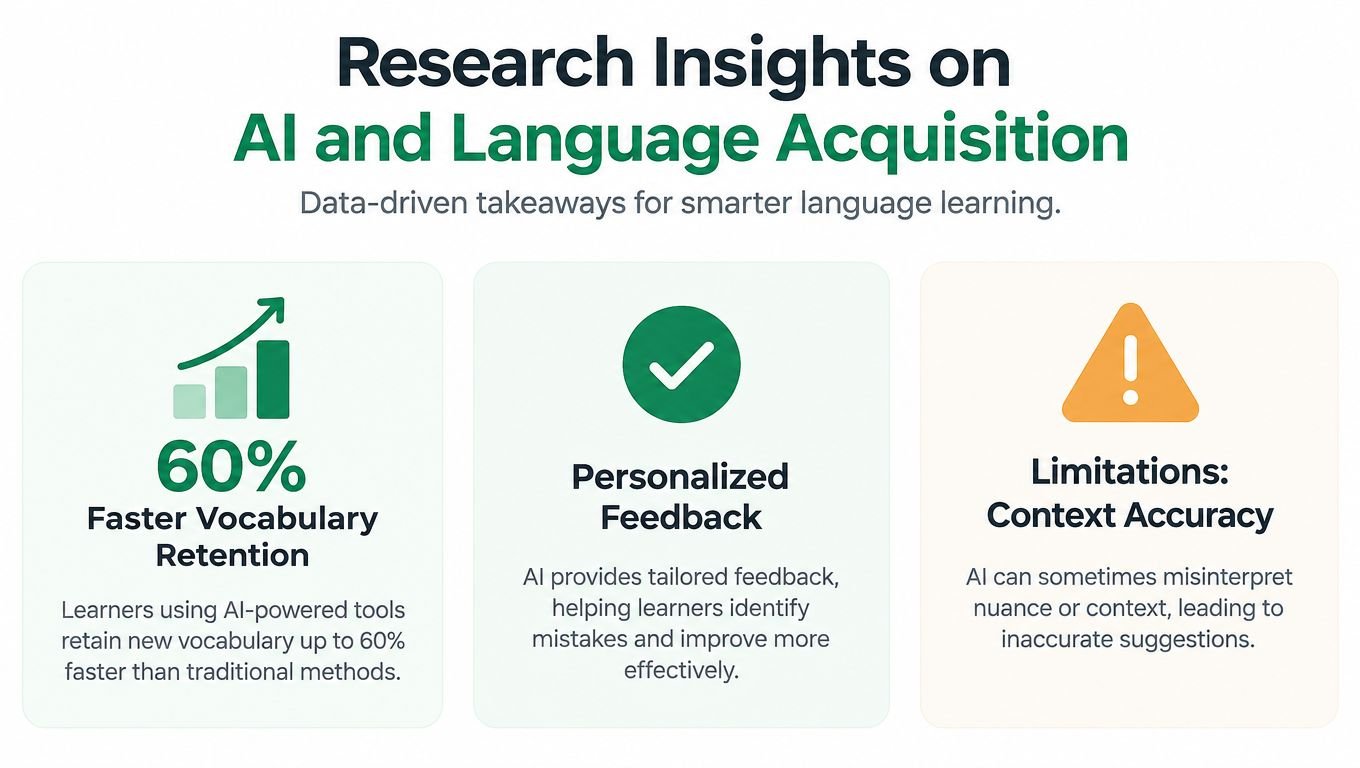
The evidence is encouraging, but it doesn't support the idea that every AI feature automatically produces learning. A meta-analysis of AI-guided individualized language learning synthesized 61 samples from 17 research projects involving 8,282 learners and reported a strong within-group effect of d = 1.18 for samples containing 2,262 learners, while also finding small-to-medium effects on linguistic outcomes more broadly (meta-analysis of AI-guided individualized language learning). The practical lesson is that individualized practice, feedback, and adaptive instruction are promising uses of AI.
Where the evidence is strongest
A 2026 systematic review selected 30 eligible experimental studies from 2014 to 2023 and found that university students were the most frequently studied learners, while speaking and writing were the most common target skills (systematic review of AI for language learning). That fits what many current tools do well: prompting you to produce an answer, correcting written language, and supporting spoken rehearsal.
A separate 2026 meta-analysis synthesized 51 studies and 175 independent effect sizes, offering a broad evidence base for examining measurable learning impacts rather than relying only on individual anecdotes (meta-analysis on generative AI in second and foreign language learning).
The missing balance
The research base remains uneven. A systematic review of 18 studies found that writing, grammar, speaking, and vocabulary received the most attention, while reading and listening remained underexplored (systematic review of AI and language learning skills). A broader 2026 scoping review examined 272 empirical studies from 2005 through 2024 and found that 78.3% of publications, or 213 studies, appeared in 2023 and 2024. It also identified chatbots in 44.1% of studies and commercial tools in 71% of recent research (twenty-year scoping review of AI in language learning).
That acceleration shows strong interest, not a complete answer. Build listening and reading into your routine deliberately, and treat AI feedback as useful guidance that still deserves careful evaluation.
Navigating Privacy, Accuracy, and Over-Reliance Risks
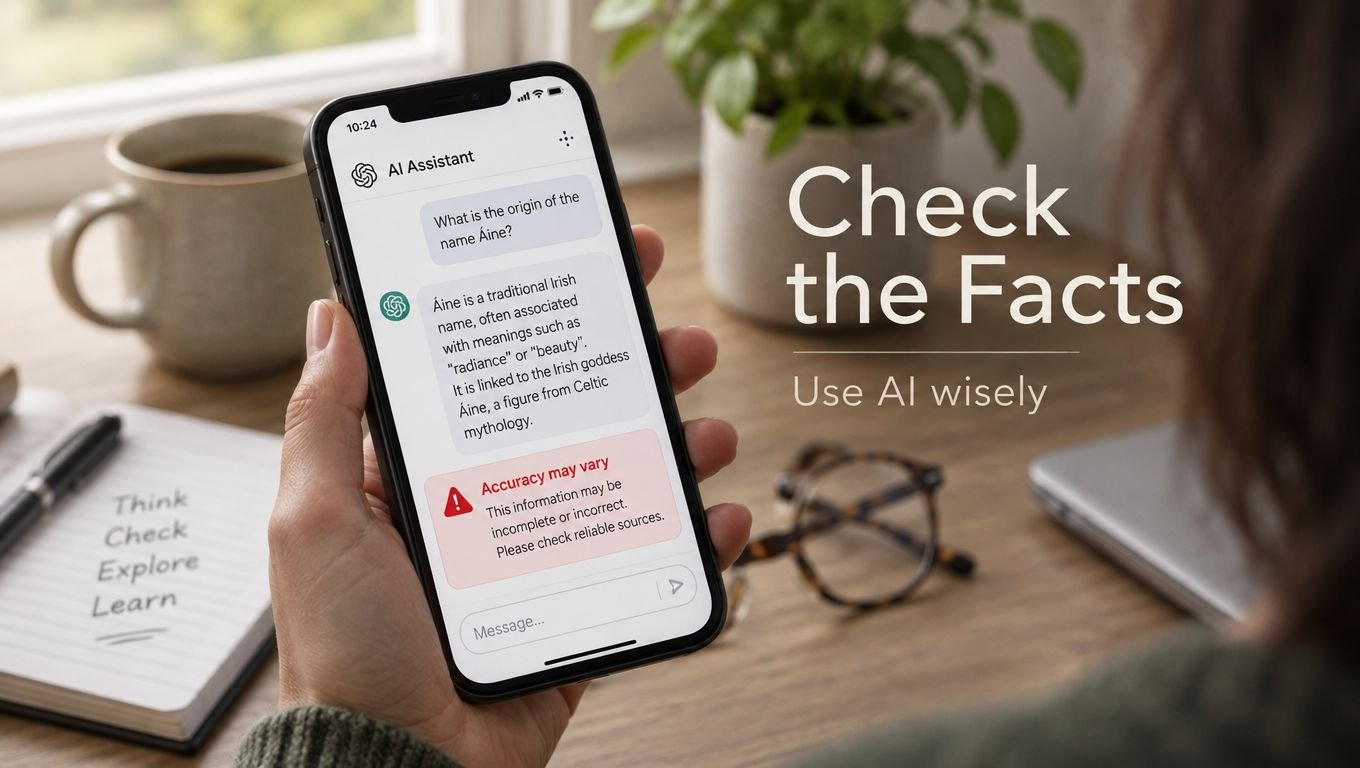
An AI response can sound confident and still be wrong. This matters in language learning because a learner may not yet know enough to challenge an unnatural translation, an incorrect grammatical explanation, or a phrase that fits one context but not another.
Before sharing practice data, read the tool's privacy settings and terms. Avoid entering personal information, private messages, school records, or sensitive conversations just to receive a language correction. You can usually replace names and identifying details with neutral examples.
Keep your own judgment active
Use a three-part check when an answer feels uncertain:
- Compare: Check the phrase against a trusted dictionary, course resource, teacher, or native speaker.
- Contextualize: Ask whether the wording is formal, informal, regional, old-fashioned, or suitable for the situation.
- Retrieve: Close the tool and try to use the phrase in a new sentence.
Research on generative AI use in language learning has raised concerns about over-reliance, inconsistent feedback quality, cultural adaptability, digital equity, and limited long-term evidence. A 2025 student survey also found that use increased between 2023 and 2025 while evaluations of output quality became more moderate over time (research on student use and concerns around generative AI for language learning).
The danger isn't using AI. It's allowing AI to do every difficult part of learning for you.
Ask for hints before answers. Speak before reading a model response. Keep some sessions screen-free, and use human conversation to test whether your knowledge works under natural pressure.
Getting Started with AI for Irish Language Learning
Irish is a strong example of why language technology should support participation, not just translation. A beginner may want to practise Dia duit, describe where they live, order lunch, or ask for directions. A heritage learner may want a gentle way to reconnect with family language. A Leaving Cert student may need focused preparation for oral topics and more confidence answering aloud.
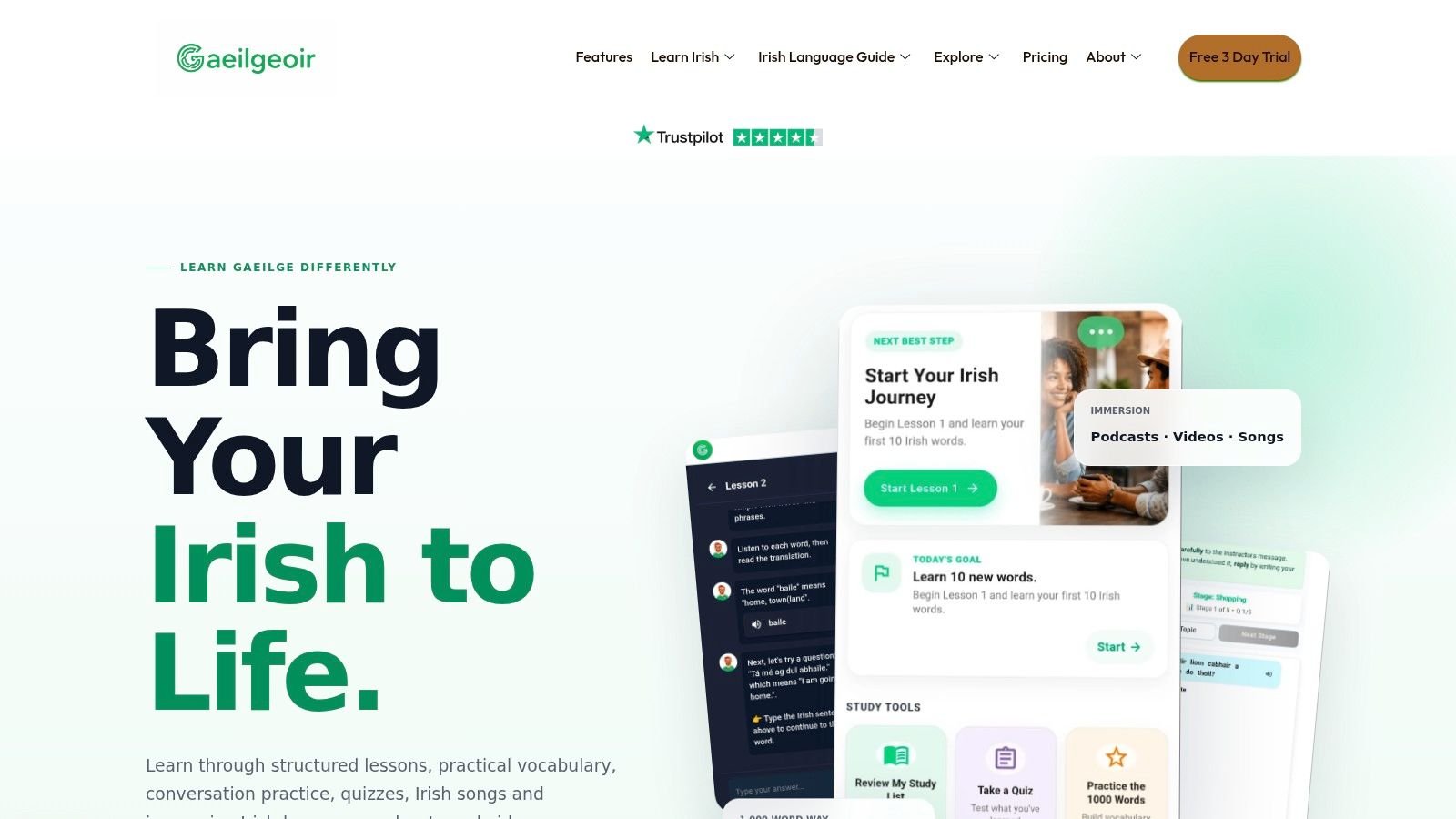
Gaeilgeoir AI provides guided, real-world Irish conversation practice for beginners through intermediate learners. Its activities include pronunciation support, adaptive quizzes with immediate feedback, and scenario-based practice for social interactions, work, travel, ordering food, and asking for directions. Learners can click words for translations and save them to a personal study list, which turns an unexpected vocabulary gap into a later review task.
That design supports a useful progression. First, you meet a phrase in context. Then you hear or produce it. Next, you retrieve it in a quiz or conversation. Finally, you try it with another person. AI can make the first three steps easier to repeat, but human interaction gives the language its humour, flexibility, cultural meaning, and emotional weight.
Use Irish for a real purpose
Choose one situation that matters to you this week. If you're preparing for travel, practise a greeting, a food order, and a request for directions. If you're studying for the Leaving Cert, rehearse likely oral themes and ask for follow-up questions rather than memorizing one fixed script. If you're returning to Irish through family or heritage, build conversations around names, places, memories, and everyday routines.
For a broader starting point, learn Gaelic language with AI offers a way to connect guided technology with active language practice. Keep your sessions purposeful, and take useful phrases into class, conversation groups, messages, or family discussions.
The video below can help you see how an AI-supported Irish learning experience fits into a practical study routine.
AI works best as a bridge between study and use. It gives you a private place to make mistakes, but your goal should always be greater participation in the living language, whether that means speaking with a teacher, joining a local group, preparing for an exam, or starting a short conversation with someone who welcomes your effort.
Gaeilgeoir AI offers guided Irish conversations, pronunciation support, adaptive quizzes, saved vocabulary, and scenario practice for everyday situations and Leaving Cert preparation. Visit Gaeilgeoir AI to choose a practical Irish goal and start turning study time into spoken language.