Adaptive Learning Algorithms Explained: A Practical Guide

You've downloaded an Irish app before, tapped through a few easy wins, then hit a wall of words you can't say out loud. Or you keep getting the same greetings while the phrases you fumble never return. A good adaptive system should notice that pattern early. It should stop wasting your time on what you know and bring back what you're close to losing, at the moment review helps most.

Table of Contents

Why Your Irish App Feels Like It Knows You

You open the app on a Tuesday evening and answer a short run of prompts. Dia duit comes easily. You hesitate on a word for ordering food, guess at a direction phrase, then nail a question about the weather. A few minutes later, the easy greeting fades from view, the food phrase returns in a new sentence, and the direction phrase gets broken into smaller pieces.

That shift can feel personal, almost uncanny. It's not intuition. The system is sorting your responses into rough categories, what looks secure, what looks shaky, and what you haven't met yet. Each answer gives it a little more evidence, and each new prompt is a bet based on that evidence.

The problem with giving everyone the same path

A fixed course treats a complete beginner, a heritage learner who understands more than they can say, and a Leaving Cert student as if they need the same next step. They don't. One needs basic sounds repeated slowly, another needs confidence producing sentences, and the third needs oral exam topics under mild pressure.

When the order never changes, strong learners spend time proving what they already know. Struggling learners get pushed forward before a weak foundation settles. Both groups can stay busy without making much progress, which is why completion screens are a poor measure of ability.

Adaptive learning algorithms exist to solve that mismatch. They use your performance to decide what to show next, how hard it should be, and when to bring it back. For speaking, that matters more than it does for passive reading, because recognising a word on screen isn't the same as retrieving it mid conversation.

A prompt you answer correctly after a long pause tells a different story from one you produce instantly and confidently.

That distinction is easy to miss if you only count right and wrong answers. In conversation, speed and certainty matter. A learner who needs ten seconds to assemble a reply may know the vocabulary, but they don't yet own it well enough to use it with another person waiting.

So the promise isn't novelty or a stream of quizzes that feel custom built. It's better use of limited practice time. The harder question, and the one worth keeping in mind throughout this guide, is whether smarter sequencing inside an app leads to spontaneous speech outside it, or mainly to higher scores inside the app itself.

What an Adaptive Learning Algorithm Actually Does

Think of a good museum guide with a small group. She doesn't recite the same script at every painting. She watches where people linger, notices who's lost, skips rooms the group already understands, and circles back when an earlier idea needs reinforcing. She's constantly estimating what the group knows and choosing the next stop accordingly.

Adaptive software does a similar job with data from your answers. It isn't one magic formula. It's a loop with three moving parts that keep feeding each other.
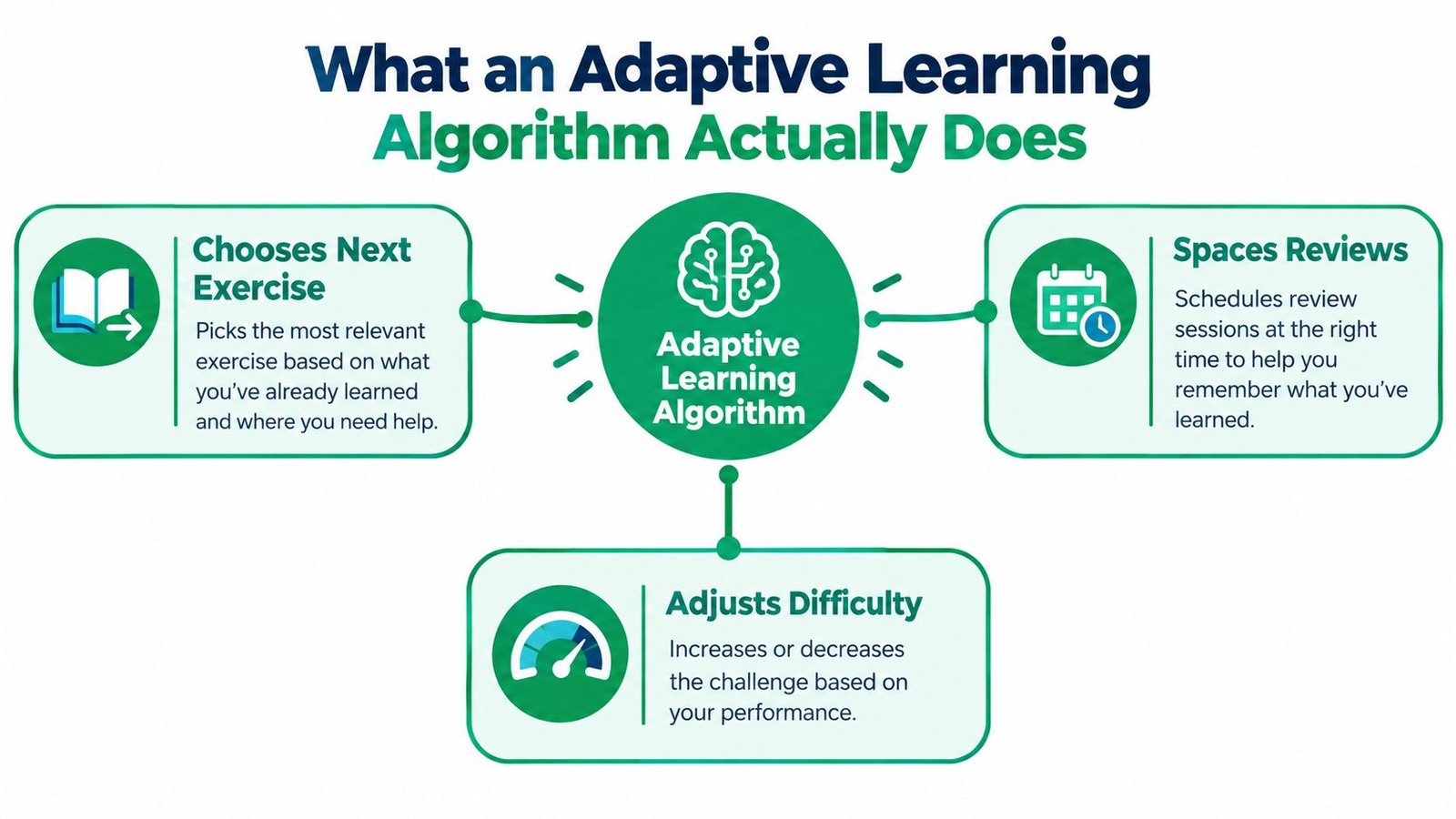
An infographic showing how an adaptive learning algorithm selects exercises, schedules reviews, and adjusts difficulty based on performance.

Three jobs happening in a loop

  • Estimate your current state: The system builds a picture of what you probably know from correct answers, errors, hints used, and sometimes how long you took.
  • Choose the next item: It picks an exercise that's likely to teach you something or reveal something useful about your ability, rather than following the next page.
  • Update the estimate: Your response changes the picture, which changes the following choice, the difficulty, and the timing of later review.

Say you translate a common Irish verb correctly twice, then miss it inside a spoken question. A fixed course might mark the lesson complete and move on. An adaptive system can treat those as different skills, keep the written form spaced further out, and bring the listening form back sooner with support.

Adaptive does not automatically mean effective

That loop only helps if the exercises, feedback, and decisions are well designed. A review of 69 studies on personalized adaptive learning in higher education found 41 studies (59%) reported improved academic performance, while 28 studies (41%) found no statistically significant effect. Changing the order of content isn't enough on its own.

Fixed sequencing still has a place, especially at the start. If you've never seen Irish spelling or heard its sounds, the system has almost no evidence about you, so a sensible introductory path can beat premature personalization. Adaptation becomes more useful after even a handful of responses gives the estimate something to work with.

Core idea: Adaptation is decision making under uncertainty about what you know, followed by a new decision each time you answer.

That uncertainty never fully disappears. The algorithm doesn't read your mind, and it shouldn't pretend to. It makes a provisional call, tests it with the next prompt, and revises.

The Core Models Behind Adaptive Practice

Different products make those calls in different ways. The names sound technical, but each model answers a plain question about you as a learner.
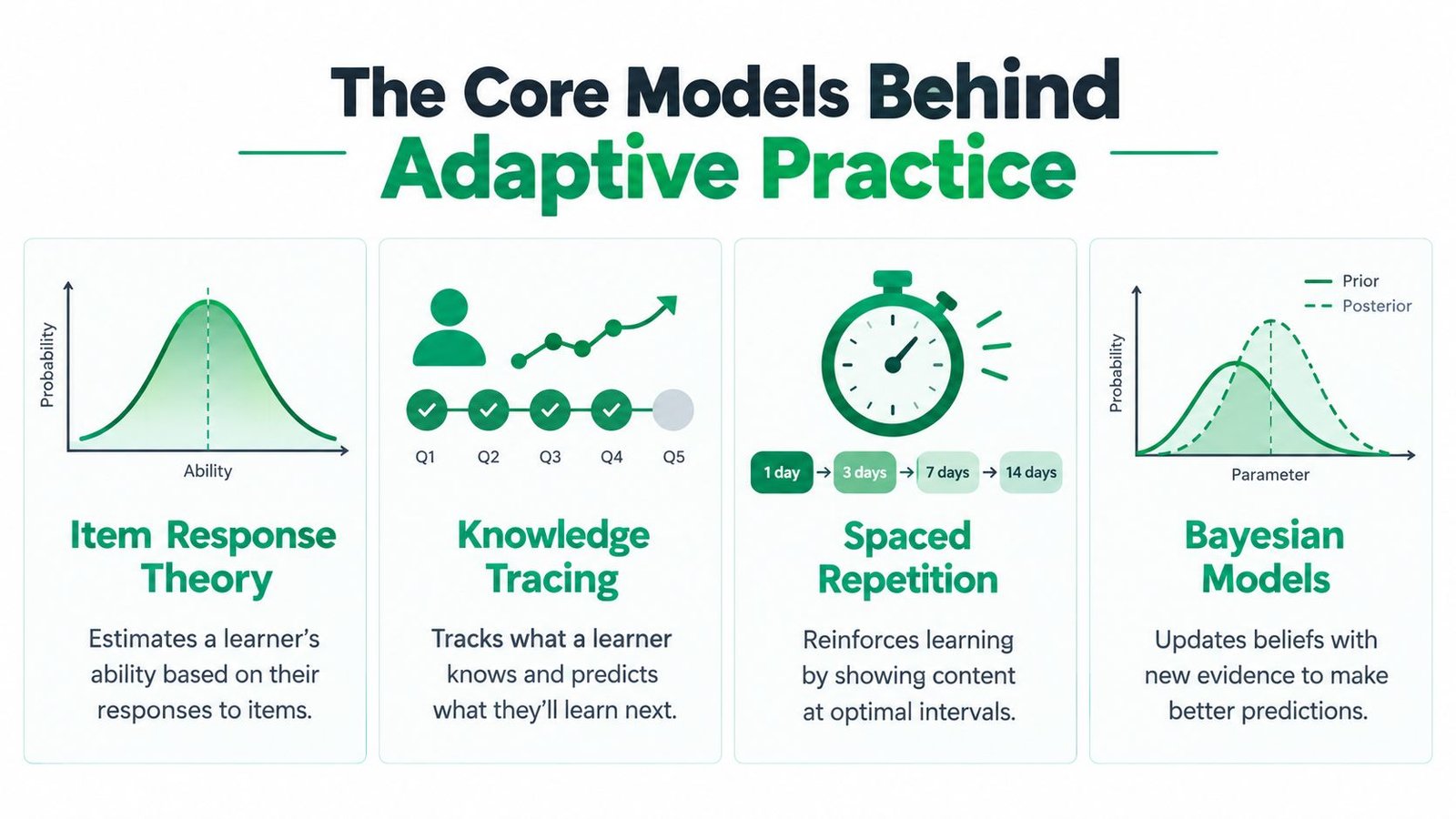
A diagram illustrating four core models of adaptive learning: Item Response Theory, Knowledge Tracing, Spaced Repetition, and Bayesian Models.

Item Response Theory, or IRT, asks how able you appear and how difficult each item is. It estimates both together, so getting a hard listening question right tells the system more than getting an easy matching question right. Items far above or below your current level reveal little, since the outcome is almost predictable.

That's why an IRT based system tries to serve prompts near your estimated ability, where your answer is most informative. It can keep separate estimates for vocabulary, listening, pronunciation, and oral interaction instead of collapsing you into one score. The catch is that items need to be calibrated in advance, which takes data and careful design.

Bayesian Knowledge Tracing, or BKT, asks a narrower question for each skill. Has this learner probably learned it yet, given the sequence of right and wrong answers so far? Every response updates that probability. A slip after several successes doesn't erase the evidence, and one lucky guess doesn't prove mastery.

Reinforcement learning takes a longer view. It treats each scheduling choice as an action and learns from reward signals such as later accuracy, retention, or time spent productively. Instead of only asking what helps on the next question, it can favour choices that pay off across a whole sequence of practice.

Why response time changes the picture

Response time aware sequencing adds hesitation to the evidence. A fast, correct answer suggests stronger recall, so the item can return later. A correct answer that took a long struggle suggests fragile knowledge, so it should come back sooner.

In the ARTS system, scheduling used accuracy plus response time to estimate mastery, and a geography learning experiment reported 53.4% greater learning efficiency than an Atkinson style Markov scheduling model. That's one experiment in one subject, not a promise for every app, but the mechanism is practical. Latency is useful evidence about fluency, provided the system allows for slow connections, accessibility needs, and a learner who got distracted.

Timing also connects these models to memory scheduling beyond language apps. If you want a practical look at how review gaps are structured in workplace training, spaced repetition intervals for enablement shows the same underlying idea applied in another setting. For Irish specifically, our guide to using spaced repetition for vocabulary review explains how recall attempts and expanding gaps fit together.

Adaptive algorithm models at a glance

Model Core signal Best for Key tradeoff
Item Response Theory Ability versus item difficulty Choosing informative next questions Needs a calibrated item bank
Bayesian Knowledge Tracing Probability a skill is learned Mastery decisions per skill Depends on clean skill definitions
Reinforcement learning Rewards across sequences Long term scheduling policies Hard to interpret and data hungry
Response time aware Accuracy plus latency Fluency and review spacing Latency is noisy across devices

No single row wins every job. Strong systems often combine them, using one model to estimate ability, another to decide mastery, and timing signals to schedule review. What matters is whether the combination is transparent enough to debug when it starts serving you odd prompts.

How Gaeilgeoir AI Puts These Algorithms to Work

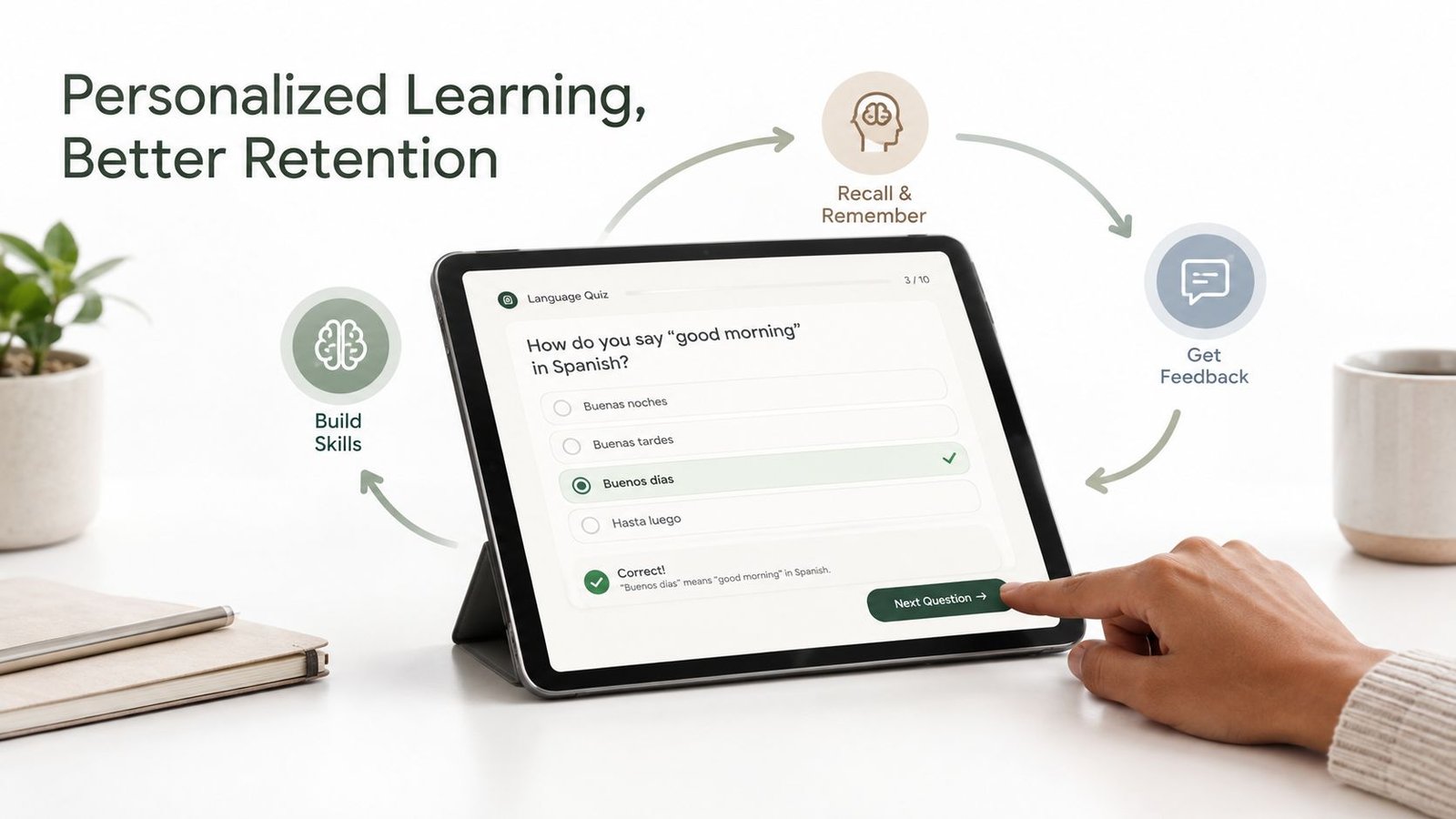
Theory gets clearer when you watch it handle a small, everyday learning task. The screen below shows the kind of prompt level view where these decisions happen, one response at a time.
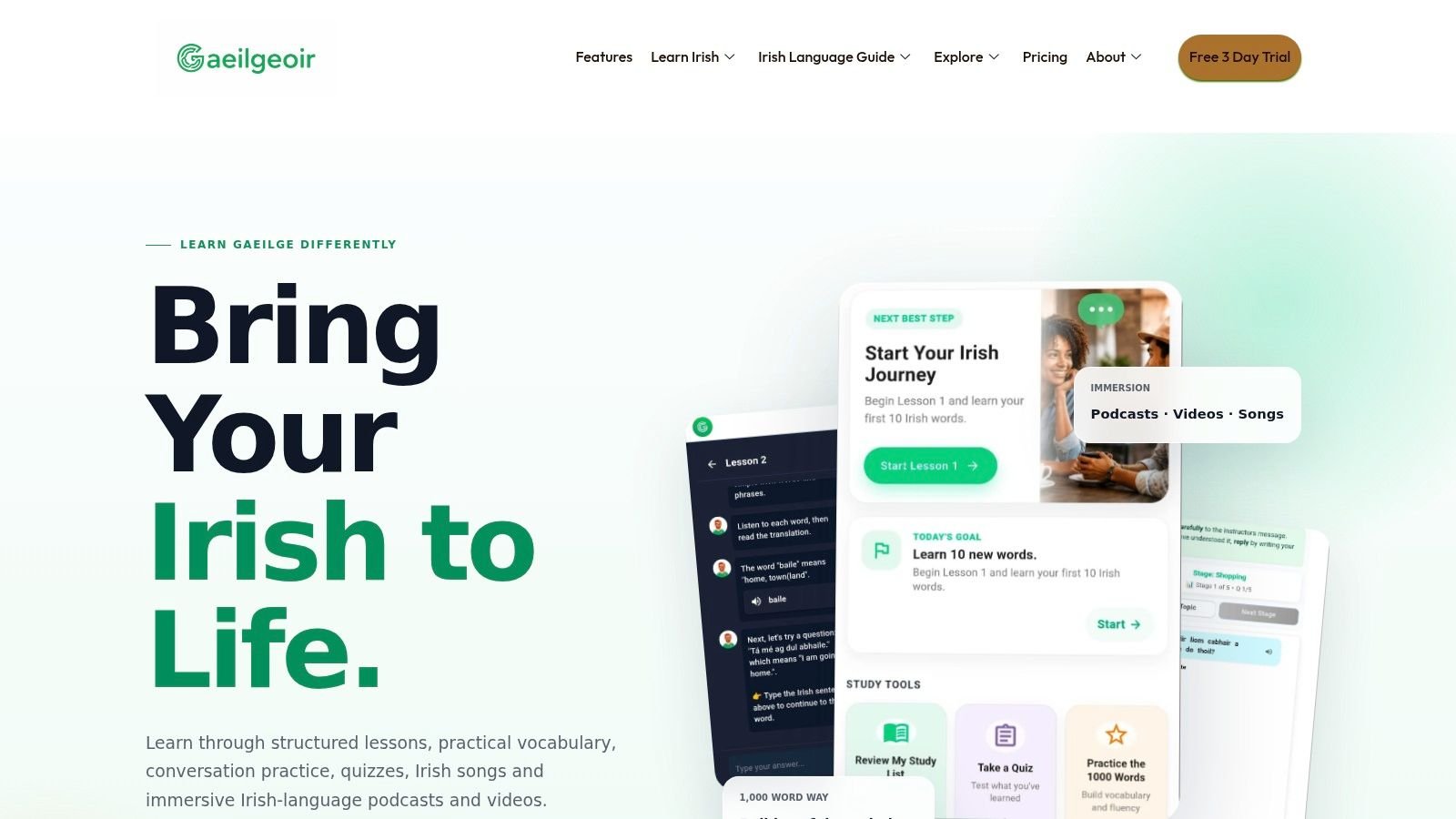
Screenshot from https://gaeilgeoir.ai

Inside Gaeilgeoir AI, adaptive quizzes schedule practice around the 1,000 most used Irish words, because high frequency vocabulary carries everyday conversation. You might meet a word first through recognition, then hear it, then need to produce it inside a short exchange about work, travel, food, or directions. Those aren't treated as interchangeable successes.

Separate estimates for separate skills

You could recognise a written phrase instantly yet miss it when spoken at natural speed. Collapsing both results into one vocabulary score would hide the actual problem. Keeping vocabulary, listening, pronunciation, and oral interaction estimates apart lets the system send help to the weak channel instead of repeating the strong one.

Pronunciation support feeds the same loop. If you repeatedly stumble on a sound inside otherwise familiar words, later prompts can isolate that pattern and give immediate feedback. You're not waiting until the end of a unit to discover you've been practising an error.

Knowledge tracing supplies a concrete stopping rule for this kind of practice. In common Bayesian Knowledge Tracing implementations, a skill is treated as mastered once the estimated probability reaches a preset threshold of 0.95. Below that line, practice or remediation continues. At or above it, you can progress while the item moves into longer term review.

That threshold is a design choice, not a law of learning. Set it too low and you advance on shaky ground. Set it too high and you drill material long after it's useful. A sensible platform tests the rule against later performance, not just against how tidy the progress bar looks.

From quiz answer to spoken reply

Response time matters here for a practical reason. If you select the right Irish phrase quickly, the system can space it further out and use your next minutes elsewhere. If you get it right slowly, or only after seeing options, it needs another appearance soon, ideally in a form that asks you to produce rather than recognise.

The short video below shows how a session moves between prompts, feedback, and speaking practice rather than sitting inside one quiz format.

Scenario based practice is where the estimates get tested. Ordering food or asking for directions forces you to combine words you may have only practised separately. If you freeze there, that's valuable evidence too, and it should pull the relevant vocabulary and pronunciation back into shorter practice.

  • Instant feedback: Corrections arrive while your attempted sentence is still fresh in memory.
  • Personal study list: Words you tap for translation can be saved and resurfaced, turning curiosity into scheduled review.
  • Gamified progress: Points, multipliers, and leaderboards reward returning, though they shouldn't be mistaken for proof of fluency.

The design goal is straightforward. Use low stakes questions to locate weakness efficiently, then spend the saved time on guided conversation where retrieval has to happen without a neat set of options.

Does Adaptation Actually Build Better Speakers

Here's where a healthy dose of scepticism helps. An app can get very good at predicting your next quiz answer while leaving your spoken Irish largely untouched. Those are different achievements, and platforms don't always measure both.
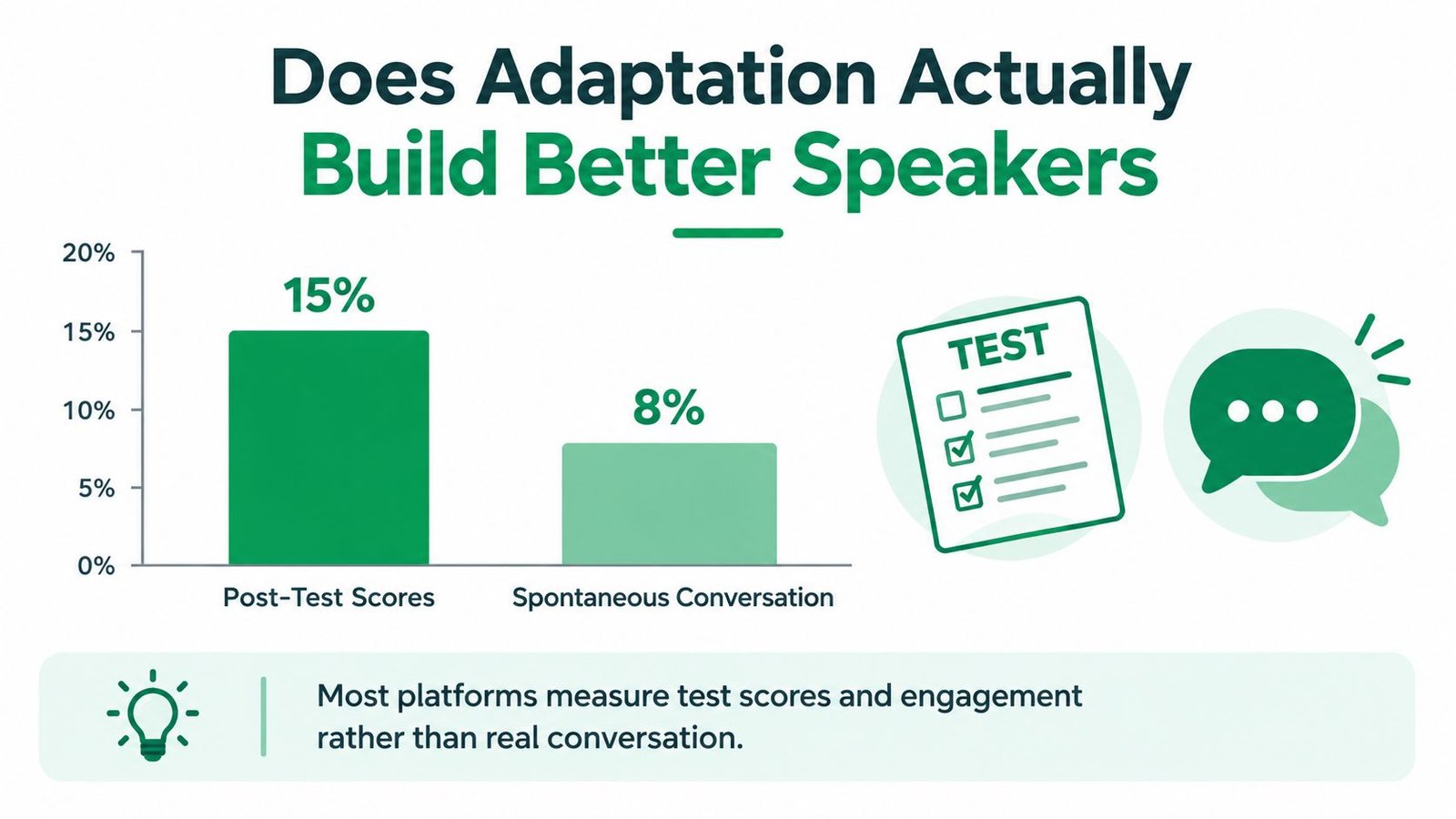
A bar chart comparing post-test scores of 15% against 8% for spontaneous conversation in language learning.

The evidence for adaptive systems is positive on average, but it's not a blank cheque. Recent reviews report cognitive outcome effect sizes of roughly g = 0.50 to 0.70 for AI enabled adaptive systems, with results varying by study quality, duration, subject, and learner characteristics. In a 2026 experimental study, an adaptive platform improved post test scores by 8.29 points out of 20 versus 4.90 for a control group, while the strongest correlation between requested adaptations and later achievement reached only ρ = 0.588.

Read that second number carefully. Personalisation signals carried useful information, but they didn't fully explain who learned. Motivation, prior knowledge, teaching quality, and what learners did with feedback still mattered. An algorithm can route you well and still not teach you by itself.

Four outcomes that should not be confused

  • Immediate mastery: You answer correctly during the session, often with recent exposure helping you.
  • Delayed retention: You still remember it days or weeks later, after the prompt stops appearing.
  • Transfer: You use the language in an unfamiliar situation that wasn't rehearsed word for word.
  • Autonomy: You keep going without hints, options, or the app structuring every turn.

Most quiz based systems measure the first outcome well and gesture at the second through review scheduling. Speaking depends heavily on the third and fourth. You can recognise the right phrase for asking directions and still freeze when a person answers with extra detail you didn't expect.

Our overview of what language acquisition research says about production and transfer goes deeper on why prompted success and unprompted use diverge. The short version is that recognition practice builds familiarity, while conversation forces retrieval, listening, repair, and word choice to happen together under time pressure.

More adaptive is not automatically more educational. The test is what you can do later, without the system arranging the question for you.

That doesn't make adaptive practice a gimmick. It makes it one component. Used well, it clears weak vocabulary, schedules review efficiently, and flags pronunciation problems early. But it needs scenario based conversation and opportunities to produce language freely if the goal is a speaker, not just a strong quiz performer.

There's also a case for restraint with true beginners. When you lack prior knowledge, an algorithm has thin evidence and can personalise confidently in the wrong direction. A clear fixed sequence for core sounds and survival phrases, followed by adaptation once responses accumulate, is often the more honest design.

Privacy, Fairness, and Trust in Low-Resource Languages

None of this works without data about you. Adaptive systems commonly use assessment results, interaction logs, engagement measures, and sometimes signals from how you speak or respond. That evidence makes personalisation possible, and it's also where the risks start.
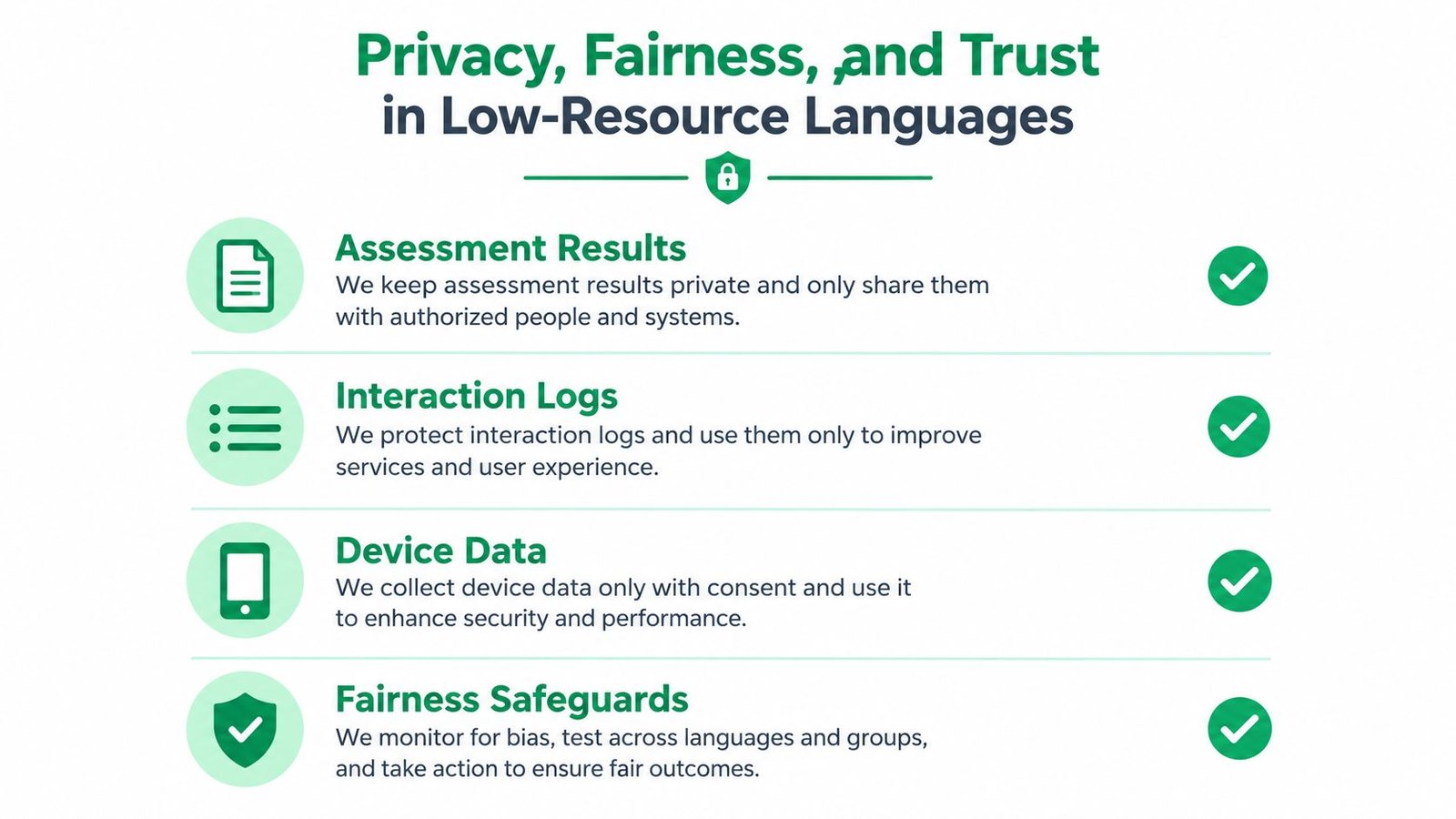
An infographic titled Privacy, Fairness, and Trust in Low-Resource Languages listing data security and ethical AI practices.

A systematic review of adaptive system governance identifies data minimization, explicit consent, retention limits, access controls, and restrictions on secondary use as core requirements, alongside GDPR and FERPA compliance, algorithmic audits, and fairness criteria such as demographic parity and equalized odds. In plain terms, collect only what's needed, say why, keep it only as long as justified, and test whether recommendations disadvantage particular groups.

If you're comparing how different jurisdictions structure those duties, you can check Keybaki's compliance checklist for a concrete example of consent and retention questions written for non lawyers. The legal details differ, but the learner facing questions travel well.

Why Irish raises the stakes

Irish is a low resource language for machine learning. Training and calibration data are smaller, regional pronunciation varies, and heritage learners may produce errors unlike those in dominant language datasets. A model can look accurate on average while repeatedly misjudging a particular accent, dialect, age group, or educational background.

Our discussion of domain specific language models for Irish covers why smaller, focused datasets need closer human review rather than less. When examples are scarce, a confident automated judgement about your pronunciation deserves extra scrutiny, not blind trust.

Before you settle into any adaptive platform, you should be able to get clear answers to three questions. What data changes your lesson path? Can you inspect or correct the learner model when it misreads you? And how are errors for minority language speakers audited, rather than averaged away in headline accuracy?

Trust check: If a platform can't explain why it recommended an exercise, you can't tell a useful diagnosis from a glitch.

How to Evaluate Any Adaptive Language Tool

Use this short checklist before you commit your practice time. Does the tool explain how it personalises, use response time alongside accuracy, and keep separate estimates for listening, vocabulary, and speaking? Does it measure delayed, unprompted performance rather than only quiz scores, and state clear consent and retention practices?

Parents weighing similar claims for children's reading tools face the same trap of confusing engagement with progress, which this guide for parents of struggling readers addresses from a different angle. In every case, ask what happens when the prompts disappear.


Try the adaptive quizzes, pronunciation support, and scenario based Irish conversation practice in Gaeilgeoir AI, then judge it by what you can say without options on screen. Start your free trial on the learning platform and watch how your next prompts change after your first answers.


AI in Language Learning: Tools, Tips, and Real Results

You know more Irish than you can use. You've studied words such as caife, bainne, and go raibh maith agat, but when someone speaks to you in real time, the vocabulary seems to disappear. You recognize a phrase on a page, yet ordering a coffee, introducing yourself, or asking for directions still feels like a high-pressure test.

That gap between remembering language and using language is where AI can help. It can give you a patient conversation partner, immediate pronunciation practice, and exercises that respond to your mistakes. Used thoughtfully, AI in language learning doesn't replace teachers, native speakers, books, or communities. It gives you more opportunities to prepare for those human interactions.

Table of Contents

Why Language Learning Feels Hard (And How AI Helps)

A learner walks into a café in Galway with a short order written on a phone. They know the words. They've reviewed them several times. But when the server asks a follow-up question in Irish, the learner freezes, switches to English, and leaves feeling that studying hasn't worked.

This reaction is normal. Vocabulary lists build recognition, but conversation demands several skills at once. You need to retrieve a word, arrange it in a sentence, pronounce it clearly, understand the response, and decide what to say next. A textbook can explain each part, but it usually can't respond to your exact hesitation in the moment.

A young woman with red hair standing at a coffee shop counter holding an order list.

Turning private practice into active language

An AI conversation partner lets you rehearse that café scene repeatedly without embarrassment. You might type or say, Ba mhaith liom caife, le do thoil, then ask the tool to reply as a server. If you struggle, it can slow the exchange, translate one phrase, or offer a simpler response instead of ending the conversation.

That low-pressure repetition matters because learners need to make mistakes before they can make language automatic. AI can also ask you to repair an answer rather than just reveal the correct one. For example, after you write an incorrect Irish sentence, ask for a hint first, then try again before viewing the explanation.

Personalization is central to this approach. If you're unfamiliar with the idea, this practical guide to what is adaptive learning explains how learning systems can adjust content to a learner's performance, pace, and needs.

Practical rule: Use AI to create more chances to speak, not to avoid speaking with people.

The most useful shift is simple. Instead of asking, “How do I memorize this list?” ask, “What real situation do I want to handle?” Then use AI to practise the words, questions, and likely replies connected to that situation.

The Core AI Technologies Behind Modern Language Apps

Modern language apps combine several technologies, and each solves a different learning problem. Understanding those roles makes it easier to choose tools instead of treating every AI feature as if it does the same job.

Four tools with four jobs

Large language models work like conversation partners who don't tire of repetition. You can ask for a beginner-level Irish dialogue about meeting a friend, then request a more natural version, a slower version, or a version that uses vocabulary you already know. The model generates responses from patterns in language, so you should still check important explanations and culturally sensitive wording.

Speech recognition acts like a pronunciation coach. You speak into a microphone, and the system compares the sound it receives with expected language patterns. It can help you notice that recognising sláinte is different from producing it clearly in a spoken exchange. Recognition isn't identical to a qualified teacher's ear, but it gives you a practical feedback loop between attempts.

Text-to-speech turns written Irish into listening material. A learner can hear a phrase, read it, hide the text, and try to identify it again. This is especially useful when you need exposure to connected speech rather than isolated vocabulary.

Adaptive algorithms serve as the app's learning planner. They track what you practise, identify patterns in your responses, and bring back material that needs attention. That's the basic principle behind spaced repetition for language learning, where review timing helps you revisit words before they disappear from memory.

Choosing tools by the task

A conversational model may be flexible, but it might not provide a structured course. A dedicated app may offer clearer progression, while a specialist service may focus on a particular language, exam, or community. Even tools outside language study, such as the LunaBloom AI app, can illustrate a wider point about AI products. The interface matters less than whether the system gives you useful feedback and a clear next action.

For Irish, check whether a platform supports the kind of language you need. Look for pronunciation audio, scenario practice, explanations that suit your level, and opportunities to produce language yourself. A tool that only translates sentences may help you understand a message, but it won't necessarily help you form your own response.

You can also explore how domain-specific language models differ from general-purpose systems. Specialization can make a tool more relevant to a defined subject, audience, or language context, although learners should still evaluate its accuracy.

How to Build an AI-Powered Study Routine

The best routine gives every tool a narrow job. Don't ask one chatbot to be your entire course, dictionary, pronunciation coach, and examiner. Create a small loop that moves from understanding to practice to recall.

Start with a repeatable daily cycle

Begin with a short review of saved words and phrases. Next, practise one realistic exchange, such as ordering food or asking Cá bhfuil an stáisiún? Finally, speak a few answers aloud without looking at the text. This sequence makes recognition serve production.

Use prompts that define the situation and your level. Write, “Act as a patient café server. Use beginner Irish. Ask one question at a time. Don't translate unless I ask.” If the exchange is too difficult, reduce the complexity rather than abandoning the conversation.

Give each day a purpose

A simple weekly pattern might look like this:

  1. Conversation day: Role-play a greeting, introduction, or café order. Ask for one correction at a time.
  2. Pronunciation day: Listen to short phrases, record yourself, and repeat them with attention to rhythm.
  3. Grammar day: Take sentences you've tried to say and ask for a plain-language explanation of the pattern.
  4. Comprehension day: Listen to a short Irish passage, identify familiar words, and summarise its meaning.
  5. Review day: Revisit your saved vocabulary without immediately checking the translation.
  6. Scenario day: Combine the week's language in a travel, work, family, or school situation.
  7. Human connection day: Use what you prepared in a class, conversation group, message, or exchange with another learner.

You don't need to make every session long. Consistency gives the system better information about your needs and gives your memory more chances to retrieve language.

Increase difficulty carefully

Beginners should request short turns, familiar vocabulary, and translation only after an attempt. Intermediate learners can ask for natural alternatives, follow-up questions, and corrections grouped by importance. At every level, keep a record of mistakes that recur, then turn those mistakes into the next practice session.

A useful test: After an AI session, can you say something useful without the screen? If not, spend less time reading explanations and more time answering aloud.

Comparing AI Language Learning Platforms

Different tools suit different moments in a learner's day. A general chatbot gives you freedom, but you must design the lesson and judge the response. A dedicated app gives you more structure, while a specialist platform may make its scenarios, vocabulary, and feedback more relevant to a specific language.

Tool Type Best For Key Feature Pricing Range
General conversational AI Flexible role-play and explanations Custom prompts and open-ended dialogue Free to paid, depending on the service
Dedicated language app Learners who prefer a guided path Lessons, review systems, and built-in practice Free tiers to subscription plans
Speech-focused AI tool Pronunciation and spoken confidence Voice interaction and speech feedback Varies by product and plan
Specialist language platform Learners targeting a particular language or goal Language-specific scenarios and study content Varies by platform and access level

Match the tool to the problem

Choose general conversational AI when you want to rehearse an unusual situation, such as explaining a hobby or preparing for a family visit. Choose a dedicated app when you need reminders, progression, and regular review. Choose a speech-focused tool when you already know what you want to say but need more confidence saying it aloud.

For Irish learners, specialization can make the practice feel closer to real use. A platform designed around Irish conversations may include everyday situations, pronunciation support, adaptive quizzes, and exam-oriented practice that a general chatbot won't provide automatically.

No platform removes the need for judgment. Before committing, test whether the tool corrects errors clearly, accepts beginner-level answers, and helps you understand why a phrase works. Also check whether it encourages you to produce language rather than just tap through translations.

What Research Tells Us About AI and Language Acquisition

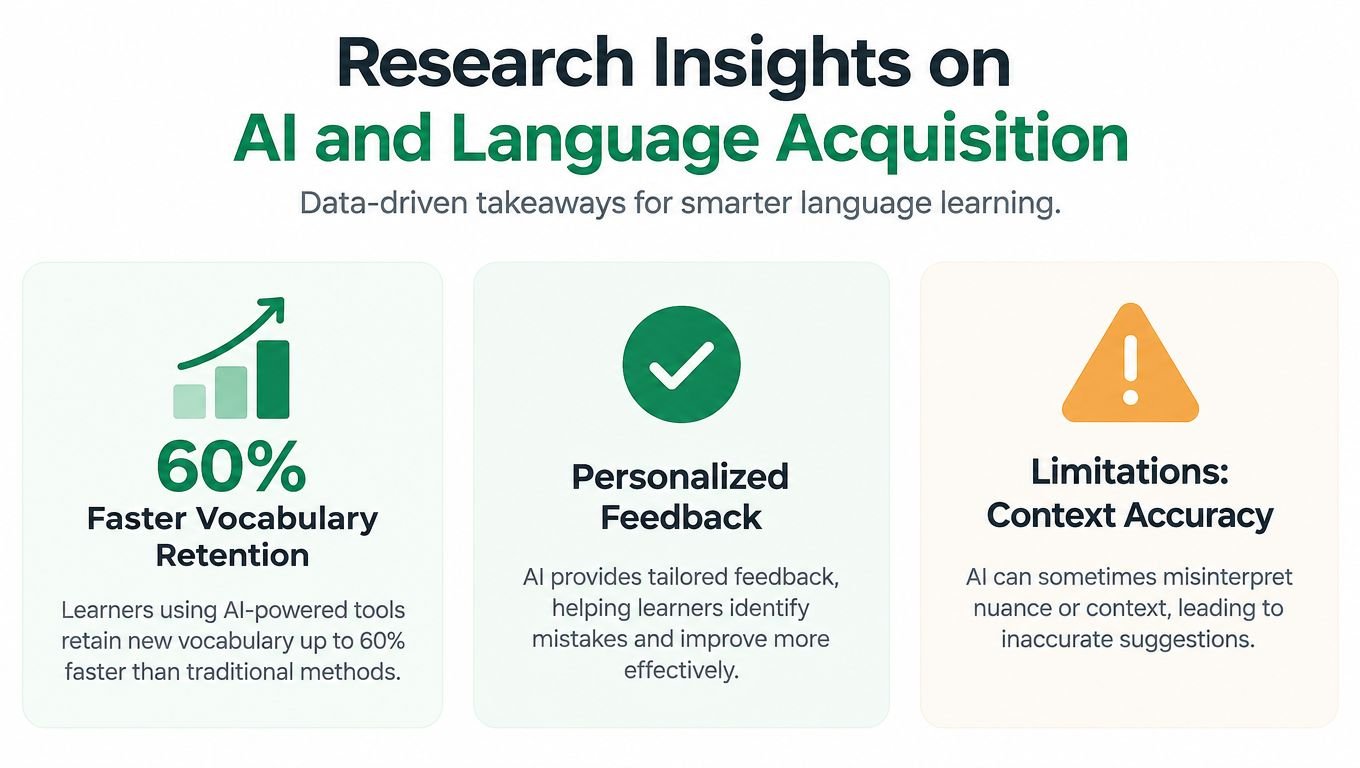
The evidence is encouraging, but it doesn't support the idea that every AI feature automatically produces learning. A meta-analysis of AI-guided individualized language learning synthesized 61 samples from 17 research projects involving 8,282 learners and reported a strong within-group effect of d = 1.18 for samples containing 2,262 learners, while also finding small-to-medium effects on linguistic outcomes more broadly (meta-analysis of AI-guided individualized language learning). The practical lesson is that individualized practice, feedback, and adaptive instruction are promising uses of AI.

An infographic titled Research Insights on AI and Language Acquisition highlighting vocabulary speed, personalized feedback, and limitations.

Where the evidence is strongest

A 2026 systematic review selected 30 eligible experimental studies from 2014 to 2023 and found that university students were the most frequently studied learners, while speaking and writing were the most common target skills (systematic review of AI for language learning). That fits what many current tools do well: prompting you to produce an answer, correcting written language, and supporting spoken rehearsal.

A separate 2026 meta-analysis synthesized 51 studies and 175 independent effect sizes, offering a broad evidence base for examining measurable learning impacts rather than relying only on individual anecdotes (meta-analysis on generative AI in second and foreign language learning).

The missing balance

The research base remains uneven. A systematic review of 18 studies found that writing, grammar, speaking, and vocabulary received the most attention, while reading and listening remained underexplored (systematic review of AI and language learning skills). A broader 2026 scoping review examined 272 empirical studies from 2005 through 2024 and found that 78.3% of publications, or 213 studies, appeared in 2023 and 2024. It also identified chatbots in 44.1% of studies and commercial tools in 71% of recent research (twenty-year scoping review of AI in language learning).

That acceleration shows strong interest, not a complete answer. Build listening and reading into your routine deliberately, and treat AI feedback as useful guidance that still deserves careful evaluation.

Navigating Privacy, Accuracy, and Over-Reliance Risks

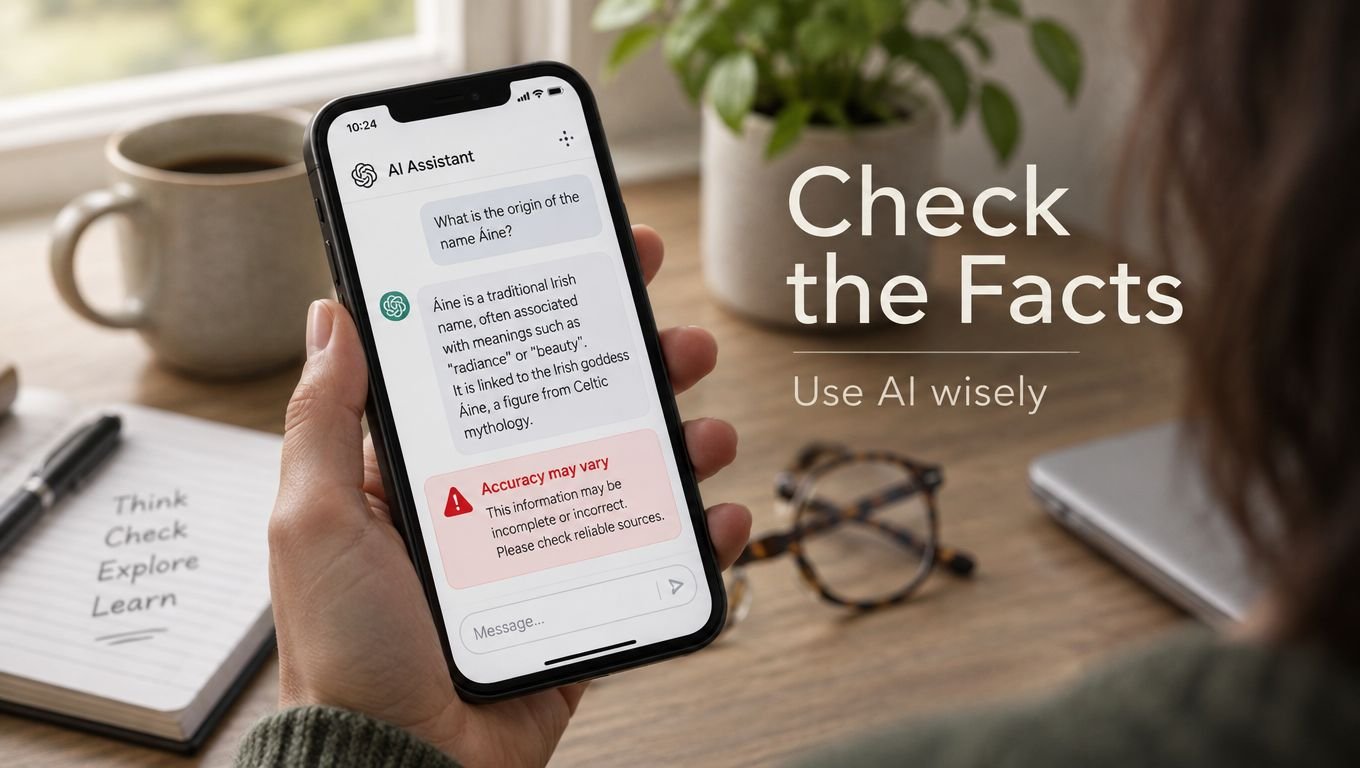
An AI response can sound confident and still be wrong. This matters in language learning because a learner may not yet know enough to challenge an unnatural translation, an incorrect grammatical explanation, or a phrase that fits one context but not another.

Before sharing practice data, read the tool's privacy settings and terms. Avoid entering personal information, private messages, school records, or sensitive conversations just to receive a language correction. You can usually replace names and identifying details with neutral examples.

A person holding a smartphone showing an AI chat interface with a warning to check facts.

Keep your own judgment active

Use a three-part check when an answer feels uncertain:

  • Compare: Check the phrase against a trusted dictionary, course resource, teacher, or native speaker.
  • Contextualize: Ask whether the wording is formal, informal, regional, old-fashioned, or suitable for the situation.
  • Retrieve: Close the tool and try to use the phrase in a new sentence.

Research on generative AI use in language learning has raised concerns about over-reliance, inconsistent feedback quality, cultural adaptability, digital equity, and limited long-term evidence. A 2025 student survey also found that use increased between 2023 and 2025 while evaluations of output quality became more moderate over time (research on student use and concerns around generative AI for language learning).

The danger isn't using AI. It's allowing AI to do every difficult part of learning for you.

Ask for hints before answers. Speak before reading a model response. Keep some sessions screen-free, and use human conversation to test whether your knowledge works under natural pressure.

Getting Started with AI for Irish Language Learning

Irish is a strong example of why language technology should support participation, not just translation. A beginner may want to practise Dia duit, describe where they live, order lunch, or ask for directions. A heritage learner may want a gentle way to reconnect with family language. A Leaving Cert student may need focused preparation for oral topics and more confidence answering aloud.

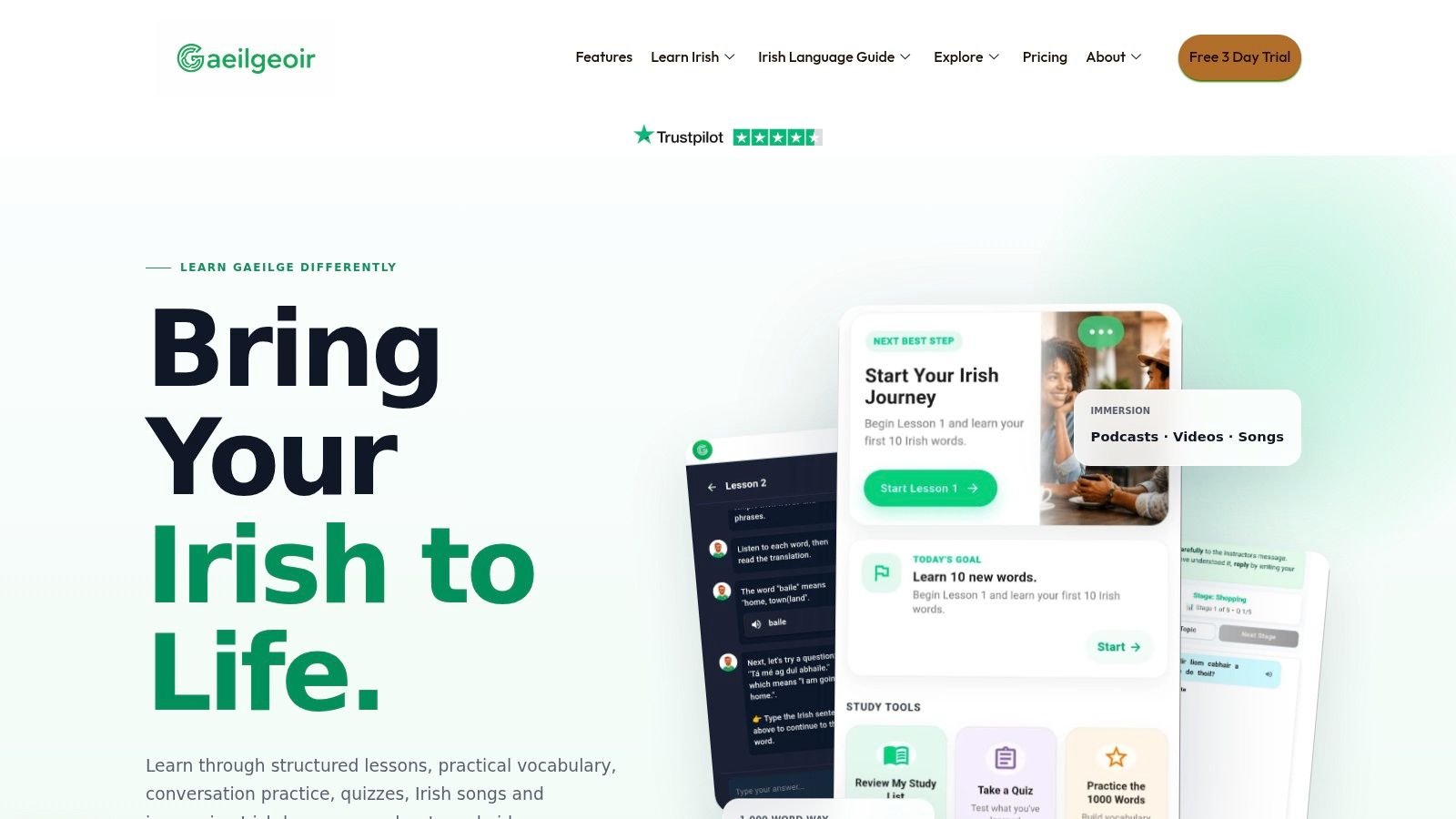
Screenshot from https://gaeilgeoir.ai

Gaeilgeoir AI provides guided, real-world Irish conversation practice for beginners through intermediate learners. Its activities include pronunciation support, adaptive quizzes with immediate feedback, and scenario-based practice for social interactions, work, travel, ordering food, and asking for directions. Learners can click words for translations and save them to a personal study list, which turns an unexpected vocabulary gap into a later review task.

That design supports a useful progression. First, you meet a phrase in context. Then you hear or produce it. Next, you retrieve it in a quiz or conversation. Finally, you try it with another person. AI can make the first three steps easier to repeat, but human interaction gives the language its humour, flexibility, cultural meaning, and emotional weight.

Use Irish for a real purpose

Choose one situation that matters to you this week. If you're preparing for travel, practise a greeting, a food order, and a request for directions. If you're studying for the Leaving Cert, rehearse likely oral themes and ask for follow-up questions rather than memorizing one fixed script. If you're returning to Irish through family or heritage, build conversations around names, places, memories, and everyday routines.

For a broader starting point, learn Gaelic language with AI offers a way to connect guided technology with active language practice. Keep your sessions purposeful, and take useful phrases into class, conversation groups, messages, or family discussions.

The video below can help you see how an AI-supported Irish learning experience fits into a practical study routine.

AI works best as a bridge between study and use. It gives you a private place to make mistakes, but your goal should always be greater participation in the living language, whether that means speaking with a teacher, joining a local group, preparing for an exam, or starting a short conversation with someone who welcomes your effort.


Gaeilgeoir AI offers guided Irish conversations, pronunciation support, adaptive quizzes, saved vocabulary, and scenario practice for everyday situations and Leaving Cert preparation. Visit Gaeilgeoir AI to choose a practical Irish goal and start turning study time into spoken language.

AI Language Tutors: How They Work and How to Choose One

If you've ever opened an Irish lesson, understood the words, and then gone completely blank the moment you had to speak, you're in the right place. That freeze is normal. It's also the exact gap that AI language tutors are trying to close, especially for learners who need more speaking time than a classroom, workbook, or flashcard app can give them.

The promise sounds simple, maybe even a little too simple, unlimited practice, instant feedback, and no fear of judgment. More useful when you look at the details. The strongest tools aren't magical conversation machines, they're systems that help you rehearse real speech, recover from mistakes, and build enough confidence to try again tomorrow.

Table of Contents

Why AI Language Tutors Are Changing How We Learn

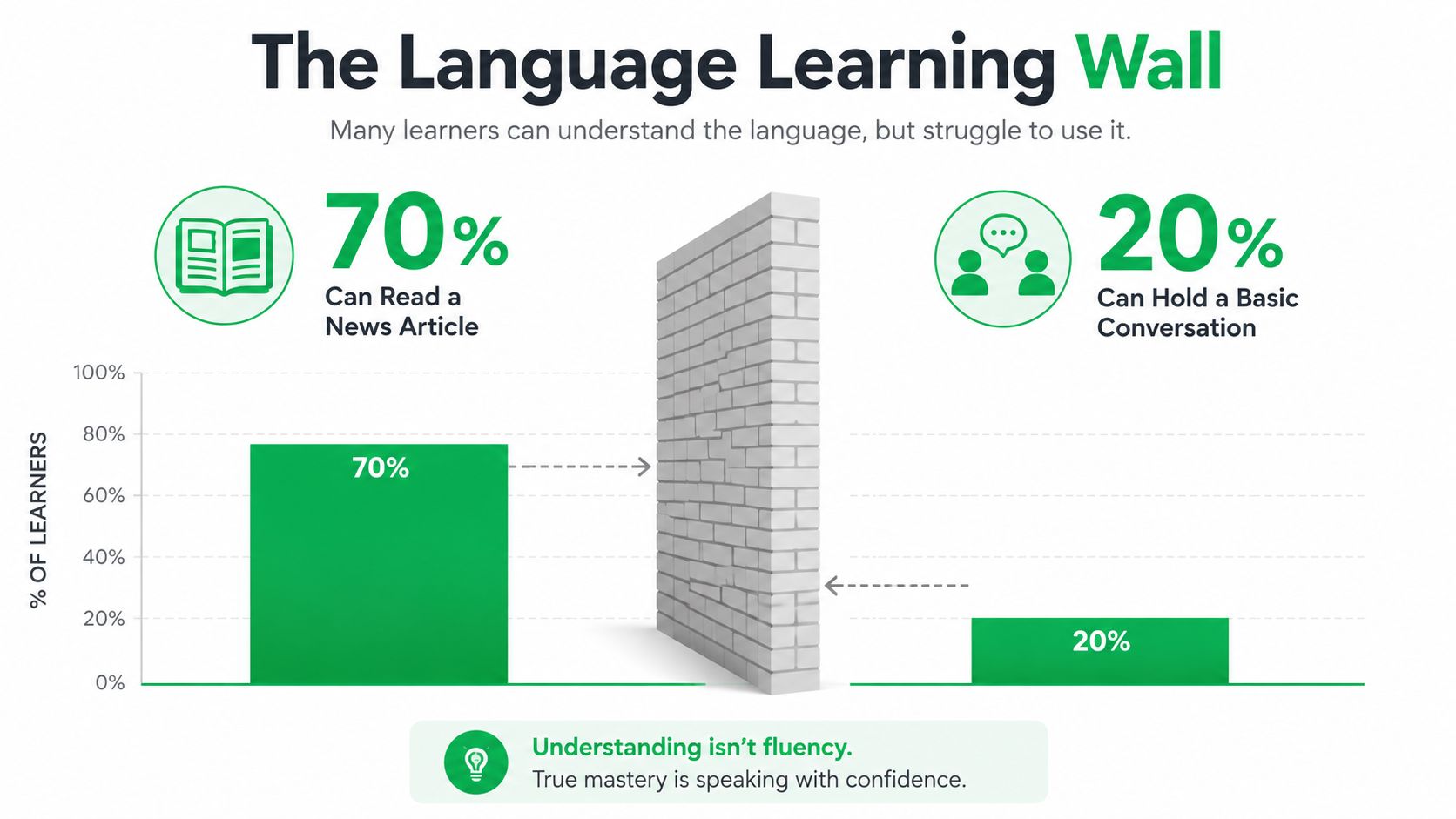
You can read a page of Irish and feel proud, then hear a simple question and suddenly your mind goes quiet. That gap is familiar to many learners, especially adults who have studied on and off for years and can recognize words without being able to produce them under pressure. AI language tutors matter because they give learners a place to rehearse speech before the stakes feel real.

An infographic titled The Language Learning Wall showing that 70% can read, while only 20% can speak.

Market forecasts help explain why this shift is happening. One major estimate places the AI tutors market at USD 3.55 billion in 2025 and projects USD 6.45 billion by 2030, while another projects USD 17.7 billion by 2033 (Mordor Intelligence). That growth helps show why language learning is no longer treated as a novelty. The same market study says language learning is the fastest-growing subject segment, and cloud deployment held 71.22% share in 2024, which fits the way many learners now expect to practice, on a phone, in a browser, whenever they have a few minutes.

The Importance of Active Speaking Practice

The strongest AI tutors do more than drill vocabulary. They let learners practice the messy middle of speaking, where the idea is there but the sentence is still forming. That is the part many people need most, because knowing a word is not the same as using it in real time. Tools that feel conversational tend to keep learners engaged because they support confidence, not just recall.

Adoption data points in the same direction. Duolingo is projected to report 12.5 million paid subscribers at the end of Q1 2026, up 21% year over year, and projected revenue of USD 1,037.6 million in FY2025, a 39% increase over FY2024 (LingoBright). Broader industry summaries also report 500 million learners globally using AI tutors in 2025, and AI-powered language-learning platforms with 2.3 million monthly active users growing 40% year over year (LingoBright). The products differ, but the pattern is consistent, learners want more speaking time than traditional apps usually provide.

Practical rule: if a tool only helps you recognize words, it is a study aid. If it helps you answer out loud, it starts acting like a speaking coach.

For Irish learners, that distinction matters. Grammar tables help you understand the language, but confidence comes from using it in the situations you face, greeting someone, ordering food, asking for directions, or handling an oral exam prompt. In Irish, the jump from recognition to speech can feel especially wide, so tools that create low-pressure speaking practice fill a real gap.

How AI Language Tutors Actually Work

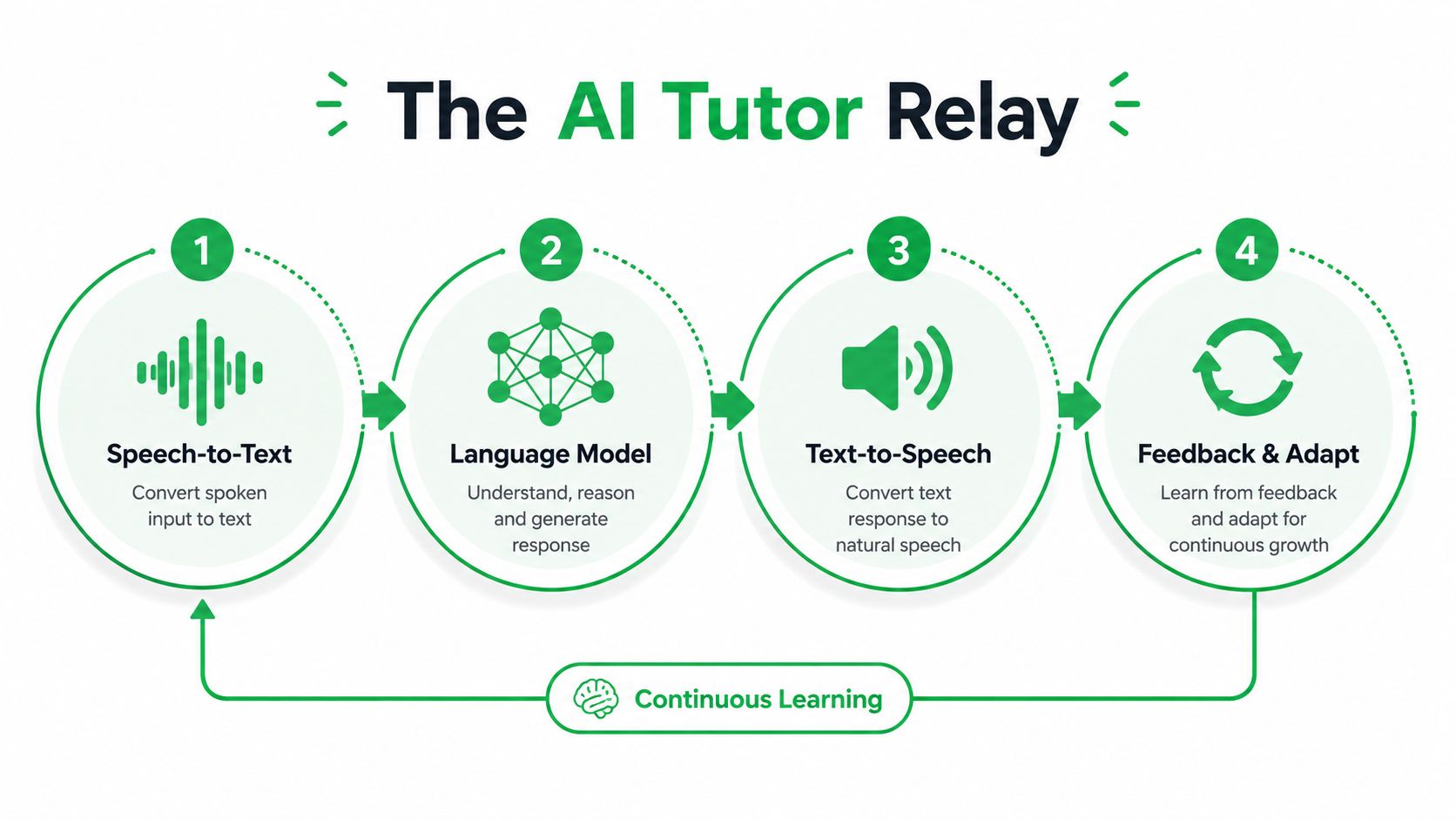
A strong AI tutor works like a relay team. One part hears you, one part interprets what you meant, one part speaks back, and one part learns from the exchange so the next round goes better. When those pieces move smoothly, the experience feels close to conversation. When they do not, it feels like waiting for a chatbot to catch up.

A diagram illustrating the four-step AI tutor relay process involving speech-to-text, language modeling, text-to-speech, and continuous learning.

The pipeline usually starts with speech-to-text, which turns your voice into words. Then the language model reasons over your input, decides how to keep the conversation going, and prepares a reply. After that, text-to-speech turns the reply into audio, and a feedback layer handles grammar, pronunciation, or vocabulary support. That sequence sounds simple on paper, but it only works if the handoffs are fast enough to preserve turn-taking. For a closer look at how AI systems support learning over time, see machine learning in education.

Latency decides whether it feels like a conversation

In practice, the whole loop needs to stay around 600 to 800 milliseconds total latency to feel natural (LinguaLive). Once response times drift beyond that, people start feeling the gap. Integrated systems like Gemini Live have been measured around 500 to 700 ms, while GPT-4o-class stacks with separate ASR and TTS often ranged 700 to 1200 ms depending on load and network conditions (LinguaLive).

That is the technical reason some apps feel alive and others feel sluggish. It is not only about how smart the model is. It is about the total budget across audio capture, inference, synthesis, and any correction logic that runs after the answer.

For readers who like the engineering side, a useful comparison is the translation workflow in GPT-4 vs Claude for Django from TranslateBot. Different systems can all produce output, but the user experience depends on how reliably they handle the full loop, not just the headline model name.

The open-source stack matters for the same reason. A reference setup that combines Whisper medium for ASR, Llama 3.1 8B for the tutor brain, and XTTS/SadTalker for voice output and avatars is designed for throughput per dollar, not just benchmark prestige (NLLB). The same source notes roughly 5 GB VRAM for ASR and another 5 GB VRAM for the quantized LLM, which makes near-real-time tutoring realistic on a single consumer GPU.

If you want a plain-language way to think about it, the tutor has to be fast enough to stop feeling like a quiz engine. That is the point where practice starts to resemble speaking.

For teams evaluating platform choices, latency is often the difference between “I'll use this daily” and “I stopped after two tries.” If the audio stalls or the corrections arrive too late, learners stop treating the tool like a partner and start treating it like a form.

The Most Effective Features in an AI Tutor

A learner sitting at a kitchen table at the end of a long day does not need flashy claims. They need a tutor that helps them speak a little more clearly, remember a little more reliably, and try again without feeling stalled. That is the test for an AI language tutor, especially for Irish learners who often need more than polish, they need repeated, usable practice.

Marketing pages often highlight personalization, gamification, and smart automation. Those can help, but only if they support the core learning loop. A good AI tutor should help you speak, remember, correct, and repeat. If the tool only makes lessons feel entertaining, it is not doing enough.

A 2025/2026 review article on generative AI in language classrooms classified GenAI into nine distinct roles, with the most common being feedback provider (n = 42), language learning tutor (n = 26), resource provider (n = 22), and content generator (n = 20), followed by evaluator, affective supporter, conversation partner, interaction facilitator, and cognitive stimulator (Taylor & Francis). That pattern matters because it keeps pointing back to the same teaching tasks, feedback, tutoring, and conversation. From an educator's point of view, those are the features that shape whether practice turns into speaking progress or stays as isolated app activity.

What deserves your attention first

The first feature to look for is pronunciation and speech feedback. If the system cannot hear your accent well, or if it gives praise without explaining the mistake, it teaches confidence without accuracy. Learners tend to relax when feedback is clear, specific, and immediate, because they can correct the next attempt instead of guessing what went wrong. A tutor also needs to adjust the difficulty of its prompts, because a beginner who needs slow, supported turns should not be pushed into advanced role-play on day one.

A 2025 systematic review on machine-based language teaching found that AI tools such as ChatGPT, Grammarly, Duolingo, Wordtune, and Pigai were used across drafting, practice, and assessment phases, and they supported writing, speaking, listening, vocabulary, grammar, and reading comprehension (ERIC PDF). The same review reported that AI feedback improved language accuracy while building confidence and encouraging active participation (ERIC PDF). Read that as a teaching signal, not a product slogan. Feedback works when it helps the learner notice a gap, try again, and hear the correction in context.

Vocabulary review deserves the same level of attention. A tool that helps you review words at the right time is more useful than one that shows a long list of terms. If you want a practical model for that, build a spaced repetition vocabulary system before you judge any platform's review loop. The point is simple, words stick when the learner meets them again after they have started to fade, not when the app just displays another progress badge.

What helps, but should not carry the whole experience

Scenario-based practice has real value because it turns isolated words into usable speech. Exam preparation also helps learners who need structured prompts and predictable speaking topics, especially when pressure is part of the task. Both features can support learning, yet neither one is enough if the tutor cannot respond naturally to mistakes, ask follow-up questions, or keep the exchange moving in a way that feels like conversation.

The British Council review identified five AI use areas in English teaching and learning, developing speaking, writing, and reading skills, supporting pedagogy, and enabling broader instructional support (British Council). That gives a useful classroom lens. AI tutors are not one thing. They can serve different parts of the learning process, and the right mix depends on whether the learner needs confidence, accuracy, or exam readiness. For that reason, a platform with personalized learning paths is only useful when the path changes what the learner practices, not just the screen they see.

Where AI Tutors Excel and Where They Fall Short

A learner who can rehearse a phrase five times without embarrassment often arrives at live conversation with less tension. That is one of the clearest places AI tutors help. They are steady, patient, and available whenever a student wants another try, which matters for beginners who need time before speaking feels natural.

The research base is also larger than many marketing pages suggest. A 2026 systematic review in a Taylor & Francis journal examined 155 studies and found that 79.5% reported positive language-learning outcomes from AI use (Taylor & Francis). That does not mean every platform works equally well, but it does show that AI support has been studied across speaking, writing, vocabulary, and grammar, not just one narrow skill (Taylor & Francis).

The strengths are real, but narrow

AI is useful for low-stakes practice, quick corrections, and a conversation partner that does not rush or interrupt. For many learners, that is enough to get the first sentence out loud. In Irish learning, that can mean moving from silent recognition of a phrase to saying it, even if the sentence is still rough.

It also helps with repetition without fatigue. A tutor can ask for the same greeting, the same direction, or the same self-introduction again and again, which is hard to get from a busy human partner. Learners often need that kind of patient loop before confidence starts to build.

Human conversation still matters for rhythm, humor, and the cultural details that do not show up in a clean transcript.

Independent education coverage keeps drawing the same line. AI tutors are strongest for repetition and practice, while human interaction remains central for fluency, culture, and nuanced communication (EdWeek). A useful way to read that is simple, an AI tutor can prepare you to speak, but it cannot fully stand in for speaking with another person.

Where the ceiling appears

Pronunciation feedback can still miss the mark, especially when a platform sounds confident even while it misreads speech. Cultural pragmatics are another weak point. Knowing the words is not the same as knowing when to soften a phrase, when to be formal, or how to sound natural in context. Those are the places where a human tutor or conversation partner still has the advantage.

Irish learners feel this gap quickly. A system may help with a phrase like a flashcard, yet still fail to explain why one wording fits a greeting and another sounds off in the same situation. That is the difference between memorizing a line and using it well.

A sensible learning setup treats AI as a practice accelerator, not a substitute for every other method. That fits the hybrid pattern now emerging in 2025 and 2026, where AI tutors are used to build repetition and confidence before learners move into authentic conversation (EdWeek). For learners of Irish, that usually means letting the tutor handle drills, corrections, and short role-plays, while human conversation still carries the parts that require timing, tone, and real social judgment.

How to Evaluate an AI Language Tutor Before Committing

A free trial should feel like a test drive, not a sales demo. If a platform can't handle your voice, your pace, and your real use case in the first conversation, it probably won't improve much after that. That's especially true for learners who need speaking support in Irish, where every minute of useful feedback matters.

Start with one simple prompt, then push the system a little. Ask for a greeting, a short role-play, and a correction of your mistakes. If the tool handles those well, then ask it to keep the conversation going for a few turns without turning into a quiz.

What to test in the first session

  • Accent recognition: Say a normal sentence in your own voice, not a studio version of the language.
  • Correction quality: Check whether feedback is specific, or just a vague “good job.”
  • Conversation flow: See whether it keeps asking natural follow-up questions, or drops the thread.
  • Scenario realism: Try something practical, like ordering food, asking directions, or introducing yourself.
  • Progress tracking: Look for a way to review mistakes instead of losing them after the session ends.

If the tutor can't do these things well, the rest of the interface won't save it.

Pricing and privacy deserve a direct look too. Voice tools collect more sensitive data than text-only apps, so you should read the privacy policy before you record long sessions or personal content. If the subscription model is hard to understand, or the limits only become clear after you've already signed up, that's a warning sign.

For learners preparing for formal tests, it also helps to compare platforms against exam-specific needs. A useful benchmark is the list of top AI TOEFL practice tools from Reach120, because it shows how specialized practice tools are usually framed around one goal rather than promising to do everything.

If a platform matches your style, you'll usually notice it quickly. The conversation feels steady, the corrections are understandable, and you come away wanting to try again tomorrow. If you feel like you're fighting the interface, keep looking.

Real-World Example How Gaeilgeoir AI Supports Irish Learners

Irish learners often don't need more theory. They need a place to speak without freezing. Gaeilgeoir AI is built around that problem, with guided, real-world conversation practice that helps beginners start speaking from day one and keeps the pressure low enough for repetition to feel manageable (Gaeilgeoir AI).

The platform's immersion-first approach uses the 1,000 most-used Irish words as a foundation, which gives learners a practical starting point instead of a giant word list that never turns into speech. Any word on the platform can be clicked for translation, and saved items can go into a personalized study list, which helps when you hear a phrase in context and want to keep it. That kind of immediate support is useful for learners who get stuck on vocabulary before they ever get to sentence building.

What that looks like in practice

A beginner can use the platform for everyday situations like ordering food or asking for directions, then move into targeted preparation for the Leaving Cert Irish oral exam. The practice isn't abstract. It's anchored in the kinds of exchanges people need, which makes the transition from study to speaking feel less dramatic.

The product also includes gamified progress tracking, with points, multipliers, and leaderboards designed to keep practice regular. That matters for learners who don't always have a set study schedule. Consistency is usually the hidden problem, not intelligence.

A learner's confidence often changes first, then fluency follows later.

That pattern shows up in the kind of testimonials language learners share after they've had enough repetition to stop overthinking every sentence. The value isn't that the AI is a substitute for a human. It's that it gives people a place to rehearse until speaking Irish feels less like a performance and more like a habit.

The platform also offers a practical option for learners who want AI support without losing focus on the language itself. Instead of chasing flashy features, it keeps the attention on speaking, comprehension, and exam readiness. For Irish specifically, that's the right tradeoff.

Your Next Steps to Start Speaking with Confidence

Start with one goal, not ten. If you want to speak more confidently, pick a simple routine, five to ten minutes of AI conversation a day, plus one real-world use case each week, like a short voice note, a tutor session, or a conversation with a language partner. The goal is to make speaking familiar before it feels flawless.

Use your first session to lower the pressure. Ask for a greeting, a short self-introduction, and a role-play tied to your life. If you're learning Irish, try a prompt about ordering in a café, asking directions, or introducing yourself at a class or meetup.

Keep the expectation realistic. The first gains usually show up in comfort, not mastery. Confidence grows when the tutor helps you speak, correct, and repeat without making the process feel like a test.

If you want a place to begin, try a platform that gives you guided conversation, pronunciation support, and everyday practice instead of just more drills.


Gaeilgeoir AI gives Irish learners guided speaking practice, pronunciation support, and scenario-based conversations built around real situations. If you're ready to turn passive Irish knowledge into active speech, visit it and try the free trial for yourself.

Start Speaking Irish Today — 25% Off
Use code START25

Learn real Irish for real life with guided practice, pronunciation support, and everyday conversations.

Get 25% off any plan with code START25

Start Speaking Irish Today — 25% Off