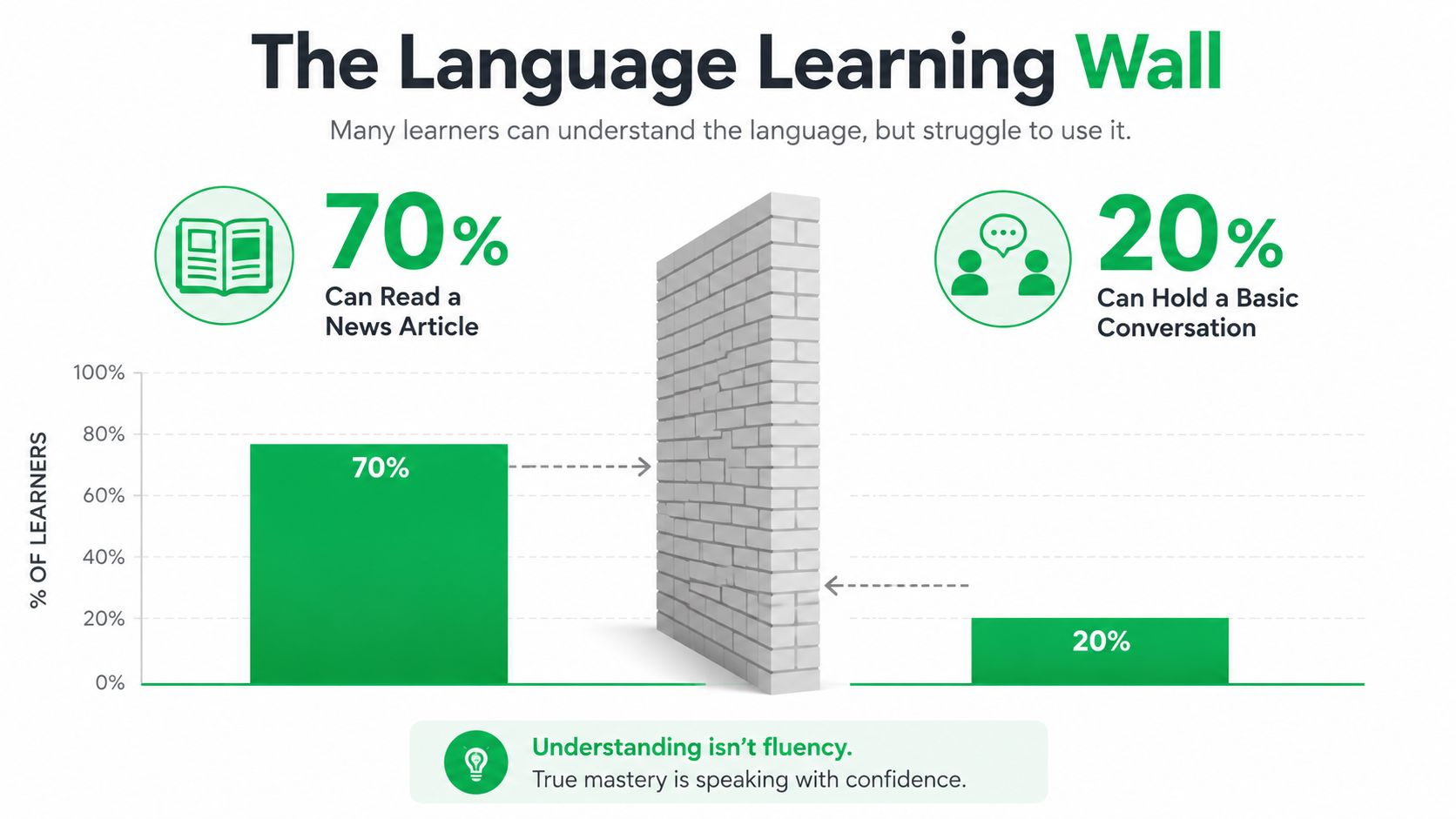
If you've ever opened an Irish lesson, understood the words, and then gone completely blank the moment you had to speak, you're in the right place. That freeze is normal. It's also the exact gap that AI language tutors are trying to close, especially for learners who need more speaking time than a classroom, workbook, or flashcard app can give them.
The promise sounds simple, maybe even a little too simple, unlimited practice, instant feedback, and no fear of judgment. More useful when you look at the details. The strongest tools aren't magical conversation machines, they're systems that help you rehearse real speech, recover from mistakes, and build enough confidence to try again tomorrow.
Table of Contents
- Why AI Language Tutors Are Changing How We Learn
- How AI Language Tutors Actually Work
- The Most Effective Features in an AI Tutor
- Where AI Tutors Excel and Where They Fall Short
- How to Evaluate an AI Language Tutor Before Committing
- Real-World Example How Gaeilgeoir AI Supports Irish Learners
- Your Next Steps to Start Speaking with Confidence
Why AI Language Tutors Are Changing How We Learn
You can read a page of Irish and feel proud, then hear a simple question and suddenly your mind goes quiet. That gap is familiar to many learners, especially adults who have studied on and off for years and can recognize words without being able to produce them under pressure. AI language tutors matter because they give learners a place to rehearse speech before the stakes feel real.
Market forecasts help explain why this shift is happening. One major estimate places the AI tutors market at USD 3.55 billion in 2025 and projects USD 6.45 billion by 2030, while another projects USD 17.7 billion by 2033 (Mordor Intelligence). That growth helps show why language learning is no longer treated as a novelty. The same market study says language learning is the fastest-growing subject segment, and cloud deployment held 71.22% share in 2024, which fits the way many learners now expect to practice, on a phone, in a browser, whenever they have a few minutes.
The Importance of Active Speaking Practice
The strongest AI tutors do more than drill vocabulary. They let learners practice the messy middle of speaking, where the idea is there but the sentence is still forming. That is the part many people need most, because knowing a word is not the same as using it in real time. Tools that feel conversational tend to keep learners engaged because they support confidence, not just recall.
Adoption data points in the same direction. Duolingo is projected to report 12.5 million paid subscribers at the end of Q1 2026, up 21% year over year, and projected revenue of USD 1,037.6 million in FY2025, a 39% increase over FY2024 (LingoBright). Broader industry summaries also report 500 million learners globally using AI tutors in 2025, and AI-powered language-learning platforms with 2.3 million monthly active users growing 40% year over year (LingoBright). The products differ, but the pattern is consistent, learners want more speaking time than traditional apps usually provide.
Practical rule: if a tool only helps you recognize words, it is a study aid. If it helps you answer out loud, it starts acting like a speaking coach.
For Irish learners, that distinction matters. Grammar tables help you understand the language, but confidence comes from using it in the situations you face, greeting someone, ordering food, asking for directions, or handling an oral exam prompt. In Irish, the jump from recognition to speech can feel especially wide, so tools that create low-pressure speaking practice fill a real gap.
How AI Language Tutors Actually Work
A strong AI tutor works like a relay team. One part hears you, one part interprets what you meant, one part speaks back, and one part learns from the exchange so the next round goes better. When those pieces move smoothly, the experience feels close to conversation. When they do not, it feels like waiting for a chatbot to catch up.
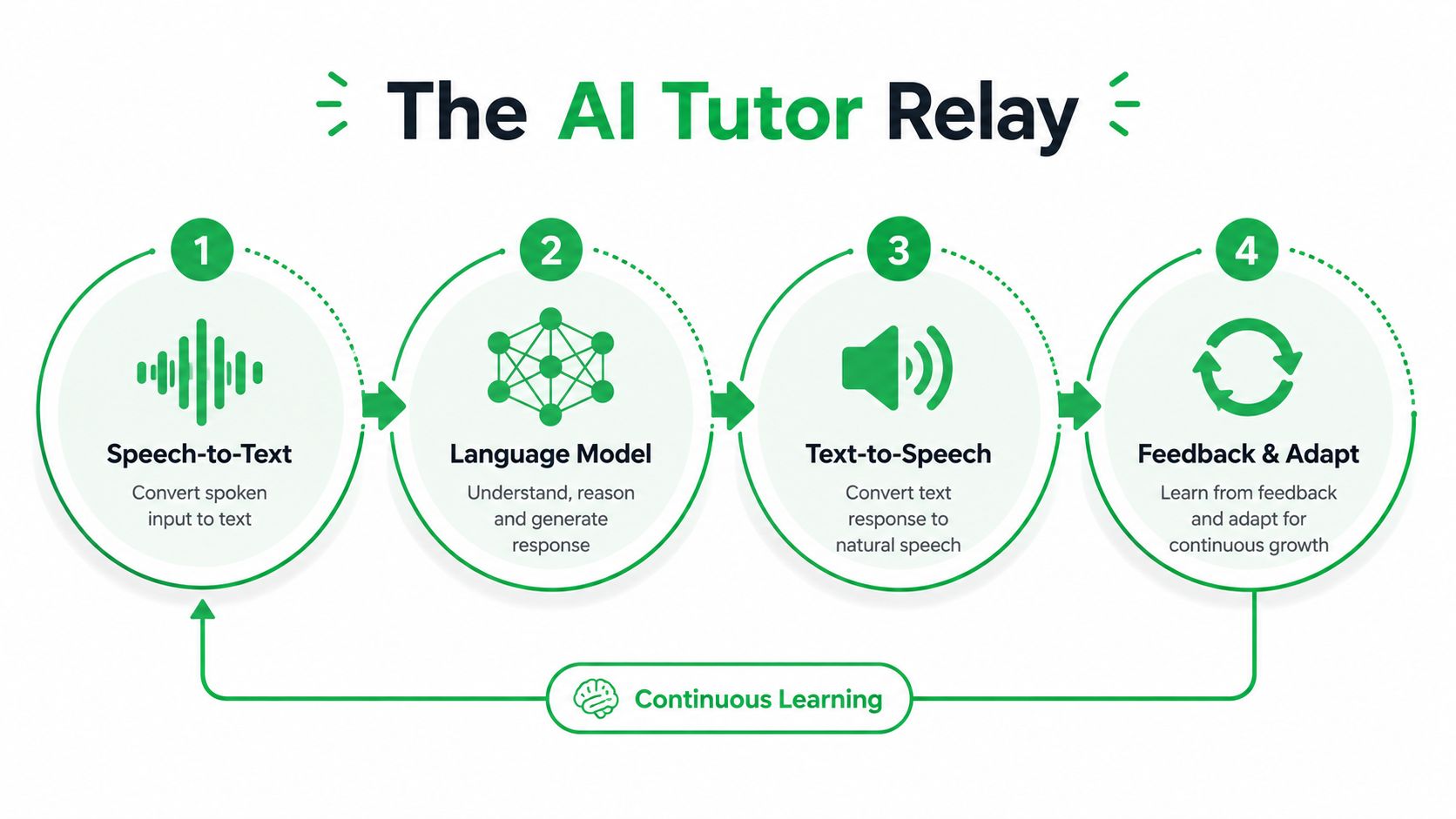
The pipeline usually starts with speech-to-text, which turns your voice into words. Then the language model reasons over your input, decides how to keep the conversation going, and prepares a reply. After that, text-to-speech turns the reply into audio, and a feedback layer handles grammar, pronunciation, or vocabulary support. That sequence sounds simple on paper, but it only works if the handoffs are fast enough to preserve turn-taking. For a closer look at how AI systems support learning over time, see machine learning in education.
Latency decides whether it feels like a conversation
In practice, the whole loop needs to stay around 600 to 800 milliseconds total latency to feel natural (LinguaLive). Once response times drift beyond that, people start feeling the gap. Integrated systems like Gemini Live have been measured around 500 to 700 ms, while GPT-4o-class stacks with separate ASR and TTS often ranged 700 to 1200 ms depending on load and network conditions (LinguaLive).
That is the technical reason some apps feel alive and others feel sluggish. It is not only about how smart the model is. It is about the total budget across audio capture, inference, synthesis, and any correction logic that runs after the answer.
For readers who like the engineering side, a useful comparison is the translation workflow in GPT-4 vs Claude for Django from TranslateBot. Different systems can all produce output, but the user experience depends on how reliably they handle the full loop, not just the headline model name.
The open-source stack matters for the same reason. A reference setup that combines Whisper medium for ASR, Llama 3.1 8B for the tutor brain, and XTTS/SadTalker for voice output and avatars is designed for throughput per dollar, not just benchmark prestige (NLLB). The same source notes roughly 5 GB VRAM for ASR and another 5 GB VRAM for the quantized LLM, which makes near-real-time tutoring realistic on a single consumer GPU.
If you want a plain-language way to think about it, the tutor has to be fast enough to stop feeling like a quiz engine. That is the point where practice starts to resemble speaking.
For teams evaluating platform choices, latency is often the difference between “I'll use this daily” and “I stopped after two tries.” If the audio stalls or the corrections arrive too late, learners stop treating the tool like a partner and start treating it like a form.
The Most Effective Features in an AI Tutor
A learner sitting at a kitchen table at the end of a long day does not need flashy claims. They need a tutor that helps them speak a little more clearly, remember a little more reliably, and try again without feeling stalled. That is the test for an AI language tutor, especially for Irish learners who often need more than polish, they need repeated, usable practice.
Marketing pages often highlight personalization, gamification, and smart automation. Those can help, but only if they support the core learning loop. A good AI tutor should help you speak, remember, correct, and repeat. If the tool only makes lessons feel entertaining, it is not doing enough.
A 2025/2026 review article on generative AI in language classrooms classified GenAI into nine distinct roles, with the most common being feedback provider (n = 42), language learning tutor (n = 26), resource provider (n = 22), and content generator (n = 20), followed by evaluator, affective supporter, conversation partner, interaction facilitator, and cognitive stimulator (Taylor & Francis). That pattern matters because it keeps pointing back to the same teaching tasks, feedback, tutoring, and conversation. From an educator's point of view, those are the features that shape whether practice turns into speaking progress or stays as isolated app activity.
What deserves your attention first
The first feature to look for is pronunciation and speech feedback. If the system cannot hear your accent well, or if it gives praise without explaining the mistake, it teaches confidence without accuracy. Learners tend to relax when feedback is clear, specific, and immediate, because they can correct the next attempt instead of guessing what went wrong. A tutor also needs to adjust the difficulty of its prompts, because a beginner who needs slow, supported turns should not be pushed into advanced role-play on day one.
A 2025 systematic review on machine-based language teaching found that AI tools such as ChatGPT, Grammarly, Duolingo, Wordtune, and Pigai were used across drafting, practice, and assessment phases, and they supported writing, speaking, listening, vocabulary, grammar, and reading comprehension (ERIC PDF). The same review reported that AI feedback improved language accuracy while building confidence and encouraging active participation (ERIC PDF). Read that as a teaching signal, not a product slogan. Feedback works when it helps the learner notice a gap, try again, and hear the correction in context.
Vocabulary review deserves the same level of attention. A tool that helps you review words at the right time is more useful than one that shows a long list of terms. If you want a practical model for that, build a spaced repetition vocabulary system before you judge any platform's review loop. The point is simple, words stick when the learner meets them again after they have started to fade, not when the app just displays another progress badge.
What helps, but should not carry the whole experience
Scenario-based practice has real value because it turns isolated words into usable speech. Exam preparation also helps learners who need structured prompts and predictable speaking topics, especially when pressure is part of the task. Both features can support learning, yet neither one is enough if the tutor cannot respond naturally to mistakes, ask follow-up questions, or keep the exchange moving in a way that feels like conversation.
The British Council review identified five AI use areas in English teaching and learning, developing speaking, writing, and reading skills, supporting pedagogy, and enabling broader instructional support (British Council). That gives a useful classroom lens. AI tutors are not one thing. They can serve different parts of the learning process, and the right mix depends on whether the learner needs confidence, accuracy, or exam readiness. For that reason, a platform with personalized learning paths is only useful when the path changes what the learner practices, not just the screen they see.
Where AI Tutors Excel and Where They Fall Short
A learner who can rehearse a phrase five times without embarrassment often arrives at live conversation with less tension. That is one of the clearest places AI tutors help. They are steady, patient, and available whenever a student wants another try, which matters for beginners who need time before speaking feels natural.
The research base is also larger than many marketing pages suggest. A 2026 systematic review in a Taylor & Francis journal examined 155 studies and found that 79.5% reported positive language-learning outcomes from AI use (Taylor & Francis). That does not mean every platform works equally well, but it does show that AI support has been studied across speaking, writing, vocabulary, and grammar, not just one narrow skill (Taylor & Francis).
The strengths are real, but narrow
AI is useful for low-stakes practice, quick corrections, and a conversation partner that does not rush or interrupt. For many learners, that is enough to get the first sentence out loud. In Irish learning, that can mean moving from silent recognition of a phrase to saying it, even if the sentence is still rough.
It also helps with repetition without fatigue. A tutor can ask for the same greeting, the same direction, or the same self-introduction again and again, which is hard to get from a busy human partner. Learners often need that kind of patient loop before confidence starts to build.
Human conversation still matters for rhythm, humor, and the cultural details that do not show up in a clean transcript.
Independent education coverage keeps drawing the same line. AI tutors are strongest for repetition and practice, while human interaction remains central for fluency, culture, and nuanced communication (EdWeek). A useful way to read that is simple, an AI tutor can prepare you to speak, but it cannot fully stand in for speaking with another person.
Where the ceiling appears
Pronunciation feedback can still miss the mark, especially when a platform sounds confident even while it misreads speech. Cultural pragmatics are another weak point. Knowing the words is not the same as knowing when to soften a phrase, when to be formal, or how to sound natural in context. Those are the places where a human tutor or conversation partner still has the advantage.
Irish learners feel this gap quickly. A system may help with a phrase like a flashcard, yet still fail to explain why one wording fits a greeting and another sounds off in the same situation. That is the difference between memorizing a line and using it well.
A sensible learning setup treats AI as a practice accelerator, not a substitute for every other method. That fits the hybrid pattern now emerging in 2025 and 2026, where AI tutors are used to build repetition and confidence before learners move into authentic conversation (EdWeek). For learners of Irish, that usually means letting the tutor handle drills, corrections, and short role-plays, while human conversation still carries the parts that require timing, tone, and real social judgment.
How to Evaluate an AI Language Tutor Before Committing
A free trial should feel like a test drive, not a sales demo. If a platform can't handle your voice, your pace, and your real use case in the first conversation, it probably won't improve much after that. That's especially true for learners who need speaking support in Irish, where every minute of useful feedback matters.
Start with one simple prompt, then push the system a little. Ask for a greeting, a short role-play, and a correction of your mistakes. If the tool handles those well, then ask it to keep the conversation going for a few turns without turning into a quiz.
What to test in the first session
- Accent recognition: Say a normal sentence in your own voice, not a studio version of the language.
- Correction quality: Check whether feedback is specific, or just a vague “good job.”
- Conversation flow: See whether it keeps asking natural follow-up questions, or drops the thread.
- Scenario realism: Try something practical, like ordering food, asking directions, or introducing yourself.
- Progress tracking: Look for a way to review mistakes instead of losing them after the session ends.
If the tutor can't do these things well, the rest of the interface won't save it.
Pricing and privacy deserve a direct look too. Voice tools collect more sensitive data than text-only apps, so you should read the privacy policy before you record long sessions or personal content. If the subscription model is hard to understand, or the limits only become clear after you've already signed up, that's a warning sign.
For learners preparing for formal tests, it also helps to compare platforms against exam-specific needs. A useful benchmark is the list of top AI TOEFL practice tools from Reach120, because it shows how specialized practice tools are usually framed around one goal rather than promising to do everything.
If a platform matches your style, you'll usually notice it quickly. The conversation feels steady, the corrections are understandable, and you come away wanting to try again tomorrow. If you feel like you're fighting the interface, keep looking.
Real-World Example How Gaeilgeoir AI Supports Irish Learners
Irish learners often don't need more theory. They need a place to speak without freezing. Gaeilgeoir AI is built around that problem, with guided, real-world conversation practice that helps beginners start speaking from day one and keeps the pressure low enough for repetition to feel manageable (Gaeilgeoir AI).
The platform's immersion-first approach uses the 1,000 most-used Irish words as a foundation, which gives learners a practical starting point instead of a giant word list that never turns into speech. Any word on the platform can be clicked for translation, and saved items can go into a personalized study list, which helps when you hear a phrase in context and want to keep it. That kind of immediate support is useful for learners who get stuck on vocabulary before they ever get to sentence building.
What that looks like in practice
A beginner can use the platform for everyday situations like ordering food or asking for directions, then move into targeted preparation for the Leaving Cert Irish oral exam. The practice isn't abstract. It's anchored in the kinds of exchanges people need, which makes the transition from study to speaking feel less dramatic.
The product also includes gamified progress tracking, with points, multipliers, and leaderboards designed to keep practice regular. That matters for learners who don't always have a set study schedule. Consistency is usually the hidden problem, not intelligence.
A learner's confidence often changes first, then fluency follows later.
That pattern shows up in the kind of testimonials language learners share after they've had enough repetition to stop overthinking every sentence. The value isn't that the AI is a substitute for a human. It's that it gives people a place to rehearse until speaking Irish feels less like a performance and more like a habit.
The platform also offers a practical option for learners who want AI support without losing focus on the language itself. Instead of chasing flashy features, it keeps the attention on speaking, comprehension, and exam readiness. For Irish specifically, that's the right tradeoff.
Your Next Steps to Start Speaking with Confidence
Start with one goal, not ten. If you want to speak more confidently, pick a simple routine, five to ten minutes of AI conversation a day, plus one real-world use case each week, like a short voice note, a tutor session, or a conversation with a language partner. The goal is to make speaking familiar before it feels flawless.
Use your first session to lower the pressure. Ask for a greeting, a short self-introduction, and a role-play tied to your life. If you're learning Irish, try a prompt about ordering in a café, asking directions, or introducing yourself at a class or meetup.
Keep the expectation realistic. The first gains usually show up in comfort, not mastery. Confidence grows when the tutor helps you speak, correct, and repeat without making the process feel like a test.
If you want a place to begin, try a platform that gives you guided conversation, pronunciation support, and everyday practice instead of just more drills.
Gaeilgeoir AI gives Irish learners guided speaking practice, pronunciation support, and scenario-based conversations built around real situations. If you're ready to turn passive Irish knowledge into active speech, visit it and try the free trial for yourself.