
AI in Language Learning: Tools, Tips, and Real Results

You know more Irish than you can use. You've studied words such as caife, bainne, and go raibh maith agat, but when someone speaks to you in real time, the vocabulary seems to disappear. You recognize a phrase on a page, yet ordering a coffee, introducing yourself, or asking for directions still feels like a high-pressure test.

That gap between remembering language and using language is where AI can help. It can give you a patient conversation partner, immediate pronunciation practice, and exercises that respond to your mistakes. Used thoughtfully, AI in language learning doesn't replace teachers, native speakers, books, or communities. It gives you more opportunities to prepare for those human interactions.

Table of Contents

Why Language Learning Feels Hard (And How AI Helps)

A learner walks into a café in Galway with a short order written on a phone. They know the words. They've reviewed them several times. But when the server asks a follow-up question in Irish, the learner freezes, switches to English, and leaves feeling that studying hasn't worked.

This reaction is normal. Vocabulary lists build recognition, but conversation demands several skills at once. You need to retrieve a word, arrange it in a sentence, pronounce it clearly, understand the response, and decide what to say next. A textbook can explain each part, but it usually can't respond to your exact hesitation in the moment.

A young woman with red hair standing at a coffee shop counter holding an order list.

Turning private practice into active language

An AI conversation partner lets you rehearse that café scene repeatedly without embarrassment. You might type or say, Ba mhaith liom caife, le do thoil, then ask the tool to reply as a server. If you struggle, it can slow the exchange, translate one phrase, or offer a simpler response instead of ending the conversation.

That low-pressure repetition matters because learners need to make mistakes before they can make language automatic. AI can also ask you to repair an answer rather than just reveal the correct one. For example, after you write an incorrect Irish sentence, ask for a hint first, then try again before viewing the explanation.

Personalization is central to this approach. If you're unfamiliar with the idea, this practical guide to what is adaptive learning explains how learning systems can adjust content to a learner's performance, pace, and needs.

Practical rule: Use AI to create more chances to speak, not to avoid speaking with people.

The most useful shift is simple. Instead of asking, “How do I memorize this list?” ask, “What real situation do I want to handle?” Then use AI to practise the words, questions, and likely replies connected to that situation.

The Core AI Technologies Behind Modern Language Apps

Modern language apps combine several technologies, and each solves a different learning problem. Understanding those roles makes it easier to choose tools instead of treating every AI feature as if it does the same job.

Four tools with four jobs

Large language models work like conversation partners who don't tire of repetition. You can ask for a beginner-level Irish dialogue about meeting a friend, then request a more natural version, a slower version, or a version that uses vocabulary you already know. The model generates responses from patterns in language, so you should still check important explanations and culturally sensitive wording.

Speech recognition acts like a pronunciation coach. You speak into a microphone, and the system compares the sound it receives with expected language patterns. It can help you notice that recognising sláinte is different from producing it clearly in a spoken exchange. Recognition isn't identical to a qualified teacher's ear, but it gives you a practical feedback loop between attempts.

Text-to-speech turns written Irish into listening material. A learner can hear a phrase, read it, hide the text, and try to identify it again. This is especially useful when you need exposure to connected speech rather than isolated vocabulary.

Adaptive algorithms serve as the app's learning planner. They track what you practise, identify patterns in your responses, and bring back material that needs attention. That's the basic principle behind spaced repetition for language learning, where review timing helps you revisit words before they disappear from memory.

Choosing tools by the task

A conversational model may be flexible, but it might not provide a structured course. A dedicated app may offer clearer progression, while a specialist service may focus on a particular language, exam, or community. Even tools outside language study, such as the LunaBloom AI app, can illustrate a wider point about AI products. The interface matters less than whether the system gives you useful feedback and a clear next action.

For Irish, check whether a platform supports the kind of language you need. Look for pronunciation audio, scenario practice, explanations that suit your level, and opportunities to produce language yourself. A tool that only translates sentences may help you understand a message, but it won't necessarily help you form your own response.

You can also explore how domain-specific language models differ from general-purpose systems. Specialization can make a tool more relevant to a defined subject, audience, or language context, although learners should still evaluate its accuracy.

How to Build an AI-Powered Study Routine

The best routine gives every tool a narrow job. Don't ask one chatbot to be your entire course, dictionary, pronunciation coach, and examiner. Create a small loop that moves from understanding to practice to recall.

Start with a repeatable daily cycle

Begin with a short review of saved words and phrases. Next, practise one realistic exchange, such as ordering food or asking Cá bhfuil an stáisiún? Finally, speak a few answers aloud without looking at the text. This sequence makes recognition serve production.

Use prompts that define the situation and your level. Write, “Act as a patient café server. Use beginner Irish. Ask one question at a time. Don't translate unless I ask.” If the exchange is too difficult, reduce the complexity rather than abandoning the conversation.

Give each day a purpose

A simple weekly pattern might look like this:

  1. Conversation day: Role-play a greeting, introduction, or café order. Ask for one correction at a time.
  2. Pronunciation day: Listen to short phrases, record yourself, and repeat them with attention to rhythm.
  3. Grammar day: Take sentences you've tried to say and ask for a plain-language explanation of the pattern.
  4. Comprehension day: Listen to a short Irish passage, identify familiar words, and summarise its meaning.
  5. Review day: Revisit your saved vocabulary without immediately checking the translation.
  6. Scenario day: Combine the week's language in a travel, work, family, or school situation.
  7. Human connection day: Use what you prepared in a class, conversation group, message, or exchange with another learner.

You don't need to make every session long. Consistency gives the system better information about your needs and gives your memory more chances to retrieve language.

Increase difficulty carefully

Beginners should request short turns, familiar vocabulary, and translation only after an attempt. Intermediate learners can ask for natural alternatives, follow-up questions, and corrections grouped by importance. At every level, keep a record of mistakes that recur, then turn those mistakes into the next practice session.

A useful test: After an AI session, can you say something useful without the screen? If not, spend less time reading explanations and more time answering aloud.

Comparing AI Language Learning Platforms

Different tools suit different moments in a learner's day. A general chatbot gives you freedom, but you must design the lesson and judge the response. A dedicated app gives you more structure, while a specialist platform may make its scenarios, vocabulary, and feedback more relevant to a specific language.

Tool Type Best For Key Feature Pricing Range
General conversational AI Flexible role-play and explanations Custom prompts and open-ended dialogue Free to paid, depending on the service
Dedicated language app Learners who prefer a guided path Lessons, review systems, and built-in practice Free tiers to subscription plans
Speech-focused AI tool Pronunciation and spoken confidence Voice interaction and speech feedback Varies by product and plan
Specialist language platform Learners targeting a particular language or goal Language-specific scenarios and study content Varies by platform and access level

Match the tool to the problem

Choose general conversational AI when you want to rehearse an unusual situation, such as explaining a hobby or preparing for a family visit. Choose a dedicated app when you need reminders, progression, and regular review. Choose a speech-focused tool when you already know what you want to say but need more confidence saying it aloud.

For Irish learners, specialization can make the practice feel closer to real use. A platform designed around Irish conversations may include everyday situations, pronunciation support, adaptive quizzes, and exam-oriented practice that a general chatbot won't provide automatically.

No platform removes the need for judgment. Before committing, test whether the tool corrects errors clearly, accepts beginner-level answers, and helps you understand why a phrase works. Also check whether it encourages you to produce language rather than just tap through translations.

What Research Tells Us About AI and Language Acquisition

The evidence is encouraging, but it doesn't support the idea that every AI feature automatically produces learning. A meta-analysis of AI-guided individualized language learning synthesized 61 samples from 17 research projects involving 8,282 learners and reported a strong within-group effect of d = 1.18 for samples containing 2,262 learners, while also finding small-to-medium effects on linguistic outcomes more broadly (meta-analysis of AI-guided individualized language learning). The practical lesson is that individualized practice, feedback, and adaptive instruction are promising uses of AI.
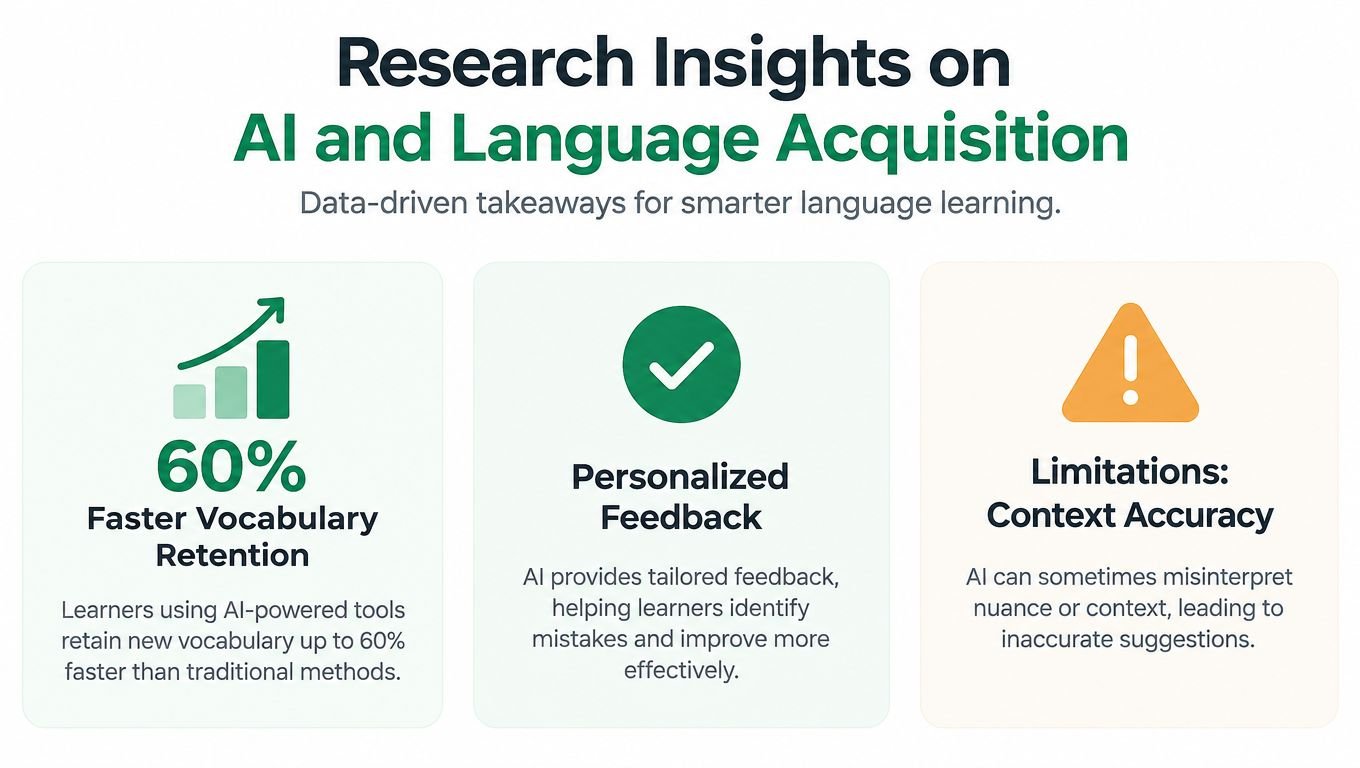
An infographic titled Research Insights on AI and Language Acquisition highlighting vocabulary speed, personalized feedback, and limitations.

Where the evidence is strongest

A 2026 systematic review selected 30 eligible experimental studies from 2014 to 2023 and found that university students were the most frequently studied learners, while speaking and writing were the most common target skills (systematic review of AI for language learning). That fits what many current tools do well: prompting you to produce an answer, correcting written language, and supporting spoken rehearsal.

A separate 2026 meta-analysis synthesized 51 studies and 175 independent effect sizes, offering a broad evidence base for examining measurable learning impacts rather than relying only on individual anecdotes (meta-analysis on generative AI in second and foreign language learning).

The missing balance

The research base remains uneven. A systematic review of 18 studies found that writing, grammar, speaking, and vocabulary received the most attention, while reading and listening remained underexplored (systematic review of AI and language learning skills). A broader 2026 scoping review examined 272 empirical studies from 2005 through 2024 and found that 78.3% of publications, or 213 studies, appeared in 2023 and 2024. It also identified chatbots in 44.1% of studies and commercial tools in 71% of recent research (twenty-year scoping review of AI in language learning).

That acceleration shows strong interest, not a complete answer. Build listening and reading into your routine deliberately, and treat AI feedback as useful guidance that still deserves careful evaluation.

Navigating Privacy, Accuracy, and Over-Reliance Risks

An AI response can sound confident and still be wrong. This matters in language learning because a learner may not yet know enough to challenge an unnatural translation, an incorrect grammatical explanation, or a phrase that fits one context but not another.

Before sharing practice data, read the tool's privacy settings and terms. Avoid entering personal information, private messages, school records, or sensitive conversations just to receive a language correction. You can usually replace names and identifying details with neutral examples.
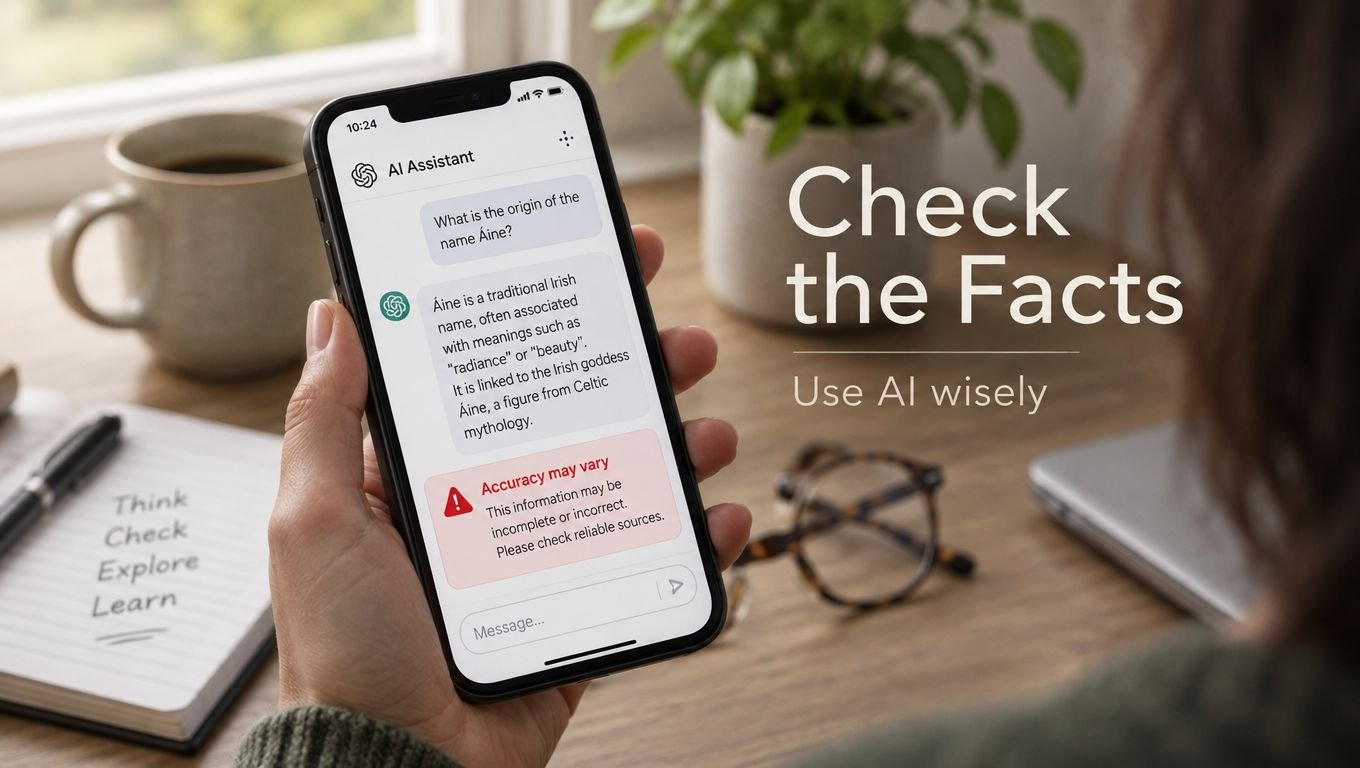
A person holding a smartphone showing an AI chat interface with a warning to check facts.

Keep your own judgment active

Use a three-part check when an answer feels uncertain:

  • Compare: Check the phrase against a trusted dictionary, course resource, teacher, or native speaker.
  • Contextualize: Ask whether the wording is formal, informal, regional, old-fashioned, or suitable for the situation.
  • Retrieve: Close the tool and try to use the phrase in a new sentence.

Research on generative AI use in language learning has raised concerns about over-reliance, inconsistent feedback quality, cultural adaptability, digital equity, and limited long-term evidence. A 2025 student survey also found that use increased between 2023 and 2025 while evaluations of output quality became more moderate over time (research on student use and concerns around generative AI for language learning).

The danger isn't using AI. It's allowing AI to do every difficult part of learning for you.

Ask for hints before answers. Speak before reading a model response. Keep some sessions screen-free, and use human conversation to test whether your knowledge works under natural pressure.

Getting Started with AI for Irish Language Learning

Irish is a strong example of why language technology should support participation, not just translation. A beginner may want to practise Dia duit, describe where they live, order lunch, or ask for directions. A heritage learner may want a gentle way to reconnect with family language. A Leaving Cert student may need focused preparation for oral topics and more confidence answering aloud.
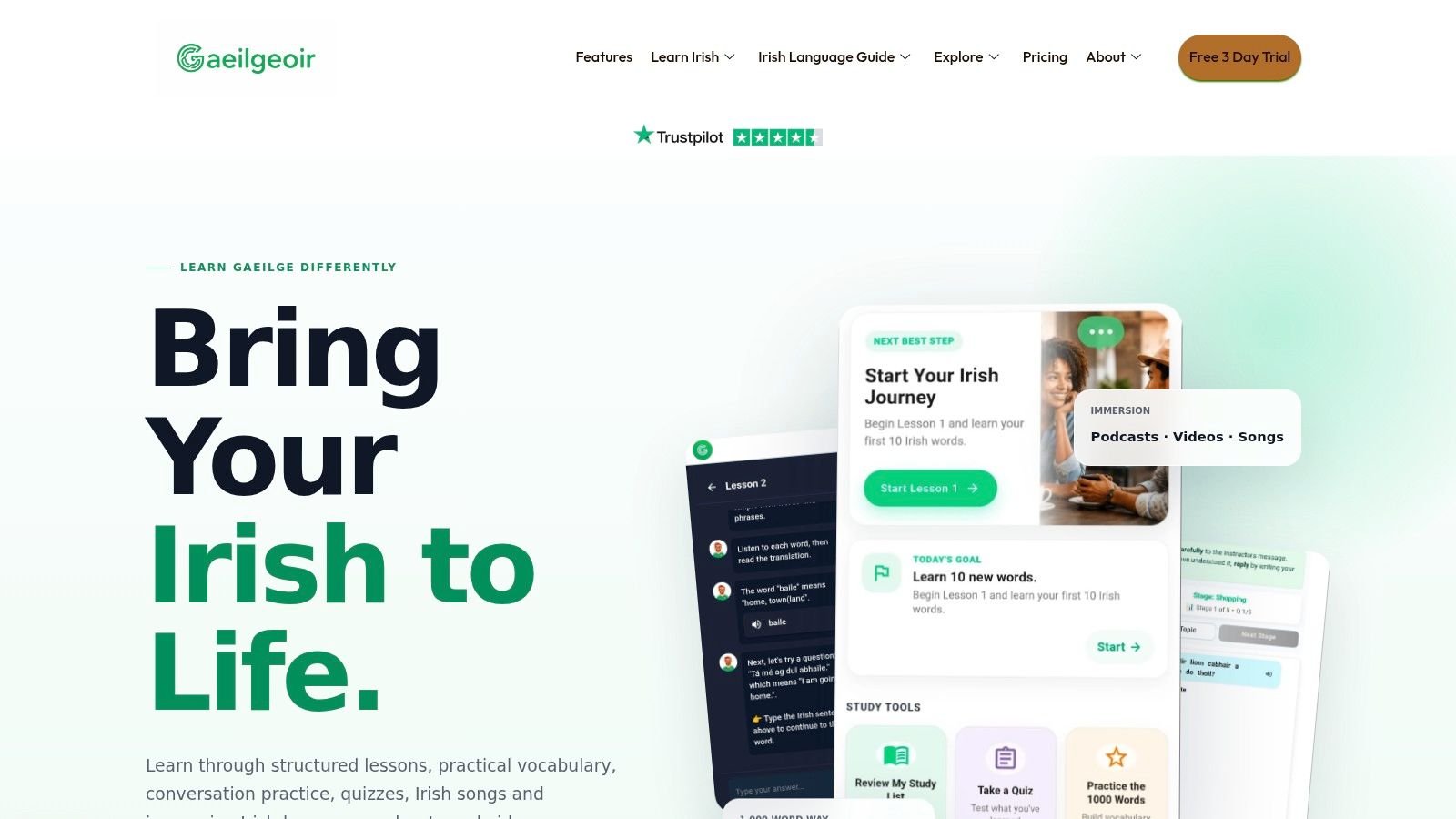
Screenshot from https://gaeilgeoir.ai

Gaeilgeoir AI provides guided, real-world Irish conversation practice for beginners through intermediate learners. Its activities include pronunciation support, adaptive quizzes with immediate feedback, and scenario-based practice for social interactions, work, travel, ordering food, and asking for directions. Learners can click words for translations and save them to a personal study list, which turns an unexpected vocabulary gap into a later review task.

That design supports a useful progression. First, you meet a phrase in context. Then you hear or produce it. Next, you retrieve it in a quiz or conversation. Finally, you try it with another person. AI can make the first three steps easier to repeat, but human interaction gives the language its humour, flexibility, cultural meaning, and emotional weight.

Use Irish for a real purpose

Choose one situation that matters to you this week. If you're preparing for travel, practise a greeting, a food order, and a request for directions. If you're studying for the Leaving Cert, rehearse likely oral themes and ask for follow-up questions rather than memorizing one fixed script. If you're returning to Irish through family or heritage, build conversations around names, places, memories, and everyday routines.

For a broader starting point, learn Gaelic language with AI offers a way to connect guided technology with active language practice. Keep your sessions purposeful, and take useful phrases into class, conversation groups, messages, or family discussions.

The video below can help you see how an AI-supported Irish learning experience fits into a practical study routine.

AI works best as a bridge between study and use. It gives you a private place to make mistakes, but your goal should always be greater participation in the living language, whether that means speaking with a teacher, joining a local group, preparing for an exam, or starting a short conversation with someone who welcomes your effort.


Gaeilgeoir AI offers guided Irish conversations, pronunciation support, adaptive quizzes, saved vocabulary, and scenario practice for everyday situations and Leaving Cert preparation. Visit Gaeilgeoir AI to choose a practical Irish goal and start turning study time into spoken language.

Gamified Language Learning How It Works and Why It Works

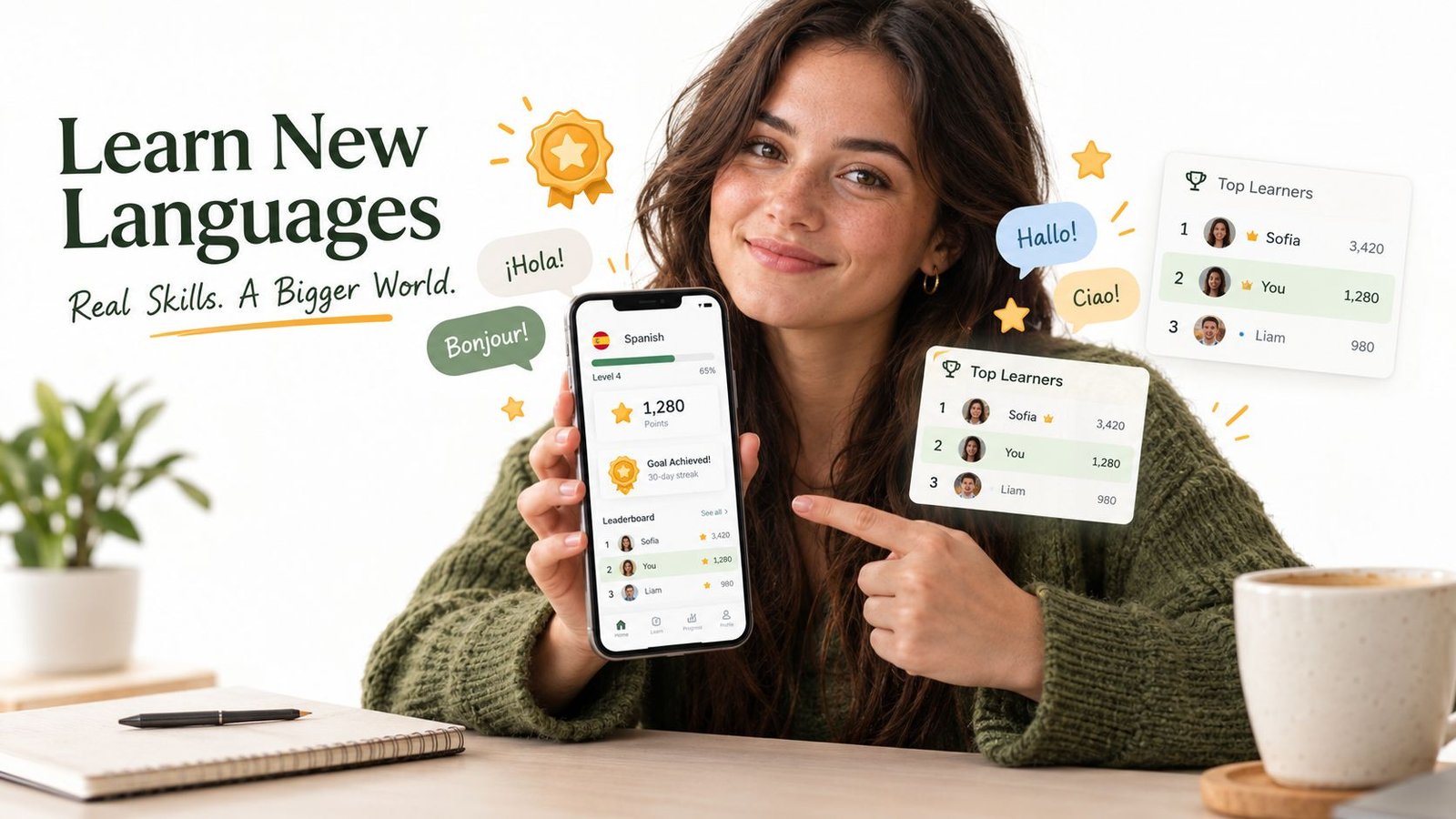
You open a language app with good intentions. The first session feels easy, the points climb, and a bright progress bar suggests that fluency is finally within reach. Then work gets busy, one day disappears, and the next time you open the app, the missed lesson feels less like an invitation and more like evidence that you've failed.

That cycle isn't a character flaw. Language learning competes with work, family, fatigue, and the simple difficulty of remembering what to practise next. Gamified language learning can help when it turns an intimidating long-term goal into a sequence of visible, manageable actions. The important question isn't whether an app has badges or streaks. It's whether those features help you return, remember, understand, and eventually use the language with another person.

A woman sits at a desk with a phone, coffee mug, and notebook, learning Irish language skills.

This guide treats gamification as behaviour design, not a fun coating. You'll see how the practice loop works, why consistency matters for memory, which mechanics deserve scrutiny, and how to evaluate a platform through Gaeilgeoir AI's Irish-learning approach. For ideas you can adapt across digital courses, this overview of eLearning gamification strategies offers useful context on designing rewards around learning behaviour rather than decoration.

If your immediate problem is finding a repeatable routine, a short daily language practice session can give your day a clear starting point. The aim is not to study perfectly. It's to make returning easy enough that practice survives ordinary life.

Table of Contents

Why Gamified Language Learning Keeps You Coming Back

A beginner named Aoife might decide to learn Irish on a Sunday evening. She studies greetings, recognises a few familiar sounds, and finishes with a satisfying score. On Monday, she's busy. Tuesday becomes Wednesday, and the vocabulary begins to blur. By the weekend, the original excitement has been replaced by guilt, so she starts again with a new burst of energy.

A well-designed gamified system changes the decision Aoife has to make. Instead of asking, “Can I become fluent today?”, it asks, “Can I complete this small speaking exercise?” That smaller question reduces friction. A point, a completed task, or a visible step on a progress path gives immediate evidence that the session is finished, even though the larger language goal remains far away.

Practical rule: A reward should mark useful practice, not replace it.

The distinction matters because gamification can solve a specific problem very well: study consistency. It can remind you where to continue, show what you've completed, and make a return visit feel rewarding. It can't automatically create pronunciation accuracy, conversational flexibility, or the ability to understand a fast speaker. Those abilities still require meaningful language tasks.

The historical evidence supports this broader view. A 2023 systematic review of gamification in EFL and ESL instruction found that research covered vocabulary, grammar, speaking, reading, writing, college English, and listening, rather than treating gamification as a tool for one isolated activity. Vocabulary represented 27.6% of the studies, grammar 20%, speaking and reading 15% each, writing 10%, college English and listening 7.5% each, with other categories making up 12.5%.

That distribution shows a field that developed around core language practice. It also gives Irish learners a useful perspective. Whether you're reconnecting with family heritage, preparing for the Leaving Cert oral exam, or starting from zero, the app should help you move from recognition to active use. The game layer earns its place when it keeps you practising the skills you want.

How Gamified Language Learning Actually Works

Gamification applies selected game-design elements to a non-game activity. In language study, that usually means giving structure to tasks through goals, feedback, progress signals, and rewards. It doesn't mean turning every lesson into entertainment or pretending that a score equals fluency.

Gamified language learning is a practice system that uses game mechanics to influence study behaviour and support learning.

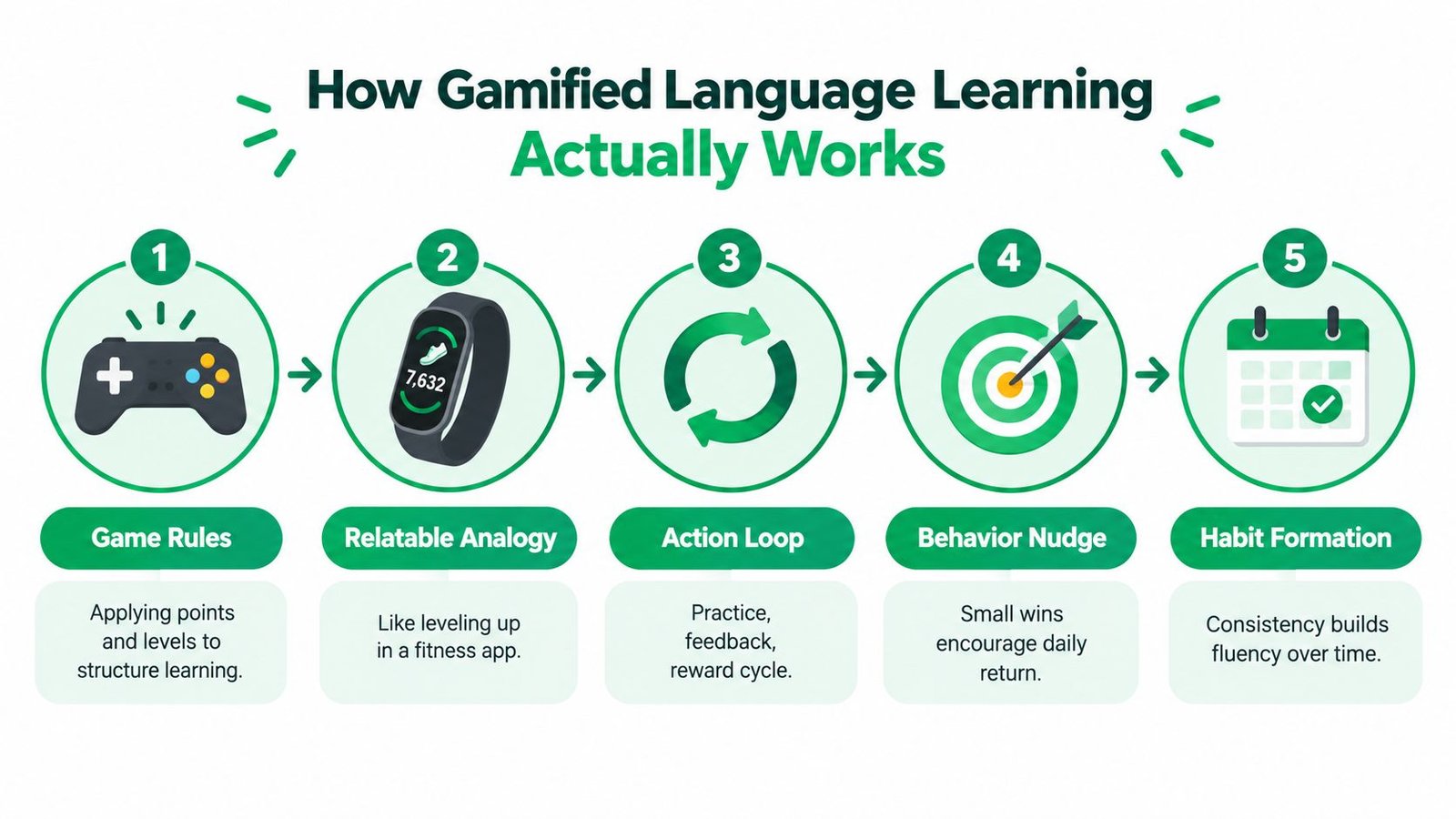
A fitness tracker provides a useful analogy. The tracker doesn't make your body stronger by displaying a ring. It makes activity visible, gives you a target, and helps you notice whether you're returning regularly. Language apps use a similar pattern. A completed listening task becomes progress, a correct answer creates feedback, and a series of sessions forms a routine.

A five-step infographic illustrating how gamified language learning works using icons for game rules, progress, loops, and habits.

The practice loop

The basic loop has three parts:

  1. Challenge: You meet a task that's small enough to attempt, such as choosing a phrase, repeating a sentence, or responding to a dialogue.
  2. Feedback: The platform tells you what worked and what needs another attempt.
  3. Reward: You receive a progress signal, such as points, a completed quest, or movement toward a milestone.

The loop becomes useful when the next challenge follows naturally from the last one. If you miss a word, the system should bring it back in a helpful way. If you master a simple item, the next task should ask you to use it in a slightly richer context. That relationship between action and response is more valuable than a decorative animation.

Reviews of gamified language learning consistently identify points, leaderboards, badges, feedback, quizzes, and progress bars as common mechanics. A 2024 synthesis in Frontiers in Education notes that leaderboards and rewards are among the most frequently used elements, with these features used to support engagement and vocabulary retention.

The learner's experience should therefore feel less like collecting virtual objects and more like following a trail. You complete a task, understand the result, and know what to do next. Over time, those small prompts can make study more automatic. But the trail must lead somewhere real, such as recalling a phrase without help or using it in a conversation.

The Science Behind Motivation and Memory

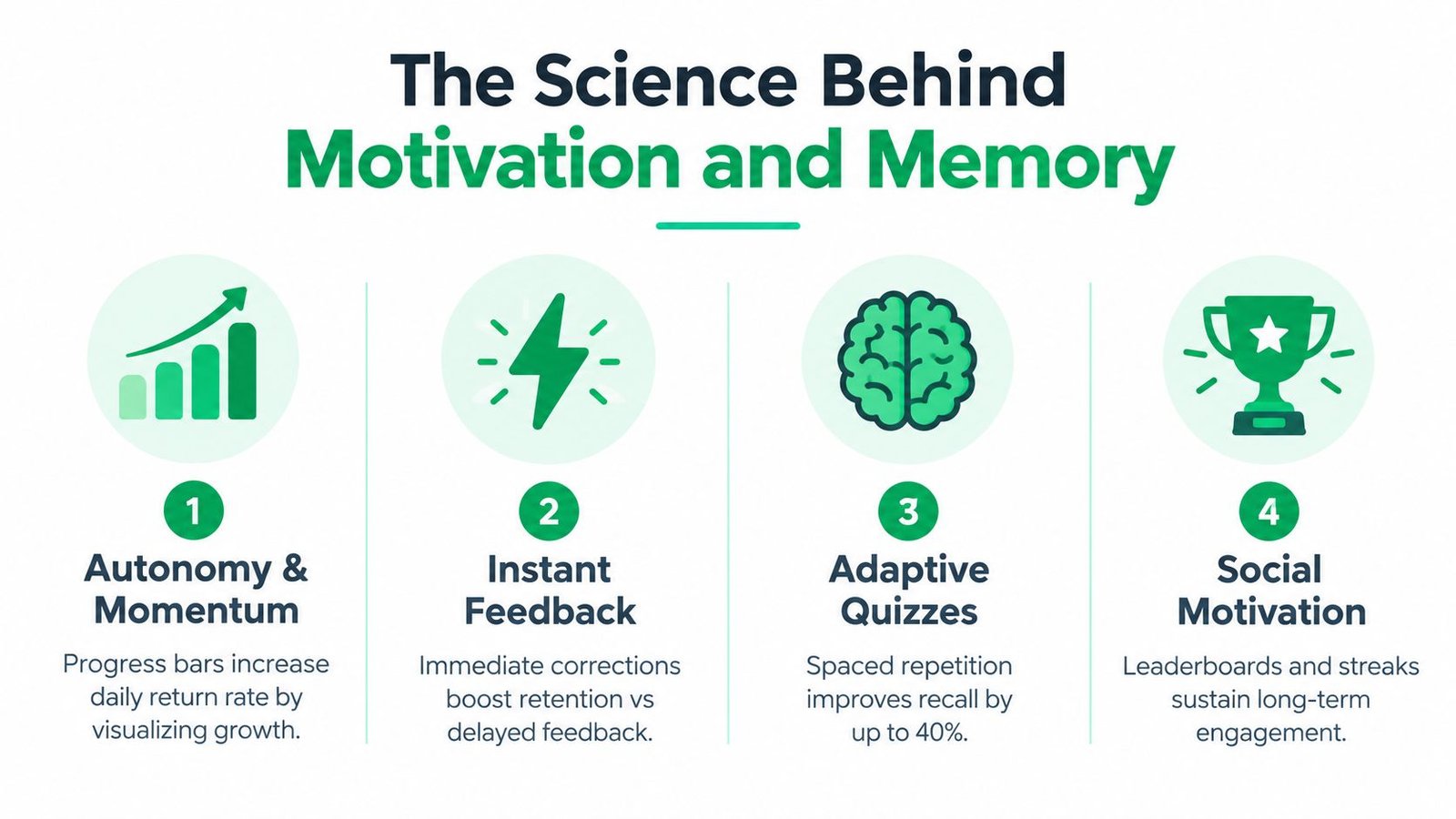
Gamification supports learning through two connected routes. First, it makes behaviour easier to repeat. Second, it can organise practice so that memory receives useful retrieval opportunities. Neither route works just because an app feels playful.

A progress bar gives an invisible process a visible shape. Language improvement often arrives gradually, so learners may not notice change from one day to the next. A completed lesson, a growing review list, or a milestone can provide momentum without claiming that the learner has mastered everything in that category.

Instant feedback adds another layer. When you answer incorrectly and immediately see the correction, you can connect the mistake with the target form while the task is still active in your mind. Adaptive quizzes can then adjust what appears next, giving familiar items less attention and bringing uncertain ones back for further retrieval.

An infographic detailing four principles of gamified language learning including progress tracking, feedback, spaced repetition, and leaderboards.

Consistency can matter more than intensity

A study published in Technology in Language Teaching & Learning followed a gamified vocabulary group over 12 weeks. The gamified learners completed a lower median number of tasks per active study day, 82.11 versus 104.76 for the non-gamified group, but they studied on more days and completed a similar total workload, 2228.50 versus 2313.00 tasks. The difference in study distribution was statistically significant at p = .021, and the gamified group showed greater vocabulary knowledge gains from pretest to posttest at p = .03. These figures are reported in the study available through ERIC.

The lesson isn't that every learner needs a leaderboard. It's that smaller sessions distributed across more study days can produce a different learning pattern from occasional heavy sessions, even when the overall workload is similar. Gamification helped shape when learners studied, not merely how much work they completed.

Spaced repetition makes this pattern more deliberate. In one L2 mobile-assisted study, correctly answered items move through lengthening review intervals, with examples of 10 days, then 2 weeks, then 3 weeks. An incorrect answer resets the item for same-day retesting before the longer spacing begins again, as described in this study of mobile-assisted L2 learning.

For a practical explanation of how reward systems can support students without turning study into pressure, the Kohru motivation guide for students provides a useful complementary perspective. The healthiest expectation is modest but powerful: gamification can help you return, retrieve, and respond to feedback. It can't do the speaking for you.

Core Mechanics That Make Practice Stick

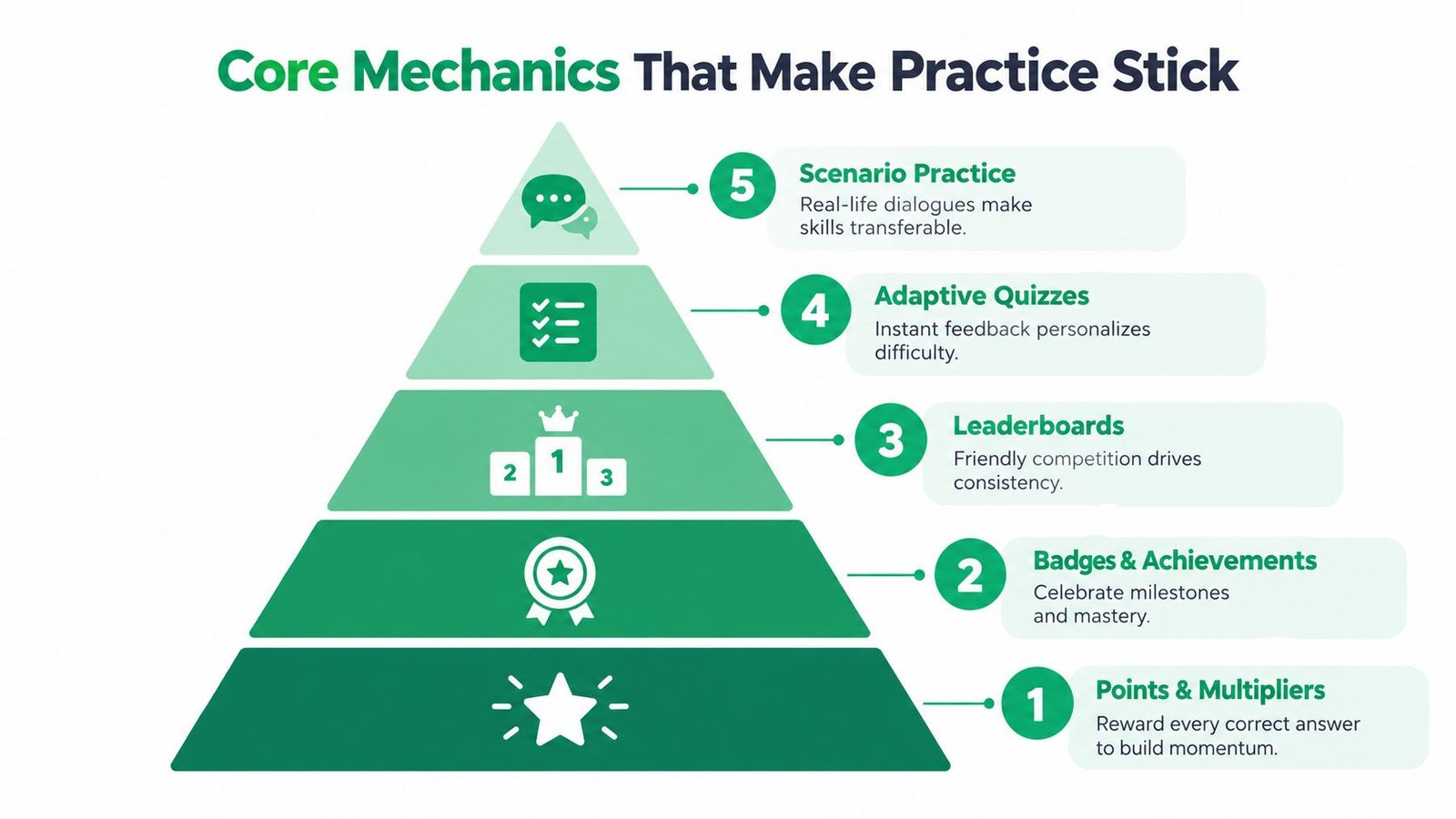
The mechanics below don't all perform the same job. Points can encourage completion, while scenario practice tests whether you can transfer a phrase beyond the quiz screen. A platform becomes educationally valuable when its rewards point toward stronger language behaviour.

A five-level pyramid infographic illustrating gamified mechanics to help make language practice stick and more effective.

Mechanic Primary Learning Job Watch For
Points and multipliers Mark effort and provide momentum Rewards for tapping through without recall
Badges and achievements Recognise milestones and completed goals Collection without meaningful review
Leaderboards Add optional social accountability Pressure that favours speed over accuracy
Adaptive quizzes Revisit weak areas and deliver feedback Repeated guesses with little explanation
Scenario practice Transfer language into realistic use Dialogue that never requires independent response
Progress tracking Make a long journey visible A score that measures activity rather than ability

Start with useful friction

Points work best when they follow a meaningful action. Speaking aloud, recalling a phrase, identifying a word in context, or responding to a realistic prompt creates useful effort. A multiplier can make a session feel satisfying, but it shouldn't encourage rushed guessing.

Badges are most helpful when they represent a real milestone, such as completing a group of review tasks or demonstrating reliable recall. Their emotional value comes from recognition. They shouldn't be mistaken for proof that you can hold a conversation.

Leaderboards can motivate learners who enjoy friendly competition. They should remain optional or psychologically light, because comparing scores can shift attention from personal progress to rank. A learner who prefers private goals can use the same progress system without competing.

Let memory decide what returns

Spaced repetition is especially valuable because it gives review a changing rhythm. Correct answers can move an item to a longer interval, such as 10 days, then 2 weeks, then 3 weeks, while an incorrect answer brings it back for same-day retesting. The interval logic is detailed in the mobile-assisted spaced repetition study, and learners can explore the approach through spaced repetition for language learning.

Scenario practice sits at the top because it tests transfer. Knowing a word in a multiple-choice question is different from using it while ordering food, asking for directions, or replying to a greeting. A good platform connects the lower-level mechanics to those moments of independent use.

Use the video as a prompt for evaluation. Ask whether a platform's game mechanics lead you into listening, speaking, and recall, or whether they stop at visible activity. The strongest design makes the reward feel pleasant, then sends you back to the language itself.

Common Pitfalls and How to Avoid Them

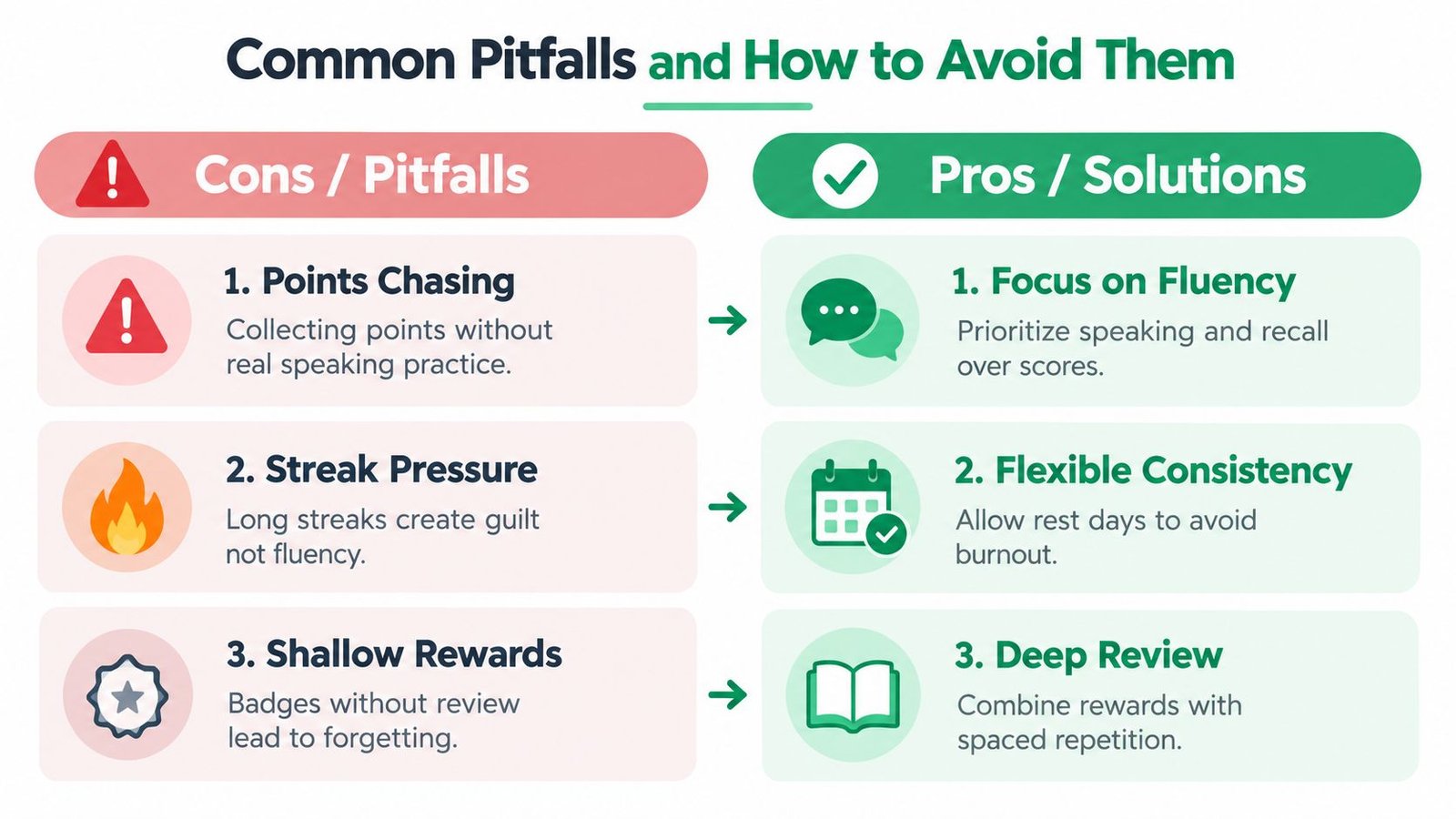
A long streak can show that you opened an app repeatedly. It can't show that you understood a fast conversation or formed a sentence without prompts. Points measure completed actions, not the whole of language ability.

The most common weakness is over-concentration on vocabulary. Vocabulary matters, especially at the beginning, but a word list won't automatically build listening comprehension, writing control, pronunciation, or conversational timing. A 2026 review of digital games and gaming in language learning notes that positive motivational and learning outcomes have been reported, while much of the research remains small and vocabulary-focused, with methodologies and theoretical frameworks still developing. The review is available from Cambridge University Press.

A comparison chart showing common gamified language learning pitfalls versus helpful solutions for better progress.

Activity is not motivation

More app use can look like stronger engagement, but those are different measures. A 2025 study of 43 Chinese EFL learners found no direct correlation between usage frequency and motivation enhancement, with r = -0.069 and p > 0.05. English proficiency and underlying personal drives moderated the effect, according to the study of motivation in vocabulary app usage.

That finding gives learners a practical warning. If an app pushes you to collect points but doesn't help you understand errors, vary your practice, or use language actively, heavier use may just produce more activity metrics.

Use a balanced audit

Check a platform for these red flags and fixes:

  • Points chasing: If points reward speed alone, slow down and require yourself to recall the answer aloud.
  • Streak pressure: Treat a missed day as information about your routine, not a moral failure. Choose a sustainable rhythm.
  • Shallow quizzes: Look for corrections that explain the answer and review that returns difficult items.
  • Leaderboard anxiety: Turn competition off if it makes you rush or avoid practice.
  • Vocabulary tunnel vision: Add speaking, listening, reading, and writing tasks so your progress reflects real communication.

A good game layer should make useful practice easier to repeat, not make empty activity harder to stop.

Putting Gamification Into Practice With Gaeilgeoir AI

Ireland has a clear gap between the number of people who report knowing Irish and the number who use it regularly outside education. The Central Statistics Office's Census 2022 summary reports that the number of people who said they could speak Irish rose by 6% from 2016 to 2022, reaching 1,873,997. The same source's 2016 census analysis found that only 4.2% of Irish speakers used Irish daily outside education, while daily speakers outside the education system represented 1.7% of the entire population.

Those figures make the evaluation question concrete. A learner doesn't only need to recognise Irish words. They need repeated opportunities to retrieve them in situations where a real exchange might happen.

Gaeilgeoir AI offers one example of that design. It combines guided real-world conversations, pronunciation support, adaptive quizzes with instant feedback, and scenario-based practice for social interactions, work, travel, ordering food, and asking for directions. Learners can click words for translations and save them to a personalised study list, which connects an unexpected gap in a conversation to later review.

The platform's game layer uses points, multipliers, and leaderboards across daily learning, conversations, quizzes, and other activities. That arrangement makes the mechanics serve a broader practice path, provided the learner treats the score as a prompt to practise rather than as the outcome itself.

Test the learning path yourself

A useful audit asks four questions:

  1. Does the platform bring language back at the right time? Look for adaptive review rather than a fixed stream of new items.
  2. Does it explain mistakes? Instant correction is more useful when you understand why an answer needs changing.
  3. Can you practise situations you recognise? Scenarios should reflect ordinary needs, not only isolated sentences.
  4. Does it support your actual goal? Gaeilgeoir AI includes an immersion-first foundation based on the 1,000 most-used Irish words and Leaving Cert oral exam simulations for learners with a specific school assessment in mind.

For beginners and returning learners, the practical routine is simple. Complete a short conversation, save unfamiliar words, review them later, and say useful phrases aloud instead of only selecting answers. Busy adults can use flexible sessions around their schedules, while learners preparing for an oral exam can give scenario practice a clear purpose. Details about the platform's AI language tutors can help you judge whether guided conversation fits your learning style.

Your Next Steps to Confident Consistent Practice

Gamified language learning works best when it changes the shape of your week. It turns a vague ambition into a visible sequence, gives you feedback while a mistake is still understandable, and creates reasons to return. The quality test remains straightforward: does the system lead from rewards to recall, and from recall to real communication?

Try this routine over the next seven days:

  • Choose one practical situation: Focus on greetings, ordering food, introductions, or directions.
  • Complete a small session: Stop while the task still feels manageable, rather than waiting for a perfect block of free time.
  • Review uncertain items: Let difficult words return through spaced practice instead of replacing them with new content.
  • Speak aloud: Repeat phrases and answer prompts without looking at the translation first.
  • Check transfer: At the end of the week, ask what you can say independently, not just how many points you collected.

You don't need to protect an impressive streak at the cost of enjoyment. A flexible routine that you can resume after a missed day is more useful than a reward system that makes practice feel like punishment. Use points as a nudge, progress bars as a map, and feedback as your coach.

Try guided Irish practice, save the words that matter to you, and use short sessions to build a habit that fits real life. Gaeilgeoir AI brings together conversations, pronunciation support, adaptive quizzes, scenario practice, and gamified progress, so visit Gaeilgeoir AI and start turning your next study session into a useful speaking step.

The Best Way to Learn a Language as an Adult: 10 Methods

You open your phone during lunch and complete one short lesson. By evening, work messages have piled up, dinner needs making, and the language app icon disappears into the background again. A week later, it is easy to conclude that adults missed their chance.

That conclusion is wrong. Adults can learn languages well, and they often begin with distinct advantages. Research summarized by Penn State Bilingualism Matters notes that adults and older children often progress faster than young children in the early stages because they bring stronger reasoning skills, clearer pattern recognition, and a better grasp of how language systems work. You are not behind. You need a method that fits an adult life.

That method usually looks less like school and more like training for a skill. You do not build strength with one long workout and then stop for a month. Language works the same way. Short, repeated contact, useful recall, and practice in realistic situations produce better results than waiting for a perfect study block that rarely appears.

A good adult plan also respects culture and context. Learning a language is not only memorizing words. It is learning how people greet each other, how formal or informal a phrase sounds, what belongs in a classroom, and what belongs in a café, group chat, or family conversation. If your goal is Irish, for example, guided Irish immersion courses for adults can place vocabulary and listening practice inside situations you would meet, which makes review easier and speaking less intimidating.

The best way to learn a language as an adult is a combination of methods that support each other. The sections below go beyond naming those methods. They show how to use them in a weekly routine, where adult learners usually get stuck, how to fix those problems, and how a platform such as Gaeilgeoir AI can support each step with structured practice, feedback, and gradual difficulty.

Table of Contents

1. Immersion-First Learning

Two people talking and laughing while sitting at a cafe table with drinks on a green background.

You walk into a café on a trip, the barista asks a simple question, and you recognize every word except the one that matters. That moment explains why immersion-first learning works. Adults remember language better when it arrives attached to a purpose, a place, and a response they need right now.

Immersion-first learning starts with use. Instead of collecting rules and hoping they become usable later, you begin with short, realistic exchanges and build outward from them. The method works like learning to cook from a recipe before studying food chemistry. You make something practical first, then the patterns start to make sense.

For an adult learner, that often means starting with high-frequency situations. Ordering coffee. Greeting a coworker. Asking where something is. Introducing yourself. These are small scenes, but they carry a lot of useful language: common verbs, polite forms, question patterns, and everyday pronunciation.

Start with situations you will actually face

If you’re learning Irish, that might mean practicing a café exchange, a workplace greeting, or a travel interaction inside Irish immersion courses. Gaeilgeoir AI supports this approach with guided conversations, clickable vocabulary, and practice that stays tied to a real context rather than a disconnected word list.

One caution matters here. Immersion does not mean drowning in content you barely understand. Adult learners make faster progress with material that is challenging but still clear enough to follow. If a dialogue feels like static, shorten it, slow it down, or narrow the goal to one task such as catching greetings or ordering language.

Practical rule: Study phrases you can use this week.

A simple weekly implementation plan

Use one theme for the week so your brain gets repeated exposure from different angles.

  • Monday: Choose one real-life scenario, such as ordering lunch or introducing yourself. Learn 5 to 8 useful phrases.
  • Tuesday: Listen to the same scenario again and speak along with it out loud.
  • Wednesday: Swap key words to create new versions. Change the drink, the destination, the time, or the person.
  • Thursday: Do a short roleplay with AI or a tutor and respond without reading from notes.
  • Friday: Review the phrases that still feel slow. If you want to learn to retain more, save them for later review instead of relearning from scratch.
  • Weekend: Use the language in a low-pressure setting, such as a voice note, a journal entry, or a short conversation prompt.

If you want a structured way to recycle those useful phrases after each immersion session, Gaeilgeoir AI also connects well with a spaced repetition study routine for language learners.

Common pitfalls and fixes

Adults often run into the same three problems.

  • Pitfall: studying scenes that look useful but never appear in your life
    Fix: Pick situations from your real week. School pickup, work chat, shopping, hobbies, family calls.

  • Pitfall: trying to understand every word
    Fix: Aim to complete the task. If you can greet, ask, answer, and close the exchange, the practice worked.

  • Pitfall: staying silent until you feel ready
    Fix: Use short responses early. One accurate sentence spoken today teaches more than ten perfect sentences postponed for later.

Immersion is often the starting engine for adult fluency because it gives vocabulary a job to do. You are not memorizing language in a vacuum. You are building it where it will be used.

2. Spaced Repetition and Active Recall

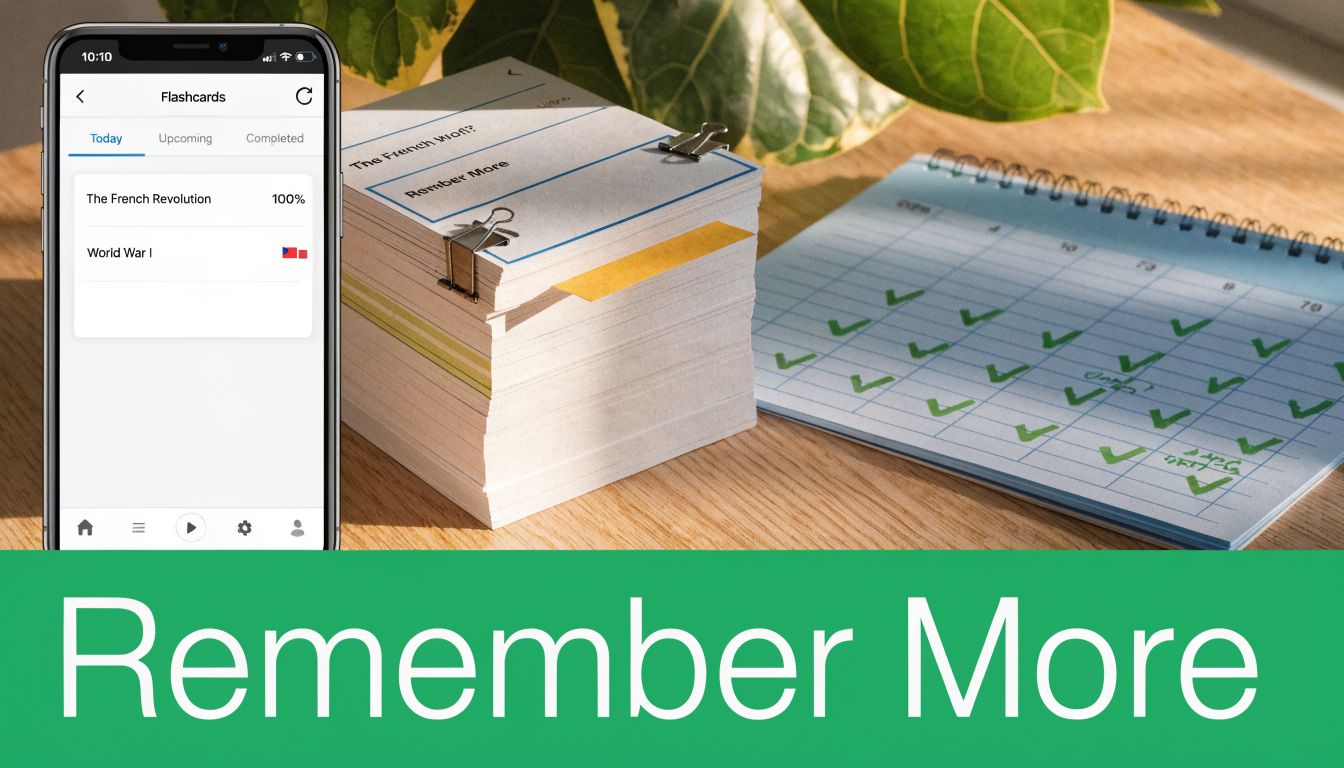
A smartphone app displaying flashcards next to a stack of paper and a calendar with checkmarks.

Tuesday night, you finally remember a new phrase. By Friday, it feels half-familiar. By Sunday, it is gone. Adult learners often read that as a memory problem. It is usually a timing problem.

Spaced repetition fixes timing. Active recall fixes effort. Together, they turn review from passive exposure into deliberate retrieval. The result is simple. You remember more of what you already studied, and you need fewer full restarts.

A useful comparison is physical training. If you lift the same weight every hour, you burn out. If you wait six months, you lose the benefit. Language review works the same way. You revisit material after enough time has passed that recall takes work, but not so much time that the item has disappeared completely.

Why this method works for adults

Adults have limited study time and a lot of interference from daily life. New words compete with meetings, errands, family routines, and the language you already use all day. Spaced repetition reduces waste by bringing back the right item at the right moment. Active recall adds the part many learners skip. You must produce the answer before seeing it.

That is why flashcards help only when used correctly. Reading a card and feeling a flicker of recognition is not the goal. Pulling the word, phrase, or structure out of memory is the goal. If you want to learn to retain more, make your reviews short, frequent, and slightly effortful.

How to implement it each week

Use a narrow, realistic routine:

  • Monday: Add 5 to 10 new items from something you used or read.
  • Tuesday: Review them once. Say or type the answer before revealing it.
  • Wednesday: Revisit only the items you missed or hesitated on.
  • Friday: Review the full set again, but keep phrases over isolated words.
  • Weekend: Use two or three reviewed items in a voice note, message, or short conversation.

This weekly rhythm matters because recall changes across time. An item you can retrieve after ten minutes is not learned yet. An item you can retrieve three days later, then use in speech, is starting to stick.

What to review

Store language in chunks that can do a job. A phrase like “Where is the station?” carries grammar, vocabulary, and a real use case. A single noun often does not.

Good review items include:

  • short phrases you expect to say
  • question forms
  • verb patterns that trip you up
  • common responses such as greetings, thanks, clarifications, and repairs
  • mistakes from recent speaking or writing practice

Gaeilgeoir AI supports this approach through adaptive quizzes, saved study lists, and review prompts based on what you struggled with earlier. Its spaced repetition system for language learning follows the same principle. Hard items return sooner. Easier ones wait longer.

Common pitfalls and fixes

Adults often make the same mistakes here.

  • Pitfall: reviewing too much at once
    Fix: Cap sessions at 10 to 15 minutes. The point is consistency, not exhaustion.

  • Pitfall: saving random vocabulary with no context
    Fix: Save phrases from your real week. Work, errands, hobbies, family life, travel plans.

  • Pitfall: marking items as “known” too early
    Fix: Count an item as learned only after you can recall it on different days and use it in a sentence.

  • Pitfall: reviewing only by recognition
    Fix: Cover the answer, pause, and retrieve first. Speaking aloud helps expose weak recall fast.

A practical example makes the difference clear. Say you learned the Irish phrase for asking where something is during a shopping scenario. Save that full phrase the same day. Review it the next morning without looking. Review it again later in the week. Then use it in a short spoken exchange. That sequence turns a phrase from something you once recognized into something you can say when you need it.

3. Gamification and Motivation Systems

Motivation matters less than is commonly believed. Systems matter more. But good systems still need something that makes you want to come back tomorrow.

That’s where gamification helps. Streaks, levels, points, badges, and leaderboards don’t teach the language by themselves. What they do is make consistency easier to sustain, especially on days when your energy is low and your schedule is full.

A widely cited example is Duolingo. Business Insider reported that Duolingo had over 500 million registered users and 35 million daily active users as of 2023 (Business Insider on adult language app use). The important lesson isn’t just scale. It’s that adults keep returning when practice feels manageable and rewarding.

Make consistency rewarding

Gaeilgeoir AI uses points, multipliers, and leaderboards in a similar spirit. That can be useful if you treat those tools as reminders to show up, not as the whole goal.

Use gamification well by keeping it grounded:

  • Protect the streak, but don’t worship it: A short meaningful session counts.
  • Reward effort tied to output: Give yourself credit for speaking, not just tapping.
  • Track real milestones: Finished a travel scenario, held a short conversation, or understood a short audio clip.
  • Reset without drama: Missing a day isn’t failure. Quitting for a month is the actual problem.

Some learners do well with visible progress bars. Others prefer small private targets, such as “I’ll complete one scenario before lunch” or “I’ll review ten phrases before bed.” The best way to learn a language as an adult often includes a little psychology. If your brain likes progress markers, use them. There’s no prize for making learning feel harder than it needs to.

4. Scenario-Based and Contextual Learning

A word learned in isolation is slippery. A word learned inside a scene has a job.

That’s why scenario-based learning works so well for adults. Instead of memorizing random lists, you practice language inside meaningful contexts. Ordering lunch. Asking for train times. Introducing yourself to a colleague. Preparing for an oral exam. Context tells you not only what the words mean, but when people typically use them.

Use language where it belongs

Suppose you’re learning how to ask for directions in Irish. You’re not only learning the verb and the noun. You’re learning tone, politeness, likely follow-up questions, and what to say if you don’t understand the first answer. That’s far closer to real communication than a grammar worksheet.

Platforms like Gaeilgeoir AI make this easier by structuring practice around scenarios adults experience, such as travel, food, and everyday social interaction. Babbel is another well-known example of organizing lessons around practical themes rather than abstract grammar labels.

Learn the sentence as part of the moment. Your memory holds on better when it knows where the language belongs.

A useful weekly rhythm is to pick one scenario and stay with it long enough to vary it. On the first day, repeat the guided exchange. On the second, answer with your own details. On the third, change the location or the people involved. By the fourth day, try the same scenario without prompts.

That repetition with variation is what turns scripted language into flexible language. It also makes speaking less intimidating, because you’ve already rehearsed situations your brain recognizes.

5. Microlearning and Habit Stacking

It is 7:40 a.m. You are packing a lunch, checking messages, and trying to get out the door on time. A 45-minute study session was never going to happen. Five focused minutes can.

That is microlearning's primary function. It breaks language practice into small pieces your day can hold. Habit stacking gives those pieces a fixed home by attaching them to routines that already happen, such as making coffee, commuting, or tidying up after dinner.

Adults do better with routines that survive ordinary tiredness. A language habit works like keeping a toothbrush by the sink. You do not rely on willpower each time. The cue is already there.

Build around anchors you already trust

Start with one existing action and one tiny language task. After coffee, review three flashcards. After lunch, listen to one short dialogue. Before bed, say yesterday's phrases out loud from memory. Small sessions feel modest, but they lower the starting friction, and that makes repetition more likely.

The goal is not to squeeze language into every spare second. The goal is to make practice so regular that missing a day feels unusual.

A simple weekly plan helps:

  • Monday: Attach one 5-minute review to your morning routine.
  • Tuesday: Keep the morning review and add one short listening task during lunch.
  • Wednesday: Repeat both anchors and end the day with a 2-minute spoken recap.
  • Thursday: Use the same anchors, but swap content so the routine stays familiar while the material changes.
  • Friday: Do the shortest possible version of each habit. This teaches consistency on busy days.
  • Weekend: Keep one anchor only. Use the extra time for a slightly longer session if you want, but do not make weekends carry the whole plan.

This approach avoids a common adult-learning mistake. People often design a schedule for their ideal week, then feel they have failed when real life interrupts it. A better standard is this: can you still do it on a tired Wednesday?

Gaeilgeoir AI fits this method well because it supports short, self-paced practice. You can open a brief conversation, review saved phrases, answer one prompt, and stop without losing your place. That matters for adults who study in fragments rather than long classroom blocks.

A few pitfalls show up often:

  • Pitfall: sessions are too long.
    Fix: Cut them in half. A habit you repeat beats a plan you postpone.

  • Pitfall: no clear trigger.
    Fix: Tie practice to a specific action, not a vague time. "After I pour coffee" works better than "in the morning."

  • Pitfall: only passive review.
    Fix: Add one tiny recall task. Close the app and say the phrase before checking the answer.

  • Pitfall: skipping one day turns into stopping.
    Fix: Use a reset rule. Never miss twice if you can help it.

One practical pattern is 5-5-2. Five minutes of review in the morning, five minutes of input later in the day, two minutes of speaking before sleep. Short cycles like this build familiarity without asking your brain to do heavy work when you are already stretched.

If you remember one idea, keep this one. The best language routine for an adult is the one that still works on your busiest day, not the one that looks impressive on paper.

6. Pronunciation and Audio Feedback

Adults often delay speaking because they’re afraid of sounding wrong. That fear is understandable, but silence creates its own problem. If you wait too long, your brain gets comfortable recognizing words without producing them.

Pronunciation practice works best when it starts early. You don’t need perfect accent goals at the beginning. You need clear sounds, understandable rhythm, and enough listening to notice what native speech does.

Train your ear and your mouth together

Irish is a good example of why this matters. Spelling, sound patterns, and rhythm won’t always match what an English speaker expects. If you only read, you may build inaccurate sound maps in your head. That’s much harder to fix later.

Use a mix of tools. Native audio from podcasts or videos helps you hear natural pace. Speech tools such as Google Translate can be useful for quick checks. Community pronunciation sites like Forvo can help with individual words. Gaeilgeoir AI adds pronunciation support inside guided practice, which is especially useful when you want immediate help while working through a realistic exchange.

A simple method works well:

  • Listen first: Hear the phrase several times.
  • Repeat aloud: Copy the sounds, even if it feels awkward.
  • Record yourself: Compare your version to the model.
  • Slow it down: Focus on stress and melody, not just single sounds.

Your accent doesn’t need to be perfect to be effective. Your speech needs to be clear enough to carry meaning.

Adults often improve faster once they stop whispering and start producing full sentences. Audio feedback speeds that process because it closes the gap between what you think you said and what came out.

7. Personalized Learning Paths and Adaptive Difficulty

One reason adults quit is that generic study plans waste time. You may already know greetings but struggle with listening. Or maybe you can read well but freeze when speaking. If every lesson treats you the same, boredom and frustration show up fast.

Adaptive learning helps by adjusting what comes next based on your performance. It doesn’t replace judgment, but it can make study time more efficient. Instead of forcing everyone through the same order, a good system notices where you hesitate and where you move easily.

Study the right thing next

This is especially useful for adults with uneven skills. You might return to Irish with some school exposure, remember fragments of vocabulary, and still need lots of conversational support. A personalized path can bring back what you half-know while introducing the next useful layer.

Gaeilgeoir AI supports this through personalized study lists and adaptive quizzes with instant feedback. If a learner repeatedly misses a phrase or mishears a common form, the platform can bring that material back rather than pretending the lesson is complete.

Use personalization well with a little self-honesty:

  • Start with an accurate baseline: Don’t place yourself higher just to feel advanced.
  • Notice patterns in mistakes: Are they listening errors, word order issues, or confidence issues?
  • Intervene manually when needed: If one weakness keeps recurring, add focused practice outside the app.
  • Refresh your goals: Travel, heritage reconnection, exam prep, and casual conversation need different emphasis.

A personalized path doesn’t mean easy. It means relevant. For most adults, relevant work is what keeps momentum alive.

8. Speaking Practice and Conversation Exchange

A man and a woman sitting at a table having a deep conversation while practicing language skills.

Speaking is where many adult learners discover the truth. You probably know more than you can currently say. Conversation exposes that gap quickly, which is uncomfortable, but that’s exactly why it works.

Solo apps help build vocabulary and confidence, but real exchange adds pressure, unpredictability, and repair. You have to listen, answer, clarify, and keep going. That’s the skill many learners seek.

Speaking early changes everything

Conversation platforms are now a major part of adult language learning. One reported figure says Italki delivers more than 10 million lessons annually across more than 150 languages by 2024 (YouTube discussion of conversation platform trends). Even if you never use Italki, the broader lesson is clear. Adults actively seek guided conversation because speaking practice changes passive knowledge into active skill.

If you’re learning Irish, start with structured speaking support such as a basic Irish conversation guide. Gaeilgeoir AI helps by giving you guided real-world conversations before you move into freer speaking. That’s a strong bridge for learners who feel anxious about live interaction.

For live sessions, solid preparation helps:

  • Bring a few target phrases: Don’t improvise everything from scratch.
  • Repeat one scenario with different partners: Fluency grows through reuse.
  • Ask for correction selectively: Too much correction can shut you down.
  • Review after the session: Save phrases you needed but couldn’t access.

If you want to sharpen your overall interaction habits while practicing, these Typist's communication strategies are useful because listening well is part of speaking well.

Speak before you feel ready. Readiness usually arrives after repetition, not before it.

9. Exam-Focused Preparation and Authentic Assessment

Some learners want broad fluency. Others need to pass something specific. If your goal is the Leaving Cert Irish oral, an English proficiency test, or another formal assessment, general practice isn’t enough by itself. You need rehearsal that matches the actual task.

Exam-focused preparation works because it narrows your attention. You study the kinds of prompts, timing, vocabulary, and speaking demands that appear under test conditions. That lowers uncertainty, which often matters as much as language knowledge.

Practice for the real pressure

For Irish learners, this can mean practicing familiar oral themes, timed responses, and likely follow-up questions. Gaeilgeoir AI is relevant here because it includes targeted Leaving Cert preparation and oral-style simulations. That gives learners a chance to practice expected topics in a format closer to what they’ll face.

Keep exam prep practical:

  • Use authentic materials: Past papers and official prompts matter most.
  • Practice aloud under time limits: Silent preparation won’t build oral control.
  • Memorize useful frames, not entire scripts: You need flexibility if the question shifts.
  • Get exam-aware feedback: A tutor who knows the task can spot weak habits quickly.

One common mistake is turning exam preparation into pure memorization. That can help at first, but it breaks down when the examiner asks an unexpected follow-up. Better prep combines predictable structures with enough general language ability to adapt in real time.

Even if your long-term goal is wider fluency, test-style practice can still help. It gives you a clear target, a reason to perform under pressure, and a realistic way to measure progress.

10. Content-Based and Interest-Driven Learning

Adult learners stay consistent when the language connects to identity, curiosity, or pleasure. If every session feels like schoolwork, motivation fades. If the language becomes a way to enjoy what you already care about, the routine becomes easier to sustain.

That’s why interest-driven learning is so useful. You study through music, sport, history, film, food, travel, family heritage, or whatever keeps your attention naturally engaged.

Turn your hobbies into study material

If you’re learning Irish, you might explore traditional music, local history, radio clips, interviews, recipes, or cultural stories. If you care about football, follow clips and commentary around that. If you love books, start with short pieces and annotated texts before moving into harder material.

This approach also helps adults maintain emotional connection. Heritage learners often don’t just want vocabulary. They want reconnection. Students may want oral practice that feels tied to real Irish life, not only exam prompts.

A good process looks like this:

  • Choose a small set of interests: Pick a few topics you’ll return to often.
  • Start with support: Use subtitles, transcripts, or clickable word help.
  • Capture recurring vocabulary: Interest areas repeat useful words.
  • Talk about what you consumed: Passive enjoyment becomes active language.

If audio suits you, you can even generate language learning podcasts around topics you care about and use them as repeat listening material.

Interest-driven learning doesn’t replace structured study. It keeps structured study alive. When your language becomes attached to music you enjoy, places you want to visit, or family roots you want to reclaim, consistency stops depending on willpower alone.

Comparison of 10 Adult Language-Learning Methods

Method Implementation complexity 🔄 Resource requirements ⚡ Expected outcomes 📊⭐ Ideal use cases 💡 Key advantages ⭐
Immersion-First Learning Medium–High 🔄 (authentic contexts, curriculum design) High ⚡ (native input, sustained exposure) Rapid conversational fluency and natural patterns 📊⭐ Beginners seeking fast speaking ability; immersion programs 💡 Fast spoken fluency; contextual retention ⭐
Spaced Repetition & Active Recall Moderate 🔄 (algorithm setup, card design) Low–Moderate ⚡ (software + daily time) Strong long-term retention and recall efficiency 📊⭐ Vocabulary-heavy study; exam prep; busy learners 💡 Maximizes retention with minimal wasted study time ⭐
Gamification & Motivation Systems Medium 🔄 (mechanics design, engagement loops) Moderate ⚡ (platform features, content updates) Higher consistency and sustained engagement 📊⭐ Habit formation; low-motivation learners; daily practice 💡 Increases adherence and enjoyment of practice ⭐
Scenario-Based & Contextual Learning Medium 🔄 (scenario creation, role-play support) Moderate ⚡ (authentic dialogues, guided practice) Practical ability to use language in real situations 📊⭐ Travel, workplace, social interactions; oral exams 💡 Immediate applicability; grouped, memorable vocabulary ⭐
Microlearning & Habit Stacking Low 🔄 (modular lesson design) Low ⚡ (mobile content, reminders) Consistent daily progress; reduced overwhelm 📊⭐ Busy adults; commuters; maintaining momentum 💡 Low barrier to entry; sustainable routine-based practice ⭐
Pronunciation & Audio Feedback Medium 🔄 (speech tech + pedagogy) Moderate ⚡ (ASR, native audio, mic) Improved intelligibility and faster correction 📊⭐ Early speaking stages; languages with unfamiliar sounds 💡 Prevents fossilized errors; builds listening and speaking precision ⭐
Personalized Learning Paths & Adaptive Difficulty High 🔄 (adaptive algorithms, assessment design) High ⚡ (data, analytics, engineering) Efficient individualized progress; fewer plateaus 📊⭐ Mixed-ability cohorts; long-term learners seeking efficiency 💡 Tailored pacing and focused remediation for faster gains ⭐
Speaking Practice & Conversation Exchange Low–Medium 🔄 (partner/tutor coordination) Moderate ⚡ (tutors, scheduling, internet) Fastest route to conversational fluency and spontaneity 📊⭐ Learners prioritizing oral skills; real-world readiness 💡 Authentic feedback; builds confidence and speed ⭐
Exam-Focused Prep & Authentic Assessment Medium 🔄 (exam simulations, targeted tasks) Moderate ⚡ (past papers, timed platforms, tutors) Measurable score gains and reduced test anxiety 📊⭐ Certification goals (e.g., Leaving Cert, TOEFL) 💡 Clear benchmarking and efficient exam strategies ⭐
Content-Based & Interest-Driven Learning Low–Medium 🔄 (curation of topical materials) Low–Moderate ⚡ (authentic media, community resources) Higher engagement and deeper, sustained learning 📊⭐ Learners motivated by hobbies, culture, or subject matter 💡 Personal relevance leading to stronger motivation and retention ⭐

Your Personalized Path to Fluency Starts Today

The single best way to learn a language as an adult doesn’t exist. What exists is the best combination for you. Adults learn well when the process is practical, repeatable, and connected to real life. That usually means building around a few core pieces instead of chasing every method at once.

A simple starting combination is generally effective. Use immersion-first practice to meet the language in realistic situations. Add spaced repetition so useful phrases don’t disappear after a few days. Then add regular speaking, even if it’s messy and brief. That gives you input, memory support, and output, which is a far stronger system than passive study alone.

If you want this to become a weekly plan, keep it straightforward. On most weekdays, do a short scenario-based session and a short review session. A few times each week, add speaking or pronunciation practice. On the weekend, return to one bigger task, such as a longer conversation, an exam simulation, or content tied to your interests. You don’t need a perfect plan. You need one you can still follow when work is stressful and your energy is average.

Common pitfalls are predictable. Many adults wait too long to speak. Fix that by speaking in guided scenarios early. Many overfocus on grammar and underexpose themselves to real language. Fix that by listening and reading daily, even in small doses. Many try to study too much at once, get tired, and disappear for two weeks. Fix that by shrinking the session until it becomes automatic. A ten-minute habit beats a ninety-minute fantasy.

Another frequent problem is using only one mode. Some learners do nothing but app taps. Others only watch videos. Others only collect notes. Real progress usually comes from combining methods. Hear the language. Say the language. Retrieve it from memory. Use it in context. Repeat that cycle enough times and fluency starts to feel less mysterious.

If Irish is your target language, a platform like Gaeilgeoir AI can fit naturally into that system because it combines guided conversation practice, adaptive quizzes, pronunciation support, and scenario-based learning in one place. That matters for busy adults because it removes friction. Instead of stitching together five different tools, you can focus on showing up and practicing.

The most important step is still the smallest one. Start before you feel fully prepared. Say your first sentence. Review your first set of useful phrases. Try one realistic conversation. That’s how momentum begins.

If you’re ready to begin, start your free trial with Gaeilgeoir AI and build your own practical path to speaking Irish.


If you want a structured way to start speaking from day one, Gaeilgeoir AI offers guided real-world conversations, pronunciation support, adaptive quizzes, and flexible Irish practice that fits around a busy adult schedule.

Start Speaking Irish Today — 25% Off
Use code START25

Learn real Irish for real life with guided practice, pronunciation support, and everyday conversations.

Get 25% off any plan with code START25

Start Speaking Irish Today — 25% Off