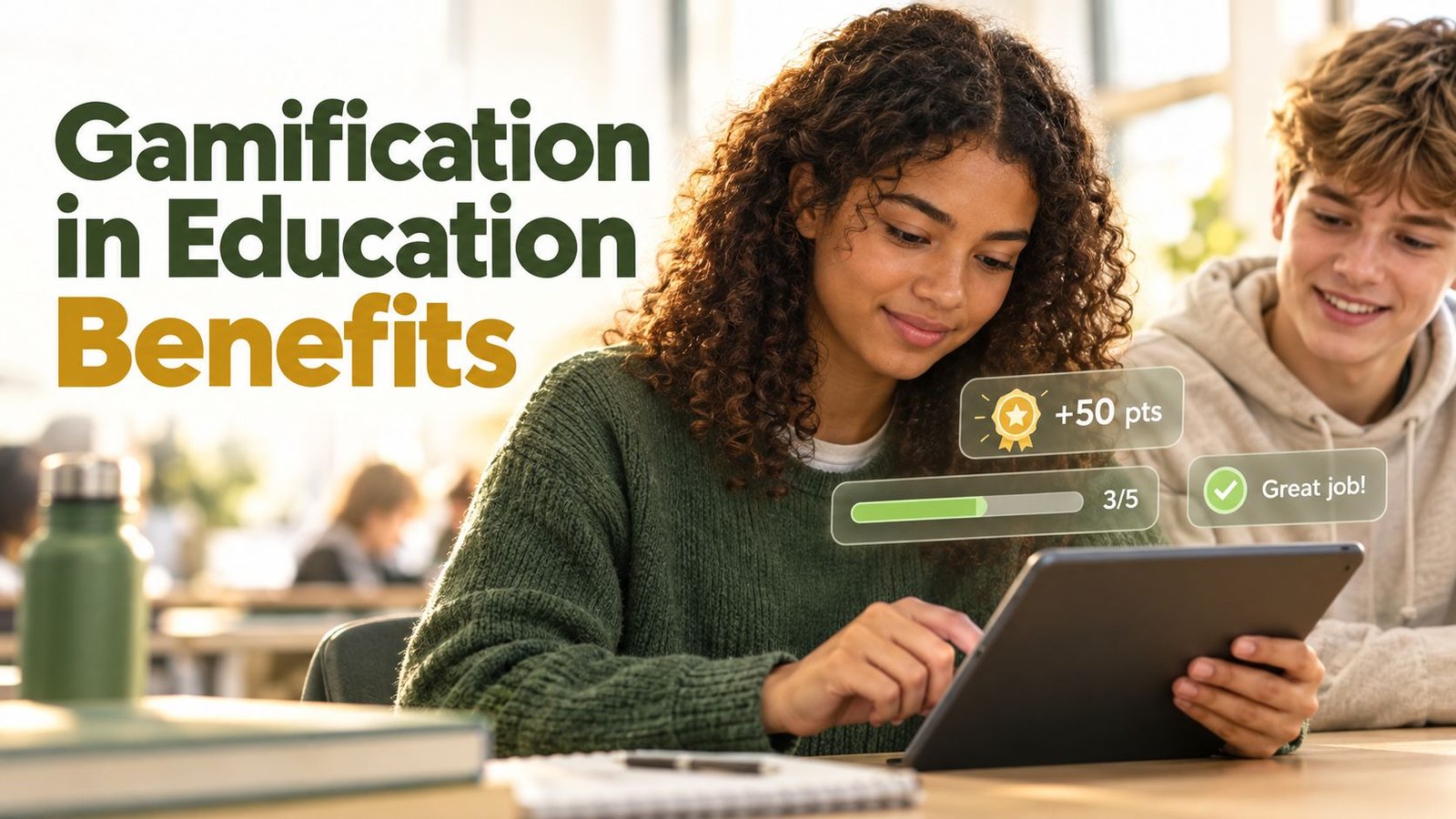
Secondary pupils don't respond to rewards the way younger children do. A 2025 K-12 meta-analysis found a moderate-to-large overall motivation effect (g = 0.654) with very high heterogeneity (I² = 88.92%). Secondary students sat at g = 1.015, while primary pupils sat at g = 0.309, in the ERIC record of that meta-analysis.
That spread is the useful part of gamification in education benefits. A point system can raise how often someone practises and still leave pronunciation, recall and exam answers untouched. Participation is a behaviour. Progress is a learning result. Mixing the two is how a streak gets mistaken for fluency.
The lookup below pairs each benefit and each mechanic with the strength of the evidence and the learner it fits best.
Table of Contents
- Gamification Benefits at a Glance
- What Gamification Means in Learning
- Cognitive and Motivational Gains by Learner Age
- Behavioral and Social Gains Shown in Studies
- Which Game Mechanics Deliver Which Benefit
- Classroom and Language-Learning Examples in Practice
- Pitfalls That Cancel Out the Benefits
- Choose Mechanics by Learner Goal, Then Measure Results
Gamification Benefits at a Glance
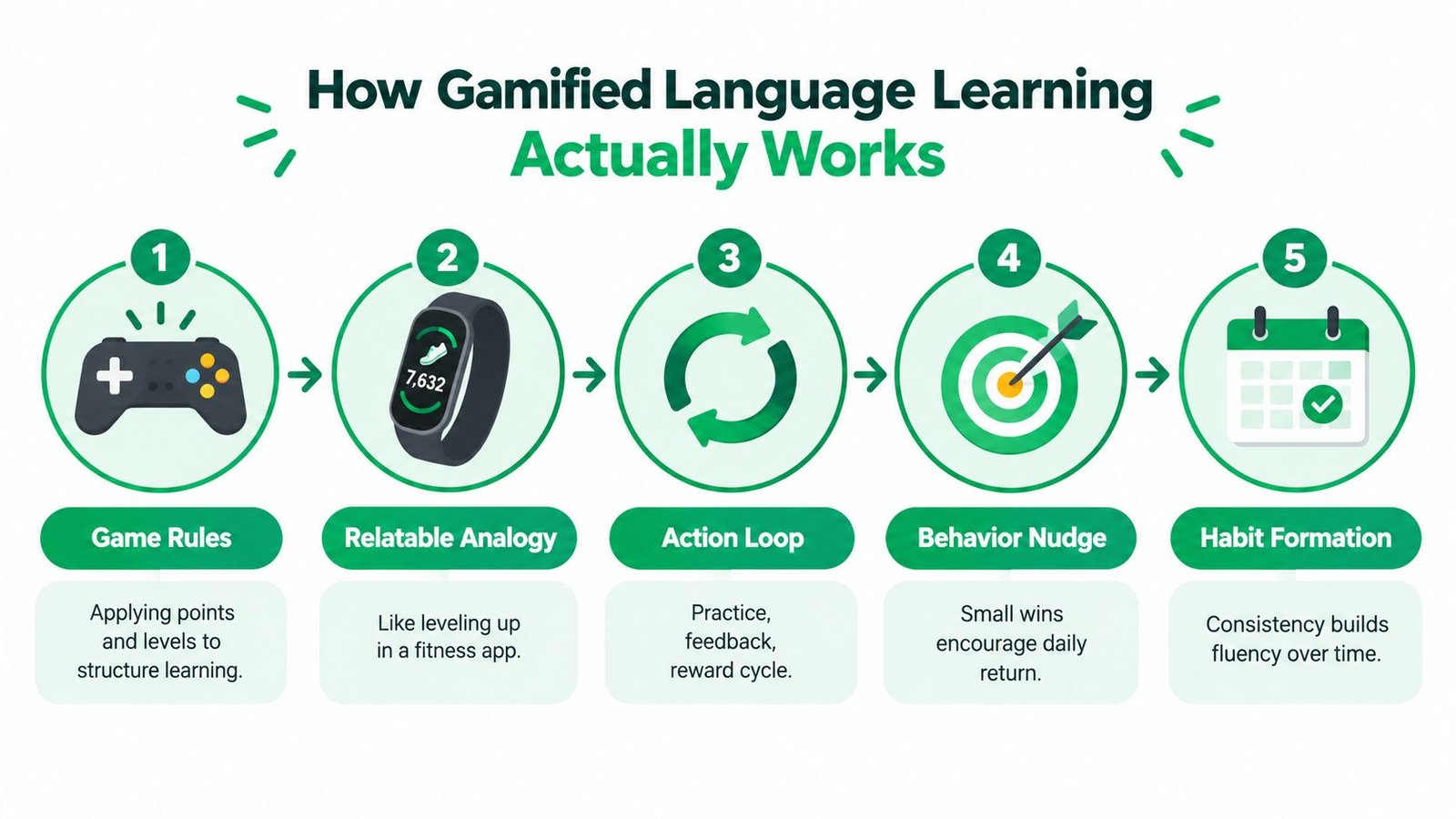
Gamification in education means adding game elements such as points, badges, levels, leaderboards and immediate feedback to learning tasks, without turning the whole lesson into a game. The lesson stays a lesson. The score, the level and the tick appear beside it.
A 2024 systematic review in Frontiers in Education identified 90 qualifying gamification interventions in primary and secondary education and found that gamification can support school engagement. That is a wide base for an engagement claim. It isn't a promise that every class will learn more.
| Benefit type | What it looks like in a lesson | Strength of evidence |
|---|---|---|
| Cognitive | Instant feedback on answers, visible progress, short quizzes | Moderate; depends on feedback design rather than game elements alone |
| Motivational | Points, levels, personal goals and streaks | Moderate to large on average (g = 0.654) but highly variable across studies |
| Behavioral | Completed tasks, session counts, participation rates | Consistent gains in participation; 25% and 30% increases reported in cited studies |
| Social | Leaderboards, team challenges, peer comparison | Mixed; improves relatedness in some studies and can discourage slower learners |
How to read the map
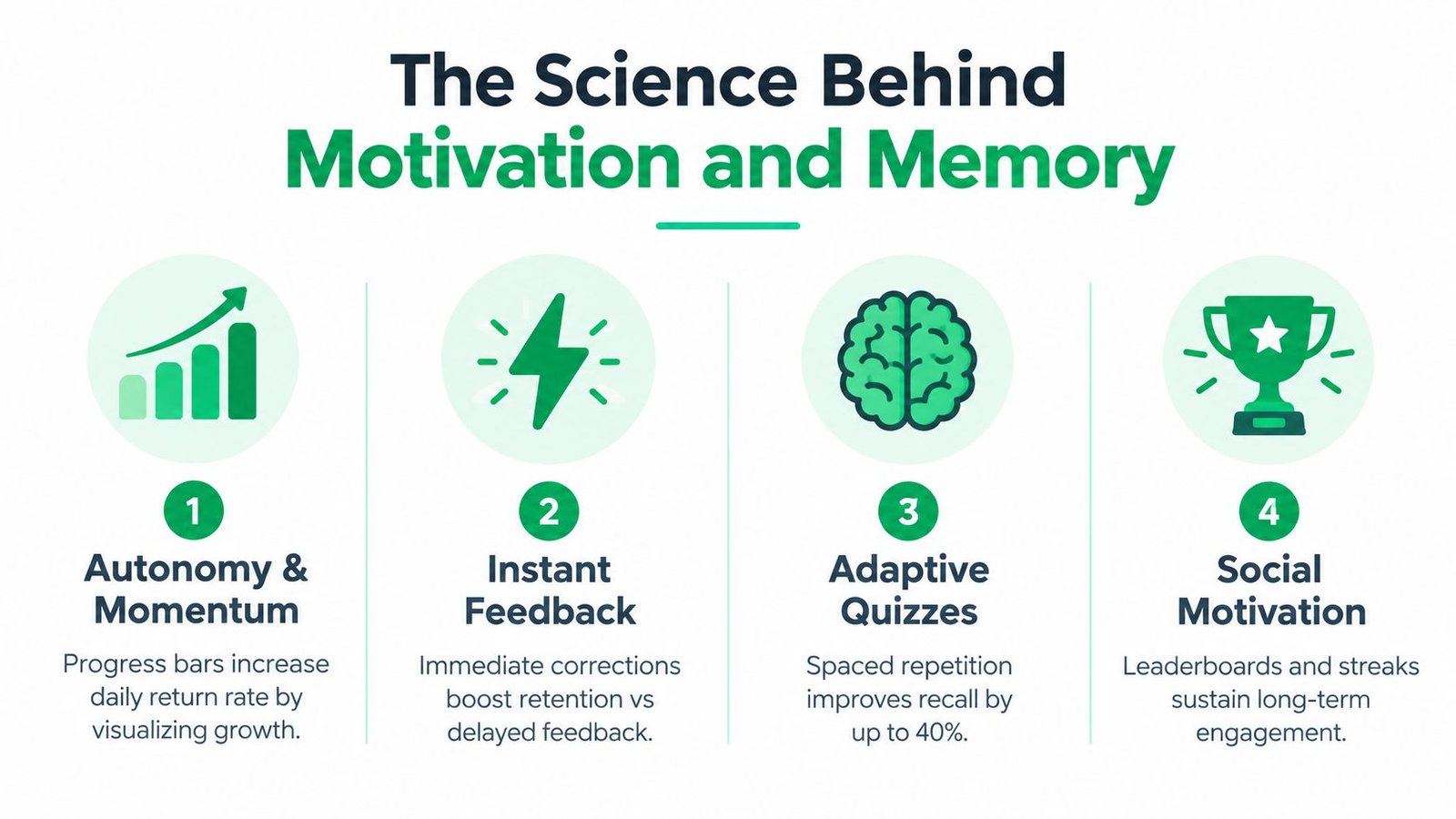
Cognitive benefit is the correction that lands while the wrong answer is still in working memory. A short quiz with an instant mark does that job. Confidence here should stay moderate, because the feedback design carries the learning, not the decoration around it.
Motivational benefit is points, levels, personal goals and streaks. The average looks solid, and the scatter is the warning. The same streak can pull one learner back tomorrow and feel pointless to another.
Behavioral benefit is what you can count without asking anyone how they feel: tasks finished, sessions opened, a class participation rate. This is the row with the most consistent movement, and it still doesn't equal mastery.
Social benefit is a rankings board or a team challenge. Some learners feel connected. Others, especially those moving slowly, feel watched.
Benefits vary by age, mechanic and design, so this table is a map of where to look rather than a guarantee. If you can chase only one row first, count the behaviour this week, then check whether accuracy moved with it.
What Gamification Means in Learning
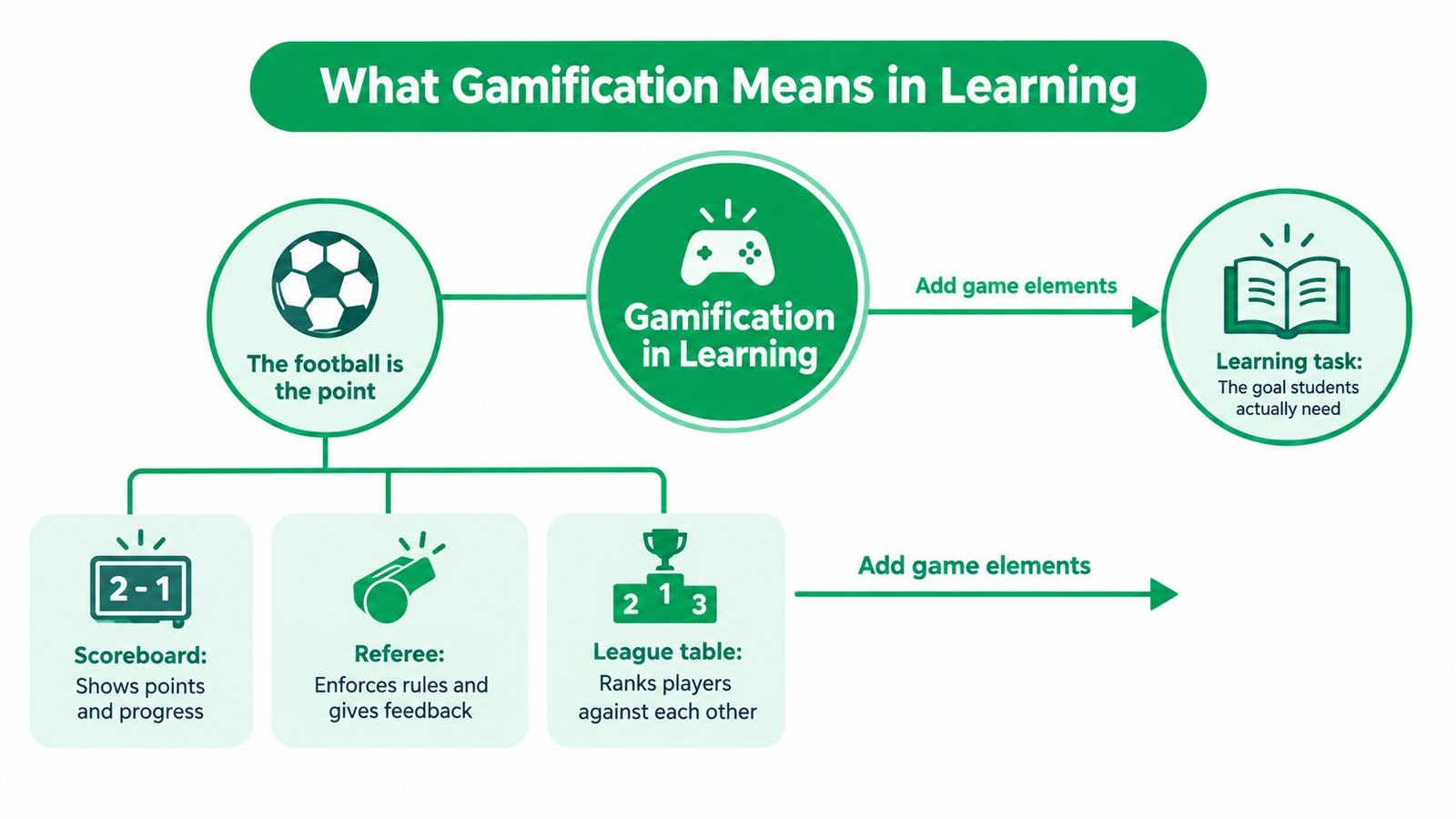
A football match has a scoreboard, a referee and a league table. The football is still the point. Gamification bolts the scoreboard onto a learning task. The learning stays the football.
Game-based learning is a different build. The whole activity is a designed game, such as a quest through a village market to practise Irish vocabulary. A serious game goes further and wraps the task in a simulation. In plain gamification, the task was already there. You added visible progress, a rule and sometimes a rank.
Three families of mechanics
Sort the usual pieces into three groups before you pick any of them.
- Progress elements: points quantify finished work, levels signal advancement, and badges mark a specific accomplishment.
- Social elements: leaderboards and team goals add comparison. They change who the learner is looking at, not what the item means.
- Feedback elements: an instant correctness mark or a hint tells the learner what to do on the next try.
A 2023 systematic review of gamified e-learning in higher education analysed 39 primary studies. Points, badges, leaderboards, levels, feedback and challenges were the most common elements. Achievement and progression mechanics were far more common than social or immersion features. Only nine of those studies were explicitly grounded in motivational theory.
Design test: For any feature, name the learning behaviour it is supposed to change, and name how you would know. If the answer is "more logins," you have an engagement tool, not a learning tool.
Presence isn't purpose. A badge that sits on a login teaches nothing about a verb. A badge that appears only after a learner can order food aloud, without prompts, is tied to a behaviour you can hear.
Cognitive and Motivational Gains by Learner Age
Immediate feedback corrects an error while the learner still remembers the attempt. Visible progress, cut into milestones the person can reach, keeps practice going long enough for repetition to stick. Those are the cognitive jobs. The points are only the receipt.
Motivation splits in two. Intrinsic motivation is curiosity and the wish to master the thing. Extrinsic motivation is points, rewards and ranks. The two respond differently to game mechanics, and the size of that response changes with age.
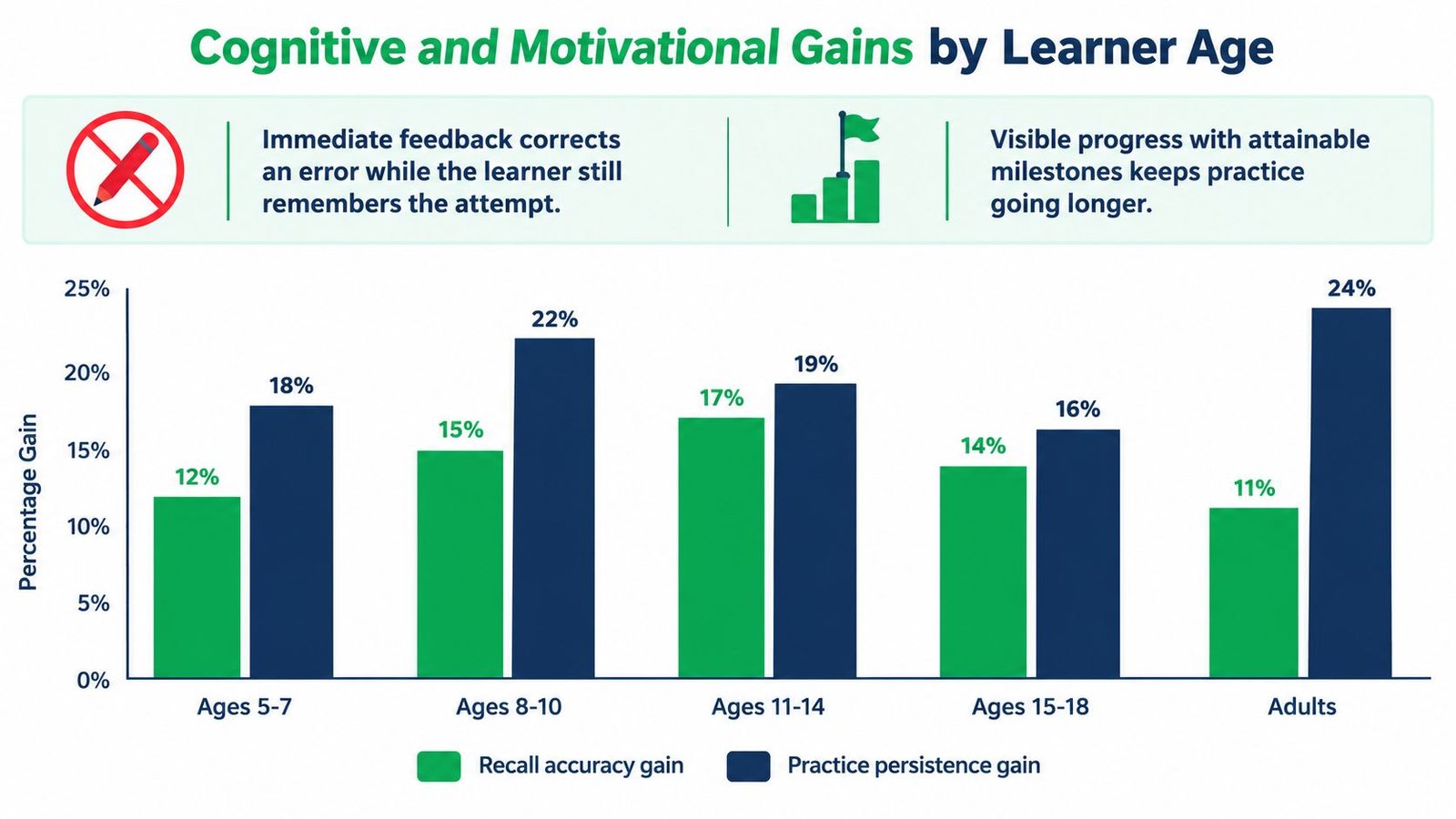
What the subgroup rows actually say
The figures below come from one K-12 motivation meta-analysis. Read them as effect sizes, not as percentage-point lifts in test scores.
| Subgroup | Effect size (g) | How to read it |
|---|---|---|
| All studies combined | 0.654 | Moderate to large, but heterogeneity is very high (I² = 88.92%) |
| Extrinsic motivation | 0.713 | Slightly stronger than intrinsic; rewards and points carry more weight |
| Intrinsic motivation | 0.638 | Smaller effect; curiosity and mastery respond less to points alone |
| Primary pupils | 0.309 | Small effect; keep rewards simple and tied to effort |
| Secondary students | 1.015 | Largest effect in the review; the age gap is clear, but the mechanism behind it is not established |
Extrinsic motivation (g = 0.713) edged intrinsic motivation (g = 0.638). Rewards and points carried slightly more of the motivational shift than curiosity did. That is a difference in degree, not a licence to drop meaning. A point on its own is a weak substitute for a reason to care about the sentence.
Secondary students (g = 1.015) gained far more than primary pupils (g = 0.309). Motivation systems do not scale across ages unchanged. A seven-year-old needs a simple mark tied to effort. A fifteen-year-old can work with layered goals and a visible path through a unit, though the review itself does not establish that those specific mechanics caused the larger effect. Treat that fit as a design hypothesis to test in your own classroom, not a settled finding.
One more caveat sits inside the pooled row. Heterogeneity across the combined studies is very high (I² = 88.92%), so the 0.654 average conceals wide differences between individual studies rather than describing a typical result.
What these figures don't prove
The evidence is K-12 motivation, not adult language learning, and not retention six months later. The review reports a larger motivation effect for secondary students than for primary pupils, but the age comparison does not show which specific mechanics drive that difference. An adult returning to Irish, or sitting a Leaving Cert oral, should treat the pattern as directional. The goal still has to be a conversation they want to have, not a multiplier on points.
Match the mechanic to the learner's age and to the type of motivation you are trying to support, then measure the two separately. A rise in sessions is an engagement result. It becomes learning evidence only when recall, pronunciation or an unaided conversation moves too.
Behavioral and Social Gains Shown in Studies
Behavioural benefits are actions you can observe: attendance, tasks completed, session counts and streak length. They answer "did the person show up?" They don't answer "can the person do the thing?"
A 2025 review of gamification research reported two concrete engagement results. Velázquez-García and colleagues found a 25% increase in student involvement after badges were introduced in a higher-education setting. Programming-course research cited in the same review associated points and leaderboards with a 30% increase in participation.
What those percentages are not
These are engagement results from different settings. They aren't proof of better mastery or long-term retention, and they aren't a universal effect size you can paste onto an Irish course. A daily language practice habit is the behaviour those percentages describe. A delayed recall quiz is a different measurement.
Visible achievement markers can raise participation when they sit inside real course work. If the badge arrives for opening the app, you've measured a tap.
Rankings versus badges
A quasi-experimental study of 42 master's students compared a badge group with a leaderboard group, reported in the International Journal of Serious Games. The leaderboard group showed significantly higher introjected regulation and relatedness. Rankings created stronger social connection and stronger competitive pressure.
Badges boosted early participation, and that increase declined over time. There was no significant difference between the two mechanics in intrinsic motivation related to achievement, knowledge or stimulation, and no clear achievement advantage.
Leaderboards can keep people in the activity through comparison. Badges can switch participation on, then fade. Neither result is a learning result until you score the work itself.
The working rule is simple. These numbers show that gamification moves participation. Learning gains need their own evidence, collected on the same learners, after the novelty has worn off.
Which Game Mechanics Deliver Which Benefit
Leaderboards, points, rewards and immediate feedback don't have identical effects. Treating them as one "gamification pack" is how a course ends up loud and uninformative.
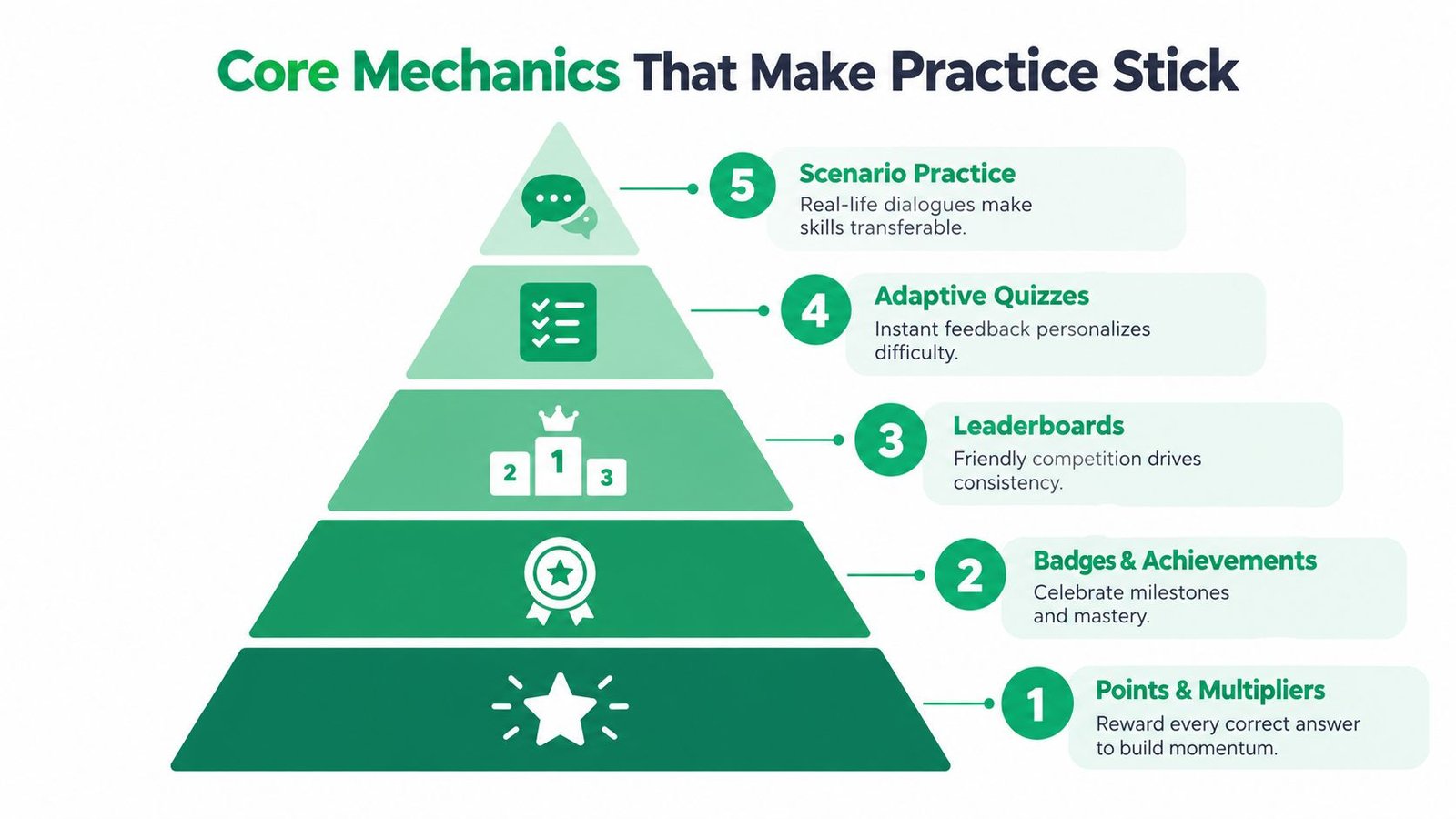
A review of game mechanics in higher-education learning separated the jobs. Leaderboards primarily promote competitiveness. Points and immediate feedback support motivation and engagement. Badges can be less motivating when used alone. Badges were the most frequently studied mechanic, in 11 of 17 studies. Leaderboards appeared in seven of 17. In one course evaluation, students ranked leaderboards, points and progress bars as more motivating than badges.
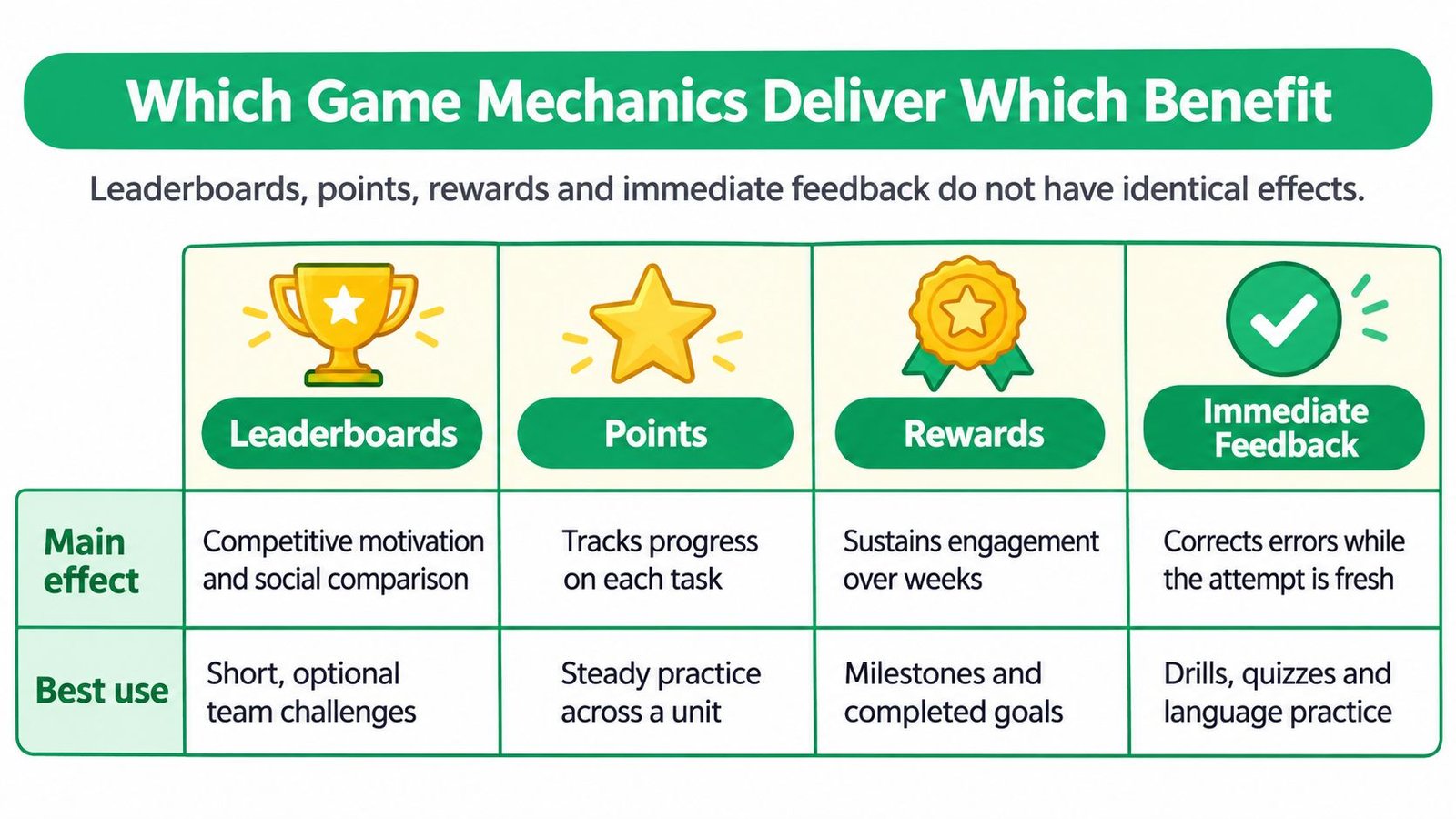
The badge-versus-leaderboard comparison fits the same split. Badges create an early activation. Leaderboards hold participation through social comparison. Neither produced an achievement advantage on its own. Combine them with a correction the learner can use, or you have a busier screen and the same errors.
| Mechanic | Main effect | Evidence reported | Best use |
|---|---|---|---|
| Points | Supports practice frequency and engagement | Linked to a 30% participation gain in a programming course | Rewarding completed daily practice |
| Immediate feedback | Corrects errors while the attempt is still fresh | Grouped with points as a motivation and engagement driver | Pronunciation checks and quiz answers |
| Badges | Early activation that fades if used alone | Appeared in 11 of 17 studies; less motivating alone | Marking milestones such as finishing a unit |
| Leaderboards | Social comparison and relatedness | Appeared in 7 of 17 studies; higher relatedness but no achievement gain | Optional, class-level or team rankings only |
| Progress bars | Visible progress toward a goal | Ranked above badges for motivation in one course evaluation | Long courses such as exam preparation |
A verdict by situation
Use points with immediate feedback for a daily practice habit. The point records that the task happened. The feedback records whether the phrase was right.
Attach badges to a real milestone, such as finishing a unit, not to logging in. A login badge trains the login.
Keep leaderboards optional and at class or team level. A public individual rank is a competitive tool, and the achievement evidence for it is thin.
Use progress bars for a long course, including exam preparation, where the learner needs to see the remaining distance rather than today's score.
The video below walks through how those pieces feel inside a lesson, which is useful before you stack every reward on one task.
Don't award points, a badge, a rank and a multiplier for the same tap. Pick the mechanic whose main effect matches the gap you have.
Classroom and Language-Learning Examples in Practice
Three situations show the same design habit. Name the person, name the mechanic, then name the measure that would tell you the mechanic worked.
A shared mural and a private page count
Aoife's primary class adds a point toward a shared wall mural for every book the class finishes. Each child also sees a personal best for weekly pages, and nobody else's page count is on the wall. The mechanic is cooperative progress plus a private personal best. The benefit you are buying is behavioural participation. The measure is weekly reading minutes, not how pretty the mural looks.
For a younger child practising a different language at the kitchen table, playful English practice at home from Talkio Kids uses short games in the same spirit: the activity stays small, and the child isn't ranked against the room.

An oral exam that compares the learner with themselves
Cian is preparing for the Leaving Cert oral. Each week he completes one exam-topic simulation, earns a level badge only when that topic is finished, and listens to his first recording beside his latest one. The benefit is confidence and progression. The measure is whether the later recording is clearer and more complete, not whether he outranks a classmate.
Ordering food, with a streak that still gets corrected
Nóra is a complete beginner ordering food in Irish. She earns points for each correct phrase, sees a multiplier after a three-day streak, and gets an instant note when the pronunciation slips. The benefit is quick repetition with corrective feedback. The measure is accuracy on the same phrases at the tenth attempt, plus whether she can place the order with the prompts removed.
One digital version of that third pattern is Gaeilgeoir AI. Points, multipliers and leaderboards sit inside scenario-based practice for ordering food, asking for directions and work conversations. Further patterns are set out in these gamified learning examples.
In any app, watch whether the points follow real speaking. A tap on a multiple-choice option isn't the same behaviour as saying the phrase aloud. If the reward fires on the tap, the streak can climb while the mouth stays quiet.
Pitfalls That Cancel Out the Benefits
The evidence base is lopsided. A 2024 systematic review of K-12 research synthesised 54 empirical studies and noted that the evidence primarily emphasises motivation, engagement and competitiveness rather than sustained retention or inclusive design. Recent reviews report positive academic and motivational effects but call for more research on long-term outcomes and differential impacts.
That skew matters when you read the results. Motivation is easier to move than memory, so a study can show logins and quiz attempts climbing while retention stays flat. Common write-ups stop at the lift. They rarely ask who paid for it.
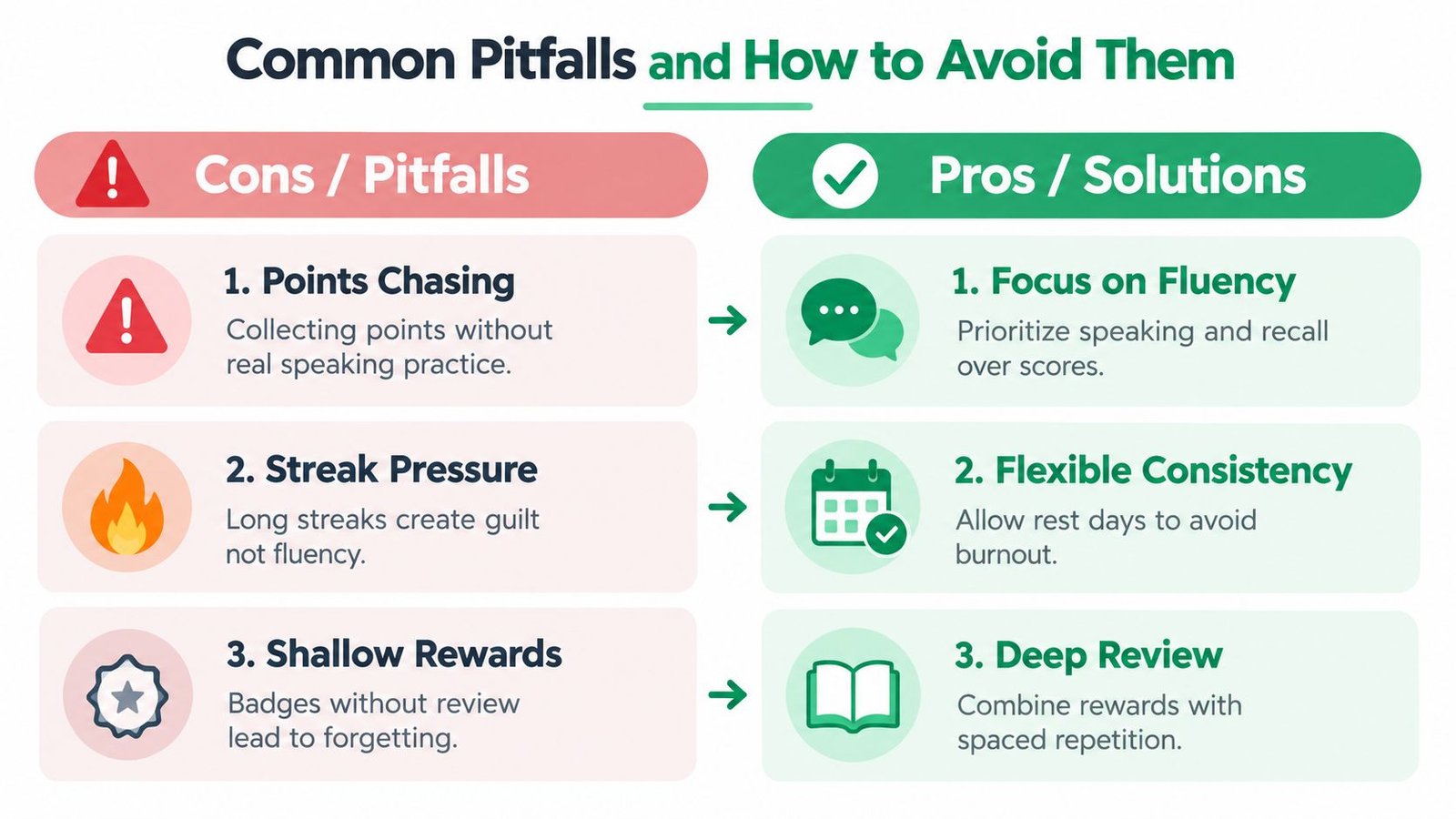
- Public leaderboards: Slow, anxious, disabled or second-language learners can be discouraged by a rank they didn't choose. Fix it with private progress, personal bests and rankings that can be hidden.
- Reward dependence: Learners stop when the points stop, because the points became the reason. Fix it by tying rewards to work that still matters after the points are gone, and by keeping a goal the learner set.
- Login badges: A badge for opening the app records attendance, not achievement. Fix it by awarding the badge for a finished unit or an unaided task.
- Exposed progress: A public board can reveal how far behind someone is. Fix it with cooperative goals and a view only the learner and the teacher see.
- Streak anxiety: A broken streak can turn practice into compulsion. Fix it with flexible pacing, a streak that pauses, and no penalty that shames a missed day.
Each of these failure modes has the same shape: the mechanic moves a behaviour metric while the learning outcome sits untouched, or drops. Heritage learners and exam candidates often value confidence and safety above rank, so competitive features should be opt-in for them and for complete beginners. A mechanic that makes a learner feel behind is working against the learning, even when the click count says otherwise.
Choose Mechanics by Learner Goal, Then Measure Results
Pick the person before you pick the points. A complete beginner, a returning heritage learner, an exam candidate and a busy adult don't fail in the same place, so they shouldn't share one motivational design.
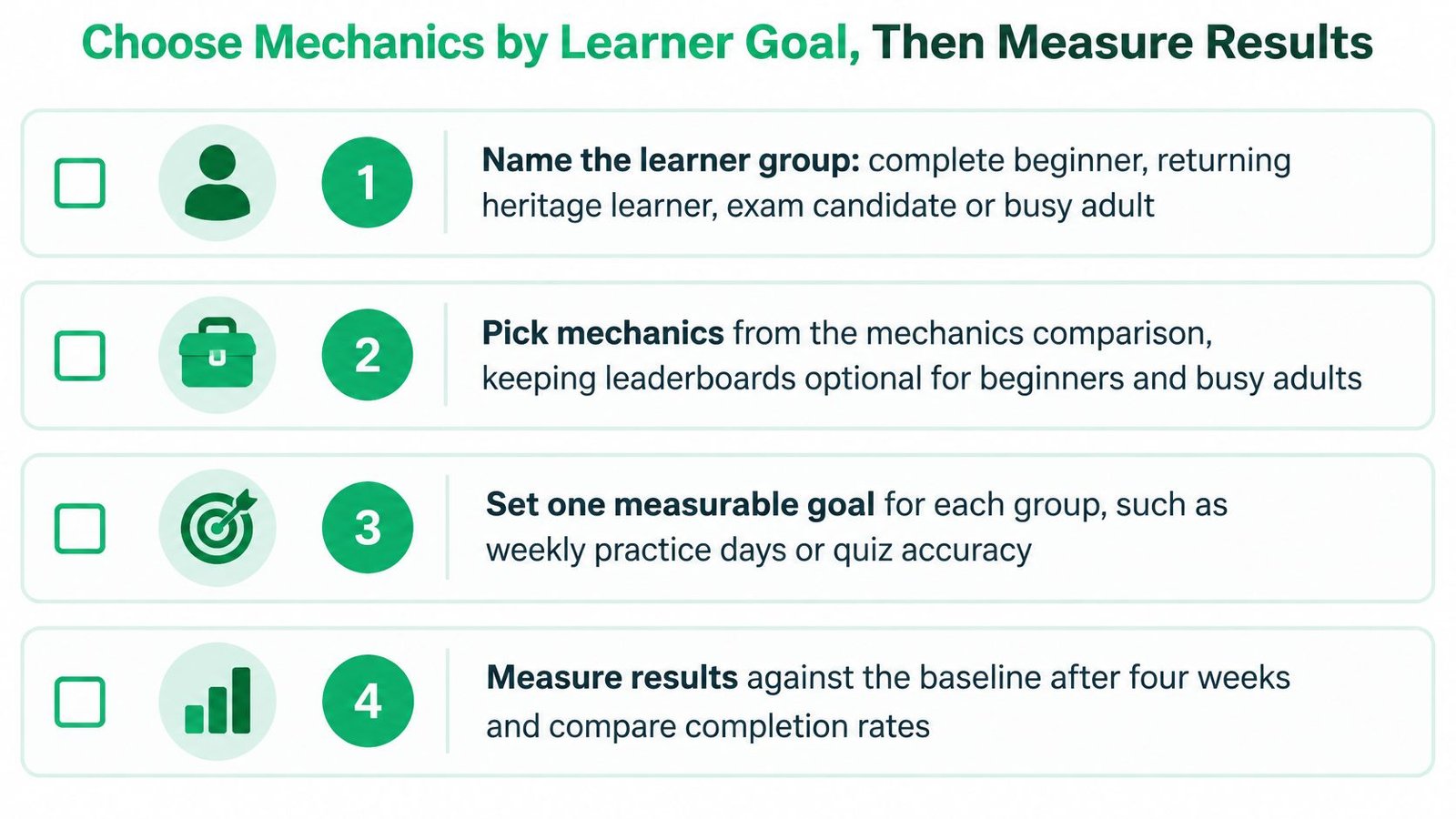
- Name the learner group. Complete beginner, returning heritage learner, exam candidate or busy adult. Write that label on the plan so the mechanic has a person attached.
- Pick mechanics from the comparison above. Points plus immediate feedback suit daily practice. Badges suit finished units. Progress bars suit a long exam course. Keep leaderboards optional for beginners and for anxious learners.
- Record a baseline for every metric in the table before you launch. A number with no "before" can't show a change.
- Review at four weeks. Drop any mechanic that moves sessions but not learning. If the path itself should change with performance, adaptive learning algorithms adjust the next task rather than only decorating the last one.
Engagement is not the learning row
| Metric | Type | How to measure | Signal of real progress |
|---|---|---|---|
| Weekly active sessions | Engagement | Count sessions per learner per week | Stable over four or more weeks, not a one-week spike |
| Streak length | Engagement | Consecutive days with one completed task | Rising alongside accuracy scores |
| Pronunciation accuracy | Learning | Score on the same phrases at first and tenth attempt | Consistent improvement across attempts |
| Vocabulary recall | Learning | Delayed quiz on the most-used words at one and four weeks | Recall holds after a week, not only on the same day |
| Speaking confidence | Learning and affect | Self-rating before and after a role-play scenario | Higher rating with equal or better accuracy |
| Scenario completion | Outcome | Complete a task such as ordering food with no prompts | Task finished unaided |
| Leaderboard opt-out rate | Equity | Share of learners who hide or leave rankings | Low rate, with no drop in weekly sessions |
Sessions and streaks are the engagement pair. If they rise while pronunciation and delayed recall stay flat, the game is working and the teaching isn't. Confidence only counts when accuracy holds or improves. An opt-out rate that climbs, or a drop in sessions among people who leave the board, means the rank is costing you learners.
Before you keep a design, confirm three things. Rewards follow real speaking practice. Rankings can be hidden. Progress is shown against the learner's own earlier results, not against the fastest person in the room.
Gaeilgeoir AI places points, multipliers and leaderboards beside pronunciation support and scenario practice for everyday Irish, including ordering food, travel and Leaving Cert oral topics. Run it through the checklist above so a streak isn't mistaken for progress. Visit Gaeilgeoir AI and try the practice at learn.gaeilgeoir.ai.