
If you're trying to learn Irish and some practice sessions feel alive while others feel like you're pushing words uphill, you're already asking the same question that drives language acquisition research. Why does one kind of input seem to stick, while another vanishes the next day? The science doesn't give you a magic shortcut, but it does give you a clearer map for where effort pays off, especially if you want your study time to sound more like real Irish and less like a worksheet.
Table of Contents
- Why Language Acquisition Research Matters to You
- The Core Theories Every Learner Should Know
- How Researchers Study Language Learning
- Landmark Findings That Shaped the Field
- Common Myths the Research Pushes Back On
- What the Science Says About How to Learn
- The Biggest Gaps in the Research
- Where to Go Next in the Literature
Why Language Acquisition Research Matters to You
You sit down with Irish, open a lesson, and two things happen. One exercise feels natural because it sounds like something you'd say. Another feels artificial, like a puzzle cut off from real life. That difference is exactly what language acquisition research tries to explain, because learners do not just absorb language by effort alone, they pick up patterns, meanings, and routines from the kinds of input they meet most often.
A useful way to read the field is to treat it as a guide to better decisions. The best studies help answer everyday learner questions, such as whether you should spend more time listening before speaking, whether grammar drills are enough, and why repeated exposure to the same phrase in context can suddenly make it feel obvious. If you want a practical starting point for self-study, see this guide to learning a language on your own.
Practical rule: If a study feels abstract, ask what it says about input, practice, or feedback. Those three things keep showing up in the literature because they shape what learners notice and retain.
That distinction matters especially for Irish learners, who often approach the language as a school subject rather than a living one. Research helps shift the focus from “Did I memorize the rule?” to “Did I hear, notice, and use the pattern enough times to make it stick?” That is a better question, and it leads to a better study plan.
The point is to use research as a reality check when your learning routine starts to feel random. Once you know what the science tends to support, you can spend less time guessing and more time building habits that line up with how people acquire language.
The Core Theories Every Learner Should Know
A learner can hear the same Irish sentence many times and still wonder why some parts stick while others fade. That puzzle sits at the center of language acquisition research. Scholars have spent decades asking how humans get language into their heads, and the answer has never settled into a single winner. Each theory explains a different slice of the process, which is why modern research often treats them as complementary lenses rather than rivals.
From imitation to patterns
The earliest classroom-friendly view was behaviorism, which saw learning as habit formation. You hear a phrase, repeat it, get reinforced, and the pattern becomes easier to produce again. That idea fits some kinds of practice well, especially drills and repeated forms, because repetition can make a phrase feel familiar and easy to retrieve. It has a harder time explaining how learners produce sentences they have never heard before.
Nativism offered a different answer. It treats the learner as someone with a built-in language capacity that helps sort the input into structure. Children aren't merely copying speech, they are using an innate toolkit to infer grammar from the language around them. A simple everyday comparison is a child who can recognize the shape of a puzzle before every piece is labeled. The pieces still matter, but so does the ability to see how they fit.
Language as interaction and usage
Interactionist and usage-based models shift the focus to what happens in real communication. Language grows through social exchange, repeated encounters with meaningful phrases, and attention to how forms behave in context. In this view, a learner is not just storing words one by one. The learner is testing patterns in conversation, noticing what speakers do, and adjusting based on the results.
That perspective also helps explain why the same phrase can feel opaque one day and obvious the next. It often becomes clear after enough encounters in familiar situations, where sound, meaning, and use line up.
Language doesn't arrive as a list of rules. It emerges from repeated contact with forms that carry meaning in real use.
Statistical learning fits naturally alongside those ideas. A major review describes it as tracking sequential statistics, especially transitional probabilities, to find word boundaries and grammar patterns in input. In plain terms, learners notice which sounds and words tend to travel together, then use those regularities to segment speech and infer structure. A broader meta-analysis covering 25 years of work and hundreds of studies supports statistical learning as a well-established phenomenon linked to language outcomes across populations and tasks (review and meta-analysis).
For someone learning Irish, that means the smartest approach usually blends exposure, notice, and use instead of relying on one method alone. Repetition helps, but only when it is tied to meaningful examples that the brain can sort into patterns. For a deeper look at how adults approach language differently, see this guide to the best way to learn a language as an adult.
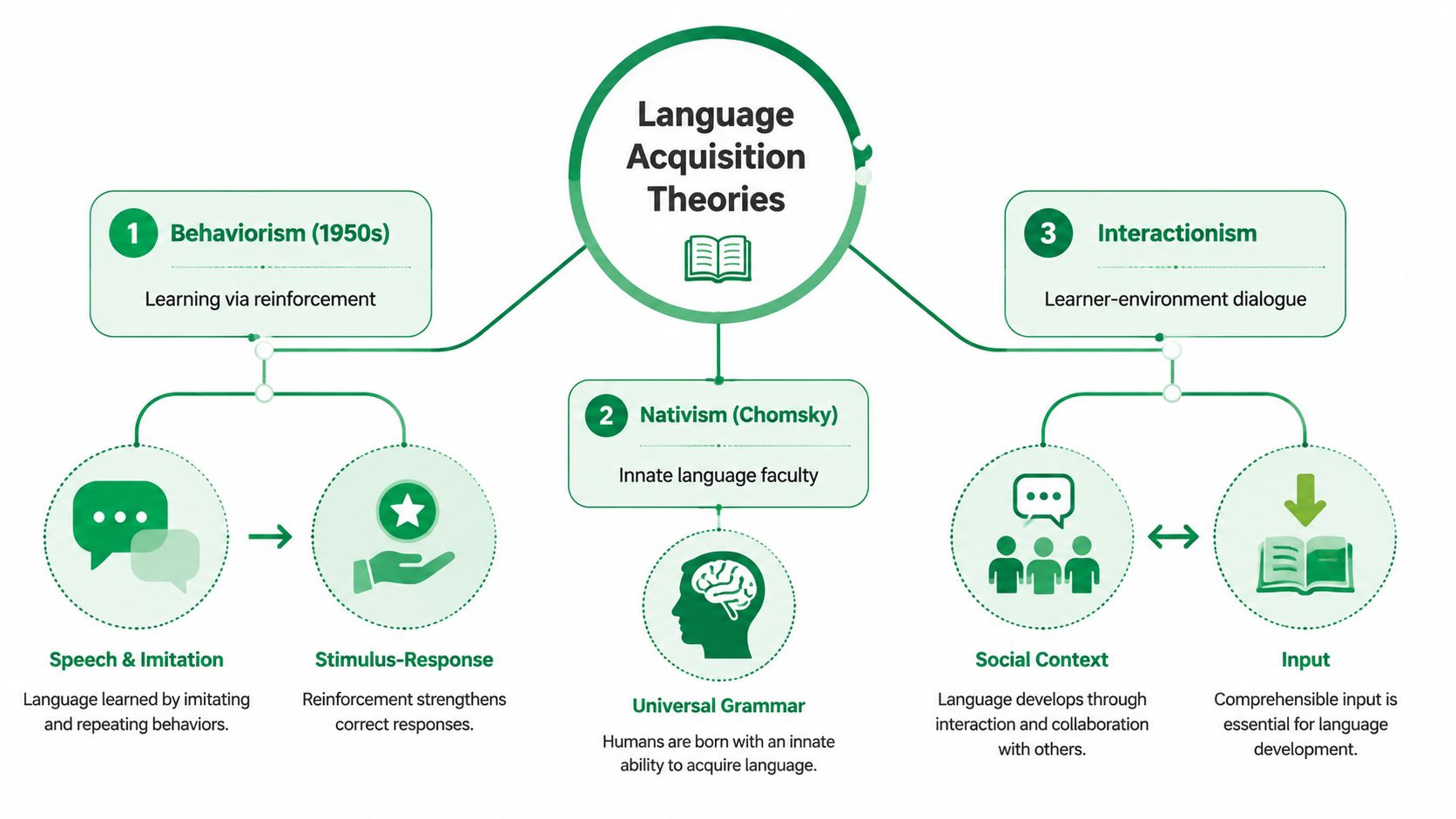
The main takeaway is straightforward. The field no longer asks whether language comes from repetition, innate capacity, or social use. It asks how those forces work together when a learner hears enough meaningful language to start extracting patterns.
How Researchers Study Language Learning
Many learners picture language research as a lab bench with a white coat, but the field uses several very different tools. Some studies follow children over time, some measure what babies look at, and some test how the brain responds to speech. Each method answers a different question, so the headline of a paper can sound firmer than the evidence really is.
Following real speech over time
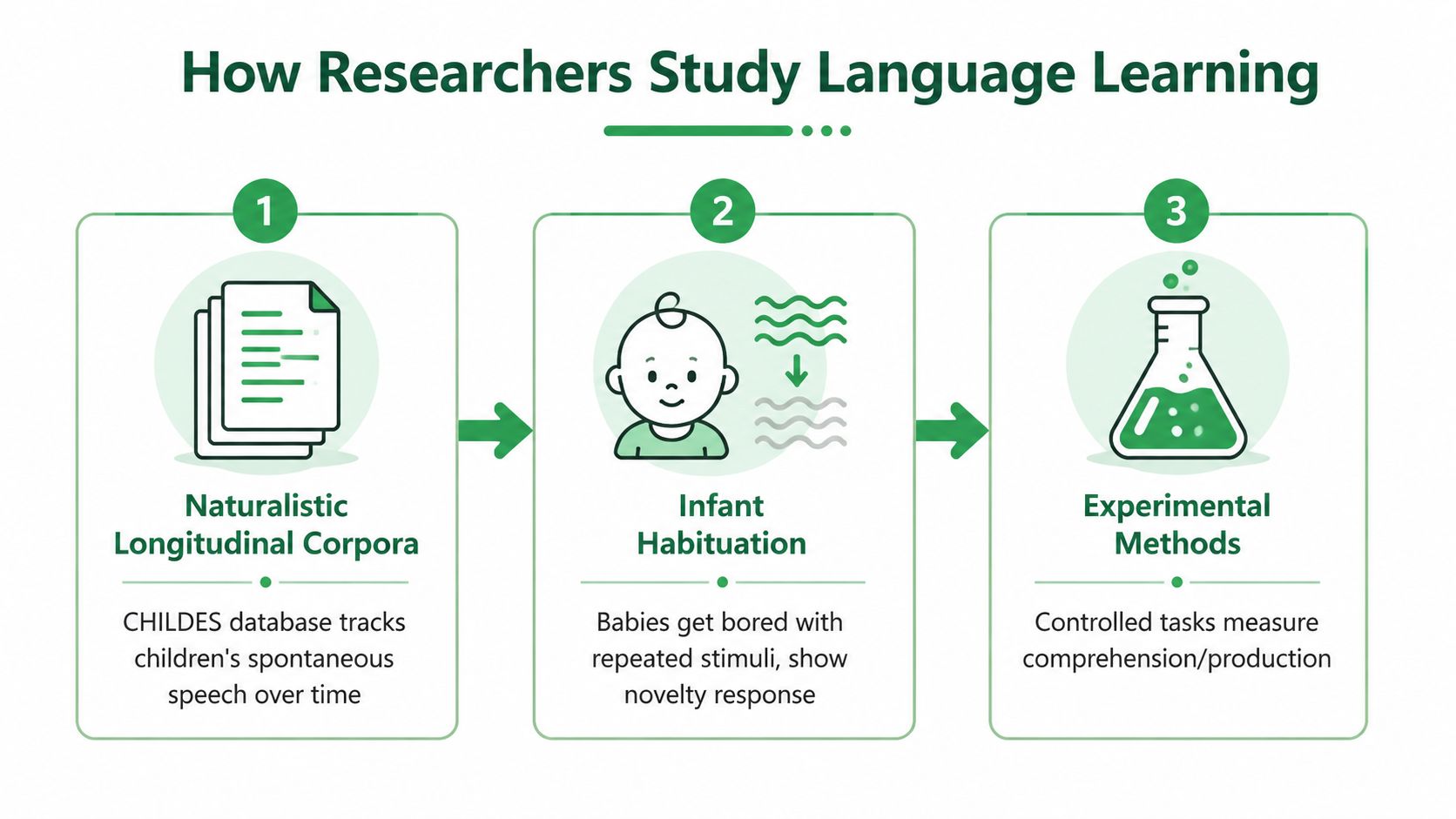
One major approach is the longitudinal corpus. Researchers record real speech over weeks, months, or years, then look for changes in vocabulary, grammar, and interaction. This kind of data matters because it shows language as it unfolds in daily life, not just in a single task that only captures one moment. The CHILDES tradition is a classic example of this broader method, and it is one reason researchers can compare spontaneous speech across ages and settings.
Another common approach is the infant habituation study. Babies hear the same sound pattern again and again until they lose interest, then researchers change the pattern and watch for renewed attention. If the baby responds to the new pattern, that suggests the difference was noticed. It is a clever way to study learning before children can talk.
What lab tasks can and can't tell us
Researchers also use eye-tracking, EEG, and other experimental methods to measure attention and processing in real time. These tools help reveal what learners notice, what they expect next, and where comprehension starts to break down. Computational models add another layer by testing whether the patterns in child-directed input are enough to produce the kinds of structures children eventually acquire, which is one reason readers interested in digital tools and feedback often compare this work with machine learning in education.
The limit is simple. A short task does not always reflect everyday learning. A learner can succeed in a lab study and still struggle in conversation, because real language comes with noise, emotion, timing, and social pressure.
Rule of thumb: If a study only measures a few minutes of performance, read it as evidence about processing, not proof of full language development.
If you open a new paper and ask, “What kind of method is this?” you are already reading more carefully than many casual readers. That habit matters because method shapes the claim. A long-term corpus, a baby looking toward a speaker, and a reaction-time task all study language, but they do not tell the same story.
Landmark Findings That Shaped the Field
Some findings keep coming back because they hold up across different tasks and different groups of learners. For people trying to make sense of Irish learning, these studies matter because they move the conversation from vague advice to specific mechanisms. They also show why researchers keep returning to input, frequency, and timing as core ingredients in acquisition.
A quick look at the anchor results
| Finding | Evidence Claim | Source |
|---|---|---|
| Infant speech segmentation | By the first year of life, infants map key properties of ambient speech and extract statistical regularities from input. | Infant speech perception and learning |
| Early exposure and later processing | Experience changes perception itself, so early input reshapes how speech is processed before production begins. | Infant speech perception and learning |
| Grammar-learning age effects | In a study of more than 670,000 participants, grammar-learning ability stayed nearly unchanged until about 17.4, then declined. | Large-scale age and grammar study |
| Native-like grammar and age | To reach native-like grammar proficiency, learning needs to begin by about 10. | Large-scale age and grammar study |
The infant findings matter because they show that learning begins with perception, not with speech production. Babies do not wait until they can talk before they start sorting sound into patterns. A major PNAS paper reports that infants detect patterns in ambient speech during the first year of life and use statistical properties to identify higher-order linguistic units (Infant speech perception and learning).
That idea helps explain why a learner's ear often changes before their mouth does. A person working on Irish may notice that certain word shapes start to feel familiar long before they can produce them confidently. The research on infant speech learning gives a clear model for that sequence, perception first, production later, with the brain building patterns in between (Infant speech perception and learning).
The age-of-acquisition work is often oversimplified in everyday discussion. The large-scale study does not say adults cannot learn, and it does not suggest that a single birthday flips a switch. It shows a gradual decline in grammar-learning ability after a late childhood to adolescence window, which is very different from the cartoon version of a hard cutoff (Large-scale age and grammar study).
That distinction matters for learners of Irish today. If you start later, the research does not tell you to stop. It tells you to expect different conditions, especially around the amount of exposure you get and how often you meet the language in real use. The practical lesson is simple. Repeated patterning, meaningful contact, and steady exposure matter a great deal, especially when they come early in a learning sequence and continue over time.
Common Myths the Research Pushes Back On
A learner opens an Irish lesson, hears a correction from a tutor, and then wonders whether they are “too old” to make real progress. That worry is common because language learning advice often gets reduced to two tidy stories. One says younger is always better, as if adults arrive too late. The other says correction drives grammar growth, as if every mistake needs a verbal red pen. Research gives a more nuanced picture.
Younger isn't a magic switch
The age findings are often misread as a dramatic cliff. A more accurate framing is a shrinking window. As noted in the age-of-acquisition study above, grammar-learning ability stayed fairly stable until about 17.4, then declined, while native-like attainment was linked to starting by about 10. Age matters, but it does not cancel out adult learning, and it does not turn later study into a dead end.
For adults, the larger obstacle is usually exposure, not ability. Many learners have fewer daily chances to hear Irish, less time to repeat patterns, and more pressure attached to speaking. That is why steady contact with meaningful Irish matters more than worrying over a missed cutoff. Like learning a tune by ear, repeated listening makes the shape familiar before your own performance feels confident.
Correction isn't the engine people think it is
The correction myth is just as persistent. A review of correction findings describes Brown and Hanlon's work showing that explicit verbal approval, phrases like “that's right” or “correct,” did not function as reinforcement for grammaticality in the way people often assume (review of correction findings). Direct correction has a limited and unreliable role in acquisition.
That does not make feedback useless. It means feedback works best when form and meaning stay tied together inside communication. If someone uses an Irish phrase in a real exchange and the response shows the form in context, that kind of feedback lands more clearly than a detached grammar comment after the moment has passed. A correction can be like a label on a shelf, while meaningful interaction is the whole room where the item belongs.
Practical takeaway: Instead of asking, “Was I corrected enough?”, ask, “Did I hear the pattern often enough in meaningful use?”
For a learner, that shift changes the goal. You do not need perfect correction to improve. You need enough understandable exposure, enough chances to notice structure, and enough real interaction for the pattern to stop feeling strange. The same idea also helps explain why tools such as the German exam milestones guide can be useful as comparison points, because they make progress feel concrete without pretending that one rule explains every learner's path.
What the Science Says About How to Learn
Adult learners often want a simple recipe. The research doesn't give a single recipe, but it does support a few habits strongly enough to make them worth following. If you're learning Irish, these habits can help your study feel less random and more aligned with how language sticks.
Five habits that fit the evidence
- Prioritize comprehensible input: Choose Irish you can mostly follow, even if it's slightly challenging. The review literature on second-language acquisition emphasizes that input is the key ingredient, and it needs to be meaningful for processing to happen (review).
- Start with frequent material: Words and phrases you meet over and over are easier to notice and reuse. That fits the statistical-learning picture, where learners track regularities in repeated input rather than memorizing isolated facts.
- Keep output low-pressure: Short, real exchanges beat silent perfectionism. Speaking helps you test what you've noticed, especially when the setting is calm enough that you're not bracing for failure.
- Use feedback that links form to meaning: A correction sticks better when it happens inside a real exchange, not as a disconnected grammar lecture.
- Space practice across days: Repeated contact matters more than a single heroic cram session. Language grows when the pattern returns often enough to become familiar.
A practical platform can help if it preserves those principles instead of fighting them. One option is Gaeilgeoir AI, which offers guided Irish conversation practice, adaptive feedback, and scenario-based exercises around everyday speaking situations. It isn't a substitute for real interaction, but it can make daily exposure easier to maintain.
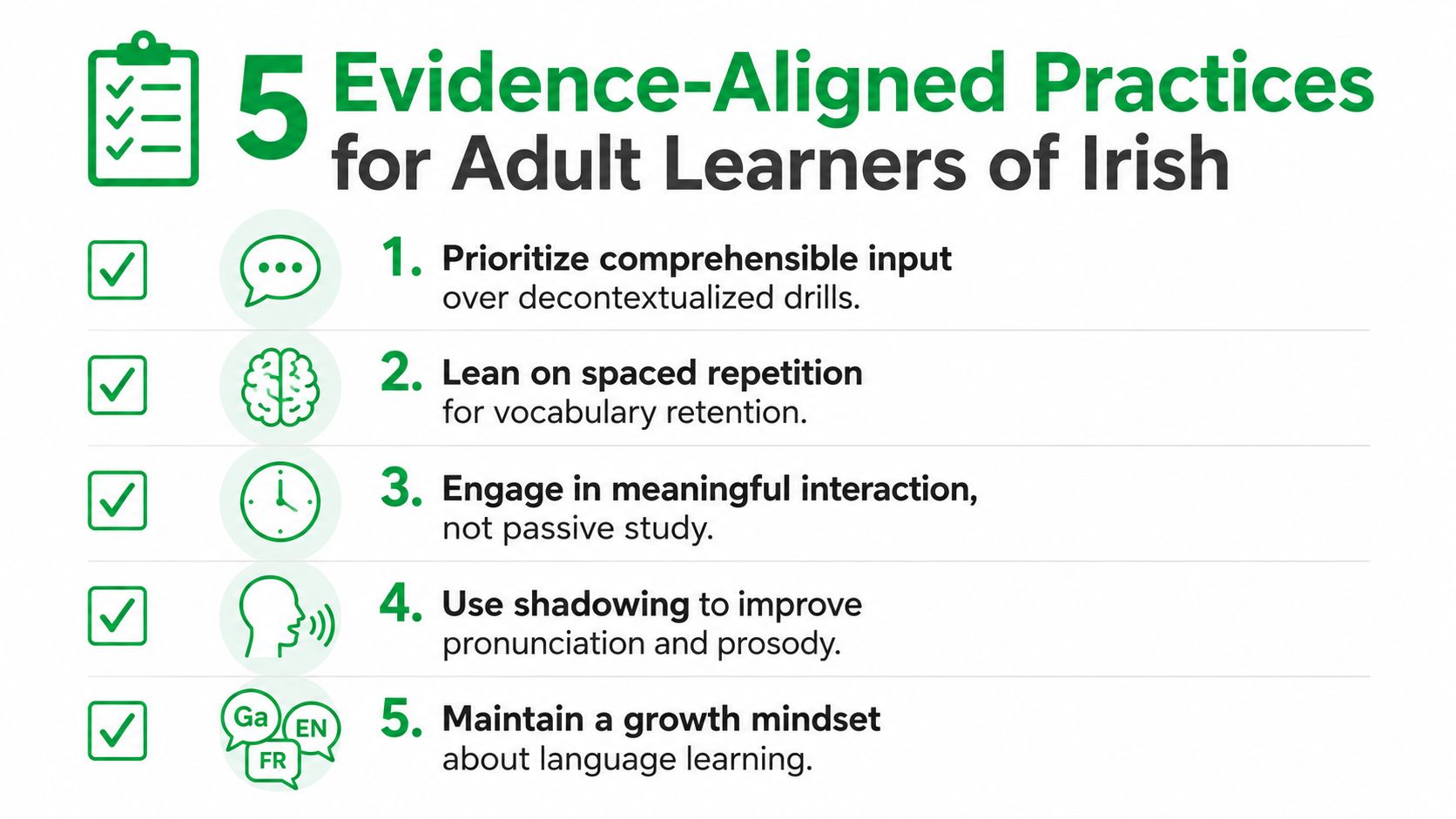
If you want a concrete model, think of your learning week as a loop, not a checklist. Read and listen to something you can follow, speak a little, get a bit of feedback, then return to the same structures later. That rhythm matches the research far better than isolated drills do.
For a useful comparison point on how timelines are framed in another language-learning context, the German exam milestones guide from German Cultural Association Hong Kong shows how learners often benefit from structured milestones. Irish learning needs its own path, but the underlying idea is the same, clear stages help people stay oriented.
The big lesson is not “study harder.” It's “study in a way that matches how language is absorbed.” If your Irish practice feels too detached from real communication, the problem may be the format, not your ability.
The Biggest Gaps in the Research
The strongest research still has blind spots, and those blind spots matter if you're learning Irish. A field can be careful and narrow at the same time. In language acquisition research, the narrowness shows up most clearly in which languages, learners, and settings get studied most often.
Where the evidence is thinnest
One analysis of child language acquisition journals found at least one article on 103 languages, about 1.47% of the world's roughly 7,000 languages (journal analysis). A related study of second-language and multilingualism journals found 183 unique languages and 174 unique language pairings, about 3% of the world's roughly 7,000 languages and less than 0.001% of the roughly 24.5 million possible combinations. English dominated that literature, appearing in 27% of the studied languages, with Mandarin Chinese next at 6.6%.
That leaves a representativeness problem. A lot of acquisition theory was built on high-resource, heavily studied languages, especially English and other Indo-European languages. Irish learners should keep that in mind, because evidence from another language family or another learning environment will not always transfer cleanly.
Why this matters for everyday learners
A second gap is population bias. Research on language acquisition still leans heavily on monolingual, WEIRD, and lab-based participants, which makes it harder to generalize to bilinguals, heritage learners, and low-resource language communities (diversity critique). A third gap is setting bias. A 2026 review found that 93.0% of the AI-in-language-learning studies it surveyed targeted English, while 76.5% of the sample was in formal university settings and receptive skills were underexplored (2026 review).
If you're learning Irish, these gaps matter because much of the headline evidence comes from other learner populations and other contexts. You can still use the findings, but you have to translate them carefully. That usually means valuing real conversation, home practice, and everyday exposure at least as much as classroom-style tasks.
For learners looking for free supplementary ideas, the Kindness Community Foundation language guide can be a helpful place to browse additional resources without losing sight of the bigger evidence picture. The important thing is to choose materials that support repeated, meaningful contact with the language.
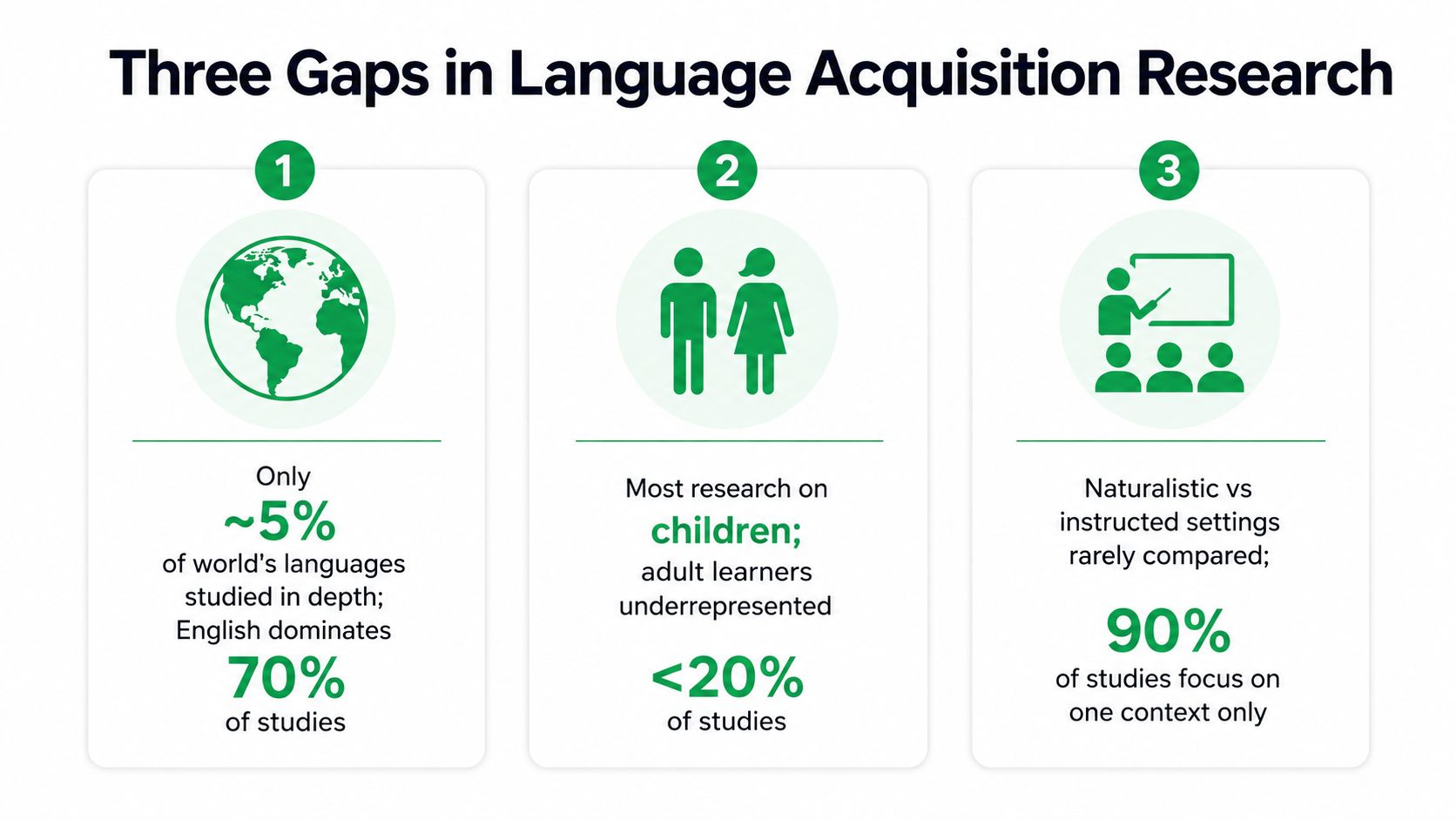
The honest conclusion is that the field is useful, but incomplete. That is not a weakness to hide. It is a reason to use research carefully, especially when you are learning a smaller language and want advice that fits your reality.
Where to Go Next in the Literature
If you want to read past broad explainers, start with review articles instead of random headlines. A good review gives you the shape of a topic, the main points of disagreement, and the studies that keep coming up again and again. For statistical learning, the review cited earlier is a useful first stop because it connects the idea to language outcomes across tasks and learner groups.
The next place to look is child language corpora, especially CHILDES, because corpus data lets you watch language unfold in real speech rather than in abstraction. That kind of evidence is useful when you want to see how often forms recur, how adults support children's language, and how patterns appear over time, almost like watching many small snapshots add up to a moving picture. Journals worth bookmarking include Language Acquisition and Studies in Second Language Acquisition, both of which regularly publish work that helps shape the field.
Good reading habit: Follow a small number of review papers and one or two journals. That gives you a steadier picture than chasing every new headline.
Preprint servers can help you spot the newest work, but they deserve a careful eye because an early claim is only a draft of an argument until peer review tests it. If you are mainly trying to improve your Irish, you do not need to read everything. You need a handful of reliable sources that help you separate stronger evidence from noisy claims and give you a sense of what is ready to use now.
The broad lesson from this field is simple. Learners tend to do better when input is meaningful, frequent, and usable, and when practice gives them chances to notice patterns in context. That is why the next sensible step is not more theory for its own sake, it is putting the theory to work in daily Irish practice.
If you want to turn these research-backed ideas into actual Irish speaking time, visit Gaeilgeoir AI and try structured conversation practice that focuses on useful words, real scenarios, and immediate feedback. It is a practical way to make comprehensible input and repeated use part of your routine without needing to build the whole system yourself.