

“Just speak more” is incomplete advice. You can repeat a polished Irish introduction every evening and still freeze when someone asks an unexpected question. More speaking time helps when you also practise forgetting a word, asking for clarification, and continuing without a script.
If you're wondering how to practice my speaking skills in a way that fits a busy week, start with a small everyday task. Rehearse it, change something, and check whether you can still get your message across. Your aim isn't a flawless performance at the kitchen table. It's an exchange you can keep going.
Table of Contents
- Your Seven Day Speaking Practice Schedule
- How to Run One Speaking Session
- Drills That Force You to Speak
- Move From Rehearsal to Real Conversation
- Get Pronunciation Feedback That You Can Retry
- Begin Guided Irish Conversation Practice
Your Seven Day Speaking Practice Schedule
Seven-day speaking practice schedule
| Day | Main task | Output to keep |
|---|---|---|
| Monday | Retrieve greetings and introduce yourself from memory | One clean 60-second introduction |
| Tuesday | Order food in three passes | Final take with the script hidden |
| Wednesday | Ask directions and repair one misunderstanding | Two clarification questions actually used |
| Thursday | Shadow a short model, then retell it | Retelling with no text visible |
| Friday | Reciprocal exchange, half listen and half speak | Unscripted answers using the week's words |
| Saturday | Repeat the hardest scenario with prompts removed | Recording compared with Monday |
| Sunday | Spaced review only, no new topic | Three phrases booked for next week |
Treat this as a practical starter plan, with a suggested daily appointment of 15 to 30 minutes. Use your phone's voice recorder, a timer, and a notebook. You don't need to prepare a lesson before you can begin.
On Monday, keep the task to retrieval: hide your model greeting and introduction, say them aloud, then check what you missed. A beginner might introduce their name and where they live; a returning learner could add why they're learning Irish. Book another attempt rather than leaving the next review to chance.
Tuesday's café scene can be a coffee and a scone. Wednesday's directions task might involve finding the station, with your partner deliberately misunderstanding the destination. On Thursday, choose a model about family or a daily routine so you can retell familiar content rather than struggle with an unfamiliar subject.
Space recall instead of collecting rereads
Retrieval means producing language from memory, not recognising it on a page. The Wiley reference entry on retrieval and spaced practice describes separating repetitions, for example after one hour, one day, and one week.
Put those appointments in your calendar. When the reminder appears, hide the answer before you speak. If you get stuck, check the phrase, close it, and try again rather than rereading it repeatedly.
For a sample 25-minute practice day, use this split:
- Recall for five minutes: Retrieve familiar phrases without text.
- Scenario for ten minutes: Speak toward an everyday outcome, such as completing an order.
- Repair for five minutes: Work on the gaps that stopped your message.
- Notes for five minutes: Save the recording and schedule another attempt.
Friday needs a responsive partner or guided exchange, not a longer monologue. Saturday removes support from your hardest task. Sunday stays deliberately light: revisit your selected phrases without opening a new topic.
Your fit check is simple: you produced speech toward a goal, kept a recording, and can name the next review time. If the session consisted mainly of reading, adjust tomorrow's task so your mouth does more of the work.
How to Run One Speaking Session
A useful speaking session has a beginning, a repair stage, and a fresh attempt. Choose an outcome you can recognise: your listener understands your order, can identify your destination, or learns what you usually do after work.
Keep a recorder running, but don't stop to inspect every sentence. Do not interrupt the first attempt. Finishing an imperfect message gives you something useful to improve.
Use this visual as a reminder of the sequence.
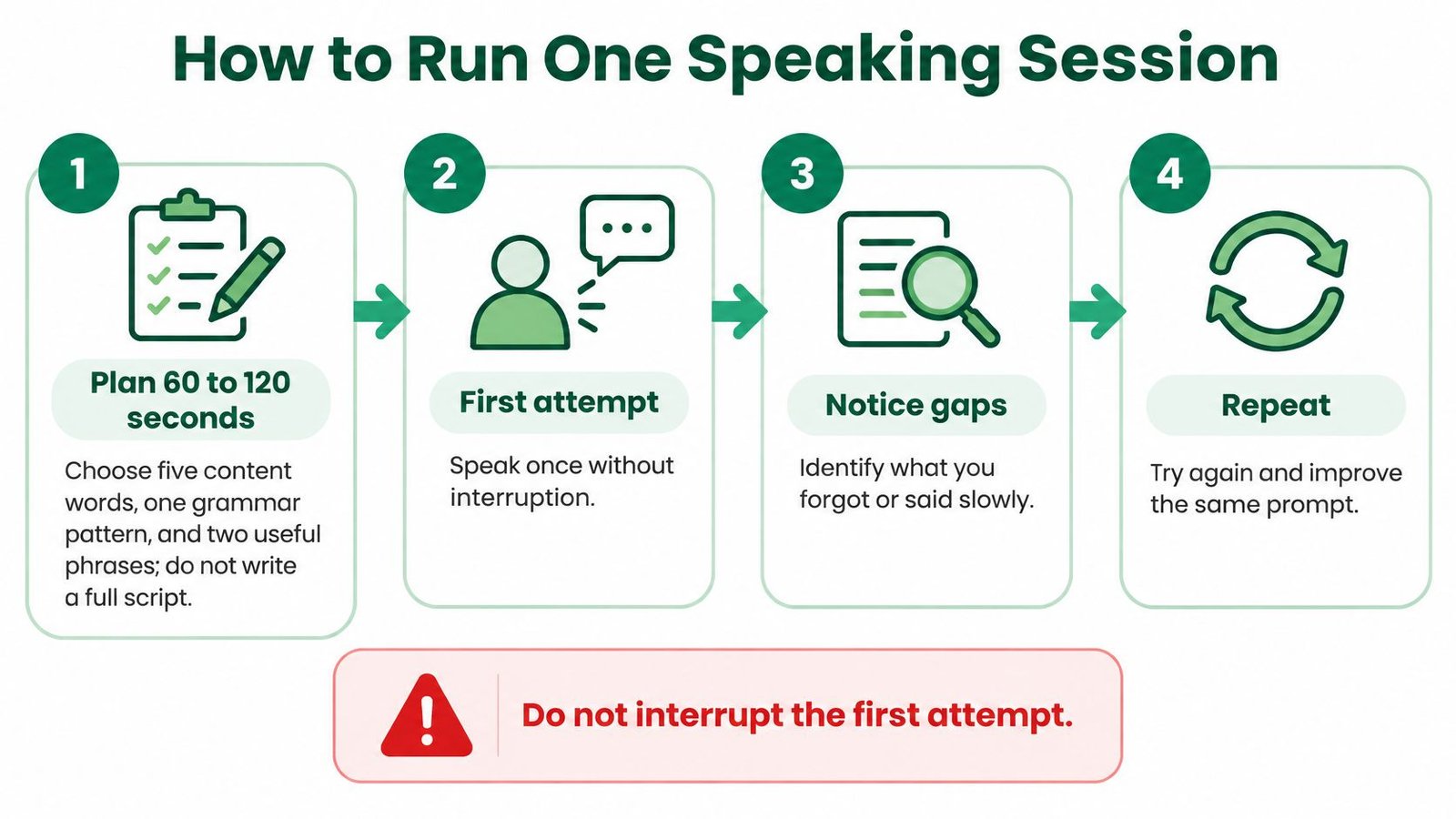
Follow the cycle in order
Plan briefly. Spend 60 to 120 seconds choosing five content words, one grammar pattern, and two useful phrases, rather than writing a script. This planning approach pairs preparation with output-promoting feedback in the study published in English Teaching & Learning. For a café task, your keywords could cover coffee, scone, milk, takeaway, and payment.
Speak for one to two minutes with a clear purpose. Let your listener wait while you search for a word; don't restart because the opening sounded awkward.
Notice the biggest obstacles. Replay the recording and mark no more than three problems. Choose something that affected communication: a long silence, a missing everyday word, or pronunciation your listener couldn't follow.
Ask for feedback after the turn. Your partner can ask what you meant or invite you to say the unclear part another way. They shouldn't immediately hand over a complete replacement sentence.
Repeat the same task. Deliberately fix your selected problems. Keep the successful parts natural rather than trying to reproduce the recording word for word.
If you still have energy, make a second or third immediate pass. Stop when you're merely reciting the previous take.
Leave the task, return several days later, and then try a related situation. Change the café order or ask directions to a different destination so you have to choose language again.
The Cambridge study of massed task repetition found steady fluency improvement until approximately the fourth or fifth performance, while concentrated repetition could reduce pauses but also slow articulation and increase verbatim repetition.
That's why fewer silences alone aren't enough. You could sound smoother because you've memorised the lines, not because you can handle a conversation.
Keep a useful speaking log
Record these marks using the same type of task each time:
- Words per minute: Compare your own attempts rather than chasing someone else's speed.
- Pauses longer than one second: Notice where you struggled to retrieve language.
- Self-corrections: Mark whether the repair helped you finish the thought.
- Goal completed: Write whether your listener understood what you needed.
For practical help with the emotional side, use these ideas for building confidence in speaking Irish. Keep your performance log separate from your feelings: a nervous attempt can still contain successful communication.
End with those concrete marks, not only a vague confidence score.
Drills That Force You to Speak
Listening to Irish can feel productive even when you haven't formed a sentence yourself. Choose drills that make you retrieve, initiate, and respond. A good prompt gives you a reason to speak without supplying your whole answer.
The Modern Language Journal study of foreign-exchange students in an intensive German course found reciprocal target-language interaction was the strongest predictor of performance, and learners' own output predicted performance more strongly than input alone; interaction concentrated among learners sharing a first language had a negative relationship with performance. That doesn't make an English-speaking friend a bad partner, but it does make an English-only chat a poor substitute for Irish practice.
These drill formats help turn listening into output.
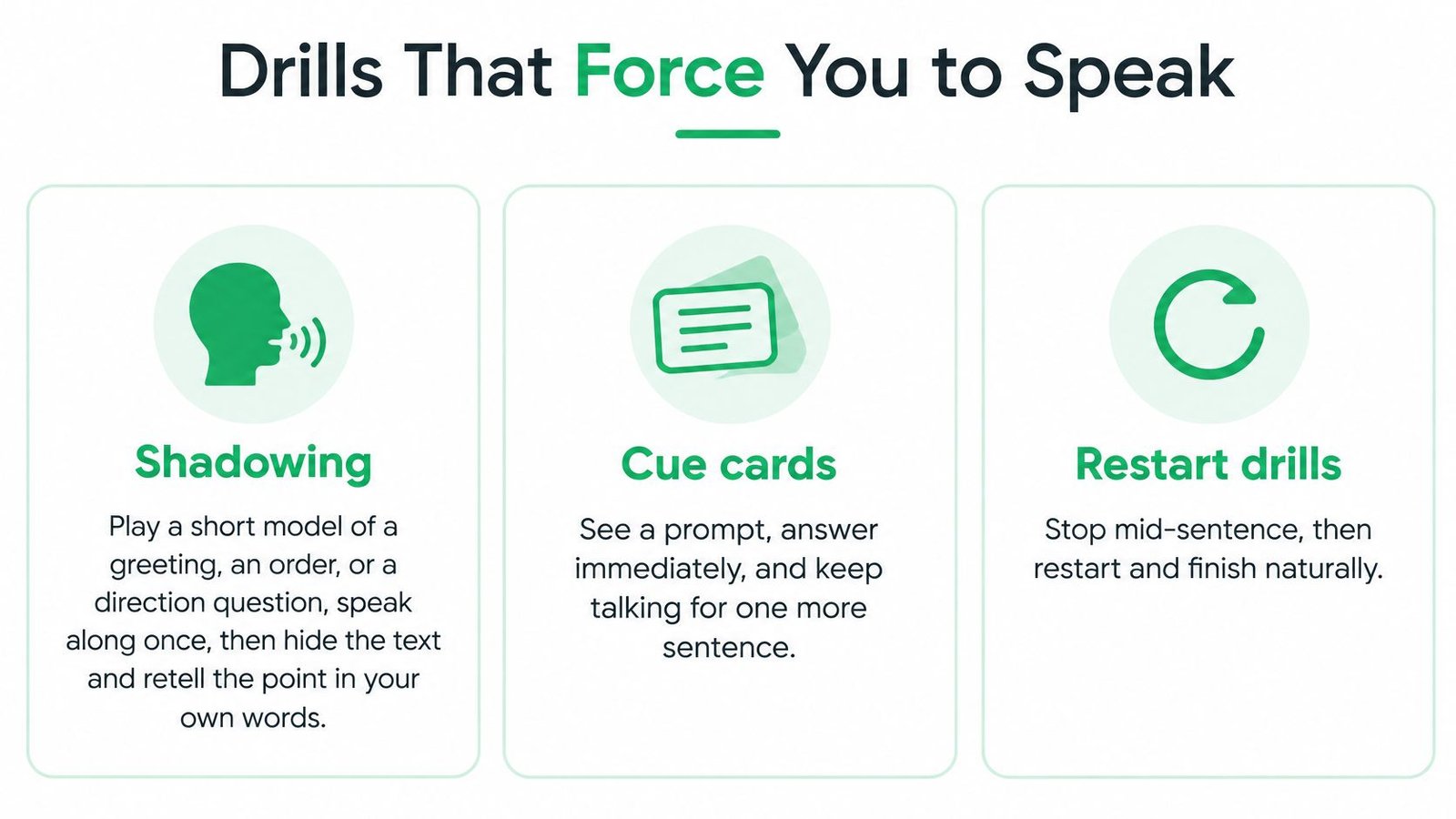
Shadow a model, then leave it behind
Try this as a short warm-up: listen to a greeting or café order, speak along, then hide the text. Retell the point in your own Irish.
Your prompt might be: greet the server, request coffee, and say you're taking it away. Caife, le do thoil means coffee, please. The important final move is changing something, such as the drink or whether you're staying, rather than copying the model indefinitely.
Run a scene with fewer cues
For a sample three-pass café drill, begin with a cue card listing the greeting, item, and takeaway request. Remove the greeting cue on the next pass, then put the card away.
Finish with an unscripted question about the order. If you forget a word, restart the unfinished sentence and complete the thought instead of abandoning the scene. A bus journey or introduction to a family member works equally well.
If you also practise English, Celprep's CELPIP speaking answer examples offer a separate resource for examining complete spoken responses. Use examples to notice how an answer develops, not as scripts to memorise for Irish conversation.
Give a partner a task card
For a suggested 10-minute exchange, divide listening and speaking roughly equally. The card should require an answer, a follow-up question, and a reformulation.
- Starter: Explain where you usually go for lunch.
- Unexpected follow-up: Explain what you'd choose if your usual food wasn't available.
- Repair: Ask your partner to explain an unclear word another way.
Try partners with different levels or backgrounds when possible. A more experienced speaker can vary the question; another beginner can help you practise explaining something clearly.
When nobody's free, record both sides of the exchange. Include a listening response, such as Tuigim for I understand, and a clarification question, rather than delivering alternating speeches.
Listening matters, but the session hasn't done its speaking job if you never initiate, answer, or respond to another turn.
Move From Rehearsal to Real Conversation
Extra rehearsal isn't proof of transfer. A perfect script at the kitchen table can collapse when someone interrupts, changes the question, or waits for more detail.
Use ordinary interaction as the test, not a more polished recording. The aim is to stay engaged when you can't predict the next line.
A conversation partner introduces choices you can't fully prepare.

Signs that speaking practice is transferring
| What happens | Still rehearsal | Transferring |
|---|---|---|
| Starting a turn | You build the English sentence first | The answer starts in Irish |
| Forgotten word | You stop the whole turn | You swap a simpler word and continue |
| Partner's move | You only finish a prepared script | You handle an interruption or odd question |
| Repair | The other person fixes every line | You ask what they meant and try again |
| Length | It is smooth alone and silent with people | You sustain about two minutes |
Treat the duration in the table as a practice target, not a proficiency threshold. After Friday's exchange, mark the column that describes what happened. Mixed results are useful: you might start readily but still struggle with follow-up questions.
Add uncertainty to a familiar scene
Take your station-directions task through a practical ladder: read the script, remove it, introduce a misunderstanding, then try an open exchange with a person or guided prompt. At the breakdown stage, have the listener say they didn't catch the destination.
Prepare repair language you can use anywhere:
- Request a repeat: Abair arís é, le do thoil means say it again, please.
- Explain more clearly: Replace a forgotten term with a familiar place, action, or description.
- Continue the message: Resume from the unclear part instead of restarting your introduction.
Use this video as another prompt for observing spoken communication, then test a response aloud.
The article on conversational AI rehearsal in the International Journal of Research and Innovation in Social Science describes its value for emotional readiness and willingness to participate, rather than immediate linguistic improvement. Guided rehearsal can provide more opportunities to speak, but don't treat comfort with a tool as proof that conversation with people will follow automatically.
Use this guide to finding language exchange partners for a human follow-up. If your separate goal involves presentations or audience delivery, you could find a public speaking coach through Carlos Alba Media; that addresses a different demand from everyday Irish retrieval.
Before adding another topic, book a two-minute unpredictable exchange.
Get Pronunciation Feedback That You Can Retry
Pronunciation practice needs a narrower target than conversation practice. Don't try to fix your grammar, speed, rhythm, and every consonant in the same recording. Choose a feature your listener can hear you change.
Prosody means the rhythm, prominence, and phrasing of speech. In a study of English learners published in Language Learning, visual feedback improved prominence production, while visual plus narrative feedback improved two of three prosodic features and intelligibility, with a moderate effect size.
Those results concern English learners, not an Irish pronunciation programme. The useful practice mechanic is narrower: produce speech, identify a feature, receive an explanation, and retry it.
Keep that loop separate from your fluency log.
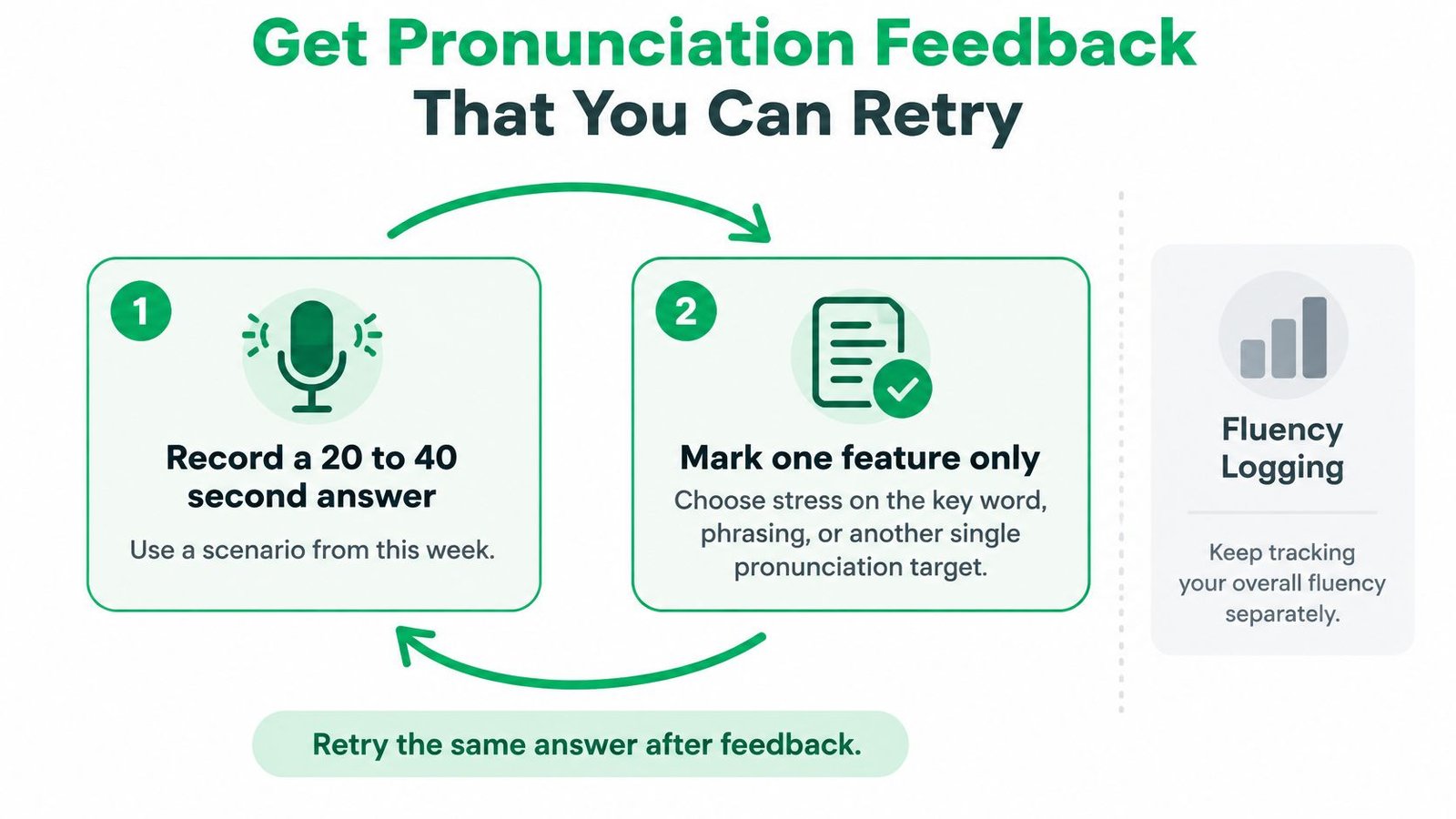
Make one audible change
Try this suggested pronunciation appointment with a familiar scenario:
- Record a 20 to 40 second answer. Begin with Dia duit, then introduce yourself or make your café request. Listen for whether you speak in meaningful chunks.
- Mark one feature only. For Dia duit, practise keeping the greeting together rather than separating its words with a searching pause.
- Hear a suitable model. For Ba mhaith liom caife agus scón, le do thoil, meaning I'd like a coffee and a scone, please, listen to how the request is grouped. Then say the order again, changing only your phrasing.
- Retry immediately and save a comparison take. In Cá bhfuil an stáisiún?, meaning where is the station, make the destination clear without forcing unnatural stress onto every word.
Ask your listener a specific question: was the destination clear, or did the food order sound broken into unrelated pieces? That gives you something to adjust. A bare score doesn't explain what your mouth should do differently.
Keep the model consistent
Irish pronunciation differs across dialects. Choose a suitable model and stay consistent while working on a feature, rather than assuming every unfamiliar pronunciation is an error.
A tutor can mark a phrase boundary or identify the word they couldn't understand. For more ways to organise recordings and comparisons, use this guide to pronunciation practice online.
Practical rule: Feedback becomes practice when you say the answer again with a deliberate change.
For your personal study list, save three problem words from the session, retry them that day, and review them on Sunday. Keep each word inside a useful phrase so you also practise joining it to its neighbours.
This loop trains intelligibility. It doesn't generate an exam grade, which depends on the assessed speaking performance rather than a polished pronunciation clip.
Begin Guided Irish Conversation Practice
Choose a situation you could naturally use: greeting someone at an Irish-language event, ordering lunch, or asking where the bus stop is. Don't spend today searching for the perfect topic. A familiar task leaves more attention available for speaking.
For a starter session, set a two-minute timer, speak without stopping, mark three issues, and retry. Put a review appointment in tomorrow's calendar before you close your notebook. If someone's available, ask them to add an unexpected follow-up rather than approve your prepared answer.
Choose support that still requires speech
A tutor, an exchange partner, or a guided conversation can provide the prompt. What matters is that you answer aloud and make decisions about what to say. Reading a suggested response without speaking won't complete the task.
One guided option is Gaeilgeoir AI conversation practice, with real-world scenes for social talk, work, travel, food, and directions. It offers pronunciation support, clickable translations grounded in the 1,000 most-used Irish words, and a personal study list built from words you click, alongside Leaving Cert oral simulations.
The plan costs €9.99 per month, with a free 3-day trial and cancellation anytime. Use any translation or hint as temporary support: check the word you need, hide the help, and produce your own answer.
Beginners can work with a greeting and a simple request. Heritage learners might describe family connections, while busy adults can choose a situation from their commute or working day. Leaving Cert students can use a typical oral topic, but should still practise responding to a question they haven't scripted.
Treat grade bands as a reference
The State Examinations information document describes eight grades, with Grade 1 highest, and records that the eight-point scale replaced the former 14-point scale in 2017.
Leaving Certificate grade bands
| Grade | Percentage band |
|---|---|
| H1 / O1 | 90% to 100% |
| H2 / O2 | above 80% to below 90% |
| H3 / O3 | above 70% to below 80% |
| H4 / O4 | above 60% to below 70% |
| H5 / O5 | above 50% to below 60% |
| H6 / O6 | above 40% to below 50% |
| H7 / O7 | above 30% to below 40% |
| H8 / O8 | below 30% |
These are qualification grade bands, not a scoring rubric for your home recording or a promised oral result. Examiners assign oral marks under State Examinations Commission procedures.
Finish one session today with something tangible: a spoken attempt, an identifiable repair, and a booked return. That's a more useful next step than collecting another page of phrases you haven't tried to use.
Guided everyday conversations and pronunciation support can help you turn familiar Irish words into spoken replies. Visit Gaeilgeoir AI, choose a food, travel, or social scenario, and use the guided practice option above to complete an aloud attempt and a focused retry today.