In Irish Gaelic, the word for fire is tine. In Scottish Gaelic, it's teine, and in the old Gaelic ritual year fire stood at the center of four major seasonal festivals, including Imbolc on 1 February and Bealtaine on 1 May.
Maybe you looked up “fire in gaelic” because you needed a quick translation for a tattoo idea, a school project, a story, or a trip to Ireland or Scotland. That simple search opens a much bigger door. Fire in the Gaelic languages isn't just a household noun. It carries memory, ritual, season, danger, warmth, and everyday speech all at once.
That's what makes tine and teine so satisfying to learn. They're small words with deep roots. Once you understand them, you're not only memorizing vocabulary. You're stepping into the older world of hearths and bonfires, and the modern world of public signs, safety language, and living Gaelic speech.
Table of Contents
- Your Quick Guide to Fire in Gaelic
- The Core Words Tine and Teine Explained
- The Cultural Importance of Fire in Gaelic Folklore
- Common Gaelic Phrases and Idioms with Fire
- Fire in the Modern Gaelic World
- Bring Your Gaelic Vocabulary to Life
Your Quick Guide to Fire in Gaelic
If you want the direct answer, keep these two words in mind: tine in Irish, teine in Scottish Gaelic. For most beginners, that's enough to get started.
But beginners often get tripped up in two places. First, they assume Irish and Scottish Gaelic are identical. They aren't. Second, they assume a single dictionary word tells them how people speak in practice. It usually doesn't.
Practical rule: Learn the core word first, then learn where people use it. A word becomes real when you can place it in culture, conversation, and daily life.
In the case of fire in gaelic, that wider context matters more than usual. Fire was tied to the calendar, the home, and seasonal survival. It also remains useful in modern settings where clear language matters, from ordinary conversation to public communication.
A good learner's path looks like this:
- Start with the noun: memorize tine and teine.
- Notice the family resemblance: the words are close enough that one can help you remember the other.
- Attach the word to a scene: a hearth, a candle, a bonfire, a warning sign.
- Learn phrases, not just labels: that's how you stop translating word by word in your head.
If you've ever felt that language guides give you a bare translation and then leave you stranded, you're not wrong. Fire in gaelic is a perfect example of why richer context helps. A learner who knows only the dictionary answer knows one word. A learner who knows where that word lives in history and modern life can use it.
The Core Words Tine and Teine Explained
A hearth is glowing in an old stone house. In one home, the word for that fire is tine. Across the water in Scotland, the matching everyday word is teine. That small spelling shift tells a larger story about two sister languages that grew from the same roots and still echo each other.
A simple comparison
| Language | Gaelic Word | IPA Pronunciation | Simple Pronunciation |
|---|---|---|---|
| Irish | tine | not provided in the verified data | TIN-yeh or TIN-uh as a learner-friendly approximation |
| Scottish Gaelic | teine | /tʲenə/ | CHEN-uh or TYEN-uh as a learner-friendly approximation |
The clearest verified source for this pair is the LearnIrish entry for fire, which lists tine in Irish and teine in Scottish Gaelic, and gives the Scottish Gaelic pronunciation /tʲenə/.
If IPA looks intimidating, set it aside for a moment. A learner-friendly way to hear teine is closer to TYEN-uh or CHEN-uh than to English “teen.” Gaelic spelling works by its own sound system, so the eye often needs time to catch up with the ear.
One helpful habit is to learn the word with a scene attached to it. Tine can live in your mind as a cooking fire, a candle flame, or a turf hearth. Teine can do the same. That makes the vocabulary stick better than memorizing a bare label on a flashcard.
Why the words look so similar
The resemblance between tine and teine comes from shared ancestry. Irish and Scottish Gaelic belong to the Goidelic branch of the Celtic languages, so some everyday words line up like close family members. Fire is one of those satisfying examples where the connection is easy to see.
For a beginner, this works like recognizing two regional versions of the same family recipe. The ingredients are familiar, but the form shifts a little from house to house. Tine and teine are not random lookalikes. They are related forms that help you notice how the languages mirror each other.
A simple memory aid helps here:
- Irish: ti-
- Scottish Gaelic: tei-
Use that pattern gently, not as a hard rule for every word in the language. Gaelic always has exceptions. Still, this pair gives you a solid foothold, and footholds matter.
The word also carries more weight than a dictionary line suggests. In Gaelic tradition, fire belonged to the home, the year's turning, and community ritual, which is why a word like teine appears naturally in discussions of Beltane as a fire feast and seasonal celebration. So when you learn tine and teine, you are not only learning how to name a flame. You are learning a word that has warmed houses, marked festivals, and stayed useful right into modern public life.
The Cultural Importance of Fire in Gaelic Folklore
Fire in the turning of the year
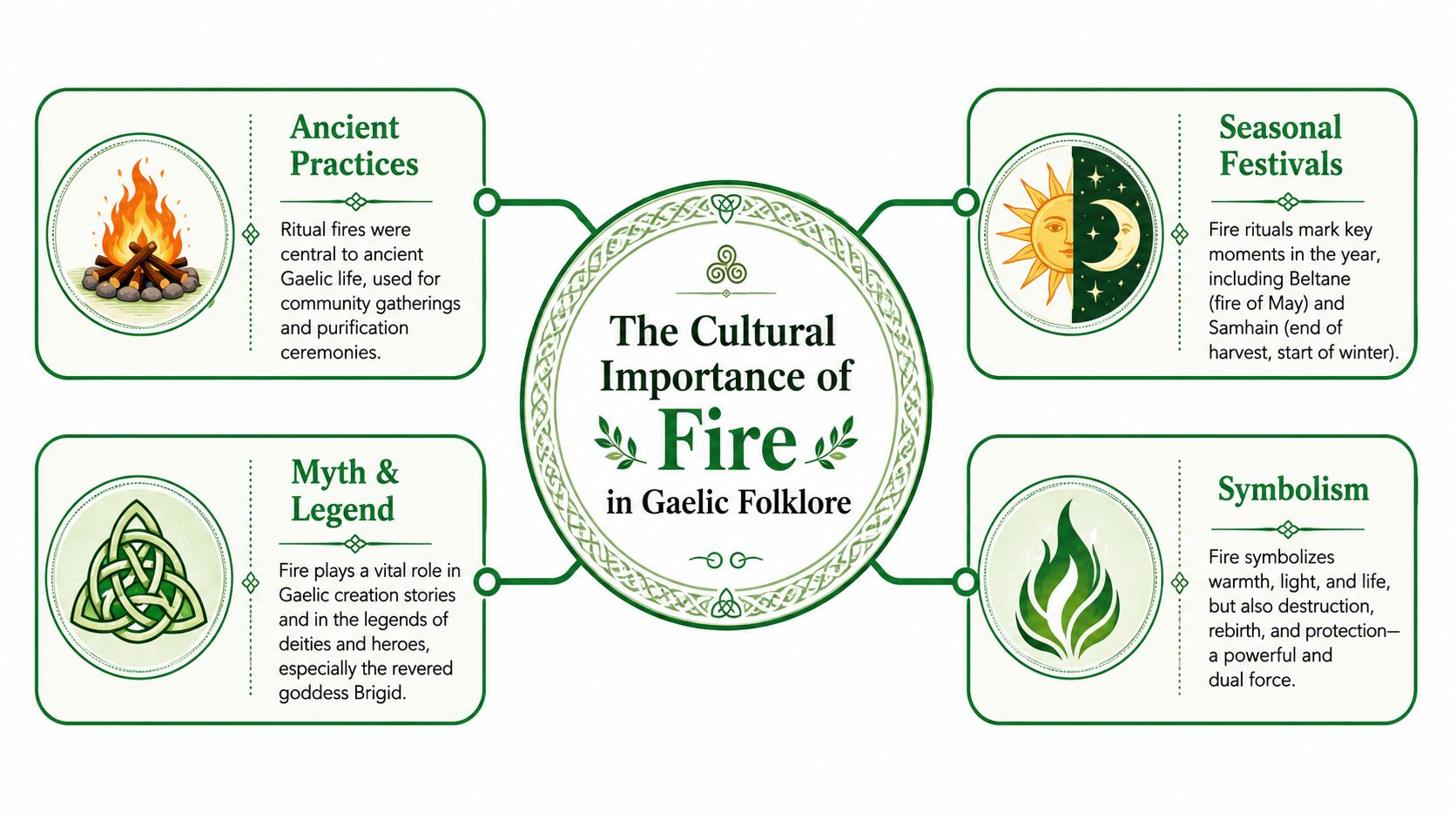
To understand fire in gaelic, it helps to leave the dictionary for a moment and consider an older context. Fire was woven into the year itself. In Ireland's pre-Christian ritual calendar there were four major seasonal festivals: Imbolc (1 February), Bealtaine (1 May), Lúnasa (1 August), and Samhain (1 November). Bealtaine and Imbolc sat roughly halfway between the solstices and equinoxes, and both were important fire festivals according to this overview of Bealtaine in the Irish ritual calendar.
Bealtaine is especially vivid. Traditional accounts describe cattle being driven between two bonfires for protection before moving to summer pasture. That detail matters because it shows something larger than symbolism. Fire wasn't floating above daily life as a poetic idea. It was embedded in the economic rhythm of herding and farming.
If you want a deeper cultural read on that seasonal world, this look at Beltane as a fire feast and celebration adds helpful background.
Why that still matters to learners
Imbolc carries a different atmosphere. Historical accounts place it at the first signs of spring, especially the lactation of ewes before lambing season in Ireland and Britain. It later became linked with Saint Brigid and then with Candlemas. In Ireland, February 2 was officially known as Candlemas, and in much of northern Europe as the Purification of the Blessed Virgin Mary until the Second Vatican Council in 1965, as discussed in this history of Imbolc, Brigid, and Candlemas.
That continuity of date is striking. The old seasonal fire-and-fertility moment didn't vanish completely. It was re-expressed through Christian practice while keeping the same early-February timing.
Here's why this matters when learning a word like tine. In English, “fire” can feel neutral until context fills it in. In Gaelic tradition, the word arrives already carrying layers of protection, household life, season, and ceremony.
- At Bealtaine, fire marks movement into summer.
- At Imbolc, fire and hearth imagery meet early spring and renewal.
- In both cases, the word points to community action, not just an object.
Fire in Gaelic folklore is less about spectacle and more about relationship. People used it to mark time, guard animals, and connect the household to the wider year.
That's why the vocabulary feels deeper than a translation card. When you say tine or teine, you're touching a word that once sat at the hinge of the seasons.
Common Gaelic Phrases and Idioms with Fire
Literal first, then natural speech
A lot of learners search for fire in gaelic and get only the bare noun. That's limiting. Learners usually need phrase-level meaning, not just a label, and many Irish-learning materials lean harder on grammar lists than on real conversational use. That gap is one reason practical phrase learning matters so much, as noted in this discussion of the need for broader semantic range in fire-related language learning from Fire Engineering's page cited in the brief.
Here's the safer way to build usable knowledge. Start with simple, transparent combinations rather than trying to memorize dramatic idioms too early.
- Use the noun alone first: learn tine as “fire.”
- Add context words next: think in scenes such as a house fire, campfire, or lighting a fire.
- Notice related meanings: learners also run into nearby ideas such as burning, sparks, heat, and smoke.
For a broader feel for natural expression, this guide to Irish sayings in Gaelic is a useful next stop.
How to avoid stiff translations
Beginners often make one of three mistakes:
- They translate English phrases word for word.
- They assume every “fire” expression must use tine.
- They ignore nearby vocabulary and get stuck with one overused noun.
That's where a distinction like tine versus other fire-related ideas becomes helpful. Sometimes you need the thing itself, fire. Sometimes you need an action, such as burning. Sometimes you need the image of a spark rather than the whole flame.
Don't ask only “What's the Gaelic word for fire?” Ask “What am I trying to say with fire?”
A few learner-friendly examples of how to think about this:
- Literal use: “The fire is out.” This is straightforward noun use.
- Practical use: “Don't go near the fire.” Again, a direct physical meaning.
- Figurative use: “She has a spark of energy.” English uses fire imagery, but another Gaelic word may fit better than the exact noun.
That habit makes your Irish sound less mechanical. It also prepares you for speech as people use it in real life, where meaning sits in phrases and situations, not in isolated vocabulary cards.
Fire in the Modern Gaelic World
Gaelic in official public use
It's easy to leave fire in gaelic sitting in the ancient world of bonfires and festivals. But the vocabulary matters now as well. The Scottish Fire and Rescue Service has an official Gaelic Language Plan for 2023–2026, which shows Gaelic being normalized in operational and public-facing contexts where terminology must be clear and consistent, as stated in the Scottish Fire and Rescue Service Gaelic Language Plan 2023–2026.
That matters for a very practical reason. Emergency language can't be vague. If a term appears in signage, print, digital messaging, or spoken communication, it has to work under pressure.
This gives learners a useful perspective on teine. It isn't only a heritage word preserved in songs or folklore. It belongs to a living language that public institutions are actively using.
If seasonal language interests you too, this article on the Irish festival of Samhain complements that older-to-modern journey.
Practical situations learners may meet
Modern fire-related language becomes relevant fast if you travel, camp, hike, or read local notices. There's also a clear content gap here. High-quality learner material rarely explains how fire vocabulary appears in public safety language such as wildfire warnings or campfire precautions, even though public guidance in Ireland stresses that almost all wildfires are human-caused and that campfires, BBQs, or land burning in dry conditions can trigger them. Officials also note that only a few dry days can make vegetation highly flammable, as described in this public wildfire safety guidance video.
That means useful learning scenarios include:
- Outdoor notices: warnings about fire risk in dry weather
- Camping language: instructions about campfires and safe extinguishing
- Community alerts: local safety announcements in bilingual settings
A living language proves itself in ordinary public life. Safety notices are one of the clearest examples.
For learners, this changes the motivation. You're not memorizing tine or teine as decorative vocabulary. You're learning a word that can appear in daily life, in official settings, and in situations where understanding matters.
Bring Your Gaelic Vocabulary to Life
You are sitting by a fire pit on a cool evening, and one small Gaelic word suddenly starts to feel much bigger than a dictionary entry. Tine in Irish and teine in Scottish Gaelic can mean the flame in front of you, the warmth of a hearth in an old story, a warning on a public notice, or a phrase in everyday conversation. That is what makes this vocabulary memorable. It belongs to real life.
A good language word works like a doorway. Step through it, and you find sound, history, culture, and modern use all meeting in one place. With tine and teine, you are hearing the family resemblance between two Gaelic languages while also touching something central to Gaelic life for centuries. Fire meant heat, cooking, gathering, ritual, and protection. It still appears in speech, signage, and safety language today.
That wider context matters for learning. A word stays with you more easily when you can attach it to a scene. You might picture a hearth in winter, a festival fire on a hillside, or a notice warning about fire risk in dry weather. Each example gives the word another root, and rooted words are the ones you remember.
Keep the foundation simple:
- Irish: tine
- Scottish Gaelic: teine
Then let the word grow in layers. Say it aloud. Notice where it appears. Use it in a phrase instead of keeping it on a flashcard by itself. That is how vocabulary becomes usable, and how a single word starts to carry the texture of a whole culture.
If you want to turn words like tine into real speaking ability, Gaeilgeoir AI is a practical next step. It helps learners move from recognition to use through guided, real-world Irish conversations, so you are not just memorizing fire in Gaelic. You are learning how to speak.