
You're probably here because you wanted a simple answer and then realized you also want to say it correctly. Maybe you're looking at a fireplace, writing a poem, tracing family roots, or trying to remember a word from school Irish. The good news is that the main Irish word for fire is tine.
That one word is a great starting point, but it's only the beginning. Irish isn't just English with different labels attached. It's a Celtic language, and its English name “Gaelic” comes from Gaeilge, the Irish word for the language itself, as explained by the University of Notre Dame's overview of Irish. That matters because Irish words have their own sound patterns, grammar habits, and sentence flow.
If you've searched “Irish word for fire,” this guide is meant to help with the part most pages skip. You won't just learn the translation. You'll learn how to say tine, how to use it in short everyday phrases, and how it connects to Irish tradition.
Table of Contents
- Your Journey to the Irish Word for Fire
- The Main Word for Fire 'Tine' Explained
- The Cultural Heartbeat of Fire in Ireland
- Using 'Tine' in Everyday Sentences
- Expanding Your Vocabulary Beyond 'Tine'
- Quick Tips for Remembering Your New Words
- Frequently Asked Questions
Your Journey to the Irish Word for Fire
A lot of learners meet this word in a cozy setting. You see a fire in the hearth, or you want to say “the fire is warm,” and suddenly you realize that knowing one translation isn't enough. You need the sound, the article, and the shape of the phrase.
The everyday answer is tine. If you want to say “the fire,” you'll often meet an tine in beginner material. That's useful because it gives you the noun in action, not just as an isolated vocabulary item.
Why Irish feels different
Irish doesn't map neatly onto English. It belongs to the Celtic family, not the Germanic or Romance families, so familiar English instincts won't always help. Word order can feel different. Pronunciation can surprise you. Even small words around the noun can change its form or sound.
Practical rule: Learn the word and one short phrase together. Don't memorize only tine. Memorize an tine as well.
That habit makes vocabulary easier to use in real speech. It also helps you hear the rhythm of Irish sooner.
A better way to learn this word
If you're a beginner, try this order:
- Hear it first: Say tine aloud before worrying about spelling perfection.
- Use it in a phrase: Try an tine and cois tine.
- Attach a scene: Think of a glowing hearth, campfire, or stove.
- Repeat it naturally: Short daily repetition works better than cramming.
Irish comes alive when words are tied to lived moments. Fire is perfect for that. It's warm, visible, concrete, and firmly rooted in the cultural memory of the language.
The Main Word for Fire 'Tine' Explained
The core word you need is tine. Bitesize Irish gives the standard learner-friendly form an tine for “the fire” and notes that tine is pronounced roughly “chin-eh” in standard Irish in its learning material on the phrase “an tine”.
How to pronounce tine
Say it slowly at first: chin-eh.
The first part sounds close to “chin.” The second part is light and quick. Don't stretch it into an English-style “tyne,” and don't pronounce the final e too heavily.
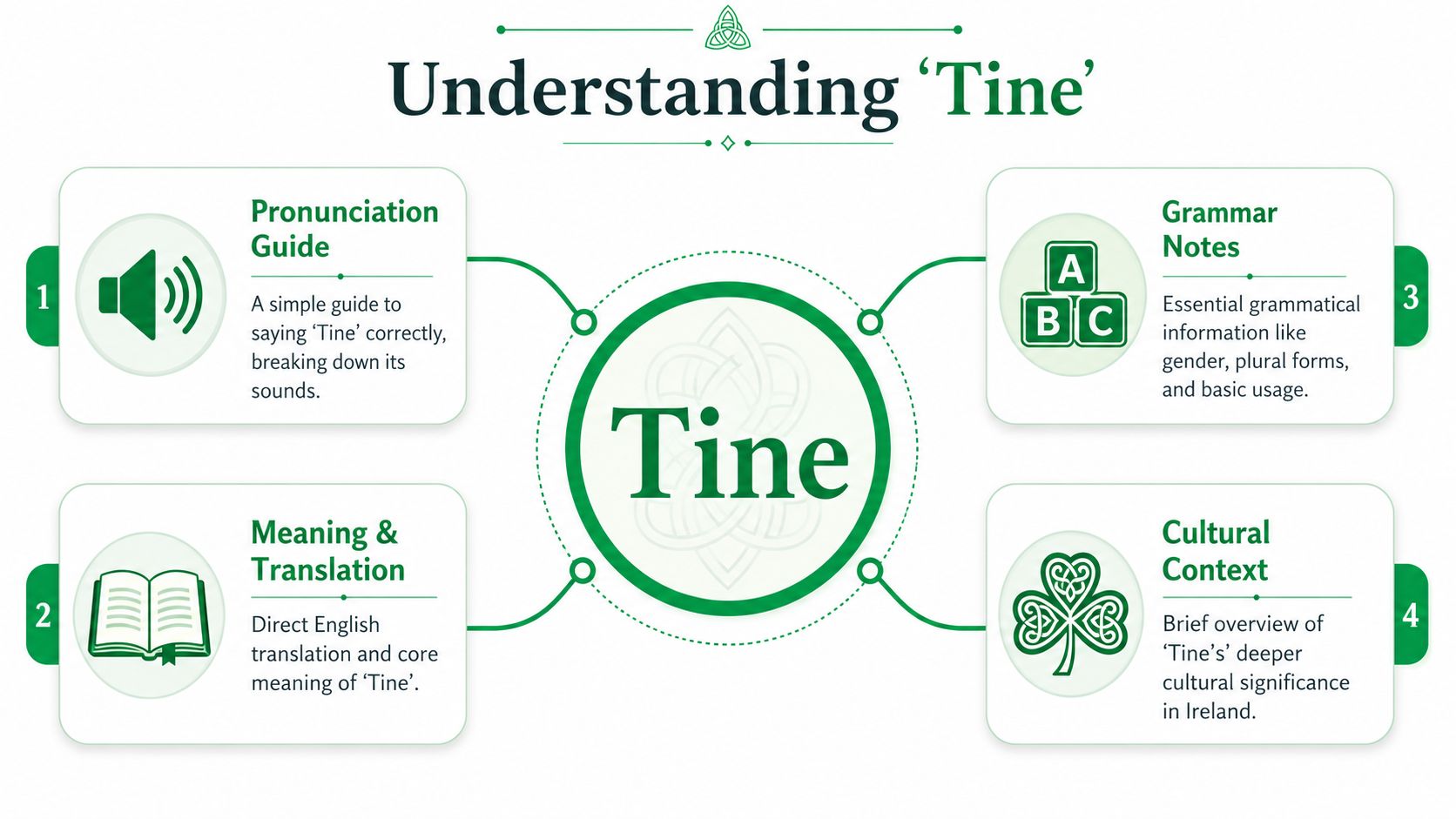
A simple IPA guide is /ˈtʲɪnʲə/. If IPA feels unfamiliar, don't worry. The plain cue is enough for most beginners.
Keep the ending soft. English speakers often want to pronounce every letter strongly, but Irish often uses a lighter final sound here.
A quick listening model can help fix the sound in your ear before you practice it alone.
What the word means in real use
In ordinary beginner use, tine means fire. Depending on context, it can also overlap with the idea of a flame. If someone asks for the Irish word for fire, this is the one to learn first.
You'll often meet it in forms like these:
- tine: fire
- an tine: the fire
- cois tine: by the fire
- tine oscailte: open fire
Those phrase-level uses matter more than memorizing a dictionary list on day one.
A note on grammar
Treat tine as a noun you learn through patterns, not through abstract grammar labels first. The fastest route is to notice what happens in short chunks.
A few beginner-friendly habits help:
- Learn the article with the noun: an tine
- Notice preposition phrases: cois tine
- Reuse one sentence frame: Tá an tine… for “The fire is…”
If you're returning to Irish from school, you may remember being told to master every form before speaking. That often slows people down. It's better to use tine in small correct phrases and let the grammar settle in through repetition.
The Cultural Heartbeat of Fire in Ireland
Fire in Irish isn't only a household word. It carries memory, ritual, gathering, and seasonal tradition. That's one reason the word tends to stick with learners. It doesn't feel flat.
Why fire feels bigger than a household word
In older Irish life, fire sat at the center of the home. It gave heat, light, and a place to gather. Even if you're only learning a simple noun, you're touching a word that has lived in daily speech and shared custom for a very long time.
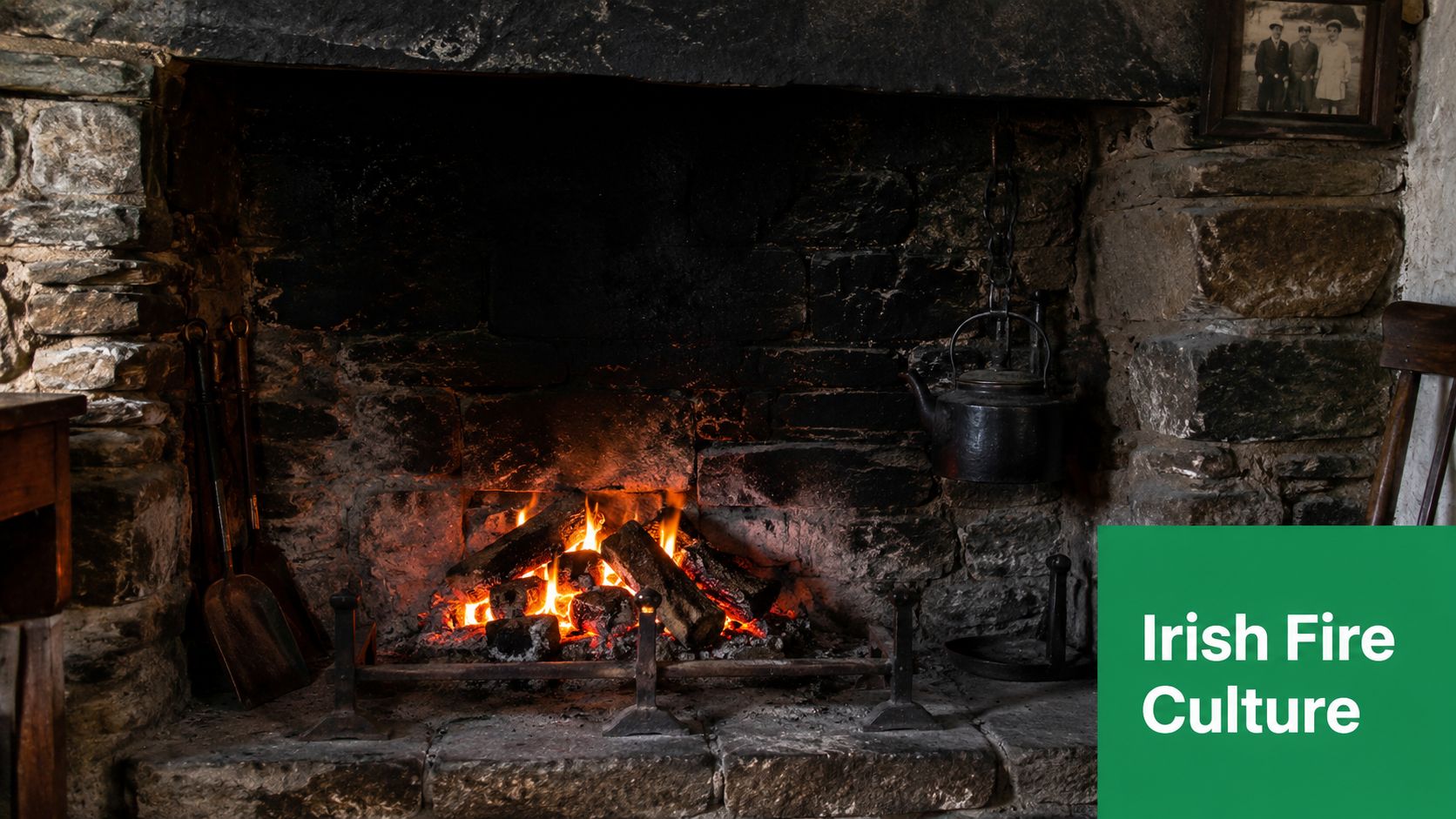
That cultural weight becomes clearer when you look at bonfires and seasonal celebrations. If you're curious about one of the best-known fire traditions, this guide to the Beltane fire feast celebration gives useful background.
The story inside bonfire
The Irish Times notes that the term bonfire is linked to tine cnámh, meaning “fire of bones,” and describes a tradition in which bones were burned and ashes were spread on fields for fertility. The same piece explains that the English word developed from the 16th-century Middle English form bonefire, as discussed in the Irish Times article on “bone fire”.
That detail matters for learners because it shows how a basic word like tine lives inside larger expressions. A single noun opens a door into history.
Some words are easier to remember once you know the story they carry. Tine is one of them.
If you remember tine only as a vocabulary flashcard, it may fade. If you remember it as the word at the center of hearths, gatherings, and tine cnámh, it starts to feel anchored.
Using 'Tine' in Everyday Sentences
Now, the word becomes usable. Start small and keep the sentences practical. You don't need long, literary Irish to make progress.
Start with short usable phrases
Here are a few beginner-friendly examples:
An tine.
The fire.Cois tine.
By the fire.Tine oscailte.
Open fire.Tá an tine te.
The fire is hot.
Say each one aloud more than once. Irish becomes much easier when your mouth gets used to the pattern.
Building full beginner sentences
Once you've got the short phrases, use them in mini-scenes:
Tá mé i mo shuí cois tine.
I am sitting by the fire.Tá an tine sa teach.
The fire is in the house.Tá an tine láidir.
The fire is strong.
You don't need to master every grammar point in these examples right away. The important thing is that you're seeing tine inside a sentence, not alone on a list.
If sentence building feels shaky, a simple guide to Irish sentence structure can help you see where nouns like tine sit in everyday patterns.
One grammar habit to notice
Irish often teaches through chunks. That's especially helpful with a word like tine, because the surroundings matter.
Try this method:
- Start with the noun: tine
- Add the article: an tine
- Add a location phrase: cois tine
- Add a description: Tá an tine te
Don't wait until you “know all the grammar” to speak. Use one safe phrase well, then expand it.
Learners also get confused by direct translation. In English, you might think word-for-word first. In Irish, it's better to absorb whole patterns. That's why cois tine is more useful than memorizing cois and tine separately and hoping they join neatly under pressure.
Expanding Your Vocabulary Beyond 'Tine'
Once tine feels comfortable, your Irish gets more expressive when you add a few nearby words. You don't always want the broad word “fire.” Sometimes you mean flame, spark, or ash.
Related words worth learning early
Teanglann notes that dictionaries include multiple related forms and entries around the idea of fire, including draig, bácáil, and loisc, but for beginners tine is the essential standard noun to learn first in its dictionary entry for “fire”.
Here's a practical learner table that keeps the focus on everyday use.
| Irish Word | Pronunciation Cue | English Meaning | When to Use |
|---|---|---|---|
| tine | chin-eh | fire | Use for the general idea of a fire or blaze |
| lasair | lah-sir | flame | Use when talking about a visible flame |
| spréach | spray-kh | spark | Use for a small spark |
| aingeal | an-gyal | ember, live coal | Use for glowing remains in a fire |
| luaith | loo-ah | ash | Use for ashes after burning |
A small set like this is enough to make your language feel more precise.
For example:
- tine is broad
- lasair is what you see flickering
- spréach is tiny and brief
- luaith is what remains
If you want to build vocabulary in themed groups like this, a resource on how to expand Irish vocabulary can help you connect words by context instead of memorizing them randomly.
Quick Tips for Remembering Your New Words
A new Irish word stays with you faster when you give it a job to do. Tine becomes easier to remember once you hear it, say it, and place it in a small real-life scene.
Start with sound. Tine is said roughly like chin-eh. If that feels slippery at first, attach it to a simple picture, such as your chin close to a warm hearth. The picture does not need to be clever. It just needs to be clear enough that your brain can find the word again.
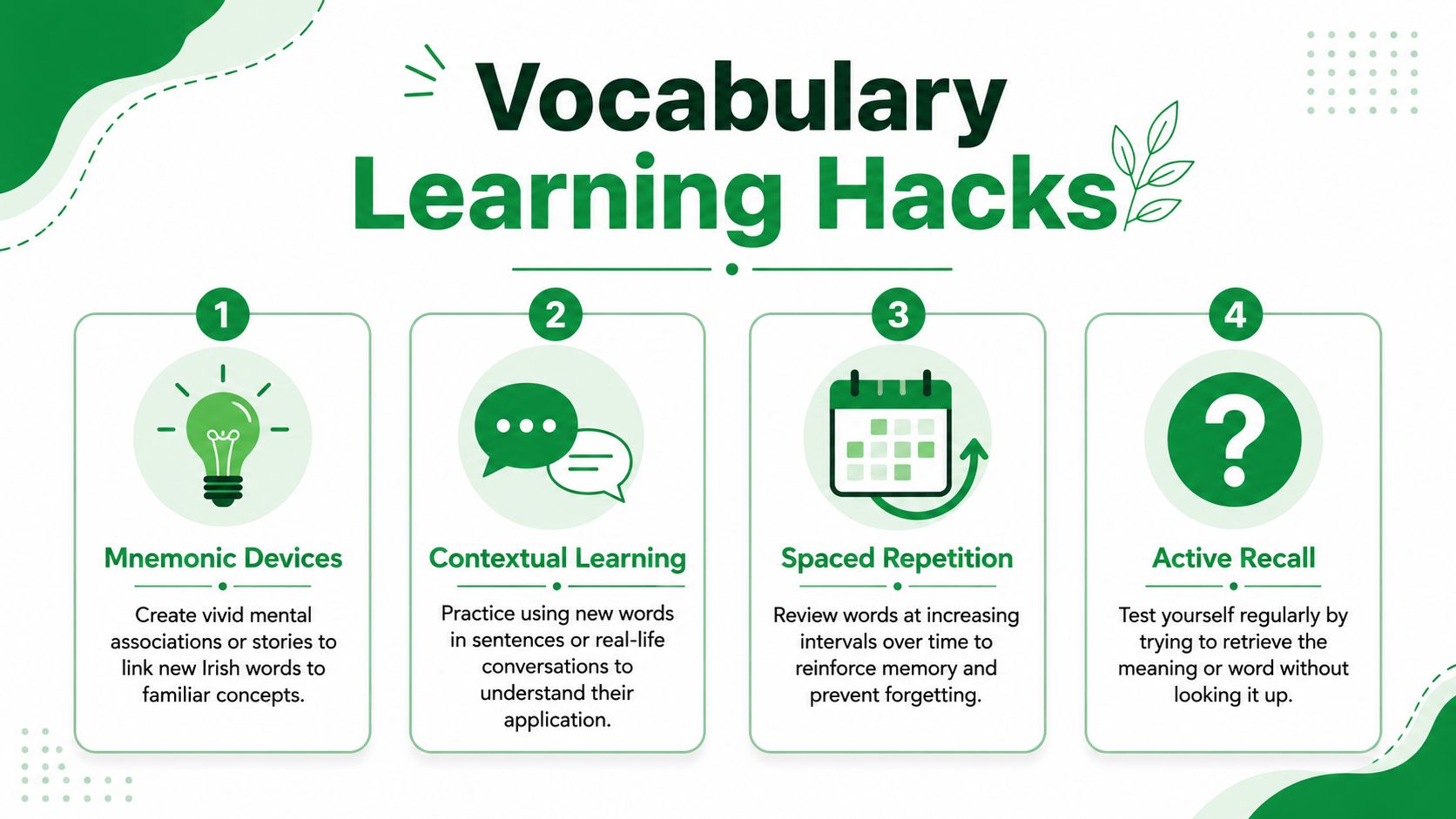
Then give the word a pattern. Language memory works a bit like building a path through grass. One step helps, but several steps in the same direction make the route easier to follow. With tine, that can be as simple as moving through this short cycle:
- Say it aloud: tine
- Add the article: an tine
- Put it in a place: cois tine
- Make a full sentence: Tá an tine te.
That last step matters most. Many learners know a translation but freeze when they try to use it. A full sentence closes that gap. It turns tine from a word you recognize into a word you can say.
Keep your practice short and active. Read the word. Cover it. Recall it. Write one phrase from memory. Come back to it later the same day. Five focused minutes usually helps more than a long study session where the word only stays on the page.
If you use Gaeilgeoir AI, you can practise the same way with pronunciation support and sentence-based review. A notebook or paper flashcards work well too.
Use beats recognition. Once you can say tine in one natural sentence, it starts to feel like part of your Irish, not just a translation on a list.
Frequently Asked Questions
Is it Irish or Gaelic
In everyday English, Irish is the clearest term for the language of Ireland. You'll also hear Gaelic, but that can be broader and less precise for beginners. Since the language's own name is Gaeilge, people sometimes use “Gaelic” in English conversation, but “Irish” is usually the most straightforward label when you're learning.
Are there other Irish words related to fire
Yes. Dictionary material includes related entries such as draig, bácáil, and loisc, but those aren't the first forms a beginner needs. Start with tine and build from there.
That's the main answer to the search “Irish word for fire.” If all you remember today is one word, make it tine.
How do I keep improving from here
Use the word in three ways today:
- Say it aloud several times.
- Write one phrase such as an tine.
- Build one sentence such as Tá an tine te.
If you keep meeting the word in context, it will stop feeling like something you memorized and start feeling like something you can say.
If you want to keep going beyond one vocabulary item, Gaeilgeoir AI offers guided Irish practice for beginners and returning learners, including pronunciation support, real-world conversation work, and vocabulary study you can fit into a busy routine. If you're ready to practice regularly, you can Start Your Free Trial.