You're probably here because you've hit a very normal learner problem. You wanted to say “green” in Irish or Scottish Gaelic, looked it up, and found more than one answer. Then the answers didn't quite agree with each other.
That confusion isn't a sign that you're doing anything wrong. It's a sign that Gaelic languages slice up the world differently from English. If you learn the logic behind those choices, green in Gaelic stops feeling messy and starts feeling memorable.
Table of Contents
- Why Is Green in Gaelic So Complicated
- The Two Greens of Irish Gaeilge Glas and Uaine
- How Scottish Gaelic Gàidhlig Handles Green
- Grammar in Action Using Green Adjectives
- More Than a Color Idioms and Cultural Notes
- Start Your Gaelic Journey Today
Why Is Green in Gaelic So Complicated
You stand in front of an Irish hillside, a wet field, a mossy stone wall, and a painted shop door, and English lets you call all of them “green.” Gaelic doesn't always do that. It asks a more specific question first.
In Irish, there isn't one all-purpose word that maps neatly onto the English word “green” in every situation. The language has long treated green as something with categories inside it. That's why learners often feel confident one minute and unsure the next.
Green in Gaelic makes more sense when you stop asking “What's the translation?” and start asking “What kind of green is it?”
That shift matters because Gaelic languages carry older ways of noticing the world. Natural surfaces, weathered shades, bright dyes, and vivid manufactured colors don't always belong in the same bucket. English tends to flatten those differences. Irish and Scottish Gaelic often keep them visible.
A helpful way to think about it is this:
- English groups by broad color family. Grass, neon plastic, and traffic lights can all be “green.”
- Irish often groups by type of green. Natural and artificial greens may call for different words.
- Scottish Gaelic adds another twist. The word used for grassy vegetation may not be the one an Irish speaker would choose.
That's why green in Gaelic feels tricky at first. But there is logic here, and once you see it, the system becomes much easier to remember.
The Two Greens of Irish Gaeilge Glas and Uaine
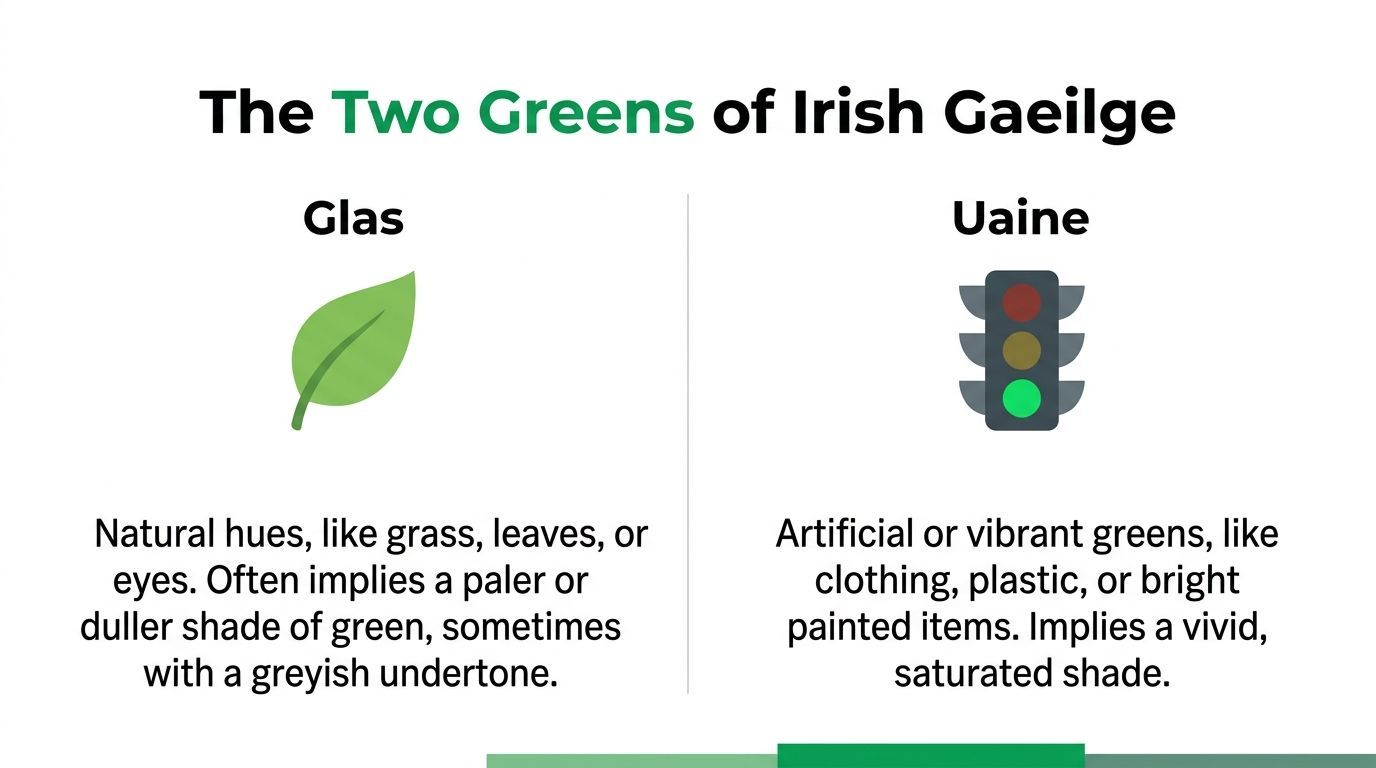
Irish gives learners two core words to work with: glas and uaine. A very reliable mental shortcut is nature's green versus man-made green.
The key fact is simple. The Irish language distinguishes green into two primary terms, glas and uaine, based on a natural-versus-artificial split that goes back to old linguistic roots. Glas is used for natural greens such as grass, leaves, and the sea, while uaine is used for vivid, artificial greens such as paint or dyed fabric, as explained in Preply's discussion of Irish color terms.
A simple mental model
If the color feels like it belongs outdoors, growing by itself, glas is often the right instinct.
Examples:
- féar glas for green grass
- leaves described with glas
- the sea in contexts where English might say greenish, grey, or blue-green
If the color looks vivid, painted, dyed, plastic, or deliberately bright, uaine is usually the better choice.
Examples:
- a painted wall
- a bright green jumper
- a traffic light
Beginners often slip, assuming the difference is only about brightness. Brightness can matter, but the more memorable test is origin. Ask yourself whether the object feels natural or manufactured.
Practical rule: If you can picture it growing in a field, try glas first. If it came from paint, fabric dye, plastic, or electric light, try uaine.
How to hear the difference
You don't need perfect pronunciation on day one, but a rough guide helps.
- glas sounds close to “gloss,” though the Irish sound is its own thing
- uaine is often pronounced roughly like “OO-an-yeh” or “WEN-yeh”
A few easy pairs make the contrast stick:
- féar glas = green grass
- péint uaine = green paint
- solas tráchta uaine = green traffic light
If you enjoy comparing colors across the language, this guide to orange in Irish is a useful companion because it shows that color vocabulary often carries cultural logic, not just dictionary logic.
One more detail matters for advanced learners. Glas can stretch beyond what English calls green. It may also lean toward greyish or pale green depending on context. That wider range is one reason literal word-for-word translation can feel unreliable at first.
How Scottish Gaelic Gàidhlig Handles Green
Scottish Gaelic looks familiar at first, then surprises you.
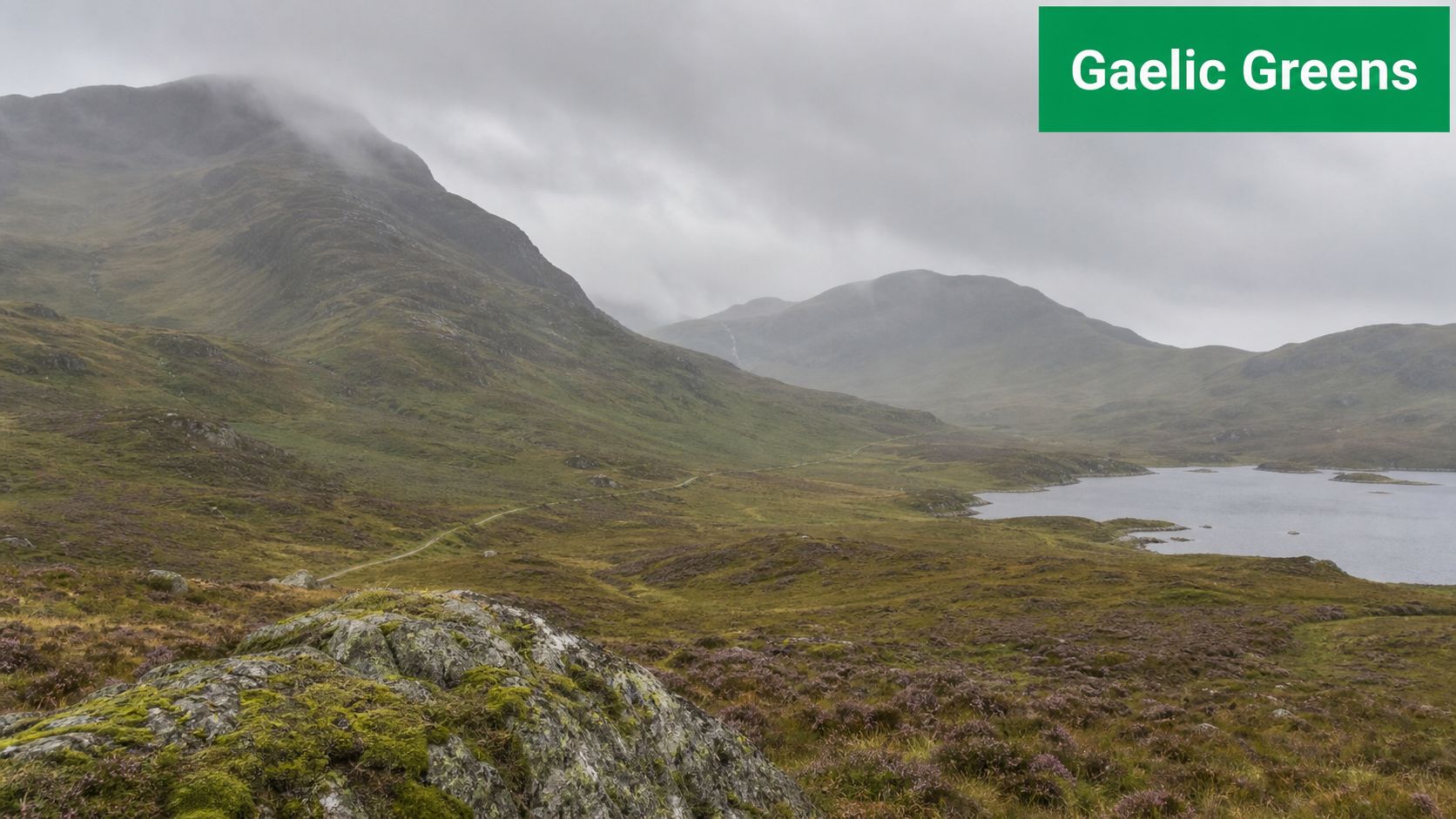
If you learned that Irish uses glas for natural green and uaine for vivid artificial green, you might expect Scottish Gaelic to do the same. It partly does, but not fully.
According to The Bottle Imp's explanation of Gaelic place-name color words, Scottish Gaelic uses a more complex three-part pattern. Gorm is the standard technical term for verdant vegetation such as feur gorm for green grass, glas refers to grey or pale greyish-green, and uaine is reserved for bright, artificial greens.
The Scottish Gaelic pattern
Here's the core contrast:
- Irish: natural green often points to glas
- Scottish Gaelic: grassy, growing green often points to gorm
- Both languages: bright, artificial green can point to uaine
That means an Irish learner can easily misread a Scottish phrase. You see gorm, think “blue,” and miss the fact that in this context it can describe lush vegetation.
If you're studying both languages, this comparison of Irish vs Scottish Gaelic differences helps sort out where the systems line up and where they clearly don't.
Why learners mix them up
The trap is understandable. English trains you to expect a stable color label. Gaelic doesn't always offer that stability across related languages.
A Scottish speaker may use gorm where an Irish speaker would never do so. A learner who memorizes single-word glosses like “gorm = blue” ends up confused by real usage. The better approach is to memorize phrases with context:
- feur gorm in Scottish Gaelic
- féar glas in Irish
- uaine for bright artificial green in both systems
This short video gives extra context on how these kinds of differences show up in Gaelic learning:
Grammar in Action Using Green Adjectives
Knowing the right color word is only half the job. You also need to place it properly in a sentence.
Rule one adjectives come after the noun
In Irish, adjectives usually come after the noun. English says “green shirt.” Irish structure says “shirt green.”
So you'll see patterns like:
- léine uaine for a green shirt
- féar glas for green grass
- bád glas for a green boat
This is one of the first habits worth building. Don't translate word order from English. Learn the noun-and-then-adjective rhythm instead.
A focused guide to mastering adjectives in Irish is helpful if you want more practice after reading these examples.
Rule two lenition changes the adjective
The next hurdle is lenition, or séimhiú. This is the softening change that adds an h after the first consonant in certain contexts.
That's why:
- bád glas stays as it is
- cathaoir ghlas shows the changed form ghlas
You don't need every grammar rule at once. For now, notice the pattern. The adjective may change shape depending on the noun that comes before it.
Your goal at first isn't to master every mutation rule. It's to get comfortable seeing both glas and ghlas as forms of the same adjective.
This matters even more because glas isn't a narrow color label. As discussed in Greater Govanhill's article on the meaning of glas, the word functions as a broader chromatic umbrella in Irish and Scottish Gaelic, covering both grey and pale green depending on context. That's why a phrase with glas sometimes needs interpretation, not automatic translation.
Quick Guide to Green in Gaelic
| Word | Language | Meaning / Context | Example |
|---|---|---|---|
| glas | Irish | natural green, often softer or greyish in feel | féar glas |
| uaine | Irish | vivid or artificial green | léine uaine |
| gorm | Scottish Gaelic | verdant vegetation, especially grass | feur gorm |
| glas | Scottish Gaelic | grey or pale greyish-green | descriptive landscape usage |
| uaine | Scottish Gaelic | bright artificial green | vivid painted or dyed objects |
A few copyable sentence frames help:
- Tá bád glas agam.
- Tá léine uaine uirthi.
- Chonaic mé cathaoir ghlas.
You don't have to produce perfect Irish instantly. Start by spotting the adjective after the noun, then notice whether lenition appears. That combination will take you a long way.
More Than a Color Idioms and Cultural Notes
The story of green in Gaelic isn't only about vocabulary. It's also about identity, land, symbolism, and the small arguments learners remember for years.
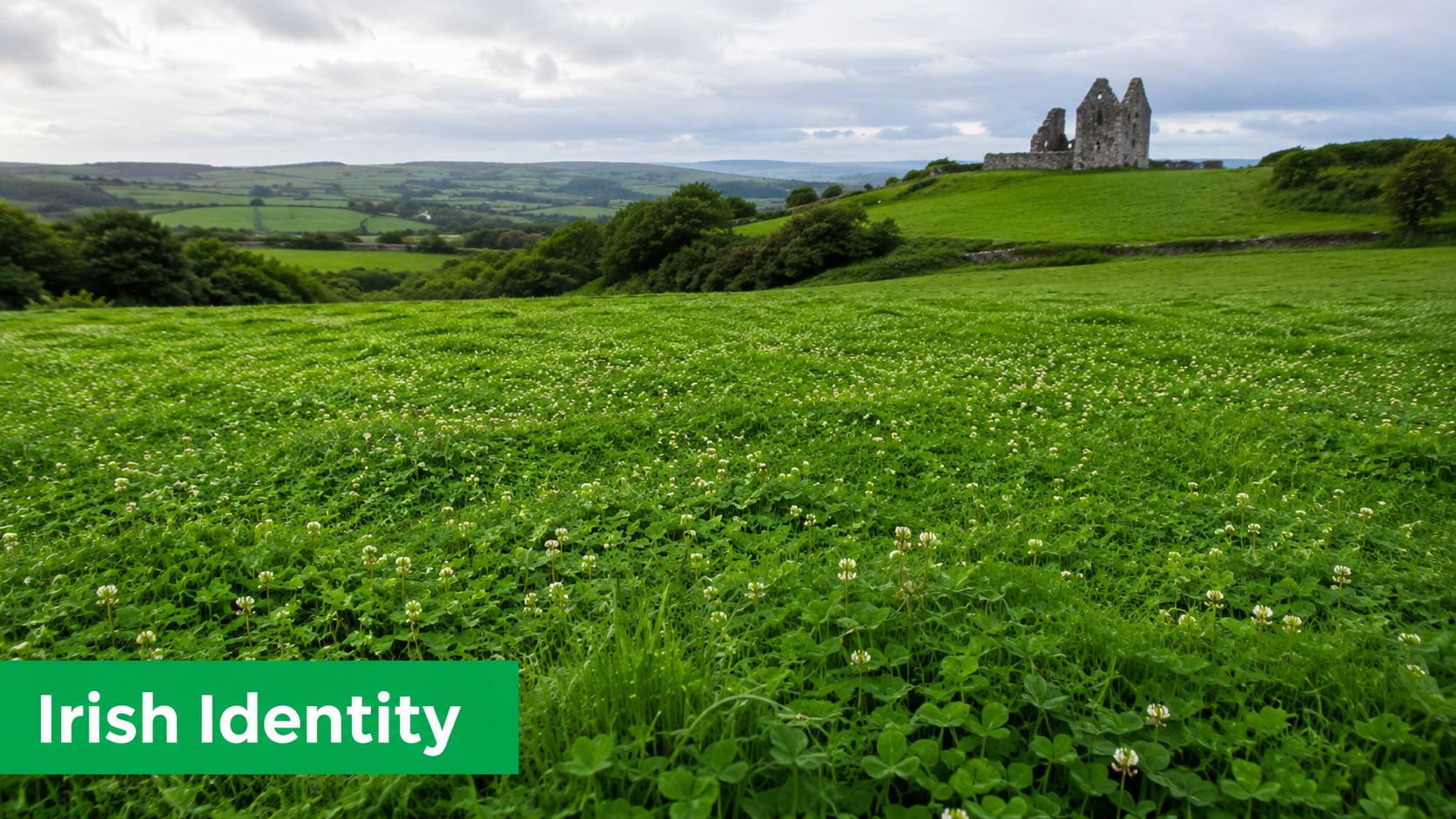
The flag question learners always ask
Sooner or later, someone asks which green belongs to the Irish flag. Is it glas or uaine?
That question doesn't have a neat answer. The symbolism points one way, and the physical object points another. As noted in this discussion of Irish flag colour terminology, the contradiction persists because the flag represents the natural scenery, which suggests glas, but its emerald shade is vibrantly artificial, which suggests uaine. The same source says this nuance remains unaddressed in 90% of cultural articles.
The flag debate is useful because it shows that language isn't just about objects. It's also about how speakers frame those objects.
That's why the question sticks in learners' minds. It captures the whole lesson in one symbol. Are you naming the land the flag stands for, or the dyed material you can physically see?
Green as identity and symbol
Irish culture gives green enormous emotional weight. The natural scenery, national imagery, and popular symbolism all pull the color into public life. That's one reason the vocabulary matters so much to learners. This isn't just a textbook color card.
If you enjoy the wider meanings colors pick up in public identity and design, WaveGen's piece on Unlocking brand power with color is a useful side read. It isn't about Irish specifically, but it helps explain why colors carry stories far beyond their visual shade.
A practical takeaway is to stay flexible. In cultural discussion, people may simplify and say “green” in English without unpacking the Irish nuance. In Irish, though, the distinction can still matter.
Start Your Gaelic Journey Today
If green in Gaelic felt confusing before, you've now got a much stronger mental map. In Irish, the useful contrast is glas for the natural world and uaine for vivid manufactured green. In Scottish Gaelic, gorm adds a distinctive extra category for verdant vegetation.
That kind of insight changes how you learn vocabulary. You're not just memorizing labels. You're learning how Gaelic speakers sort the world.

If you want to turn that understanding into actual speaking practice, Gaeilgeoir AI is built for that next step. The platform immerses learners in the 1,000 most common Irish words and lets users click any word to see translations and save it to a personalised study list, as described in this overview of Gaeilgeoir AI's learning approach.
It's a good fit if you want flexible practice instead of waiting for the perfect study session. You can build confidence through guided conversation, real-world scenarios, and repeated exposure to the vocabulary that matters most.
Do not allow pingbacks or comments.
A CTA for Gaeilgeoir AI. If you're ready to move from memorizing words like glas, uaine, and gorm to using them in conversation, start with Gaeilgeoir AI.