
The popular advice on how to find language exchange partners is incomplete. “Download an app, find a native speaker, and send a message” solves the easiest part. The work starts after someone replies, when schedules collide, motivation fades, and an exchange that felt promising becomes another abandoned chat.
I've been ghosted, over-corrected, and trapped in exchanges where I spoke almost no Irish. The partners who stayed weren't found by luck. We matched on goals, agreed on a workable format, and made each session easy to repeat. Treat partner-finding as a reliability filter, not a popularity contest, and your odds of building a lasting Gaeilge routine improve immediately.
Table of Contents
- Why Most Language Exchanges Die After Week Two
- Where to Look for Language Exchange Partners
- Evaluating Profiles and Writing a First Message That Gets a Reply
- Setting the Rules of the Exchange Before You Start
- Using Gaeilgeoir AI to Prepare, Rehearse and Follow Up
- Staying Safe and Keeping the Exchange Alive
Why Most Language Exchanges Die After Week Two
A match isn't a partnership. It's only an invitation to test whether two people can fit language practice into real life.
The failure usually begins with vague expectations. One person wants relaxed conversation, the other wants detailed corrections. One expects weekly calls, the other prefers occasional messages. Add different time zones, uneven confidence, or a partner who only wants to practise their target language, and the exchange becomes tiring instead of reciprocal.
Research on tandem programmes makes the problem clear. In one university evaluation, only 5 of 18 respondents had started regular practice, while 27.78% had met their partner only once and 44.44% hadn't met their partner again after joining (the programme evaluation). The difficult step isn't discovery. It's converting a match into a repeatable routine.
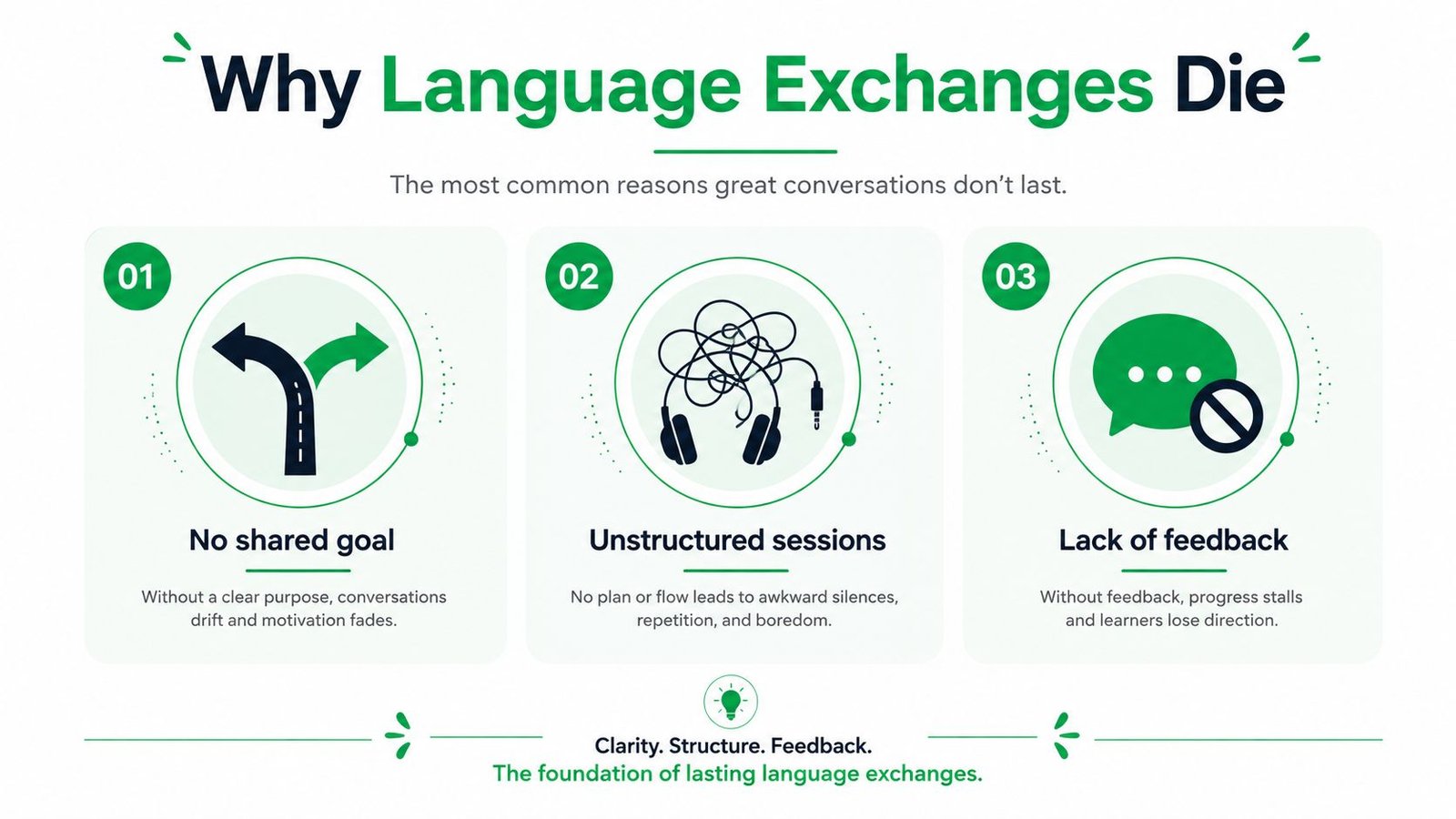
The three-part failure pattern
- No shared goal: You want Gaeilge speaking confidence, while your partner wants English conversation with no correction.
- Unstructured sessions: Neither person brings a topic, so the conversation defaults to whichever language feels easier.
- Lack of feedback: You finish the call without knowing what to practise next, which makes the next session harder to prepare for.
That social side matters. In an online exchange study, 61% of respondents said their speaking improved at least moderately, and 78% reported at least moderate listening gains, although only eight participants completed the follow-up survey. Participants also valued the friendships they built with speaking partners (the online tandem study). The lesson is practical: people keep showing up when the exchange feels useful and human.
Use light structure rather than turning the call into a class. A shared topic, a clear language split, and a next appointment remove the friction that kills momentum. If you want a simple individual practice routine alongside your exchange, use daily language practice to arrive with more words ready.
Practical rule: Don't ask whether someone seems interesting. Ask whether the two of you can repeat the same useful practice arrangement next week.
For motivation ideas that can make repetition less dull, this guide to gamification in language learning offers useful ways to add goals and small rewards without making practice feel childish.
Where to Look for Language Exchange Partners
Choose the channel based on the kind of commitment you need. Don't join every community at once. A crowded inbox creates the illusion of progress while leaving you with no dependable partner.
Dedicated tandem apps
Tandem and HelloTalk are the obvious starting points for online practice. Their language and interest filters help you narrow the field, and built-in corrections or translation can reduce the pressure of writing to a stranger.
They work best for learners who can check messages consistently and move from text to voice before the conversation becomes purely social. Your profile should state that you want a reciprocal exchange, not unpaid tutoring. For Irish learners, write “Gaeilge” or “Irish” clearly, name your current ability accurately, and mention whether you're preparing for conversation, heritage reconnection, or the Leaving Cert oral.
Local meetups and conversation tables
In-person groups suit beginners who need accountability. Irish cultural societies, Gaeilge communities, and conversation tables can offer a lower-pressure setting than a private video call. Look for groups connected with Gaeltacht activity or Irish-language organisations in cities such as Dublin, Galway, and Cork.
The advantage is regular physical presence. If you miss one conversation, the group still exists. The drawback is that you may get less control over partner level, topic, and language balance.
University clubs and study circles
University Irish clubs and Leaving Cert study circles are especially useful for students. They're usually practical, familiar, and tied to a predictable academic schedule. That fixed schedule is also the limitation, since term breaks and exams can interrupt the exchange.
Ask whether members want paired practice or casual group discussion. If you're focused on oral preparation, you need someone willing to practise answers aloud and give focused feedback, not only someone who enjoys discussing Irish culture.
Social media, Reddit, and Discord
Communities such as r/languagelearning, r/gaeilge, Irish-language Discord servers, and relevant study groups are good for finding topic swaps or study buddies. They're less reliable as a long-term system because people join for different reasons and availability changes quickly.
Use these spaces to test compatibility, then suggest a clear recurring format. If you need more guided support than a casual exchange provides, compare it with an option to find an Irish tutor for enhanced learning.
| Channel | Best for | Time to first chat | Commitment level |
|---|---|---|---|
| Tandem apps | Filtered online matching and frequent practice | Often quick | Depends on follow-through |
| Local meetups | Beginners who need accountability | Depends on the group schedule | Medium to high |
| University clubs | Students and Leaving Cert practice | Usually tied to term activity | Medium |
| Social media and Discord | Topic swaps and study buddies | Can be quick | Variable |
My decision rule is simple. Pick one channel this week, send a small batch of specific messages, and propose a recurring format to anyone who replies well. Don't spend the week comparing platforms instead of speaking.
Evaluating Profiles and Writing a First Message That Gets a Reply
A profile tells you less than a person's response to a concrete proposal. Still, three signals help you avoid obvious mismatches: their stated level in both languages, their correction preference, and their time zone.
Look for people who explain what they're learning and what they can offer. A profile that says “I want to practise English and help with Irish” gives you something to work with. A profile that only says “message me” tells you almost nothing about reliability.
Check whether their level is close enough for mutual conversation. A large gap can turn one person into a permanent tutor. Also notice whether they want live calls, voice notes, text corrections, or casual chat. Finally, compare local times before you invest in a long conversation. A theoretically perfect partner who is never available when you are is not a practical match.

Write a message with a reason to reply
Weak: “Hi, want to practise?”
Strong messages answer four questions immediately: who you are, what you're learning, what you want to achieve, and when you can practise.
Warm and casual:
Hi, I'm learning Gaeilge and I'm around beginner level. I'm trying to build confidence speaking about everyday topics, and I can help you practise English. I'm usually free on weekday evenings. Would you be interested in a short Gaeilge and English voice exchange about food, music, or where we live?
More structured for a club or meetup:
Hi, I'm preparing for the Leaving Cert Irish oral and want regular speaking practice. I'd like to split our time between Gaeilge and English, with corrections saved until the end unless I ask for help. I'm available on [your days]. Would a weekly conversation about one prepared topic suit you?
Don't copy these mechanically. Replace the brackets, state your real level, and offer a format you'll maintain. A clear proposal filters out people who only want sporadic attention and gives serious learners an easy yes.
Setting the Rules of the Exchange Before You Start
The fastest way to lose an exchange is to let the format drift. If nobody decides how long each language gets, the stronger language will usually take over. If nobody agrees on corrections, one person may interrupt every sentence while the other stops taking risks.
Set the operating rules before the first proper call. You don't need a formal contract. You need a short message that makes the arrangement visible.
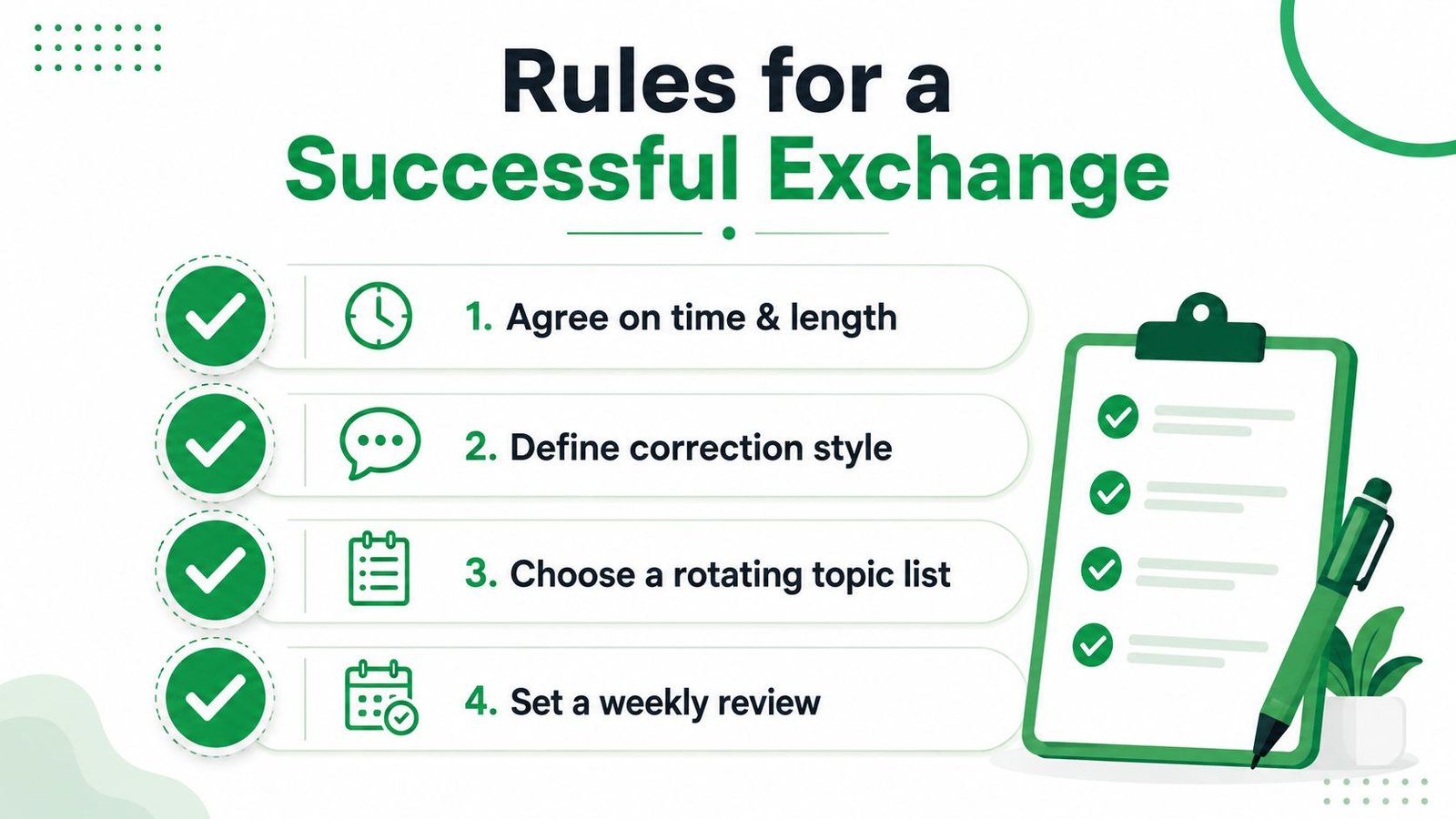
Four rules that prevent resentment
- Fix the weekly slot. Choose a day and time that both people can protect. A recurring appointment is stronger than “we'll see when we're free.”
- Split the languages evenly. A beginner-friendly default is 25 minutes in Gaeilge and 25 minutes in English, with a brief opening and closing for setup.
- Choose the correction style. Decide between live corrections, notes during the call, or an end-of-session review. For nervous speakers, delayed corrections usually preserve flow.
- Rotate responsibility. Each person brings the topic every other week. That keeps preparation mutual and stops one partner from becoming the permanent teacher.
Here's a simple first-session plan: begin with introductions and an easy warm-up, speak Gaeilge for the first half, switch to English, then review a few useful expressions. Finish by agreeing on the next topic and appointment.
Use this message: “Let's keep the exchange balanced. We'll practise Gaeilge first, switch to English halfway through, note corrections unless one of us asks for immediate help, and take turns choosing the topic.”
Renegotiate without making it awkward
After two sessions, ask one direct question: “What should we keep, change, or make easier?” If the slot no longer works, propose a replacement rather than apologising vaguely. If one language is dominating, shorten the sections and use a visible timer.
A good exchange can change shape. Text messages, voice notes, and calls all have a place, but the basic promise should remain clear: both people practise, both people prepare, and both people leave knowing what comes next.
Using Gaeilgeoir AI to Prepare, Rehearse and Follow Up
A human partner gives you spontaneity, personality, and real conversational pressure. An AI practice partner can't replace that relationship. It can, however, remove the awkward silence that often makes a live exchange feel unproductive.
Use a short preparation loop before every call. Choose the topic your partner will discuss, practise a few likely answers aloud, and rehearse the sentences you keep avoiding. This means you arrive with language available instead of spending the opening searching for words.
Use preparation to create better conversation
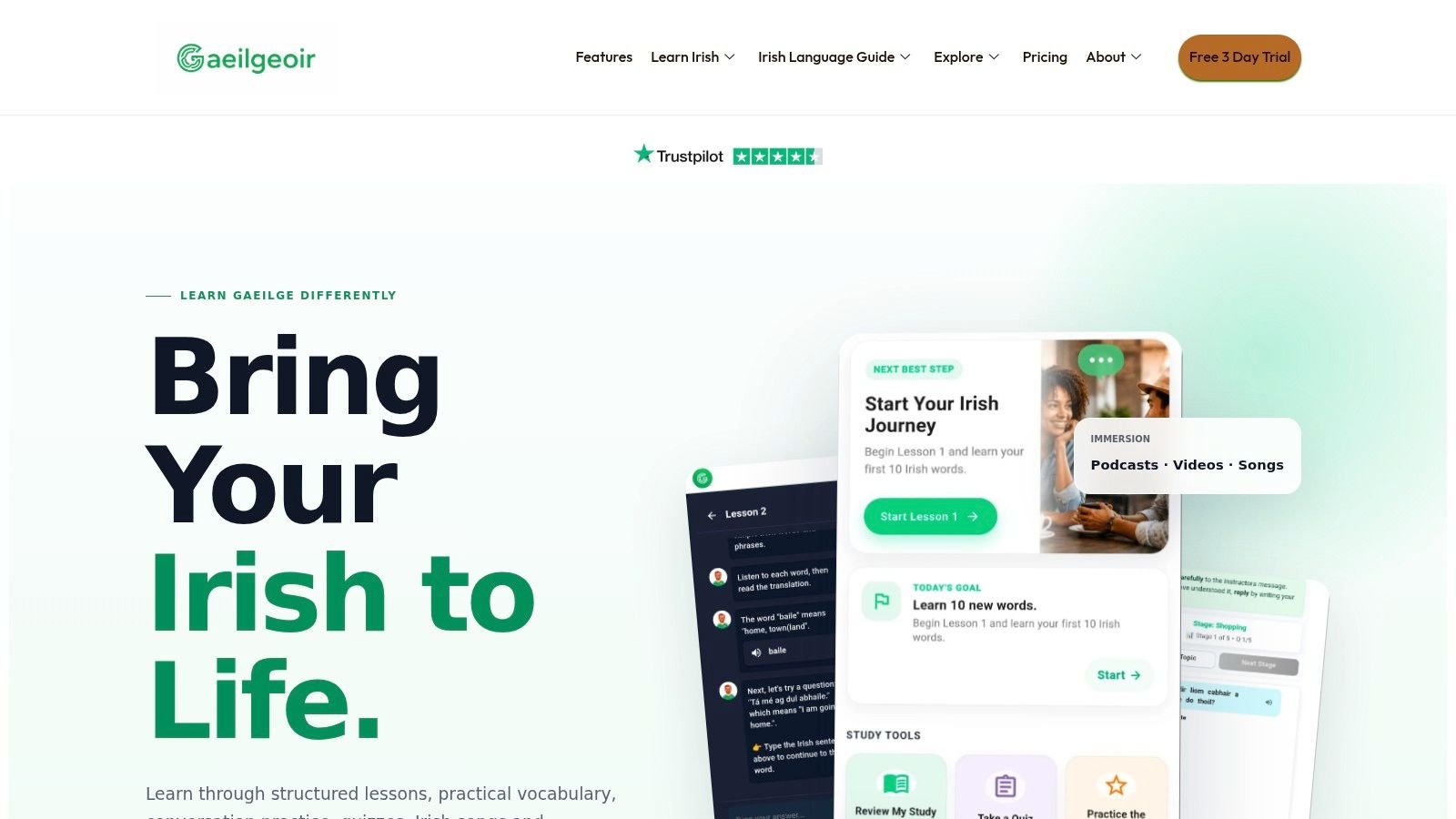
Gaeilgeoir AI supports scenario-based Irish practice, pronunciation support, click-to-translate vocabulary, and adaptive quizzes. Its practice focus on the 1,000 most-used Irish words gives a beginner a practical base for everyday exchanges, while saved vocabulary can turn a live conversation into the material for the next study session.
The best use is targeted, not endless. Before speaking with your partner, practise the exact situation you expect: introducing yourself, discussing school, describing your family, ordering food, or answering a Leaving Cert oral prompt. Then write down two questions you'll ask your partner so the call isn't carried by one person.
After the call, run a debrief. Save unfamiliar words, review the corrections your partner gave you, and practise the sentences again. If pronunciation caused trouble, repeat the difficult phrase until it feels less foreign before the next meeting.
The point isn't to sound perfect before the call. It's to make sure you have enough prepared language to keep the call moving.
You can also use AI language tutors as a private rehearsal space when your partner is unavailable. That protects the weekly habit without pretending that solo practice offers the same value as reciprocal conversation.
A useful sequence looks like this:
- Before the call: Rehearse the week's topic and prepare questions.
- During the call: Use the agreed language split and record corrections in the chosen format.
- After the call: Save new expressions, review them, and choose the next topic.
The video below offers another way to see how the platform fits into an Irish-learning routine.
This preparation also makes the human exchange more enjoyable. You'll have something to say, your partner won't need to rescue every pause, and both of you can spend more time using Gaeilge rather than negotiating what to discuss.
Staying Safe and Keeping the Exchange Alive
Reliability matters, but safety comes first. Keep early conversations inside the platform's chat or video tools, and avoid sharing your home address, payment information, or other sensitive details before trust exists. If a platform offers moderation, use it. Tandem says members can report someone from a chat, profile, or Language Party, and reports are anonymous and sent to community moderators (Tandem's safety guidance).
Compatibility screening protects your time as well as your privacy. Academic research on tandem apps identifies mismatched motivation, uneven language balance, and misrepresentation as recurring problems (research on tandem app experiences). If someone ignores your stated format, pushes personal boundaries, or only wants access to your native language, stop trying to fix the match.
Use small habits to protect continuity
Keep one shared note with new words, corrections, and the next topic. If someone cancels, suggest a replacement within a 24-hour rescheduling window. A one-line message such as “I can't make today, but I can do Thursday at the same time” shows whether the partnership still has momentum.
Use this troubleshooting checklist when the exchange starts slipping:
- Level mismatch: Switch to prepared topics and simpler prompts, or find a partner closer to your ability.
- Time-zone drift: Move to a fixed local slot or use asynchronous voice notes temporarily.
- Tutor trap: Reconfirm the language split and ask both people to bring topics and questions.
- Repeated cancellations: Stop chasing indefinitely. Reliability is part of compatibility.
The history of tandem learning supports this reciprocal model. Programmes evolved from early mutual-learning efforts in England into organised exchanges, European TANDEM Networks, and online partner systems, including the International Email Tandem Network launched by Helmut Brammerts in 1994 (the European Commission's language learning survey). The technology changed, but the principle didn't: two learners keep helping each other.
Start a free 3-day trial at learn.gaeilgeoir.ai and build a partner-ready Gaeilge routine before booking your first live call.
Gaeilgeoir AI gives Irish learners guided conversations, pronunciation support, scenario practice, translations, saved vocabulary, and adaptive quizzes for focused preparation between exchanges. Visit Gaeilgeoir AI today, practise one real conversation topic, and send your first specific partner message while the language is fresh.