Master Irregular Irish Verbs with Ease

Learning to master irregular Irish verbs is a key step on your journey to fluency in the Irish language. While regular verbs follow predictable patterns, irregular verbs often require a deeper understanding and consistent practice. Mastering these unique verbs enhances your speaking and writing abilities, allowing you to express yourself more naturally and accurately in Irish. Whether you’re just beginning or advancing your studies, focusing on irregular Irish verbs will take your language skills to the next level.


Understanding Irish Verbs

In Irish, verbs play a central role in sentence structure and meaning. Just like in English, Irish verbs can be either regular or irregular.

  • Regular verbs follow a consistent conjugation pattern across tenses.
  • Irregular Irish verbs, however, deviate from standard patterns and require memorization and context-based learning.

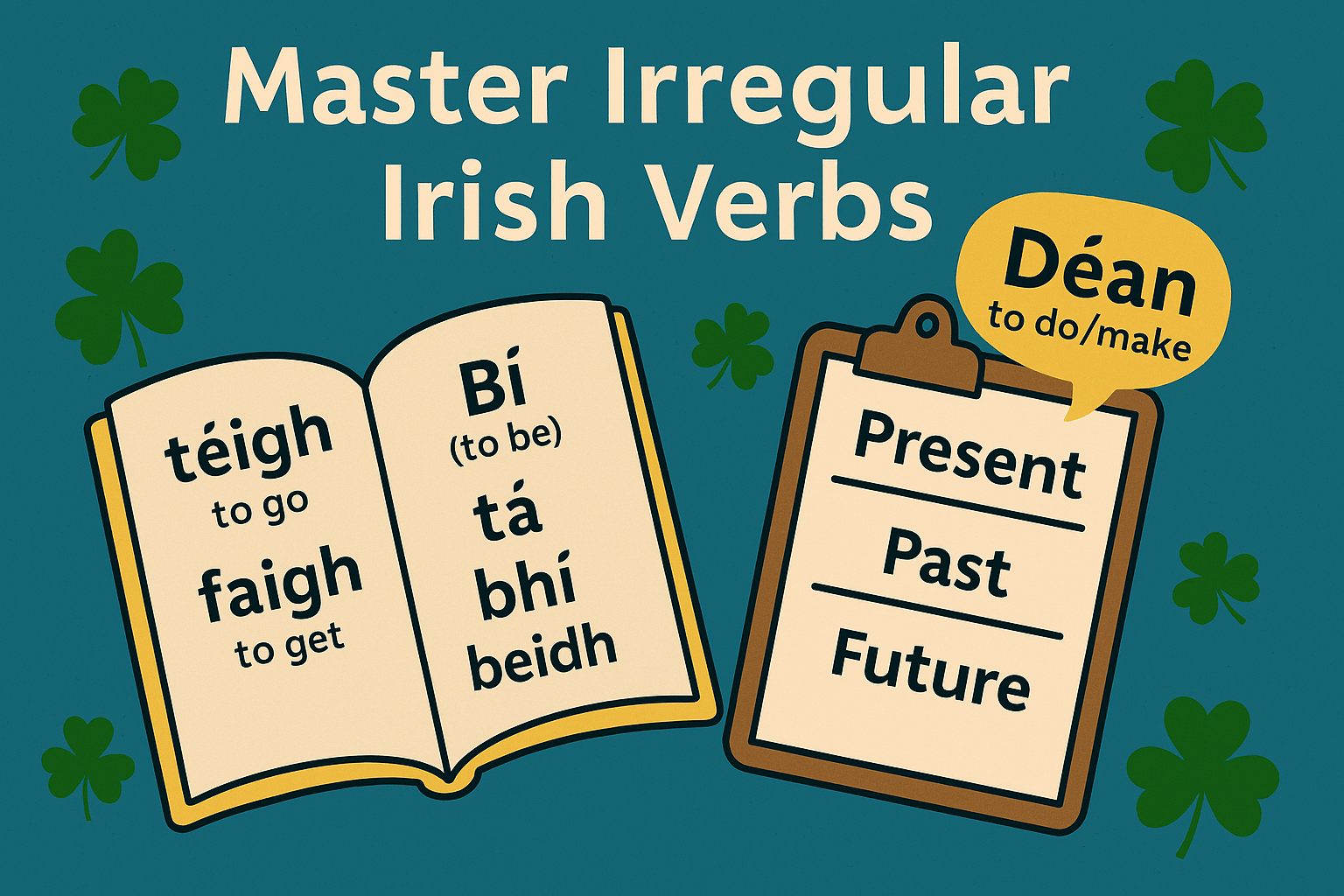
There are 11 commonly recognized irregular verbs in Irish. Some of the most frequently used include:

  1. – to be
  2. Déan – to do/make
  3. Faigh – to get
  4. Feic – to see
  5. Téigh – to go

Understanding the traits of irregular Irish verbs is essential for proper conjugation and usage in real-life conversations.

For those just beginning their journey, our Irish Language Lessons for Beginners provide a helpful foundation.


Strategies for Mastering Irregular Verbs

Conquering irregular Irish verbs takes commitment, but with the right techniques, it becomes a manageable and rewarding task.

1. Break Down Each Verb

Start with one verb at a time. Learn its meaning and conjugation in different tenses:

  • Past tense (Aimsir Chaite)
  • Present tense (Aimsir Láithreach)
  • Future tense (Aimsir Fháistineach)

For instance, the verb Téigh (to go) conjugates irregularly as:

  • Present: Téann sé
  • Past: Chuaigh sé
  • Future: Rachaidh sé

2. Leverage Online Tools

Use interactive online Irish language courses like those offered by Gaeilgeoir AI. Our AI-powered platform helps learners drill down into verb conjugation with tailored quizzes and context-based learning exercises. Sign up here to get started.

3. Compare Grammar Across Celtic Languages

Understanding differences between Irish and its sister language, Scottish Gaelic, can also illuminate grammar rules. Explore this comparison in our article on Irish vs. Scottish Gaelic Grammar.

4. Use Repetition & Spaced Learning

Repeat conjugation patterns regularly over several days. Use flashcards or digital apps with spaced repetition algorithms to keep verb forms fresh in your memory.


Incorporating Irregular Verbs into Everyday Conversations

It’s not enough to simply memorize conjugations. To truly master irregular Irish verbs, learners must actively use them in conversation.

Tips for Natural Usage:

  • Construct Short Sentences: Practice using one verb at a time in basic sentences. E.g., “Chonaic mé an grian” (I saw the sun).
  • Narrate Daily Activities: Use verbs like “Bí” and “Téigh” to describe your routine. E.g., “Bhí mé ag dul ar scoil” (I was going to school).
  • Speak With Others: Join Irish-speaking groups or online communities.

Check out our Basic Irish Conversation Guide for practical phrases that incorporate common irregular verbs.


Overcoming Challenges in Learning Irregular Irish Verbs

Common Hurdles:

  1. Memorizing Irregular Forms: Unlike regular verbs, each irregular verb may have unique rules.
  2. Inconsistent Practice: Lack of routine can cause you to forget forms quickly.
  3. Pronunciation Barriers: Some verb forms can be difficult to pronounce correctly.

Solutions:

  • Self-Study Techniques: Dedicate time daily to review one verb and create sentences.
  • Use AI Tools: Our AI-based learning tools adapt to your pace and progress.
  • Hire a Tutor: Personalized instruction helps solidify your understanding. Read our article on how to Find an Irish Tutor for Enhanced Learning.
  • Learn Irish Independently: Explore how you can succeed even on your own in Can You Learn Irish by Yourself?

Conclusion

Mastering irregular Irish verbs is one of the most important steps in becoming fluent in the Irish language. With consistent practice, interactive tools, and a deep appreciation for how these verbs function within conversation and storytelling, you’ll find yourself growing more confident and expressive in Irish.

Verbs like “Téigh” (to go) and “Bí” (to be) don’t just power your sentences—they help you connect with the rich culture and heritage behind the language. And by learning to conjugate them correctly, you open the door to mastering more advanced concepts such as the Irish Future Tense or understanding the wisdom of Irish Proverbs (Seanfhocail).

If you’re ready to level up your Irish skills, join a global community of learners and take advantage of our free trial at Gaeilgeoir AI. Click here to sign up and make irregular verbs your new strength!


External Resource:

  • Teanglann.ie – A trusted online Irish-English dictionary with comprehensive verb conjugation tables.

Slán go fóill – and happy verb learning!

 How to Conjugate Irish Verbs Easily

Learning to conjugate Irish verbs is a key milestone for anyone committed to mastering the Irish language. Verb conjugation is what gives your sentences structure and meaning, allowing you to express actions, feelings, and events in the past, present, and future. In this ultimate 2025 guide, we’ll walk you through the basics and beyond, helping you gain confidence as you unlock the beauty of Gaeilge.

Whether you’re a complete beginner or brushing up on skills, understanding how to conjugate Irish verbs is essential. With the help of modern tools like Gaeilgeoir AI and smart learning strategies, you can conquer even the trickiest verb forms.


Understanding Irish Verb Conjugation

Irish verbs are conjugated based on tense (past, present, future), mood (indicative, conditional, imperative, subjunctive), and person (first, second, third). Unlike English, which uses helping verbs, Irish changes the actual form of the verb.

Key Features of Irish Verb Conjugation:

  • Verbs come first in the sentence (VSO: Verb-Subject-Object)
  • Tense is built into the verb, not via auxiliary verbs
  • Initial mutations (e.g., lenition, eclipsis) may occur based on grammatical context

Two Main Classes of Verbs:

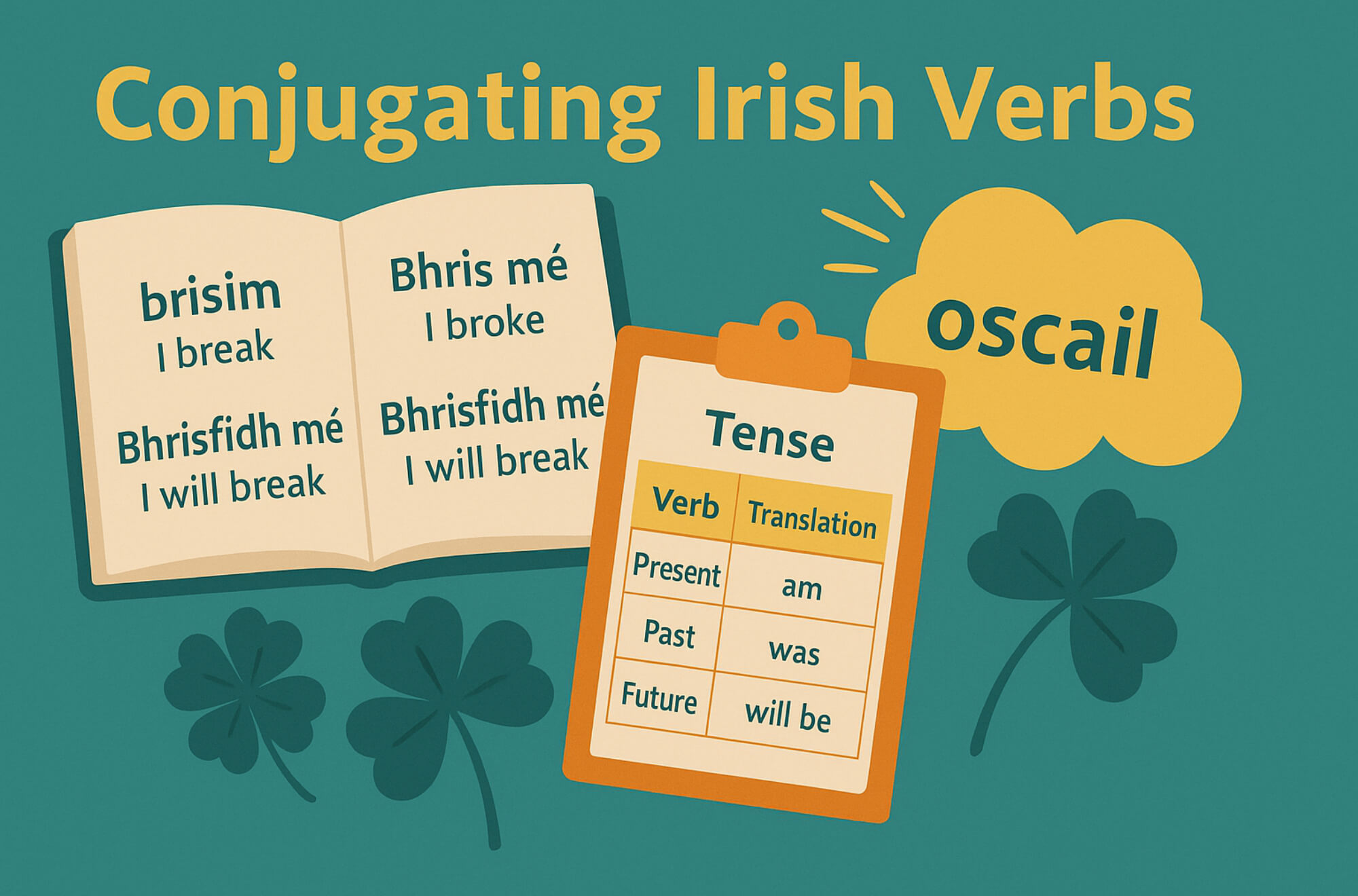
  1. First Conjugation Verbs: One-syllable verbs (e.g., bris – break)
  2. Second Conjugation Verbs: Two or more syllables (e.g., oscail – open)

Learn more about the sentence structure in our Irish sentence structure guide.


Common Irregular Verbs in Irish

Some verbs don’t follow standard patterns and must be memorized. Here are a few essential irregular verbs every learner should know:

VerbEnglishPresentPastFuture
To beBhíBeidh
DéanTo do/makeDéanannRinneDéanfaidh
FeicTo seeFeiceannChonaicFeicfidh
FaighTo getFaigheannFuairGheobhaidh
TeighTo goTeannChuaighRachaidh

These irregular verbs are widely used in everyday speech. Memorizing their forms will significantly boost your fluency.


Tips for Mastering Irish Verb Conjugation

When learning to conjugate Irish verbs, consistency and smart strategies make a world of difference.

Here are our top tips:

  1. Use Flashcards – Practice verb forms regularly with visual aids.
  2. Practice One Tense at a Time – Avoid overwhelm by focusing on one tense before moving on.
  3. Listen to Native Speakers – Watch Irish-language shows, listen to top Irish podcasts, or tune into TG4.
  4. Repeat and Reinforce – Spaced repetition systems (SRS) help with long-term memory.
  5. Use AI Tools Like Gaeilgeoir AI – Get immediate feedback and guidance tailored to your level.

Online Resources for Practicing Irish Verb Conjugation

Digital learning has made it easier than ever to practice and master verb conjugations.

Top Tools to Help You Learn:

  • Gaeilgeoir AI – Offers AI-powered grammar correction, smart quizzes, and progress tracking.
  • Teanglann.ie – A trusted online dictionary with verb conjugation tables.
  • Duolingo – Good for casual practice but lacks depth in grammar.
  • BBC Gaeilge – Offers vocabulary and basic grammar resources.

For more options, check out our guide to online Irish language courses.


Incorporating Verbs into Everyday Conversations

Knowing how to conjugate Irish verbs is only useful if you put it into practice.

Try These Examples:

  • Tá mé ag foghlaim. – I am learning.
  • Chonaic mé an scannán. – I saw the movie.
  • Beidh sí anseo amárach. – She will be here tomorrow.

Start by forming basic sentences:

  1. Identify your verb and conjugate it appropriately.
  2. Add your subject (mé, tú, sé, sí, sinn, sibh, siad).
  3. Add object or complement (if needed).

Need help with pronunciation? Visit our Irish pronunciation guide.


Challenges and Solutions in Mastering Irish Verb Conjugation

It’s completely normal to hit roadblocks while learning to conjugate Irish verbs. Here are some typical challenges:

Common Hurdles:

  • Confusing irregularities
  • Mixing up tenses
  • Lack of practice with native materials

Solutions:

  • Use visual grammar charts
  • Review consistently with Gaeilgeoir AI’s quizzes and grammar tips
  • Immerse yourself in Irish content (radio, books, subtitles)

Summary: Mastering Irish Verb Conjugation

To truly master the Irish language, you must learn how to conjugate Irish verbs with confidence. From understanding tense changes to memorizing irregulars and applying them in real-life conversations, the journey is rewarding.

Remember:

  • Start simple, then build complexity.
  • Don’t fear mistakes—they’re essential for learning.
  • Make Gaeilge part of your daily routine.

Ready to take your learning to the next level?

Join a vibrant community of learners today with Gaeilgeoir AI. Sign up for a free trial and start mastering Irish verbs one lesson at a time!


External Reference:

  • Foras na Gaeilge – Promotes the Irish language and offers excellent grammar resources.

Irish in Argentina: A Legacy of Language and Heritage

The story of the Irish in Argentina is a fascinating chapter in the global Irish diaspora, one that is often overlooked but deeply rich in cultural and historical significance. From the 19th century onward, thousands of Irish immigrants settled in Argentina, shaping rural communities, contributing to national development, and preserving elements of Irish identity far from home. Today, rediscovering this legacy offers not just a look into the past but also an inspiring path forward for Irish language learners and cultural enthusiasts.


Historical Waves of Irish Migration to Argentina

Early Arrivals and Reasons for Emigration

The first Irish in Argentina began arriving in notable numbers in the early 1800s, with migration waves peaking during and after the Great Famine (1845-1852). Many came from counties like Westmeath, Longford, and Wexford, seeking escape from poverty and hardship.

So, why is there Irish people in Argentina? Unlike traditional destinations like the United States, Argentina presented a unique appeal: generous land policies, the promise of agricultural opportunity, and an open immigration policy during its nation-building era. The growing need for skilled laborers and farmers attracted Irish migrants, many of whom were already experienced in rural life.

Notable Historical Figures

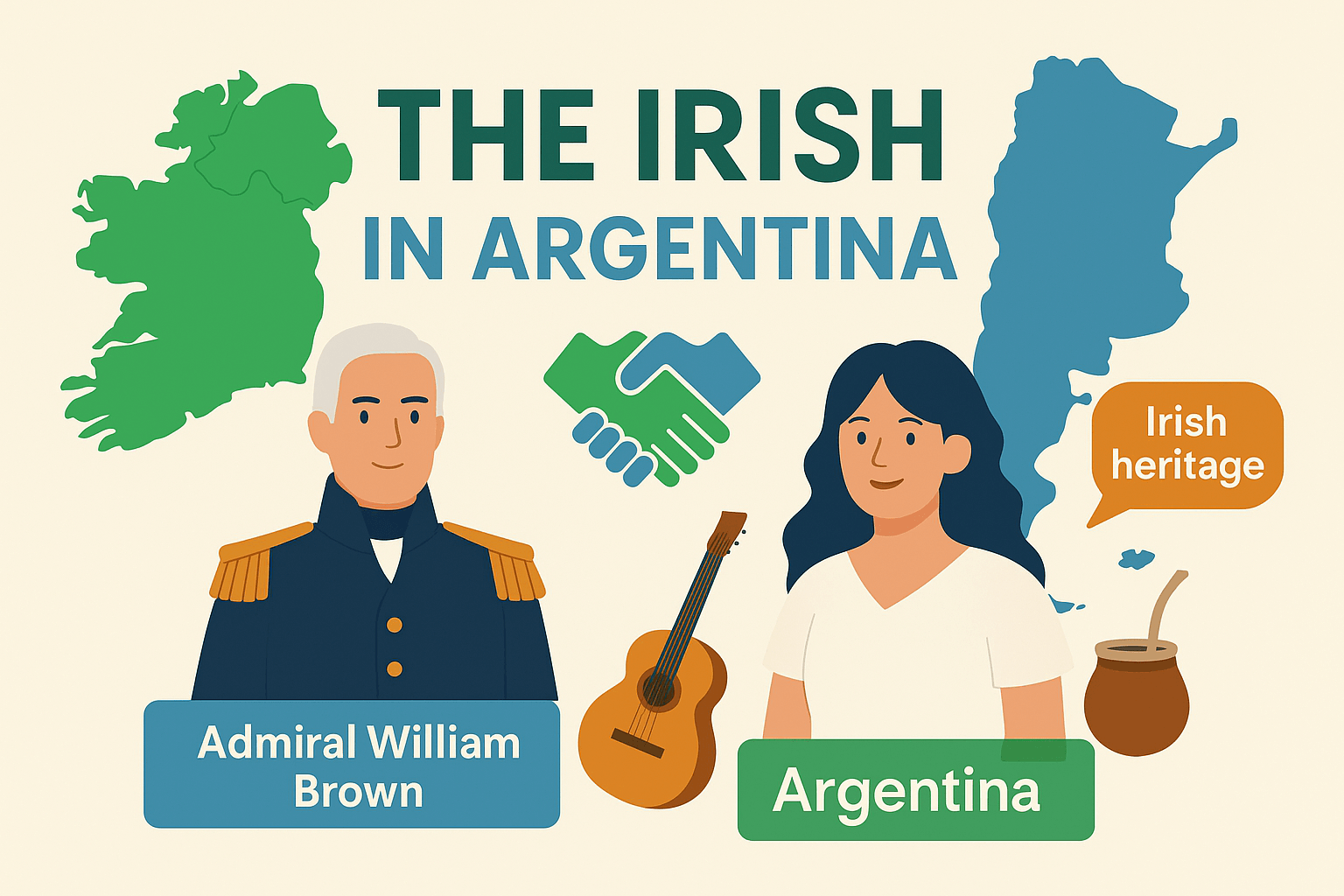
Among the most prominent Irish Argentines was Admiral William Brown, hailed as the founder of the Argentine navy. Born in County Mayo, Brown is a national hero in Argentina and a symbol of the powerful ties between Ireland and its South American counterpart.


The Irish Diaspora in Argentina: Communities, Culture, and Contributions

Irish immigrants tended to cluster in areas like Buenos Aires, Entre Ríos, and Santa Fe, where they established vibrant farming communities. These enclaves maintained close-knit networks, celebrated Irish holidays, and built Catholic churches and schools to sustain cultural identity.

Contributions to Argentine Society

The Irish diaspora in Argentina played a pivotal role in agricultural development, especially in cattle ranching and sheep farming. Irish teachers, doctors, and clergy also contributed to the intellectual and spiritual fabric of Argentine life.

Notable Irish Argentines include Eamon Bulfin, born in Buenos Aires, who later participated in the 1916 Easter Rising in Dublin. Figures like him demonstrate the enduring link between both nations.


Preserving Heritage: Language, Culture, and Identity Among Irish Argentines

Though the original settlers spoke Irish or Hiberno-English, the passage of time and assimilation led to a decline in Irish language use. Today, Irish speakers in Argentina are rare, but interest in heritage revival is growing.

Revitalizing the Language Abroad

Modern technology and community efforts are helping keep the spirit of the Irish language alive. Irish descendants in Argentina now turn to online Irish language courses and pronunciation guides to learn Gaeilge.

At Gaeilgeoir AI, we offer Irish language lessons for beginners, empowering learners with AI-powered pronunciation tools, flashcards, and cultural insights to support diaspora communities like those in Argentina.


Exploring the Legacy of the Irish Community Within Modern Argentine Society

Today, the legacy of the Irish community is celebrated through festivals, bilingual signage, and cultural connections between Ireland and Argentina. Annual St. Patrick’s Day parades in Buenos Aires are among the largest in Latin America, showcasing the enduring pride of Irish descendants.

There are also partnerships and sister city relationships between Irish and Argentine towns, fostering educational and artistic exchanges that strengthen cultural bridges.


Engaging with Dual Heritage Today: Language Learning, Cultural Exchange, and Personal Journeys

For those tracing their ancestry or simply intrigued by Celtic culture, learning Irish can be a deeply fulfilling experience. Platforms like Gaeilgeoir AI offer:

  • Step-by-step speaking Irish guides
  • Vocabulary builders to expand your Irish lexicon
  • Tools to explore Gaelic grammar and Irish history

Check out our Creative Ways to Learn Gaeilge to make your language journey engaging and effective.


Conclusion

The story of the Irish in Argentina is more than a historical migration tale—it is a living legacy. From Admiral Brown to modern-day learners seeking to reconnect with Gaelic roots, the Irish-Argentine experience continues to inspire.

Whether you’re a descendant of Irish immigrants in Argentina or simply fascinated by global Celtic culture, embracing the Irish language can be a powerful way to honor that connection. Begin your journey today with Gaeilgeoir AI and rediscover the voices, stories, and identity that continue to echo across continents.

Understanding the Gaulish Language and Its Celtic Roots

The Gaulish language was once a thriving Celtic tongue spoken across large parts of Europe, particularly in what is now France and surrounding regions. As a key branch of the Celtic language family, Gaulish provides rich insights into the linguistic, cultural, and spiritual life of the ancient Gauls. Today, there is growing interest in understanding this long-extinct language, not only for academic study but for reconnecting with Celtic roots. In this article, we explore the history of the Gaulish language, its structure, legacy, and how it connects with modern efforts to preserve other Celtic languages like Irish.


Origins and Evolution of the Gaulish Language

The Gaulish language developed among the Celtic tribes of ancient Gaul, a region that included modern-day France, parts of Belgium, Switzerland, Northern Italy, and Western Germany. Gaulish belongs to the Continental Celtic branch, distinct from the Insular Celtic branch that includes Irish, Scottish Gaelic, and Welsh.

Key Historical Points:

  • Geographic Spread: Gaulish was spoken widely across Western Europe before Roman conquest.
  • Linguistic Roots: It shares a common Proto-Celtic ancestor with Irish and Welsh.
  • Roman Influence: After the Roman conquest of Gaul (58–50 BC), Latin gradually replaced Gaulish as the dominant language.
  • Decline and Extinction: By the 5th century AD, Gaulish had largely disappeared, leaving only traces in place names and Latin borrowings.

Was Gaulish a Romance Language?

Despite being spoken in areas now associated with Romance languages, Gaulish itself was not a Romance language. However, it significantly influenced the vocabulary and phonetics of local Latin, contributing to the development of Old French.


Characteristics and Dialects of the Gaulish Language

Studying Gaulish is challenging due to the limited number of inscriptions and texts that have survived. However, researchers have identified distinctive features of the language.

Vocabulary and Grammar Structure

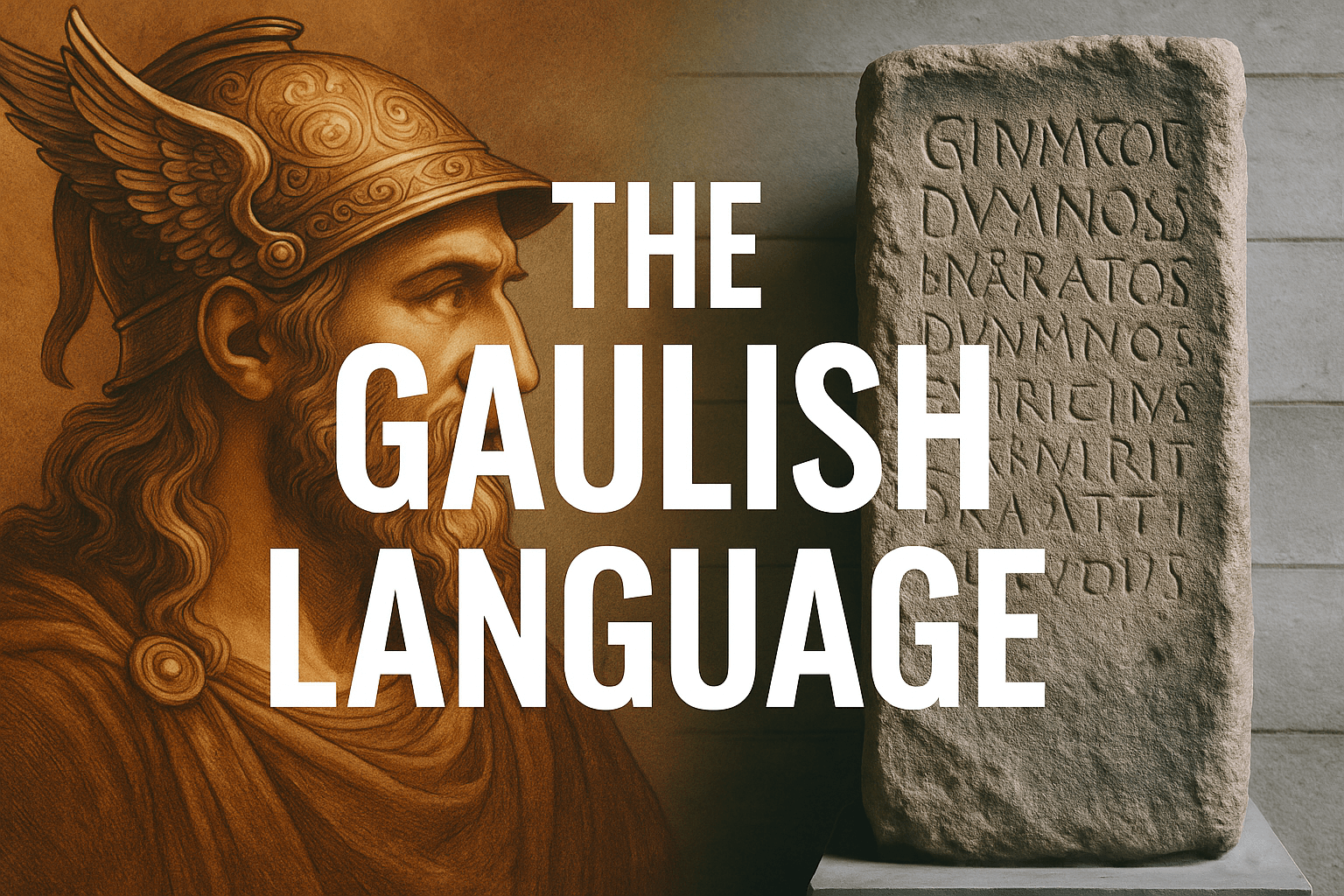
  • Vocabulary: Words like rix (king), dumnos (world), and bratos (judgement) offer a glimpse into Gaulish society and beliefs.
  • Grammar: Gaulish had a complex system of inflection, with different endings for case, number, and gender.

Dialectal Variation

Just like modern Irish has distinct dialects in Ulster, Munster, and Connacht, Gaulish likely had regional dialects too. Variations existed between Cisalpine Gaul (Northern Italy) and Transalpine Gaul (modern France), affecting pronunciation and vocabulary.


The Modern Revival Efforts and Challenges in Studying the Gaulish Language

Reviving a dead language is no easy task, but interest in Gaulish language revival has gained momentum, especially among Celtic heritage communities.

Current Initiatives

  • Online Courses and Resources: Websites and YouTube channels dedicated to teaching reconstructed Gaulish grammar and vocabulary.
  • Reconstructed Texts: Attempts to translate modern concepts and phrases into Gaulish, using reconstructed lexicons.
  • Community Support: Forums and social media groups for language learners and enthusiasts.

Challenges

  • Limited Source Material: With only a few hundred inscriptions, much of the grammar and vocabulary must be reconstructed.
  • Pronunciation Ambiguity: Since Gaulish died before the age of audio recording, pronunciation is based on scholarly inference.

Comparative Study: The Relationship Between Gaelic and Other Celtic Languages

Although separated by geography and history, Gaulish and Irish Gaelic share deep structural and lexical roots.

Similarities

  • Common Ancestry: Both descend from Proto-Celtic.
  • Shared Vocabulary: Words related to kingship, the supernatural, and nature often bear resemblance.
  • Cultural Parallels: Both cultures revered oral tradition, poetry, and spiritual leaders like druids.

Differences

  • Insular vs. Continental: Irish evolved on the periphery of Roman influence, preserving more archaic Celtic features.
  • Script: Gaulish used Greek and Latin alphabets, while Irish developed the unique Ogham script, which you can learn more about in our Ogham Script Alphabet Guide.

Why the Gaulish Language Still Matters

Studying the Gaulish language deepens our understanding of Europe’s pre-Roman cultures and enhances our appreciation for modern Celtic languages. It reveals:

  • The diversity and reach of the Celtic world.
  • Historical connections between ancient tribes.
  • The importance of language in shaping identity.

Preserving and learning Celtic languages like Irish is not only about communication; it’s about connecting to a deeper cultural and historical legacy.


Conclusion

The Gaulish language may be classified as extinct, but its echoes live on in place names, cultural memory, and linguistic study. Its close relationship to Irish Gaelic and other Celtic tongues underscores the importance of language preservation as a form of heritage conservation. If you’re fascinated by ancient languages and want to reconnect with your Celtic roots, learning Irish is a great place to start.

At Gaeilgeoir AI, we combine tradition with technology to help you learn the Irish language meaningfully. From AI-powered flashcards to pronunciation tools and mythological vocabulary, our platform offers everything you need to start your journey. Join us today and explore how living Celtic languages can help you unlock the mysteries of those that came before.

Exploring the Celtic God of War in Irish Mythology

In Celtic mythology, the gods were deeply intertwined with every facet of life—from fertility and agriculture to poetry and battle. Among the most revered were the gods of war, powerful figures who embodied strength, strategy, and supernatural might. Understanding the Celtic god of war offers unique insights into ancient Irish culture, language, and identity. This article explores legendary war deities, symbols, and sacred practices associated with warfare in Celtic belief systems.


Key Figures: The Celtic and Irish Gods of War

The Morrígan

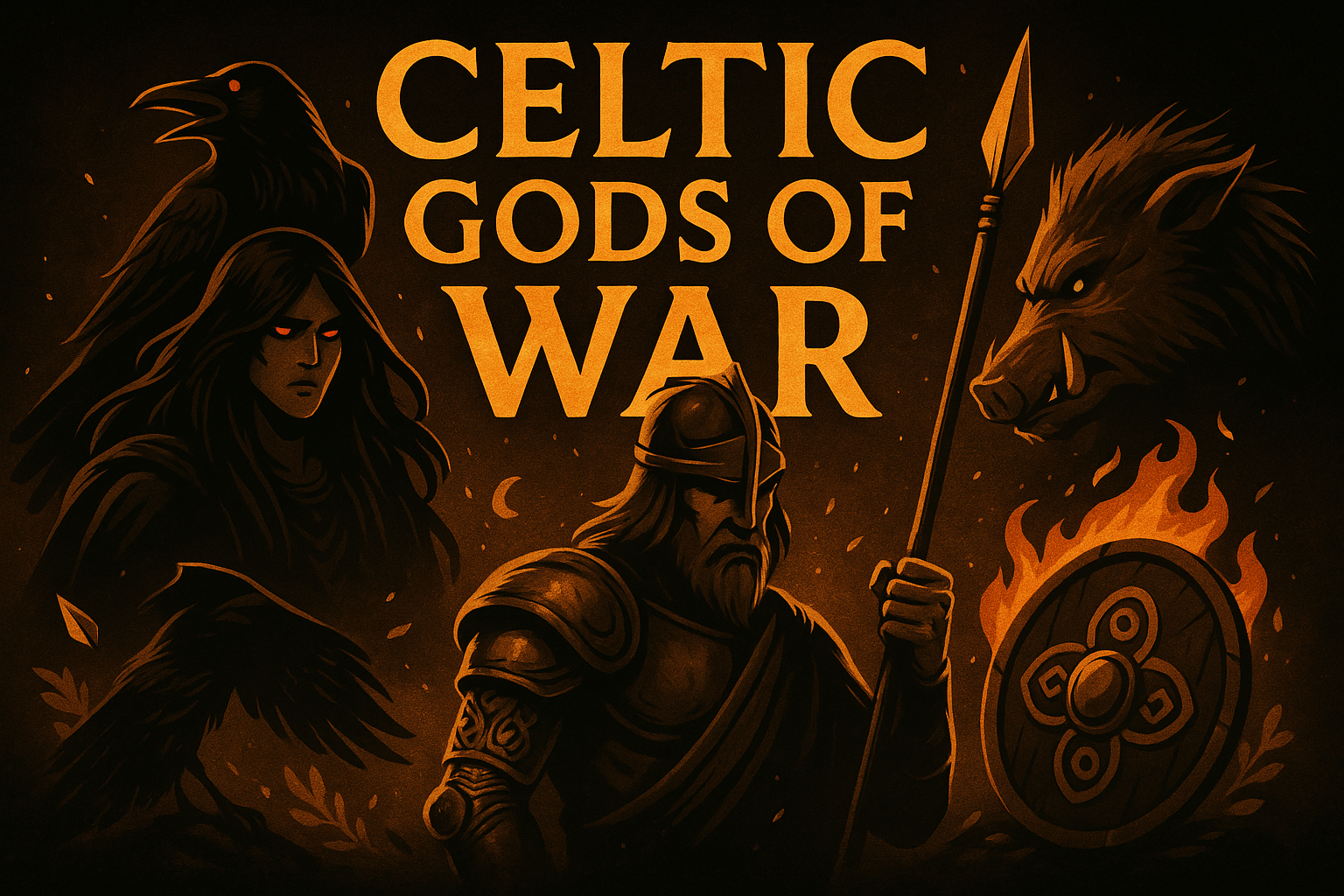
One of the most iconic war deities in Irish mythology, the Morrígan is a triple goddess associated with fate, battle, and death. She often appears in the form of a crow or raven on the battlefield, foretelling doom or inspiring fear.

Nuada

Known as Nuada Airgetlám (“Silver Hand”), he was a king of the Tuatha Dé Danann and a fierce warrior god. Though he lost an arm in battle, it was replaced with a silver prosthetic, symbolizing resilience and regeneration.

Camulus

More prominent in Gaulish and British Celtic traditions but still worth noting, Camulus was a Roman-era war god later syncretized with Mars. His name is connected to battle and victory.


Symbols and Iconography of the Celtic God of War

Ancient Celtic war deities were often linked to powerful visual symbols:

  • Spear: Associated with Lugh and the Lúin of Celtchar.
  • Crow or Raven: Symbol of the Morrígan, representing death and battle.
  • Boar: A symbol of courage and ferocity, often linked to warrior rituals.
  • Shield and Armor: Emblems of protection, common in both artwork and myth.

These Celtic god of war symbols were used on battle standards, jewelry, and even carved into stones.


Herbs and Rituals Associated with the Celtic God of War

In Celtic spiritual practice, certain herbs were believed to hold divine power:

  • Yarrow: Used to stop bleeding and invoke protection in battle.
  • Mugwort: Burned in rituals for visions and guidance.
  • Oak leaves: Sacred to many deities, symbolizing strength and endurance.

Rituals to honor war gods included:

  1. Saining (blessing) with herbs.
  2. Battle chants invoking divine protection.
  3. Offerings left at cairns or sacred wells before war.

The Role of Language in Preserving War Deity Legends

Irish mythology has survived thanks to oral storytelling and early manuscripts written in Irish. Learning the Irish language provides richer access to the original tales, names, and meanings of these deities.

Explore the Irish Pronunciation Guide to better understand names like Morrígan (pronounced MOR-ree-gan) and Lugh (pronounced Loo).


Exploring Irish War God Myths Through Language Resources

At Gaeilgeoir AI, language and mythology come together through smart tools and accessible content. With AI-powered features, you can:

  • Decode original Irish war chants.
  • Learn grammatical structures used in ancient storytelling.
  • Access bilingual versions of epic tales like the Táin Bó Cúailnge.

Start with our Irish Language Lessons for Beginners to begin reading these stories in Irish.


Comparative Insights: Irish vs. Scottish Gaelic Perspectives on War Deities

While Irish mythology highlights figures like the Morrígan and Nuada, Scottish Gaelic traditions also feature warrior spirits and deities, such as Cailleach, a hag goddess tied to winter and strife.

Linguistic nuances:

  • Irish: Morrígan (great queen)
  • Scottish Gaelic: Cailleach (old woman)

Understanding both helps appreciate how different regions interpreted the role of war and the supernatural.


Modern Cultural Impact and Legacy

The Celtic god of war continues to influence art, literature, and modern pagan spirituality. From fantasy novels to tattoos, these symbols remain powerful expressions of cultural pride.

Examples include:

  • Reenactments of Lughnasadh festivals.
  • Use of crow imagery in Celtic-inspired art.
  • Revival of Irish myths in games and pop culture.

Conclusion

The Celtic gods are more than mythological figures; they are a gateway to understanding celtic history, language, and resilience. By learning Irish and exploring its myths, you can deepen your cultural connection.

Discover how Gaeilgeoir AI can support your journey. Sign up here to explore Irish mythology and language through AI-powered tools rooted in Celtic heritage.

Celtic God Lugh: Master of Skill, Light, and Heritage

In the vast and rich tapestry of Irish mythology, the Celtic god Lugh stands out as one of the most revered and multifaceted figures. Known as Lugh Lámhfhada, or “Lugh of the Long Arm,” he is celebrated as the god of light, skill, and craftsmanship. Lugh’s role in Irish mythology is not only crucial to understanding Celtic spirituality but also to appreciating the linguistic and cultural depth of ancient Ireland. This article explores the life, myths, symbolism, and enduring influence of Lugh, guiding you through a journey of mythological insight and cultural preservation.


Historical and Mythological Background of Lugh

Lugh’s prominence begins with the Tuatha Dé Danann, a mythical race of deities in Irish folklore. According to ancient texts, Lugh was born of mixed divine lineage, with his maternal side tracing back to the Tuatha Dé Danann and his paternal side to the Fomorians, powerful beings often depicted as adversaries. This dual heritage positioned Lugh as a mediator between opposing forces, bringing harmony through strength and intellect.

One of Lugh’s most famous myths is his arrival at Tara, where he impresses the king by claiming mastery in every skill: warrior, smith, poet, sorcerer, historian, and more. His crowning moment comes in the Second Battle of Mag Tuired, where he leads the Tuatha Dé Danann to victory against the Fomorians, using the spear Lúin, a weapon said never to miss its mark.

These stories underscore Lugh’s role as a champion of balance, innovation, and wisdom in Irish culture.


Exploring the Attributes and Symbolism of Lugh

The attributes of Lugh make him one of the most dynamic figures in Celtic mythology. He embodies:

  • Light and the Sun: As a solar deity, Lugh is associated with illumination, clarity, and vision.
  • Craftsmanship: He is the patron of blacksmiths, builders, and artists.
  • Warrior Spirit: Lugh is revered for his martial prowess and strategic thinking.
  • Leadership: His wisdom and charisma made him a natural leader among the gods.

The symbolism of Lugh is equally significant. The spear Lúin represents directness, power, and divine justice. Lugh’s association with ravens and oaths speaks to his role in upholding truth and sacred law.


Worship and Festivals Dedicated to Lugh: A Closer Look at Lughnasadh

The most enduring celebration of Lugh is Lughnasadh, a harvest festival held on August 1st. Rooted in pre-Christian Ireland, Lughnasadh marked the beginning of the harvest season and was a time to honor Lugh’s foster mother, Tailtiu, who died clearing the land for agriculture.

Lughnasadh involved:

  • Ritual Games: Athletic contests symbolized strength and honor.
  • Feasting: Communities gathered to share the bounty of the land.
  • Handfasting: Trial marriages that lasted a year and a day.

Even today, modern pagans and cultural enthusiasts celebrate Lughnasadh through music, dance, storytelling, and seasonal crafts—all echoing Lugh’s versatile spirit.


The Ogham Script: A Window into Celtic Language Heritage During Lugh’s Era

Language played a key role in Lugh’s mythos. In ancient times, Irish druids and poets used the Ogham script, a system of lines and notches inscribed on stone or wood, to record names, messages, and lore. Ogham is often linked to sacred trees, many of which held symbolic significance in Celtic spirituality.

Learning about Ogham gives insight into how language, identity, and mythology were intertwined. Lugh, often portrayed as a poet and wordsmith, embodies the oral tradition central to Irish cultural continuity.

If you’re interested in connecting language and legend, check out Gaeilgeoir AI’s Ogham Script Alphabet Guide for a deeper exploration of this ancient writing form.


Modern Influence of Lugh in Irish Culture and Language Revival Efforts

Today, the legacy of Lugh lives on not only in folklore but also in Ireland’s renewed efforts to reclaim its cultural roots. Many Irish language learners encounter Lugh through literature, seasonal festivals, and modern adaptations in film, fiction, and fantasy.

If you’re inspired by Celtic heritage and want to strengthen your own language journey, visit our Irish Language Lessons for Beginners and take your first steps toward mastering Gaeilge.


Conclusion

The Celtic god Lugh continues to inspire as a symbol of intellect, creativity, and cultural strength. Whether in ancient tales of victory and sacrifice or in modern celebrations of identity and language, Lugh embodies the light that guides both warriors and learners.

By exploring myths, mastering phrases, and honoring traditions, we don’t just remember the past—we breathe new life into it. Join the movement to reconnect with Ireland’s roots by signing up with Gaeilgeoir AI and discover how language learning can be your path to Celtic cultural revival.

Discover the Magic of Irish Myths and Legends

Irish myths have captivated imaginations for centuries. These legends are more than bedtime stories; they are the living heart of Irish identity, passed down through oral tradition, song, and poetry. Whether it’s the mysterious banshee, the trickster leprechaun, or the transformative Púca, Irish myths bring us closer to the spiritual and cultural beliefs of the Celtic world. In this article, we delve into some of the most iconic Irish myths, their historical roots, and why they continue to influence global culture today.


The Origins of Irish Myths

The foundation of Irish mythology rests in Celtic tradition, a web of heroic tales, magical beings, and sacred lore. These stories were preserved in ancient manuscripts like the “Book of Invasions” and the “Táin Bó Cúailnge.” Originally part of an oral tradition, these myths were eventually written down by monks, often blending pagan beliefs with Christian influences.

Irish myths served not just as entertainment but as tools for teaching values, explaining natural phenomena, and preserving lineage. They connected people to the land, the seasons, and the spiritual world.


1. The Enigmatic Banshee: A Harbinger of Death or a Benevolent Spirit?

Few figures in Irish folklore are as widely known as the banshee. Derived from the Irish “bean sí,” meaning “fairy woman,” the banshee is said to wail or keen when someone is about to die.

Key Aspects:

  • Appearance: Sometimes described as an old crone, other times as a beautiful woman with long silver hair.
  • Function: Her keening is a mourning song, often heard near the home of the dying.
  • Symbolism: The banshee represents both loss and protection, alerting families to impending death.

Despite her ominous reputation, the banshee is not malevolent. She acts more as a guardian, continuing the Irish tradition of ancestral veneration.


2. Shapeshifting Myths in Ireland: What Do They Reveal About Our Identity?

Shapeshifting is a recurring theme in Irish myths, symbolizing the ever-changing nature of identity and reality.

Famous Shapeshifters:

  • Púca: A mischievous creature that can appear as a horse, goat, or even a human.
  • Selkies: Seal-people who shed their skins to become human.

These creatures blur the line between human and animal, mortal and fae. They often carry moral lessons about trust, deception, and transformation.


3. From Leprechauns to Merrows: The Fascinating Diversity of Irish Mythical Creatures

Irish folklore is populated by an array of creatures, each with its own story and significance.

Notable Creatures:

  1. Leprechauns: Solitary shoemakers with a hidden pot of gold.
  2. Merrows: Irish mermaids who live beneath the sea, wearing red caps to move between worlds.
  3. Dullahan: A headless rider who signals death.
  4. Fir Bolg and Tuatha Dé Danann: Mythical races involved in epic battles for Ireland.

These beings reflect human desires, fears, and our relationship with nature and the supernatural.


4. Beyond Borders: Exploring the Global Influence of Irish Myths and Legends

From Hollywood films to bestselling fantasy novels, Irish myths continue to resonate with audiences worldwide.

Global Touchpoints:

  • Literature: J.R.R. Tolkien and C.S. Lewis drew inspiration from Celtic mythology.
  • Cinema: Films like Darby O’Gill and the Little People and Song of the Sea showcase Irish legends.
  • Video Games: Modern games like Hellblade: Senua’s Sacrifice explore themes rooted in Celtic lore.

These adaptations keep Irish mythology alive and introduce it to new generations.


5. The Timeless Appeal Of The Otherworldly: Why We Still Believe In Fairies Today

Irish myths are not relics of the past; many people still believe in the fairies and respect their traditions.

Why the Belief Endures:

  • Cultural Pride: Respecting fairy lore is a way of honoring ancestors.
  • Symbolism: Fairies often represent justice, mischief, or nature’s power.
  • Community Ties: In rural Ireland, folklore shapes local traditions and seasonal festivals.

Comparing Irish fairies to Japanese Yōkai or Norse elves reveals common archetypes and universal human concerns.


Learn Irish, Understand Myth

Myths come alive when experienced in their native tongue. Learning Irish opens a deeper door to mythology, allowing learners to appreciate nuance and wordplay lost in translation. If this inspires you to go beyond reading and start speaking Irish, Gaeilgeoir AI offers a rich platform to support your journey.

Explore Irish Language Lessons for Beginners or browse our guide to learning Gaelic to get started.


Conclusion: Why Irish Myths Matter

Irish myths are more than charming stories—they are the cultural DNA of Ireland. They teach us about life, death, transformation, and the unseen world that exists alongside our own. These myths bridge the ancient and the modern, the fantastical and the real.

By exploring Irish mythology, you not only engage with captivating tales but also embrace a deeper understanding of Irish language, heritage, and identity.

Ready to immerse yourself further in the Celtic world? Sign up today with Gaeilgeoir AI and connect with Irish language and culture through interactive lessons powered by cutting-edge AI.

Discover your voice in Ireland’s oldest stories.

10 Cornish Phrases to Know and Say With Confidence

Cornwall is more than just picturesque beaches and pasties; it is home to a unique linguistic tradition that continues to inspire learners and linguists alike. Cornish, or Kernewek, is a Celtic language that shares roots with Welsh and Breton. Though it nearly faded into obscurity, Cornish has experienced a cultural revival, with communities and learners bringing it back to life. One of the best ways to begin engaging with this heritage is to learn simple, everyday Cornish phrases that connect you to the language and culture.

In this guide, you’ll learn 10 essential Cornish phrases to enhance your understanding of the language and connect with Cornish heritage. We’ll also explore pronunciation tips, cultural context, and resources to help you on your journey.


Understanding the Cornish Dialect

The Cornish language has a melodious sound and distinct pronunciation patterns. Many Cornish phrases include guttural consonants and rolling R’s, and vowels may shift depending on dialect or speaker.

Pronunciation Tips:

  • “gh” is often pronounced like the “ch” in the Scottish “loch.”
  • “dh” is similar to the English “th” in “this.”
  • Stress usually falls on the first syllable.

Use pronunciation recordings from trusted sources or language learning platforms to practice. Listening is key to mastering both rhythm and inflection.


Top 10 Essential Cornish Phrases You Need to Know

Here are 10 Cornish language phrases with pronunciation and meaning:

  1. Dydh da (dith da) – Hello / Good day
  2. Fatla genes? (faht-la guh-ness?) – How are you?
  3. Da lowr (da lowr) – Good enough / Okay
  4. Meur ras (myoor rass) – Thank you
  5. Piw os ta? (pyoo oss tah?) – Who are you?
  6. Nadelik Lowen (nah-del-ik low-en) – Merry Christmas
  7. Gool Peran Lowen (gool per-an low-en) – Happy St Piran’s Day
  8. Dha weles yn pub le (tha well-ess un pub lay) – See you everywhere (Goodbye/farewell)
  9. Kernow bys vyken! (ker-now bis vee-ken) – Cornwall forever!
  10. Lowena dhis! (low-en-ah dhees) – Joy to you!

These essential Cornish phrases are perfect for greeting friends, expressing gratitude, and celebrating traditions.


Cultural Significance of Common Cornish Sayings

Cornish expressions often reveal a strong connection to land, nature, and community. For example, “Kernow bys vyken” isn’t just a motto; it encapsulates pride in Cornish identity. Phrases like “Lowena dhis!” share an ethos of goodwill and hospitality.

Cornish phrases serve not only as communication tools but also as cultural markers, passed down through oral storytelling and festival traditions.


Resources for Further Learning

Whether you’re looking to enhance your pronunciation or expand your vocabulary, here are some resources to support your Cornish learning journey:

  • Go Cornish – An initiative promoting Cornish in schools and communities.
  • Learn Cornish Now (Cornwall Council)
  • Memrise – Has Cornish phrase decks.
  • SaySomethinginCornish – Offers immersive audio-based learning.

If you’re passionate about Celtic languages, check out Gaeilgeoir AI’s Creative Ways to Learn Gaeilge for methods you can apply to Cornish too.


Benefits of Learning the Cornish Language Today

Learning a minority language like Cornish isn’t just a hobby — it’s a meaningful act of cultural preservation. Some benefits include:

  • Connecting to heritage: Whether you have Cornish roots or simply admire Celtic culture.
  • Boosting cognitive skills: Bilingualism enhances memory, creativity, and mental flexibility.
  • Building community: Join global efforts to keep Cornish alive by using Cornish phrases in conversation.

Conclusion

Mastering these 10 Cornish phrases is a fantastic first step into the world of Cornish language and culture. Each phrase brings you closer to a rich Celtic tradition and helps you play a role in its ongoing revival.

If you enjoy exploring Celtic languages and traditions, start your Irish language journey with Gaeilgeoir AI’s Irish Language Lessons for Beginners or sign up today to connect more deeply with the spirit of Celtic heritage through the Irish language.

Lowena dhis—joy to you!

Irish Shamanism Explained: Symbols, Rituals, and Healing

Irish Shamanism is a captivating spiritual tradition rooted in the ancient beliefs of the Celtic people. Though the word “shaman” is not originally Gaelic, the practices and wisdom found in Irish culture mirror the essence of shamanism—deep connection to the spirit world, nature, healing, and ancestral reverence. Understanding Irish Shamanism enriches not only our knowledge of Irish history but also our connection to the Irish language and worldview. In this guide, we’ll uncover the traditions, symbols, practices, and ongoing revival of this sacred path.


Exploring the Depths of Ancient Irish Shamanism

The spiritual leaders of early Ireland were druids, poets (filí), and healers who performed many of the roles attributed to shamans in other cultures. Ancient Irish Shamanism was interwoven with mythology and oral storytelling, drawing upon cycles like the Lebor Gabála Érenn (Book of Invasions) and tales of deities from the Tuatha Dé Danann.

Unlike centralized religions, Irish shamanic traditions were deeply personal and localized. Rituals took place in sacred groves, at holy wells, and on mountaintops. The shaman’s role was to mediate between this world and the Otherworld (An Saol Eile), drawing wisdom from ancestors, spirits, and the land itself.

Key features that distinguish Irish Shamanism include:

  • Integration with poetic language and storytelling
  • Strong ties to place-based spirituality
  • Emphasis on community, ancestry, and seasonal cycles

Unveiling the Symbols: A Closer Look at Irish Shamanic Symbols and Their Meanings

Symbols hold great significance in Irish Shamanism. They are not merely decorative but are tools for meditation, spiritual journeying, and healing.

Some important Irish shamanic symbols include:

  • Triskelion (Triskele): Representing the triplicity of land, sea, and sky, or the mind, body, and spirit.
  • Spirals: Found at Newgrange and other sacred sites, symbolizing eternal cycles and the journey inward.
  • Ogham Script: The earliest written form of the Irish language, used not just for communication but as a magical system.

For a deeper understanding of these symbols, see our Ogham Script Alphabet Guide.


Embarking on a Journey Through Shamanic Practices: Rituals, Trances, and Healing Techniques in Irish Shamanism

Practitioners of Irish Shamanism often engage in techniques like:

  • Journeying: Using rhythmic drumming or chanting to enter a trance and communicate with spirits or ancestors.
  • Healing with Herbs: Drawing from a long-standing herbal tradition for spiritual and physical well-being.
  • Divination: Using tools like Ogham sticks or interpreting dreams and natural signs.

These rituals were conducted in harmony with the lunar calendar and seasonal festivals like Samhain, Bealtaine, and Lughnasadh, further reinforcing the connection between time, ritual, and transformation.


The Role of Shamans in Traditional Irish Society: Spiritual Leaders and Mediators Between Worlds

While the term “shaman” may not have an exact Irish equivalent, several roles embodied its spirit:

  • Druids: Philosophers, judges, and spiritual leaders with deep ritual knowledge.
  • Filí: Poets who preserved history, lore, and spiritual truths through verse.
  • Bean Feasa (wise woman): Female healers and seers with herbal and mystical knowledge.

These figures were respected not only for their wisdom but also for their ability to mediate between the material and spiritual realms, using language (as Gaeilge) and ritual as tools of transformation.


Nature’s Embrace: The Deep Connection Between Shamans and the Elements in Irish Shamanism

Irish Shamanism emphasizes harmony with nature and the elements:

  • Earth (Talamh): Associated with ancestors and grounding rituals.
  • Water (Uisce): Sacred wells and rivers were places of offering and insight.
  • Fire (Tine): Central to festivals and purification rituals.
  • Air (Aer): Linked to song, breath, and inspiration (“imbas”).

This elemental framework informs many Irish blessings and prayers, offering a practical way to integrate ancient wisdom into daily life.


Resources for Learning About Irish Shamanism: Books, Online Courses, and More

If you’re interested in learning more about Irish Shamanism, here are some top resources:

Books:

  • “Celtic Shaman” by John Matthews
  • “Kindling the Celtic Spirit” by Mara Freeman

Online Courses & Communities:

  • Gaeilgeoir AI’s Creative Ways to Learn Gaeilge offers cultural insights along with language lessons.
  • Global networks like OBOD (Order of Bards, Ovates & Druids) often feature Irish traditions in their teachings.

Comparative Study: Celtic Shamanism vs. Other Forms of Shamanistic Practices Around the World

While many cultures feature shamanic traditions, Celtic Shamanism stands apart in several ways:

  • It is deeply poetic and symbolic, emphasizing story and myth.
  • The Otherworld is a central feature of Irish cosmology, unlike the spirit realms in Siberian or Andean traditions.
  • Tools like the Ogham and herbalism are unique, intertwined with the Irish language.

Comparing practices allows modern seekers to appreciate what makes Irish Shamanism a distinct path among global traditions.


Conclusion

Irish Shamanism offers a rich, intuitive, and profoundly rooted path into Ireland’s spiritual heritage. Whether through language, story, nature, or ritual, it helps modern seekers connect with ancestral wisdom. As Gaeilgeoir AI continues to support learners worldwide, incorporating the spiritual elements of Irish tradition enriches not only our vocabulary but our worldview.

To begin your own journey, explore the language of the ancestors with our Irish Pronunciation Guide or sign up for a free trial and start reconnecting with Ireland’s timeless spirit through language and tradition.

Slán agus beannacht!

Celebrating the Celtic New Year: Samhain and Irish Tradition

The Celtic New Year is a celebration steeped in tradition, folklore, and seasonal change. It marks not just the end of one year and the beginning of another, but a time when the veil between the worlds of the living and the dead was believed to be at its thinnest. For the ancient Celts, this turning point was observed through Samhain (pronounced “sow-in”), a festival of great spiritual and cultural importance. In this article, we’ll explore the origins and customs of the Celtic New Year, how it ties into Irish language and tradition, and how you can celebrate it in a meaningful way today.


Historical and Cultural Background

Samhain, and the Celtic New Year it ushers in, predates Christianity and finds its roots in the early Gaelic calendar. This turning of the seasons—usually celebrated from October 31st to November 1st—was not just agricultural but deeply symbolic.

The Irish language played a key role in preserving these customs. Many ancient festivals, rituals, and oral traditions were recorded in Old and Middle Irish, giving us a window into the spiritual life of our ancestors. Irish revolutionaries and cultural revivalists in the 19th and 20th centuries helped to protect and restore these traditions by promoting Gaeilge (Irish Gaelic) as a cornerstone of national identity.


Samhain: The Heart of the Celtic New Year

Samhain was more than just a harvest festival. It was a time to honor the ancestors, commune with the spirit world, and prepare for the darkness of winter. Bonfires were lit to ward off evil spirits, and offerings were made to deities and the aos sí (fairy folk). People would leave food outside their homes for wandering souls and wear disguises to blend in with the spirits.

The symbolism is powerful: just as the crops die and the days shorten, so too does the world descend into a time of reflection and rebirth. It is a festival of both endings and beginnings—perfectly aligning with the Celtic concept of a new year.


Language and Celebration: Gaelic Expressions for the New Year

Saying “Happy New Year” in Irish Gaelic is Athbhliain faoi mhaise duit! (pronounced: “ah-vleen fwee vosh-ah ditch”). During the Celtic New Year, greetings and blessings would reflect the hope for prosperity, protection, and renewal.

Other useful phrases:

  • Sláinte! (Health!)
  • Go néirí an t-adh leat! (May luck be with you!)
  • Fáilte roimh an Athbhliain! (Welcome the New Year!)

For those wanting to learn how to pronounce these properly or integrate them into conversation, Gaeilgeoir AI offers tools like Irish pronunciation guides and basic conversation lessons.


Traditional Customs and Symbols Associated with the Celtic New Year

Key symbols and practices include:

  • Ogham script: This early medieval alphabet was often inscribed on standing stones and trees. Some Samhain rituals used Ogham to write blessings or divinations.
  • Seanfhocail (proverbs): These traditional sayings encapsulate deep wisdom. A relevant one for Samhain: “Ní neart go cur le chéile” (There is no strength without unity).
  • Seasonal foods: Apples, nuts, and root vegetables were used in feasts and games of divination.

Learning the deeper meanings behind these symbols is a great way to engage with Irish culture. Check out our guide to Irish sayings in Gaelic for more insights.


Modern Celebrations and Revivals

Today, Samhain and the Celtic New Year are celebrated by communities across Ireland and beyond. These celebrations include:

  • Reenactments of traditional rituals.
  • Community bonfires.
  • Irish music and storytelling nights.
  • Language workshops and cultural festivals.

Modern learners often turn to tools like online Irish courses or find a tutor to enrich their experience through language.


The Celtic New Year’s Influence on Language Learning

The Celtic New Year inspires many to reconnect with the Irish language as a way to reclaim heritage. Interest in festivals like Samhain sparks curiosity in traditional vocabulary, phrases, and dialects. Learners may encounter regional variations in greetings or interpretations of customs.

Gaeilgeoir AI supports this journey through resources that address dialectal differences in Irish and help learners expand their vocabulary.


Integrating Celtic Traditions into Daily Life

Want to bring a bit of the Celtic New Year into your everyday routine?

  • Start your day with an Irish proverb or blessing.
  • Greet friends in Irish with a simple “Athbhliain faoi mhaise duit.”
  • Reflect on the seasons and journal your goals at Samhain.
  • Decorate with Celtic symbols or Ogham art.

These small gestures help bridge ancient wisdom with modern life.


Conclusion

Celebrating the Celtic New Year is about more than honoring the past—it’s about enriching the present and preserving culture for the future. From ancient Samhain rituals to modern language apps, every effort to engage with tradition matters. Whether you’re lighting a symbolic candle, learning a new Irish phrase, or diving deeper into history, you’re helping keep the spirit of the Celtic New Year alive.

To continue your journey into Irish culture and language, sign up for a free trial with Gaeilgeoir AI and join a global community passionate about Ireland’s living heritage.

25% off any subscription

Enjoy 25% off your subscription. Just use promo code START25 at checkout!

25% off with Promo code: START25