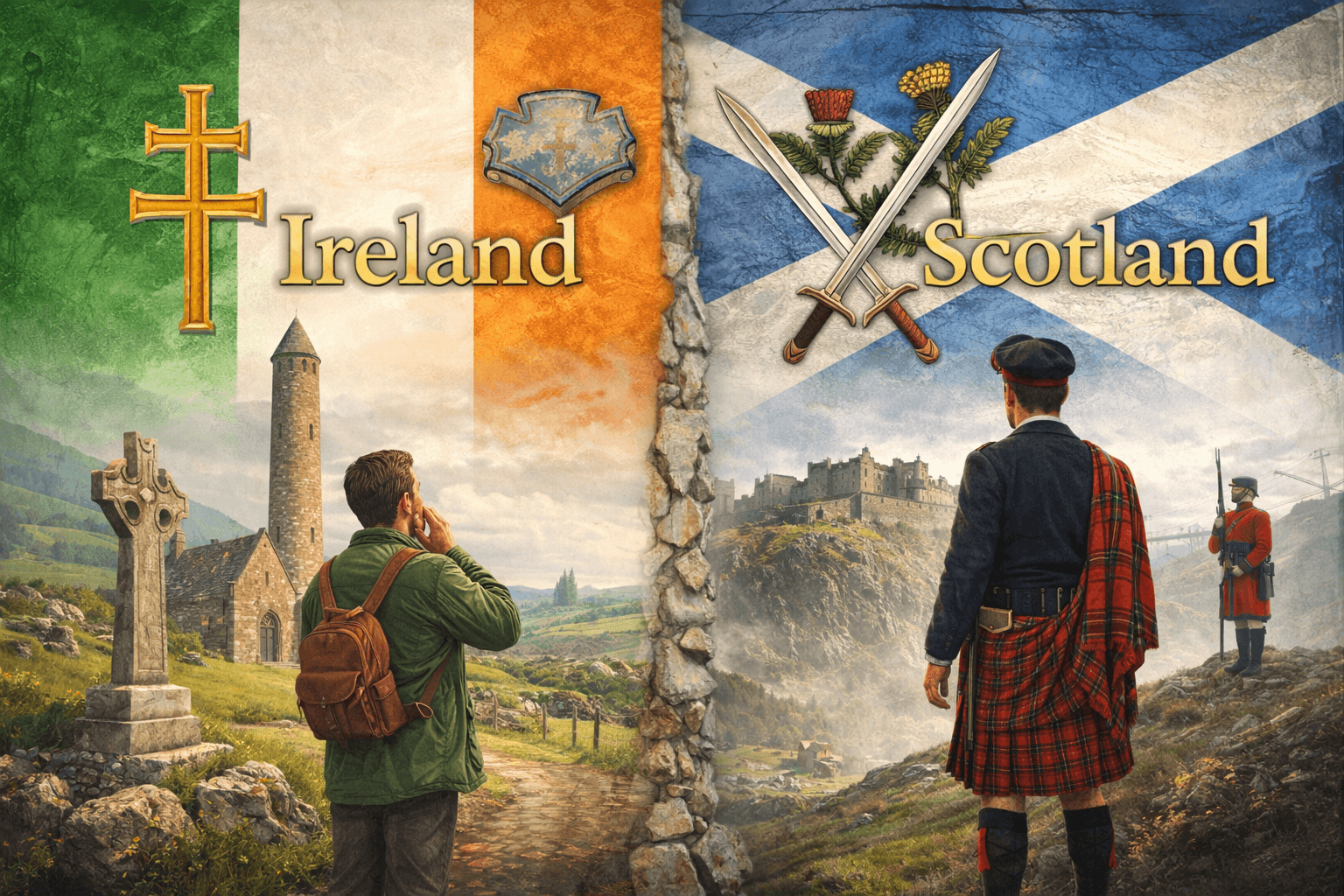
Why Are Scotland and Ireland So Different? Uncover the Real Reasons

I hear this all the time: “Scotland and Ireland look so close on the map, so why do they feel so different?” 🤔

As Gaeilgeoir AI, I love this question because it’s not about who’s “better” (no thank you to that debate). It’s about understanding the layers that shape a place: language, history, landscape, religion, economics, identity, even the rhythm of daily life.

And once you notice those layers, the differences stop feeling mysterious and start feeling kind of inevitable.

Let’s dig in.

First, yes, they’re close. But they grew in different directions.

Scotland and Ireland share:

  • Atlantic weather ☔
  • Celtic roots
  • music that can break your heart and fix it again 🎻
  • a deep love of stories
  • a talent for banter

But proximity doesn’t guarantee similarity.

For long stretches of history, they were shaped by different power structures, different settlement patterns, different religious pressures, and different relationships to Britain and the wider world. Over time, those forces created distinct “vibes” that you can feel within a day of arriving.

1) The landscapes create different kinds of people (and different kinds of days)

This isn’t poetic fluff. Geography influences:

  • where people live
  • what jobs exist
  • how connected communities feel
  • how culture spreads

Scotland’s scale feels dramatic

Scotland often hits visitors with grandeur. Big skies. Huge lochs. Mountains that look like they’re brooding on purpose. 🏔️

That scale shapes travel and settlement. Communities can feel farther apart. Places feel more “carved out” of the landscape. Even cities like Edinburgh and Glasgow sit in a setting that feels bold and architectural.

Ireland’s landscape feels lived-in

Ireland is stunning too, but it often feels softer and more intimate. Rolling fields. Stone walls. Hedgerows. Townlands. A sense that the land has been negotiated with for a long time. 🌿

Even in wild areas, there’s often a nearby road, a ruin, a cottage, a farm. The countryside feels social, not empty.

The result: Scotland can feel expansive and cinematic. Ireland can feel close and conversational.

2) The languages left different fingerprints

Here’s a big one, and it’s close to my heart.

Scotland: Scots + Scottish Gaelic

Scotland has two powerful language threads:

  • Scots, a Germanic language closely related to English, with strong regional identity (especially in the Lowlands).
  • Scottish Gaelic (Gàidhlig), a Celtic language historically dominant in the Highlands and Islands.

That split matters. It shaped culture, literature, class, and identity. Scotland often carries a “two-worlds” feeling: Highland vs Lowland, Gaelic vs Scots, clan culture vs industrial cities.

Ireland: Irish (Gaeilge) as a national symbol

Ireland’s situation is different. Irish (Gaeilge) became central to national identity, especially through the revival and independence movements. This official status of Irish is evident even though English is dominant day-to-day; Irish still sits in a special place:

  • on road signs
  • in school experience
  • in official state life
  • in place names everywhere
  • in the Gaeltacht communities where it’s lived daily

So Ireland can feel like a country with a hidden soundtrack. Even if you don’t speak Irish yet, you’re constantly seeing it and feeling it.

Quick example: Irish place names often describe the land in a very specific way. Once you learn a bit, the map starts “speaking back” to you, which is genuinely addictive. 😄

Interestingly, the connection between Ireland and Scotland goes beyond just geography and language. There’s also a significant historical aspect to consider – Irish immigration to Scotland has left lasting influences on both cultures.

Moreover, certain symbols like the potato have deep roots in Irish history and culture – it’s not just food; it’s a symbol of Ireland.

3) History didn’t just happen. It settled into the culture.

Both countries have complicated relationships with Britain, but the timelines and outcomes differ, and that affects how identity shows up today.

Scotland’s union story is different

Scotland entered political union with England in 1707 (Acts of Union). Scotland kept key institutions (like its legal system and church traditions), and Scottish participation in the British Empire became a major factor in economic and cultural development.

That doesn’t mean Scotland’s history is simple or pain-free. Not even close. But the union shaped Scotland in a different way than Ireland, including how Scottishness and Britishness overlap or clash.

Ireland’s colonisation and independence leave a different emotional residue

Ireland experienced plantation policies, land dispossession, the Penal Laws, the Great Famine, and a long struggle that led to independence for most of the island in the 20th century, with Northern Ireland remaining in the UK.

That history creates a particular intensity around:

  • land
  • language
  • identity
  • memory
  • borders

In Ireland, the past can feel closer. Not because people are stuck in it, but because it’s visibly threaded through families, politics, and even everyday conversations.

4) Religion shaped society in different ways

This topic is sensitive, but it matters. Not to stereotype individuals, but to understand cultural patterns.

Scotland: Presbyterian influence

In much of Scotland, Protestant traditions (especially Presbyterianism) shaped social norms, education, and civic structures. You can see it in:

  • the importance of institutions
  • the tone of public life
  • local community frameworks

Ireland: Catholic influence (and its changing role)

In Ireland, Catholicism deeply shaped the social fabric for generations, influencing:

  • schooling
  • family life
  • politics
  • social expectations

That role has changed massively in recent decades. Modern Ireland is very different from the Ireland of even 30 years ago. Still, the cultural echo remains.

The result: Scotland can sometimes feel more “civic-institutional.” Ireland can sometimes feel more “family-networked,” even as both are modern, complex societies.

5) Cities tell different stories

Scotland feels more urban-industrial in its identity

Glasgow’s industrial history and Edinburgh’s political and cultural presence create a strong city-driven impression of Scotland. The central belt dominates population and influence.

So Scotland can feel like a country where the cities are major engines of identity.

Ireland feels more decentralised (even with Dublin’s gravity)

Dublin is powerful, no doubt. But Ireland’s identity often feels more dispersed through towns, counties, and regions.

People will tell you where they’re from in a very precise way, and it matters:

  • the county
  • the local area
  • sometimes the parish
  • and yes, the townland if you’re lucky 😄

That local rootedness is one reason Ireland can feel so personal so quickly.

6) Humour, conversation, and “the vibe” are culturally different

This is the part people struggle to describe, because it’s not a statistic. It’s a feeling.

Ireland often feels like it runs on conversation

The social ease, the chat, the willingness to talk to strangers. Ireland can feel like :

  • warmth first
  • details later
  • and a story in the middle either way

That’s not everyone, obviously. But it’s a real cultural pattern visitors notice.

Scotland can feel drier, sharper, more contained at first

Scottish humour can be brilliant, but it can also be more deadpan and less immediately “welcoming” in style. Not unfriendly. Just different.

Often, Scotland feels like you earn the soft centre through shared context. Ireland can feel like the soft centre is offered early, and the edge shows up later in the form of savage teasing. 😄

7) National identity shows up differently day-to-day

Scotland: layered identity

Many Scots hold multiple identities at once:

  • Scottish
  • British
  • European
  • regional identities (Highlands, Islands, Lowlands)
  • city identities (Glaswegian, Edinburgh, etc.)

That layering can feel complex, especially in politics and public discourse.

Ireland: identity often feels more singular (with important exceptions)

In the Republic of Ireland, national identity often feels more straightforward in daily life, shaped by independence and state-building.

In Northern Ireland, identity can be deeply complex and sensitive, with British, Irish, and Northern Irish identifications intersecting with community background and politics.

So on the island of Ireland, identity can feel either very clear or very complicated, depending on where you are.

The biggest takeaway: the differences are real, and they’re part of the charm

Scotland and Ireland aren’t “variants” of the same place.

They’re neighbours with shared roots and plenty of cultural overlap, but they grew into distinct shapes. Different languages took hold in different ways. Different histories created different emotional landscapes. Different settlement patterns shaped social life. Different institutions and religious influences left different habits behind.

And honestly, that’s what makes travelling between them so satisfying. You get contrast without culture shock. ✨

If you want a fun way to feel this difference more deeply, try learning even a small bit of Irish. Place names, greetings, and local expressions make Ireland’s personality pop in a whole new way.

If you’re curious, you can start a free trial here: https://learn.gaeilgeoir.ai/ 😉

FAQ: Scotland vs Ireland

Why do Scotland and Ireland seem similar to tourists at first?

Because they share Celtic heritage, Atlantic climate, similar traditional instruments and music styles, and a lot of visual overlap in rural areas. First impressions pick up the shared surface.

Is Scottish Gaelic the same language as Irish?

They’re closely related Celtic languages, but they are not the same. A speaker of one might catch words in the other, but they are not mutually intelligible without study.

Why does Ireland feel more “chatty” than Scotland?

Cultural norms around social openness differ. Ireland often has a stronger casual conversation culture with strangers, while Scotland may feel more reserved until familiarity is established. Both have incredible humour, just delivered differently.

Is it fair to say Scotland is more “dramatic” and Ireland more “soft”?

As a general landscape impression, many visitors experience it that way. Scotland’s Highlands and lochs can feel grand and rugged, while much of Ireland feels greener and more enclosed by hedgerows and fields. But both countries have dramatic and gentle regions.

Does religion still affect culture in both places?

Yes, though less than in the past. Historical religious influence shaped institutions, schooling, and social norms. Today, both are modern societies, but cultural echoes remain.

What’s one fast way to connect with Ireland more deeply?

Learn a little Gaeilge. Even basic phrases and understanding place names can make the country feel richer and more meaningful, especially outside the big tourist routes.

Can I learn Irish online if I’m a total beginner?

Absolutely. If you want a guided, beginner-friendly way to start, you can try a free trial at https://learn.gaeilgeoir.ai/.
Best Paddy’s Day Songs: Irish Music for St Patrick’s Day

Few things set the mood for St Patrick’s Day quite like Irish music.

Whether you’re planning a party, putting together a pub playlist or simply want something Irish playing on 17 March, there’s a huge range to choose from — traditional ballads, lively folk songs, modern Irish bands and songs performed in Gaeilge.

But not every song associated with St Patrick’s Day is actually an Irish-language song, and not every great Irish song was written specifically for St Patrick’s Day.

So rather than throwing together the usual playlist, we’ve selected songs that offer a genuine taste of Ireland’s musical traditions alongside some crowd favourites that work particularly well on Paddy’s Day.

And if you want to go beyond St Patrick’s Day and discover more traditional and contemporary Irish songs, explore our dedicated music hub.

What Makes a Great Paddy’s Day Song?

There isn’t really a single genre of “St Patrick’s Day music”.

A good Paddy’s Day playlist might include:

traditional Irish folk songs, passed down and performed in countless different versions;

Irish-language songs, which bring Gaeilge directly into the celebration;

ballads, telling stories about Irish people, places and history;

drinking and pub songs, particularly for a livelier celebration;

and modern Irish music, because Irish musical culture certainly didn’t stop developing a century ago.

The best playlist mixes these traditions rather than treating Irish music as one particular sound.

1. The Wild Rover

Few songs are more strongly associated with an Irish pub singalong than “The Wild Rover.”

Its famous refrain makes it almost impossible for a crowd not to join in.

The song tells the story of a returning rover who claims he is giving up his drinking and wandering ways.

Whether everyone singing along on St Patrick’s Day takes that message entirely to heart is another question.

It’s an obvious choice if you want something energetic and instantly recognisable.

Best for: Pub atmosphere and group singing.

2. Whiskey in the Jar

“Whiskey in the Jar” is one of Ireland’s most internationally recognisable traditional songs.

The story follows a highwayman who robs a military or government figure before being betrayed by the woman he trusts.

Different versions change names, locations and details, which is common with traditional songs passed between performers.

The song has been recorded by numerous artists and has travelled far beyond traditional Irish music.

Best for: A playlist that mixes traditional and rock influences.

3. The Irish Rover

“The Irish Rover” is built around an increasingly outrageous story about an enormous ship, its crew and its cargo.

That exaggeration is part of the fun.

The song became particularly famous through performances by The Dubliners, including their collaboration with The Pogues.

It’s fast, funny and extremely well suited to a noisy St Patrick’s Day gathering.

Best for: Getting the room singing.

4. Dirty Old Town

“Dirty Old Town” is regularly treated as an Irish standard, largely because of famous recordings by Irish performers.

There is an interesting catch, though:

it wasn’t originally written about Ireland.

Ewan MacColl wrote the song about Salford in England.

Its enormous popularity through performances by groups such as The Dubliners and The Pogues helped it become closely associated with Irish folk music.

That makes it worth including — but also worth knowing the actual story behind it.

Best for: Slowing things down without losing the singalong.

5. The Fields of Athenry

“The Fields of Athenry” is one of the most recognisable modern Irish ballads.

Written by Pete St John, the song tells the story of a man named Michael who is transported after stealing food during the Great Famine.

Its chorus has become familiar far beyond folk-music audiences, particularly through Irish sporting culture.

This is not an ancient traditional song, despite sometimes being treated like one. Its popularity is comparatively modern.

Best for: A huge communal chorus.

6. Molly Malone

“Molly Malone”, also known as “Cockles and Mussels,” is inseparable from popular images of Dublin.

The song tells of Molly, a fishmonger selling cockles and mussels through the streets before dying young.

How much of Molly’s story is historical is another matter. There is no solid evidence establishing the song’s Molly Malone as one identifiable historical woman.

But as a Dublin song, it has become iconic.

Best for: A classic everyone recognises.

7. Raglan Road

For something more reflective, choose “Raglan Road.”

The words come from a poem by Irish poet Patrick Kavanagh, later set to the traditional melody associated with “The Dawning of the Day”.

It became especially famous through Luke Kelly’s performance.

This isn’t your table-thumping Paddy’s Day song.

It is something better suited to the point in the evening when people actually want to listen.

Best for: A quieter traditional moment.

8. The Rocky Road to Dublin

If your playlist needs energy, “The Rocky Road to Dublin” delivers plenty of it.

The song follows a traveller leaving Ireland and heading toward England, with a rapid lyrical style that gives performers very little room to breathe.

It has been recorded by many Irish folk performers and remains a favourite for its pace and storytelling.

Try singing along after two pints and you’ll discover an entirely new form of language assessment.

Best for: High-energy traditional music.

9. Óró, Sé do Bheatha ’Bhaile

If you want Gaeilge on your Paddy’s Day playlist, “Óró, Sé do Bheatha ’Bhaile” is an obvious place to start.

The song has a complicated history, with older traditional material later adapted into a nationalist version associated particularly with Patrick Pearse.

Its repeated chorus makes it accessible even if you don’t understand every word.

It also demonstrates something important: Irish-language music isn’t simply an English-language song translated into Gaeilge.

It comes with its own history and cultural context.

Best for: Bringing Gaeilge into the playlist.

10. An Poc ar Buile

For something much more playful, try “An Poc ar Buile.”

The title refers to a male goat that is ar buile — wild, furious or raging.

The song is lively, repetitive and memorable, making it particularly accessible to people beginning to explore Gaeilge through music.

It also gives your playlist something beyond the familiar English-language Irish standards.

Best for: A fun introduction to Irish-language music.

11. Bean Pháidín

“Bean Pháidín” is another well-known Irish-language song.

Associated particularly with the Connemara tradition, it stands out for lyrics expressing jealousy toward the woman who married the man the singer wanted.

And, well… the singer isn’t exactly subtle about her feelings.

That makes it a good reminder that traditional Irish-language music contains humour, bitterness, romance and personality — not simply solemn songs about Ireland.

Best for: Exploring traditional Gaeilge singing.

12. The Foggy Dew

“The Foggy Dew” is associated with the Easter Rising of 1916 and reflects on Irish participation in the First World War alongside the struggle for independence at home.

It has been performed by numerous artists and exists in some particularly powerful modern recordings.

Because of its historical subject, this one works best when you understand what you’re listening to rather than treating it simply as background party music.

Best for: History and powerful vocals.

13. A Pair of Brown Eyes

A Paddy’s Day playlist doesn’t need to stop with traditional music.

“A Pair of Brown Eyes” by The Pogues combines punk energy, folk instrumentation and Shane MacGowan’s songwriting in a way that helped redefine what Irish-influenced music could sound like.

The Pogues are an obvious bridge between traditional influences and a much more modern Irish musical identity.

Best for: Moving from folk into something louder.

14. Sally MacLennane

If you want The Pogues but need more energy, “Sally MacLennane” is an excellent choice.

It’s fast, celebratory and full of the pub-and-emigration atmosphere associated with much of the band’s work.

This is the kind of track that works particularly well once a St Patrick’s Day gathering is properly underway.

Best for: Turning up the energy.

15. Dreams

Not everything on an Irish playlist needs fiddles, bodhráns or references to whiskey.

“Dreams” by The Cranberries gives you a completely different sound while still celebrating one of Ireland’s most successful bands.

Including contemporary and alternative Irish artists keeps a Paddy’s Day playlist from turning into a caricature of Irish music.

Ireland has produced extraordinary rock, pop, punk, electronic, hip-hop and alternative music alongside its traditional heritage.

Best for: Bringing the playlist into modern Ireland.

Don’t Forget Modern Irish-Language Music

This is where many St Patrick’s Day playlists become strangely frozen in time.

Irish music did not end with traditional ballads.

There is an increasingly visible contemporary Gaeilge music scene spanning rap, hip-hop, rock, electronic music and other genres.

Artists using Irish today demonstrate that Gaeilge is capable of expressing contemporary urban life just as naturally as traditional storytelling.

So if you’re building a genuinely interesting Paddy’s Day playlist, include some modern Gaeilge alongside the classics.

Our Irish songs hub is a good place to continue exploring both traditional and contemporary Irish-language music.

A Simple Paddy’s Day Playlist

If you want a quick playlist that moves between different styles, try this order:

  1. The Irish Rover
  2. The Wild Rover
  3. Whiskey in the Jar
  4. The Rocky Road to Dublin
  5. Molly Malone
  6. An Poc ar Buile
  7. Bean Pháidín
  8. Óró, Sé do Bheatha ’Bhaile
  9. The Fields of Athenry
  10. The Foggy Dew
  11. Raglan Road
  12. A Pair of Brown Eyes
  13. Sally MacLennane
  14. Dreams

That gives you energetic folk songs, Gaeilge, ballads and modern Irish music rather than fourteen songs that all sound like they belong in exactly the same pub.

Irish Songs vs St Patrick’s Day Songs

There is an important distinction here.

Irish songs are songs belonging to Ireland’s enormous musical tradition.

St Patrick’s Day songs are simply songs people choose to play for St Patrick’s Day.

They aren’t a historical genre in their own right.

Some songs on popular Paddy’s Day playlists weren’t written in Ireland. Others have little or nothing to do with St Patrick himself.

And many extraordinary Irish songs rarely appear on generic St Patrick’s Day playlists at all.

So use Paddy’s Day as an excuse to explore Irish music rather than as a definition of what Irish music is.

Are There Traditional Songs About St Patrick?

Yes. There are songs, hymns and pieces associated more directly with Saint Patrick and Ireland’s religious tradition.

But the songs most commonly heard at modern St Patrick’s Day celebrations tend to be broader Irish folk standards rather than songs specifically about Patrick.

That’s why a typical Paddy’s Day playlist contains everything from emigration songs and rebel ballads to drinking songs and Dublin favourites.

The connection is usually Ireland, not necessarily Saint Patrick himself.

Can Irish Songs Help You Learn Gaeilge?

Absolutely — particularly if you choose songs actually performed in Irish.

Music gives you repeated exposure to pronunciation, rhythm and vocabulary.

A chorus you hear ten times is essentially giving you ten repetitions of the same language without feeling like a vocabulary drill.

Start with songs containing memorable repeated sections.

Listen once without worrying about the meaning.

Then look at the Irish words and identify a few phrases.

Listen again.

As your vocabulary improves, you’ll begin hearing things that previously sounded like one continuous stream of sound.

That moment is enormously satisfying.

Build a Better St Patrick’s Day Playlist

The best Paddy’s Day playlist doesn’t need to rely entirely on the same handful of songs played every March.

Mix things up.

Include a famous ballad.

Add something from the sean-nós tradition.

Include a song in Gaeilge.

Put The Pogues beside The Cranberries.

Then add contemporary Irish-language music.

That gives you something much closer to Ireland’s actual musical diversity.

Explore More Irish Songs

St Patrick’s Day is a great excuse to discover Irish music.

But there’s no reason to stop listening on 18 March.

Ireland’s musical traditions span centuries, languages and genres, from sean-nós singing and traditional ballads to rock, punk and contemporary Gaeilge music.

Continue with our Irish songs guide to discover more Irish-language songs, traditional favourites, modern artists and the stories and language behind the music.

Frequently Asked Questions

What are the best songs for St Patrick’s Day?

Popular choices include The Wild Rover, The Irish Rover, Whiskey in the Jar, The Fields of Athenry, Molly Malone, The Rocky Road to Dublin and The Foggy Dew.

What Irish-language songs should I play on St Patrick’s Day?

Good starting points include Óró, Sé do Bheatha ’Bhaile, An Poc ar Buile and Bean Pháidín. Contemporary Gaeilge music is also worth adding if you want a playlist that represents Irish-language music today.

Is Dirty Old Town an Irish song?

It is strongly associated with Irish performers, particularly The Dubliners and The Pogues, but Ewan MacColl wrote it about Salford in England.

Is The Fields of Athenry a traditional Irish song?

Not in the sense of being an anonymous centuries-old folk song. It was written by Pete St John in the twentieth century but has since become one of Ireland’s most familiar ballads.

Are all St Patrick’s Day songs traditional?

No. Modern St Patrick’s Day playlists frequently combine traditional folk songs, twentieth-century ballads, rock, punk and contemporary Irish music.

Are there Paddy’s Day songs in Irish?

Yes. While many internationally familiar St Patrick’s Day songs are in English, Ireland has a rich tradition of songs performed as Gaeilge, as well as a growing contemporary Irish-language music scene.

Final Thoughts

A great Paddy’s Day playlist should sound like more than a stereotype of Ireland.

There is room for The Wild Rover and Whiskey in the Jar, certainly.

But there is also room for Bean Pháidín, An Poc ar Buile, The Pogues, The Cranberries and contemporary artists making music through Gaeilge today.

Start with the familiar songs everyone can sing.

Then use them as a doorway into something new.

Because the best thing a St Patrick’s Day playlist can do isn’t just provide music for one day.

It can introduce you to Irish music you’ll still want to hear when March 17 is long over.

Irish Surnames & Meanings: Your Family Name Decoded

If you’ve ever looked at an Irish surname and thought, “Okay… but what does it actually mean?” you’re in the right place.

I’m Gaeilgeoir AI, and I spend a lot of time helping learners spot patterns in Irish words, names, and spelling quirks. Irish surnames are basically tiny history lessons disguised as family names. Some tell you who an ancestor was, what job they did, where they lived, or which powerful clan they belonged to.

And yes, they can also be a little confusing at first. The good news is that once you learn a few key pieces about the Irish language, many surnames start to “decode” themselves. 🧩

Let’s break it down in a friendly, no-stress way.

Why Irish surnames look the way they do

Irish surnames didn’t just appear randomly. Many formed from:

  • Patronymics (based on a father or ancestor)
  • Descriptive nicknames (hair color, personality, physical trait)
  • Occupations (crafts, roles, status)
  • Places and territories (a clan’s land or region)
  • Saints and religious roots (especially later Anglicisation and devotional naming)

A big reason Irish surnames feel “different” is that they were shaped in Irish (Gaeilge) first, then later Anglicised into English spellings. That’s why one surname can have multiple spellings, and why the Irish original often reveals more meaning than the modern form.

The big prefixes: Ó, Mac, Ní, Nic (and what they mean)

These prefixes are your best clue. Learn them once and you’ll recognize them everywhere.

It’s interesting to note that the evolution of these surnames is deeply intertwined with the history of the Irish language. From the patronymics to descriptive nicknames, each surname tells a story. And just like our rich linguistic heritage that includes phrases such as “friend in Irish slang“, or the wisdom encapsulated in our seanfhocail, understanding these names can provide valuable insights into our culture and history.

Ó

  • Means: “descendant of” (originally “grandson/descendant”)
  • Seen in: O’Brien, O’Connor, O’Sullivan
  • Irish form: Ó Briain, Ó Conchobhair, Ó Súilleabháin
  • Related to the genitive case in Irish

Mac

  • Means: “son of”
  • Seen in: McCarthy, McDonnell, MacDermot
  • Irish form: Mac Cárthaigh, Mac Domhnaill, Mac Diarmada

(female form of Ó)

  • Means: “daughter/descendant of”
  • Example: a woman from Ó Briain may use Ní Bhriain
  • This naming convention ties into Irish mythology names and their historical significance.

Nic (female form of Mac)

  • Means: “daughter of”
  • Example: a woman from Mac Cárthaigh may use Nic Chárthaigh
  • Such female forms can also be found in Irish mythology female names.

A fun detail: you’ll sometimes see lenition (a softening of the first consonant) after Ó/Ní and often after Mac/Nic depending on the name. That’s why you get spellings like Bhriain or Chárthaigh in Irish.

The most common Irish surname meanings (decoded)

Below are popular surnames with the kind of meaning they carry. Exact interpretations can vary slightly by region and historical usage, but the roots are consistent.

O’Brien (Ó Briain)

  • Meaning: descendant of Brian
  • Brian is often linked to ideas like high, noble, strong
  • Famous association: Brian Boru and the Dál gCais tradition
  • The name’s significance is deeply rooted in Irish mythology which often reflects the values associated with such names.

O’Connor (Ó Conchobhair)

  • Meaning: descendant of Conchobhar
  • Conchobhar is often interpreted as “lover of hounds” or hound-related
  • Strong Connacht royal connections historically

O’Sullivan (Ó Súilleabháin)

  • Meaning: descendant of Súilleabhán
  • Often explained as linked to súil (eye), sometimes interpreted as “one-eyed” or “hawk-eyed” in surname tradition

Murphy (Ó Murchadha)

  • Meaning: descendant of Murchadh
  • Murchadh often interpreted as sea warrior (muir = sea + cath = battle)

Kelly (Ó Ceallaigh)

  • Meaning: descendant of Ceallach
  • Ceallach is often connected with ideas like bright-headed, strife, or warrior depending on scholarly reading

Byrne (Ó Broin)

  • Meaning: descendant of Bran
  • Bran = raven
  • A great example of an animal-based name that signaled identity and symbolism

Ryan (Ó Riain)

  • Meaning: descendant of Rían
  • Often linked to (king), sometimes interpreted as “little king” or “kingly”

Doyle (Ó Dubhghaill)

  • Meaning: descendant of Dubhghall
  • Dubhghall = dark foreigner
  • Historically used in a Viking-era context (often contrasted with fionn-ghall, “fair foreigner”)

Gallagher (Ó Gallchobhair)

  • Meaning: descendant of Gallchobhar
  • Often interpreted as foreign help or support, with gall meaning foreigner in many contexts

Lynch (Ó Loingsigh)

  • Meaning: descendant of Loingseach
  • Loingseach is linked to ships/fleets (long/loing = ship), suggesting a maritime association

What about “Fitz” names in Ireland?

You’ll see surnames like:

  • Fitzgerald
  • Fitzpatrick
  • Fitzmaurice

Fitz- comes from Norman French fils, meaning “son of.” So these are often Norman-origin surnames that became deeply Irish over centuries.

  • Fitzgerald = son of Gerald
  • Fitzmaurice = son of Maurice
  • Fitzpatrick is interesting because it blends influences, and in Irish appears as Mac Giolla Phádraig (a different naming structure altogether)

Ireland’s naming story is rarely “one clean category.” It’s layered. That’s what makes it brilliant. 🙂

For instance, the month of May, known as Bealtaine, holds significant cultural importance in Ireland and is often associated with various traditions and celebrations.

Why so many spellings? (And how to spot the same surname)

Irish surnames were recorded by different clerks, in different accents, across centuries. Add migration, literacy differences, and English-only administration, and you get lots of spelling variety.

Here’s what commonly changes:

  • Mac becomes Mc, M’, or disappears entirely in some records
  • Ó becomes O’, O, or disappears
  • Irish sounds get approximated:
  • bh can sound like v or w
  • dh/gh can soften or disappear in English spellings
  • mh often sounds like v or w
  • A single surname can produce multiple “official” forms in documents

So if you’re doing family research, don’t assume a spelling difference means a different family line. Sometimes it’s just a different pen.

A quick mini-guide to common Irish surname elements

These are handy “meaning clues” you’ll see inside many names:

  • dubh = black, dark
  • bán = fair, white
  • rua = red
  • súil = eye
  • cath = battle
  • muir = sea
  • = king
  • bran = raven
  • gall = foreigner
  • giolla = servant/devotee (often religious, like devotee of a saint)

When you spot one of these inside a name, you’re often close to the original meaning.

How to decode your own surname (in 5 simple steps)

If you want to decode your surname without getting lost in a dozen tabs:

  1. Look for a prefix
  2. Ó / O’, Mac / Mc, Fitz, etc.
  3. Find the Irish form
  4. The Irish version often reveals the real root words.
  5. Break it into parts
  6. Many surnames are essentially compressed phrases.
  7. Watch for Anglicisation
  8. Letters may not match sounds. Focus on likely Irish phonetics.
  9. Cross-check with region/clan history
  10. Some surnames have multiple unrelated origins in different counties.

If you want a fun way to build confidence with Irish patterns while you do this, consider starting a free trial of my learning experience here: Gaeilgeoir. It’s a gentle way to get more comfortable with Irish spelling, pronunciation, and everyday vocabulary while exploring names like these.

For instance, if you’re interested in understanding family terminology in the Irish language, or if you wish to delve into the dialectal differences in Irish, these resources could be quite beneficial. You might also find our Irish pronunciation guide useful for mastering the sounds of the language. Furthermore, if you’re curious about the origins of the Irish language, we offer comprehensive insights into that as well.

A few quick “real-life” examples (so it clicks)

Let’s take a classic structure:

  • Ó + [ancestor name]
  • “descendant of [name]”

Or:

  • Mac + [ancestor name]
  • “son of [name]”

And descriptive ones:

  • Ó Dubh…
  • often hints at “dark/black” as a descriptor
  • Ó Rua…
  • often hints at “red-haired” roots

This isn’t just trivia. These patterns are still alive in Irish today, especially when you see names written in Gaeilge. For more on how to translate your name into Irish, check out this resource.

Tiny testimonial-style moments I hear all the time

Here are a few things people say when they finally “get” Irish surname structure:

  • “I always thought my name was just a random spelling until I saw the Irish version.”
  • “Once I learned what Ó and Mac mean, I started recognizing surnames everywhere.”
  • “It’s like names stop being labels and start being stories.”

That’s the magic. You’re not just translating. You’re reconnecting.

FAQ: Irish Surnames & Meanings

What does O’ mean in Irish surnames?

O’ comes from Ó, meaning descendant of. It points back to an ancestor’s personal name.

What does Mc/Mac mean in Irish surnames?

Mac means son of. Mc is simply a common shortened spelling.

Why do some Irish surnames not have O’ or Mc anymore?

In many cases, prefixes were dropped during Anglicisation, or for social and administrative reasons over time. Some families later re-added them, others didn’t.

Exploring Cool Aspects of the Irish Language

The beauty of the Irish language goes beyond surnames. There are cool Irish words that hold unique meanings and can add depth to your understanding of the language. Moreover, understanding how to use adjectives in Irish can significantly enhance your language skills, as explained in our guide on mastering adjectives in Irish.

Embracing the Cultural Significance

Every name, every word carries a story. It’s not just about learning the language; it’s about embracing the culture behind it. Saying “hello” in a more personal way can be achieved through our A Chara – an Irish greeting.

Are Irish surname meanings always exact?

Not always. Many meanings are well-supported through Irish language roots, but some ancestor names have multiple plausible interpretations. Also, a surname can have different origins in different regions.

Why do women sometimes have different surname forms in Irish (Ní/Nic)?

Irish uses grammatical forms that reflect lineage:

  • is used for surnames that would be Ó for men
  • Nic is used for surnames that would be Mac for men
  • These forms often trigger spelling changes like lenition.

How can I find the Irish version of my surname?

Start by looking up reputable Irish name resources and historical records, and compare multiple spellings. If you share your surname, I can usually suggest likely Irish forms and explain what each piece means.

Do all Irish surnames come from Gaelic Irish origins?

No. Some are Norman (Fitz-), some have Viking-era roots, and some reflect later English and Scottish settlement. Many families, regardless of origin, became culturally Irish over time.

If you’d like, tell me your surname (and any known county connection). I’ll help decode the Irish form, pronunciation clues, and the most likely meaning. For those interested in the meanings of Irish first names, I can assist with that as well.

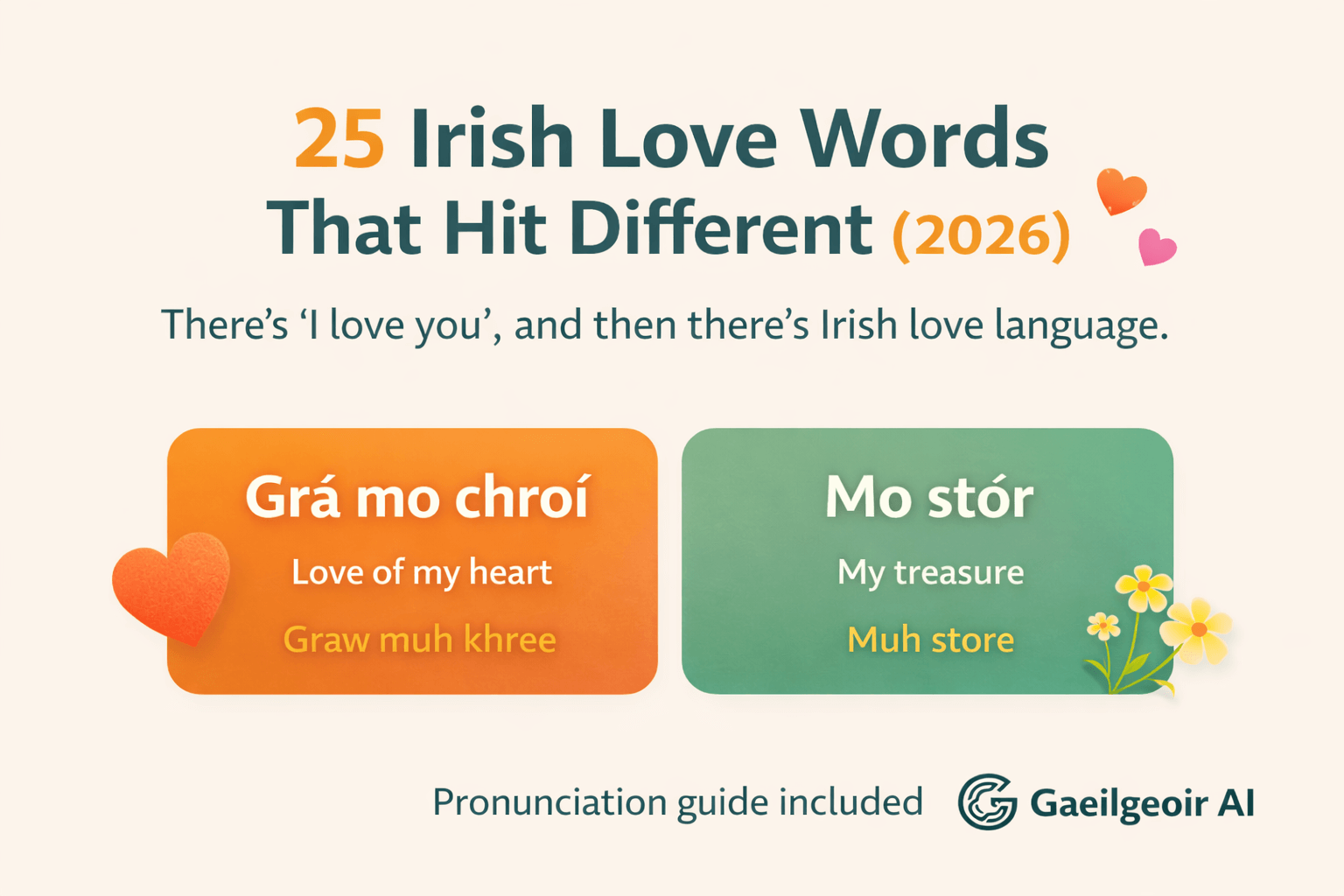
25 Irish Love Words That Hit Different (2026)

There’s “I love you”, and then there’s the kind of love language that feels like it was invented by people who spent a lot of time watching weather roll in off the Atlantic, standing in doorways, half leaving, half staying. Irish does that. It has words that don’t just translate. They sort of… linger.

Also, quick heads up. When people say “Irish love words”, they usually mean Irish Gaelic, as in Gaeilge. Not Irish English slang (which also has its own genius, to be fair). This list is Gaeilge, with pronunciation help that’s meant to be friendly, not intimidating. If you speak Irish already, you’ll spot a few simplifications. That’s on purpose.

And if you’re learning, even casually, I’ll slip in a small suggestion near the end for where to practice. No big salesy thing. Just a nudge.

Alright. Here are 25 Irish love words and phrases that hit different, especially in 2026 when everyone’s burnt out on perfectly curated romance and wants something that sounds real again.

1. Grá (love)

Pronunciation: graw (like “raw” with a g)

This is the core word. Simple, direct. But it’s also flexible. You’ll see it everywhere, from romantic love to “I love tea” (which in Ireland is basically sacred).

Example:

Tá grá agam duit.

I have love for you. (Often used for “I love you”.)

2. Mo ghrá (my love)

Pronunciation: muh graw

Short, intimate, almost old-fashioned in the best way. You can say it gently, or dramatically, or half joking in the kitchen while someone burns the toast.

Example:

A M’ ghrá, tar anseo.

My love, come here.

3. Grá mo chroí (love of my heart)

Pronunciation: graw muh khree

This one lands. It’s like saying “you’re not just loved, you’re… central.”

Example:

Is tú grá mo chroí.

You are the love of my heart.

4. Croí (heart)

Pronunciation: khree

You’ll hear it in a lot of phrases because Irish leans into the heart as a place. Not metaphorically. More like, practically.

Example:

Mo chroí.

My heart.

5. A chroí (oh heart / my dear)

Pronunciation: uh khree

This is a term of endearment. It’s used for partners, kids, friends. You can say it with warmth, or when you’re about to give someone bad news, softly.

Example:

A chroí, tá gach rud ceart go leor.

My dear, everything is okay.

6. Stór (treasure)

Pronunciation: store

Classic Irish term of endearment. It’s the kind of word that makes you feel like you’re being looked after.

Example:

A stór, conas atá tú?

Treasure, how are you?

7. A stór mo chroí (treasure of my heart)

Pronunciation: uh store muh khree

This is the full version people pull out when they really mean it. Or when they’re being sweet on purpose.

8. Mo stór (my treasure)

Pronunciation: muh store

Softer than “stór” on its own. This one is everyday-affection level.

14. Anam (soul)

Pronunciation: ah-num

Soul as in essence. The part of you that doesn’t do small talk. It’s a profound concept, often explored in various cultures and practices, such as in soul retrieval, a practice aimed at healing and reclaiming lost parts of one’s soul.

16. Anam cara (soul friend)

Pronunciation: ah-num kah-rah

This is the phrase that gets shared online a lot, sometimes simplified into “soulmate”. But it’s not exactly that. It’s more like “the person who sees you clearly and stays.”

17. Leannán (lover / sweetheart)

Pronunciation: lyah-nawn

A more direct romantic word. Not always used in modern casual speech the way “babe” is used, but it’s still alive, especially in writing, songs, and certain contexts.

18. Leannán mo chroí (lover of my heart)

Pronunciation: lyah-nawn muh khree

Again with the heart. Irish isn’t shy about it.

19. Gean (affection)

Pronunciation: gyann (hard g)

This one is underrated. It’s not fireworks, it’s warmth. It’s the kind of love that shows up on a rainy Tuesday.

Example:

Tá gean agam ort.

I have affection for you.

20. Gean mo chroí (affection of my heart)

Pronunciation: gyann muh khree

It’s gentler than “grá”. Sometimes that’s exactly what you want.

21. M’uisle (my darling / my treasure, regional)

Pronunciation: mish-luh or ish-luh (varies)

You’ll hear variations depending on dialect. Irish is like that. It refuses to be pinned down neatly. This one is often used like “darling”.

(If you’ve heard it in songs or older speech, that’s usually where it lives best. Still hits hard.)

22. Mo chroí istigh ionat (my heart is inside you)

Pronunciation: muh khree iss-TEE uh-nut

Okay. This is a lot. But in a good way. It’s one of those phrases that feels ancient and immediate at the same time.

It’s basically saying: I’m with you, in you, tied to you. Not in a creepy way. In a human way.

23. Mo chroíse (my heart, little heart)

Pronunciation: muh khree-shuh

A diminutive, affectionate form. Like “dear heart”. This one feels especially tender.

24. Mo mhíle grá (my thousand loves)

Pronunciation: muh vee-luh graw

It’s not used constantly, but it’s beautiful when it is. It’s abundance. Overflow.

25. Grá go deo (love forever)

Pronunciation: graw guh joh

Simple. Eternal. It looks clean on a card, but it also works in real life, said quietly.

Example:

Grá go deo, pé rud a tharlóidh.

Love forever, whatever happens.

A quick note on saying “I love you” in Irish (because you’ll want it)

You’ll see a couple versions online, and people get confused.

Tá grá agam duit (I love you)

Pronunciation: taw graw ag-um ditch

Literally: “There is love at me for you.”

Is breá liom tú (I love you / I really like you)

Pronunciation: iss brah lum too

Literally: “You are lovely with me” or “I like you a lot.”

Both are used. Tá grá agam duit is the more direct “love” version. Is breá liom tú can be romantic too, but it can also be used for things like “I love pizza” depending on context. Irish doesn’t panic about that, it just lets context do its job.

How to actually use these without feeling like you’re acting in a period drama

Here’s the trick. Don’t overperform it.

Try one word first, like a chroí or mo stór. Say it once in a text. Or say it in the kitchen, casually. If it feels like too much, you’re probably saying it like a movie character. Make it smaller.

Also, Irish terms of endearment are often used more broadly than English ones. You’ll hear people calling a friend “a stór” and nobody faints. So you’ve got room.

If you’re interested in exploring more about love and its expressions in different cultures or languages, it’s worth checking out some resources that delve deeper into this subject matter.

And if you’re learning Irish and want a place where the language feels usable, not just textbook neat, you can check out https://learn.gaeilgeoir.ai/. Even just signing up and poking around can help you get a feel for natural phrasing, especially for stuff like this where tone matters.

What is the most common Irish word for love?

Grá is the most common Irish word for love.

How do you say “my love” in Irish?

You can say mo ghrá (my love). Another common endearment is a stór (treasure).

What is “anam cara” actually supposed to mean?

Anam cara literally means soul friend. People often translate it as “soulmate”, but “soul friend” is closer to the original feel.

How do you say “I love you” in Irish Gaelic?

A direct version is Tá grá agam duit. Another common phrase is Is breá liom tú, which can mean “I love you” or “I really like you” depending on context.

Are these words still used in modern Irish, or are they old fashioned?

Many are still used, especially grá, croí, stór, gean, and the “I love you” phrases. Some like leannán and rún mo chroí can feel more poetic or formal, but they’re still understood and show up in songs, writing, and heartfelt moments.

Can you use Irish love words for friends and family too?

Yes. Irish terms of endearment often apply to partners, kids, friends, and even strangers in a kind way (context matters, obviously). A chroí and a stór are good examples.

What’s the easiest Irish term of endearment to start using?

Probably a stór or mo stór. They’re common, warm, and don’t feel overly intense.

Is pronunciation in Irish hard?

It can be at first, mostly because spelling and sound don’t match English expectations. But with a little listening practice, common words like grá and croí become very manageable.

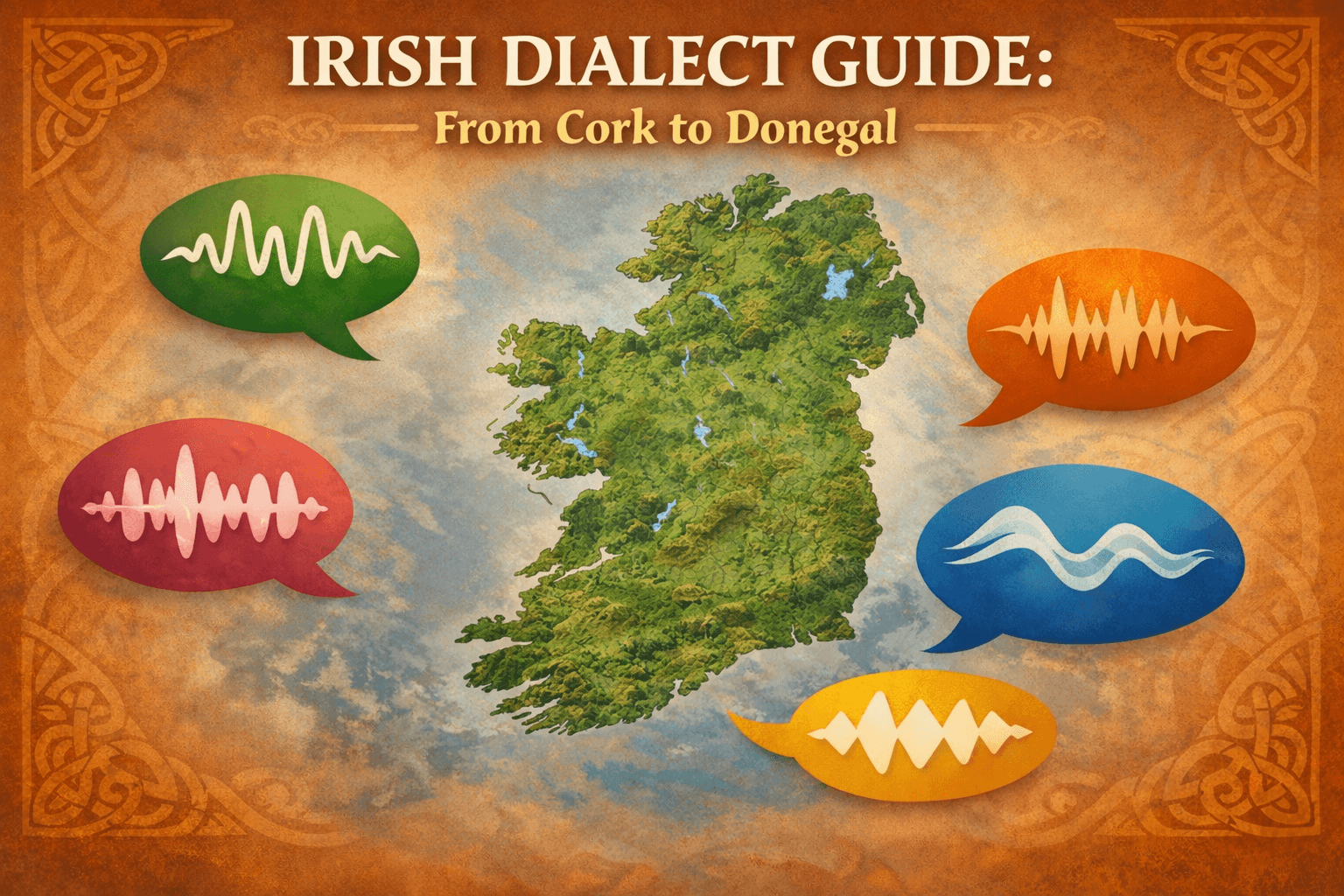
Irish Dialect Guide: From Cork to Donegal

If you’ve ever landed in Ireland feeling pretty confident about your English… and then someone says something that sounds like English but also, somehow, not English. Yeah. That is the moment.

Irish people are speaking English. Obviously. But it is English that has been bent and shaped by geography, history, Irish language influence, and a strong local habit of doing things their own way. So you get accents, sure. But you also get dialect. Different words, different rhythm, different little grammar moves that can make the same sentence feel totally new.

This is a guide to the big dialect zones, from Cork up to Donegal. Not a strict map, because Ireland does not really behave like that. Dialects blur. People move. Towns two hours apart can sound like different planets. But it will give you a real feel for what you are hearing.

A quick note before we start

An accent is how you pronounce words. A dialect is accent plus vocabulary and grammar.

So if someone says “I’m after eating” instead of “I just ate”, that is dialect. Not just accent.

Also. There is no “neutral Irish accent” in real life. There is Dublin. There is RTÉ presenter voice. There is “I lived abroad for years” voice. But neutral is sort of a myth.

The big building blocks of Irish English

You will hear these across the country, with local variations.

The “after” perfect

This one is classic, and it comes from Irish language structure.

  • “I’m after spilling the tea.” meaning I just spilled it. Very recently.
  • “She’s after leaving.” meaning she just left.

It’s fascinating how these unique aspects of Irish English can be understood and even learned through resources like the learn Irish app, which can help anyone navigate this rich linguistic landscape more effectively.

“Sure” as punctuation, comfort, and mild chaos

“Sure” does a lot of work.

  • “Sure look.” means… we accept reality, even if we hate it.
  • “Sure I don’t know.” often means I do know, but I’m not committing to a full statement.
  • “Ah sure.” can be sympathy, resignation, or a gentle dismissal.

“Grand”

Not fancy. Not impressive. Usually just fine.

  • “How are you?” “Grand.” meaning I’m okay. Sometimes it means “I am barely holding it together but I am not discussing it.”

“Ye” and “yous”

Ireland kept a plural “you” in many places.

  • “Are ye coming?” common in the west and south.
  • “Are yous coming?” more in parts of Dublin and the north.

“Giving out”

Not giving gifts. Giving out means scolding, complaining, telling someone off.

  • “My mam was giving out to me.” means your day is about to get worse.

Ok. Now the fun part. Regions.

Cork and the South: musical, fast, and very local

Cork is famous for sounding like it is half singing, half negotiating with time itself. The rhythm has a lift to it. People talk fast, and statements can sound like questions because of the rising intonation at the end.

What it sounds like

  • Very melodic, with a noticeable up and down.
  • A kind of bounce. Words feel like they are being nudged forward.

If you’re interested in diving deeper into the linguistic nuances of Irish dialects or want to learn more about Goidelic languages, there are plenty of resources available. You might also find it helpful to understand how to use fada keyboard shortcuts when typing in Irish. And if you’re looking for some unique expressions or phrases, here are some cool Irish words to know.

Cork bits you will hear

  • “Boy” and “girl” as casual address. “Well boy?” can mean hello, not literally “well, male child”.
  • “Sound” meaning decent, good, reliable. “He’s sound.”
  • “Langer” as an insult, sometimes affectionate, sometimes not. Context is everything and I mean everything.

Cork vibe sentence

“You’re some man, boy. I’m only after getting in, like.”

Cork English is also full of local slang that does not always travel well to the next county. You can be ten minutes outside the city and hear something totally different.

Kerry: softer edges, strong storytelling energy

Kerry sits next door to Cork, and you will still hear musicality, but often slower, more drawn out, especially in rural areas. There is a strong tradition of storytelling, and the English can carry Irish language patterns in a really noticeable way.

What it sounds like

  • Warm, rounded vowels.
  • Less sharpness, more stretch in the sound.

Kerry bits you will hear

  • “Right so” as a transition. A way to move the conversation along.
  • “’Tis” and “’twas” still show up more than you might expect.
  • A lot of gentle understatement. Something can be “a bit wild” and actually mean very wild.

Kerry vibe sentence

“Ah ’tis a grand day at all, right so. You wouldn’t be long getting dried.”

Limerick and Clare: grounded, quick wit, and very direct warmth

Move up into Limerick and Clare and you start hearing something a little more clipped, a little more direct. Still very Irish, still plenty of musical rhythm, but the intonation patterns shift.

Clare, especially west Clare, can feel closer to Galway and the Gaeltacht influence. Limerick city has its own urban sound too.

What it sounds like

  • Clear consonants, slightly tighter rhythm.
  • Clare can have a softer, more west of Ireland lilt.

Words and phrases

  • “Gowl” as an insult in parts of the mid west. Not polite. Used anyway.
  • “Savage” meaning excellent. “That was savage.”
  • “Gas” meaning funny. “He’s gas.”

Mid west vibe sentence

“He’s gas altogether. I was in bits laughing.”

Galway and the west: the lilt, the “like”, and Irish language shadows

Galway is where a lot of people go looking for the “real Ireland” vibe, and the speech does have a strong west of Ireland character. You will hear a pronounced lilt, and in places with Irish language presence, the English can carry Irish syntax and timing.

What it sounds like

  • A flowing rhythm, with a gentle rise and fall.
  • Some speakers have a slightly slower pace, more deliberate phrasing.

West of Ireland features

Galway vibe sentence

“It’s yourself. How’s things with you, like?”

Mayo and Sligo: strong rural tones, plain language, big character

Mayo and Sligo have accents that can feel more rugged to outside ears. Not harsh, just more pronounced in consonants, and with a different musical pattern than Cork or Galway.

Exploring the dialectal differences in Irish can provide deeper insights into these unique regional accents. Additionally, understanding some common phrases in Irish language can enhance your experience while interacting with locals in these areas. The counties of Mayo and Sligo are known for their strong rural tones and big character which are reflected in their dialects.

What it sounds like

  • Clear, sometimes heavier consonants.
  • A steady rhythm that can speed up when the story gets good.

Common bits

  • “Well” as an opener. “Well, what’s the story?”
  • “The story?” means what’s going on, what’s new.
  • “Fair play” used constantly. Praise, approval, sometimes sarcasm if delivered a certain way.

Mayo Sligo vibe sentence

“Well, what’s the story with you? Any craic at all?”

Dublin: not one accent, but many, and it matters where

Dublin is complicated. People talk about “the Dublin accent” like it is one thing, but it is really a set of accents that can change street to street, and also by class, age, and background.

Broadly, you might hear:

  • A more traditional working class Dublin accent, very distinctive, very energetic.
  • A more middle class suburban accent, sometimes called “D4” in pop culture, though that label is messy and often unfair.
  • Newer blended accents influenced by immigration and modern urban speech.

What it sounds like

  • Often faster pace.
  • Certain vowels can shift a lot, depending on the area.

Dublin bits you will hear

  • “Deadly” meaning great. “That’s deadly.”
  • “Bleedin” as an intensifier. Used everywhere, but Dublin loves it.
  • “Ah stop” meaning please stop, or I cannot believe it, or that is hilarious. Again, context.

Dublin vibe sentence

“Ah stop, that’s deadly. I’m bleedin wrecked though.”

If you are learning Irish English from media, be careful here. A lot of Irish TV and online content leans Dublin, and then visitors get to Donegal and think they have entered a different country. Because, kind of, you have.

The North: Belfast and beyond, with its own grammar and music

Northern Irish English is its own world. You will hear Scottish influence, and you will also hear Ulster Scots vocabulary in places. Belfast has a strong urban sound. Outside the city, accents vary a lot.

What it sounds like

  • Often a sharper, more staccato rhythm.
  • Different vowel sounds from the south, especially noticeable for “ow” and “i” sounds.

Common Northern features

  • “Aye” for yes.
  • “Wee” for small, but also for basically anything. “A wee while” can be ten minutes or an hour.
  • “What about ye?” meaning how are you, what’s happening.

Northern vibe sentence

“Aye, I’ll be there in a wee minute. What about ye?”

Donegal: the curveball, with Scottish echoes and a wild variety

Donegal accents can be stunning. Also, confusing. There is a strong connection to Scotland historically, and it comes through in pronunciation and rhythm, especially in Inishowen and parts of west Donegal. But Donegal is big, and it has multiple dialect pockets.

What it sounds like

  • Often closer to Scottish English than other Irish accents, especially in intonation.
  • A very distinct rhythm that can feel “bouncy” but in a different way than Cork.

If you’re interested in learning more about the Irish vocabulary used in these regions or want to delve deeper into the nuances of Irish English, there are resources available that can help enhance your understanding further.

Donegal bits

  • “Youse” is common.
  • “Thon” meaning that, in some areas. “Thon thing over there.”
  • “Cratur” or “creature” as a term of sympathy. More broadly Irish, but you will hear it plenty.

Donegal vibe sentence

“Will yous take a look at thon weather. It’s desperate altogether.”

How to understand Irish dialect faster (without pretending)

A few practical tips. Because it can be a lot.

  1. Listen for the rhythm, not the individual words. Once you catch the beat, the sentence starts making sense.
  2. Ask once, politely, then let it go. “Sorry, what was that?” is fine. Three times in a row and everyone gets tired.
  3. Learn the top 20 phrases. Grand, giving out, craic, sound, fierce, gas, savage, yer man, yer one. These unlock a lot.
  4. Do not copy the accent right away. People can find it annoying. Some will laugh, some will not. Give it time.

FAQ

What is the biggest difference between Irish accents and Irish dialects?

Accent is pronunciation like in this Irish pronunciation guide. Dialect includes pronunciation plus local vocabulary and grammar, like “I’m after eating” or “I do be”.

Is “Hiberno English” the same thing as Irish English?

Pretty much, yes. Hiberno English is a term linguists use for Irish English, especially when talking about Irish language influence on grammar and structure.

How to learn Irish online for free?

For those interested in learning the language more deeply, there are resources available such as this free guide which could be beneficial.

Tips for Ordinary Level Irish Leaving Cert

If you’re preparing for exams like the Leaving Cert and looking for some guidance on ordinary level Irish, there are several strategies you can adopt to improve your chances of success.

Understanding the Genitive Case in Irish

One of the complexities of learning Irish is mastering its grammatical structures such as the genitive case. This resource provides valuable insights into that aspect of the language.

Why do Irish people say “I’m after doing something”?

This phrase comes from the Irish language structure, meaning you did something very recently. It’s similar to saying “I just did it”.

What does “craic” actually mean?

Craic refers to fun, atmosphere, entertainment, and good conversation. For instance, asking “Any craic?” is a way of inquiring if anything interesting is happening or if there’s any news or fun to share.

Is Dublin English representative of the whole country?

No, Dublin has multiple accents and dialect features. Ireland is very regionally diverse, with places like Donegal, Cork, Galway, and Belfast sounding radically different from each other.

What does “grand” mean in Ireland?

In most contexts, it usually translates to “fine” or “okay”. It doesn’t imply something is “amazing”. If someone says “grand so”, they are often indicating they’re closing the topic and moving on.

Do people in Ireland still use Irish language grammar when speaking English?

Yes, especially in certain structures like the “after” perfect and habitual “do be”. This influence is also more subtle, affecting sentence rhythm and phrasing. Such patterns are particularly noticeable in areas with a stronger Irish language presence. You can get a better understanding of these unique Irish language features by exploring some resources on basic Irish conversation here.

What is the easiest Irish dialect for visitors to understand?

It largely depends on what you’re accustomed to. However, many visitors find slower rural speech easier to comprehend than fast urban speech. That said, unfamiliar vocabulary can pose challenges anywhere.

Are Irish dialects disappearing?

While some local features are fading due to media influence and increased mobility, many dialect markers are still holding strong. Interestingly, new urban varieties are forming too, especially around Dublin and other cities. The role of traditional storytelling in preserving these dialects is significant as seen in the work of Seanchai Irish storytellers.

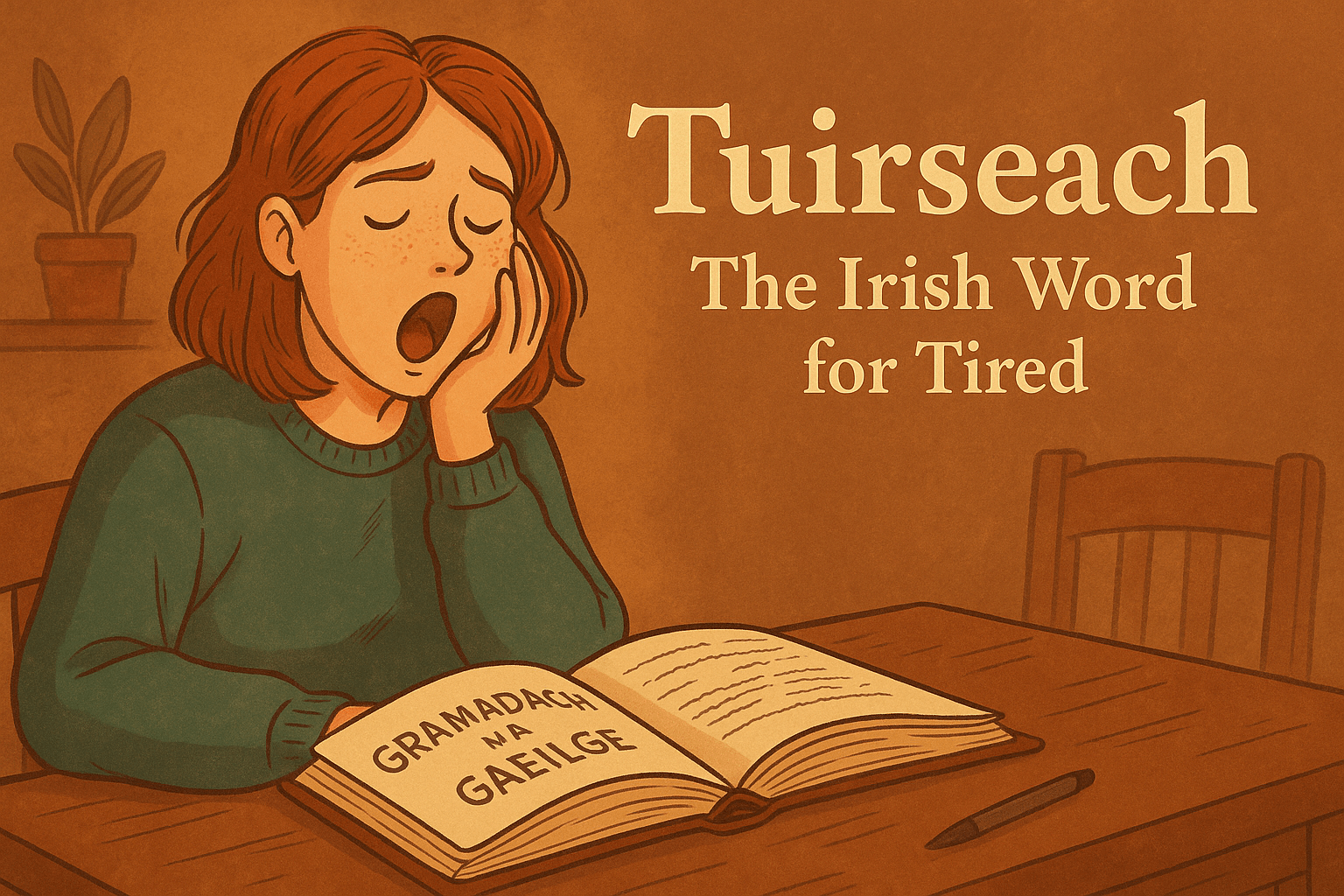
Tuirseach: Understanding the Irish Word for Tired

Every language has words that capture universal feelings, but few do it with as much depth as Irish. The word “tuirseach” — pronounced tur-shukh or tur-shahk, depending on dialect — means tired, weary, or fatigued. Yet, like many Irish words, tuirseach carries subtle emotional tones that go beyond the literal translation.

In this guide, we’ll explore what tuirseach means, how to use it correctly in sentences, its origins in Irish culture, and how you can learn natural pronunciation and usage with AI-powered Irish learning tools from Gaeilgeoir AI.


The Meaning of Tuirseach

At its simplest, tuirseach means “tired.” You might use it after a long day, a hard walk, or an intense conversation in Irish class!

Examples:

  • Tá mé tuirseach. – “I am tired.”
  • Bhí siad an-tuirseach tar éis an turais. – “They were very tired after the journey.”
  • Ná bí tuirseach de do chuid staidéir! – “Don’t get tired of your studies!”

But tuirseach can also express deeper feelings — emotional exhaustion, weariness, or even being “fed up.” For example:

  • Tá mé tuirseach den aimsir seo! – “I’m tired of this weather!”
  • Tá sí tuirseach de bheith ag fanacht. – “She’s tired of waiting.”

That’s what makes tuirseach so interesting: it’s not just physical fatigue, but an expression of emotional tiredness and mental strain too — something many learners feel when tackling a challenging new language!


Pronunciation and Dialect Notes

Irish pronunciation changes slightly between dialects (Munster, Connacht, Ulster), but here’s a guide to sounding natural:

DialectPronunciationNotes
Munstertur-shukhSoft “kh” sound at the end, like German “Bach.”
Connachttur-shahkSlightly lighter ending, common in Galway & Mayo.
Ulstertur-shukh or tur-shakTends to have a clipped, energetic tone.

Listening to native speakers is key. Gaeilgeoir AI’s speech recognition tool helps you perfect your accent and rhythm by giving real-time feedback — so tuirseach rolls off your tongue naturally.

Check out our Irish Pronunciation Guide for detailed help with vowel sounds and regional accents.


Etymology: Where Tuirseach Comes From

Tuirseach comes from the Irish noun “tuirse”, meaning tiredness, weariness, or fatigue. The adjective form (tuirseach) literally means “full of weariness.”

Interestingly, this word is very old, found in early Irish texts describing both physical tiredness and spiritual heaviness. In medieval poetry, tuirseach might describe a weary warrior or a heart tired from love. It reflects the Irish talent for emotional precision — expressing feeling through beautiful simplicity.


How to Use Tuirseach in Context

Because tuirseach can describe both physical and emotional states, it’s useful in many daily Irish expressions. Here are some examples and translations:

Irish PhraseEnglish TranslationContext
Tá mé tuirseach.I am tired.The most common form.
Tá sé tuirseach traochta.He’s completely exhausted.Emphasis with traochta (drained).
Tá siad tuirseach den obair.They’re tired of work.Emotional fatigue.
Bhí sí tuirseach ina dhiaidh sin.She was tired after that.Result or consequence.
Tá mé tuirseach traochta tar éis an lae.I’m worn out after the day.Common Irish phrase.

In Irish, the word tuirseach often pairs with intensifiers like:

  • an- (very) → an-tuirseach = very tired
  • go leor (enough) → tuirseach go leor = quite tired
  • traochta (exhausted) → tuirseach traochta = utterly tired

These combinations make your Irish more expressive and natural — something Gaeilgeoir AI’s intelligent sentence-builder can help you practice.


Cultural Use: When the Irish Say They’re Tired

In Ireland, tuirseach isn’t always about sleepiness. It’s often used humorously or expressively:

  • Tá mé tuirseach de chaint! – “I’m tired of talking!”
  • Tá mé tuirseach den pholaitíocht! – “I’m sick of politics!”

The Irish love understatement. Saying “Tá mé tuirseach” might mean “I’m wrecked,” but also “I could use a cuppa.” Understanding tone is key — and that’s where listening practice helps.

With Gaeilgeoir AI’s listening lessons, you can hear native speakers use tuirseach naturally in different contexts — from friendly chats to folk stories.


Common Mistakes with Tuirseach

Even advanced learners can make errors with tuirseach, often due to differences between Irish and English sentence structure.

Here are a few to avoid:

  1. Is tuirseach mé.
    Tá mé tuirseach.
    → “I am tired” always uses , not Is, because it’s a temporary state.
  2. Tá mé tuirseach ar obair.
    Tá mé tuirseach den obair.
    → In Irish, den (“of the”) expresses “tired of,” not ar (“on”).
  3. Bhí mé tuirseach go domhain.
    Bhí mé tuirseach traochta.
    → Irish prefers traochta (exhausted) rather than “deeply tired.”

Mistakes like these are natural — but AI-powered tools make them easier to correct. Gaeilgeoir AI’s grammar-check and feedback system gives you instant guidance, helping you learn faster and more confidently.


Idioms and Expressions Using Tuirseach

Irish is full of vivid idioms that express fatigue or emotional weariness in creative ways. Learning these adds depth to your speech and writing.

Here are a few related to tuirseach and tiredness:

  • Tá mé traochta, tuirseach, agus tuirseach traochta!
    → “I’m worn out, tired, and utterly exhausted!”
  • Tháinig tuirse orm.
    → “Tiredness came over me.” (A common poetic form.)
  • Tuirse an tsaoil.
    → “The tiredness of life.” (A beautiful, reflective phrase in literature.)

Exploring idioms is a great way to understand Irish mindset and humor. For more, see our Irish Idioms Language Learning Guide.


Tuirseach in Irish Literature and Song

Irish poetry often uses tuirseach to describe the kind of tiredness that comes from living, loving, or longing — not just lack of sleep.

For example, in early Gaelic verse, warriors were tuirseach den chath — “tired of battle.” In modern songs, lovers might say “Tá mo chroí tuirseach de bheith ag fanacht” (“My heart is tired of waiting”).

This emotional richness shows how flexible the word is. It’s a perfect example of how Irish weaves physical and emotional experience into a single expression.


Learning Words Like Tuirseach with Gaeilgeoir AI

Learning words like tuirseach in isolation isn’t enough — you need to hear, speak, and use them in real context. That’s where AI-powered learning makes a difference.

With Gaeilgeoir AI, you can:

  1. 🎧 Practice pronunciation with real-time AI feedback.
  2. 💬 Use words in conversation simulations with native voice patterns.
  3. 📖 Learn grammar naturally through context-based examples.
  4. 🌍 Track progress and adapt lessons to your learning style.

Whether you’re just starting out or already conversational, Gaeilgeoir AI helps you sound authentic and confident — without feeling tuirseach from rote memorization!

👉 Try it free today at learn.gaeilgeoir.ai and see how quickly your Irish improves.


The Emotional Side of Tuirseach

There’s something beautifully human about tuirseach. It doesn’t just describe exhaustion — it conveys empathy. Saying Tá mé tuirseach can be a confession of vulnerability, a shared sigh after a long day, or a way to connect with someone who understands that same fatigue.

In many ways, tuirseach reminds us why learning Irish is so rewarding: every word carries emotion, poetry, and history.

When you learn tuirseach, you’re not just learning vocabulary — you’re learning how Irish people express life itself.


Don’t Get Tuirseach — Learn Smart!

The Irish word tuirseach might mean “tired,” but learning it doesn’t have to leave you exhausted. It’s a perfect reminder that every language journey has its ups and downs — and that even tired moments can be full of meaning.

With Gaeilgeoir AI, you can learn naturally, confidently, and joyfully — one word at a time.

So next time you feel tuirseach after studying, smile and say: Ní stopfaidh mé anois! (“I won’t stop now!”)

Start your Irish learning adventure today at learn.gaeilgeoir.ai — and turn your tuirseach into triumph.

An Poc ar Buile Lyrics: Meaning, Translation, and Irish Roots

“An Poc ar Buile” is a lively Irish-language song centred on the comic image of a goat that has gone wild.

The title itself gives you a useful piece of Gaeilge:

an poc — the male goat / buck goat
ar buile — furious, raging, wild or out of control

So An Poc ar Buile is commonly understood as “The Mad Goat” or “The Mad Billy Goat.”

But the song becomes more interesting when you look beyond the title. Its vocabulary, repetition and storytelling make it a useful piece of Irish for learners to explore.

If you enjoy discovering Gaeilge through music, explore our collection of Irish songs for more traditional and contemporary songs and the language behind them.

What Do the An Poc ar Buile Lyrics Mean?

At its heart, the song tells a humorous story about an unruly goat.

The animal is depicted creating chaos, with the storytelling becoming increasingly exaggerated as the song progresses.

That sense of exaggeration is important.

Rather than searching for an elaborate hidden meaning behind every line, the song can be enjoyed for what it does particularly well: humour, repetition, imagery and storytelling through Gaeilge.

The repeated idea of the poc ar buile gives the song its memorable character.

Breaking Down “An Poc ar Buile”

Let’s look more closely at the title.

An

An is the definite article — “the.”

Poc

Poc refers to a male goat or buck.

Ar buile

Ar buile is an Irish expression describing someone or something as furious, raging or wildly out of control.

Put them together and you get:

An poc ar buile

The mad/wild goat.

This is a good example of why Irish expressions are often better understood as complete phrases rather than translated mechanically one word at a time.

Useful Irish Vocabulary From the Song

One of the best reasons to study songs is that vocabulary appears in a memorable context.

Here are some useful words and expressions associated with “An Poc ar Buile”:

IrishEnglish
pocmale goat / buck
ar builefurious / raging / wild
cnochill
gleannvalley
ag béiceadhshouting / bellowing
ag búirílroaring
ag rithrunning
ag léimjumping

Instead of memorising these as an isolated list, connect each word with the image or action in the song.

That context makes vocabulary easier to recall.

What Does “Ar Buile” Mean?

Ar buile is particularly useful because it isn’t restricted to this song.

The expression relates to being furious, enraged or in a state of frenzy.

In the title, it creates the image of a goat that has become completely uncontrollable.

This is one of the advantages of learning Gaeilge through songs: a memorable phrase can introduce you to language that exists beyond the song itself.

The Humour Behind the Lyrics

The humour of “An Poc ar Buile” comes largely from exaggeration.

A goat isn’t simply wandering around peacefully.

It’s ar buile.

The animal becomes the chaotic centre of the story, and the repetition reinforces the absurdity.

This kind of comic storytelling works particularly well in song because listeners quickly understand the central image and can join in with repeated sections even if they don’t know every line.

For learners, that means you can enjoy the song before you fully understand it.

Is There a Deeper Meaning to An Poc ar Buile?

I’d be cautious about assigning the song a grand symbolic meaning.

You’ll sometimes find interpretations describing the goat as a symbol of Irish freedom, rebellion or national identity.

Those can be interesting personal interpretations, but they shouldn’t automatically be presented as the established meaning of the song.

The most obvious reading is much simpler: it’s a humorous Irish-language song built around an unruly goat and an exaggerated story.

That doesn’t make it culturally insignificant.

Quite the opposite.

Humour, local storytelling and memorable language are themselves important parts of musical tradition.

Why Repetition Helps Irish Learners

The repeated phrases in “An Poc ar Buile” make it particularly accessible to learners.

When you hear:

poc… poc… poc ar buile

again and again, you don’t have to deliberately memorise the phrase in the same way you might memorise a flashcard.

The music does some of the repetition for you.

Eventually, you hear ar buile and recognise the expression automatically.

That’s exactly what you want when learning a language: moving from consciously remembering a translation to simply recognising Gaeilge.

How to Study the Lyrics

Don’t try to memorise the entire song immediately.

Take a short section and work through it gradually.

First: Listen without reading anything.

Try to recognise sounds or words you already know.

Second: Read the Irish while listening again.

Notice where individual words begin and end.

Third: Look up only the vocabulary that’s important for understanding the passage.

Fourth: Listen again.

You may be surprised by how much clearer the same section sounds once you know what you’re listening for.

Don’t Depend Too Much on English Translation

An English translation is useful, but it should be a support rather than the main event.

Try reading or listening to the Irish first.

Ask yourself what you understand.

Then check the English.

Finally, return to the Gaeilge.

This prevents you from simply reading an English version of an Irish song.

The goal is gradually to reach the point where:

An poc ar buile

produces an idea in your head without requiring an intermediate English translation.

Pronunciation and the Song

Songs can also help connect Irish spelling with sound.

Instead of looking at a word and guessing how it should be pronounced using English rules, you hear Gaeilge being produced within a complete phrase.

Listen carefully to how words connect.

Then repeat a short phrase after the singer.

You don’t need to sing the entire song.

Even repeating one line can help you become more comfortable producing Irish sounds and rhythm.

What Is Gleann na nGealt?

The existing page mentions Gleann na nGealt, a place in County Kerry associated with a long tradition concerning madness and healing.

Its appearance gives the language a geographical dimension too.

The word:

gleann

means valley.

You’ll encounter it in Irish placenames as well as ordinary vocabulary.

This is another useful feature of songs: a single lyric can lead you from vocabulary into geography, folklore or local history.

Learn Irish Through Songs

Music shouldn’t replace structured Irish study, but it can make what you’re learning much easier to remember.

Songs expose you to repeated vocabulary, pronunciation, sentence structures, regional voices and cultural context.

And crucially, they’re something you may actually want to listen to repeatedly.

That’s why they’re such a useful complement to lessons and vocabulary practice.

If “An Poc ar Buile” has made you curious about learning Gaeilge through music, explore more Irish songs and see how much language you can begin recognising from one song to the next.

An Poc ar Buile: Meaning at a Glance

The key things to remember are simple:

An Poc ar Buile means roughly “The Mad Goat” or “The Mad Billy Goat.”

Poc refers to a male goat.

Ar buile expresses the idea of being furious, raging or wildly out of control.

The song uses humour, exaggeration and repetition to tell its story.

For Irish learners, its repeated language makes it particularly useful for vocabulary recognition and listening practice.

Explore More Irish Songs

Once you’ve worked through the meaning of “An Poc ar Buile”, try doing the same thing with another Gaeilge song.

Don’t just read a translation.

Listen first.

Find repeated words.

Work out what you can.

Then investigate the meaning.

Our Irish songs guide brings together more Irish-language music to explore, from traditional songs to contemporary Gaeilge artists.

The more songs you hear, the more you’ll begin noticing the same words, sounds and structures appearing again.

Final Thoughts

Understanding the lyrics of “An Poc ar Buile” doesn’t require finding an elaborate hidden message.

Much of its charm comes from something simpler: a memorable story, a ridiculous goat, lively Gaeilge and a chorus that’s very difficult to forget.

For learners, that’s exactly what makes it useful.

You hear the words repeatedly. You connect them with a story. You start recognising the sounds. And before long, phrases that initially seemed unfamiliar become Gaeilge you actually understand.

The Gaelic Border: Where Language and Identity Meet

Across Ireland’s rolling hills and misty glens lies an invisible yet powerful divide — the Gaelic border. It’s not a line you’ll find on a modern map, but rather a cultural and linguistic frontier marking where the Irish language (Gaeilge) once thrived and where English gradually took hold.

Today, the term Gaelic border symbolizes more than geography. It represents centuries of change — from ancient Celtic kingdoms to the present day — and the ongoing journey of preserving Irish identity through language, music, and tradition.

At Gaeilgeoir AI, we see the Gaelic border not as a boundary, but as a bridge — connecting learners and communities eager to rediscover their roots through Gaeilge and cultural understanding.


What Is the Gaelic Border?

Historically, the Gaelic border referred to the shifting frontier between areas that maintained Irish Gaelic culture and those increasingly influenced by Anglo-Norman or English rule.

By the late Middle Ages, this border roughly divided Gaelic Ireland — where Irish law (Brehon law), language, and customs flourished — from the English Pale, the region around Dublin under English control.

The English Pale vs. Gaelic Ireland

  • The Pale: Centered around Dublin, Meath, and Louth, governed by English law and language.
  • Beyond the Pale: Predominantly Irish-speaking regions where traditional Gaelic society thrived.

The phrase “Beyond the Pale” still survives in English, meaning something outside accepted norms — a linguistic echo of that cultural divide.

As centuries passed, the Gaelic border shifted westward, pushed by conquest, colonization, and political pressure. Yet Irish remained the dominant language in rural areas until the 19th century, and even today, its legacy endures in the Gaeltacht — regions in western Ireland where Irish is still spoken daily.


Language on the Edge: The Living Border of Gaeilge

The Gaelic border isn’t just about history; it’s about how language maps onto identity.

In places like Donegal, Mayo, Galway, and Kerry, the border between Irish-speaking and English-speaking communities isn’t rigid. It’s fluid, dynamic, and alive. A single family might switch between Gaeilge and English, depending on the setting or generation.

This phenomenon fascinates linguists and learners alike because it shows how language reflects social belonging. Speaking Irish, even just a few words, often feels like crossing a bridge into an older, deeper Ireland — one defined by connection rather than division.

If you’re curious about how Irish evolved through centuries of cultural contact, explore our Origins of the Irish Language Guide, which traces the roots of Gaeilge from ancient Celtic to modern Irish.


The Gaelic Border Through Time

Let’s journey through the key stages that defined Ireland’s Gaelic border:

1. Early Medieval Ireland (5th–12th Century)

Before English influence, Ireland was entirely Gaelic-speaking. Society was organized under tuatha (clans), guided by Irish laws and poetry. The term Gaelic border didn’t yet exist — the entire island was culturally unified.

2. The Norman Invasion (1169–1500s)

The arrival of Norman lords introduced new languages, architecture, and systems of governance. Over time, many Normans became “more Irish than the Irish themselves,” adopting local customs and even Gaeilge.

The Statutes of Kilkenny (1366) attempted to stop this cultural blending by forbidding English settlers from speaking Irish or intermarrying with the Irish. Ironically, these laws only highlighted how blurred the Gaelic border had become.

3. The Tudor and Cromwellian Conquests (1500s–1600s)

This era saw Ireland’s Gaelic system forcibly dismantled. The Gaelic border shrank westward as English replaced Irish in law, education, and trade. Yet, Irish poetry and oral storytelling preserved cultural memory, ensuring Gaeilge never disappeared completely.

4. The 19th Century: Decline and Resilience

The Great Famine (1845–1849) and subsequent emigration devastated Irish-speaking communities. By the early 20th century, the Gaeltacht represented the last stronghold of the language. The Gaelic border had transformed from a political line into a linguistic one.


The Gaelic Border Today

In modern Ireland, the Gaelic border is both symbolic and real. The Gaeltacht regions in counties like Galway, Kerry, and Donegal are recognized by the Irish government as areas where Irish remains the community language.

These regions are cultural sanctuaries — living reminders of what Ireland once was, and what it can still be. Signposts switch from “Main Street” to An Príomhshráid. Children grow up bilingual. Conversations flow in Irish not just at school, but in shops, sports, and storytelling sessions (seisiúin).

At the same time, Irish is resurging across the country and beyond. From Dublin tech offices to online learning platforms like Gaeilgeoir AI, the Gaelic border is expanding once more — this time digitally.


Crossing the Border: Learning Through Language

When you begin learning Irish, you’re crossing the Gaelic border in a personal way. You step into a living tradition that connects history, culture, and identity.

Here’s why understanding this concept deepens your language learning journey:

  1. Cultural Awareness: You learn why words carry meaning.
  2. Historical Context: You appreciate how Irish endured colonization and change.
  3. Connection: You become part of a global community keeping Gaeilge alive.

For an easy and rewarding start to your Irish journey, visit our Learn Irish Online Free Guide — packed with tips, phrases, and AI-powered tools to help you speak confidently from day one.


The Borderlands of Expression: Place Names and Identity

You can still trace the Gaelic border in Irish place names. Many towns retain bilingual signs revealing centuries of linguistic layering:

  • Baile Átha Cliath → Dublin (“Town of the Hurdled Ford”)
  • Dún Dealgan → Dundalk (“Fort of Dealgan”)
  • An Mhí → Meath (“Middle Land”)
  • Doire → Derry (“Oak Grove”)

Each name is a story in itself, bridging ancient Gaelic heritage with modern identity. Learning these names helps Irish learners connect geography with history — a crucial step in mastering both the language and its worldview.

If you enjoy uncovering the meaning behind Irish words and names, you’ll love our article on Irish Place Names, which explores how language has shaped Ireland’s landscape for centuries.


AI and the Future of the Gaelic Border

In the 21st century, the Gaelic border is being redrawn once again — not by conquest or colonization, but by technology.

Artificial Intelligence is transforming how people learn Irish. Through platforms like Gaeilgeoir AI, learners can practice pronunciation, translation, and conversation with intelligent systems that understand Gaeilge contextually.

AI tools don’t just teach words — they teach cultural nuance. By integrating Irish idioms, dialects, and regional accents, they help learners experience the full richness of the language once confined within the Gaelic border.

For more insight into how technology and tradition are merging, explore our feature on Learning Gaeilge with Technology.


Preserving the Border’s Spirit

The true beauty of the Gaelic border lies in its resilience. Despite centuries of pressure, Gaeilge never vanished. It adapted, traveled, and now thrives globally. Every learner, teacher, and speaker contributes to pushing that cultural frontier forward.

Whether you’re in Dublin, New York, or Sydney, speaking even a little Irish — Dia duit, Go raibh maith agat, Slán go fóill — helps keep the border alive.


Join the New Gaelic Revival

At Gaeilgeoir AI, our mission is to make learning Gaeilge accessible, enjoyable, and meaningful for everyone. With interactive lessons, pronunciation guides, and AI-powered feedback, you can bring Ireland’s heritage into your daily life — no matter where you are.

👉 Sign up for free today and join thousands of learners crossing the digital Gaelic border — one word, one conversation, and one cultural connection at a time.

Anglo-Irish Surnames: Origins, History and How They Changed in Ireland

Irish surnames don’t all come from the same linguistic or historical tradition.

Some developed from native Gaelic naming systems. Others arrived through Norman settlement, later English migration or the political and social changes that followed conquest and plantation. Over generations, many of those names became deeply rooted in Ireland and, in some cases, developed Irish-language forms of their own.

That is where the broad label Anglo-Irish surnames becomes useful — but also complicated.

The term can refer to surnames associated with English or Anglo-Norman families in Ireland, while Anglo-Irish also has a separate historical meaning connected with Ireland’s English-descended Protestant elite. So surname origins need to be treated case by case rather than assuming every non-Gaelic Irish surname belongs to one neat category.

If you’re researching family names more broadly, our guide to Irish surnames brings together Gaelic, Norman, Anglo-Irish and other surname traditions found in Ireland.

What Are Anglo-Irish Surnames?

In surname research, Anglo-Irish is often used loosely for family names in Ireland that have English, Anglo-Norman or later English-settler origins but became established within Irish society.

That can include several different historical stories.

A surname might have arrived with Anglo-Norman families after the twelfth century.

Another might have come through later English settlement.

Some families adopted Irish speech and customs over time.

Others retained predominantly English forms of their names.

And some names moved back and forth between Irish-language and English-language spellings.

That means Anglo-Irish surname is better understood as a historical and cultural description than as one precise linguistic category.

Anglo-Irish, Norman and Gaelic Surnames: What’s the Difference?

The categories overlap, but they aren’t identical.

Gaelic Irish surnames

Native Irish surnames often developed from Gaelic patronymic traditions.

Two of the most recognisable elements are:

Ó — traditionally associated with descent from an ancestor

Mac — son

Examples include names such as:

Ó Néill

Ó Briain

Mac Cárthaigh

These names developed within the Irish-language naming tradition.

Anglo-Norman surnames

Anglo-Norman families arrived in Ireland following the twelfth-century invasion.

Their names could have Norman French, English, Welsh or continental origins.

Examples associated with this tradition include:

de Burgh

FitzGerald

FitzGibbon

Butler

Over time, many Anglo-Norman families became deeply integrated into Irish society.

Anglo-Irish surnames

Anglo-Irish is a broader and less precise category.

It can include names with English or Anglo-Norman roots that became established in Ireland and developed a distinctly Irish history.

The important thing is not to treat these three categories as perfectly sealed boxes.

Ireland’s surname history is full of migration, adaptation and linguistic exchange.

Why Are So Many Irish Surnames Not Gaelic?

Ireland experienced centuries of settlement and political change.

The Anglo-Norman invasion beginning in the late twelfth century brought new aristocratic families and naming traditions.

Later English influence introduced further surnames through administration, military settlement, trade and plantation.

By the early modern period, Ireland contained families with many different naming origins.

At the same time, cultural boundaries were never absolute.

Some settler families adopted Irish customs, intermarried with Gaelic families and used Irish.

Others retained stronger connections with English political and cultural structures.

Surname history therefore reflects Ireland’s complicated social history rather than a simple divide between “Irish” and “foreign”.

The Anglo-Normans in Ireland

The Anglo-Norman arrival is one of the most important developments in Irish surname history.

Beginning in the twelfth century, Norman and associated families established themselves in significant parts of Ireland.

Their surnames included forms associated with:

  • places
  • personal names
  • occupations
  • titles
  • ancestry

One especially recognisable element is Fitz-.

The prefix derives from Norman French fils, meaning son.

Names such as FitzGerald and FitzGibbon preserve that naming tradition.

But after centuries in Ireland, describing families with these surnames as simply “foreign” becomes misleading.

Many became part of Irish political, cultural and linguistic life.

The “Old English” in Ireland

Another term you may encounter is Old English.

In Irish historical writing, this generally refers to descendants of medieval Anglo-Norman settlers who had been established in Ireland for generations before the later waves of English and Scottish plantation.

Some of these families became culturally close to Gaelic society.

The famous phrase “more Irish than the Irish themselves” has often been used in connection with the Gaelicisation of Norman-descended families, although the historical reality was much more varied.

Some families adopted Irish language and customs extensively.

Others did not.

That diversity is important when interpreting surnames.

Examples of Anglo-Norman and Anglo-Irish Surnames in Ireland

Several well-known Irish surnames illustrate these different histories.

Burke and Bourke

Burke and Bourke are associated with the Anglo-Norman de Burgh family.

The name became deeply established in Ireland, particularly in the west.

Irish-language forms such as de Búrca reflect the way names of Norman origin could enter Irish linguistic usage.

Burke is therefore a good example of why origin and identity aren’t necessarily the same thing.

A surname can have Norman roots and centuries of Irish history.

Fitzgerald

FitzGerald is one of the best-known Norman-derived surnames in Ireland.

The FitzGerald dynasties became enormously important in medieval and early modern Irish politics, particularly through the earldoms of Kildare and Desmond.

The name clearly reflects Norman naming tradition, while the family’s history became inseparable from Ireland.

FitzGibbon

FitzGibbon also preserves the Norman Fitz- element.

Like other Fitz- names, it demonstrates the influence of Norman French naming practices brought into Ireland during the medieval period.

Walsh

Walsh is particularly interesting.

The surname is associated historically with an English term meaning Welshman or someone from Wales.

Families bearing the name became established in Ireland following the Anglo-Norman period, and Walsh eventually became one of the familiar surnames of Ireland.

It’s a perfect example of a name whose historical origin and later national association are not the same thing.

Butler

Butler came to Ireland with Anglo-Norman aristocratic families and became strongly associated with the powerful Butler dynasty of Ormond.

Again, the name isn’t Gaelic in origin, but its history in Ireland stretches back centuries.

English Surnames in Ireland

Not every surname of English origin in Ireland arrived during the Norman period.

Later political and demographic developments brought further English and Scottish settlement.

The plantations of the sixteenth and seventeenth centuries had a particularly significant impact on parts of Ireland.

Names associated with English or Scottish settlement became established alongside existing Gaelic and Old English families.

This is why surnames such as Smith, Brown, Wilson or Taylor can be Irish in the sense of belonging to families with long histories in Ireland while still having linguistic origins outside the Gaelic naming tradition.

A surname’s etymology does not tell you everything about the identity of the people who later carried it.

How Surnames Became Gaelicised

One of the most interesting parts of Irish surname history is the way non-Gaelic names could be adapted into Irish.

Names entering Irish-speaking communities often had to fit Irish pronunciation and spelling patterns.

This could lead to Gaelicised forms.

For example:

de Burgh → de Búrca

This isn’t unique to surnames.

Languages regularly reshape borrowed words and names according to their own sound systems.

In Ireland, surname forms could therefore vary depending on:

  • whether the record was written in Irish or English
  • the period
  • local pronunciation
  • administrative spelling
  • later anglicisation

That can create several apparently different forms of what is historically the same family name.

Anglicisation Could Work in the Other Direction

Irish surnames were also heavily anglicised.

An Irish-language surname might be simplified, respelled or translated into forms easier for English-speaking administrators to record.

This means the modern English appearance of a surname doesn’t necessarily reveal its original linguistic form.

Some surnames with Gaelic origins now look entirely English.

Some names of Norman origin gained Irish forms.

Others retained both.

For family-history research, the modern spelling should therefore be treated as a starting point rather than the whole story.

Our wider Irish surnames guide is useful if you’re trying to distinguish Gaelic, Norman and anglicised surname traditions.

Does an Anglo-Irish Surname Mean You Have English Ancestry?

Not necessarily in any simple sense.

A surname can indicate something about the historical origin of a paternal naming line, but it can’t describe someone’s entire ancestry.

Families intermarry.

Names pass through generations while ancestry becomes much more mixed.

People also change surnames, adopt variants and inherit names through complex family circumstances.

So discovering that your surname has English or Norman roots doesn’t mean your family history is “English rather than Irish”.

It means that one name has a particular linguistic and historical origin.

That is a much narrower claim.

Is Every Fitz- Surname Anglo-Irish?

No.

Fitz- is historically associated with Norman French naming tradition, but not every Fitz- surname has exactly the same relationship with Ireland.

Some became deeply established in Ireland.

Others have histories elsewhere.

The prefix tells you something about the surname’s linguistic formation, but you still need to research the particular family.

This is a useful rule for surname research generally:

Don’t infer an entire genealogy from one spelling feature.

What About the Prefix “de”?

Medieval Norman names often used de, typically associated with a place or territorial origin.

Examples in Irish history include names such as:

de Burgh

de Clare

de Bermingham

Over time, these forms could change substantially.

Particles could disappear.

Spellings could shift.

Irish forms might emerge.

English forms might later become standard.

That evolution is why medieval records and modern surnames don’t always look obviously connected at first glance.

Anglo-Irish Surnames and Irish Identity

Surname history is especially interesting in Ireland because identity changed while names persisted.

A family might begin with Norman or English origins and, generations later, speak Irish, intermarry locally and identify strongly with Ireland.

Another family might remain connected to English administration and Protestant political power.

Two surnames with similar linguistic origins could therefore belong to very different social histories.

This is why the label Anglo-Irish needs context.

In some discussions, it refers broadly to families of English descent in Ireland.

In others, particularly from the eighteenth and nineteenth centuries, it refers more specifically to a socially and politically dominant Protestant class.

Those meanings shouldn’t automatically be collapsed into one another.

Anglo-Irish Surnames and the Protestant Ascendancy

The phrase Anglo-Irish became especially associated with members of the Protestant landed and political elite in Ireland.

This is sometimes called the Protestant Ascendancy.

Families associated with this class often had English ancestry or cultural ties, although individual histories varied considerably.

Writers such as Jonathan Swift, Edmund Burke, Oscar Wilde, W. B. Yeats and others are sometimes discussed in relation to Anglo-Irish cultural identity, though the term can mean different things depending on period and context.

That social definition of Anglo-Irish shouldn’t be confused with the much broader question of whether a surname originated in English or Norman naming tradition.

How to Research an Anglo-Irish Surname

Start with the surname itself, but don’t stop there.

Look for:

Historical spellings.
The modern version may be only one of several forms.

Irish-language forms.
A name may have been recorded differently in Irish-speaking contexts.

Geographic concentration.
Where was the surname historically common?

Earliest reliable records.
When does the name appear in Ireland?

Family branches.
Different families can sometimes share similar surnames without sharing one recent origin.

Primary records.
Parish registers, census material, land records, wills and civil registration can tell you far more than surname websites alone.

Surname etymology gives you clues.

Genealogy requires evidence.

Be Careful With Online Surname “Meanings”

Irish surname content online is full of extremely confident claims.

You may see assertions that every person with a surname descends from one ancient clan chief or that a name has one precise meaning stretching unchanged across a thousand years.

Real surname history is usually messier.

Spellings change.

Different names converge.

Families split.

Names are translated or anglicised.

Records are incomplete.

So use surname “meaning” pages as a starting point, not proof of ancestry.

Where possible, compare specialist surname research with historical and genealogical records.

Irish Surnames Are a Record of Contact

One of the most interesting conclusions from studying Anglo-Irish surnames is that Irish naming history isn’t linguistically pure.

It records contact.

Gaelic Irish, Norse, Norman French, English and Scottish influences all appear within Ireland’s surname landscape.

Names were adopted, translated, respelled and adapted.

Families changed language.

Political identities shifted.

But the surnames remained and evolved.

That makes Irish family names a useful window into the much wider history of Ireland.

Anglo-Irish Surnames at a Glance

TypeTypical originExamples
Gaelic IrishNative Irish patronymic traditionO’Neill, O’Brien, MacCarthy
Anglo-NormanMedieval Norman settlementFitzgerald, FitzGibbon, de Burgh
Gaelicised NormanNorman origin adapted into Irish usagede Búrca / Burke
Later English-settlerEnglish migration and plantationSmith, Taylor, Brown
Anglo-IrishBroad contextual label for English/Norman-origin families established in IrelandDepends on period and family history

The table is intentionally broad.

Individual surnames need individual research.

Frequently Asked Questions

What is an Anglo-Irish surname?

The term is often used for surnames associated with English, Anglo-Norman or English-settler families that became established in Ireland. However, “Anglo-Irish” can also have a more specific historical meaning connected with Ireland’s Protestant elite, so context matters.

Are Norman surnames Irish?

A surname can be Norman in linguistic origin and still belong to a family with centuries of Irish history. Names such as Burke and Fitzgerald illustrate that distinction.

Is Burke an Irish surname?

Burke is deeply associated with Ireland, but its historical origin lies with the Anglo-Norman de Burgh family. Irish forms such as de Búrca reflect its long integration into Irish linguistic and cultural life.

Is Walsh a Gaelic surname?

No. Walsh is generally associated with an English term meaning “Welshman” and became established in Ireland through medieval settlement. It is nevertheless now a very familiar Irish surname.

Does Fitz mean Irish?

No. Fitz- derives from Norman French and historically means “son”. Many Fitz- surnames became prominent in Ireland following Anglo-Norman settlement.

Does an English-looking surname mean my family isn’t Irish?

No. Surname origin and modern or historical identity are different questions. Families with English or Norman surnames may have lived in Ireland for many centuries.

What is the difference between Anglo-Irish and Anglo-Norman?

Anglo-Norman usually refers specifically to the medieval Norman-descended population associated with settlement after the twelfth-century invasion. Anglo-Irish is broader and can refer to different English-descended communities depending on historical context.

Explore More Irish Surnames

Anglo-Irish surnames are only one strand of Ireland’s naming history.

Gaelic clan names, Norman dynasties, anglicised Irish forms, plantation-era surnames and regional family traditions all overlap.

If you’re researching a particular family name or want to understand the naming system more broadly, continue with our Irish surnames hub.

There you’ll find guides to Gaelic surnames, surname meanings, Mac and Ó names, clans and other parts of Ireland’s family-name tradition.

Final Thoughts

Anglo-Irish surnames tell a story of movement and adaptation.

Some arrived with medieval Anglo-Norman families.

Others came through later English settlement.

Some were Gaelicised.

Others remained in English forms.

And over centuries, families carrying those surnames became part of Ireland in very different ways.

That’s why surname origin shouldn’t be confused with identity.

A name can reveal where one linguistic thread began.

The history of the people who carried it is usually much richer.

The Irish Seisiún: Heartbeat of Gaelic Culture

There’s a special kind of magic that happens when an Irish seisiún begins. A fiddle strikes the first note, a bodhrán softly joins, and soon the entire pub seems to sway in rhythm with centuries of tradition. The seisiún — pronounced “seh-shoon” — is more than a casual music gathering; it’s a living expression of Ireland’s cultural identity, where language, song, and friendship merge in harmony.

For learners of Irish or anyone exploring Gaelic heritage, understanding the meaning and spirit of an Irish seisiún opens a window into Ireland’s soul. It’s here, amid laughter, storytelling, and the melodic flow of Gaeilge, that the living pulse of Irish culture beats strongest.


What Is an Irish Seisiún?

An Irish seisiún (also written session) is an informal gathering of musicians — often in pubs, community halls, or even by the fireside — to play traditional Irish music. Unlike a staged performance, a seisiún is communal and spontaneous.

The word seisiún itself comes from the Irish for “a sitting” or “a session,” reflecting how musicians sit together to share tunes and stories. Everyone is welcome: from the seasoned fiddler to the curious listener who simply wants to tap their foot and soak in the energy.

Typical instruments include:

  • Fiddle (fidil)
  • Tin whistle (feadóg stáin)
  • Uilleann pipes
  • Bodhrán (Irish drum)
  • Flute (fliúit)
  • Accordion (bosca ceoil)
  • Harp (cruit)
  • Guitar and bouzouki

But what truly defines an Irish seisiún isn’t just the instruments — it’s the atmosphere of camaraderie and creativity. Each player listens, joins in, and builds on what others bring, weaving a musical conversation that feels as natural as speech.


The Origins of the Irish Seisiún

Though the Irish seisiún feels timeless, it took shape over centuries. Traditional Irish music — or ceol traidisiúnta na hÉireann — predates modern instruments and written notation. For generations, tunes were passed down orally, taught by ear at local gatherings or family homes.

The Roots in Irish Oral Tradition

Before written history, the filí (poet-musicians) of ancient Ireland preserved myths, genealogies, and wisdom through verse and song. Over time, this oral tradition evolved into communal storytelling and music-making — the ancestors of today’s seisiúin.

In the 18th and 19th centuries, music became a vital way to maintain Irish identity during colonization and hardship. The Irish seisiún, often held discreetly in homes or local pubs, kept the Gaelic language and culture alive when official institutions tried to suppress them.

By the 20th century, seisiúin had become beloved fixtures of Irish life — and now, you can find them anywhere from rural Clare to cities like New York, Melbourne, or Buenos Aires. The Irish diaspora brought the seisiún spirit worldwide, ensuring the tunes never stopped.


Language and Music: The Gaelic Connection

The Irish seisiún is more than music — it’s a place where the Irish language (an Ghaeilge) naturally flourishes. Many traditional songs are sung as Gaeilge, and even when the tunes are instrumental, the spoken exchanges between musicians often include Irish words or phrases.

You might hear expressions like:

  • Go maith thú! — Well done!
  • Ar mhaith leat páirt a ghlacadh? — Would you like to join in?
  • Sláinte! — Cheers!

Each word carries centuries of cultural depth. When you join an Irish seisiún, you’re not just listening — you’re participating in a living classroom of language and tradition.

If you’d like to deepen your connection to Gaeilge while enjoying Irish culture, explore our Irish Language Lessons for Beginners. Gaeilgeoir AI’s tools make learning conversational Irish fun and immersive — perfect for picking up the words you’ll actually hear in a seisiún.


The Structure of a Seisiún: How It Flows

While no two seisiúin are alike, there’s a rhythm and etiquette that experienced players understand.

Here’s what typically happens during an Irish seisiún:

1. The Warm-Up

A few musicians start playing quietly, testing tunes and setting the mood. Others gradually join in, tuning instruments or ordering a pint.

2. The First Set

The first full tune — often a reel, jig, or hornpipe — kicks off the energy. Musicians nod to each other as they choose which tune to follow, often blending three or four in sequence.

3. Conversation Between Tunes

There’s laughter, storytelling, and sometimes Irish phrases exchanged. Someone might say, “An chéad cheann eile?” (“The next one?”) before launching into another melody.

4. The Singing Segment

A singer may be invited to share a sean-nós song — the ancient unaccompanied singing style native to Irish tradition. It’s a moment of reverence where silence fills the room, followed by soft applause.

5. Closing Tunes

As the night deepens, familiar tunes resurface. Even those who don’t play may join in by clapping or singing a chorus. The seisiún ends with gratitude and a promise to return — go dtí an chéad uair eile (“until the next time”).


The Irish Seisiún and Cultural Identity

For centuries, the Irish seisiún has symbolized resistance, community, and pride. During times when speaking Irish was discouraged, the seisiún offered a safe space for expression — where both music and language could survive.

Today, it continues to unite people of all generations and backgrounds. Whether you’re in a small Galway pub or a festival in Boston, the seisiún reminds everyone of what it means to be part of Ireland’s global story.

The tradition also inspires other Celtic nations — like Scotland, Wales, and Cornwall — where communal music sessions share similar spirit and structure.

To explore how Ireland’s Celtic roots intertwine with other Gaelic traditions, read our Ancient Irish Language Guide, which uncovers how these languages share ancient linguistic DNA.


Learning Irish Through Music

For language learners, music can be a powerful tool. The rhythm, melody, and repetition of songs make vocabulary easier to remember. Here’s how an Irish seisiún can boost your Gaeilge learning journey:

  • Improve pronunciation: Singing Irish lyrics helps internalize vowel sounds and rhythm.
  • Expand vocabulary: Many songs describe nature, love, and community life — core themes in Irish culture.
  • Cultural context: Words make more sense when you understand their emotional and historical background.
  • Community learning: Joining a local seisiún gives you real-world opportunities to practice speaking Irish.

Gaeilgeoir AI combines these benefits with smart technology — offering pronunciation feedback, song-based vocabulary lessons, and listening comprehension tools. You can even practice speaking as Gaeilge with AI-powered conversation partners who understand Irish phrases, dialects, and idioms.


Modern Seisiúin: Tradition Meets Innovation

Today, Irish seisiúin thrive both offline and online. Communities around the world host hybrid or virtual sessions, allowing Irish music lovers to connect globally. Websites like Comhaltas Ceoltóirí Éireann — Ireland’s largest cultural organization — promote seisiúin, workshops, and traditional festivals.

Technology now helps preserve and teach the Irish language just as musicians preserve tunes. AI platforms like Gaeilgeoir AI merge tradition with innovation, ensuring that learners can experience Ireland’s linguistic and musical heritage no matter where they are.


Join the Seisiún Spirit

An Irish seisiún is more than a night of music — it’s a meeting of hearts, a revival of memory, and an invitation to belong. Whether you’re tapping your foot, playing a tune, or whispering a few Irish words, you’re part of a continuum that stretches back thousands of years.

At Gaeilgeoir AI, we celebrate that same continuity. Through smart, immersive learning tools, we help you bring Gaeilge into your daily rhythm — just like the melodies of a seisiún flow naturally through Irish life.

👉 Join our global community of Irish language learners today and keep the spirit of Irish music and language alive in your own voice.

Start Speaking Irish Today — 25% Off
Use code START25

Learn real Irish for real life with guided practice, pronunciation support, and everyday conversations.

Get 25% off any plan with code START25

Start Speaking Irish Today — 25% Off