Irish Mythology Names: Legends, Meanings & Origins

The names of Irish mythology are more than just labels—they’re ancient echoes of magic, heroism, beauty, and power. Whether you’re naming a baby, a pet, a character, or just love the sound of Celtic legend, diving into Irish mythology names opens a portal into one of the world’s richest storytelling traditions.

From warrior queens and sea gods to shape-shifting poets and tragic lovers, these names carry deep meanings and unforgettable stories. In this post, we’ll explore some of the most iconic names in Irish mythology, what they mean, and why they’re still captivating today.

Why Irish Mythology Names Are So Powerful

Irish mythology, particularly as preserved in the Mythological Cycle, Ulster Cycle, Fenian Cycle, and Historical Cycle, is filled with larger-than-life characters. These names have stood the test of time—not just because they sound beautiful, but because they’re tied to timeless themes: courage, transformation, tragedy, love, and fate.

Using or learning these names helps you connect with Irish culture in a deeply authentic way. Plus, many of them are still used in modern Ireland (and beyond), keeping the ancient stories alive in everyday life.

Legendary Irish Mythology Names and Their Meanings

Here’s a look at some of the most famous—and fascinating—names in Irish mythology, along with their background and meaning.

1. Lugh

Pronounced: Loo
Meaning: Bright or shining one
Lugh is the multi-talented god of light, craftsmanship, and skill. He’s associated with harvest festivals and is a key figure in the Mythological Cycle. His name is the root of Lúnasa, the Irish name for August and the harvest festival Lughnasadh.

2. Cú Chulainn

Pronounced: Koo KULL-in
Meaning: The Hound of Culann
One of the greatest heroes in the Ulster Cycle, Cú Chulainn is known for his superhuman strength, tragic youth, and unstoppable rage in battle. Think of him as Ireland’s Achilles—fierce, flawed, and unforgettable.

3. Aoife

Pronounced: EE-fa
Meaning: Beauty or radiance
Aoife appears in multiple legends. Most famously, she’s the jealous stepmother in the tale of the Children of Lir, who turns her stepchildren into swans. Her name, despite the dark role, remains one of the most popular girl’s names in Ireland today.

4. Fionn (or Finn) Mac Cumhaill

Pronounced: Fyunn / Finn Mac Coo-wil
Meaning: Fair or bright
Fionn is the central figure in the Fenian Cycle, a wise and mighty warrior who gains all the world’s knowledge by tasting the Salmon of Knowledge. Fionn is often seen as the ultimate Irish hero—smart, strong, and noble.

5. Brigid (Bríde)

Pronounced: BREE-jid or Breed
Meaning: Exalted one
A goddess of poetry, healing, and fertility in pre-Christian mythology, Brigid was so beloved that she was transformed into a Christian saint. She’s deeply associated with Imbolc, the festival of early spring.

6. Niamh

Pronounced: Neev
Meaning: Bright or radiant
Niamh of the Golden Hair was a beautiful and otherworldly woman who brought Oisín to Tír na nÓg, the Land of Youth. Her name is tied to love, mystery, and the bittersweet longing for what we can’t keep.

7. Deirdre

Pronounced: DEER-dra
Meaning: Sorrowful or broken-hearted
One of the most tragic figures in Irish legend, Deirdre was fated from birth to bring doom. Her story is one of doomed love and betrayal—yet her name is still a powerful, poetic choice full of emotion and grace.

8. Aengus (Óengus)

Pronounced: AYN-gus
Meaning: Strength or vigor
The god of youth, love, and poetic inspiration. Aengus is known for dreaming of a beautiful girl and then searching for her across Ireland—ultimately transforming into a swan to be with her. A symbol of longing, beauty, and transformation.

Modern Love for Irish Mythology Names

Today, many of these names are still widely used, not just in Ireland but around the world. Names like Aoife, Niamh, Fionn, and Brigid are popular baby names, while names like Cú Chulainn and Aengus are often used in books, video games, and fantasy fiction.

These names also feature heavily in Irish phrases and everyday speech. To learn how names show up in greetings and storytelling, you might enjoy our guide to Irish language greetings and phrases.

How to Learn to Pronounce Irish Names

Let’s be honest: Irish spelling can be intimidating at first. But pronunciation doesn’t have to be a barrier.

To get better at pronouncing Irish mythology names:

  • Listen to native speakers (RTÉ or TG4 often mention these figures)
  • Use pronunciation tools like Forvo or YouTube
  • Practice with Gaeilgeoir AI’s beginner-friendly courses, which include audio help and pronunciation feedback

Want to Explore More of the Irish Language?

These names are just the beginning. If Irish mythology has sparked your interest, learning the language behind the legends is an amazing next step.

You can start your journey today with a free 3-day trial of Gaeilgeoir AI—our AI-powered learning platform designed to make learning Irish approachable, interactive, and effective.

With Gaeilgeoir AI, you’ll get:

  • Smart vocabulary and grammar practice
  • Real-time pronunciation feedback
  • Bite-sized lessons that build confidence
  • Tools to learn Irish while exploring culture, history, and myth

👉 Start your free trial now and unlock the language of the legends.

Want to Go Deeper?

For more on Irish mythology and ancient Celtic culture, we recommend checking out Mythopedia’s guide to Irish mythology — a great external resource for digging into the stories behind the names.

Final Thoughts

Irish mythology names are more than just beautiful sounds or cool trivia. They’re alive with meaning, myth, and magic. Whether you’re drawn to the fiery Aoife, the tragic Deirdre, or the ever-curious Fionn, each name holds a story—and each story holds a part of Ireland’s soul.

So next time you hear an Irish name that sounds like music, remember: it probably has a thousand-year-old tale waiting to be told.

Slán go fóill! (Goodbye for now!)

Master Irish Irregular Verbs Without Memorizing Charts

If you’re learning Irish and dreading the 11 infamous Irish irregular verbs, you’re not alone. These verbs break the rules, don’t follow tidy patterns, and seem to show up everywhere in conversation. And if you’ve ever opened a grammar book and stared at a sea of verb charts, you know how overwhelming it can be.

But here’s the good news: you don’t have to memorize charts to get the hang of irregular verbs in Irish. In fact, there’s a smarter way to learn them—through patterns, context, and repetition. In this post, we’ll show you exactly how to do that.

Whether you’re just starting your Irish journey or you’ve been learning for a while and keep mixing up chonaic and d’fhaca, this is your no-stress guide to mastering Irish irregular verbs.

What Are Irish Irregular Verbs?

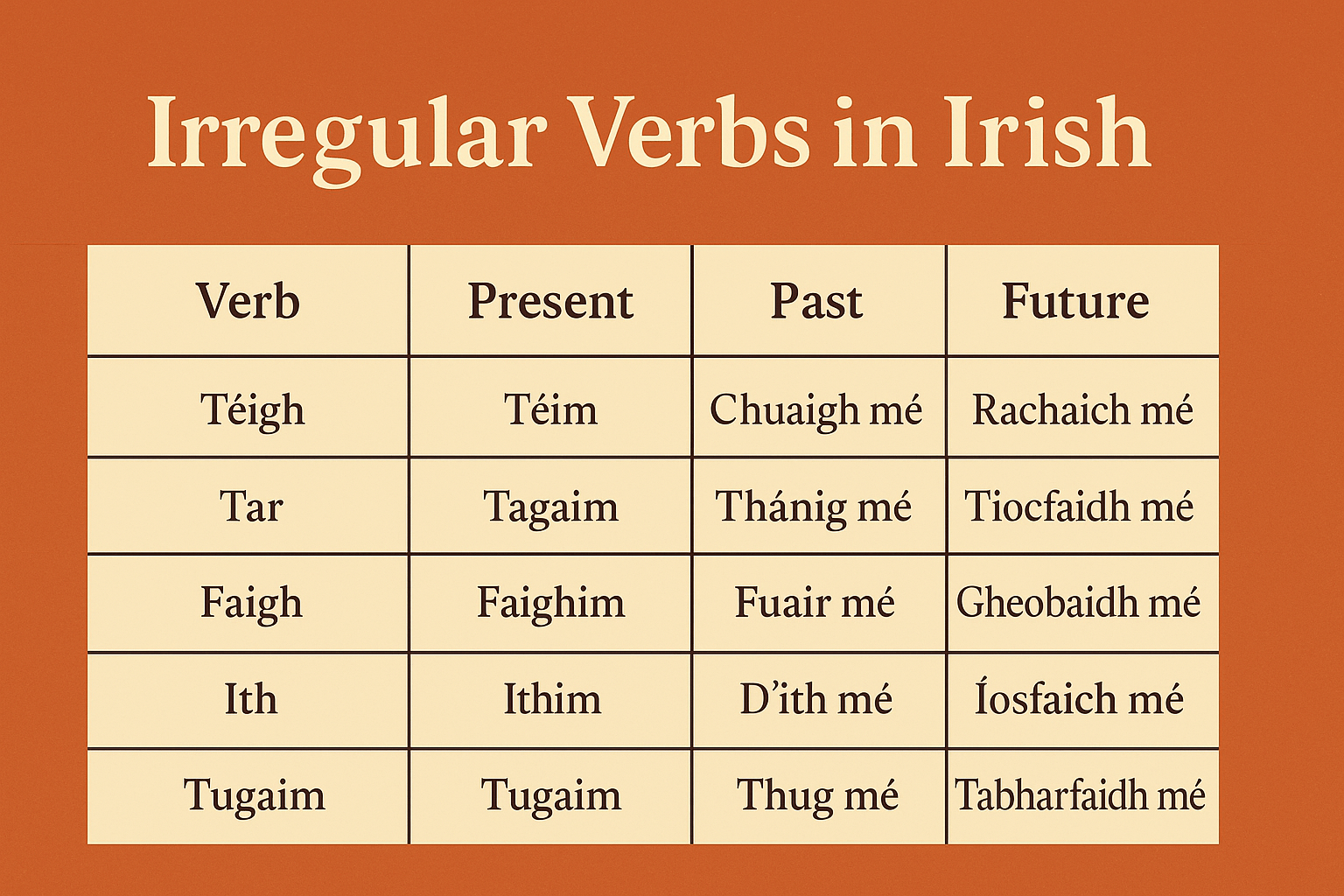
In Irish, most verbs follow regular patterns in different tenses. But 11 verbs don’t behave—they’re irregular, meaning they don’t follow standard conjugation rules. These verbs are:

bí, déan, faigh, feic, abair, beir, clois, ith, tabhair, tar, téigh

You’ll notice that these are some of the most commonly used verbs in everyday Irish. So yes, they’re essential—but also totally learnable without brute force.

Why You Don’t Need to Memorize Charts

Traditional Irish classes often drill these verbs using large tables showing every tense and form. And while that works for some learners, it’s often too abstract and overwhelming.

Here’s what works better:

  • Focus on real sentences, not isolated forms
  • Learn in pairs or opposites (e.g., “I said” / “I didn’t say”)
  • Listen and repeat — your brain remembers patterns more easily than lists
  • Use AI tools and daily mini-conversations to reinforce what you already know

With the right approach, you’ll start using these verbs automatically—just like native speakers do.

The 3-Step Method to Mastering Irregular Verbs

✅ Step 1: Start With the Verbs You Use Every Day

Instead of trying to learn all 11 at once, start with 3–4 verbs you’ll actually use:

  • (to be) – essential for describing yourself, feelings, and location
  • Téigh (to go) – for saying where you went
  • Déan (to do/make) – incredibly versatile
  • Feic (to see) – great for conversations

Here’s how they look in the past tense—the tense most learners start using first:

  • Bhí mé sa bhaile. – I was at home.
  • Chuaigh sé go Gaillimh. – He went to Galway.
  • Rinne sí an obair. – She did the work.
  • Chonaic mé é. – I saw him.

You’ve just used 4 irregular verbs, no charts needed.

✅ Step 2: Learn in Context, Not in Columns

Here’s the trick: instead of memorizing “abair = say”, learn sentences like:

  • Dúirt sí liom é. – She told me.
  • Ní dúirt mé tada. – I didn’t say anything.
  • An ndúirt tú é? – Did you say it?

You just learned 3 forms: affirmative, negative, and question — the most common use cases.

Practicing verbs in mini dialogues helps you retain the grammar and the meaning.

✅ Step 3: Use AI and Repetition for Natural Fluency

Want to make this stick without drilling tables? Use an AI-powered tool like Gaeilgeoir AI to practice:

  • Custom sentence builders
  • Instant feedback
  • Voice repetition tools
  • Spaced repetition learning

This way, you get real-time exposure to verbs in action, not in isolation.

You can also pair this with passive learning by listening to top Irish language podcasts. Hearing Rinne mé or Chuaigh siad in natural speech builds recognition and confidence.

Quick Reference: Common Forms You’ll Actually Use

Don’t worry—we’re not giving you a chart. But here are a few high-frequency forms to look out for. (You’ll see these everywhere.)

Bí (to be)

  • Bhí mé = I was
  • Ní raibh sé = He wasn’t
  • An raibh tú? = Were you?

Téigh (to go)

  • Chuaigh sí = She went
  • Ní dheachaigh siad = They didn’t go
  • An ndeachaigh tú? = Did you go?

Feic (to see)

  • Chonaic mé = I saw
  • Ní fhaca sé = He didn’t see
  • An bhfaca tú? = Did you see?

Déan (to do/make)

  • Rinne mé = I did
  • Ní dhearna sí = She didn’t do
  • An ndearna tú? = Did you do?

Notice the patterns: many negative forms use Ní + lenition, and many questions start with An + eclipsis. You’re not just learning verbs—you’re learning the structure of Irish itself.

Final Tips: Make It Stick

  1. Practice out loud. Irish verbs sound different from how they’re spelled. Speaking helps solidify them.
  2. Use a “verb of the week.” Pick one irregular verb and use it in every sentence you can for a few days.
  3. Create personal sentences. Talk about your own life: Chonaic mé mo mhadra inniu. (I saw my dog today.)
  4. Review little, often. Five minutes a day with flashcards or Gaeilgeoir AI beats a 2-hour cram session.

And most importantly: don’t panic about getting them wrong. Even native speakers stumble over irregular forms from time to time.

Want to Practice These the Smart Way?

With Gaeilgeoir AI’s free 3-day trial, you can skip the rote memorization and start using Irish irregular verbs in real conversations. You’ll get:

  • Personalized verb practice
  • Grammar tips based on your level
  • Instant corrections and pronunciation help
  • Lessons that grow with you

👉 Start your free trial now and speak Irish more confidently in just a few days.


Keep Learning

Once you’ve got irregular verbs down, explore more of our learner-friendly grammar guides:


Final Thoughts

Yes, Irish irregular verbs can look intimidating—but they’re nothing you can’t handle with the right approach. Skip the charts. Focus on patterns. Practice with purpose.

Before long, you won’t be thinking “Is this an irregular verb?”—you’ll just be speaking Irish.

Ádh mór ort! (Good luck!)

Daily Irish Practice Plan (Just 15 Minutes a Day)

Think you need hours a day to get good at Irish? Think again. The truth is, consistent, focused practice beats long cram sessions — every time.

In this guide, you’ll get a realistic, easy-to-follow daily Irish practice plan that fits into your life — whether you’re commuting, making coffee, or hiding from your emails. All you need is 15 minutes a day.

Let’s break it down.


🕒 Why Just 15 Minutes Works

Language learning is like building muscle. You don’t need a 2-hour gym session — just regular reps.
With Irish, a little bit every day trains your brain to retain words, notice patterns, and get used to sentence flow.

It’s less about how much time you spend, and more about how often.


🗓️ Your Daily 15-Minute Gaeilge Plan

Here’s a powerful, compact daily routine. Mix it up as you go — and don’t worry if you miss a day. Just jump back in.

🔹 Minutes 1–3: Warm-Up with Vocabulary

Start with a handful of new or review words.

✅ Use flashcards, an app, or our Irish Language Flashcards
✅ Focus on a theme: food, greetings, weather, etc.
✅ Say each word aloud — even better if you sing it a little!

🔹 Minutes 4–7: Build a Sentence

Pick 2–3 of your vocab words and turn them into simple Irish sentences.

✅ Use sentence patterns like:

  • Tá ____ agam. (I have ____)
  • Is maith liom ____. (I like ____)
  • Chuaigh mé go dtí ____. (I went to ____)

✅ Say the sentences out loud. Record yourself if you can!

🔹 Minutes 8–11: Listen & Repeat

Spend 3 minutes tuning your ear.

✅ Listen to a podcast, audio clip, or short video
✅ Repeat 1–2 sentences after the speaker
✅ Pause and mimic their intonation (don’t stress about perfection!)

Great places to start: Top Podcasts in Irish

🔹 Minutes 12–15: Practice with Gaeilgeoir AI

Now’s the time to test what you’ve learned.

✅ Use Gaeilgeoir AI to generate a short conversation
✅ Get pronunciation help or grammar feedback
✅ Try a mini-quiz or chat with the AI for live practice

The platform adapts to your level, so even a few minutes gives you targeted, useful input.

🧠 Weekly Theme Ideas

Keep things fresh by rotating weekly themes:

  • Week 1: Food & Drink
  • Week 2: Weather & Seasons
  • Week 3: Feelings & Emotions
  • Week 4: Travel & Places
  • Week 5: Work & Daily Routine

Learning in chunks helps you build connected vocabulary and context.

📅 Optional: Weekly Challenge (Extra Credit!)

If you want to go a little deeper once a week:

✅ Watch 5 minutes of a TG4 show
✅ Write a short diary entry in Irish
✅ Chat with a tutor or friend (or Gaeilgeoir AI!)
✅ Try saying your grocery list in Irish

🙌 Realistic, Sustainable, and Actually Fun

You don’t have to move to Connemara or enroll in full-time classes to get better at Irish. You just need a plan — and the commitment to show up a little bit each day.

This 15-minute structure is flexible, practical, and built to work with real life (even chaotic ones!).

🎁 Want Help Sticking to It?

You’re more likely to keep going when the learning is fun, feedback is instant, and the tools fit your style.

👉 Start your free 3-day trial of Gaeilgeoir AI at learn.gaeilgeoir.ai and build your daily Irish habit the smart way.

✅ Interactive sentence practice
✅ Grammar feedback
✅ Personalized learning paths
✅ Available 24/7 (even during tea breaks)

Final Thoughts

Fluency doesn’t happen overnight — but it does happen with 15 minutes a day.

Start small. Stay curious. And remember: every sentence you build, every word you say aloud, brings you one step closer to real Irish confidence.

Go n-éirí leat! (Best of luck!)

Common Mistakes in Irish (And How to Fix Them)

We’ve all been there. You’re finally building up the courage to speak Irish out loud, and then — bam — something just doesn’t sound right. Maybe you said mé ith instead of Itheann mé, or you used mo teach when you really meant ár dteach. (Oops.)

The good news? Everyone makes mistakes when learning Irish — and most of them are easy to fix once you know what to watch for.

Here are 10 common mistakes in Irish that learners run into again and again — plus a few tips to help you steer clear of them.


1. Forgetting That Verbs Come First

Mé ith arán.
Itheann mé arán.

Irish isn’t English in disguise — the sentence order is different. In Irish, the verb always comes first, followed by the subject and then the object. This is called VSO (Verb–Subject–Object) word order. It takes some getting used to, but it’s non-negotiable.

🧠 Quick Fix: Think “Do – Who – What” instead of “Who does what.”


2. Not Using Lenition When Needed

Mo bean
Mo bhean

Lenition (adding an “h” after the first consonant) isn’t just a spelling change — it changes how the word sounds and even what it means. Many possessive pronouns (mo, do, a) trigger lenition, and skipping it is one of the most common beginner slip-ups.

🧠 Quick Fix: Learn which pronouns and grammatical structures cause lenition. A cheat sheet doesn’t hurt.


3. Mixing Up “a” for His / Her / Their

a madra — but whose dog??
a mhadra = his dog
a madra = her dog
a gcat = their cat

The possessive a is sneaky. It looks the same for his, her, and their — but it causes different mutations depending on who’s doing the owning. Context (and consonant changes!) matter here.

🧠 Quick Fix:

  • a + lenition = his
  • a + nothing = her
  • a + eclipsis = their

4. Using English Word Order in Questions

An tú chonaic é?
An bhfaca tú é?

Irish doesn’t just flip a few words for questions — the verb still comes first, and many verbs change form in the question structure. Using An often requires lenition or eclipsis, too.

🧠 Quick Fix: Practice forming yes/no questions using An + verb + subject.


5. Overusing “is maith liom” for Everything

Is maith liom an bia seo (every time)
Taitníonn an bia seo go mór liom.

Yes, Is maith liom (“I like”) is easy and useful — but it’s just one way to express preference. There are richer, more expressive alternatives in Irish.

🧠 Quick Fix: Explore verbs like taitin, is aoibhinn liom, or ba mhaith liom for variety.


6. Ignoring Prepositional Pronouns

Le mé
Liom

Prepositions and pronouns in Irish don’t hang out separately — they morph into one word. You’ll need to learn these combos, or you’ll sound like a walking error message.

🧠 Quick Fix: Drill common prepositional pronouns (liom, leat, leis, liom féin, etc.) with flashcards or repetition exercises. Try our flashcards here.


7. Using “agus” Like Commas in English

Bhí sé ag caint agus ag ól agus ag gáire agus ag canadh…
Bhí sé ag caint, ag ól, ag gáire, agus ag canadh.

Just because agus means “and” doesn’t mean you should use it ten times in a row. Irish can be more fluid — sometimes even dropping agus in short lists.

🧠 Quick Fix: Use agus thoughtfully. Vary your sentence structures for better flow.


8. Literal English-to-Irish Translations

Tá mé fuar.
Tá fuacht orm.

Tá mé tuirseach ar mo sháith.
Tá tuirse orm.

English says “I am cold,” but Irish says “Cold is on me.” Emotions and states are often expressed through prepositional phrases, not adjectives.

🧠 Quick Fix: Learn the most common expressions with Tá ___ orm/agat/air… and think in Irish structure, not English logic.


9. Saying “Tá sé go maith” for Everything

Tá sé go maith
Tá sé go hiontach / go dona / go deas / ar fheabhas

Go maith is fine, but overusing it makes your Irish sound bland. There’s a world of colorful adjectives and adverbs to try instead.

🧠 Quick Fix: Expand your vocab with our essential Gaelic phrases guide.


10. Not Speaking Out Loud

Reads everything silently, never practices pronunciation
Speaks Irish every day — even alone in the kitchen

A lot of learners delay speaking out loud because they feel self-conscious. But speaking regularly is the fastest way to improve your fluency, confidence, and comprehension.

🧠 Quick Fix: Read a sentence out loud every day. Better yet, speak into your phone and listen back — you’ll pick up on patterns fast.


🎁 Bonus: Want Help Catching These Mistakes?

You don’t have to fix everything on your own.

👉 Try Gaeilgeoir AI free for 3 days and get instant feedback on grammar, word order, pronunciation, and more — so you can learn faster (and avoid making the same mistakes again).

Start your free trial now – no credit card, no pressure, just better Gaeilge.


Final Thoughts

Learning Irish isn’t about being perfect — it’s about showing up, making mistakes, and learning from them. The mistakes above? They’re all totally normal. In fact, making them means you’re actually trying — and that’s something to be proud of.

Keep speaking. Keep learning. And remember:

Nobody speaks perfect Irish at first — but everyone can improve.
Go n-éirí leat! 💚

Build Sentences in Irish: Word Order Made Easy

One of the first big “aha!” moments Irish learners have is realizing the word order is… well, a bit different from English. In Irish, sentences don’t follow the usual subject-verb-object structure (SVO). Instead, Irish uses verb–subject–object (VSO) order — and once you understand how it works, building sentences becomes much easier.

In this beginner-friendly guide, we’ll break down Irish sentence structure, explain the most common patterns, and give you the confidence to start forming your own phrases right away.


Why Irish Sentence Structure Matters

Irish is a beautifully structured language, but it plays by its own rules. While English speakers might be used to saying “I eat bread”, Irish flips that to say something closer to “Eat I bread.”

That’s the VSO structure in action:

  • Verb first
  • Subject second
  • Object third

Once you get the hang of it, you’ll see that Irish word order is actually quite logical — and pretty consistent.


The Core Rule: VSO (Verb–Subject–Object)

Let’s look at a simple sentence in Irish:

Ithim arán.
(I eat bread)

Here’s the breakdown:

  • Verb: Ithim – I eat
  • Subject: implied by the verb ending (-im = mé/I)
  • Object: arán – bread

You can also write it more fully:

Itheann mé arán.
(Eat I bread → I eat bread)

That’s the basic VSO pattern: VerbSubjectObject

More Examples:

IrishEnglish
Feiceann sí é.She sees him.
Léann siad leabhar.They read a book.
Tugann sé dom é.He gives it to me.

See how the verb always leads the way?


Adding Time, Place, and Manner

Want to add more detail to your sentences? Irish prefers a specific order when expanding a sentence:

➡️ Verb – Subject – Object – Time – Place – Manner

Example:

Léann sí an leabhar gach lá sa leabharlann go ciúin.
She reads the book every day in the library quietly.

This is the natural flow in Irish:

  1. Gach lá (Time)
  2. Sa leabharlann (Place)
  3. Go ciúin (Manner)

You don’t have to cram all that into every sentence, but it’s helpful to know the order for when you do want to add detail.


Negative Sentences

To say something in the negative, just use before the verb and change the verb form slightly (e.g., add lenition).

Example:

Ní fheiceann sí é.
She does not see him.

Another example:

Ní ithim feoil. – I don’t eat meat.


Asking Questions

In Irish, questions are formed by placing a question particle (usually An or Ar) at the start of the sentence, followed by the verb.

Examples:

  • An bhfeiceann tú é? – Do you see him?
  • An dtuigeann tú? – Do you understand?
  • Ar ith tú? – Did you eat?

Just like in statements, the verb still comes first — it just gets an extra helper word.


Common Mistakes to Avoid

  1. Starting with the subject – In English it’s “I eat,” but Irish always leads with the verb: Itheann mé, not Mé itheann.
  2. Forgetting lenition in negative or questionsNí fheiceann, not Ní feiceann.
  3. Dropping the time/place too early – Irish prefers that VSO order first before you tack on extras like time or place.

Tips to Build Better Sentences

Here are some easy ways to strengthen your skills:

🔹 Start with Formulaic Sentences

Pick a few sentence patterns and swap out words:

  • Itheann mé ___.
  • Ní fheiceann sí ___.
  • An dtuigeann tú ___?

🔹 Think in Irish Word Order

Try mentally translating from English as: “Do → Who → What.”

So “He drinks coffee” becomes:

  • Ólann sé caife.
    Not Sé ólann caife.

🔹 Use Practice Tools

Get daily sentence-building practice with Gaeilgeoir AI — smart tools help reinforce correct sentence structure through guided exercises.


📣 Try Gaeilgeoir AI Free for 3 Days

Ready to build full Irish sentences confidently?

Sign up for a free 3-day trial of Gaeilgeoir AI and practice real sentence construction with interactive tools, AI feedback, and fun challenges tailored to your level.

No stress, no commitment — just three days of focused learning to supercharge your progress.

👉 Start your free trial now


Keep Learning

Once you’ve nailed Irish sentence structure, the rest of the language becomes much easier to navigate. Keep the momentum going:


Final Thoughts

Building sentences in Irish doesn’t have to be intimidating. Once you understand the VSO structure and see how it fits into real examples, everything starts falling into place.

Start simple, practice daily, and don’t be afraid to make mistakes — it’s all part of the learning process.

And if you want help along the way, we’ve got your back.
👉 Start your free 3-day trial with Gaeilgeoir AI and start building better Irish sentences today.

Slán go fóill! (Bye for now!)

The Definitive Guide to Irish Pronouns

If you’re learning Irish and want to start forming natural, fluid sentences, then understanding Irish pronouns is a must. Pronouns are the glue of everyday speech — you’ll use them constantly without even thinking about it. But Irish has a few twists that make its pronoun system unique (and honestly, kind of fun to learn once you get into the rhythm).

This guide will walk you through the essential pronouns in Irish — including personal, possessive, and prepositional forms — with practical examples and a beginner-friendly approach.


Why Pronouns Matter in Irish

Imagine trying to speak without saying “I”, “you”, or “they.” It gets tricky fast. Pronouns help us keep sentences short, fluid, and natural. Irish uses pronouns in familiar ways, but also adds some flavor — especially when it comes to prepositions and possession.

Don’t worry, though. Once you learn the basic forms and see how they work in sentences, it all starts to click.


1. Personal Pronouns in Irish

Let’s start with the basics — these are your go-to words for “I”, “you”, “he”, “we”, and so on.

IrishEnglish
I
you (singular)
he
she
muid / sinnwe
sibhyou (plural)
siadthey

🧠 Tip: Muid and sinn both mean “we” — muid is more commonly used in speech, while sinn pops up in certain fixed phrases or more formal contexts.

Example Sentences:

  • Is mise Seán. – I am Seán.
  • Tá tú anseo. – You are here.
  • Chonaic siad an scannán. – They saw the film.

2. Possessive Pronouns: Talking About What’s Yours

Irish possessive pronouns show ownership — my, your, his, her, etc. But instead of standalone words, they’re attached to the noun they modify.

Here’s a handy chart:

IrishMeaningExample
momymo leabhar – my book
doyour (sing.)do chara – your friend
a (sé)hisa dheirfiúr – his sister
a (sí)hera máthair – her mother
árourár dteach – our house
bhuryour (pl.)bhur madra – your (plural) dog
a (siad)theira gcarr – their car

A Few Grammar Notes:

  • Possessive pronouns affect the spelling of the next word — often triggering lenition (adding “h”) or eclipsis (adding a prefix).
  • For example:
    • mo chat (my cat) → “c” becomes “ch”
    • a gcairde (their friends) → “c” gets eclipsed with “g”

This is where Irish gets a little spicy — but it’s also where you’ll start to appreciate how beautifully structured the language is.


3. Prepositional Pronouns: The Irish Special

This is where Irish grammar takes a turn from English. When you combine a preposition with a pronoun, Irish doesn’t use two words — it fuses them together into a single prepositional pronoun.

Let’s take le (with), ar (on), and ag (at/have) as examples.

Personle (with)ar (on)ag (at)
liomormagam
leatortagat
leisairaige
léiuirthiaici
muidlinnorainnagainn
sibhlibhoraibhagaibh
siadleoorthuacu

Example Phrases:

  • Tá brón orm. – I’m sorry. (Literally: “Sadness is on me.”)
  • Tá peann agam. – I have a pen.
  • Bhí sí ag caint liom. – She was talking with me.

Want more like this? Check out our full Irish pronunciation guide to help you speak these phrases with confidence.


The Best Way to Learn Irish Pronouns

You don’t need to memorize everything in one go. Here’s how most learners make it stick:

✅ Use them in daily practice.

Try describing your day in Irish using , , or siad — even simple things like:

  • D’éirigh mé go luath.
  • Chuaigh siad ag siúl.

✅ Speak aloud — even to yourself.

Say a few phrases each morning: Tá ocras orm, Tá grá agam duit, etc.

✅ Use flashcards or quizzes.

Our Irish flashcards make it super easy to drill these forms during short study breaks.


📣 Try Gaeilgeoir AI Free for 3 Days

Want to master Irish pronouns the smart way? Sign up for a free 3-day trial of Gaeilgeoir AI — no credit card needed. You’ll get access to:

  • Interactive grammar tools
  • Real-time feedback
  • AI-generated practice exercises tailored to your level
  • And yes — tons of preposition and pronoun training!

👉 Start your free trial today and let Irish grammar finally make sense.


Explore More from Gaeilgeoir AI

Once you’ve got the pronouns down, why not level up even further?


Bonus Read

Curious how AI is transforming language education? Have a look at this article from EDUCAUSE on how technology is reshaping how we learn.


Final Thoughts

Irish pronouns might seem tricky at first — especially those prepositional ones — but with a little practice, they become second nature. Start with the basics, focus on one type at a time, and use them in context whenever you can.

And don’t forget — you don’t have to go it alone.
👉 Try Gaeilgeoir AI’s free 3-day trial and let the language grow on you — one sentence at a time.

Ádh mór ort! (Good luck!)

Understanding Irish Prepositions: Simple Breakdown

If you’ve started learning Irish and find yourself confused by little words like le, ar, or ag, you’re not alone. Irish prepositions might seem small, but they do a lot of heavy lifting in sentences — and they work quite differently than their English counterparts.

This guide offers a friendly and practical breakdown of Irish prepositions. We’ll walk through how they’re used, some of the most common ones to learn first, and tips for getting them right. Whether you’re just starting out or brushing up on grammar, this is for you.


Why Irish Prepositions Deserve Attention

In English, prepositions are pretty straightforward: on the table, with a friend, to the store. But in Irish, they come with their own set of rules — and sometimes even change depending on the person being spoken about.

That’s right — prepositions in Irish “hook onto” pronouns, creating new combined forms. It’s different, but once you get the hang of it, it actually starts to feel intuitive.


Most Common Irish Prepositions (You’ll Use These Daily)

Let’s take a look at some of the most frequently used Irish prepositions and how they’re typically used.

PrepositionMeaningCommon Usage
aron / atar an mbord (on the table)
agat / haveTá leabhar agam (I have a book)
lewith / byle mo chara (with my friend)
ófromó m’athair (from my father)
doto / fordo mo mháthair (to my mother)
faoiunder / aboutfaoi bhord (under the table), faoi seo (about this)
i / inini dteach (in a house)

Want to learn essential greetings and phrases using these prepositions? Check out our Irish language greetings and phrases guide.


Prepositional Pronouns: The Irish Twist

Here’s where Irish stands out. Instead of saying “with me” as two words, Irish combines them into one word: liom.

Let’s take le (with) as an example:

PronounWith (le)At (ag)On (ar)
liomagamorm
leatagatort
leisaigeair
léiaiciuirthi
muidlinnagainnorainn
sibhlibhagaibhoraibh
siadleoacuorthu

Example Sentences:

  • Tá brón orm. – I am sorry. (Literally “Sadness is on me.”)
  • Tá cupán caife agam. – I have a cup of coffee.
  • Tá sé ag caint léi. – He is talking to her.

It may seem strange at first, but these expressions are deeply rooted in how Irish speakers describe emotions, ownership, and physical states.


Visual Learner? Think in Pictures

One helpful trick is to imagine the preposition’s meaning as an image.

  • Ar means “on” – imagine something sitting on you: Tá eagla orm (I am afraid — fear is on me).
  • Ag implies possession or location – like something being at you: Tá madra agam (I have a dog).
  • Le is connection – with or alongside someone.

This kind of mental imagery helps you learn faster and remember better.


Expressions You’ll Hear All the Time

Here are some phrases with prepositions that are super common in conversation:

  • Tá ocras orm. – I’m hungry.
  • Tá grá agam duit. – I love you.
  • Tá suim agam i nGaeilge. – I’m interested in Irish.
  • Tá sé ag obair liom. – He’s working with me.
  • Fáilte romhat. – You’re welcome (literally, “Welcome before you”).

Want to learn more useful phrases like these? Explore our essential Gaelic phrases guide.


Noticing Patterns: A Simple Learning Strategy

You don’t need to memorize dozens of charts. Instead:

  1. Start with 2–3 prepositions like ar, le, and ag.
  2. Practice them with different pronouns.
  3. Use them in real phrases you might actually say.

You’ll soon recognize recurring forms and meanings without even trying too hard.


Want a Smarter Way to Learn?

If memorizing prepositional pronouns feels overwhelming, you’re not alone — but there’s good news.

💡 Try Gaeilgeoir AI’s Free 3-Day Trial
Want interactive grammar tools, smart quizzes, and personalized guidance?
Sign up for a free 3-day trial at Gaeilgeoir AI and see how AI-powered learning can help you master Irish — prepositions and all.


More Ways to Boost Your Irish

Once you’ve got the basics of Irish prepositions, you’re well on your way to expressing yourself more naturally. Take the next step:


Extra Insight

Curious how AI can help you learn faster and smarter? Check out this EDUCAUSE article on AI in education to learn more about the future of language learning.


Final Thoughts

Irish prepositions may feel like a twisty puzzle at first — but once you start seeing the patterns, they become second nature. You don’t need to know them all right away. Just start small, practice often, and let the language guide you.

And if you’d like some help along the way, we’re here for you.
👉 Start your free 3-day Gaeilgeoir AI trial today and take the guesswork out of grammar.

Go n-éirí leat! (Best of luck!)

Master the Irish Past Tense: A Beginner’s Guide

If you’re learning Irish and want to take your skills up a notch, mastering the Irish past tense is a great place to start. It’s what allows you to describe things you’ve done, stories you’ve heard, and memories worth sharing — in Irish.

In this guide, we’ll walk through the basics of how the past tense works, how to use it correctly with regular and irregular verbs, and share a few handy tips to help it all click. No fuss, no jargon — just straightforward, beginner-friendly guidance.


Why Learn the Irish Past Tense?

Once you get comfortable with the past tense, your options for speaking and writing expand massively. Think about it — how often do we talk about what we did yesterday, last week, or even ten years ago? The same goes for Irish. And even better, the past tense in Irish is more consistent than many learners expect — especially with regular verbs.

Of course, there are quirks (this is Irish, after all), but that’s all part of the fun.


Regular Verbs: The Backbone of Irish Grammar

Let’s start simple. Most verbs in Irish follow regular patterns, especially in the past tense.

✅ Regular Past Tense Rule:

For most regular verbs, just add lenition (an “h” after the first consonant) to the root form of the verb.

Here’s a quick look:

VerbMeaningPast Tense (mé)Translation
BrisTo breakBhris méI broke
DúnTo closeDhún túYou closed
CeannaighTo buyCheannaigh síShe bought

📝 Note: If a verb starts with a vowel, you’ll add “d’” instead. For example, ól (to drink) becomes D’ól mé — “I drank.”

What’s nice is that the verb form is the same for all subjects (mé, tú, sé, etc.). So once you learn one, you’ve learned them all.


Meet the Irregulars

Ah yes — the 11 irregular verbs. These guys don’t follow the same neat patterns, but they’re used so often that you’ll pick them up pretty quickly with a bit of exposure and repetition.

Here are a few you’ll encounter early and often:

VerbMeaningPast Tense (mé)Translation
To beBhí méI was
TéighTo goChuaigh túYou went
DéanTo do/makeRinne síShe did
FeicTo seeChonaic méI saw
FaighTo getFuair méI got

🧠 Want to keep these fresh in your mind? Our Irish language flashcards are perfect for quick reviews — just a few minutes a day makes a difference.


Talk Like a Local: Time Words for the Past Tense

When using the past tense, you’ll naturally need time expressions. Here are some useful ones to memorize:

  • Inné – yesterday
  • Aréir – last night
  • An tseachtain seo caite – last week
  • Cúpla lá ó shin – a couple of days ago
  • Tamall ó shin – some time ago

Try using them to form full sentences:

  • D’ith mé pasta inné. – I ate pasta yesterday.
  • Bhí mé sa bhaile aréir. – I was at home last night.

Asking Questions & Saying “No” in the Past

Irish makes questions and negatives in the past tense super logical — once you see the pattern.

🔸 To ask a question:

Use Ar before the verb (and apply lenition).

  • Ar ól tú tae? – Did you drink tea?

🔹 To say “didn’t”:

Use Níor + verb (again, lenition applies).

  • Níor ith sí an cáca. – She didn’t eat the cake.

It sounds fancy, but really, it’s just a matter of remembering your helper words.


Real-World Tips for Using the Past Tense

You don’t need to memorize long verb tables. Try these more natural ways to pick it up:

1. Practice Short Recaps

At the end of your day, say out loud (or write down) 2–3 things you did. Use the past tense. Keep it simple:

  • Chuaigh mé ag siúl.
  • D’ith mé arán.
  • Bhí mé tuirseach.

2. Flashcards Are Your Friend

Grab a pack (or use ours here) and go over them while you wait for the kettle to boil. It’s those little moments that add up.

3. Listen and Repeat

Podcasts and short videos are gold. You’ll start hearing the past tense in context, which helps you learn when and how to use it naturally. If you need somewhere to start, check out our guide to the Top Podcasts in Irish.


What’s Next?

Now that you’ve got the basics of the Irish past tense, why not build on what you’ve learned? Our Irish language lessons for beginners are designed to help learners just like you progress quickly — and actually enjoy the process.

If you want to take it a step further, check out this free guide to learning Irish online for a full learning roadmap.


Final Word

Mastering the Irish past tense is like unlocking a new chapter in your language journey. With practice, persistence, and a bit of fun along the way, you’ll soon be telling your own stories in Irish. So, don’t hesitate—take your learning further by signing up for that free trial at Gaeilgeoir AI, and get ready to bring your Irish skills to life.

Inis do scéal! (Tell your story!)

Irish New House Blessing: Traditional Words for Your Home

The Irish new house blessing tradition has deep roots in Celtic culture, offering beautiful sentiments for homeowners looking to infuse their dwellings with warmth, protection, and good fortune. These traditional blessings, often spoken in Gaeilge (the Irish language), connect modern homeowners to centuries of Irish cultural heritage. At Gaeilgeoir AI, we believe learning these meaningful phrases can enhance both your language skills and your appreciation for Irish traditions that remain relevant in contemporary life.

Whether you’re moving into a new home yourself, attending a housewarming, or simply fascinated by Irish cultural practices, understanding the Irish new house blessing tradition provides insight into values that have sustained Irish communities for generations.

The Cultural Significance of House Blessings in Irish Tradition

Historical Origins

The practice of blessing a new home has ancient origins in Ireland, predating Christianity and connecting to Celtic beliefs about the spiritual nature of dwelling places. When Christianity arrived in Ireland, these traditions blended with Christian practices, resulting in the unique blend we see today.

In traditional Irish society, a house blessing served multiple purposes:

  • To cleanse the space of any negative energies
  • To invite prosperity and good fortune
  • To protect the inhabitants from harm
  • To establish the home as a sacred space for the family
  • To strengthen community bonds as neighbors participated in the blessing

Modern Relevance of Irish New House Blessing

Today, many Irish families and those of Irish descent continue this tradition when moving into a new home. The Irish new house blessing has evolved to reflect contemporary values while maintaining its core purpose of creating a sacred, protected space for family life.

Modern Irish house blessings often incorporate:

  1. Gathering of friends and family
  2. Recitation of traditional blessing phrases in Gaeilge
  3. Sometimes a sprinkling of holy water in each room
  4. Sharing of bread and salt (symbols of prosperity)
  5. A house-warming celebration that follows the blessing ceremony

Essential Irish New House Blessing Phrases and Their Meanings

Traditional Blessing Phrases

Here are some beautiful phrases used in an Irish new house blessing, along with their pronunciations and meanings:

  1. “Go mbeannaí Dia an teach seo” (Guh man-ee DEE-uh un tyakh shuh)
    Meaning: “May God bless this house”
  2. “Síocháin san áras seo” (SHEE-uh-kawn sahn AW-raws shuh)
    Meaning: “Peace in this dwelling”
  3. “Beannacht Dé ar an teach seo agus ar gach duine a chónaíonn ann” (BAN-ukht day air un tyakh shuh AH-gus air gokh DIN-yuh uh KHOH-nee-un oun)
    Meaning: “God’s blessing on this house and on everyone who lives in it”
  4. “Go dtuga Dia solas do do theach” (Guh DIG-uh DEE-uh SUH-lus duh duh HYAKH)
    Meaning: “May God bring light to your house”

Room-Specific Blessings

In the Irish new house blessing tradition, specific rooms often receive tailored blessings:

Kitchen Blessing:

“Go mbeirimid beo ar an am seo arís le bia agus deoch”
(Guh mer-ih-mid byoh air un om shuh ah-reesh leh BEE-uh ah-gus dyokh)
Meaning: “May we be alive at this time next year with food and drink”

Bedroom Blessing:

“Codladh sámh agus aislingí álainn”
(CUH-luh sawv ah-gus ASH-ling-ee AW-lin)
Meaning: “Peaceful sleep and beautiful dreams”

Living Room Blessing:

“Go mbeirimid le chéile go sona sásta”
(Guh mer-ih-mid leh KAY-luh guh SUN-uh SAW-stuh)
Meaning: “May we be together happy and content”

How to Perform an Irish New House Blessing Ceremony

If you’d like to incorporate this beautiful tradition into your own home, here’s a step-by-step guide to conducting an Irish new house blessing:

Preparation Steps

  1. Set a date – Traditionally after moving in but before fully settling
  2. Invite close friends and family – Those who will be frequent visitors
  3. Prepare traditional symbols – Bread, salt, and candles
  4. Learn key phrases – Practice the pronunciation of the Irish blessing phrases

The Ceremony Process

  1. Begin at the entrance – Start the blessing at the front door, inviting positive energy in
  2. Move clockwise – Progress through the house in a sunwise direction (clockwise)
  3. Light candles in each room – Symbolizing bringing light into the home
  4. Recite room-specific blessings – Use the appropriate blessing for each space
  5. Sprinkle salt in corners – A traditional practice for purification
  6. Break bread together – Share bread with guests as a symbol of never going hungry
  7. Conclude with a toast – Often using the phrase “Sláinte chuig an teach nua!” (Health to the new house!)

Modern Adaptations of the Irish New House Blessing

Today’s Irish new house blessing ceremonies often blend traditional elements with contemporary practices. Here are some modern adaptations:

  • House blessing parties – Combining the blessing with a housewarming celebration
  • Digital participation – Including distant family members via video calls
  • Custom blessing prints – Framed Irish blessings as housewarming gifts
  • Blessing boxes – Gift boxes containing symbols like salt, bread, honey, and candles

Learning Irish Blessings as Part of Language Study

At Gaeilgeoir AI, we encourage incorporating cultural elements like the Irish new house blessing into your language learning journey. These meaningful phrases provide:

  • Practical vocabulary you can use in real-life situations
  • Cultural context that deepens your understanding of the language
  • Emotional connection to the words you’re learning
  • Pronunciation practice with phrases that have stood the test of time

Our Irish language lessons for beginners include cultural elements like blessings and traditional phrases to make your learning experience more authentic and engaging.

Irish House Blessing Gifts for Special Occasions

If you’re attending a housewarming and want to bring an Irish-themed gift, consider these options that incorporate the Irish new house blessing tradition:

  • A decorative plaque or framed print with a traditional Irish blessing
  • A handcrafted house blessing candle
  • Salt and bread in a decorative basket with the blessing written on a card
  • A door harp (traditional Irish instrument believed to ward off evil spirits)
  • A Gaeilge language learning gift subscription to help the new homeowners connect with Irish heritage

Regional Variations in Irish House Blessing Traditions

Like many cultural practices, the Irish new house blessing varies by region throughout Ireland. According to research from the National Folklore Collection at University College Dublin, these regional differences reflect local history and traditions:

  • West of Ireland: Greater emphasis on protection from the Atlantic elements
  • Border Counties: Blessings often reference peace and harmony
  • Urban Dublin: More concise blessings adapted to apartment living
  • Gaeltacht Regions: More extensive use of Gaeilge in the ceremony

Connect With Your Heritage Through Irish Language and Traditions

The Irish new house blessing represents just one beautiful aspect of Irish cultural heritage that can be explored through language learning. By understanding these traditions, you gain insight into values that have sustained Irish communities for generations.

Ready to learn more beautiful Irish expressions like those used in the traditional house blessing? Gaeilgeoir AI offers personalized Irish language learning tools that incorporate cultural elements into every lesson.

Our AI-powered platform adapts to your learning style, making mastering Irish phrases both enjoyable and effective. You’ll quickly progress from simple greetings to meaningful cultural expressions like those used in the Irish new house blessing tradition.

Sign up for a free trial today and begin your journey into the rich world of Irish language and traditions. Our community of learners is waiting to share this beautiful cultural heritage with you!

Irish Mythology Female Names: Powerful Female Figures

The rich tapestry of Celtic legends features a mesmerizing collection of Irish mythology female names The rich tapestry of Celtic legends features a mesmerizing collection of female names from Irish mythology that continue to captivate people worldwide. These powerful names carry profound meanings, fascinating histories, and a mystical quality that connects us to ancient Ireland. At Gaeilgeoir AI, we believe understanding these names enhances your Irish language journey, adding cultural context to your learning experience.

Irish lore presents us with powerful goddesses, warriors, and magical beings whose identities have stood the test of time. Learning to pronounce and understand the origins of these ancient feminine names not only expands your vocabulary but also deepens your connection to Gaeilge (the Irish language) and its cultural heritage.

Most Powerful Female Names from Irish Legends and Their Origins

Warrior Women and Queens in Celtic Tales

Irish folklore celebrates female strength and leadership. These legendary names belonged to some of the most formidable women in Celtic stories:

  1. Maeve (Medb) – Perhaps the most famous queen in Celtic mythology, Maeve ruled Connacht and led her army against Ulster in the epic Táin Bó Cúailnge (The Cattle Raid of Cooley). Her name means “she who intoxicates” or “the cause of great joy.”
  2. Gráinne – A fiery and independent princess who refused to marry the aging warrior Fionn Mac Cumhaill and instead eloped with the younger warrior Diarmuid. Her name relates to “grace” or “love.”
  3. Ériu – One of the three sovereignty goddesses after whom Ireland (Éire) is named. Her name represents the very essence of the island.
  4. Scáthach – The legendary warrior woman and trainer of heroes, including the great Cú Chulainn. Her name means “shadowy one,” reflecting her mysterious dwelling in the Land of Shadows.
  5. Aoife – A warrior queen and rival of Scáthach, she later became the mother of Cú Chulainn’s only son. Her name means “beauty” or “radiance.”

Divine Beings and Celtic Feminine Deities

These names from Irish legends belong to divine figures who controlled various aspects of life and nature:

  • Brigid (Brighid) – A goddess of poetry, healing, and smithcraft, later adopted as a Christian saint. Her name means “exalted one.”
  • Danu – The mother goddess of the Tuatha Dé Danann (the tribe of Danu), representing primordial waters and abundance.
  • Morrigan – A powerful triple goddess associated with fate, especially death in battle. Her name translates to “phantom queen” or “great queen.”
  • Áine – Goddess of summer, wealth, and sovereignty, associated with midsummer celebrations. Her name connects to brightness and radiance.
  • Flidais – A goddess of the wilderness, animals, and fertility, often depicted riding a chariot pulled by deer.

How Female Names from Irish Mythology Connect to Modern Language Learning

Understanding these legendary feminine names provides numerous benefits for language learners:

Cultural Context Through Mythological Characters

When learning Irish with our beginner-friendly courses, knowing the stories behind these names helps you understand references in literature, music, and everyday conversation. Many Irish people still use these mythology-inspired names, creating an unbroken link to ancient traditions.

Pronunciation Practice with Celtic Female Names

Legendary feminine names from Irish folklore help you practice important pronunciation patterns in Gaeilge. For example:

  • The name Siobhán (derived from Síle, a Christianized version of a mythological name) introduces you to the “bh” sound (pronounced as “v”)
  • Aoife (EE-fa) helps you understand how vowel combinations work
  • Gráinne (GRAWN-ya) demonstrates the effect of the fada (accent) on vowel sounds

Vocabulary Building Through Ancient Female Lore

Learning these ancient feminine names and their meanings expands your vocabulary naturally. For example, understanding that “Deirdre” relates to the word for “sorrow” or that “Niamh” means “brightness” or “radiance” helps you recognize these root words in other contexts.

Using Technology to Master Ancient Irish Female Names

At Gaeilgeoir AI, we’ve developed specialized tools to help you learn and remember names from Irish mythology along with their pronunciations and meanings:

  1. Interactive Flashcards: Our Irish language flashcards feature dedicated mythology sections with audio pronunciations of each name.
  2. Contextual Learning: Our AI system introduces you to these names through stories and conversations, making them more memorable.
  3. Pronunciation Guidance: Get instant feedback on your pronunciation of challenging Celtic feminine names using our voice recognition technology.
  4. Cultural Notes: Each name comes with detailed information about its mythological origins and cultural significance.

Beyond the Names: Deepening Your Connection to Irish Mythological Traditions

Learning feminine names from Irish mythology is more than memorizing vocabulary—it’s about connecting with Ireland’s rich cultural heritage. As noted by researchers at University College Dublin’s School of Irish, Celtic Studies and Folklore, mythology provides “a window into the worldview and values of ancient Irish society” and continues to influence modern Irish identity (O’Connor, 2019).

To truly appreciate these names:

  • Read the myths in which these women appear
  • Listen to traditional songs that reference them
  • Understand the regions of Ireland associated with particular stories
  • Learn about how these myths influenced Irish literature throughout history

The Renaissance of Ancient Irish Female Names Today

In recent decades, there has been a notable resurgence in the popularity of traditional Irish female names. Names like Aoife, Siobhán, and Niamh rank among the most popular baby names in Ireland and are gaining popularity internationally. This renaissance reflects a growing appreciation for cultural heritage and unique naming traditions.

Modern parents are drawn to these names for their:

  • Distinctive sounds and spellings
  • Rich historical associations
  • Strong female characterizations
  • Connection to Irish identity

Start Your Irish Language Journey Through Mythological Female Lore

Female names from Irish mythology offer a fascinating entry point into learning Gaeilge. Their stories capture the imagination while teaching important aspects of pronunciation, vocabulary, and cultural understanding.

Ready to discover more about these enchanting names and the language they belong to? Join Gaeilgeoir AI today and access our comprehensive tools designed specifically for learning Irish through cultural exploration. Our AI-powered platform adapts to your learning style, making mastering these beautiful names and the broader language both enjoyable and effective.

Sign up for a free trial and begin your journey through the magical world of Irish language and mythology. Connect with our community of learners who share your passion for this beautiful language and its ancient stories!

Start Speaking Irish Today — 25% Off
Use code START25

Learn real Irish for real life with guided practice, pronunciation support, and everyday conversations.

Get 25% off any plan with code START25

Start Speaking Irish Today — 25% Off