
You've probably done what most beginners do. You searched for the irish word for girl, found cailín, and then immediately hit a second question. How do I use it?
That's where Irish gets interesting. A simple dictionary answer helps, but it doesn't tell you when to say cailín, when to say an cailín, how to talk about more than one girl, or why a word that means “girl” behaves in a way that surprises learners. If you've ever wanted to use a sweet phrase, understand a family conversation, or reconnect with Irish in a way that feels real, those details matter.
Irish is full of small patterns that look tricky at first and then become satisfying once you see how they work. This guide keeps things simple. You'll learn the main word, how to pronounce it, how it differs from iníon for “daughter,” and the key grammar that helps you use it in real sentences instead of just memorising a translation.
Table of Contents
- Your Guide to the Irish Word for Girl
- Cailín The Foundational Word for Girl
- Cailín vs Iníon A Crucial Distinction
- Essential Grammar for Using Cailín Correctly
- Exploring Other Irish Words for Girl
- Your Next Steps in Irish Learning
Your Guide to the Irish Word for Girl
The most common Irish word for girl is cailín. That's the word you'll want first if you're building everyday vocabulary.
But beginners usually need more than the one-word answer. They want to know questions like these:
- How do I pronounce it?
- Does it mean girl, young woman, or girlfriend?
- What's the plural?
- Why does the word change in some phrases?
- Is it the same as daughter?
Those are smart questions. Irish often asks you to notice context in a way English doesn't.
What cailín usually means
In everyday use, cailín usually means girl or young woman. It isn't the same as bean, which means woman, and it isn't the same as iníon, which means daughter. That distinction is one reason this word shows up so early in beginner learning.
Practical rule: If you mean a female child or a young woman in a general sense, start with cailín.
You may also hear mo chailín, which can mean “my girl” and in some contexts can refer to a girlfriend. Context does the heavy lifting there, just like English does with “my girl.”
Why beginners get stuck after the translation
A dictionary gives you the front door. Real Irish starts when you try to make a sentence.
Here are the forms learners often need right away:
- cailín for “girl”
- an cailín for “the girl”
- cailíní for “girls”
- na cailíní for “the girls”
That little set is far more useful than memorising a single isolated word. Once you know those forms, you can begin reading, speaking, and noticing patterns instead of guessing.
A good beginner mindset
Don't aim for perfection on day one. Aim for recognition first.
If you can spot the difference between girl, the girl, and girls, you're already moving from lookup learning to real language use. That's the shift that makes Irish feel less like a puzzle and more like something you can speak.
Cailín The Foundational Word for Girl
The core irish word for girl is cailín. Historically, it's the Irish word most closely associated with “girl,” and it's described as a foundational beginner word that usually refers to a girl or young woman in this naming and language overview.
How to pronounce cailín
A simple English-friendly guide is kah-LEEN.
The stress falls on the second part. That matters. If you flatten it out too much, it won't sound as natural. Irish spelling becomes much less intimidating once you stop trying to read every letter the way you would in English.
Try it in three steps:
- Say “kah” softly
- Say “leen” clearly
- Stress the second part so it sounds like kah-LEEN
If you've ever seen the name Colleen, that's closely connected to cailín. If you're curious about that relationship and how the borrowed form developed, this short guide to Colleen in Irish is a useful next read.
What kind of word it is
In plain English, cailín is your everyday neutral word for a girl. It isn't stiff, formal, or poetic. That's part of why it belongs near the top of any beginner vocabulary list.
You can use it in simple statements such as:
Is cailín í.
She is a girl.An cailín.
The girl.Cailíní.
Girls.
When a word appears often in family talk, beginner lessons, and names, it's worth learning deeply rather than quickly.
A note on meaning in context
Sometimes learners worry because one word seems to cover more than one idea. That's normal. Cailín can refer to a girl or a young woman, and in phrases like mo chailín, the meaning can shift depending on who's speaking and the situation.
Consider English words such as “girl” or “my girl.” The phrase itself is simple. The exact meaning comes from context, tone, and relationship.
A helpful way to remember it is this:
- cailín = girl or young woman
- bean = woman
- iníon = daughter
That small contrast saves a lot of confusion later.
Cailín vs Iníon A Crucial Distinction
Many beginners mix up cailín and iníon. That's understandable, because both refer to female people and both appear early in learning. But they are not interchangeable.
Cailín means girl. Iníon means daughter.
If you wouldn't swap “girl” and “daughter” in English, don't swap them in Irish either. That one habit will keep your Irish much clearer.
The difference in everyday use
Use cailín when you mean a girl in general.
Use iníon when you mean someone's daughter.
That means these two ideas are different:
Sin an cailín.
That is the girl.Sin mo iníon.
That is my daughter.
The first sentence identifies a girl. The second shows a family relationship.
A fast test helps. Ask yourself, “Could I replace this with daughter in English?” If yes, use iníon. If no, you probably want cailín.
Cailín vs Iníon at a Glance
| Word | Pronunciation | Core Meaning | When to Use It |
|---|---|---|---|
| Cailín | kah-LEEN | girl, young woman | For a girl in general |
| Iníon | in-EEN | daughter | For someone's daughter |
Two common beginner mistakes
Learners often make one of these mistakes first:
Using iníon for any young female person
That makes the meaning too specific. It adds a family relationship that may not be there.Using cailín when talking about your daughter
That removes the family meaning and sounds less precise than you intend.
Try these pairs and feel the contrast:
Tá cailín sa seomra.
There is a girl in the room.Tá m'iníon sa seomra.
My daughter is in the room.
The room is the same. The relationship changes the word.
A memory trick that works
Think of iníon as belonging to the family-word group. It sits naturally beside words like “mother,” “father,” and “son” in your mental vocabulary.
Think of cailín as belonging to the social-word group. It's a general person word, like “boy,” “woman,” or “teacher.”
Once you sort the words that way, the distinction becomes much easier to keep straight.
Essential Grammar for Using Cailín Correctly
Most pages stop at the translation. That's exactly where beginners need help most. If you want to use the irish word for girl correctly, you need a few sentence-level patterns.
The most useful forms first
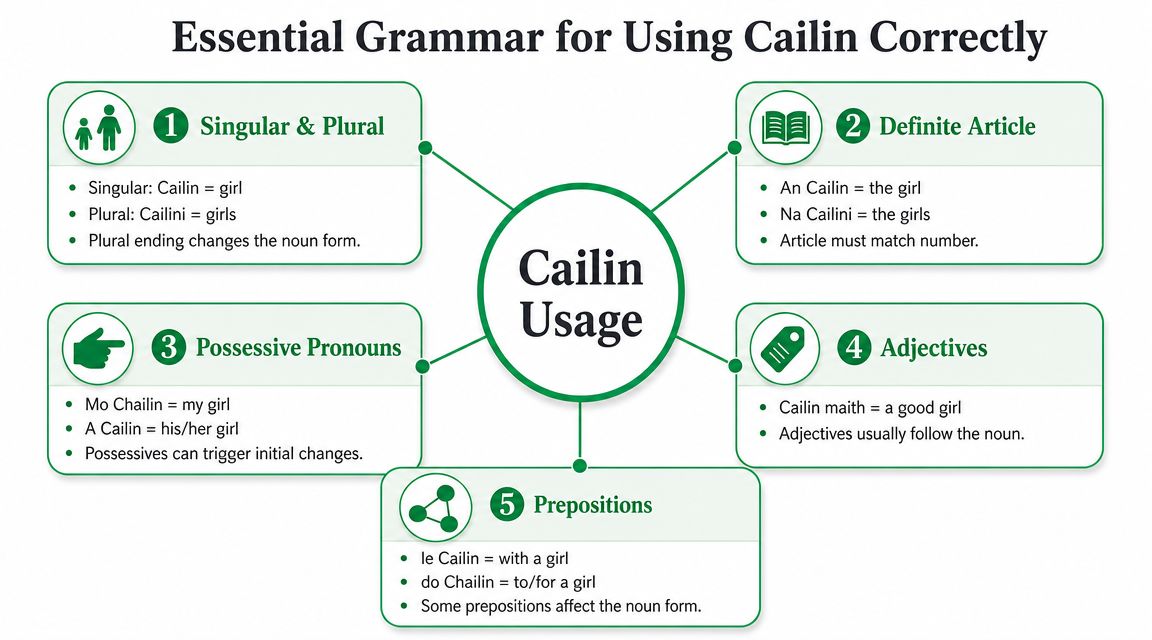
Start with the forms you'll meet again and again:
- cailín = girl
- an cailín = the girl
- cailíní = girls
- na cailíní = the girls
Those singular and plural forms matter because learners often only memorise the first one. A beginner grammar explainer highlights this exact gap around cailín, an cailín, and sentence use in this Irish learning page.
Here's the clean pattern:
| English | Irish |
|---|---|
| girl | cailín |
| the girl | an cailín |
| girls | cailíní |
| the girls | na cailíní |
That table alone makes your vocabulary much more usable.
Why cailín surprises beginners
Here's the twist. Cailín is a masculine noun in grammar, even though it means girl. That's a key point many learners miss, and it affects how the word behaves in sentences.
This feels odd at first because English doesn't work that way. In Irish, grammatical gender and real-life sex don't always match. A noun can be grammatically masculine while referring to a female person.
Don't try to force Irish grammar to mirror English. Treat grammatical gender as a word pattern, not a statement about the person.
That mindset saves a lot of frustration.
One change you'll see often
A very common phrase is mo chailín for “my girl.” Notice that the c changes to ch.
That kind of initial change is one of the features that gives Irish its distinctive look and sound. Beginners often meet it early and think they've found a different word, when really they're seeing the same word in a different grammatical setting.
A useful habit is to learn words in mini-phrases, not alone:
- cailín
- an cailín
- mo chailín
- na cailíní
If you enjoy structured explanations of patterns like this, a broader article on mastering grammar for fluency can help you think about grammar as a tool rather than a list of rules.
Build phrases, not just vocabulary
Once you know the base word, the article form, and the plural, you can start noticing how Irish builds meaning through small shifts. That's also why topics like noun relationships become more important over time, including patterns connected to forms discussed in guides such as this one on the genitive case in Irish.
For now, keep your focus narrow:
- Learn cailín
- Add an cailín
- Learn cailíní
- Recognise mo chailín
That's enough grammar to start using the word with confidence instead of guessing.
Exploring Other Irish Words for Girl
Once you're comfortable with cailín, it helps to know that Irish has more than one way to express the idea of “girl.” The standard plural is cailíní, but dictionary-style resources also list alternatives such as girseach and gearrchaile in this Wiktionary entry on girl.
That doesn't mean you should replace cailín as a beginner. It means Irish has regional and descriptive richness, just like English has words such as “girl,” “lass,” and “young one” in different places and tones.
Which word should a beginner use
For most learners, the answer is simple:
- Use cailín first because it's the standard, safest choice.
- Recognise girseach if you come across it in dialect or informal material.
- Treat gearrchaile as a context-specific variant, not your default beginner word.
That approach keeps your core vocabulary strong without pretending the language has only one option.
Irish rarely rewards a one-word-for-one-word mindset. It rewards noticing meaning, region, and tone.
Why this matters beyond one noun
This is part of what makes Irish feel alive rather than museum-like. A single English word can map onto a small group of Irish words depending on context.
You'll notice the same richness when you move into names and identity words. Many learners enjoy following that trail into personal names and their meanings, especially through collections of Irish names for girls, where sound, culture, and vocabulary often overlap.
For now, keep the hierarchy clear in your mind. Cailín is the everyday standard. The others are useful to recognise later.
Your Next Steps in Irish Learning
You now know more than just the irish word for girl. You know the form beginners need to use: cailín, its plural cailíní, the article forms, the difference between cailín and iníon, and the small grammar surprise that catches many new learners.
That's a strong start. It's also how good language learning usually works. One ordinary word opens the door to pronunciation, grammar, family vocabulary, and culture all at once.

Follow the word into names and culture
Irish vocabulary often connects naturally to names. Naming traditions are one of the clearest signs that Irish is a living language. For example, Fiadh reached No. 1 for baby girls in Ireland in 2021 according to this Irish baby names overview.
That matters for learners because it shows these words and roots aren't just old textbook material. They still live in homes, schools, media, and everyday identity.
Keep your practice practical
A good next step is to practice in useful chunks instead of isolated vocabulary lists. Try reading and saying forms such as:
- an cailín
- na cailíní
- mo chailín
- mo iníon
That kind of small, repeated use builds confidence fast. If you're interested in how language tools fit into real learning tasks, this overview of translation use cases explained gives helpful context for thinking beyond word-for-word lookup.
The key is consistency. One well-understood word is more valuable than twenty half-memorised ones.
If you're ready to move from reading about Irish to using it, Gaeilgeoir AI is a great next step. It helps you practise real Irish from day one with guided conversation, pronunciation support, and everyday situations that make words like cailín stick naturally. You can also start directly at the Gaeilgeoir AI learning platform.