AI Language Tutors: How They Work and How to Choose One

If you've ever opened an Irish lesson, understood the words, and then gone completely blank the moment you had to speak, you're in the right place. That freeze is normal. It's also the exact gap that AI language tutors are trying to close, especially for learners who need more speaking time than a classroom, workbook, or flashcard app can give them.

The promise sounds simple, maybe even a little too simple, unlimited practice, instant feedback, and no fear of judgment. More useful when you look at the details. The strongest tools aren't magical conversation machines, they're systems that help you rehearse real speech, recover from mistakes, and build enough confidence to try again tomorrow.

Table of Contents

Why AI Language Tutors Are Changing How We Learn

You can read a page of Irish and feel proud, then hear a simple question and suddenly your mind goes quiet. That gap is familiar to many learners, especially adults who have studied on and off for years and can recognize words without being able to produce them under pressure. AI language tutors matter because they give learners a place to rehearse speech before the stakes feel real.
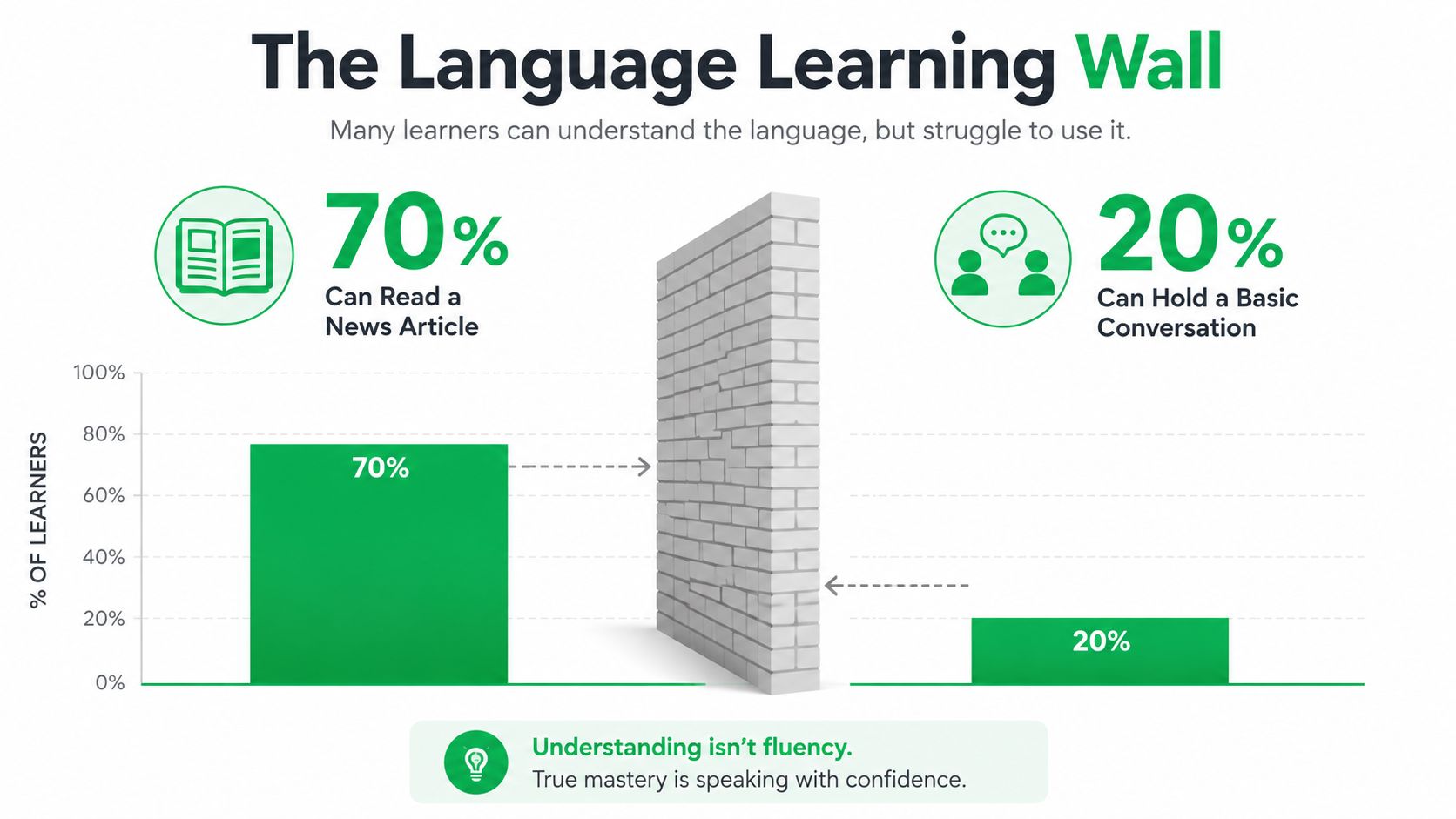
An infographic titled The Language Learning Wall showing that 70% can read, while only 20% can speak.

Market forecasts help explain why this shift is happening. One major estimate places the AI tutors market at USD 3.55 billion in 2025 and projects USD 6.45 billion by 2030, while another projects USD 17.7 billion by 2033 (Mordor Intelligence). That growth helps show why language learning is no longer treated as a novelty. The same market study says language learning is the fastest-growing subject segment, and cloud deployment held 71.22% share in 2024, which fits the way many learners now expect to practice, on a phone, in a browser, whenever they have a few minutes.

The Importance of Active Speaking Practice

The strongest AI tutors do more than drill vocabulary. They let learners practice the messy middle of speaking, where the idea is there but the sentence is still forming. That is the part many people need most, because knowing a word is not the same as using it in real time. Tools that feel conversational tend to keep learners engaged because they support confidence, not just recall.

Adoption data points in the same direction. Duolingo is projected to report 12.5 million paid subscribers at the end of Q1 2026, up 21% year over year, and projected revenue of USD 1,037.6 million in FY2025, a 39% increase over FY2024 (LingoBright). Broader industry summaries also report 500 million learners globally using AI tutors in 2025, and AI-powered language-learning platforms with 2.3 million monthly active users growing 40% year over year (LingoBright). The products differ, but the pattern is consistent, learners want more speaking time than traditional apps usually provide.

Practical rule: if a tool only helps you recognize words, it is a study aid. If it helps you answer out loud, it starts acting like a speaking coach.

For Irish learners, that distinction matters. Grammar tables help you understand the language, but confidence comes from using it in the situations you face, greeting someone, ordering food, asking for directions, or handling an oral exam prompt. In Irish, the jump from recognition to speech can feel especially wide, so tools that create low-pressure speaking practice fill a real gap.

How AI Language Tutors Actually Work

A strong AI tutor works like a relay team. One part hears you, one part interprets what you meant, one part speaks back, and one part learns from the exchange so the next round goes better. When those pieces move smoothly, the experience feels close to conversation. When they do not, it feels like waiting for a chatbot to catch up.
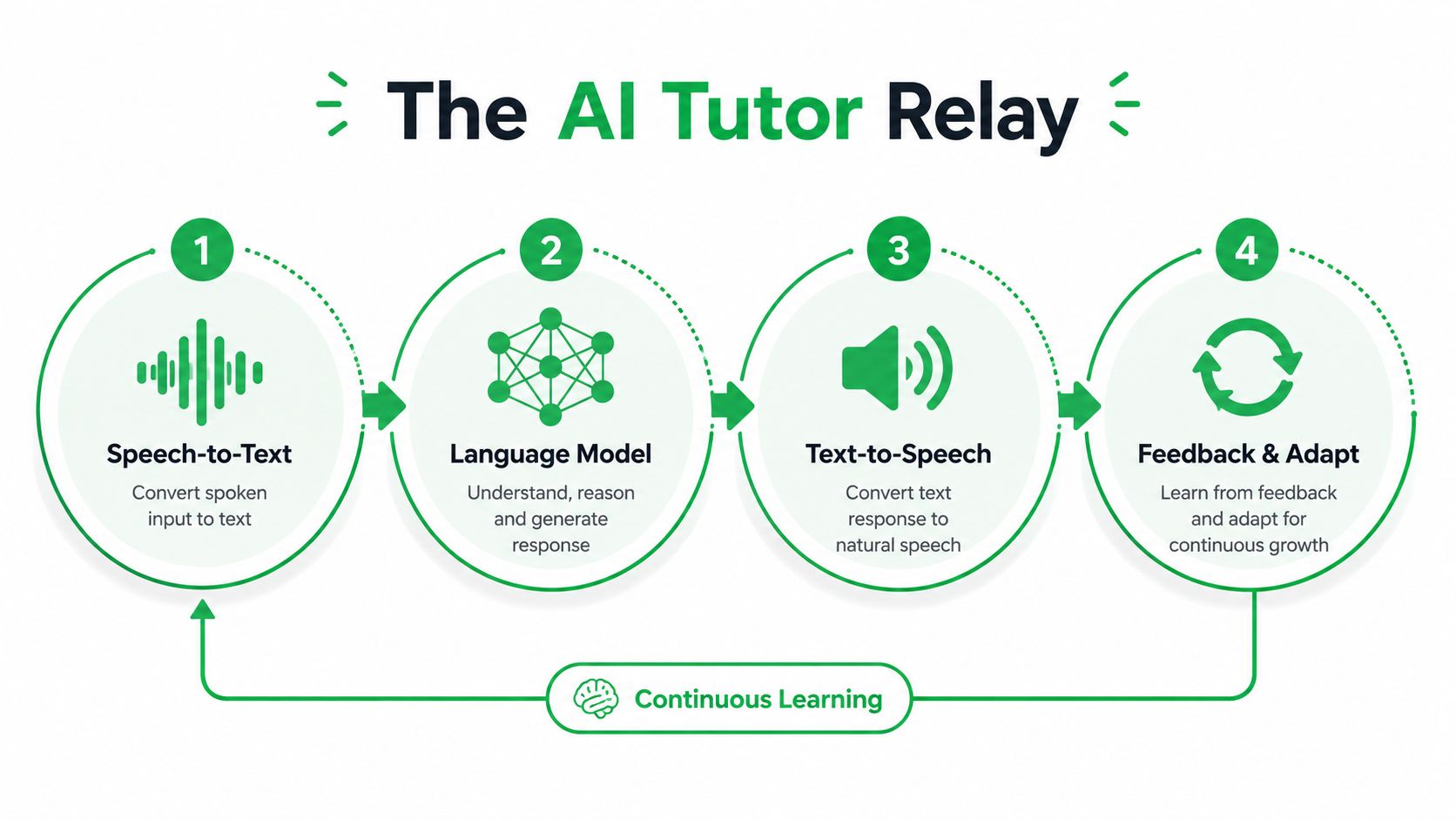
A diagram illustrating the four-step AI tutor relay process involving speech-to-text, language modeling, text-to-speech, and continuous learning.

The pipeline usually starts with speech-to-text, which turns your voice into words. Then the language model reasons over your input, decides how to keep the conversation going, and prepares a reply. After that, text-to-speech turns the reply into audio, and a feedback layer handles grammar, pronunciation, or vocabulary support. That sequence sounds simple on paper, but it only works if the handoffs are fast enough to preserve turn-taking. For a closer look at how AI systems support learning over time, see machine learning in education.

Latency decides whether it feels like a conversation

In practice, the whole loop needs to stay around 600 to 800 milliseconds total latency to feel natural (LinguaLive). Once response times drift beyond that, people start feeling the gap. Integrated systems like Gemini Live have been measured around 500 to 700 ms, while GPT-4o-class stacks with separate ASR and TTS often ranged 700 to 1200 ms depending on load and network conditions (LinguaLive).

That is the technical reason some apps feel alive and others feel sluggish. It is not only about how smart the model is. It is about the total budget across audio capture, inference, synthesis, and any correction logic that runs after the answer.

For readers who like the engineering side, a useful comparison is the translation workflow in GPT-4 vs Claude for Django from TranslateBot. Different systems can all produce output, but the user experience depends on how reliably they handle the full loop, not just the headline model name.

The open-source stack matters for the same reason. A reference setup that combines Whisper medium for ASR, Llama 3.1 8B for the tutor brain, and XTTS/SadTalker for voice output and avatars is designed for throughput per dollar, not just benchmark prestige (NLLB). The same source notes roughly 5 GB VRAM for ASR and another 5 GB VRAM for the quantized LLM, which makes near-real-time tutoring realistic on a single consumer GPU.

If you want a plain-language way to think about it, the tutor has to be fast enough to stop feeling like a quiz engine. That is the point where practice starts to resemble speaking.

For teams evaluating platform choices, latency is often the difference between “I'll use this daily” and “I stopped after two tries.” If the audio stalls or the corrections arrive too late, learners stop treating the tool like a partner and start treating it like a form.

The Most Effective Features in an AI Tutor

A learner sitting at a kitchen table at the end of a long day does not need flashy claims. They need a tutor that helps them speak a little more clearly, remember a little more reliably, and try again without feeling stalled. That is the test for an AI language tutor, especially for Irish learners who often need more than polish, they need repeated, usable practice.

Marketing pages often highlight personalization, gamification, and smart automation. Those can help, but only if they support the core learning loop. A good AI tutor should help you speak, remember, correct, and repeat. If the tool only makes lessons feel entertaining, it is not doing enough.

A 2025/2026 review article on generative AI in language classrooms classified GenAI into nine distinct roles, with the most common being feedback provider (n = 42), language learning tutor (n = 26), resource provider (n = 22), and content generator (n = 20), followed by evaluator, affective supporter, conversation partner, interaction facilitator, and cognitive stimulator (Taylor & Francis). That pattern matters because it keeps pointing back to the same teaching tasks, feedback, tutoring, and conversation. From an educator's point of view, those are the features that shape whether practice turns into speaking progress or stays as isolated app activity.

What deserves your attention first

The first feature to look for is pronunciation and speech feedback. If the system cannot hear your accent well, or if it gives praise without explaining the mistake, it teaches confidence without accuracy. Learners tend to relax when feedback is clear, specific, and immediate, because they can correct the next attempt instead of guessing what went wrong. A tutor also needs to adjust the difficulty of its prompts, because a beginner who needs slow, supported turns should not be pushed into advanced role-play on day one.

A 2025 systematic review on machine-based language teaching found that AI tools such as ChatGPT, Grammarly, Duolingo, Wordtune, and Pigai were used across drafting, practice, and assessment phases, and they supported writing, speaking, listening, vocabulary, grammar, and reading comprehension (ERIC PDF). The same review reported that AI feedback improved language accuracy while building confidence and encouraging active participation (ERIC PDF). Read that as a teaching signal, not a product slogan. Feedback works when it helps the learner notice a gap, try again, and hear the correction in context.

Vocabulary review deserves the same level of attention. A tool that helps you review words at the right time is more useful than one that shows a long list of terms. If you want a practical model for that, build a spaced repetition vocabulary system before you judge any platform's review loop. The point is simple, words stick when the learner meets them again after they have started to fade, not when the app just displays another progress badge.

What helps, but should not carry the whole experience

Scenario-based practice has real value because it turns isolated words into usable speech. Exam preparation also helps learners who need structured prompts and predictable speaking topics, especially when pressure is part of the task. Both features can support learning, yet neither one is enough if the tutor cannot respond naturally to mistakes, ask follow-up questions, or keep the exchange moving in a way that feels like conversation.

The British Council review identified five AI use areas in English teaching and learning, developing speaking, writing, and reading skills, supporting pedagogy, and enabling broader instructional support (British Council). That gives a useful classroom lens. AI tutors are not one thing. They can serve different parts of the learning process, and the right mix depends on whether the learner needs confidence, accuracy, or exam readiness. For that reason, a platform with personalized learning paths is only useful when the path changes what the learner practices, not just the screen they see.

Where AI Tutors Excel and Where They Fall Short

A learner who can rehearse a phrase five times without embarrassment often arrives at live conversation with less tension. That is one of the clearest places AI tutors help. They are steady, patient, and available whenever a student wants another try, which matters for beginners who need time before speaking feels natural.

The research base is also larger than many marketing pages suggest. A 2026 systematic review in a Taylor & Francis journal examined 155 studies and found that 79.5% reported positive language-learning outcomes from AI use (Taylor & Francis). That does not mean every platform works equally well, but it does show that AI support has been studied across speaking, writing, vocabulary, and grammar, not just one narrow skill (Taylor & Francis).

The strengths are real, but narrow

AI is useful for low-stakes practice, quick corrections, and a conversation partner that does not rush or interrupt. For many learners, that is enough to get the first sentence out loud. In Irish learning, that can mean moving from silent recognition of a phrase to saying it, even if the sentence is still rough.

It also helps with repetition without fatigue. A tutor can ask for the same greeting, the same direction, or the same self-introduction again and again, which is hard to get from a busy human partner. Learners often need that kind of patient loop before confidence starts to build.

Human conversation still matters for rhythm, humor, and the cultural details that do not show up in a clean transcript.

Independent education coverage keeps drawing the same line. AI tutors are strongest for repetition and practice, while human interaction remains central for fluency, culture, and nuanced communication (EdWeek). A useful way to read that is simple, an AI tutor can prepare you to speak, but it cannot fully stand in for speaking with another person.

Where the ceiling appears

Pronunciation feedback can still miss the mark, especially when a platform sounds confident even while it misreads speech. Cultural pragmatics are another weak point. Knowing the words is not the same as knowing when to soften a phrase, when to be formal, or how to sound natural in context. Those are the places where a human tutor or conversation partner still has the advantage.

Irish learners feel this gap quickly. A system may help with a phrase like a flashcard, yet still fail to explain why one wording fits a greeting and another sounds off in the same situation. That is the difference between memorizing a line and using it well.

A sensible learning setup treats AI as a practice accelerator, not a substitute for every other method. That fits the hybrid pattern now emerging in 2025 and 2026, where AI tutors are used to build repetition and confidence before learners move into authentic conversation (EdWeek). For learners of Irish, that usually means letting the tutor handle drills, corrections, and short role-plays, while human conversation still carries the parts that require timing, tone, and real social judgment.

How to Evaluate an AI Language Tutor Before Committing

A free trial should feel like a test drive, not a sales demo. If a platform can't handle your voice, your pace, and your real use case in the first conversation, it probably won't improve much after that. That's especially true for learners who need speaking support in Irish, where every minute of useful feedback matters.

Start with one simple prompt, then push the system a little. Ask for a greeting, a short role-play, and a correction of your mistakes. If the tool handles those well, then ask it to keep the conversation going for a few turns without turning into a quiz.

What to test in the first session

  • Accent recognition: Say a normal sentence in your own voice, not a studio version of the language.
  • Correction quality: Check whether feedback is specific, or just a vague “good job.”
  • Conversation flow: See whether it keeps asking natural follow-up questions, or drops the thread.
  • Scenario realism: Try something practical, like ordering food, asking directions, or introducing yourself.
  • Progress tracking: Look for a way to review mistakes instead of losing them after the session ends.

If the tutor can't do these things well, the rest of the interface won't save it.

Pricing and privacy deserve a direct look too. Voice tools collect more sensitive data than text-only apps, so you should read the privacy policy before you record long sessions or personal content. If the subscription model is hard to understand, or the limits only become clear after you've already signed up, that's a warning sign.

For learners preparing for formal tests, it also helps to compare platforms against exam-specific needs. A useful benchmark is the list of top AI TOEFL practice tools from Reach120, because it shows how specialized practice tools are usually framed around one goal rather than promising to do everything.

If a platform matches your style, you'll usually notice it quickly. The conversation feels steady, the corrections are understandable, and you come away wanting to try again tomorrow. If you feel like you're fighting the interface, keep looking.

Real-World Example How Gaeilgeoir AI Supports Irish Learners

Irish learners often don't need more theory. They need a place to speak without freezing. Gaeilgeoir AI is built around that problem, with guided, real-world conversation practice that helps beginners start speaking from day one and keeps the pressure low enough for repetition to feel manageable (Gaeilgeoir AI).

The platform's immersion-first approach uses the 1,000 most-used Irish words as a foundation, which gives learners a practical starting point instead of a giant word list that never turns into speech. Any word on the platform can be clicked for translation, and saved items can go into a personalized study list, which helps when you hear a phrase in context and want to keep it. That kind of immediate support is useful for learners who get stuck on vocabulary before they ever get to sentence building.

What that looks like in practice

A beginner can use the platform for everyday situations like ordering food or asking for directions, then move into targeted preparation for the Leaving Cert Irish oral exam. The practice isn't abstract. It's anchored in the kinds of exchanges people need, which makes the transition from study to speaking feel less dramatic.

The product also includes gamified progress tracking, with points, multipliers, and leaderboards designed to keep practice regular. That matters for learners who don't always have a set study schedule. Consistency is usually the hidden problem, not intelligence.

A learner's confidence often changes first, then fluency follows later.

That pattern shows up in the kind of testimonials language learners share after they've had enough repetition to stop overthinking every sentence. The value isn't that the AI is a substitute for a human. It's that it gives people a place to rehearse until speaking Irish feels less like a performance and more like a habit.

The platform also offers a practical option for learners who want AI support without losing focus on the language itself. Instead of chasing flashy features, it keeps the attention on speaking, comprehension, and exam readiness. For Irish specifically, that's the right tradeoff.

Your Next Steps to Start Speaking with Confidence

Start with one goal, not ten. If you want to speak more confidently, pick a simple routine, five to ten minutes of AI conversation a day, plus one real-world use case each week, like a short voice note, a tutor session, or a conversation with a language partner. The goal is to make speaking familiar before it feels flawless.

Use your first session to lower the pressure. Ask for a greeting, a short self-introduction, and a role-play tied to your life. If you're learning Irish, try a prompt about ordering in a café, asking directions, or introducing yourself at a class or meetup.

Keep the expectation realistic. The first gains usually show up in comfort, not mastery. Confidence grows when the tutor helps you speak, correct, and repeat without making the process feel like a test.

If you want a place to begin, try a platform that gives you guided conversation, pronunciation support, and everyday practice instead of just more drills.


Gaeilgeoir AI gives Irish learners guided speaking practice, pronunciation support, and scenario-based conversations built around real situations. If you're ready to turn passive Irish knowledge into active speech, visit it and try the free trial for yourself.
Irish Vowel Sounds: A Complete 2026 Guide

Most advice on Irish vowel sounds starts in the wrong place. It tells learners to memorize letter-to-sound pairs, as if Irish worked like a neat code where each vowel always delivers one fixed result. Irish doesn't work that way, and that's exactly why so many beginners get stuck.

The better way to read Irish vowels is as a system shaped by stress, surrounding consonants, and dialect. Irish orthography marks broad and slender consonants with nearby vowels, the síneadh fada marks long vowels, and unstressed vowels often weaken in everyday speech. Once you start listening for those three forces together, pronunciation stops feeling random and starts feeling logical.

Table of Contents

Why Irish Vowels Are Not What You Expect

The first mistake is treating Irish vowels like English vowels. In Irish, the written vowel often carries more than one job, because spelling helps show how the consonants around it should be read, and it can also signal vowel length. A letter on the page is only part of the story. The full sound depends on the surrounding consonants, the stress in the word, and, in some cases, the dialect.

The pattern behind the spelling

Irish spelling works by context. Broad consonants sit beside a, o, u, while slender consonants sit beside i, e. That means a vowel letter can change how it behaves depending on the consonants next to it, which is why fixed letter-to-sound memorising often leads beginners into trouble. If you read each vowel in isolation, you miss the pattern the language is giving you.

Practical rule: in Irish, vowel letters often tell you as much about the surrounding consonants as they do about the vowel itself.

Stress adds another layer. A vowel in a stressed syllable can sound fuller and clearer than the same spelling in an unstressed one, so two words with similar letters may still sound quite different. Dialect matters too, because the sound value of a vowel can shift from one variety of Irish to another. Irish orthography and pronunciation basics gives a plain explanation of how the spelling clues work together.

The vowel system is also wider than a simple English-style chart. Irish phonology is commonly analysed as having 11 monophthong vowel qualities in Connacht and Munster, plus 4 diphthongs, with nearby broad and slender consonants shaping how those vowels are heard (Irish phonology overview). That matters because the learner's job is not to force every written vowel into one fixed English equivalent. The job is to read the whole sound pattern, the vowel, the stress, and the consonant setting around it.

Why this helps you learn faster

Once you stop expecting one vowel letter to give you one stable sound, pronunciation gets easier to handle. You can ask better questions. Is the syllable stressed, are the consonants broad or slender, and is the vowel long or short? Those checks explain far more than a page of memorised sound pairs.

That shift also reduces guesswork. Instead of treating spelling as a set of exceptions, you start hearing it as a guide that is pointing you toward the correct vowel quality. For learners, that is usually the turning point, because Irish becomes less like a list of surprises and more like a pattern you can read with confidence.

The Core Irish Vowel Inventory Explained

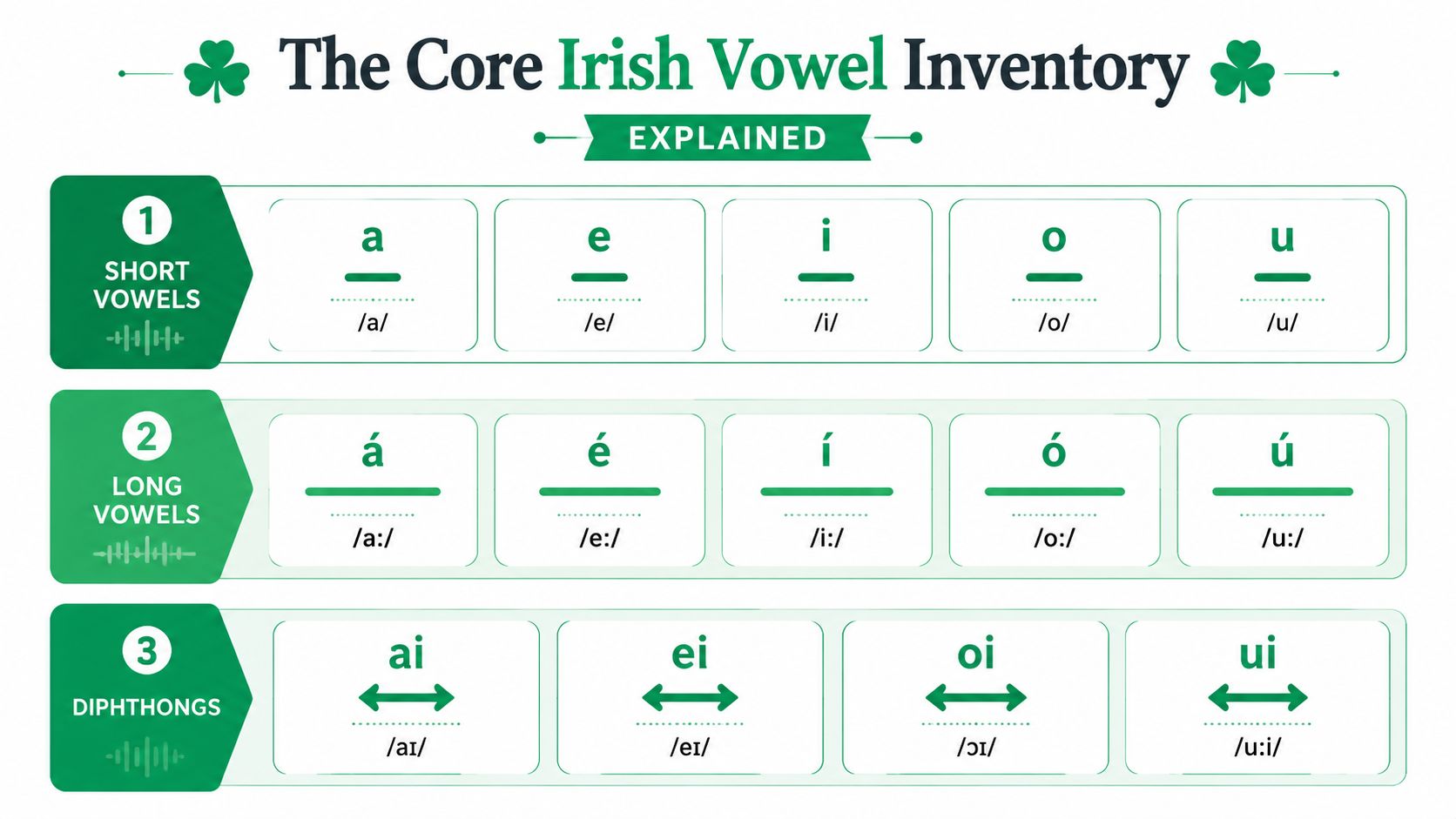
Irish vowel learning becomes easier once you separate short vowels, long vowels, and diphthongs. The language also uses the síneadh fada to mark long vowels, and the standard set is á, é, í, ó, ú. Unaccented vowels are short, while an accented vowel in a combination carries the long sound.

Here's the core inventory learners usually need first.

A chart showing the core Irish vowel inventory including short vowels, long vowels, and diphthong sounds.

Short vowels and long vowels

The core Irish vowel system is best understood as a set of sound patterns shaped by stress and the consonants around them. A useful summary in Key features of Irish phonology shows why the same written vowel can behave differently depending on its phonetic setting.

The commonly analysed monophthongs in Connacht and Munster include /iː, ɪ, uː, ʊ, eː, ɛ, oː, ɔ, aː, a, ə/, alongside 4 diphthongs: /əi, əu, iə, uə/. You do not need to master every IPA symbol on day one, but you do need to know how the system is organised.

A simple learner-friendly way to approach it is this.

  • á is long, often an open ah-like sound.
  • é and í are long, with a stretched quality that is not the same as English's “ay” or “ee.”
  • ó and ú are long, rounded vowels.
  • unaccented vowels stay shorter and more clipped.

A pronunciation guide notes that Irish has two basic vowel types, long and short, with the fada marking the long vowels. Another spelling rule matters too. If one vowel in a combination carries the acute accent, that accented vowel is the one pronounced long, while the surrounding unaccented vowels often serve mainly to shape the neighbouring consonants (Bitesize Irish on sounds and fada).

Reading a word without guessing

The first thing to check is the accented vowel. That is usually the sound you are meant to hold. Then look at the nearby vowels and ask whether they are carrying their own sound or doing spelling work around the consonants.

Learners often rush past this and try to pronounce every written vowel. That creates extra syllables that Irish does not want, and it can make a word sound much less natural. The spelling is giving you a map, but it is a map of the whole sound pattern, not a one-letter, one-sound code.

The core habit to build is simple: read the stressed vowel first, then listen for the consonant setting around it. Once you do that, the vowel inventory stops feeling random and starts behaving like a system you can follow with confidence.

How Broad and Slender Vowels Shape Pronunciation

Irish spelling uses vowels to signal whether a consonant is broad or slender, and that changes pronunciation in a noticeable way. Broad consonants sit beside a, o, u, while slender consonants sit beside i, e. One spelling guide explains that, with a few older exceptions, if an i or e appears on one side of a consonant cluster, it will usually appear on the other side as well, because the spelling is framing the consonant rather than adding a separate vowel sound (Bitesize Irish on the sounds of Irish Gaelic).

Read the vowels as signals around the consonant

That framing is the part learners often miss. In words like beir or bain, the written vowels are doing more than sitting on the page. They tell you what kind of consonant shape to make, and that shape changes how the word comes out.

Broad consonants are usually darker and farther back in the mouth. Slender consonants are palatalised and lighter. The spelling is giving you that mouth position before you even speak.

The same written vowel can behave differently depending on its neighbours. Irish vowel quality is strongly shaped by consonant environment. Every consonant except /h/ has both a velarised, broad form and a palatalised, slender form, and those consonant types affect the vowels beside them (Grammar.ie phonology guide).

A useful rule for beginners

Do not read each vowel letter as if it were standing alone. Read the vowel group as a cue for the consonants around it.

That is the part that helps pronunciation start making sense. A broad consonant and a slender consonant are not just different spellings. They are different mouth settings, a bit like two camera angles on the same scene. The vowel letters tell you which angle to use.

A simple way to test yourself

When you meet a word, ask three quick questions:

  1. Which consonants sit beside the vowel?
  2. Are those consonants broad or slender?
  3. Is the written vowel making its own sound, or marking the consonant quality?

That third question matters more than beginners expect. In Irish, some written vowels are there to show consonant quality rather than create a new syllable. Once you accept that, the spelling starts to look less like a puzzle and more like a set of instructions.

For a fuller look at how these patterns work in real speech, this guide on dialectal differences in Irish is a useful companion. It shows why the same spelling can behave differently once stress and regional pronunciation come into play.

Dialect Differences That Change Vowel Sounds

Irish vowel pronunciation changes across Ulster, Connacht, and Munster, and that variation is part of the language in speech. A spelling can point in one direction on the page and still shift once dialect, stress, and vowel reduction enter the picture. That is why a fixed letter-to-sound chart only gets you so far.

Why one spelling can sound like more than one thing

The sequence ao gives beginners a clear example. In some descriptions it is pronounced roughly like /iː/, while in others it is closer to /eː/. The point is not that one speaker is careless, it is that Irish spelling often carries more than one possible sound path, depending on dialect and the consonants around it.

Unstressed vowels also change the picture. Outside the first syllable, vowels are often reduced to schwa-like sounds, so the word on the page can be lighter and less fully spoken than a learner expects. A useful overview of these patterns appears in Irish speech features and dialect notes, which shows how real speech can trim down vowels that look full in print.

Stress changes the whole vowel pattern

Stress does more than make one syllable louder. It shifts how the nearby vowels behave, almost like pressing one key on a piano and hearing nearby strings vibrate in response. Irish vowel learning works better when you track stress + surrounding consonants + dialect together, instead of trying to force each letter into a single permanent sound.

That matters for pronunciation-first learners who need to hear patterns, not memorize isolated spellings. Dialectal differences in Irish helps with that shift in listening, because it shows why the same spelling can sound different in different regions. Once you start listening this way, the dialect becomes a clue rather than a problem. You stop asking which version is correct and start asking which dialect you are hearing, and how stress is changing the vowels around it.

Common Vowel Mistakes Learners Make

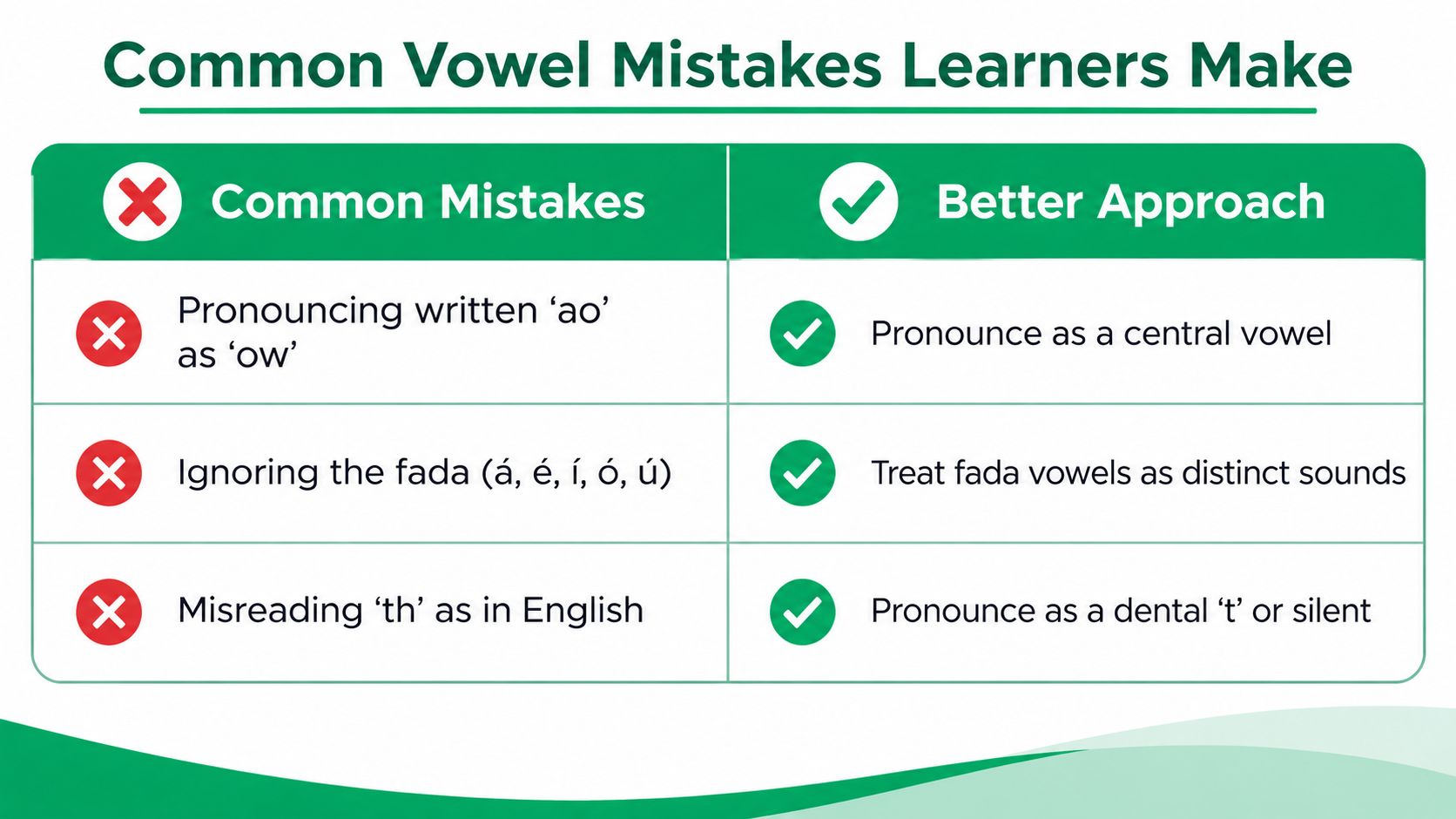
Most vowel mistakes come from good intentions. A learner sees a word, trusts the letters too much, and applies English habits without noticing. The result is usually over-pronounced vowels, the wrong vowel length, or a stressed syllable that sounds unnatural.

A chart illustrating common vowel pronunciation mistakes learners make when learning the Irish language and better alternatives.

The errors that show up most often

Here are the patterns I see again and again:

  • Pronouncing every written vowel separately. Irish often uses vowel letters to shape consonants, so adding an extra syllable can distort the word.
  • Applying English vowel values. English habits make learners turn Irish vowels into familiar sounds that don't belong there.
  • Ignoring the fada. The fada marks long vowels, so treating á, é, í, ó, ú as if they were short changes the word.
  • Forgetting to reduce unstressed vowels. Outside the first syllable, many vowels lose their full weight in natural speech.

A learner may also get tripped up by epenthetic vowels, the brief inserted sounds between certain consonant clusters. Acoustic work on Irish schwa epenthesis found that, for the first five speakers in the study, epenthetic vowels averaged 0.059 seconds while underlying vowels averaged 0.069 seconds, a difference of about 10 milliseconds, and the authors reported that the duration gap was statistically significant (schwa epenthesis study). That's a small but real timing difference, which helps explain why these inserted sounds don't behave exactly like full vowels.

A better correction for each mistake

If you're reading too many vowels, slow down and mark the stressed syllable first. If you're using English vowel values, mute that instinct and listen for the Irish consonant environment around the vowel. If you're ignoring the fada, train yourself to circle it before you say the word.

Practical rule: if a vowel feels “too obvious,” check whether Irish is using it as spelling support rather than as a full sound.

For learners who want help turning audio into something they can review, accuracy tips for transcription can be surprisingly useful as a listening discipline. Careful transcription makes you notice where the vowel starts, ends, and weakens.

Practice Exercises and Tools for Real Progress

Pronunciation improves fastest when you connect what you know to active speaking. Start with tiny drills, then move into words you'll commonly hear in conversations, directions, food, and everyday greetings. The point isn't perfection on day one, it's building a reliable ear for vowel quality, stress, and consonant environment.

Screenshot from https://gaeilgeoir.ai

Three drills that actually build skill

Try this sequence:

  1. Broad versus slender contrast. Say paired words slowly and notice how the consonant changes the vowel feel. Don't rush the letter, focus on the mouth shape.
  2. Fada recognition. Read short lists and mark every accented vowel before speaking. Train your eye to spot length immediately.
  3. Stress pattern practice. Say multi-syllable words with the stress in the right place, then reduce the unstressed vowels so they don't all sound equal.

A listening drill helps too. Pick one dialect at a time, then replay the same word until you can hear whether the vowel is full, reduced, or shaped by the surrounding consonants. That single habit prevents a lot of confusion when you move between recordings.

Tools that support repetition

For guided practice, Gaeilgeoir AI offers conversation-based Irish learning with pronunciation support, adaptive quizzes with instant feedback, and scenario-based practice for everyday situations. Its immersion-first approach is grounded in the 1,000 most-used Irish words, which keeps practice close to the language people use. You can click any word to see translations and save items to a personalized study list, which makes revision more targeted and less random.

If you want a platform that turns pronunciation into a habit instead of a one-off lesson, Gaeilgeoir AI is one option to look at. It also uses points and leaderboards to keep repetition from feeling dull, which matters when you're drilling sounds that only become natural after a lot of reuse. Its pronunciation guide, “Mastering Irish with Our Pronunciation Guide,” is built around hearing the language clearly, not just reading about it.

Your Path Forward with Irish Vowel Mastery

The fastest way to improve Irish vowel sounds is to stop treating them as isolated letters. Think in layers. First, identify the fada and the long/short contrast. Then read for broad and slender consonant context. After that, listen for dialect and for the way stress changes the vowel shape.

A practical roadmap you can keep using

Start with these milestones:

  • Phase one, length. Spot every fada automatically and hear the difference between long and short vowels.
  • Phase two, consonant environment. Notice whether the surrounding consonants are broad or slender before you pronounce the vowel.
  • Phase three, real speech. Listen across dialects and adjust for stress, reduced vowels, and natural timing.

That sequence keeps you from memorizing fragments that don't hold up in conversation. It also gives you a way to measure progress without chasing perfection. If you can read a word, identify the stressed syllable, and explain why a vowel sounds the way it does, you're already moving like a real learner.

The big shift is mental. Irish vowels aren't a pile of exceptions to survive. They're a pattern you can learn to hear.


If you want structured practice that connects pronunciation, listening, and speaking in one place, visit Gaeilgeoir AI. It gives you guided conversation practice, instant feedback, and word-level study tools that fit this exact problem, learning to hear Irish vowels in real speech.

How to Use Spaced Repetition: Irish Vocabulary Guide

You can spend an hour making Irish flashcards, feel sure you've finally got seo, chomh, or a whole verb pattern into your head, then freeze when someone asks you to use it out loud. That gap between “I studied it” and “I can say it” is exactly where spaced repetition earns its keep, especially for Irish, where mutations, conjugations, and set phrases all have to show up at the right moment.

If you've been guessing at revision intervals or making random piles of vocabulary, you're not failing at Irish. You just need a system that keeps bringing the right material back before it slips away.

Table of Contents

Why Your Irish Vocabulary Keeps Slipping Away

A learner will often tell me the same story. They study a list of Irish words on Sunday, recognise them on Monday, then blank on Wednesday when the sentence is slightly different. The word didn't vanish, but the brain did what brains do when information isn't revisited at the right time, it started filing it away as optional.

Why cramming feels useful and then falls apart

Cramming gives a short burst of familiarity. You can look at bád, teach, or cailín and think, “Yes, I know this,” because the words are still warm from the last review. But language doesn't reward warm familiarity, it rewards retrieval under pressure, and that's where spaced repetition beats one long study session.

Irish adds another layer because the thing you need to remember is often not just the base word. You need to remember whether it changes after an article, whether it mutates, and whether the phrase lives comfortably in a real conversation. A simple list of English-Irish pairs won't train that kind of memory.

If you want a broader overview of the method, the spaced repetition guide from MasteryMind is a useful companion read, especially if you're trying to understand the logic before you build your own routine. For a more Irish-specific starting point, keep your own word bank close to a learn Irish words page or notebook so you're not hunting through scattered lists later.

Practical rule: if you can recognise a word but can't produce it in a sentence, it isn't secure yet.

Why Irish makes repetition more important, not less

Irish vocabulary is tied to grammar in a way that pure memorisation doesn't always prepare you for. A learner might know bean, but still hesitate when the form changes in a sentence. The same goes for verbs, where one learned item can split into several usable forms depending on tense and context.

That's why spaced repetition matters so much for Irish. It keeps returning words to your attention after the first burst of learning has faded, and it gives you repeated chances to meet them in slightly different forms. That repetition is what turns isolated knowledge into something you can use.

The Science Behind Spaced Repetition

A learner opens a notebook, reviews a few Irish phrases, and feels confident for the moment. A week later, the same forms are hazier, especially the ones that changed after lenition, eclipsis, or a verb ending that looked familiar but never quite stayed put. That gap between recognition and recall is exactly what how to use spaced repetition is designed to address.

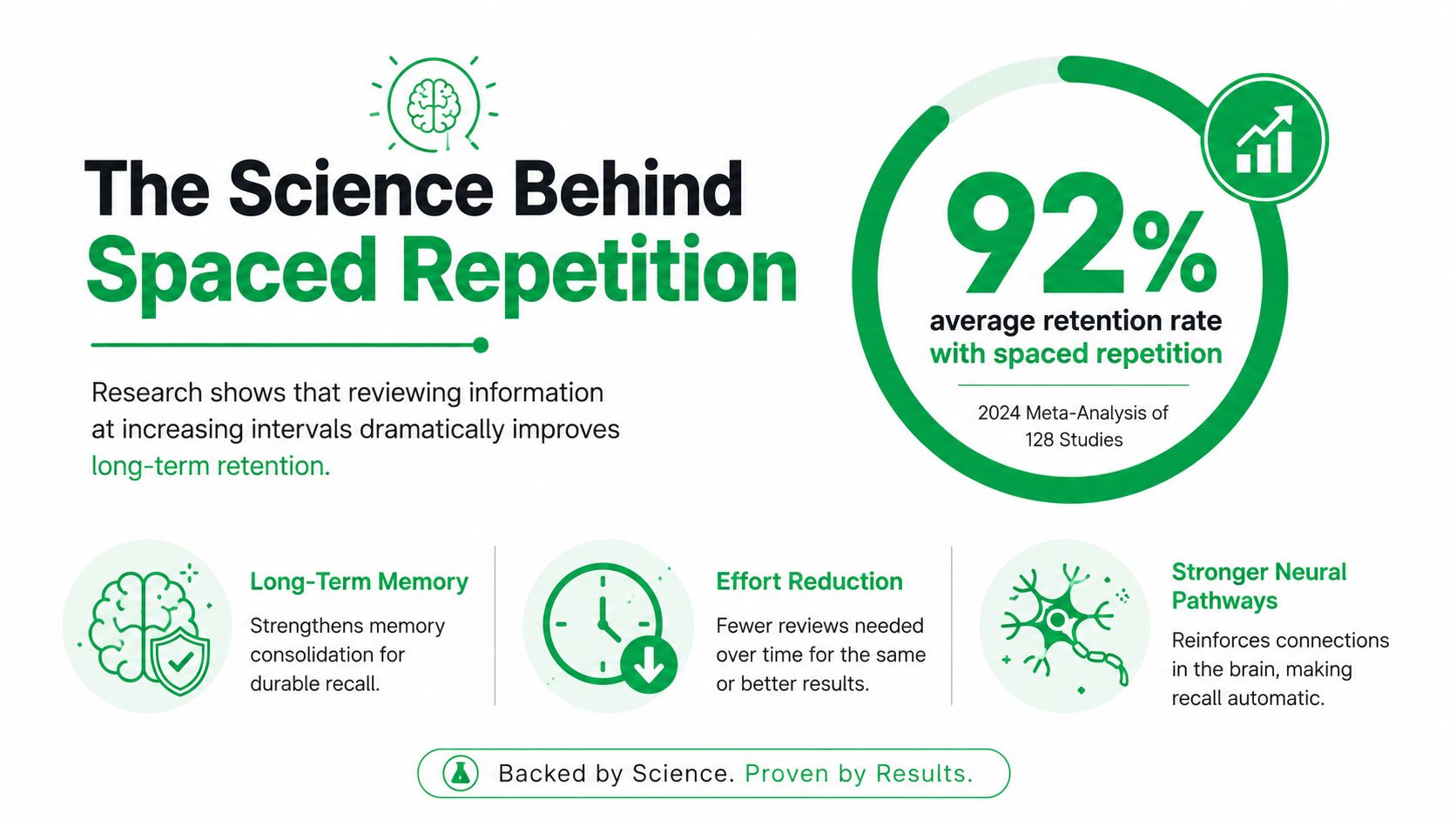
The strongest case for the method comes from the research, not from habit or trendiness. A 2024 systematic review and meta-analysis in medical education found that spaced repetition outperformed standard studying across 21,415 learners, with an overall standardized mean difference of 0.78 (PubMed). The review included 14 studies, with 13 entering the meta-analysis, so the result rests on more than a single classroom trial.

An infographic showing the benefits of spaced repetition for long-term memory retention and learning efficiency.

Why the timing matters

The spacing effect comes down to timing. A major review of spacing research reported that after a 7-day delay, a 1-day spacing interval produced about 86% recall, while a 10-day spacing interval produced around 62% recall (PMC review). In another study summarized there, after a 7-day delay, a 3-day interval yielded 83.1% retention and a 14-day interval yielded 80.9%.

Those numbers matter because they show the schedule itself changes what sticks. The best interval is not fixed in stone. It depends on the task and the amount of relearning involved. For Irish, that means a noun, a mutation pattern, and a conversational phrase may each need a different review rhythm.

What this means for Irish learners

Irish asks for more than recognition. You need recall that still works after a word changes shape in a sentence, and you need enough repetition for those changes to feel ordinary. A learner who knows bean on a flashcard may still hesitate when it appears after an article or in a mutated form. The same problem shows up with verbs, where one learned item can split into several usable forms depending on tense and context.

Spaced repetition fits that challenge because it keeps bringing material back just before it slips away. Each return asks your brain to rebuild the answer instead of passively rereading it, and that effort strengthens access over time. For Irish, that matters most with the pieces that sound simple in a list but become slippery in real speech, especially mutations, verb conjugations, and set phrases you want ready in conversation.

The point is not to review everything every day. The point is to revisit material at the moment it starts becoming slightly harder to recall.

That is why the method works so well for long-term retention. It does not just show the same item again. It makes retrieval effort do part of the work, which is exactly what Irish learners need when a phrase has to come out quickly and correctly in conversation.

Choosing Your Spaced Repetition Tools

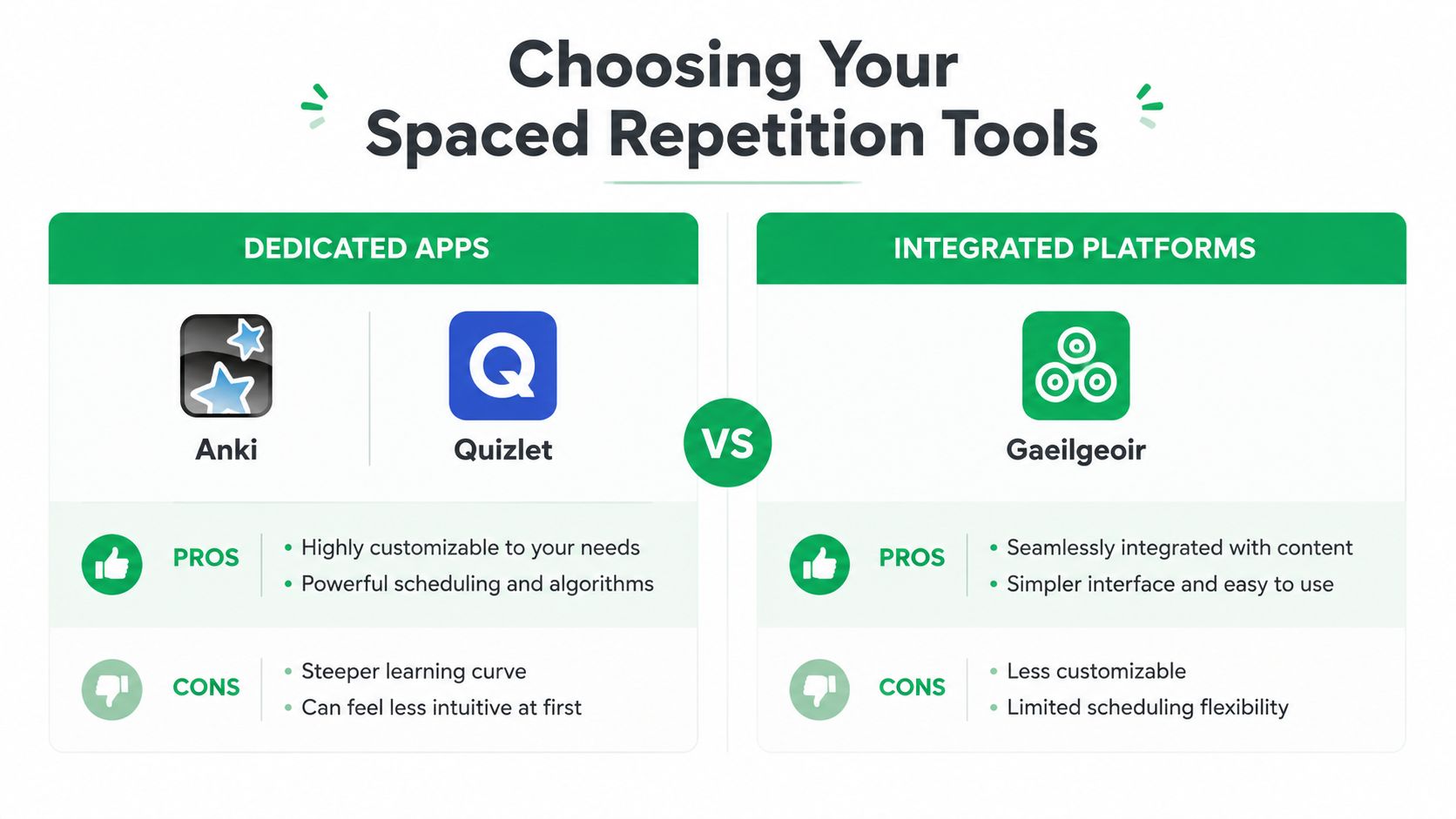
Start with the tool you will keep using. Dedicated apps like Anki and Quizlet give you more control over card design and review timing, while integrated platforms keep everything in one place and reduce the number of steps between study and review. For Irish learners, that difference matters because a tool only helps if it fits the way you already study.

A comparison chart outlining the pros and cons of using dedicated spaced repetition apps versus integrated platforms.

Dedicated apps and when they fit

Anki works well for learners who want to shape every part of the system, from card format to tags to scheduling. Quizlet is easier to start with and can suit anyone who wants less setup before reviewing. Both can be useful if you like building your own deck and do not mind spending time arranging it.

For Irish, that control is useful because a good card often needs to capture more than a translation. A noun may need its mutation pattern, a verb may need several forms, and a phrase may need the exact wording you would say aloud. If your app lets you separate those pieces cleanly, you can review the form you need instead of a vague approximation.

Integrated platforms and when they help

Some learners stay more consistent when revision sits inside the same space as the rest of their study. Gaeilgeoir AI combines guided practice, topic-based quizzes, and a personal vocabulary list, so you are not jumping between tools while trying to keep a habit alive. That matters on busy days, because the obstacle is often follow-through, not understanding the method. If you want a closer look at how a structured card set can support Irish study, the Irish language flashcards page shows that approach in a practical format.

Good tool choice: the one you will open again tomorrow without negotiating with yourself.

There is also a useful language learning without Anki discussion that makes the case for choosing a system based on your own habits rather than on reputation alone.

What to look for before you commit

Choose the option that supports pronunciation, context, and adaptive review. A deck full of isolated word pairs can feel productive, but it will not help much if your real goal is speaking. For Irish, the tool should let you hear forms, see them in context, and review them often enough that mutations, conjugations, and conversational phrases stop feeling like special cases.

The best setup is the one that keeps presenting the right item at the right moment, without turning preparation into a second job.

Creating Flashcards That Actually Work for Irish

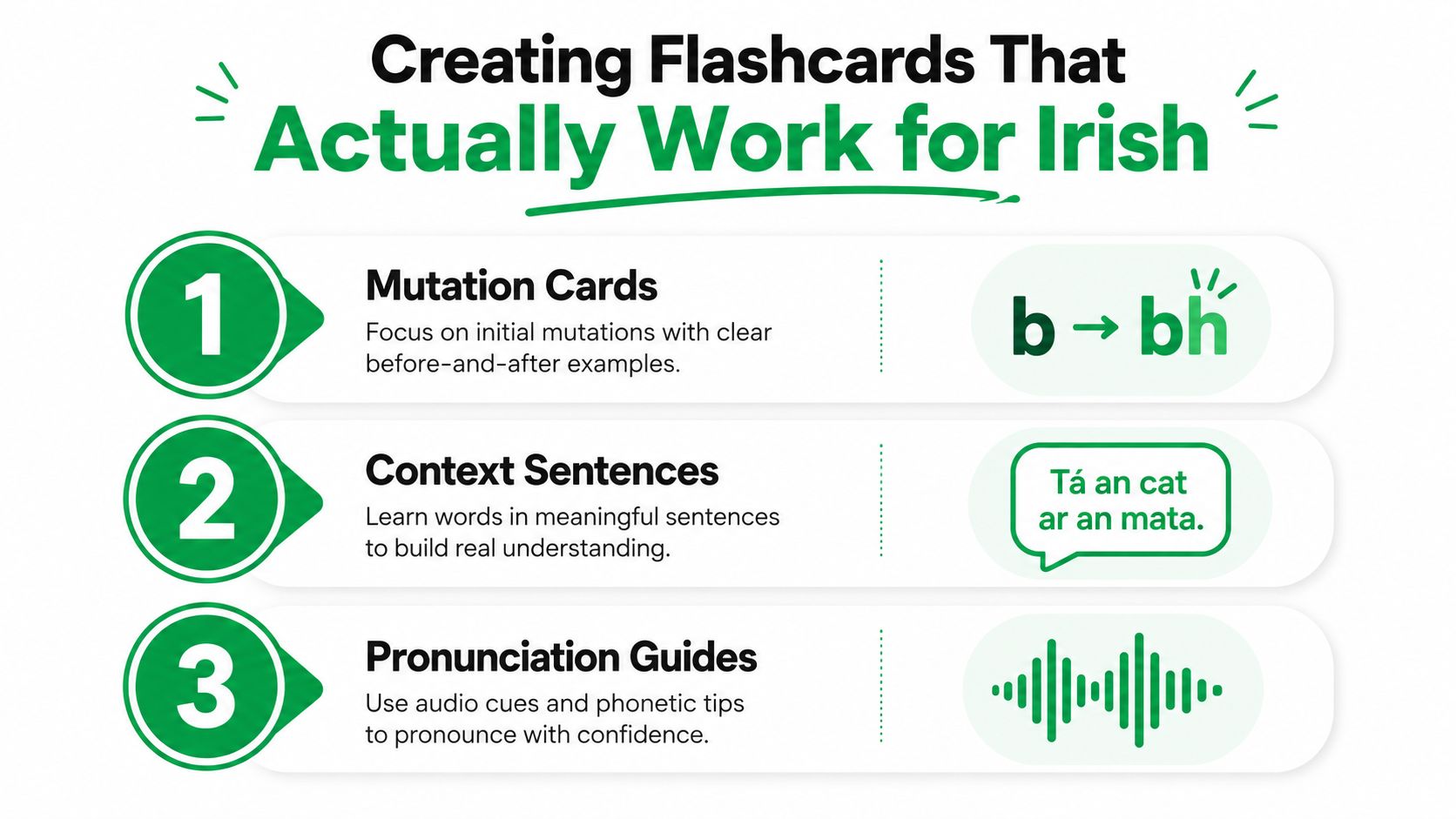
A flashcard should teach one usable thing, not four. If you crowd too much onto a card, you end up recognising the answer instead of recalling it, and that is a weak form of knowledge for Irish. A clean card is easier to retrieve under pressure, especially when you are trying to speak and not just recognise words on a screen.

An infographic showing three effective strategies for creating flashcards to learn the Irish language.

Build cards around mutations and forms

Irish learners need cards that respect séimhiú and urú. A card for bean should not stay frozen as a dictionary entry if the form you need changes in context. Make the prompt specific enough that you are forced to recall the version that belongs in the sentence, because the mutation is part of the language, not decoration.

The advice on atomic cards from independent spaced repetition guidance becomes very relevant here. Long sequences make poor flashcard targets, so do not try to cram whole paragraphs into one review item. Keep the learning unit small enough that your brain has to retrieve the exact answer, not a fuzzy approximation.

Use sentences for phrases and grammar

For conversational Irish, a bare word is often the wrong unit. A phrase like Tá mé… or An bhfuil tú… belongs in a sentence because that is how you will need it in speech. Sentence cards also show how verbs, pronouns, and word order work together instead of leaving them as disconnected rules.

Practical rule: if a phrase only makes sense in a full sentence, make the card a full sentence.

That rule helps with verb conjugations too. A card that asks for one form in isolation can still be useful, but a card that places the verb inside a real utterance trains both recall and use. For Irish, that extra context often separates knowing a form from being able to say it naturally.

Add pronunciation support without clutter

Pronunciation matters, but it should not bury the main task. Add a sound guide, audio, or a brief phonetic note when a word is likely to be pronounced differently from how an English speaker might guess. Keep it short, because the card still needs to act as a retrieval cue, not a mini textbook.

If you want a practical home for these kinds of cards, the Irish language flashcards page is a useful model for a cleaner study set. And if you want a broader argument for choosing study habits that fit real life, the language learning without Anki discussion is a good reminder that the quality of the review item matters more than the reputation of the tool.

Setting Up Your Review Schedule

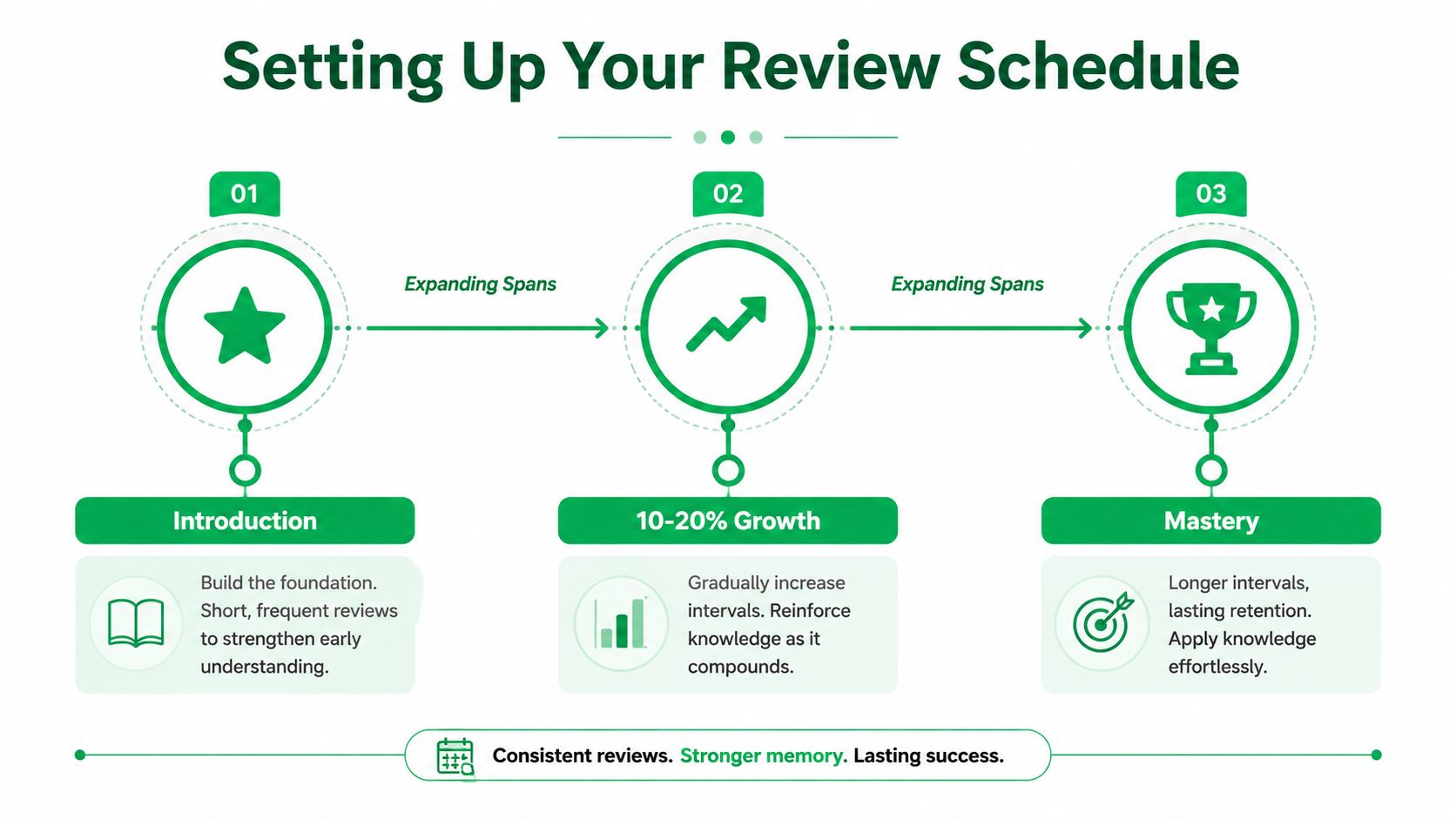
The simplest way to think about spacing is this, the next review should come after a little forgetting has happened, not before and not too late. One practical planning rule from Learner Lab is the 10–20% rule, which treats the time you need to remember something as a starting point for deciding how long the interval should be (Learner Lab). That gives you a rough way to think about review length without pretending every item deserves the same schedule.

A diagram illustrating a spaced repetition review schedule with three stages: Introduction, 10-20% Growth, and Mastery.

Start small, then expand the gap

Khan Academy's guidance is straightforward, begin with a manageable amount of material, use flash cards or spaced-repetition software such as Quizlet or Anki, and make the later reviews longer for items you remember well while shortening the interval for items that still feel shaky (Khan Academy). That matters for Irish because some words settle quickly while verb patterns may need more repeats before they feel stable.

A university guide from Birmingham City University also recommends adapting review frequency based on how well material is remembered, rather than forcing one fixed cadence for everything (BCU spaced repetition guide). That's the right mindset for Irish, especially when you're balancing vocabulary, mutations, and speaking practice.

Reverse-plan when the deadline is fixed

If you're working toward the Leaving Cert or another fixed date, work backward from that deadline instead of hoping the calendar will sort itself out. A reverse-planned schedule keeps the final review close enough to the exam that the material is fresh, while earlier reviews do the heavier lifting. A home study routine can help here too, and a practical overview of that kind of structure is available in how to create a home study routine from Boss as a Service.

Use performance to decide the next interval

The point of the schedule is feedback. If a card comes back easily, it deserves more space before the next review. If you miss it or hesitate, shorten the gap and bring it back sooner.

The daily Irish practice plan can sit alongside this approach when you need a simple routine rather than a complex system. And if your material includes spoken phrases, the embedded video below is a useful reminder that consistency matters more than perfect timing.

Common Mistakes That Sabotage Your Progress

The biggest mistake is not missing a day. The problem is building a system so heavy that you stop trusting it. Learners often create too many cards at once, review them passively, and then decide spaced repetition “doesn't work” because the deck became unmanageable.

Too many cards, too fast

A huge deck feels ambitious on day one and discouraging by day four. If you keep adding every interesting word you meet, you end up with a pile of half-learned items that all need attention at once. Start with material you need, not every word you like the sound of.

Passive review is a trap

Reading a card and thinking, “Yes, I know that,” is not the same as retrieving it. You need to cover the answer, say it, write it, or choose it before you see it. Active recall is the part that does the work.

If you're only recognising the answer, you're rehearsing familiarity, not memory.

Don't ignore hard cards

Hard items aren't clutter, they're the point. A card you miss should come back sooner, not disappear because it's annoying. That's especially true in Irish, where one troublesome mutation or verb form can block a whole sentence.

A detailed math-facts workflow shows how strict this can get in practice, with missed facts shown again before the session ends and reviewed the next day, while fast correct answers move out to longer gaps such as 3 days, 7 days, 14 days, and 30 days (math facts implementation). The exact timing there is for math facts, but the principle is useful for language learners too, difficult items need tighter attention, and easy items can wait longer.

Keep consistency ahead of intensity

A short review done regularly beats a heroic session you can't repeat. If you miss a day, restart calmly instead of scrapping the system. Spaced repetition only helps when it stays part of ordinary study life.


If you want Irish practice that already includes topic-based quizzes, pronunciation support, and a personal list for words you want to see again, Gaeilgeoir AI gives you a structured place to apply spaced repetition without building everything from scratch. Try it with a few words you keep forgetting, then let the review system do the remembering for you.

Start Speaking Irish Today — 25% Off
Use code START25

Learn real Irish for real life with guided practice, pronunciation support, and everyday conversations.

Get 25% off any plan with code START25

Start Speaking Irish Today — 25% Off