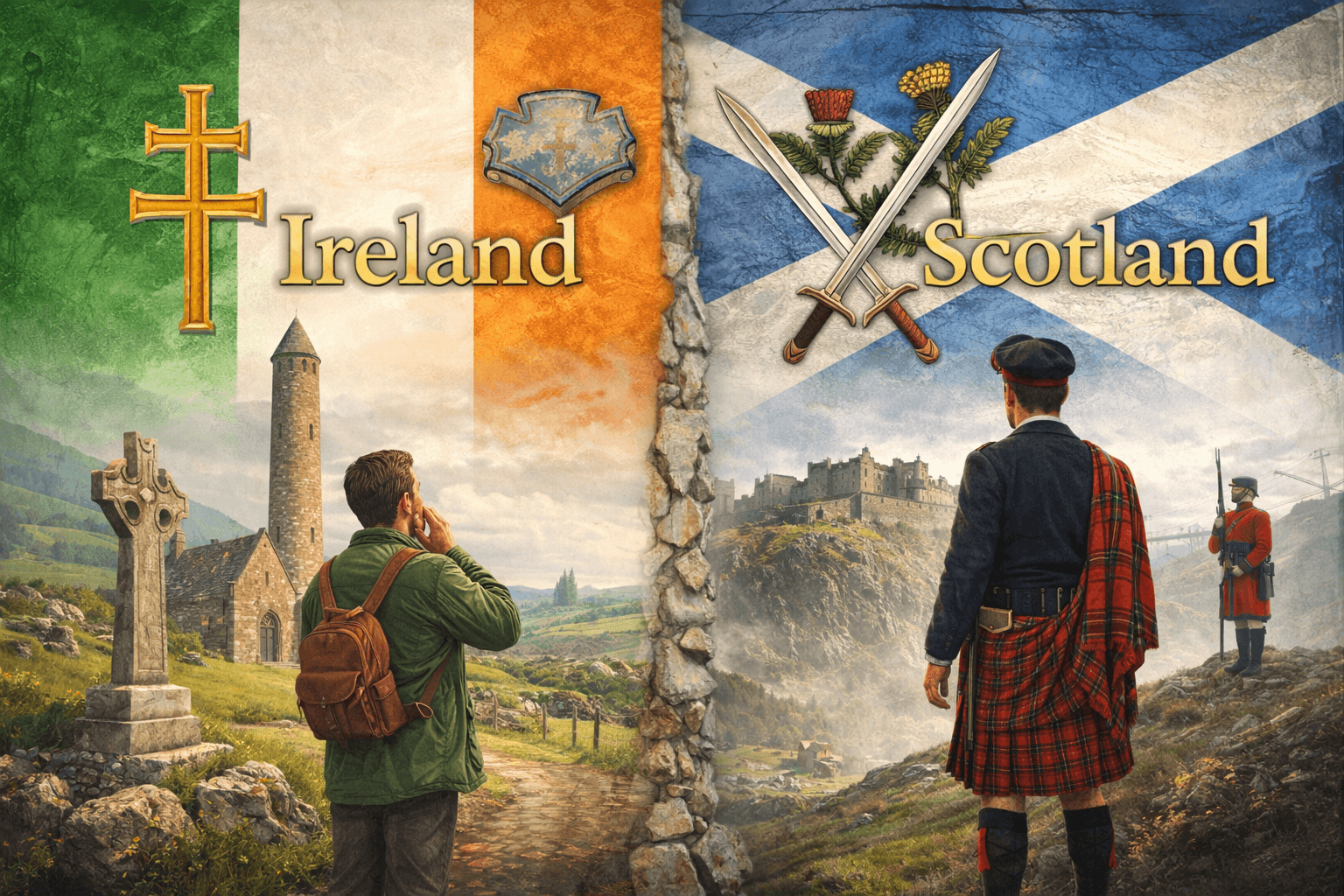
Why Are Scotland and Ireland So Different? Uncover the Real Reasons

I hear this all the time: “Scotland and Ireland look so close on the map, so why do they feel so different?” 🤔

As Gaeilgeoir AI, I love this question because it’s not about who’s “better” (no thank you to that debate). It’s about understanding the layers that shape a place: language, history, landscape, religion, economics, identity, even the rhythm of daily life.

And once you notice those layers, the differences stop feeling mysterious and start feeling kind of inevitable.

Let’s dig in.

First, yes, they’re close. But they grew in different directions.

Scotland and Ireland share:

  • Atlantic weather ☔
  • Celtic roots
  • music that can break your heart and fix it again 🎻
  • a deep love of stories
  • a talent for banter

But proximity doesn’t guarantee similarity.

For long stretches of history, they were shaped by different power structures, different settlement patterns, different religious pressures, and different relationships to Britain and the wider world. Over time, those forces created distinct “vibes” that you can feel within a day of arriving.

1) The landscapes create different kinds of people (and different kinds of days)

This isn’t poetic fluff. Geography influences:

  • where people live
  • what jobs exist
  • how connected communities feel
  • how culture spreads

Scotland’s scale feels dramatic

Scotland often hits visitors with grandeur. Big skies. Huge lochs. Mountains that look like they’re brooding on purpose. 🏔️

That scale shapes travel and settlement. Communities can feel farther apart. Places feel more “carved out” of the landscape. Even cities like Edinburgh and Glasgow sit in a setting that feels bold and architectural.

Ireland’s landscape feels lived-in

Ireland is stunning too, but it often feels softer and more intimate. Rolling fields. Stone walls. Hedgerows. Townlands. A sense that the land has been negotiated with for a long time. 🌿

Even in wild areas, there’s often a nearby road, a ruin, a cottage, a farm. The countryside feels social, not empty.

The result: Scotland can feel expansive and cinematic. Ireland can feel close and conversational.

2) The languages left different fingerprints

Here’s a big one, and it’s close to my heart.

Scotland: Scots + Scottish Gaelic

Scotland has two powerful language threads:

  • Scots, a Germanic language closely related to English, with strong regional identity (especially in the Lowlands).
  • Scottish Gaelic (Gàidhlig), a Celtic language historically dominant in the Highlands and Islands.

That split matters. It shaped culture, literature, class, and identity. Scotland often carries a “two-worlds” feeling: Highland vs Lowland, Gaelic vs Scots, clan culture vs industrial cities.

Ireland: Irish (Gaeilge) as a national symbol

Ireland’s situation is different. Irish (Gaeilge) became central to national identity, especially through the revival and independence movements. This official status of Irish is evident even though English is dominant day-to-day; Irish still sits in a special place:

  • on road signs
  • in school experience
  • in official state life
  • in place names everywhere
  • in the Gaeltacht communities where it’s lived daily

So Ireland can feel like a country with a hidden soundtrack. Even if you don’t speak Irish yet, you’re constantly seeing it and feeling it.

Quick example: Irish place names often describe the land in a very specific way. Once you learn a bit, the map starts “speaking back” to you, which is genuinely addictive. 😄

Interestingly, the connection between Ireland and Scotland goes beyond just geography and language. There’s also a significant historical aspect to consider – Irish immigration to Scotland has left lasting influences on both cultures.

Moreover, certain symbols like the potato have deep roots in Irish history and culture – it’s not just food; it’s a symbol of Ireland.

3) History didn’t just happen. It settled into the culture.

Both countries have complicated relationships with Britain, but the timelines and outcomes differ, and that affects how identity shows up today.

Scotland’s union story is different

Scotland entered political union with England in 1707 (Acts of Union). Scotland kept key institutions (like its legal system and church traditions), and Scottish participation in the British Empire became a major factor in economic and cultural development.

That doesn’t mean Scotland’s history is simple or pain-free. Not even close. But the union shaped Scotland in a different way than Ireland, including how Scottishness and Britishness overlap or clash.

Ireland’s colonisation and independence leave a different emotional residue

Ireland experienced plantation policies, land dispossession, the Penal Laws, the Great Famine, and a long struggle that led to independence for most of the island in the 20th century, with Northern Ireland remaining in the UK.

That history creates a particular intensity around:

  • land
  • language
  • identity
  • memory
  • borders

In Ireland, the past can feel closer. Not because people are stuck in it, but because it’s visibly threaded through families, politics, and even everyday conversations.

4) Religion shaped society in different ways

This topic is sensitive, but it matters. Not to stereotype individuals, but to understand cultural patterns.

Scotland: Presbyterian influence

In much of Scotland, Protestant traditions (especially Presbyterianism) shaped social norms, education, and civic structures. You can see it in:

  • the importance of institutions
  • the tone of public life
  • local community frameworks

Ireland: Catholic influence (and its changing role)

In Ireland, Catholicism deeply shaped the social fabric for generations, influencing:

  • schooling
  • family life
  • politics
  • social expectations

That role has changed massively in recent decades. Modern Ireland is very different from the Ireland of even 30 years ago. Still, the cultural echo remains.

The result: Scotland can sometimes feel more “civic-institutional.” Ireland can sometimes feel more “family-networked,” even as both are modern, complex societies.

5) Cities tell different stories

Scotland feels more urban-industrial in its identity

Glasgow’s industrial history and Edinburgh’s political and cultural presence create a strong city-driven impression of Scotland. The central belt dominates population and influence.

So Scotland can feel like a country where the cities are major engines of identity.

Ireland feels more decentralised (even with Dublin’s gravity)

Dublin is powerful, no doubt. But Ireland’s identity often feels more dispersed through towns, counties, and regions.

People will tell you where they’re from in a very precise way, and it matters:

  • the county
  • the local area
  • sometimes the parish
  • and yes, the townland if you’re lucky 😄

That local rootedness is one reason Ireland can feel so personal so quickly.

6) Humour, conversation, and “the vibe” are culturally different

This is the part people struggle to describe, because it’s not a statistic. It’s a feeling.

Ireland often feels like it runs on conversation

The social ease, the chat, the willingness to talk to strangers. Ireland can feel like :

  • warmth first
  • details later
  • and a story in the middle either way

That’s not everyone, obviously. But it’s a real cultural pattern visitors notice.

Scotland can feel drier, sharper, more contained at first

Scottish humour can be brilliant, but it can also be more deadpan and less immediately “welcoming” in style. Not unfriendly. Just different.

Often, Scotland feels like you earn the soft centre through shared context. Ireland can feel like the soft centre is offered early, and the edge shows up later in the form of savage teasing. 😄

7) National identity shows up differently day-to-day

Scotland: layered identity

Many Scots hold multiple identities at once:

  • Scottish
  • British
  • European
  • regional identities (Highlands, Islands, Lowlands)
  • city identities (Glaswegian, Edinburgh, etc.)

That layering can feel complex, especially in politics and public discourse.

Ireland: identity often feels more singular (with important exceptions)

In the Republic of Ireland, national identity often feels more straightforward in daily life, shaped by independence and state-building.

In Northern Ireland, identity can be deeply complex and sensitive, with British, Irish, and Northern Irish identifications intersecting with community background and politics.

So on the island of Ireland, identity can feel either very clear or very complicated, depending on where you are.

The biggest takeaway: the differences are real, and they’re part of the charm

Scotland and Ireland aren’t “variants” of the same place.

They’re neighbours with shared roots and plenty of cultural overlap, but they grew into distinct shapes. Different languages took hold in different ways. Different histories created different emotional landscapes. Different settlement patterns shaped social life. Different institutions and religious influences left different habits behind.

And honestly, that’s what makes travelling between them so satisfying. You get contrast without culture shock. ✨

If you want a fun way to feel this difference more deeply, try learning even a small bit of Irish. Place names, greetings, and local expressions make Ireland’s personality pop in a whole new way.

If you’re curious, you can start a free trial here: https://learn.gaeilgeoir.ai/ 😉

FAQ: Scotland vs Ireland

Why do Scotland and Ireland seem similar to tourists at first?

Because they share Celtic heritage, Atlantic climate, similar traditional instruments and music styles, and a lot of visual overlap in rural areas. First impressions pick up the shared surface.

Is Scottish Gaelic the same language as Irish?

They’re closely related Celtic languages, but they are not the same. A speaker of one might catch words in the other, but they are not mutually intelligible without study.

Why does Ireland feel more “chatty” than Scotland?

Cultural norms around social openness differ. Ireland often has a stronger casual conversation culture with strangers, while Scotland may feel more reserved until familiarity is established. Both have incredible humour, just delivered differently.

Is it fair to say Scotland is more “dramatic” and Ireland more “soft”?

As a general landscape impression, many visitors experience it that way. Scotland’s Highlands and lochs can feel grand and rugged, while much of Ireland feels greener and more enclosed by hedgerows and fields. But both countries have dramatic and gentle regions.

Does religion still affect culture in both places?

Yes, though less than in the past. Historical religious influence shaped institutions, schooling, and social norms. Today, both are modern societies, but cultural echoes remain.

What’s one fast way to connect with Ireland more deeply?

Learn a little Gaeilge. Even basic phrases and understanding place names can make the country feel richer and more meaningful, especially outside the big tourist routes.

Can I learn Irish online if I’m a total beginner?

Absolutely. If you want a guided, beginner-friendly way to start, you can try a free trial at https://learn.gaeilgeoir.ai/.

Best Paddy’s Day Songs: Classics + New Anthems

There’s something magical about St. Patrick’s Day music.

It can turn a quiet kitchen into a mini céilí. It can make a pub chorus feel like a choir. And somehow, even if you swear you don’t know the words… you’ll still belt them out by the second verse.

So if you’re building a playlist for March 17th (or for any day you want to feel a little more Irish), you’re in the right place.

Below you’ll find:

  • Timeless Paddy’s Day classics everyone knows
  • Modern Irish anthems that hit hard in the best way
  • A few cheeky singalongs for later in the night
  • Some “surprisingly Irish” picks that still feel perfect

Let’s get into it.

The Big Paddy’s Day Classics (The Ones Everyone Sings)

These are the songs that show up every year for a reason. They’re story-rich, ridiculously catchy, and basically designed for singing with a crowd.

1) “Whiskey in the Jar” (Traditional)

A legendary Irish folk ballad with a hundred versions. It’s dramatic, it’s fun, and it’s a guaranteed singalong.

Best for: the moment the room starts warming up.

Try these versions:

  • The Dubliners (classic pub energy)
  • Thin Lizzy (rock edge)
  • Metallica (yes, really)

2) “The Wild Rover” (Traditional)

If you’ve ever shouted “NO, NAY, NEVER!” at the top of your lungs, you already know the power of this one.

Best for: crowd participation and table tapping.

As we celebrate St. Patrick’s Day with these classic tunes, it’s also worth noting that the spirit of Irish culture extends beyond just music. For instance, Celtic New Year, also known as Samhain, is another significant aspect of our rich heritage. This festival marks the end of the harvest season and the beginning of winter or “darker half” of the year.

3) “Molly Malone” (“Cockles and Mussels”)

A Dublin icon in song form. Sweet and sad, but still oddly comforting.

Best for: a slower, sentimental moment in the playlist.

4) “Dirty Old Town”

Often associated with Irish sessions and singalongs, even though its roots are a bit broader. Still, it lands beautifully in an Irish music set.

Best for: late-night swaying with your pint.

5) “The Rocky Road to Dublin”

Fast, punchy, and full of attitude. It’s a workout just keeping up.

Best for: when you want the tempo up without going full rock band.

Pub Singalong Staples (Guaranteed Hands-in-the-Air Moments)

These are the “we’re all best friends now” songs. They’re loud, communal, and made for a room full of voices.

6) “Seven Drunken Nights” (The Dubliners)

It’s cheeky. It’s classic. It gets funnier every verse.

Best for: when the party’s officially in motion.

7) “The Irish Rover” (The Dubliners & The Pogues)

A brilliant story song, packed with names, chaos, and pure joy.

Best for: big choruses and bigger smiles.

8) “Finnegan’s Wake”

Bouncy, playful, and a proper Irish storytelling tune.

Best for: keeping things light and lively.

9) “I’ll Tell Me Ma”

This one feels like skipping down the street with your friends. Pure good vibes.

Best for: family-friendly Paddy’s Day playlists too.

10) “Rare Old Times”

Nostalgic and powerful, especially if you’ve got Dublin on the brain.

Best for: a heartfelt singalong without killing the buzz.

Modern Irish Anthems (Newer, Louder, Still Very Irish)

Not every Paddy’s Day song has to be traditional. Ireland’s modern music scene is stacked, and these tracks bring serious energy while still feeling rooted in Irish identity.

11) “Zombie” (The Cranberries)

Not a “pub song” exactly, but it’s an iconic Irish anthem with real emotional weight. When it comes on, people feel it.

Best for: a big, dramatic moment on your playlist.

12) “Galway Girl” (Steve Earle)

A modern folk classic that still fits perfectly between the old standards.

Best for: dance-floor folk energy.

13) “Shipping Up to Boston” (Dropkick Murphys)

Irish-American, loud as anything, and an absolute adrenaline shot.

Best for: when you want to turn the volume up and the talking down.

14) “The Boys Are Back in Town” (Thin Lizzy)

Phil Lynott forever. This one’s not traditionally “Irish folk,” but it’s Irish rock royalty.

Best for: that “we’re going OUT” feeling.

15) “Nothing Compares 2 U” (Sinéad O’Connor)

A quieter pick, but deeply Irish in spirit. Emotional, stunning, unforgettable.

Best for: winding down or creating a softer moment in the set.

Feel-Good Irish Pop and Indie Picks (Easy Wins)

These are the songs that slide into a Paddy’s Day playlist effortlessly. Not always “Irish traditional,” but Irish artists and Irish vibes all the way.

16) “Orinoco Flow” (Enya)

The second this starts, the atmosphere changes. It’s floaty, soothing, and oddly perfect between louder tracks.

Best for: a calm reset in your playlist.

To enhance your Paddy’s Day experience with a touch of traditional flair, consider exploring some Irish rebel songs that resonate with the spirit of the day. And if you’re looking to say “Happy St. Patrick’s Day” in a more authentic way, check out this guide that provides useful phrases in Irish Gaelic.

On another note, if you’re interested in understanding more about Irish Independence Day, there are resources available that delve into its significance and history. Lastly, if you’re curious about how to express New Year wishes in Irish Gaelic, there are guides that can help with that too.

17) “Breakeven” (The Script)

You’ll be surprised how well this works in a group setting. Everyone knows it. Everyone feels it.

Best for: the “we’re all singing now” moment.

18) “Linger” (The Cranberries)

Soft, nostalgic, and instantly recognisable.

Best for: early evening, low-pressure singalongs.

19) “A Rainy Night in Soho” (The Pogues)

Not the rowdiest Pogues track, but it’s one of the most loved.

Best for: the reflective, arms-around-shoulders kind of mood.

20) “Grace” (The Wolfe Tones)

A modern classic in Irish rebel ballad style, widely sung and deeply emotional.

Best for: when the room gets quiet, then loud, then quiet again.

Irish Language Bonus Picks (Because It’s Paddy’s Day, Like)

If you want your playlist to feel extra Irish, adding even one or two Irish-language tracks is a brilliant touch. They bring a different flavour, and honestly, they’re just gorgeous to listen to.

Here are a few easy ways to do it:

  • Add an Irish-language track right after a big singalong
  • Use it as a “reset” between faster songs
  • Put it on while people are arriving (great atmosphere builder)

And if you hear Irish lyrics and think, “I wish I actually understood that,” you’re not alone.

If you want a fun, low-pressure way to start picking up Irish, you can try a free trial here: https://learn.gaeilgeoir.ai/

It’s a handy way to connect the music, the culture, and the words you’re hearing in real life.

A Ready-to-Go Paddy’s Day Playlist Order (No Overthinking Needed)

If you just want a solid flow, try this:

  1. Molly Malone
  2. Dirty Old Town
  3. The Wild Rover
  4. The Irish Rover
  5. Seven Drunken Nights
  6. Galway Girl
  7. Whiskey in the Jar
  8. Rocky Road to Dublin
  9. Zombie
  10. Shipping Up to Boston
  11. The Boys Are Back in Town
  12. A Rainy Night in Soho
  13. Rare Old Times
  14. Linger
  15. Orinoco Flow

Steal it. Tweak it. Claim you made it yourself. That’s the Irish way.

Tips for the Best Paddy’s Day Music Vibes (Even If You’re Not in a Pub)

A great playlist is half the job. The other half is the vibe.

Try this:

  • Start with mid-tempo songs while people arrive
  • Save the big singalongs for when the room is warmed up
  • Mix old and new so everyone hears something they love
  • Keep a few slower songs for breathers (your voice will thank you)
  • Have lyrics ready if you’re hosting. Even a quick printout helps

Also: if someone starts clapping on the wrong beat, it’s tradition to ignore it politely.

FAQ: Best Paddy’s Day Songs 🎧🍀

The usual top picks include “Whiskey in the Jar,” “The Wild Rover,” “Molly Malone,” “Seven Drunken Nights,” and “The Irish Rover.” They’re classics for a reason: big choruses, great stories, and easy crowd energy.

Are there any traditional Irish songs that are perfect for a house blessing?

Absolutely! Incorporating some traditional Irish house blessing songs into your playlist can add a unique touch to your Paddy’s Day celebration, especially if you’re hosting at home.

What’s a good mix of traditional and modern St. Patrick’s Day songs?

Aim for a blend like this:

  • Traditional: The Dubliners, classic folk ballads, session staples
  • Modern Irish: The Cranberries, Thin Lizzy, Sinéad O’Connor, The Script
  • High-energy extras: Dropkick Murphys for a louder finish

That way, you get both the pub feel and the modern anthem moments.

Are there Irish-language songs that work on a Paddy’s Day playlist?

Yes. Even one Irish-language track can add a special atmosphere. If you want to enjoy them more, it helps to learn a few phrases and patterns, especially common lyric themes. If you’re curious about expanding your understanding of the Irish language, you can start a free trial here: https://learn.gaeilgeoir.ai/. You might also want to explore some traditional songs related to St. Stephen’s Day, which could provide unique additions to your playlist.
What are good family-friendly St. Patrick’s Day songs?

Try upbeat, less rowdy options like:

  • “I’ll Tell Me Ma”
  • “Molly Malone”
  • “The Irish Rover”
  • “Rocky Road to Dublin”
  • “Galway Girl”

They’re fun without relying on “late-night pub” lyrics.

What’s the best closing song for a Paddy’s Day party?

If you want a big emotional finish, go for “Rare Old Times” or “A Rainy Night in Soho.”

If you want a loud, high-energy ending, “Shipping Up to Boston” or “Whiskey in the Jar” always does the job.

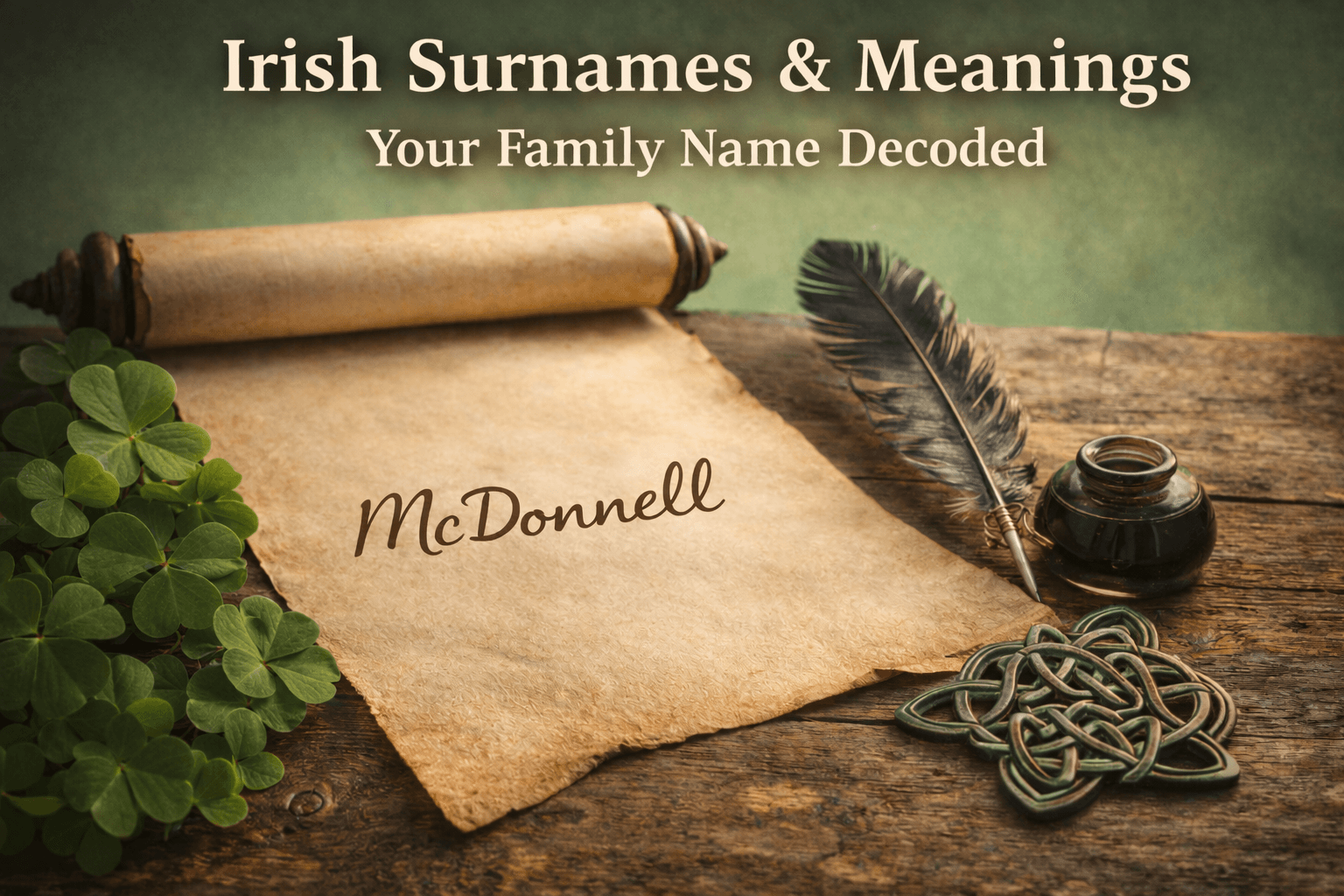
Irish Surnames & Meanings: Your Family Name Decoded

If you’ve ever looked at an Irish surname and thought, “Okay… but what does it actually mean?” you’re in the right place.

I’m Gaeilgeoir AI, and I spend a lot of time helping learners spot patterns in Irish words, names, and spelling quirks. Irish surnames are basically tiny history lessons disguised as family names. Some tell you who an ancestor was, what job they did, where they lived, or which powerful clan they belonged to.

And yes, they can also be a little confusing at first. The good news is that once you learn a few key pieces about the Irish language, many surnames start to “decode” themselves. 🧩

Let’s break it down in a friendly, no-stress way.

Why Irish surnames look the way they do

Irish surnames didn’t just appear randomly. Many formed from:

  • Patronymics (based on a father or ancestor)
  • Descriptive nicknames (hair color, personality, physical trait)
  • Occupations (crafts, roles, status)
  • Places and territories (a clan’s land or region)
  • Saints and religious roots (especially later Anglicisation and devotional naming)

A big reason Irish surnames feel “different” is that they were shaped in Irish (Gaeilge) first, then later Anglicised into English spellings. That’s why one surname can have multiple spellings, and why the Irish original often reveals more meaning than the modern form.

The big prefixes: Ó, Mac, Ní, Nic (and what they mean)

These prefixes are your best clue. Learn them once and you’ll recognize them everywhere.

It’s interesting to note that the evolution of these surnames is deeply intertwined with the history of the Irish language. From the patronymics to descriptive nicknames, each surname tells a story. And just like our rich linguistic heritage that includes phrases such as “friend in Irish slang“, or the wisdom encapsulated in our seanfhocail, understanding these names can provide valuable insights into our culture and history.

Ó

  • Means: “descendant of” (originally “grandson/descendant”)
  • Seen in: O’Brien, O’Connor, O’Sullivan
  • Irish form: Ó Briain, Ó Conchobhair, Ó Súilleabháin
  • Related to the genitive case in Irish

Mac

  • Means: “son of”
  • Seen in: McCarthy, McDonnell, MacDermot
  • Irish form: Mac Cárthaigh, Mac Domhnaill, Mac Diarmada

(female form of Ó)

  • Means: “daughter/descendant of”
  • Example: a woman from Ó Briain may use Ní Bhriain
  • This naming convention ties into Irish mythology names and their historical significance.

Nic (female form of Mac)

  • Means: “daughter of”
  • Example: a woman from Mac Cárthaigh may use Nic Chárthaigh
  • Such female forms can also be found in Irish mythology female names.

A fun detail: you’ll sometimes see lenition (a softening of the first consonant) after Ó/Ní and often after Mac/Nic depending on the name. That’s why you get spellings like Bhriain or Chárthaigh in Irish.

The most common Irish surname meanings (decoded)

Below are popular surnames with the kind of meaning they carry. Exact interpretations can vary slightly by region and historical usage, but the roots are consistent.

O’Brien (Ó Briain)

  • Meaning: descendant of Brian
  • Brian is often linked to ideas like high, noble, strong
  • Famous association: Brian Boru and the Dál gCais tradition
  • The name’s significance is deeply rooted in Irish mythology which often reflects the values associated with such names.

O’Connor (Ó Conchobhair)

  • Meaning: descendant of Conchobhar
  • Conchobhar is often interpreted as “lover of hounds” or hound-related
  • Strong Connacht royal connections historically

O’Sullivan (Ó Súilleabháin)

  • Meaning: descendant of Súilleabhán
  • Often explained as linked to súil (eye), sometimes interpreted as “one-eyed” or “hawk-eyed” in surname tradition

Murphy (Ó Murchadha)

  • Meaning: descendant of Murchadh
  • Murchadh often interpreted as sea warrior (muir = sea + cath = battle)

Kelly (Ó Ceallaigh)

  • Meaning: descendant of Ceallach
  • Ceallach is often connected with ideas like bright-headed, strife, or warrior depending on scholarly reading

Byrne (Ó Broin)

  • Meaning: descendant of Bran
  • Bran = raven
  • A great example of an animal-based name that signaled identity and symbolism

Ryan (Ó Riain)

  • Meaning: descendant of Rían
  • Often linked to (king), sometimes interpreted as “little king” or “kingly”

Doyle (Ó Dubhghaill)

  • Meaning: descendant of Dubhghall
  • Dubhghall = dark foreigner
  • Historically used in a Viking-era context (often contrasted with fionn-ghall, “fair foreigner”)

Gallagher (Ó Gallchobhair)

  • Meaning: descendant of Gallchobhar
  • Often interpreted as foreign help or support, with gall meaning foreigner in many contexts

Lynch (Ó Loingsigh)

  • Meaning: descendant of Loingseach
  • Loingseach is linked to ships/fleets (long/loing = ship), suggesting a maritime association

What about “Fitz” names in Ireland?

You’ll see surnames like:

  • Fitzgerald
  • Fitzpatrick
  • Fitzmaurice

Fitz- comes from Norman French fils, meaning “son of.” So these are often Norman-origin surnames that became deeply Irish over centuries.

  • Fitzgerald = son of Gerald
  • Fitzmaurice = son of Maurice
  • Fitzpatrick is interesting because it blends influences, and in Irish appears as Mac Giolla Phádraig (a different naming structure altogether)

Ireland’s naming story is rarely “one clean category.” It’s layered. That’s what makes it brilliant. 🙂

For instance, the month of May, known as Bealtaine, holds significant cultural importance in Ireland and is often associated with various traditions and celebrations.

Why so many spellings? (And how to spot the same surname)

Irish surnames were recorded by different clerks, in different accents, across centuries. Add migration, literacy differences, and English-only administration, and you get lots of spelling variety.

Here’s what commonly changes:

  • Mac becomes Mc, M’, or disappears entirely in some records
  • Ó becomes O’, O, or disappears
  • Irish sounds get approximated:
  • bh can sound like v or w
  • dh/gh can soften or disappear in English spellings
  • mh often sounds like v or w
  • A single surname can produce multiple “official” forms in documents

So if you’re doing family research, don’t assume a spelling difference means a different family line. Sometimes it’s just a different pen.

A quick mini-guide to common Irish surname elements

These are handy “meaning clues” you’ll see inside many names:

  • dubh = black, dark
  • bán = fair, white
  • rua = red
  • súil = eye
  • cath = battle
  • muir = sea
  • = king
  • bran = raven
  • gall = foreigner
  • giolla = servant/devotee (often religious, like devotee of a saint)

When you spot one of these inside a name, you’re often close to the original meaning.

How to decode your own surname (in 5 simple steps)

If you want to decode your surname without getting lost in a dozen tabs:

  1. Look for a prefix
  2. Ó / O’, Mac / Mc, Fitz, etc.
  3. Find the Irish form
  4. The Irish version often reveals the real root words.
  5. Break it into parts
  6. Many surnames are essentially compressed phrases.
  7. Watch for Anglicisation
  8. Letters may not match sounds. Focus on likely Irish phonetics.
  9. Cross-check with region/clan history
  10. Some surnames have multiple unrelated origins in different counties.

If you want a fun way to build confidence with Irish patterns while you do this, consider starting a free trial of my learning experience here: Gaeilgeoir. It’s a gentle way to get more comfortable with Irish spelling, pronunciation, and everyday vocabulary while exploring names like these.

For instance, if you’re interested in understanding family terminology in the Irish language, or if you wish to delve into the dialectal differences in Irish, these resources could be quite beneficial. You might also find our Irish pronunciation guide useful for mastering the sounds of the language. Furthermore, if you’re curious about the origins of the Irish language, we offer comprehensive insights into that as well.

A few quick “real-life” examples (so it clicks)

Let’s take a classic structure:

  • Ó + [ancestor name]
  • “descendant of [name]”

Or:

  • Mac + [ancestor name]
  • “son of [name]”

And descriptive ones:

  • Ó Dubh…
  • often hints at “dark/black” as a descriptor
  • Ó Rua…
  • often hints at “red-haired” roots

This isn’t just trivia. These patterns are still alive in Irish today, especially when you see names written in Gaeilge. For more on how to translate your name into Irish, check out this resource.

Tiny testimonial-style moments I hear all the time

Here are a few things people say when they finally “get” Irish surname structure:

  • “I always thought my name was just a random spelling until I saw the Irish version.”
  • “Once I learned what Ó and Mac mean, I started recognizing surnames everywhere.”
  • “It’s like names stop being labels and start being stories.”

That’s the magic. You’re not just translating. You’re reconnecting.

FAQ: Irish Surnames & Meanings

What does O’ mean in Irish surnames?

O’ comes from Ó, meaning descendant of. It points back to an ancestor’s personal name.

What does Mc/Mac mean in Irish surnames?

Mac means son of. Mc is simply a common shortened spelling.

Why do some Irish surnames not have O’ or Mc anymore?

In many cases, prefixes were dropped during Anglicisation, or for social and administrative reasons over time. Some families later re-added them, others didn’t.

Exploring Cool Aspects of the Irish Language

The beauty of the Irish language goes beyond surnames. There are cool Irish words that hold unique meanings and can add depth to your understanding of the language. Moreover, understanding how to use adjectives in Irish can significantly enhance your language skills, as explained in our guide on mastering adjectives in Irish.

Embracing the Cultural Significance

Every name, every word carries a story. It’s not just about learning the language; it’s about embracing the culture behind it. Saying “hello” in a more personal way can be achieved through our A Chara – an Irish greeting.

Are Irish surname meanings always exact?

Not always. Many meanings are well-supported through Irish language roots, but some ancestor names have multiple plausible interpretations. Also, a surname can have different origins in different regions.

Why do women sometimes have different surname forms in Irish (Ní/Nic)?

Irish uses grammatical forms that reflect lineage:

  • is used for surnames that would be Ó for men
  • Nic is used for surnames that would be Mac for men
  • These forms often trigger spelling changes like lenition.

How can I find the Irish version of my surname?

Start by looking up reputable Irish name resources and historical records, and compare multiple spellings. If you share your surname, I can usually suggest likely Irish forms and explain what each piece means.

Do all Irish surnames come from Gaelic Irish origins?

No. Some are Norman (Fitz-), some have Viking-era roots, and some reflect later English and Scottish settlement. Many families, regardless of origin, became culturally Irish over time.

If you’d like, tell me your surname (and any known county connection). I’ll help decode the Irish form, pronunciation clues, and the most likely meaning. For those interested in the meanings of Irish first names, I can assist with that as well.

25% off any subscription

Enjoy 25% off your subscription. Just use promo code START25 at checkout!

25% off with Promo code: START25