If you want to say hi in Irish, the two most useful greetings to learn first are Haigh and Dia dhuit. Haigh works like a casual “hi,” while Dia dhuit is the classic traditional hello.
You’re probably here because you want something practical. Maybe you’ve got Irish family, you’re heading to Ireland, you’re brushing up for the Leaving Cert oral, or you just want to stop freezing every time you try to greet someone in Gaeilge. That nervous feeling is normal. Most beginners don’t struggle because Irish is impossible. They struggle because they learn a word list, then nobody tells them what happens next.
That’s why a simple greeting in Irish can feel oddly stressful. You learn one phrase, say it out loud, and then start wondering: Was that too formal? What if I’m speaking to more than one person? What do they say back? What am I supposed to say after that?
The good news is that Irish greetings are learnable fast when you treat them as little conversation patterns instead of isolated vocabulary. Once you know the right phrase, the expected reply, and one easy follow-up, you’re no longer memorising. You’re speaking.
Table of Contents
- Your First Words in Irish Starting with Hello
- The Casual Haigh vs The Traditional Dia Dhuit
- Pronunciation You Can Actually Use
- Greetings for Groups and The All-Important Response
- Beyond Hello Starting a Real Conversation
- Practice Your Irish Greetings with Confidence
Your First Words in Irish Starting with Hello
A lot of learners want their first phrase to feel real, not like something copied from a dusty textbook. That’s a smart instinct. Greetings are where language becomes social.
If you’re meeting one person, Dia dhuit is a strong place to begin. If you want something lighter and more modern, Haigh is easy and friendly. Those two alone cover a lot of everyday situations.

Why this small phrase matters
Irish isn’t some tiny museum language that only appears on road signs. In the 2022 Census, nearly 1.9 million people in Ireland reported being able to speak Irish, representing about 40% of the population, according to Conradh na Gaeilge’s summary of Census facts and figures.
That matters for beginners because it changes the feeling of the whole project. You’re not learning a novelty phrase. You’re stepping into a living language with learners, fluent speakers, heritage speakers, school memories, regional accents, and everyday cultural weight.
Good beginner rule: Learn one greeting well enough to say without panic, then learn the reply that usually comes after it.
Here’s the simplest starting set:
- Haigh means a casual hi.
- Dia dhuit is a traditional hello for one person.
- Conas atá tú? means “How are you?” and helps you keep going.
Your first mini goal
Don’t aim to “know Irish.” Aim to do one smooth exchange.
Try this out loud:
- Dia dhuit
- Dia is Muire dhuit
- Conas atá tú?
That short chain already sounds much more natural than stopping after hello. It also helps calm the beginner fear that you’ll say one phrase and then have nowhere to go.
The Casual Haigh vs The Traditional Dia Dhuit
These two greetings don’t compete with each other. They do different jobs.
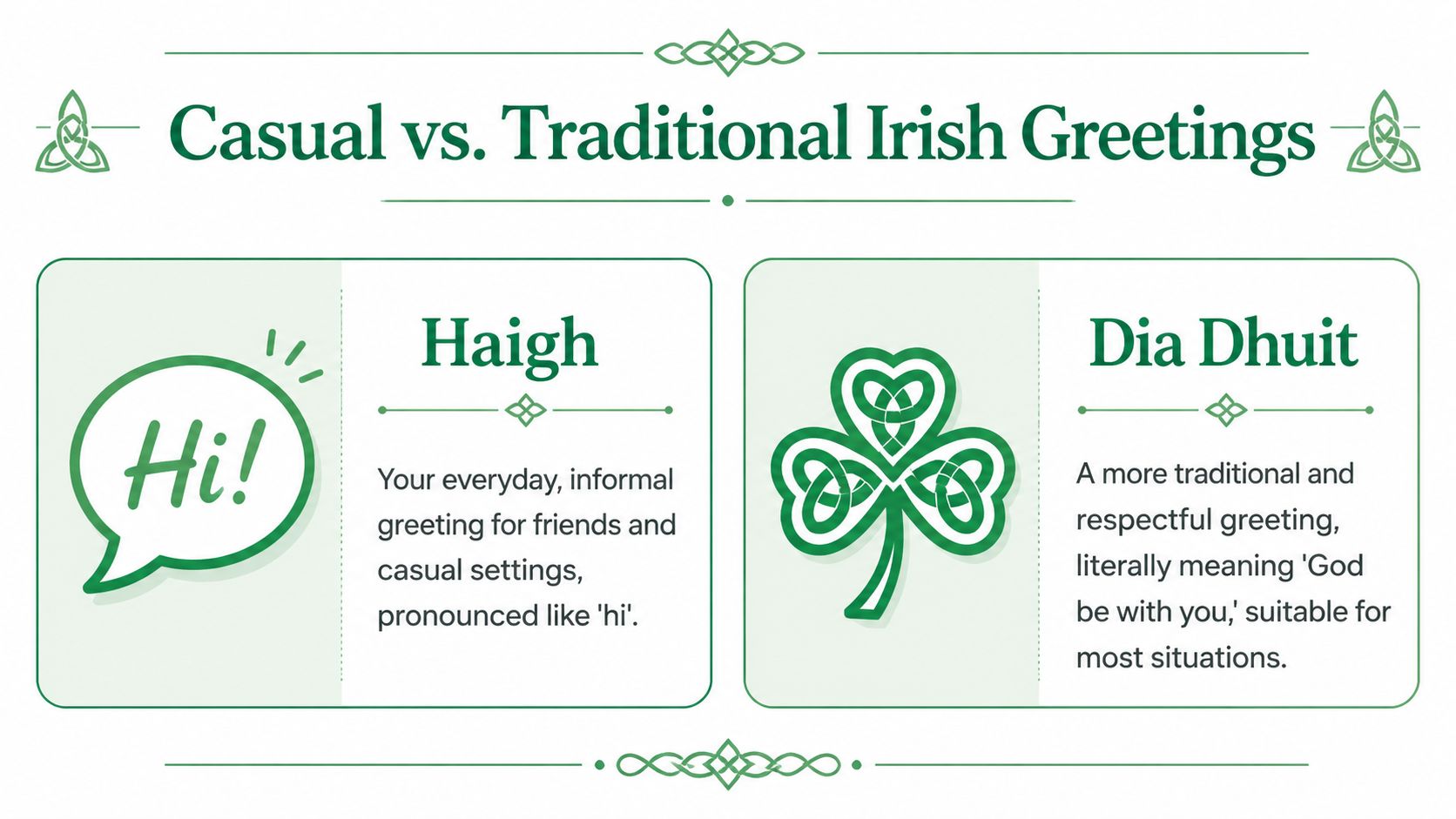
Haigh is modern and informal. Dia dhuit carries more tradition and cultural texture. If you know when each one fits, you’ll sound much more comfortable.
When Haigh feels right
Use Haigh the way you’d use “hi” in English. It suits relaxed situations, friends, quick messages, and younger conversational settings.
It’s also a lovely confidence booster because you don’t have to wrestle with spelling or grammar right away. If your main barrier is shyness, Haigh gets you speaking immediately.
A quick way to consider this:
| Greeting | Tone | Best for |
|---|---|---|
| Haigh | Casual | Friends, quick hellos, relaxed chat |
| Dia dhuit | Traditional, respectful | First meetings, polite conversation, learning classic Irish |
Why Dia dhuit feels different
Dia dhuit translates as “God be with you,” with roots in 17th-century religious customs, and the word dia goes back further to the Old Irish dé, showing the blend of older and Christian influences in the language, as explained in this discussion of the phrase’s background.
That history matters, but you don’t need to overthink it when you speak. In modern learning contexts, many people experience Dia dhuit as the standard traditional Irish hello. It sounds recognisably Irish, and it teaches you something about the culture while doing a basic conversational job.
Some learners worry that Dia dhuit sounds “too religious” to use. In practice, it’s often best understood as a traditional greeting with historical roots.
A practical choice, not a test
You don’t need to pick one forever.
Use Haigh when you want ease. Use Dia dhuit when you want the classic form. If you’re unsure, Dia dhuit is a safe and respectful choice for learning.
A lot of beginner anxiety comes from trying to find the perfect phrase. There usually isn’t one. There’s just the phrase that fits the moment well enough and lets the conversation move forward.
Pronunciation You Can Actually Use
Irish spelling can look intimidating at first. The trick is to aim for a useful approximation, not perfection on day one.
Haigh is easy. Say it like English “hi.”
Dia dhuit takes a little more attention. A very usable learner version is “JEE-uh gwitch” or sometimes “JEE-uh vitch.” You may also hear a softer start on the d, especially depending on region.
A simple sound breakdown
Try it in two chunks:
- Dia = JEE-uh
- dhuit = gwitch or vitch
Say it slowly first. Then say it as one phrase: JEE-uh gwitch.
The reason you’ll hear variation is that Irish pronunciation changes across dialects. The consonants can shift in subtle ways, so don’t panic if one speaker sounds different from another. That doesn’t mean you learned it wrong. It means Irish is a real spoken language with regional life.
What to focus on first
You don’t need a phonetics degree. You need a target your mouth can remember.
- Clarity first: Speak slowly enough that each part is audible.
- Rhythm second: Let the phrase flow as one unit.
- Listening always: Match what you hear from actual speakers.
If you want help hearing the sounds more clearly, this Irish pronunciation guide is a useful next step because pronunciation gets much easier once you can hear the common patterns.
If your pronunciation is understandable and respectful, you’re doing well. Native-like polish comes later.
Greetings for Groups and The All-Important Response
This is the part that makes learners sound much less robotic. Irish greetings aren’t just single phrases. They often work as a social exchange.
The first thing to know is that Irish changes depending on whether you’re speaking to one person or more than one. The second thing is even more important. You usually don’t reply by repeating the same greeting.

One person or several people
For one person, say:
- Dia dhuit
For two or more people, say:
- Dia dhaoibh
That small switch matters. It shows you’re paying attention to the structure of the language, not just repeating memorised sounds.
The response beginners often miss
The Irish greeting system works on a reciprocal escalation principle. If someone says Dia duit, the response is Dia is Muire duit, and learners also need to track whether they are greeting one person or a group with duit versus dhaoibh, as described in Bitesize Irish’s explanation of greeting forms.
That means the classic pattern looks like this:
| Situation | Greeting | Reply |
|---|---|---|
| One person | Dia dhuit | Dia is Muire dhuit |
| Group | Dia dhaoibh | Dia is Muire dhaoibh |
Why this feels strange at first
English trains you to mirror greetings. Someone says “Hi,” you say “Hi.” Irish doesn’t always do that here.
That’s why learners can freeze. They know the opening line but not the social logic behind it. Once you understand that the reply expands the greeting instead of copying it, the exchange starts making sense.
Practice cue: Don’t rehearse Dia dhuit by itself. Rehearse it as a pair with Dia is Muire dhuit.
If you want more common greeting chains to practise, this guide to Irish language greetings and phrases is handy because it keeps the phrases in conversational context.
Beyond Hello Starting a Real Conversation
A good hello opens the door. It doesn’t carry the whole conversation.
After a greeting, the most useful next step is usually Conas atá tú?, which means How are you? That one question turns a language exercise into an interaction.

A simple conversation chain
Here’s a beginner-friendly version you can use:
- Dia dhuit
- Dia is Muire dhuit
- Conas atá tú?
- Tá mé go maith
Even if you only learn that much, you’ve moved beyond reciting a greeting and into exchange.
The tourist phrase to skip
One phrase causes a lot of confusion: “Top of the morning to you.” It’s widely recognised as a tourist cliché and rarely used by locals. More useful follow-ups like Conas atá tú? matter far more in real conversation, and that same source notes that learners often struggle with greeting chains when they haven’t practised natural follow-ups, as discussed in Preply’s article on saying hello in Irish.
That’s why I usually tell beginners to choose authenticity over performance. A simple, correct greeting is far better than reaching for a phrase that sounds “Irish” in a film version of Ireland.
If you want to sound warm, don’t hunt for a fancy phrase. Use a real greeting, then ask a real question.
Hearing a natural exchange can help the rhythm click. This short video is useful for that:
For more beginner conversation patterns after the greeting stage, this basic Irish conversation guide gives you practical next lines to use.
Practice Your Irish Greetings with Confidence
At this point, you don’t need more theory. You need repetition.
Say the phrases out loud when nobody’s listening. Say them while making tea. Say them in the car. Say them to your dog if that helps. Spoken confidence in Irish usually grows from low-pressure repetition, not from waiting until you feel “ready.”
A few habits make a big difference:
- Use tiny drills: Repeat one greeting-response pair until it feels automatic.
- Record yourself: Voice notes help you catch hesitation, dropped sounds, and pacing.
- Keep it social: Practise full exchanges, not isolated words.
If you like recording yourself as part of study, SpeakNotes for language learners offers a sensible look at how voice notes can support language practice without making it feel heavy.
You can also mix your practice tools. Listen to Irish audio, repeat after speakers, and use guided conversation platforms when you want structure. Gaeilgeoir AI is one example. It offers guided real-world conversations, pronunciation support, adaptive quizzes, and scenario-based practice for everyday Irish, including social interactions and Leaving Cert oral preparation.
The most important thing is consistency. A short greeting you can say comfortably is worth more than ten phrases you only recognise on a screen.
If you want a structured place to practise greetings, replies, and real conversation flow, Gaeilgeoir AI gives you a simple way to start speaking Irish from day one.