If you're looking at the end of the year and feeling a little tired of the same countdown, the same noise, and the same resolutions that vanish by mid-January, Irish tradition offers something richer. An irish new year's tradition often asks a different question. Not just how to celebrate, but how to cross a threshold well.
In Ireland, New Year customs have long blended household ritual, community gathering, memory, and hope. Some are lively and public. Others are small enough to do in a quiet kitchen just before midnight. That mix is what makes them so appealing, especially if you want a celebration that feels personal.
For language learners, there’s another layer. Knowing a custom is one thing. Being able to talk about it in Gaeilge makes it feel lived-in. A phrase as simple as Athbhliain shona duit! can turn heritage from something you read about into something you can use.
Table of Contents
- Welcoming the New Year the Irish Way
- Ancient Roots of Irish New Year Superstitions
- Key Rituals for Luck and Remembrance
- Modern New Year Celebrations in Ireland
- How You Can Celebrate an Irish New Year Anywhere
- Speak the Season with These Irish Phrases
Welcoming the New Year the Irish Way
An Irish New Year often feels less like a party theme and more like a way of entering time carefully. You tidy the house. You think about who crosses the threshold. You remember the people who are gone. You make room for luck, but you also act as if luck needs an invitation.
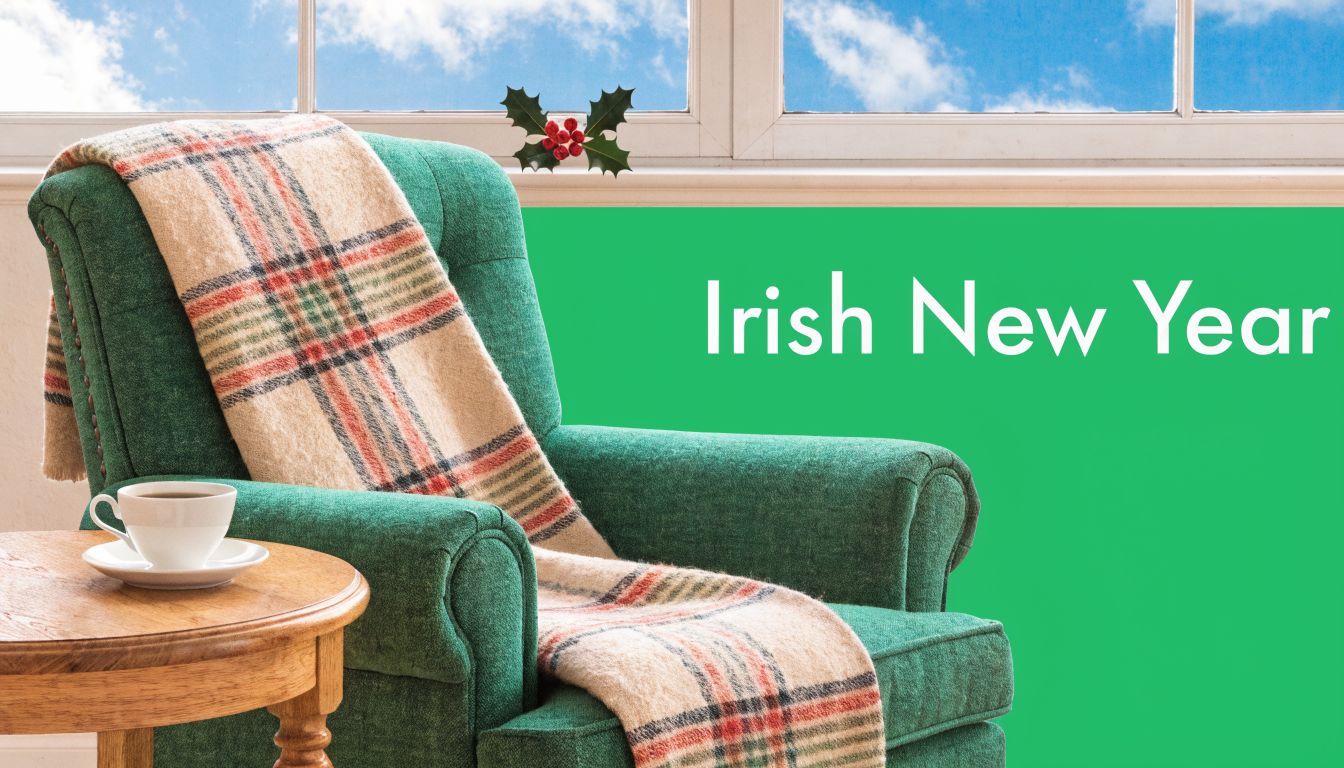
That’s where many readers get confused. They assume these customs are random superstitions, a collection of charming habits with no thread connecting them. In practice, the thread is quite clear. People wanted to leave hardship behind, welcome blessing into the home, and start the year in right relationship with family, neighbors, and the unseen world.
What makes it different
Three ideas sit at the heart of many Irish customs:
- Thresholds matter: Doors, windows, and gates aren’t just practical spaces. They mark crossing points, and crossing points carry meaning.
- The home matters: Many traditions happen indoors, around bread, firelight, a table, or the front door.
- Community matters: Even when the ritual is private, it still connects the household to a wider circle of visitors, relatives, and local gatherings.
Irish New Year customs often treat midnight as a moment that can be shaped, not just observed.
That makes them useful even now. You don’t need a village square or a family farm to understand the instinct behind them. You only need a willingness to be intentional.
A good way to approach these traditions
If you're new to them, keep it simple:
- Choose one household ritual such as tidying or a symbolic welcome at the door.
- Add one act of remembrance for a loved one.
- Learn one Irish phrase so the custom has a voice, not just an action.
That last part matters more than people think. Cultural tradition becomes much easier to remember when you can say it out loud. A greeting, a blessing, or the name of a custom can turn a borrowed ritual into a felt connection.
Ancient Roots of Irish New Year Superstitions
Irish New Year's Eve traditions trace back to ancient Celtic times, when the night was known as Oíche Chinn Bliana. It was understood as a liminal moment, a bridge between one year and the next, and also a bridge between the human world and the world of spirits. That old worldview still explains why so many customs focus on protection, welcome, and signs of fortune, as described in this account of Oíche Chinn Bliana and first-footing.
A night between worlds
For the Celts, transition nights weren't ordinary. They carried risk and possibility at the same time. The end of the year was not just a calendar event. It was a moment when the usual boundaries felt thinner.
That helps explain why New Year's customs often seem so alert to invisible influence. A household might watch who enters first, how the home is prepared, or what kind of energy is carried over from the old year. These actions weren’t decorative. They were protective.
If you want to place these customs in a wider seasonal context, it helps to read about the older Celtic framework around the Celtic New Year.
Why luck mattered so much
One of the clearest examples is first-footing. Historical sources note that it was widely observed, especially in urban areas and parts of the northeast of Ireland a generation ago. The belief held that the first person to enter a home after midnight could shape the household’s luck for the year ahead.
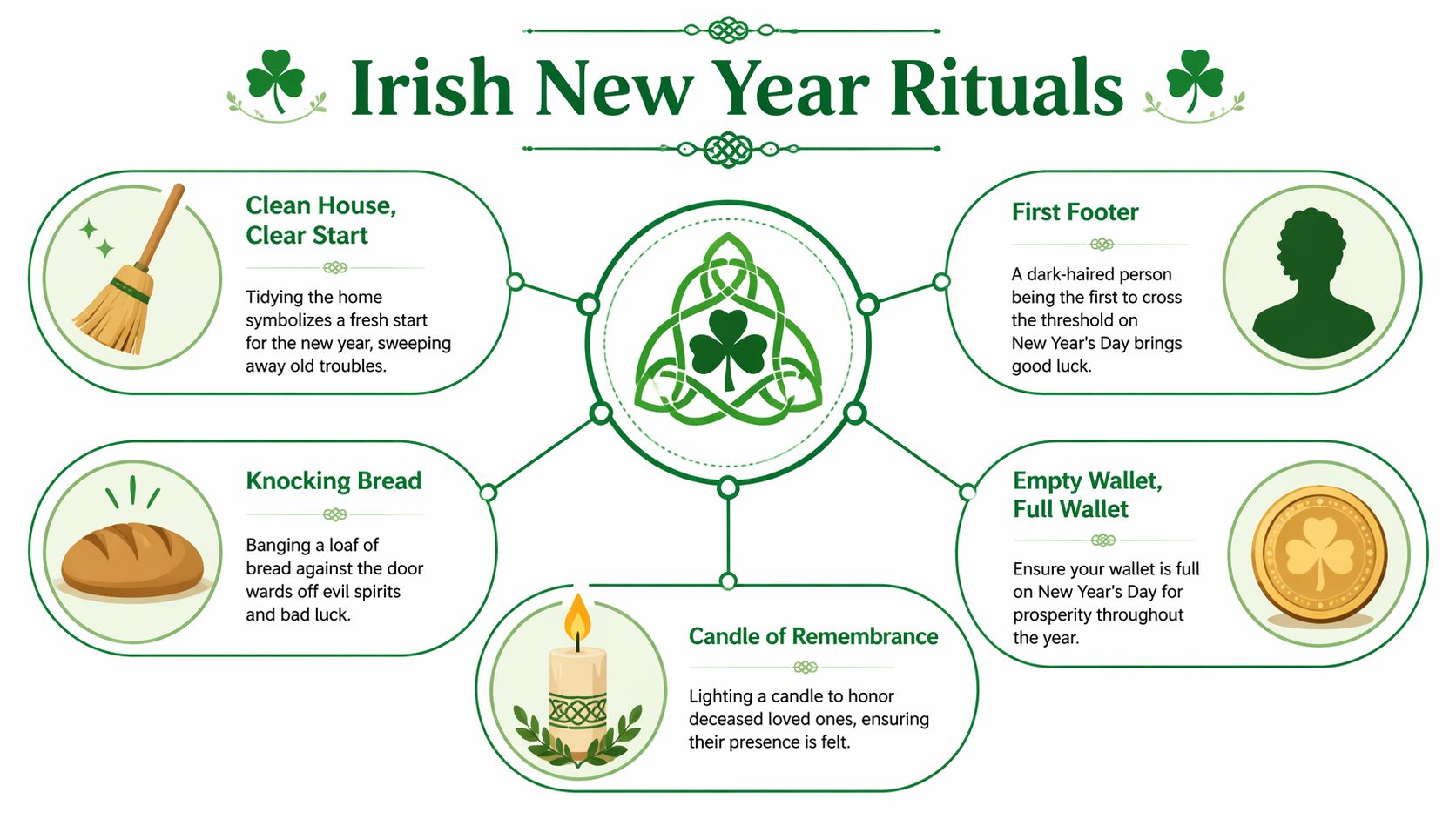
A dark-haired male visitor was seen as a fortunate sign. A red-haired visitor, by contrast, could be taken as unlucky. To modern readers, that can sound arbitrary or uncomfortable. The key is to understand the older logic rather than defend every detail of it.
Historical lens: These beliefs came from a culture that saw luck as limited, something families had to actively secure.
That idea of finite luck is one of the most useful keys for understanding Irish New Year superstition. People did not assume good fortune would arrive on its own. They believed the household had to prepare, welcome, and guard it.
This is why seemingly small acts mattered so much. A visit, a threshold crossing, the timing of a knock at the door. Each one could become a sign.
For language learners, tradition simplifies the act of remembering. Instead of memorizing isolated vocabulary, you connect words to a scene. A door opening after midnight. A guest being welcomed in. A family watching for the year's first sign of blessing.
Key Rituals for Luck and Remembrance
Once you know the worldview behind the customs, the household rituals start to make sense. They weren’t done because someone needed entertainment on a winter night. They were done because every action carried a hoped-for result.
Household customs with clear purpose
One often overlooked ritual is banging bread, or buaile arán, against the walls and doors of the home at midnight. It was done to chase out lingering bad luck from the old year and to help ensure the family would have enough food in the new one, a tradition described in this discussion of buaile arán and Irish New Year customs.
That custom is wonderfully concrete. You can hear it. You can feel it. And you immediately understand what the family hoped for: protection and plenty.
Other traditions often named alongside it include welcoming wandering souls, honoring the dead, and preparing the home as if it were about to receive both guests and blessing.
Bread at the wall wasn't a performance. It was a household prayer made physical.
How to try them respectfully at home
You don’t need to recreate every custom exactly. A respectful approach works better than a theatrical one.
- Prepare the house with intention: A tidy room, a cleared table, or a swept threshold can stand for release from the old year.
- Use bread symbolically: If banging bread feels too literal for your setting, hold a loaf at the doorway and name what you want to leave behind and what you hope to welcome.
- Honor absent loved ones: An empty place setting, a candle, or a quiet spoken memory keeps the tradition of remembrance at the center.
- Mark the doorway: Open the door for a moment around midnight and treat the threshold as meaningful.
A related custom appears in older ideas of blessing the home itself. If that interests you, this guide to an Irish house blessing tradition gives useful context.
Here’s where people sometimes hesitate. They worry that adapting a tradition means doing it wrong. In most cases, a simple, sincere version is far closer to the spirit of the custom than an elaborate version copied without understanding.
A family meal, a quiet doorway ritual, and a moment for remembrance already carry the heart of the tradition. What matters is the meaning attached to the act.
Modern New Year Celebrations in Ireland
Not every Irish New Year custom stays inside the home. In modern Ireland, many celebrations unfold in shared public spaces, where sound, light, and cold sea air all play their part.

From church bells to city streets
One of the most visible modern traditions is the ringing of bells on New Year's Eve. Across Ireland, bells sound from cathedrals, churches, and homes. In Dublin, Christ Church Cathedral provides a striking example through its annual festival and its sixteen pealing bells, part of a midnight tradition described in this overview of Irish New Year celebrations and bell-ringing.
The same source describes an "awesome cacophony of sound that sweeps the country" as midnight arrives. That phrase captures something essential. Even when celebrations are modern, they still carry the old instinct to make the turning of the year audible and communal.
The Dublin New Year Festival builds on that mood with an open-air countdown concert, light show, and procession. In other words, a custom that once belonged mainly to sacred and domestic spaces now spills into the street.
Practical reading of the tradition: The public celebration is newer in form, but it keeps the older Irish habit of marking the year together.
A short clip can help you feel the atmosphere better than description alone:
A bracing start on New Year's Day
Then comes one of the liveliest modern customs. The New Year's Day Swim. Formalized gatherings now take place at locations such as the Forty Foot in Sandycove, Dublin, along with beaches throughout Galway, where people plunge into the cold water on January 1st.
This is a good example of how Irish tradition evolves. The older customs focused on cleansing, luck, and renewal at home. The swim turns those ideas outward. The body meets the cold. The crowd cheers. The year begins with a shock that feels almost ceremonial.
Here, the mood shifts from superstition to shared courage. But the underlying hope is familiar. Start fresh. Enter the year awake.
How You Can Celebrate an Irish New Year Anywhere
You don't need to be in Dublin, Galway, or a rural Irish cottage to keep an irish new year's tradition alive. Most customs can travel well because they depend more on intention than location.

A simple home version
Try building your evening around three moments rather than one big event.
| Moment | What to do | Why it fits the tradition |
|---|---|---|
| Before midnight | Tidy one room or clean your doorway | It marks a clear break from the old year |
| At midnight | Open the door, speak a blessing, or welcome a chosen first visitor | It gives the threshold symbolic meaning |
| After midnight | Share food, raise a glass, and remember absent loved ones | It keeps hospitality and memory together |
That pattern works for one person, a couple, or a larger family gathering. You can keep it quiet or festive.
If you want a language element without turning the evening into a lesson, pick one phrase and use it naturally. If you’re studying Irish already, one option is Gaeilgeoir AI, which offers guided conversation practice and pronunciation support that can help learners use seasonal phrases in realistic social situations.
Ways the diaspora keeps traditions alive
Traditions also change when families live far apart. That doesn't make them weaker. It often makes people more intentional about keeping them.
A source discussing diaspora adaptations notes a 30% rise in virtual first-footing via video calls among expats, and says #IrishNewYear videos garnered over 5 million views in late 2025, showing renewed interest in reconnecting with heritage in modern ways, as described in this piece on Irish New Year traditions among diaspora communities.
That matters because many readers are not trying to recreate a museum version of Irish culture. They’re trying to build a meaningful family practice where they are now.
Some easy adaptations work well:
- Virtual first-footer: Ask a relative or friend to be the first face you greet after midnight by video call.
- Shared remembrance: Light a candle in different households and speak the same family names.
- Small ritual for children: Let them knock gently on the front door, then enter laughing and welcomed, so the threshold becomes memorable rather than solemn.
- Online storytelling: Share one family story connected to Ireland before the countdown.
A living tradition isn't frozen. People carry it, reshape it, and keep its meaning intact.
Speak the Season with These Irish Phrases
This is the part most culture guides skip. They explain the ritual, but they don't help you say anything. For learners, that leaves the tradition half-finished.
Irish New Year customs become more personal when you can name them in Gaeilge. Even a few phrases can help you greet someone, describe a custom, or connect family practice to language study.
Essential Irish phrases for New Year's
Here is a practical starter table.
| Irish Phrase | Phonetic Pronunciation | English Meaning | When to Use It |
|---|---|---|---|
| Athbhliain shona duit! | ah-vleen hun-uh ditch | Happy New Year to you | A friendly greeting at midnight or on New Year's Day |
| Athbhliain faoi mhaise duit! | ah-vleen fwee vosh-uh ditch | A happy prosperous New Year to you | A warmer traditional greeting |
| Oíche Chinn Bliana | ee-huh hin blee-uh-nuh | New Year's Eve | When naming the night itself |
| céadchosán | kayd-khuh-sawn | first-footing | When talking about the first visitor tradition |
| cling cloig | cling clug | ringing of bells | When describing midnight bells |
| buaile arán | bool-yuh aw-rawn | banging bread | When discussing the bread ritual |
If you want help with one of the most common seasonal expressions, this guide on how to say New Year in Irish Gaelic is a useful next step.
How to practice without overthinking
Most beginners make the same mistake. They wait until they can pronounce everything perfectly before saying anything out loud. That usually slows progress.
Try this instead:
- Use one greeting repeatedly: Say it to family, text it to a friend, or write it in a card.
- Pair phrase with action: Say Oíche Chinn Bliana as you set the table on New Year's Eve.
- Build a tiny script: “Athbhliain shona duit. This year we welcome good luck.” Even mixing English and Irish helps.
- Name one custom in Irish: If you're doing a threshold ritual, say céadchosán and explain it to someone.
For heritage learners, this is often the turning point. The language stops feeling like a school subject and starts sounding like family, season, and memory.
The goal isn't to perform fluency at the dinner table. It's to create a small bridge between words and life. Once that bridge is there, both the culture and the language become easier to carry forward.
If this sparked your interest, Gaeilgeoir AI is a practical next step. It helps learners build spoken Irish through guided, real-world conversation practice, pronunciation support, and everyday scenarios, so customs like New Year greetings become something you can say with confidence rather than just recognize on the page.