There’s “I love you”, and then there’s the kind of love language that feels like it was invented by people who spent a lot of time watching weather roll in off the Atlantic, standing in doorways, half leaving, half staying. Irish does that. It has words that don’t just translate. They sort of… linger.
Also, quick heads up. When people say “Irish love words”, they usually mean Irish Gaelic, as in Gaeilge. Not Irish English slang (which also has its own genius, to be fair). This list is Gaeilge, with pronunciation help that’s meant to be friendly, not intimidating. If you speak Irish already, you’ll spot a few simplifications. That’s on purpose.
And if you’re learning, even casually, I’ll slip in a small suggestion near the end for where to practice. No big salesy thing. Just a nudge.
Alright. Here are 25 Irish love words and phrases that hit different, especially in 2026 when everyone’s burnt out on perfectly curated romance and wants something that sounds real again.
1. Grá (love)
Pronunciation: graw (like “raw” with a g)
This is the core word. Simple, direct. But it’s also flexible. You’ll see it everywhere, from romantic love to “I love tea” (which in Ireland is basically sacred).
Example:
Tá grá agam duit.
I have love for you. (Often used for “I love you”.)
2. Mo ghrá (my love)
Pronunciation: muh graw
Short, intimate, almost old-fashioned in the best way. You can say it gently, or dramatically, or half joking in the kitchen while someone burns the toast.
Example:
A M’ ghrá, tar anseo.
My love, come here.
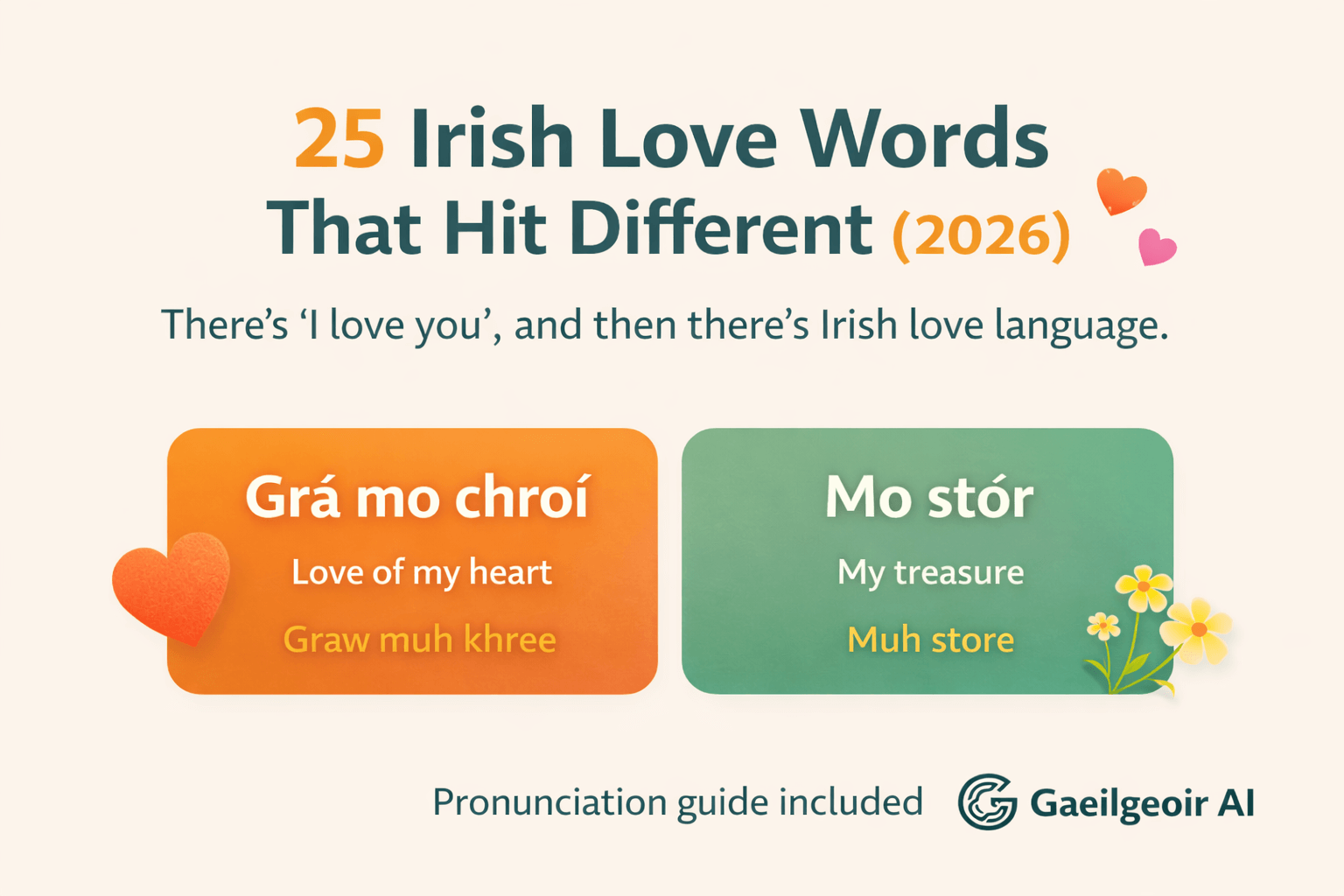
3. Grá mo chroí (love of my heart)
Pronunciation: graw muh khree
This one lands. It’s like saying “you’re not just loved, you’re… central.”
Example:
Is tú grá mo chroí.
You are the love of my heart.
4. Croí (heart)
Pronunciation: khree
You’ll hear it in a lot of phrases because Irish leans into the heart as a place. Not metaphorically. More like, practically.
Example:
Mo chroí.
My heart.
5. A chroí (oh heart / my dear)
Pronunciation: uh khree
This is a term of endearment. It’s used for partners, kids, friends. You can say it with warmth, or when you’re about to give someone bad news, softly.
Example:
A chroí, tá gach rud ceart go leor.
My dear, everything is okay.
6. Stór (treasure)
Pronunciation: store
Classic Irish term of endearment. It’s the kind of word that makes you feel like you’re being looked after.
Example:
A stór, conas atá tú?
Treasure, how are you?
7. A stór mo chroí (treasure of my heart)
Pronunciation: uh store muh khree
This is the full version people pull out when they really mean it. Or when they’re being sweet on purpose.
8. Mo stór (my treasure)
Pronunciation: muh store
Softer than “stór” on its own. This one is everyday-affection level.
14. Anam (soul)
Pronunciation: ah-num
Soul as in essence. The part of you that doesn’t do small talk. It’s a profound concept, often explored in various cultures and practices, such as in soul retrieval, a practice aimed at healing and reclaiming lost parts of one’s soul.
16. Anam cara (soul friend)
Pronunciation: ah-num kah-rah
This is the phrase that gets shared online a lot, sometimes simplified into “soulmate”. But it’s not exactly that. It’s more like “the person who sees you clearly and stays.”
17. Leannán (lover / sweetheart)
Pronunciation: lyah-nawn
A more direct romantic word. Not always used in modern casual speech the way “babe” is used, but it’s still alive, especially in writing, songs, and certain contexts.
18. Leannán mo chroí (lover of my heart)
Pronunciation: lyah-nawn muh khree
Again with the heart. Irish isn’t shy about it.
19. Gean (affection)
Pronunciation: gyann (hard g)
This one is underrated. It’s not fireworks, it’s warmth. It’s the kind of love that shows up on a rainy Tuesday.
Example:
Tá gean agam ort.
I have affection for you.
20. Gean mo chroí (affection of my heart)
Pronunciation: gyann muh khree
It’s gentler than “grá”. Sometimes that’s exactly what you want.
21. M’uisle (my darling / my treasure, regional)
Pronunciation: mish-luh or ish-luh (varies)
You’ll hear variations depending on dialect. Irish is like that. It refuses to be pinned down neatly. This one is often used like “darling”.
(If you’ve heard it in songs or older speech, that’s usually where it lives best. Still hits hard.)
22. Mo chroí istigh ionat (my heart is inside you)
Pronunciation: muh khree iss-TEE uh-nut
Okay. This is a lot. But in a good way. It’s one of those phrases that feels ancient and immediate at the same time.
It’s basically saying: I’m with you, in you, tied to you. Not in a creepy way. In a human way.
23. Mo chroíse (my heart, little heart)
Pronunciation: muh khree-shuh
A diminutive, affectionate form. Like “dear heart”. This one feels especially tender.
24. Mo mhíle grá (my thousand loves)
Pronunciation: muh vee-luh graw
It’s not used constantly, but it’s beautiful when it is. It’s abundance. Overflow.
25. Grá go deo (love forever)
Pronunciation: graw guh joh
Simple. Eternal. It looks clean on a card, but it also works in real life, said quietly.
Example:
Grá go deo, pé rud a tharlóidh.
Love forever, whatever happens.
A quick note on saying “I love you” in Irish (because you’ll want it)
You’ll see a couple versions online, and people get confused.
Tá grá agam duit (I love you)
Pronunciation: taw graw ag-um ditch
Literally: “There is love at me for you.”
Is breá liom tú (I love you / I really like you)
Pronunciation: iss brah lum too
Literally: “You are lovely with me” or “I like you a lot.”
Both are used. Tá grá agam duit is the more direct “love” version. Is breá liom tú can be romantic too, but it can also be used for things like “I love pizza” depending on context. Irish doesn’t panic about that, it just lets context do its job.
How to actually use these without feeling like you’re acting in a period drama
Here’s the trick. Don’t overperform it.
Try one word first, like a chroí or mo stór. Say it once in a text. Or say it in the kitchen, casually. If it feels like too much, you’re probably saying it like a movie character. Make it smaller.
Also, Irish terms of endearment are often used more broadly than English ones. You’ll hear people calling a friend “a stór” and nobody faints. So you’ve got room.
If you’re interested in exploring more about love and its expressions in different cultures or languages, it’s worth checking out some resources that delve deeper into this subject matter.
And if you’re learning Irish and want a place where the language feels usable, not just textbook neat, you can check out https://learn.gaeilgeoir.ai/. Even just signing up and poking around can help you get a feel for natural phrasing, especially for stuff like this where tone matters.
What is the most common Irish word for love?
Grá is the most common Irish word for love.
How do you say “my love” in Irish?
You can say mo ghrá (my love). Another common endearment is a stór (treasure).
What is “anam cara” actually supposed to mean?
Anam cara literally means soul friend. People often translate it as “soulmate”, but “soul friend” is closer to the original feel.
How do you say “I love you” in Irish Gaelic?
A direct version is Tá grá agam duit. Another common phrase is Is breá liom tú, which can mean “I love you” or “I really like you” depending on context.
Are these words still used in modern Irish, or are they old fashioned?
Many are still used, especially grá, croí, stór, gean, and the “I love you” phrases. Some like leannán and rún mo chroí can feel more poetic or formal, but they’re still understood and show up in songs, writing, and heartfelt moments.
Can you use Irish love words for friends and family too?
Yes. Irish terms of endearment often apply to partners, kids, friends, and even strangers in a kind way (context matters, obviously). A chroí and a stór are good examples.
What’s the easiest Irish term of endearment to start using?
Probably a stór or mo stór. They’re common, warm, and don’t feel overly intense.
Is pronunciation in Irish hard?
It can be at first, mostly because spelling and sound don’t match English expectations. But with a little listening practice, common words like grá and croí become very manageable.