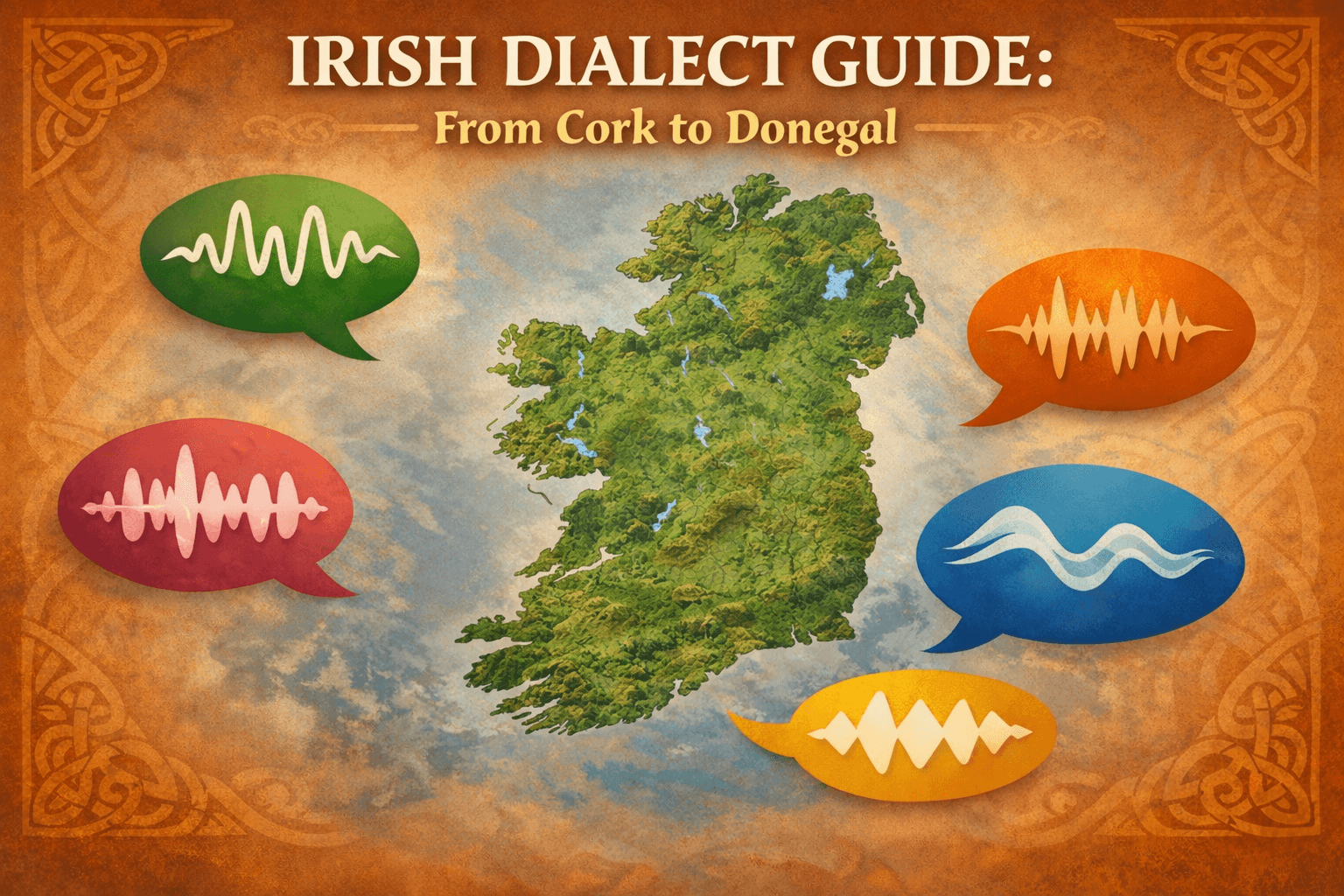
Irish Dialect Guide: From Cork to Donegal

If you’ve ever landed in Ireland feeling pretty confident about your English… and then someone says something that sounds like English but also, somehow, not English. Yeah. That is the moment.

Irish people are speaking English. Obviously. But it is English that has been bent and shaped by geography, history, Irish language influence, and a strong local habit of doing things their own way. So you get accents, sure. But you also get dialect. Different words, different rhythm, different little grammar moves that can make the same sentence feel totally new.

This is a guide to the big dialect zones, from Cork up to Donegal. Not a strict map, because Ireland does not really behave like that. Dialects blur. People move. Towns two hours apart can sound like different planets. But it will give you a real feel for what you are hearing.

A quick note before we start

An accent is how you pronounce words. A dialect is accent plus vocabulary and grammar.

So if someone says “I’m after eating” instead of “I just ate”, that is dialect. Not just accent.

Also. There is no “neutral Irish accent” in real life. There is Dublin. There is RTÉ presenter voice. There is “I lived abroad for years” voice. But neutral is sort of a myth.

The big building blocks of Irish English

You will hear these across the country, with local variations.

The “after” perfect

This one is classic, and it comes from Irish language structure.

  • “I’m after spilling the tea.” meaning I just spilled it. Very recently.
  • “She’s after leaving.” meaning she just left.

It’s fascinating how these unique aspects of Irish English can be understood and even learned through resources like the learn Irish app, which can help anyone navigate this rich linguistic landscape more effectively.

“Sure” as punctuation, comfort, and mild chaos

“Sure” does a lot of work.

  • “Sure look.” means… we accept reality, even if we hate it.
  • “Sure I don’t know.” often means I do know, but I’m not committing to a full statement.
  • “Ah sure.” can be sympathy, resignation, or a gentle dismissal.

“Grand”

Not fancy. Not impressive. Usually just fine.

  • “How are you?” “Grand.” meaning I’m okay. Sometimes it means “I am barely holding it together but I am not discussing it.”

“Ye” and “yous”

Ireland kept a plural “you” in many places.

  • “Are ye coming?” common in the west and south.
  • “Are yous coming?” more in parts of Dublin and the north.

“Giving out”

Not giving gifts. Giving out means scolding, complaining, telling someone off.

  • “My mam was giving out to me.” means your day is about to get worse.

Ok. Now the fun part. Regions.

Cork and the South: musical, fast, and very local

Cork is famous for sounding like it is half singing, half negotiating with time itself. The rhythm has a lift to it. People talk fast, and statements can sound like questions because of the rising intonation at the end.

What it sounds like

  • Very melodic, with a noticeable up and down.
  • A kind of bounce. Words feel like they are being nudged forward.

If you’re interested in diving deeper into the linguistic nuances of Irish dialects or want to learn more about Goidelic languages, there are plenty of resources available. You might also find it helpful to understand how to use fada keyboard shortcuts when typing in Irish. And if you’re looking for some unique expressions or phrases, here are some cool Irish words to know.

Cork bits you will hear

  • “Boy” and “girl” as casual address. “Well boy?” can mean hello, not literally “well, male child”.
  • “Sound” meaning decent, good, reliable. “He’s sound.”
  • “Langer” as an insult, sometimes affectionate, sometimes not. Context is everything and I mean everything.

Cork vibe sentence

“You’re some man, boy. I’m only after getting in, like.”

Cork English is also full of local slang that does not always travel well to the next county. You can be ten minutes outside the city and hear something totally different.

Kerry: softer edges, strong storytelling energy

Kerry sits next door to Cork, and you will still hear musicality, but often slower, more drawn out, especially in rural areas. There is a strong tradition of storytelling, and the English can carry Irish language patterns in a really noticeable way.

What it sounds like

  • Warm, rounded vowels.
  • Less sharpness, more stretch in the sound.

Kerry bits you will hear

  • “Right so” as a transition. A way to move the conversation along.
  • “’Tis” and “’twas” still show up more than you might expect.
  • A lot of gentle understatement. Something can be “a bit wild” and actually mean very wild.

Kerry vibe sentence

“Ah ’tis a grand day at all, right so. You wouldn’t be long getting dried.”

Limerick and Clare: grounded, quick wit, and very direct warmth

Move up into Limerick and Clare and you start hearing something a little more clipped, a little more direct. Still very Irish, still plenty of musical rhythm, but the intonation patterns shift.

Clare, especially west Clare, can feel closer to Galway and the Gaeltacht influence. Limerick city has its own urban sound too.

What it sounds like

  • Clear consonants, slightly tighter rhythm.
  • Clare can have a softer, more west of Ireland lilt.

Words and phrases

  • “Gowl” as an insult in parts of the mid west. Not polite. Used anyway.
  • “Savage” meaning excellent. “That was savage.”
  • “Gas” meaning funny. “He’s gas.”

Mid west vibe sentence

“He’s gas altogether. I was in bits laughing.”

Galway and the west: the lilt, the “like”, and Irish language shadows

Galway is where a lot of people go looking for the “real Ireland” vibe, and the speech does have a strong west of Ireland character. You will hear a pronounced lilt, and in places with Irish language presence, the English can carry Irish syntax and timing.

What it sounds like

  • A flowing rhythm, with a gentle rise and fall.
  • Some speakers have a slightly slower pace, more deliberate phrasing.

West of Ireland features

Galway vibe sentence

“It’s yourself. How’s things with you, like?”

Mayo and Sligo: strong rural tones, plain language, big character

Mayo and Sligo have accents that can feel more rugged to outside ears. Not harsh, just more pronounced in consonants, and with a different musical pattern than Cork or Galway.

Exploring the dialectal differences in Irish can provide deeper insights into these unique regional accents. Additionally, understanding some common phrases in Irish language can enhance your experience while interacting with locals in these areas. The counties of Mayo and Sligo are known for their strong rural tones and big character which are reflected in their dialects.

What it sounds like

  • Clear, sometimes heavier consonants.
  • A steady rhythm that can speed up when the story gets good.

Common bits

  • “Well” as an opener. “Well, what’s the story?”
  • “The story?” means what’s going on, what’s new.
  • “Fair play” used constantly. Praise, approval, sometimes sarcasm if delivered a certain way.

Mayo Sligo vibe sentence

“Well, what’s the story with you? Any craic at all?”

Dublin: not one accent, but many, and it matters where

Dublin is complicated. People talk about “the Dublin accent” like it is one thing, but it is really a set of accents that can change street to street, and also by class, age, and background.

Broadly, you might hear:

  • A more traditional working class Dublin accent, very distinctive, very energetic.
  • A more middle class suburban accent, sometimes called “D4” in pop culture, though that label is messy and often unfair.
  • Newer blended accents influenced by immigration and modern urban speech.

What it sounds like

  • Often faster pace.
  • Certain vowels can shift a lot, depending on the area.

Dublin bits you will hear

  • “Deadly” meaning great. “That’s deadly.”
  • “Bleedin” as an intensifier. Used everywhere, but Dublin loves it.
  • “Ah stop” meaning please stop, or I cannot believe it, or that is hilarious. Again, context.

Dublin vibe sentence

“Ah stop, that’s deadly. I’m bleedin wrecked though.”

If you are learning Irish English from media, be careful here. A lot of Irish TV and online content leans Dublin, and then visitors get to Donegal and think they have entered a different country. Because, kind of, you have.

The North: Belfast and beyond, with its own grammar and music

Northern Irish English is its own world. You will hear Scottish influence, and you will also hear Ulster Scots vocabulary in places. Belfast has a strong urban sound. Outside the city, accents vary a lot.

What it sounds like

  • Often a sharper, more staccato rhythm.
  • Different vowel sounds from the south, especially noticeable for “ow” and “i” sounds.

Common Northern features

  • “Aye” for yes.
  • “Wee” for small, but also for basically anything. “A wee while” can be ten minutes or an hour.
  • “What about ye?” meaning how are you, what’s happening.

Northern vibe sentence

“Aye, I’ll be there in a wee minute. What about ye?”

Donegal: the curveball, with Scottish echoes and a wild variety

Donegal accents can be stunning. Also, confusing. There is a strong connection to Scotland historically, and it comes through in pronunciation and rhythm, especially in Inishowen and parts of west Donegal. But Donegal is big, and it has multiple dialect pockets.

What it sounds like

  • Often closer to Scottish English than other Irish accents, especially in intonation.
  • A very distinct rhythm that can feel “bouncy” but in a different way than Cork.

If you’re interested in learning more about the Irish vocabulary used in these regions or want to delve deeper into the nuances of Irish English, there are resources available that can help enhance your understanding further.

Donegal bits

  • “Youse” is common.
  • “Thon” meaning that, in some areas. “Thon thing over there.”
  • “Cratur” or “creature” as a term of sympathy. More broadly Irish, but you will hear it plenty.

Donegal vibe sentence

“Will yous take a look at thon weather. It’s desperate altogether.”

How to understand Irish dialect faster (without pretending)

A few practical tips. Because it can be a lot.

  1. Listen for the rhythm, not the individual words. Once you catch the beat, the sentence starts making sense.
  2. Ask once, politely, then let it go. “Sorry, what was that?” is fine. Three times in a row and everyone gets tired.
  3. Learn the top 20 phrases. Grand, giving out, craic, sound, fierce, gas, savage, yer man, yer one. These unlock a lot.
  4. Do not copy the accent right away. People can find it annoying. Some will laugh, some will not. Give it time.

FAQ

What is the biggest difference between Irish accents and Irish dialects?

Accent is pronunciation like in this Irish pronunciation guide. Dialect includes pronunciation plus local vocabulary and grammar, like “I’m after eating” or “I do be”.

Is “Hiberno English” the same thing as Irish English?

Pretty much, yes. Hiberno English is a term linguists use for Irish English, especially when talking about Irish language influence on grammar and structure.

How to learn Irish online for free?

For those interested in learning the language more deeply, there are resources available such as this free guide which could be beneficial.

Tips for Ordinary Level Irish Leaving Cert

If you’re preparing for exams like the Leaving Cert and looking for some guidance on ordinary level Irish, there are several strategies you can adopt to improve your chances of success.

Understanding the Genitive Case in Irish

One of the complexities of learning Irish is mastering its grammatical structures such as the genitive case. This resource provides valuable insights into that aspect of the language.

Why do Irish people say “I’m after doing something”?

This phrase comes from the Irish language structure, meaning you did something very recently. It’s similar to saying “I just did it”.

What does “craic” actually mean?

Craic refers to fun, atmosphere, entertainment, and good conversation. For instance, asking “Any craic?” is a way of inquiring if anything interesting is happening or if there’s any news or fun to share.

Is Dublin English representative of the whole country?

No, Dublin has multiple accents and dialect features. Ireland is very regionally diverse, with places like Donegal, Cork, Galway, and Belfast sounding radically different from each other.

What does “grand” mean in Ireland?

In most contexts, it usually translates to “fine” or “okay”. It doesn’t imply something is “amazing”. If someone says “grand so”, they are often indicating they’re closing the topic and moving on.

Do people in Ireland still use Irish language grammar when speaking English?

Yes, especially in certain structures like the “after” perfect and habitual “do be”. This influence is also more subtle, affecting sentence rhythm and phrasing. Such patterns are particularly noticeable in areas with a stronger Irish language presence. You can get a better understanding of these unique Irish language features by exploring some resources on basic Irish conversation here.

What is the easiest Irish dialect for visitors to understand?

It largely depends on what you’re accustomed to. However, many visitors find slower rural speech easier to comprehend than fast urban speech. That said, unfamiliar vocabulary can pose challenges anywhere.

Are Irish dialects disappearing?

While some local features are fading due to media influence and increased mobility, many dialect markers are still holding strong. Interestingly, new urban varieties are forming too, especially around Dublin and other cities. The role of traditional storytelling in preserving these dialects is significant as seen in the work of Seanchai Irish storytellers.


The Irish Plantations: A Turning Point in Irish History

The Irish Plantations were a defining period that changed the course of Irish history. From the confiscation of land to the displacement of entire communities, their impact went far beyond land ownership—it touched language, identity, and the soul of Irish culture.

Today, understanding the legacy of the plantations is not just for historians. It helps anyone learning the Irish language (Gaeilge) appreciate why the language nearly disappeared in certain regions—and why learning it now is a way of reclaiming more than just words.

This post explores what the plantations were, how they affected everyday Irish life, and what they can teach us about culture, language loss, and resilience.


What Were the Irish Plantations?

The Plantations of Ireland were state-sponsored colonization schemes carried out by the English Crown between the 16th and 17th centuries. The goal was to subdue Irish resistance and spread English influence, especially in Ulster and Munster.

Land was confiscated from Gaelic chieftains and given to Protestant English and Scottish settlers. These settlers brought new customs, laws, religion, and language—transforming the regions they colonized.

Key Plantation Periods

  1. Munster Plantation (1580s):
    Followed the Desmond Rebellions. Land in southern Ireland was seized and redistributed to English settlers.
  2. Ulster Plantation (1609):
    The most significant plantation. After the Flight of the Earls, vast lands in northern Ireland were taken and colonized.
  3. Cromwellian Settlement (1650s):
    After Cromwell’s brutal conquest, native Irish were forced west of the River Shannon, and soldiers were “paid” with Irish land.

Cultural Disruption and the Loss of Language

The plantations weren’t just about territory. They reshaped Ireland’s cultural landscape in ways that are still felt today.

Language Decline

One of the most lasting impacts was the suppression of the Irish language. English became the language of landowners, courts, and government. Irish speakers were pushed to the margins—both socially and geographically.

As Protestant settlers established new towns and estates, Irish was spoken less in those areas. Over time, many regions that had once been fully Irish-speaking—like large parts of Ulster—shifted to English.

This wasn’t just language shift. It was language loss.

Religious and Cultural Division

The plantations also deepened divisions between:

  • Protestant settlers (largely English- and Scots-speaking)
  • Native Irish Catholics (predominantly Irish-speaking)

This divide went beyond religion. It marked a cultural and linguistic rupture, the effects of which still influence Ireland and Northern Ireland today.


How the Irish Plantations Changed Place Names and Identity

Plantation settlers introduced new town names, renamed existing ones, and altered the administrative structure of land ownership.

But many Irish names survived—often in anglicized form. Understanding these names in Irish helps reveal layers of hidden meaning:

  • Doire → Derry (“oak grove”)
  • Cill Mhantáin → Wicklow (“church of Mantan”)
  • Droichead Átha → Drogheda (“bridge of the ford”)

By learning Irish, even at a basic level, you begin to notice these patterns—and reconnect with the landscape in its original voice.

For a deeper look at this topic, check out What Does Slieve Mean in Irish?, which explores Irish place names rooted in geography.


How the Irish Language Survived the Plantations

Despite the disruption caused by the plantations, the Irish language persisted—especially in rural areas, among the poorer population, and in parts of the country less affected by colonization.

Oral tradition kept Irish alive when institutions could not. Songs, proverbs, and storytelling (seanchas) were passed from generation to generation.

Irish remained the first language of many until the 19th and early 20th centuries, when emigration, education policy, and poverty further reduced its use. Still, in places like the Gaeltacht, Irish has never disappeared.

The language’s survival is a testament to the resilience of a people who held on, even when they had little else.


Learning Irish Today: Reconnecting with History

Learning Irish today isn’t just about vocabulary or grammar. It’s about engaging with a living culture—one shaped by survival, endurance, and identity.

Understanding events like the Irish Plantations helps you see the language in context. It answers questions like:

  • Why did Irish decline in some regions but not others?
  • Why are some Irish surnames and place names anglicized?
  • Why is reclaiming Irish now so important?

You can explore more ways to start learning with Irish Language Lessons for Beginners, which offer cultural insights alongside practical lessons.


Key Irish Words from the Plantation Era

Here are some Irish words and phrases that are helpful when studying this period of history:

EnglishIrishMeaning
PlantationPlandáilColonization scheme
LandlordTiarna TalúnLandowner, often English or Scottish
Native IrishGaeil DúchaisIndigenous Irish population
DisplacementDíbirtForcible removal
ResistanceFriotaíochtOpposition to colonization
CultureCultúrTraditions, language, way of life

If you’re curious about how Irish words reflect cultural shifts, check out the Expand Irish Vocabulary guide.


Tips for Learning Irish with Historical Context

Using history as a lens can make learning Irish more engaging and meaningful. Here’s how:

1. Focus on Real-World Use

Learn how Irish connects to daily life and identity, not just academic terms.

2. Explore Songs and Proverbs

Many old rebel songs and sayings reference the time of the plantations and English conquest.

3. Study Irish Place Names

Look at maps and learn what towns and counties mean in Irish. You’ll uncover hidden histories.

4. Read Irish Historical Texts

Try translations of 17th-century poems or bardic laments. Many reflect the trauma of dispossession.

You can also explore Irish in context with posts like Exploring Seanfhocail – Irish Proverbs.


Further Reading and Resources

Want to learn more about the Irish Plantations? Here are a few recommended sources:

For Irish language learners interested in history, pairing these readings with your study materials can offer powerful insight.


Final Thoughts: Memory, Language, and Moving Forward

The story of the Irish Plantations is one of conflict, change, and survival. It marks a time when the Irish language was threatened—but not silenced.

By learning Irish today, you are part of a larger story of revival. You’re helping reconnect threads that were once torn apart—and ensuring that the Irish voice continues to be heard, not just in textbooks, but in everyday life.

Whether you’re exploring heritage, history, or just curious about the language, there’s a place for you in this journey.


Ready to explore Irish further?
Consider joining a community of learners passionate about history, identity, and language revival at Gaeilgeoir AI. No pressure—just a helpful place to get started.

Go n-éirí an bóthar leat – May the road rise to meet you.

Can You Learn Irish On Your Own? Yes, Here’s How!

The question of whether it’s feasible to learn Irish independently is one that many enthusiasts of Ireland’s native language ponder. With advances in technology and the availability of comprehensive resources, the answer is increasingly a resounding “Yes.” At Gaeilgeoir AI, we empower individuals with cutting-edge tools designed to make learning Irish not only possible but also enjoyable and efficient when navigating it solo. This post will guide you through various strategies and resources that can help you master Irish on your own terms.

The Feasibility of Solo Irish Learning

Misconceptions About Learning Languages Alone

Many people believe that languages like Irish can only be effectively learned in a traditional classroom setting or through immersion in a native-speaking environment. While these methods have their benefits, the digital age has shattered these old paradigms, offering innovative ways to absorb languages remotely and independently.

Essential Tools and Resources for Independent Learners

1. Digital Language Learning Platforms

Platforms like Gaeilgeoir AI employ artificial intelligence to tailor lessons according to your pace and progress, providing interactive exercises, real-time feedback, and personalized learning paths.

2. Online Dictionaries and Language Apps

Utilizing online resources such as Teanglann.ie for comprehensive dictionaries or apps like Duolingo for gamified learning can significantly enhance your vocabulary and grammatical knowledge.

3. Irish Language Media

Incorporating media such as podcasts, Irish music, and films into your learning routine can improve your listening skills and pronunciation. TG4 and Raidió na Gaeltachta offer a wide array of programs streamed online.

Strategies to Enhance Self-Learning

Establish a Routine

Consistency is key. Dedicate regular hours each week to your Irish studies. Integrating language practice into your daily life, such as listening to an Irish podcast during your commute, can make learning a part of your routine.

Set Realistic Goals

Goal-setting can significantly boost your motivation and sense of achievement. Start with small goals, like mastering basic greetings or numbers, and gradually increase the complexity of your objectives.

Engage with the Community

While studying alone offers flexibility, engaging with other learners can provide support and enhance your learning experience. Online forums, social media groups, or virtual meet-ups can offer valuable practice and feedback.

Common Challenges and How to Overcome Them

Staying Motivated

Self-learning can sometimes feel isolating. To combat this, vary your learning activities, set frequent small goals, and reward yourself upon achieving them.

Understanding Complex Grammar

Irish grammar can be daunting due to its unique structure. Utilizing Gaeilgeoir AI’s explanations and contextual exercises can demystify complex topics, making them more approachable.

Pronunciation

Irish pronunciation can be challenging due to its distinct sounds. Regularly listen to native speakers and use Gaeilgeoir AI’s pronunciation tools to practice and improve.

Conclusion

Learning Irish on your own is not only possible but also a profoundly rewarding endeavor, thanks to a plethora of online tools and resources tailored to self-learners. With commitment, the right strategies, and the support of innovative platforms like Gaeilgeoir AI, anyone can embark on a successful language learning journey independently.

Want to learn more?

Ready to start your journey to mastering Irish on your terms? Sign up for a free trial at Gaeilgeoir AI today and take advantage of personalized learning experiences designed to make you fluent. Join our community of Irish language enthusiasts and transform your linguistic skills!

Find the Perfect Irish Tutor: Enhance Your Learning Journey

Embarking on the journey to learn Irish can be thrilling and enriching. However, mastering a new language often requires more than self-study; it demands personalized guidance that suits your learning style and goals. This is where an Irish tutor can make a significant difference. Whether you’re a beginner or looking to advance your proficiency, finding the right tutor can accelerate your progress and deepen your understanding of the language. At Gaeilgeoir AI, we understand the importance of tailored educational experiences and offer resources to help you connect with expert tutors.

The Role of an Irish Tutor in Language Learning

An Irish tutor does more than teach grammar and vocabulary. They are your guide through the cultural nuances and intricate patterns of the language, providing:

  • Personalized Attention: Customized learning plans that address specific challenges and goals.
  • Interactive Practice: Real-time conversations and feedback to improve pronunciation and fluency.
  • Cultural Insights: Knowledge about Irish history, literature, and traditions, enriching your linguistic experience.

How to Choose the Right Irish Tutor

Selecting an Irish tutor suited to your needs involves several considerations:

  1. Qualifications and Experience: Look for tutors with formal qualifications in teaching Irish and experience in educating students at your learning level.
  2. Teaching Style: Choose a tutor whose teaching style aligns with your learning preferences—whether visual, auditory, or kinesthetic.
  3. Flexibility and Availability: Consider their availability and willingness to adapt schedules and content according to your requirements.

Top Platforms to Find Irish Tutors

1. Gaeilgeoir AI

Offering a connection to experienced, vetted Irish tutors through an AI-enhanced platform, Gaeilgeoir AI ensures a match that suits your learning pace and style.

2. Italki

This global language learning community connects students with language tutors for 1-on-1 online lessons tailored to their learning needs.

3. Preply

Preply offers a diverse range of tutors specialized in different languages, including Irish, allowing learners to choose tutors based on their profiles, reviews, and rates.

Integrating Technology in Learning with an Irish Tutor

Combining traditional tutoring with modern technology, such as language learning apps and online resources, can enhance the educational experience:

  • Interactive Tools: Use Gaeilgeoir AI’s interactive exercises for practice between your tutoring sessions.
  • Online Resources: Access extensive materials for grammar, vocabulary, and listening provided by your tutor or found on learning platforms.

Benefits of Learning Irish with a Tutor

  • Accelerated Learning: One-on-one tutoring helps overcome learning obstacles more quickly than classroom settings.
  • Motivation and Accountability: Regular sessions with a tutor provide structure and encourage consistency, keeping you motivated throughout your learning journey.
  • Customized Feedback: Immediate, personalized feedback helps rectify mistakes and refine language skills effectively.

Conclusion

Finding the right Irish tutor can transform your language learning experience, making it more engaging, efficient, and enjoyable. By utilizing the resources at Gaeilgeoir AI, you can ensure that your learning journey is supported by expert guidance tailored to your unique needs.

Want to learn more?

Ready to elevate your Irish language skills with a personalized tutoring experience? Sign up today for a free trial at Gaeilgeoir AI and explore our resources to find the perfect Irish tutor for your learning objectives. Join our community of passionate learners and embrace the journey to fluency!

Top Podcasts in Irish to Enhance Your Language Skills

In the digital age, podcasts have become a vital resource for language learners, offering a unique blend of entertainment and education. For those keen on mastering Irish, tuning into podcasts in Irish can be an exceptional way to enhance listening skills, expand vocabulary, and gain cultural insights. In this post, we’ll explore some of the top Irish language podcasts that can help you immerse yourself in the language, whether you’re a beginner or looking to polish your fluency.

Why Listen to Podcasts in Irish?

  1. Immersive Learning: Podcasts provide a naturalistic way to hear Irish spoken by native speakers, which is crucial for honing pronunciation and listening skills.
  2. Flexible Learning: You can listen to podcasts anytime and anywhere, making it easy to integrate Irish language learning into your daily routine.
  3. Cultural Context: Many podcasts also delve into Irish culture, history, and current affairs, offering listeners a deeper understanding of the context in which the language is used.

Top Podcasts in Irish You Shouldn’t Miss

1. Motherfoclóir

Hosted by Darach Ó Séaghdha, Motherfoclóir tackles various topics from linguistics to everyday Irish life, all with a humorous twist. Great for intermediate learners, this podcast not only teaches you the language but also gives you a laugh.

  • Recommended Episode: Dive into any episode that looks at the quirks and idiosyncrasies of the Irish language and culture.

2. Beo Ar Éigean

A light-hearted podcast by RTÉ, Ireland’s National Television and Radio Broadcaster, which focuses on the lives of Irish-speaking women. Each episode discusses different personal and cultural themes, offering enriching vocabulary and expressions.

  • Recommended for: Beginners and intermediate learners interested in conversational Irish.

3. Irish History Podcast

While primarily in English, this podcast by Fin Dwyer occasionally features episodes in Irish, focusing on Ireland’s rich history. It’s perfect for history buffs looking to mix language learning with historical narratives.

  • Recommended Usage: Listen to gain historical context and catch snippets of Irish usage.

4. An Saol ó Dheas

A more advanced podcast that features interviews and discussions entirely in Irish, covering topics from politics to the arts. It’s broadcast on RTÉ Raidió na Gaeltachta, providing insights into contemporary issues in Gaeltacht areas.

  • Recommended for: Advanced learners aiming for proficiency in understanding fast-paced, natural Irish.

Making the Most Out of Irish Language Podcasts

  1. Consistent Listening: Make it a habit to listen regularly. Even if you don’t understand everything at first, regular exposure is key.
  2. Active Listening: Take notes of new vocabulary and phrases, and try to use them in your speaking or writing.
  3. Repetition: Don’t hesitate to replay parts of the podcast to fully grasp the material or pronunciation.

Integrating Podcasts into Your Learning Routine

For an optimal learning experience, combine podcast listening with other learning methods:

  • Interactive Courses: Strengthen podcast learning with structured lessons from Gaeilgeoir AI’s Irish Language Courses.
  • Community Practice: Join discussions on the podcasts you listen to in online forums or study groups.

Conclusion

Podcasts in Irish offer a dynamic and practical way to improve your language skills and immerse yourself in Irish cultural life. By integrating these podcasts into your daily routine and utilizing other resources like Gaeilgeoir AI, you can accelerate your Irish language learning journey while enjoying every step.

Want to learn more?

Ready to boost your Irish language skills through engaging podcasts and interactive learning? Sign up for a free trial at Gaeilgeoir AI today, and join our vibrant community of learners. Let’s explore the Irish language together in a fun and effective way!

How to Learn Irish Online for Free: A Complete Guide

Learning a new language opens doors to diverse cultures and experiences, and Irish, with its rich history and poetic flair, is no exception. Many aspiring learners often wonder where they can find reliable resources to learn Irish online for free. With advancements in digital education and AI, acquiring a new language skill has never been more accessible. In this guide, we’ll explore various platforms and techniques, including how Gaeilgeoir AI enhances your learning experience without costing you a penny.

Benefits of Learning Irish Online

Learning Irish online offers flexibility, diversity in learning materials, and the opportunity to connect with a global community. Whether you’re a seasoned polyglot or a curious beginner, online resources can provide:

  • Convenience: Learn at your own pace and schedule.
  • Variety: Access a wide range of learning formats, from interactive courses to engaging podcasts.
  • Community: Participate in forums and social media groups dedicated to Irish language learners.

Best Free Online Resources to Learn Irish

1. Gaeilgeoir AI

Our platform utilizes advanced AI technology to provide personalized learning experiences. Users can access interactive lessons, pronunciation guides, and practice exercises tailored to their learning level.

2. Duolingo

This popular app offers courses in Irish, allowing learners to build their skills in a game-like environment that’s effective and fun.

3. TG4 Player

TG4, the Irish language television channel, offers a plethora of shows and programs in Irish, providing immersive listening practice for free.

4. Teanglann.ie

An invaluable resource for grammar and vocabulary, featuring dictionaries, pronunciation databases, and grammar guides.

Strategies for Effective Learning

Set Clear Goals

Define what you want to achieve with your Irish learning journey, be it conversational fluency, reading literature, or understanding Irish music lyrics.

Integrate Daily Practice

Consistency is key in language learning. Dedicate at least 15-30 minutes daily to studying Irish using a mix of listening, speaking, reading, and writing exercises.

Engage with Native Content

Listening to Irish music, watching films, or following Irish news can significantly boost your comprehension and cultural knowledge.

Overcoming Challenges in Learning Irish

While free resources are invaluable, learners often face challenges such as:

  • Limited Advanced Material: Free resources tend to cater more to beginners.
  • Lack of Structured Path: Without a clear learning path, it’s easy to lose direction.

Solution: Use a combination of resources to address various skill levels and aspects of the language. Gaeilgeoir AI, for instance, helps by offering structured learning paths tailored to individual needs, from beginner to advanced levels.

Why Use Gaeilgeoir AI?

Gaeilgeoir AI stands out by offering:

  • AI-Powered Lessons: Adaptive learning technology that evolves with your progress.
  • Interactive Tools: Real-time feedback on pronunciation and quizzes to test your knowledge.
  • Cultural Insight: Learn not just the language but also immerse yourself in Irish culture, enhancing your overall learning experience.

Conclusion

The journey to learn Irish online for free is both rewarding and enriching. By utilizing the right tools and resources, anyone can embark on this linguistic adventure with success. Whether through comprehensive platforms like Gaeilgeoir AI or diverse tools available across the web, your path to fluency in Irish is just a few clicks away.

Want to learn more?

Begin your adventure in Irish today! Sign up for a free trial at Gaeilgeoir AI and access a plethora of customized learning materials and tools. Join our community of language enthusiasts and embrace the beautiful challenge of learning Irish!

Your Essential Guide on How to Speak Irish

Embarking on the journey to learn a new language is exhilarating, and if your choice is Irish, you’re in for an enriching experience. Learning how to speak Irish connects you not only to the language but also to the vibrant culture and history of Ireland. Whether you’re a complete beginner or someone looking to refresh their skills, Gaeilgeoir AI offers tailored tools and resources to make your learning process both enjoyable and effective. Let’s dive into how you can begin to speak Irish with confidence and authenticity.

Step 1: Understanding the Basics of Irish Language

Familiarize Yourself with the Alphabet and Sounds

Irish uses a version of the Latin alphabet but with its own set of phonetic rules. Getting comfortable with pronunciation is crucial:

  • The Irish Alphabet: Learn the 18 letters of the Irish alphabet.
  • Vowel Sounds: Pay special attention to the broad (a, o, u) and slender (e, i) vowels as their pronunciation can significantly alter the meaning of words.

Resources:

Step 2: Building Your Core Vocabulary and Phrases

Start with Common Phrases

Kickstart your learning by focusing on essential phrases and greetings, which are the building blocks of daily conversation.

  • Greetings: “Dia dhuit” (Hello) and “Slán” (Goodbye)
  • Basic Questions: “Conas atá tú?” (How are you?) and “Cad is ainm duit?” (What is your name?)

Resources:

Step 3: Practicing Pronunciation and Listening Skills

Listen and Repeat

Improve your pronunciation by listening to native speakers. This practice helps in understanding the rhythmic and melodic flow of Irish.

  • Listening Sources: Irish radio stations, podcasts, and music.
  • Speech Tools: Use Gaeilgeoir AI’s pronunciation tool to practice and receive feedback.

Resources:

Step 4: Engage in Regular Practice and Use Language Immersion

Language Immersion

Surround yourself with Irish by labeling items in your home, changing device settings to Irish, or joining language groups.

  • Community Interaction: Participate in forums or local groups where you can practice speaking.

Resources:

Step 5: Explore Irish Grammar and Sentence Structure

Understand the Basics of Grammar

While grammar might not be the most exciting aspect of learning a language, a basic understanding is vital for constructing sentences correctly.

  • Key Concepts: Learn about verb conjugation, the use of prepositions, and the structure of Irish sentences.

Resources:

Conclusion

Speaking Irish fluently is a rewarding endeavor that opens doors to new cultural insights and personal growth. With consistent practice, engagement with native content, and the use of Gaeilgeoir AI’s advanced learning tools, you’ll find yourself speaking Irish with increasing confidence and ease.

Want to learn more?

Eager to bring your dream of speaking Irish to life? Sign up for a free trial at Gaeilgeoir AI and access customized learning plans that cater to your individual needs. Connect with a vibrant community of learners and embark on a journey to mastering Irish today!

Discover the Benefits of Online Irish Language Courses

Learning the Irish language has become more accessible than ever with the rise of online Irish language courses. At Gaeilgeoir AI, we offer innovative, AI-powered tools and resources designed to help you learn and practice Irish effectively. Whether you’re a complete beginner or looking to improve your existing skills, our courses provide a flexible and engaging way to immerse yourself in the language.

Why Choose Online Irish Language Courses?

Online Irish language courses offer numerous advantages that traditional classroom settings may not provide. Here are some key benefits:

  • Flexibility: Learn at your own pace and on your own schedule, making it easier to fit language learning into your busy life.
  • Diverse Learning Materials: Access a variety of resources, including videos, quizzes, and interactive exercises that cater to different learning styles.
  • Community Support: Join a vibrant community of learners where you can practice speaking and share experiences.

What You Can Expect from Our Courses

At Gaeilgeoir AI, our online Irish language courses are designed with your success in mind. Here’s what you can look forward to:

  1. Structured Curriculum: Our courses follow a clear progression that helps you build on your knowledge step by step.
  2. Expert Guidance: Learn from experienced instructors who are passionate about teaching the Irish language and culture.
  3. Interactive Learning Environment: Engage with multimedia content that makes learning fun and effective.

Key Features of Our Online Courses

When you enroll in our online Irish language courses, you’ll benefit from several unique features:

  • Personalized Learning Paths: Tailor your learning experience based on your goals and interests.
  • Real-Time Feedback: Our AI tools provide instant feedback on your progress, helping you identify areas for improvement.
  • Cultural Insights: Gain a deeper appreciation of the Irish culture through lessons that incorporate history, music, and literature.

For more information about our mission and values, visit our About Us page.

Tips for Success in Online Language Learning

To maximize your experience with online Irish language courses, consider these tips:

  • Set Regular Study Times: Consistency is key; try to dedicate specific times each week for study.
  • Practice Speaking Regularly: Use conversation partners or language exchange platforms to practice speaking with others.
  • Utilize Supplemental Resources: Explore additional materials such as podcasts, books, and videos to reinforce what you learn. For example, check out Bitesize Irish Gaelic, which offers small, manageable lessons tailored for learners of all levels.

Start Your Journey Today!

Are you ready to embark on your journey to fluency? Sign up for a free trial of Gaeilgeoir AI’s platform today! Our user-friendly interface and engaging content will inspire you as you learn the beautiful Irish language.

For more free resources, visit LetsLearnIrish.com for a curated list of tools that can enhance your learning experience.

Join us at Gaeilgeoir AI and take the first step towards mastering the Irish language through our innovative online courses!

Unlocking the Irish Language with Flashcards

Learning a new language can be a delightful journey, especially when it involves the rich and vibrant Irish language. One of the most effective tools to aid your learning is through Irish language flashcards. At Gaeilgeoir AI, we provide innovative AI-powered resources designed to enhance your language acquisition and practice.

Why Use Flashcards for Learning Irish?

Flashcards offer a versatile and engaging way to build vocabulary and reinforce grammar. Here are some benefits of using Irish language flashcards:

  • Active Recall: Flashcards encourage you to actively engage with the material, enhancing memory retention.
  • Portability: You can carry them anywhere, making it easy to practice on the go.
  • Customizable Learning: Create your own flashcards tailored to your learning needs, focusing on specific vocabulary or phrases.

How Gaeilgeoir AI Integrates Flashcards into Learning

At Gaeilgeoir AI, we recognize that every learner has unique needs. Our platform incorporates Irish language flashcards into a broader learning strategy that includes personalized lessons and real-time feedback. Here’s how our flashcard system works:

  1. Interactive Design: Our flashcards are designed to be visually appealing and easy to navigate.
  2. Gamification: We incorporate game-like elements to make learning fun and engaging.
  3. Cultural Context: Each flashcard includes cultural notes that enhance understanding and appreciation of the Irish language.

Tips for Effective Use of Flashcards

To maximize your learning experience with Irish language flashcards, consider these strategies:

  • Daily Practice: Dedicate a few minutes each day to review your flashcards.
  • Mix It Up: Use a combination of vocabulary, phrases, and grammar rules on your cards.
  • Engage with Others: Join a community of learners where you can share flashcards and practice together.

For more in-depth strategies on mastering the Irish language, check out our guide on learning the Irish language.

Join the Gaeilgeoir AI Community

Ready to take your Irish language skills to the next level? Sign up for a free trial at Gaeilgeoir AI today! Our platform not only offers Irish language flashcards, but also interactive lessons tailored to your learning style.

Additionally, explore our features like personalized feedback and adaptive learning paths that cater specifically to your needs as a learner.

Conclusion

Embracing the Irish language is not just about vocabulary; it’s about connecting with culture and community. With tools like Irish language flashcards from Gaeilgeoir AI, you’ll find yourself making significant strides in your learning journey. Whether you’re preparing for conversations or simply exploring the beauty of Gaeilge, our resources are designed to empower you every step of the way.

For further insights into how technology enhances language learning, consider reading this McKinsey study on AI’s impact in education.

Take action today—join us at Gaeilgeoir AI and start your journey toward fluency in the beautiful Irish language!

Learning Gaeilge: 5 Tech-Powered Tips for Modern Learners

Learning Gaeilge, the Irish language, has never been more accessible. In today’s tech-savvy world, embracing innovative tools can fast-track your progress and make the experience more engaging than ever before.

Gaeilgeoir AI’s Personalized Learning Paths: Tired of generic lessons that don’t match your pace or interests? Gaeilgeoir AI’s cutting-edge platform changes the game. Our AI-powered system analyzes your strengths and weaknesses, then crafts a personalized learning path just for you. Whether you’re a complete beginner or brushing up on your skills, you’ll always have relevant and challenging lessons at your fingertips.

Immerse Yourself with Virtual Reality (VR): Ever dreamed of strolling through the Gaeltacht, hearing the lilt of Irish conversations all around you? With VR, this is no longer a fantasy. Immerse yourself in virtual Irish-speaking environments, practice real-life conversations with virtual characters, and gain a deeper understanding of the culture behind the language.

Gamify Your Learning: Who says learning can’t be fun? A multitude of language learning apps now incorporate gamification elements.  Complete quizzes, solve puzzles, and earn points as you progress. This not only makes learning more enjoyable but also keeps you motivated and coming back for more.

Connect with Native Speakers Online: One of the best ways to improve your language skills is to practice with native speakers. Thanks to the internet, this is easier than ever. Join virtual language exchange groups or online communities where you can chat, write, and even have video calls with fluent Gaeilge speakers. You’ll not only improve your fluency but also gain valuable insights into Irish culture and customs.

Leverage AI-Powered Translation Tools:  While not a substitute for dedicated study, AI-powered translation tools like Google Translate or DeepL can be incredibly helpful. Use them to decipher tricky texts, expand your vocabulary, or even double-check your own writing. Remember, they’re a tool to aid your learning, not replace it.

By combining these tech-powered strategies with your own dedication and practice, learning Gaeilge becomes an enjoyable and rewarding adventure. You’ll be amazed at how quickly you can progress and how much fun you can have along the way.

Ready to take the next step? Explore our comprehensive Guide to Learning Gaelic and discover how Gaeilgeoir AI can revolutionize your language learning journey.

For a comprehensive list of additional online resources, check out some of the free resources provided by LetsLearnIrish.com.

25% off any subscription

Enjoy 25% off your subscription. Just use promo code START25 at checkout!

25% off with Promo code: START25