You're probably here because you want one simple thing: to say your name in Irish, or to understand what someone means when they ask for it. That small moment matters more than most beginners expect. In Irish, learning how to ask and answer “what's your name?” isn't just survival language. It opens the door to sound, grammar, family history, and a very Irish way of making connection.
If you've ever felt that Irish looks beautiful but slightly intimidating, this is a good place to start. One useful word, a few natural phrases, and a little cultural context can carry you surprisingly far.
Table of Contents
- The Irish Word for Name Ainm
- Understanding Key Grammar and Variations
- From English to Irish Common Gaelicised Names
- The Cultural Importance of Names in Ireland
- Practice Your Irish Introductions with Gaeilgeoir AI
- Start Your Irish Language Journey Today
The Irish Word for Name Ainm
The Irish for name is ainm. If you're searching for irish for name, that's the core word you want to remember first.
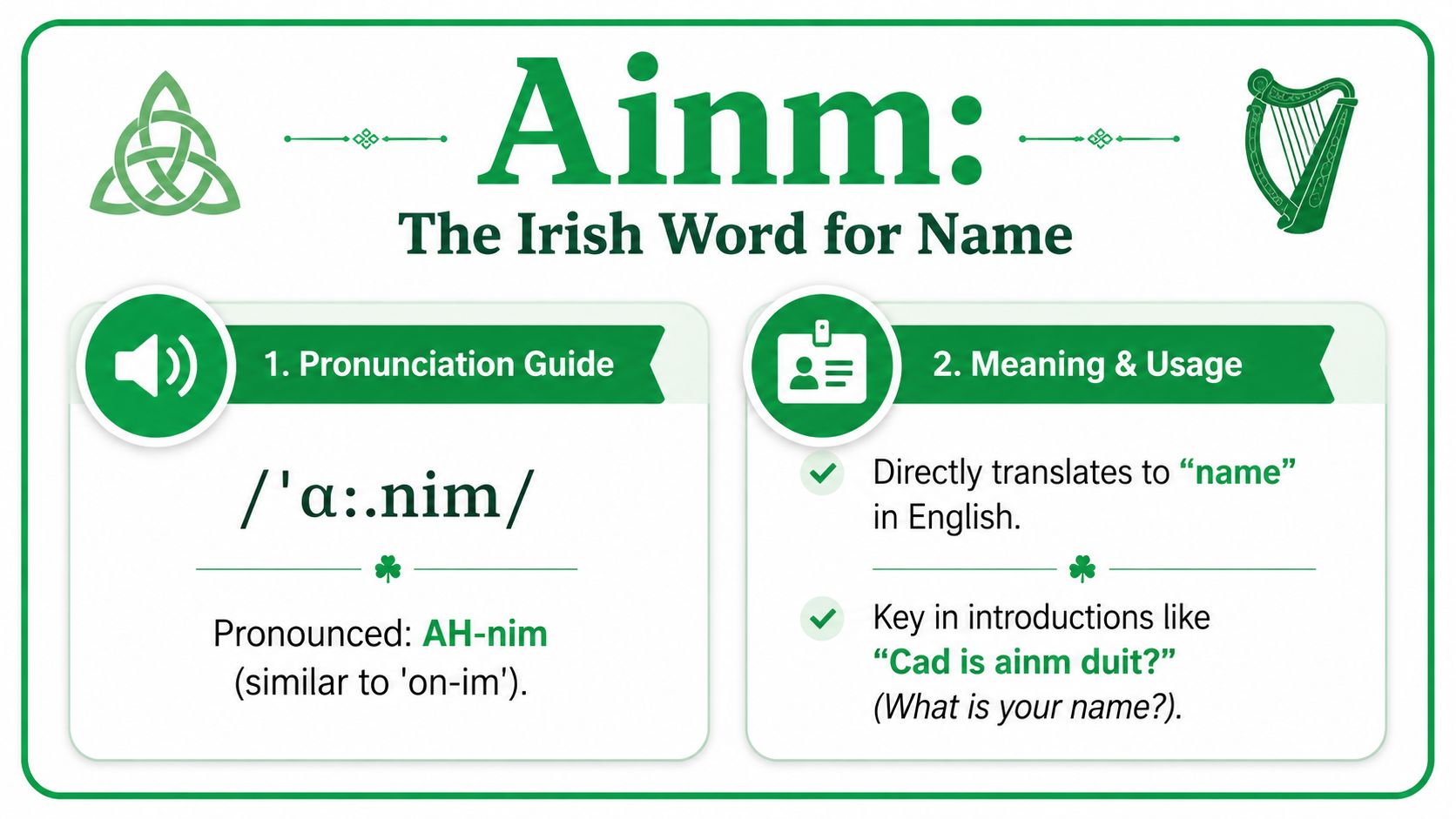
How to say ainm
Many beginners freeze when they see Irish spelling. That's normal. Irish spelling is systematic, but it doesn't map neatly onto English sounds.
A handy beginner guide is to say ainm roughly like AH-nim. Don't worry about making it perfect on day one. What matters first is that you recognize it when you hear it and can say it clearly enough to be understood.
If pronunciation is the part that makes you hesitate, a focused Irish pronunciation guide can help you hear common sound patterns instead of trying to guess every word from the page.
Practical rule: Learn words with their sound, not just their spelling. Irish becomes much easier once your ear gets involved.
The most useful introduction phrases
Once you know ainm, you can build the most common question:
- Cad is ainm duit?
What is your name?
There are two very natural ways to answer:
Is mise Seán.
I am Seán.Seán is ainm dom.
My name is Seán.
Both are correct. Both are common. If you're a beginner, start with the one that feels easier in your mouth.
Here are a few examples:
- Cad is ainm duit? Is mise Aoife.
- Cad is ainm duit? Liam is ainm dom.
- Cad is ainm duit? Is mise Sara.
The second pattern can feel strange to English speakers because it doesn't follow English word order. That's one of the first lovely things about Irish. It reminds you that you're stepping into a different language world, not just swapping in translated words.
A quick way to remember it
Try this memory trick:
- ainm = name
- Cad is ainm duit? = What is your name?
- Is mise… = I am…
- … is ainm dom = My name is…
Say the full exchange aloud as one unit. It's easier to remember a tiny conversation than four separate fragments.
Understanding Key Grammar and Variations
Irish gets more flexible once you notice that small words carry a lot of meaning. The good news is that you don't need advanced grammar to sound polite and natural. You just need to recognize a few patterns.
Duit and daoibh
In Cad is ainm duit?, the word duit is used when speaking to one person.
You may also hear:
- Cad is ainm daoibh?
That form is used when speaking to more than one person. In some contexts, it can also sound more formal or respectful.
Irish often marks the relationship between speakers more clearly than English does. English uses “you” for one person and many people. Irish doesn't always leave that vague.
A simple contrast helps:
| Irish phrase | Plain English use |
|---|---|
| Cad is ainm duit? | asking one person |
| Cad is ainm daoibh? | asking a group, or using a more formal plural form |
If you only remember duit at first, that's fine. It will serve you well in everyday beginner conversation.
Why you may hear mainm
You might also come across a form like M'ainm is Pádraig. That means My name is Pádraig.
This can puzzle learners because it looks different from ainm. What's happening is that Irish changes words in certain grammatical settings. The little m’ shows possession, so m'ainm means my name.
Compare these:
- Is mise Pádraig
- Pádraig is ainm dom
- M'ainm is Pádraig
All three introduce your name. They do it in different ways.
If grammar is something you want to understand rather than just memorize, a clear guide to the genitive case in Irish can help you notice why forms shift.
Surnames change in Irish too
Irish names don't stop at first names. Surnames also carry grammar and identity.
The Gaois Linguistic Database of Irish-language Surnames organizes 664 surname clusters and helps account for distinctions between male and female surname forms, including married and unmarried variations, features that anglicised forms often lost in English (research on the Gaois surname database).
That can surprise learners who only know surnames in fixed English forms. In Irish, names can reflect grammar, gender, and social context more visibly.
A name in Irish isn't always a frozen label. It can behave like part of the language around it.
That's one reason introductions in Irish feel richer than a simple exchange of labels. You're hearing language, family history, and grammar working together.
From English to Irish Common Gaelicised Names
A lot of learners don't stop at “what's your name?” They want to know, “What would my name be in Irish?” That question is especially meaningful for people reconnecting with family roots, but it's also just fun.
In Ireland today, naming remains lively and varied. The Central Statistics Office reported 10,336 distinct newborn names in 2025, with Irish-language names such as Rían, Dáire, Naoise, and Éabha prominent among the choices (CSO key findings on Irish babies' names in 2025).
Given names often have Irish forms
Some English names have direct Irish equivalents. Others have traditional Irish forms that aren't exact translations but are long-established matches.
A few examples many learners recognize quickly:
- John becomes Seán
- Mary becomes Máire
- Patrick becomes Pádraig
- Bridget becomes Bríd
Not every modern name has a neat traditional Irish counterpart. Sometimes the best approach is to keep your own name and learn how Irish speakers pronounce it naturally. That's a completely valid choice.
Common English Names and Their Irish Equivalents
| English Name | Irish (Gaeilge) Form | Phonetic Pronunciation |
|---|---|---|
| John | Seán | shawn |
| Mary | Máire | MAW-ra |
| Patrick | Pádraig | PAW-drig |
| Bridget | Bríd | breed |
| Michael | Mícheál | mee-HAWL |
| Catherine | Caitríona | kat-TREE-na |
| James | Séamus | SHAY-mus |
| Sarah | Sorcha | SUR-kha |
| Joan | Siobhán | shi-VAWN |
| Owen | Eoin | OH-in |
Use this table as a starting point, not a rulebook. Some families prefer one form, some another, and some use both depending on context.
What Ó and Mac tell you
Irish surnames carry especially deep history. Many are built from two ancestral markers: Ó and Mac.
- Ó comes from an older form Ua
- Mac means son
These forms later became the familiar English-looking O' and Mc/Mac. A large portion of common Irish surnames follow these recognizable patterns, which makes them useful for learners trying to decode family names (linguistic overview of Irish surname structure).
That's why surnames like Ó Briain and Mac Cárthaigh feel like more than labels. They point to descent, lineage, and older naming habits.
If your surname begins with O' or Mc, there's a good chance that learning its Irish form will teach you something about how Irish identity was carried through language, even when spelling shifted into English.
The Cultural Importance of Names in Ireland
Names matter in every culture, but in Ireland they often carry a special charge. Ask someone their name, and very often the conversation doesn't stop there. It moves naturally toward family, place, and connection.
A name can place you
A surname in Ireland can hint at region and history. One of the clearest examples is Murphy, which has been the most popular Irish surname for over a century according to Ireland's Central Statistics Office, with roots linked to the Ó Murchadha sept in Leinster (Irish surname reporting based on CSO data).
That kind of continuity helps explain why Irish people often listen closely to names. A surname may suggest where a family came from, what part of the island shaped them, or which older Gaelic form lies underneath the English spelling.
Why introductions feel personal in Ireland
Think of a simple encounter. You introduce yourself. Someone hears your surname and asks where your people are from. They aren't necessarily being formal or nosy. Often, they're being friendly in a distinctively Irish way.
That social instinct is part of what makes learning introduction phrases worthwhile. You're not just practicing textbook conversation. You're learning how to step into a culture where names often act like doors.
In Ireland, asking your name can be the start of a real conversation, not the end of a polite exchange.
For heritage learners, that can be especially moving. Sometimes the first Irish phrase someone learns is the one that lets them say their own name in a language their ancestors may have spoken. That's a small thing on paper. It rarely feels small in practice.
Practice Your Irish Introductions with Gaeilgeoir AI
Knowing the words is one thing. Saying them smoothly, at a natural pace, is something else.
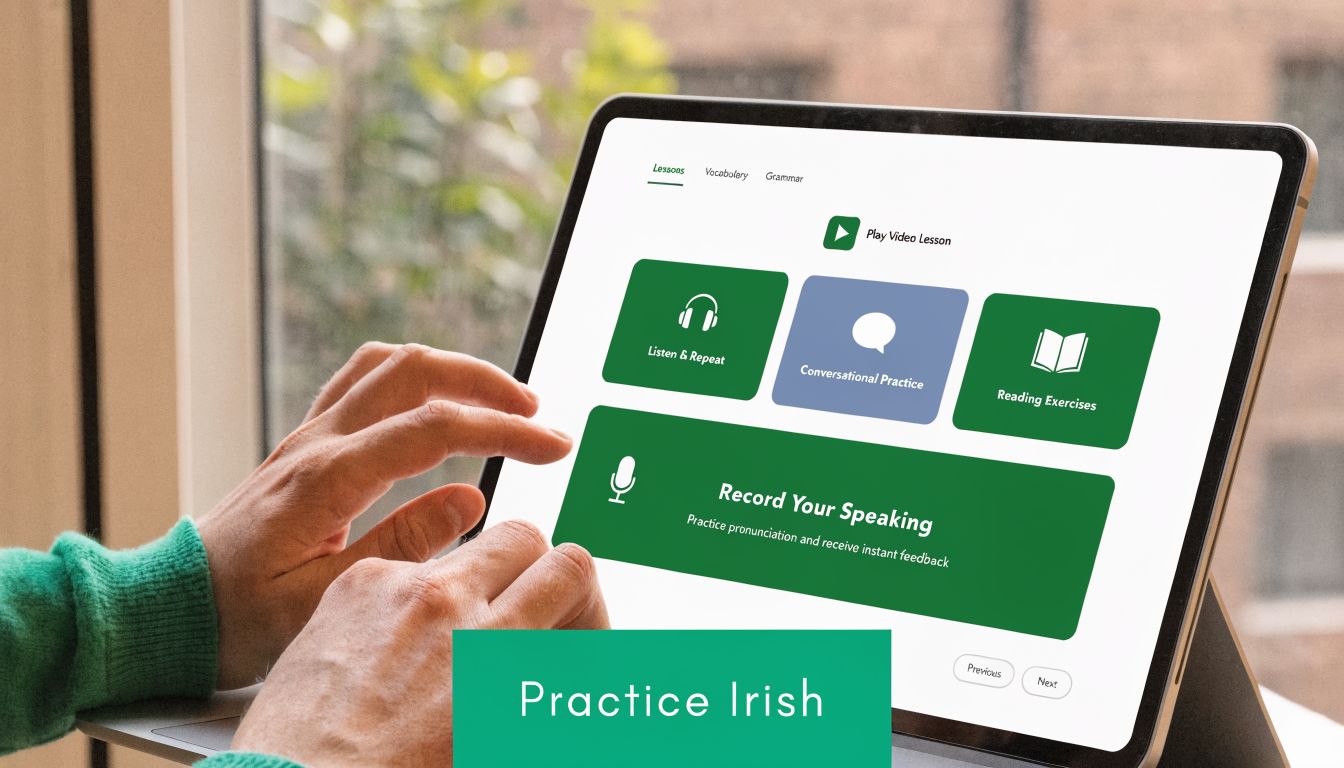
Why speaking practice matters early
A lot of learners stay stuck in recognition mode. They can read Cad is ainm duit? and understand it, but when a real person asks them a question, their mind goes blank for a second.
That's why active practice helps so much. Repeating short exchanges trains your mouth and ear together. It also removes the pressure of inventing long sentences before you're ready.
If you've used conversation tools for other languages, the same principle applies here. Many learners who want to boost your French confidence already understand that speaking improves fastest when practice feels low-pressure and regular. Irish works the same way.
A practical starting point for this is a basic Irish conversation guide that keeps you close to real social language rather than abstract vocabulary lists.
A simple practice routine
Try a short rotation rather than a long study session:
Say the question aloud three times.
Cad is ainm duit?Answer in two different ways.
Is mise Anna.
Anna is ainm dom.Swap in different names.
Use your own name, your friends' names, and common Irish names.Practice listening as well as speaking.
Hearing the rhythm matters as much as memorizing the wording.Add one follow-up question.
Once your introduction feels easy, build outward.
Short, repeated speaking practice usually beats a long session of silent reading.
That's especially useful with names, because names are personal. If you practice with words that matter to you, they tend to stick better.
Start Your Irish Language Journey Today
Learning irish for name starts with ainm, but it doesn't end there. From one small word, you've already met everyday conversation, key grammar, Gaelic versions of names, and the cultural weight surnames can carry in Ireland.
That's a strong beginning. It's also a manageable one. You don't need to master the whole language before you can introduce yourself well.
If you want more real interaction, it can help to find language practice partners alongside your own study so you hear different accents and conversation styles. Even then, your first reliable skill should still be a confident introduction.
Keep it simple. Learn ainm. Practice Cad is ainm duit?. Answer without rushing. Then repeat until it feels like yours.
If you're ready to turn these phrases into real spoken Irish, Gaeilgeoir AI is a practical next step. It gives you guided, real-world Irish conversation practice from day one, so you can move from recognizing phrases like Cad is ainm duit? to using them with confidence. You can also start at learn.gaeilgeoir.ai if you want a focused place to begin.