A learner in a café tries out a new phrase, gets the grammar a bit wrong, and the other person smiles and answers anyway. That moment matters more than perfect accuracy. Irish idioms live in that space where language becomes relationship, humor, and shared understanding.
Beyond the tourist clichés, Irish idioms open a door into how people soften a point, signal warmth, tease gently, or talk around difficulty. This guide keeps things practical. You'll learn ten well-known sayings in Irish, what they mean, how to pronounce and use them, and why they reflect values that run deep in Irish life. If you've searched for irish idioms and found only quick glossaries, the missing piece is usually context. Some expressions belong to Irish itself, some to Irish English, and some shift by region or tone, so using them well means hearing the culture inside the phrase. That matters for learners because Irish speech is not just literal. It often carries stance, kindness, irony, and social awareness.
Modern explainers of Irish speech regularly gather dozens of expressions around common functions like greeting, approval, surprise, joking, and criticism, which shows how broad this layer of everyday language is in Ireland, not just a handful of curiosities from postcards or pub talk, as shown in this Ireland-based overview of common sayings. Keep that in mind as you learn. You're not memorizing ornaments. You're building cultural fluency.
Table of Contents
- 1. Is fearr Gaeilge bhriste, ná Béarla cliste
- 2. Níl aon tinteán mar do thinteán féin
- 3. Éadaigh bhreá agus páipéar bán a chuireann geal ar chéachta
- 4. Mol an óige agus tiocfaidh siad
- 5. Ní bhíonn aon rogha ag an bhfear bocht ach glacadh le'a bhreall
- 6. Ar scáth a chéile a bhímid beo
- 7. Go n-éiri an bóthar len do chois
- 8. Bréag agus dhá bhréag is fírinne
- 9. Is geal an scéal é seo
- 10. Ní neart go cur le chéile
- 10 Irish Idioms Compared
- From Words to Wisdom Your Next Steps in Irish
1. Is fearr Gaeilge bhriste, ná Béarla cliste
This is one of the most important irish idioms for any learner. It means “Broken Irish is better than clever English.” The heart of it is simple. Trying matters.
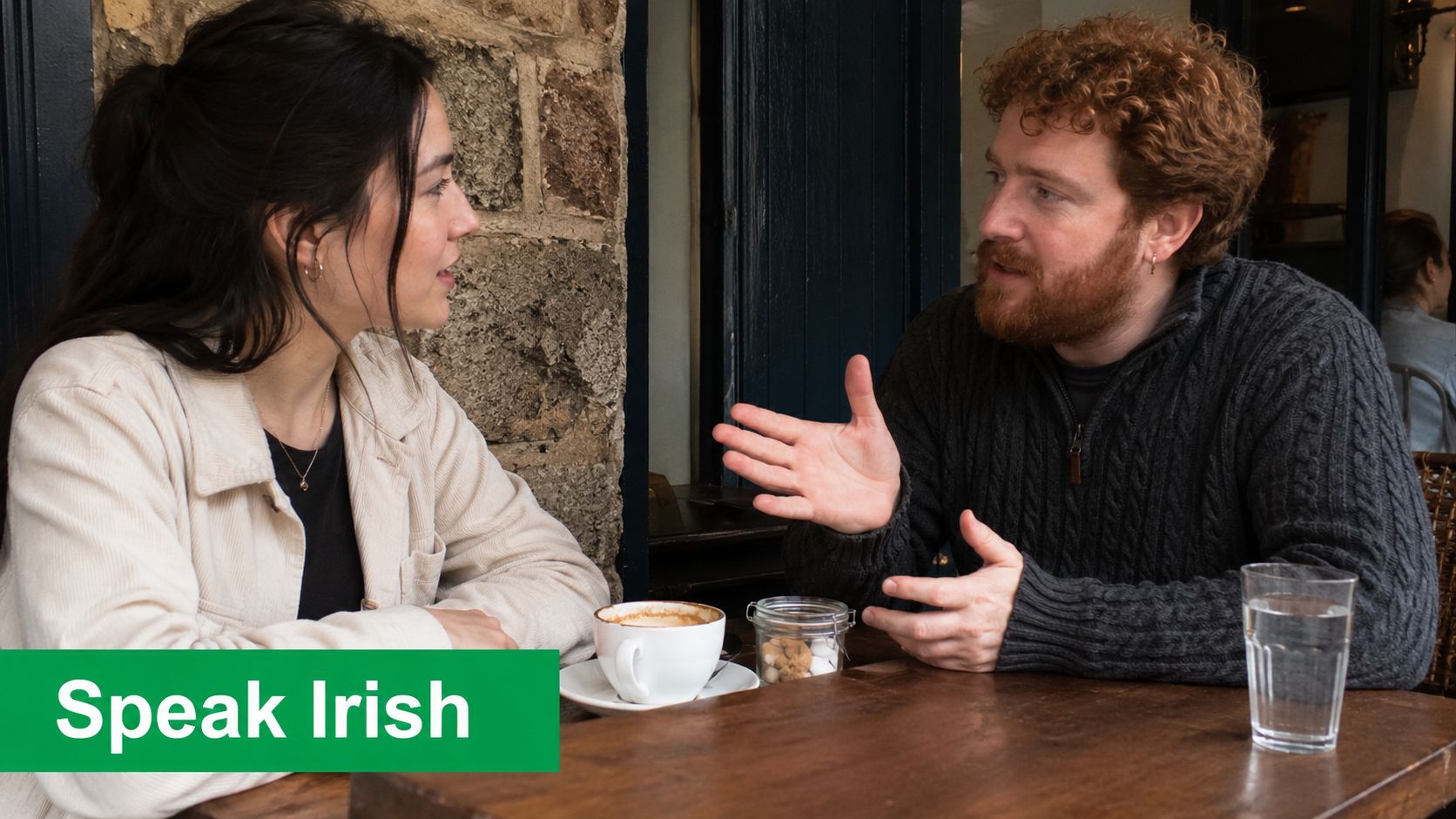
If you know only a few words and still use them, you're already living this proverb. A student who hesitates over verb endings but keeps speaking is doing better, in cultural terms, than someone who waits for flawless Irish and never opens their mouth. That's why this saying survives. It protects courage.
Why learners love this one
Say it to yourself when embarrassment starts creeping in. Irish often feels intimate because using it can connect you to family, place, and identity. That can make mistakes feel bigger than they are.
Practical rule: Start speaking from day one, even if your sentence is only three words long.
A useful pronunciation shortcut is to keep the rhythm steady rather than chasing perfection. You can practice by saying the first half, pausing, then saying the second half. Over time the phrase becomes more than vocabulary. It becomes permission.
A good real-world example is a beginner ordering tea, greeting someone, or asking a simple question in Irish, then switching only when needed. That is exactly the spirit behind this saying. If you want more learner-friendly examples, this Irish idioms language learning guide builds on the same idea of using phrases actively instead of only memorizing them.
2. Níl aon tinteán mar do thinteán féin
This saying means “There's no fireside like your own fireside,” or more naturally, “There's no place like home.” The image matters. A fireside is not just a room feature. It suggests warmth, welcome, family stories, and being known.
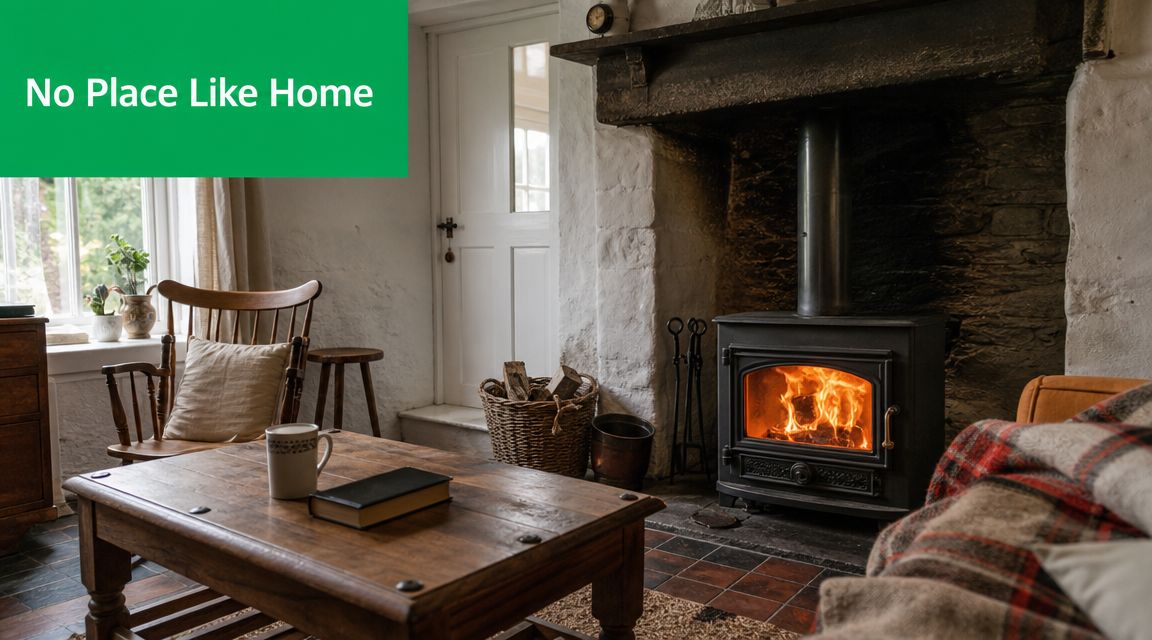
For heritage learners, this one often lands hard. Someone living abroad may learn Irish not because they need it for daily transactions, but because it brings them closer to grandparents, songs, place names, or a sense of belonging. The saying gives that feeling words.
A phrase full of home and memory
Try learning this idiom alongside a small set of related words: teach for house, muintir for family, and baile for home or hometown. That cluster helps you use the phrase naturally in conversation about visits, roots, and return.
You might say it when a family member comes back after time away, or when discussing why learning Irish matters to you personally. The phrase also carries a quiet worldview. Home is not only where you sleep. It is where your speech relaxes.
In a broader social sense, language exposure shapes whether people continue using Irish in adulthood. Self-reported ability differs strongly by jurisdiction, with 41% in the Republic of Ireland reporting they can speak Irish compared with 11% in Northern Ireland, according to this ESRI study on Irish language exposure and use.pdf). That doesn't make this proverb less personal. It makes the question of home, transmission, and belonging even more vivid.
3. Éadaigh bhreá agus páipéar bán a chuireann geal ar chéachta
This proverb warns against surface polish. A loose English sense is “Fine clothes and white paper brighten fools.” In other words, appearance can flatter something empty.
It's a sharp saying, and that sharpness is part of its value. Irish tradition often admires wit, but it also distrusts showiness without substance. A flashy display, a smooth pitch, or a polished image doesn't automatically deserve respect.
Why this still feels modern
You can hear the wisdom of this proverb in everyday decisions. A learner comparing two language tools might be tempted by the prettier interface, not the clearer explanations. A person scrolling social media may assume confidence equals expertise. This proverb tells you to slow down.
Use it when discussing authenticity, reputation, or first impressions. It works especially well with intermediate learners because it invites you to unpack the grammar word by word.
- Break the image apart: Learn the nouns first, then the verb phrase, so the saying becomes memorable rather than overwhelming.
- Apply it to media: If a video, ad, or app looks impressive, ask what kind of learning or truth sits underneath.
- Use it in debate: It's a strong phrase for conversations about image, branding, and public performance.
Fine wrapping can still hide poor goods.
That line captures the spirit of many traditional irish idioms. They don't just label life. They judge it.
4. Mol an óige agus tiocfaidh siad
This means “Praise the young and they will flourish.” It's generous, hopeful, and practical. Encouragement is not treated as softness here. It is treated as fuel.
For language learners, that matters every day. A teacher who notices a better pronunciation, a classmate who says your answer was good, or a tool that marks progress clearly can keep you going through the awkward middle stage when you know more than you can comfortably say.
Encouragement as a learning method
If you're studying Irish, borrow this proverb as a habit. Praise effort you can name. “You remembered the phrase.” “Your rhythm was better.” “You answered without switching to English.” Specific encouragement works better than vague approval because it tells the learner what to repeat.
This saying also belongs to the long tradition of seanfhocail, or Irish proverbs, where moral instruction is packed into memorable language. If you want to spend time with more sayings in that tradition, this introduction to exploring seanfhocail in Irish is a useful next read.
A real-world example is easy to imagine. A student freezes during speaking practice, manages one imperfect sentence, and the teacher answers warmly in Irish instead of correcting every flaw at once. That learner is far more likely to try again tomorrow.
- Use it with peers: Encourage another learner after a conversation practice session.
- Use it with yourself: Keep a record of small wins, not just mistakes.
- Use it with younger speakers: If a child or teen tries Irish, answer with warmth before precision.
Many idiom lists explain meanings but stop before tone. This one is all tone. It tells you what kind of speech community people want to build.
5. Ní bhíonn aon rogha ag an bhfear bocht ach glacadh le'a bhreall
This is a harder proverb. It means, roughly, “The poor man has no choice but to accept his lot.” It reflects a sober realism about limits, hardship, and making do.
Not every Irish saying is playful. Some come out of lives shaped by scarcity, migration, and constraint. That doesn't mean they celebrate suffering. Often they name it plainly, without ornament.
A hard saying with practical wisdom
A modern learner can use this proverb without treating it as fatalism. Maybe you work long hours, have family responsibilities, and only get ten minutes a day for Irish. You still practice with what you have. The saying recognizes constraint, but it can also sharpen resolve.
Here's one way to turn it into action:
- Shrink the session: If a full lesson won't happen, do a short speaking drill or review saved words.
- Use waiting time: Practice one phrase while commuting, cooking, or walking.
- Choose consistency over ideal conditions: Small contact with the language keeps the thread alive.
This proverb also helps explain why many traditional sayings carry both toughness and dignity. They were not written from a position of abundance. They were written by people who knew that endurance is often made of ordinary decisions.
In conversation, use it carefully. It can sound heavy. But in the right context, it expresses realism without self-pity, and that tone is one reason so many irish idioms feel emotionally mature.
6. Ar scáth a chéile a bhímid beo
This beautiful saying means “We live in the shelter of each other.” It's one of the clearest expressions of interdependence in Irish thought. Nobody becomes fully themselves alone.

For language learning, this is more than sentiment. Feeling safe, heard, and helped enhances one's ability to speak. A study partner, a patient relative, a local conversation circle, or an online learning community can create that shelter.
What community sounds like
This saying also helps correct a common misunderstanding. Many individuals looking for “Irish idiom” often expect one neat list. In reality, usage varies by region and social setting, and dialect experts stress that these forms belong to active regional speech rather than one fixed standard, as discussed in this expert conversation on Irish dialect variation. Community shapes language, and language reflects community back.
That matters when you hear one phrase often in Cork and less often in Donegal, or when a familiar expression lands differently depending on age, county, or company. Learning Irish well means learning who says what, where, and why.
You don't need to carry the language alone.
In practical terms, join spaces where Irish is spoken kindly. Ask questions. Listen to stronger speakers. Share what you know with someone newer than you. This proverb teaches that support is not extra. It is part of the language itself.
7. Go n-éiri an bóthar len do chois
This traditional blessing is often rendered as “May the road rise up to meet you.” Even if you've heard it in English before, learning it in Irish gives it new life. It is blessing as movement.
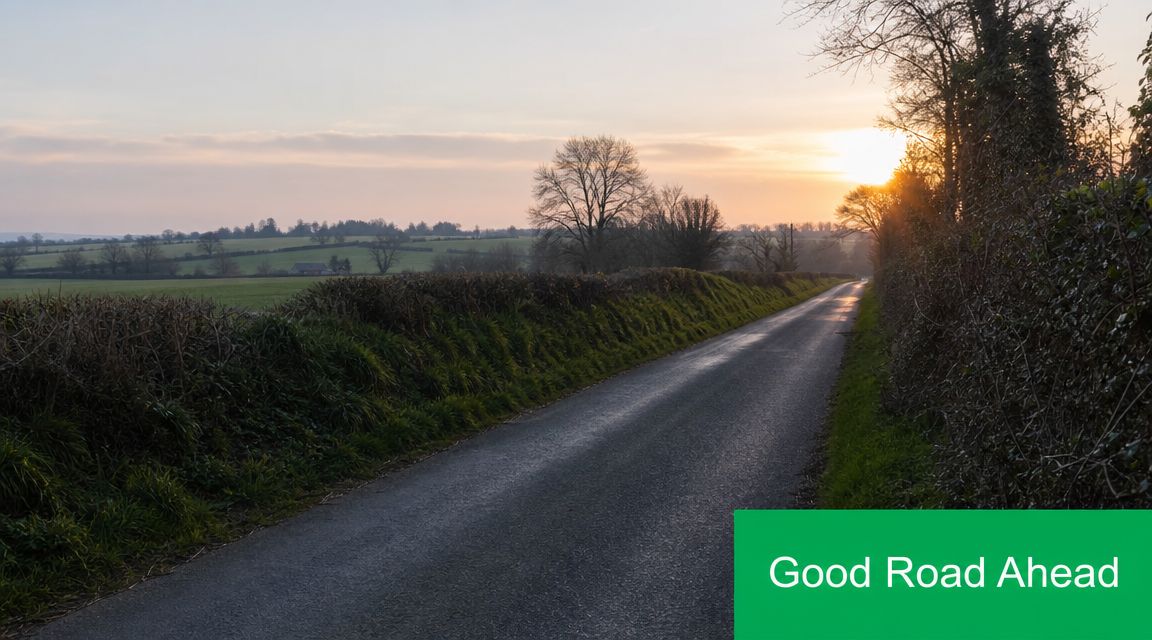
The phrase fits journeys of all kinds. A student starting oral exam preparation, a beginner speaking Irish for the first time, or a returning learner reconnecting with heritage can all receive this blessing naturally. It doesn't only wish luck. It imagines the path itself helping you along.
A blessing for beginnings
Try memorizing this one as a set phrase rather than analyzing every grammatical piece at first. Blessings often work by sound and repetition. Their emotional force comes from saying them whole.
You can use it when a friend begins a course, takes an exam, moves abroad, or commits to speaking more Irish each week. That makes it one of the warmest irish idioms to keep ready.
For beginners building a bank of useful expressions, this collection of essential Gaelic phrases for everyday use pairs well with blessings like this one.
A real-life scene is easy to picture. One learner messages another before an oral practice session: “Go n-éiri an bóthar len do chois.” It's short, generous, and unmistakably Irish in spirit. Language here is not just information. It is goodwill made audible.
8. Bréag agus dhá bhréag is fírinne
This proverb means “A lie and two lies make the truth.” It sounds cynical, and it is. But it's also observant. Repetition can make weak claims feel solid.
That makes this saying surprisingly relevant for modern learners. If you keep seeing a phrase translated the same way on random posts, or hear broad claims about “real Irish sayings” with no nuance, you may start trusting a simplified version of the truth.
Use this one to stay sharp
Many mainstream explainers of Irish sayings bundle together Irish, Irish English, and Hiberno-English without clearly separating them. This discussion of common Irish sayings and meanings highlights that gap and points out how phrases like “what's the craic,” “the Jacks,” “give out,” and “grand” are often treated as if they belong to one standard set, yet their nature is more layered and often region-specific.
That's exactly where this proverb helps. It reminds you not to confuse frequent repetition with precision.
- Compare meanings: Check whether a phrase is Irish, Irish English, or a translation from Irish.
- Notice register: Ask whether the phrase sounds formal, playful, rural, urban, old-fashioned, or current.
- Watch for oversimplification: A quick glossary may give a rough meaning but miss tone and audience.
If you're learning with curiosity, this saying becomes a method. Be open, but verify. It's a healthy instinct in language study and in life.
9. Is geal an scéal é seo
At first glance, this sounds positive. A natural sense is “That's a great story” or “That's wonderful news.” But often the phrase is used ironically. Tone can flip it from praise to skepticism.
The depth of Irish speech becomes apparent to learners. Meaning does not sit only in the dictionary. It lives in facial expression, timing, shared knowledge, and voice.
How irony changes everything
Suppose someone tells an unlikely tale, or makes an exaggerated claim about how easy something was. A speaker might answer with this phrase in a way that really means, “I'm not fully buying that.” The words alone won't teach you that. Context will.
This is one reason beginner lists can mislead. They often flatten expression into neat one-to-one translations. Yet many common sayings in Irish life shift with politeness, stance, and setting. This overview of common Irish sayings points to that gap, noting that phrases such as “give out,” “grand,” and “what's the craic” often need pragmatic explanation, not just dictionary glosses.
Listen for the smile behind the sentence.
To learn this well, watch conversations, interviews, or drama where speakers react naturally. Notice when a phrase sounds warmer, drier, or more doubtful than its literal meaning suggests. Once you hear that layer, irish idioms stop feeling decorative and start feeling alive.
10. Ní neart go cur le chéile
This means “There is no strength like unity.” It's close in spirit to Ar scáth a chéile a bhímid beo, but it has more force. It speaks not just of mutual shelter, but of combined power.
That makes it a strong phrase for study groups, language revival, community classes, and shared cultural effort. One learner working alone can do a lot. A group that practices together, recommends resources, and keeps each other accountable can do more.
Strength in shared effort
Use this saying when you want to rally people. A teacher might say it before group work. A community organizer might use it for an Irish event. A learner might use it to invite others into a weekly speaking circle.
The deeper lesson is cultural. Irish has long depended on collective care, not only individual interest. Families, schools, local groups, and committed learners all help keep speech in circulation.
Try applying the phrase in practical ways:
- Build a small circle: Even two people meeting regularly can create momentum.
- Share phrases aloud: Idioms stick better when they become social, not private.
- Support beginners openly: Strong communities grow when newcomers feel welcome.
This is a fitting final entry because it points outward. Language learning starts in the mouth and ear of one person, but it survives in the bonds between many.
10 Irish Idioms Compared
| Idiom | Implementation Complexity 🔄 | Resource Requirements ⚡ | Expected Outcomes ⭐📊 | Ideal Use Cases 💡 | Key Advantages |
|---|---|---|---|---|---|
| Is fearr Gaeilge bhriste, ná Béarla cliste | Low 🔄, simple to teach | Low ⚡, conversational drills | ⭐ High, 📊 Greater speaking confidence | 💡 Beginner conversation practice, immersion | Normalizes mistakes; increases usage |
| Níl aon tinteán mar do thinteán féin | Low–Moderate 🔄, cultural framing needed | Moderate ⚡, cultural/context materials | ⭐ Moderate, 📊 Strong emotional resonance | 💡 Heritage learning, family & home topics | Teaches cultural values; builds connection |
| Éadaigh bhreá agus páipéar bán a chuireann geal ar chéachta | Moderate 🔄, phrase analysis required | Moderate ⚡, intermediate lessons, examples | ⭐ Moderate, 📊 Improves discernment & vocabulary | 💡 Discussions on authenticity, branding | Encourages critical thinking; rich vocabulary |
| Mol an óige agus tiocfaidh siad | Low 🔄, straightforward proverb | Low ⚡, praise-based activities | ⭐ High, 📊 Boosts motivation and persistence | 💡 Feedback, gamified learning, mentoring | Supports growth mindset; motivates learners |
| Ní bhíonn aon rogha ag an bhfear bocht ach glacadh le'a bhreall | Moderate 🔄, contextual sensitivity | Low ⚡, historical/context notes | ⭐ Moderate, 📊 Teaches resilience perspective | 💡 Learning with constraints, social discussions | Validates pragmatic learning; fosters resilience |
| Ar scáth a chéile a bhímid beo | Low 🔄, easily integrated | Moderate ⚡, community platforms/tools | ⭐ High, 📊 Strengthens peer support & retention | 💡 Study groups, community-based programs | Fosters collaboration; boosts engagement |
| Go n-éiri an bóthar len do chois | Low 🔄, simple blessing form | Low ⚡, memorization, ceremonial use | ⭐ Moderate, 📊 Enhances motivation at milestones | 💡 Course starts, milestone celebrations | Emotional encouragement; ritual for beginnings |
| Bréag agus dhá bhréag is fírinne | Moderate–High 🔄, requires explanation | Moderate ⚡, examples of misinformation | ⭐ High, 📊 Improves critical evaluation skills | 💡 Media literacy, vetting learning resources | Teaches skepticism; prevents misinformation uptake |
| Is geal an scéal é seo | Moderate 🔄, nuance & irony teaching | Moderate–High ⚡, advanced practice, media | ⭐ Moderate, 📊 Develops cultural nuance & irony detection | 💡 Intermediate/advanced learners, literature | Teaches irony and pragmatic competence |
| Ní neart go cur le chéile | Low 🔄, easily applied in group design | Moderate ⚡, group coordination tools | ⭐ High, 📊 Increases collective outcomes & advocacy | 💡 Community campaigns, collaborative study | Encourages unity; historically and practically effective |
From Words to Wisdom Your Next Steps in Irish
These ten idioms do more than decorate speech. They teach attitudes. Is fearr Gaeilge bhriste, ná Béarla cliste tells you to begin before you feel ready. Níl aon tinteán mar do thinteán féin reminds you that language is tied to belonging. Ar scáth a chéile a bhímid beo and Ní neart go cur le chéile place community at the center, while sayings like Éadaigh bhreá agus páipéar bán a chuireann geal ar chéachta and Bréag agus dhá bhréag is fírinne sharpen your judgment.
That mix is part of what makes Irish so rewarding to learn. The language carries warmth, irony, resilience, and moral clarity all at once. Even when two idioms seem contradictory, one hopeful and one hard-edged, they often reflect different sides of the same worldview. People need encouragement, but they also need realism. They need home, but they also need courage for the road. Irish idioms hold those tensions comfortably.
If you're a beginner, don't try to master all ten at once. Pick two. Say them aloud. Write one in a notebook and use it in a practice sentence. Learn the situation as well as the translation. Ask yourself when you would say it, to whom, and with what tone. That habit will take you further than memorizing long lists.
It also helps to remember that not every “Irish idiom” online belongs to the same category. Some expressions are in Irish. Some belong to Irish English. Some are local. Some are old but still understood. Some sound warm in one setting and sharp in another. That isn't a problem. It's the living texture of the language.
Real progress begins when you move from recognition to use. Try speaking one proverb before a study session. Send a blessing to a friend. Use a phrase of encouragement in a language exchange. Notice when a native or fluent speaker uses irony or understatement and ask what made it work. Those moments build intuition.
Ready to start speaking with confidence? Gaeilgeoir AI gives you guided, real-world conversations and pronunciation support so you can use idioms like these naturally in context. The platform is built for learners who want to speak from day one, whether you're returning to Irish, preparing for an oral exam, or learning on a busy schedule. And if you run a program or teach in a structured environment, Tutorbase for language schools is also worth exploring.
If you want to turn these sayings into real speech, Gaeilgeoir AI is a smart place to begin. You can practice everyday conversations, get pronunciation help, and build confidence with guided Irish from your first session. For a direct next step, start here at Learn with Gaeilgeoir AI.