You've probably seen álainn in a song lyric, under a photo of Ireland, or in a message from someone learning Irish and thought, “I know that means something lovely, but how do you say it?” That's a very normal place to start.
It's also where a lot of beginners get stuck. A single translation like “beautiful” is helpful, but it doesn't tell you how the word sounds in real speech, where it goes in a sentence, or why Irish sometimes changes the shape of words around it. If you've ever felt that Irish looks simple for a moment and then suddenly slippery, you're in good company.
There's a real reason for that wider learning gap. Irish is still widely taught, but everyday spoken use is much rarer. In Ireland's 2022 Census, 1.87 million people said they could speak Irish, but only 71,968 said they spoke it daily outside education, and 41.2% said they had not used Irish in the previous week. That's why many adult learners know words on paper but want more help turning them into conversation.
Table of Contents
- The Beautiful Irish Word You Keep Hearing
- What Álainn Means and How to Say It Correctly
- How to Use Álainn in a Sentence
- Common Phrases and Sentences with Álainn
- Expanding Your Vocabulary Beyond Álainn
- How to Practice and Remember Álainn
The Beautiful Irish Word You Keep Hearing
A learner once told me they kept hearing álainn and thought it was a person's name. That happens more often than you'd think. Search results around similar spellings can be messy, especially because terms like “alainn” or “álainn” can point people toward unrelated businesses and brands instead of the Irish adjective they were looking for. One result tied to that confusion even describes a beauty subscription as “the only Irish Beauty Box on the market” on a BBB profile for Alainn Medical Aesthetics.
That confusion is a shame, because álainn is one of the nicest beginner words in Irish. It means beautiful, lovely, or sometimes fine, depending on the situation. It's the sort of word you can use for a person, a place, a day, a song, a meal, or even a feeling.
A good beginner word does two jobs: it gives you meaning fast, and it shows you how Irish likes to build sentences.
Álainn does both. It sounds musical, it turns up in everyday compliments, and it teaches you a very useful Irish pattern. English usually puts the describing word first. Irish often puts it after the noun. That's a small change, but once you notice it, a lot of Irish starts making more sense.
If you're reconnecting with Irish after school, this word can feel like a friendly door back in. If you're brand new, it's a satisfying first win. You can learn it, say it out loud, and start using it today.
What Álainn Means and How to Say It Correctly
Start with the spelling
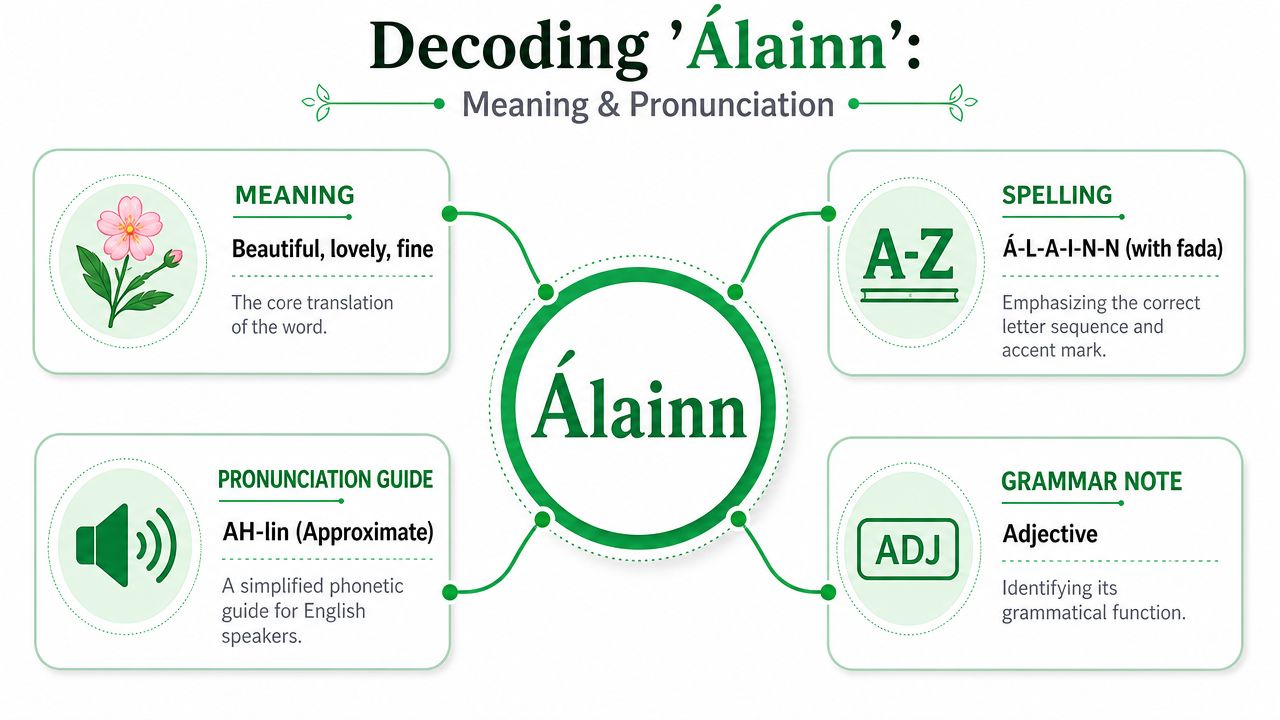
The correct spelling is álainn, with a fada over the first a. That mark matters. In Irish, the fada changes the vowel sound, so it isn't decoration and it isn't optional if you want to learn the word properly.
The primary meaning of álainn is beautiful. Depending on tone and context, it can also feel like lovely or gorgeous in English. Irish words often stretch a little in meaning, and this is one of them.
For learners who like technical detail, the IPA pronunciation is [ˈaːl̪ˠɪnʲ].
If you want to hear Irish words spoken clearly by different voices while you practise, it can help to compare audio. Tools discussed in ClipCreator.ai's TTS software picks can be useful for slow, repeatable listening, especially when you're trying to catch vowel length.
A simple pronunciation guide for English speakers
The easiest beginner approximation is AH-lin.
Not “uh-LANE.”
Not “AL-an.”
Not “a-LINE.”
Think of it in two parts:
- Á sounds long. Open your mouth and let it stretch a little. It's closer to ah than the short a in “cat.”
- Lainn comes out softly, almost like lin or lyin depending on the speaker and dialect you hear.
A rough learner-friendly version is:
| Part | How to think of it | What to avoid |
|---|---|---|
| Á | long ah | short flat a |
| -lainn | soft lin | hard English lane |
The most common beginner mistake is dropping the fada and reading the word like plain English spelling. Irish doesn't reward that approach very often. If the fada disappears, the pronunciation clue disappears with it.
Say it slowly first: AH…linn. Then say it again as one smooth word: Álainn.
Try this tiny drill:
- Say it once alone: álainn
- Say it with a noun: lá álainn
- Say it with feeling: Tá sé álainn
That last step matters. Irish comes alive when you stop treating words like flashcards and start saying them as complete thoughts.
How to Use Álainn in a Sentence
The main word order rule
Here's the first grammar point worth keeping: álainn is an adjective, and in Irish the adjective usually comes after the noun it describes.
That feels backwards if English is your starting point. In English, you say “beautiful girl.” In Irish, you usually say the equivalent of “girl beautiful.”
So:
- cailín álainn = a beautiful girl
- madra álainn = a beautiful dog
- lá álainn = a beautiful day
- áit álainn = a beautiful place
That one rule gets you a long way.
A good way to feel the pattern is to swap in different nouns:
- teach álainn for a beautiful house
- gairdín álainn for a beautiful garden
- amhrán álainn for a beautiful song
You don't need to master every grammar exception before you use the word. You just need the basic habit. Noun first, adjective after.
Using go hálainn
Beginners also meet go hálainn, and that can look strange at first. You'll often hear it in phrases like:
- Tá sé go hálainn = It is beautiful / It's lovely
- Tá sí go hálainn = She is beautiful
The h appears after go, and yes, that's one of those little Irish changes that can seem mysterious at first. For now, the useful thing is not the full grammar theory. The useful thing is to recognise the chunk and use it naturally.
Here's a quick comparison:
| Pattern | Irish example | English meaning |
|---|---|---|
| Noun + álainn | lá álainn | a beautiful day |
| Tá + go hálainn | Tá sé go hálainn | it is beautiful |
You don't have to solve every mutation the first day. Learn the phrase as a whole, then let grammar catch up.
If you're speaking casually, start with short, usable lines:
- Tá sé álainn.
- Tá sí álainn.
- Tá an áit seo álainn.
This place is beautiful.
That last sentence is especially handy when you're travelling in Ireland or reacting to something around you. It sounds natural, warm, and easy to remember.
Common Phrases and Sentences with Álainn
The word starts to feel real. Instead of staring at álainn on its own, you can pick it up inside phrases people might say.
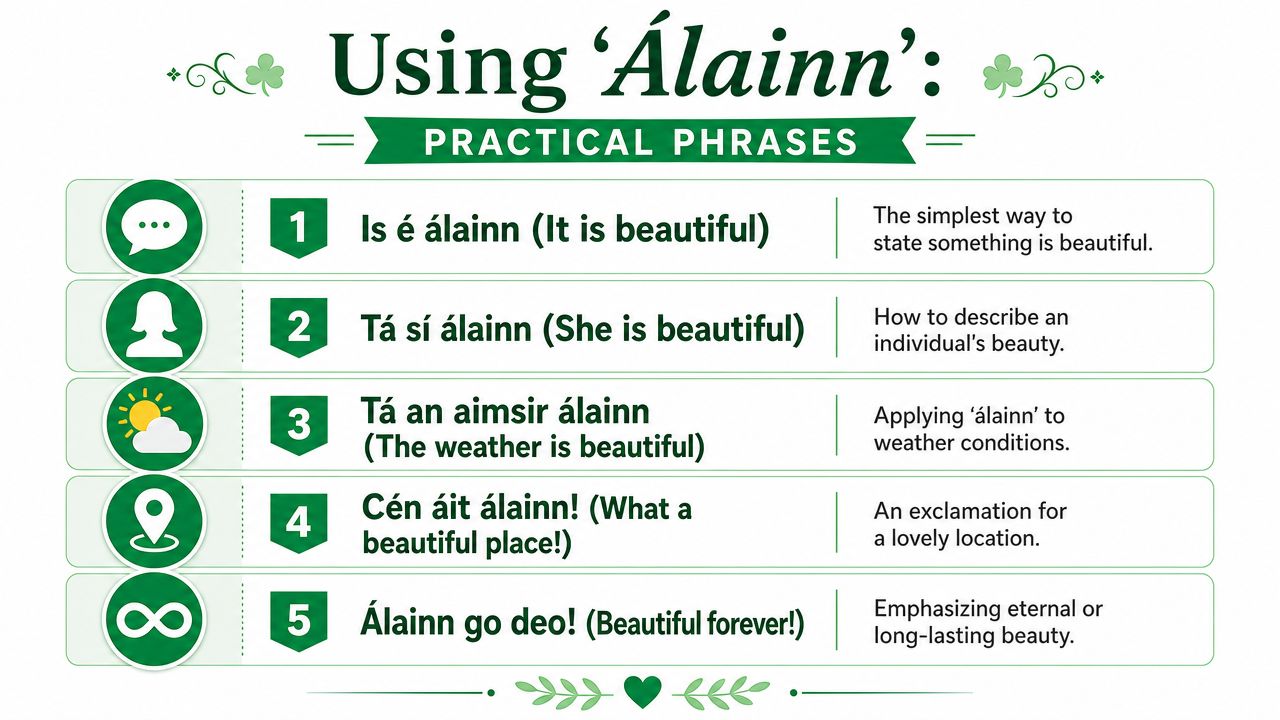
Easy phrases you can use right away
Here are some useful ones to learn by heart:
Lá álainn
A beautiful day.
Short, simple, and perfect for weather or mood.Oíche álainn
A beautiful night.
Nice for writing, speech, or a quiet compliment about an evening.Tá sí álainn
She is beautiful.
Common and direct.Tá sé álainn
It is beautiful.
Good for places, music, scenery, food, and lots more.Tá an aimsir álainn
The weather is beautiful.
Extremely useful in everyday Irish conversation.Cén áit álainn!
What a beautiful place!
Great as an exclamation when you arrive somewhere striking.
A quick listening break helps here:
How these phrases feel in real life
Not every phrase with álainn sounds equally formal. Some feel warm and conversational. Some feel a little poetic. That's normal.
For example, Tá an aimsir álainn is everyday speech. You could say it while opening the curtains. Oíche álainn feels a little more lyrical. You might hear it in a song, a toast, or a message.
Here's a small guide:
| Phrase | Where it fits best |
|---|---|
| Tá an aimsir álainn | everyday conversation |
| Tá sé álainn | general reaction to something nice |
| Cén áit álainn! | travel, scenery, excitement |
| Oíche álainn | poetic or expressive use |
And one longer example:
Go raibh maith agat, tá sé go hálainn.
Thank you, it's lovely.
That's the kind of sentence that makes Irish feel useful, not distant. You can imagine saying it when someone gives you a gift, serves food, or shows you something they've made.
If you only memorise three items today, make them these:
- lá álainn
- tá sé álainn
- tá an aimsir álainn
Those three give you weather, reaction, and description. That's a solid start.
Expanding Your Vocabulary Beyond Álainn
Once álainn feels comfortable, it helps to compare it with nearby words. That's how you stop translating everything as just “beautiful” and start hearing shades of meaning.
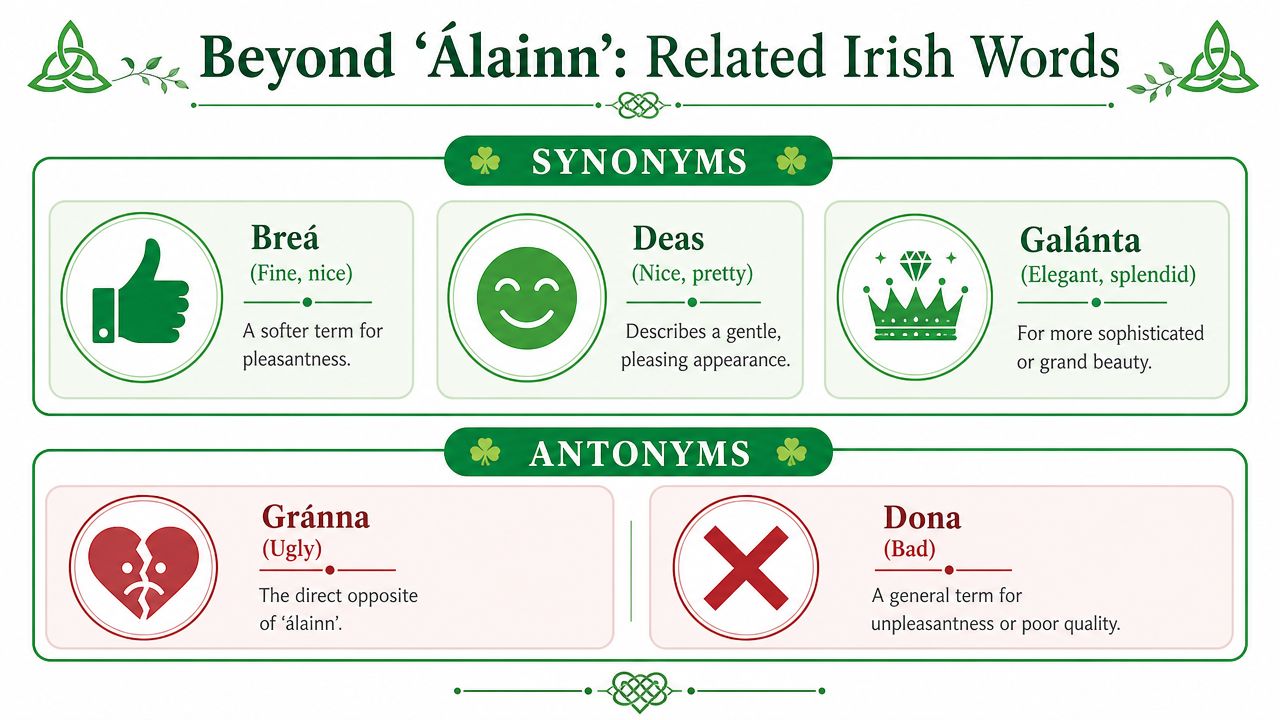
Words that overlap with álainn
A few useful neighbours are:
breá
This often feels like fine, nice, lovely, or great. It's broad and friendly. If álainn is “beautiful,” breá is often the easier everyday cousin.deas
Usually nice, pleasant, or pretty. Softer than álainn in many situations.dathúil
Often used for someone attractive, stylish, or good-looking. It can be a better fit for people than for natural settings.aoibhinn
More like delightful or lovely in a joyful sense. It often carries feeling, not just appearance.galánta
Think elegant or splendid. Good when the beauty has style or polish.
You can see the difference in a simple comparison:
| Word | English sense | Common feel |
|---|---|---|
| álainn | beautiful, lovely | broad and expressive |
| breá | fine, lovely, great | everyday and flexible |
| deas | nice, pretty | gentle and casual |
| galánta | elegant | more refined |
If you like learning vocabulary through culture, seasonal language is a nice way in. Around spring themes and traditional celebrations, words of praise and beauty come up naturally. You can see that in this piece on Imbolc in Irish tradition, where descriptive Irish helps tie language to place, weather, and custom.
When not to use álainn
A beginner mistake is trying to make álainn do every positive job. Sometimes another word fits better.
If your tea was nice, breá or deas may sound more natural depending on the speaker. If someone looks elegant at an event, galánta might hit the right note. If something is the opposite of beautiful, the most useful contrast word is gránna, meaning ugly.
The goal isn't to replace álainn. It's to give it neighbours, so your Irish starts to sound more flexible.
As your ear improves, you'll notice that álainn often carries warmth beyond physical beauty. People use it for moments, weather, music, and atmosphere too. That's one reason learners love it so quickly.
How to Practice and Remember Álainn
The best way to keep álainn in your memory is to stop treating it like a test item and start attaching it to your own life. A word sticks when you use it for things you notice.
A short daily routine
Try this routine for a few days:
Look around and name one thing.
Say teach álainn, lá álainn, or amhrán álainn aloud if it fits what's around you.Use one full sentence.
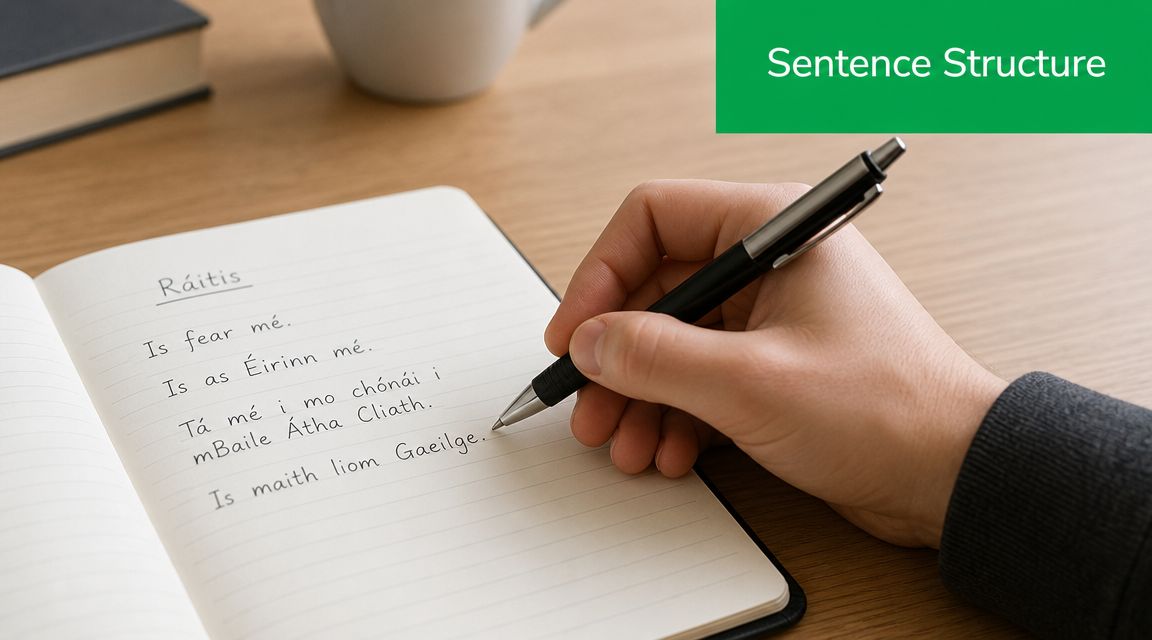
Try Tá sé álainn when you see a photo, hear music, or step outside.Write one line in a notebook.
Keep it tiny. For example: Tá an aimsir álainn inniu.Repeat the sound slowly.
Focus on the long first vowel. Don't rush.
If spoken practice feels awkward, that's normal. Many adults know Irish as a school subject first, not as a spoken habit. Since daily use is limited for many learners, building your own speaking routine matters more than waiting for the perfect moment.
How to keep the word active
Audio helps. Songs, learner podcasts, and short clips can all reinforce rhythm and pronunciation. Some learners also find it useful to record themselves, then compare what they hear. If that appeals to you, this guide to voice-to-notes for language learners offers practical ways to turn speaking into a regular habit.
You can also make the word social:
- Say lá álainn in a message on a sunny morning.
- Describe a view with Tá an áit seo álainn.
- Compliment a song, photo, or gift in Irish.
If you want more than isolated words, tools that support speaking practice can help. One option is Gaeilgeoir AI, which offers guided Irish conversation practice, pronunciation support, and scenario-based learning for everyday situations.
If you're ready to move beyond single words and start using Irish in real conversations, Gaeilgeoir AI gives you a structured way to practise pronunciation, everyday phrases, and speaking habits from the start.