You might be in this exact spot right now. You downloaded an Irish app, bought a grammar book, or promised yourself that this time you'd finally stick with learning Gaeilge. For a few days, it felt exciting. Then the lessons got oddly mismatched. Some were too easy, some jumped ahead, and some taught phrases you'd never use in real life.
That frustration doesn't mean you're bad at languages. It usually means the system wasn't built around you. Language learners don't all start in the same place, move at the same speed, or want the same outcome. A beginner who wants to order coffee in Galway needs a different route from a student preparing for the oral exam, and both need something different again from a heritage learner reconnecting with school Irish.
Table of Contents
- The Problem with One-Size-Fits-All Language Learning
- A Smarter Route to Fluency Personalized Learning Paths Explained
- How Adaptive Technology Builds Your Unique Path
- Why Personalized Learning Accelerates Language Skills
- Personalized Irish Learning from Beginner to Leaving Cert
- Best Practices for Maximizing Your Learning Path
- How Gaeilgeoir AI Creates Your Personalized Path
The Problem with One-Size-Fits-All Language Learning
A generic language course usually assumes there's a “normal learner.” That imaginary person starts with the right background, has the same free time every week, enjoys the same lesson style, and needs the same vocabulary in the same order. Real learners don't look like that.
A beginner learning Irish often meets this problem on day one. The app throws in grammar labels before the learner can hold a tiny conversation. Or it spends too long drilling words they already know from school while skipping the phrases they want, such as greeting someone, asking for directions, or introducing themselves. Progress starts to feel random.
A common Irish learning pattern
Take three learners:
- The busy adult: They want practical spoken Irish for travel and family connection, but the course keeps feeding them classroom-style exercises.
- The heritage learner: They remember scattered phrases from school, yet the platform treats them like a total beginner.
- The student: They need oral fluency under exam pressure, but the lessons focus on broad exposure rather than targeted speaking practice.
Each learner hits a wall for a different reason. The material isn't wrong. It's just poorly matched.
Practical rule: When a course feels too fast, too slow, or oddly irrelevant, the issue often isn't your ability. It's the pathway.
That's why personalized learning paths have gained so much attention. This isn't a tiny trend. The global market for personalized learning reached $1.8 billion in 2023 and is projected to surge to $19.86 billion by 2030, according to SkillPanel's overview of personalized learning pathways. That growth reflects a broad move away from fixed, one-track teaching and toward systems that adapt to the learner.
Why generic study advice falls short
Many learners also collect disconnected tips. One video says to memorize vocabulary lists. Another says only speak. Another says use AI. Helpful in theory, messy in practice.
If you want a practical companion piece on using AI without turning your study routine into chaos, this guide to effective AI study techniques is worth reading. It's useful because it focuses on study habits, not hype.
A better Irish course acts more like a guide than a conveyor belt. It figures out what you know, what you're ready for next, and what matters for your goal. That's the core idea behind personalized learning paths.
A Smarter Route to Fluency Personalized Learning Paths Explained
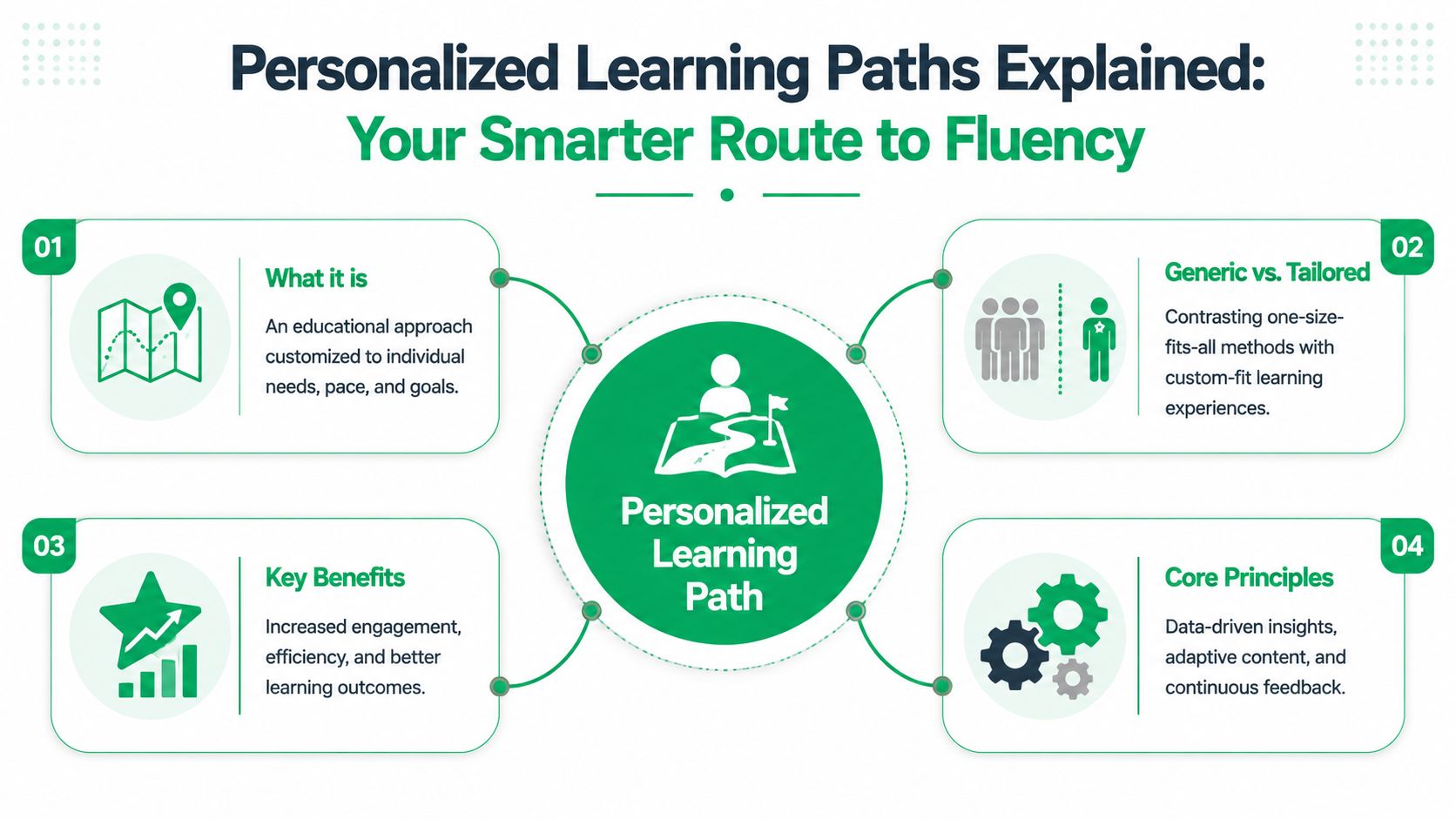
A personalized learning path is a learning route shaped around your current level, your goals, and your pace. It's not just “self-paced” in the casual sense. It's structured, but the structure bends around the learner rather than forcing the learner into a fixed sequence.
Early in the journey, a visual map helps more than a long definition.
Think of a personal trainer, not a photocopied plan
The easiest analogy is fitness. A generic workout from a magazine tells everyone to do the same routine. A good trainer asks better questions. Are you recovering from injury? Training for a race? Trying to build strength? Short on time? Strong in some areas and weak in others?
Language learning works the same way.
A generic Irish course says, “Lesson 1, then Lesson 2, then Lesson 3.” A personalized path asks:
- What can you already do? Maybe you can read simple Irish but freeze when speaking.
- What do you need first? Maybe conversation matters more than formal grammar labels.
- Where do you stumble? Maybe verb forms are fine, but listening speed knocks you out.
- What's your target? Daily speech, heritage reconnection, or Leaving Cert performance.
Evidence summarized in this overview of personalized learning in education notes that personalized learning emphasizes learner agency, competency-based progression, and flexible environments. In plain English, that means you get more say, you move forward by mastering skills, and the learning environment adjusts instead of staying rigid.
Later, it helps to hear the concept explained from another angle.
What makes the path personalized
A real personalized path usually has a few core features:
| Element | What it means for an Irish learner |
|---|---|
| Learner profile | The system tracks your strengths, weak spots, and goals |
| Adaptive sequence | You don't get the same next lesson as everyone else |
| Competency-based progress | You move on when you can do the thing, not when the calendar says so |
| Flexible practice | Reading, listening, speaking, and review can shift based on need |
That last point matters a lot. If you can recognize “Dia duit” on screen but can't respond when someone says it aloud, your path should change. It shouldn't keep rewarding recognition alone.
Personalized learning works best when it feels like someone noticed where you are, not just where the curriculum starts.
How Adaptive Technology Builds Your Unique Path
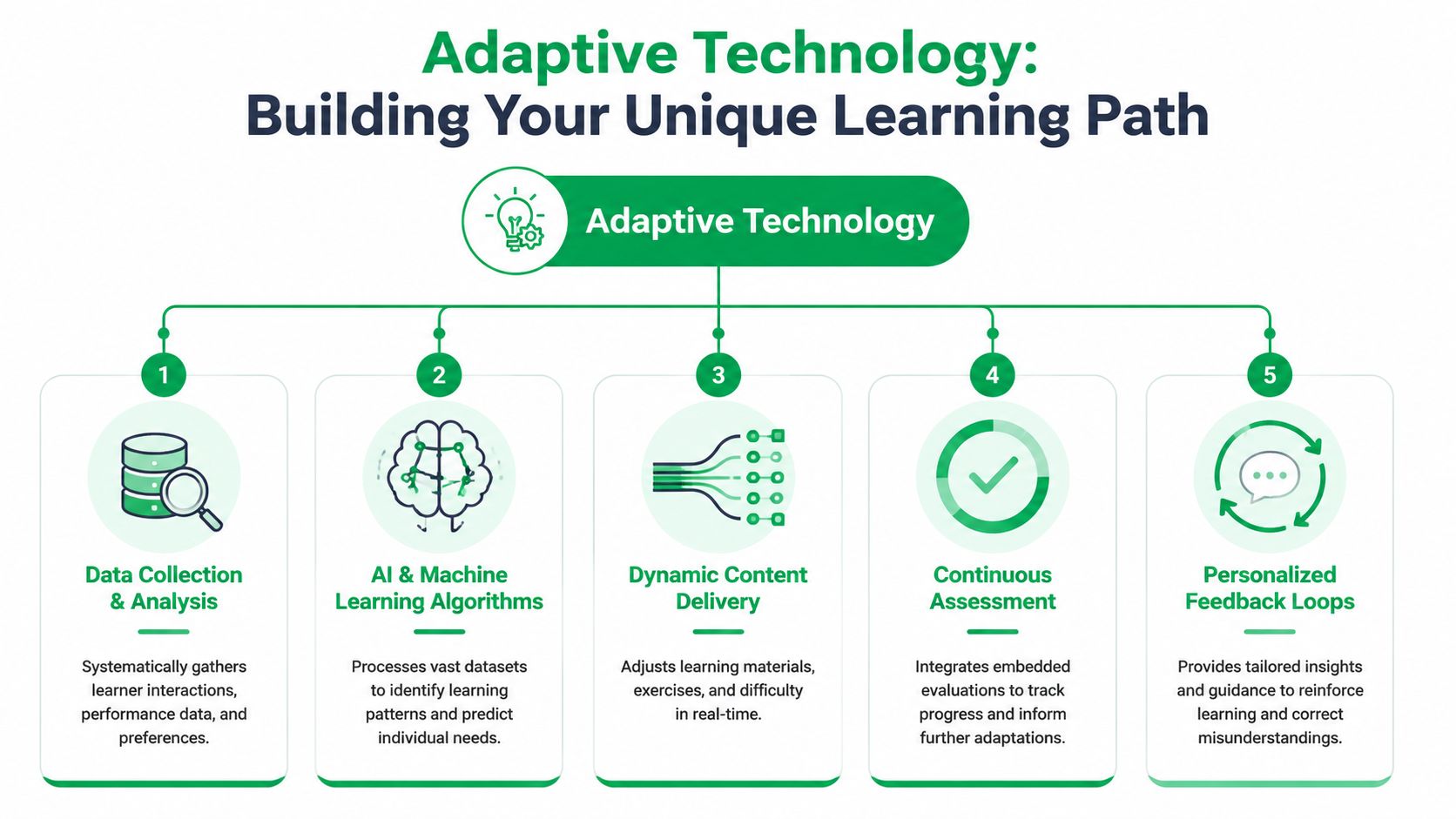
When people hear “adaptive technology,” they often picture a mysterious black box. In practice, the good version is simpler. It watches how you perform, notices patterns, and changes what comes next.
This visual breaks the process down.
Your starting point matters
The first piece is diagnosis. Before a system can personalize anything, it needs to know where you are.
Like a satnav, if the starting point is wrong, the route will be wrong too. In Irish, that could mean giving a returning learner endless beginner word matching, or handing a new learner fast dialogue practice before they've built a foundation in sounds and core phrases.
A good diagnostic does more than sort you into “beginner” or “intermediate.” It tries to detect specific patterns, such as:
- Recognition without recall: You understand words when you see them but can't produce them.
- Grammar without fluency: You know rules from school but can't use them in conversation.
- Vocabulary gaps by topic: You can discuss school but not travel, family, or daily routines.
For a deeper look at how these systems work behind the scenes, this piece on machine learning in education is a useful companion.
How the system adjusts as you learn
The second piece is adaptation. Once the system has a baseline, it starts changing the route in response to your performance.
If you keep missing a listening item, the platform might slow the pace, repeat the structure in a new context, or switch to simpler audio. If you consistently answer a form correctly, it may stop wasting your time and move to the next challenge.
The U.S. Department of Education summary discussed in the earlier education overview highlights learner agency, competency-based progression, flexible environments, and instruction shifts such as data-driven decisions, targeted instruction, and increasing student ownership. Those ideas sound technical, but the learner-facing version is concrete: the work becomes more relevant.
Why feedback loops matter in Irish study
A strong adaptive system also uses feedback loops. Through these loops, many learners feel the difference.
Instead of waiting until the end of a unit to discover you misunderstood a pattern, the platform responds in the moment. That might mean showing a pronunciation cue, surfacing a review card just before you forget a word, or giving you a simpler speaking prompt before returning to the harder one.
Here's how the main pieces feel from the learner's side:
- Diagnostic assessment helps you avoid starting in the wrong place.
- Adaptive difficulty keeps tasks from becoming dull or crushing.
- Spaced review brings words back before they fade.
- Scenario practice teaches language in context, not in isolation.
- Progress feedback shows whether you're building real ability or just clicking through.
A good adaptive system doesn't race you through content. It keeps adjusting until the content fits.
For Irish, that fit matters because learners often have uneven skills. Someone may know isolated school vocabulary, mishear everyday speech, and still be ready for useful conversation if the path is arranged properly.
Why Personalized Learning Accelerates Language Skills
Language progress speeds up when your energy goes to the right problem. That's the practical advantage of personalization. You spend less time proving what you already know and more time strengthening what's weak.
Research summarized by Third Rock Techkno on personalized learning paths for students states that AI-powered personalized learning systems improve student outcomes by 25% while simultaneously reducing teacher workload. For learners, the key takeaway is straightforward. Better targeting can improve results because the system keeps adapting to real performance.
Motivation improves when the challenge fits
Motivation drops fast when work feels mismatched.
If your Irish lesson is too easy, you drift. If it's too hard, you tense up and avoid it. The sweet spot is the “just manageable” challenge. You have to think, but you don't feel lost.
That's especially useful in speaking practice. A personalized system can move from “My name is…” to short exchanges about family, work, or travel at a pace you can handle, instead of throwing you into a long dialogue before your ears and mouth are ready.
Retention gets stronger through timing and context
A language doesn't stick because you saw it once. It sticks when you meet it again at the right moment and in the right setting.
Personalized review is helpful here because the system can keep resurfacing Irish words, sentence patterns, and listening items that are at risk of fading. It can also connect them to scenarios that matter. “An bhfuil cead agam?” lands better when tied to a school or social situation than when it appears as an abstract line on a worksheet.
The brain remembers language more easily when meaning, timing, and use show up together.
That's why contextual practice often feels smoother than isolated memorization. You're not just learning the phrase. You're learning when it belongs.
Efficiency comes from not wasting effort
Efficiency in language study doesn't mean rushing. It means using your limited time well.
A personalized path can skip repeated drills on material you've clearly mastered and redirect your effort toward weak pronunciation, shaky listening, or high-value vocabulary. For adult learners, that matters because study time is usually squeezed between work, family, and everything else.
A short comparison makes the difference clearer:
| Study style | Likely experience |
|---|---|
| Fixed sequence course | Everyone gets the same material in the same order |
| Personalized path | Your review, pacing, and next tasks respond to your performance |
That's why personalized learning paths often feel lighter even when they're demanding more of the right kind of effort.
Personalized Irish Learning from Beginner to Leaving Cert
The easiest way to understand personalization is to look at how different Irish learners need different routes. The content may overlap, but the order, pacing, and practice style shouldn't.
The complete beginner
Niamh is starting from scratch. She wants one simple outcome first. Hold a short conversation without panicking.
Her path shouldn't begin with dense grammar explanations. It should begin with sounds, high-frequency words, and small social exchanges. She needs greetings, introductions, common questions, and listening practice that trains her ear to the rhythm of Irish.
A beginner path might look like this:
- Week focus: Core phrases for meeting people
- Practice type: Short listen-and-repeat drills, simple prompts, and tiny dialogues
- Success marker: She can greet someone, say where she's from, and ask one basic question
That foundation matters because beginners often mistake speed for progress. If the platform rushes ahead, they can end up clicking through material without building stable recall.
The returning learner with patchy school Irish
Seán learned Irish in school and remembers more than he thinks. He can recognize bits of vocabulary and grammar, but his active recall is uneven. He knows some forms on paper and struggles to say anything spontaneously.
His ideal path starts with diagnosis. The system needs to find the gaps instead of starting over from zero. Maybe his listening is stronger than his speaking. Maybe he knows school topics but lacks practical everyday language.
A personalized route for Seán would likely emphasize:
- Gap filling: Spotting missing verb patterns or topic vocabulary
- Conversion to active use: Turning passive recognition into spoken production
- Confidence repair: Giving manageable speaking tasks that prove he knows more than he feels
This kind of learner often benefits from targeted review rather than broad beginner content. The aim is reconstruction, not restart.
The Leaving Cert student
Aoife has a clear deadline. She needs oral exam fluency, topic control, and confidence under pressure.
Her path should be shaped around exam-style interaction. That means repeated practice with common oral themes, short-answer agility, and speaking prompts that feel realistic rather than generic. She also needs feedback on where she hesitates, where her vocabulary thins out, and which topics need reinforcement.
If that's your situation, this Leaving Cert Irish guide is a useful extra resource.
A student like Aoife doesn't need endless broad exposure. She needs focused repetition in likely scenarios. The platform should help her build from topic phrases to fuller responses, then to fluid back-and-forth speech.
Different Irish learners don't need different motivation speeches. They need different routes.
That's the core promise of personalized learning paths. The path changes because the learner changes.
Best Practices for Maximizing Your Learning Path
Even the smartest system can't do the learning for you. Personalization works best when the learner participates honestly and when the platform is built on sound teaching, not flashy shortcuts.
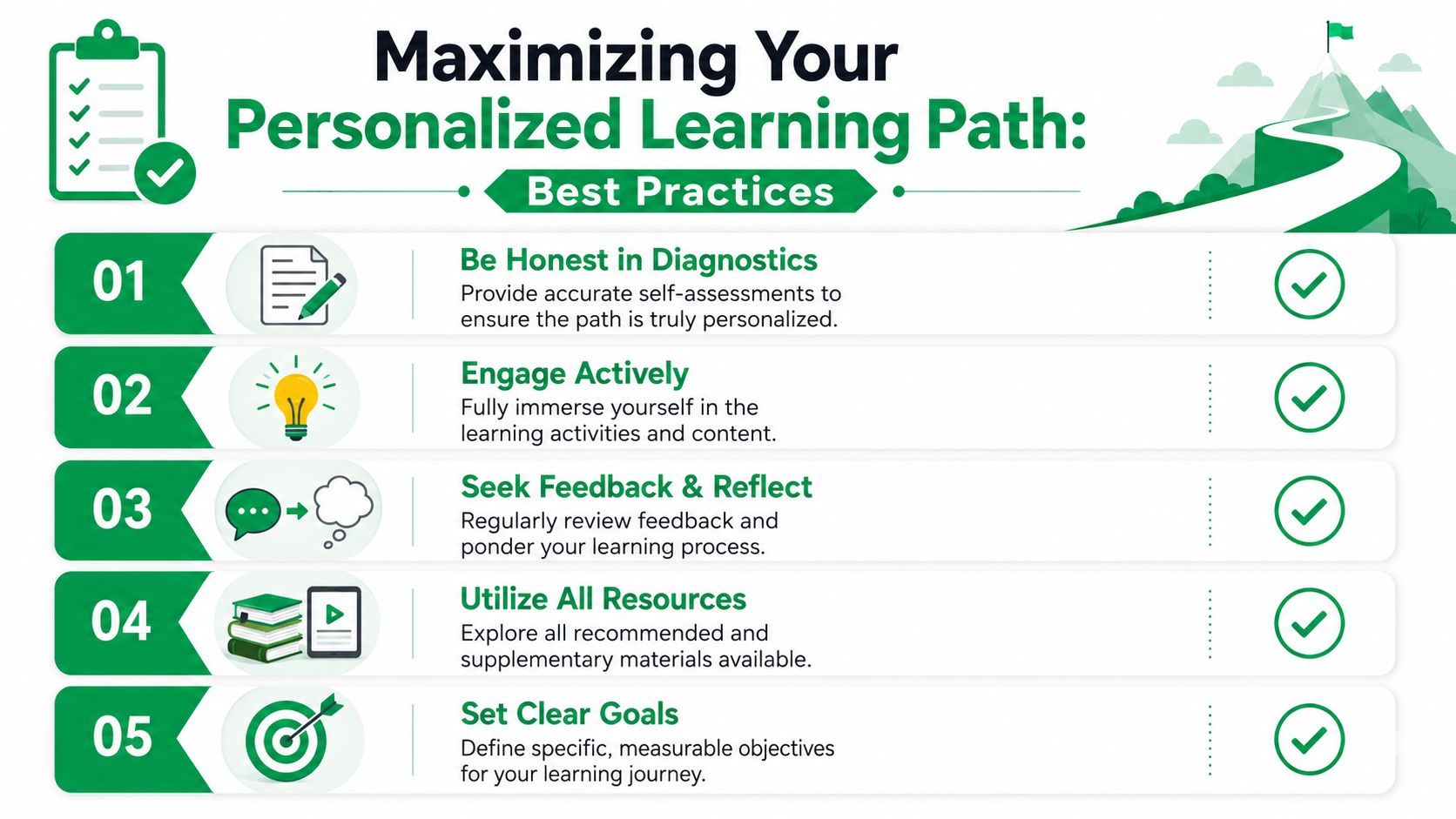
This checklist captures the habits that make a difference.
How to get better results from the system
Start with the diagnostic and answer truthfully. If you guess, rush, or try to “place higher,” the system may give you a route that looks impressive but feels frustrating. In language learning, the correct starting point is a gift.
A few habits help a lot:
- Use feedback immediately: If the platform flags a weak point, revisit it while it's fresh.
- Set a concrete goal: “Speak for five minutes about my family” is stronger than “get better at Irish.”
- Work with full attention: If your study sessions are shallow and distracted, even good personalization won't help much. This guide on how to learn to achieve deep work is useful if your study time keeps getting fragmented.
- Review on schedule: Systems are more effective when you return for the reviews they surface.
If you want a focused explanation of one of the most useful review methods, this resource on spaced repetition for language learning is worth your time.
How to spot shallow AI learning
This is where healthy skepticism matters. Not every AI learning tool is well designed.
Recent 2025 studies on English learners show that some models can lead to “low learning efficiency” when they prioritize speed over foundational mastery, as discussed in this ScienceDirect article on AI-enabled language learning. That warning matters for beginners especially. If a system keeps pushing you forward before the basics are stable, progress can become superficial.
Watch for these signs:
| Warning sign | What it often means |
|---|---|
| You keep “unlocking” new content fast | The platform may value pace more than mastery |
| You recognize lessons but can't produce language | Practice may be too passive |
| Mistakes repeat without meaningful correction | Feedback may be weak or generic |
| The tool replaces teaching logic with novelty | AI is driving the lesson, but pedagogy isn't guiding it |
A sound system balances adaptation with old-fashioned good teaching. It should revisit foundations, slow down when needed, and ask you to produce language, not just consume it.
Fast progression can feel satisfying. Deep mastery is what actually holds up in conversation.
How Gaeilgeoir AI Creates Your Personalized Path
The strongest Irish platforms combine adaptive technology with practical teaching choices. That means diagnosis, scenario-based practice, useful feedback, and a clear focus on what learners can say and understand.
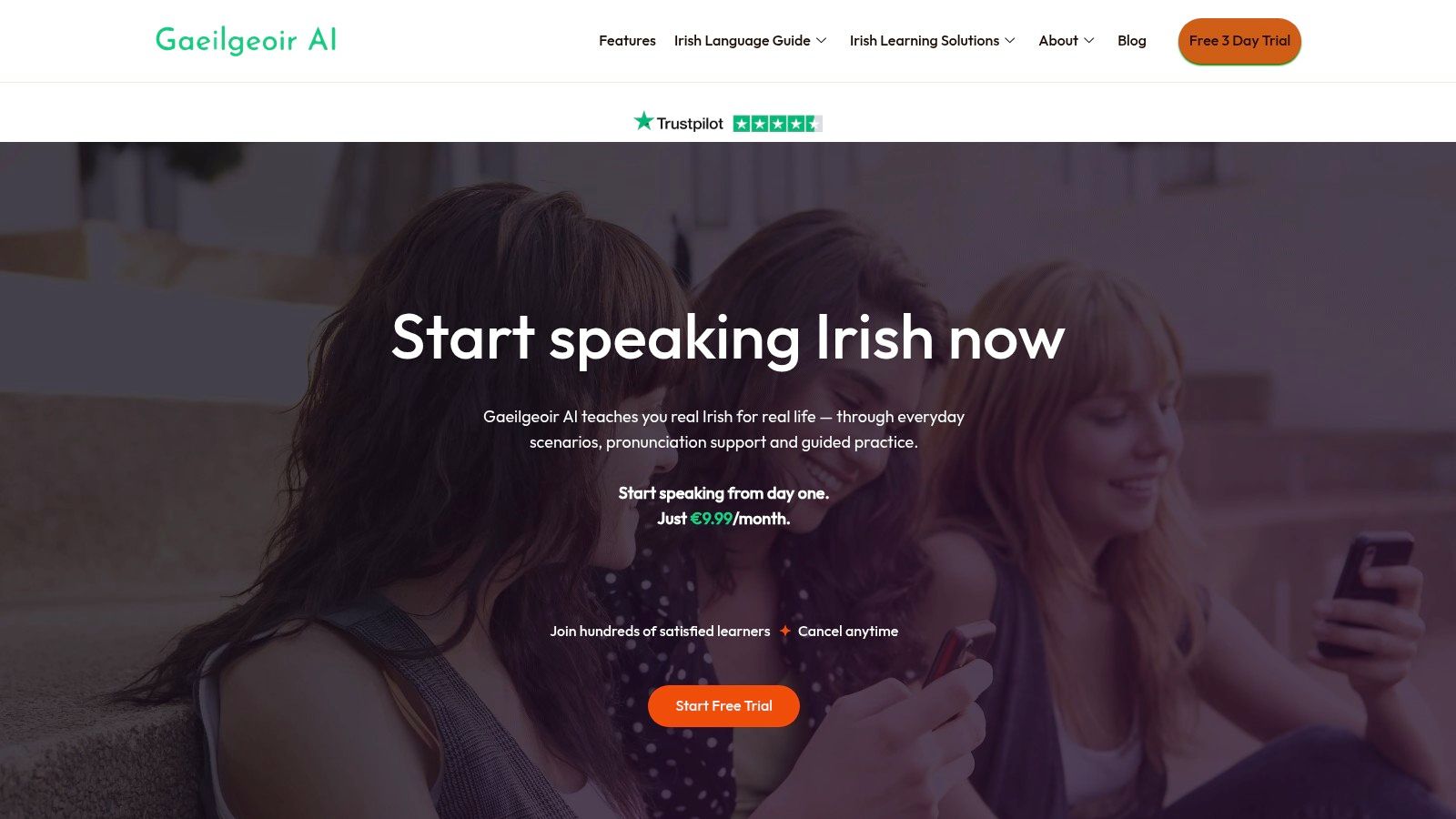
One example is Gaeilgeoir AI, which offers guided real-world conversations, adaptive quizzes with instant feedback, pronunciation support, personalized study lists, and dedicated Leaving Cert oral preparation. Those features line up with what a well-built personalized path should do. They help learners practice everyday interactions, track weak spots, and keep study tied to real use rather than abstract completion.
What a sound Irish learning system looks like
A learner-centered Irish platform should do a few things well:
- Start with practical communication: Everyday social interactions, work, travel, food, and directions are more useful than random sentence collections.
- Support foundational mastery: Core words and repeat exposure matter, especially for beginners.
- Use adaptive review: Weak areas should reappear until they stabilize.
- Offer scenario practice: Learners need to use Irish in context.
- Track progress clearly: You should be able to see what's improving and what still needs attention.
This kind of design matches broader findings from adaptive learning research. In an AI-driven personalized learning path optimization study, the experimental group achieved a 28.8% improvement rate in learning effect, significantly higher than the control group, according to this SPIE conference paper on adaptive resource recommendation. The practical lesson isn't that every tool gets the same result. It's that careful adaptation can improve outcomes when the recommendations are well targeted.
For readers curious about the broader technical side of language models, Gydel's LLM details offer an interesting reference point on how language systems can be documented.
This is what the learning experience looks like in practice:
A personalized path won't make Irish effortless, but it can make your effort count. Instead of dragging you through the same route as everyone else, it can help you build fluency in a way that fits your level, your gaps, and your reason for learning.
If you're tired of generic language tools and want a more personalized route into Irish, try Gaeilgeoir AI and start your path at this learning page.