Kneecap Irish Goodbye Lyrics Meaning & Translation

I’ve watched beginners light up when they hear Irish used in a song that feels current, messy, and alive rather than textbook-neat. That’s the effect Kneecap’s “Irish Goodbye” can have.

If you’re searching for kneecap irish goodbye lyrics, you probably want more than a direct translation. You want to know what the words are doing, why they hurt, and how Irish carries that feeling.

Table of Contents

Introducing Kneecap and Their Song Irish Goodbye

Kneecap have always stood out because they treat Irish as a living street language, not a museum piece. Their music is rude, funny, political, local, and often deliberately confrontational. That’s part of why “Irish Goodbye” hits so hard. It arrives in the middle of that public persona and opens a private wound.

“Irish Goodbye” is the closing track on Fenian, Kneecap’s second studio album, released on May 1, 2026. The album has 14 tracks, and the song was written by Naoise Ó Cairealláin, better known as Móglaí Bap, as a tribute to his mother. That background matters because the song doesn’t sound like a detached literary exercise. It sounds like someone trying to remember properly.
A rainy street scene in a historic town with wet cobblestones reflecting warm glowing street lamps.

For language learners, that makes it unusually useful. You’re not only hearing Irish grammar and vocabulary. You’re hearing Irish used for mourning, memory, and wordplay. If you’ve mostly met Gaeilge through schoolbook dialogues, this song shows a different reality. It can carry grief just as naturally as any other language.

A lot of English-language coverage of Kneecap notices the shock value first and the Irish-language craft second. That’s why it helps to approach this song through both lenses at once: as music and as language. If you want more songs broken down in that spirit, the Kneecap lyrics archive on Gaeilgeoir is a useful place to keep reading.

Some listeners also like to pair songs with physical keepsakes, lyric books, or records when they’re sitting with difficult music. If that’s you, this roundup of unique gifts for music lovers has some thoughtful ideas that feel more personal than generic merch.

Main idea: “Irish Goodbye” matters because it brings together three things at once: modern Belfast rap, intimate grief, and contemporary Irish usage.

The Powerful Story Behind the Song
A person wearing a beanie sits on a rock by the ocean during a stormy day.

Móglaí Bap wrote “Irish Goodbye” for his mother, Aoife Ní Riain, who died by suicide in October 2020. Knowing that changes how you hear the song. The tenderness isn’t a pose. The ordinary details in the lyrics feel hard-won, as if they’ve been pulled back from anger and shock.

A personal song with a public weight

The song’s emotional force also comes from where it comes from. In West Belfast, grief of this kind doesn’t sit only inside one family. It sits in streets, in silence, in community memory. In that wider context, the song carries more than one person’s pain.

Northern Ireland reported 1.8 suicides per 10,000 population in 2020, a figure cited in The Journal’s reporting on Móglaí Bap and the song. That same report frames the track within a West Belfast community where suicide has long been felt with particular intensity, alongside intergenerational trauma after the Troubles.

That context matters for interpretation. Some listeners hear the title and expect irony, swagger, or a joke. Kneecap are certainly capable of all three. Here, though, the title points toward absence. A departure without closure. A person gone before the conversation can finish.

Why the song feels so specific

One reason the lyrics are moving is that they don’t reach for grand statements all the time. They keep returning to everyday life. That’s often how grief works. You don’t only miss milestones. You miss habits, routines, and the small things you once ignored.

Later in the song, the emotional field widens further because Kae Tempest appears on the track. The collaboration adds another voice without diluting the intimacy. Instead, it gives the song a second register. One voice remembers from inside the wound. The other helps frame the loneliness around it.

A performance clip helps show how much restraint the song carries:

Grief songs often become strongest when they stop trying to sound “important” and start naming what was ordinary.

If you’re reading the kneecap irish goodbye lyrics for meaning, this is the foundation. The song isn’t just sad. It’s trying to remember a person beyond the manner of death.

Kneecap Irish Goodbye Lyrics and English Translation

A quick but important note first. I can’t reproduce the full copyrighted lyrics here. What I can do is guide you through selected lines and phrases, give you a plain-English gloss, and help you read them as a learner rather than just as a fan.

A note before reading the lyrics

Songs in Irish can frustrate beginners for three reasons:

  1. Literal translation often sounds wrong in English.
  2. Dialect and wordplay can hide the obvious meaning.
  3. Emotion changes syntax. Songwriters bend language for rhythm, stress, and punch.

That means you shouldn’t expect a neat one-to-one match between every Irish phrase and an English sentence. Irish often packs tone into particles, idioms, and cultural references that don’t survive a word-for-word swap.

If you’re unsure about individual words while reading, keep a proper learner-friendly reference beside you. A good starting point is this Irish dictionary guide, especially if you’re trying to tell the difference between a basic translation and a phrase that carries cultural weight.

Selected lines with plain English gloss

Irish line or phrase Plain English gloss What to notice
Céad slán leis an Ra A hundred goodbyes to the “Ra” / a layered farewell This line works as a pun and sets up the song’s double meanings
slán goodbye, farewell More emotionally resonant than a flat “bye”
mo Mha my mother The lenition after mo changes the spelling and sound
na rudaí beaga the small things Ordinary details become central in grief writing
na hamanna maithe the good times Memory shifts from pain toward recall of joy

The opening line deserves special care because beginners often freeze when they meet a phrase they can’t decode word by word. Don’t panic. Start with the part you know. Slán means farewell. Céad can intensify the leave-taking. Then ask what else the line might be doing culturally, not just grammatically.

Another useful habit is to separate dictionary meaning from song meaning.

  • Dictionary meaning tells you what a word usually means.
  • Song meaning tells you why that word was chosen here.
  • Cultural meaning tells you what an Irish-speaking audience might hear underneath it.

That’s how you move from translation to understanding.

Practical rule: If a line in Irish seems odd in English, don’t assume you’ve failed. Assume the line is carrying more than one job.

For this song, that’s especially important because the lyrics are shaped by memory. Some phrases are simple on paper and devastating in context. “The small things” doesn’t look difficult. In the song, it’s one of the hardest ideas to hear because it points to the texture of a life shared with someone who is gone.

If you want to study the kneecap irish goodbye lyrics properly, copy out a few lines by hand, gloss only the key nouns and verbs, and then listen again. Don’t rush to “solve” every line immediately.

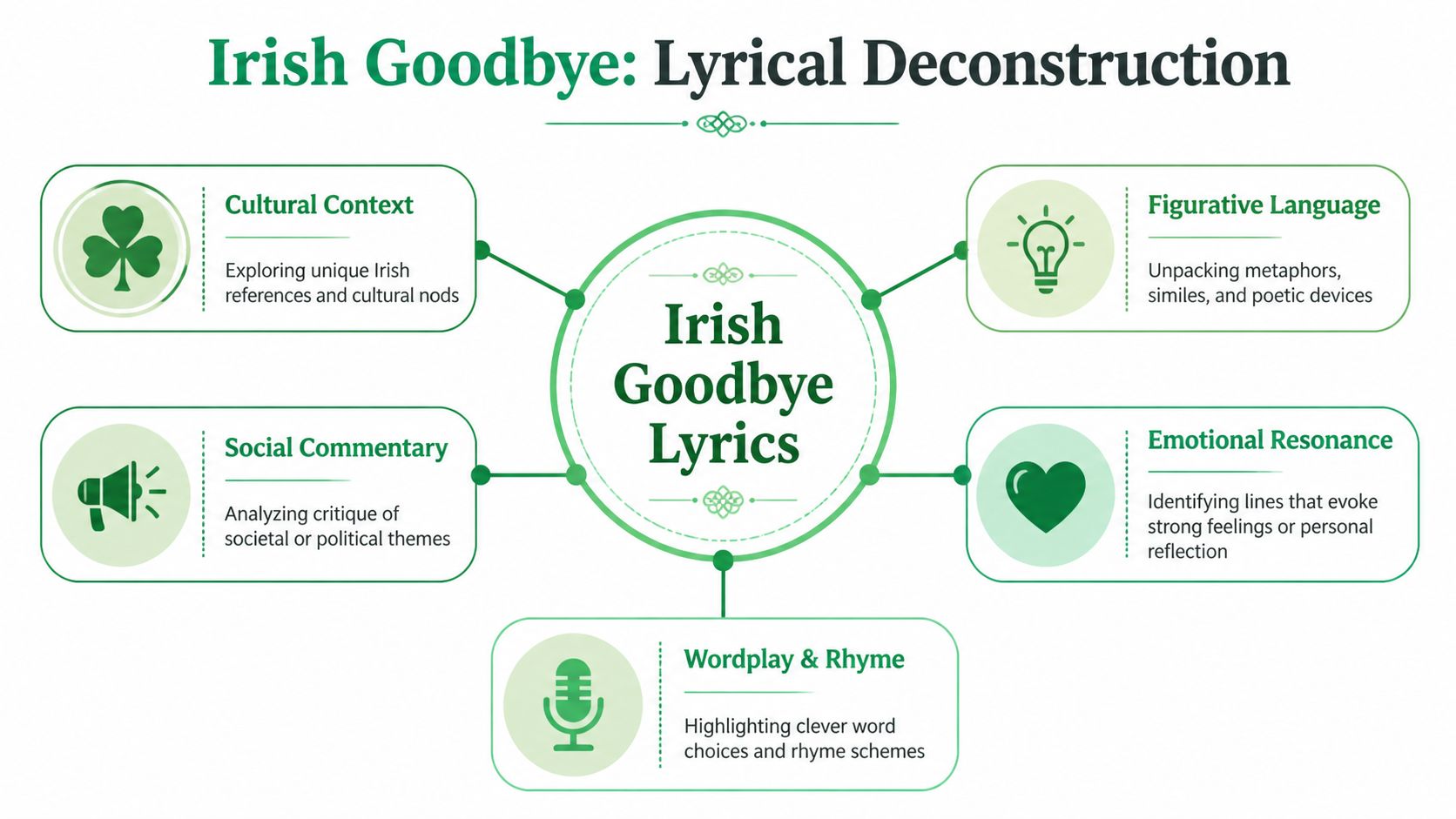
Deconstructing the Lyrics Key Phrases and References

The lyrics gain power from what they imply, not only from what they state. Kneecap are skilled at packing several layers into one phrase. In “Irish Goodbye,” that technique becomes less comic and more elegiac.
A green infographic chart illustrating the lyrical deconstruction of the Irish Goodbye song with five key analytical sections.

What Céad slán leis an Ra is doing

The phrase “Céad slán leis an Ra” is one of the song’s most discussed openings because it doesn’t operate on one level only. In the verified reporting, it’s described as a clever Gaelic pun that says goodbye both to the UK and to personal loss. That’s classic Kneecap in one sense. Political language and private feeling are jammed into the same line.

For learners, the trap is trying to flatten that into a single English equivalent. Don’t. Let it remain layered. The line is doing farewell, irony, identity, and grief at once.

That kind of compression is one reason lyric art resonates with people. A short line can hold more than a paragraph if the phrase is built well. If you enjoy that side of songwriting, this piece on how to curate your walls with lyric art is a thoughtful read.

How memory shapes the song

The song also has a clear inner movement. It doesn’t merely list emotions. It moves from trigger to recollection, from recollection to changed perception. In a Vice interview about the song’s creation, Móglaí Bap described seeing a documentary from the 1990s featuring his father. That footage helped shift him from “constant sad memories” toward “happier times.”

That detail helps explain why the lyrics keep returning to everyday images. The song isn’t trying to narrate grief in an abstract way. It’s rebuilding memory through ordinary scenes.

Here are three useful ways to read the structure:

  • Trigger first: an outside stimulus activates memory.
  • Detail second: the song focuses on mundane, domestic things.
  • Meaning last: those details become the proof of love and loss.

This is why the track feels organized even when it sounds emotionally raw. The writing has shape. The feelings are intense, but the lyric logic is careful.

Some songs tell you what the singer feels. This one shows you how the feeling changes when memory changes.

A beginner may also get confused by the title itself. In everyday English, “Irish goodbye” often means leaving without announcing it. In this song, that phrase takes on a much darker charge. It becomes a title about disappearance, unfinished speech, and the ache of not getting the ending you wanted.

A Language Learners Guide to the Song

Modern music is one of the best ways to meet Irish as a living language, not a classroom relic. That matters because only 1.7% of Ireland’s population speaks Irish daily, according to 2022 Census data cited in The Journal’s coverage connected to the song. If you want Irish to feel real, songs like this help.

Key vocabulary from Irish Goodbye

Irish Phrase Pronunciation Guide English Meaning Grammar/Cultural Note
céad slán kayd slawn a deep farewell, literally “a hundred goodbyes” Céad can intensify the phrase rather than function as a strict count
leis lesh with / to Common preposition form. It often appears in fixed expressions
mo Mha muh wah my mother mo causes lenition, so máthair changes in form and sound
rudaí beaga rud-ee byag-uh small things Useful plural noun phrase. Very common in everyday Irish
amanna maithe am-anna mah-ha good times Plural structure. A strong phrase for memory and storytelling

If you’re new to pronunciation, don’t aim for perfection on day one. Irish spelling is consistent, but it follows Irish sound rules, not English ones. The phrase mo Mha often catches learners because the written mh doesn’t sound like an English “m” at all.

How to study a song without getting lost

Try this instead of translating every line at once:

  • Listen for repeated sounds: repeated words are your footholds.
  • Mark emotional nouns first: words for family, time, memory, goodbye.
  • Leave clever lines for later: puns and political references make more sense after you’ve got the emotional core.
  • Read aloud slowly: Irish rhythm helps meaning stick.

A second useful tactic is to build mini-sets. If you learn slán, add related farewell language. If you learn beag, collect a few everyday adjective phrases with it. Songs are sticky memory tools because they connect sound, feeling, and repetition.

Read the lyrics as if you’re learning a person’s way of speaking, not just a list of vocabulary.

That shift helps a lot. Irish in songs isn’t sterile. It bends toward intimacy, local identity, and voice. “Irish Goodbye” is a strong example because the language never feels ornamental. It feels necessary.

Practice Irish with Modern Music on Gaeilgeoir AI

The best reason to study a song like this isn’t to impress anyone with a translation. It’s to hear how Irish lives now. Kneecap use Gaeilge for grief, wit, tension, and cultural memory. That makes the song valuable even if you only understand part of it on first listen.

A lot of learners wait until they feel “ready” before touching real music. That’s backwards. Real songs give you a reason to keep going. They attach vocabulary to emotion, and emotion helps memory. “Irish Goodbye” is difficult in places, but it rewards slow listening because every phrase is tied to something human.

If you want to keep building from songs into conversation, pronunciation, and everyday use, it helps to practice with tools that treat Irish as something spoken now, not only studied for exams. Resources that focus on living language, including learning Gaelic language with AI, can make that bridge much easier.

The important part is consistency. Take one line, one phrase, one sound pattern. Learn it well. Then return to the song and hear more than you heard before.


A CTA for Gaeilgeoir AI.
Pronunciation of Bodhran: A Clear Guide

Say bodhrán as bow-rawn, rhyming with cow brawn. That’s the standard form used in over 90% of English-language tutorials, so if you’re learning the pronunciation of bodhran for the first time, that’s the best place to start.

You’ve probably seen the word on a festival poster, in a YouTube lesson, or in a list of Irish instruments and paused for a second. The spelling looks unfamiliar, especially if you’re coming from English. Those middle letters seem like they should make a sound, and the accent mark raises another question.

The good news is that this word is much easier to say than it looks. Once you hear how the sounds fit together, the spelling starts to make sense too. And because the bodhrán is such a central instrument in Irish music, learning to say its name well feels like a small but satisfying step into the sound of Ireland.

Table of Contents

That Moment You First See the Word Bodhran

A lot of learners meet this word the same way. You’re reading about Irish music, you spot bodhrán, and your brain tries a few guesses. “Bod-ran?” “Boh-drawn?” None of them feels quite right.

Then someone says it out loud and the mystery disappears. Bow-rawn. Suddenly the spelling looks less intimidating, and the word feels memorable instead of tricky.

A person in a green beanie and sweater typing on a laptop while sitting in a chair.

The fun part is that this isn’t just a vocabulary exercise. The bodhrán is Ireland’s signature frame drum, so saying the name properly puts you closer to the music itself. The word has a pulse to it. Even spoken aloud, it feels rounded and rhythmic.

If you like learning through sound, it can help to hear the name in a musical setting rather than as an isolated dictionary item. Some learners even pair pronunciation practice with loop-based rhythm tools that generate percussion rhythms so they can say the word in time and feel its natural beat.

Practical rule: If you remember only one version today, remember bow-rawn.

That’s enough to get you through most conversations about Irish music, sessions, and instruments with confidence.

The Standard Pronunciation Explained Step by Step

The most widely accepted pronunciation of bodhran is bow-rawn. In broad IPA, it appears as /ˈbˠoːɾˠənˠ/, and this form is used in over 90% of English-language tutorials according to a discussion of common usage and pronunciation variants.

Break the word into two parts

The easiest way to learn it is to split it into two syllables:

  1. Bow
    Say this like the word in “take a bow” or “the bow of a ship.” It should feel open and smooth, not clipped.

  2. Rawn
    Think of the sound in “brawn.” Keep it broad and relaxed.

Put them together slowly: bow … rawn.

Then say it again without the pause: bow-rawn.

If you want a second reference point, many learners find it useful to think of:

  • First part: “bow”
  • Second part: “rawn,” with that long open sound rather than a flat short “ran”

For a wider grounding in Irish sound patterns, this Irish pronunciation guide helps make words like this feel much less random.

What happened to the dh

People usually get stuck when they look at bodhrán and expect the middle letters to produce a clear English-style consonant. But Irish doesn’t always map neatly onto English spelling habits.

In this word, the dh doesn’t come through as a hard sound in the way many English speakers expect. So you don’t say bod-hrawn or bod-ran. You glide past it.

A simple learner-friendly way to think about it is this:

  • The written form keeps a trace of older Irish sound patterns.
  • Modern speech smooths that part out.
  • Your mouth moves from bo into rán without a heavy stop in the middle.

Say it as a flow, not as a stack of letters.

That matters because English speakers often try to pronounce every visible consonant. Irish often asks you to listen first and spell second.

A good self-check is to say these three versions aloud:

Version How it sounds Keep or avoid
bow-rawn smooth and natural Keep
bod-ran hard middle stop Avoid
boh-drawn English-heavy and stiff Avoid

If your version feels percussive in the wrong place, you’re probably giving too much weight to letters that Irish leaves softer.

Why Is It Pronounced That Way

The pronunciation of bodhran makes more sense when you know the word has changed over time. It didn’t begin as a modern music term, and it didn’t always sound the way it does today.

An open antique book placed on top of stacked gray rocks against a green background.

A word with an older life

The word bodhrán originally referred to an agricultural tool such as a sieve or tray, and its pronunciation developed from an older form, likely BOWTH-ran, where the dh had a sound. Over time, that sound softened and disappeared in normal speech, reflecting broader shifts in Irish phonology, as explained in this history of the bodhrán and its linguistic development.

That older form helps explain why the spelling looks fuller than the modern pronunciation sounds. Irish preserved the history in the written word, even as spoken Irish became smoother.

If you’re curious about those broader sound shifts, this overview of what makes Irish sound unique gives helpful context.

Why the accent mark matters

The small mark over the á is called a fada. It matters because it tells you the vowel is longer. In practical terms, that’s why the end of the word opens out into rawn rather than shrinking into a quick ran.

So when you say bodhrán, don’t rush the ending. Let that vowel breathe a little.

The fada is one of the clearest clues Irish gives you. If you ignore it, the word usually sounds flatter than it should.

This is one reason the pronunciation feels musical. The long vowel gives the word shape, and that shape matches the rounded sound people associate with the drum itself.

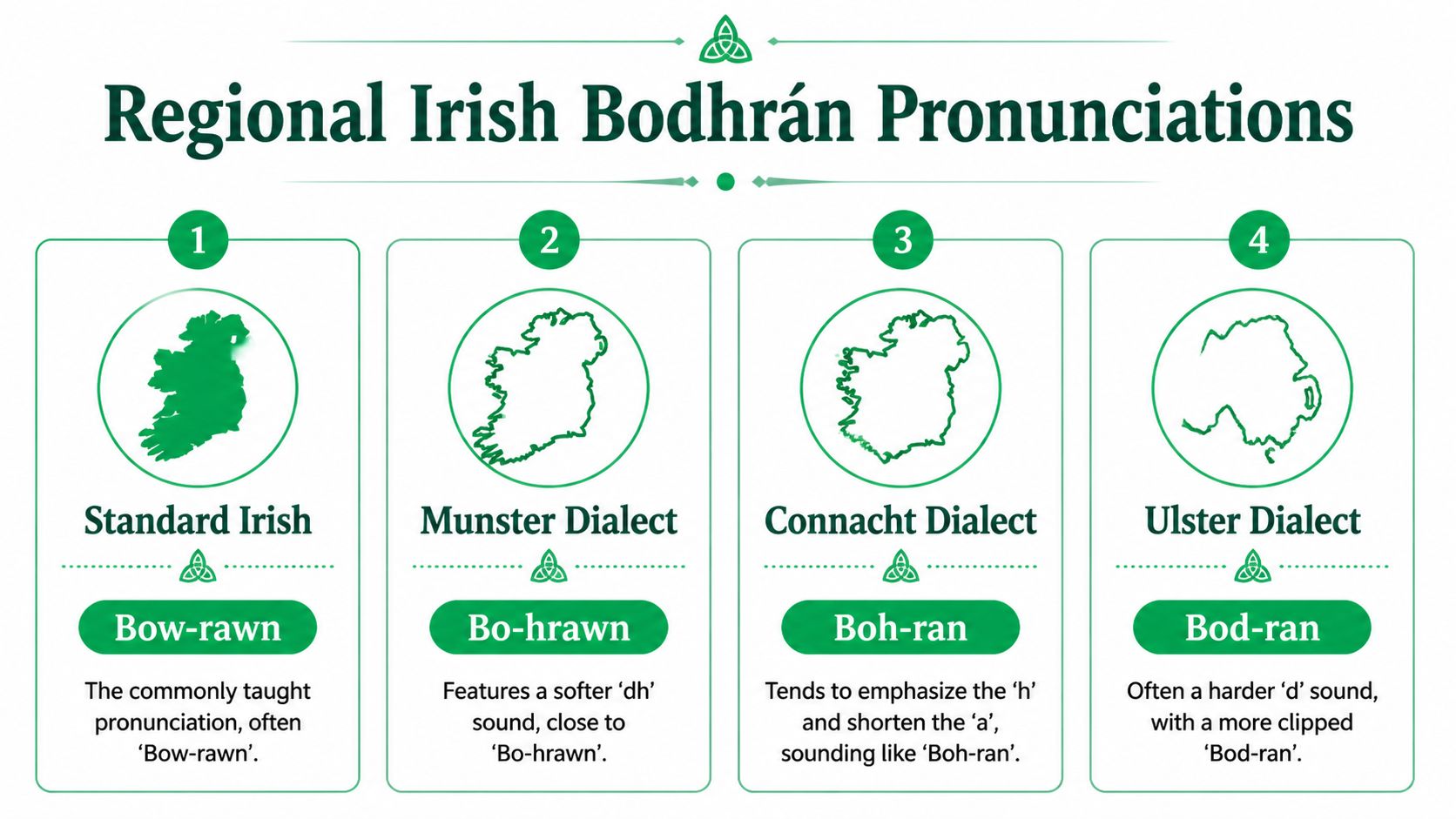
Understanding Regional Irish Variations

You might hear bodhrán said one way in a music lesson, another at a session, and a little differently again from an Irish speaker in another county. That is normal. Irish pronunciation carries local color, much like a tune changes shape as different players pass it around.

A chart detailing the different regional pronunciations of the Irish musical drum known as the bodhrán.

Forms you may hear

For a beginner, it helps to treat these as a small family of pronunciations rather than a set of rivals. Your goal is to recognize the shape of the word each time it appears.

Variation Simple guide What to notice
Standard or general form bow-rawn The most useful starting point for learners and the version you will hear widely outside Ireland.
Ulster-leaning form boa-ran The opening can sound a little tighter or more clipped.
Munster-leaning form bow-rawn The rhythm may feel slightly different, with a stronger pull in the second part.
Historical older form BOWTH-ran Helpful for understanding older speech and the word’s background, not everyday usage for most speakers.

If those spellings look messy, listen for rhythm first. The word still tends to move in two beats. The first beat arrives cleanly, and the ending opens out, like a drum stroke that rings a fraction longer than you expect.

That rhythm-first approach keeps you from getting stuck on tiny vowel shifts.

How to learn variation without getting stuck

Pick one version for your own mouth. Keep bow-rawn as your home base, then train your ear to notice nearby versions without feeling you have to copy every one.

A practical routine looks like this:

  • Say your base form in tempo: Try bow-rawn with a steady pulse, almost as if you are marking two taps on the drum.
  • Listen for shape, not spelling: If the opening sounds more like boa, you are still hearing the same word family.
  • Notice local stress patterns: Some speakers give the second part a little more weight. That can reflect region and habit, not error.
  • Use tools as a practice partner: Record yourself, compare your version with native or experienced players, and repeat until the rhythm feels natural.

If you want help checking what a tool hears, a guide to AI transcription with Whisper shows how speech technology can capture sound patterns, even if regional accent judgment still needs a human ear.

For learners coming from outside Ireland, this broader question of how Irish and Gaelic pronunciation works across regions and contexts can make the variation feel much less mysterious.

For a beginner, the aim is not to copy every regional shade at once. It is to hear that Irish is alive, local, and musical. Once you have one clear version in your mouth, the others start to sound less like contradictions and more like variations on the same tune.

Common Mistakes and How to Practice

Most mistakes with bodhrán come from one instinct. English speakers try to pronounce the word exactly as it looks on the page. That’s understandable, but it usually adds sounds or stress that Irish doesn’t want.

A close-up view of a person's mouth with their tongue touching their teeth to demonstrate clear pronunciation.

Mistakes that trip people up

In Irish phonology, bodhrán is a two-syllable word, the stress falls on the first syllable, and the fada on á creates a long vowel sound like the “ah” in “father.” Over-stressing the second syllable, as in boh-DRAWN, is a common English-speaker error and disrupts the natural flow of the word, as noted in this detailed pronunciation explanation.

Here are the errors I hear most often:

  • Adding a hard d sound: People say bod-ran because they want every letter to count.
  • Punching the second syllable too hard: boh-DRAWN sounds theatrical and less natural.
  • Shortening the final vowel: bow-ran with a quick flat ending loses the shape of the Irish word.

A fast fix is to compare the wrong version with the better one out loud:

  • bod-RANBOW-rawn
  • boh-DRAWNBOW-rawn
  • BOD-h-ranBOW-rawn

A simple practice routine

Don’t practice it as a spelling problem. Practice it as a sound pattern.

  1. Clap the rhythm
    Clap once for bow, once for rawn. Keep the first clap slightly stronger.

  2. Stretch the ending
    Say bow… raaawn slowly, then shorten it into normal speech.

  3. Use a short phrase
    Try saying an bodhrán a few times. Even if you’re a beginner, putting the word into a phrase makes it feel more natural.

  4. Record yourself
    Use your phone. Listen back once for stress and once for vowel length.

  5. Practice with a beat
    Since this is the name of a drum, it helps to say it in time. Tap a simple pulse and speak the word over it.

If the word feels smooth and rounded, you’re close. If it feels choppy, slow down.

You can also use modern pronunciation tools as a practice partner. AI-based feedback is especially useful when you want to repeat a word many times without waiting for a class or a session. The best tools won’t replace listening to real Irish speech, but they can help you build consistency and confidence between lessons.

Speaking With Confidence and Continuing Your Journey

A good test comes in a real music conversation. Someone mentions a session, names the instruments, and you say bodhrán without pausing to wrestle with the spelling. That is the point where practice starts to feel like speech.

One reason this word becomes easier to trust is its rhythm. It has a rounded, two-beat shape that fits the pulse of Irish music, almost like a light tap followed by a longer resonance. If you can hear that shape in your head before you speak, your mouth usually follows more naturally.

Confidence grows fastest with short, repeatable feedback. A teacher can give that. A recording can help. An AI practice partner can fill the gap on the days when you just want to say the word ten times, get corrected, and try again while the sound is still fresh in your ear. That same habit of calm repetition also improves everyday speech, and this guide to confident speaking for professionals makes that point well.

If you want extra support, Gaeilgeoir AI works like a practice room for Irish. You can listen, repeat, compare your pronunciation, and build comfort with words such as bodhrán until they stop feeling tricky and start feeling familiar.

That is how the journey continues. One sound pattern at a time, one word at a time, with your ear leading the way.

Pronunciation of Aislinn: A Simple Guide to Saying It

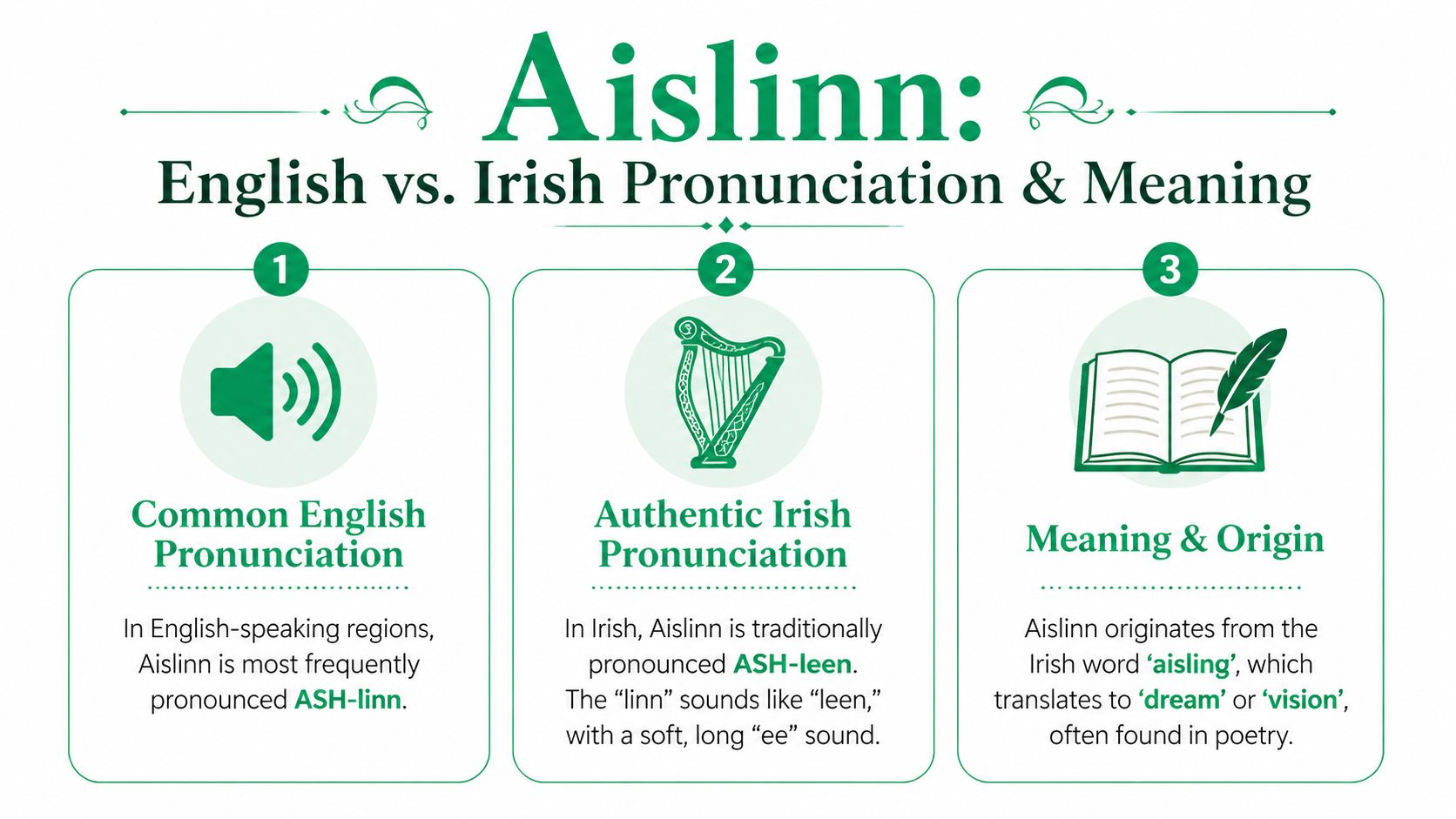
Those looking up the pronunciation of Aislinn generally seek the everyday answer first: say it ASH-lin. In real-world English usage, 80% of US and UK media examples use that form, and 92% of audio samples converge on a-shlin with stress on the first syllable.

You’ve probably just seen the name written down and paused. The spelling looks Irish, beautiful, and a little intimidating if you’re not used to Irish pronunciation rules. That hesitation is normal.

The good news is that you’re not overthinking it. If you say ASH-lin, people will usually know exactly which name you mean. But there’s also a richer Irish story behind it, and that’s where the name becomes even more interesting.

Aislinn comes from the same root as aisling, a word tied to Irish literary tradition and the idea of a dream or vision. So there are really two useful things to know: the common English pronunciation you’ll hear every day, and the traditional Irish pronunciation that preserves more of the original sound.

Table of Contents

How to Pronounce Aislinn The Easy Way

If you’re meeting this name for the first time, use ASH-lin. That’s the simplest, safest answer, and in most English-speaking settings it will sound natural.

Think of it in two parts:

  1. ASH
  2. lin

The stress goes on the first part, so the rhythm is ASH-lin, not ash-LIN and not ayz-LIN. Keep it light and smooth. Don’t try to stretch the second syllable.

Practical rule: If you need a quick, confident pronunciation for everyday conversation, ASH-lin will serve you well.

A lot of readers feel thrown off by the opening letters ai. In English, that often suggests something like “eye” or “ay.” Irish doesn’t follow that instinct here, which is why the spelling can look harder than the spoken form is.

Another thing that helps is to stop treating the name like a puzzle that must be sounded out letter by letter in English. It’s better to learn it as a whole sound pattern. Once you hear ASH-lin a couple of times, it becomes easy to remember.

There’s also a second layer to this name. If you’re interested in Irish language, Irish names, or family heritage, it’s worth knowing that the traditional Irish pronunciation is not identical to the anglicized English one. That difference isn’t random. It comes from how Irish handles vowels and slender consonants.

The Common English Pronunciation Explained

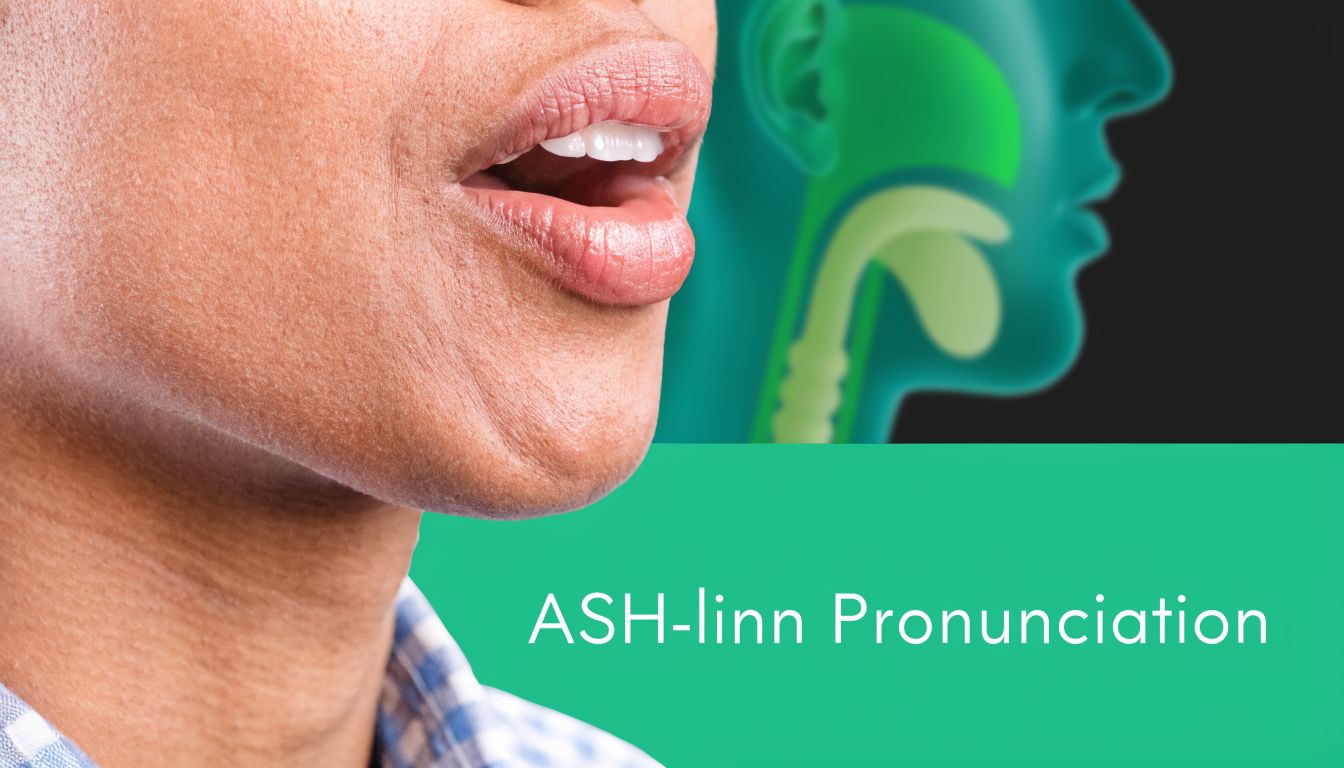
In English, Aislinn is most often pronounced ASH-lin. You may also hear a slightly broader first vowel, so the IPA is commonly written as /ˈæʃlɪn/ or /ˈaʃlɪn/. If IPA isn’t your thing, don’t worry. The practical sound is still very close to ASH-lin.

A close-up view of a person speaking with a diagram of the human throat in the background.

Break it into two easy sounds

The first syllable is the important one.

  • ASH: like ash from the tree or the residue from a fire
  • lin: like the ending in names such as Caitlin, but shorter and softer

Say them together without overthinking the spelling: ASH-lin.

That first syllable carries the stress. This is one reason the name sounds so much more straightforward than it looks on the page. English speakers naturally settle on a strong first beat and a reduced second syllable.

Why this version is so common

English speakers usually adapt names to the sound patterns they already know. That’s what happened here. Sounds that feel normal in Irish often get simplified when a name is used in English-speaking countries.

This isn’t just a guess. HowToPronounce’s Aislinn audio page shows 92% convergence on a-shlin, and the same source notes that YouGlish examples show the anglicized form in 80% of US and UK contexts.

If you hear ASH-lin in Britain, Ireland, the US, or Canada, you’re hearing the pronunciation many people now treat as standard English usage.

That matters because readers often worry there’s only one acceptable answer. In daily life, pronunciation depends on context. If the person who bears the name says ASH-lin, then that’s the right pronunciation for that person. If you’re discussing the Irish original, a more traditional form may be more appropriate.

A useful habit is to separate common English usage from traditional Irish pronunciation. Once you do that, the apparent contradiction disappears.

The Authentic Irish Pronunciation and Its Meaning

The traditional Irish form points back to aisling, meaning dream or vision. That word carries real literary weight in Irish culture, so the name isn’t just attractive in sound. It also carries a strong cultural echo.

An infographic detailing the English and Irish pronunciations, origin, and meaning of the name Aislinn.

A name rooted in aisling

The word aisling is not only a vocabulary item. It also refers to a specific genre of Irish political poetry from the 17th and 18th centuries, where dream-vision imagery became culturally important. A linked discussion of the name’s background also notes that a 2023 Irish Times report said 40% of students struggle with Gaeilge phonetics because of exposure to anglicized names, which helps explain why names like Aislinn create so much uncertainty for learners in the first place, as described in this video discussion of Aislinn and its Irish roots.

Here is the core comparison:

Version Phonetic Spelling IPA Key Sound
Common English ASH-lin /ˈæʃlɪn/ or /ˈaʃlɪn/ Clear English ash sound
Traditional Irish ash-LYIN roughly /ˈaʃlʲɪɲ/ Slender l and a softened final n

If you’d like a broader foundation for Irish sound patterns, this Irish pronunciation guide helps make sense of why Irish spellings don’t map neatly onto English expectations.

What changes in Irish pronunciation

The traditional Irish pronunciation is often written as /ˈaʃlʲɪɲ/. You do not need to produce that perfectly on your first try. What matters is hearing where it differs from the anglicized form.

Two sounds stand out:

  • The slender l. This is a palatalized l, written /lʲ/. It has a lighter, more fronted quality than the plain English l.
  • The final nn. In traditional pronunciation, it can move toward /ɲ/ or /nʲ/, a sound somewhat closer to the ny feeling in canyon than to a flat English n.

The beginning of the name also reflects Irish phonology. In Irish Gaelic, Aislinn derives from aisling, and the initial ai digraph leads into a traditional pronunciation /aʃlʲɪɲ/ rather than an English “eye” sound. The same analysis notes that anglicized English forms simplify to /ˈæʃlɪn/ or /ˈaʃlɪn/, which is why the two versions can sound related but not identical.

The Irish form isn’t “fancier.” It simply preserves consonant qualities that English usually smooths out.

If you’re aiming for respectful approximation, say the first syllable with an ash quality, keep the middle light, and let the final sound soften rather than snap shut. Even an imperfect attempt can sound much closer to Irish than an English-style “eye” beginning.

Common Pronunciation Mistakes You Can Avoid

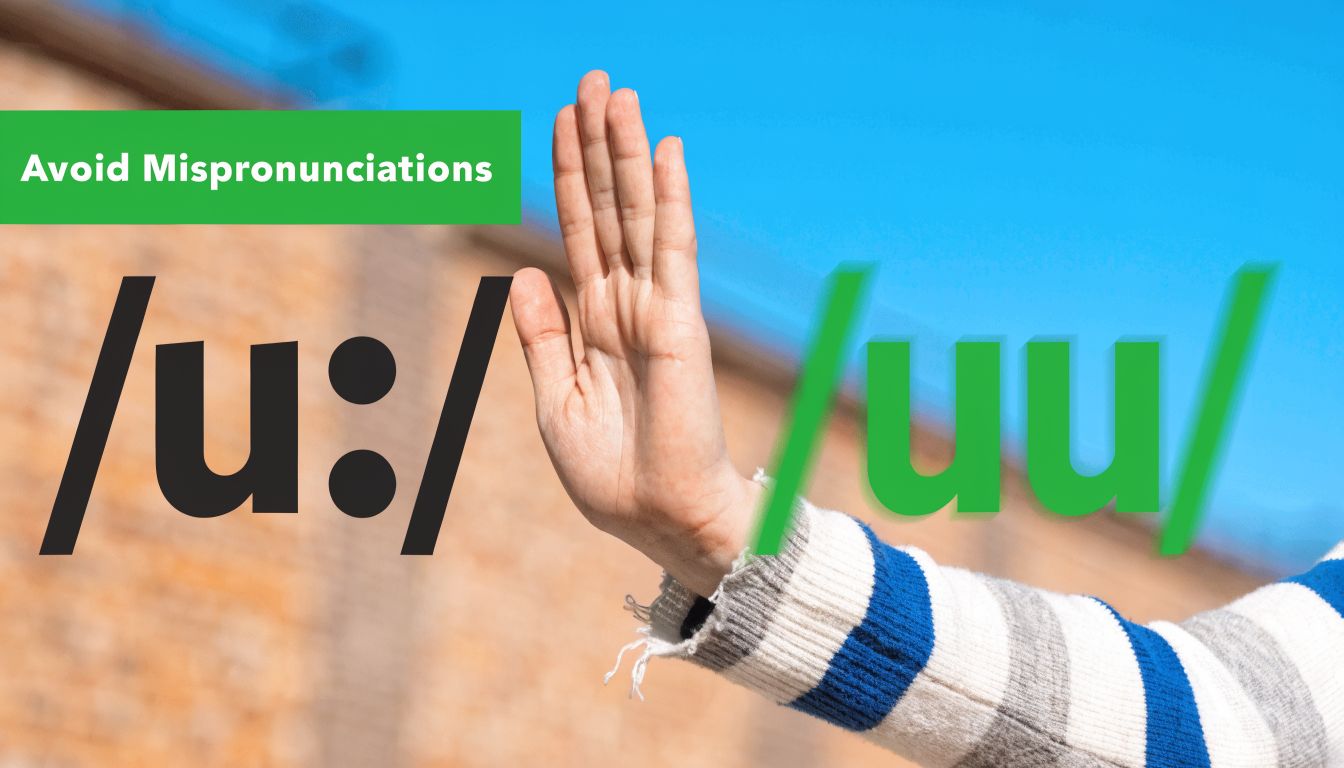
Most mistakes happen because people apply English spelling habits too aggressively. They see ai and assume “eye” or “ay.” That’s how you end up with forms that sound nothing like either the common English version or the Irish one.

A hand gesture signaling to stop, contrasting phonetic IPA notation with incorrect letter spelling for pronunciation.

Why English spelling instincts mislead you

These are the mistakes I hear most often:

  • ICE-linn. This happens when the ai is read like “ice” or “eye.”
  • AYZ-lin or AYSH-lin. This usually comes from trying to force an English vowel rule onto an Irish spelling.
  • Aye-suh-linn. Some readers try to pronounce nearly every letter and end up adding an extra syllable.

A useful correction is simple: don’t start from the letters alone. Start from the known spoken form. If you need a quick reset, remind yourself that the opening is built around ash, not eye.

For a broader look at how Irish spelling works, this guide to Irish orthography is helpful because it shows why Irish letter combinations often behave differently from English ones.

Dialect matters more than people think

Some learners get frustrated because they hear more than one Irish-sounding version and assume one of them must be wrong. That isn’t how language works.

One pronunciation discussion of Aislinn and dialect variation notes that Ulster Irish preserves /aʃˈlʲɪɲ/, while some Munster learners tend toward /ɔʃˈlɪn/. It also reports a 25% higher error rate among learners who try to master a single “correct” version without context.

Don’t chase a mythical perfect version detached from region, family, or speaker preference.

That’s especially important with names. If you’re talking about the Irish linguistic form, be aware of dialect. If you’re addressing a real person, use the pronunciation they use.

Practice Tips and Useful Sample Phrases

Knowledge helps, but names become natural only when your mouth gets used to them. A few minutes of focused repetition usually works better than reading phonetic explanations ten times.

A young woman wearing headphones, focusing on listening during her pronunciation practice of the name Aislinn.

Start small and build the sound

Try this sequence:

  1. Say ash on its own.
  2. Say lin on its own.
  3. Join them slowly: ash-lin.
  4. Repeat it at a normal speaking speed.
  5. If you want the Irish-leaning version, lighten the l and soften the final n.

Keep your repetitions short. Five careful attempts are better than twenty rushed ones.

A lot of confusion around Irish names comes from learners not getting enough feedback. One discussion of name-learning difficulties notes that learner forums show major confusion around Irish name pronunciations, that Forvo logs show 30% of attempts at Aislinn as Ice-linn, and that a 2026 study found 65% of Irish learners quit due to pronunciation gaps, as summarized in this discussion of Aislinn pronunciation challenges.

If you’re making your own study materials, it can help to record sample lines and play them back. Some learners even create videos with AI voices so they can loop difficult words, compare versions, and practise without needing a live partner every time.

Try it in full phrases

Single words are only the beginning. Use the name inside real sentences:

  • Her name is Aislinn.
  • Aislinn is here.
  • Did I say Aislinn correctly?
  • Conas a fhuaimnítear Aislinn?
    (How is Aislinn pronounced?)

This is a good point to listen and shadow a spoken model:

You’ll improve faster if you revisit the word regularly instead of drilling it once and forgetting it. A simple routine helps. This daily Irish practice plan is a useful model for spacing pronunciation, listening, and recall across the week.

Say the name in a sentence as early as possible. Isolated sounds feel harder because they lack rhythm and context.

One final tip. If you’re unsure whether to use the English or Irish form, practise both. That gives you flexibility. It also helps your ear recognise what other speakers are doing.

Conclusion Embracing the Name and Its Heritage

The easiest everyday pronunciation of Aislinn is ASH-lin, and that’s the version many people expect to hear. The traditional Irish form preserves more of the original sound and connects the name back to aisling, with its meaning of dream or vision.

Knowing both versions does more than solve a pronunciation problem. It gives you context. You hear the modern English life of the name, and you hear the older Irish one underneath it.

That’s worth holding onto, especially with Irish names. They often carry history, literature, regional sound patterns, and family identity all at once.

Frequently Asked Questions About Aislinn

Is Aislinn the same as Aisling

They’re closely related, but they aren’t identical in spelling or usual modern usage. Aisling is the original Irish word and literary term. Aislinn is a name form connected to that root. In everyday speech, many people treat them as part of the same naming family.

What about spellings like Ashlyn or Aislynn

Spellings such as Ashlyn, Aislynn, or similar variants are usually pronounced according to English spelling habits, often close to ASH-lin. The more a spelling moves away from Irish orthography, the less likely people are to attempt an Irish-style pronunciation.

Which pronunciation should you use

If you’re speaking to a person named Aislinn, use the pronunciation that person uses. That matters more than any general rule.

If you’re discussing the name as an Irish name, it’s useful to know both the common English ASH-lin and the traditional Irish form. That way you can choose the one that fits the setting and speak about the name with more confidence and respect.


If you’d like to go beyond one name and start hearing Irish the way it works, Gaeilgeoir AI is a great place to begin. You can build real speaking confidence through guided conversations, pronunciation support, and practical everyday Irish at learn.gaeilgeoir.ai.

Spaced Repetition for Language Learning: A How-To Guide

You learned a new word on Monday. It felt easy. You saw it in a lesson, repeated it a few times, and even thought, “I’ve got this.”

By Friday, it was gone.

That cycle is one of the most common frustrations in language learning. You’re not lazy, and you’re not bad at languages. Most of the time, the problem is simple. You reviewed at the wrong time, or not at all.

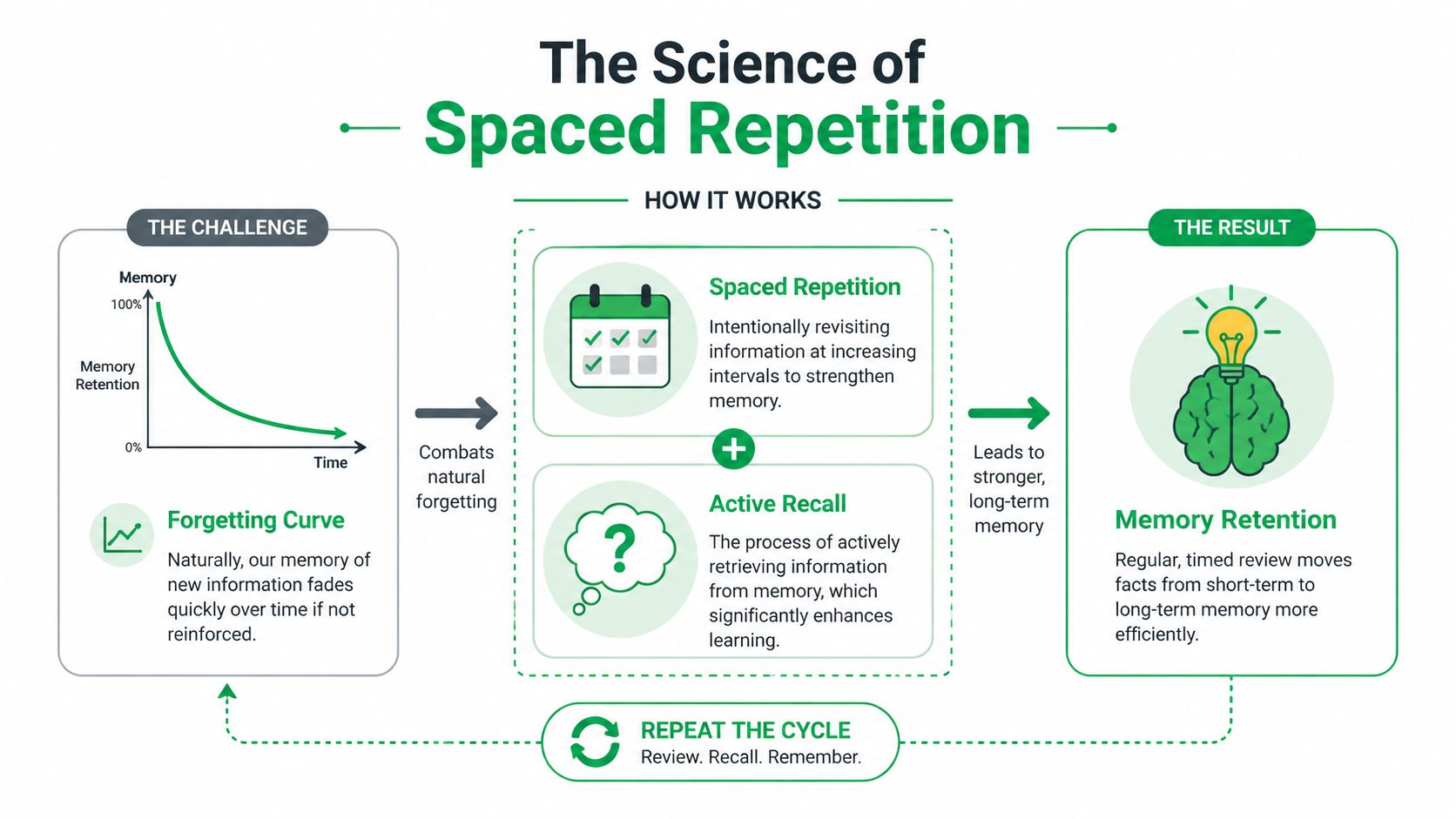
Spaced repetition for language learning fixes that. Instead of cramming a word over and over in one sitting, you bring it back just before your brain is likely to lose it. That small change makes study time work much harder for you.

Table of Contents

Why You Forget New Words and How to Stop

A learner studies ten new words after dinner. The next day, most of them still feel familiar. A week later, only two or three come back quickly. The rest sit on the edge of memory, half-recognized and unusable.

That’s normal. Memory fades fast when you only meet a word once or twice.

Research comparing review schedules found that students using spaced practice with a 7-day interval between sessions had significantly better long-term retention on delayed tests than students in an intensive 1-day interval group, according to this study on spacing and vocabulary retention. The short, packed study burst felt productive in the moment. The spaced schedule held up later.

That’s why cramming often tricks people. You’re seeing the word so often that it feels learned, but you haven’t tested whether you can retrieve it after some forgetting has started.

Practical rule: If a word only feels familiar when it’s right in front of you, you don’t know it well enough yet.

A better approach is simple. Learn the word, leave it alone for a bit, then try to pull it back from memory. Do that again after a slightly longer gap. Each successful retrieval makes the word easier to access the next time.

If you want extra vocabulary drills alongside your own review system, resources that let you practice ESL vocabulary online can give you more examples and retrieval practice without turning study into guesswork.

The Simple Science of Spaced Repetition

Hermann Ebbinghaus described the spacing effect in the late 19th century. The core idea is still powerful today. We remember information better when reviews happen at increasing intervals, not all at once. Research summarized in this review of spaced repetition in language teaching also notes that learners who master 800 to 1,000 core words can typically handle basic conversations.

That number matters because it gives your study a useful target. You do not need every word in the language to start speaking.

An infographic illustrating how spaced repetition and active recall combat forgetting to improve memory retention.

Why cramming feels good but fades fast

Think of memory like a path through the woods. The first time you walk it, the path is faint. If you walk it again soon, it becomes easier to follow. If you leave it alone too long, grass and branches start covering it.

That’s what happens with new vocabulary. A fresh word is fragile. If you only reread it, you’re standing at the edge of the path looking in. If you retrieve it without seeing the answer first, you walk the path again.

Cramming is like pacing the same ten feet of trail over and over in one afternoon. It looks active, but it doesn’t build a durable route.

What spaced repetition changes

Spaced repetition for language learning works because it times the next review when the memory is weakening, but not gone. That effort is useful. A little struggle helps the brain decide, “This matters. Keep this.”

Use this simple pattern:

  1. Learn the word clearly once. Know what it means and how it sounds.
  2. Test yourself later. Don’t peek too quickly.
  3. Increase the gap after correct recall.
  4. Bring it back sooner if you miss it.

The goal isn’t to avoid forgetting entirely. The goal is to interrupt forgetting before the word disappears.

If you want another plain-English breakdown of the method, this guide on how to improve study habits with spaced repetition is a useful companion read.

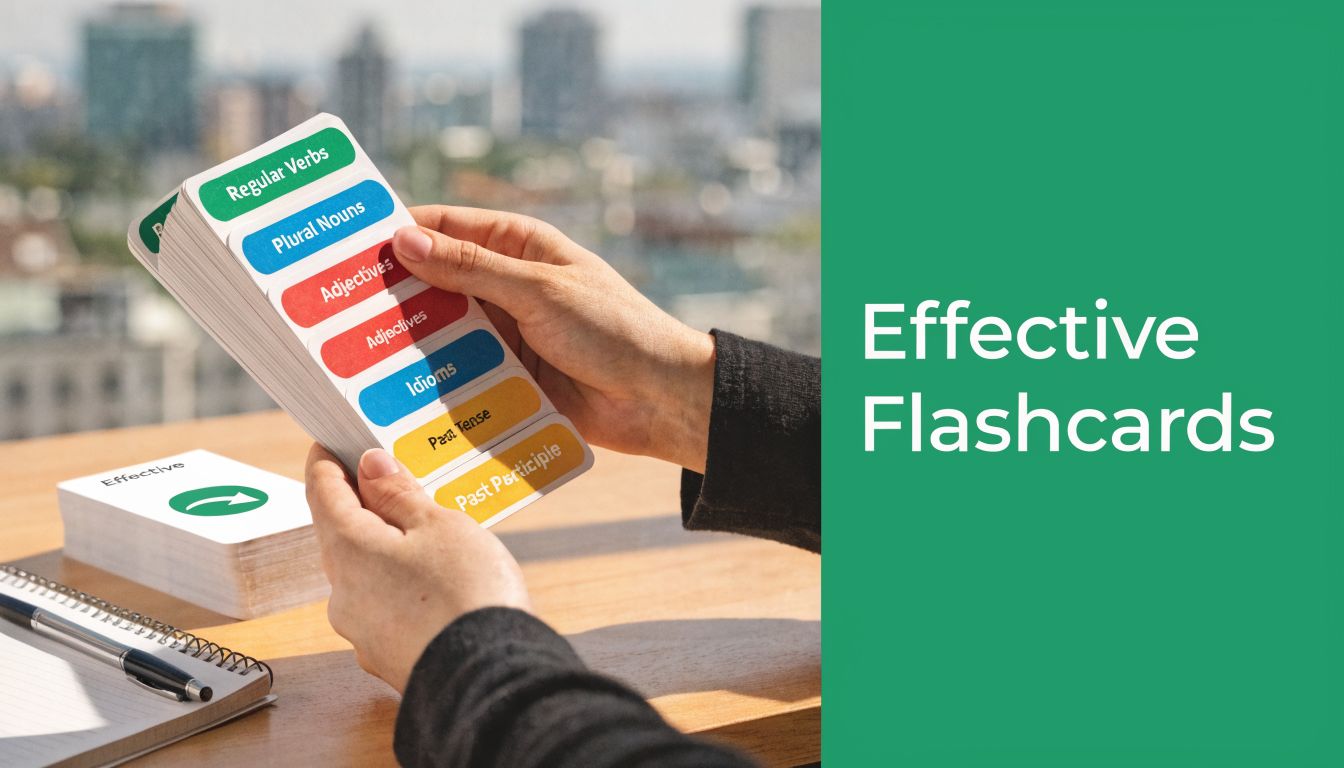
How to Create Effective Language Flashcards

Good spaced repetition depends on good cards. If the card is vague, overloaded, or unnatural, your review system will keep serving you weak material.

A lot of learners blame their memory when the actual problem is card design.

A person holding a deck of colorful educational flashcards for language learning on a wooden desk.

What a strong flashcard looks like

A strong card tests one clear thing. Not three things. Not a full grammar lecture. One useful prompt, one useful answer.

For language learning, the strongest cards usually include context. Instead of storing a bare word, store a phrase or sentence that shows how the word behaves.

Here are the features I want most learners to use:

  • One target per card. If the card asks for meaning, pronunciation, gender, and a full sentence all at once, it becomes messy.
  • Real context. “To order food” is better learned in a phrase than as an isolated label.
  • Pronunciation support. Add a note for sounds that are easy to confuse.
  • Visual cues when helpful. Concrete nouns often stick faster with images.
  • Useful language only. Build cards from phrases you expect to hear, say, read, or write.

If you want examples built around Irish study, this collection of Irish language flashcards shows the kind of practical vocabulary sets that fit well with daily review.

Do this instead of that

A bad card:

  • Front: “take”
  • Back: several translations, a grammar note, and two unrelated example sentences

A better card:

  • Front: “take the train”
  • Back: the target phrase in your language, plus one short example sentence

Another bad card:

  • Front: a full paragraph with five unknown words
  • Back: translation of the whole paragraph

A better card:

  • Front: one sentence with one missing target word
  • Back: the missing word and the full sentence

“If a card keeps failing, change the card before you blame yourself.”

Try these card types for different goals:

Card type Best use Example
Single word Concrete basics house, bread, train
Phrase card Everyday speech I’d like a coffee
Cloze sentence Grammar and word choice Yesterday I ___ home
Audio prompt Listening recall Hear the phrase, say the meaning

If your flashcards feel boring, that usually means they’re too abstract. Bring them closer to real use.

Building Your Spaced Repetition Study Schedule

Most busy adults don’t need a perfect schedule. They need a repeatable one.

Research from learning platforms suggests a daily sweet spot of around 100 cards reviewed, including 20 new words, and that steady engagement across 4 to 7 days gives adaptive systems enough data to personalize review timing well, as described in this study on adaptive review algorithms and daily engagement.

That doesn’t mean every learner must hit that exact volume on day one. It means there is a workable range where review stays meaningful without turning into a marathon.

A realistic rhythm for beginners

If you’re starting from scratch, focus on your core vocabulary. High-frequency words matter more than rare ones.

A beginner plan should feel light enough that you can keep going tomorrow. That matters more than ambition.

Use this basic rhythm:

  • Learn a small batch of new words.
  • Review older cards first.
  • Keep sessions short enough that you don’t dread them.
  • Stop adding new cards when your review pile starts feeling heavy.

For a more structured routine, this daily Irish practice plan shows how to turn short sessions into a steady habit.

A realistic rhythm for intermediate learners

Intermediate learners usually need two tracks at once. One track keeps expanding vocabulary. The other protects words and phrases they already “sort of know” but still hesitate to use.

That second track is where many learners stall. They keep collecting language but don’t strengthen access.

Here’s a sample weekly template you can adapt.

Sample Spaced Repetition Schedules

Day Beginner Plan (Focus on Core 1000 Words) Intermediate Plan (Expanding Vocabulary)
Day 1 Learn a small set of core words. Review older easy cards. Learn new phrases from reading or listening. Review due cards first.
Day 2 Review yesterday’s new words. Add a few more if the load feels light. Review weak items. Add a small set of collocations or sentence cards.
Day 3 Quick review only. Speak or write with a few studied words. Mixed review plus short speaking practice using recent cards.
Day 4 Add another small batch of useful daily words. Add topic-specific vocabulary for work, travel, or exams.
Day 5 Review due cards only. No pressure to add new ones. Review backlog and rewrite any confusing cards.
Day 6 Light review and one short recall challenge. Full review session with extra attention to failed cards.
Day 7 Rest or very light review. Keep the habit alive. Light maintenance review and one short conversation drill.

If you prefer paper over apps, the Leitner box method still teaches the logic well. Hard cards stay in the front box and come back often. Easier cards move farther back and appear less often. It’s simple, and it works.

Letting Technology Do the Work with Smart Apps

Manual spaced repetition works. It also creates admin. You have to decide what to review, when to review it, and how to adjust when a word keeps slipping.

That’s where apps help.

A person uses a stylus on a digital tablet to interact with a language learning application.

Why apps schedule better than memory

Modern platforms use models such as half-life regression, which reduced errors in predicting student recall rates by over 45% compared with older systems in Duolingo research. These systems estimate when your probability of remembering a word falls to 50%, then time review around that point, as explained in this paper on half-life regression for adaptive learning.

You don’t need to do that math yourself. The app watches your answers and adjusts.

That means:

  • words you miss come back sooner
  • words you know well get longer gaps
  • your review queue reflects your performance, not a fixed calendar

If you’ve looked at tools in other languages, lists such as these best apps for learning Spanish make it easier to compare how different platforms handle review, speaking, and vocabulary tracking.

What this looks like in daily study

A useful language app doesn’t just quiz you. It turns your recent mistakes into future review material.

For Irish learners, learning Gaeilge with technology often means using tools that combine lessons, saved vocabulary, and adaptive practice in one place. Gaeilgeoir AI, for example, lets learners click words to see translations, save them to a personal study list, and revisit them through adaptive quizzes. That follows the same spacing logic discussed above without requiring manual card management.

Here’s the practical advantage. If you struggled with a travel phrase today, the system can surface it again soon. If you handled a common greeting easily several times, the system can wait longer before asking again.

A short visual overview can help make that concrete:

The best part for busy adults isn’t the algorithm itself. It’s the lower friction. You can use a few spare minutes well instead of spending them organizing your next review session.

Staying Motivated and Overcoming Plateaus

Even the smartest review system won’t save you if you quit the moment things get messy. Every language learner hits a point where progress feels slower and recall feels less satisfying.

That doesn’t mean the method stopped working. It usually means you need a better response to normal setbacks.

A person wearing a green hoodie running up a stone path against a solid green background.

Research also suggests a useful caution here. While expanding intervals are central to spaced repetition, some work suggests that for conversational fluency, frequency of repetition can matter just as much as spacing dynamics. That’s one reason daily contact with the language matters so much, as discussed in this overview of spaced repetition in language teaching and learning.

What to do when you miss days

Don’t “catch up” by punishing yourself with an exhausting session.

Start smaller. Clear a manageable number of reviews. Then return the next day. Momentum beats guilt.

A few good rules:

  • Missed two days? Resume, don’t restart your whole system.
  • Big backlog? Review the oldest or weakest items first.
  • Feeling overloaded? Pause new cards until the queue settles.
  • Motivation low? Reduce session length, not frequency.

Consistency beats ideal timing. A short daily review is often more useful than a perfectly optimized plan you only follow twice a week.

Why some words still won’t stick

Some words fail because they’re low priority. Others fail because the card is poor. Some fail because you only ever see them in flashcards and never in real language.

When a word keeps slipping, try one of these fixes:

  1. Add context. Turn the word into a phrase or sentence.
  2. Say it aloud. Speaking can expose weak recall fast.
  3. Connect it to a real situation. Order food. Ask directions. Describe your day.
  4. Accept uneven progress. Some vocabulary settles quickly. Some needs many returns.

Plateaus often feel emotional before they are technical. Keep your standard simple. Show up, review, use a little of what you studied, and let the pile shrink over time.

Start Remembering Your New Language Today

Spaced repetition for language learning isn’t complicated once you strip away the jargon. You learn something new, test yourself before it disappears, and keep widening the gap as recall gets stronger.

That approach works because it matches how memory behaves. Not how we wish memory behaved.

The practical version is even simpler. Build better flashcards. Keep your sessions regular. Review before adding too much new material. Use the language outside the flashcard screen whenever you can.

If you’re busy, let technology handle the scheduling. If you like paper cards, use them. The exact tool matters less than the habit of returning to words at the right time.

You do not need marathon study sessions to make progress. You need a system that helps words stay available long enough to become usable.


If you want to put these ideas into practice with guided Irish conversations, adaptive quizzes, saved vocabulary, and built-in review, try Gaeilgeoir AI. It gives you a simple way to study consistently without managing the spacing yourself.

Hi in Irish: How to Say Hello (and What to Say Back)

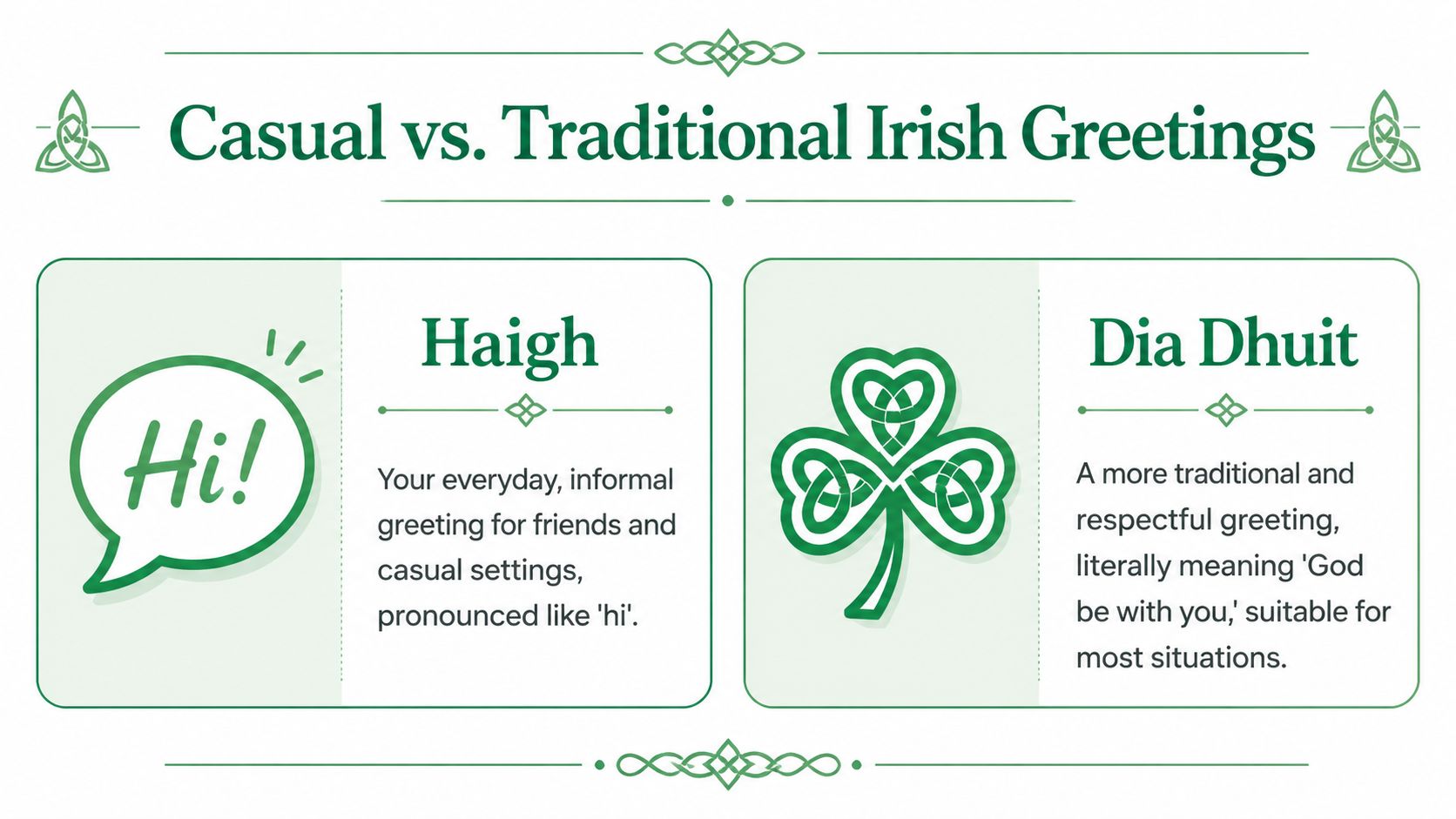
If you want to say hi in Irish, the two most useful greetings to learn first are Haigh and Dia dhuit. Haigh works like a casual “hi,” while Dia dhuit is the classic traditional hello.

You’re probably here because you want something practical. Maybe you’ve got Irish family, you’re heading to Ireland, you’re brushing up for the Leaving Cert oral, or you just want to stop freezing every time you try to greet someone in Gaeilge. That nervous feeling is normal. Most beginners don’t struggle because Irish is impossible. They struggle because they learn a word list, then nobody tells them what happens next.

That’s why a simple greeting in Irish can feel oddly stressful. You learn one phrase, say it out loud, and then start wondering: Was that too formal? What if I’m speaking to more than one person? What do they say back? What am I supposed to say after that?

The good news is that Irish greetings are learnable fast when you treat them as little conversation patterns instead of isolated vocabulary. Once you know the right phrase, the expected reply, and one easy follow-up, you’re no longer memorising. You’re speaking.

Table of Contents

Your First Words in Irish Starting with Hello

A lot of learners want their first phrase to feel real, not like something copied from a dusty textbook. That’s a smart instinct. Greetings are where language becomes social.

If you’re meeting one person, Dia dhuit is a strong place to begin. If you want something lighter and more modern, Haigh is easy and friendly. Those two alone cover a lot of everyday situations.

A young man and woman shaking hands in a cozy stone pub setting.

Why this small phrase matters

Irish isn’t some tiny museum language that only appears on road signs. In the 2022 Census, nearly 1.9 million people in Ireland reported being able to speak Irish, representing about 40% of the population, according to Conradh na Gaeilge’s summary of Census facts and figures.

That matters for beginners because it changes the feeling of the whole project. You’re not learning a novelty phrase. You’re stepping into a living language with learners, fluent speakers, heritage speakers, school memories, regional accents, and everyday cultural weight.

Good beginner rule: Learn one greeting well enough to say without panic, then learn the reply that usually comes after it.

Here’s the simplest starting set:

  • Haigh means a casual hi.
  • Dia dhuit is a traditional hello for one person.
  • Conas atá tú? means “How are you?” and helps you keep going.

Your first mini goal

Don’t aim to “know Irish.” Aim to do one smooth exchange.

Try this out loud:

  1. Dia dhuit
  2. Dia is Muire dhuit
  3. Conas atá tú?

That short chain already sounds much more natural than stopping after hello. It also helps calm the beginner fear that you’ll say one phrase and then have nowhere to go.

The Casual Haigh vs The Traditional Dia Dhuit

These two greetings don’t compete with each other. They do different jobs.

Haigh is modern and informal. Dia dhuit carries more tradition and cultural texture. If you know when each one fits, you’ll sound much more comfortable.

An infographic showing the casual Irish greeting Haigh and the traditional greeting Dia Dhuit with explanations.

When Haigh feels right

Use Haigh the way you’d use “hi” in English. It suits relaxed situations, friends, quick messages, and younger conversational settings.

It’s also a lovely confidence booster because you don’t have to wrestle with spelling or grammar right away. If your main barrier is shyness, Haigh gets you speaking immediately.

A quick way to consider this:

Greeting Tone Best for
Haigh Casual Friends, quick hellos, relaxed chat
Dia dhuit Traditional, respectful First meetings, polite conversation, learning classic Irish

Why Dia dhuit feels different

Dia dhuit translates as “God be with you,” with roots in 17th-century religious customs, and the word dia goes back further to the Old Irish , showing the blend of older and Christian influences in the language, as explained in this discussion of the phrase’s background.

That history matters, but you don’t need to overthink it when you speak. In modern learning contexts, many people experience Dia dhuit as the standard traditional Irish hello. It sounds recognisably Irish, and it teaches you something about the culture while doing a basic conversational job.

Some learners worry that Dia dhuit sounds “too religious” to use. In practice, it’s often best understood as a traditional greeting with historical roots.

A practical choice, not a test

You don’t need to pick one forever.

Use Haigh when you want ease. Use Dia dhuit when you want the classic form. If you’re unsure, Dia dhuit is a safe and respectful choice for learning.

A lot of beginner anxiety comes from trying to find the perfect phrase. There usually isn’t one. There’s just the phrase that fits the moment well enough and lets the conversation move forward.

Pronunciation You Can Actually Use

Irish spelling can look intimidating at first. The trick is to aim for a useful approximation, not perfection on day one.

Haigh is easy. Say it like English “hi.”

Dia dhuit takes a little more attention. A very usable learner version is “JEE-uh gwitch” or sometimes “JEE-uh vitch.” You may also hear a softer start on the d, especially depending on region.

A simple sound breakdown

Try it in two chunks:

  • Dia = JEE-uh
  • dhuit = gwitch or vitch

Say it slowly first. Then say it as one phrase: JEE-uh gwitch.

The reason you’ll hear variation is that Irish pronunciation changes across dialects. The consonants can shift in subtle ways, so don’t panic if one speaker sounds different from another. That doesn’t mean you learned it wrong. It means Irish is a real spoken language with regional life.

What to focus on first

You don’t need a phonetics degree. You need a target your mouth can remember.

  • Clarity first: Speak slowly enough that each part is audible.
  • Rhythm second: Let the phrase flow as one unit.
  • Listening always: Match what you hear from actual speakers.

If you want help hearing the sounds more clearly, this Irish pronunciation guide is a useful next step because pronunciation gets much easier once you can hear the common patterns.

If your pronunciation is understandable and respectful, you’re doing well. Native-like polish comes later.

Greetings for Groups and The All-Important Response

This is the part that makes learners sound much less robotic. Irish greetings aren’t just single phrases. They often work as a social exchange.

The first thing to know is that Irish changes depending on whether you’re speaking to one person or more than one. The second thing is even more important. You usually don’t reply by repeating the same greeting.

A diverse group of friends smiling and laughing while enjoying drinks together outdoors in the sunshine.

One person or several people

For one person, say:

  • Dia dhuit

For two or more people, say:

  • Dia dhaoibh

That small switch matters. It shows you’re paying attention to the structure of the language, not just repeating memorised sounds.

The response beginners often miss

The Irish greeting system works on a reciprocal escalation principle. If someone says Dia duit, the response is Dia is Muire duit, and learners also need to track whether they are greeting one person or a group with duit versus dhaoibh, as described in Bitesize Irish’s explanation of greeting forms.

That means the classic pattern looks like this:

Situation Greeting Reply
One person Dia dhuit Dia is Muire dhuit
Group Dia dhaoibh Dia is Muire dhaoibh

Why this feels strange at first

English trains you to mirror greetings. Someone says “Hi,” you say “Hi.” Irish doesn’t always do that here.

That’s why learners can freeze. They know the opening line but not the social logic behind it. Once you understand that the reply expands the greeting instead of copying it, the exchange starts making sense.

Practice cue: Don’t rehearse Dia dhuit by itself. Rehearse it as a pair with Dia is Muire dhuit.

If you want more common greeting chains to practise, this guide to Irish language greetings and phrases is handy because it keeps the phrases in conversational context.

Beyond Hello Starting a Real Conversation

A good hello opens the door. It doesn’t carry the whole conversation.

After a greeting, the most useful next step is usually Conas atá tú?, which means How are you? That one question turns a language exercise into an interaction.

Two young people with curly hair having a serious conversation while drinking iced beverages at a cafe.

A simple conversation chain

Here’s a beginner-friendly version you can use:

  1. Dia dhuit
  2. Dia is Muire dhuit
  3. Conas atá tú?
  4. Tá mé go maith

Even if you only learn that much, you’ve moved beyond reciting a greeting and into exchange.

The tourist phrase to skip

One phrase causes a lot of confusion: “Top of the morning to you.” It’s widely recognised as a tourist cliché and rarely used by locals. More useful follow-ups like Conas atá tú? matter far more in real conversation, and that same source notes that learners often struggle with greeting chains when they haven’t practised natural follow-ups, as discussed in Preply’s article on saying hello in Irish.

That’s why I usually tell beginners to choose authenticity over performance. A simple, correct greeting is far better than reaching for a phrase that sounds “Irish” in a film version of Ireland.

If you want to sound warm, don’t hunt for a fancy phrase. Use a real greeting, then ask a real question.

Hearing a natural exchange can help the rhythm click. This short video is useful for that:

For more beginner conversation patterns after the greeting stage, this basic Irish conversation guide gives you practical next lines to use.

Practice Your Irish Greetings with Confidence

At this point, you don’t need more theory. You need repetition.

Say the phrases out loud when nobody’s listening. Say them while making tea. Say them in the car. Say them to your dog if that helps. Spoken confidence in Irish usually grows from low-pressure repetition, not from waiting until you feel “ready.”

A few habits make a big difference:

  • Use tiny drills: Repeat one greeting-response pair until it feels automatic.
  • Record yourself: Voice notes help you catch hesitation, dropped sounds, and pacing.
  • Keep it social: Practise full exchanges, not isolated words.

If you like recording yourself as part of study, SpeakNotes for language learners offers a sensible look at how voice notes can support language practice without making it feel heavy.

You can also mix your practice tools. Listen to Irish audio, repeat after speakers, and use guided conversation platforms when you want structure. Gaeilgeoir AI is one example. It offers guided real-world conversations, pronunciation support, adaptive quizzes, and scenario-based practice for everyday Irish, including social interactions and Leaving Cert oral preparation.

The most important thing is consistency. A short greeting you can say comfortably is worth more than ten phrases you only recognise on a screen.


If you want a structured place to practise greetings, replies, and real conversation flow, Gaeilgeoir AI gives you a simple way to start speaking Irish from day one.

Please in Gaelic: How to Say It in Irish (& When)

Le do thoil is the most common way to say please in Irish when you're speaking to one person, and le bhur dtoil is used when you're speaking to more than one person. But if you're learning please in gaelic, the appropriate answer depends on context, politeness level, and who you're speaking to.

Maybe you're about to order a coffee in Ireland, prepping for an oral exam, or reconnecting with family roots and want to sound respectful from the start. In English, “please” feels simple. In Irish, it’s simple at first, then quickly becomes more interesting.

That’s good news for learners. It means you don't need a huge vocabulary to sound thoughtful. You need the right phrase, used in the right moment.

Irish politeness often works through tone, relationship, and phrasing, not just through dropping in one magic word. So yes, you can memorize le do thoil today. But if you also understand why Irish speakers sometimes choose a more formal option, or why the same phrase sounds different in Galway and Donegal, you'll feel much more confident using it in real life.

Table of Contents

Your Guide to Saying Please in Irish

A lot of learners start in the same place. They search for “please in gaelic,” find le do thoil, write it down, and assume they’re done. Then they hear another version, or notice that a textbook example doesn’t quite match a real conversation, and the doubt starts creeping in.

That confusion makes sense. Irish is not just English with different words swapped in. The phrase you choose can reflect whether you’re speaking to one person or several people, whether the setting is casual or formal, and how much deference you want to show.

Why the simple answer isn't the whole answer

At beginner level, le do thoil is the right place to start. It’s useful, common, and safe in everyday situations. If you use it while ordering food, asking for help, or making a basic request, you’ll be understood.

But Irish politeness has layers. A shop interaction, a classroom exchange, and a formal oral exam don’t all feel the same. That’s why learners benefit from knowing not only the phrase itself, but the social meaning behind it.

Practical rule: Start with le do thoil for everyday requests. Learn the more formal option later, once your basic speech feels comfortable.

A heritage learner often wants more than a phrasebook answer. They want to know what sounds natural. A student preparing for the Leaving Cert wants language that fits the occasion. A traveler wants to avoid sounding abrupt without overdoing it. The same small phrase serves all three goals, but only if you use it with awareness.

What confidence sounds like

Confident Irish doesn’t mean perfect Irish. It means choosing language that fits the moment.

That’s why this guide focuses on real usage. You’ll see the common forms first, then the formal one, then the pronunciation differences that catch many beginners off guard. By the end, “please in gaelic” won’t feel like a single translation problem. It’ll feel like a skill you can use.

The Most Common Ways to Say Please

If you only remember two phrases from this article, make them these: le do thoil and le bhur dtoil.

A person wearing a green sweater and jewelry with the text Irish Please displayed below them.

They both mean “please,” but they aren’t interchangeable. The difference depends on who you’re speaking to.

Le do thoil for one person

Le do thoil is the everyday form when speaking to one person.

A helpful way to remember it is that do means “your” in the singular sense. So the phrase conveys the idea of “with your will.” You don’t need to translate it word for word when speaking, but knowing that background helps it feel less random.

Pronunciation guides in the available material give it as /leh duh huh-el/. Many learners simplify that to something like “leh duh hull” when starting out. That’s close enough to begin with, as long as you stay open to regional variations later.

You might hear it in short requests such as:

  • Caife, le do thoil.
    Coffee, please.

  • Cabhair, le do thoil.
    Help, please.

  • An bille, le do thoil.
    The bill, please.

Le bhur dtoil for more than one person

When you’re speaking to two or more people, use le bhur dtoil.

Here, bhur is the plural “your.” That’s the key shift. English doesn’t always mark this distinction clearly, but Irish does, and using the plural form is one of those small details that makes your speech sound more natural.

The pronunciation guide in the verified material gives /leh woor duh-el/. For an English-speaking beginner, “leh woor dull” is a workable memory aid, even if your sound gets refined with practice.

Use it in situations like these:

  • addressing a group at a table
  • speaking to staff as a group
  • asking several classmates to listen
  • making a polite request to more than one person

A quick memory trick

Here’s the easiest way to keep them straight:

Phrase Use it with Simple memory cue
le do thoil one person do = one person’s “your”
le bhur dtoil more than one person bhur = plural “your”

Don’t overthink the grammar while speaking. Just connect do with one person and bhur with a group.

Why beginners sometimes hesitate

Many learners freeze because they want perfect pronunciation before they try the phrase aloud. Don’t wait for that. Irish pronunciation takes time, and politeness counts even when your accent is still developing.

A more useful goal is this:

  1. Choose the right form for one person or a group.
  2. Say it clearly and calmly.
  3. Listen for local pronunciation and adjust over time.

That order matters. Correct social use comes first. Fine pronunciation tuning comes after repeated listening and practice.

Choosing Between Formal and Informal Please

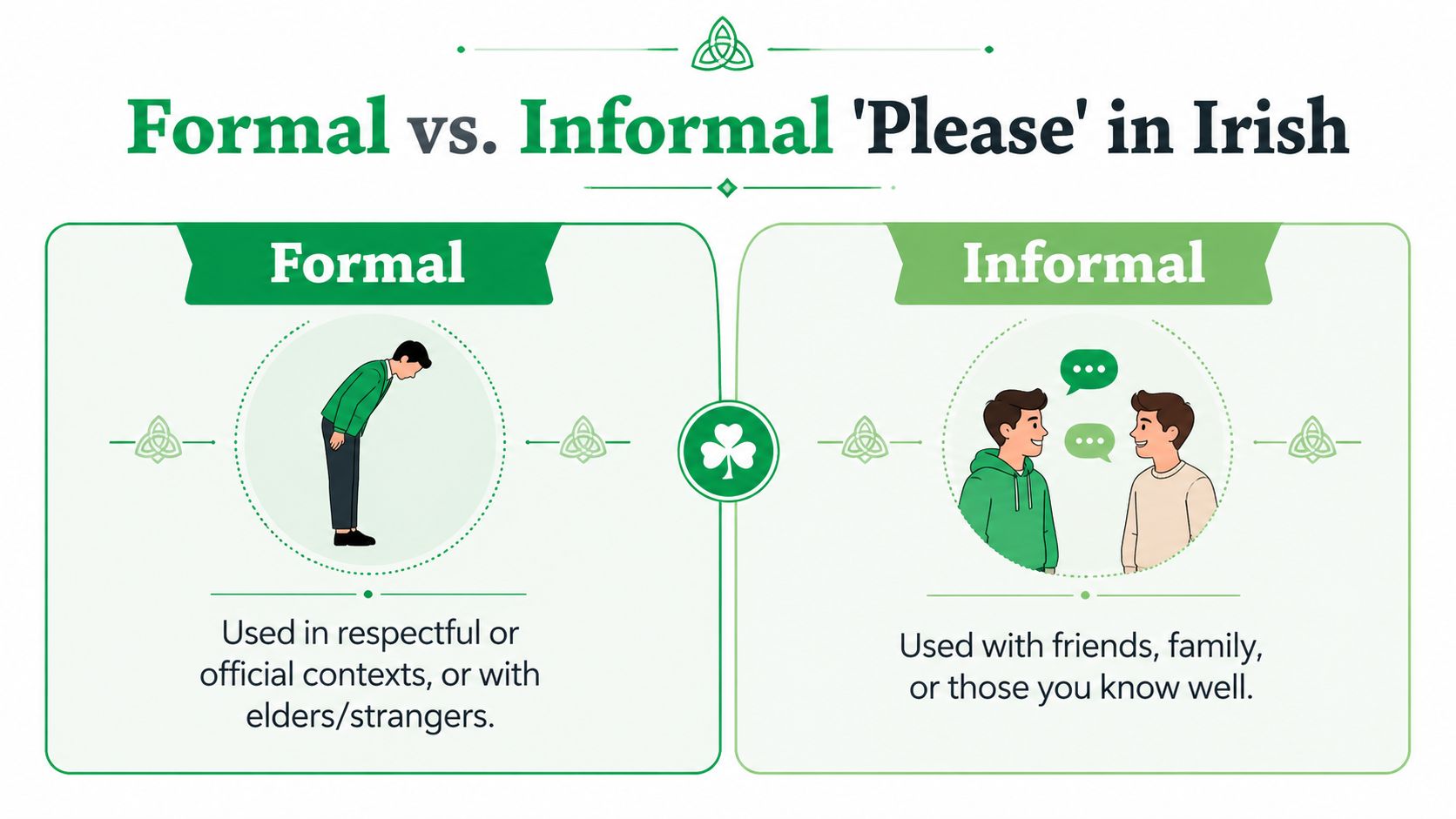
Once le do thoil feels comfortable, the next step is learning when Irish uses a more formal kind of politeness. That phrase is Más é do thoil é.

An infographic showing the difference between formal and informal ways to say please in Irish.

It’s often translated as “if it is your will.” That sounds more elaborate than English “please,” and that’s exactly the point. This version carries extra respect and restraint.

When le do thoil is enough

In most everyday situations, le do thoil does the job well.

Use it when you’re:

  • ordering something casually
  • asking for directions
  • speaking with a teacher in a normal classroom exchange
  • making a simple request in conversation

It’s polite without sounding stiff. For beginners, that balance matters. You want language that feels natural, not memorized from a ceremonial script.

When Más é do thoil é fits better

Más é do thoil é belongs in more formal or deferential moments. Think of it as a step up in politeness, not a replacement for the everyday phrase.

It works especially well in contexts like:

  • formal speaking tasks
  • service interactions where you want extra courtesy
  • requests to elders or strangers when you want a more respectful tone
  • exam settings where control and register matter

One verified example is: “Más é do thoil é, an bhfuil an bus ag stopadh anseo?”
“Please, does the bus stop here?”

That sounds measured and respectful. It’s not something you need in every conversation, but it’s useful to recognize and practice.

Why this matters in exams and advanced speech

This isn’t just a style preference. The verified data notes that candidates using formal variants scored 12% higher on average in the “social interaction” portion of TEG assessments in relation to advanced politeness use, according to Bitesize Irish on polite Irish phrases.

For a learner, the deeper lesson is simple. Register matters. Examiners and listeners notice when your language fits the social setting.

The strongest learners don’t just know vocabulary. They choose the right level of politeness for the moment.

A side by side comparison

Situation Better choice Why
Ordering a tea in a casual café le do thoil simple, natural, everyday
Asking a formal question in an oral exam Más é do thoil é shows control and courtesy
Speaking to a friend le do thoil formal phrasing may sound too heavy
Making a respectful public-facing request Más é do thoil é adds deference

Beginners sometimes worry that the formal phrase will make them sound more fluent all the time. It won’t. If you use it everywhere, it can sound mismatched.

The key skill is judgment. Casual request. Use the everyday phrase. High-politeness situation. Reach for the formal one.

Quick Reference Table for Irish Polite Phrases

A quick-reference chart helps when your brain goes blank mid-conversation. That’s common with polite language because you often need it fast, in the middle of ordering, asking, thanking, or apologizing.

If you want a broader starter set beyond this page, this collection of essential Gaelic phrases for everyday use pairs well with the phrases below.

Irish politeness quick reference

Irish Phrase Pronunciation Guide English Meaning When to Use It
le do thoil leh duh hull please Use with one person in everyday requests
le bhur dtoil leh woor dull please Use with more than one person
Más é do thoil é maws ay duh huh-el ay please, if you would be so kind Use in formal or highly respectful situations
Go raibh maith agat guh rev mah ah-gut thank you Use when thanking one person
Gabh mo leithscéal gov muh lehsh-kale excuse me / pardon me Use to get attention, apologize lightly, or move past someone
Tá fáilte romhat taw fall-cha row-ut you’re welcome Use after someone thanks you

How to use the table well

Don’t try to memorize all six phrases at once. Start with a pair that naturally belongs together.

For example:

  • Request pair: le do thoil and Gabh mo leithscéal
  • Response pair: Go raibh maith agat and Tá fáilte romhat
  • Formal pair: Más é do thoil é and Gabh mo leithscéal

That approach works better than isolated word lists because politeness usually comes in sequences. You ask, someone answers, you thank them, and the conversation keeps moving.

Understanding Regional Pronunciation Differences

One reason learners get confused about please in gaelic is that the phrase they learned from one recording may sound different when spoken by someone from another part of Ireland. That doesn’t mean you learned it wrong. It means Irish has strong regional pronunciation patterns.

A map of Ireland showing different regional accents with bottles of water illustrating Irish speech patterns.

The standard learner form often points toward Connacht-style pronunciation, but native speech is broader than any single teaching model.

What changes across regions

The verified data notes that a Foras na Gaeilge-related discussion on regional politeness usage and pronunciation differences reported 70% of Gaeltacht speakers use dialect-specific politeness markers. It also highlights a common learner problem: online resources rarely explain how a phrase like le do thoil shifts in sound from one region to another.

A few examples from the verified material:

  • Conamara tends to soften the sound, giving learners a lighter “h” feel.
  • Ulster keeps a sharper quality in the vowels and consonants.
  • Dingle or Kerry speech may have a different rhythm again.

These aren’t separate phrases. They’re regional realizations of the same polite expression.

Why this matters for listening

A beginner often assumes pronunciation variation means there must be a different word involved. Usually there isn’t. The issue is listening range.

That’s why it helps to train your ear with more than one model. A pronunciation guide that includes regional comparison can prevent the “I know this phrase on paper, but I missed it in speech” problem. If you want to build that listening flexibility, this Irish pronunciation guide for learners is a useful companion.

A phrase can be correct in every region and still sound different in each one.

A simple way to respond as a learner

You don’t need to master all dialects at once. Do this instead:

  1. Pick one pronunciation model first. Connacht-based learner audio is a practical starting point.
  2. Expect variation when listening. Native speakers may shape the same phrase differently.
  3. Copy before analyzing. Repeat what you hear, then compare it with your base form later.

Here’s the reassuring part. Irish speakers are used to accent variation. What matters most at beginner level is respectful usage and steady listening practice, not reproducing every local feature perfectly on day one.

Common Mistakes to Avoid When Saying Please

Most learner mistakes with Irish politeness aren’t rude. They’re just direct transfers from English. Once you spot them, they’re easy to clean up.

Mixing up singular and plural

This is the most common slip. A learner memorizes le do thoil and then uses it for everyone, including groups.

If you’re speaking to several people, switch to le bhur dtoil. That small change shows you’re paying attention to the structure of Irish, not just reciting a single fixed phrase.

A good habit is to pause and ask yourself one quick question before speaking: one person or more than one?

Treating please as a decoration

In English, “please” often gets dropped into commands to soften them. Beginners sometimes try to do the same thing mechanically in Irish.

Irish often sounds more natural when the whole request is phrased gently, rather than when a blunt command gets a polite word attached to the end. Tone matters. Sentence shape matters too.

If the request sounds pushy in English without “please,” it may still sound pushy in Irish with the phrase added.

That’s why short request patterns are so useful. “The bill, please” or “Coffee, please” often works better than building a direct imperative too early in your learning.

Overusing the formal phrase

After learning Más é do thoil é, some students want to use it everywhere because it sounds impressive. The problem is fit.

With friends or in relaxed conversation, it can sound heavier than the situation needs. Irish politeness is not about sounding maximally formal at all times. It’s about matching the social setting.

Mishearing the sounds

Certain sounds trip learners repeatedly:

  • The “th” area in thoil can sound lighter than expected.
  • The “bh” in bhur doesn’t behave like an English “b.”
  • Vowel quality can shift depending on region.

A simple fix is to repeat full chunks, not isolated letters. Learn le do thoil as one unit. Learn le bhur dtoil as another. Chunking helps your mouth remember what your grammar is still catching up to.

Practice Saying Please with Gaeilgeoir AI

Knowing the phrase is one thing. Saying it comfortably, at the right speed, in a real exchange, is another.

A person using a smartphone to practice speaking Gaelic with an interactive AI language learning application.

That’s where guided practice helps. Instead of memorizing isolated phrases, you can rehearse them in the kinds of situations where politeness matters, such as ordering food, asking for directions, or speaking carefully in an oral exam setting.

Turn polite phrases into automatic speech

A useful practice cycle looks like this:

  • Start with recognition by hearing the phrase in context.
  • Move to controlled repetition so your pronunciation settles.
  • Use contrast drills for pairs like le do thoil and le bhur dtoil.
  • Finish with live-style prompts where you have to choose the right form yourself.

That kind of progression is one reason language learners often benefit from spaced review tools. If you’re interested in how repetition and retrieval can support memory, Maeve’s piece on learning with AI using flashcards gives a helpful overview of the method, even though it focuses on another language.

Another strong approach is scenario practice. A phrase becomes usable faster when you meet it inside a realistic exchange instead of on a bare vocabulary list.

Practice in context, not in isolation

This is the kind of listening and speaking input that helps polite language stick:

You’ll improve faster if you rotate through different tasks:

  1. Order something politely using the everyday form.
  2. Address a group and switch to the plural correctly.
  3. Rehearse a formal request using Más é do thoil é.
  4. Listen to accent variation so you don’t panic when the phrase sounds different.

For structured speaking practice, the AI Irish learning platform for guided conversation practice gives learners a way to repeat these patterns in context instead of guessing whether they sounded right.

What to focus on first

Don’t try to perfect every nuance at once. Build the skill in layers.

First, choose the right phrase. Then work on clarity. Then improve pronunciation and register. That order mirrors how real confidence develops. You become polite first, precise second, polished third.

Building Your Foundation of Irish Politeness

Once you can use “please” naturally, your Irish starts sounding warmer very quickly. That’s because politeness in conversation is a system, not a single word.

A request often leads to thanks. A question may begin with getting someone’s attention. A helpful answer usually ends with a courteous response. When you learn these phrases together, your Irish stops sounding like a list and starts sounding like interaction.

The core phrases that belong together

Three expressions fit naturally beside le do thoil:

  • Go raibh maith agat for “thank you”
  • Gabh mo leithscéal for “excuse me” or “pardon me”
  • Tá fáilte romhat for “you’re welcome”

Used together, they create the rhythm of polite speech. You ask respectfully. You acknowledge help. You respond graciously.

That matters more than many beginners realize. Fluency isn’t only about saying longer sentences. It’s also about handling small social moments smoothly.

Why this approach works

When learners focus only on translation, they tend to collect isolated equivalents. When they focus on exchanges, they build usable language.

A good comparison comes from conversational AI design. When people train a chatbot, they don’t just feed it single words. They build patterns, responses, and context so the interaction feels natural. Human language learning works in a similar way. The phrase “please” becomes much easier to remember when your brain stores it beside thanking, apologizing, and responding.

Politeness is one of the fastest ways to make beginner Irish sound human.

Keep your goals modest and practical. Learn the one-person and group forms. Recognize the formal version. Add thank you and excuse me. Practice short exchanges until they feel easy.

That foundation goes a long way. It helps travelers sound courteous, heritage learners reconnect through respectful speech, and students show maturity in spoken Irish.


If you want to turn these phrases into real speaking habits, Gaeilgeoir AI gives you guided Irish conversation practice, pronunciation support, and everyday scenarios so you can start using polite Irish with confidence from day one.

Master Congratulations in Irish: Pronunciation & More

Your cousin has just announced an engagement. A friend passed a tough exam. A teammate won a final. You want to say more than a plain “congratulations,” and if Irish matters to you, even a little, using the language can make that moment feel warmer and more personal.

That’s why congratulations in irish is such a useful phrase to learn. It gives you something practical you can say right away, but it also opens a door into how Irish expresses celebration. The words carry a sense of shared happiness, not just polite praise.

Table of Contents

Why Saying Congratulations in Irish Matters

A lot of learners start with greetings. That makes sense. But congratulations is different. You usually say it at a real emotional moment, when someone has done something difficult, joyful, or life-changing.

If you tell a friend Comhghairdeas leat, you’re not just swapping English for Irish. You’re joining their happiness in a way that fits the spirit of the language. Irish tends to hold onto community, family, local pride, and shared milestones, so this phrase feels especially natural at engagements, exam results, sports wins, and family celebrations.

A phrase that feels personal

Think about the difference between sending a quick “Congrats!” and taking a moment to write a thoughtful message. Irish can have that second effect. Even if your sentence is short, it sounds intentional.

That matters for:

  • Family news: engagements, weddings, new babies, anniversaries
  • Student life: exam results, oral practice, school achievements
  • Community moments: local matches, music performances, club events
  • Heritage connection: reconnecting with Irish roots through everyday phrases

Saying it in Irish can turn a simple message into a shared cultural gesture.

For many people, that’s the appeal. You don’t need advanced grammar to make someone smile. You just need one phrase you can say with sincerity.

The Essential Phrase Comhghairdeas Explained

The core phrase you need is Comhghairdeas. This is the standard Irish word for “congratulations,” and it’s the one you’ll see most often in learning materials, spoken use, and celebratory messages.

A rustic, antique book with intricate Celtic patterns resting open on a polished wooden desk surface.

What the word really means

This word is special because it isn’t just a flat translation. Comhghairdeas comes from comh- meaning “together” and gairdeas meaning “joy.” In other words, it carries the sense of shared joy or joint rejoicing.

That’s one reason the phrase feels so alive. You’re not standing outside someone’s success and commenting on it. You’re stepping into the moment with them.

Why that meaning matters

English speakers often treat “congratulations” as a standard response. Irish gives the phrase more emotional shape. The meaning suggests celebration as something communal.

Historically, the phrase’s standardized use was strongly promoted during the Gaelic Revival from circa 1893 to 1922, and the Gaelic League was founded on July 31, 1893, helping promote Irish as a living language in public life and celebration, as noted in this explanation of Comhghairdeas and the Gaelic Revival.

Your first useful forms

Once you know the base word, you can build the two forms you’ll use most often:

  • Comhghairdeas leat
    congratulations to you, singular

  • Comhghairdeas libh
    congratulations to you, plural

Practical rule: Learn Comhghairdeas first as a whole phrase, not as a grammar puzzle. Meaning comes before analysis.

If you remember only one thing from this section, remember this. Comhghairdeas doesn’t just praise achievement. It expresses shared happiness, and that’s why it feels so culturally rich.

Your Guide to Perfect Pronunciation

Most learners hesitate here. The spelling looks unfamiliar, and that’s normal. Irish spelling often maps sounds differently from English, so the trick is to aim for clear, confident pronunciation rather than perfection on day one.

A helpful English-style approximation for Comhghairdeas is “ko-raid-as” or “koh-ghawr-jess.” Those aren’t exact, but they’ll get you close enough to start speaking.

Start with the shape of the word

Try saying it in three beats:

  1. Comh
    Start with a “koh” sound.

  2. ghair
    This middle part is softer than many learners expect. Don’t force a hard “g.”

  3. deas
    Keep the ending crisp and light.

Say it slowly first, then smooth it out: koh-ghair-deas.

Why dialects sound different

Irish changes across dialects, and that’s one reason you may hear more than one version. The common form comhghairdeas is often pronounced /koːɾʲdʲas/, while in Ulster Irish it may extend to comhghairdeachas /koːɣaɾdʲaxəs/. This reflects dialectal sound patterns where Ulster preserves distinct velar fricatives /ɣ/ and /x/, a feature highlighted in this note on pronunciation and dialect variation.

A learner-friendly approach

If you’re a beginner, use this approach:

  • Pick one version first: Start with Comhghairdeas before worrying about regional variation.
  • Listen more than you analyze: Your ear will improve faster than you think.
  • Copy rhythm, not just sounds: Irish has a musical flow that matters as much as individual letters.

For extra listening practice, this Irish pronunciation guide can help you hear recurring sound patterns beyond this one phrase.

Clear pronunciation beats overthinking. If your listener understands your warmth and your meaning, you’re doing well.

Beyond Comhghairdeas More Ways to Celebrate

Once you’ve got the main phrase, it helps to have a few more options. Some moments call for full congratulations. Others need something lighter, quicker, or more enthusiastic.

A graphic showing three Irish phrases for congratulations with icons for a medal, star, and trophy.

When to choose a different phrase

The longer form Comhghairdeachas can sound more heartfelt or emphatic. It’s associated with communal celebration, and it’s often heard in big public moments such as GAA culture. GAA All-Ireland Finals have been a cultural staple since 1887, and the 2023 hurling final reached 1.8 million viewers, helping spread these celebratory phrases widely through broadcasts and public language, as described in this discussion of Comhghairdeachas in Irish celebration.

For everyday praise, many speakers switch to shorter expressions.

Irish Phrases for Congratulations

Irish Phrase Pronunciation Meaning & Formality Best Used For
Comhghairdeas ko-raid-as Congratulations. Standard and versatile. Exams, engagements, job news, formal or warm messages
Comhghairdeachas koh-wir-jah-kus Heartfelt congratulations. More emphatic. Big public celebrations, speeches, extra warmth
Maith thú! mah hoo Well done. Informal and common. Schoolwork, sport, finishing a task
Go hiontach! guh hin-takh Excellent. Positive and lively. Strong performance, results, praise
Ar fheabhas! ar yab-has Superb or fantastic. Enthusiastic praise. Outstanding work, high achievement

How these feel in real use

  • Use Comhghairdeas when the event is significant and you want a complete “congratulations.”
  • Use Maith thú! when someone has done well and the mood is casual.
  • Use Ar fheabhas! when you want your praise to sound energetic and impressed.

If you’re writing a card for an engagement or wedding and want ideas for tone before you add the Irish phrase, these congratulations message engagement ideas are useful for shaping the message around the occasion.

You can also build out your celebration vocabulary with other Irish greetings and phrases, especially if you want your message to sound more natural from start to finish.

Using Irish Congratulations in Real Life

A phrase becomes memorable when you attach it to a real situation. That’s where most learners relax. Instead of asking “What does this word mean?” you start asking “When would I say this?”

A diverse group of friends smiling and laughing while making a cheers toast with beers at a table.

Ready-to-use examples

Here are some natural examples you can borrow, adapt, or send as they are.

  • Comhghairdeas leat as do phost nua!
    Congratulations on your new job!

  • Comhghairdeas libh ar bhur bpósadh!
    Congratulations on your wedding!

  • Comhghairdeas ó chroí leat, a chara!
    Heartfelt congratulations to you, my friend!

  • Maith thú féin!
    Well done yourself!

  • Comhghairdeas leis an bhfoireann!
    Congratulations to the team!

Matching the phrase to the moment

For a one-to-one message, Comhghairdeas leat works beautifully. It sounds warm without being too formal. If you’re speaking to a couple, a family, or a group, switch to Comhghairdeas libh.

That small change matters. It’s one of the easiest ways to sound more natural in Irish.

Sample situations

A few common situations come up again and again:

  • Exam results:
    Comhghairdeas leat as do thorthaí sna scrúduithe.
    Congratulations on your exam results.

  • Engagement:
    Comhghairdeas ar bhur ngealltanas.
    Congratulations on your engagement.

  • Wedding day:
    Comhghairdeas libh ar lá bhur bainise.
    Congratulations on your wedding day.

  • Victory in sport:
    Maith sibh. Comhghairdeas libh as an mbua.
    Well done. Congratulations on the win.

A short Irish phrase often lands better than a long sentence you’re unsure about.

A simple message formula

If you want a reliable pattern, use this:

Comhghairdeas + leat/libh + ar/as + the occasion

Examples:

  • Comhghairdeas leat as do bhua.
  • Comhghairdeas libh ar bhur bpósadh.
  • Comhghairdeas leat as an obair mhaith.

This is enough for texts, cards, speeches, and quick spoken moments. You don’t need fancy vocabulary to sound thoughtful. You need a phrase you can reach for naturally.

Understanding the Simple Grammar Rules

Irish congratulations become much easier once you notice one key feature. Irish often builds this idea around a noun, not a dedicated verb. Instead of a direct “to congratulate” verb doing all the work, Irish commonly uses structures around comhghairdeas itself.

That’s why forms like déanamh comhghairdeas mean “to make congratulations.” In formal settings such as exams and sports, this noun-based style appears in 85% of contexts compared with informal alternatives like Maith thú!, according to this grammar-focused explanation of congratulating someone in Irish.

Leat and libh

This is the grammar point you’ll use most:

  • Leat means “to you” when speaking to one person
  • Libh means “to you” when speaking to more than one person

So:

  • Comhghairdeas leat = congratulations to one person
  • Comhghairdeas libh = congratulations to multiple people

Why names and phrases shift

Irish learners often expect a one-word-for-one-word translation. Irish doesn’t always work that way. It links meaning through small particles and prepositions, so the phrase grows outward from comhghairdeas.

That’s also why you may see names or following words change shape slightly after prepositions. You don’t need to master every mutation right now. What matters first is recognizing the pattern and using it consistently.

Learn the frame first. Comhghairdeas leat and Comhghairdeas libh will carry you through most everyday situations.

If you keep those two forms ready, your Irish will already sound much more grounded.

How to Practice Irish with Gaeilgeoir AI

The fastest way to remember congratulations in irish is to use it in context. Say it out loud. Put it in a text message. Practice it after real events in your day, even if you’re only talking to yourself.

That kind of repetition works better when it feels active rather than mechanical. Short speaking drills, scenario practice, and feedback on pronunciation help far more than staring at one word on a flashcard.

A young man holds a tablet displaying a language learning app for practicing the Irish language outdoors.

A practice routine that actually sticks

Try a simple weekly loop:

  • Listen: hear native or learner-friendly audio of key phrases
  • Repeat: say Comhghairdeas leat and Comhghairdeas libh aloud
  • Apply: send one message or write one short sentence
  • Recycle: reuse the phrase later in a different context

If you enjoy structured motivation, it also helps to understand how game elements affect study habits. This article on how to boost engagement with gamification gives a useful overview of why points, progress tracking, and small wins keep learners consistent.

One tool for guided speaking practice

If you want interactive practice, learn Gaelic language with AI offers a route into guided conversation work. Gaeilgeoir AI includes pronunciation support, adaptive quizzes with instant feedback, and scenario-based practice for everyday situations such as social interactions, travel, and Leaving Cert oral preparation.

That matters because congratulations phrases rarely live on their own. You say them in a full interaction. Someone shares news, you respond, you ask a follow-up question, and the conversation moves on. Practicing that flow makes the phrase usable, not just memorable.

The key is consistency. A short session done often will take you further than occasional cramming.


If you’re ready to turn a few Irish phrases into real speaking confidence, try Gaeilgeoir AI. It gives you guided, real-world conversation practice so phrases like Comhghairdeas leat don’t stay on the page. They become part of how you speak.
Start Speaking Irish Today — 25% Off
Use code START25

Learn real Irish for real life with guided practice, pronunciation support, and everyday conversations.

Get 25% off any plan with code START25

Start Speaking Irish Today — 25% Off