Content Based Language Instruction Explained Step by Step

You know the feeling. You sit down with a list of Irish words, you rehearse a few grammar rules, and then the moment you need to speak, everything feels slippery again. That frustration is exactly why content based language instruction matters, because it asks a different question, not “Can you remember the rule?” but “Can you use the language to do something real?”

For a lot of learners, that shift changes the whole experience. A heritage beginner might want to talk about family, food, or where they grew up. A Leaving Cert student might need to handle oral exam topics without freezing. A busy adult might just want practice that feels useful instead of abstract. Content based language instruction gives those learners a way in, because the language is tied to meaning from the start.

Table of Contents

Why Learning Through Real Content Changes Everything

A learner can memorise “I'm hungry” in Irish and still struggle to order lunch. The missing piece is context. When the lesson grows out of a real situation, like making a sandwich, planning a trip, or describing a favourite place, the language has somewhere to go, and memory has something concrete to hold on to.

That is the quiet strength of content based language instruction. It treats language like a tool in use, not a museum piece behind glass. You learn the words while using them for a purpose, the way you learn to fix a leaking tap by repairing it, not by reading the manual from start to finish and never touching the spanner.

Who benefits most

This approach helps different learners in different ways. Beginners get structure, because the content gives them a clear path. Intermediate learners get depth, because the topic pushes them to say more. Returning learners get a bridge back into the language through familiar subjects rather than isolated drills. In Irish, that might mean building a lesson around bia, taisteal, or a family conversation instead of starting with a page of unrelated verbs.

It also gives motivation a steadier base.

If the topic is something you care about, like food, travel, work, or the Leaving Cert oral, the lesson feels less like a test and more like a task you can finish. That makes practice easier to repeat. Repetition is where confidence starts to grow.

Practical rule: if the language never helps you do anything meaningful, it is too easy to forget.

The approach also suits self-study better than many people expect. A short session on weather, a café menu, or directions to the station can feel like real progress because the content is concrete. That is much easier to return to than a random vocabulary list with no story attached.

What Content Based Language Instruction Really Means
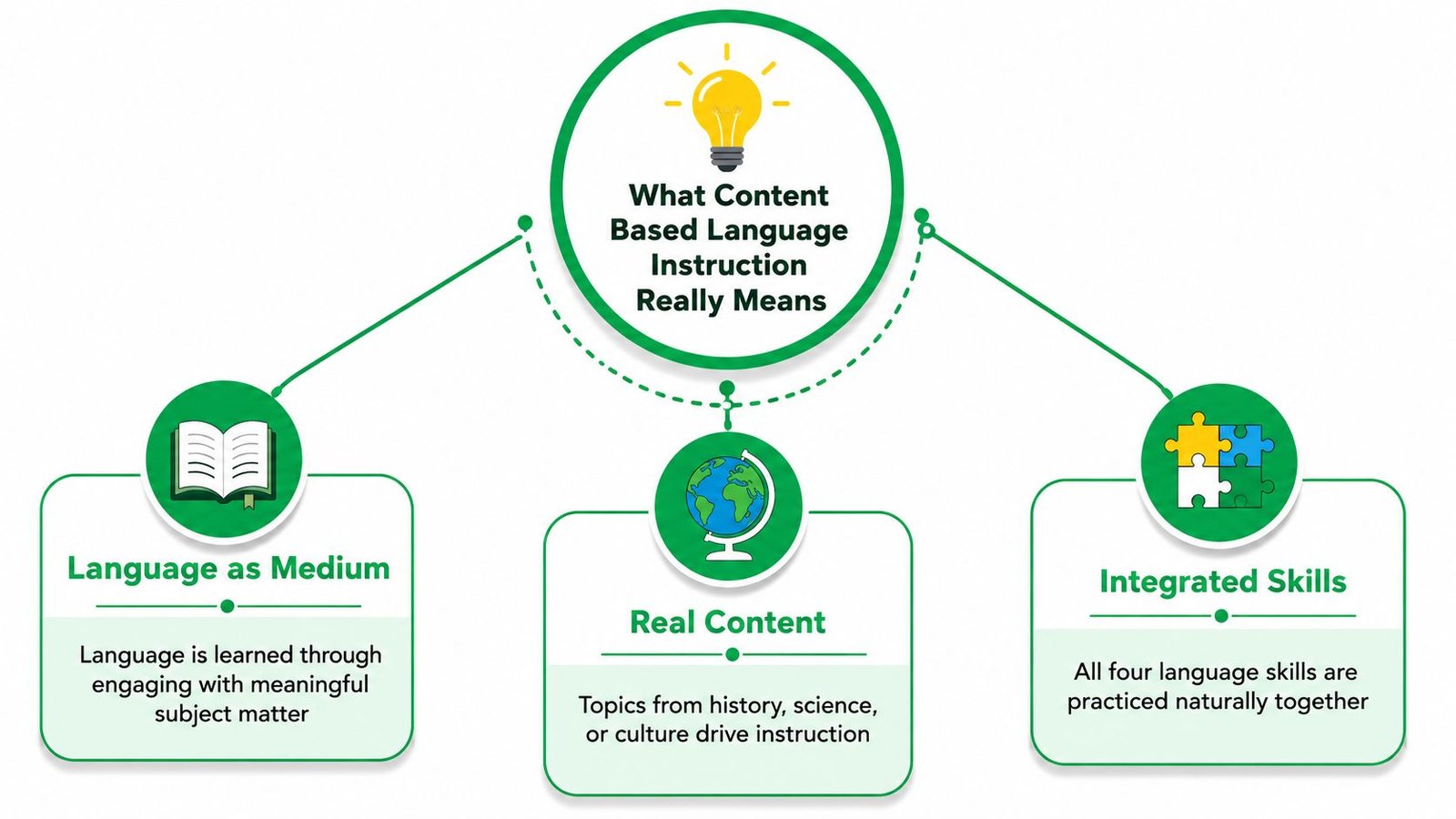
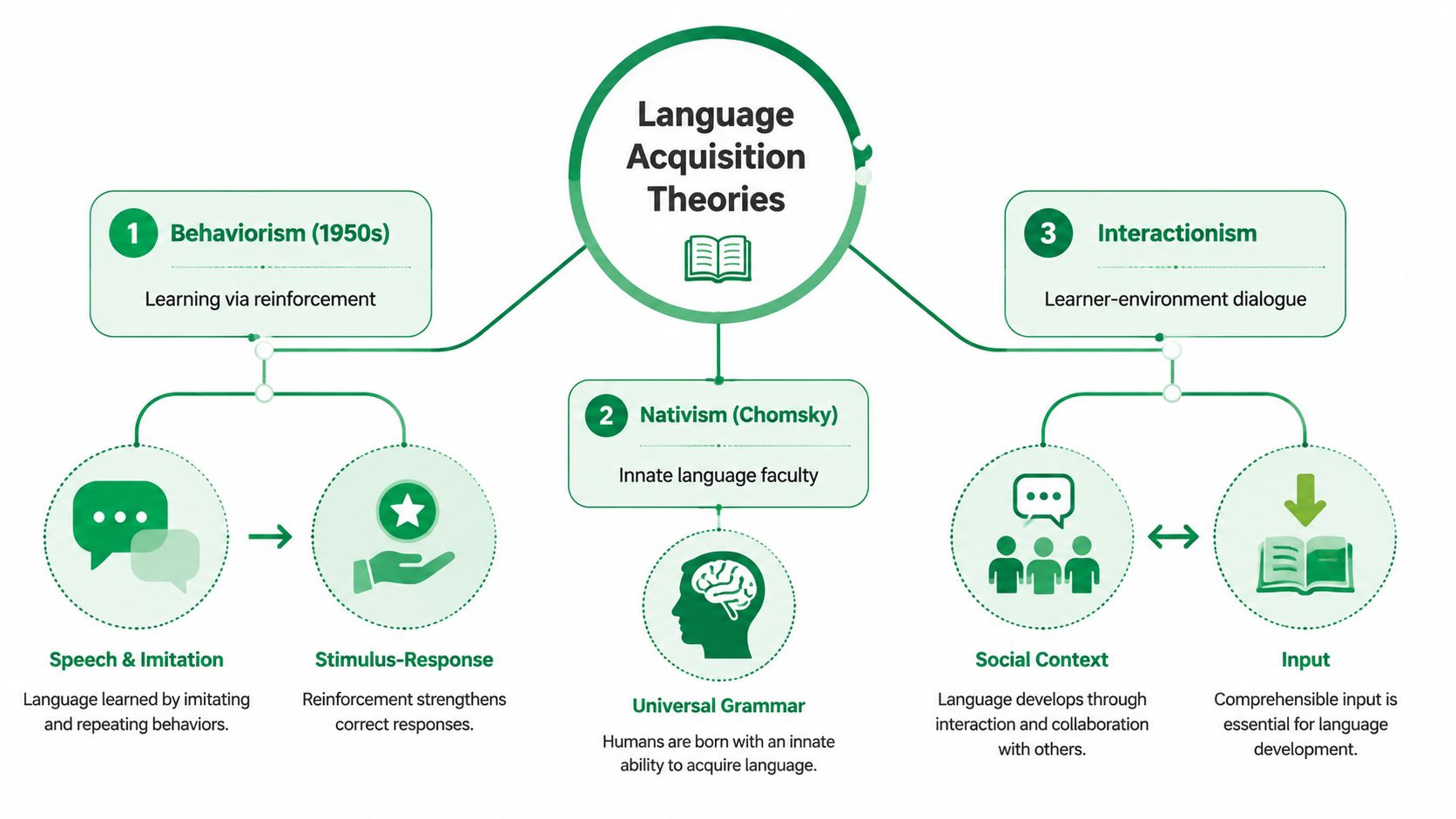
A diagram explaining content-based language instruction through the pillars of language as medium, real content, and integrated skills.

Content based language instruction means the target language becomes the medium for learning something else. Instead of studying Irish as an isolated subject, you use Irish to understand a topic, complete a task, or work through a lesson with an academic or practical goal. That shift is simple, but it changes the feel of the whole lesson.

A beginner who hears this idea for the first time may assume the language work disappears into the background. It does not. The classroom is still teaching Irish, but it does so through meaning, purpose, and use. The lesson might revolve around a topic such as food, travel, or school life, while the learner is also practising question forms, listening for detail, or building short spoken answers.

How the pieces fit together

In strong CBLI lessons, language sits inside real tasks, content-obligatory language, and integrated skill use. If the topic is shopping, the learner needs words for quantities, preferences, and polite requests. If the topic is travel, the learner needs directions, transport terms, and ways to ask follow-up questions. The content gives the language a job to do.

That is why scaffolding matters so much. Visuals, modelling, sentence starters, and graphic organisers reduce the load on working memory, so learners can focus on the meaning of the task instead of getting lost in unfamiliar language. Pair work and small-group work help too, because speaking to another person gives the language a live purpose. A map, a menu, or a short dialogue sheet can do the same work as a long explanation, and often more clearly.

Meaningful context makes repeated language use feel natural, and repeated use helps new academic language stick.

The same logic appears in subject classes too. Teachers use materials, tasks, and techniques from academic content areas as the vehicle for developing language, content, cognitive, and study skills, so learners acquire language while using it to learn school content, as described in CAL's overview of content-centered language learning. The point is to embed language work inside something the learner can do.

For a simple Irish example, a lesson on bia might begin with pictures of a lunch tray, a short model response, and a task like asking what someone wants to eat. A learner does not need a grammar lecture before speaking. The content gives the lesson shape, and the language grows inside that shape.

Theoretical Foundations That Shaped CBI

The history matters because it explains why this method looks the way it does today. Early definitions, later summarised by the University of Minnesota's CARLA centre, framed content based language instruction as an approach that integrates subject matter and second-language skills, including the idea of the concurrent teaching of academic subject matter and second language skills in 1989 and a 1990 definition that drew on tasks from classes such as math and social studies (CARLA's CBI overview). That framing moved language out of the “standalone subject” box.

Once language was treated as a tool for learning content, other models followed. Immersion, CLIL, and related integrated approaches all built on that basic insight, even if they looked different in practice. For Irish learners, that history is useful because it explains why a lesson on travel, family, or school life can still count as serious language learning.

From theory to research

A 2012 review of K to 12 content-language integration research found that the field had already spread across a wide range of contexts, from highly content-driven to more language-driven models (CARLA's research summary). That matters because it shows this wasn't a fringe idea sitting on the edge of language teaching. It had become a recognised research area with different classroom forms.

This language acquisition research overview is a helpful companion if you want to connect classroom practice with broader learning theory without getting lost in jargon.

The long view also helps with a common beginner worry. Many learners assume that if a lesson doesn't look like traditional grammar teaching, it must be less serious. The history points the other way. The field developed precisely because teachers saw that language sticks better when it's tied to meaningful content, not detached from it.

Why the historical shift still matters

That older shift still shapes Irish classrooms, online lessons, and self-study tools. It's why a topic-based lesson about food feels so different from a page of detached verbs. It's also why a good CBI lesson doesn't just “include content”, it uses content to structure the learning itself.

Three Main Models of Content Based Instruction
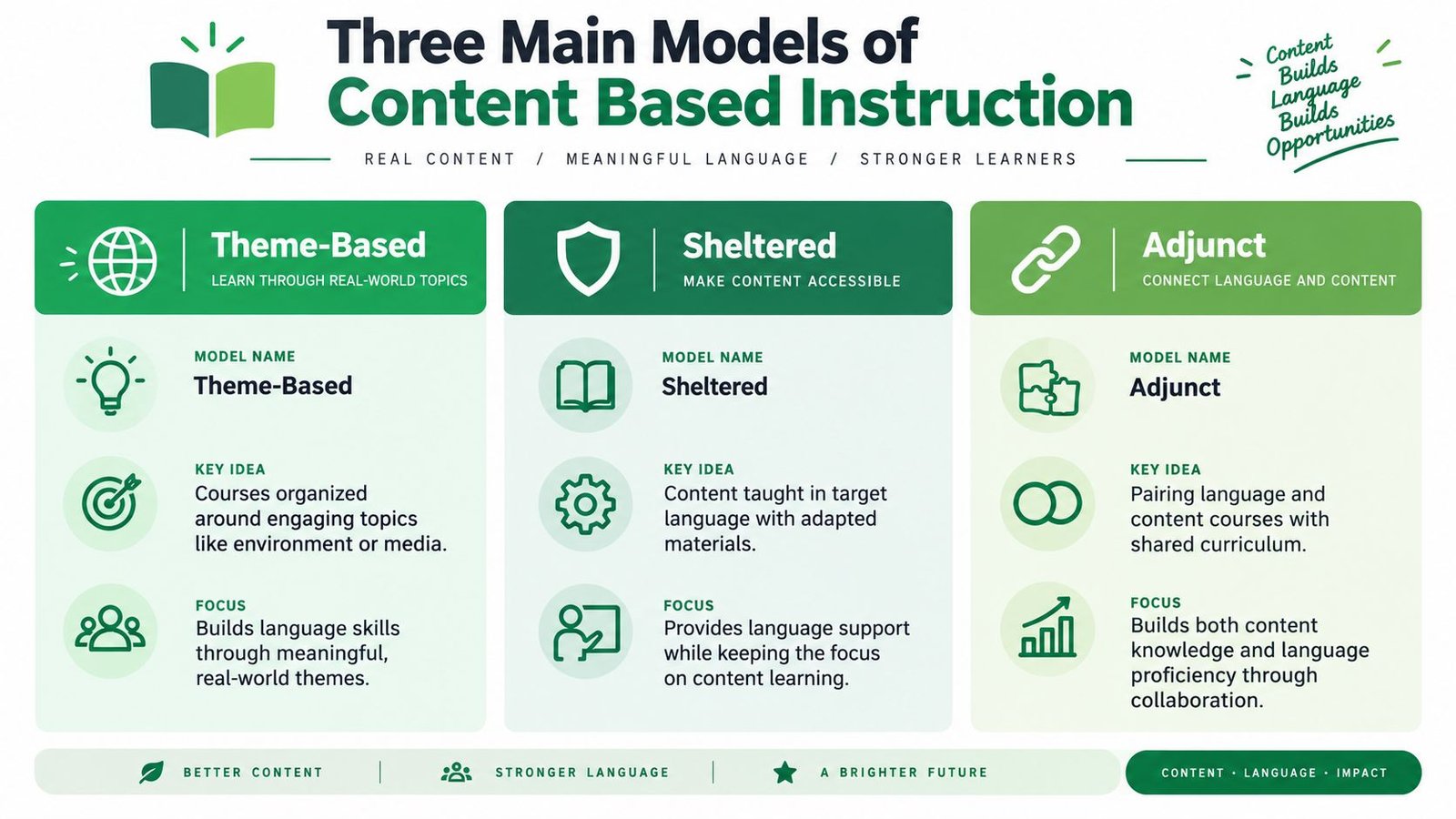
An infographic titled Three Main Models of Content Based Instruction comparing Theme-Based, Sheltered, and Adjunct teaching models.

Different classrooms need different shapes, so it helps to separate the main models clearly. In the broadest sense, the label is used inconsistently across contexts, and CARLA notes that it's “commonly used to describe approaches to integrating language and content instruction,” but “it is not always used in the same way” (CARLA on content-based decisions). That's why the model matters more than the label.

Theme-Based, Sheltered, Adjunct

A theme-based course is organised around a topic. In Irish, that could be bia, scoil, teaghlach, or taisteal. The teacher chooses language tasks that grow out of that topic, so the content gives the sequence its shape.

A sheltered model teaches content through the target language with adapted supports. The CAL resource describes this as using academic content materials, tasks, and techniques as the vehicle for building language and study skills, with instruction delivered by a language teacher alone or by a combination of language and content teachers (CAL's content-centered language learning overview). That setup works well when the class needs more guidance, visuals, and controlled language input.

An adjunct model pairs language and content courses so the two classes reinforce each other. That's a useful shape for older students who can handle more complexity, because one teacher can focus on the content and another can support the language needed to access it.

Model How It Works Best For
Theme-Based Lessons follow a topic such as food, travel, or media Beginners to intermediate learners who need structure
Sheltered Content is taught in the target language with supports Learners who can handle subject matter with scaffolding
Adjunct Language and content courses are linked Older learners or programmes with coordinated teaching

A quick Irish classroom picture

A Leaving Cert oral prep unit might use a theme-based model for describing holidays. A sheltered lesson might use Irish to explore a simplified geography topic. An adjunct setup could link a language class with a content class so vocabulary from one supports discussion in the other.

The best model is the one that fits the learner's language level, the teacher's role, and the amount of support available.

How CBI Compares to Other Language Teaching Methods
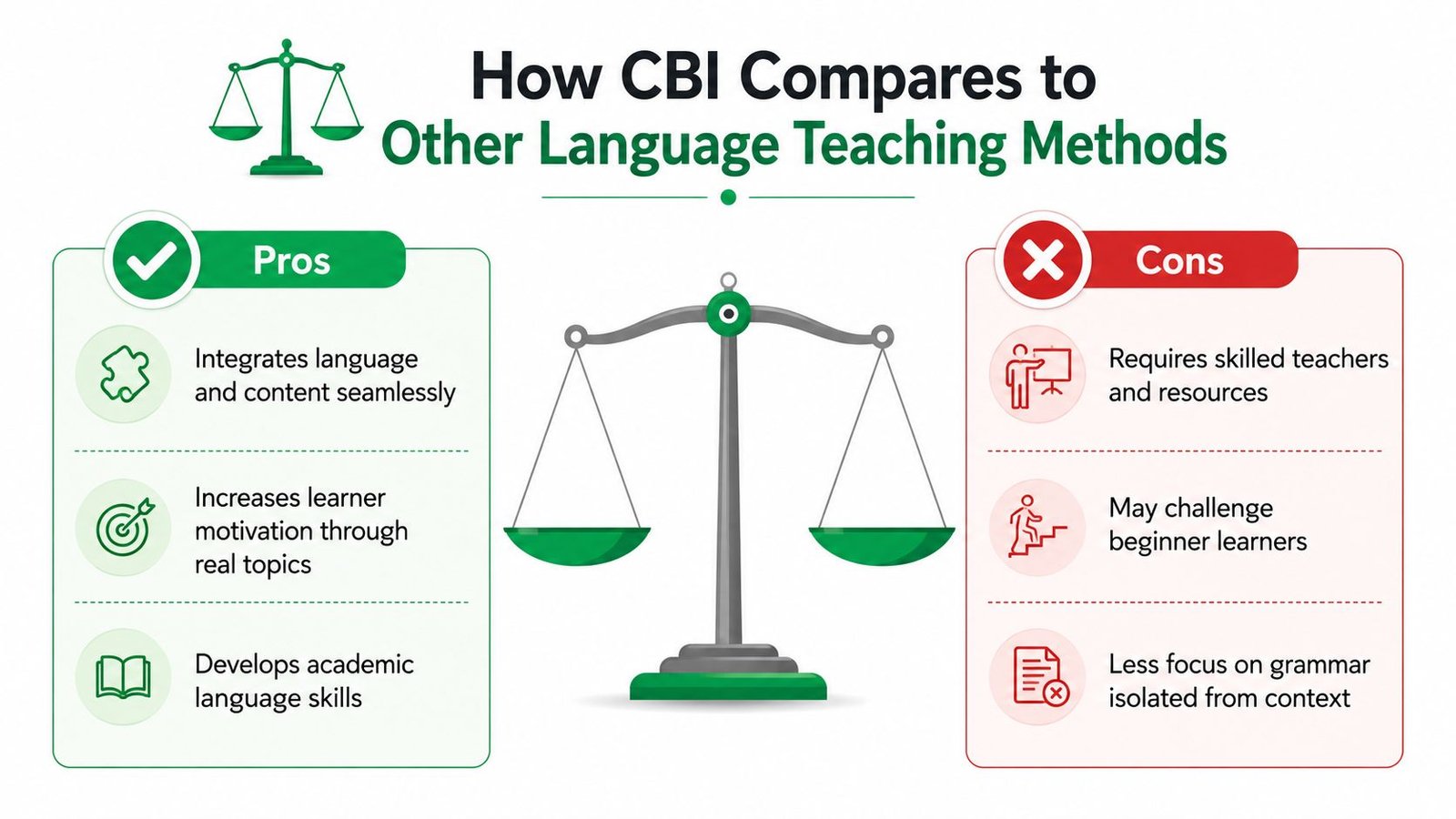
A comparison chart showing the pros and cons of content-based language instruction displayed on scales.

People often group content based language instruction with communicative teaching, CLIL, or immersion, but the terms do different jobs. CBI keeps language growth tied to learning something specific, while other methods may give more weight to interaction, subject delivery, or general fluency. That difference matters in an Irish class, because a lesson on food, travel, or the Leaving Cert oral needs both the topic and the language work to stay visible.

Grammar-translation sits at a very different point. It usually organises learning around rules, word lists, and translation. That can help learners study forms in a controlled way, but it does not naturally push them to use Irish to complete a task or understand a topic.

Where it overlaps, and where it doesn't

Communicative language teaching shares CBI's interest in meaningful language use, but it often centres functions such as asking, describing, or agreeing rather than a content sequence. Immersion and CLIL move further into teaching subject matter through the target language, so they sit close to CBI, even though they are not the same thing in every classroom.

The term is broad, and classroom practice changes from setting to setting (CARLA's definition note). That is why it helps to ask what the lesson is built around, not only what label it carries.

A practical way to judge a lesson comes from strong CBLI guidance. The content goal and the language goal both need to be explicit, and learners need scaffolding such as modelling, visuals, sentence starters, and graphic organisers, because those supports lower the strain of the task and make output more manageable (Texas EL CBLI guidance).

The myth that CBI is just immersion

It is more structured than that. Strong CBI combines content with planned language objectives, collaboration, and support for beginners, so the lesson feels closer to a carefully shaped bridge than to silent exposure.

That distinction matters for Irish learners. A complete beginner does not need uncontrolled speech pouring over them. They need content that is simple, meaningful, and supported, like a short food menu, a travel role-play, or a small oral-prep prompt with a frame to lean on. A stronger learner can handle more open work, but the content still has to drive the lesson, not sit in the background.

Putting CBI Into Practice in Class and at Home

A learner sits in an Irish lesson with the words in front of them, but the task still feels blurry. They can read a menu, or hear a short dialogue, yet they do not know what to do with it. That frustration usually comes from missing structure, not missing ability. Strong CBLI gives the learner a clear content goal and a clear language goal, so they know both the topic and the kind of language they are expected to use. Without that clarity, beginners often guess and then stall. With it, they can spend their attention on the right part of the task.

Classroom moves that make output possible

Start with modeling. Show one example response before asking for independent work. Add visuals, sentence starters, and a short word bank. Then let learners work in pairs or small groups, because speaking to one another makes the language feel less like a performance and more like something they can handle step by step.

A simple Irish lesson on ordering food might begin with a menu, a few pictures, and a short teacher model. Learners first match items. Then they ask and answer in pairs. After that, each learner places an order using a sentence frame. The class finishes by listening for one useful phrase and reusing it.

That structure helps mixed-level groups. The stronger learner can stretch an answer a little further. The beginner can still take part with a frame. Everyone works on the same topic, but the language demand shifts to fit the learner.

Teachers who want a planning template can use Learniverse teaching resources to see how a topic becomes a lesson with a clear sequence, then adapt that shape for Irish content instead of another subject.

A sheltered lesson works in much the same way as a well-marked walking route. The destination is shared, but the signs appear one at a time, so no one is left guessing where the path goes next. In a theme-based lesson on food, that might mean simple vocabulary, a short listening task, and a spoken exchange about what someone would like to eat. In task-based work, the task itself, like arranging a meal order or planning a visit, gives the language its purpose.

Self-study that feels like real use

At home, the same principle still holds. Build a small theme, like ag ordú caife, ag cur treoracha, or ag caint faoin scoil, and gather only the language you need to complete one real task. Then speak it aloud, read it, and write it back in slightly different forms. The point is to make the language do something, not to leave it sitting in a list on the page.

Self-study also needs scaffolding, because beginners can get stuck if they try to do everything from memory at once. A simple sequence helps: read or listen first, check the hard parts, rehearse the task aloud, then repeat it later with one small change. For learners who want a clearer way to set that up on their own, how to learn a language on your own gives a practical starting point for building a routine around real use.

A tool like Gaeilgeoir AI fits naturally into that routine because it gives learners conversational practice in Irish around everyday scenarios, with pronunciation support and adaptive quizzes built into the process. It works best when the learner treats each session like a content task, not a memorisation drill.

Avoid this mistake: introducing too many new academic words at once. Chunk the language, then come back to it in a new context.

Feedback should stay close to the task. If a learner uses the wrong word order, correct the version they need for that situation, then let them try again. That kind of repetition, inside a real topic, helps the language settle far better than a long explanation detached from use.

Your Next Steps With Content Based Irish Learning

A learner who opens a lesson with a real purpose usually holds onto the language more easily. Ordering a meal, describing a journey, or preparing for an oral exam gives Irish a clear job to do, and that job keeps the words from feeling empty on the page.

CBI still needs a careful boundary. Beginners and mixed-level groups often need more than exposure alone, because hearing Irish in context does not automatically turn into usable speech. The stronger versions of content based instruction pair theme-based input with language goals, scaffolding, and structured interaction, so learners can understand the topic and practise the Irish needed to talk about it.

A simple filter helps before you choose a lesson or a study topic. Pick a theme that feels familiar in daily life. Keep the task small enough to finish in one sitting. Add one support for comprehension, one support for speaking, and one chance to reuse the language in a fresh sentence or short exchange. If the topic is too wide to handle that way, it needs to be narrowed before you start.

Self-study works better with a steady sequence. Read or listen first. Translate the difficult parts. Speak the task aloud. Return to it later and change one detail. That kind of scaffolding matters because it keeps the learner moving through a task instead of trying to hold everything in working memory at once. For learners who want help setting up that routine, AI language tutors can fit into a real-topic study habit when they are used for guided practice rather than random chat.

Irish learners often do well with content that already has a clear shape, like food, travel, or Leaving Cert oral preparation. A sheltered lesson can simplify the language, a theme-based lesson can keep the topic familiar, and a task-based lesson can push the learner to use the language in a concrete outcome. That sequence gives the beginner a path in, then gives the intermediate learner a reason to stretch.

Keep the first step modest. One well-scaffolded topic, used again in a slightly different form, does more for long-term progress than a pile of disconnected vocabulary lists.
Daily Language Practice: Build a Sustainable Irish Habit

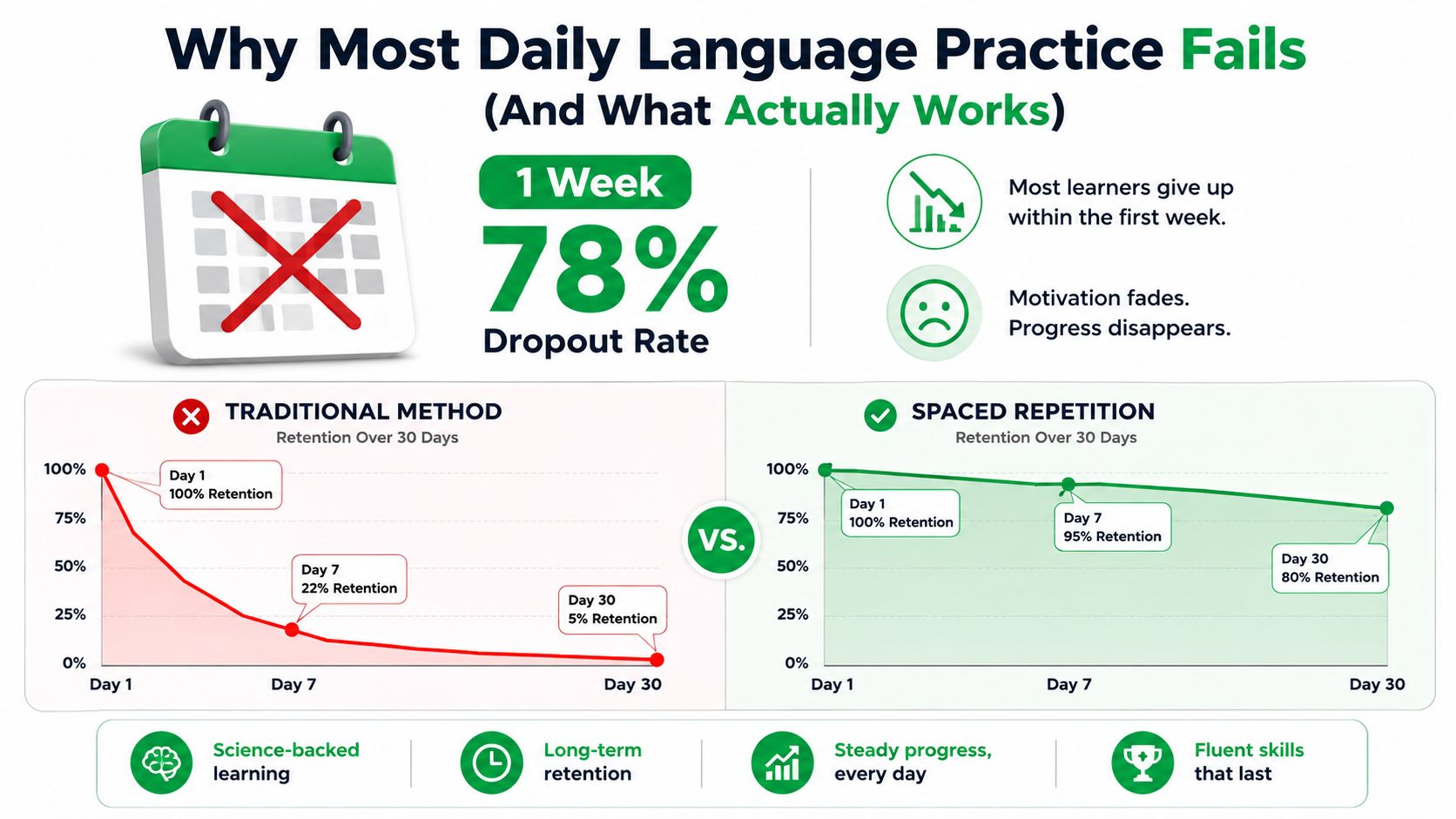
Only about 10% of 9,000 learners came back the next day, and roughly 1 in 6 did anything in the first week after day zero, which is a blunt reminder that daily language practice fails when it relies on goodwill alone rather than habit design (daily speaking practice data). The same dataset showed that learners who reached 20 to 49 conversation turns on day one returned within a week at 39.9%, compared with 8.1% for those who stopped after 1 to 4 turns. That gap changes the whole conversation for Irish learners, because the first day isn't about proving fluency, it's about creating a routine your brain is willing to repeat.

Learners don't quit because they hate languages. They quit because their practice plan is too heavy, too passive, or too easy to postpone. Short, active, repeated speaking sessions fit what cognitive science says about retention and habit formation, and they also match what real learners sustain over time. If you want Irish to stick, you need a routine that makes speaking feel normal on ordinary days, not heroic on rare good ones.

Table of Contents

Why Most Daily Language Practice Fails (And What Works Instead)

The hard truth is that most learners do not lose interest first, they lose momentum. In a large 2026 learner analysis, only about 10% returned the next day, and only about 1 in 6 did anything in the first week after day zero (daily speaking practice data). That pattern shows a design problem, not a motivation problem.

A comparison chart showing traditional language learning methods failing compared to effective spaced repetition techniques.

The first day matters more than the streak

The strongest signal in the data is not streak length, it is depth on day one. Learners who reached 20+ conversational exchanges on day one came back within a week at 39.9%, while those who stopped after 1 to 4 turns returned at just 8.1% (daily speaking practice data). For Irish learners, that gap matters because the first session is where the habit gets its shape. If day one is thin and passive, day two feels optional. If day one includes real back-and-forth, the next session feels like a return, not a fresh start.

That is why a short session can still fail. Ten quiet minutes spent arranging notes, tapping through menus, or waiting to feel ready does not build the same memory trace as active speaking. The learner finishes the session, but the brain has little to come back to.

Practical rule: if the first session feels too easy, it usually will not survive day three.

A simple daily check-in also correlated with 32.9% week-one return and 23.6% in weeks 2 to 4, which is about 2 to 3 times baseline (daily speaking practice data). That fits what experienced teachers see in real classrooms. The learners who return are usually the ones who can begin quickly, speak early, and finish with a clear next step.

Short practice beats cramming

Independent guidance grounded in spaced-practice research points to 15 to 30 minutes of daily study as more effective than 3-hour weekly marathon sessions, and even 10 to 15 minutes a day can be enough to maintain progress and habit formation (minutes per day guidance; effective language study routines). The reason is simple. Memory strengthens through repeated retrieval, not through one long block of exposure.

For Irish, that means daily language practice should behave like brushing your teeth, not like preparing for an exam. You want a routine that fits an ordinary evening, a crowded morning, or a day when your energy is low. The better plan is active speaking, review, and correction in small doses, because those are the parts learners can repeat.

Building Your Daily Irish Practice Routine

A good Irish routine doesn't need to be dramatic. It needs to be specific enough that you know what to do when you're tired, busy, or half paying attention. The best routines also change by energy level, because an exhausted day and a free evening are not the same learning problem.

A graphic illustration detailing a daily Irish language study plan, broken into three time-based practice segments.

Three routines that cover most real life

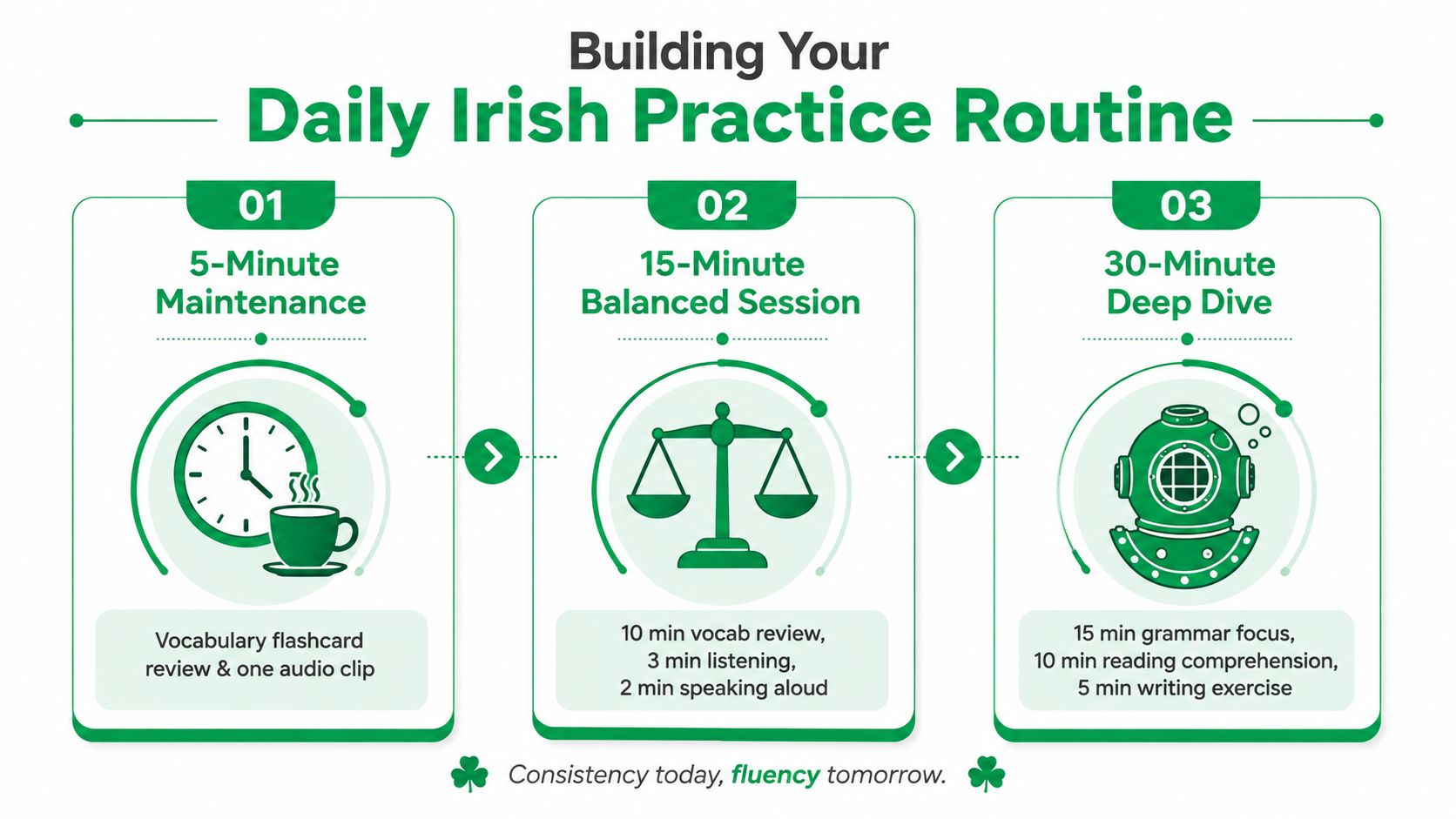
A 5-minute maintenance routine works on overloaded days. Use 3 minutes for flashcards in small sets, then 2 minutes to listen to one short audio clip and repeat one line aloud. The point is to keep contact with the language, not to force progress when your head's elsewhere.

A 15-minute balanced session suits most weekdays. Spend 5 minutes reviewing known words, 5 minutes listening or reading something short, and 5 minutes speaking aloud from prompts or a scenario. That mix keeps the session active without feeling like a second job.

A 30-minute deep practice session is for days when you've got room to think. Use 10 minutes for new vocabulary or grammar, 10 minutes for reading or listening at the right challenge level, and 10 minutes for speaking or writing from memory. The key is that each segment builds on the last one, instead of scattering your attention.

Here's a useful comparison for planning.

Duration Activities Best For
5 minutes Flashcard review, one short audio clip, one spoken sentence Survival on busy days
15 minutes Review, listening, speaking aloud Steady habit building
30 minutes New material, comprehension, production Faster progress and deeper recall

Make the week rotate, not repeat

If every day looks identical, boredom creeps in. A better weekly pattern is to keep the routine length stable while rotating focus. One day can lean toward vocabulary, the next toward listening, then speaking, then review.

For conversation practice, it helps to use real world conversation strategies rather than isolated sentence drilling, because Irish needs to feel useful in ordinary life, not only in a notebook. A practical guide to that mindset is real world conversation strategies, especially the parts on active engagement and speaking under pressure.

Useful anchor: review the same small set of words several times before you try to expand it.

If you want a simple structure for spaced review, keep your first round small and revisit it soon after. The spaced repetition guide for Gaeilgeoir users fits neatly into that rhythm, because it keeps review compact instead of letting it sprawl.

Using AI Tools to Maximize Your Practice Sessions

AI works best when it removes the awkward parts of practice. It gives you something to answer, something to correct, and something to repeat without waiting for a partner to be free. That matters for Irish learners who need speaking opportunities but don't always have access to them in daily life.

Use each feature for a different job

When you need vocabulary support, click-to-translate is useful because it keeps you inside the conversation instead of sending you off to a separate dictionary hunt. Save the word, read it in context, and come back to it later, because vocabulary sticks better when you meet it in a sentence rather than as a lonely list item.

Scenario-based practice is where confidence grows. If you can rehearse greetings, asking for directions, ordering food, or making small talk in a controlled setting, the same words feel less fragile in real life. The practice is still simple, but it's anchored in situations learners face.

Adaptive quizzes with instant feedback are the right place for correction. They're not glamorous, but they stop errors from hardening into habits. If your pronunciation or word choice is off, immediate correction gives you a second attempt while the mistake is still fresh.

For pronunciation support and voice practice, a helpful companion reference is AI chat with voice guide, especially if you want to see how spoken exchanges can feel more natural in a digital setting. Used well, voice practice turns hesitation into repetition.

Match the tool to your level

Beginners need fewer moving parts. Start with short guided conversations, quick translations, and simple prompts you can answer without freezing. Intermediate learners can handle longer scenario chains, more correction, and more recall from memory.

The internal practice library at Gaeilgeoir AI tutors fits that progression because it pairs guided conversation with instant feedback instead of asking you to improvise too early. In a daily language practice routine, that kind of structure reduces the friction that usually breaks consistency.

One thing to avoid is using AI as a passive chat window. If you only read responses, you're not building spoken recall. Make yourself answer aloud first, then check, correct, and repeat.

Gamification and Motivation Strategies That Stick

Motivation is unstable, so good habits need better scaffolding than enthusiasm. Points, streaks, and visible progress work because they give the brain a clear reason to return, especially on days when the language itself doesn't feel urgent. That's not childish, it's practical.

Reward the act of showing up

A streak is useful only if it lowers the odds of skipping tomorrow. The learner data above already showed that a daily check-in correlated with stronger return rates, which lines up with the basic psychology of consistency. If you log practice every day, even briefly, the habit starts to feel real.

Micro-goals help because they make success visible. Finish one review set. Complete one speaking prompt. Revisit one old phrase. The win has to be small enough that you can repeat it on an ordinary Tuesday, not just on a motivated Sunday.

Don't reward perfection. Reward return.

That matters after a missed day too. The fast way back is to do one tiny session the next day, not to punish yourself with a “catch-up” marathon. People often drop the habit after a gap because they think the streak is broken, but the actual loss is the silence that follows.

Track the right signal

A streak counter is useful, but it isn't the only measure that matters. Track whether you spoke, whether you reviewed, and whether you used the language on a day you wouldn't have otherwise. Those are the behaviors that build the habit underneath the habit.

If you like social accountability, share the goal with someone who won't overcomplicate it. You don't need a crowd. You need one person who notices when you show up and doesn't turn one missed day into a lecture.

Overcoming Real-World Practice Obstacles

Real life doesn't care about your study plan. Shifts run late, kids get sick, energy disappears, and the day gets away from you. The wrong response is to treat that as failure. The better response is to have a smaller version of the habit ready for exactly those days.

A chart showing four common real-world language practice obstacles and their corresponding digital learning solutions.

What to do when the day goes sideways

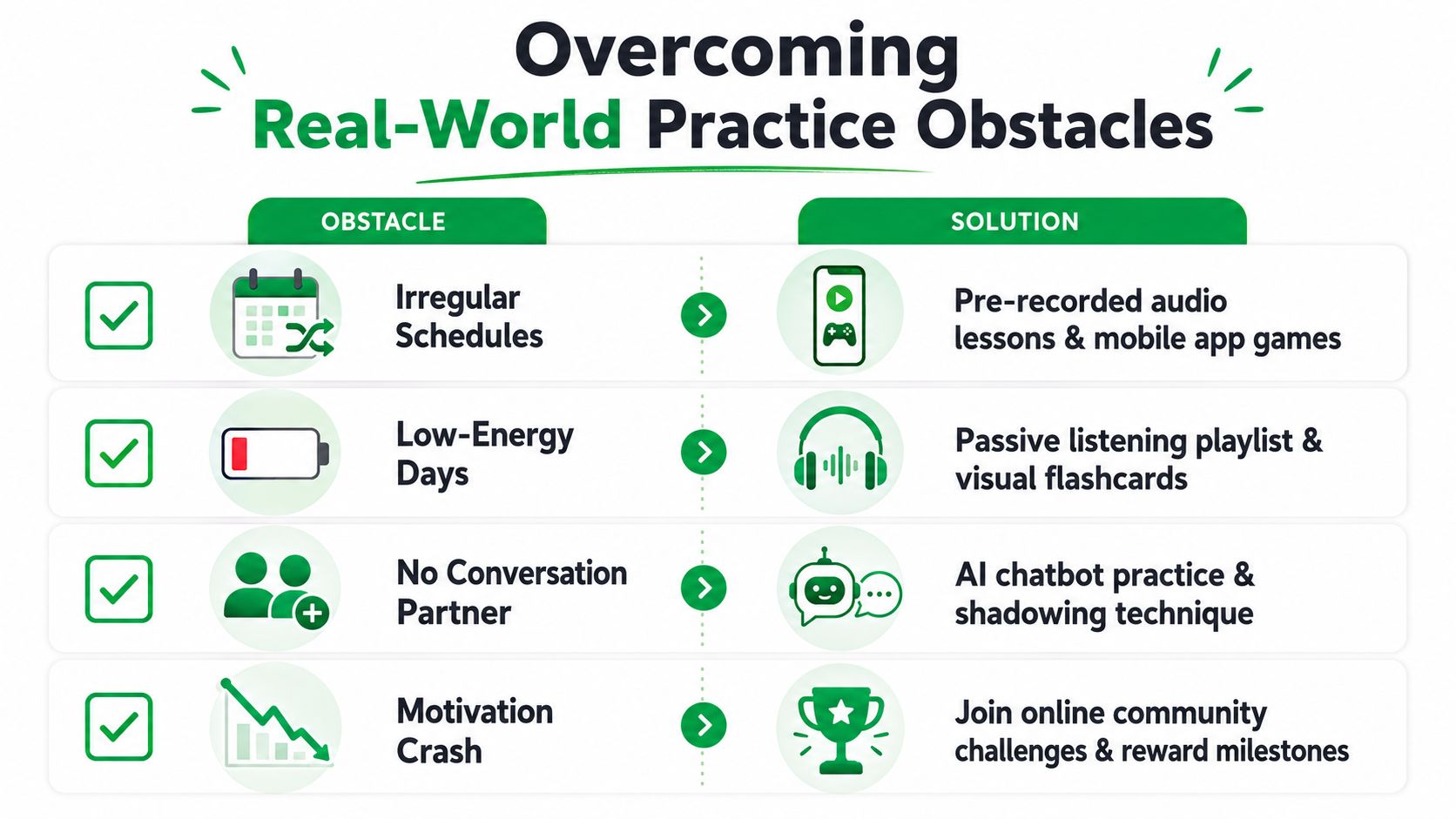
If your schedule is irregular, stop trying to assign practice to one perfect time slot. Tie it to a stable anchor instead, like coffee, lunch, or the last thing you do before bed. That way, the habit survives even when the clock doesn't cooperate.

On low-energy days, use maintenance practice. Listen, repeat one line, review a tiny set of words, and leave it there. Maintenance keeps the language warm without demanding full concentration, which is exactly what tired learners need.

If you don't have a conversation partner, don't wait for one. Use AI conversation practice, shadowing, and short spoken responses to create output anyway. The goal is not to mimic a perfect classroom setup, it's to keep your mouth working in Irish every day.

For learners who deal with anxiety around speaking, the language learning anxiety guide is worth reading because it addresses the mental block that often shows up right before practice starts.

Maintenance practice and progress practice are different

Maintenance practice protects the habit. Progress practice stretches it. Both matter, but they serve different days.

When life is crowded, maintenance is enough. When you've got room, add new material, longer speaking, and harder review. That distinction keeps you from burning out by trying to make every session count the same way.

If you're rebuilding after a break, don't ask for perfection on day one. Ask for contact. One short session creates the next one, and that's how momentum returns.

Daily Practice Strategies for Leaving Cert Exam Prep

Leaving Cert Irish oral prep works best when the practice mirrors the exam without becoming exam-shaped all the time. You need fluency, but you also need enough repetition that common topics don't blank your mind under pressure. Daily work should make those topics feel ordinary.

Build the answer before you build the script

Spend 20 to 30 minutes on a focused daily session, with one part for theme vocabulary, one part for oral responses, and one part for speaking under pressure. Keep the topics close to the exam, such as family, school, hobbies, local area, future plans, and current routine. That way, your daily language practice reinforces what you're most likely to need.

A useful method for learners who freeze at the start is to reduce task paralysis before the session begins. The advice in how to overcome task paralysis maps neatly here, because oral prep often fails at the starting line rather than halfway through.

Practice like someone will ask follow-up questions

Don't stop at memorised answers. Say your answer once, then answer it again in a slightly different way, because examiners can steer the conversation in directions you didn't plan for. That second version matters more than polishing a perfect script.

Use self-check questions after each response. Did you speak clearly. Did you stay on topic. Did you use enough detail to avoid sounding like a list. Those checks are simple, but they train the habits that matter in the room.

If you're short on time, use one daily prompt and recycle it across several days. Familiarity lowers panic, and panic is often the obstacle in oral prep.

Your Personalized Daily Irish Practice Action Plan

A first session that goes well is usually small, specific, and spoken. One learner may only manage a few short turns, another may complete a longer exchange, but the point is the same, get Irish out of the notebook and into your mouth on day one. If you wait until you feel ready, the habit often stays theoretical.

Choose a routine that matches your real week, then give it a shape that is hard to misunderstand. The 5-minute routine works well for a true beginner who needs a clear starting line. The 15-minute routine suits someone returning to Irish who wants structure without too much load. The 30-minute routine helps if you already have some stamina and need enough time for a proper spoken cycle. A flowchart showing a personalized daily Irish language practice plan with options for five, fifteen, or thirty minutes.

Plan the first week before you start. Day 1 can be a self-introduction using An lá atá inniu ann, with your name, where you are from, and one thing you are doing today. Day 2 can focus on family. Day 3 can cover school or work. Day 4 can be hobbies. Day 5 can be the weather and the time of day. Day 6 can be your local area. Day 7 can return to the self-introduction and compare it with Day 1. That repetition matters because the first week is where many learners discover whether the topic is too broad, too hard, or just right.

Keep the routine simple enough that you can repeat it on a tired day. A useful first-week pattern is speaking first, then correcting one mistake, then saying the same answer again with that correction built in. For example, if you say Tá mé ag déanamh mo dhícheall and your pronunciation of the ending feels unclear, repeat the sentence slowly, then once more at normal speed. That gives the brain one clear target instead of a pile of notes.

Use a short checklist instead of a full tracking sheet.

  • Did I speak Irish today?
  • Did I stay with one topic?
  • Did I repeat one answer after correction?
  • Did I leave with one phrase I can reuse tomorrow?

If you are coming back to Irish after a long break, this kind of checklist helps you see progress without turning practice into paperwork. If you are starting from zero, it also stops the common mistake of collecting ideas faster than you can use them. The goal is not a perfect record. The goal is to notice whether today's session gave you one better sentence than yesterday.

A learner who has a rough first week should not abandon the plan. Short sessions often fail for practical reasons, not because the method is wrong. The topic may have been too wide, the speaking target too ambitious, or the session may have started with reading instead of speaking. Tighten one part, keep the rest the same, and try again tomorrow.

That is usually enough for the first stretch. If the routine survives a week, it becomes much easier to keep it going when motivation drops and life gets busy.

Pronunciation Practice Online: A Guide for Irish Learners

You can know the grammar, remember the vocabulary, and still freeze the moment you have to speak. That's a familiar place for Irish learners, especially when a teacher, examiner, or conversation partner hears the words, but still asks you to repeat them. The problem usually isn't effort, it's pronunciation practice online that doesn't focus on the sounds and patterns that carry meaning in real speech.

The good news is that online practice can close that gap when it is structured properly. Short, focused speaking sessions, clear feedback, and repeated correction can move pronunciation from theory into habit, which matters for learners returning to Irish, beginners building confidence, and students preparing for oral exams. A 2024 study on online pronunciation tutors found that 80% of learners used online pronunciation platforms regularly and 85% rated them effective or very effective, while 60% showed significant improvement after four weeks of guided practice, especially on difficult phonemes such as /θ/ and /ð/, a useful benchmark for what consistent practice can do in a month rather than over a vague long-term horizon (study on online pronunciation tutors).

Table of Contents

Why Online Pronunciation Practice Works for Irish Learners

You may know exactly what you want to say, then still see the listener lean in and ask for it again. That moment is frustrating because the problem is often narrow, one vowel, one consonant, or a stress pattern that blurs the message. Pronunciation practice online helps you isolate those weak points and test them quickly, instead of leaving you to guess what went wrong.

From knowing words to being understood

A learner can know grammar and vocabulary well enough, yet still be hard to follow if the sounds are not clear. Pronunciation belongs in speaking practice, but it needs its own method, because people do not usually hear their own errors clearly enough to correct them in the moment. Online practice changes that by letting you record, replay, and refine your speech in a short cycle.

That matters for Irish learners who need speech that works in real conversations, not just textbook knowledge. Cambridge's pronunciation activity library is organised by skill and level, which shows that online pronunciation work is often matched to learner stage rather than presented as one generic lesson stream (Cambridge English learner activities). British Council guidance recommends choosing two or three pronunciation areas at a time, then working on them until they feel natural before adding more, which is a far steadier path than trying to fix every sound at once (British Council pronunciation advice).

Practical rule: if a short answer is hard to understand, do not start by chasing a full accent change. Start with the sound that most affects meaning.

Why digital feedback helps faster

Online systems work best when the correction comes back immediately. Many pronunciation tools use a record, analyse, review, and re-record loop, which mirrors the move from tutor-only correction toward self-paced feedback. ScreenApp's pronunciation checker describes that cycle directly, recording speech, analysing sounds, stress, and intonation, then offering feedback before the learner tries again (ScreenApp pronunciation checker).

That repeated loop is especially useful for heritage learners who may already know many Irish words but still carry older pronunciation habits that need reshaping. It also suits oral exam preparation, because exam confidence grows when you can rehearse the same speaking task in a low-pressure setting, then tighten the weak spots before the next attempt.

The Core Mechanics of Effective Pronunciation Drills

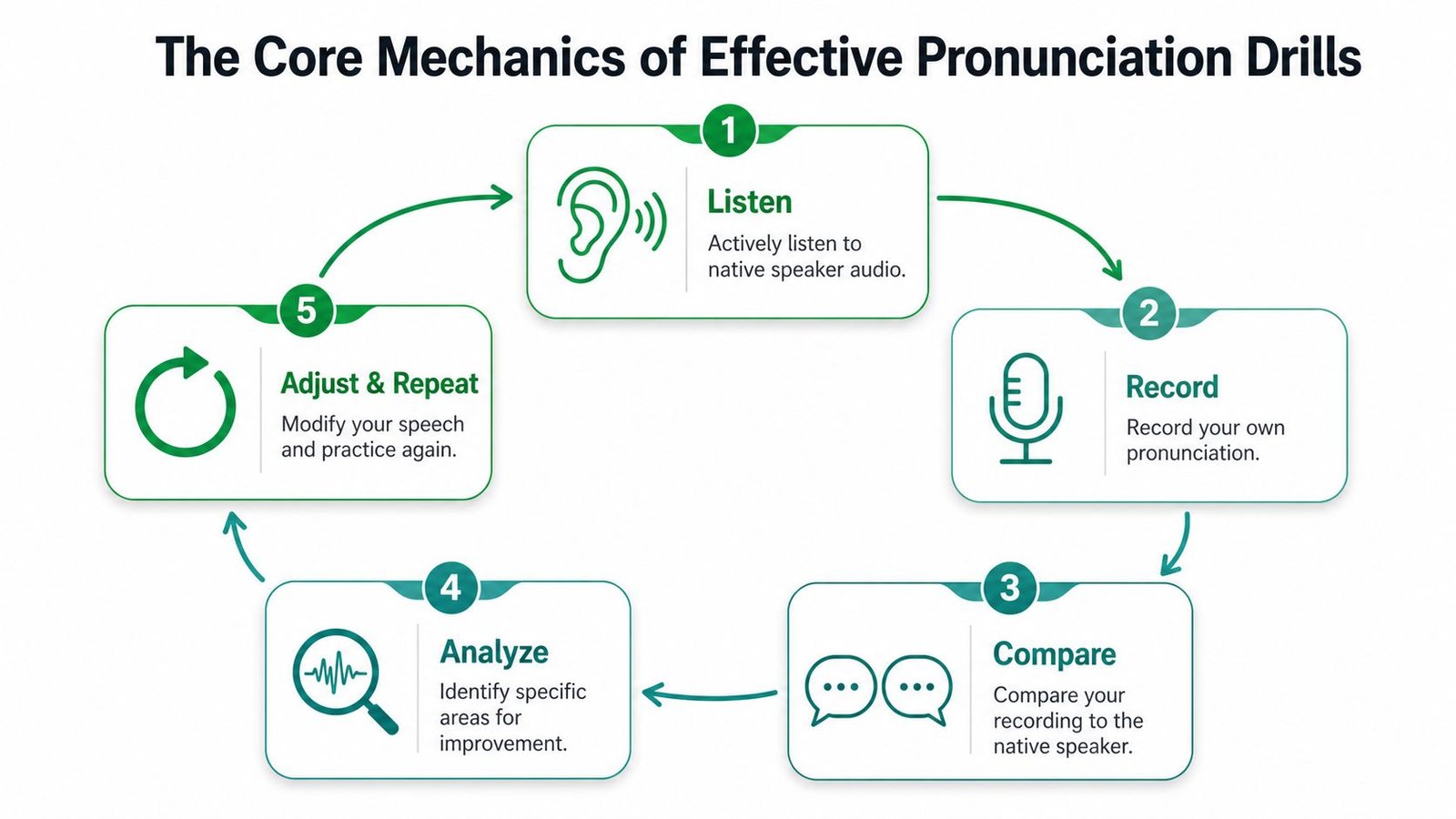
A learner sitting with headphones on can still make very little progress if the practice stays passive. Pronunciation improves when the loop is tight, hear the model, produce a version yourself, compare the two, then adjust the next attempt. Short, focused repetitions give the ear a clearer contrast and give the mouth enough chances to form the new movement.

A diagram illustrating the five core steps of effective pronunciation practice: listen, record, compare, analyze, and adjust.

What the five-step loop looks like

The sequence is straightforward. You listen to a model, record your own speech, compare the two, analyze the difference, then adjust and repeat. That structure helps because it gives you something specific to react to, instead of a vague feeling that your pronunciation is “off.”

Computer-assisted pronunciation training has shown a medium-to-large overall benefit for pronunciation learning, and one meta-analysis reported an effect size of d = 0.68 (CAPT meta-analysis). That review also found benefits for both younger and adult learners, with stronger gains for beginner and intermediate learners than for advanced learners. In practice, that fits what tutors see every day, because early learners usually need clearer correction on basic sound contrasts, while advanced learners need finer listening and more speaking in context.

What to focus on first

Start with a narrow target. A limited set of segmental features is easier to hear, easier to repeat, and easier to correct than a broad “sound better” goal. The CAPT evidence also points to explicit corrective feedback, segmental focus, and medium-to-long treatment duration as stronger choices than indirect feedback, suprasegmental-only work, or short exposure.

Practical rule: one clean correction repeated well beats ten different corrections that never stick.

Many learners rush toward rhythm or “sounding native” before the core sounds are steady. That order often creates frustration, because the sounds that block understanding stay in place while the learner works on style. Segmental accuracy comes first for communicative intelligibility, then stress and intonation can be trained with better results.

For Irish learners, this matters in a particular way. Heritage speakers may already have a large vocabulary and strong listening familiarity, but still need careful feedback on sound distinctions that have settled into family speech habits. Oral exam preparation needs the same kind of focus, because the goal is not just to sound pleasant, it is to make each word clear under pressure.

Why repetition beats random practice

Controlled repetition works better than scattered exposure. A learner tries a sound, gets a cue, tries again, and the brain starts linking the mouth movement with the correct acoustic result. One focused session can do more than a long stretch of unfocused listening because the correction stays active in memory.

There is also a simple reason this helps in oral exam work. Repeated practice lets you stabilise one correction before moving to the next task, which is much closer to how real speaking improves than trying to fix everything at once. In a lesson room or on a screen, the same pattern keeps appearing, hear, adjust, try again, until the sound becomes dependable enough to use in actual speech.

Building Your Daily Pronunciation Practice Routine

A workable routine has to be small enough that you can repeat it tomorrow without dreading it. That is usually what separates useful pronunciation practice from vague review. Fifteen minutes can be enough if you give one sound a clear target, speak out loud, and stay active from start to finish. The Preply pronunciation practice guide makes the same point in a practical way, with short daily habits such as vowel work, holding a vowel long enough to hear it, and checking mouth shape in a mirror.

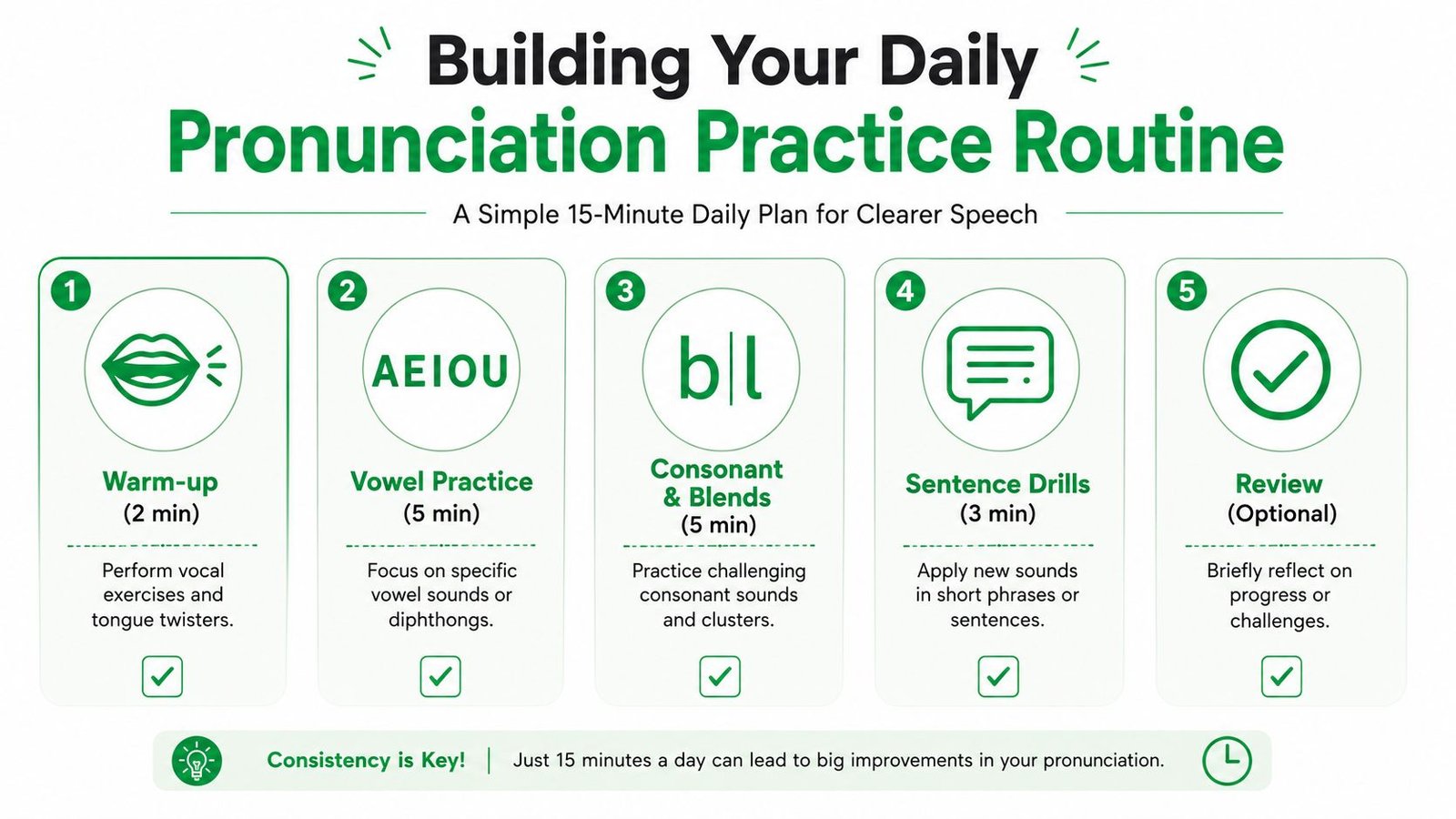
A five-step daily pronunciation practice routine infographic showing a 15-minute plan for clearer speech improvement.

A fifteen-minute structure that stays realistic

Start with two minutes of warm-up. Loosen the jaw, read a short line aloud, or run through a brief tongue-twister so the mouth is already moving before the harder work begins. Then spend five minutes on one vowel or diphthong. Watch how the lips and jaw move, because copying a sound in your head is not the same as shaping it with the mouth.

Use the next five minutes for consonants and blends. Minimal-pair practice is useful here, especially for sounds that tend to merge in fast speech. If a sound is hard to hear clearly, slow the model to 0.75x or 0.5x speed, then compare it with your own recording. That kind of close listening is often the fastest way to notice whether the problem sits in the sound itself, the stress pattern, or the way the word is linked to the next one.

A final three minutes should go to sentence drills. Read a short phrase, record it, and listen back once without editing the result in your head. If you want a starting point for shaping the day's work, the daily Irish practice plan gives a sensible rhythm for combining speaking and review, and the structure can also sit alongside the use of AI language tutors when you want feedback between lessons.

How to rotate focus without overload

Keep to two or three pronunciation targets at a time. That keeps the ear and mouth focused. One day can centre on a vowel, a consonant contrast, and a short sentence pattern. The next day can keep the vowel and change the consonant set, so the work builds on what you already corrected instead of starting again from zero.

A simple weekly rotation can look like this:

  • Monday: one vowel contrast, one tricky consonant, one short sentence
  • Tuesday: repeat the same vowel, add connected speech in a short phrase
  • Wednesday: minimal pairs and one recorded self-check
  • Thursday: slow playback at 0.75x and correction
  • Friday: sentence-level shadowing and review
  • Weekend: light recap, then rest

Keep the routine short enough that you'll finish it on a tired day, because the routine that survives busy weeks is the one that changes speech.

For learners preparing for exams, the sentence stage is where confidence starts to grow. For heritage learners, it is where old habits start to loosen, because the work moves from isolated sounds into real speech. Oral exam preparation also needs a different kind of feedback from generic drills. A learner may produce a sound correctly in isolation and still lose clarity under pressure, so the routine has to test the sound inside phrases, not only on its own. That is the gap the daily plan is meant to close.

Why this format sticks

The body remembers repeated motor patterns better than occasional intense effort. A steady fifteen-minute routine usually does more than a long session that appears only once in a while. The exact sounds will differ from learner to learner, but the shape of the practice should stay the same. Use one narrow focus, record your voice, listen back quickly, and make the next attempt with the correction still fresh.

Choosing the Right AI Pronunciation Tools for Irish

A learner can spend time on a pronunciation app and still finish the session unsure what changed. The score looked tidy, the practice felt active, and the speech in real conversation still sounded unclear. For Irish learners, the better test is simpler: does the tool improve communicative intelligibility, or does it only produce a polished rating?

What to look for in a tool

A useful pronunciation platform should tell you what to change, not only that something was wrong. The feedback needs to point to a specific vowel, consonant, stress pattern, or connected speech problem, then let you try again straight away. If a system only gives a score, it may help motivation, but it does very little for correction.

That distinction matters for multilingual learners and heritage learners, because feedback can behave differently depending on first-language habits and long-set patterns of speech. Some systems promise instant scoring or model matching, yet they do not explain how they handle those cases. The wider market shows the same gap, with many tools still presented as accent or pronunciation training without much clarity on scoring validity or learner fit, as noted in the PronounceLive overview of the market gap.

If you want a more structured route into speaking feedback, the AI language tutors at Gaeilgeoir AI are a useful example of how pronunciation support can be tied to learner response rather than treated as a standalone rating exercise. That matters because Irish learners often need to hear exactly where clarity breaks down, not just whether a model approves of the attempt.

Comparing generic tools with Irish-focused practice

A general English pronunciation app can still be useful for practice structure, but it will not always answer the questions Irish learners have. Does it catch vowel length issues, connected speech problems, or the gap between a sound that works in isolation and a sound that holds up in conversation? Those are the details that matter when you need to be understood by a tutor, examiner, or community speaker.

A helpful comparison point is a language learning app with RapidNative, which shows how modern speaking tools often place pronunciation inside broader language learning rather than treating it as a separate accent drill. That kind of setup can be helpful, but the core question is still feedback quality, not presentation.

If you are trying Gaeilgeoir AI as part of your routine, check whether it gives immediate correction, whether the speaking task feels close to a real exchange, and whether you can re-record after hearing the feedback. Compare your own output with a model, too. That comparison turns “I got a score” into “I know what to adjust,” which is the shift that matters before an oral exam or a real conversation.

A simple test before you commit

Start with one short phrase, then move to one sentence, then give one unscripted response. If the platform improves all three, it is helping transfer. If it only improves the scripted line, it may be rewarding repetition more than actual pronunciation growth.

Prioritizing Intelligibility Over Accent Perfection

A lot of pronunciation advice still treats sounding native-like as the goal. That sets up the wrong target for most Irish learners, because the core question isn't whether your speech sounds polished in every detail, it's whether people understand you quickly and naturally. The strongest practice plan starts by asking which errors block comprehension.

What matters most in real conversation

Sound-by-sound drills can be useful, but they're not the whole picture. Mainstream resources such as Cambridge and BBC Learning English put heavy emphasis on specific sounds, stress, and exercises, which is helpful for building awareness, but they don't fully answer the learner's central question, which errors most affect being understood? That gap matters because pronunciation research and teaching guidance increasingly separate accent reduction from intelligibility.

If the listener understands you, the pronunciation job is working, even if your accent remains clearly yours.

For beginners, this usually means focusing first on the sounds that cause breakdowns, rather than trying to remove every trace of an original accent. For heritage learners, that means protecting an authentic voice while tightening the pronunciations that create confusion in community settings. The goal is not imitation, it's communication.

How to choose your priorities

Start with one of three categories. First, the problem sounds that regularly get misunderstood. Second, stress and rhythm when they change meaning or make speech hard to follow. Third, a small set of phrases that come up constantly in your speaking life, so the improvements transfer into real conversations.

That order helps because it saves time. You don't need to solve every pronunciation issue before speaking, and you don't need a native-like accent to sound clear. You need the parts of pronunciation that carry the biggest communicative load, then enough repetition to make them automatic.

This is also where self-study can go wrong. If every practice session becomes an accent chase, learners often lose confidence and stop speaking. If the session focuses on intelligibility, the feedback feels more practical, and progress is easier to notice in daily conversation.

Leaving Cert Oral Exam Preparation Strategies

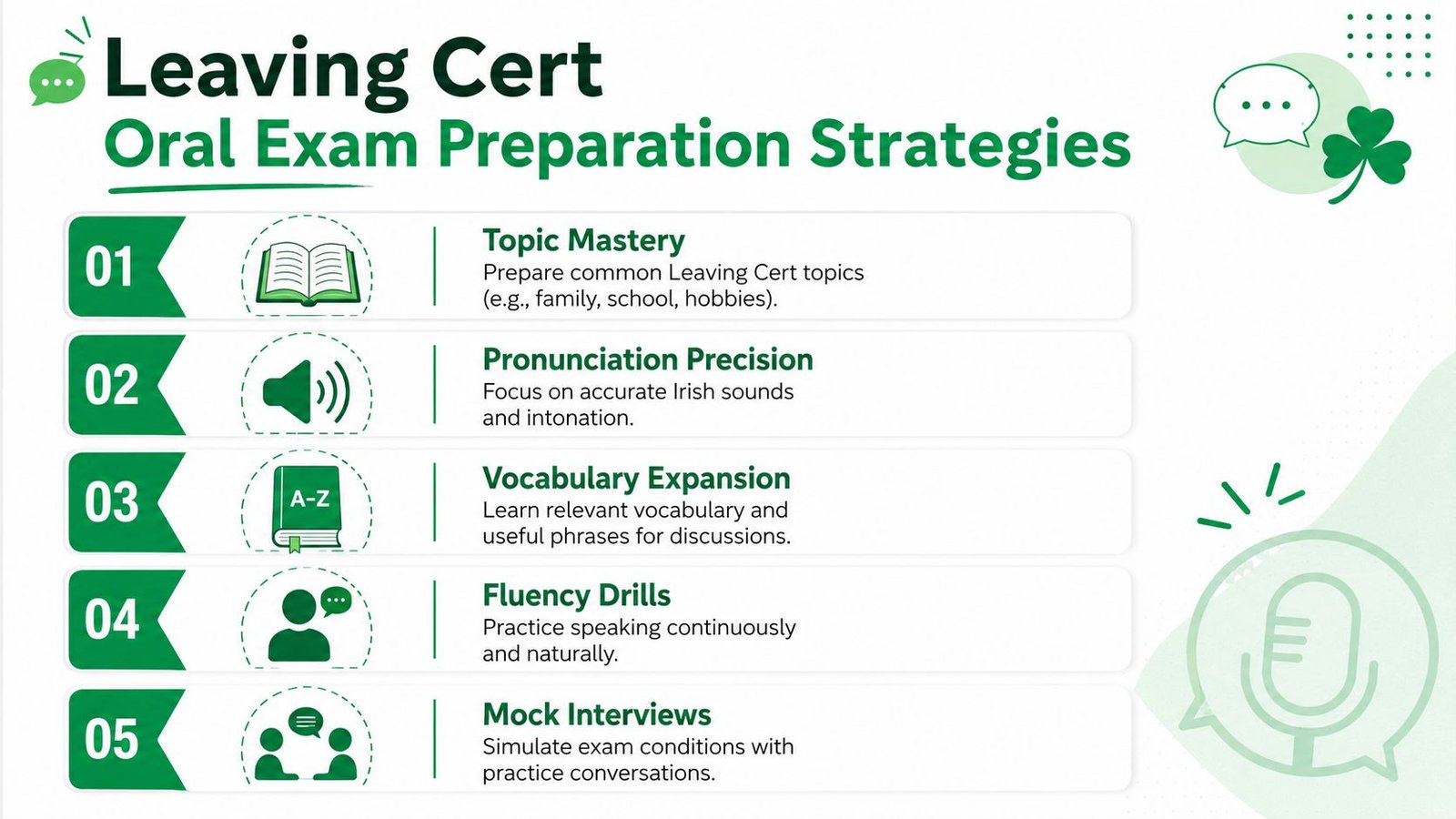
The Leaving Cert oral exam rewards clear, flexible speaking, not just memorized lines. Students who prepare only general pronunciation often struggle when the examiner moves the conversation in an unexpected direction or asks the same topic in a different way. The smarter move is to combine pronunciation work with exam-style content, so the speech pattern and the topic knowledge grow together.

An infographic titled Leaving Cert Oral Exam Preparation Strategies featuring five numbered steps for exam success.

Prepare the exam shape, not just the answers

The oral exam usually moves through familiar territory, then shifts into follow-up questions. Practicing only one polished answer leaves you exposed when the examiner changes the angle. A better approach is to rehearse common topics, then answer them in slightly different forms, so your mouth and mind learn to stay steady under pressure.

Here's a practical topic checklist:

  • Family and home: describe people, routines, and relationships clearly
  • School and subjects: explain what you study and why
  • Hobbies and sport: speak in full sentences, not single-word replies
  • Holidays and travel: keep the story moving with time markers
  • Current events: use simple opinions and short reasons
  • Social issues: practice calm, clear phrasing
  • Pictures: describe what you see before you interpret it
  • Stories: keep sequence words ready
  • Future plans: use confident, simple structures
  • Part-time work: speak about responsibility and routine
  • Technology: explain habits and preferences
  • Music: give examples and reasons
  • Sporting events: describe what happened, not just what you liked
  • Town or area: name places and directions
  • Health and lifestyle: keep vocabulary practical
  • Weather: use it as a conversation bridge
  • Food and cooking: rehearse ingredients and actions
  • Irish culture: know a few personal examples
  • Friends and social life: sound natural, not over-scripted
  • Unexpected questions: practice staying calm when you need a second

The dedicated Leaving Cert preparation mode inside Gaeilgeoir AI is designed for this kind of work, because it lets you rehearse typical Irish oral exam topics in a speaking format rather than only reading notes. For fillers and hesitation management, the filler phrases guide for the oral Irish exam can help you keep the flow when you lose a word.

How to handle nerves and lost words

Keep your answers slightly flexible. If you forget a word, move around it with a simpler phrase instead of stopping the sentence completely. That matters more than sounding perfect, because oral examiners respond well to continuity and clarity.

Time management also helps. If you spend too long on the opening answer, you'll rush later. Practice with a timer, answer aloud, and leave a little space for follow-up questions so the exam feels more familiar on the day.

Troubleshooting Common Pronunciation Plateaus

Progress rarely moves in a straight line. You can sound better one week, then feel stuck the next, even when you're still practicing. That usually means the problem is not lack of effort, it's that the next barrier is different from the last one.

When the issue is perception

Sometimes you can't hear the difference between your version and the target sound. In that case, no amount of repetition will fully solve the problem, because the ear needs training before the mouth can copy anything accurately. Slow playback, contrastive listening, and minimal pairs are the right tools here, because they sharpen your perception before you try to produce the sound again.

When the issue is production

Other times you can hear the difference, but your mouth keeps defaulting to the old habit. That usually calls for slower, more deliberate speech, a mirror for mouth shape, and short re-recording loops. If a sound works in isolation but falls apart in connected speech, the fix is to practice it inside phrases, not to keep drilling it alone.

When correction isn't sticking, change the unit of practice, not just the volume of practice.

If you've reached a plateau and want a cleaner feedback loop, use AI for repetition and then bring in a tutor or conversation partner for human judgment. The human listener catches whether the speech feels natural in real interaction, while the tool helps you isolate the sound that keeps slipping. That combination is usually stronger than either one by itself.


Gaeilgeoir AI gives Irish learners guided speaking practice, pronunciation feedback, and exam-focused oral preparation in one place, so you can work on clarity without guessing what to fix next. If you want a practical way to build better pronunciation habits and rehearse real Irish conversations, visit Gaeilgeoir AI and start with a speaking routine that fits your day.

AI Language Tutors: How They Work and How to Choose One

If you've ever opened an Irish lesson, understood the words, and then gone completely blank the moment you had to speak, you're in the right place. That freeze is normal. It's also the exact gap that AI language tutors are trying to close, especially for learners who need more speaking time than a classroom, workbook, or flashcard app can give them.

The promise sounds simple, maybe even a little too simple, unlimited practice, instant feedback, and no fear of judgment. More useful when you look at the details. The strongest tools aren't magical conversation machines, they're systems that help you rehearse real speech, recover from mistakes, and build enough confidence to try again tomorrow.

Table of Contents

Why AI Language Tutors Are Changing How We Learn

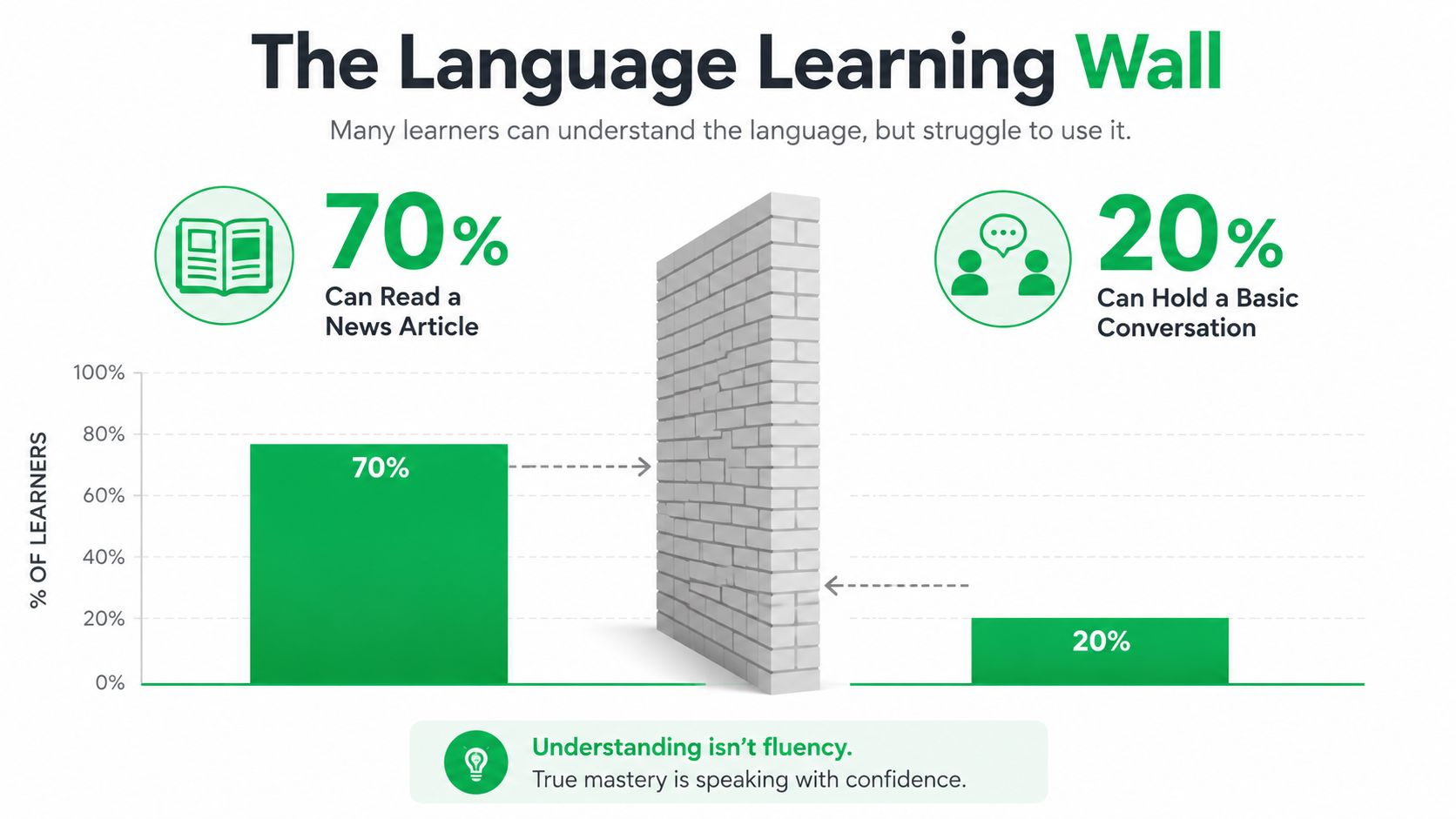
You can read a page of Irish and feel proud, then hear a simple question and suddenly your mind goes quiet. That gap is familiar to many learners, especially adults who have studied on and off for years and can recognize words without being able to produce them under pressure. AI language tutors matter because they give learners a place to rehearse speech before the stakes feel real.

An infographic titled The Language Learning Wall showing that 70% can read, while only 20% can speak.

Market forecasts help explain why this shift is happening. One major estimate places the AI tutors market at USD 3.55 billion in 2025 and projects USD 6.45 billion by 2030, while another projects USD 17.7 billion by 2033 (Mordor Intelligence). That growth helps show why language learning is no longer treated as a novelty. The same market study says language learning is the fastest-growing subject segment, and cloud deployment held 71.22% share in 2024, which fits the way many learners now expect to practice, on a phone, in a browser, whenever they have a few minutes.

The Importance of Active Speaking Practice

The strongest AI tutors do more than drill vocabulary. They let learners practice the messy middle of speaking, where the idea is there but the sentence is still forming. That is the part many people need most, because knowing a word is not the same as using it in real time. Tools that feel conversational tend to keep learners engaged because they support confidence, not just recall.

Adoption data points in the same direction. Duolingo is projected to report 12.5 million paid subscribers at the end of Q1 2026, up 21% year over year, and projected revenue of USD 1,037.6 million in FY2025, a 39% increase over FY2024 (LingoBright). Broader industry summaries also report 500 million learners globally using AI tutors in 2025, and AI-powered language-learning platforms with 2.3 million monthly active users growing 40% year over year (LingoBright). The products differ, but the pattern is consistent, learners want more speaking time than traditional apps usually provide.

Practical rule: if a tool only helps you recognize words, it is a study aid. If it helps you answer out loud, it starts acting like a speaking coach.

For Irish learners, that distinction matters. Grammar tables help you understand the language, but confidence comes from using it in the situations you face, greeting someone, ordering food, asking for directions, or handling an oral exam prompt. In Irish, the jump from recognition to speech can feel especially wide, so tools that create low-pressure speaking practice fill a real gap.

How AI Language Tutors Actually Work

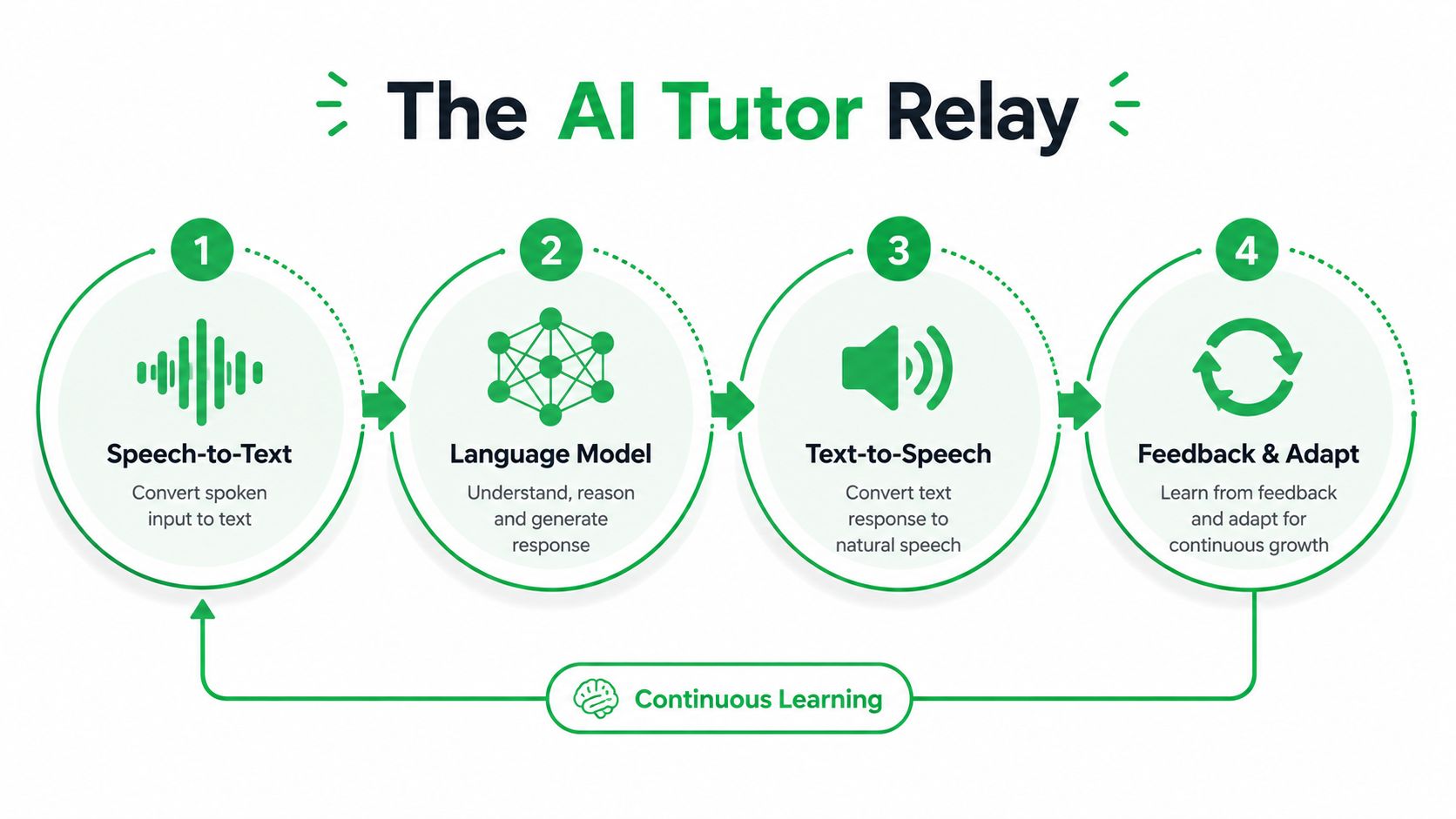
A strong AI tutor works like a relay team. One part hears you, one part interprets what you meant, one part speaks back, and one part learns from the exchange so the next round goes better. When those pieces move smoothly, the experience feels close to conversation. When they do not, it feels like waiting for a chatbot to catch up.

A diagram illustrating the four-step AI tutor relay process involving speech-to-text, language modeling, text-to-speech, and continuous learning.

The pipeline usually starts with speech-to-text, which turns your voice into words. Then the language model reasons over your input, decides how to keep the conversation going, and prepares a reply. After that, text-to-speech turns the reply into audio, and a feedback layer handles grammar, pronunciation, or vocabulary support. That sequence sounds simple on paper, but it only works if the handoffs are fast enough to preserve turn-taking. For a closer look at how AI systems support learning over time, see machine learning in education.

Latency decides whether it feels like a conversation

In practice, the whole loop needs to stay around 600 to 800 milliseconds total latency to feel natural (LinguaLive). Once response times drift beyond that, people start feeling the gap. Integrated systems like Gemini Live have been measured around 500 to 700 ms, while GPT-4o-class stacks with separate ASR and TTS often ranged 700 to 1200 ms depending on load and network conditions (LinguaLive).

That is the technical reason some apps feel alive and others feel sluggish. It is not only about how smart the model is. It is about the total budget across audio capture, inference, synthesis, and any correction logic that runs after the answer.

For readers who like the engineering side, a useful comparison is the translation workflow in GPT-4 vs Claude for Django from TranslateBot. Different systems can all produce output, but the user experience depends on how reliably they handle the full loop, not just the headline model name.

The open-source stack matters for the same reason. A reference setup that combines Whisper medium for ASR, Llama 3.1 8B for the tutor brain, and XTTS/SadTalker for voice output and avatars is designed for throughput per dollar, not just benchmark prestige (NLLB). The same source notes roughly 5 GB VRAM for ASR and another 5 GB VRAM for the quantized LLM, which makes near-real-time tutoring realistic on a single consumer GPU.

If you want a plain-language way to think about it, the tutor has to be fast enough to stop feeling like a quiz engine. That is the point where practice starts to resemble speaking.

For teams evaluating platform choices, latency is often the difference between “I'll use this daily” and “I stopped after two tries.” If the audio stalls or the corrections arrive too late, learners stop treating the tool like a partner and start treating it like a form.

The Most Effective Features in an AI Tutor

A learner sitting at a kitchen table at the end of a long day does not need flashy claims. They need a tutor that helps them speak a little more clearly, remember a little more reliably, and try again without feeling stalled. That is the test for an AI language tutor, especially for Irish learners who often need more than polish, they need repeated, usable practice.

Marketing pages often highlight personalization, gamification, and smart automation. Those can help, but only if they support the core learning loop. A good AI tutor should help you speak, remember, correct, and repeat. If the tool only makes lessons feel entertaining, it is not doing enough.

A 2025/2026 review article on generative AI in language classrooms classified GenAI into nine distinct roles, with the most common being feedback provider (n = 42), language learning tutor (n = 26), resource provider (n = 22), and content generator (n = 20), followed by evaluator, affective supporter, conversation partner, interaction facilitator, and cognitive stimulator (Taylor & Francis). That pattern matters because it keeps pointing back to the same teaching tasks, feedback, tutoring, and conversation. From an educator's point of view, those are the features that shape whether practice turns into speaking progress or stays as isolated app activity.

What deserves your attention first

The first feature to look for is pronunciation and speech feedback. If the system cannot hear your accent well, or if it gives praise without explaining the mistake, it teaches confidence without accuracy. Learners tend to relax when feedback is clear, specific, and immediate, because they can correct the next attempt instead of guessing what went wrong. A tutor also needs to adjust the difficulty of its prompts, because a beginner who needs slow, supported turns should not be pushed into advanced role-play on day one.

A 2025 systematic review on machine-based language teaching found that AI tools such as ChatGPT, Grammarly, Duolingo, Wordtune, and Pigai were used across drafting, practice, and assessment phases, and they supported writing, speaking, listening, vocabulary, grammar, and reading comprehension (ERIC PDF). The same review reported that AI feedback improved language accuracy while building confidence and encouraging active participation (ERIC PDF). Read that as a teaching signal, not a product slogan. Feedback works when it helps the learner notice a gap, try again, and hear the correction in context.

Vocabulary review deserves the same level of attention. A tool that helps you review words at the right time is more useful than one that shows a long list of terms. If you want a practical model for that, build a spaced repetition vocabulary system before you judge any platform's review loop. The point is simple, words stick when the learner meets them again after they have started to fade, not when the app just displays another progress badge.

What helps, but should not carry the whole experience

Scenario-based practice has real value because it turns isolated words into usable speech. Exam preparation also helps learners who need structured prompts and predictable speaking topics, especially when pressure is part of the task. Both features can support learning, yet neither one is enough if the tutor cannot respond naturally to mistakes, ask follow-up questions, or keep the exchange moving in a way that feels like conversation.

The British Council review identified five AI use areas in English teaching and learning, developing speaking, writing, and reading skills, supporting pedagogy, and enabling broader instructional support (British Council). That gives a useful classroom lens. AI tutors are not one thing. They can serve different parts of the learning process, and the right mix depends on whether the learner needs confidence, accuracy, or exam readiness. For that reason, a platform with personalized learning paths is only useful when the path changes what the learner practices, not just the screen they see.

Where AI Tutors Excel and Where They Fall Short

A learner who can rehearse a phrase five times without embarrassment often arrives at live conversation with less tension. That is one of the clearest places AI tutors help. They are steady, patient, and available whenever a student wants another try, which matters for beginners who need time before speaking feels natural.

The research base is also larger than many marketing pages suggest. A 2026 systematic review in a Taylor & Francis journal examined 155 studies and found that 79.5% reported positive language-learning outcomes from AI use (Taylor & Francis). That does not mean every platform works equally well, but it does show that AI support has been studied across speaking, writing, vocabulary, and grammar, not just one narrow skill (Taylor & Francis).

The strengths are real, but narrow

AI is useful for low-stakes practice, quick corrections, and a conversation partner that does not rush or interrupt. For many learners, that is enough to get the first sentence out loud. In Irish learning, that can mean moving from silent recognition of a phrase to saying it, even if the sentence is still rough.

It also helps with repetition without fatigue. A tutor can ask for the same greeting, the same direction, or the same self-introduction again and again, which is hard to get from a busy human partner. Learners often need that kind of patient loop before confidence starts to build.

Human conversation still matters for rhythm, humor, and the cultural details that do not show up in a clean transcript.

Independent education coverage keeps drawing the same line. AI tutors are strongest for repetition and practice, while human interaction remains central for fluency, culture, and nuanced communication (EdWeek). A useful way to read that is simple, an AI tutor can prepare you to speak, but it cannot fully stand in for speaking with another person.

Where the ceiling appears

Pronunciation feedback can still miss the mark, especially when a platform sounds confident even while it misreads speech. Cultural pragmatics are another weak point. Knowing the words is not the same as knowing when to soften a phrase, when to be formal, or how to sound natural in context. Those are the places where a human tutor or conversation partner still has the advantage.

Irish learners feel this gap quickly. A system may help with a phrase like a flashcard, yet still fail to explain why one wording fits a greeting and another sounds off in the same situation. That is the difference between memorizing a line and using it well.

A sensible learning setup treats AI as a practice accelerator, not a substitute for every other method. That fits the hybrid pattern now emerging in 2025 and 2026, where AI tutors are used to build repetition and confidence before learners move into authentic conversation (EdWeek). For learners of Irish, that usually means letting the tutor handle drills, corrections, and short role-plays, while human conversation still carries the parts that require timing, tone, and real social judgment.

How to Evaluate an AI Language Tutor Before Committing

A free trial should feel like a test drive, not a sales demo. If a platform can't handle your voice, your pace, and your real use case in the first conversation, it probably won't improve much after that. That's especially true for learners who need speaking support in Irish, where every minute of useful feedback matters.

Start with one simple prompt, then push the system a little. Ask for a greeting, a short role-play, and a correction of your mistakes. If the tool handles those well, then ask it to keep the conversation going for a few turns without turning into a quiz.

What to test in the first session

  • Accent recognition: Say a normal sentence in your own voice, not a studio version of the language.
  • Correction quality: Check whether feedback is specific, or just a vague “good job.”
  • Conversation flow: See whether it keeps asking natural follow-up questions, or drops the thread.
  • Scenario realism: Try something practical, like ordering food, asking directions, or introducing yourself.
  • Progress tracking: Look for a way to review mistakes instead of losing them after the session ends.

If the tutor can't do these things well, the rest of the interface won't save it.

Pricing and privacy deserve a direct look too. Voice tools collect more sensitive data than text-only apps, so you should read the privacy policy before you record long sessions or personal content. If the subscription model is hard to understand, or the limits only become clear after you've already signed up, that's a warning sign.

For learners preparing for formal tests, it also helps to compare platforms against exam-specific needs. A useful benchmark is the list of top AI TOEFL practice tools from Reach120, because it shows how specialized practice tools are usually framed around one goal rather than promising to do everything.

If a platform matches your style, you'll usually notice it quickly. The conversation feels steady, the corrections are understandable, and you come away wanting to try again tomorrow. If you feel like you're fighting the interface, keep looking.

Real-World Example How Gaeilgeoir AI Supports Irish Learners

Irish learners often don't need more theory. They need a place to speak without freezing. Gaeilgeoir AI is built around that problem, with guided, real-world conversation practice that helps beginners start speaking from day one and keeps the pressure low enough for repetition to feel manageable (Gaeilgeoir AI).

The platform's immersion-first approach uses the 1,000 most-used Irish words as a foundation, which gives learners a practical starting point instead of a giant word list that never turns into speech. Any word on the platform can be clicked for translation, and saved items can go into a personalized study list, which helps when you hear a phrase in context and want to keep it. That kind of immediate support is useful for learners who get stuck on vocabulary before they ever get to sentence building.

What that looks like in practice

A beginner can use the platform for everyday situations like ordering food or asking for directions, then move into targeted preparation for the Leaving Cert Irish oral exam. The practice isn't abstract. It's anchored in the kinds of exchanges people need, which makes the transition from study to speaking feel less dramatic.

The product also includes gamified progress tracking, with points, multipliers, and leaderboards designed to keep practice regular. That matters for learners who don't always have a set study schedule. Consistency is usually the hidden problem, not intelligence.

A learner's confidence often changes first, then fluency follows later.

That pattern shows up in the kind of testimonials language learners share after they've had enough repetition to stop overthinking every sentence. The value isn't that the AI is a substitute for a human. It's that it gives people a place to rehearse until speaking Irish feels less like a performance and more like a habit.

The platform also offers a practical option for learners who want AI support without losing focus on the language itself. Instead of chasing flashy features, it keeps the attention on speaking, comprehension, and exam readiness. For Irish specifically, that's the right tradeoff.

Your Next Steps to Start Speaking with Confidence

Start with one goal, not ten. If you want to speak more confidently, pick a simple routine, five to ten minutes of AI conversation a day, plus one real-world use case each week, like a short voice note, a tutor session, or a conversation with a language partner. The goal is to make speaking familiar before it feels flawless.

Use your first session to lower the pressure. Ask for a greeting, a short self-introduction, and a role-play tied to your life. If you're learning Irish, try a prompt about ordering in a café, asking directions, or introducing yourself at a class or meetup.

Keep the expectation realistic. The first gains usually show up in comfort, not mastery. Confidence grows when the tutor helps you speak, correct, and repeat without making the process feel like a test.

If you want a place to begin, try a platform that gives you guided conversation, pronunciation support, and everyday practice instead of just more drills.


Gaeilgeoir AI gives Irish learners guided speaking practice, pronunciation support, and scenario-based conversations built around real situations. If you're ready to turn passive Irish knowledge into active speech, visit it and try the free trial for yourself.

Building Confidence in Speaking: Practical Strategies

You know the feeling. You've prepared the words, maybe even practiced them in your head on the walk to class, the meeting, or the oral exam, and then your mouth opens and everything changes. Your voice tightens, your pace doubles, and the first sentence comes out sounding nothing like the calm version you rehearsed. That moment is why building confidence in speaking has less to do with “being naturally confident” and more to do with learning how to stay functional when your body gets loud.

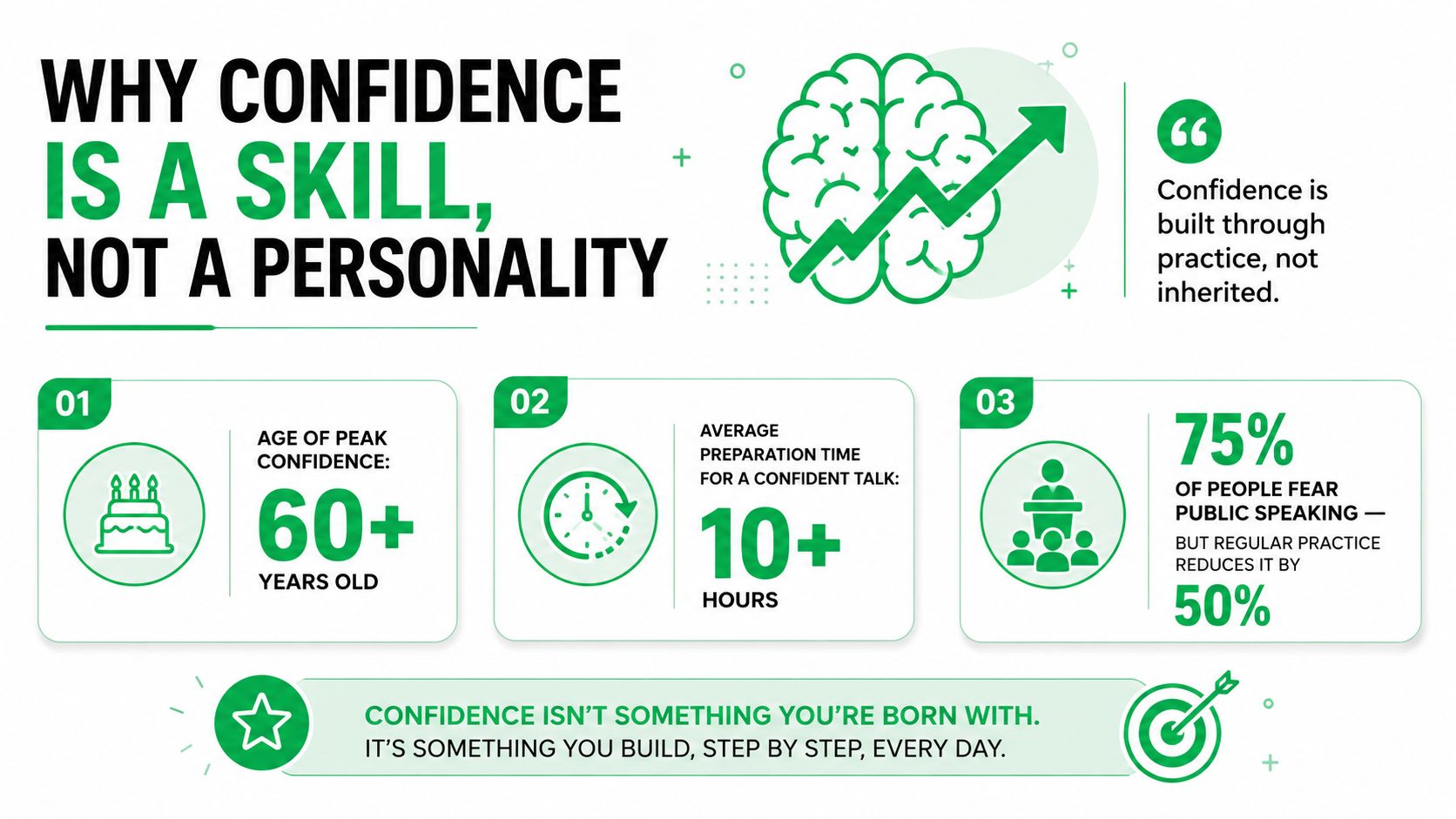
That matters because speaking anxiety is common, and avoidance keeps the cycle going. A widely cited benchmark says about 75% of people feel speech anxiety before a presentation or public speech, while only 8% seek professional help, and the average audience attention span is only 8 to 10 minutes. Those numbers make a simple point, confidence has to show up early, under pressure, and without perfect conditions. For readers who don't have a safe audience on demand, that's where the work begins.

Table of Contents

The Moment Your Voice Refuses to Cooperate

You know the answer, but the opening sentence won't arrive. Your throat feels narrow, your tongue feels too big, and you begin with a sentence you'd never choose if you had one more second. Then you hear yourself rushing, so you rush harder, and the room starts to feel larger than it did a moment ago. That isn't ignorance, it's an activation problem.

What the body is actually doing

The speaker in that moment usually has the material. What they don't have is enough automaticity to keep the speech stable while stress rises. That's why a learner can do fine in rehearsal, then freeze in a classroom or workplace setting where the stakes feel higher. A resource on public-speaking nerves, manage toast and eulogy nerves, captures the same basic truth, the body often reacts before the mind has finished organizing the message.

When learners tell me they “forgot everything,” I usually look for a different explanation. They didn't forget everything. Their attention narrowed, their breathing changed, and their first few seconds lost structure. That's why speaking confidence grows through repetition in realistic conditions, not through more self-criticism.

Practical rule: if the opening feels shaky, don't ask, “Why am I like this?” Ask, “What is my first sentence, and what do I do with my hands?”

For language learners dealing with fear, the pattern is familiar enough that it shows up across many contexts, including language-learning anxiety. The point isn't to eliminate nerves before speaking. It's to make speaking possible while nerves are still present.

A better way to think about the problem

Once you frame the issue as a performance activation gap, the solution becomes layered instead of vague. You need mindset work so the fear isn't interpreted as proof of failure. You need exposure so speaking stops feeling alien. You need short practice blocks so the skill sticks. And you need feedback so each attempt gives you usable information.

That's also why “just be more confident” is useless advice. Confidence isn't a switch. It's the result of surviving small speaking moments often enough that your body stops treating every one of them like a threat. The sections below build that path one rung at a time, including a practical option for people who don't have a live audience waiting for them.

Why Confidence Is a Skill, Not a Personality

An infographic titled Why Confidence Is A Skill explaining that confidence is built through practice, not inherited.

The most stubborn myth around speaking is that confident people were born with a different nervous system. The data point in the opposite direction. A benchmark in communication training says about 75% of people experience speech anxiety before a presentation or public speech, while only 8% of those who fear public speaking seek professional help. That gap matters because it shows how often people try to outwait the problem instead of training through it.

Experience changes confidence

One 2026 compilation reports that only 25% of people aged 16 to 24 feel confident speaking, compared with 69% of people aged 45 and over. That doesn't prove older people are magically calm. It suggests that confidence often rises with repeated exposure, familiarity, and practice over time. In other words, confidence tends to behave like a learned response.

Preparation matters just as much. The same report says 90% of anxiety before making a presentation comes from a lack of preparation, and 91% of presenters feel more confident when they use a well-designed slide deck. Taken together, those figures point to one plain conclusion, preparation is not cosmetic. It's one of the strongest levers you can pull before you ever face an audience. For readers who want a deeper look at how speech anxiety can overlap with broader discomfort in social settings, social anxiety disorder is a useful related topic.

Why this changes the way you practice

If confidence were a personality trait, practice would only help a little. But if confidence is something that grows from repeated, mostly manageable attempts, then practice becomes central. That's the more useful model for learners who are preparing for classroom speaking, interviews, oral exams, or workplace updates.

Confidence usually follows evidence. You give your brain evidence by speaking, not by waiting.

There's also a caution here. Confidence doesn't come from feeling ready first. It comes from enough exposure that the next attempt no longer feels like a cliff edge. That's why the exercises later in this article are deliberately specific. They're not motivational filler. They're ways of creating evidence your body can trust.

The Graduated Exposure Ladder You Can Climb This Week

A five-step visual guide to overcoming stage fright through a gradual public speaking exposure ladder.

Confidence grows best when each step is small enough to repeat. That's the logic behind the graduated exposure ladder, start low, repeat until it feels routine, then move up. A practical benchmark from the exposure-ladder approach is to keep each step small enough that you can complete it repeatedly without high distress before advancing, like a 2-minute summary or one question in a meeting.

Rung one, speak when no one is judging

Start with a 2-minute self-recording. Pick one topic, set a timer, and talk out loud without rewriting every sentence. The goal isn't polish, it's getting your voice used to carrying meaning while you hear yourself in real time.

After that, listen once and note only one thing that helped or hurt clarity. If you try to fix everything, you'll probably fix nothing. That's one of the main pitfalls of this ladder, too much correction too early makes people freeze.

Rung two, add one trusted listener

Next, speak to one person who knows what you're doing. A friend, tutor, study partner, or family member works if they can give you one piece of feedback and stop there. The point is to experience a little social pressure without turning the session into a test.

A completed version might be a short explanation of a hobby, a class topic, or an exam answer. You say it once, ask one follow-up question, and finish. If you can repeat that comfortably, you're moving in the right direction.

Rung three, bring in a small group

At this stage, try a 5-minute update to a small study group or ask one question in a team meeting. The speech should still be brief enough to survive, but social complexity rises. You're learning how to stay clear while other people are present and thinking.

Useful standard: if you can recover from a stumble without abandoning the message, you're gaining confidence.

Skip levels and the process breaks. Practice only in your head and the skill won't transfer. Try to “fix everything” at once and you'll lose the chance to notice what improved. The ladder works because each rung gives you a finished success, not just an intention.

A Daily Practice Routine That Actually Fits

A young man sitting at a wooden desk, focused on writing in his notebook while working.

A routine falls apart when it feels endless. The most usable version is short, repeatable, and specific enough that you don't have to decide what to do each day. Several expert guides recommend 10 to 15 minute daily practice, plus a more reflective weekly session, and that's the right size for most learners who already feel busy.

The daily block

Start with a 60-second breath and posture reset. Use slow exhale breathing, or box-breathing if that works better for your body, until your shoulders settle and your mouth stops feeling dry. This isn't relaxation theater, it's a way to keep the first sentence from arriving in a rush.

Then rehearse your scripted opening for 2 minutes until it feels automatic. The first 30 seconds are the highest-anxiety segment, so treat them like a launch sequence. After that, speak freely on one topic for 5 minutes, even if the wording is rough.

Finish with a 30-second recording review. Don't review the whole impression. Pick one dimension only, pace, posture, or sentence endings. That one-dimension-at-a-time rule makes improvement measurable instead of vague.

The weekly block

Once a week, spend 30 minutes recording a slightly longer piece and reviewing it with more care. One internal practice tool that fits this rhythm is this daily Irish practice plan, which aligns well with short, repeated speaking sessions. If you're using recordings, listen for whether your opening is steady, whether your pauses help the listener, and whether you're drifting into filler sounds.

The key warning is simple. Don't over-rehearse in isolation and call it progress. Speaking confidence needs live exposure, even if the first live audience is tiny. Practice blocks build readiness, but real speaking moments prove it.

Small daily practice sessions are powerful because they keep speaking from feeling foreign.

If you want a simple version to start tomorrow, use this order: reset, opening, free talk, review. Keep it short enough that you'll do it again the next day. Consistency beats dramatic effort that disappears after one week.

Frameworks That Make You Sound Confident on Demand

Unstructured speaking is where many learners freeze, because they have content but no shape. Frameworks help because they reduce decision-making under pressure. They don't make you less authentic, they make your answer easier to follow.

Two structures worth keeping ready

PREP works well for opinions and points. It stands for Point, Reason, Example, Point. STAR works well for stories and achievements. It stands for Situation, Task, Action, Result.

A practical tool for this kind of timed practice is Pretty Progress timer for Mac, especially if you like clear countdowns for repeated runs. Timed practice matters because it keeps your answer within a shape, not a drift.

Framework Best For Components Example Trigger
PREP Opinions, exam answers, quick workplace views Point, Reason, Example, Point “Do you think uniforms are useful?”
STAR Stories, achievements, interview answers Situation, Task, Action, Result “Tell me about a time you solved a problem.”

Finished examples you can copy in spirit

A student answering a Leaving Cert oral topic with PREP might say, “I think group learning helps because you remember more when you explain ideas aloud. For example, I used to revise vocabulary with a classmate, and I noticed I could recall it faster in the oral. So yes, I'd choose group study when the topic is difficult.” That answer is short, structured, and easy to expand.

A professional answering a behavioral interview question with STAR might say, “In my last role, our team had a deadline shift. My task was to keep the client updated. I reorganized the weekly check-in, clarified next steps, and shared a simple progress summary. As a result, the client stayed informed and the team avoided confusion.” The listener hears the shape immediately.

One useful drill is to keep 5 to 7 personal stories and practice each one at 30 seconds, 1 minute, and 2 minutes. That gives you a bank of material that can shrink or expand depending on the setting. For oral exam prep, filler support for the Irish oral exam can help you sound less trapped when you need a moment to think.

When You Don't Have a Real Audience Yet

A lot of advice assumes you already have a class, a meetup, or a workplace meeting waiting for you. Many learners don't. Shy students, busy adults, heritage speakers returning to Irish, and people learning a new language often need a practice space before they're ready for live conversation.

Why the missing rung matters

That access problem changes the whole confidence equation. If you can only practice when another person is available, you may go too long between speaking reps to build momentum. Scenario-based AI practice fills that gap by letting you complete a low-distress rep many times before you ever face a real listener.

That doesn't replace human conversation. It acts like the rung before it. You can rehearse a restaurant order, a self-introduction, a travel question, or an exam-style response, then repeat it until the words stop feeling fragile.

What this kind of practice gives you

Tools with pronunciation support and instant feedback shorten the path from understanding to speaking. They also let you test a phrase, correct it, and try again without waiting for another person to be free. In the context of building confidence in speaking, that matters because confidence often needs repetition more than reassurance.

Gaeilgeoir AI is one platform that offers scenario-based practice, pronunciation support, and interactive speaking exercises for Irish, which can be useful when you want a safe place to rehearse before real conversation. The main point is not that technology replaces people. It's that a low-stakes practice partner can make the next human conversation less intimidating.

If you don't have an audience, create a rehearsal environment first.

That shift changes what “ready” means. Ready doesn't have to mean fearless. It can mean you've already spoken the same idea several times in a controlled setting, so the live version feels familiar instead of shocking.

Tracking Progress and Handling Setbacks

Confidence feels fragile when there's no proof. A simple log solves that. Use three columns each week, situation, what went well, and one thing to adjust. That gives you evidence that speaking is changing, even if progress is uneven.

A record that keeps you honest

Once a month, replay a 60-second recording from earlier in the month and compare it with a new one. Listen for steadier openings, clearer pauses, or fewer moments where you abandon your thought mid-sentence. Small differences count, because they show your nervous system that speaking isn't as dangerous as it once felt.

Setbacks belong in the log too. A bad question in class, a stumble on an oral exam, or a freeze in a meeting doesn't erase progress. Recovery from a mistake is part of confidence, because it teaches you that you can stay in the room after things go wrong.

The weekly rhythm that works best is simple, mindset, exposure, daily practice, and one structured framework. Keep the log open beside those habits so you can see what changed, not just what felt hard. That mix is what turns isolated practice into real speaking trust.


If you want a place to rehearse before the live moment arrives, visit Gaeilgeoir AI and start with a scenario you'd normally avoid. It gives you a structured place to speak, hear feedback, and try again without pressure. If confidence has felt out of reach, this is a practical way to begin today.

Language Acquisition Research Explained

If you're trying to learn Irish and some practice sessions feel alive while others feel like you're pushing words uphill, you're already asking the same question that drives language acquisition research. Why does one kind of input seem to stick, while another vanishes the next day? The science doesn't give you a magic shortcut, but it does give you a clearer map for where effort pays off, especially if you want your study time to sound more like real Irish and less like a worksheet.

Table of Contents

Why Language Acquisition Research Matters to You

You sit down with Irish, open a lesson, and two things happen. One exercise feels natural because it sounds like something you'd say. Another feels artificial, like a puzzle cut off from real life. That difference is exactly what language acquisition research tries to explain, because learners do not just absorb language by effort alone, they pick up patterns, meanings, and routines from the kinds of input they meet most often.

A useful way to read the field is to treat it as a guide to better decisions. The best studies help answer everyday learner questions, such as whether you should spend more time listening before speaking, whether grammar drills are enough, and why repeated exposure to the same phrase in context can suddenly make it feel obvious. If you want a practical starting point for self-study, see this guide to learning a language on your own.

Practical rule: If a study feels abstract, ask what it says about input, practice, or feedback. Those three things keep showing up in the literature because they shape what learners notice and retain.

That distinction matters especially for Irish learners, who often approach the language as a school subject rather than a living one. Research helps shift the focus from “Did I memorize the rule?” to “Did I hear, notice, and use the pattern enough times to make it stick?” That is a better question, and it leads to a better study plan.

The point is to use research as a reality check when your learning routine starts to feel random. Once you know what the science tends to support, you can spend less time guessing and more time building habits that line up with how people acquire language.

The Core Theories Every Learner Should Know

A learner can hear the same Irish sentence many times and still wonder why some parts stick while others fade. That puzzle sits at the center of language acquisition research. Scholars have spent decades asking how humans get language into their heads, and the answer has never settled into a single winner. Each theory explains a different slice of the process, which is why modern research often treats them as complementary lenses rather than rivals.

From imitation to patterns

The earliest classroom-friendly view was behaviorism, which saw learning as habit formation. You hear a phrase, repeat it, get reinforced, and the pattern becomes easier to produce again. That idea fits some kinds of practice well, especially drills and repeated forms, because repetition can make a phrase feel familiar and easy to retrieve. It has a harder time explaining how learners produce sentences they have never heard before.

Nativism offered a different answer. It treats the learner as someone with a built-in language capacity that helps sort the input into structure. Children aren't merely copying speech, they are using an innate toolkit to infer grammar from the language around them. A simple everyday comparison is a child who can recognize the shape of a puzzle before every piece is labeled. The pieces still matter, but so does the ability to see how they fit.

Language as interaction and usage

Interactionist and usage-based models shift the focus to what happens in real communication. Language grows through social exchange, repeated encounters with meaningful phrases, and attention to how forms behave in context. In this view, a learner is not just storing words one by one. The learner is testing patterns in conversation, noticing what speakers do, and adjusting based on the results.

That perspective also helps explain why the same phrase can feel opaque one day and obvious the next. It often becomes clear after enough encounters in familiar situations, where sound, meaning, and use line up.

Language doesn't arrive as a list of rules. It emerges from repeated contact with forms that carry meaning in real use.

Statistical learning fits naturally alongside those ideas. A major review describes it as tracking sequential statistics, especially transitional probabilities, to find word boundaries and grammar patterns in input. In plain terms, learners notice which sounds and words tend to travel together, then use those regularities to segment speech and infer structure. A broader meta-analysis covering 25 years of work and hundreds of studies supports statistical learning as a well-established phenomenon linked to language outcomes across populations and tasks (review and meta-analysis).

For someone learning Irish, that means the smartest approach usually blends exposure, notice, and use instead of relying on one method alone. Repetition helps, but only when it is tied to meaningful examples that the brain can sort into patterns. For a deeper look at how adults approach language differently, see this guide to the best way to learn a language as an adult.

A diagram outlining the three main language acquisition theories: Behaviorism, Nativism, and Interactionism.

The main takeaway is straightforward. The field no longer asks whether language comes from repetition, innate capacity, or social use. It asks how those forces work together when a learner hears enough meaningful language to start extracting patterns.

How Researchers Study Language Learning

Many learners picture language research as a lab bench with a white coat, but the field uses several very different tools. Some studies follow children over time, some measure what babies look at, and some test how the brain responds to speech. Each method answers a different question, so the headline of a paper can sound firmer than the evidence really is.

Following real speech over time

One major approach is the longitudinal corpus. Researchers record real speech over weeks, months, or years, then look for changes in vocabulary, grammar, and interaction. This kind of data matters because it shows language as it unfolds in daily life, not just in a single task that only captures one moment. The CHILDES tradition is a classic example of this broader method, and it is one reason researchers can compare spontaneous speech across ages and settings.

Another common approach is the infant habituation study. Babies hear the same sound pattern again and again until they lose interest, then researchers change the pattern and watch for renewed attention. If the baby responds to the new pattern, that suggests the difference was noticed. It is a clever way to study learning before children can talk.

What lab tasks can and can't tell us

Researchers also use eye-tracking, EEG, and other experimental methods to measure attention and processing in real time. These tools help reveal what learners notice, what they expect next, and where comprehension starts to break down. Computational models add another layer by testing whether the patterns in child-directed input are enough to produce the kinds of structures children eventually acquire, which is one reason readers interested in digital tools and feedback often compare this work with machine learning in education.

The limit is simple. A short task does not always reflect everyday learning. A learner can succeed in a lab study and still struggle in conversation, because real language comes with noise, emotion, timing, and social pressure.

Rule of thumb: If a study only measures a few minutes of performance, read it as evidence about processing, not proof of full language development.

A diagram illustrating three methods for studying language learning, including longitudinal corpora, infant habituation, and experimental methods.

If you open a new paper and ask, “What kind of method is this?” you are already reading more carefully than many casual readers. That habit matters because method shapes the claim. A long-term corpus, a baby looking toward a speaker, and a reaction-time task all study language, but they do not tell the same story.

Landmark Findings That Shaped the Field

Some findings keep coming back because they hold up across different tasks and different groups of learners. For people trying to make sense of Irish learning, these studies matter because they move the conversation from vague advice to specific mechanisms. They also show why researchers keep returning to input, frequency, and timing as core ingredients in acquisition.

A quick look at the anchor results

Finding Evidence Claim Source
Infant speech segmentation By the first year of life, infants map key properties of ambient speech and extract statistical regularities from input. Infant speech perception and learning
Early exposure and later processing Experience changes perception itself, so early input reshapes how speech is processed before production begins. Infant speech perception and learning
Grammar-learning age effects In a study of more than 670,000 participants, grammar-learning ability stayed nearly unchanged until about 17.4, then declined. Large-scale age and grammar study
Native-like grammar and age To reach native-like grammar proficiency, learning needs to begin by about 10. Large-scale age and grammar study

The infant findings matter because they show that learning begins with perception, not with speech production. Babies do not wait until they can talk before they start sorting sound into patterns. A major PNAS paper reports that infants detect patterns in ambient speech during the first year of life and use statistical properties to identify higher-order linguistic units (Infant speech perception and learning).

That idea helps explain why a learner's ear often changes before their mouth does. A person working on Irish may notice that certain word shapes start to feel familiar long before they can produce them confidently. The research on infant speech learning gives a clear model for that sequence, perception first, production later, with the brain building patterns in between (Infant speech perception and learning).

The age-of-acquisition work is often oversimplified in everyday discussion. The large-scale study does not say adults cannot learn, and it does not suggest that a single birthday flips a switch. It shows a gradual decline in grammar-learning ability after a late childhood to adolescence window, which is very different from the cartoon version of a hard cutoff (Large-scale age and grammar study).

That distinction matters for learners of Irish today. If you start later, the research does not tell you to stop. It tells you to expect different conditions, especially around the amount of exposure you get and how often you meet the language in real use. The practical lesson is simple. Repeated patterning, meaningful contact, and steady exposure matter a great deal, especially when they come early in a learning sequence and continue over time.

Common Myths the Research Pushes Back On

A learner opens an Irish lesson, hears a correction from a tutor, and then wonders whether they are “too old” to make real progress. That worry is common because language learning advice often gets reduced to two tidy stories. One says younger is always better, as if adults arrive too late. The other says correction drives grammar growth, as if every mistake needs a verbal red pen. Research gives a more nuanced picture.

Younger isn't a magic switch

The age findings are often misread as a dramatic cliff. A more accurate framing is a shrinking window. As noted in the age-of-acquisition study above, grammar-learning ability stayed fairly stable until about 17.4, then declined, while native-like attainment was linked to starting by about 10. Age matters, but it does not cancel out adult learning, and it does not turn later study into a dead end.

For adults, the larger obstacle is usually exposure, not ability. Many learners have fewer daily chances to hear Irish, less time to repeat patterns, and more pressure attached to speaking. That is why steady contact with meaningful Irish matters more than worrying over a missed cutoff. Like learning a tune by ear, repeated listening makes the shape familiar before your own performance feels confident.

Correction isn't the engine people think it is

The correction myth is just as persistent. A review of correction findings describes Brown and Hanlon's work showing that explicit verbal approval, phrases like “that's right” or “correct,” did not function as reinforcement for grammaticality in the way people often assume (review of correction findings). Direct correction has a limited and unreliable role in acquisition.

That does not make feedback useless. It means feedback works best when form and meaning stay tied together inside communication. If someone uses an Irish phrase in a real exchange and the response shows the form in context, that kind of feedback lands more clearly than a detached grammar comment after the moment has passed. A correction can be like a label on a shelf, while meaningful interaction is the whole room where the item belongs.

Practical takeaway: Instead of asking, “Was I corrected enough?”, ask, “Did I hear the pattern often enough in meaningful use?”

For a learner, that shift changes the goal. You do not need perfect correction to improve. You need enough understandable exposure, enough chances to notice structure, and enough real interaction for the pattern to stop feeling strange. The same idea also helps explain why tools such as the German exam milestones guide can be useful as comparison points, because they make progress feel concrete without pretending that one rule explains every learner's path.

What the Science Says About How to Learn

Adult learners often want a simple recipe. The research doesn't give a single recipe, but it does support a few habits strongly enough to make them worth following. If you're learning Irish, these habits can help your study feel less random and more aligned with how language sticks.

Five habits that fit the evidence

  • Prioritize comprehensible input: Choose Irish you can mostly follow, even if it's slightly challenging. The review literature on second-language acquisition emphasizes that input is the key ingredient, and it needs to be meaningful for processing to happen (review).
  • Start with frequent material: Words and phrases you meet over and over are easier to notice and reuse. That fits the statistical-learning picture, where learners track regularities in repeated input rather than memorizing isolated facts.
  • Keep output low-pressure: Short, real exchanges beat silent perfectionism. Speaking helps you test what you've noticed, especially when the setting is calm enough that you're not bracing for failure.
  • Use feedback that links form to meaning: A correction sticks better when it happens inside a real exchange, not as a disconnected grammar lecture.
  • Space practice across days: Repeated contact matters more than a single heroic cram session. Language grows when the pattern returns often enough to become familiar.

A practical platform can help if it preserves those principles instead of fighting them. One option is Gaeilgeoir AI, which offers guided Irish conversation practice, adaptive feedback, and scenario-based exercises around everyday speaking situations. It isn't a substitute for real interaction, but it can make daily exposure easier to maintain.

A list of five evidence-based strategies for adult learners to effectively learn the Irish language.

If you want a concrete model, think of your learning week as a loop, not a checklist. Read and listen to something you can follow, speak a little, get a bit of feedback, then return to the same structures later. That rhythm matches the research far better than isolated drills do.

For a useful comparison point on how timelines are framed in another language-learning context, the German exam milestones guide from German Cultural Association Hong Kong shows how learners often benefit from structured milestones. Irish learning needs its own path, but the underlying idea is the same, clear stages help people stay oriented.

The big lesson is not “study harder.” It's “study in a way that matches how language is absorbed.” If your Irish practice feels too detached from real communication, the problem may be the format, not your ability.

The Biggest Gaps in the Research

The strongest research still has blind spots, and those blind spots matter if you're learning Irish. A field can be careful and narrow at the same time. In language acquisition research, the narrowness shows up most clearly in which languages, learners, and settings get studied most often.

Where the evidence is thinnest

One analysis of child language acquisition journals found at least one article on 103 languages, about 1.47% of the world's roughly 7,000 languages (journal analysis). A related study of second-language and multilingualism journals found 183 unique languages and 174 unique language pairings, about 3% of the world's roughly 7,000 languages and less than 0.001% of the roughly 24.5 million possible combinations. English dominated that literature, appearing in 27% of the studied languages, with Mandarin Chinese next at 6.6%.

That leaves a representativeness problem. A lot of acquisition theory was built on high-resource, heavily studied languages, especially English and other Indo-European languages. Irish learners should keep that in mind, because evidence from another language family or another learning environment will not always transfer cleanly.

Why this matters for everyday learners

A second gap is population bias. Research on language acquisition still leans heavily on monolingual, WEIRD, and lab-based participants, which makes it harder to generalize to bilinguals, heritage learners, and low-resource language communities (diversity critique). A third gap is setting bias. A 2026 review found that 93.0% of the AI-in-language-learning studies it surveyed targeted English, while 76.5% of the sample was in formal university settings and receptive skills were underexplored (2026 review).

If you're learning Irish, these gaps matter because much of the headline evidence comes from other learner populations and other contexts. You can still use the findings, but you have to translate them carefully. That usually means valuing real conversation, home practice, and everyday exposure at least as much as classroom-style tasks.

For learners looking for free supplementary ideas, the Kindness Community Foundation language guide can be a helpful place to browse additional resources without losing sight of the bigger evidence picture. The important thing is to choose materials that support repeated, meaningful contact with the language.

An infographic titled Three Gaps in Language Acquisition Research highlighting limited diversity, focus on children, and setting constraints.

The honest conclusion is that the field is useful, but incomplete. That is not a weakness to hide. It is a reason to use research carefully, especially when you are learning a smaller language and want advice that fits your reality.

Where to Go Next in the Literature

If you want to read past broad explainers, start with review articles instead of random headlines. A good review gives you the shape of a topic, the main points of disagreement, and the studies that keep coming up again and again. For statistical learning, the review cited earlier is a useful first stop because it connects the idea to language outcomes across tasks and learner groups.

The next place to look is child language corpora, especially CHILDES, because corpus data lets you watch language unfold in real speech rather than in abstraction. That kind of evidence is useful when you want to see how often forms recur, how adults support children's language, and how patterns appear over time, almost like watching many small snapshots add up to a moving picture. Journals worth bookmarking include Language Acquisition and Studies in Second Language Acquisition, both of which regularly publish work that helps shape the field.

Good reading habit: Follow a small number of review papers and one or two journals. That gives you a steadier picture than chasing every new headline.

Preprint servers can help you spot the newest work, but they deserve a careful eye because an early claim is only a draft of an argument until peer review tests it. If you are mainly trying to improve your Irish, you do not need to read everything. You need a handful of reliable sources that help you separate stronger evidence from noisy claims and give you a sense of what is ready to use now.

The broad lesson from this field is simple. Learners tend to do better when input is meaningful, frequent, and usable, and when practice gives them chances to notice patterns in context. That is why the next sensible step is not more theory for its own sake, it is putting the theory to work in daily Irish practice.


If you want to turn these research-backed ideas into actual Irish speaking time, visit Gaeilgeoir AI and try structured conversation practice that focuses on useful words, real scenarios, and immediate feedback. It is a practical way to make comprehensible input and repeated use part of your routine without needing to build the whole system yourself.

Domain Specific Language Models: A Practical 2026 Guide

General models can sound polished and still miss the target. A clinical note, a legal clause, a support ticket, or a learner sentence in a low-resource language all demand different vocabulary, constraints, and error tolerance. In those settings, domain specific language models are not a nicer wrapper around a general LLM, they are the model class that is trained and judged against a narrower task, a narrower vocabulary, and a narrower definition of correctness.

That narrower focus is becoming a real market category, not just a research idea. Mordor Intelligence estimates the market at USD 3.85 billion in 2025, rising to USD 4.78 billion in 2026 and reaching USD 18.25 billion by 2031, with North America holding 41.55% of revenue in 2025 and Asia-Pacific growing fastest at 30.98% CAGR through 2031 market estimate.

The deeper point is that training is only half the job. A domain model can have the right architecture and the right corpus, yet still fail if evaluation is vague, if the test set is too easy, or if the language itself is underrepresented, as happens with low-resource languages such as Irish. That is why a practical guide has to treat evaluation and small, curated domain models as first-class parts of the workflow, not as an afterthought once the model already sounds fluent.

Table of Contents

What Domain Specific Language Models Are

A learner opens Gaeilgeoir AI on a Tuesday evening, types a simple request, and wants one thing, a sentence that sounds natural in Irish, not a literal translation assembled from fragments. That is the everyday purpose of domain specific language models, they turn a general language engine into something that understands a narrow world well enough to answer like it belongs there.

An infographic titled What Domain Specific Language Models Actually Are explaining their data, training, and output benefits.

A working definition without the jargon

A DSLM is a language model, large or small, that has been deliberately adapted for a specific field. That field could be law, medicine, finance, software, customer support, or Irish-language learning. The important point is that the model does not just learn more words, it learns the vocabulary, reasoning patterns, and constraints that matter in that domain model adaptation overview.

A useful way to separate it from a general model is to ask a simple question. If the answer needs domain fluency to be correct, the model has to be trained for that domain, not merely exposed to it.

The 2021 paper Learning Domain Specific Language Models is a useful historical marker because it formalized the idea that pretraining on in-domain corpora can materially change behavior and performance paper. Since then, the field has settled around a simple reality, a model can sound fluent and still be wrong for the task at hand.

Practical rule: if accuracy changes the user's outcome, the model is no longer “just a chatbot.” It is part of the product.

The four ingredients that make a model domain-specific

A survey on domain specialization describes four ingredients that show up again and again. First, customizing a general-purpose model with domain contextual data. Second, augmenting it with domain knowledge. Third, optimizing it toward the domain's objective. Fourth, regulating it with domain-specific constraints survey.

That framing matters because it separates a DSLM from a smaller general model. A smaller model can still be broad and generic. A DSLM is narrow on purpose. It is shaped by the domain's language, rules, and failure modes, which is why the category now sits in a distinct commercial market rather than a research footnote. It also explains why teams building products like master AI features in apps often care less about raw model size and more about whether the model stays useful inside a specific workflow.

Domain Models vs General LLMs in Plain English

The key difference is how the model behaves when the task gets specific and the stakes go up. A general LLM can sound fluent across many topics. A domain-specific model is built to stay accurate inside one lane, keep terminology consistent, and produce outputs that fit a narrow workflow without extra cleanup.

Dimension General LLM Domain-Specific Model
Accuracy on target task Broadly capable, less consistent in a narrow workflow More reliable on one domain's tasks
Hallucination risk Can drift when the prompt gets specific More likely to stay anchored to the domain
Operational cost Can rise through retries, prompt work, and review Often cheaper to run in a narrow lane
Control over outputs More open-ended, less constrained Easier to shape around policies and terminology

A quick way to read that table is to separate “can answer almost anything” from “can answer this one thing well.” A general model is useful when the request is wide open. A domain model is useful when the answer has to match a business rule, a professional register, or a fixed vocabulary.

What the benchmark numbers mean in practice

One industry analysis reports domain accuracy of 88–96% for fine-tuned DSLMs versus 70–82% for generalist LLMs, and in-domain hallucination rates of 2–5% versus 8–15% for generalists. In practice, that gap shows up as fewer corrections, less back-and-forth, and less time spent checking whether the model drifted away from the task.

The useful mental model is a restaurant order. A general model may understand the request and still improvise the phrasing, while a domain model is more likely to keep the request in the right register, with the right words, and without unnecessary variation. That difference matters even more in workflows where wording itself carries meaning, including specialized customer support, legal review, or a narrow language task such as learning Gaeilge with technology.

The same logic applies in regulated or high-stakes work. A general model can still be fine for brainstorming, creative writing, or casual chat. A domain model earns its place when a wrong answer creates extra review, extra rework, or a trust problem that is expensive to fix.

A model that needs three retries, two prompt rewrites, and one human correction is rarely cheaper just because the API call itself was small.

When general models still make sense

A general model makes sense when the task is broad, exploratory, or low-stakes. It also fits early-stage teams that are still learning what their users need, because the model gives them room to test ideas before they commit to a narrower system.

A DSLM makes more sense when the language is narrow, the terminology matters, or the system has to respect rules a generic model will not reliably keep in memory. For low-resource languages and smaller curated domains, that distinction becomes even sharper, because the question is often whether the model can be evaluated and trusted at all, not whether it can produce a fluent answer.

Core Techniques Behind Every Domain Specific Model

The main levers are easy to confuse because they all sit under the same umbrella. They don't do the same job. Each one changes the model in a different place, and the right one depends on whether you want better task fit, fresher knowledge, lower cost, or stricter grounding.

An infographic showing five core techniques for creating domain specific language models: fine-tuning, continual pre-training, adapters, prompt tuning, and RAG.

The five common levers

Fine-tuning changes model weights using curated input-output examples. It's the most direct way to teach a model how your domain should answer.

Continual pre-training exposes the model to large volumes of domain text so its internal representations shift toward the new language patterns. That's useful when the model needs deeper exposure to the domain's vocabulary and style.

Adapters and LoRA keep the base model frozen and train smaller side modules. That makes them attractive when you want specialization without rewriting the whole model.

Prompt tuning uses learned soft prompts to steer behavior. It's lighter-weight and can be helpful when you need a small nudge rather than a full retrain.

RAG leaves the weights alone and retrieves verified documents at inference time. It's the best fit when freshness and grounding matter more than changing the model itself adaptation tradeoffs.

Picking the lever that fits the job

A useful mental model is language tutoring. Fine-tuning is like drilling a student on the exact kind of answer you want. Continual pre-training is like immersing them in the subject until the vocabulary starts to feel native. LoRA and adapters are like giving them a focused workbook instead of a new textbook. RAG is the trusted reference book on the desk.

If you're building AI features inside apps, the same tradeoff shows up in product design. A good overview of how developers master AI features in application workflows appears in this AppLighter guide on prompt engineering for developers, especially when you're deciding whether the behavior should come from prompts, retrieval, or model adaptation.

The key is not to stack techniques blindly. Start with the lightest method that gives you enough accuracy, then move heavier only if the task needs it.

Building and Curating the Right Dataset

A domain model is only as honest as the text you feed it. If the corpus is noisy, duplicated, skewed toward one subtopic, or stale, the model learns those flaws just as faithfully as it learns the useful parts. That is why dataset work is not a setup chore, it is part of the model itself.

An infographic showing a four-step process for building and curating datasets for domain specific language models.

Sourcing, cleaning, balancing, auditing

Sourcing means gathering raw text from trusted, relevant places. In legal or medical settings, that source list needs to be deliberate, not opportunistic, because the wrong document can teach the model the wrong habit.

Cleaning removes duplicates, broken formatting, and low-quality passages. A model will happily memorize repeated noise if nobody removes it, the same way a student will repeat a mistake if the same bad example keeps showing up.

Balancing keeps one topic from taking over the dataset. If one subdomain appears everywhere, the model will overfit to it and become narrow in places where you expected flexibility.

Auditing checks for bias, safety problems, and mismatched examples before training starts. This step gets skipped when teams move quickly, but it is also the step that reveals whether the dataset really matches the product.

An audit can surface concrete imbalances that are easy to miss in a spreadsheet. For example, it might show that most of your conversational data is about ordering food, which would bias the model away from travel, work, or support scenarios. It might also show that your “general” examples are drawn from one region or one writing style, which can make the model sound oddly repetitive once users start asking broader questions.

A useful language-learning example is a curated Irish corpus for everyday conversation. The goal is not all Irish text on the internet. It is the right slice of Irish for the product's users, beginner phrases, common conversational patterns, oral exam topics, and culturally appropriate phrasing. A practical reference point for that kind of learning workflow is the Gaeilgeoir AI learning page, where the product focus is clearly on guided language practice rather than open-ended generation.

Why small and clean often beats large and messy

In niche domains, the corpus is often limited, and every line matters more than people expect. The literature on small, efficient domain models emphasizes guided data curation and staged training, especially where the language is underrepresented or the domain has specialized vocabulary small model research. Irish is a good example of the broader point, because language-equity gaps make careful selection more useful than raw scale.

Rule of thumb: if you can't explain why a sentence belongs in the dataset, it probably shouldn't be there.

That discipline also helps avoid domain drift. When user questions change but training data does not, the model starts answering yesterday's problems. The answer is a living dataset, with regular review, targeted additions, and removal of examples that no longer match how people use the system.

Evaluating a Domain Model the Way It Deserves

A domain model can look polished in a demo and still fail the people who need it most. Teams train, fine-tune, and ship, then wait to see whether the model fits a real workflow, a real culture, or a real learner path. That gap is where evaluation has to do real work.

Three layers of proof

The first layer is automatic checks. Use task accuracy where it fits, hallucination checks where answers must stay grounded, and retrieval quality for RAG systems. These checks are fast, repeatable, and useful for catching regressions early, but they only cover part of the picture.

The second layer is a domain-specific test set. Generic benchmarks miss the cases that matter in practice. A model for law needs contract language and edge-case phrasing, a model for medicine needs safe handling of symptoms and treatment terms, and a model for Irish-language learning needs beginner forms, common classroom phrases, and the kinds of mistakes learners make repeatedly.

The third layer is human review. That matters most when answers touch cultural norms, ethical constraints, regulatory language, or pedagogy. Research on domain specialization says the hard part is often deciding what “good” means inside the domain, especially when the constraint is social, cultural, or linguistic rather than purely technical evaluation challenge.

A 2024 thesis on specialized-domain modeling points to another problem, the shortage of datasets that fit narrow domains, with the gap even wider outside English thesis note. That is why “just benchmark it” breaks down so quickly. A generic score can miss the kind of error that matters in a classroom, a clinic, or a public service setting.

A practical review loop for your team

Build a gold set with domain experts. Run automated checks on a schedule. Sample real outputs for human review. Feed failures back into the next training round. The model becomes trustworthy because the team keeps testing it against the situations that matter, not because a dashboard looked healthy once.

For Irish learning, that review loop should check beginner phrasing, oral exam prompts, and common learner mistakes. It should also check cultural and pedagogical fit. A generic benchmark might reward a translation that is grammatically plausible but strange in a classroom, such as a phrase that sounds too literal for everyday use or a response that ignores the learner's level and gives an advanced construction when a simpler one would be better. In that case, the model has not just made a language error, it has failed the teaching moment.

The safest outputs are not always the most confident ones. A model that says it is unsure and offers two common alternatives is often more useful than a model that produces one polished but unnatural phrase. That is the kind of distinction human reviewers catch, and the kind of distinction domain evaluation should be built to surface.

Deployment, Cost, and the Case for Smaller Domain Models

Once the model is trained, deployment becomes the primary product decision. You're choosing where the model runs, who controls it, how fast it feels, and how much friction the team adds every time it answers.

A comparison chart showing deployment methods including on-device, private cloud, and hosted API with cost and performance metrics.

Where the model runs changes the product

On-device deployment gives the most control and the best privacy posture because the interaction stays local. It also works well when you want lower latency and a smoother feel on mobile.

Private cloud keeps control high while centralizing operations. That's a practical middle path for teams that want governance without fully giving up flexibility.

Hosted API is the simplest path to launch, but it gives you less control and can create a hidden cost trail once retries, guardrails, and review steps start piling up.

A useful design principle for learner products is to keep the core interaction close to the user. A platform like Gaeilgeoir AI can benefit from that because conversational practice works best when responses feel immediate and the experience stays tightly managed.

Why smaller models can win in niche settings

The strongest case for smaller domain models isn't hype, it's fit. When the language is narrow and the task is specific, a smaller curated model can be easier to deploy, easier to review, and less expensive to keep honest. That matters even more when the product needs privacy, low latency, or predictable behavior.

A practical deployment stack often adds quantization, batching, prompt caching, and fallbacks when the model is uncertain. Those aren't glamorous features, but they're the difference between a demo and a product.

If the domain is narrow enough, spending less on a smaller model can buy you more reliability than spending more on a broad one.

Risks, Limits, and How to Mitigate Them

A good DSLM still fails in familiar ways. The most common problem is silent overconfidence on questions outside the training slice, where the answer sounds clean but doesn't belong in the domain. The second is cultural or ethical blind spots inherited from narrow data. The third is drift, because the domain itself changes. The fourth is the old product mistake of treating the model as finished instead of monitored.

Four mitigations that hold up in practice

Use confidence thresholds and graceful refusals so the model can say it's unsure. That's better than inventing a neat answer that nobody asked for.

Bring in diverse reviewer panels when the domain touches culture, language, or community norms. A narrow reviewer set will miss narrow failures.

Schedule re-evaluation against fresh domain data. A model that passed last quarter can still be off-target now.

Close the loop by turning user corrections into new training signal. That's how the system stays honest as the domain shifts.

These habits matter because the business logic for DSLMs is constraint handling as much as raw accuracy. A domain model makes sense when the cost of being wrong touches revenue, compliance, safety, or user trust, and when the deployment context rewards privacy or low latency.

Putting It All Together With Gaeilgeoir AI

A learner-facing Irish product shows the whole pattern in miniature. A curated corpus supports everyday conversation, the model is tuned for domain use instead of open-ended chatter, and evaluation has to cover beginner mistakes and Leaving Cert oral topics, not just generic fluency. That kind of design also fits the broader trend toward smaller, more honest models and evaluation as a first-class product feature.

For a direct Irish-learning example, learn Gaelic language with AI points to the same idea in product form. The lesson is simple, when the language is narrow and the stakes are real, a carefully built domain model often has more value than a bigger generic one.

If you want to see how that feels in practice, try Gaeilgeoir AI. It applies domain-specific AI to Irish conversation practice, with lessons built around the kind of language learners need.

Irish Vowel Sounds: A Complete 2026 Guide

Most advice on Irish vowel sounds starts in the wrong place. It tells learners to memorize letter-to-sound pairs, as if Irish worked like a neat code where each vowel always delivers one fixed result. Irish doesn't work that way, and that's exactly why so many beginners get stuck.

The better way to read Irish vowels is as a system shaped by stress, surrounding consonants, and dialect. Irish orthography marks broad and slender consonants with nearby vowels, the síneadh fada marks long vowels, and unstressed vowels often weaken in everyday speech. Once you start listening for those three forces together, pronunciation stops feeling random and starts feeling logical.

Table of Contents

Why Irish Vowels Are Not What You Expect

The first mistake is treating Irish vowels like English vowels. In Irish, the written vowel often carries more than one job, because spelling helps show how the consonants around it should be read, and it can also signal vowel length. A letter on the page is only part of the story. The full sound depends on the surrounding consonants, the stress in the word, and, in some cases, the dialect.

The pattern behind the spelling

Irish spelling works by context. Broad consonants sit beside a, o, u, while slender consonants sit beside i, e. That means a vowel letter can change how it behaves depending on the consonants next to it, which is why fixed letter-to-sound memorising often leads beginners into trouble. If you read each vowel in isolation, you miss the pattern the language is giving you.

Practical rule: in Irish, vowel letters often tell you as much about the surrounding consonants as they do about the vowel itself.

Stress adds another layer. A vowel in a stressed syllable can sound fuller and clearer than the same spelling in an unstressed one, so two words with similar letters may still sound quite different. Dialect matters too, because the sound value of a vowel can shift from one variety of Irish to another. Irish orthography and pronunciation basics gives a plain explanation of how the spelling clues work together.

The vowel system is also wider than a simple English-style chart. Irish phonology is commonly analysed as having 11 monophthong vowel qualities in Connacht and Munster, plus 4 diphthongs, with nearby broad and slender consonants shaping how those vowels are heard (Irish phonology overview). That matters because the learner's job is not to force every written vowel into one fixed English equivalent. The job is to read the whole sound pattern, the vowel, the stress, and the consonant setting around it.

Why this helps you learn faster

Once you stop expecting one vowel letter to give you one stable sound, pronunciation gets easier to handle. You can ask better questions. Is the syllable stressed, are the consonants broad or slender, and is the vowel long or short? Those checks explain far more than a page of memorised sound pairs.

That shift also reduces guesswork. Instead of treating spelling as a set of exceptions, you start hearing it as a guide that is pointing you toward the correct vowel quality. For learners, that is usually the turning point, because Irish becomes less like a list of surprises and more like a pattern you can read with confidence.

The Core Irish Vowel Inventory Explained

Irish vowel learning becomes easier once you separate short vowels, long vowels, and diphthongs. The language also uses the síneadh fada to mark long vowels, and the standard set is á, é, í, ó, ú. Unaccented vowels are short, while an accented vowel in a combination carries the long sound.

Here's the core inventory learners usually need first.

A chart showing the core Irish vowel inventory including short vowels, long vowels, and diphthong sounds.

Short vowels and long vowels

The core Irish vowel system is best understood as a set of sound patterns shaped by stress and the consonants around them. A useful summary in Key features of Irish phonology shows why the same written vowel can behave differently depending on its phonetic setting.

The commonly analysed monophthongs in Connacht and Munster include /iː, ɪ, uː, ʊ, eː, ɛ, oː, ɔ, aː, a, ə/, alongside 4 diphthongs: /əi, əu, iə, uə/. You do not need to master every IPA symbol on day one, but you do need to know how the system is organised.

A simple learner-friendly way to approach it is this.

  • á is long, often an open ah-like sound.
  • é and í are long, with a stretched quality that is not the same as English's “ay” or “ee.”
  • ó and ú are long, rounded vowels.
  • unaccented vowels stay shorter and more clipped.

A pronunciation guide notes that Irish has two basic vowel types, long and short, with the fada marking the long vowels. Another spelling rule matters too. If one vowel in a combination carries the acute accent, that accented vowel is the one pronounced long, while the surrounding unaccented vowels often serve mainly to shape the neighbouring consonants (Bitesize Irish on sounds and fada).

Reading a word without guessing

The first thing to check is the accented vowel. That is usually the sound you are meant to hold. Then look at the nearby vowels and ask whether they are carrying their own sound or doing spelling work around the consonants.

Learners often rush past this and try to pronounce every written vowel. That creates extra syllables that Irish does not want, and it can make a word sound much less natural. The spelling is giving you a map, but it is a map of the whole sound pattern, not a one-letter, one-sound code.

The core habit to build is simple: read the stressed vowel first, then listen for the consonant setting around it. Once you do that, the vowel inventory stops feeling random and starts behaving like a system you can follow with confidence.

How Broad and Slender Vowels Shape Pronunciation

Irish spelling uses vowels to signal whether a consonant is broad or slender, and that changes pronunciation in a noticeable way. Broad consonants sit beside a, o, u, while slender consonants sit beside i, e. One spelling guide explains that, with a few older exceptions, if an i or e appears on one side of a consonant cluster, it will usually appear on the other side as well, because the spelling is framing the consonant rather than adding a separate vowel sound (Bitesize Irish on the sounds of Irish Gaelic).

Read the vowels as signals around the consonant

That framing is the part learners often miss. In words like beir or bain, the written vowels are doing more than sitting on the page. They tell you what kind of consonant shape to make, and that shape changes how the word comes out.

Broad consonants are usually darker and farther back in the mouth. Slender consonants are palatalised and lighter. The spelling is giving you that mouth position before you even speak.

The same written vowel can behave differently depending on its neighbours. Irish vowel quality is strongly shaped by consonant environment. Every consonant except /h/ has both a velarised, broad form and a palatalised, slender form, and those consonant types affect the vowels beside them (Grammar.ie phonology guide).

A useful rule for beginners

Do not read each vowel letter as if it were standing alone. Read the vowel group as a cue for the consonants around it.

That is the part that helps pronunciation start making sense. A broad consonant and a slender consonant are not just different spellings. They are different mouth settings, a bit like two camera angles on the same scene. The vowel letters tell you which angle to use.

A simple way to test yourself

When you meet a word, ask three quick questions:

  1. Which consonants sit beside the vowel?
  2. Are those consonants broad or slender?
  3. Is the written vowel making its own sound, or marking the consonant quality?

That third question matters more than beginners expect. In Irish, some written vowels are there to show consonant quality rather than create a new syllable. Once you accept that, the spelling starts to look less like a puzzle and more like a set of instructions.

For a fuller look at how these patterns work in real speech, this guide on dialectal differences in Irish is a useful companion. It shows why the same spelling can behave differently once stress and regional pronunciation come into play.

Dialect Differences That Change Vowel Sounds

Irish vowel pronunciation changes across Ulster, Connacht, and Munster, and that variation is part of the language in speech. A spelling can point in one direction on the page and still shift once dialect, stress, and vowel reduction enter the picture. That is why a fixed letter-to-sound chart only gets you so far.

Why one spelling can sound like more than one thing

The sequence ao gives beginners a clear example. In some descriptions it is pronounced roughly like /iː/, while in others it is closer to /eː/. The point is not that one speaker is careless, it is that Irish spelling often carries more than one possible sound path, depending on dialect and the consonants around it.

Unstressed vowels also change the picture. Outside the first syllable, vowels are often reduced to schwa-like sounds, so the word on the page can be lighter and less fully spoken than a learner expects. A useful overview of these patterns appears in Irish speech features and dialect notes, which shows how real speech can trim down vowels that look full in print.

Stress changes the whole vowel pattern

Stress does more than make one syllable louder. It shifts how the nearby vowels behave, almost like pressing one key on a piano and hearing nearby strings vibrate in response. Irish vowel learning works better when you track stress + surrounding consonants + dialect together, instead of trying to force each letter into a single permanent sound.

That matters for pronunciation-first learners who need to hear patterns, not memorize isolated spellings. Dialectal differences in Irish helps with that shift in listening, because it shows why the same spelling can sound different in different regions. Once you start listening this way, the dialect becomes a clue rather than a problem. You stop asking which version is correct and start asking which dialect you are hearing, and how stress is changing the vowels around it.

Common Vowel Mistakes Learners Make

Most vowel mistakes come from good intentions. A learner sees a word, trusts the letters too much, and applies English habits without noticing. The result is usually over-pronounced vowels, the wrong vowel length, or a stressed syllable that sounds unnatural.

A chart illustrating common vowel pronunciation mistakes learners make when learning the Irish language and better alternatives.

The errors that show up most often

Here are the patterns I see again and again:

  • Pronouncing every written vowel separately. Irish often uses vowel letters to shape consonants, so adding an extra syllable can distort the word.
  • Applying English vowel values. English habits make learners turn Irish vowels into familiar sounds that don't belong there.
  • Ignoring the fada. The fada marks long vowels, so treating á, é, í, ó, ú as if they were short changes the word.
  • Forgetting to reduce unstressed vowels. Outside the first syllable, many vowels lose their full weight in natural speech.

A learner may also get tripped up by epenthetic vowels, the brief inserted sounds between certain consonant clusters. Acoustic work on Irish schwa epenthesis found that, for the first five speakers in the study, epenthetic vowels averaged 0.059 seconds while underlying vowels averaged 0.069 seconds, a difference of about 10 milliseconds, and the authors reported that the duration gap was statistically significant (schwa epenthesis study). That's a small but real timing difference, which helps explain why these inserted sounds don't behave exactly like full vowels.

A better correction for each mistake

If you're reading too many vowels, slow down and mark the stressed syllable first. If you're using English vowel values, mute that instinct and listen for the Irish consonant environment around the vowel. If you're ignoring the fada, train yourself to circle it before you say the word.

Practical rule: if a vowel feels “too obvious,” check whether Irish is using it as spelling support rather than as a full sound.

For learners who want help turning audio into something they can review, accuracy tips for transcription can be surprisingly useful as a listening discipline. Careful transcription makes you notice where the vowel starts, ends, and weakens.

Practice Exercises and Tools for Real Progress

Pronunciation improves fastest when you connect what you know to active speaking. Start with tiny drills, then move into words you'll commonly hear in conversations, directions, food, and everyday greetings. The point isn't perfection on day one, it's building a reliable ear for vowel quality, stress, and consonant environment.

Screenshot from https://gaeilgeoir.ai

Three drills that actually build skill

Try this sequence:

  1. Broad versus slender contrast. Say paired words slowly and notice how the consonant changes the vowel feel. Don't rush the letter, focus on the mouth shape.
  2. Fada recognition. Read short lists and mark every accented vowel before speaking. Train your eye to spot length immediately.
  3. Stress pattern practice. Say multi-syllable words with the stress in the right place, then reduce the unstressed vowels so they don't all sound equal.

A listening drill helps too. Pick one dialect at a time, then replay the same word until you can hear whether the vowel is full, reduced, or shaped by the surrounding consonants. That single habit prevents a lot of confusion when you move between recordings.

Tools that support repetition

For guided practice, Gaeilgeoir AI offers conversation-based Irish learning with pronunciation support, adaptive quizzes with instant feedback, and scenario-based practice for everyday situations. Its immersion-first approach is grounded in the 1,000 most-used Irish words, which keeps practice close to the language people use. You can click any word to see translations and save items to a personalized study list, which makes revision more targeted and less random.

If you want a platform that turns pronunciation into a habit instead of a one-off lesson, Gaeilgeoir AI is one option to look at. It also uses points and leaderboards to keep repetition from feeling dull, which matters when you're drilling sounds that only become natural after a lot of reuse. Its pronunciation guide, “Mastering Irish with Our Pronunciation Guide,” is built around hearing the language clearly, not just reading about it.

Your Path Forward with Irish Vowel Mastery

The fastest way to improve Irish vowel sounds is to stop treating them as isolated letters. Think in layers. First, identify the fada and the long/short contrast. Then read for broad and slender consonant context. After that, listen for dialect and for the way stress changes the vowel shape.

A practical roadmap you can keep using

Start with these milestones:

  • Phase one, length. Spot every fada automatically and hear the difference between long and short vowels.
  • Phase two, consonant environment. Notice whether the surrounding consonants are broad or slender before you pronounce the vowel.
  • Phase three, real speech. Listen across dialects and adjust for stress, reduced vowels, and natural timing.

That sequence keeps you from memorizing fragments that don't hold up in conversation. It also gives you a way to measure progress without chasing perfection. If you can read a word, identify the stressed syllable, and explain why a vowel sounds the way it does, you're already moving like a real learner.

The big shift is mental. Irish vowels aren't a pile of exceptions to survive. They're a pattern you can learn to hear.


If you want structured practice that connects pronunciation, listening, and speaking in one place, visit Gaeilgeoir AI. It gives you guided conversation practice, instant feedback, and word-level study tools that fit this exact problem, learning to hear Irish vowels in real speech.

Language Learning Anxiety: A Calm Practice Guide

You know the moment. You've rehearsed the phrase in your head, you're sure you know the word, and then the shop assistant or teacher looks at you and your mind goes blank. The air feels a little too quiet, your mouth doesn't quite cooperate, and suddenly a simple language moment feels like a test you didn't study for.

That freeze is language learning anxiety, and it's far more common than most learners think. Research has long shown that anxiety is a measurable barrier to achievement, not a personal flaw, and it shows up in different ways for different people. Some learners only feel it when speaking, others notice it in listening, reading, or any moment where they think they might be judged.

Table of Contents

What It Feels Like When Words Won't Come

A learner in a coffee shop in Galway can know exactly what they want to say and still sit there in silence, staring at the menu while the barista waits. The phrase is in their head, but the doorway from thought to speech seems locked. That pause is often the first sign that language learning anxiety has taken over the moment.

The feeling usually isn't dramatic. It can be a tight chest before a mock oral, a sudden urge to switch back to English, or the habit of avoiding eye contact so nobody asks a question. Some learners blame themselves for being “bad at languages,” when what's really happening is that their nervous system is treating a practice moment like a threat.

That matters because this struggle isn't rare. A review in the ERIC material notes that about one-third of foreign-language learners experience at least a moderate level of anxiety, while other samples show one third to one half of students with debilitating levels, and higher-education analysis cites anxiety affecting 32% of students globally, with situation-specific anxiety often estimated at 30% to 40% ERIC review. You're not watching your own private failure. You're running into a well-documented learner experience.

Practical rule: if the fear shows up before the words do, the problem is often anxiety management, not ability.

For a simple starting point on Irish-speaking practice, this guide to speaking in Irish can help you connect the feeling of hesitation to a real first step. The important thing is not to wait until confidence arrives. Confidence usually follows action.

Defining Language Learning Anxiety

An infographic titled The Three Pillars of Language Learning Anxiety, showing Fear of Negative Evaluation, Communication Apprehension, and Test Anxiety.

Foreign language anxiety is usually defined in the research literature as a negative emotional response tied to using, learning, or understanding a language PMC review. The Horwitz framework gives it three core parts, and the clearest way to understand it is through ordinary classroom moments.

Fear of negative evaluation

This is the worry that someone will notice your mistake and judge you for it. A learner may avoid saying Gaeilge aloud because they're certain the teacher will correct them sharply, or that classmates will notice every mispronounced consonant. The fear is less about the word itself and more about being seen as wrong.

Communication apprehension

This is the dread that rises when you have to respond in real time. You know the vocabulary, but the pressure of a live exchange makes it hard to retrieve. That's the feeling behind freezing during a conversation, even when you've practiced the material privately.

Test anxiety

This is the panic that appears when performance is graded or formally watched. A learner who speaks more freely in casual practice may blank during a mock oral or any assessed moment. The task hasn't changed, but the stakes have.

A useful question is simple, which part makes your shoulders rise, being corrected, being put on the spot, or being scored?

Separating anxiety from other traits is helpful. Anxiety is not low intelligence, and it isn't proof that you lack motivation. It also isn't the same as shyness, because a quiet learner can still feel confident internally, while a talkative learner can still panic when the language gets real.

For readers who want an outside perspective on stress and support, the resource to compare anxiety counsellors Penticton can be a useful reminder that naming a fear is often the first practical step. For language learners, the same principle applies. Once you know which fear is active, the right practice becomes easier to choose.

How Widespread the Problem Really Is

The hardest part of anxiety is often the private story learners tell themselves. They think everyone else is relaxed, fluent, and effortlessly brave. The research says otherwise.

A major meta-analysis by Teimouri, Goetze, and Plonsky brought together 216 effect sizes from 97 published studies conducted between 1985 and 2017 and found a moderate negative relationship between second-language anxiety and achievement, with an average correlation of r = -0.36. A later meta-analysis of 46 studies found a very similar relationship of r = -0.34 Cambridge meta-analysis. That means anxiety isn't just uncomfortable, it is consistently tied to lower performance across grades and tests.

What those numbers mean in plain English

A correlation like r = -0.36 doesn't mean a learner is doomed. It means anxiety reliably pulls performance downward, enough that researchers can detect the pattern across decades of studies. In other words, if a learner feels tense in language class, there's a good reason the words get harder to find and the recall gets slower.

The prevalence data points to the same conclusion. Language anxiety isn't a fringe issue. It shows up often enough to shape classroom participation, study habits, and willingness to speak. The result is a learner population where worry is common, measurable, and widely shared.

Takeaway: anxiety is not proof that you are failing, it's evidence that the learning moment feels high-stakes to your brain.

That changes the conversation. Instead of asking, “Why am I like this?” the better question is, “What kind of practice lowers the pressure enough for learning to happen?” Once you ask that, the problem becomes workable. Not easy, but workable.

Skill-Specific Signs and Daily Triggers

A visual guide illustrating common anxiety triggers for language learners across reading, listening, writing, and speaking skills.

A learner may feel fine while reading and then tense up the moment a listening task begins. Another may follow a conversation on paper, but freeze when the speaker talks too quickly in real time. A 2025 systematic review highlights that technology can reduce anxiety by creating psychological safety and personalized feedback, while it can also raise anxiety through cognitive overload and less human interaction. The same review also points out that the field still focuses too heavily on higher education and needs more work on reading, writing, listening, and VR or AR use 2025 systematic review. That makes the pattern easier to see, the trigger is often tied to a specific skill, not to language learning in general.

This is a common experience, as illustrated in the following clip:

Reading, listening, writing, speaking

Reading can feel safe until the page fills with unfamiliar words. Listening can feel steady until the audio starts moving faster than your mind can sort it out. Writing often stirs up perfectionism, because every sentence seems to demand polish before it is allowed to exist.

Speaking tends to be the most visible trigger, yet it is only one part of the picture. The common pattern is simple. The task becomes time-sensitive, public, or overloaded, and anxiety rises. Once you start noticing the pattern by skill, a bad moment stops looking like one giant problem and starts looking like a specific pressure point.

What tends to set it off

A Cambridge study on online language learning found that the main trigger for speaking anxiety in both groups was not remembering vocabulary learners believed they knew. Learners with mental-health conditions more often pointed to identity and confidence issues, while other learners more often described competence, study, and learning barriers Cambridge online-learning study. That corrects a common mistake in advice. The problem is not always courage. Sometimes it is access, especially under pressure.

For many motivated learners, the first place to look is vocabulary retrieval failure. A word may be present in your head and still refuse to surface when you need it. If you can name the trigger, you can match it with the right kind of practice instead of treating every anxious moment the same way.

  • Reading trigger: unknown words pile up and you start guessing instead of understanding.
  • Listening trigger: the speed feels too fast, and your mind tries to catch every word at once.
  • Writing trigger: you keep restarting sentences because they do not feel polished enough.
  • Speaking trigger: the pause between thought and speech makes you feel exposed.

That kind of pattern is easier to work with than a vague fear. It gives you something concrete to observe, and that is often the first step toward calmer practice.

Short-Term Relief You Can Use in the Next Five Minutes

When anxiety spikes, you need something concrete, not a lecture about bravery. Start with the body first, because a calm body gives the brain a better chance of retrieving words.

A five-minute reset

Take one slow breath cycle before you open your practice app. A simple 4-7-8 breathing reset can slow the spiral enough to make the next step possible. Then say one small sentence out loud, even if it feels basic, because motion matters more than polish in the first minute.

Practical rule: make the first sentence so easy that your brain can't argue with it.

Then lower the stakes. Practice alone before practicing with anyone else. Use a pre-rehearsed opening phrase so you don't have to invent the first move under pressure, and if a word blocks you, tap it for translation so momentum doesn't collapse.

A platform like Gaeilgeoir AI fits this stage because it offers guided scenario conversations, tap-to-translate across the platform, and a personalized study list for saving tricky vocabulary. For oral practice, a learner can also use its scenario-based setup alongside fillers for the oral Irish exam so the opening minutes feel less exposed. The point isn't perfection. The point is getting your voice moving before your fear talks you out of it.

Use this reset when you feel stuck:

  1. Breathe first. Let the body settle before you ask it to perform.
  2. Start with a sentence you already know. That breaks the silence.
  3. Translate only what blocks you. Don't stop for every unknown.
  4. Save the hard word. Put it in a study list and move on.
  5. Finish one small exchange. Ending well matters more than starting perfectly.

This is short-term relief, not a cure. It buys you a little space, and that space is enough to keep practice alive.

Long-Term Habits That Rebuild Confidence

Short-term calm helps in the moment, but confidence grows from repetition that feels safe enough to repeat tomorrow. One study of college students' foreign-language-learning anxiety in online teaching reported that extracurricular activities accounted for 65% of indicated anxiety-reduction factors, followed by group learning at 46%, tracking tests at 43%, network skills learning at 33%, teachers' network quality at 21%, and learning resources at 18% online-teaching study. The pattern is clear, learners do better when practice is active, social, and easy to revisit.

A habit stack that doesn't feel heavy

Start with a daily five-minute warm-up. It can be one easy dialogue, one pronunciation check, or one quick review of words you already saved. The goal is not intensity, it's showing up often enough that the task stops feeling unfamiliar.

Then add a weekly checkpoint. A lightweight self-test gives your brain proof that recall is improving, which helps the fear of “I'm not getting anywhere” lose some of its force. In a tool like Gaeilgeoir AI, adaptive quizzes with instant feedback can serve that role, and points, multipliers, and leaderboards add a social layer without turning study into a public performance.

Make practice feel safer, not grander

Low-pressure partner or group sessions matter because they normalize the act of being imperfect in front of other people. That's also why realistic Leaving Cert simulations help, they make the exam shape feel familiar before it becomes high-stakes. If a learner wants a structured daily routine, this daily Irish practice plan can anchor the habit without asking them to design everything from scratch.

Helpful frame: confidence usually comes from proof, not from pep talks.

A simple two-week pattern can look like this. Week one, keep the practice short and repeatable. Week two, keep the same rhythm but add one small challenge, like a new scenario or a slightly longer response. The habit is what teaches your nervous system that language use is survivable.

That's where gamified practice has a place. Points, progress markers, and simulation-based repetition don't remove fear on their own, but they make the work feel trackable. For many learners, that trackability is what turns practice from a vague intention into a routine.

Starting Today With One Low-Stakes Session

The first step doesn't need to be bold. It needs to be small enough that you'll do it. Language learning anxiety is widespread, it shifts by skill, and it responds to both short-term relief and long-term habits when the practice is low-stakes and repeatable.

Pick one easy scenario today, like ordering coffee or asking for directions. Open the practice session, use the tap-to-translate safety net if you need it, and finish one exchange before you decide whether you feel ready. Confidence doesn't come first, it shows up after you've already begun.


Gaeilgeoir AI gives you guided Irish conversations, tap-to-translate support, adaptive quizzes, and oral exam simulations in one place, so you can practice without turning every session into a performance. If you want a calmer way to build speaking confidence one small step at a time, visit Gaeilgeoir AI and start with one low-stakes session today.

10 Best Dyslexia Friendly Apps for Learners in 2026

You're probably juggling a screen full of apps, a PDF that won't behave, and a learner who's tired of hearing “just try harder.” That's the problem dyslexia friendly apps are supposed to solve. The best ones don't just read text aloud, they reduce friction, support comprehension, and fit the way a person studies, works, or practices a language.

Finding the Right Digital Tools is the useful mindset here. Start with the job, not the buzzword. A learner who needs support for reading a textbook needs something different from someone who needs help decoding a worksheet, drafting an email, or practicing Irish conversations. That's why a practical toolkit usually combines a reader, an OCR app, and a writing aid, instead of relying on one all-purpose download.

If typography matters in the background, it can help to browse the Atkinson Hyperlegible profile and compare how letter shapes affect legibility.

Table of Contents

1. Voice Dream Reader

Voice Dream Reader

Voice Dream Reader is one of the most dependable options when the main goal is to hear text while following along visually. It handles books, PDFs, webpages, and documents, and its synchronized word and sentence highlighting make it easier to keep place when attention drifts. The app's value comes from polish, not novelty. The reading flow feels deliberate, and the navigation tools are strong enough for large files and long study sessions.

Its biggest strength is file flexibility. Voice Dream Reader imports from Bookshare, web sources, cloud drives, and local files, so it can sit in the middle of a student's reading workflow instead of forcing extra conversions. The platform also gives you granular control over voice rate, pitch, and auto-scroll, which matters when one learner wants slow, steady pacing and another wants a faster review pass.

Practical rule: choose a reader like this when the learner already has content and needs better access to it, not when the learner still needs skill-building support.

The trade-off is cost. Voice Dream Reader has moved to a subscription model on many platforms, and that can feel expensive compared with a one-time purchase app. Even so, for readers who need a mature accessibility tool with strong document handling, it remains a serious benchmark.

Use it here: Voice Dream Reader and pair it with language-learning support for beginners if the learner also needs structured practice beyond reading.

2. Learning Ally Audiobooks

Learning Ally Audiobooks

Learning Ally Audiobooks is built for learners who benefit from human narration, especially when textbooks feel exhausting in a synthetic voice. That distinction matters. Human-read audiobooks can make dense curriculum material easier to track, especially for students who lose focus when the pacing sounds mechanical. The platform is also shaped around school use, with educator tools for assigning books and monitoring progress.

The practical appeal is obvious in classrooms. Teachers can use school accounts to assign titles, while the app also includes vocabulary tools and a dictionary. That makes it more than a listening app, because it helps students pause, review, and keep up with assigned reading without relying on a parent or aide to mediate every page.

The trade-off is access. Learning Ally requires qualifying membership, and the library is centered on educational titles. That means it's a strong fit for students, but less attractive for someone who mainly wants broad consumer reading access.

For families and schools, this is often the right compromise. The library is curriculum-focused, the narration is clear, and the app exists to support educational reading rather than entertainment browsing. If the learner needs a steady audiobook companion for class content, it deserves a spot near the top of the list.

Visit the platform at Learning Ally Audiobooks.

When it fits best

  • School reading plans: Best when teachers assign novels, textbooks, or study material.
  • Listening-first learners: Useful for students who understand more when they hear the text spoken by a human voice.
  • Classroom accountability: Helpful when progress tracking matters as much as access.

3. Bookshare Reader with Bookshare membership

Bookshare Reader (with Bookshare membership)

Bookshare Reader is the cleanest answer for learners who need accessible ebooks rather than a general-purpose reader. It works with Bookshare's catalog, and that library angle is the whole point. If the learner qualifies, this gives them a structured way to open books with text-to-speech, highlighting, and display customization across web, mobile, and smart speaker environments.

The advantage is flexibility without much setup friction. Users can adjust font size, font choice, and colors, then move by page or chapter instead of getting stuck in a flat wall of text. That is especially helpful for older students and adults who need to move around in long documents without losing their place.

Membership eligibility is the main limitation. Proof of disability is required, and adult individual membership is a paid plan. For K-12 students, access through schools can make the experience more straightforward, but adults may need to weigh whether the catalog justifies the membership route.

Some learners do not need more apps, they need a better source of content. Bookshare solves that problem more directly than most storefront readers.

Use the official app at Bookshare Reader, and if the learner is also self-studying a language, this guide to learning on your own can help shape a routine around reading plus practice.

4. Dolphin EasyReader

Dolphin EasyReader

Dolphin EasyReader is one of the most practical free entries because it covers a lot of ground without making users pay just to get started. It supports direct library logins, including Bookshare, and handles formats such as DAISY, EPUB, MathML, DOCX, and PDF. That format support matters in real life, since students rarely receive everything in one clean export.

The app is especially useful for households and schools that bounce between devices. It runs on iOS, Android, Windows, and Chromebooks, so a learner can keep reading even if the laptop changes or a school-issued device gets swapped midyear. The extensive text customization also makes it easier to dial in spacing, color, and voice behavior for different readers.

There is a catch. Some premium voices and extra features may require paid add-ons, and the interface can take time to learn. That's not unusual for accessible tools, but it does mean the first setup session should be calm and deliberate, not rushed between classes.

Best use case

Dolphin EasyReader is strongest when a family already uses accessible libraries and wants a free core reader that can handle mixed formats. It's not flashy, but it's dependable. For many learners, dependable beats clever.

Open it at Dolphin EasyReader.

6. Microsoft Immersive Reader

A student opens a Word document, sees the reading tool already built in, and gets immediate support without installing another app. That is the practical appeal of Microsoft Immersive Reader. It lives inside Microsoft Edge, OneNote, and Word online, and it adds read-aloud, syllable highlighting, parts-of-speech highlighting, line focus, and text spacing controls. For learners who need both audio and visual structure, that mix can reduce effort quickly.

The strongest part of Immersive Reader is not a single feature, it is how little setup it asks for. If a school or workplace already uses Microsoft products, adoption is usually easier because the reader feels like part of the normal workflow. It also works directly on webpages and Microsoft documents, so users spend less time copying text into another program and more time reading.

There are limits, and they matter. The feature set changes by app and platform, so a learner may not get the same tools everywhere. Mobile capture workflows also changed after Microsoft Lens Android retired on Jan. 9, 2026, which makes device planning more important than it used to be. For teams supporting learners, that means checking where the reader will be used before assuming every device behaves the same.

Immersive Reader is often the first place I would start for schools and offices that already rely on Microsoft. It costs nothing extra in many environments and gives quick relief without another login or a separate setup process. For learners who need a familiar starting point, it is one of the least disruptive options, and it can also support language learning work through AI tools for language learning in education when teachers are choosing ways to scaffold reading and comprehension. For Irish learners in particular, that can matter when the goal is to balance accessible reading with pronunciation and vocabulary support.

Use the official feature page at Microsoft Immersive Reader

Microsoft Immersive Reader is one of the most overlooked wins in this space because it's already sitting inside tools many schools and workplaces use. It appears in Microsoft Edge, OneNote, and Word online, and it adds read-aloud, syllable highlighting, parts-of-speech highlighting, line focus, and text spacing controls. That combination supports readers who need both audio and visual structure.

Its strongest feature is convenience. If a learner already uses Microsoft products, there's less resistance to adoption because the tool feels built in rather than bolted on. It also works directly on webpages and Microsoft documents, which means fewer copy-paste workarounds and less lost time.

The feature set does vary by app and platform, so it's not identical everywhere. Mobile capture workflows changed after Microsoft Lens Android retired on Jan. 9, 2026, which makes device planning more important than it used to be.

For schools and offices, this is often the first stop. It costs nothing extra in many environments and gives immediate relief without another login. If a learner needs a familiar, low-friction starting point, this is one of the easiest places to begin.

Use the official feature page at Microsoft Immersive Reader, and for broader digital learning context, this education and machine learning overview can help frame how adaptive tools fit into study habits.

Why it matters in practice

  • Low setup burden: Often available where the learner already works.
  • Visual support: Helps readers track where they are while listening.
  • Flexible on webpages: Useful for assignments, articles, and online handouts.

8. Read&Write by Texthelp Everway

Ghotit Real Writer & Reader

A school that wants one supported reading and writing layer across classrooms often ends up looking at Read&Write by Texthelp, now under Everway branding. The appeal is practical: a teacher can roll out the same toolbar across shared devices, and a student can move between classwork, browser tasks, and documents without learning a different workflow for each one. It brings read-aloud with highlighting, a picture dictionary, word prediction, vocabulary tools, screen masking, simplification features, and PDF support through OrbitNote, so the support sits close to the work instead of interrupting it.

That matters in institutional settings where consistency is harder to maintain than feature lists. Chrome, Windows, Mac, and iPad support make deployment easier in mixed-device schools, and the toolbar model is familiar enough that staff training usually focuses on when to use each feature, not on basic access. For learners who need reading support in one class and writing support in another, a single installed tool can reduce friction.
The trade-off is weight. Some users will prefer a lighter extension or a simpler reader, especially if they only need one function. Pricing can also be hard to compare directly because institutional licensing shapes how many students and staff see the product, so the value is often clearer after a school has already committed to it. In that setting, Read&Write is less about novelty and more about giving the building a shared assistive toolbar that works across day-to-day tasks.

Read&Write fits best where staff want a common tool across classrooms and the support needs are steady rather than occasional. It is not the simplest option in this guide, but it is one of the more full-featured education toolsets. For students who rely on regular reading and writing assistance, that broader coverage can matter more than keeping the interface minimal.

8. Read&Write by Texthelp Everway

Read&Write by Texthelp (Everway)

Read&Write by Texthelp, now under Everway branding, is the classic school-friendly toolbar that tries to do a lot in one place. It brings read-aloud with highlighting, a picture dictionary, word prediction, vocabulary tools, screen masking, simplification features, and PDF support through OrbitNote. For many learners, that means fewer context switches and a more predictable support layer across classwork.

Its strongest point is breadth. The same toolbar can help with reading, writing, and document handling, which is useful in environments where a learner needs one installed solution rather than a stack of niche apps. It also spans Chrome, Windows, Mac, and iPad, so deployment is easier for schools with mixed hardware.
The trade-off is weight. Some users find the toolset heavier than a lightweight extension, and pricing can be opaque because institutional licensing shapes how many people encounter it. That said, when a school already licenses it, the value is often obvious.

Read&Write is a good institutional answer, especially when staff want a common tool across classrooms. It isn't the simplest app on this list, but it is one of the most complete. For students who need regular support, that completeness can matter more than simplicity.

See the product at Read&Write by Texthelp.

9. OneStep Reader formerly KNFB Reader

OneStep Reader is the app for moments when print shows up unexpectedly and someone needs it read right now. It captures worksheets, handouts, signs, and other printed material through OCR, then reads the text aloud with highlighting. That fast capture workflow is useful in classrooms, hallways, offices, and anywhere a learner can't wait for a cleaner digital copy.

The cloud integrations with OneDrive, Dropbox, and Google Drive make it easier to move the captured text into an existing workflow. That matters because OCR alone isn't the goal. The value is reducing dependence on another person to interpret the page in the moment.

The app is not a full study suite. It solves a specific problem well, but most users will still need a reader or notetaking tool alongside it. The up-front purchase can also be a barrier, especially if the learner only needs OCR occasionally.

Where it earns its place

OneStep Reader is one of the best fits for users who regularly encounter paper-based instruction. It reduces anxiety when the handout arrives late, the print is awkward, or the classroom material doesn't exist in a clean digital form.

Use the platform at OneStep Reader.

10. ModMath

ModMath solves a problem a lot of dyslexia lists miss completely, messy math output. It gives learners digital graph paper and a specialized keypad so equations line up cleanly and symbols stay legible. For students who understand the math but lose points to disorganization, that distinction is huge.

The app is less about solving and more about presenting work clearly. That makes it a better companion for classwork than a replacement for instruction. The ability to import from Google Drive or photos and export as PDF also makes sharing easier, especially in school environments where teachers need a clean submission.

The limitation is just as clear. ModMath is not a step-by-step tutor, so it won't teach a learner how to solve the problem from scratch. It focuses on input and formatting, which is exactly the right job for some students and the wrong job for others.

Best use case

Use ModMath when the learner knows the process but struggles to keep math work organized, readable, and easy to submit. It's a quiet fix for a very common frustration.

Try it at ModMath.

Top 10 Dyslexia-Friendly Apps: Feature Comparison

Item Core features UX / Quality (★) Price & Value (💰) Target audience (👥) Unique selling point (✨/🏆)
Voice Dream Reader High‑quality TTS, synced word/sentence highlighting, wide import support ★★★★★ 💰 Subscription (platform varies) 👥 Readers with accessibility needs, book learners ✨ Polished, granular reading controls & library tools
Learning Ally Audiobooks Human‑narrated textbooks & literature, teacher tools ★★★★☆ 💰 Membership required (education focus) 👥 Students with dyslexia / schools 🏆 Human narration + curriculum library
Bookshare Reader TTS with highlighting, large accessible ebook catalog ★★★★☆ 💰 Free for eligible K–12; paid adult memberships 👥 Readers with qualifying print disabilities ✨ Massive accessible catalog & cross‑platform access
Dolphin EasyReader Supports DAISY/EPUB/PDF/MathML, direct library logins ★★★★ 💰 Core app free; premium voices/add‑ons possible 👥 Families & schools using Bookshare/libraries ✨ Broad format & library integration (free core)
NaturalReader (Personal) Neural voices, OCR (paid), browser & mobile apps ★★★ 💰 Freemium (paid tiers for voices/OCR) 👥 Casual readers and students wanting cross‑device TTS ✨ Easy cross‑platform setup + neural voices
Microsoft Immersive Reader Read‑aloud, syllables/parts‑of‑speech, line focus ★★★★ 💰 Free (included in Microsoft apps) 👥 Students & workers in MS ecosystem 🏆 Free, research‑informed features built into apps
Ghotit Real Writer & Reader Phonetic/context spellcheck, word prediction, dual TTS ★★★★ 💰 Paid/licensed (higher cost) 👥 Users with dyslexia & dysgraphia needing writing support ✨ Deep dyslexia‑focused writing + OCR screenshot reader
Read&Write by Texthelp Read‑aloud, picture dictionary, word prediction, PDF tools ★★★★ 💰 Subscription / school site licenses 👥 Schools & students needing broad assistive toolbar 🏆 Comprehensive education‑focused toolset
OneStep Reader Fast OCR capture, read‑aloud of printed pages, cloud sync ★★★★ 💰 Paid app (one‑time purchase) 👥 Students & users needing quick capture of printed text ✨ Reliable point‑and‑read OCR for real‑world print
ModMath Digital graph paper, custom math keypad, teacher sharing ★★★ 💰 Freemium / paid tiers for enterprise 👥 Learners with dysgraphia/dyslexia struggling with math layout ✨ Focused math workspace improving legibility & organization
NaturalReader (Personal) (duplicate entry consolidated) ★★★ 💰 Freemium (paid tiers for voices/OCR) 👥 Casual readers and students wanting cross‑device TTS ✨ Easy cross‑platform setup + neural voices
Bookshare Reader (with Bookshare membership) (duplicate entry consolidated) ★★★★☆ 💰 Free for eligible K–12; paid adult memberships 👥 Readers with qualifying print disabilities ✨ Massive accessible catalog & cross‑platform access

Build Your Personal Assistive Technology Toolkit

The best app is the one that fits naturally into your daily life. Start by trying one or two from this list that address your biggest challenges. If reading is the main barrier, begin with a reader like Voice Dream Reader, Bookshare Reader, or Microsoft Immersive Reader. If the bigger issue is writing, Ghotit or Read&Write may do more for your day than another TTS-only app.

That decision point matters because dyslexia friendly apps are not all solving the same problem. The market spans intervention tools, accessibility tools, and productivity tools, and the right mix depends on age, goal, and reading profile. For some learners, the smartest choice is not a dyslexia-specific app at all, but a strong accessibility layer that reads webpages, handles PDFs, or supports dictation and revision. That lines up with the way many learners work, one task at a time, across school, home, and work settings.

If you're helping a learner practice Irish, the toolkit idea becomes even more useful. A conversation-first platform like Gaeilgeoir AI can sit beside a reader or OCR app, giving structure to speaking practice while the other tools handle text access. That mix is especially helpful for Irish learners who want confidence, repetition, and real-world phrases without getting buried in grammar drills before they're ready.

The same principle applies to adults, teens, multilingual learners, and anyone who's tired of app overload. Choose one tool for reading, one for writing or capture, and one for practice. Then remove the rest. Simplicity usually beats a crowded folder full of half-used downloads.


If you're building a dyslexia support setup and also want to learn Irish, visit Gaeilgeoir AI and try a conversation-first approach that helps you speak from day one. It pairs naturally with the kind of reading and writing support covered here, because you can practice language in a structured way while your assistive tools reduce friction elsewhere.

Start Speaking Irish Today — 25% Off
Use code START25

Learn real Irish for real life with guided practice, pronunciation support, and everyday conversations.

Get 25% off any plan with code START25

Start Speaking Irish Today — 25% Off