
I first heard “MAM” in a room full of people who expected a joke, a provocation, or a hard-edged chant. Instead, the song landed softly, and nobody talked over it.
Kneecap built their name on swagger, argument, taboo topics, and sharp political edge. So when learners search for kneecap mam lyrics, they often expect slang, punchlines, or something hard to decode. What they find instead is one of the warmest and most teachable songs in modern Irish-language music.
That contrast matters for language learners. A song with emotional clarity gives you better access to meaning. You’re not only hearing words. You’re hearing gratitude, memory, and everyday family language that sticks in the mind far more easily than a random vocabulary list.
For a beginner or returning learner, “MAM” works well because it gives you three things at once:
Repeated core phrases that are easier to remember after a few listens
Simple but meaningful vocabulary about family, work, care, and appreciation
A mix of Irish and English that lowers the barrier if full Irish lyrics still feel intimidating
Practical rule: If a song makes you want to sing along before you fully understand it, it’s usually a strong language-learning text.
The chorus is a good example. Even if you know only a little Irish, a line like “Seo ceann do na mná, a bhíonn ag obair gach lá” is learnable because the structure repeats naturally and the message is direct. You can hear the rhythm, identify key nouns, and start mapping grammar onto something emotionally real.
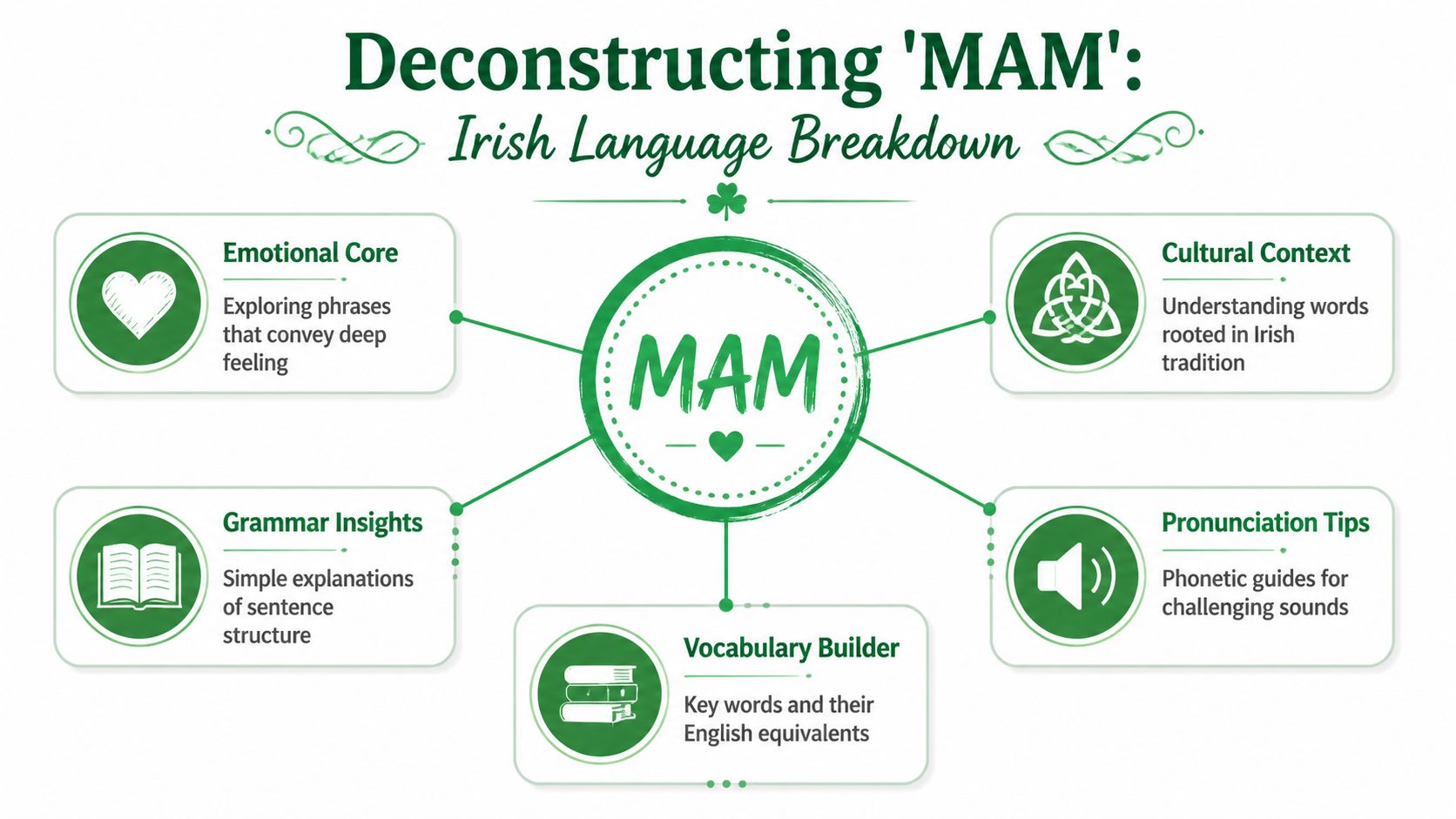
That’s why I don’t treat “MAM” as just a translation exercise. I treat it as a compact lesson in modern Irish usage, pronunciation, and culture.
The Cultural Context Behind MAM
Kneecap come from Belfast, and their public image has long been tied to confrontational rap, bilingual wordplay, and a style that doesn’t try to smooth out rough edges. That’s part of why “MAM” caught people off guard. The song didn’t abandon their identity. It revealed another side of it.
Why the song hit differently
According to a lyric background summary for Kneecap’s “MAM”, the single was released in December 2020 and marked a clear shift from the group’s usual provocative hip-hop style. The same source notes that the song became a heartfelt tribute to mothers and was directly shaped by the tragic suicide of Móglaí Bap’s mother, while also explaining that the track had already been in development before her death. That detail matters because it changes how we hear the song. It wasn’t written as a neat public statement afterward. It became something more painful and more personal as events changed around it.
The song also blended Irish and English to express gratitude for the kind of labour mothers often do unassumingly. Not glamorous work. Daily work. Care work. The kind learners instantly recognise once they understand the lines.
One more detail gives the song extra weight. Proceeds from “MAM” supported Samaritans, a suicide prevention charity, which ties the song’s personal grief to a wider act of care in the world.
A song can be rebellious in one context and deeply tender in another. “MAM” does both without sounding false.
Why this matters for learners
If you only read the lyrics as isolated lines, you’ll miss why they feel so direct. The tenderness isn’t accidental. It stands against the band’s usual public stance, and that tension is part of the song’s force.
That’s also why songs are useful in language study. They carry social meaning, not just vocabulary. If you’re interested in how communal singing and lyric recall help memory, this short piece on karaoke history from MyKaraoke Video is a handy side read. Singing culture often gives language learners a way into pronunciation and repetition without making practice feel like homework.
Kneecap’s wider story also helps place “MAM” in their creative arc. If you want to see how their later work is framed in a different mode, this note on the Kneecap Fenian album gives useful context.
Kneecap MAM Lyrics and Full English Translation
If you came here looking for kneecap mam lyrics, you probably want two things. First, a clear sense of what the song says. Second, a version you can study without bouncing between tabs and half-correct snippets online.
A quick note before the learning table below. Because lyric rights can be complex, I’m not reproducing a complete official text of the song here. For study purposes, it’s often better to work with key lines and a faithful learning translation anyway. That keeps the focus on comprehension, grammar, and pronunciation.
Key lines for study
Irish line
Plain English meaning
Seo ceann do na mná
This one is for the women
a bhíonn ag obair gach lá
who are working every day
MAM
Mam
do na mná
for the women
gach lá
every day
Those lines are enough to begin serious study because they contain a lot of useful Irish structure. You have a demonstrative opening, a prepositional phrase, a relative clause, and a common time phrase. That’s more than enough material for a beginner or intermediate learner to mine.
How to read the chorus naturally
Take the line Seo ceann do na mná. A learner often tries to translate word by word in rigid order. That leads to awkward English like “Here head to the women” or “This head for the women,” because ceann can mean “head” in some contexts but also “one” or “a thing/item” in others. In this lyric, it means “this one.”
Then look at a bhíonn ag obair gach lá. Many learners freeze at this point because the phrase doesn’t map neatly onto basic schoolbook English. The clean reading is “who are working every day” or more naturally “who work every day.”
Don’t chase a perfect one-word match for every Irish word. Chase the meaning of the full phrase.
A learner-friendly way to use the lyrics
Try this three-pass method with the song:
Pass one, just listen Don’t stop the track. Only notice repeated words such as mná, obair, and lá.
Pass two, mark the chunks Break the chorus into thought groups: Seo ceann / do na mná / a bhíonn ag obair / gach lá.
Pass three, speak with meaning Say the line as if you’re dedicating something to someone you care about. Emotion helps rhythm, and rhythm helps memory.
Where beginners usually get stuck
A few confusion points show up again and again:
“Mná” looks strange because learners know bean for “woman.” Irish often changes a noun’s form depending on grammar. You’re seeing one of those changes.
“Bíonn” isn’t the basic present tense beginners usually meet first. It expresses something habitual or repeated.
“Ag obair” is a verbal noun phrase. In plain terms, it works like “working.”
If you only study one part of the song, study the chorus. It gives you high-frequency grammar wrapped in a line that’s emotionally memorable.
A Line-by-Line Irish Language Breakdown
A good song line does more than sound nice. It hides grammar inside rhythm. “MAM” is excellent for that because the key phrases are short, natural, and full of structures that appear all over everyday Irish.
As noted on Kneecap’s band page), “MAM” was released in December 2020 with minimalistic production and had over 1 million YouTube views by 2024, which helps explain why so many learners encounter it early when exploring modern Irish-language music.
Phrase 1 and what Seo is doing
Seo ceann do na mná
Start with seo. It usually means “this” or “here.” In song language, it often works like a presenter's gesture. You’re offering something to someone.
seo = this
ceann = one, item, one piece
do na mná = for the women
A natural translation is “This one is for the women.”
Phrase 2 and the meaning of mná
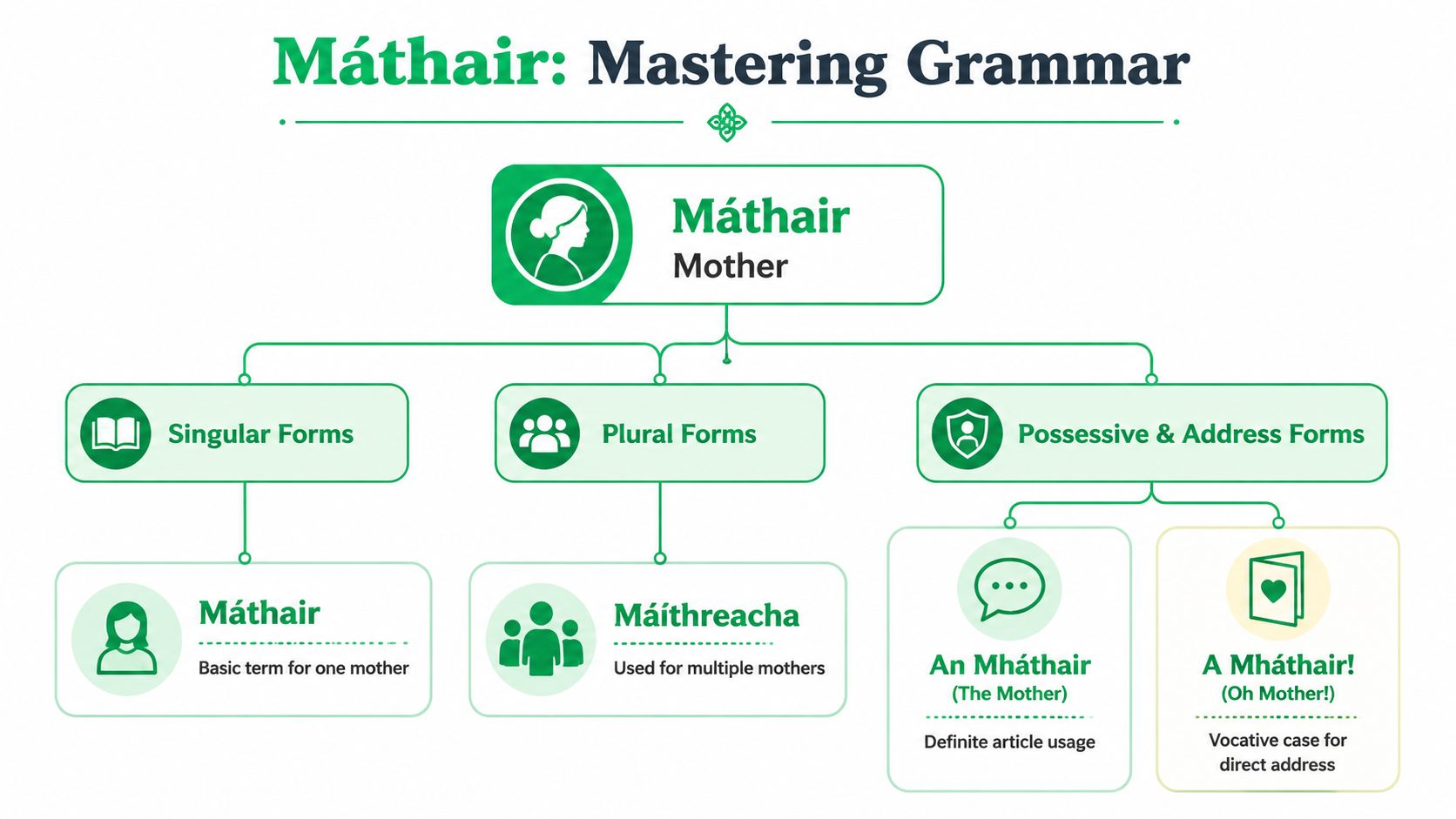
The form mná often throws beginners. You learn bean for “woman,” then suddenly the song gives you mná.
Here’s the useful takeaway:
Base form
Related form in the lyric
Meaning
bean
mná
woman, women depending on structure
You don’t need to master every noun pattern immediately. You only need to notice that Irish changes word forms more often than English does. That’s normal, not a sign that you’ve missed a whole chapter.
Phrase 3 and why bíonn matters
a bhíonn ag obair gach lá
This is one of the most valuable chunks in the whole song. Bíonn is the habitual present of the verb “to be.” It describes actions that happen regularly.
Compare the feel:
tá sí ag obair = she is working right now
bíonn sí ag obair = she works, or she is usually working
That’s why the lyric carries the sense of everyday effort, not a single moment.
Grammar shortcut: When you see bíonn, think “usually is” or “habitually is.”
Phrase 4 and how ag obair works
Ag obair means working. This is a verbal noun structure. In learner-friendly English, that means Irish often builds ongoing actions with ag + verbal noun.
Examples based on the same pattern:
ag canadh = singing
ag ithe = eating
ag foghlaim = learning
Once you know that pattern, song lyrics become much less mysterious.
Phrase 5 and the time marker gach lá
Gach lá is a great everyday phrase because you can reuse it immediately.
gach = every
lá = day
You can swap in new nouns later:
gach oíche = every night
gach seachtain = every week
That’s one reason songs help so much. A single lyric chunk can become a model for dozens of your own sentences.
Phrase 6 and the little word a
Learners often skip over a because it looks too small to matter. It matters a lot. In this line, it introduces a relative clause, which is a clause that adds information about the women.
So instead of learning a technical rule first, learn the feeling of the line:
na mná = the women
a bhíonn ag obair gach lá = who work every day
If you can understand that relationship, your grammar is already improving.
Pronunciation Guide and Practice Activities
Irish spelling gets much easier when you stop expecting English rules from it. “MAM” is a nice training ground because the repeated phrases let you rehearse the same sounds several times without boredom.
Say these words out loud
Use these as rough learner approximations, not perfect phonetic truth:
Word or phrase
Say it roughly like
Seo
shoh
ceann
kyan or kyown, depending on accent
mná
mraw or mnah
bíonn
bee-un
ag obair
ag ober
gach lá
gahkh law
If your version isn’t perfect, that’s fine. Aim for confidence first, accuracy second. Then refine.
For a deeper foundation, this Irish pronunciation guide is useful when you want to connect song sounds to broader pronunciation patterns.
Say the line slowly once, rhythmically once, and naturally once. Those are three different skills.
Three practice activities that actually help
1. Echo-and-pause practice
Play the chorus. Pause after each chunk and repeat it back.
Try this sequence:
Seo ceann
do na mná
a bhíonn ag obair
gach lá
This is better than repeating the whole line badly ten times. Short chunks train your ear.
2. Rewrite the dedication
Keep the grammar frame and change the ending.
Examples:
Seo ceann do m’athair
Seo ceann do mo chara
Seo ceann do na daoine a chabhraíonn liom
You don’t need to write poetry. You need to reuse structure.
3. Record your own version
If you want a playful way to hear rhythm and stress, tools that create singing voices from text can help you experiment with melody and timing before you try your own spoken or sung version. Use that kind of tool carefully. The value is in hearing phrase flow, not in outsourcing your practice.
A small listening challenge
Listen once and identify only these items:
A family word
A time phrase
A work-related phrase
That trains selective listening. It also stops you from panicking when you don’t understand every word.
Bring Irish Music into Your Learning Journey
Music gives you something textbooks often can’t. It gives memory a reason to care. When a learner remembers a line from “MAM,” they’re not just recalling vocabulary. They’re recalling voice, rhythm, feeling, and cultural context all at once.
That’s why songs like this deserve a place in your routine. Not as a break from study, but as part of study. A single chorus can teach noun forms, habitual action, pronunciation habits, and social meaning in one sitting. You’re far more likely to remember gach lá from a song than from an isolated flashcard.
A simple way to build this into study
You don’t need an elaborate system. Try this weekly cycle:
One listen for enjoyment so the song stays alive as music
One focused listen with notes where you mark useful chunks
One speaking session where you read or sing lines aloud
One writing task where you adapt a phrase into your own Irish
If you enjoy looking at how songs travel and reach new listeners, this guide on strategies for musicians to get heard is a worthwhile side read because it helps explain how modern tracks move through online spaces and find audiences beyond their local scene.
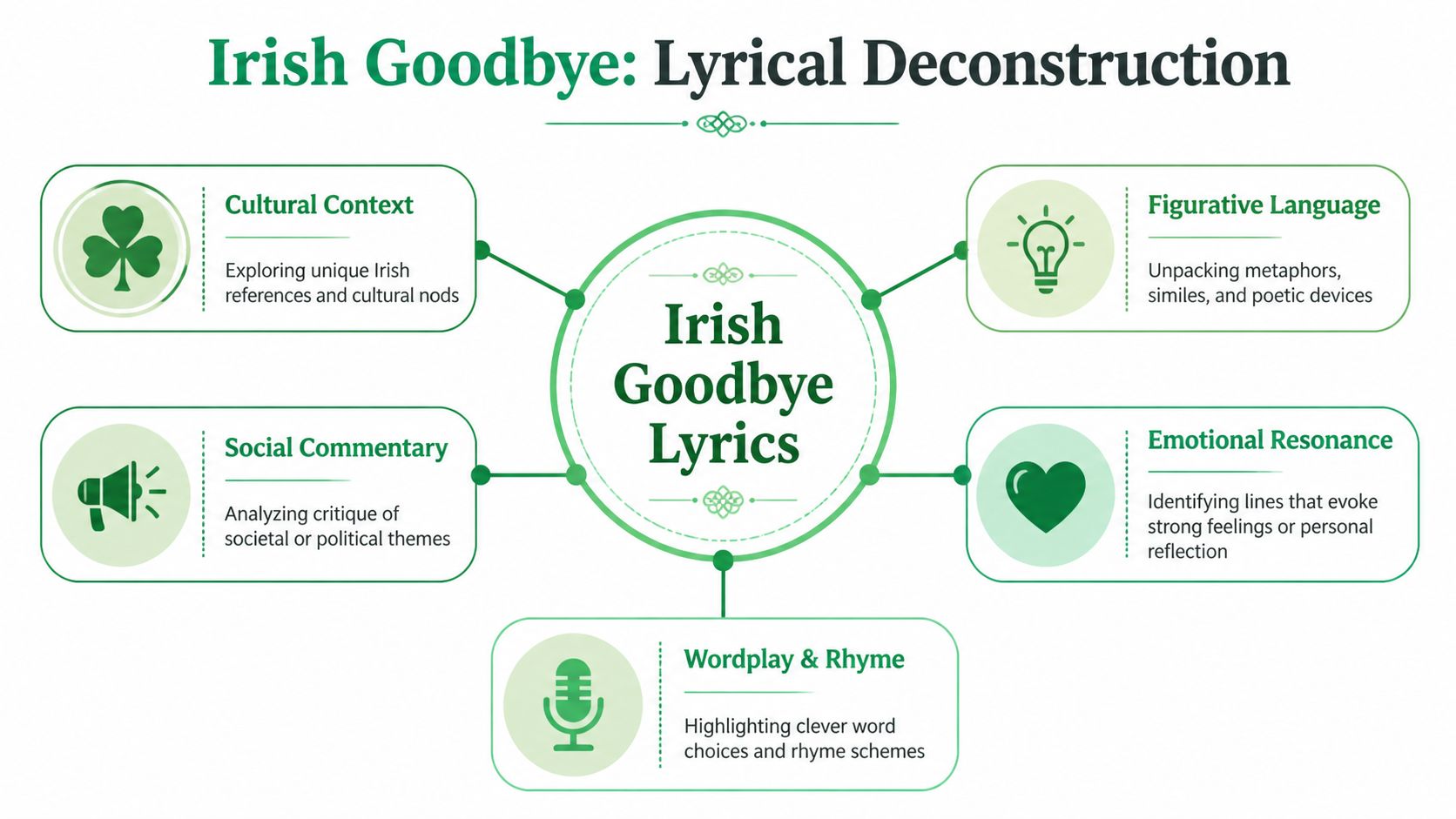
For more lyric-based learning, the Kneecap Irish Goodbye lyrics guide is another useful comparison point. It lets you see how tone, vocabulary, and learner difficulty can change from one song to another.
The best Irish study material is often the material you’ll return to willingly.
That’s the core value of kneecap mam lyrics for learners. The song is emotionally direct, linguistically rich, and short enough to revisit often. That combination is rare. When you find it, use it.
If you want to turn songs like “MAM” into real speaking progress, Gaeilgeoir AI is a strong next step. It helps beginners and intermediate learners practise Irish through guided conversations, pronunciation support, adaptive quizzes, and real-world scenarios, so the phrases you recognise in music become language you can use.
You want to learn a language, but you're on your own. No class. No teacher waiting for homework. No built-in schedule. Just you, a phone, a browser full of tabs, and that nagging feeling that you should have started months ago.
That situation is more normal than commonly perceived. A lot of independent learners don't fail because they're lazy or “bad at languages.” They fail because the process looks fuzzy. They don't need more motivation speeches. They need a working system.
The good news is that solo language learning is far more realistic now than it used to be. You can build reading, listening, speaking, and writing into daily life without arranging your week around a classroom. And if you're worried you've started too late, that old fear doesn't hold up very well. A landmark MIT study on the language-learning critical period analyzing nearly 670,000 participants found that while children learn languages faster, adults can still master grammar effectively through deliberate, immersive self-study, with the critical period for rapid learning extending to age 17-18.
That matters because it changes the question. The question isn't “Am I too old?” It's “How do I build a method I can consistently follow?”
I've taught myself a language, and the biggest lesson wasn't about talent. It was about structure. You need a clear reason, the right kind of input, regular output, and a system that keeps you showing up. If you're starting with a new script, even a focused beginner step like mastering Hangul can show how much easier things get once the first layer is made simple. The same principle applies more broadly, especially if you're learning later in life and want a practical path like this guide to learning a language as an adult.
Introduction A New Era for Independent Language Learners
Learning alone used to mean piecing together a textbook, a dictionary, and whatever audio you could find. Now the challenge isn't access. It's choosing a method that doesn't collapse after the first burst of enthusiasm.
That's why “how to learn a language on your own” needs a better answer than “download an app and stay consistent.” Consistency matters, but it doesn't appear by magic. It grows out of a plan that matches your life, your goals, and your current level.
You don't need a perfect method. You need a method you'll still be using next month.
Adult learners often carry unnecessary pressure. They think every mistake proves they missed their window. In practice, adults usually do better when they stop chasing the feeling of school and start building a repeatable home system with clear inputs and clear outputs.
A strong self-study plan has four parts:
A clear destination: You know what you're trying to do with the language.
Useful input: You spend time reading and listening to material you can mostly understand.
Regular output: You write and speak often enough to test what you know.
A routine: You make the work small enough to repeat.
That blueprint works whether you're learning Spanish for travel, German for work, or Irish to reconnect with family history. It also matters even more for languages that don't have endless media and tutoring options. In those cases, structure matters as much as motivation.
Laying Your Foundation with Clear Goals
You sit down on a Monday full of motivation, open three apps, save two YouTube playlists, and buy a notebook. By Thursday, you're stuck on a basic question. What am I supposed to do first?
That confusion usually starts with the goal.
Start with your real reason
Your reason for learning decides what belongs in your study plan and what can wait.
A traveler needs survival language. A heritage learner may care more about family stories, songs, and everyday conversation. Someone preparing for an exam needs timed prompts, common topics, and practice under pressure. These are three different jobs, so they need three different first months.
This matters even more if you're learning a language like Irish. You may not have endless graded readers, local tutors, or large speaking communities nearby. In that case, your goal acts like a filter. It helps you choose the right textbook, the right audio, and the right kind of practice. It also helps you use AI well. A tool like Gaeilgeoir AI can give you speaking and writing practice tied to the situations you care about, instead of sending you through a generic sequence built for a more widely taught language.
“I want to be fluent” feels motivating for about five minutes. After that, it becomes fog.
A better goal gives you a target you can practice. SMART goals can help here. Keep them specific, measurable, achievable, relevant, and time-bound.
Compare these:
Vague: I want to get good at Irish.
Clear: In three months, I want to introduce myself, order food, ask for directions, and understand the main point of a short beginner conversation.
The second version gives you a map. You know which vocabulary to collect, which dialogues to practice, and what success looks like.
Use functions before levels. “Ask for help at a train station” is easier to study than “reach B1.” Level labels have their place, but they are poor daily instructions.
A lot of self-learners also underestimate scale. Language learning works more like saving money than cramming for a quiz. Small deposits add up. Random bursts do not. The U.S. Foreign Service Institute is often cited for showing that some languages take far more guided study time than others, as summarized in this overview of FSI time estimates. You do not need to count every hour. You do need to expect progress to come from repeated practice over time.
Build a goal that can survive real life
This is the part many guides skip. A good goal should still make sense on a tired Tuesday night.
If your plan says “study for 90 minutes every day,” but your evenings are crowded, the plan is brittle. If your plan says “practice one 10-minute listening task, review 15 useful words, and answer one short prompt,” it has a much better chance of surviving.
I learned this the hard way. My early goals were too big and too abstract. Once I switched to smaller job-based targets, my study sessions got calmer. I was no longer asking, “How do I learn the whole language?” I was asking, “Can I handle this one conversation?”
That question is easier to answer.
A practical first-month plan looks like this:
Pick three situations you care about, such as meeting relatives, ordering in a café, or joining a simple chat online.
List the words and phrases that appear in those situations again and again.
Choose a few resources that match those situations, including one source of feedback. If you need options, this guide to language learning apps for beginners can help you compare tools.
Set one weekly performance check such as recording yourself, writing a short dialogue, or answering an AI prompt aloud.
That gives you a working system, not just a wish list.
A quick walkthrough can help if you'd rather hear this idea explained out loud before writing your own plan.
Building Your Immersion Engine with Input
Most of your progress will come from input. Not passive exposure in the background while you scroll, but regular contact with language you can mostly follow.
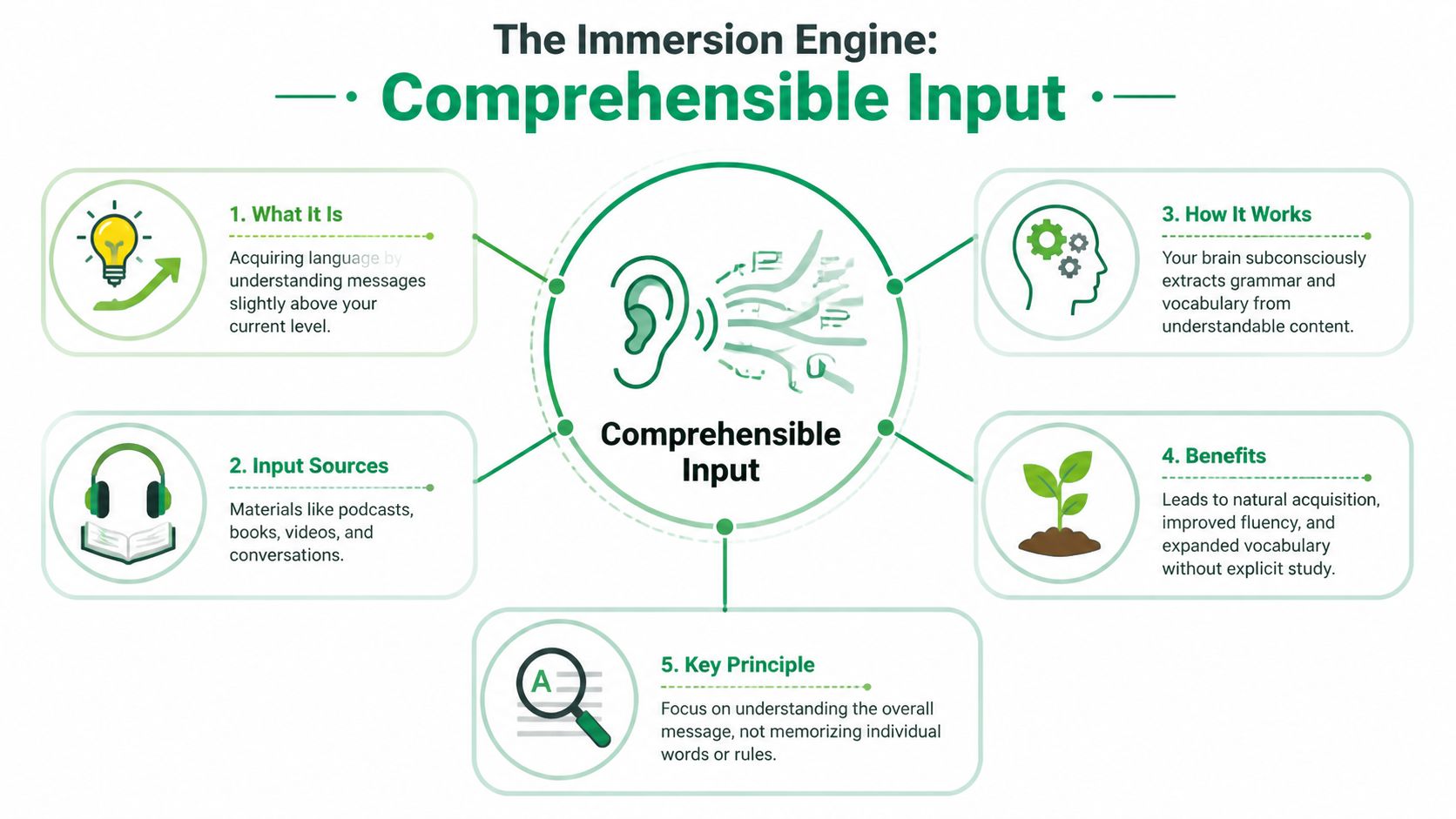
What comprehensible input actually means
Comprehensible input means reading or listening to language that is slightly above your current level, but still understandable enough that your brain can keep extracting meaning. You don't need to know every word. You need enough context to follow the message.
That matters because language doesn't grow in a random order. Research discussed in Scott H. Young's article on how language acquisition develops through input notes that language acquisition follows a fixed developmental sequence. One study found that after two years in an input-based class, students performed as well or better on speaking tests than those in traditional classes, despite never formally practicing speaking.
That's reassuring for beginners who feel behind because they aren't talking much yet. Input isn't a delay from “real learning.” It is real learning.
How to choose input you can grow from
A lot of beginners get stuck because they choose materials at the wrong level. Native TV with no support is often too hard. Children's materials can be oddly unnatural or boring. The sweet spot is content that feels challenging but not crushing.
Try a mix like this:
Beginner dialogues: Short exchanges with audio and text.
Graded readers: Simple stories written for learners.
Learner podcasts: Slower speech with repeated patterns.
Subtitled video: Short clips where you can connect sound, text, and meaning.
Topic-based lessons: Materials built around common situations like shopping or travel.
When you use them, don't turn everything into a translation exercise. Try this instead:
Listen once for the general meaning.
Read or replay with support.
Notice a few recurring words or structures.
Listen again without stopping every few seconds.
That last step matters. If you interrupt constantly, you never build flow.
Focus on understanding the message first. Detailed analysis can come after.
For low-resource languages, finding enough comprehensible input can be the hardest part. That's one reason some learners use tools like Gaeilgeoir AI, which provides guided real-world conversations, pronunciation support, adaptive quizzes, and practice built around the 1,000 most-used Irish words. For solo learners, that kind of structure reduces the time spent hunting for suitable material and increases the time spent engaging with the language.
A simple weekly input mix might look like this:
Input type
Example use
Short audio
Repeat one beginner dialogue during a walk
Reading
Read one short text and highlight recurring phrases
Video
Watch a subtitled clip twice, first for gist, then for details
Review
Revisit familiar material to build speed and confidence
If you're wondering whether you should study grammar at all, the answer is yes, but in support of input, not instead of it. Grammar helps you notice patterns. Input helps those patterns settle into real understanding.
Activating Your Knowledge Through Output
Input builds recognition. Output shows you what you can do.
A lot of solo learners wait too long to speak or write because they want to feel ready first. That feeling usually doesn't arrive on its own. You get ready by producing imperfect language, noticing gaps, and trying again.
Start with low-pressure output
You do not need to jump straight into live conversation.
Start with forms of output that feel safe and repeatable:
Self-talk: Describe what you're doing while cooking, commuting, or cleaning.
Mini journaling: Write three to five sentences about your day.
Sentence rebuilding: Read a model sentence, close it, then recreate it from memory.
Voice notes: Record yourself answering one simple prompt.
These exercises work because they force retrieval. You stop recognizing words and start reaching for them. That's where a lot of growth happens.
A useful pattern is to recycle the same topic for a few days. For example, if the topic is introductions, you might write a short paragraph on Monday, say it aloud on Tuesday, record it on Wednesday, and expand it on Thursday.
Use structured speaking before live conversation
Speaking to another person is valuable, but it can feel like too big a jump for beginners. That's especially true when you're learning a language with fewer available tutors, fewer local communities, and less casual media.
That gap is one reason AI conversation practice has become more relevant for solo learners. Most language guides still focus on high-resource languages and often ignore the immersion problem in low-resource languages like Irish. A 2025 Duolingo study discussed in this article on self-learning low-resource languages reported 40% higher retention in low-resource languages using AI conversation simulations, which is especially useful when a learner doesn't have regular speaking partners.
That doesn't mean AI replaces people. It means it can serve as the bridge between silence and real interaction.
Use that bridge in stages:
Stage
What you do
Private rehearsal
Read model dialogues aloud
Guided response
Answer simple prompts with support
Simulated conversation
Practice short exchanges in common scenarios
Live interaction
Talk with a tutor, partner, or community member
Mistakes made during output aren't proof of failure. They're the map of what to practice next.
Writing helps here too. If you can't yet say a sentence smoothly, write it first. Then say it. Then say it again without looking. Spoken fluency often starts as written clarity plus repetition.
If you're wondering how much correction you need, keep it selective. Correct everything and you'll freeze. Correct nothing and mistakes fossilize. Pick one target at a time. Maybe this week it's word order. Next week it's pronunciation of a recurring sound. Keep the spotlight narrow enough that you can improve without feeling swamped.
Creating Habits and Staying Consistent
Tuesday goes well. You review a few words with coffee, listen to Irish on your walk, and write two lines before bed. Wednesday gets busy, Thursday disappears, and by Friday it feels like you have "fallen off."
That feeling tricks a lot of independent learners. The problem is usually not motivation. It is a routine that depends on having extra time and extra willpower every day.
A good self-study system works like a stove with a pilot light. You do not want to rebuild the fire from scratch each morning. You want a small flame that stays on, even during messy weeks.
Build a routine that can survive ordinary life
Set up your study plan around moments that already happen. That is why habit stacking works. You attach language practice to an existing part of your day, so the cue is built in.
For example:
After breakfast, review five to ten flashcards.
During lunch, listen to one short audio clip.
Before bed, reread a familiar paragraph or write three sentences.
Small actions count because they remove friction. You are no longer asking, "When should I study?" You already decided.
This matters even more if you are learning a low-resource language like Irish. You may not have endless graded readers, local classes, or people to practice with on demand. Your routine has to create regular contact with the language on purpose. That is where a tool like Gaeilgeoir AI can fit into the system. Not as your whole plan, but as one reliable place to practice, get feedback, and keep the language present between human conversations.
A weekly plan helps because it shows whether your routine has range. If every day is only flashcards, you will remember words but struggle to use them. If every day is only passive listening, you may recognize patterns without being able to produce them. The goal is a repeatable mix.
Make consistency easier than quitting
Solo learners need visible proof that effort is adding up. A teacher normally provides that. When you study alone, your system has to provide it instead.
Track completed sessions. Put an X on a calendar. Keep a simple note in your phone. Use streaks if they encourage you, and ignore them if they make you tense. The point is not to turn learning into a video game. The point is to make progress tangible enough that your brain believes it is worth returning tomorrow.
If you want a broader framework for building routines, these practical steps for habit formation are a useful complement to language-specific planning.
Memory also needs structure. If you keep meeting the same word and forgetting it a week later, the problem is often timing, not effort. A short guide to spaced repetition for language learning can help you review vocabulary at the point where it is about to fade, instead of starting over again and again.
Here is a simple schedule that many busy learners can adapt:
Day
Morning (15 min)
Lunch (10 min)
Evening (30 min)
Monday
Review vocabulary
Listen to a short dialogue
Read and reread one short text
Tuesday
Pronunciation practice
Flashcard review
Write a short journal entry
Wednesday
Review phrases
Listen and repeat
Practice speaking prompts
Thursday
Reread familiar text
Quick vocabulary review
Watch subtitled video
Friday
Sentence review
Listen to audio again
Free writing and self-correction
Saturday
Longer reading session
Light review
Simulated conversation practice
Sunday
Review weak points
Passive listening
Weekly recap and planning
Keep the routine stable, but keep the daily minimum small.
A few rules make that easier:
Keep the floor low: On hard days, do the smallest version of the habit.
Reuse material on purpose: Familiar texts and audio build speed and confidence.
Track sessions, not feelings: A short session still counts.
Protect the restart: Missing one day is normal. Restart the next day before the gap grows.
Small wins matter: Ten minutes done regularly will carry you farther than a perfect-looking plan that collapses after one busy week.
If your routine keeps breaking, shrink it until it holds. Then build from there.
Overcoming Plateaus and Common Pitfalls
Every learner hits a stretch where progress feels invisible. You know more than you used to, but you still don't feel comfortable. That's the plateau often misread as failure.
What to do when progress feels flat
The plateau usually means your current materials are too easy to create noticeable growth, but not rich enough to pull you upward. Change the type of challenge, not just the amount.
Try one of these adjustments:
Switch from isolated sentences to short connected stories.
Move from learner audio to slower native content with support.
Pick one recurring topic and go deeper instead of wider.
Record yourself once a week so you can hear changes over time.
Sometimes the fix is not more study. It's better contrast.
How to avoid overwhelm
The other common trap is resource overload. Too many apps, too many channels, too many saved posts. Decision fatigue drains energy before learning even begins.
Commit to a short core stack for a while:
One main input source
One review tool
One output practice method
That's enough for real progress.
Fear of mistakes also needs reframing. Errors are not interruptions to learning. They are the evidence that learning is happening in public rather than staying trapped in your head. If you keep showing up, the awkward stage passes.
Frequently Asked Questions About Self-Study
Some questions tend to linger even after you have a plan. Here are concise answers to the ones I hear most often.
Question
Answer
How long does it take to learn a language on your own?
Longer than most beginners hope, but often faster than inconsistent classroom study. Your timeline depends on the language, your goal, and how regularly you practice. Aim for steady months, not quick fixes.
What's the first thing an absolute beginner should do?
Pick one clear goal and one beginner-friendly source of input. Then build a tiny daily routine around it. Don't start with ten tools. Start with one path you can repeat.
Do I need to speak from day one?
You don't need live conversation on day one, but you should begin some form of output early. Self-talk, journaling, repeating dialogues, and voice notes are all good starting points.
Do I need grammar study?
Yes, but lightly and in context. Grammar helps you notice patterns. It shouldn't replace reading, listening, writing, and speaking.
Can I become fluent without classes?
Yes, but “fluent” should mean functional and growing, not perfect. Independent learners do well when they combine structured input, regular output, and a routine they can keep.
If you remember one thing, make it this: learning alone doesn't mean learning randomly. A clear goal, understandable input, repeated output, and a workable habit system can take you much farther than scattered effort ever will.
If you want a structured way to practice Irish independently, Gaeilgeoir AI offers guided real-world conversations, pronunciation support, adaptive quizzes, and scenario-based practice that fits around a busy schedule. It's especially useful if you want to start speaking early, prepare for the Leaving Cert oral, or rebuild your Irish through short daily sessions without needing a class or a partner.
I’ve watched beginners light up when they hear Irish used in a song that feels current, messy, and alive rather than textbook-neat. That’s the effect Kneecap’s “Irish Goodbye” can have.
If you’re searching for kneecap irish goodbye lyrics, you probably want more than a direct translation. You want to know what the words are doing, why they hurt, and how Irish carries that feeling.
Kneecap have always stood out because they treat Irish as a living street language, not a museum piece. Their music is rude, funny, political, local, and often deliberately confrontational. That’s part of why “Irish Goodbye” hits so hard. It arrives in the middle of that public persona and opens a private wound.
“Irish Goodbye” is the closing track on Fenian, Kneecap’s second studio album, released on May 1, 2026. The album has 14 tracks, and the song was written by Naoise Ó Cairealláin, better known as Móglaí Bap, as a tribute to his mother. That background matters because the song doesn’t sound like a detached literary exercise. It sounds like someone trying to remember properly.
For language learners, that makes it unusually useful. You’re not only hearing Irish grammar and vocabulary. You’re hearing Irish used for mourning, memory, and wordplay. If you’ve mostly met Gaeilge through schoolbook dialogues, this song shows a different reality. It can carry grief just as naturally as any other language.
A lot of English-language coverage of Kneecap notices the shock value first and the Irish-language craft second. That’s why it helps to approach this song through both lenses at once: as music and as language. If you want more songs broken down in that spirit, the Kneecap lyrics archive on Gaeilgeoir is a useful place to keep reading.
Some listeners also like to pair songs with physical keepsakes, lyric books, or records when they’re sitting with difficult music. If that’s you, this roundup of unique gifts for music lovers has some thoughtful ideas that feel more personal than generic merch.
Main idea: “Irish Goodbye” matters because it brings together three things at once: modern Belfast rap, intimate grief, and contemporary Irish usage.
The Powerful Story Behind the Song
Móglaí Bap wrote “Irish Goodbye” for his mother, Aoife Ní Riain, who died by suicide in October 2020. Knowing that changes how you hear the song. The tenderness isn’t a pose. The ordinary details in the lyrics feel hard-won, as if they’ve been pulled back from anger and shock.
A personal song with a public weight
The song’s emotional force also comes from where it comes from. In West Belfast, grief of this kind doesn’t sit only inside one family. It sits in streets, in silence, in community memory. In that wider context, the song carries more than one person’s pain.
Northern Ireland reported 1.8 suicides per 10,000 population in 2020, a figure cited in The Journal’s reporting on Móglaí Bap and the song. That same report frames the track within a West Belfast community where suicide has long been felt with particular intensity, alongside intergenerational trauma after the Troubles.
That context matters for interpretation. Some listeners hear the title and expect irony, swagger, or a joke. Kneecap are certainly capable of all three. Here, though, the title points toward absence. A departure without closure. A person gone before the conversation can finish.
Why the song feels so specific
One reason the lyrics are moving is that they don’t reach for grand statements all the time. They keep returning to everyday life. That’s often how grief works. You don’t only miss milestones. You miss habits, routines, and the small things you once ignored.
Later in the song, the emotional field widens further because Kae Tempest appears on the track. The collaboration adds another voice without diluting the intimacy. Instead, it gives the song a second register. One voice remembers from inside the wound. The other helps frame the loneliness around it.
A performance clip helps show how much restraint the song carries:
Grief songs often become strongest when they stop trying to sound “important” and start naming what was ordinary.
If you’re reading the kneecap irish goodbye lyrics for meaning, this is the foundation. The song isn’t just sad. It’s trying to remember a person beyond the manner of death.
Kneecap Irish Goodbye Lyrics and English Translation
A quick but important note first. I can’t reproduce the full copyrighted lyrics here. What I can do is guide you through selected lines and phrases, give you a plain-English gloss, and help you read them as a learner rather than just as a fan.
A note before reading the lyrics
Songs in Irish can frustrate beginners for three reasons:
Literal translation often sounds wrong in English.
Dialect and wordplay can hide the obvious meaning.
Emotion changes syntax. Songwriters bend language for rhythm, stress, and punch.
That means you shouldn’t expect a neat one-to-one match between every Irish phrase and an English sentence. Irish often packs tone into particles, idioms, and cultural references that don’t survive a word-for-word swap.
If you’re unsure about individual words while reading, keep a proper learner-friendly reference beside you. A good starting point is this Irish dictionary guide, especially if you’re trying to tell the difference between a basic translation and a phrase that carries cultural weight.
Selected lines with plain English gloss
Irish line or phrase
Plain English gloss
What to notice
Céad slán leis an Ra
A hundred goodbyes to the “Ra” / a layered farewell
This line works as a pun and sets up the song’s double meanings
slán
goodbye, farewell
More emotionally resonant than a flat “bye”
mo Mha
my mother
The lenition after mo changes the spelling and sound
na rudaí beaga
the small things
Ordinary details become central in grief writing
na hamanna maithe
the good times
Memory shifts from pain toward recall of joy
The opening line deserves special care because beginners often freeze when they meet a phrase they can’t decode word by word. Don’t panic. Start with the part you know. Slán means farewell. Céad can intensify the leave-taking. Then ask what else the line might be doing culturally, not just grammatically.
Another useful habit is to separate dictionary meaning from song meaning.
Dictionary meaning tells you what a word usually means.
Song meaning tells you why that word was chosen here.
Cultural meaning tells you what an Irish-speaking audience might hear underneath it.
That’s how you move from translation to understanding.
Practical rule: If a line in Irish seems odd in English, don’t assume you’ve failed. Assume the line is carrying more than one job.
For this song, that’s especially important because the lyrics are shaped by memory. Some phrases are simple on paper and devastating in context. “The small things” doesn’t look difficult. In the song, it’s one of the hardest ideas to hear because it points to the texture of a life shared with someone who is gone.
If you want to study the kneecap irish goodbye lyrics properly, copy out a few lines by hand, gloss only the key nouns and verbs, and then listen again. Don’t rush to “solve” every line immediately.
Deconstructing the Lyrics Key Phrases and References
The lyrics gain power from what they imply, not only from what they state. Kneecap are skilled at packing several layers into one phrase. In “Irish Goodbye,” that technique becomes less comic and more elegiac.
What Céad slán leis an Ra is doing
The phrase “Céad slán leis an Ra” is one of the song’s most discussed openings because it doesn’t operate on one level only. In the verified reporting, it’s described as a clever Gaelic pun that says goodbye both to the UK and to personal loss. That’s classic Kneecap in one sense. Political language and private feeling are jammed into the same line.
For learners, the trap is trying to flatten that into a single English equivalent. Don’t. Let it remain layered. The line is doing farewell, irony, identity, and grief at once.
That kind of compression is one reason lyric art resonates with people. A short line can hold more than a paragraph if the phrase is built well. If you enjoy that side of songwriting, this piece on how to curate your walls with lyric art is a thoughtful read.
How memory shapes the song
The song also has a clear inner movement. It doesn’t merely list emotions. It moves from trigger to recollection, from recollection to changed perception. In a Vice interview about the song’s creation, Móglaí Bap described seeing a documentary from the 1990s featuring his father. That footage helped shift him from “constant sad memories” toward “happier times.”
That detail helps explain why the lyrics keep returning to everyday images. The song isn’t trying to narrate grief in an abstract way. It’s rebuilding memory through ordinary scenes.
Here are three useful ways to read the structure:
Trigger first: an outside stimulus activates memory.
Detail second: the song focuses on mundane, domestic things.
Meaning last: those details become the proof of love and loss.
This is why the track feels organized even when it sounds emotionally raw. The writing has shape. The feelings are intense, but the lyric logic is careful.
Some songs tell you what the singer feels. This one shows you how the feeling changes when memory changes.
A beginner may also get confused by the title itself. In everyday English, “Irish goodbye” often means leaving without announcing it. In this song, that phrase takes on a much darker charge. It becomes a title about disappearance, unfinished speech, and the ache of not getting the ending you wanted.
A Language Learners Guide to the Song
Modern music is one of the best ways to meet Irish as a living language, not a classroom relic. That matters because only 1.7% of Ireland’s population speaks Irish daily, according to 2022 Census data cited in The Journal’s coverage connected to the song. If you want Irish to feel real, songs like this help.
Key vocabulary from Irish Goodbye
Irish Phrase
Pronunciation Guide
English Meaning
Grammar/Cultural Note
céad slán
kayd slawn
a deep farewell, literally “a hundred goodbyes”
Céad can intensify the phrase rather than function as a strict count
leis
lesh
with / to
Common preposition form. It often appears in fixed expressions

mo Mha
muh wah
my mother
mo causes lenition, so máthair changes in form and sound
rudaí beaga
rud-ee byag-uh
small things
Useful plural noun phrase. Very common in everyday Irish
amanna maithe
am-anna mah-ha
good times
Plural structure. A strong phrase for memory and storytelling
If you’re new to pronunciation, don’t aim for perfection on day one. Irish spelling is consistent, but it follows Irish sound rules, not English ones. The phrase mo Mha often catches learners because the written mh doesn’t sound like an English “m” at all.
How to study a song without getting lost
Try this instead of translating every line at once:
Listen for repeated sounds: repeated words are your footholds.
Mark emotional nouns first: words for family, time, memory, goodbye.
Leave clever lines for later: puns and political references make more sense after you’ve got the emotional core.
Read aloud slowly: Irish rhythm helps meaning stick.
A second useful tactic is to build mini-sets. If you learn slán, add related farewell language. If you learn beag, collect a few everyday adjective phrases with it. Songs are sticky memory tools because they connect sound, feeling, and repetition.
Read the lyrics as if you’re learning a person’s way of speaking, not just a list of vocabulary.
That shift helps a lot. Irish in songs isn’t sterile. It bends toward intimacy, local identity, and voice. “Irish Goodbye” is a strong example because the language never feels ornamental. It feels necessary.
Practice Irish with Modern Music on Gaeilgeoir AI
The best reason to study a song like this isn’t to impress anyone with a translation. It’s to hear how Irish lives now. Kneecap use Gaeilge for grief, wit, tension, and cultural memory. That makes the song valuable even if you only understand part of it on first listen.
A lot of learners wait until they feel “ready” before touching real music. That’s backwards. Real songs give you a reason to keep going. They attach vocabulary to emotion, and emotion helps memory. “Irish Goodbye” is difficult in places, but it rewards slow listening because every phrase is tied to something human.
If you want to keep building from songs into conversation, pronunciation, and everyday use, it helps to practice with tools that treat Irish as something spoken now, not only studied for exams. Resources that focus on living language, including learning Gaelic language with AI, can make that bridge much easier.
The important part is consistency. Take one line, one phrase, one sound pattern. Learn it well. Then return to the song and hear more than you heard before.
Say bodhrán as bow-rawn, rhyming with cow brawn. That’s the standard form used in over 90% of English-language tutorials, so if you’re learning the pronunciation of bodhran for the first time, that’s the best place to start.
You’ve probably seen the word on a festival poster, in a YouTube lesson, or in a list of Irish instruments and paused for a second. The spelling looks unfamiliar, especially if you’re coming from English. Those middle letters seem like they should make a sound, and the accent mark raises another question.
The good news is that this word is much easier to say than it looks. Once you hear how the sounds fit together, the spelling starts to make sense too. And because the bodhrán is such a central instrument in Irish music, learning to say its name well feels like a small but satisfying step into the sound of Ireland.
A lot of learners meet this word the same way. You’re reading about Irish music, you spot bodhrán, and your brain tries a few guesses. “Bod-ran?” “Boh-drawn?” None of them feels quite right.
Then someone says it out loud and the mystery disappears. Bow-rawn. Suddenly the spelling looks less intimidating, and the word feels memorable instead of tricky.
The fun part is that this isn’t just a vocabulary exercise. The bodhrán is Ireland’s signature frame drum, so saying the name properly puts you closer to the music itself. The word has a pulse to it. Even spoken aloud, it feels rounded and rhythmic.
If you like learning through sound, it can help to hear the name in a musical setting rather than as an isolated dictionary item. Some learners even pair pronunciation practice with loop-based rhythm tools that generate percussion rhythms so they can say the word in time and feel its natural beat.
Practical rule: If you remember only one version today, remember bow-rawn.
That’s enough to get you through most conversations about Irish music, sessions, and instruments with confidence.
The Standard Pronunciation Explained Step by Step
The most widely accepted pronunciation of bodhran is bow-rawn. In broad IPA, it appears as /ˈbˠoːɾˠənˠ/, and this form is used in over 90% of English-language tutorials according to a discussion of common usage and pronunciation variants.
Break the word into two parts
The easiest way to learn it is to split it into two syllables:
Bow Say this like the word in “take a bow” or “the bow of a ship.” It should feel open and smooth, not clipped.
Rawn Think of the sound in “brawn.” Keep it broad and relaxed.
Put them together slowly: bow … rawn.
Then say it again without the pause: bow-rawn.
If you want a second reference point, many learners find it useful to think of:
First part: “bow”
Second part: “rawn,” with that long open sound rather than a flat short “ran”
For a wider grounding in Irish sound patterns, this Irish pronunciation guide helps make words like this feel much less random.
What happened to the dh
People usually get stuck when they look at bodhrán and expect the middle letters to produce a clear English-style consonant. But Irish doesn’t always map neatly onto English spelling habits.
In this word, the dh doesn’t come through as a hard sound in the way many English speakers expect. So you don’t say bod-hrawn or bod-ran. You glide past it.
A simple learner-friendly way to think about it is this:
The written form keeps a trace of older Irish sound patterns.
Modern speech smooths that part out.
Your mouth moves from bo into rán without a heavy stop in the middle.
Say it as a flow, not as a stack of letters.
That matters because English speakers often try to pronounce every visible consonant. Irish often asks you to listen first and spell second.
A good self-check is to say these three versions aloud:
Version
How it sounds
Keep or avoid
bow-rawn
smooth and natural
Keep
bod-ran
hard middle stop
Avoid
boh-drawn
English-heavy and stiff
Avoid
If your version feels percussive in the wrong place, you’re probably giving too much weight to letters that Irish leaves softer.
Why Is It Pronounced That Way
The pronunciation of bodhran makes more sense when you know the word has changed over time. It didn’t begin as a modern music term, and it didn’t always sound the way it does today.
A word with an older life
The word bodhrán originally referred to an agricultural tool such as a sieve or tray, and its pronunciation developed from an older form, likely BOWTH-ran, where the dh had a sound. Over time, that sound softened and disappeared in normal speech, reflecting broader shifts in Irish phonology, as explained in this history of the bodhrán and its linguistic development.
That older form helps explain why the spelling looks fuller than the modern pronunciation sounds. Irish preserved the history in the written word, even as spoken Irish became smoother.
If you’re curious about those broader sound shifts, this overview of what makes Irish sound unique gives helpful context.
Why the accent mark matters
The small mark over the á is called a fada. It matters because it tells you the vowel is longer. In practical terms, that’s why the end of the word opens out into rawn rather than shrinking into a quick ran.
So when you say bodhrán, don’t rush the ending. Let that vowel breathe a little.
The fada is one of the clearest clues Irish gives you. If you ignore it, the word usually sounds flatter than it should.
This is one reason the pronunciation feels musical. The long vowel gives the word shape, and that shape matches the rounded sound people associate with the drum itself.
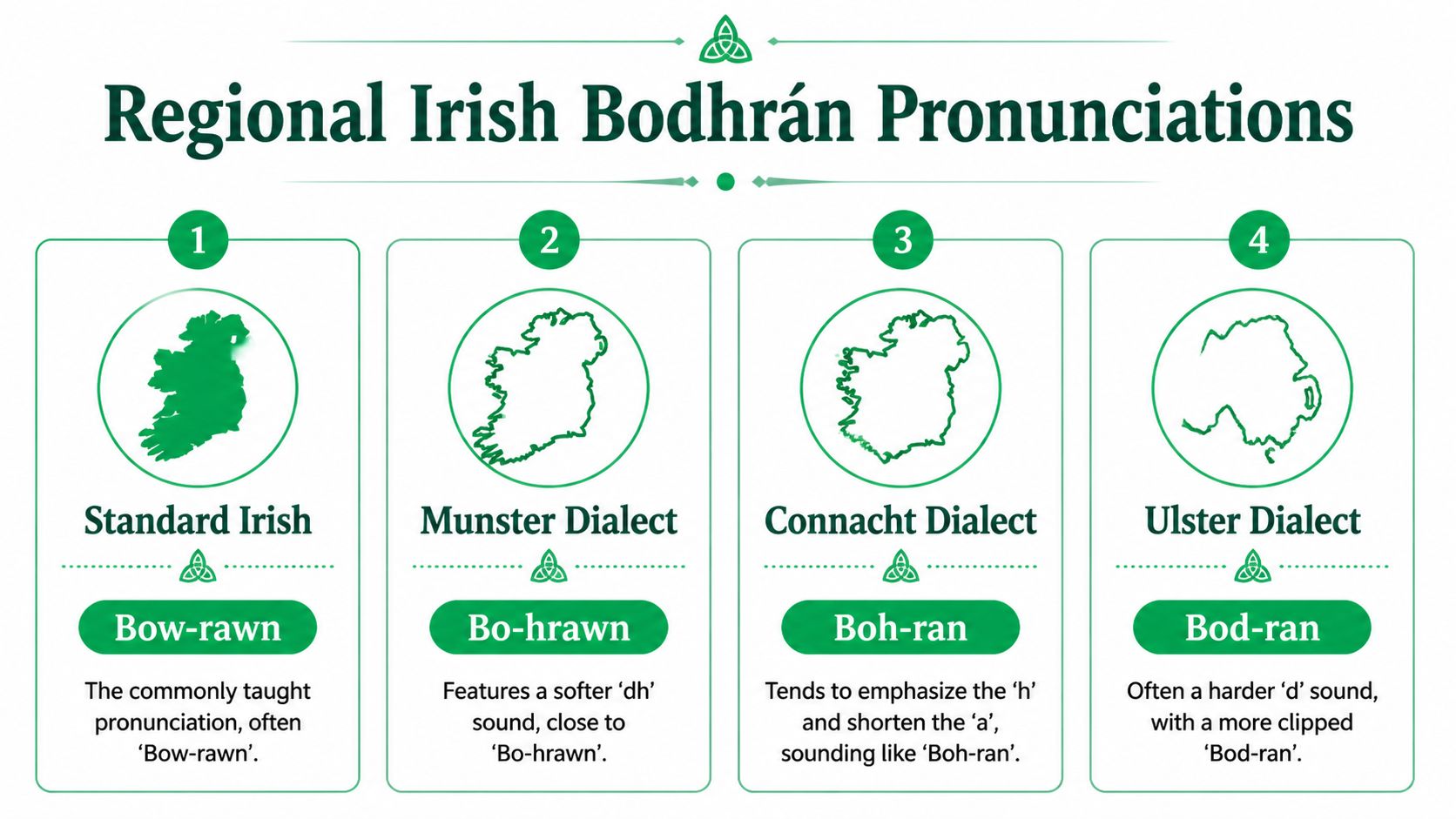
Understanding Regional Irish Variations
You might hear bodhrán said one way in a music lesson, another at a session, and a little differently again from an Irish speaker in another county. That is normal. Irish pronunciation carries local color, much like a tune changes shape as different players pass it around.
Forms you may hear
For a beginner, it helps to treat these as a small family of pronunciations rather than a set of rivals. Your goal is to recognize the shape of the word each time it appears.
Variation
Simple guide
What to notice
Standard or general form
bow-rawn
The most useful starting point for learners and the version you will hear widely outside Ireland.
Ulster-leaning form
boa-ran
The opening can sound a little tighter or more clipped.
Munster-leaning form
bow-rawn
The rhythm may feel slightly different, with a stronger pull in the second part.
Historical older form
BOWTH-ran
Helpful for understanding older speech and the word’s background, not everyday usage for most speakers.
If those spellings look messy, listen for rhythm first. The word still tends to move in two beats. The first beat arrives cleanly, and the ending opens out, like a drum stroke that rings a fraction longer than you expect.
That rhythm-first approach keeps you from getting stuck on tiny vowel shifts.
How to learn variation without getting stuck
Pick one version for your own mouth. Keep bow-rawn as your home base, then train your ear to notice nearby versions without feeling you have to copy every one.
A practical routine looks like this:
Say your base form in tempo: Try bow-rawn with a steady pulse, almost as if you are marking two taps on the drum.
Listen for shape, not spelling: If the opening sounds more like boa, you are still hearing the same word family.
Notice local stress patterns: Some speakers give the second part a little more weight. That can reflect region and habit, not error.
Use tools as a practice partner: Record yourself, compare your version with native or experienced players, and repeat until the rhythm feels natural.
If you want help checking what a tool hears, a guide to AI transcription with Whisper shows how speech technology can capture sound patterns, even if regional accent judgment still needs a human ear.
For a beginner, the aim is not to copy every regional shade at once. It is to hear that Irish is alive, local, and musical. Once you have one clear version in your mouth, the others start to sound less like contradictions and more like variations on the same tune.
Common Mistakes and How to Practice
Most mistakes with bodhrán come from one instinct. English speakers try to pronounce the word exactly as it looks on the page. That’s understandable, but it usually adds sounds or stress that Irish doesn’t want.
Mistakes that trip people up
In Irish phonology, bodhrán is a two-syllable word, the stress falls on the first syllable, and the fada on á creates a long vowel sound like the “ah” in “father.” Over-stressing the second syllable, as in boh-DRAWN, is a common English-speaker error and disrupts the natural flow of the word, as noted in this detailed pronunciation explanation.
Here are the errors I hear most often:
Adding a hard d sound: People say bod-ran because they want every letter to count.
Punching the second syllable too hard:boh-DRAWN sounds theatrical and less natural.
Shortening the final vowel:bow-ran with a quick flat ending loses the shape of the Irish word.
A fast fix is to compare the wrong version with the better one out loud:
bod-RAN → BOW-rawn
boh-DRAWN → BOW-rawn
BOD-h-ran → BOW-rawn
A simple practice routine
Don’t practice it as a spelling problem. Practice it as a sound pattern.
Clap the rhythm Clap once for bow, once for rawn. Keep the first clap slightly stronger.
Stretch the ending Say bow… raaawn slowly, then shorten it into normal speech.
Use a short phrase Try saying an bodhrán a few times. Even if you’re a beginner, putting the word into a phrase makes it feel more natural.
Record yourself Use your phone. Listen back once for stress and once for vowel length.
Practice with a beat Since this is the name of a drum, it helps to say it in time. Tap a simple pulse and speak the word over it.
If the word feels smooth and rounded, you’re close. If it feels choppy, slow down.
You can also use modern pronunciation tools as a practice partner. AI-based feedback is especially useful when you want to repeat a word many times without waiting for a class or a session. The best tools won’t replace listening to real Irish speech, but they can help you build consistency and confidence between lessons.
Speaking With Confidence and Continuing Your Journey
A good test comes in a real music conversation. Someone mentions a session, names the instruments, and you say bodhrán without pausing to wrestle with the spelling. That is the point where practice starts to feel like speech.
One reason this word becomes easier to trust is its rhythm. It has a rounded, two-beat shape that fits the pulse of Irish music, almost like a light tap followed by a longer resonance. If you can hear that shape in your head before you speak, your mouth usually follows more naturally.
Confidence grows fastest with short, repeatable feedback. A teacher can give that. A recording can help. An AI practice partner can fill the gap on the days when you just want to say the word ten times, get corrected, and try again while the sound is still fresh in your ear. That same habit of calm repetition also improves everyday speech, and this guide to confident speaking for professionals makes that point well.
If you want extra support, Gaeilgeoir AI works like a practice room for Irish. You can listen, repeat, compare your pronunciation, and build comfort with words such as bodhrán until they stop feeling tricky and start feeling familiar.
That is how the journey continues. One sound pattern at a time, one word at a time, with your ear leading the way.
Those looking up the pronunciation of Aislinn generally seek the everyday answer first: say it ASH-lin. In real-world English usage, 80% of US and UK media examples use that form, and 92% of audio samples converge on a-shlin with stress on the first syllable.
You’ve probably just seen the name written down and paused. The spelling looks Irish, beautiful, and a little intimidating if you’re not used to Irish pronunciation rules. That hesitation is normal.
The good news is that you’re not overthinking it. If you say ASH-lin, people will usually know exactly which name you mean. But there’s also a richer Irish story behind it, and that’s where the name becomes even more interesting.
Aislinn comes from the same root as aisling, a word tied to Irish literary tradition and the idea of a dream or vision. So there are really two useful things to know: the common English pronunciation you’ll hear every day, and the traditional Irish pronunciation that preserves more of the original sound.
If you’re meeting this name for the first time, use ASH-lin. That’s the simplest, safest answer, and in most English-speaking settings it will sound natural.
Think of it in two parts:
ASH
lin
The stress goes on the first part, so the rhythm is ASH-lin, not ash-LIN and not ayz-LIN. Keep it light and smooth. Don’t try to stretch the second syllable.
Practical rule: If you need a quick, confident pronunciation for everyday conversation, ASH-lin will serve you well.
A lot of readers feel thrown off by the opening letters ai. In English, that often suggests something like “eye” or “ay.” Irish doesn’t follow that instinct here, which is why the spelling can look harder than the spoken form is.
Another thing that helps is to stop treating the name like a puzzle that must be sounded out letter by letter in English. It’s better to learn it as a whole sound pattern. Once you hear ASH-lin a couple of times, it becomes easy to remember.
There’s also a second layer to this name. If you’re interested in Irish language, Irish names, or family heritage, it’s worth knowing that the traditional Irish pronunciation is not identical to the anglicized English one. That difference isn’t random. It comes from how Irish handles vowels and slender consonants.
The Common English Pronunciation Explained
In English, Aislinn is most often pronounced ASH-lin. You may also hear a slightly broader first vowel, so the IPA is commonly written as /ˈæʃlɪn/ or /ˈaʃlɪn/. If IPA isn’t your thing, don’t worry. The practical sound is still very close to ASH-lin.
Break it into two easy sounds
The first syllable is the important one.
ASH: like ash from the tree or the residue from a fire
lin: like the ending in names such as Caitlin, but shorter and softer
Say them together without overthinking the spelling: ASH-lin.
That first syllable carries the stress. This is one reason the name sounds so much more straightforward than it looks on the page. English speakers naturally settle on a strong first beat and a reduced second syllable.
Why this version is so common
English speakers usually adapt names to the sound patterns they already know. That’s what happened here. Sounds that feel normal in Irish often get simplified when a name is used in English-speaking countries.
This isn’t just a guess. HowToPronounce’s Aislinn audio page shows 92% convergence on a-shlin, and the same source notes that YouGlish examples show the anglicized form in 80% of US and UK contexts.
If you hear ASH-lin in Britain, Ireland, the US, or Canada, you’re hearing the pronunciation many people now treat as standard English usage.
That matters because readers often worry there’s only one acceptable answer. In daily life, pronunciation depends on context. If the person who bears the name says ASH-lin, then that’s the right pronunciation for that person. If you’re discussing the Irish original, a more traditional form may be more appropriate.
A useful habit is to separate common English usage from traditional Irish pronunciation. Once you do that, the apparent contradiction disappears.
The Authentic Irish Pronunciation and Its Meaning
The traditional Irish form points back to aisling, meaning dream or vision. That word carries real literary weight in Irish culture, so the name isn’t just attractive in sound. It also carries a strong cultural echo.
A name rooted in aisling
The word aisling is not only a vocabulary item. It also refers to a specific genre of Irish political poetry from the 17th and 18th centuries, where dream-vision imagery became culturally important. A linked discussion of the name’s background also notes that a 2023 Irish Times report said 40% of students struggle with Gaeilge phonetics because of exposure to anglicized names, which helps explain why names like Aislinn create so much uncertainty for learners in the first place, as described in this video discussion of Aislinn and its Irish roots.
Here is the core comparison:
Version
Phonetic Spelling
IPA
Key Sound
Common English
ASH-lin
/ˈæʃlɪn/ or /ˈaʃlɪn/
Clear English ash sound
Traditional Irish
ash-LYIN roughly
/ˈaʃlʲɪɲ/
Slender l and a softened final n
If you’d like a broader foundation for Irish sound patterns, this Irish pronunciation guide helps make sense of why Irish spellings don’t map neatly onto English expectations.
What changes in Irish pronunciation
The traditional Irish pronunciation is often written as /ˈaʃlʲɪɲ/. You do not need to produce that perfectly on your first try. What matters is hearing where it differs from the anglicized form.

Two sounds stand out:
The slender l. This is a palatalized l, written /lʲ/. It has a lighter, more fronted quality than the plain English l.
The final nn. In traditional pronunciation, it can move toward /ɲ/ or /nʲ/, a sound somewhat closer to the ny feeling in canyon than to a flat English n.
The beginning of the name also reflects Irish phonology. In Irish Gaelic, Aislinn derives from aisling, and the initial ai digraph leads into a traditional pronunciation /aʃlʲɪɲ/ rather than an English “eye” sound. The same analysis notes that anglicized English forms simplify to /ˈæʃlɪn/ or /ˈaʃlɪn/, which is why the two versions can sound related but not identical.
The Irish form isn’t “fancier.” It simply preserves consonant qualities that English usually smooths out.
If you’re aiming for respectful approximation, say the first syllable with an ash quality, keep the middle light, and let the final sound soften rather than snap shut. Even an imperfect attempt can sound much closer to Irish than an English-style “eye” beginning.
Common Pronunciation Mistakes You Can Avoid
Most mistakes happen because people apply English spelling habits too aggressively. They see ai and assume “eye” or “ay.” That’s how you end up with forms that sound nothing like either the common English version or the Irish one.
Why English spelling instincts mislead you
These are the mistakes I hear most often:
ICE-linn. This happens when the ai is read like “ice” or “eye.”
AYZ-lin or AYSH-lin. This usually comes from trying to force an English vowel rule onto an Irish spelling.
Aye-suh-linn. Some readers try to pronounce nearly every letter and end up adding an extra syllable.
A useful correction is simple: don’t start from the letters alone. Start from the known spoken form. If you need a quick reset, remind yourself that the opening is built around ash, not eye.
For a broader look at how Irish spelling works, this guide to Irish orthography is helpful because it shows why Irish letter combinations often behave differently from English ones.
Dialect matters more than people think
Some learners get frustrated because they hear more than one Irish-sounding version and assume one of them must be wrong. That isn’t how language works.
One pronunciation discussion of Aislinn and dialect variation notes that Ulster Irish preserves /aʃˈlʲɪɲ/, while some Munster learners tend toward /ɔʃˈlɪn/. It also reports a 25% higher error rate among learners who try to master a single “correct” version without context.
Don’t chase a mythical perfect version detached from region, family, or speaker preference.
That’s especially important with names. If you’re talking about the Irish linguistic form, be aware of dialect. If you’re addressing a real person, use the pronunciation they use.
Practice Tips and Useful Sample Phrases
Knowledge helps, but names become natural only when your mouth gets used to them. A few minutes of focused repetition usually works better than reading phonetic explanations ten times.
Start small and build the sound
Try this sequence:
Say ash on its own.
Say lin on its own.
Join them slowly: ash-lin.
Repeat it at a normal speaking speed.
If you want the Irish-leaning version, lighten the l and soften the final n.
Keep your repetitions short. Five careful attempts are better than twenty rushed ones.
A lot of confusion around Irish names comes from learners not getting enough feedback. One discussion of name-learning difficulties notes that learner forums show major confusion around Irish name pronunciations, that Forvo logs show 30% of attempts at Aislinn as Ice-linn, and that a 2026 study found 65% of Irish learners quit due to pronunciation gaps, as summarized in this discussion of Aislinn pronunciation challenges.
If you’re making your own study materials, it can help to record sample lines and play them back. Some learners even create videos with AI voices so they can loop difficult words, compare versions, and practise without needing a live partner every time.
Try it in full phrases
Single words are only the beginning. Use the name inside real sentences:
Her name is Aislinn.
Aislinn is here.
Did I say Aislinn correctly?
Conas a fhuaimnítear Aislinn? (How is Aislinn pronounced?)
This is a good point to listen and shadow a spoken model:
You’ll improve faster if you revisit the word regularly instead of drilling it once and forgetting it. A simple routine helps. This daily Irish practice plan is a useful model for spacing pronunciation, listening, and recall across the week.
Say the name in a sentence as early as possible. Isolated sounds feel harder because they lack rhythm and context.
One final tip. If you’re unsure whether to use the English or Irish form, practise both. That gives you flexibility. It also helps your ear recognise what other speakers are doing.
Conclusion Embracing the Name and Its Heritage
The easiest everyday pronunciation of Aislinn is ASH-lin, and that’s the version many people expect to hear. The traditional Irish form preserves more of the original sound and connects the name back to aisling, with its meaning of dream or vision.
Knowing both versions does more than solve a pronunciation problem. It gives you context. You hear the modern English life of the name, and you hear the older Irish one underneath it.
That’s worth holding onto, especially with Irish names. They often carry history, literature, regional sound patterns, and family identity all at once.
Frequently Asked Questions About Aislinn
Is Aislinn the same as Aisling
They’re closely related, but they aren’t identical in spelling or usual modern usage. Aisling is the original Irish word and literary term. Aislinn is a name form connected to that root. In everyday speech, many people treat them as part of the same naming family.
What about spellings like Ashlyn or Aislynn
Spellings such as Ashlyn, Aislynn, or similar variants are usually pronounced according to English spelling habits, often close to ASH-lin. The more a spelling moves away from Irish orthography, the less likely people are to attempt an Irish-style pronunciation.
Which pronunciation should you use
If you’re speaking to a person named Aislinn, use the pronunciation that person uses. That matters more than any general rule.
If you’re discussing the name as an Irish name, it’s useful to know both the common English ASH-lin and the traditional Irish form. That way you can choose the one that fits the setting and speak about the name with more confidence and respect.
If you’d like to go beyond one name and start hearing Irish the way it works, Gaeilgeoir AI is a great place to begin. You can build real speaking confidence through guided conversations, pronunciation support, and practical everyday Irish at learn.gaeilgeoir.ai.
You’ve probably done the same thing most beginners do. You open the app store, type “learn a language,” and get buried under bright icons, streak counters, free trials, and big promises. Every app says it’s the easiest, fastest, smartest way to learn. Most of them are only telling part of the truth.
Here’s the short version. The best language learning apps for beginners aren’t the ones with the loudest marketing. They’re the ones that match your goal. If you want a low-friction daily habit, one kind of app works. If you want to speak quickly, a different kind wins. If you’re learning a less common language like Irish, most mainstream apps won’t take you far enough.
A crowded market makes this harder, not easier. Language learning apps generated $1.08 billion in 2023, up 28% from the prior year, with 231 million downloads according to Business of Apps’ language learning app market data. That growth is good news for learners. It also means there’s more noise to cut through.
The first mistake beginners make is asking, “What’s the best app?” The better question is, “What do I need this app to do for me this month?” That one shift saves you from wasting weeks on an app that feels fun but doesn’t move you toward your real goal.
A good beginner app should reduce friction. It should tell you what to study next, make review easy, and stop you from drowning in menus and optional features. If an app feels clever but leaves you unsure what to do tomorrow, it’s already failing the beginner test.
Ask these five questions first
What’s your real goal Travel phrases, conversational confidence, exam prep, heritage reconnection, or a casual hobby all require different tools. Don’t pick an app for “language learning” in the abstract.
Do you need speaking or just exposure Some apps are good at helping you recognize words. Fewer apps push you to produce language out loud.
Can you handle structure If you’re self-directed, you can combine multiple tools. If you’re not, you need one app with a clear path.
How much time will you realistically give this Ten honest minutes daily beats a fantasy plan of one hour that never happens.
Is your target language well served This matters more than most reviews admit. Popular languages get polished content. Niche languages often get scraps.
Practical rule: Choose for your bottleneck, not your ambition. If your problem is consistency, pick the app you’ll open every day. If your problem is speaking, pick the app that forces output.
What beginners should value most
A lot of people overrate features and underrate learning design. Leaderboards, badges, and AI chat all sound nice. The key question is whether the app helps you remember and use what you studied yesterday.
That’s why I’d look closely at review systems and sentence practice. If you want a deeper look at why that matters, this guide on spaced repetition for language learning is worth reading before you commit.
If you’re studying through a school, tutor, or organized program, the admin side matters too. Many learners underestimate how much smoother progress feels when scheduling, tracking, and communication are handled well. That’s also why tools like Tutorbase for language schools are useful for programs that want less chaos around lessons.
Comparing Top Language Apps at a Glance
You don’t need a list of twenty apps. You need a clean shortlist.
For most beginners, the field breaks into recognizable types. There’s the gamified giant, the structured teacher, the audio coach, the immersion classic, and the vocabulary booster. Each can work. Each also has a ceiling.
Duolingo is the benchmark because it’s everywhere, and the scale behind it is hard to ignore. It recorded approximately 147 million downloads in 2025 and reported 50.5 million daily active users in Q3 2025, up 36% year over year, according to Statista’s language app download data. That doesn’t make it perfect. It does make it the app every beginner ends up comparing everything else against.
Top Language Learning Apps Comparison
App
Primary Method
Best For
Beginner Friendliness
Pricing Model
Duolingo
Gamified bite-sized lessons
Building a daily habit and trying a language with low friction
Very high
Free with premium upgrade
Babbel
Structured lessons and practical dialogues
Learners who want order and clearer progression
High
Paid subscription
Pimsleur
Audio-first speaking practice
Commuters and learners who want oral repetition
Medium to high
Paid subscription
Rosetta Stone
Visual immersion
Learners who like learning through context and repetition
Medium
Paid subscription
Memrise
Vocabulary plus native-style exposure
Learners who want listening and word acquisition support
High
Free and paid options
My blunt take on the main contenders
Duolingo is the easiest app to start and the easiest app to overstay on. It’s great at reducing resistance. It’s weaker at forcing real output.
Babbel feels more like an adult made it. The lessons usually feel more intentional, and the structure is better for beginners who want a curriculum, not a game.
Pimsleur is still one of the better picks for people who learn through their ears. If you spend a lot of time walking, driving, or doing chores, audio-first practice can fit your life better than flashy screens ever will.
Most beginners don’t need the “best app.” They need the app whose teaching style matches how they’ll actually study on a Tuesday night when they’re tired.
Choosing an App Based on Your Learning Goals
The right app changes when your reason for learning changes. That’s why generic rankings are usually weak. They mix together people preparing for a holiday, students facing an oral exam, and adults trying to reconnect with family roots.
As Olesen Tuition’s breakdown of language app strengths points out, apps specialize. Pimsleur leans into audio, Quizlet into vocabulary, and Babbel into structured curriculum. That’s the key lens to use. No single app is universally optimal for beginners.
If you want basic conversation for travel
You need listening and speaking before you need grammar depth. Travel learners often waste time on abstract vocabulary they’ll never use.
Look for:
Pronunciation support: You need to hear and repeat useful phrases.
Scenario-based dialogues: Ordering food, asking directions, checking in.
Fast review: Travel prep works best when you revisit practical chunks often.
Avoid apps that make you feel busy without making you speak.
If you’re reconnecting with heritage
This goal is more emotional than most app reviews admit. You’re not only learning words. You’re rebuilding a relationship with family, place, or identity.
That means you need:
Relevant cultural context: Not generic tourist lessons only.
Useful everyday language: The kind of language relatives use.
A path you’ll stick with: Heritage learners often carry baggage from school or past failed attempts.
For heritage learners in particular, being able to combine structured study with real Irish can make the language feel much more relevant. If Gaeilge is your focus, our guide to how to learn Irish online looks at lessons, vocabulary, listening, immersion and regular practice as parts of the same learning process.
If you’re preparing for an exam
Exam learners need less romance and more alignment. If there’s an oral component, speaking practice matters. If there are expected themes, you need topic coverage and controlled repetition.
For students juggling study tools beyond language work, this roundup of discover top student apps is also useful for building a more workable study setup.
If you’re learning as a flexible hobby
Then enjoyment matters. A lot.
Pick an app that:
Feels easy to open: Friction kills hobby learning.
Rewards consistency: Streaks and visible progress help.
Lets you dabble without guilt: Some people need freedom more than structure.
If your goal is fuzzy, choose an app that builds habit first. If your goal is specific, choose an app that serves that goal even if it’s less entertaining.
Gamification vs Immersion Which Teaching Method Wins
This is the argument hidden underneath almost every beginner app review. Do you learn better through gamified repetition or through more immersive sentence-based practice?
My answer is simple. Gamification wins for starting. Immersion wins for transfer. If you can only pick one forever, I’d rather have the method that gets you producing language.
Why gamification works early
Gamified apps lower the barrier to entry. They make it easy to do one lesson, then another. That matters because beginners usually don’t quit from difficulty alone. They quit from friction, boredom, and uncertainty.
The best part of the gamified model is psychological, not linguistic. It helps you return tomorrow. That’s not a minor benefit. A method you don’t use is worthless.
The downside is just as clear. Recognition is not the same as recall. Tapping the right answer can feel like progress long before you can say anything on your own.
Why immersion and sentence recall go deeper
According to Taalhammer’s comparison of beginner language app methods, platforms implementing full-sentence recall with spaced repetition demonstrate superior retention compared to word-based gamification models. That matters because beginners don’t just need vocabulary lists. They need patterns that stick.
When you practice full sentences, grammar stops being a list of rules and starts becoming something your brain expects. You absorb structure through use. That’s far closer to real conversation than picking from multiple choice options.
What I’d choose for different beginners
If you get overwhelmed easily, start with a gamified app. Momentum matters.
If you’re serious about speaking, don’t stay there too long. Move toward tools that make you retrieve full phrases and build answers yourself.
A practical split looks like this:
Teaching style
Strongest use
Main weakness
Gamification
Habit building and low-pressure entry
Too much passive recognition
Audio immersion
Pronunciation and speaking rhythm
Less visual support
Sentence-based repetition
Recall and conversational structure
Higher effort at the start
Structured lessons
Clarity and progression
Can feel dry if overdone
Recognition-based apps teach you to notice language. Production-based apps teach you to use it.
Tailored App Recommendations for Every Beginner
This is the part most readers need. Not theory. A recommendation.
For the complete beginner
Start with Duolingo if you freeze when there are too many choices. It removes enough friction that you can build a habit without overthinking. That matters more than people like to admit.
I wouldn’t marry it. I would use it as a launchpad.
For the learner who wants structure
Pick Babbel if you want lessons that feel ordered and purposeful. It suits people who dislike the chaos of streak culture and want a clearer sense of progression.
If you’re the type who asks, “What should I study next?” Babbel is often a better fit than more game-like tools.
For the busy adult
Choose Pimsleur if your life already has dead time built into it. Audio lessons work when screen-based study doesn’t. A commute, walk, or kitchen session can become study time without needing extra willpower.
This recommendation is practical, not glamorous. Busy adults need formats that survive real life.
For the vocabulary-focused beginner
Use Memrise or Quizlet-style tools as support, not as your main course. They’re useful when your problem is word recall. They’re weak when your problem is speaking spontaneously.
For the returning learner
Returning learners usually have rusty recognition and low confidence. They often remember more than they think.
A structured app like Babbel or an audio-heavy option like Pimsleur tends to work better here than a pure beginner game. You need something that feels like rebuilding, not starting from zero.
For the learner focused on Irish
If your target language is Irish, mainstream apps often won’t match your needs. A specialist Irish learning app like Gaeilgeoir can focus specifically on the things Irish learners need: structured lessons, useful vocabulary, personalised study, conversation practice, quizzes and opportunities to hear more Gaeilge through songs, podcasts and videos.
Why Gaeilgeoir Is Built Differently for Irish Learners
Most mainstream app roundups fail Irish learners before they even begin. They act like every beginner is choosing between Spanish, French, German, or Japanese. That’s fine if you’re learning a major language. It’s useless if you want Gaeilge.
The problem isn’t just content volume. It’s design intent. Mainstream apps are usually built for global demand first, and niche languages get trimmed-down courses, limited speaking support, or awkward coverage that never moves beyond basics.
As TalkReal’s review of language app gaps notes, Google Trends data from 2025 shows a 25% year-over-year increase in “learn Irish app” searches, yet top-ranked beginner apps still don’t offer full Irish support with features like pronunciation feedback or scenario-based practice. That gap is real, and Irish learners feel it quickly.
Where general apps fall short for Irish
A beginner learning Irish doesn’t just need random phrases and vocabulary drills. They need:
Pronunciation help: Irish spelling and sound patterns can throw off new learners fast.
Real scenarios: Social interaction, everyday questions, and practical exchanges matter more than novelty lessons.
A focused vocabulary base: High-frequency language beats sprawling, unfocused word lists.
Exam relevance when needed: Students preparing for oral work need targeted speaking practice, not generic gamification.
That’s why specialist tools usually beat broad platforms in low-resource languages. They’re built around the actual problems learners face.
Why a specialist platform works better
If you’re learning a major language, a broad app can often get you started. If you’re learning Irish, a specialist platform is usually the smarter first choice because it can prioritize what Irish learners need from day one.
That includes guided conversation, practical scenarios, pronunciation support, and a more relevant vocabulary foundation. If you want a closer look at how that approach works, see learn Gaelic language with AI.
One more thing mainstream reviews miss is the importance of good spoken audio. For learners and creators alike, natural voice quality affects how believable and repeatable practice feels. If you’re curious about that side of the puzzle, this guide to realistic voiceovers for content creators is a useful reference.
Irish learners don’t need “more content.” They need the right content, in the right situations, with support for actually speaking it.
Who benefits most
Three groups stand out.
First, complete beginners who want a cleaner path into Irish without digging through disconnected resources.
Second, heritage learners who want to reconnect with the language in a way that feels alive, not academic only.
Third, students preparing for oral performance, especially when confidence is the primary bottleneck.
Building a Habit Your First 30-Day Study Plan
A beginner doesn’t need a perfect system. A beginner needs a repeatable week.
The biggest danger in the first month is intensity. People download three apps, buy a notebook, make a color-coded plan, then disappear after six days. Keep it smaller. Consistency beats enthusiasm.
A simple 30-day rhythm
Week 1 Focus on sound and core vocabulary. Keep sessions short. Learn a small set of useful words and phrases and repeat them until they feel familiar.
Week 2 Add simple scenario practice. Greetings, introductions, asking basic questions, and understanding short replies are enough.
Week 3 Increase recall. Stop only recognizing phrases and start producing them. Use quizzes, short speaking prompts, and review sessions.
Week 4 Push into short interactions. Try mini conversations, light roleplay, and mixed review so old material doesn’t vanish.
Daily rules that actually work
Study at the same time: Even a rough routine helps.
Stop while it still feels easy: That makes tomorrow easier to start.
Track sessions, not mood: You won’t always feel motivated.
Use one core app: Supplement later, not now.
For Irish learners, a structured routine works better than random dabbling. This daily Irish practice plan is a good model for keeping sessions realistic and repeatable.
If you want a visual walkthrough alongside your plan, this video is a useful companion:
Start with 15 minutes a day. Protect the streak of showing up, not the fantasy of studying perfectly.
If Irish is the language you want to learn, you don’t have to piece together your learning from apps designed primarily for other languages. Explore the Gaeilgeoir Irish learning app or see how you can learn Irish online with structured lessons, vocabulary, personalised study, conversation practice and Irish-language immersion.
You open your phone during lunch and complete one short lesson. By evening, work messages have piled up, dinner needs making, and the language app icon disappears into the background again. A week later, it is easy to conclude that adults missed their chance.
That conclusion is wrong. Adults can learn languages well, and they often begin with distinct advantages. Research summarized by Penn State Bilingualism Matters notes that adults and older children often progress faster than young children in the early stages because they bring stronger reasoning skills, clearer pattern recognition, and a better grasp of how language systems work. You are not behind. You need a method that fits an adult life.
That method usually looks less like school and more like training for a skill. You do not build strength with one long workout and then stop for a month. Language works the same way. Short, repeated contact, useful recall, and practice in realistic situations produce better results than waiting for a perfect study block that rarely appears.
A good adult plan also respects culture and context. Learning a language is not only memorizing words. It is learning how people greet each other, how formal or informal a phrase sounds, what belongs in a classroom, and what belongs in a café, group chat, or family conversation. If your goal is Irish, for example, guided Irish immersion courses for adults can place vocabulary and listening practice inside situations you would meet, which makes review easier and speaking less intimidating.
The best way to learn a language as an adult is a combination of methods that support each other. The sections below go beyond naming those methods. They show how to use them in a weekly routine, where adult learners usually get stuck, how to fix those problems, and how a platform such as Gaeilgeoir AI can support each step with structured practice, feedback, and gradual difficulty.
You walk into a café on a trip, the barista asks a simple question, and you recognize every word except the one that matters. That moment explains why immersion-first learning works. Adults remember language better when it arrives attached to a purpose, a place, and a response they need right now.
Immersion-first learning starts with use. Instead of collecting rules and hoping they become usable later, you begin with short, realistic exchanges and build outward from them. The method works like learning to cook from a recipe before studying food chemistry. You make something practical first, then the patterns start to make sense.
For an adult learner, that often means starting with high-frequency situations. Ordering coffee. Greeting a coworker. Asking where something is. Introducing yourself. These are small scenes, but they carry a lot of useful language: common verbs, polite forms, question patterns, and everyday pronunciation.
Start with situations you will actually face
If you’re learning Irish, that might mean practicing a café exchange, a workplace greeting, or a travel interaction inside Irish immersion courses. Gaeilgeoir AI supports this approach with guided conversations, clickable vocabulary, and practice that stays tied to a real context rather than a disconnected word list.
One caution matters here. Immersion does not mean drowning in content you barely understand. Adult learners make faster progress with material that is challenging but still clear enough to follow. If a dialogue feels like static, shorten it, slow it down, or narrow the goal to one task such as catching greetings or ordering language.
Practical rule: Study phrases you can use this week.
A simple weekly implementation plan
Use one theme for the week so your brain gets repeated exposure from different angles.
Monday: Choose one real-life scenario, such as ordering lunch or introducing yourself. Learn 5 to 8 useful phrases.
Tuesday: Listen to the same scenario again and speak along with it out loud.
Wednesday: Swap key words to create new versions. Change the drink, the destination, the time, or the person.
Thursday: Do a short roleplay with AI or a tutor and respond without reading from notes.
Friday: Review the phrases that still feel slow. If you want to learn to retain more, save them for later review instead of relearning from scratch.
Weekend: Use the language in a low-pressure setting, such as a voice note, a journal entry, or a short conversation prompt.
Pitfall: studying scenes that look useful but never appear in your life Fix: Pick situations from your real week. School pickup, work chat, shopping, hobbies, family calls.
Pitfall: trying to understand every word Fix: Aim to complete the task. If you can greet, ask, answer, and close the exchange, the practice worked.
Pitfall: staying silent until you feel ready Fix: Use short responses early. One accurate sentence spoken today teaches more than ten perfect sentences postponed for later.
Immersion is often the starting engine for adult fluency because it gives vocabulary a job to do. You are not memorizing language in a vacuum. You are building it where it will be used.
2. Spaced Repetition and Active Recall
Tuesday night, you finally remember a new phrase. By Friday, it feels half-familiar. By Sunday, it is gone. Adult learners often read that as a memory problem. It is usually a timing problem.
Spaced repetition fixes timing. Active recall fixes effort. Together, they turn review from passive exposure into deliberate retrieval. The result is simple. You remember more of what you already studied, and you need fewer full restarts.
A useful comparison is physical training. If you lift the same weight every hour, you burn out. If you wait six months, you lose the benefit. Language review works the same way. You revisit material after enough time has passed that recall takes work, but not so much time that the item has disappeared completely.
Why this method works for adults
Adults have limited study time and a lot of interference from daily life. New words compete with meetings, errands, family routines, and the language you already use all day. Spaced repetition reduces waste by bringing back the right item at the right moment. Active recall adds the part many learners skip. You must produce the answer before seeing it.
That is why flashcards help only when used correctly. Reading a card and feeling a flicker of recognition is not the goal. Pulling the word, phrase, or structure out of memory is the goal. If you want to learn to retain more, make your reviews short, frequent, and slightly effortful.
How to implement it each week
Use a narrow, realistic routine:
Monday: Add 5 to 10 new items from something you used or read.
Tuesday: Review them once. Say or type the answer before revealing it.
Wednesday: Revisit only the items you missed or hesitated on.
Friday: Review the full set again, but keep phrases over isolated words.
Weekend: Use two or three reviewed items in a voice note, message, or short conversation.
This weekly rhythm matters because recall changes across time. An item you can retrieve after ten minutes is not learned yet. An item you can retrieve three days later, then use in speech, is starting to stick.
What to review
Store language in chunks that can do a job. A phrase like “Where is the station?” carries grammar, vocabulary, and a real use case. A single noun often does not.
Good review items include:
short phrases you expect to say
question forms
verb patterns that trip you up
common responses such as greetings, thanks, clarifications, and repairs
mistakes from recent speaking or writing practice
Gaeilgeoir AI supports this approach through adaptive quizzes, saved study lists, and review prompts based on what you struggled with earlier. Its spaced repetition system for language learning follows the same principle. Hard items return sooner. Easier ones wait longer.
Common pitfalls and fixes
Adults often make the same mistakes here.
Pitfall: reviewing too much at once Fix: Cap sessions at 10 to 15 minutes. The point is consistency, not exhaustion.
Pitfall: saving random vocabulary with no context Fix: Save phrases from your real week. Work, errands, hobbies, family life, travel plans.
Pitfall: marking items as “known” too early Fix: Count an item as learned only after you can recall it on different days and use it in a sentence.
Pitfall: reviewing only by recognition Fix: Cover the answer, pause, and retrieve first. Speaking aloud helps expose weak recall fast.
A practical example makes the difference clear. Say you learned the Irish phrase for asking where something is during a shopping scenario. Save that full phrase the same day. Review it the next morning without looking. Review it again later in the week. Then use it in a short spoken exchange. That sequence turns a phrase from something you once recognized into something you can say when you need it.
3. Gamification and Motivation Systems
Motivation matters less than is commonly believed. Systems matter more. But good systems still need something that makes you want to come back tomorrow.
That’s where gamification helps. Streaks, levels, points, badges, and leaderboards don’t teach the language by themselves. What they do is make consistency easier to sustain, especially on days when your energy is low and your schedule is full.
A widely cited example is Duolingo. Business Insider reported that Duolingo had over 500 million registered users and 35 million daily active users as of 2023 (Business Insider on adult language app use). The important lesson isn’t just scale. It’s that adults keep returning when practice feels manageable and rewarding.
Make consistency rewarding
Gaeilgeoir AI uses points, multipliers, and leaderboards in a similar spirit. That can be useful if you treat those tools as reminders to show up, not as the whole goal.
Use gamification well by keeping it grounded:
Protect the streak, but don’t worship it: A short meaningful session counts.
Reward effort tied to output: Give yourself credit for speaking, not just tapping.
Track real milestones: Finished a travel scenario, held a short conversation, or understood a short audio clip.
Reset without drama: Missing a day isn’t failure. Quitting for a month is the actual problem.
Some learners do well with visible progress bars. Others prefer small private targets, such as “I’ll complete one scenario before lunch” or “I’ll review ten phrases before bed.” The best way to learn a language as an adult often includes a little psychology. If your brain likes progress markers, use them. There’s no prize for making learning feel harder than it needs to.
4. Scenario-Based and Contextual Learning
A word learned in isolation is slippery. A word learned inside a scene has a job.
That’s why scenario-based learning works so well for adults. Instead of memorizing random lists, you practice language inside meaningful contexts. Ordering lunch. Asking for train times. Introducing yourself to a colleague. Preparing for an oral exam. Context tells you not only what the words mean, but when people typically use them.
Use language where it belongs
Suppose you’re learning how to ask for directions in Irish. You’re not only learning the verb and the noun. You’re learning tone, politeness, likely follow-up questions, and what to say if you don’t understand the first answer. That’s far closer to real communication than a grammar worksheet.
Platforms like Gaeilgeoir AI make this easier by structuring practice around scenarios adults experience, such as travel, food, and everyday social interaction. Babbel is another well-known example of organizing lessons around practical themes rather than abstract grammar labels.
Learn the sentence as part of the moment. Your memory holds on better when it knows where the language belongs.
A useful weekly rhythm is to pick one scenario and stay with it long enough to vary it. On the first day, repeat the guided exchange. On the second, answer with your own details. On the third, change the location or the people involved. By the fourth day, try the same scenario without prompts.
That repetition with variation is what turns scripted language into flexible language. It also makes speaking less intimidating, because you’ve already rehearsed situations your brain recognizes.
5. Microlearning and Habit Stacking
It is 7:40 a.m. You are packing a lunch, checking messages, and trying to get out the door on time. A 45-minute study session was never going to happen. Five focused minutes can.
That is microlearning's primary function. It breaks language practice into small pieces your day can hold. Habit stacking gives those pieces a fixed home by attaching them to routines that already happen, such as making coffee, commuting, or tidying up after dinner.
Adults do better with routines that survive ordinary tiredness. A language habit works like keeping a toothbrush by the sink. You do not rely on willpower each time. The cue is already there.
Build around anchors you already trust
Start with one existing action and one tiny language task. After coffee, review three flashcards. After lunch, listen to one short dialogue. Before bed, say yesterday's phrases out loud from memory. Small sessions feel modest, but they lower the starting friction, and that makes repetition more likely.
The goal is not to squeeze language into every spare second. The goal is to make practice so regular that missing a day feels unusual.
A simple weekly plan helps:
Monday: Attach one 5-minute review to your morning routine.
Tuesday: Keep the morning review and add one short listening task during lunch.
Wednesday: Repeat both anchors and end the day with a 2-minute spoken recap.
Thursday: Use the same anchors, but swap content so the routine stays familiar while the material changes.
Friday: Do the shortest possible version of each habit. This teaches consistency on busy days.
Weekend: Keep one anchor only. Use the extra time for a slightly longer session if you want, but do not make weekends carry the whole plan.
This approach avoids a common adult-learning mistake. People often design a schedule for their ideal week, then feel they have failed when real life interrupts it. A better standard is this: can you still do it on a tired Wednesday?
Gaeilgeoir AI fits this method well because it supports short, self-paced practice. You can open a brief conversation, review saved phrases, answer one prompt, and stop without losing your place. That matters for adults who study in fragments rather than long classroom blocks.
A few pitfalls show up often:
Pitfall: sessions are too long. Fix: Cut them in half. A habit you repeat beats a plan you postpone.
Pitfall: no clear trigger. Fix: Tie practice to a specific action, not a vague time. "After I pour coffee" works better than "in the morning."
Pitfall: only passive review. Fix: Add one tiny recall task. Close the app and say the phrase before checking the answer.
Pitfall: skipping one day turns into stopping. Fix: Use a reset rule. Never miss twice if you can help it.
One practical pattern is 5-5-2. Five minutes of review in the morning, five minutes of input later in the day, two minutes of speaking before sleep. Short cycles like this build familiarity without asking your brain to do heavy work when you are already stretched.
If you remember one idea, keep this one. The best language routine for an adult is the one that still works on your busiest day, not the one that looks impressive on paper.
6. Pronunciation and Audio Feedback
Adults often delay speaking because they’re afraid of sounding wrong. That fear is understandable, but silence creates its own problem. If you wait too long, your brain gets comfortable recognizing words without producing them.
Pronunciation practice works best when it starts early. You don’t need perfect accent goals at the beginning. You need clear sounds, understandable rhythm, and enough listening to notice what native speech does.
Train your ear and your mouth together
Irish is a good example of why this matters. Spelling, sound patterns, and rhythm won’t always match what an English speaker expects. If you only read, you may build inaccurate sound maps in your head. That’s much harder to fix later.
Use a mix of tools. Native audio from podcasts or videos helps you hear natural pace. Speech tools such as Google Translate can be useful for quick checks. Community pronunciation sites like Forvo can help with individual words. Gaeilgeoir AI adds pronunciation support inside guided practice, which is especially useful when you want immediate help while working through a realistic exchange.
A simple method works well:
Listen first: Hear the phrase several times.
Repeat aloud: Copy the sounds, even if it feels awkward.
Record yourself: Compare your version to the model.
Slow it down: Focus on stress and melody, not just single sounds.
Your accent doesn’t need to be perfect to be effective. Your speech needs to be clear enough to carry meaning.
Adults often improve faster once they stop whispering and start producing full sentences. Audio feedback speeds that process because it closes the gap between what you think you said and what came out.
7. Personalized Learning Paths and Adaptive Difficulty
One reason adults quit is that generic study plans waste time. You may already know greetings but struggle with listening. Or maybe you can read well but freeze when speaking. If every lesson treats you the same, boredom and frustration show up fast.
Adaptive learning helps by adjusting what comes next based on your performance. It doesn’t replace judgment, but it can make study time more efficient. Instead of forcing everyone through the same order, a good system notices where you hesitate and where you move easily.
Study the right thing next
This is especially useful for adults with uneven skills. You might return to Irish with some school exposure, remember fragments of vocabulary, and still need lots of conversational support. A personalized path can bring back what you half-know while introducing the next useful layer.
Gaeilgeoir AI supports this through personalized study lists and adaptive quizzes with instant feedback. If a learner repeatedly misses a phrase or mishears a common form, the platform can bring that material back rather than pretending the lesson is complete.
Use personalization well with a little self-honesty:
Start with an accurate baseline: Don’t place yourself higher just to feel advanced.
Notice patterns in mistakes: Are they listening errors, word order issues, or confidence issues?
Intervene manually when needed: If one weakness keeps recurring, add focused practice outside the app.
Refresh your goals: Travel, heritage reconnection, exam prep, and casual conversation need different emphasis.
A personalized path doesn’t mean easy. It means relevant. For most adults, relevant work is what keeps momentum alive.
8. Speaking Practice and Conversation Exchange
Speaking is where many adult learners discover the truth. You probably know more than you can currently say. Conversation exposes that gap quickly, which is uncomfortable, but that’s exactly why it works.
Solo apps help build vocabulary and confidence, but real exchange adds pressure, unpredictability, and repair. You have to listen, answer, clarify, and keep going. That’s the skill many learners seek.
Speaking early changes everything
Conversation platforms are now a major part of adult language learning. One reported figure says Italki delivers more than 10 million lessons annually across more than 150 languages by 2024 (YouTube discussion of conversation platform trends). Even if you never use Italki, the broader lesson is clear. Adults actively seek guided conversation because speaking practice changes passive knowledge into active skill.
If you’re learning Irish, start with structured speaking support such as a basic Irish conversation guide. Gaeilgeoir AI helps by giving you guided real-world conversations before you move into freer speaking. That’s a strong bridge for learners who feel anxious about live interaction.
For live sessions, solid preparation helps:
Bring a few target phrases: Don’t improvise everything from scratch.
Repeat one scenario with different partners: Fluency grows through reuse.
Ask for correction selectively: Too much correction can shut you down.
Review after the session: Save phrases you needed but couldn’t access.
If you want to sharpen your overall interaction habits while practicing, these Typist's communication strategies are useful because listening well is part of speaking well.
Speak before you feel ready. Readiness usually arrives after repetition, not before it.
9. Exam-Focused Preparation and Authentic Assessment
Some learners want broad fluency. Others need to pass something specific. If your goal is the Leaving Cert Irish oral, an English proficiency test, or another formal assessment, general practice isn’t enough by itself. You need rehearsal that matches the actual task.
Exam-focused preparation works because it narrows your attention. You study the kinds of prompts, timing, vocabulary, and speaking demands that appear under test conditions. That lowers uncertainty, which often matters as much as language knowledge.
Practice for the real pressure
For Irish learners, this can mean practicing familiar oral themes, timed responses, and likely follow-up questions. Gaeilgeoir AI is relevant here because it includes targeted Leaving Cert preparation and oral-style simulations. That gives learners a chance to practice expected topics in a format closer to what they’ll face.
Keep exam prep practical:
Use authentic materials: Past papers and official prompts matter most.
Practice aloud under time limits: Silent preparation won’t build oral control.
Memorize useful frames, not entire scripts: You need flexibility if the question shifts.
Get exam-aware feedback: A tutor who knows the task can spot weak habits quickly.
One common mistake is turning exam preparation into pure memorization. That can help at first, but it breaks down when the examiner asks an unexpected follow-up. Better prep combines predictable structures with enough general language ability to adapt in real time.
Even if your long-term goal is wider fluency, test-style practice can still help. It gives you a clear target, a reason to perform under pressure, and a realistic way to measure progress.
10. Content-Based and Interest-Driven Learning
Adult learners stay consistent when the language connects to identity, curiosity, or pleasure. If every session feels like schoolwork, motivation fades. If the language becomes a way to enjoy what you already care about, the routine becomes easier to sustain.
That’s why interest-driven learning is so useful. You study through music, sport, history, film, food, travel, family heritage, or whatever keeps your attention naturally engaged.
Turn your hobbies into study material
If you’re learning Irish, you might explore traditional music, local history, radio clips, interviews, recipes, or cultural stories. If you care about football, follow clips and commentary around that. If you love books, start with short pieces and annotated texts before moving into harder material.
This approach also helps adults maintain emotional connection. Heritage learners often don’t just want vocabulary. They want reconnection. Students may want oral practice that feels tied to real Irish life, not only exam prompts.
A good process looks like this:
Choose a small set of interests: Pick a few topics you’ll return to often.
Start with support: Use subtitles, transcripts, or clickable word help.
Capture recurring vocabulary: Interest areas repeat useful words.
Talk about what you consumed: Passive enjoyment becomes active language.
If audio suits you, you can even generate language learning podcasts around topics you care about and use them as repeat listening material.
Interest-driven learning doesn’t replace structured study. It keeps structured study alive. When your language becomes attached to music you enjoy, places you want to visit, or family roots you want to reclaim, consistency stops depending on willpower alone.
Measurable score gains and reduced test anxiety 📊⭐
Certification goals (e.g., Leaving Cert, TOEFL) 💡
Clear benchmarking and efficient exam strategies ⭐
Content-Based & Interest-Driven Learning
Low–Medium 🔄 (curation of topical materials)
Low–Moderate ⚡ (authentic media, community resources)
Higher engagement and deeper, sustained learning 📊⭐
Learners motivated by hobbies, culture, or subject matter 💡
Personal relevance leading to stronger motivation and retention ⭐
Your Personalized Path to Fluency Starts Today
The single best way to learn a language as an adult doesn’t exist. What exists is the best combination for you. Adults learn well when the process is practical, repeatable, and connected to real life. That usually means building around a few core pieces instead of chasing every method at once.
A simple starting combination is generally effective. Use immersion-first practice to meet the language in realistic situations. Add spaced repetition so useful phrases don’t disappear after a few days. Then add regular speaking, even if it’s messy and brief. That gives you input, memory support, and output, which is a far stronger system than passive study alone.
If you want this to become a weekly plan, keep it straightforward. On most weekdays, do a short scenario-based session and a short review session. A few times each week, add speaking or pronunciation practice. On the weekend, return to one bigger task, such as a longer conversation, an exam simulation, or content tied to your interests. You don’t need a perfect plan. You need one you can still follow when work is stressful and your energy is average.
Common pitfalls are predictable. Many adults wait too long to speak. Fix that by speaking in guided scenarios early. Many overfocus on grammar and underexpose themselves to real language. Fix that by listening and reading daily, even in small doses. Many try to study too much at once, get tired, and disappear for two weeks. Fix that by shrinking the session until it becomes automatic. A ten-minute habit beats a ninety-minute fantasy.
Another frequent problem is using only one mode. Some learners do nothing but app taps. Others only watch videos. Others only collect notes. Real progress usually comes from combining methods. Hear the language. Say the language. Retrieve it from memory. Use it in context. Repeat that cycle enough times and fluency starts to feel less mysterious.
If Irish is your target language, a platform like Gaeilgeoir AI can fit naturally into that system because it combines guided conversation practice, adaptive quizzes, pronunciation support, and scenario-based learning in one place. That matters for busy adults because it removes friction. Instead of stitching together five different tools, you can focus on showing up and practicing.
The most important step is still the smallest one. Start before you feel fully prepared. Say your first sentence. Review your first set of useful phrases. Try one realistic conversation. That’s how momentum begins.
If you’re ready to begin, start your free trial with Gaeilgeoir AI and build your own practical path to speaking Irish.
If you want a structured way to start speaking from day one, Gaeilgeoir AI offers guided real-world conversations, pronunciation support, adaptive quizzes, and flexible Irish practice that fits around a busy adult schedule.
You learned a new word on Monday. It felt easy. You saw it in a lesson, repeated it a few times, and even thought, “I’ve got this.”
By Friday, it was gone.
That cycle is one of the most common frustrations in language learning. You’re not lazy, and you’re not bad at languages. Most of the time, the problem is simple. You reviewed at the wrong time, or not at all.
Spaced repetition for language learning fixes that. Instead of cramming a word over and over in one sitting, you bring it back just before your brain is likely to lose it. That small change makes study time work much harder for you.
A learner studies ten new words after dinner. The next day, most of them still feel familiar. A week later, only two or three come back quickly. The rest sit on the edge of memory, half-recognized and unusable.
That’s normal. Memory fades fast when you only meet a word once or twice.
Research comparing review schedules found that students using spaced practice with a 7-day interval between sessions had significantly better long-term retention on delayed tests than students in an intensive 1-day interval group, according to this study on spacing and vocabulary retention. The short, packed study burst felt productive in the moment. The spaced schedule held up later.
That’s why cramming often tricks people. You’re seeing the word so often that it feels learned, but you haven’t tested whether you can retrieve it after some forgetting has started.
Practical rule: If a word only feels familiar when it’s right in front of you, you don’t know it well enough yet.
A better approach is simple. Learn the word, leave it alone for a bit, then try to pull it back from memory. Do that again after a slightly longer gap. Each successful retrieval makes the word easier to access the next time.
If you want extra vocabulary drills alongside your own review system, resources that let you practice ESL vocabulary online can give you more examples and retrieval practice without turning study into guesswork.
The Simple Science of Spaced Repetition
Hermann Ebbinghaus described the spacing effect in the late 19th century. The core idea is still powerful today. We remember information better when reviews happen at increasing intervals, not all at once. Research summarized in this review of spaced repetition in language teaching also notes that learners who master 800 to 1,000 core words can typically handle basic conversations.
That number matters because it gives your study a useful target. You do not need every word in the language to start speaking.
Why cramming feels good but fades fast
Think of memory like a path through the woods. The first time you walk it, the path is faint. If you walk it again soon, it becomes easier to follow. If you leave it alone too long, grass and branches start covering it.
That’s what happens with new vocabulary. A fresh word is fragile. If you only reread it, you’re standing at the edge of the path looking in. If you retrieve it without seeing the answer first, you walk the path again.
Cramming is like pacing the same ten feet of trail over and over in one afternoon. It looks active, but it doesn’t build a durable route.
What spaced repetition changes
Spaced repetition for language learning works because it times the next review when the memory is weakening, but not gone. That effort is useful. A little struggle helps the brain decide, “This matters. Keep this.”
Use this simple pattern:
Learn the word clearly once. Know what it means and how it sounds.
Test yourself later. Don’t peek too quickly.
Increase the gap after correct recall.
Bring it back sooner if you miss it.
The goal isn’t to avoid forgetting entirely. The goal is to interrupt forgetting before the word disappears.
Good spaced repetition depends on good cards. If the card is vague, overloaded, or unnatural, your review system will keep serving you weak material.
A lot of learners blame their memory when the actual problem is card design.
What a strong flashcard looks like
A strong card tests one clear thing. Not three things. Not a full grammar lecture. One useful prompt, one useful answer.
For language learning, the strongest cards usually include context. Instead of storing a bare word, store a phrase or sentence that shows how the word behaves.
Here are the features I want most learners to use:
One target per card. If the card asks for meaning, pronunciation, gender, and a full sentence all at once, it becomes messy.
Real context. “To order food” is better learned in a phrase than as an isolated label.
Pronunciation support. Add a note for sounds that are easy to confuse.
Visual cues when helpful. Concrete nouns often stick faster with images.
Useful language only. Build cards from phrases you expect to hear, say, read, or write.
If you want examples built around Irish study, this collection of Irish language flashcards shows the kind of practical vocabulary sets that fit well with daily review.
Do this instead of that
A bad card:
Front: “take”
Back: several translations, a grammar note, and two unrelated example sentences
A better card:
Front: “take the train”
Back: the target phrase in your language, plus one short example sentence
Another bad card:
Front: a full paragraph with five unknown words
Back: translation of the whole paragraph
A better card:
Front: one sentence with one missing target word
Back: the missing word and the full sentence
“If a card keeps failing, change the card before you blame yourself.”
Try these card types for different goals:
Card type
Best use
Example
Single word
Concrete basics
house, bread, train
Phrase card
Everyday speech
I’d like a coffee
Cloze sentence
Grammar and word choice
Yesterday I ___ home
Audio prompt
Listening recall
Hear the phrase, say the meaning
If your flashcards feel boring, that usually means they’re too abstract. Bring them closer to real use.
Building Your Spaced Repetition Study Schedule
Most busy adults don’t need a perfect schedule. They need a repeatable one.
Research from learning platforms suggests a daily sweet spot of around 100 cards reviewed, including 20 new words, and that steady engagement across 4 to 7 days gives adaptive systems enough data to personalize review timing well, as described in this study on adaptive review algorithms and daily engagement.
That doesn’t mean every learner must hit that exact volume on day one. It means there is a workable range where review stays meaningful without turning into a marathon.
A realistic rhythm for beginners
If you’re starting from scratch, focus on your core vocabulary. High-frequency words matter more than rare ones.
A beginner plan should feel light enough that you can keep going tomorrow. That matters more than ambition.
Use this basic rhythm:
Learn a small batch of new words.
Review older cards first.
Keep sessions short enough that you don’t dread them.
Stop adding new cards when your review pile starts feeling heavy.
For a more structured routine, this daily Irish practice plan shows how to turn short sessions into a steady habit.
A realistic rhythm for intermediate learners
Intermediate learners usually need two tracks at once. One track keeps expanding vocabulary. The other protects words and phrases they already “sort of know” but still hesitate to use.
That second track is where many learners stall. They keep collecting language but don’t strengthen access.
Here’s a sample weekly template you can adapt.
Sample Spaced Repetition Schedules
Day
Beginner Plan (Focus on Core 1000 Words)
Intermediate Plan (Expanding Vocabulary)
Day 1
Learn a small set of core words. Review older easy cards.
Learn new phrases from reading or listening. Review due cards first.
Day 2
Review yesterday’s new words. Add a few more if the load feels light.
Review weak items. Add a small set of collocations or sentence cards.
Day 3
Quick review only. Speak or write with a few studied words.
Mixed review plus short speaking practice using recent cards.
Day 4
Add another small batch of useful daily words.
Add topic-specific vocabulary for work, travel, or exams.
Day 5
Review due cards only. No pressure to add new ones.
Review backlog and rewrite any confusing cards.
Day 6
Light review and one short recall challenge.
Full review session with extra attention to failed cards.
Day 7
Rest or very light review. Keep the habit alive.
Light maintenance review and one short conversation drill.
If you prefer paper over apps, the Leitner box method still teaches the logic well. Hard cards stay in the front box and come back often. Easier cards move farther back and appear less often. It’s simple, and it works.
Letting Technology Do the Work with Smart Apps
Manual spaced repetition works. It also creates admin. You have to decide what to review, when to review it, and how to adjust when a word keeps slipping.
That’s where apps help.
Why apps schedule better than memory
Modern platforms use models such as half-life regression, which reduced errors in predicting student recall rates by over 45% compared with older systems in Duolingo research. These systems estimate when your probability of remembering a word falls to 50%, then time review around that point, as explained in this paper on half-life regression for adaptive learning.
You don’t need to do that math yourself. The app watches your answers and adjusts.
That means:
words you miss come back sooner
words you know well get longer gaps
your review queue reflects your performance, not a fixed calendar
If you’ve looked at tools in other languages, lists such as these best apps for learning Spanish make it easier to compare how different platforms handle review, speaking, and vocabulary tracking.
What this looks like in daily study
A useful language app doesn’t just quiz you. It turns your recent mistakes into future review material.
For Irish learners, learning Gaeilge with technology often means using tools that combine lessons, saved vocabulary, and adaptive practice in one place. Gaeilgeoir AI, for example, lets learners click words to see translations, save them to a personal study list, and revisit them through adaptive quizzes. That follows the same spacing logic discussed above without requiring manual card management.
Here’s the practical advantage. If you struggled with a travel phrase today, the system can surface it again soon. If you handled a common greeting easily several times, the system can wait longer before asking again.
A short visual overview can help make that concrete:
The best part for busy adults isn’t the algorithm itself. It’s the lower friction. You can use a few spare minutes well instead of spending them organizing your next review session.
Staying Motivated and Overcoming Plateaus
Even the smartest review system won’t save you if you quit the moment things get messy. Every language learner hits a point where progress feels slower and recall feels less satisfying.
That doesn’t mean the method stopped working. It usually means you need a better response to normal setbacks.
Research also suggests a useful caution here. While expanding intervals are central to spaced repetition, some work suggests that for conversational fluency, frequency of repetition can matter just as much as spacing dynamics. That’s one reason daily contact with the language matters so much, as discussed in this overview of spaced repetition in language teaching and learning.
What to do when you miss days
Don’t “catch up” by punishing yourself with an exhausting session.
Start smaller. Clear a manageable number of reviews. Then return the next day. Momentum beats guilt.
A few good rules:
Missed two days? Resume, don’t restart your whole system.
Big backlog? Review the oldest or weakest items first.
Feeling overloaded? Pause new cards until the queue settles.
Motivation low? Reduce session length, not frequency.
Consistency beats ideal timing. A short daily review is often more useful than a perfectly optimized plan you only follow twice a week.
Why some words still won’t stick
Some words fail because they’re low priority. Others fail because the card is poor. Some fail because you only ever see them in flashcards and never in real language.
When a word keeps slipping, try one of these fixes:
Add context. Turn the word into a phrase or sentence.
Say it aloud. Speaking can expose weak recall fast.
Connect it to a real situation. Order food. Ask directions. Describe your day.
Accept uneven progress. Some vocabulary settles quickly. Some needs many returns.
Plateaus often feel emotional before they are technical. Keep your standard simple. Show up, review, use a little of what you studied, and let the pile shrink over time.
Start Remembering Your New Language Today
Spaced repetition for language learning isn’t complicated once you strip away the jargon. You learn something new, test yourself before it disappears, and keep widening the gap as recall gets stronger.
That approach works because it matches how memory behaves. Not how we wish memory behaved.
The practical version is even simpler. Build better flashcards. Keep your sessions regular. Review before adding too much new material. Use the language outside the flashcard screen whenever you can.
If you’re busy, let technology handle the scheduling. If you like paper cards, use them. The exact tool matters less than the habit of returning to words at the right time.
You do not need marathon study sessions to make progress. You need a system that helps words stay available long enough to become usable.
If you want to put these ideas into practice with guided Irish conversations, adaptive quizzes, saved vocabulary, and built-in review, try Gaeilgeoir AI. It gives you a simple way to study consistently without managing the spacing yourself.
If you want to say hi in Irish, the two most useful greetings to learn first are Haigh and Dia dhuit. Haigh works like a casual “hi,” while Dia dhuit is the classic traditional hello.
You’re probably here because you want something practical. Maybe you’ve got Irish family, you’re heading to Ireland, you’re brushing up for the Leaving Cert oral, or you just want to stop freezing every time you try to greet someone in Gaeilge. That nervous feeling is normal. Most beginners don’t struggle because Irish is impossible. They struggle because they learn a word list, then nobody tells them what happens next.
That’s why a simple greeting in Irish can feel oddly stressful. You learn one phrase, say it out loud, and then start wondering: Was that too formal? What if I’m speaking to more than one person? What do they say back? What am I supposed to say after that?
The good news is that Irish greetings are learnable fast when you treat them as little conversation patterns instead of isolated vocabulary. Once you know the right phrase, the expected reply, and one easy follow-up, you’re no longer memorising. You’re speaking.
A lot of learners want their first phrase to feel real, not like something copied from a dusty textbook. That’s a smart instinct. Greetings are where language becomes social.
If you’re meeting one person, Dia dhuit is a strong place to begin. If you want something lighter and more modern, Haigh is easy and friendly. Those two alone cover a lot of everyday situations.
Why this small phrase matters
Irish isn’t some tiny museum language that only appears on road signs. In the 2022 Census, nearly 1.9 million people in Ireland reported being able to speak Irish, representing about 40% of the population, according to Conradh na Gaeilge’s summary of Census facts and figures.
That matters for beginners because it changes the feeling of the whole project. You’re not learning a novelty phrase. You’re stepping into a living language with learners, fluent speakers, heritage speakers, school memories, regional accents, and everyday cultural weight.
Good beginner rule: Learn one greeting well enough to say without panic, then learn the reply that usually comes after it.
Here’s the simplest starting set:
Haigh means a casual hi.
Dia dhuit is a traditional hello for one person.
Conas atá tú? means “How are you?” and helps you keep going.
Your first mini goal
Don’t aim to “know Irish.” Aim to do one smooth exchange.
Try this out loud:
Dia dhuit
Dia is Muire dhuit
Conas atá tú?
That short chain already sounds much more natural than stopping after hello. It also helps calm the beginner fear that you’ll say one phrase and then have nowhere to go.
The Casual Haigh vs The Traditional Dia Dhuit
These two greetings don’t compete with each other. They do different jobs.
Haigh is modern and informal. Dia dhuit carries more tradition and cultural texture. If you know when each one fits, you’ll sound much more comfortable.
When Haigh feels right
Use Haigh the way you’d use “hi” in English. It suits relaxed situations, friends, quick messages, and younger conversational settings.
It’s also a lovely confidence booster because you don’t have to wrestle with spelling or grammar right away. If your main barrier is shyness, Haigh gets you speaking immediately.
A quick way to consider this:
Greeting
Tone
Best for
Haigh
Casual
Friends, quick hellos, relaxed chat
Dia dhuit
Traditional, respectful
First meetings, polite conversation, learning classic Irish
Why Dia dhuit feels different
Dia dhuit translates as “God be with you,” with roots in 17th-century religious customs, and the word dia goes back further to the Old Irish dé, showing the blend of older and Christian influences in the language, as explained in this discussion of the phrase’s background.
That history matters, but you don’t need to overthink it when you speak. In modern learning contexts, many people experience Dia dhuit as the standard traditional Irish hello. It sounds recognisably Irish, and it teaches you something about the culture while doing a basic conversational job.
Some learners worry that Dia dhuit sounds “too religious” to use. In practice, it’s often best understood as a traditional greeting with historical roots.
A practical choice, not a test
You don’t need to pick one forever.
Use Haigh when you want ease. Use Dia dhuit when you want the classic form. If you’re unsure, Dia dhuit is a safe and respectful choice for learning.
A lot of beginner anxiety comes from trying to find the perfect phrase. There usually isn’t one. There’s just the phrase that fits the moment well enough and lets the conversation move forward.
Pronunciation You Can Actually Use
Irish spelling can look intimidating at first. The trick is to aim for a useful approximation, not perfection on day one.
Haigh is easy. Say it like English “hi.”
Dia dhuit takes a little more attention. A very usable learner version is “JEE-uh gwitch” or sometimes “JEE-uh vitch.” You may also hear a softer start on the d, especially depending on region.
A simple sound breakdown
Try it in two chunks:
Dia = JEE-uh
dhuit = gwitch or vitch
Say it slowly first. Then say it as one phrase: JEE-uh gwitch.
The reason you’ll hear variation is that Irish pronunciation changes across dialects. The consonants can shift in subtle ways, so don’t panic if one speaker sounds different from another. That doesn’t mean you learned it wrong. It means Irish is a real spoken language with regional life.
What to focus on first
You don’t need a phonetics degree. You need a target your mouth can remember.
Clarity first: Speak slowly enough that each part is audible.
Rhythm second: Let the phrase flow as one unit.
Listening always: Match what you hear from actual speakers.
If you want help hearing the sounds more clearly, this Irish pronunciation guide is a useful next step because pronunciation gets much easier once you can hear the common patterns.
If your pronunciation is understandable and respectful, you’re doing well. Native-like polish comes later.
Greetings for Groups and The All-Important Response
This is the part that makes learners sound much less robotic. Irish greetings aren’t just single phrases. They often work as a social exchange.
The first thing to know is that Irish changes depending on whether you’re speaking to one person or more than one. The second thing is even more important. You usually don’t reply by repeating the same greeting.
One person or several people
For one person, say:
Dia dhuit
For two or more people, say:
Dia dhaoibh
That small switch matters. It shows you’re paying attention to the structure of the language, not just repeating memorised sounds.
The response beginners often miss
The Irish greeting system works on a reciprocal escalation principle. If someone says Dia duit, the response is Dia is Muire duit, and learners also need to track whether they are greeting one person or a group with duit versus dhaoibh, as described in Bitesize Irish’s explanation of greeting forms.
That means the classic pattern looks like this:
Situation
Greeting
Reply
One person
Dia dhuit
Dia is Muire dhuit
Group
Dia dhaoibh
Dia is Muire dhaoibh
Why this feels strange at first
English trains you to mirror greetings. Someone says “Hi,” you say “Hi.” Irish doesn’t always do that here.
That’s why learners can freeze. They know the opening line but not the social logic behind it. Once you understand that the reply expands the greeting instead of copying it, the exchange starts making sense.
Practice cue: Don’t rehearse Dia dhuit by itself. Rehearse it as a pair with Dia is Muire dhuit.
If you want more common greeting chains to practise, this guide to Irish language greetings and phrases is handy because it keeps the phrases in conversational context.
Beyond Hello Starting a Real Conversation
A good hello opens the door. It doesn’t carry the whole conversation.
After a greeting, the most useful next step is usually Conas atá tú?, which means How are you? That one question turns a language exercise into an interaction.
A simple conversation chain
Here’s a beginner-friendly version you can use:
Dia dhuit
Dia is Muire dhuit
Conas atá tú?
Tá mé go maith
Even if you only learn that much, you’ve moved beyond reciting a greeting and into exchange.
The tourist phrase to skip
One phrase causes a lot of confusion: “Top of the morning to you.” It’s widely recognised as a tourist cliché and rarely used by locals. More useful follow-ups like Conas atá tú? matter far more in real conversation, and that same source notes that learners often struggle with greeting chains when they haven’t practised natural follow-ups, as discussed in Preply’s article on saying hello in Irish.
That’s why I usually tell beginners to choose authenticity over performance. A simple, correct greeting is far better than reaching for a phrase that sounds “Irish” in a film version of Ireland.
If you want to sound warm, don’t hunt for a fancy phrase. Use a real greeting, then ask a real question.
Hearing a natural exchange can help the rhythm click. This short video is useful for that:
For more beginner conversation patterns after the greeting stage, this basic Irish conversation guide gives you practical next lines to use.
Practice Your Irish Greetings with Confidence
At this point, you don’t need more theory. You need repetition.
Say the phrases out loud when nobody’s listening. Say them while making tea. Say them in the car. Say them to your dog if that helps. Spoken confidence in Irish usually grows from low-pressure repetition, not from waiting until you feel “ready.”
A few habits make a big difference:
Use tiny drills: Repeat one greeting-response pair until it feels automatic.
Record yourself: Voice notes help you catch hesitation, dropped sounds, and pacing.
Keep it social: Practise full exchanges, not isolated words.
If you like recording yourself as part of study, SpeakNotes for language learners offers a sensible look at how voice notes can support language practice without making it feel heavy.
You can also mix your practice tools. Listen to Irish audio, repeat after speakers, and use guided conversation platforms when you want structure. Gaeilgeoir AI is one example. It offers guided real-world conversations, pronunciation support, adaptive quizzes, and scenario-based practice for everyday Irish, including social interactions and Leaving Cert oral preparation.
The most important thing is consistency. A short greeting you can say comfortably is worth more than ten phrases you only recognise on a screen.
If you want a structured place to practise greetings, replies, and real conversation flow, Gaeilgeoir AI gives you a simple way to start speaking Irish from day one.
Le do thoil is the most common way to say please in Irish when you're speaking to one person, and le bhur dtoil is used when you're speaking to more than one person. But if you're learning please in gaelic, the appropriate answer depends on context, politeness level, and who you're speaking to.
Maybe you're about to order a coffee in Ireland, prepping for an oral exam, or reconnecting with family roots and want to sound respectful from the start. In English, “please” feels simple. In Irish, it’s simple at first, then quickly becomes more interesting.
That’s good news for learners. It means you don't need a huge vocabulary to sound thoughtful. You need the right phrase, used in the right moment.
Irish politeness often works through tone, relationship, and phrasing, not just through dropping in one magic word. So yes, you can memorize le do thoil today. But if you also understand why Irish speakers sometimes choose a more formal option, or why the same phrase sounds different in Galway and Donegal, you'll feel much more confident using it in real life.
A lot of learners start in the same place. They search for “please in gaelic,” find le do thoil, write it down, and assume they’re done. Then they hear another version, or notice that a textbook example doesn’t quite match a real conversation, and the doubt starts creeping in.
That confusion makes sense. Irish is not just English with different words swapped in. The phrase you choose can reflect whether you’re speaking to one person or several people, whether the setting is casual or formal, and how much deference you want to show.
Why the simple answer isn't the whole answer
At beginner level, le do thoil is the right place to start. It’s useful, common, and safe in everyday situations. If you use it while ordering food, asking for help, or making a basic request, you’ll be understood.
But Irish politeness has layers. A shop interaction, a classroom exchange, and a formal oral exam don’t all feel the same. That’s why learners benefit from knowing not only the phrase itself, but the social meaning behind it.
Practical rule: Start with le do thoil for everyday requests. Learn the more formal option later, once your basic speech feels comfortable.
A heritage learner often wants more than a phrasebook answer. They want to know what sounds natural. A student preparing for the Leaving Cert wants language that fits the occasion. A traveler wants to avoid sounding abrupt without overdoing it. The same small phrase serves all three goals, but only if you use it with awareness.
What confidence sounds like
Confident Irish doesn’t mean perfect Irish. It means choosing language that fits the moment.
That’s why this guide focuses on real usage. You’ll see the common forms first, then the formal one, then the pronunciation differences that catch many beginners off guard. By the end, “please in gaelic” won’t feel like a single translation problem. It’ll feel like a skill you can use.
The Most Common Ways to Say Please
If you only remember two phrases from this article, make them these: le do thoil and le bhur dtoil.
They both mean “please,” but they aren’t interchangeable. The difference depends on who you’re speaking to.
Le do thoil for one person
Le do thoil is the everyday form when speaking to one person.
A helpful way to remember it is that do means “your” in the singular sense. So the phrase conveys the idea of “with your will.” You don’t need to translate it word for word when speaking, but knowing that background helps it feel less random.
Pronunciation guides in the available material give it as /leh duh huh-el/. Many learners simplify that to something like “leh duh hull” when starting out. That’s close enough to begin with, as long as you stay open to regional variations later.
You might hear it in short requests such as:
Caife, le do thoil. Coffee, please.
Cabhair, le do thoil. Help, please.
An bille, le do thoil. The bill, please.
Le bhur dtoil for more than one person
When you’re speaking to two or more people, use le bhur dtoil.
Here, bhur is the plural “your.” That’s the key shift. English doesn’t always mark this distinction clearly, but Irish does, and using the plural form is one of those small details that makes your speech sound more natural.
The pronunciation guide in the verified material gives /leh woor duh-el/. For an English-speaking beginner, “leh woor dull” is a workable memory aid, even if your sound gets refined with practice.
Use it in situations like these:
addressing a group at a table
speaking to staff as a group
asking several classmates to listen
making a polite request to more than one person
A quick memory trick
Here’s the easiest way to keep them straight:
Phrase
Use it with
Simple memory cue
le do thoil
one person
do = one person’s “your”
le bhur dtoil
more than one person
bhur = plural “your”
Don’t overthink the grammar while speaking. Just connect do with one person and bhur with a group.
Why beginners sometimes hesitate
Many learners freeze because they want perfect pronunciation before they try the phrase aloud. Don’t wait for that. Irish pronunciation takes time, and politeness counts even when your accent is still developing.
A more useful goal is this:
Choose the right form for one person or a group.
Say it clearly and calmly.
Listen for local pronunciation and adjust over time.
That order matters. Correct social use comes first. Fine pronunciation tuning comes after repeated listening and practice.
Choosing Between Formal and Informal Please
Once le do thoil feels comfortable, the next step is learning when Irish uses a more formal kind of politeness. That phrase is Más é do thoil é.
It’s often translated as “if it is your will.” That sounds more elaborate than English “please,” and that’s exactly the point. This version carries extra respect and restraint.
When le do thoil is enough
In most everyday situations, le do thoil does the job well.
Use it when you’re:
ordering something casually
asking for directions
speaking with a teacher in a normal classroom exchange
making a simple request in conversation
It’s polite without sounding stiff. For beginners, that balance matters. You want language that feels natural, not memorized from a ceremonial script.
When Más é do thoil é fits better
Más é do thoil é belongs in more formal or deferential moments. Think of it as a step up in politeness, not a replacement for the everyday phrase.
It works especially well in contexts like:
formal speaking tasks
service interactions where you want extra courtesy
requests to elders or strangers when you want a more respectful tone
exam settings where control and register matter
One verified example is: “Más é do thoil é, an bhfuil an bus ag stopadh anseo?” “Please, does the bus stop here?”
That sounds measured and respectful. It’s not something you need in every conversation, but it’s useful to recognize and practice.
Why this matters in exams and advanced speech
This isn’t just a style preference. The verified data notes that candidates using formal variants scored 12% higher on average in the “social interaction” portion of TEG assessments in relation to advanced politeness use, according to Bitesize Irish on polite Irish phrases.
For a learner, the deeper lesson is simple. Register matters. Examiners and listeners notice when your language fits the social setting.
The strongest learners don’t just know vocabulary. They choose the right level of politeness for the moment.
A side by side comparison
Situation
Better choice
Why
Ordering a tea in a casual café
le do thoil
simple, natural, everyday
Asking a formal question in an oral exam
Más é do thoil é
shows control and courtesy
Speaking to a friend
le do thoil
formal phrasing may sound too heavy
Making a respectful public-facing request
Más é do thoil é
adds deference
Beginners sometimes worry that the formal phrase will make them sound more fluent all the time. It won’t. If you use it everywhere, it can sound mismatched.
The key skill is judgment. Casual request. Use the everyday phrase. High-politeness situation. Reach for the formal one.
Quick Reference Table for Irish Polite Phrases
A quick-reference chart helps when your brain goes blank mid-conversation. That’s common with polite language because you often need it fast, in the middle of ordering, asking, thanking, or apologizing.
Use to get attention, apologize lightly, or move past someone
Tá fáilte romhat
taw fall-cha row-ut
you’re welcome
Use after someone thanks you
How to use the table well
Don’t try to memorize all six phrases at once. Start with a pair that naturally belongs together.
For example:
Request pair:le do thoil and Gabh mo leithscéal
Response pair:Go raibh maith agat and Tá fáilte romhat
Formal pair:Más é do thoil é and Gabh mo leithscéal
That approach works better than isolated word lists because politeness usually comes in sequences. You ask, someone answers, you thank them, and the conversation keeps moving.
Understanding Regional Pronunciation Differences
One reason learners get confused about please in gaelic is that the phrase they learned from one recording may sound different when spoken by someone from another part of Ireland. That doesn’t mean you learned it wrong. It means Irish has strong regional pronunciation patterns.
The standard learner form often points toward Connacht-style pronunciation, but native speech is broader than any single teaching model.
Conamara tends to soften the sound, giving learners a lighter “h” feel.
Ulster keeps a sharper quality in the vowels and consonants.
Dingle or Kerry speech may have a different rhythm again.
These aren’t separate phrases. They’re regional realizations of the same polite expression.
Why this matters for listening
A beginner often assumes pronunciation variation means there must be a different word involved. Usually there isn’t. The issue is listening range.
That’s why it helps to train your ear with more than one model. A pronunciation guide that includes regional comparison can prevent the “I know this phrase on paper, but I missed it in speech” problem. If you want to build that listening flexibility, this Irish pronunciation guide for learners is a useful companion.
A phrase can be correct in every region and still sound different in each one.
A simple way to respond as a learner
You don’t need to master all dialects at once. Do this instead:
Pick one pronunciation model first. Connacht-based learner audio is a practical starting point.
Expect variation when listening. Native speakers may shape the same phrase differently.
Copy before analyzing. Repeat what you hear, then compare it with your base form later.
Here’s the reassuring part. Irish speakers are used to accent variation. What matters most at beginner level is respectful usage and steady listening practice, not reproducing every local feature perfectly on day one.
Common Mistakes to Avoid When Saying Please
Most learner mistakes with Irish politeness aren’t rude. They’re just direct transfers from English. Once you spot them, they’re easy to clean up.
Mixing up singular and plural
This is the most common slip. A learner memorizes le do thoil and then uses it for everyone, including groups.
If you’re speaking to several people, switch to le bhur dtoil. That small change shows you’re paying attention to the structure of Irish, not just reciting a single fixed phrase.
A good habit is to pause and ask yourself one quick question before speaking: one person or more than one?
Treating please as a decoration
In English, “please” often gets dropped into commands to soften them. Beginners sometimes try to do the same thing mechanically in Irish.
Irish often sounds more natural when the whole request is phrased gently, rather than when a blunt command gets a polite word attached to the end. Tone matters. Sentence shape matters too.
If the request sounds pushy in English without “please,” it may still sound pushy in Irish with the phrase added.
That’s why short request patterns are so useful. “The bill, please” or “Coffee, please” often works better than building a direct imperative too early in your learning.
Overusing the formal phrase
After learning Más é do thoil é, some students want to use it everywhere because it sounds impressive. The problem is fit.
With friends or in relaxed conversation, it can sound heavier than the situation needs. Irish politeness is not about sounding maximally formal at all times. It’s about matching the social setting.
Mishearing the sounds
Certain sounds trip learners repeatedly:
The “th” area in thoil can sound lighter than expected.
The “bh” in bhur doesn’t behave like an English “b.”
Vowel quality can shift depending on region.
A simple fix is to repeat full chunks, not isolated letters. Learn le do thoil as one unit. Learn le bhur dtoil as another. Chunking helps your mouth remember what your grammar is still catching up to.
Practice Saying Please with Gaeilgeoir AI
Knowing the phrase is one thing. Saying it comfortably, at the right speed, in a real exchange, is another.
That’s where guided practice helps. Instead of memorizing isolated phrases, you can rehearse them in the kinds of situations where politeness matters, such as ordering food, asking for directions, or speaking carefully in an oral exam setting.
Turn polite phrases into automatic speech
A useful practice cycle looks like this:
Start with recognition by hearing the phrase in context.
Move to controlled repetition so your pronunciation settles.
Use contrast drills for pairs like le do thoil and le bhur dtoil.
Finish with live-style prompts where you have to choose the right form yourself.
That kind of progression is one reason language learners often benefit from spaced review tools. If you’re interested in how repetition and retrieval can support memory, Maeve’s piece on learning with AI using flashcards gives a helpful overview of the method, even though it focuses on another language.
Another strong approach is scenario practice. A phrase becomes usable faster when you meet it inside a realistic exchange instead of on a bare vocabulary list.
Practice in context, not in isolation
This is the kind of listening and speaking input that helps polite language stick:
You’ll improve faster if you rotate through different tasks:
Order something politely using the everyday form.
Address a group and switch to the plural correctly.
Rehearse a formal request using Más é do thoil é.
Listen to accent variation so you don’t panic when the phrase sounds different.
Don’t try to perfect every nuance at once. Build the skill in layers.
First, choose the right phrase. Then work on clarity. Then improve pronunciation and register. That order mirrors how real confidence develops. You become polite first, precise second, polished third.
Building Your Foundation of Irish Politeness
Once you can use “please” naturally, your Irish starts sounding warmer very quickly. That’s because politeness in conversation is a system, not a single word.
A request often leads to thanks. A question may begin with getting someone’s attention. A helpful answer usually ends with a courteous response. When you learn these phrases together, your Irish stops sounding like a list and starts sounding like interaction.
The core phrases that belong together
Three expressions fit naturally beside le do thoil:
Go raibh maith agat for “thank you”
Gabh mo leithscéal for “excuse me” or “pardon me”
Tá fáilte romhat for “you’re welcome”
Used together, they create the rhythm of polite speech. You ask respectfully. You acknowledge help. You respond graciously.
That matters more than many beginners realize. Fluency isn’t only about saying longer sentences. It’s also about handling small social moments smoothly.
Why this approach works
When learners focus only on translation, they tend to collect isolated equivalents. When they focus on exchanges, they build usable language.
A good comparison comes from conversational AI design. When people train a chatbot, they don’t just feed it single words. They build patterns, responses, and context so the interaction feels natural. Human language learning works in a similar way. The phrase “please” becomes much easier to remember when your brain stores it beside thanking, apologizing, and responding.
Politeness is one of the fastest ways to make beginner Irish sound human.
Keep your goals modest and practical. Learn the one-person and group forms. Recognize the formal version. Add thank you and excuse me. Practice short exchanges until they feel easy.
That foundation goes a long way. It helps travelers sound courteous, heritage learners reconnect through respectful speech, and students show maturity in spoken Irish.
If you want to turn these phrases into real speaking habits, Gaeilgeoir AI gives you guided Irish conversation practice, pronunciation support, and everyday scenarios so you can start using polite Irish with confidence from day one.
Start Speaking Irish Today — 25% Off Use code START25
Learn real Irish for real life with guided practice, pronunciation support, and everyday conversations.