If you searched for slan leath, you almost certainly mean slán leat. It means goodbye, or more precisely, “safety with you.”
That confusion is extremely common. You type what you think you heard, then search results give you song titles, lyric pages, or scattered translations that don't quite explain what the phrase is. If you're learning Irish for the first time, that's frustrating.
The good news is that this is an easy fix. Once you know the correct spelling and the basic pattern behind it, slán leat becomes one of the most useful beginner phrases in Irish.
You type slan leath into a search bar because that is what it sounded like when you heard it. That is a very normal beginner mistake. The correct phrase is slán leat.
Two details make the difference. Slán needs a fada over the a, and the second word is leat, not leath. Those spellings are close enough to confuse a new learner, but they are different words.
Practical rule: If you want the Irish farewell, write slán leat.
Search results often make this harder than it should be. A beginner may find song titles, lyric pages, or casual spellings before finding a clear language explanation. That is why many learners end up with the right sound in mind but the wrong form on the page. A simple correction helps: slan leath is a misspelling, and slán leat is the phrase you want.
What Slán Leat means
At the simplest level, slán leat means goodbye.
It also carries a warmer idea underneath that translation. The word slán is tied to safety, health, and well-being, so the phrase has the feeling of wishing someone well as they go. Irish often does this. Instead of using a plain label for parting, it wraps a small good wish into the farewell.
A beginner-friendly breakdown looks like this:
Slán = safe, well, goodbye
Leat = with you
Slán leat = goodbye, with the sense of wishing the other person well
That is a useful way to remember it. English speakers often look for a one-word match, but slán leat works more like a kind farewell with a built-in blessing. Once you see that, the phrase becomes easier to remember and easier to use with confidence.
Why Irish Has More Than One Way To Say Goodbye
You are at the door after a visit. Your friend picks up their coat, you stay inside, and both of you want to say goodbye in Irish. Beginners often pause here, because Irish pays attention to direction in a way English usually does not.
With slán leat, the goodbye is aimed at the person who is going. With slán agat, the speaker is the one heading off. So Irish is not using two random versions of the same phrase. It is marking who is leaving and who is staying.
That can feel odd at first. English uses “goodbye” the same way on both sides of the exchange, so learners often expect slán leat to work in every case.
A doorways rule helps:
Situation
Phrase
You stay, they go
Slán leat
You go, they stay
Slán agat
Here is the pattern in real life.
Your neighbour is leaving your house. You are still standing in the hall. You say, Slán leat. If you are the one walking away instead, you say, Slán agat.
Irish often does this. It builds the situation into the phrase itself. That is one reason learners meet more than one way to say goodbye.
If you only keep one line in your head for now, keep this one: say slán leat to the person who is heading off.
How To Use Slán Leat In Real Life
A beginner usually meets slán leat at the exact moment they need to say something quickly. Someone is putting on their coat, ending a call, or stepping out of the room, and you want a simple Irish goodbye that fits the situation. That is the job of slán leat.
It also helps to clear up the common spelling mistake here. If you have seen slan leath, that is not the standard phrase. The form you want is slán leat. The fada on slán matters, and leat is the word that belongs in the phrase.
Everyday situations
The easiest way to learn it is to attach it to small, ordinary moments:
At the door Your cousin is leaving after tea. You stay where you are. You say, Slán leat.
After class A classmate heads out first while you are still packing your bag. You say, Slán leat.
On the phone or on a video call The other person is the one signing off first. A friendly Slán leat sounds natural.
Leaving a shop or office conversation Someone turns to go, and you are staying behind. Slán leat works well as a polite, brief farewell.
This phrase is useful because it is short, clear, and easy to repeat. Beginners do well with phrases like that. You can use them early, then build around them later.
A quick way to test yourself
Use one question: Who is going?
If the other person is going, slán leat fits.
That question works like a small checkpoint in your head. It keeps you from guessing, and it helps the phrase feel tied to a real situation instead of a vocabulary list.
A few related farewell phrases
You will also hear other goodbye phrases built around slán. They are related, but they are not interchangeable.
Phrase
Plain meaning
When it fits
Slán
Goodbye
General farewell
Slán leat
Goodbye
The other person is leaving
Slán agat
Goodbye
You are leaving
Slán abhaile
Safe home
Someone is heading home
Slán go fóill
Goodbye for now
You expect to see them again
Treat these like tools in a small toolkit. You do not need every tool on day one. Start with slán leat, use it in real conversations, and add the others one at a time.
How To Pronounce Slán Leat Without Overthinking It
Focus on clarity first
Pronunciation worries stop a lot of adults from speaking. Don't let that happen here.
Your first goal isn't to sound perfect. Your first goal is to say the phrase clearly enough that you can recognize it, repeat it, and use it without freezing. Because slán leat is short and common, teachers often introduce it early as a foundation phrase for beginners, alongside related forms like slán agat, slán leibh, and slán abhaile, as shown in this Irish lesson video on basic farewells.
A practical approach works best:
Listen first to a native or fluent speaker.
Repeat the whole phrase, not just isolated sounds.
Use it in context, such as pretending someone is leaving the room.
Common pronunciation worries
Beginners often get snagged on three things:
The fada in slán The fada changes the vowel sound. Don't skip it in writing, even if your keyboard makes it awkward at first.
Blending the two words Say the phrase as one unit. That helps it sound more natural.
Fear of getting it wrong Irish speakers are used to learners building confidence one phrase at a time.
Say it often enough that it becomes a reflex, not a test.
If you can say it politely and at the right moment, you're already using real Irish.
The Mistakes Beginners Usually Make
Spelling mistakes
The most common written mistake is exactly the one that brought you here: Slan Leath.
That version usually comes from hearing the phrase before seeing it written down. Irish spelling can look unfamiliar at first, especially if you're returning to the language after school or learning through songs.
Watch for these:
Missing the fada Writing slan instead of slán is common, but the proper spelling includes the accent.
Writing leath instead of leat These are different words. For the farewell, you want leat.
Capitalizing randomly In mid-sentence English, write it naturally as slán leat unless it begins a sentence or appears in a title.
Usage mistakes
The next mistake is using the right phrase in the wrong direction.
If you say slán leat when you're the one leaving, a learner or teacher may notice. It's not a disaster, but it does miss the pattern that makes the expression interesting and useful.
A good beginner habit is to tie the phrase to a visual cue:
They walk away from you. Say slán leat.
You walk away from them. Use slán agat.
That tiny distinction gives you a better feel for Irish than memorizing a flat translation ever could.
A Short Practice Routine That Helps It Stick
A short phrase sticks best when you meet it in the same small pattern again and again. That is especially helpful here, because many beginners arrive with the misspelling slan leath in their head and need the correct form, slán leat, to start feeling familiar.
Try a five-minute routine for a few days in a row:
Write slán leat three times by hand.
Pause and check the two parts: slán with the fada, leat without the extra h.
Say it out loud as if someone is leaving the room.
Add one nearby phrase, such as slán abhaile.
Finish with a tiny two-line exchange.
For example:
A: I'm off now. B: Slán leat.
Then try a second one:
A: I'm heading home. B: Slán abhaile.
This gives your memory more than a single label. It gives it a little scene. Language often sticks that way, much like remembering where you put your keys by recalling the whole moment, not just the object.
If speaking is the hard part, keep the practice very small. Say the phrase while closing a notebook, ending a call, or standing up from your desk. The goal is not perfection. The goal is to make slán leat feel like something you can reach for without hesitation.
You can also use simple supports:
beginner phrase lists that group farewells together
repeat-after-me videos with clear pronunciation
tiny role-plays based on everyday moments
Short, regular practice beats cramming. A few calm repetitions will do more for your Irish than trying to memorize a long list in one sitting.
Final Takeaway
If you searched for Slan Leath, the phrase you want is slán leat.
It means goodbye, with the deeper sense of wishing safety or well-being to the person who is leaving. That's why it's such a good beginner phrase. It's short, practical, and it teaches you something real about how Irish works.
Most of all, don't let a misspelling make you think you're far off. You were very close. You just needed the correct form, the right context, and a little confidence to start using it.
You've probably heard Óró, sé do bheatha ’bhaile in a pub, a film soundtrack, a session clip online, or from someone who seemed to sing it effortlessly. Then you tried to join in and hit the same wall most beginners hit. The spelling looks beautiful, but it doesn't sound the way an English speaker expects.
That's exactly why this phrase is such a good place to begin. It gives you a short, memorable line, a strong rhythm, and a chorus that repeats enough times to let your ear settle in. If you're searching for oro se do bheatha bhaile phonetic, you likely don't want a dictionary entry. You want to say it out loud, and maybe even sing it without tripping over every syllable.
This guide takes the phrase slowly, then puts it back into musical time so it feels natural in the mouth. Think of it as the kind of help a patient Irish tutor would give beside you at the table, one sound at a time.
Why This Famous Irish Song is a Gateway to Gaeilge
You hear the chorus once at a session, in a video, or from a friend singing along, and suddenly you want to join in. The problem is familiar to many beginners. You can copy a rough phonetic spelling, but the line still feels stiff in your mouth and late against the beat.
That is why Óró, sé do bheatha ’bhaile is such a good doorway into Gaeilge. It gives you more than a set of sounds to copy. It gives you a short, memorable line with a pulse. You start to feel how Irish pronunciation lives inside rhythm, not only on the page.
Songs help beginners for a simple reason. Repetition does part of the teaching for you. A chorus comes back again and again, so your ear gets several chances to notice the same vowel length, the same soft consonants, and the same rise and fall of the phrase. In spoken drills, beginners often stop after every word. In singing, the phrase has to keep moving.
That movement matters.
Irish pronunciation can seem tricky at first because English-trained eyes expect letters to behave in English ways. A song loosens that habit. Instead of staring at spelling and trying to force each word out one by one, you listen for the shape of the whole line. Music works like a guide rope here. It carries you through the phrase at the right speed.
For many learners, this is the first time Gaeilge stops looking like a puzzle and starts sounding like a living language.
There is also a cultural reason this song stays with people. Óró, sé do bheatha ’bhaile is not just a classroom example. It is a traditional song with emotional force, public memory, and a chorus made to be voiced together. That gives the phrase a different kind of staying power. You are not only practicing pronunciation. You are stepping into a piece of Irish musical history.
If you want to connect the sound to the sense of the line, this guide to the meaning of Óró, sé do bheatha bhaile helps place the phrase in context.
A useful way to approach the chorus is to treat it like a small melody first and a reading exercise second. The goal is not perfect control of every letter on the first try. The goal is to say, then sing, the line in a way that feels natural and steady. Once the rhythm settles into your ear, the pronunciation becomes much easier to hold onto.
What Óró, Sé do Bheatha Bhaile Actually Means
Someone starts the chorus in a crowded room, and even if you do not know every word yet, you can feel what it is doing. It reaches outward. It sounds like a welcome given with feeling, not a flat label from a phrasebook.
At the simplest level, “Óró, sé do bheatha bhaile” means “oh-ro, you are welcome home” or more naturally, “welcome home.” For a beginner, that core meaning is enough. You are singing a greeting, and a warm one.
A phrase you can feel before you analyze it
The line carries warmth because of what it does, not only what it translates to. It calls someone in. It suggests return, belonging, and recognition. If you have ever heard a chorus where the whole room seems to open up on the same words, that is the effect this phrase has.
Óró works like a vocal call, the kind of opening sound that gathers energy before the rest of the line arrives. Then sé do bheatha bhaile gives the welcome itself. A learner does not need to master every grammar point on day one to hear the shape of that meaning.
Why the meaning feels bigger than a literal translation
A literal translation gives you the doorway. The song gives you the room.
This refrain has lasted because it is more than a set of dictionary meanings. Over time, singers have used it in domestic, communal, and political settings. Earlier tradition connects it with welcoming someone home, and later versions gave that same chorus a broader public force. The words stayed simple enough to sing together, but rich enough to carry memory with them.
That helps explain a common beginner experience. You may understand “welcome home” quickly, yet still feel that the line means more when it is sung than when it is printed on a page. That is normal. Songs often hold emotion in their rhythm and repetition, and this one is a strong example.
So as you learn the phrase, keep both layers in mind. The plain meaning is “welcome home.” The lived meaning is a shared call of return, belonging, and celebration.
How to Pronounce Óró, Sé do Bheatha Bhaile
You hear the chorus start in a session, you know the words on the page, and then the line arrives too quickly to catch. That is the usual beginner problem with Óró, Sé do Bheatha Bhaile. The challenge is not only the sounds. It is getting the sounds to sit inside the tune.
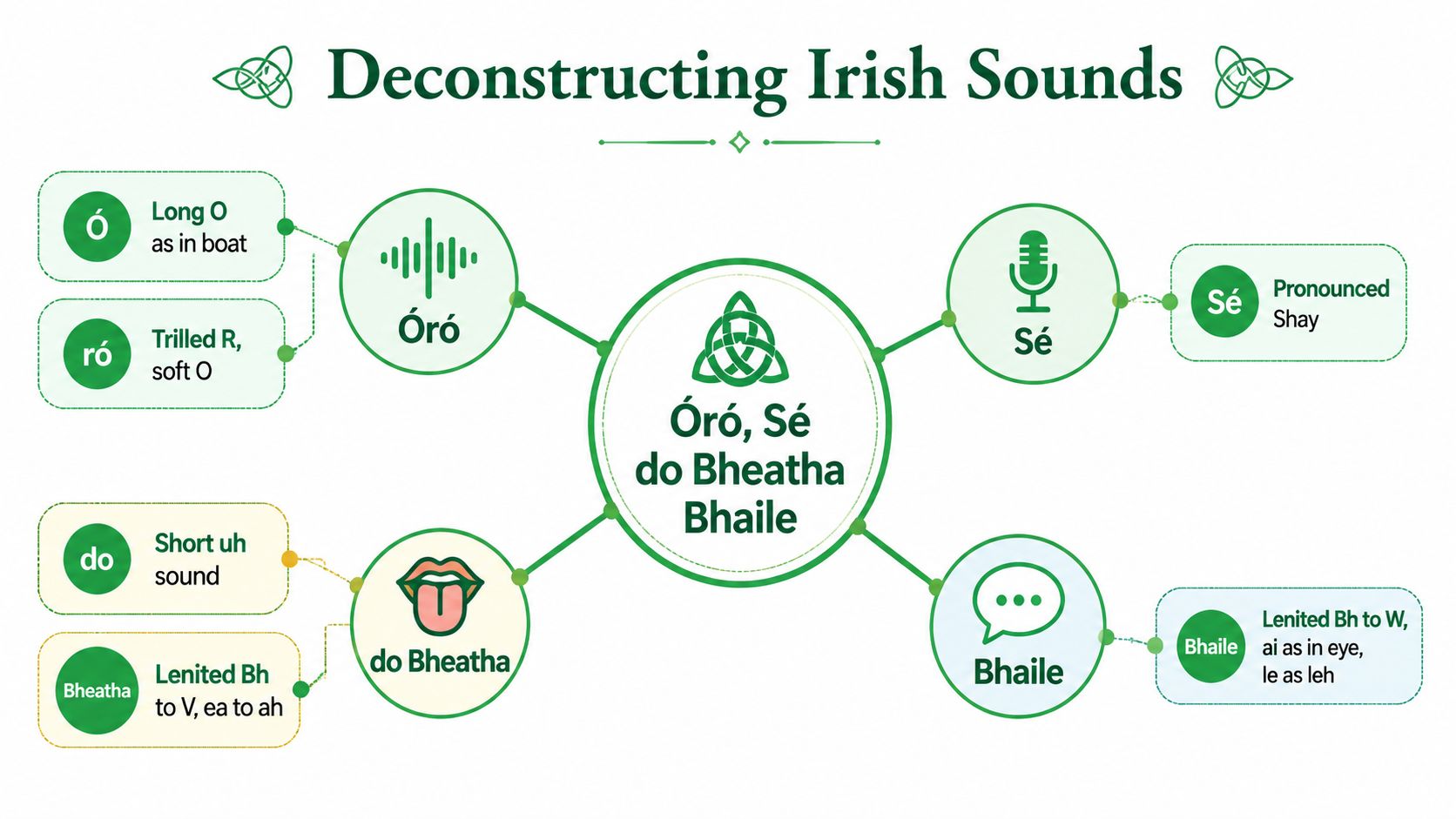
A good learner version is:
The quick phonetic answer
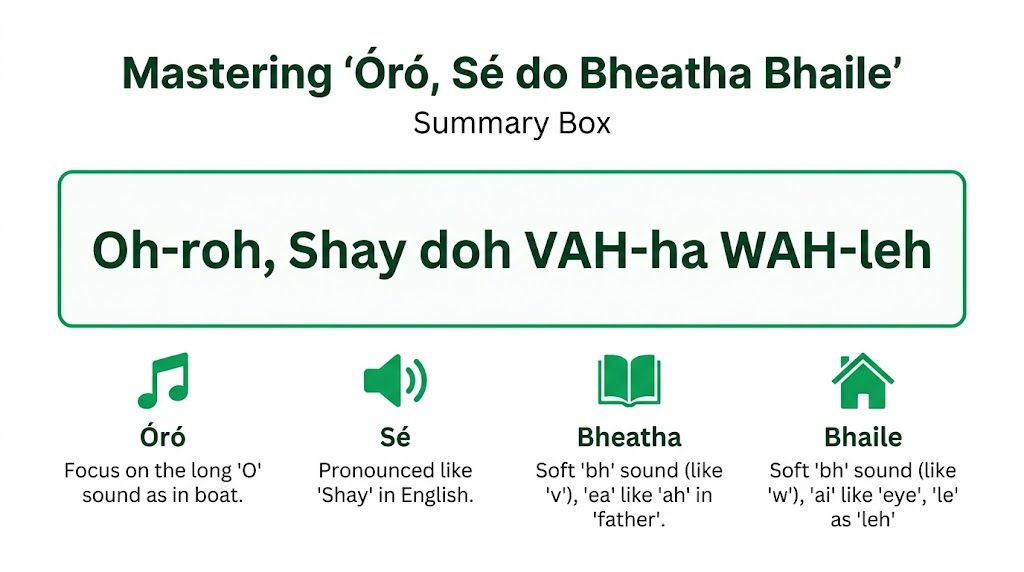
oh-roh shey duh VAH-ha WOL-yah
Use that as a starting point, not a final exam answer. Irish song pronunciation often becomes clearer when you say the line in one gentle sweep, almost like clapping a rhythm before learning all the notes.
For learners who want help hearing the wider sound patterns behind this refrain, this Irish pronunciation guide gives useful background. If you have learned sounds from other language traditions, even resources like K-12 Te Reo Māori learning materials can remind you that sound systems make more sense when you listen for rhythm, vowel length, and flow rather than forcing English spelling rules onto them.
Pronunciation guide table
Irish Phrase
Simplified Phonetic Spelling
IPA Notation
Óró
oh-roh
/oːˈɾˠoː/
sé
shey
/ʃeː/
do
duh
/d̪ˠə/
bheatha
VAH-ha
/vʲahə/ approximation
'bhaile
WOL-yah
[w]-like opening in casual pronunciation
The musical shape matters as much as the phonetic spelling. Óró usually feels like the lift at the start. Sé do moves more lightly. Bheatha bhaile carries the weight of the phrase, with VAH giving you the strongest landing point before the line releases at WOL-yah.
If it helps, treat it like a wave. The voice rises on oh-roh, settles briefly on shey duh, then rolls forward through VAH-ha WOL-yah without chopping each word apart.
A few habits make the line sound more natural:
Keep it connected: say the whole phrase in one breath if you can.
Hold the long vowels:oh and shey need a little space.
Let VAH lead the phrase: this is often the clearest stress point for beginners.
Finish with a glide:WOL-yah should taper off, not stop sharply.
First speak it slowly in time. Then repeat it with a gentle pulse, as if you are already joining the chorus.
Breaking Down Each Syllable and Sound
You may know the rough phonetic spelling already, then still freeze when the song starts. That happens because pronunciation on the page and pronunciation in rhythm are not quite the same skill. Irish song asks you to feel the phrase as a chain of small sound-units that travel together.
A good starting point is to hear the line in four musical chunks, not five separate words: Óró | sé do | bheatha | bhaile. Once those chunks feel steady, the spelling stops looking so intimidating.
Word by word breakdown
Óró Give both syllables space. Ó is a long oh, and ró answers it with another rounded roh. Singers often give this pair a lifted, calling quality, almost like the phrase is opening a door.
Sé Say shey, with a soft sh at the front. The vowel is held a touch longer than an English speaker might expect, which helps it sit properly in the tune.
do Keep this one light and quick. It works like a passing note in music. You touch it and move on.
bheatha Here the spelling looks heavy, but the sound is gentler. bh softens into a v-like opening, so the shape is closer to VAH-ha. Let the first syllable carry the weight, then let the second fall away lightly.
’bhaile This is the part many beginners need to hear several times before it clicks. The apostrophe marks a shortened form of abhaile, and the opening sound can glide in with a w-like feel. A learner-friendly target is WOL-yah or WUH-lya, depending on the singer. The exact shade can vary, but the important thing is the movement. It should flow forward, not land like a hard English word ending.
Why these sounds are easier in rhythm than in isolation
Irish songs often teach pronunciation better than a printed guide does. The melody tells your mouth how long to hold a vowel, where to relax, and which syllable carries the phrase.
That is why many beginners improve faster when they clap or tap the line first. Teachers using K-12 Te Reo Māori learning materials often teach sound patterns through beat, repetition, and grouped syllables. The same habit helps here. Your ear learns the pattern before your eyes fully trust the spelling.
Try this practice ladder:
Speak the chunks on a steady pulse oh-roh | shey-duh | VAH-ha | WOL-yah
Tap once per chunk This keeps the phrase from turning into a string of separate English-style words.
Stretch the long vowels slightly Give Ó and sé a little room, like notes that need time to ring.
Sing the last two chunks together VAH-ha WOL-yah should feel like one flowing release, not two disconnected pieces.
One small tip helps a lot. If the full line feels too fast, loop only sé do bheatha until it feels natural in time, then add Óró at the front and bhaile at the end.
Learn the phrase like a melody first, then like a spelling pattern. For this song, the rhythm often teaches the sounds more clearly than the letters do.
Common Pronunciation Mistakes and How to Fix Them
Most pronunciation problems with this line are completely normal. They usually come from English reading habits, not from lack of ability.
Four mistakes beginners make
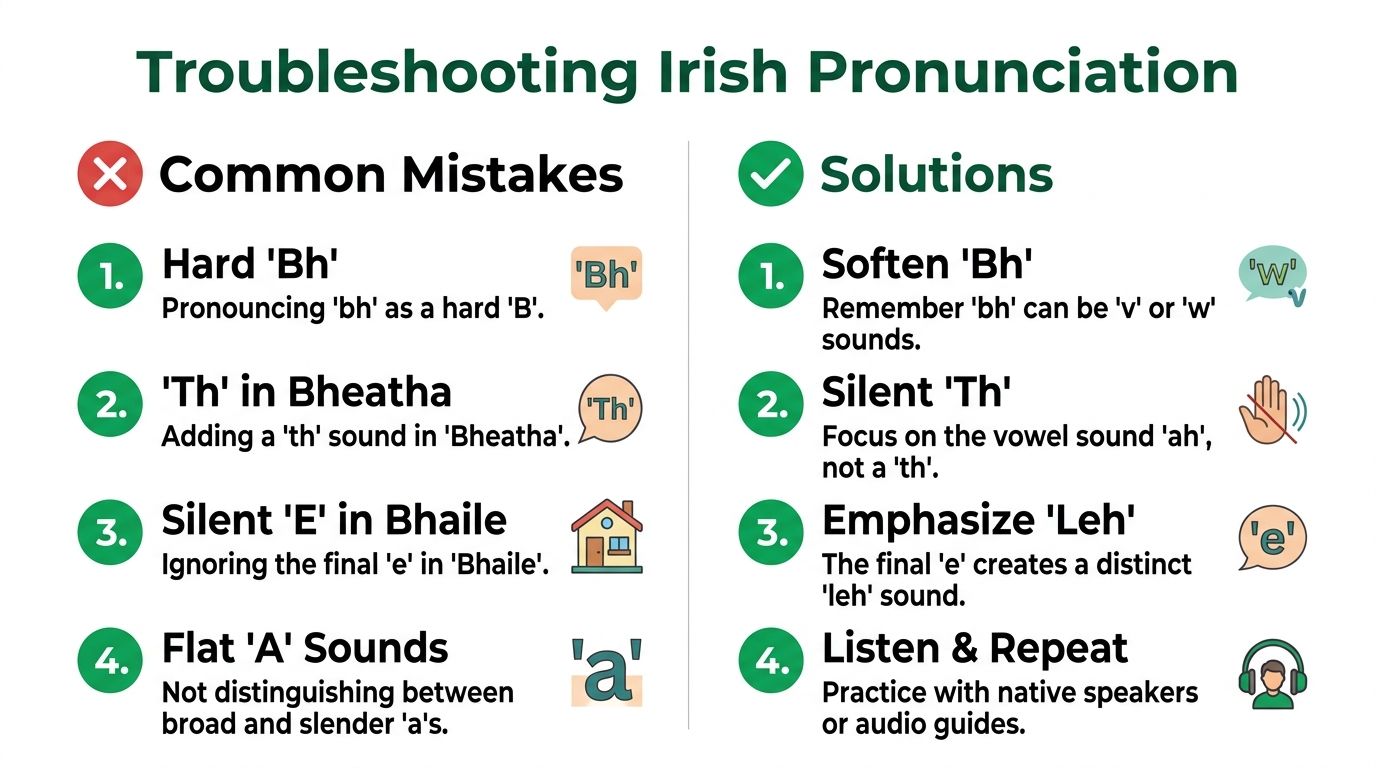
Hard B in bheatha Don't say beh-ha. Say VAH-ha with a softened opening.
See instead of shey Don't flatten sé into an English long e. Give it that sh quality: shey.
Over-pronouncing each word Don't speak it like a list: oh-roh / shay / doh / vah-ha / wah-lee. Let it run together as one musical phrase.
Dropping the final movement Don't chop ’bhaile short. Let it travel. The end should glide, not stop dead.
A simple self-check routine
Use this quick check after each practice round:
If you hear this
Try this instead
A hard b sound
Soften the opening to v or w-like
A heavy English doh
Reduce it to a light duh
A stiff, word-by-word rhythm
Group the phrase into sound chunks
A clipped ending
Let ’bhaile flow forward
One more fix helps almost everyone. Record yourself once speaking the phrase and once singing it. If the sung version sounds better, that's a clue that rhythm is helping you stop overthinking the spelling.
How to Practice and Master the Rhythm
A lot of guides stop once they've given you the phonetic spelling. That leaves out the part learners often need most. Existing coverage often treats the song as a lyric or translation problem, but there is little practical help for learners who want to sing it correctly and confidently in real time, especially around breathing, pace, and keeping rhythm while respecting Irish vowel length, as noted in this discussion of the pronunciation gap in song learning.
From speaking to singing
Start by speaking the chorus in a steady pulse. Don't rush because the song is often sung with energy. Fast versions only work if the vowels stay clear.
Then mark a tiny breath after each full line, not in the middle of sé do bheatha ’bhaile. If you breathe inside the phrase, the rhythm falls apart and the words start to sound choppy.
If you want to record your own repetitions cleanly on a phone or laptop, this elearning video audio recorder guide gives useful basics for setting up simple practice recordings. It's handy if you're comparing spoken and sung attempts side by side.
A short practice routine that works
Try this routine for a few minutes at a time:
Speak on the beat Tap your hand on the table and say the phrase once per pulse group.
Hum the contour first Hum the shape of the chorus before adding words. This reduces tension.
Add the lyric in chunks Start with Óró. Then sé do bheatha. Then the final ’bhaile.
Record one clean repetition Listen back for flow, not just individual sounds.
Sing with context Reading about traditional Irish music culture and the seisiún can help you hear why this phrase is often carried with lift, energy, and communal timing instead of textbook neatness.
If you want structured speaking practice after working on this chorus, Gaeilgeoir AI offers guided Irish conversation practice, pronunciation support, and short interactive exercises that suit learners who want to move from memorized phrases into everyday spoken Gaeilge.
If you want a place to keep practicing after this phrase, try Gaeilgeoir AI. It's a simple next step for turning one famous chorus into real spoken Irish you can use again and again.
You're probably here because you've seen Irish on a road sign, heard a phrase in a song, or felt that tug to reconnect with something older and more rooted. Then you try to learn a few words and hit a wall. One site gives you a translation, another gives you a different spelling, and suddenly a simple word like “beautiful” seems less simple than it should be.
That confusion is normal. Learning Gaelic, especially Irish Gaelic, gets much easier when you stop treating it like a word-for-word code and start hearing it as a living language with patterns, texture, and mood. Irish rewards curiosity. A small grammar rule can completely change how natural you sound, and a single adjective can tell you a lot about tone, context, and even culture.
More Than a Word An Introduction to Beauty in Irish
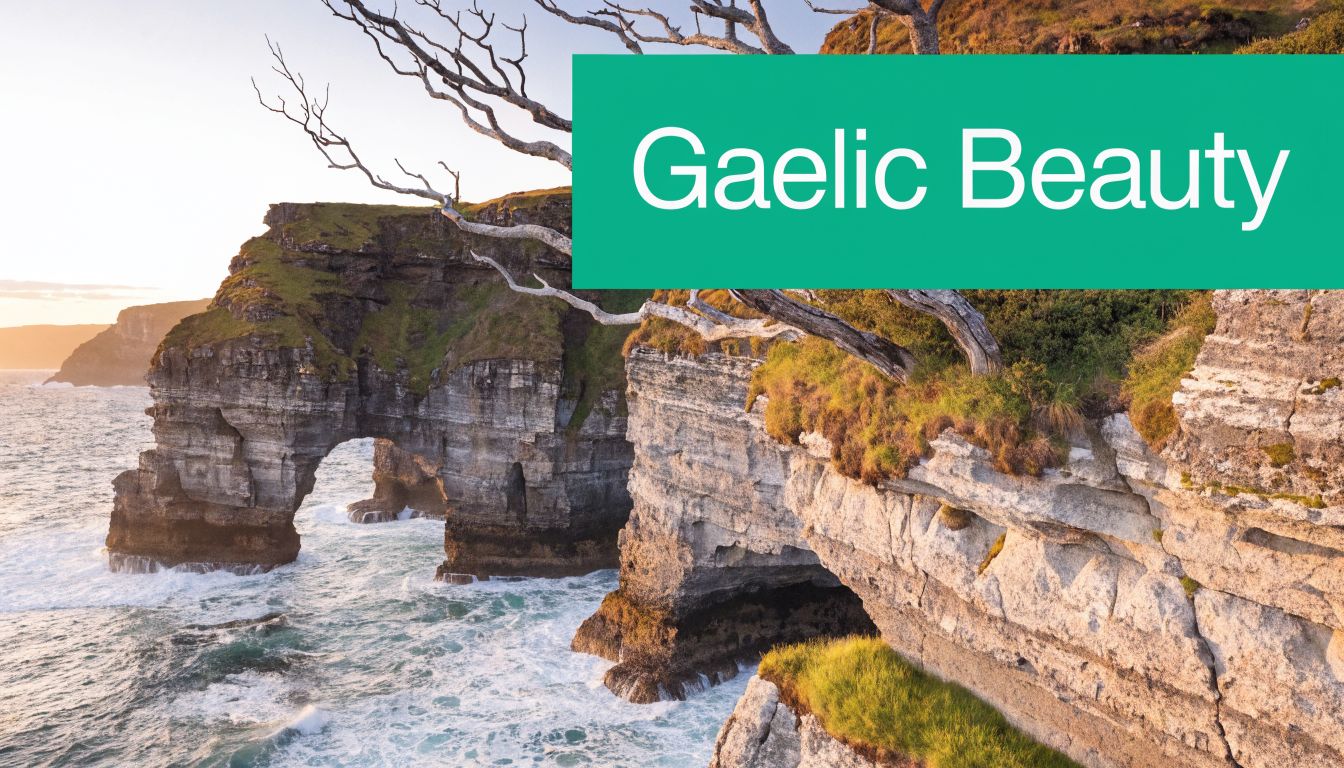
You stand on the west coast, the wind is loud, the sea is grey-blue, and the cliffs look almost unreal. In English, “beautiful” does the job. In Irish, you quickly notice that one English word opens into several choices, each with its own shade of meaning.
That's one of the joys of learning Gaelic. Irish often asks you to be a little more precise. Is something grand and striking? Soft and pleasant? Fine and elegant? The language nudges you to notice more.
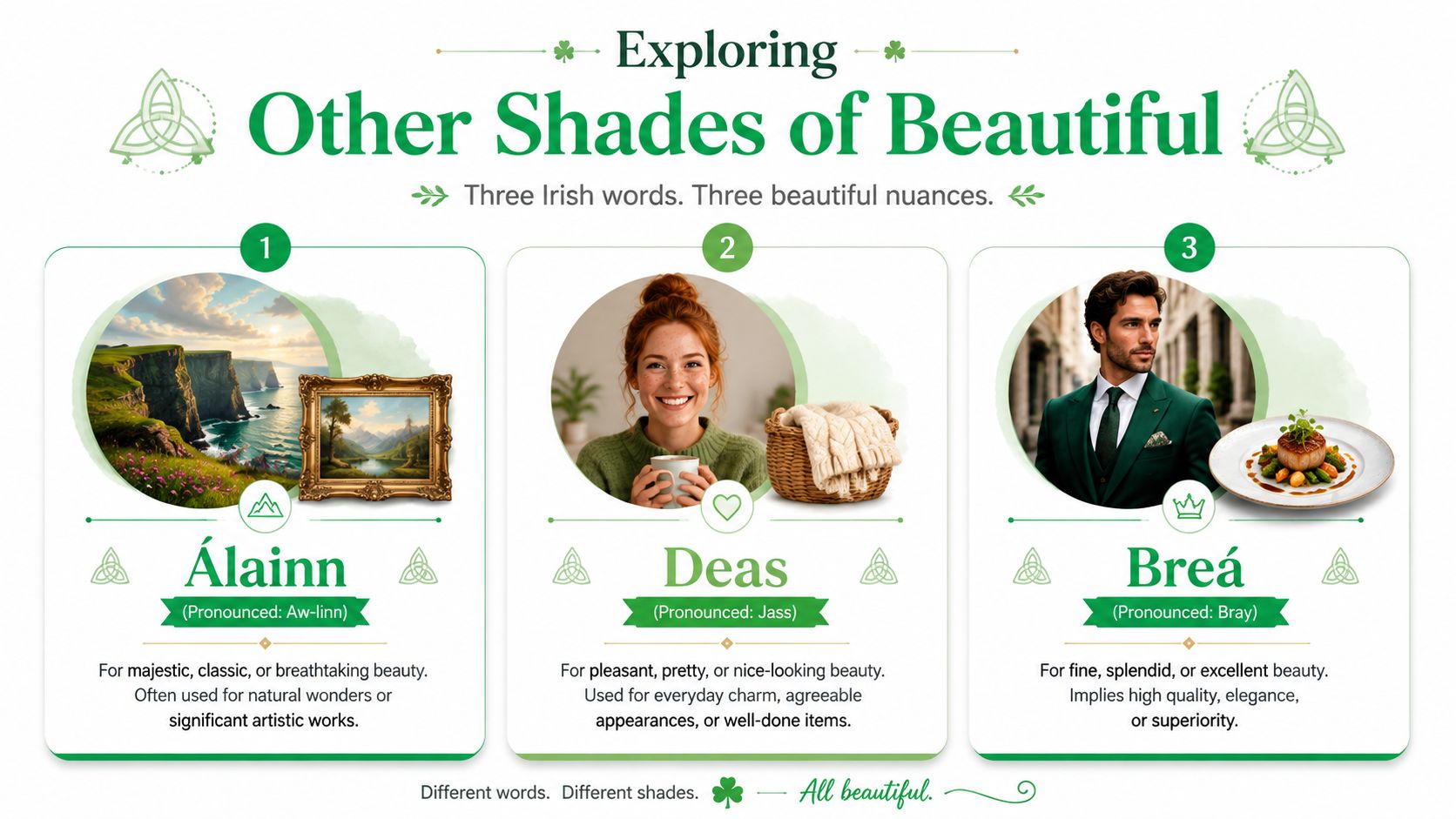
That sensitivity to detail is part of what makes Irish feel so expressive. It doesn't just label the world. It colours it. When learners first meet words like álainn, deas, or breá, they're not just memorising synonyms. They're learning how Irish speakers shape feeling and description.
Irish is also very much alive now, not locked away in old books. The language has seen a 71% increase in speakers in Ireland since 1991, and digital tools like Duolingo have over 1 million active learners at any given time, which helps explain why Irish is now one of the world's most actively studied minority languages, as noted in this overview of the growing Gaeilge opportunity.
If you're curious about why Irish sounds the way it does, this guide to what makes Irish sound unique is a helpful companion. Pronunciation and meaning are tightly linked in Irish, so the sound system matters from the start.
Irish often feels poetic because it asks you to choose words by situation, not just by dictionary match.
That can seem like extra work at first. It's a gift. Once you understand the pattern, the language starts to feel warmer, richer, and much more human.
The Main Word for Beautiful Álainn
If you learn only one word for “beautiful” today, make it álainn.
This is the broad, dependable word you can use in many situations. You can use it for a person, a place, a day, a song, a memory, or a piece of art. It carries the sense of real beauty, not just “nice enough.”
How to say álainn
A simple pronunciation clue is AWL-inn.
Say the first part gently, with an “awl” sound. Then finish with a short “inn.” Don't worry if it isn't perfect on day one. Irish pronunciation becomes clearer when you repeat whole phrases, not isolated syllables.
Try these:
bean álainn = a beautiful woman
áit álainn = a beautiful place
lá álainn = a beautiful day
Notice how useful this is already. With one adjective, you can start describing the world around you.
When álainn fits best
Think of álainn as your “full beauty” word. If deas is like “nice” or “pretty,” álainn is stronger and deeper. It suits moments when you want to say something moved you.
A few easy examples:
Tá an áit seo álainn. This place is beautiful.
Bhí lá álainn againn. We had a beautiful day.
Is amhrán álainn é sin. That is a beautiful song.
The exact sentence structure can wait. What matters first is confidence. You want a word you can reach for quickly.
Practical rule: If you're unsure which Irish word for “beautiful” to use, start with álainn. It's the safest and most flexible choice.
A memory trick that helps
Link álainn to moments with emotional weight. A coastline. A singer's voice. A child asleep. A sky after rain. The word sticks better when it's tied to an image.
Many learners make the mistake of building long vocabulary lists too early. A better start is to take one strong word and use it in five or six real phrases. That's how language becomes available in conversation, not just visible on a flashcard.
Exploring Other Shades of Beautiful
Once álainn feels comfortable, your Irish becomes more natural when you add a few nearby words. English leans heavily on “beautiful.” Irish spreads that meaning across different everyday choices.
The key is not to ask, “Which word is the direct translation?” Ask, “What kind of beauty do I mean?”
Three common choices
Here's a practical way to separate them in your mind:
Álainn This is the strongest all-purpose choice for beauty. Use it when something feels striking, moving, or deeply lovely.
Deas This often means “nice,” “pleasant,” or “pretty.” It can describe a person, weather, clothing, or a friendly atmosphere. It's lighter than álainn.
Breá This can suggest “fine,” “splendid,” or “lovely.” It often has a polished feel, and you'll hear it in phrases about weather, appearance, and quality.
If you're building a study habit, the same approach used in daily English vocabulary routines works well here too. Don't collect ten near-synonyms at once. Learn three words, compare them, then use each in a sentence you'd genuinely say.
How the tone changes
Think of these words like paint shades.
Álainn is the deep, rich colour you use for something memorable. Deas is the bright everyday shade that makes speech sound friendly and natural. Breá has a neat, finished quality, like complimenting something for being both lovely and well put together.
Here are simple examples:
cailín deas = a nice or pretty girl
lá breá = a fine day
pictiúr álainn = a beautiful picture
You may also meet dathúil, often used for “handsome” or “good-looking,” especially for a person. It's more specific than álainn and less general than deas.
Context matters more than dictionaries
A bilingual dictionary can tell you what a word can mean. It usually can't tell you what feels natural in the moment.
That's why collections of cool Irish words to know can be useful when you're learning Gaelic. They expose you to mood and context, not just bare translations.
A learner who knows one word in ten real situations usually speaks better than a learner who knows ten words in no situation at all.
When you're choosing among álainn, deas, and breá, don't chase perfection. Pick the one that matches the feeling best. Native-like precision grows through exposure and repetition.
Making It Sound Right Grammar and Agreement
Irish gets its music from small changes. One of the biggest is that words often shift depending on what comes before them. At first this feels strange. After a while, it starts to feel elegant.
Two ideas matter early on. First, every noun in Irish is masculine or feminine. Second, the adjective that follows it may change sound or spelling. This is why Learning Gaelic is not just about storing vocabulary. It's about noticing relationships between words.
Why Irish changes words at the beginning
One of the most famous Irish grammar features is lenition, or séimhiú. In writing, this often means adding an h after the first consonant. In speech, it softens the beginning of the word.
You can think of lenition like a dimmer switch instead of an on-off switch. The word is still the same word, but the opening becomes gentler.
For example, with some feminine nouns, an adjective beginning with certain consonants lenites:
bean deas can become a form where the adjective softens after the noun
deas may appear as dheas in the right grammatical setting
Not every adjective changes in the same visible way, and not every learner needs every rule on the first day. What matters is hearing that Irish often prefers flow over rigidity.
Gaelic's grammatical structure, including lenition, is one reason regular study matters. According to this discussion of how hard Gaelic is to learn, daily sessions of at least 30 minutes strengthen long-term retention by 50-200% compared with infrequent longer sessions. That fits what most teachers see in practice. Irish settles into memory through contact, not cramming.
A small table that makes this easier
Here's a beginner-friendly snapshot. The examples focus on the pattern, not on memorising every exception at once.
Adjective
Example Noun (Feminine)
Resulting Phrase
Pronunciation Clue
deas
bean
bean dheas
the dh is softened, almost like a light glide
beag
fuinneog
fuinneog bheag
bh is softened
mór
oíche
oíche mhór
mh sounds softened at the front
The exact sound of lenited consonants varies, and dialect affects how strong that change is. But the main idea stays the same. Irish smooths transitions between words.
A simple way to think about agreement
Try this three-step check when making a phrase:
Find the noun Is the thing you're describing a woman, place, day, song, or something else?
Learn its gender You won't always guess correctly at first, and that's fine. Gender is part memory, part exposure.
Notice whether the adjective changes Sometimes it won't. Sometimes the beginning softens.
If this feels technical, keep it grounded in sound. Language learners often freeze because they think grammar is a list of punishments. In Irish, grammar is often just a set of habits that make speech flow better.
For a fuller walkthrough of these patterns, mastering adjectives in Irish is worth reading alongside your phrase practice.
Don't try to master every mutation rule in one sitting. Learn one pattern, hear it in a phrase, then reuse it until it feels ordinary.
That's when grammar starts helping instead of intimidating.
From Beautiful to Most Beautiful
Once you can say something is beautiful, the next useful step is comparison. You want to say one place is more beautiful than another, or that a certain song is the most beautiful one you know.
Irish gives you a neat pattern for this.
The comparison pattern
For more beautiful, use níos plus the comparative form.
For most beautiful, use is plus the comparative form in the right structure.
With álainn, the form you'll often meet is áille.
So you get:
níos áille = more beautiful
is áille = most beautiful
That spelling shift can surprise beginners, but it's normal. English does this too in its own way. We say “good, better, best,” not “good, gooder, goodest.” Irish also changes form rather than adding one fixed ending every time.
What changes in álainn
The jump from álainn to áille is one of those forms you should learn as a chunk. Don't overanalyse it too early.
Use it in clear comparisons:
Tá an pictiúr seo níos áille. This picture is more beautiful.
Is í seo an áit is áille. This is the most beautiful place.
Tá an leagan sin níos deise. That version is nicer.
You can already hear how your Irish becomes more expressive here. You're no longer just naming qualities. You're weighing, comparing, and reacting.
A good habit is to compare things around you:
this room and that room
today and yesterday
one song and another song
two photos from a trip
That turns grammar into opinion, and opinion is where real conversation begins.
Once you can compare, you stop sounding like you're pointing at objects and start sounding like you have a voice.
If the forms feel slippery, repeat whole sentences instead of isolated adjective charts. Your ear will often learn the pattern before your conscious mind can explain it.
Putting It All Together Real Phrases and Examples
Vocabulary and grammar begin to function like a genuine language here. You are not simply memorizing terms for “beautiful.” You are discovering how Irish speakers use them in praise, description, and everyday reaction.
Useful phrases you can actually say
Try these out loud:
Tá an radharc álainn. The view is beautiful.
Lá breá deas atá ann. It's a lovely, nice day.
Tá gúna deas uirthi. She's wearing a nice dress.
Is amhrán álainn é. It is a beautiful song.
Is í an bhean is áille ar domhan í. She is the most beautiful woman in the world.
Notice the spread of tone. Álainn lifts the sentence. Deas keeps it conversational. Breá adds a smooth, pleasant note.
If you want to build fluency, don't memorise these in your head. Say them while looking at something real. A window view. A jacket. A painting. A person in a photograph. Irish sticks when the phrase has a target.
A quick note on dialects
Irish has regional varieties, and pronunciation can shift from one area to another. That means a word you learned from a teacher in Munster may sound a little different in Connacht or Ulster.
This isn't a problem. It's part of the life of the language.
A few things beginners notice:
Deas may sound sharper or softer depending on the speaker.
Vowel length can feel different across regions.
Some everyday phrasing choices vary by dialect, even when the grammar is still recognisably the same.
Treat dialect like accent, not like contradiction. English speakers don't panic when Dublin, Glasgow, and Toronto sound different. Irish works the same way.
A mini phrase bank for practice
Use these as short drills:
Áit álainn a beautiful place
Bean dheas a nice woman
Lá breá a fine day
Níos áille more beautiful
Is áille most beautiful
Read the phrase, look away, then say it from memory. After that, swap in a new noun. Change áit to teach, or lá to maidin. That small act of substitution is where passive knowledge turns active.
Some of the best Irish practice is ordinary. Describe your tea, your street, your weather, your music, and your mood.
That may sound humble, but it's how people begin speaking.
Practice Speaking with Your AI Gaeilgeoir
Reading examples helps, but speaking is where most learners stall. You know the word on the page, then your mouth hesitates when it's time to use it. That's especially common with Irish because pronunciation, mutations, and sentence rhythm all meet at once.
A useful first step is to give yourself tiny speaking tasks each day:
A simple practice routine
Describe one object with deas or álainn.
Compare two things using níos áille or níos deise.
Say one full sentence aloud about the weather, a place, or a photo.
Repeat after audio and notice where your pronunciation drifts.
Traditional study often under-serves speaking. A 2025 study found that 62% of Gaelic learners abandon traditional methods within 3 months because they lack speaking practice, while gamified apps with AI feedback and scenario-based learning retain 35% more users, according to SpeakGaelic's referenced discussion of this learning gap.
That's why tools built around conversation can help busy adults more than static word lists. Gaeilgeoir AI is one example. It offers guided Irish conversations, pronunciation support, and scenario-based practice for situations like travel, social interaction, or asking for directions.
When you want a quick speaking model, this video is a useful addition to your practice session:
The actual goal isn't perfect performance. It's regular output. A few spoken lines every day will take you farther than long silent study sessions once a week.
If you want to turn these phrases into real conversation practice, try Gaeilgeoir AI. It gives you guided Irish speaking practice with pronunciation support and everyday scenarios, so words like álainn, deas, and breá move from recognition into active use.
You open your mouth to say a simple sentence in Irish. You know the word you want. You may even remember seeing it in school or hearing it at home. Then everything stalls the second you try to say it out loud.
That moment frustrates a lot of learners, and it does not mean you are bad at languages. It usually means your knowledge is sitting in one place and your speaking practice is sitting in another. Irish often lives in people's memories as something they studied, recognised, or read, but not something they used in everyday conversation.
That gap is common in Ireland too. As noted earlier, many people report that they can speak Irish, while far fewer use it daily outside education. So if your Irish feels stuck in your head instead of coming out of your mouth, you are far from alone.
The encouraging part is simple. Spoken Irish can begin with very small wins.
A short phrase about your morning. A greeting you can say without translating. One sentence you repeat until it feels natural in your mouth. That is how active speaking starts. It works a bit like learning to play a tune. Reading the notes helps, but your hands only learn it by playing.
This article focuses on getting you from passive knowledge to real speech from day one. That means starting with sounds you can copy, sentence patterns you can reuse, and topics from your actual life. It also means using tools that give you a chance to respond, hear yourself, and get feedback. Modern support, including tools like Gaeilgeoir AI, can help you practise conversation earlier and more often, especially when you do not have a speaking partner beside you.
You do not need perfect grammar before you begin. You need a starting point that gets your voice involved early, so Irish becomes a language you use, not just one you recognise.
You meet an Irish speaker at a café, hear a friendly Dia duit, and suddenly your brain goes blank. You know more than you can say. That gap between recognising Irish and putting it into use is where many beginners get stuck.
The fix is simple. Put speaking at the centre from day one.
If you want to learn how to speak in Irish, treat speech as practice, not as a test you earn after enough reading. A language is a bit like music in that way. You do not master the theory first and then touch the instrument. You play early, badly, and often. Irish works the same way. Reading, grammar, and listening all support you, but your speaking only grows when you open your mouth and use what you have.
As noted earlier, many people have some Irish but do not use it regularly. As a teacher, I see that pattern all the time. Knowledge sitting in your head is passive. The moment you say even one short sentence, it starts becoming active.
Practical rule: Speak Irish with the words you already know. Start small and start now.
A strong day-one goal is to build one tiny conversation you can use:
Introduce yourself:Is mise Aoife.
Ask a simple question:Conas atá tú?
Give a simple answer:Tá mé go maith.
Say one preference:Is maith liom caife.
Say one fact about your day:Tá mé tuirseach.
This may seem small. It is still real speaking.
That matters because beginners often study Irish as if they are filling a bookshelf. Useful speaking works more like building a footpath. One solid phrase leads to the next. You do not need a huge vocabulary to begin. You need a few phrases you can reach for quickly, without freezing.
If speaking to another person feels like too much on day one, use a tool that lets you rehearse safely. Gaeilgeoir AI can help you practise short exchanges, repeat common responses, and turn passive knowledge into spoken habits before you try them in real conversation. That kind of practice is helpful because it closes the gap between “I know this” and “I can say this.”
Aim for use, not perfection. If you can greet someone, answer a basic question, and say one true thing about your life, you are already speaking Irish.
Learn the sound before the rule
Irish spelling can look intimidating at first. The solution isn't to stare at the page longer. The solution is to connect sound, spelling, and meaning at the same time.
Build your ear first
A useful approach is to hear a short line slowly, repeat it, then hear it at normal speed and repeat again. The teaching method described in the Tús Maith methodology video on progressive auditory imitation lays out a four-step pattern: slow playback with support, normal-speed repetition, memorisation through adapted scripts, and then freer off-script speaking.
That order matters because beginners often try to jump straight into free conversation. Their brain hasn't had enough sound input yet, so the language feels slippery.
Use this sequence with one short phrase:
Listen slowly Hear: Conas atá tú?
Repeat slowly Say it with care, not speed.
Repeat at normal pace Let the rhythm become more natural.
Use it in a tiny exchange Conas atá tú? Tá mé go maith.
Slow, clear repetition helps you notice patterns that disappear when you rush.
Copy whole phrases, not isolated words
Irish becomes easier when you learn it in chunks. Instead of collecting random nouns, collect whole lines you can say today.
A few strong beginner chunks:
Situation
Irish phrase
Plain meaning
Greeting
Dia duit
Hello
Asking after someone
Conas atá tú?
How are you?
Fine response
Tá mé go maith
I am well
Saying your name
Is mise Seán
I am Seán
Wanting something
Ba mhaith liom tae
I would like tea
Chunk learning solves a common beginner problem. If you learn the word for tea, the word for like, and the word for I, you still might not say anything. If you learn Ba mhaith liom tae, you can use it at once.
Use simple Irish sentence patterns
Irish feels different from English because the structure often changes. That can be frustrating until you stop trying to force English patterns into Irish.
Irish often starts with the verb
One of the biggest shifts is that Irish commonly uses verb-subject-object order. The Preply guide to learning Irish points to this as an important pattern for learners to practise actively rather than leaving it as a grammar note.
In plain English, that means the action often comes first.
Look at the difference:
English idea
Irish pattern
I eat bread
Ithim arán
I am eating an apple
Tá mé ag ithe úll
If you keep trying to build every sentence in English order first, your speech will stall. So don't begin with abstract grammar terms. Begin with frames you can reuse.
Sentence frames to use every day
These are strong early patterns because they cover a lot of real conversation:
Tá mé… Use it for states and feelings. Tá mé tuirseach. Tá mé sásta.
Is maith liom… Use it for likes. Is maith liom ceol. Is maith liom tae.
Ba mhaith liom… Use it for wants and polite requests. Ba mhaith liom caife. Ba mhaith liom cabhair.
Tá mé ag… Use it for actions happening now. Tá mé ag léamh. Tá mé ag obair.
An bhfuil…? Use it for yes-no questions. An bhfuil tú anseo? An bhfuil sé fuar?
A good rule is to stay with a sentence frame until it feels automatic. Don't race to cover everything. Depth beats breadth in speaking.
If a phrase helps you describe your actual day, it belongs in your first week of Irish.
Say useful things about your real life
You meet an Irish speaker at a café. You do not need a speech about literature or a perfect grammar chart. You need a few honest lines about your day.
That is why real-life sentences matter so much at the start. If your first Irish helps you talk about your name, your mood, your work, your home, or what you want to eat, you can start speaking from day one. The goal is not to collect interesting sentences. The goal is to say things you might use before lunch.
A good shortcut is to build your early Irish around small personal topics. These topics come up again and again in normal conversation, so every sentence pulls double duty. You are learning vocabulary, and you are also rehearsing real interaction.
Start with tiny personal topics
Choose three areas from your own life and write five short sentences for each. Keep them simple enough that you could say them without stopping to translate.
About yourself
Is mise Niamh.
Tá mé i mBaile Átha Cliath.
Tá mé ag foghlaim Gaeilge.
Is maith liom leabhair.
Tá mé ag obair inniu.
About home
Tá mé sa bhaile.
Tá tae sa chistin.
Tá sé ciúin anseo.
Tá fuinneog mhór ann.
Is maith liom an seomra seo.
About today
Tá sé fuar.
Tá ocras orm.
Tá mé ag dul amach.
Ba mhaith liom lón.
Tá mé tuirseach anois.
This kind of practice closes the gap between recognising Irish and using it. Many learners already know more words than they can say out loud. Personal sentences fix that because they give those words a job to do.
It also makes practice easier to repeat. You already know your own routines, preferences, and plans. You are not inventing content from scratch. You are just learning how to say your life in Irish.
Turn passive vocabulary into active speech
Use a simple four-step drill:
Pick five words you already know.
Put each one into a full sentence about your real life.
Say each sentence aloud three times.
Change one detail in each sentence.
Here is what that looks like with caife:
Is maith liom caife.
Ba mhaith liom caife.
Tá an caife te.
Tá mé ag ól caife.
An bhfuil caife anseo?
Now caife is not just a word on a list. It works in likes, wants, descriptions, actions, and questions. That is how speaking starts to feel quicker.
If you want extra help turning your own daily life into spoken practice, tools like Gaeilgeoir AI can help you generate simple personalised prompts, check phrasing, and rehearse short exchanges. Used well, that kind of support can speed up the jump from passive knowledge to active conversation.
Keep the bar low at first. A short true sentence is better than a clever sentence you will never say again.
Expect dialect differences early
Some learners get discouraged when they hear one phrase in a course and a different phrase in a real conversation. That's not failure. That's Irish being a living language.
Why greetings can sound different
Irish has regional variation, and beginners often meet it immediately in greetings and short social phrases. The video discussing Irish dialect differences in greetings highlights forms such as Conas atá tú?, Cad mar atá tú?, and other regional variants.
This can feel unsettling if you expected one fixed form for everything. It helps to think of dialects the same way you'd think about accents and regional wording in English. Different does not mean wrong.
A few things may change:
The greeting itself
The pronunciation
The natural response
The form you hear in a specific region
How to avoid dialect overload
You don't need to master every dialect as a beginner. You do need a clear starting point.
Use this approach:
Situation
What to do
You want one steady beginner path
Learn one common form and stick with it for now
You have family ties to a region
Prioritise that dialect when possible
You're studying for school exams
Stay close to the expected school forms
You hear a different version
Notice it, don't panic, and save it for later
Pick one greeting and one response first. Use them until they feel natural. You can add variants gradually.
A beginner doesn't need every version of a phrase. A beginner needs one version they can say comfortably.
Practice out loud every day
You don't need marathon study sessions. You need repetition that your mouth, ear, and memory can handle.
A short daily routine that works
Here's a simple routine you can keep:
Warm up with two greetings Say them aloud without reading if you can.
Review three sentence frames For example: Tá mé…, Is maith liom…, Ba mhaith liom…
Describe your day for one minute Use tiny facts. Weather, food, mood, plans.
Repeat one short dialogue Keep it short enough that you can memorise it.
Finish with self-talk Narrate what you're doing. Tá mé ag siúl. Tá mé ag déanamh tae.
This kind of active use is far more valuable than passive review alone. It also fits the reality of adult learners, who usually need short, flexible practice rather than long classroom blocks.
What to do when you get stuck
Everyone freezes. The trick is to have rescue moves ready.
Use these when speaking breaks down:
Go back to a frame: If you can't build a sentence, start with Tá mé… or Is maith liom…
Shrink the idea: Don't say everything. Say one fact.
Repeat a known phrase: Familiar language restarts your rhythm.
Swap the word: If you don't know the exact noun, choose a simpler one you do know.
Write down the missing piece: Keep a note on your phone and return to it later.
A stuck moment doesn't mean your Irish is bad. It usually means your sentence was too ambitious for that moment.
Find ways to speak with feedback
You say a sentence out loud, and it feels fine in your head. Then a listener replies, or your app catches a sound you missed, and you notice the gap. That moment is useful. Feedback turns private practice into real speaking.
Solo work still has a clear job. It helps you build the physical side of Irish: the mouth movements, the rhythm, and the habit of answering without freezing. It also gives you a safe place to test what you know before another person joins in.
Use solo practice for:
Training pronunciation
Speeding up recall
Getting comfortable with your own Irish voice
Turning words on a page into spoken language
Trying out sentence patterns before conversation
A mirror helps. Voice notes help. Reading a short exchange, then closing the page and saying it from memory helps too. This kind of practice is like doing scales before playing music with others. It does not replace conversation, but it makes conversation much easier to enter.
Then add feedback as early as you can.
Choose feedback that matches your level
You do not need a perfect conversation partner from day one. You need a response that shows you what to keep, what to fix, and what to say again.
A few good options:
Pronunciation and dictionary tools Use TEanglann to hear words and check forms when a sound or spelling confuses you.
Language exchange apps Tandem or HelloTalk can help you find short, low-pressure exchanges with other learners or speakers.
AI speaking practice Gaeilgeoir AI offers guided conversations based on real situations, along with pronunciation support and adaptive practice. That is helpful for learners who know some Irish passively but need a bridge into active speaking.
Oral-topic practice for school Leaving Cert students usually improve faster by answering common speaking topics out loud than by trying to revise everything at once.
The best feedback is the kind you will use three or four times a week. Consistency matters more than finding one perfect method.
If live conversation feels intimidating, start with a simple loop: say one sentence, get a correction, repeat it correctly, then use it again in a new sentence. That loop is small, but it teaches your brain how spoken Irish grows. You stop collecting phrases and start using them.
Keep going even when your Irish feels messy
You are in the middle of a sentence, you know the word you want in English, and your Irish comes out in bits and pieces. That is not failure. That is speaking.
Spoken Irish usually grows the same way a tune grows under your fingers. At first, it feels slow and uneven. Then a few phrases start to come more quickly. After that, you stop building every sentence word by word and begin to answer more naturally. The jump from passive knowledge to active speech rarely feels tidy while it is happening.
That matters because many learners already know more Irish than they can say out loud. They recognise school phrases, understand bits of conversation, or remember grammar they cannot use quickly enough in real life. The goal is not to wait until everything feels polished. The goal is to keep turning recognition into response.
Give yourself small speaking wins.
Say hello. Say your name. Say what you like. Say how you feel. Say one true thing about your day.
Then change one part and say it again.
That simple habit trains your brain to build with the Irish you already have, instead of freezing while you search for perfect Irish. Messy speech is often the working stage between “I know that” and “I can say that.”
Irish also lives through ordinary use. Every time a learner moves from understanding to speaking, even for one short sentence, the language becomes a little more present in daily life. That is part of what makes speaking practice feel personal and cultural at the same time.
If you need extra support, Gaeilgeoir AI can give you another place to practise turning passive Irish into active conversation, one short exchange at a time.
You want to learn a language, but you're on your own. No class. No teacher waiting for homework. No built-in schedule. Just you, a phone, a browser full of tabs, and that nagging feeling that you should have started months ago.
That situation is more normal than commonly perceived. A lot of independent learners don't fail because they're lazy or “bad at languages.” They fail because the process looks fuzzy. They don't need more motivation speeches. They need a working system.
The good news is that solo language learning is far more realistic now than it used to be. You can build reading, listening, speaking, and writing into daily life without arranging your week around a classroom. And if you're worried you've started too late, that old fear doesn't hold up very well. A landmark MIT study on the language-learning critical period analyzing nearly 670,000 participants found that while children learn languages faster, adults can still master grammar effectively through deliberate, immersive self-study, with the critical period for rapid learning extending to age 17-18.
That matters because it changes the question. The question isn't “Am I too old?” It's “How do I build a method I can consistently follow?”
I've taught myself a language, and the biggest lesson wasn't about talent. It was about structure. You need a clear reason, the right kind of input, regular output, and a system that keeps you showing up. If you're starting with a new script, even a focused beginner step like mastering Hangul can show how much easier things get once the first layer is made simple. The same principle applies more broadly, especially if you're learning later in life and want a practical path like this guide to learning a language as an adult.
Introduction A New Era for Independent Language Learners
Learning alone used to mean piecing together a textbook, a dictionary, and whatever audio you could find. Now the challenge isn't access. It's choosing a method that doesn't collapse after the first burst of enthusiasm.
That's why “how to learn a language on your own” needs a better answer than “download an app and stay consistent.” Consistency matters, but it doesn't appear by magic. It grows out of a plan that matches your life, your goals, and your current level.
You don't need a perfect method. You need a method you'll still be using next month.
Adult learners often carry unnecessary pressure. They think every mistake proves they missed their window. In practice, adults usually do better when they stop chasing the feeling of school and start building a repeatable home system with clear inputs and clear outputs.
A strong self-study plan has four parts:
A clear destination: You know what you're trying to do with the language.
Useful input: You spend time reading and listening to material you can mostly understand.
Regular output: You write and speak often enough to test what you know.
A routine: You make the work small enough to repeat.
That blueprint works whether you're learning Spanish for travel, German for work, or Irish to reconnect with family history. It also matters even more for languages that don't have endless media and tutoring options. In those cases, structure matters as much as motivation.
Laying Your Foundation with Clear Goals
You sit down on a Monday full of motivation, open three apps, save two YouTube playlists, and buy a notebook. By Thursday, you're stuck on a basic question. What am I supposed to do first?
That confusion usually starts with the goal.
Start with your real reason
Your reason for learning decides what belongs in your study plan and what can wait.
A traveler needs survival language. A heritage learner may care more about family stories, songs, and everyday conversation. Someone preparing for an exam needs timed prompts, common topics, and practice under pressure. These are three different jobs, so they need three different first months.
This matters even more if you're learning a language like Irish. You may not have endless graded readers, local tutors, or large speaking communities nearby. In that case, your goal acts like a filter. It helps you choose the right textbook, the right audio, and the right kind of practice. It also helps you use AI well. A tool like Gaeilgeoir AI can give you speaking and writing practice tied to the situations you care about, instead of sending you through a generic sequence built for a more widely taught language.
“I want to be fluent” feels motivating for about five minutes. After that, it becomes fog.
A better goal gives you a target you can practice. SMART goals can help here. Keep them specific, measurable, achievable, relevant, and time-bound.
Compare these:
Vague: I want to get good at Irish.
Clear: In three months, I want to introduce myself, order food, ask for directions, and understand the main point of a short beginner conversation.
The second version gives you a map. You know which vocabulary to collect, which dialogues to practice, and what success looks like.
Use functions before levels. “Ask for help at a train station” is easier to study than “reach B1.” Level labels have their place, but they are poor daily instructions.
A lot of self-learners also underestimate scale. Language learning works more like saving money than cramming for a quiz. Small deposits add up. Random bursts do not. The U.S. Foreign Service Institute is often cited for showing that some languages take far more guided study time than others, as summarized in this overview of FSI time estimates. You do not need to count every hour. You do need to expect progress to come from repeated practice over time.
Build a goal that can survive real life
This is the part many guides skip. A good goal should still make sense on a tired Tuesday night.
If your plan says “study for 90 minutes every day,” but your evenings are crowded, the plan is brittle. If your plan says “practice one 10-minute listening task, review 15 useful words, and answer one short prompt,” it has a much better chance of surviving.
I learned this the hard way. My early goals were too big and too abstract. Once I switched to smaller job-based targets, my study sessions got calmer. I was no longer asking, “How do I learn the whole language?” I was asking, “Can I handle this one conversation?”
That question is easier to answer.
A practical first-month plan looks like this:
Pick three situations you care about, such as meeting relatives, ordering in a café, or joining a simple chat online.
List the words and phrases that appear in those situations again and again.
Choose a few resources that match those situations, including one source of feedback. If you need options, this guide to language learning apps for beginners can help you compare tools.
Set one weekly performance check such as recording yourself, writing a short dialogue, or answering an AI prompt aloud.
That gives you a working system, not just a wish list.
A quick walkthrough can help if you'd rather hear this idea explained out loud before writing your own plan.
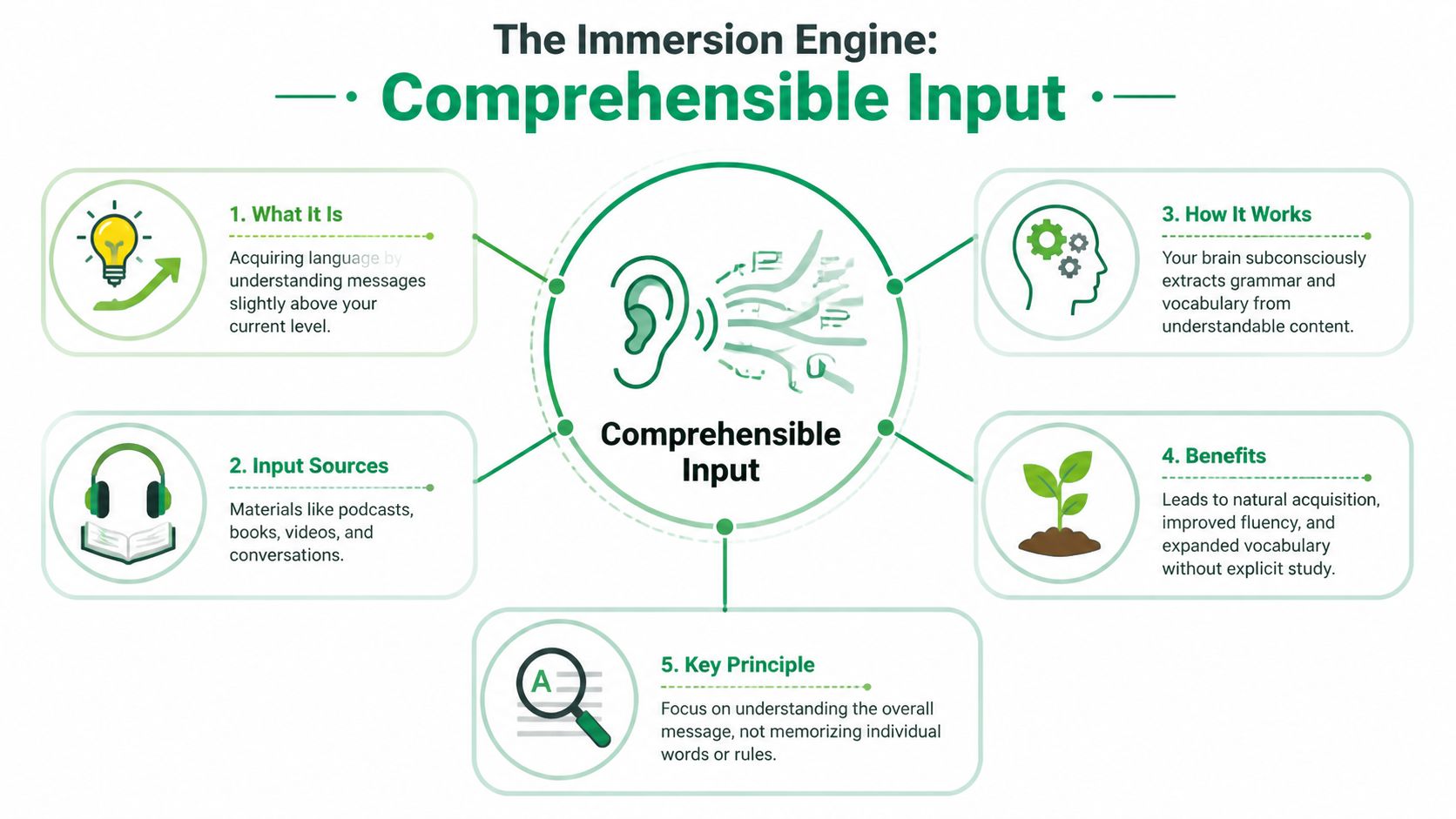
Building Your Immersion Engine with Input
Most of your progress will come from input. Not passive exposure in the background while you scroll, but regular contact with language you can mostly follow.
What comprehensible input actually means
Comprehensible input means reading or listening to language that is slightly above your current level, but still understandable enough that your brain can keep extracting meaning. You don't need to know every word. You need enough context to follow the message.
That matters because language doesn't grow in a random order. Research discussed in Scott H. Young's article on how language acquisition develops through input notes that language acquisition follows a fixed developmental sequence. One study found that after two years in an input-based class, students performed as well or better on speaking tests than those in traditional classes, despite never formally practicing speaking.
That's reassuring for beginners who feel behind because they aren't talking much yet. Input isn't a delay from “real learning.” It is real learning.
How to choose input you can grow from
A lot of beginners get stuck because they choose materials at the wrong level. Native TV with no support is often too hard. Children's materials can be oddly unnatural or boring. The sweet spot is content that feels challenging but not crushing.
Try a mix like this:
Beginner dialogues: Short exchanges with audio and text.
Graded readers: Simple stories written for learners.
Learner podcasts: Slower speech with repeated patterns.
Subtitled video: Short clips where you can connect sound, text, and meaning.
Topic-based lessons: Materials built around common situations like shopping or travel.
When you use them, don't turn everything into a translation exercise. Try this instead:
Listen once for the general meaning.
Read or replay with support.
Notice a few recurring words or structures.
Listen again without stopping every few seconds.
That last step matters. If you interrupt constantly, you never build flow.
Focus on understanding the message first. Detailed analysis can come after.
For low-resource languages, finding enough comprehensible input can be the hardest part. That's one reason some learners use tools like Gaeilgeoir AI, which provides guided real-world conversations, pronunciation support, adaptive quizzes, and practice built around the 1,000 most-used Irish words. For solo learners, that kind of structure reduces the time spent hunting for suitable material and increases the time spent engaging with the language.
A simple weekly input mix might look like this:
Input type
Example use
Short audio
Repeat one beginner dialogue during a walk
Reading
Read one short text and highlight recurring phrases
Video
Watch a subtitled clip twice, first for gist, then for details
Review
Revisit familiar material to build speed and confidence
If you're wondering whether you should study grammar at all, the answer is yes, but in support of input, not instead of it. Grammar helps you notice patterns. Input helps those patterns settle into real understanding.
Activating Your Knowledge Through Output
Input builds recognition. Output shows you what you can do.
A lot of solo learners wait too long to speak or write because they want to feel ready first. That feeling usually doesn't arrive on its own. You get ready by producing imperfect language, noticing gaps, and trying again.
Start with low-pressure output
You do not need to jump straight into live conversation.
Start with forms of output that feel safe and repeatable:
Self-talk: Describe what you're doing while cooking, commuting, or cleaning.
Mini journaling: Write three to five sentences about your day.
Sentence rebuilding: Read a model sentence, close it, then recreate it from memory.
Voice notes: Record yourself answering one simple prompt.
These exercises work because they force retrieval. You stop recognizing words and start reaching for them. That's where a lot of growth happens.
A useful pattern is to recycle the same topic for a few days. For example, if the topic is introductions, you might write a short paragraph on Monday, say it aloud on Tuesday, record it on Wednesday, and expand it on Thursday.
Use structured speaking before live conversation
Speaking to another person is valuable, but it can feel like too big a jump for beginners. That's especially true when you're learning a language with fewer available tutors, fewer local communities, and less casual media.
That gap is one reason AI conversation practice has become more relevant for solo learners. Most language guides still focus on high-resource languages and often ignore the immersion problem in low-resource languages like Irish. A 2025 Duolingo study discussed in this article on self-learning low-resource languages reported 40% higher retention in low-resource languages using AI conversation simulations, which is especially useful when a learner doesn't have regular speaking partners.
That doesn't mean AI replaces people. It means it can serve as the bridge between silence and real interaction.
Use that bridge in stages:
Stage
What you do
Private rehearsal
Read model dialogues aloud
Guided response
Answer simple prompts with support
Simulated conversation
Practice short exchanges in common scenarios
Live interaction
Talk with a tutor, partner, or community member
Mistakes made during output aren't proof of failure. They're the map of what to practice next.
Writing helps here too. If you can't yet say a sentence smoothly, write it first. Then say it. Then say it again without looking. Spoken fluency often starts as written clarity plus repetition.
If you're wondering how much correction you need, keep it selective. Correct everything and you'll freeze. Correct nothing and mistakes fossilize. Pick one target at a time. Maybe this week it's word order. Next week it's pronunciation of a recurring sound. Keep the spotlight narrow enough that you can improve without feeling swamped.
Creating Habits and Staying Consistent
Tuesday goes well. You review a few words with coffee, listen to Irish on your walk, and write two lines before bed. Wednesday gets busy, Thursday disappears, and by Friday it feels like you have "fallen off."
That feeling tricks a lot of independent learners. The problem is usually not motivation. It is a routine that depends on having extra time and extra willpower every day.
A good self-study system works like a stove with a pilot light. You do not want to rebuild the fire from scratch each morning. You want a small flame that stays on, even during messy weeks.
Build a routine that can survive ordinary life
Set up your study plan around moments that already happen. That is why habit stacking works. You attach language practice to an existing part of your day, so the cue is built in.
For example:
After breakfast, review five to ten flashcards.
During lunch, listen to one short audio clip.
Before bed, reread a familiar paragraph or write three sentences.
Small actions count because they remove friction. You are no longer asking, "When should I study?" You already decided.
This matters even more if you are learning a low-resource language like Irish. You may not have endless graded readers, local classes, or people to practice with on demand. Your routine has to create regular contact with the language on purpose. That is where a tool like Gaeilgeoir AI can fit into the system. Not as your whole plan, but as one reliable place to practice, get feedback, and keep the language present between human conversations.
A weekly plan helps because it shows whether your routine has range. If every day is only flashcards, you will remember words but struggle to use them. If every day is only passive listening, you may recognize patterns without being able to produce them. The goal is a repeatable mix.
Make consistency easier than quitting
Solo learners need visible proof that effort is adding up. A teacher normally provides that. When you study alone, your system has to provide it instead.
Track completed sessions. Put an X on a calendar. Keep a simple note in your phone. Use streaks if they encourage you, and ignore them if they make you tense. The point is not to turn learning into a video game. The point is to make progress tangible enough that your brain believes it is worth returning tomorrow.
If you want a broader framework for building routines, these practical steps for habit formation are a useful complement to language-specific planning.
Memory also needs structure. If you keep meeting the same word and forgetting it a week later, the problem is often timing, not effort. A short guide to spaced repetition for language learning can help you review vocabulary at the point where it is about to fade, instead of starting over again and again.
Here is a simple schedule that many busy learners can adapt:
Day
Morning (15 min)
Lunch (10 min)
Evening (30 min)
Monday
Review vocabulary
Listen to a short dialogue
Read and reread one short text
Tuesday
Pronunciation practice
Flashcard review
Write a short journal entry
Wednesday
Review phrases
Listen and repeat
Practice speaking prompts
Thursday
Reread familiar text
Quick vocabulary review
Watch subtitled video
Friday
Sentence review
Listen to audio again
Free writing and self-correction
Saturday
Longer reading session
Light review
Simulated conversation practice
Sunday
Review weak points
Passive listening
Weekly recap and planning
Keep the routine stable, but keep the daily minimum small.
A few rules make that easier:
Keep the floor low: On hard days, do the smallest version of the habit.
Reuse material on purpose: Familiar texts and audio build speed and confidence.
Track sessions, not feelings: A short session still counts.
Protect the restart: Missing one day is normal. Restart the next day before the gap grows.
Small wins matter: Ten minutes done regularly will carry you farther than a perfect-looking plan that collapses after one busy week.
If your routine keeps breaking, shrink it until it holds. Then build from there.
Overcoming Plateaus and Common Pitfalls
Every learner hits a stretch where progress feels invisible. You know more than you used to, but you still don't feel comfortable. That's the plateau often misread as failure.
What to do when progress feels flat
The plateau usually means your current materials are too easy to create noticeable growth, but not rich enough to pull you upward. Change the type of challenge, not just the amount.
Try one of these adjustments:
Switch from isolated sentences to short connected stories.
Move from learner audio to slower native content with support.
Pick one recurring topic and go deeper instead of wider.
Record yourself once a week so you can hear changes over time.
Sometimes the fix is not more study. It's better contrast.
How to avoid overwhelm
The other common trap is resource overload. Too many apps, too many channels, too many saved posts. Decision fatigue drains energy before learning even begins.
Commit to a short core stack for a while:
One main input source
One review tool
One output practice method
That's enough for real progress.
Fear of mistakes also needs reframing. Errors are not interruptions to learning. They are the evidence that learning is happening in public rather than staying trapped in your head. If you keep showing up, the awkward stage passes.
Frequently Asked Questions About Self-Study
Some questions tend to linger even after you have a plan. Here are concise answers to the ones I hear most often.
Question
Answer
How long does it take to learn a language on your own?
Longer than most beginners hope, but often faster than inconsistent classroom study. Your timeline depends on the language, your goal, and how regularly you practice. Aim for steady months, not quick fixes.
What's the first thing an absolute beginner should do?
Pick one clear goal and one beginner-friendly source of input. Then build a tiny daily routine around it. Don't start with ten tools. Start with one path you can repeat.
Do I need to speak from day one?
You don't need live conversation on day one, but you should begin some form of output early. Self-talk, journaling, repeating dialogues, and voice notes are all good starting points.
Do I need grammar study?
Yes, but lightly and in context. Grammar helps you notice patterns. It shouldn't replace reading, listening, writing, and speaking.
Can I become fluent without classes?
Yes, but “fluent” should mean functional and growing, not perfect. Independent learners do well when they combine structured input, regular output, and a routine they can keep.
If you remember one thing, make it this: learning alone doesn't mean learning randomly. A clear goal, understandable input, repeated output, and a workable habit system can take you much farther than scattered effort ever will.
If you want a structured way to practice Irish independently, Gaeilgeoir AI offers guided real-world conversations, pronunciation support, adaptive quizzes, and scenario-based practice that fits around a busy schedule. It's especially useful if you want to start speaking early, prepare for the Leaving Cert oral, or rebuild your Irish through short daily sessions without needing a class or a partner.
I’ve watched beginners light up when they hear Irish used in a song that feels current, messy, and alive rather than textbook-neat. That’s the effect Kneecap’s “Irish Goodbye” can have.
If you’re searching for kneecap irish goodbye lyrics, you probably want more than a direct translation. You want to know what the words are doing, why they hurt, and how Irish carries that feeling.
Kneecap have always stood out because they treat Irish as a living street language, not a museum piece. Their music is rude, funny, political, local, and often deliberately confrontational. That’s part of why “Irish Goodbye” hits so hard. It arrives in the middle of that public persona and opens a private wound.
“Irish Goodbye” is the closing track on Fenian, Kneecap’s second studio album, released on May 1, 2026. The album has 14 tracks, and the song was written by Naoise Ó Cairealláin, better known as Móglaí Bap, as a tribute to his mother. That background matters because the song doesn’t sound like a detached literary exercise. It sounds like someone trying to remember properly.
For language learners, that makes it unusually useful. You’re not only hearing Irish grammar and vocabulary. You’re hearing Irish used for mourning, memory, and wordplay. If you’ve mostly met Gaeilge through schoolbook dialogues, this song shows a different reality. It can carry grief just as naturally as any other language.
A lot of English-language coverage of Kneecap notices the shock value first and the Irish-language craft second. That’s why it helps to approach this song through both lenses at once: as music and as language. If you want more songs broken down in that spirit, the Kneecap lyrics archive on Gaeilgeoir is a useful place to keep reading.
Some listeners also like to pair songs with physical keepsakes, lyric books, or records when they’re sitting with difficult music. If that’s you, this roundup of unique gifts for music lovers has some thoughtful ideas that feel more personal than generic merch.
Main idea: “Irish Goodbye” matters because it brings together three things at once: modern Belfast rap, intimate grief, and contemporary Irish usage.
The Powerful Story Behind the Song
Móglaí Bap wrote “Irish Goodbye” for his mother, Aoife Ní Riain, who died by suicide in October 2020. Knowing that changes how you hear the song. The tenderness isn’t a pose. The ordinary details in the lyrics feel hard-won, as if they’ve been pulled back from anger and shock.
A personal song with a public weight
The song’s emotional force also comes from where it comes from. In West Belfast, grief of this kind doesn’t sit only inside one family. It sits in streets, in silence, in community memory. In that wider context, the song carries more than one person’s pain.
Northern Ireland reported 1.8 suicides per 10,000 population in 2020, a figure cited in The Journal’s reporting on Móglaí Bap and the song. That same report frames the track within a West Belfast community where suicide has long been felt with particular intensity, alongside intergenerational trauma after the Troubles.
That context matters for interpretation. Some listeners hear the title and expect irony, swagger, or a joke. Kneecap are certainly capable of all three. Here, though, the title points toward absence. A departure without closure. A person gone before the conversation can finish.
Why the song feels so specific
One reason the lyrics are moving is that they don’t reach for grand statements all the time. They keep returning to everyday life. That’s often how grief works. You don’t only miss milestones. You miss habits, routines, and the small things you once ignored.
Later in the song, the emotional field widens further because Kae Tempest appears on the track. The collaboration adds another voice without diluting the intimacy. Instead, it gives the song a second register. One voice remembers from inside the wound. The other helps frame the loneliness around it.
A performance clip helps show how much restraint the song carries:
Grief songs often become strongest when they stop trying to sound “important” and start naming what was ordinary.
If you’re reading the kneecap irish goodbye lyrics for meaning, this is the foundation. The song isn’t just sad. It’s trying to remember a person beyond the manner of death.
Kneecap Irish Goodbye Lyrics and English Translation
A quick but important note first. I can’t reproduce the full copyrighted lyrics here. What I can do is guide you through selected lines and phrases, give you a plain-English gloss, and help you read them as a learner rather than just as a fan.
A note before reading the lyrics
Songs in Irish can frustrate beginners for three reasons:
Literal translation often sounds wrong in English.
Dialect and wordplay can hide the obvious meaning.
Emotion changes syntax. Songwriters bend language for rhythm, stress, and punch.
That means you shouldn’t expect a neat one-to-one match between every Irish phrase and an English sentence. Irish often packs tone into particles, idioms, and cultural references that don’t survive a word-for-word swap.
If you’re unsure about individual words while reading, keep a proper learner-friendly reference beside you. A good starting point is this Irish dictionary guide, especially if you’re trying to tell the difference between a basic translation and a phrase that carries cultural weight.
Selected lines with plain English gloss
Irish line or phrase
Plain English gloss
What to notice
Céad slán leis an Ra
A hundred goodbyes to the “Ra” / a layered farewell
This line works as a pun and sets up the song’s double meanings
slán
goodbye, farewell
More emotionally resonant than a flat “bye”
mo Mha
my mother
The lenition after mo changes the spelling and sound
na rudaí beaga
the small things
Ordinary details become central in grief writing
na hamanna maithe
the good times
Memory shifts from pain toward recall of joy
The opening line deserves special care because beginners often freeze when they meet a phrase they can’t decode word by word. Don’t panic. Start with the part you know. Slán means farewell. Céad can intensify the leave-taking. Then ask what else the line might be doing culturally, not just grammatically.
Another useful habit is to separate dictionary meaning from song meaning.
Dictionary meaning tells you what a word usually means.
Song meaning tells you why that word was chosen here.
Cultural meaning tells you what an Irish-speaking audience might hear underneath it.
That’s how you move from translation to understanding.
Practical rule: If a line in Irish seems odd in English, don’t assume you’ve failed. Assume the line is carrying more than one job.
For this song, that’s especially important because the lyrics are shaped by memory. Some phrases are simple on paper and devastating in context. “The small things” doesn’t look difficult. In the song, it’s one of the hardest ideas to hear because it points to the texture of a life shared with someone who is gone.
If you want to study the kneecap irish goodbye lyrics properly, copy out a few lines by hand, gloss only the key nouns and verbs, and then listen again. Don’t rush to “solve” every line immediately.
Deconstructing the Lyrics Key Phrases and References
The lyrics gain power from what they imply, not only from what they state. Kneecap are skilled at packing several layers into one phrase. In “Irish Goodbye,” that technique becomes less comic and more elegiac.
What Céad slán leis an Ra is doing
The phrase “Céad slán leis an Ra” is one of the song’s most discussed openings because it doesn’t operate on one level only. In the verified reporting, it’s described as a clever Gaelic pun that says goodbye both to the UK and to personal loss. That’s classic Kneecap in one sense. Political language and private feeling are jammed into the same line.
For learners, the trap is trying to flatten that into a single English equivalent. Don’t. Let it remain layered. The line is doing farewell, irony, identity, and grief at once.
That kind of compression is one reason lyric art resonates with people. A short line can hold more than a paragraph if the phrase is built well. If you enjoy that side of songwriting, this piece on how to curate your walls with lyric art is a thoughtful read.
How memory shapes the song
The song also has a clear inner movement. It doesn’t merely list emotions. It moves from trigger to recollection, from recollection to changed perception. In a Vice interview about the song’s creation, Móglaí Bap described seeing a documentary from the 1990s featuring his father. That footage helped shift him from “constant sad memories” toward “happier times.”
That detail helps explain why the lyrics keep returning to everyday images. The song isn’t trying to narrate grief in an abstract way. It’s rebuilding memory through ordinary scenes.
Here are three useful ways to read the structure:
Trigger first: an outside stimulus activates memory.
Detail second: the song focuses on mundane, domestic things.
Meaning last: those details become the proof of love and loss.
This is why the track feels organized even when it sounds emotionally raw. The writing has shape. The feelings are intense, but the lyric logic is careful.
Some songs tell you what the singer feels. This one shows you how the feeling changes when memory changes.
A beginner may also get confused by the title itself. In everyday English, “Irish goodbye” often means leaving without announcing it. In this song, that phrase takes on a much darker charge. It becomes a title about disappearance, unfinished speech, and the ache of not getting the ending you wanted.
A Language Learners Guide to the Song
Modern music is one of the best ways to meet Irish as a living language, not a classroom relic. That matters because only 1.7% of Ireland’s population speaks Irish daily, according to 2022 Census data cited in The Journal’s coverage connected to the song. If you want Irish to feel real, songs like this help.
Key vocabulary from Irish Goodbye
Irish Phrase
Pronunciation Guide
English Meaning
Grammar/Cultural Note
céad slán
kayd slawn
a deep farewell, literally “a hundred goodbyes”
Céad can intensify the phrase rather than function as a strict count
leis
lesh
with / to
Common preposition form. It often appears in fixed expressions
mo Mha
muh wah
my mother
mo causes lenition, so máthair changes in form and sound
rudaí beaga
rud-ee byag-uh
small things
Useful plural noun phrase. Very common in everyday Irish
amanna maithe
am-anna mah-ha
good times
Plural structure. A strong phrase for memory and storytelling
If you’re new to pronunciation, don’t aim for perfection on day one. Irish spelling is consistent, but it follows Irish sound rules, not English ones. The phrase mo Mha often catches learners because the written mh doesn’t sound like an English “m” at all.
How to study a song without getting lost
Try this instead of translating every line at once:
Listen for repeated sounds: repeated words are your footholds.
Mark emotional nouns first: words for family, time, memory, goodbye.
Leave clever lines for later: puns and political references make more sense after you’ve got the emotional core.
Read aloud slowly: Irish rhythm helps meaning stick.
A second useful tactic is to build mini-sets. If you learn slán, add related farewell language. If you learn beag, collect a few everyday adjective phrases with it. Songs are sticky memory tools because they connect sound, feeling, and repetition.
Read the lyrics as if you’re learning a person’s way of speaking, not just a list of vocabulary.
That shift helps a lot. Irish in songs isn’t sterile. It bends toward intimacy, local identity, and voice. “Irish Goodbye” is a strong example because the language never feels ornamental. It feels necessary.
Practice Irish with Modern Music on Gaeilgeoir AI
The best reason to study a song like this isn’t to impress anyone with a translation. It’s to hear how Irish lives now. Kneecap use Gaeilge for grief, wit, tension, and cultural memory. That makes the song valuable even if you only understand part of it on first listen.
A lot of learners wait until they feel “ready” before touching real music. That’s backwards. Real songs give you a reason to keep going. They attach vocabulary to emotion, and emotion helps memory. “Irish Goodbye” is difficult in places, but it rewards slow listening because every phrase is tied to something human.
If you want to keep building from songs into conversation, pronunciation, and everyday use, it helps to practice with tools that treat Irish as something spoken now, not only studied for exams. Resources that focus on living language, including learning Gaelic language with AI, can make that bridge much easier.
The important part is consistency. Take one line, one phrase, one sound pattern. Learn it well. Then return to the song and hear more than you heard before.
You’ve probably done the same thing most beginners do. You open the app store, type “learn a language,” and get buried under bright icons, streak counters, free trials, and big promises. Every app says it’s the easiest, fastest, smartest way to learn. Most of them are only telling part of the truth.
Here’s the short version. The best language learning apps for beginners aren’t the ones with the loudest marketing. They’re the ones that match your goal. If you want a low-friction daily habit, one kind of app works. If you want to speak quickly, a different kind wins. If you’re learning a less common language like Irish, most mainstream apps won’t take you far enough.
A crowded market makes this harder, not easier. Language learning apps generated $1.08 billion in 2023, up 28% from the prior year, with 231 million downloads according to Business of Apps’ language learning app market data. That growth is good news for learners. It also means there’s more noise to cut through.
The first mistake beginners make is asking, “What’s the best app?” The better question is, “What do I need this app to do for me this month?” That one shift saves you from wasting weeks on an app that feels fun but doesn’t move you toward your real goal.
A good beginner app should reduce friction. It should tell you what to study next, make review easy, and stop you from drowning in menus and optional features. If an app feels clever but leaves you unsure what to do tomorrow, it’s already failing the beginner test.
Ask these five questions first
What’s your real goal Travel phrases, conversational confidence, exam prep, heritage reconnection, or a casual hobby all require different tools. Don’t pick an app for “language learning” in the abstract.
Do you need speaking or just exposure Some apps are good at helping you recognize words. Fewer apps push you to produce language out loud.
Can you handle structure If you’re self-directed, you can combine multiple tools. If you’re not, you need one app with a clear path.
How much time will you realistically give this Ten honest minutes daily beats a fantasy plan of one hour that never happens.
Is your target language well served This matters more than most reviews admit. Popular languages get polished content. Niche languages often get scraps.
Practical rule: Choose for your bottleneck, not your ambition. If your problem is consistency, pick the app you’ll open every day. If your problem is speaking, pick the app that forces output.
What beginners should value most
A lot of people overrate features and underrate learning design. Leaderboards, badges, and AI chat all sound nice. The key question is whether the app helps you remember and use what you studied yesterday.
That’s why I’d look closely at review systems and sentence practice. If you want a deeper look at why that matters, this guide on spaced repetition for language learning is worth reading before you commit.
If you’re studying through a school, tutor, or organized program, the admin side matters too. Many learners underestimate how much smoother progress feels when scheduling, tracking, and communication are handled well. That’s also why tools like Tutorbase for language schools are useful for programs that want less chaos around lessons.
Comparing Top Language Apps at a Glance
You don’t need a list of twenty apps. You need a clean shortlist.
For most beginners, the field breaks into recognizable types. There’s the gamified giant, the structured teacher, the audio coach, the immersion classic, and the vocabulary booster. Each can work. Each also has a ceiling.
Duolingo is the benchmark because it’s everywhere, and the scale behind it is hard to ignore. It recorded approximately 147 million downloads in 2025 and reported 50.5 million daily active users in Q3 2025, up 36% year over year, according to Statista’s language app download data. That doesn’t make it perfect. It does make it the app every beginner ends up comparing everything else against.
Top Language Learning Apps Comparison
App
Primary Method
Best For
Beginner Friendliness
Pricing Model
Duolingo
Gamified bite-sized lessons
Building a daily habit and trying a language with low friction
Very high
Free with premium upgrade
Babbel
Structured lessons and practical dialogues
Learners who want order and clearer progression
High
Paid subscription
Pimsleur
Audio-first speaking practice
Commuters and learners who want oral repetition
Medium to high
Paid subscription
Rosetta Stone
Visual immersion
Learners who like learning through context and repetition
Medium
Paid subscription
Memrise
Vocabulary plus native-style exposure
Learners who want listening and word acquisition support
High
Free and paid options
My blunt take on the main contenders
Duolingo is the easiest app to start and the easiest app to overstay on. It’s great at reducing resistance. It’s weaker at forcing real output.
Babbel feels more like an adult made it. The lessons usually feel more intentional, and the structure is better for beginners who want a curriculum, not a game.
Pimsleur is still one of the better picks for people who learn through their ears. If you spend a lot of time walking, driving, or doing chores, audio-first practice can fit your life better than flashy screens ever will.
Most beginners don’t need the “best app.” They need the app whose teaching style matches how they’ll actually study on a Tuesday night when they’re tired.
Choosing an App Based on Your Learning Goals
The right app changes when your reason for learning changes. That’s why generic rankings are usually weak. They mix together people preparing for a holiday, students facing an oral exam, and adults trying to reconnect with family roots.
As Olesen Tuition’s breakdown of language app strengths points out, apps specialize. Pimsleur leans into audio, Quizlet into vocabulary, and Babbel into structured curriculum. That’s the key lens to use. No single app is universally optimal for beginners.
If you want basic conversation for travel
You need listening and speaking before you need grammar depth. Travel learners often waste time on abstract vocabulary they’ll never use.
Look for:
Pronunciation support: You need to hear and repeat useful phrases.
Scenario-based dialogues: Ordering food, asking directions, checking in.
Fast review: Travel prep works best when you revisit practical chunks often.
Avoid apps that make you feel busy without making you speak.
If you’re reconnecting with heritage
This goal is more emotional than most app reviews admit. You’re not only learning words. You’re rebuilding a relationship with family, place, or identity.
That means you need:
Relevant cultural context: Not generic tourist lessons only.
Useful everyday language: The kind of language relatives use.
A path you’ll stick with: Heritage learners often carry baggage from school or past failed attempts.
For heritage learners in particular, being able to combine structured study with real Irish can make the language feel much more relevant. If Gaeilge is your focus, our guide to how to learn Irish online looks at lessons, vocabulary, listening, immersion and regular practice as parts of the same learning process.
If you’re preparing for an exam
Exam learners need less romance and more alignment. If there’s an oral component, speaking practice matters. If there are expected themes, you need topic coverage and controlled repetition.
For students juggling study tools beyond language work, this roundup of discover top student apps is also useful for building a more workable study setup.
If you’re learning as a flexible hobby
Then enjoyment matters. A lot.
Pick an app that:
Feels easy to open: Friction kills hobby learning.
Rewards consistency: Streaks and visible progress help.
Lets you dabble without guilt: Some people need freedom more than structure.
If your goal is fuzzy, choose an app that builds habit first. If your goal is specific, choose an app that serves that goal even if it’s less entertaining.
Gamification vs Immersion Which Teaching Method Wins
This is the argument hidden underneath almost every beginner app review. Do you learn better through gamified repetition or through more immersive sentence-based practice?
My answer is simple. Gamification wins for starting. Immersion wins for transfer. If you can only pick one forever, I’d rather have the method that gets you producing language.
Why gamification works early
Gamified apps lower the barrier to entry. They make it easy to do one lesson, then another. That matters because beginners usually don’t quit from difficulty alone. They quit from friction, boredom, and uncertainty.
The best part of the gamified model is psychological, not linguistic. It helps you return tomorrow. That’s not a minor benefit. A method you don’t use is worthless.
The downside is just as clear. Recognition is not the same as recall. Tapping the right answer can feel like progress long before you can say anything on your own.
Why immersion and sentence recall go deeper
According to Taalhammer’s comparison of beginner language app methods, platforms implementing full-sentence recall with spaced repetition demonstrate superior retention compared to word-based gamification models. That matters because beginners don’t just need vocabulary lists. They need patterns that stick.
When you practice full sentences, grammar stops being a list of rules and starts becoming something your brain expects. You absorb structure through use. That’s far closer to real conversation than picking from multiple choice options.
What I’d choose for different beginners
If you get overwhelmed easily, start with a gamified app. Momentum matters.
If you’re serious about speaking, don’t stay there too long. Move toward tools that make you retrieve full phrases and build answers yourself.
A practical split looks like this:
Teaching style
Strongest use
Main weakness
Gamification
Habit building and low-pressure entry
Too much passive recognition
Audio immersion
Pronunciation and speaking rhythm
Less visual support
Sentence-based repetition
Recall and conversational structure
Higher effort at the start
Structured lessons
Clarity and progression
Can feel dry if overdone
Recognition-based apps teach you to notice language. Production-based apps teach you to use it.
Tailored App Recommendations for Every Beginner
This is the part most readers need. Not theory. A recommendation.
For the complete beginner
Start with Duolingo if you freeze when there are too many choices. It removes enough friction that you can build a habit without overthinking. That matters more than people like to admit.
I wouldn’t marry it. I would use it as a launchpad.
For the learner who wants structure
Pick Babbel if you want lessons that feel ordered and purposeful. It suits people who dislike the chaos of streak culture and want a clearer sense of progression.
If you’re the type who asks, “What should I study next?” Babbel is often a better fit than more game-like tools.
For the busy adult
Choose Pimsleur if your life already has dead time built into it. Audio lessons work when screen-based study doesn’t. A commute, walk, or kitchen session can become study time without needing extra willpower.
This recommendation is practical, not glamorous. Busy adults need formats that survive real life.
For the vocabulary-focused beginner
Use Memrise or Quizlet-style tools as support, not as your main course. They’re useful when your problem is word recall. They’re weak when your problem is speaking spontaneously.
For the returning learner
Returning learners usually have rusty recognition and low confidence. They often remember more than they think.
A structured app like Babbel or an audio-heavy option like Pimsleur tends to work better here than a pure beginner game. You need something that feels like rebuilding, not starting from zero.
For the learner focused on Irish
If your target language is Irish, mainstream apps often won’t match your needs. A specialist Irish learning app like Gaeilgeoir can focus specifically on the things Irish learners need: structured lessons, useful vocabulary, personalised study, conversation practice, quizzes and opportunities to hear more Gaeilge through songs, podcasts and videos.
Why Gaeilgeoir Is Built Differently for Irish Learners
Most mainstream app roundups fail Irish learners before they even begin. They act like every beginner is choosing between Spanish, French, German, or Japanese. That’s fine if you’re learning a major language. It’s useless if you want Gaeilge.
The problem isn’t just content volume. It’s design intent. Mainstream apps are usually built for global demand first, and niche languages get trimmed-down courses, limited speaking support, or awkward coverage that never moves beyond basics.
As TalkReal’s review of language app gaps notes, Google Trends data from 2025 shows a 25% year-over-year increase in “learn Irish app” searches, yet top-ranked beginner apps still don’t offer full Irish support with features like pronunciation feedback or scenario-based practice. That gap is real, and Irish learners feel it quickly.
Where general apps fall short for Irish
A beginner learning Irish doesn’t just need random phrases and vocabulary drills. They need:
Pronunciation help: Irish spelling and sound patterns can throw off new learners fast.
Real scenarios: Social interaction, everyday questions, and practical exchanges matter more than novelty lessons.
A focused vocabulary base: High-frequency language beats sprawling, unfocused word lists.
Exam relevance when needed: Students preparing for oral work need targeted speaking practice, not generic gamification.
That’s why specialist tools usually beat broad platforms in low-resource languages. They’re built around the actual problems learners face.
Why a specialist platform works better
If you’re learning a major language, a broad app can often get you started. If you’re learning Irish, a specialist platform is usually the smarter first choice because it can prioritize what Irish learners need from day one.
That includes guided conversation, practical scenarios, pronunciation support, and a more relevant vocabulary foundation. If you want a closer look at how that approach works, see learn Gaelic language with AI.
One more thing mainstream reviews miss is the importance of good spoken audio. For learners and creators alike, natural voice quality affects how believable and repeatable practice feels. If you’re curious about that side of the puzzle, this guide to realistic voiceovers for content creators is a useful reference.
Irish learners don’t need “more content.” They need the right content, in the right situations, with support for actually speaking it.
Who benefits most
Three groups stand out.
First, complete beginners who want a cleaner path into Irish without digging through disconnected resources.
Second, heritage learners who want to reconnect with the language in a way that feels alive, not academic only.
Third, students preparing for oral performance, especially when confidence is the primary bottleneck.
Building a Habit Your First 30-Day Study Plan
A beginner doesn’t need a perfect system. A beginner needs a repeatable week.
The biggest danger in the first month is intensity. People download three apps, buy a notebook, make a color-coded plan, then disappear after six days. Keep it smaller. Consistency beats enthusiasm.
A simple 30-day rhythm
Week 1 Focus on sound and core vocabulary. Keep sessions short. Learn a small set of useful words and phrases and repeat them until they feel familiar.
Week 2 Add simple scenario practice. Greetings, introductions, asking basic questions, and understanding short replies are enough.
Week 3 Increase recall. Stop only recognizing phrases and start producing them. Use quizzes, short speaking prompts, and review sessions.
Week 4 Push into short interactions. Try mini conversations, light roleplay, and mixed review so old material doesn’t vanish.
Daily rules that actually work
Study at the same time: Even a rough routine helps.
Stop while it still feels easy: That makes tomorrow easier to start.
Track sessions, not mood: You won’t always feel motivated.
Use one core app: Supplement later, not now.
For Irish learners, a structured routine works better than random dabbling. This daily Irish practice plan is a good model for keeping sessions realistic and repeatable.
If you want a visual walkthrough alongside your plan, this video is a useful companion:
Start with 15 minutes a day. Protect the streak of showing up, not the fantasy of studying perfectly.
If Irish is the language you want to learn, you don’t have to piece together your learning from apps designed primarily for other languages. Explore the Gaeilgeoir Irish learning app or see how you can learn Irish online with structured lessons, vocabulary, personalised study, conversation practice and Irish-language immersion.
Start Speaking Irish Today — 25% Off Use code START25
Learn real Irish for real life with guided practice, pronunciation support, and everyday conversations.