Master ‘Daideo’: Irish Grandfather Meaning & Usage

Daideo is the Irish word for grandfather, often used in a warm, family-centered way. It's pronounced approximately “daj-oh”, and once you know that, the word starts to feel much more approachable.

Maybe you saw daideo in a children's book, heard it in a family conversation, or typed it into a search engine and got a confusing mix of company listings, products, and unrelated pages. That happens a lot with Irish words. A simple family term can end up buried under results that don't help a learner at all.

That's a pity, because Daideo is exactly the kind of word that opens a door into real Irish. It isn't just vocabulary for a flashcard. It's a word tied to memory, family stories, heritage, and everyday affection. If you're reconnecting with Irish, learning it for the first time, or helping a child understand family words, this is one of those terms worth learning properly.

Table of Contents

Your Journey to Understanding Daideo

You often meet a new Irish word in a very ordinary moment. A relative says it. A song lyric catches your ear. A school memory returns years later. Then you want more than a one-word translation. You want to know how to say it, when to use it, and what kind of feeling it carries.

Daideo is one of those words. In Irish, it means grandfather. A learner-focused explanation matters here because many search results for this term don't help with the language itself. One credible discussion of the search environment notes that results can skew toward company names, business listings, or retail products instead of explaining the Irish word and how people use it in daily life, which leaves a clear gap for learners looking for meaning and usage guidance through a company listing context that highlights that search mismatch.

That gap can make Irish feel harder than it is. It isn't that the word is complicated. It's that the learner often isn't being met at the right starting point.

Practical rule: When you learn a family word in Irish, learn three things together. Meaning, sound, and one sentence you can actually say.

That approach works especially well with kinship words because they live in real conversation. You don't learn Daideo to passively recognize it once. You learn it so you can say “my grandfather,” introduce someone in a family photo, or understand a story someone tells about home.

The Meaning and Pronunciation of Daideo

Why this word confuses learners

At the simplest level, Daideo means grandfather in Irish. A credible Irish language reference also gives the pronunciation as approximately “daj-oh”, with the stress on the first syllable and a long sound at the end, which helps learners avoid the usual spelling-based guesses in English, as noted in this Irish pronunciation entry for daideo.
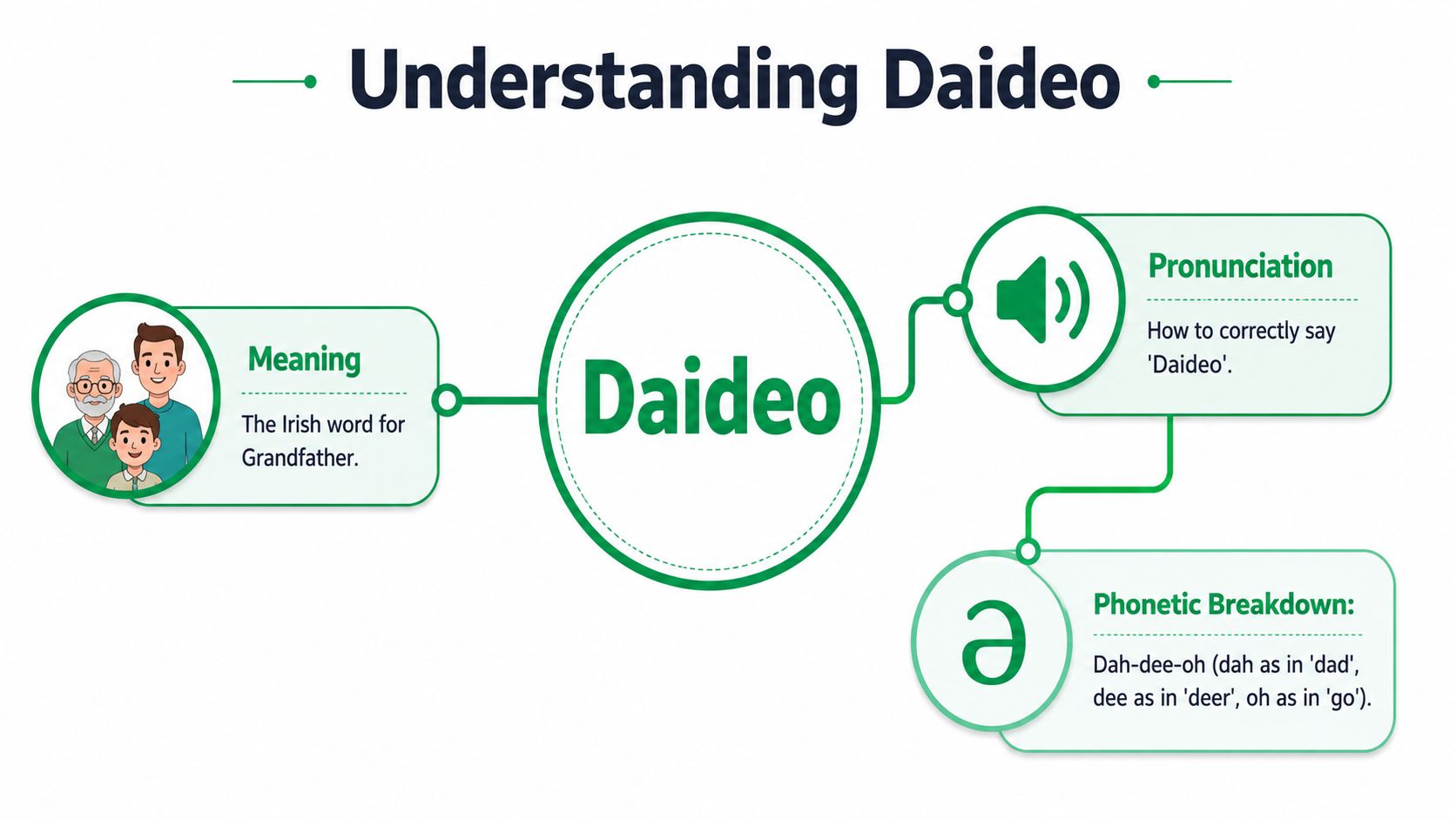
An infographic explaining the Irish word Daideo, its meaning as grandfather, and how to pronounce it.

Irish spelling can feel unfamiliar at first because you can't always map the letters directly onto English sounds. That's why many beginners hesitate. They see daideo and try to force an English reading onto it.

A better approach is to treat it as a sound pattern, not a spelling puzzle.

How to say Daideo clearly

Say it slowly first: daj-oh.

You can think of it like this:

  • First part feels like “daj”
  • Second part ends with a clear “oh”
  • Stress stays on the first syllable
  • Ending should not be clipped too short

If you'd like a broader foundation for sounds like this, an Irish pronunciation guide for beginners can help you build confidence beyond one word.

A short listening model helps too:

Say it aloud before you try to memorize it. Irish often settles into place through the ear faster than through the eye.

If you're curious about formal notation, some learners also like to check IPA when studying pronunciation. That can be useful, but don't let it slow you down. For most beginners, the plain-English sound cue is enough to get started.

The important thing is to say Daideo warmly and naturally, not stiffly. Family words sound best when they feel lived in.

Using Daideo in Everyday Sentences
A young boy holds a wooden toy while standing in a cozy library with bookshelves.

A word becomes real when you can use it in a sentence. With Daideo, the most useful everyday pattern is talking about your grandfather.

The most useful form to learn first

In Irish, “my” is mo. When mo comes before many nouns, the next sound changes. With Daideo, that gives you mo dhaideo.

This change is called lenition. You don't need to master the full grammar today. You only need to notice the before-and-after pattern:

English Basic noun With “my”
grandfather Daideo mo dhaideo

That small spelling change matters because it reflects how Irish words behave together in real speech. If you learn mo dhaideo as one useful chunk, you'll sound more natural right away.

For a broader feel for how Irish builds meaning through word order and small grammatical changes, this Irish sentence structure guide is a helpful next step.

Common learner mistake: keeping the noun unchanged and saying mo daideo. You'll often want mo dhaideo instead.

Simple examples you can start using

Here are a few friendly, practical examples:

  • Seo é mo dhaideo.
    This is my grandfather.

  • Tá mo dhaideo sa bhaile.
    My grandfather is at home.

  • Is fear cineálta é mo dhaideo.
    My grandfather is a kind man.

  • Bhí mé le mo dhaideo inné.
    I was with my grandfather yesterday.

  • Is breá liom mo dhaideo.
    I love my grandfather.

Notice how often Irish learning comes down to reusable chunks. You don't need a huge vocabulary to say meaningful things. One family word plus a few common structures can already carry a lot of feeling.

Try these short practice tasks:

  1. Introduce a family photo
    Say: Seo é mo dhaideo.

  2. Describe him in one word
    Try: Tá mo dhaideo greannmhar.
    My grandfather is funny.

  3. Add a memory
    Try: Bhí mé le mo dhaideo aréir.
    I was with my grandfather last night.

If you're teaching a child, keep it playful. Point to a picture and repeat the phrase together. If you're learning for yourself, say each sentence three times aloud. The rhythm matters as much as the translation.

Daideo vs Seanathair and Regional Terms

Not every Irish speaker uses the same family word in the same way. That's part of the beauty of the language. Daideo is one option, but not the only one.

A quick comparison

The most common comparison learners meet is Daideo versus Seanathair.

Term Usual feel Rough English equivalent
Daideo warm, familiar, affectionate grandad, grandpa
Seanathair more formal, traditional, dictionary-like grandfather

This isn't a strict rule for every family. Some households prefer one term because that's what they've always said. Still, for many learners, Daideo feels more intimate and immediately usable in family speech, while Seanathair can sound more formal.
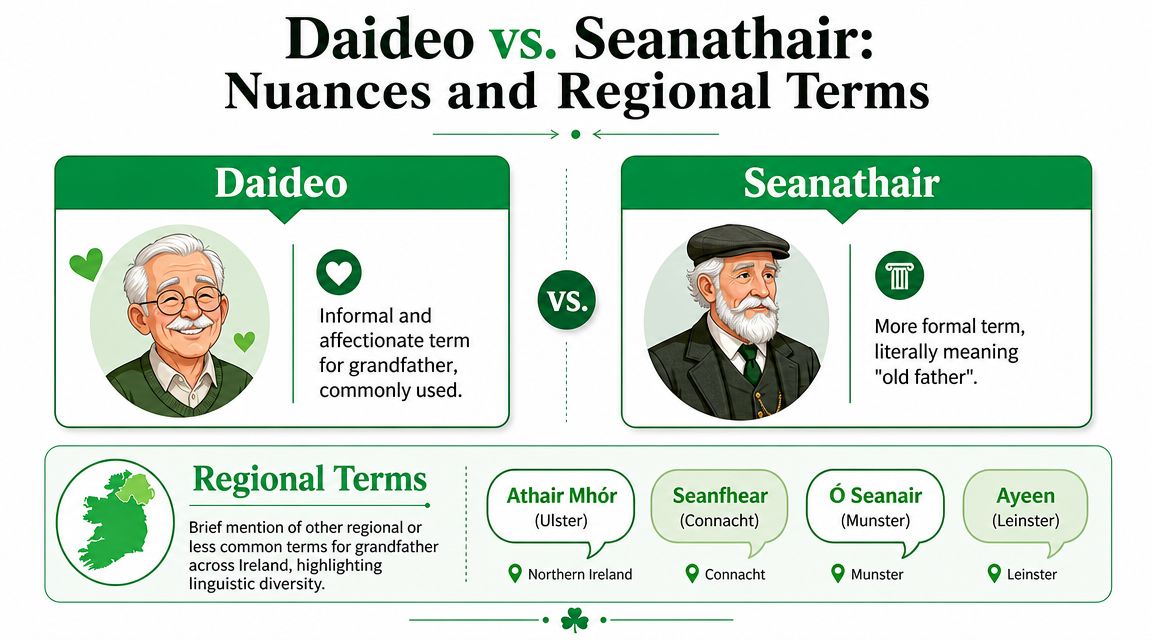
An infographic comparing Irish words for grandfather, Daideo and Seanathair, and various regional Irish terms.

What about regional variation

Irish is a living language with strong regional identities. Families in different parts of Ireland may prefer different expressions, pronunciations, or affectionate forms. That doesn't mean one version is “the only correct one” and the others are wrong. It means language belongs to people and place.

If dialect differences interest you, a useful follow-on resource is this guide to dialectal differences in Irish.

A good learner mindset is simple:

  • Start with one usable word. Daideo is a strong choice.
  • Notice alternatives when they appear. Don't panic if you hear something else.
  • Respect family habit. Homes often keep their own preferred term.

The best word for grandfather in conversation is often the word your family actually says.

That gives you permission to learn with warmth instead of anxiety. Irish isn't asking you to choose one perfect form forever. It's inviting you into real usage.

The Cultural Significance of a Daideo

More than a dictionary meaning

Some words carry family structure. Others carry family feeling. Daideo does both.

In many Irish-speaking and Irish-rooted families, a grandfather isn't only an older male relative. He may be the person who tells the same story at the fire, remembers older place-names, passes on songs, or uses turns of phrase that younger people hear nowhere else. Even when family life looks modern and busy, the idea of the grandfather as a link to continuity remains powerful.

That's why words like Daideo matter. They hold affection inside them. They can feel less distant than a plain formal label.

Why family words stay with us

Family vocabulary is often among the last language people forget and the first language they want back. Someone may know very little Irish, yet still remember a grandparent term, a blessing, or a pet name from childhood. These are often the words that survive in emigrant families too. They stay because they're attached to voice, not just meaning.

Think of how people speak when they remember a grandparent. They rarely begin with grammar. They begin with texture. The chair by the window. The walk to school. The stories repeated so many times they became part of the house itself.

A heritage word becomes powerful when it names a relationship you can still feel.

That's one reason learners reconnect so strongly through kinship terms. Daideo can be a vocabulary item, yes. It can also be an entry point into personal history. When you say it, you're not only practicing Irish. You're naming a role that often carries wisdom, humour, steadiness, and memory.

Practice and Master Daideo with Gaeilgeoir AI
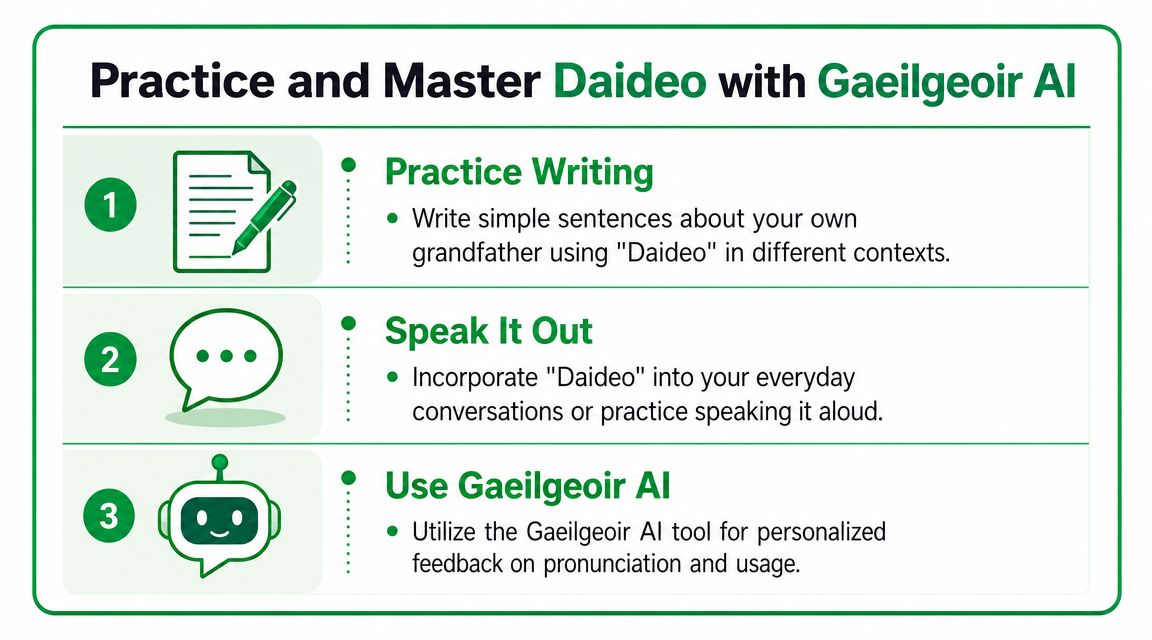
An infographic showing three steps to practice and master the Irish word Daideo using Gaeilgeoir AI.

Learning sticks when you use the word in ways that matter to you. Daideo is perfect for that because it's personal, concrete, and easy to place in everyday speech.

Three easy ways to practise

Try a short routine like this:

  • Write one true sentence. Use a real memory or description, even if it's simple. Bhí mo dhaideo greannmhar. A real sentence is easier to remember than a random one.

  • Say it while looking at a photo. That keeps the word attached to a person, not just a notebook. Speak slowly and aim for a relaxed rhythm.

  • Build a tiny family set. Once Daideo feels comfortable, add other family words around it. That helps your brain store vocabulary by relationship, which is how people often use it in conversation.

If you're helping a child learn at home, keep the atmosphere light and repetitive. Songs, family pictures, and short spoken routines work well. Parents looking for broader ideas may also find this guide on teaching kids a second language at home useful.

When guided practice helps most

Some learners do well with self-study at first, then hit a wall when pronunciation, recall, and sentence-building need regular feedback. That's normal. Family words may be emotionally familiar, but using them fluently still takes repetition.

A good practice tool should make it easy to do three things: hear the word, say the word, and use the word in context. That matters far more than memorizing long lists in isolation.

Keep your first goal modest:

  1. Recognize Daideo when you hear it.
  2. Say it comfortably.
  3. Use it in one sentence about your own family.

Once you can do that, the word is no longer abstract. It belongs to your spoken Irish.


If you'd like to turn words like Daideo into real conversation, Gaeilgeoir AI is a practical next step. It helps learners start speaking from day one with guided conversations, pronunciation support, adaptive quizzes, and everyday vocabulary practice built around the most-used Irish words. You can also get started at Learn Gaeilgeoir AI.
The Irish Word for Fire: A Beginner’s Guide to ‘Tine’

You're probably here because you wanted a simple answer and then realized you also want to say it correctly. Maybe you're looking at a fireplace, writing a poem, tracing family roots, or trying to remember a word from school Irish. The good news is that the main Irish word for fire is tine.

That one word is a great starting point, but it's only the beginning. Irish isn't just English with different labels attached. It's a Celtic language, and its English name “Gaelic” comes from Gaeilge, the Irish word for the language itself, as explained by the University of Notre Dame's overview of Irish. That matters because Irish words have their own sound patterns, grammar habits, and sentence flow.

If you've searched “Irish word for fire,” this guide is meant to help with the part most pages skip. You won't just learn the translation. You'll learn how to say tine, how to use it in short everyday phrases, and how it connects to Irish tradition.

Table of Contents

Your Journey to the Irish Word for Fire

A lot of learners meet this word in a cozy setting. You see a fire in the hearth, or you want to say “the fire is warm,” and suddenly you realize that knowing one translation isn't enough. You need the sound, the article, and the shape of the phrase.

The everyday answer is tine. If you want to say “the fire,” you'll often meet an tine in beginner material. That's useful because it gives you the noun in action, not just as an isolated vocabulary item.

Why Irish feels different

Irish doesn't map neatly onto English. It belongs to the Celtic family, not the Germanic or Romance families, so familiar English instincts won't always help. Word order can feel different. Pronunciation can surprise you. Even small words around the noun can change its form or sound.

Practical rule: Learn the word and one short phrase together. Don't memorize only tine. Memorize an tine as well.

That habit makes vocabulary easier to use in real speech. It also helps you hear the rhythm of Irish sooner.

A better way to learn this word

If you're a beginner, try this order:

  • Hear it first: Say tine aloud before worrying about spelling perfection.
  • Use it in a phrase: Try an tine and cois tine.
  • Attach a scene: Think of a glowing hearth, campfire, or stove.
  • Repeat it naturally: Short daily repetition works better than cramming.

Irish comes alive when words are tied to lived moments. Fire is perfect for that. It's warm, visible, concrete, and firmly rooted in the cultural memory of the language.

The Main Word for Fire 'Tine' Explained

The core word you need is tine. Bitesize Irish gives the standard learner-friendly form an tine for “the fire” and notes that tine is pronounced roughly “chin-eh” in standard Irish in its learning material on the phrase “an tine”.

How to pronounce tine

Say it slowly at first: chin-eh.

The first part sounds close to “chin.” The second part is light and quick. Don't stretch it into an English-style “tyne,” and don't pronounce the final e too heavily.

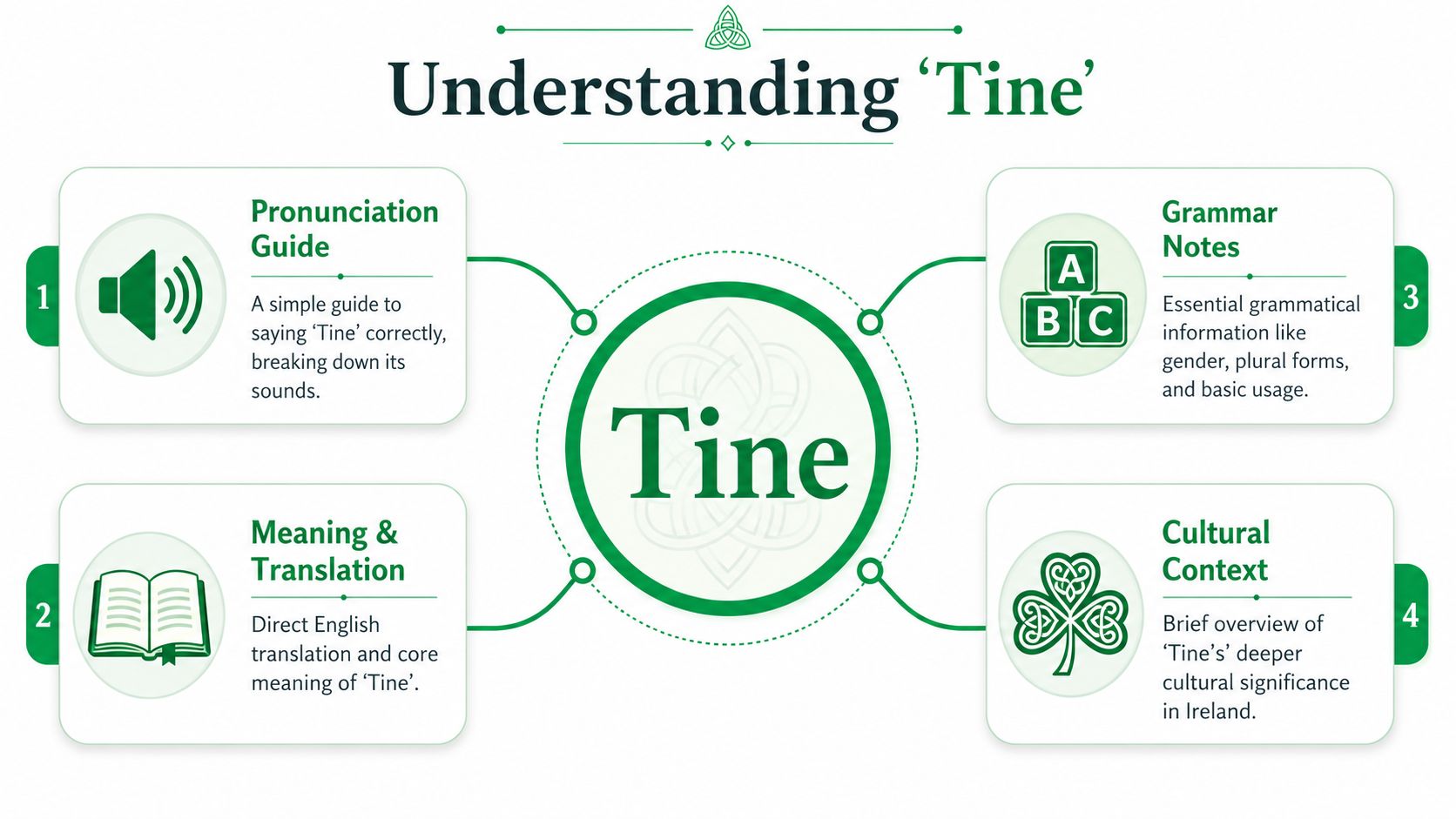
An infographic titled Understanding Tine with four sections explaining pronunciation, meaning, grammar, and cultural context of the word.

A simple IPA guide is /ˈtʲɪnʲə/. If IPA feels unfamiliar, don't worry. The plain cue is enough for most beginners.

Keep the ending soft. English speakers often want to pronounce every letter strongly, but Irish often uses a lighter final sound here.

A quick listening model can help fix the sound in your ear before you practice it alone.

What the word means in real use

In ordinary beginner use, tine means fire. Depending on context, it can also overlap with the idea of a flame. If someone asks for the Irish word for fire, this is the one to learn first.

You'll often meet it in forms like these:

  • tine: fire
  • an tine: the fire
  • cois tine: by the fire
  • tine oscailte: open fire

Those phrase-level uses matter more than memorizing a dictionary list on day one.

A note on grammar

Treat tine as a noun you learn through patterns, not through abstract grammar labels first. The fastest route is to notice what happens in short chunks.

A few beginner-friendly habits help:

  • Learn the article with the noun: an tine
  • Notice preposition phrases: cois tine
  • Reuse one sentence frame: Tá an tine… for “The fire is…”

If you're returning to Irish from school, you may remember being told to master every form before speaking. That often slows people down. It's better to use tine in small correct phrases and let the grammar settle in through repetition.

The Cultural Heartbeat of Fire in Ireland

Fire in Irish isn't only a household word. It carries memory, ritual, gathering, and seasonal tradition. That's one reason the word tends to stick with learners. It doesn't feel flat.

Why fire feels bigger than a household word

In older Irish life, fire sat at the center of the home. It gave heat, light, and a place to gather. Even if you're only learning a simple noun, you're touching a word that has lived in daily speech and shared custom for a very long time.

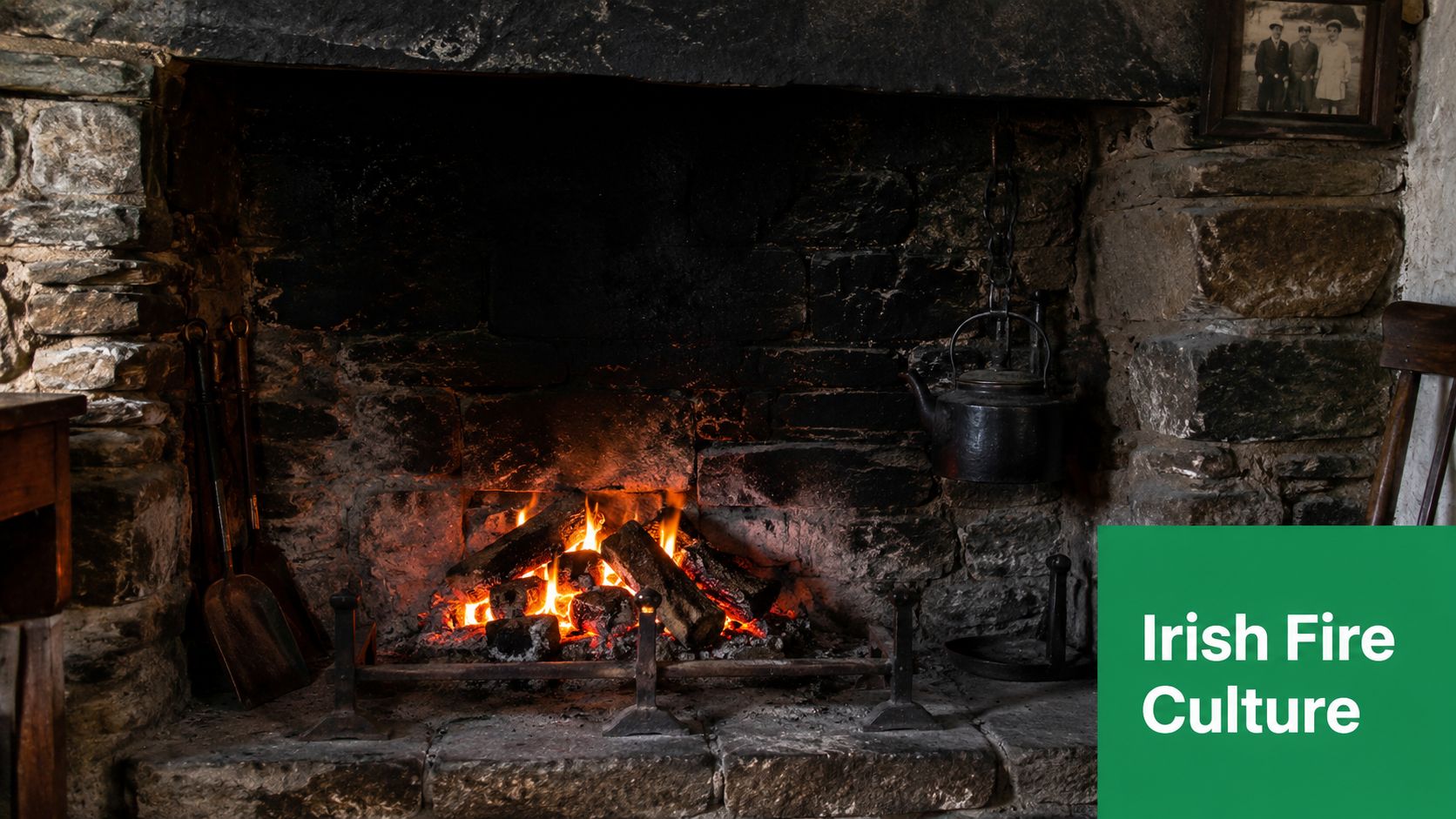
A rustic stone fireplace with a glowing wood fire, hanging kettle, and traditional tools inside an Irish cottage.

That cultural weight becomes clearer when you look at bonfires and seasonal celebrations. If you're curious about one of the best-known fire traditions, this guide to the Beltane fire feast celebration gives useful background.

The story inside bonfire

The Irish Times notes that the term bonfire is linked to tine cnámh, meaning “fire of bones,” and describes a tradition in which bones were burned and ashes were spread on fields for fertility. The same piece explains that the English word developed from the 16th-century Middle English form bonefire, as discussed in the Irish Times article on “bone fire”.

That detail matters for learners because it shows how a basic word like tine lives inside larger expressions. A single noun opens a door into history.

Some words are easier to remember once you know the story they carry. Tine is one of them.

If you remember tine only as a vocabulary flashcard, it may fade. If you remember it as the word at the center of hearths, gatherings, and tine cnámh, it starts to feel anchored.

Using 'Tine' in Everyday Sentences

Now, the word becomes usable. Start small and keep the sentences practical. You don't need long, literary Irish to make progress.

Start with short usable phrases

Here are a few beginner-friendly examples:

  • An tine.
    The fire.

  • Cois tine.
    By the fire.

  • Tine oscailte.
    Open fire.

  • Tá an tine te.
    The fire is hot.

Say each one aloud more than once. Irish becomes much easier when your mouth gets used to the pattern.

Building full beginner sentences

Once you've got the short phrases, use them in mini-scenes:

  1. Tá mé i mo shuí cois tine.
    I am sitting by the fire.

  2. Tá an tine sa teach.
    The fire is in the house.

  3. Tá an tine láidir.
    The fire is strong.

You don't need to master every grammar point in these examples right away. The important thing is that you're seeing tine inside a sentence, not alone on a list.

If sentence building feels shaky, a simple guide to Irish sentence structure can help you see where nouns like tine sit in everyday patterns.

One grammar habit to notice

Irish often teaches through chunks. That's especially helpful with a word like tine, because the surroundings matter.

Try this method:

  • Start with the noun: tine
  • Add the article: an tine
  • Add a location phrase: cois tine
  • Add a description: Tá an tine te

Don't wait until you “know all the grammar” to speak. Use one safe phrase well, then expand it.

Learners also get confused by direct translation. In English, you might think word-for-word first. In Irish, it's better to absorb whole patterns. That's why cois tine is more useful than memorizing cois and tine separately and hoping they join neatly under pressure.

Expanding Your Vocabulary Beyond 'Tine'

Once tine feels comfortable, your Irish gets more expressive when you add a few nearby words. You don't always want the broad word “fire.” Sometimes you mean flame, spark, or ash.

Related words worth learning early

Teanglann notes that dictionaries include multiple related forms and entries around the idea of fire, including draig, bácáil, and loisc, but for beginners tine is the essential standard noun to learn first in its dictionary entry for “fire”.

Here's a practical learner table that keeps the focus on everyday use.

Irish Word Pronunciation Cue English Meaning When to Use
tine chin-eh fire Use for the general idea of a fire or blaze
lasair lah-sir flame Use when talking about a visible flame
spréach spray-kh spark Use for a small spark
aingeal an-gyal ember, live coal Use for glowing remains in a fire
luaith loo-ah ash Use for ashes after burning

A small set like this is enough to make your language feel more precise.

For example:

  • tine is broad
  • lasair is what you see flickering
  • spréach is tiny and brief
  • luaith is what remains

If you want to build vocabulary in themed groups like this, a resource on how to expand Irish vocabulary can help you connect words by context instead of memorizing them randomly.

Quick Tips for Remembering Your New Words

A new Irish word stays with you faster when you give it a job to do. Tine becomes easier to remember once you hear it, say it, and place it in a small real-life scene.

Start with sound. Tine is said roughly like chin-eh. If that feels slippery at first, attach it to a simple picture, such as your chin close to a warm hearth. The picture does not need to be clever. It just needs to be clear enough that your brain can find the word again.

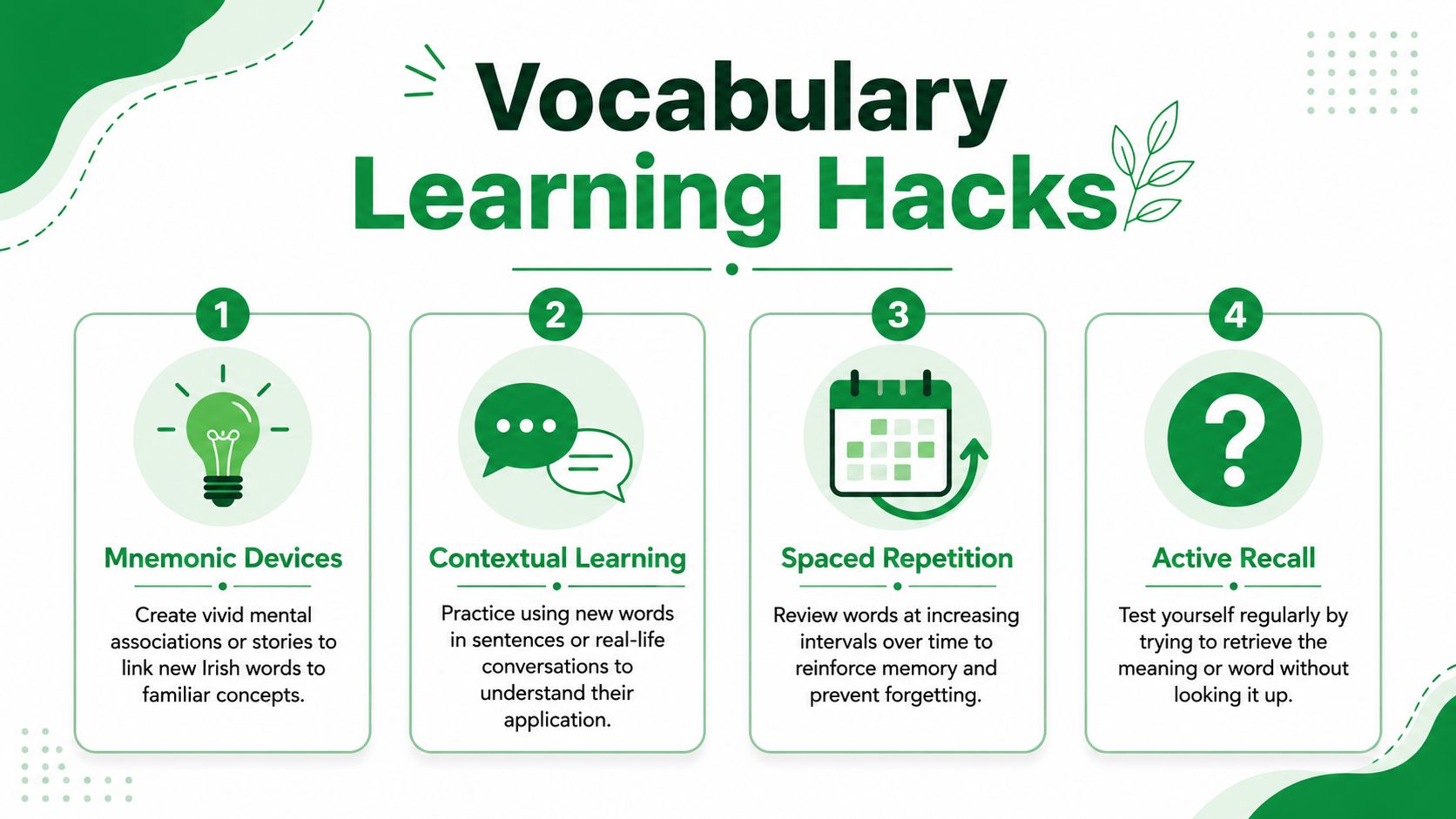
A green and white infographic titled Vocabulary Learning Hacks listing four techniques for learning Irish language vocabulary.

Then give the word a pattern. Language memory works a bit like building a path through grass. One step helps, but several steps in the same direction make the route easier to follow. With tine, that can be as simple as moving through this short cycle:

  • Say it aloud: tine
  • Add the article: an tine
  • Put it in a place: cois tine
  • Make a full sentence: Tá an tine te.

That last step matters most. Many learners know a translation but freeze when they try to use it. A full sentence closes that gap. It turns tine from a word you recognize into a word you can say.

Keep your practice short and active. Read the word. Cover it. Recall it. Write one phrase from memory. Come back to it later the same day. Five focused minutes usually helps more than a long study session where the word only stays on the page.

If you use Gaeilgeoir AI, you can practise the same way with pronunciation support and sentence-based review. A notebook or paper flashcards work well too.

Use beats recognition. Once you can say tine in one natural sentence, it starts to feel like part of your Irish, not just a translation on a list.

Frequently Asked Questions

Is it Irish or Gaelic

In everyday English, Irish is the clearest term for the language of Ireland. You'll also hear Gaelic, but that can be broader and less precise for beginners. Since the language's own name is Gaeilge, people sometimes use “Gaelic” in English conversation, but “Irish” is usually the most straightforward label when you're learning.

Are there other Irish words related to fire

Yes. Dictionary material includes related entries such as draig, bácáil, and loisc, but those aren't the first forms a beginner needs. Start with tine and build from there.

That's the main answer to the search “Irish word for fire.” If all you remember today is one word, make it tine.

How do I keep improving from here

Use the word in three ways today:

  • Say it aloud several times.
  • Write one phrase such as an tine.
  • Build one sentence such as Tá an tine te.

If you keep meeting the word in context, it will stop feeling like something you memorized and start feeling like something you can say.


If you want to keep going beyond one vocabulary item, Gaeilgeoir AI offers guided Irish practice for beginners and returning learners, including pronunciation support, real-world conversation work, and vocabulary study you can fit into a busy routine. If you're ready to practice regularly, you can Start Your Free Trial.

Sister in Irish Gaelic: Your Complete Guide to ‘Deirfiúr’

The main modern Irish word for sister is deirfiúr. Irish is a living language with a large speaker and learner base, and in the 2022 census 1,873,997 people over age 3 said they could speak Irish, while 13% said they spoke it daily.

If you're here, you're probably in a very familiar place. You've looked up “sister in Irish Gaelic,” found a translation, and then immediately wondered what to do with it. How do you pronounce it? How do you say my sister? Why does the word seem to change in some sentences?

That's where many beginners get stuck. A dictionary gives you the word, but not the confidence to use it. So let's make this practical. By the end, you'll know how to say deirfiúr, how to hear its shape, and how to build real sentences about your own family.

Table of Contents

Why Learning Family Words in Irish Matters

Many learners don't start with abstract grammar. They start with the people they love. You might want to describe your sister to a grandparent, add a few Irish words to a family card, or reconnect with heritage in a way that feels personal rather than academic.

That's why family words matter so much. They're among the first things you reach for in real conversation. If you know how to say a family term naturally, the language starts feeling usable instead of distant.

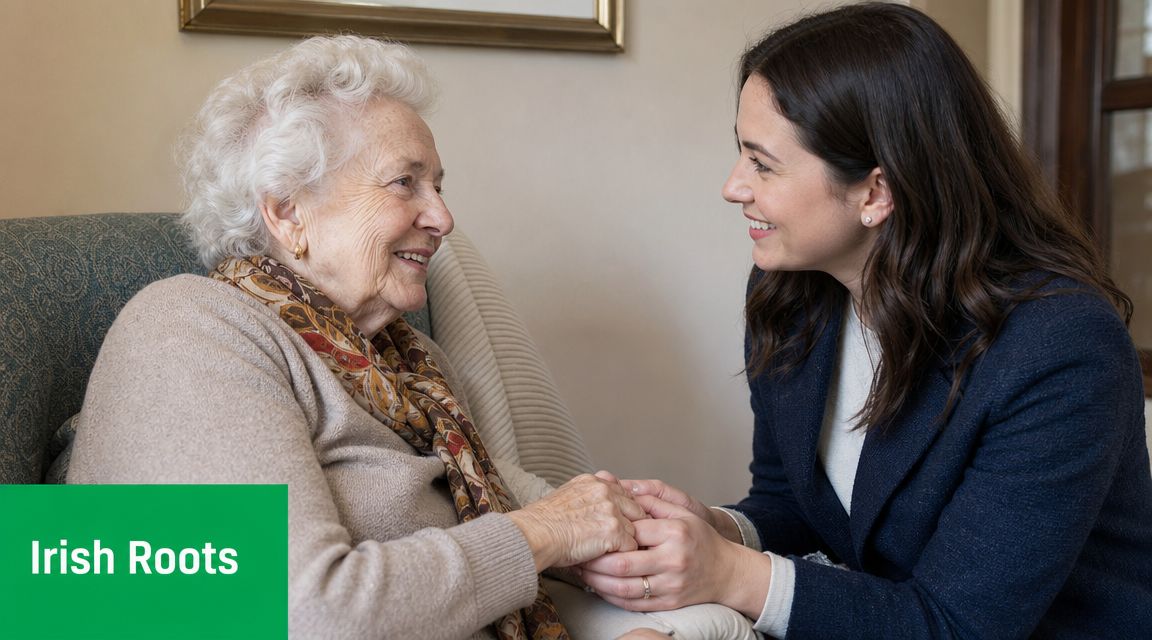
A young woman smiling and holding the hands of an elderly woman during a conversation.

A learner might begin with a simple goal: “I want to say, ‘This is my sister.’” That sounds easy in English. In Irish, it's still very doable, but there are a few small patterns you need to notice. Once you learn them, a lot of other family vocabulary becomes easier too.

If you're building out your home and family vocabulary, this guide to family words in the Irish language can help you widen the picture.

Family terms are often the first words that turn language study into actual communication.

There's also a cultural reason this matters. Irish isn't only a language of old songs, place names, or school memory. It's spoken today in communities across Ireland, including the Gaeltacht, so learning a word like deirfiúr gives you something useful in current contexts.

How to Say Sister in Irish

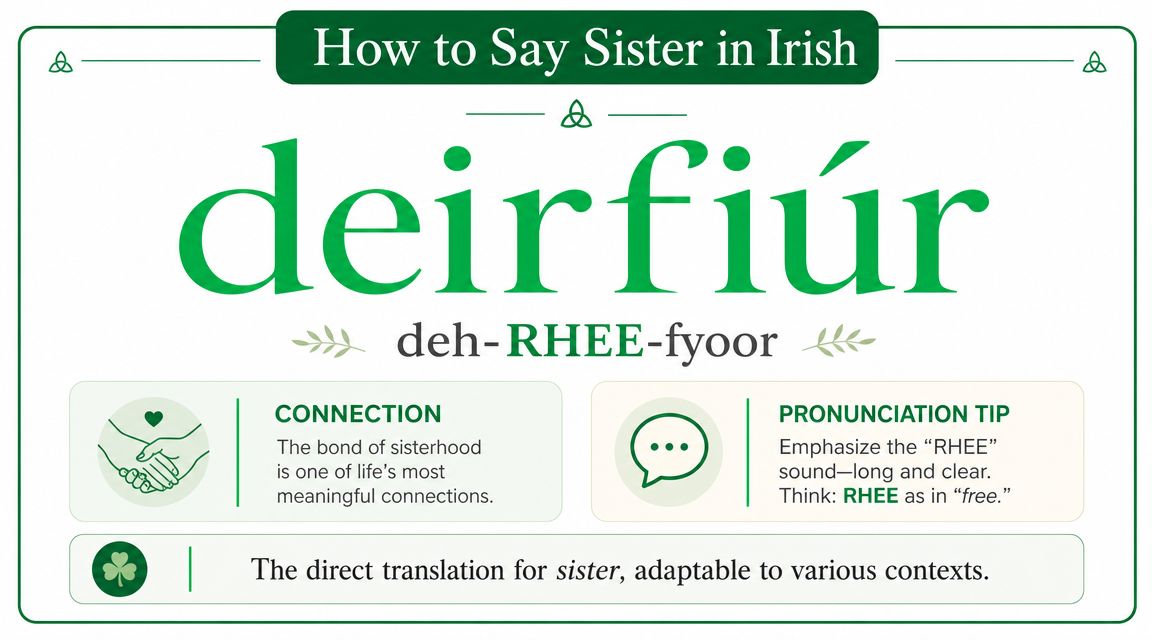
The word you want is deirfiúr. If you're searching for “sister in Irish Gaelic,” this is the standard modern Irish form you'll most often meet in current learning materials and dictionaries.

A common way to ease into the pronunciation is deh-RHEE-fyoor. You may also hear learners describe it more roughly as “drih-foor,” but that can flatten the middle of the word too much. Irish pronunciation is best learned by listening as well as reading, because spelling and sound don't always line up in the way English speakers expect.

An educational infographic showing the Irish word for sister, deirfiúr, with its pronunciation guide and tips.

Start with the shape of the word

Break deirfiúr into two parts in your ear:

  • deir
  • fiúr

Don't worry about making it perfect on day one. Aim for a smooth rhythm rather than a word-by-word English reading. The stress tends to fall strongly near the start, and the ending should sound rounded, not chopped short.

A good beginner habit is to say it in three steps:

  1. Listen first
  2. Repeat slowly
  3. Use it in a tiny phrase

That last step matters most. A word settles in faster when it appears inside a sentence.

Add the article

You'll also see an deirfiúr, which means the sister.

Irish words often appear with small helpers in front of them, meaning that if you only memorize isolated vocabulary, you'll feel lost the moment you meet a sentence. If you learn deirfiúr and an deirfiúr, you already have two useful building blocks.

Here's the simplest pair:

English Irish
sister deirfiúr
the sister an deirfiúr

Modern Irish uses stable, standardized forms, which helps learners a lot. That matters in a language that's actively spoken today. According to Bitesize Irish on deirfiúr, 1,873,997 people over age 3 said in the 2022 census that they could speak Irish, and 13% said they spoke it daily.

Practical rule: Don't stop at the translation. Learn the word, say it aloud, then place it in one short phrase immediately.

One more point that often surprises learners. Irish and Scottish Gaelic are related, but they don't always use the same everyday family words. Modern Irish uses deirfiúr, while Scottish Gaelic commonly uses piuthar. That difference is normal.

Understanding the Grammar of Deirfiúr

Once you know deirfiúr, the next challenge is grammar. Often, beginners think Irish is becoming complicated, but the first ideas are manageable if you treat them as sound patterns instead of rules to fear.

Deirfiúr is a feminine noun

In Irish, nouns belong to grammatical groups, and deirfiúr is a feminine noun. That doesn't mean the word has some magical property. It just means other words around it may behave a certain way.

If that sounds strange, think of it as a category label. English has traces of this kind of idea in older expressions and literary language, but Irish uses it more clearly. You don't need to memorize every feminine noun at once. You only need to notice that deirfiúr is one of them.

Why is this useful? Because later, when you meet phrases around the word, the changes won't feel random.

Irish often softens the first sound

One of the biggest beginner hurdles is séimhiú, usually called lenition in English. This is a kind of sound-softening at the start of a word. In writing, it often shows up as an extra h after the first consonant.

So a word can change shape a little without becoming a different word.

For example:

  • deirfiúr
  • dheirfiúr

That added h tells you the opening sound has softened.

Irish often changes the beginning of a word because of the word in front of it. If you expect that, the language starts making more sense.

You don't need a full mutation chart yet. What matters is the idea that Irish likes flow. Instead of every word staying frozen in one form, the language lets nearby words influence one another.

If you want a fuller explanation of these patterns, this guide to urú and séimhiú rules in Irish is a useful next read.

Hear the change before you try to master it

When beginners see mo dheirfiúr, they often ask, “Why did the word change?” The short answer is that mo triggers that softening.

You don't have to solve every grammar question immediately. Start by noticing these pairs:

Base form Changed form
deirfiúr dheirfiúr

Then say them aloud. The learning order that generally works best is:

  • Notice the pattern
  • Hear the difference
  • Use it in one phrase
  • Repeat often

That's much better than trying to memorize a long grammar table with no examples.

Older and newer forms both exist

Irish also has layers of older and newer vocabulary. One older root word for sister is siúr, while modern everyday Irish commonly uses deirfiúr. That older literary layer still appears in some texts and religious writing, which is why learners sometimes meet more than one form.

As discussed on the Irish Language Forum thread about siúr and deirfiúr, modern standard forms matter in a living language used across the island, including by 71,968 daily Irish users outside the education system in the 2022 census, and the 2021 census in Northern Ireland found 228,617 people with some ability in Irish, equal to 12.45% of the population.

How to Say My Sister Your Sister and Her Sister

This is the point where the word becomes useful. Once you can say my sister, your sister, and her sister, you can start talking about real people instead of repeating isolated vocabulary.

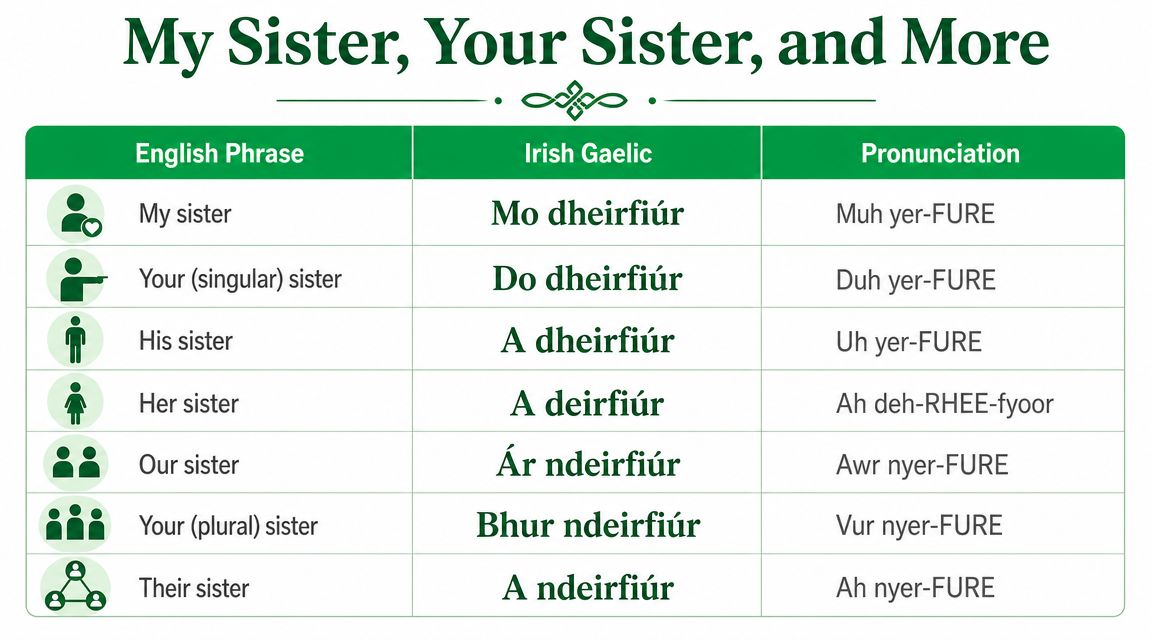
A table displaying Irish Gaelic phrases for sister, showing possessive pronouns, translations, and phonetic pronunciations.

The key forms side by side

Here are the forms beginners need most:

English Irish Simple pronunciation
my sister mo dheirfiúr muh yer-FURE
your sister do dheirfiúr duh yer-FURE
his sister a dheirfiúr uh yer-FURE
her sister a deirfiúr ah deh-RHEE-fyoor
our sister ár ndeirfiúr awr nyer-FURE
your sister plural bhur ndeirfiúr vur nyer-FURE
their sister a ndeirfiúr ah nyer-FURE

The first thing to notice is the change after mo and do. Both cause lenition, so deirfiúr becomes dheirfiúr.

The common confusion with a

The trickiest pair is this one:

  • a dheirfiúr = his sister
  • a deirfiúr = her sister

They look very similar, but they don't behave the same way. His causes lenition. Her does not.

That small difference can feel frustrating at first, but it becomes familiar quickly if you practise in pairs. Always learn them as a contrast, not as separate facts.

Say these together out loud: a dheirfiúr, a deirfiúr. Your ear will start catching the difference faster than your eyes do.

A useful memory trick

Try this beginner-friendly way to remember the most common forms:

  • mo softens
  • do softens
  • his a softens
  • her a doesn't

That's not the whole grammar system, but it's enough to get moving.

If you want to compare this with another close family word, this guide to mother in Irish Gaelic helps reinforce the same kind of pattern.

The standard modern use of deirfiúr is especially helpful because learners need one dependable everyday form. The discussion on the earlier linked forum source notes the older siúr alongside modern deirfiúr, and that standardization supports clear communication for everyday speakers.

Common Phrases and Sentences Using Deirfiúr

Single words are only the start. The true breakthrough comes when you can say a full sentence without freezing halfway through.

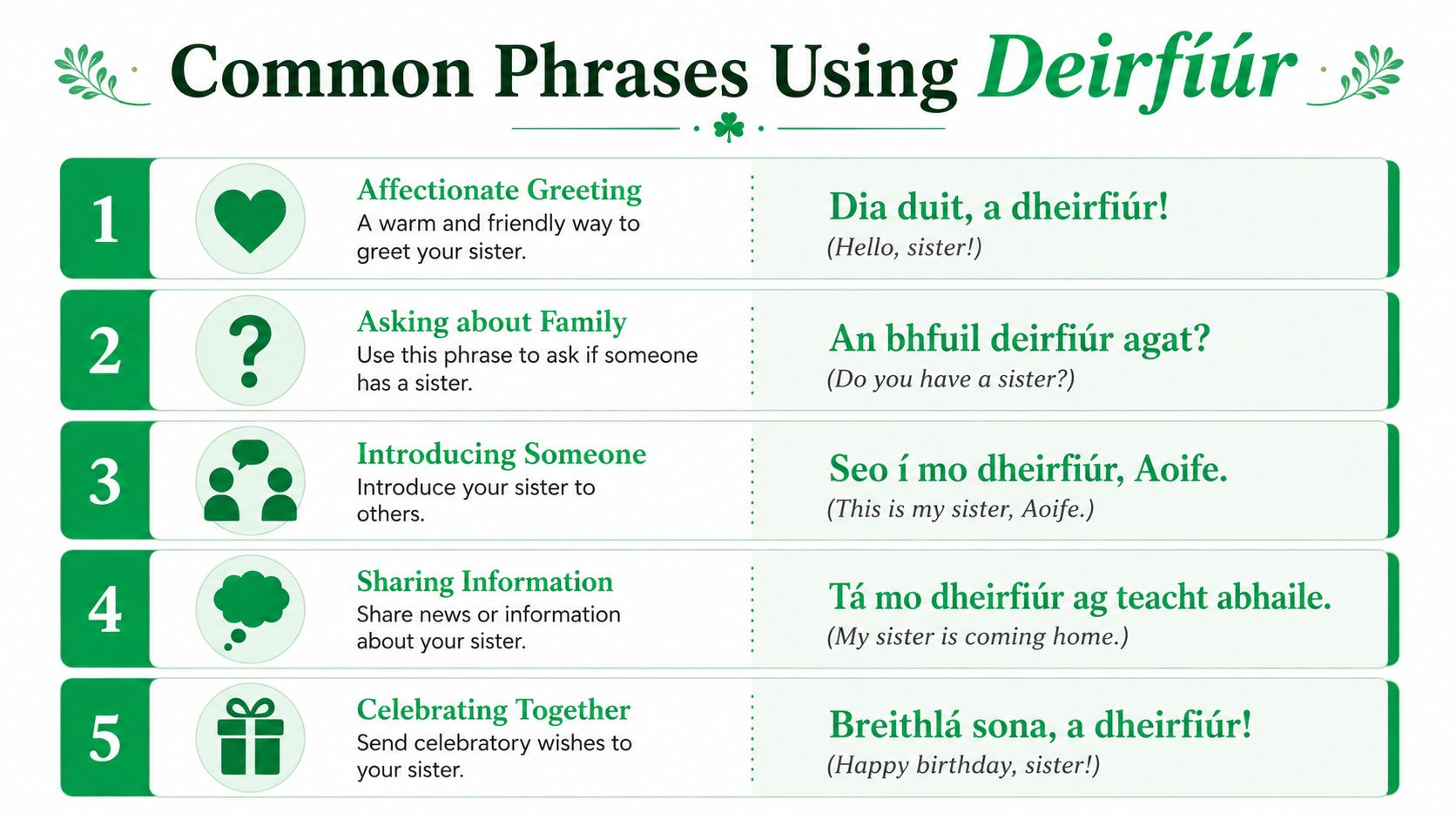
Here are some natural beginner phrases built around deirfiúr.

An educational chart displaying five common Irish phrases using the word deirfiúr for sister with translations.

Short phrases you can start using

  • Seo mo dheirfiúr.
    Pronunciation: shoh muh yer-FURE
    Meaning: This is my sister.

  • An bhfuil deirfiúr agat?
    Pronunciation: an will jer-FURE ah-gut
    Meaning: Do you have a sister?

  • Cad is ainm do do dheirfiúr?
    Pronunciation: cod iss ann-im duh duh yer-FURE
    Meaning: What is your sister's name?

  • Is múinteoir í mo dheirfiúr.
    Pronunciation: iss MOON-choir ee muh yer-FURE
    Meaning: My sister is a teacher.

  • Tá mo dheirfiúr ag teacht abhaile.
    Pronunciation: taw muh yer-FURE egg tyacht uh-wal-yeh
    Meaning: My sister is coming home.

Direct address sounds a little different

When you speak directly to your sister, you may hear:

  • Dia duit, a dheirfiúr!
    Meaning: Hello, sister!

  • Breithlá sona, a dheirfiúr!
    Meaning: Happy birthday, sister!

That direct-address pattern can look unusual, so don't worry if it feels less familiar than mo dheirfiúr. It's enough at first to recognize it when you hear it.

Here's a short video to support your listening practice:

A simple way to practise without overwhelm

Use one sentence pattern and swap in your own details.

Try this mini routine:

  1. Seo mo dheirfiúr.
  2. Is [job] í mo dheirfiúr.
  3. Tá mo dheirfiúr [verb phrase].

That gives you a repeatable frame. You're not inventing Irish from scratch each time. You're using a known structure and changing one piece.

Learn one phrase until it feels easy, then vary one word. That's how confidence grows.

Start Your Irish Language Journey Today

You came looking for the Irish Gaelic word for sister, and now you've got much more than a translation. You know that deirfiúr is the main modern Irish word, you've seen how to pronounce it, and you've worked through the first grammar patterns that appear the moment you try to say my sister or her sister.

That's real progress. It's how Irish becomes speakable. Not by memorizing huge lists, but by learning one useful word well and then putting it into phrases you can say.

Keep going in that same spirit. Stay close to high-frequency words. Say them aloud. Reuse them in short sentences about your own life. That's where fluency starts to feel possible.

If you want the next step, focus on practice that lets you hear, repeat, and respond. The more often you use words like deirfiúr in context, the less they feel like vocabulary items and the more they feel like part of your voice.


If you're ready to move from reading about Irish to speaking it, Gaeilgeoir AI is a strong next step. It helps beginners and returning learners practise real-world Irish through guided conversations, pronunciation support, and everyday vocabulary that you can start using right away.

Gaelic for White: Your Irish & Scottish Translation Guide

The Gaelic for white is bán in Irish and geal in Scottish Gaelic. That split matters right away, because “Gaelic” isn't one single language, and the right word depends on which one you're learning.

A lot of people search for Gaelic for white because they need one quick answer. Maybe you're labeling artwork, writing a tattoo idea in a notebook, choosing a name, or trying to reconnect with family language. The tricky part is that a one-word answer can steer you wrong if nobody tells you which Gaelic they mean.

That's where beginners usually get stuck. They find bán on one site, geal on another, and start wondering whether one is old, one is modern, or one is “more correct.” The core issue is simpler. You're looking at two related but different languages, and each has its own normal word, pronunciation, and grammar patterns.

Table of Contents

Why 'Gaelic for White' Is a Trick Question

You can ask for “Gaelic for white” and still be asking two different questions.

If you mean Irish Gaelic, the usual word is bán. If you mean Scottish Gaelic, the common word is geal. Many beginner guides flatten that difference and give only one answer, which is why learners often come away confused. The distinction matters from the first word.

Gaelic is a family label, not one single everyday language

In ordinary conversation, people often use “Gaelic” loosely. But learners get better results when they get more specific. Irish is Gaeilge. Scottish Gaelic is Gàidhlig. They're related, but they aren't interchangeable.

Imagine looking for the word “white” in Spanish and being handed a Portuguese answer. The languages are cousins, not copies. That's why choosing the language first is the primary first step.

Practical rule: Before you memorize the translation, decide whether you need Irish or Scottish Gaelic. The same English word can lead to different answers.

If you want a broader overview of how the two languages differ beyond vocabulary, this comparison of Irish and Scottish Gaelic grammar is a helpful next read.

Why beginners get mixed answers online

Search results often favor short dictionary-style answers. Those are useful, but they skip the part that helps you speak effectively. A color word in Gaelic usually isn't just a label you paste into a sentence unchanged. It interacts with pronunciation, grammar, and context.

That's why Gaelic for white is a better learning moment than it first appears. You're not just learning a color. You're learning how the language organizes meaning.

Here's the short version:

  • If you study Irish: learn bán
  • If you study Scottish Gaelic: learn geal
  • If you want to use the word in a real phrase: expect the form or sound to shift depending on the sentence

The Irish Word for White Bán

In Irish, the standard word for white is bán. A simple English-friendly pronunciation guide is “bawn.”

That long vowel matters. If you say it too quickly or too flatly, it can lose the shape that makes it sound recognizably Irish. Slow is good when you're starting.

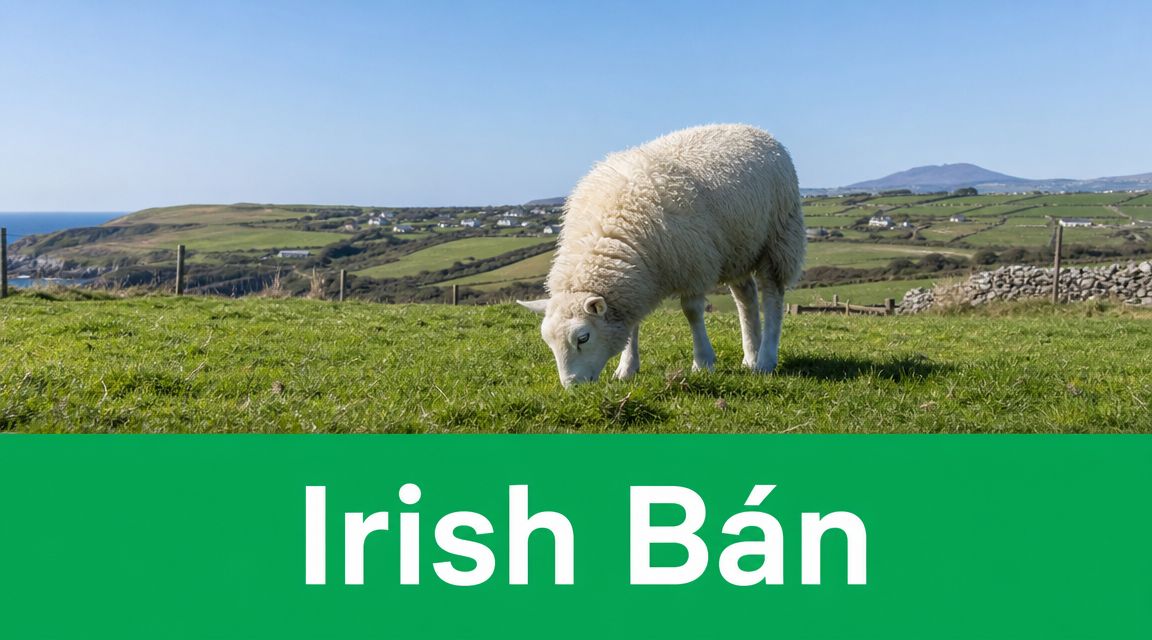
A white sheep grazing in a green pasture with a coastal landscape and hills in the background.

Bán means more than a color

This is one of the most useful details learners usually miss. In Irish, bán doesn't only point to the color white. Lexicographic sources also give related senses such as blank, fallow, or empty in context, which is why a direct one-to-one translation can be too narrow in real use, as shown in the Majstro entry for white.

That doesn't mean every use of bán is mysterious. It means the word has a wider field of meaning than English learners expect. Languages do this all the time. One word can cover a family of related ideas rather than a single neat box.

A first phrase you can actually use

A very basic pattern is noun plus adjective:

  • teach bán = white house

That structure helps beginners because it shows where the color word often sits. English says “white house.” Irish often puts the describing word after the noun.

Don't treat bán like a sticker you place before every noun. In Irish, adjectives commonly follow the thing they describe.

A few beginner habits help here:

  • Say it out loud: “bawn” is easier to remember when your ear joins in.
  • Pair it with a noun: single words fade fast, but phrases stick.
  • Watch the context: if a dictionary gives extra meanings, that's a clue the word has nuance.

Why this matters for real Irish

A learner who only memorizes “white = bán” can still freeze when reading an actual sentence. A learner who knows that bán can stretch into nearby meanings is much less likely to panic.

That's part of what makes Irish feel alive. Words carry history, habit, and context, not just labels.

The Scottish Gaelic Word for White Geal

In Scottish Gaelic, the common word for white is geal. A beginner-friendly pronunciation guide is often written as “gyal” or “gal” with a light palatal quality, depending on how closely you're trying to imitate native sound.

What matters most at first is recognizing that geal is not the same word as Irish bán. They may both answer the English question “what's the Gaelic for white?”, but they belong to different languages.

A serene Scottish loch shoreline filled with smooth white stones under a cloudy sky.

Geal has a wider job than English white

Scottish Gaelic often packs more function into a word than beginners expect. Authoritative dictionary material shows that geal can refer to a white object or substance, and it can also work as a verb meaning whiten or bleach, as shown in the LearnGaelic dictionary entry for geal.

That's a big clue about how Gaelic works. A word may describe a state, point to a thing, or suggest a process. English often splits those jobs across separate words. Gaelic doesn't always do that.

Why geal feels different from bán

Irish bán often gets taught as a plain color word first. Scottish Gaelic geal invites you to think a little more dynamically. It can describe whiteness, but it can also lean toward the idea of something becoming white or being treated as white in appearance.

That doesn't make it difficult. It just means you should learn it in context, not as an isolated flashcard.

A simple memory aid can help:

  • bán feels like the standard Irish answer
  • geal feels like the standard Scottish Gaelic answer with a broader functional range

A useful beginner mindset

If you're learning Scottish Gaelic, don't ask only, “What does geal mean?” Ask, “How does geal behave?” That small change leads to better reading and better speaking.

A Gaelic word often acts more like a small toolkit than a single English label.

Once you start looking for that pattern, the language becomes more logical.

How These Words Change in a Sentence

Memorizing bán and geal is only the first step. The next surprise is that these words may change shape when they move into a sentence.

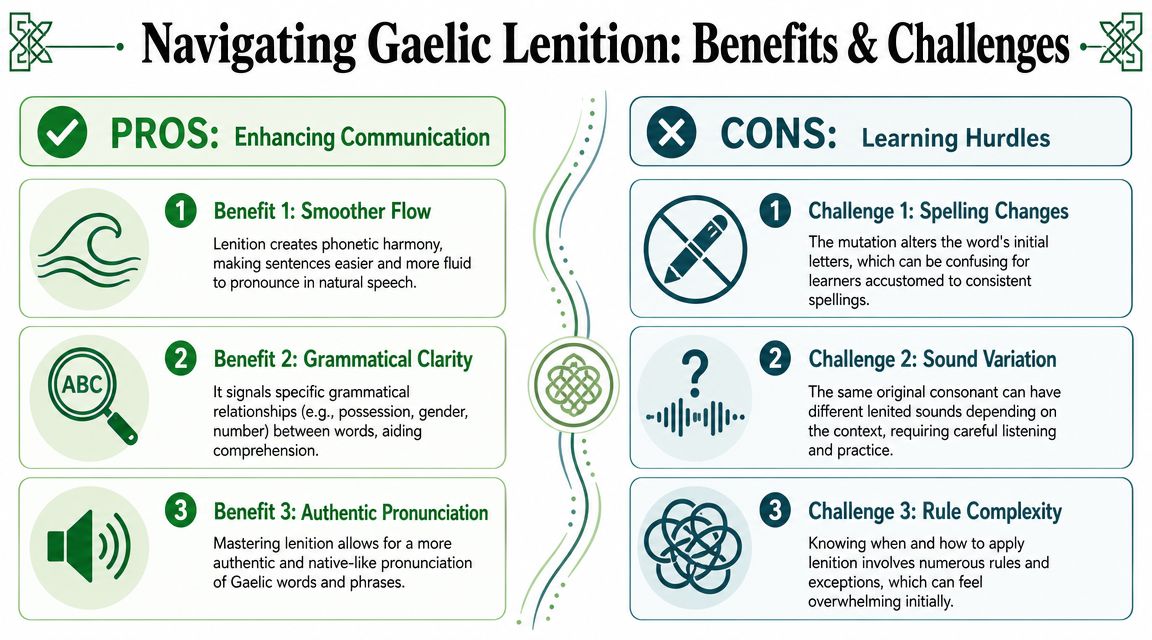
This change is often called lenition. If that sounds technical, don't worry. You can think of it as the word's first sound softening after certain grammar triggers. It's a bit like a key turning in a lock. The sentence around the word changes how the word opens.

An infographic titled Navigating Gaelic Lenition showing the linguistic pros and cons of learning Gaelic mutations.

Irish example with bán and bhán

In Irish, bán can become bhán in the right environment. Beginners often hear that new form as something like “vawn.”

The spelling looks dramatic at first, but the pattern becomes familiar. Irish uses added h after certain consonants to show that the sound has softened. So b can soften into bh.

Here's the basic idea:

Base form Changed form Rough learner pronunciation
bán bhán vawn

Scottish Gaelic example with geal and gheal

Scottish Gaelic uses a related softening pattern. geal can become gheal after certain triggers.

The exact sound can vary with dialect and speed of speech, which is normal in living languages. The important beginner lesson is visual and structural. You need to recognize that the word you learned in the dictionary may show up in a changed form in real writing.

A simple comparison helps:

Base form Changed form
geal gheal

If you want extra practice with how descriptive words behave in Irish, this guide on mastering adjectives in Irish gives a wider picture.

Why mutations exist at all

To English speakers, mutation can feel unfair. You finally learn the word, and then the language changes it.

But there is a reason. These changes help signal grammar relationships. They tell you something about what came before, how words connect, or how a phrase is functioning. In other words, the change is not random decoration. It carries information.

Here's a good way to think about it:

  • English often uses word order to show relationships.
  • Gaelic often uses sound changes too.

That means your ear matters as much as your eyes.

A quick watch can make the pattern feel less abstract:

How to practice without getting overwhelmed

You don't need to master every mutation rule today. Start smaller.

  • Learn the base word first: know bán and geal on sight.
  • Notice changed forms when reading: treat bhán and gheal as family members, not brand-new words.
  • Say both versions aloud: your mouth learns patterns faster than silent reading alone.

Once you stop seeing mutation as a mistake and start seeing it as grammar doing its job, a lot of Gaelic becomes easier to trust.

Common Phrases Using Bán and Geal

The best way to make these words stick is to see them side by side. A comparison table helps you notice two things at once. First, Irish and Scottish Gaelic use different core words. Second, the phrase structure can look similar even when the vocabulary differs.

Irish vs. Scottish Gaelic Phrase Comparison

English Phrase Irish (Gaeilge) Scottish Gaelic (Gàidhlig)
white house teach bán taigh geal
white horse capall bán each geal
white flower bláth bán flùr geal
white stone cloch bhán clach gheal
white hair gruaig bhán falt geal
white sheep caora bhán caora gheal
white wine fíon bán fìon geal
white thing rud bán rud geal

What this table teaches you

A table like this does more than give you phrases to copy.

  • Word order: the color word often follows the noun.
  • Mutation in action: some Irish and Scottish Gaelic phrases show the softened form.
  • Vocabulary boundaries: one English idea doesn't force the same Gaelic word in both languages.

If you only memorize isolated color words, you'll hesitate in conversation. If you memorize short phrases, you'll speak sooner.

Try picking three phrases from the table and using them with real objects around you. That turns passive recognition into active recall.

The Ancient Roots of White Fionn and Finn

The story of white in Gaelic doesn't end with bán and geal. Older Celtic material also preserves forms like fionn or finn, which helps explain why learners sometimes meet several related-looking words in names, legends, and historical discussions.

Verified language background notes that older Celtic-root explanations connect the idea of white to Proto-Celtic *windos, and Old Irish had finn meaning white, bright, blessed. That older layer matters because it shows how a color word can carry ideas of brightness or radiance, not only surface color.

Why fionn shows up in names and stories

If you've heard of Fionn mac Cumhaill, you've already seen this older root at work. In that context, the meaning leans toward brightness, fairness, or shining quality. Here, language and storytelling meet. A descriptive word becomes part of a cultural image.

For learners, the useful lesson is simple. Gaelic vocabulary often has a long memory. Modern everyday words do one job, while older forms continue to live in names, poetry, and myth.

If etymology interests you, a Proto-Celtic dictionary guide can help you trace those older layers more carefully.

White as a color is not the same as white as identity

This is another place readers can get tangled. A translation question about color can slide into a social-history question about identity.

Historically, Gaelic-speaking populations were increasingly classified within broader white racial frameworks in the nineteenth and twentieth centuries. In the United States, the Census reported over 235 million people identifying as White alone or in combination in 2020, and among detailed responses in that population, English (46.6 million), German (45 million), and Irish (38.6 million) were the largest ancestral groups, according to the U.S. Census Bureau's overview of the White population in 2020.

That history is important, but it's a different conversation from translation. In language study, bán, geal, and older forms like fionn are vocabulary items. In social history, “white” refers to classification and identity. Mixing those two meanings too quickly causes confusion.

Start Using Your New Gaelic Words Today

You don't need to wait until you “know enough” to start using these words.

Keep these takeaways in front of you:

  • Irish uses bán
  • Scottish Gaelic uses geal
  • Sentence grammar can soften the opening sound
  • Context matters more than a one-word lookup

A simple practice routine works well:

  1. Pick one object near you and name it with the color.
  2. Say the phrase out loud three times.
  3. Write one short sentence with the base form.
  4. Notice any mutated form when you read later.

One final point helps keep the cultural side clear. In modern official statistics, White Irish is treated as an ethnic category rather than a separate race. Ireland's 2016 Census reported 3,854,226 people as White Irish, equal to 82.2% of usual residents, as shown in the Central Statistics Office release on ethnicity and Irish Travellers. That's useful background if your interest in Gaelic for white comes from heritage as well as language.

The most effective next step is regular use. Label a few white objects at home. Repeat one Irish phrase and one Scottish Gaelic phrase. Let the language become something you do, not just something you look up.


If you want guided practice after learning words like bán and seeing how Irish changes inside real phrases, Gaeilgeoir AI is a smart next step. It helps you start speaking from day one with practical conversations, pronunciation support, and beginner-friendly practice that turns vocabulary into usable Irish. For a direct start, visit Learn Gaeilgeoir AI. Comments are closed and pingbacks are disabled.

Fire in Gaelic: The Complete Guide to Tine and Teine

In Irish Gaelic, the word for fire is tine. In Scottish Gaelic, it's teine, and in the old Gaelic ritual year fire stood at the center of four major seasonal festivals, including Imbolc on 1 February and Bealtaine on 1 May.

Maybe you looked up “fire in gaelic” because you needed a quick translation for a tattoo idea, a school project, a story, or a trip to Ireland or Scotland. That simple search opens a much bigger door. Fire in the Gaelic languages isn't just a household noun. It carries memory, ritual, season, danger, warmth, and everyday speech all at once.

That's what makes tine and teine so satisfying to learn. They're small words with deep roots. Once you understand them, you're not only memorizing vocabulary. You're stepping into the older world of hearths and bonfires, and the modern world of public signs, safety language, and living Gaelic speech.

Table of Contents

Your Quick Guide to Fire in Gaelic

If you want the direct answer, keep these two words in mind: tine in Irish, teine in Scottish Gaelic. For most beginners, that's enough to get started.

But beginners often get tripped up in two places. First, they assume Irish and Scottish Gaelic are identical. They aren't. Second, they assume a single dictionary word tells them how people speak in practice. It usually doesn't.

Practical rule: Learn the core word first, then learn where people use it. A word becomes real when you can place it in culture, conversation, and daily life.

In the case of fire in gaelic, that wider context matters more than usual. Fire was tied to the calendar, the home, and seasonal survival. It also remains useful in modern settings where clear language matters, from ordinary conversation to public communication.

A good learner's path looks like this:

  • Start with the noun: memorize tine and teine.
  • Notice the family resemblance: the words are close enough that one can help you remember the other.
  • Attach the word to a scene: a hearth, a candle, a bonfire, a warning sign.
  • Learn phrases, not just labels: that's how you stop translating word by word in your head.

If you've ever felt that language guides give you a bare translation and then leave you stranded, you're not wrong. Fire in gaelic is a perfect example of why richer context helps. A learner who knows only the dictionary answer knows one word. A learner who knows where that word lives in history and modern life can use it.

The Core Words Tine and Teine Explained

A hearth is glowing in an old stone house. In one home, the word for that fire is tine. Across the water in Scotland, the matching everyday word is teine. That small spelling shift tells a larger story about two sister languages that grew from the same roots and still echo each other.

A simple comparison

Language Gaelic Word IPA Pronunciation Simple Pronunciation
Irish tine not provided in the verified data TIN-yeh or TIN-uh as a learner-friendly approximation
Scottish Gaelic teine /tʲenə/ CHEN-uh or TYEN-uh as a learner-friendly approximation

The clearest verified source for this pair is the LearnIrish entry for fire, which lists tine in Irish and teine in Scottish Gaelic, and gives the Scottish Gaelic pronunciation /tʲenə/.

If IPA looks intimidating, set it aside for a moment. A learner-friendly way to hear teine is closer to TYEN-uh or CHEN-uh than to English “teen.” Gaelic spelling works by its own sound system, so the eye often needs time to catch up with the ear.

One helpful habit is to learn the word with a scene attached to it. Tine can live in your mind as a cooking fire, a candle flame, or a turf hearth. Teine can do the same. That makes the vocabulary stick better than memorizing a bare label on a flashcard.

Why the words look so similar

The resemblance between tine and teine comes from shared ancestry. Irish and Scottish Gaelic belong to the Goidelic branch of the Celtic languages, so some everyday words line up like close family members. Fire is one of those satisfying examples where the connection is easy to see.

For a beginner, this works like recognizing two regional versions of the same family recipe. The ingredients are familiar, but the form shifts a little from house to house. Tine and teine are not random lookalikes. They are related forms that help you notice how the languages mirror each other.

A simple memory aid helps here:

  • Irish: ti-
  • Scottish Gaelic: tei-

Use that pattern gently, not as a hard rule for every word in the language. Gaelic always has exceptions. Still, this pair gives you a solid foothold, and footholds matter.

The word also carries more weight than a dictionary line suggests. In Gaelic tradition, fire belonged to the home, the year's turning, and community ritual, which is why a word like teine appears naturally in discussions of Beltane as a fire feast and seasonal celebration. So when you learn tine and teine, you are not only learning how to name a flame. You are learning a word that has warmed houses, marked festivals, and stayed useful right into modern public life.

The Cultural Importance of Fire in Gaelic Folklore

Fire in the turning of the year

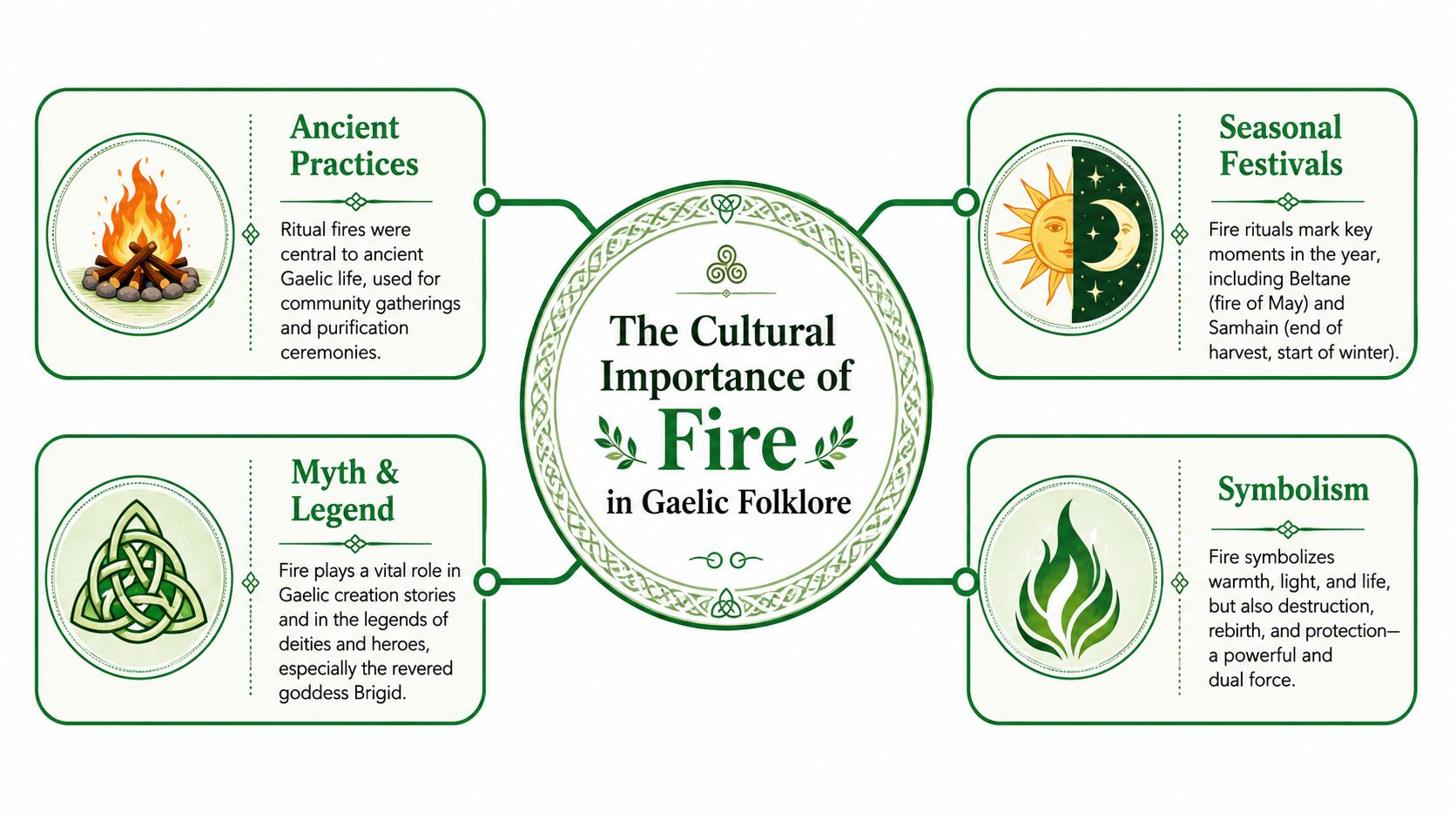
A diagram illustrating the cultural importance of fire in Gaelic folklore through four key thematic categories.

To understand fire in gaelic, it helps to leave the dictionary for a moment and consider an older context. Fire was woven into the year itself. In Ireland's pre-Christian ritual calendar there were four major seasonal festivals: Imbolc (1 February), Bealtaine (1 May), Lúnasa (1 August), and Samhain (1 November). Bealtaine and Imbolc sat roughly halfway between the solstices and equinoxes, and both were important fire festivals according to this overview of Bealtaine in the Irish ritual calendar.

Bealtaine is especially vivid. Traditional accounts describe cattle being driven between two bonfires for protection before moving to summer pasture. That detail matters because it shows something larger than symbolism. Fire wasn't floating above daily life as a poetic idea. It was embedded in the economic rhythm of herding and farming.

If you want a deeper cultural read on that seasonal world, this look at Beltane as a fire feast and celebration adds helpful background.

Why that still matters to learners

Imbolc carries a different atmosphere. Historical accounts place it at the first signs of spring, especially the lactation of ewes before lambing season in Ireland and Britain. It later became linked with Saint Brigid and then with Candlemas. In Ireland, February 2 was officially known as Candlemas, and in much of northern Europe as the Purification of the Blessed Virgin Mary until the Second Vatican Council in 1965, as discussed in this history of Imbolc, Brigid, and Candlemas.

That continuity of date is striking. The old seasonal fire-and-fertility moment didn't vanish completely. It was re-expressed through Christian practice while keeping the same early-February timing.

Here's why this matters when learning a word like tine. In English, “fire” can feel neutral until context fills it in. In Gaelic tradition, the word arrives already carrying layers of protection, household life, season, and ceremony.

  • At Bealtaine, fire marks movement into summer.
  • At Imbolc, fire and hearth imagery meet early spring and renewal.
  • In both cases, the word points to community action, not just an object.

Fire in Gaelic folklore is less about spectacle and more about relationship. People used it to mark time, guard animals, and connect the household to the wider year.

That's why the vocabulary feels deeper than a translation card. When you say tine or teine, you're touching a word that once sat at the hinge of the seasons.

Common Gaelic Phrases and Idioms with Fire

A man and woman having a thoughtful conversation at a cafe table with coffee and flowers.

Literal first, then natural speech

A lot of learners search for fire in gaelic and get only the bare noun. That's limiting. Learners usually need phrase-level meaning, not just a label, and many Irish-learning materials lean harder on grammar lists than on real conversational use. That gap is one reason practical phrase learning matters so much, as noted in this discussion of the need for broader semantic range in fire-related language learning from Fire Engineering's page cited in the brief.

Here's the safer way to build usable knowledge. Start with simple, transparent combinations rather than trying to memorize dramatic idioms too early.

  • Use the noun alone first: learn tine as “fire.”
  • Add context words next: think in scenes such as a house fire, campfire, or lighting a fire.
  • Notice related meanings: learners also run into nearby ideas such as burning, sparks, heat, and smoke.

For a broader feel for natural expression, this guide to Irish sayings in Gaelic is a useful next stop.

How to avoid stiff translations

Beginners often make one of three mistakes:

  1. They translate English phrases word for word.
  2. They assume every “fire” expression must use tine.
  3. They ignore nearby vocabulary and get stuck with one overused noun.

That's where a distinction like tine versus other fire-related ideas becomes helpful. Sometimes you need the thing itself, fire. Sometimes you need an action, such as burning. Sometimes you need the image of a spark rather than the whole flame.

Don't ask only “What's the Gaelic word for fire?” Ask “What am I trying to say with fire?”

A few learner-friendly examples of how to think about this:

  • Literal use: “The fire is out.” This is straightforward noun use.
  • Practical use: “Don't go near the fire.” Again, a direct physical meaning.
  • Figurative use: “She has a spark of energy.” English uses fire imagery, but another Gaelic word may fit better than the exact noun.

That habit makes your Irish sound less mechanical. It also prepares you for speech as people use it in real life, where meaning sits in phrases and situations, not in isolated vocabulary cards.

Fire in the Modern Gaelic World

A group of university students with backpacks walking along a paved pathway on a campus

Gaelic in official public use

It's easy to leave fire in gaelic sitting in the ancient world of bonfires and festivals. But the vocabulary matters now as well. The Scottish Fire and Rescue Service has an official Gaelic Language Plan for 2023–2026, which shows Gaelic being normalized in operational and public-facing contexts where terminology must be clear and consistent, as stated in the Scottish Fire and Rescue Service Gaelic Language Plan 2023–2026.

That matters for a very practical reason. Emergency language can't be vague. If a term appears in signage, print, digital messaging, or spoken communication, it has to work under pressure.

This gives learners a useful perspective on teine. It isn't only a heritage word preserved in songs or folklore. It belongs to a living language that public institutions are actively using.

If seasonal language interests you too, this article on the Irish festival of Samhain complements that older-to-modern journey.

Practical situations learners may meet

Modern fire-related language becomes relevant fast if you travel, camp, hike, or read local notices. There's also a clear content gap here. High-quality learner material rarely explains how fire vocabulary appears in public safety language such as wildfire warnings or campfire precautions, even though public guidance in Ireland stresses that almost all wildfires are human-caused and that campfires, BBQs, or land burning in dry conditions can trigger them. Officials also note that only a few dry days can make vegetation highly flammable, as described in this public wildfire safety guidance video.

That means useful learning scenarios include:

  • Outdoor notices: warnings about fire risk in dry weather
  • Camping language: instructions about campfires and safe extinguishing
  • Community alerts: local safety announcements in bilingual settings

A living language proves itself in ordinary public life. Safety notices are one of the clearest examples.

For learners, this changes the motivation. You're not memorizing tine or teine as decorative vocabulary. You're learning a word that can appear in daily life, in official settings, and in situations where understanding matters.

Bring Your Gaelic Vocabulary to Life

You are sitting by a fire pit on a cool evening, and one small Gaelic word suddenly starts to feel much bigger than a dictionary entry. Tine in Irish and teine in Scottish Gaelic can mean the flame in front of you, the warmth of a hearth in an old story, a warning on a public notice, or a phrase in everyday conversation. That is what makes this vocabulary memorable. It belongs to real life.

A good language word works like a doorway. Step through it, and you find sound, history, culture, and modern use all meeting in one place. With tine and teine, you are hearing the family resemblance between two Gaelic languages while also touching something central to Gaelic life for centuries. Fire meant heat, cooking, gathering, ritual, and protection. It still appears in speech, signage, and safety language today.

That wider context matters for learning. A word stays with you more easily when you can attach it to a scene. You might picture a hearth in winter, a festival fire on a hillside, or a notice warning about fire risk in dry weather. Each example gives the word another root, and rooted words are the ones you remember.

Keep the foundation simple:

  • Irish: tine
  • Scottish Gaelic: teine

Then let the word grow in layers. Say it aloud. Notice where it appears. Use it in a phrase instead of keeping it on a flashcard by itself. That is how vocabulary becomes usable, and how a single word starts to carry the texture of a whole culture.

If you want to turn words like tine into real speaking ability, Gaeilgeoir AI is a practical next step. It helps learners move from recognition to use through guided, real-world Irish conversations, so you are not just memorizing fire in Gaelic. You are learning how to speak.

Orange in Irish: Gaelic Terms for Fruit and Color

You're probably here because you met orange in Irish and got two different answers.

One book says oráiste. Another teacher says that isn't the old native colour word at all. Then you spot phrases like flannbhuí, hear that buí can cover more than just “yellow,” and suddenly a simple colour feels oddly slippery.

That confusion makes sense. Irish doesn't always divide colours the way modern English does, and orange is one of the clearest examples. If you understand the reason behind that, the vocabulary becomes much easier to remember. You stop trying to force a one-to-one translation and start seeing the logic of the language.

Table of Contents

Why Is 'Orange' in Irish So Confusing?

A learner in Galway might walk into a market, point at a piece of fruit, and say oráiste with no problem. Five minutes later, that same learner wants to describe an orange scarf and hesitates. Is it still oráiste? Is it buí? Is it something longer like flannbhuí?

That hesitation happens because English uses orange for both the fruit and the colour so naturally that we expect other languages to do the same. Irish doesn't always work that way. Older Irish colour categories developed from how people described shades in the world around them, not from modern English labels.

Practical rule: If you mix up the fruit word and the colour word at first, you're not making a silly mistake. You're running into a real difference between two language systems.

This is why beginners often feel that orange in Irish is “inconsistent” when it's quite logical. The fruit has a clear modern name. The colour sits at the meeting point of older Irish description and newer borrowed usage.

A confusion that keeps repeating

Here's the pattern I see most often with students:

  • They learn one word first. Usually that word is oráiste.
  • They assume it covers everything. That works in many modern situations, but then they meet older or more traditional phrasing.
  • They think one source must be wrong. Usually neither is wrong. They're working from different layers of the language.

A good way to think about it is this. English gives you one neat box labelled “orange.” Irish has an older shelf where some of those shades sit closer to yellow or red, and a newer shelf where oráiste appears as a familiar modern term.

Once you know that, the whole topic gets calmer.

The Two Words for Orange Fruit and Colour

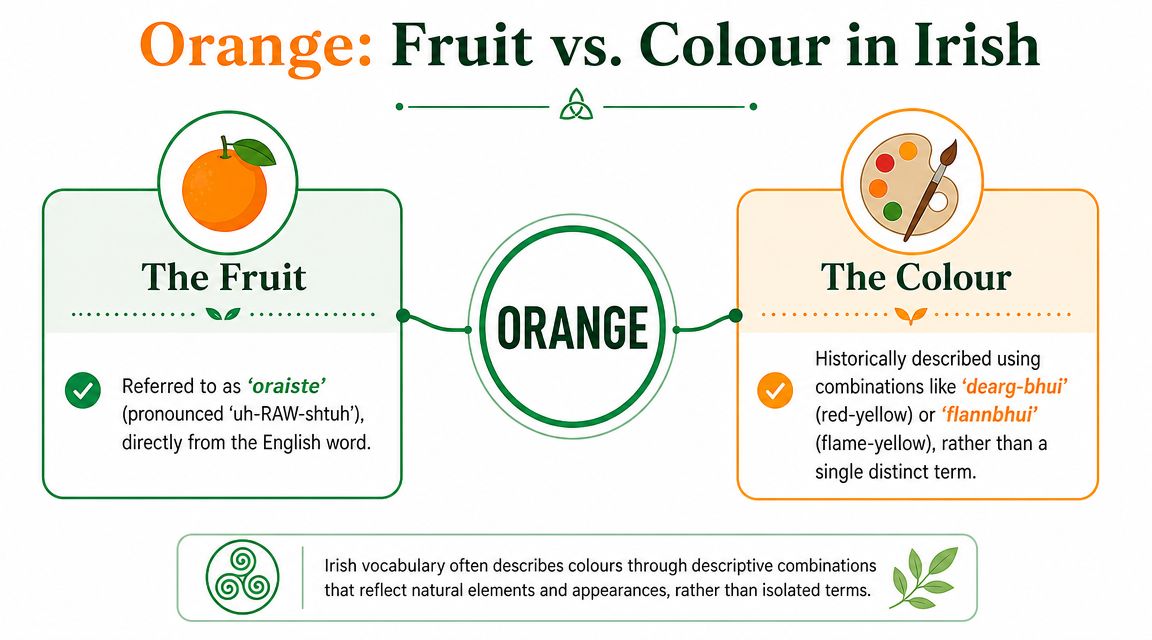
The first distinction matters more than anything else. Oráiste is the word for the fruit. For the colour, modern Irish often accepts oráiste, but traditional usage also points learners toward words like buí and flannbhuí. A language note on orange in Irish from Native Dialogs explains this split and notes that learners will meet both modern and traditional forms.

An educational infographic explaining the difference between the fruit and the colour orange in the Irish language.

A simple way to separate them

If you want a beginner-friendly rule, use this:

  • Fruit: use oráiste
  • Colour in modern everyday language: oráiste is commonly understood
  • Colour in traditional or explanatory contexts: you may meet buí or flannbhuí

An older explanation discussed in this note on Irish colour categories says the colour word most directly associated with “orange” is historically buí, with flannbhuí used for a more specific orange-yellow shade. That's the key reason the topic feels odd to English speakers. Irish didn't originally carve up the colour space in exactly the same way English does.

Think of oráiste as the everyday modern label many people recognise, and flannbhuí as the more traditional descriptive label that tells you what kind of shade it is.

Irish Words for Orange At a Glance

Irish Term Pronunciation (approx.) Primary Meaning Notes
oráiste uh-RAW-shtuh orange fruit Safe, clear word for the fruit
oráiste uh-RAW-shtuh orange colour Common in modern usage
buí bwee yellow, sometimes covering orange territory historically Reflects older colour categorisation
flannbhuí flan-vwee orange-yellow, flame-yellow More specific and more traditional
buí-dearg bwee DYAR-ug yellow-red Descriptive way to explain an orange shade

A beginner doesn't need to use every one of these right away. Start with the split between fruit and colour, then add the traditional terms as your ear gets used to them.

Why both systems matter

You'll be less confused if you stop asking, “Which word is the one correct word?” and instead ask, “Which word fits this context?”

For a supermarket label, oráiste will feel natural. For a language class discussing traditional vocabulary, flannbhuí may be exactly what the teacher wants. For understanding how Irish once grouped colours, buí gives you the deeper story.

Mastering the Grammar of Oráiste

Knowing the word is one thing. Using it comfortably in a sentence is where it starts to feel real.

For beginners, the most useful forms are the basic noun forms you'll use when buying fruit, naming objects, or asking simple questions. Treat oráiste first as a noun you can carry around in ordinary speech.

Why it becomes an t-oráiste

You'll often see an t-oráiste for the orange.

That extra t- can look strange at first, but it's a part of how Irish handles the definite article before certain vowel sounds. Because oráiste begins with a vowel, the article changes shape. So:

  • oráiste = an orange
  • an t-oráiste = the orange

Say it aloud a few times and it settles quickly. The added sound helps the phrase flow more smoothly.

The best way to learn grammar in Irish is to learn it as a pattern, not as a rule sheet. An t-oráiste will stick faster than memorising a chart.

Useful beginner patterns

Here are some practical forms worth keeping:

  1. Singular noun

    • oráiste
    • Example: Tá oráiste agam.
      “I have an orange.”
  2. With the article

    • an t-oráiste
    • Example: Ithim an t-oráiste.
      “I eat the orange.”
  3. After dhá

    • dhá oráiste
    • Example: Cheannaigh mé dhá oráiste.
      “I bought two oranges.”

Notice that oráiste itself stays very manageable in these common expressions. That's good news for beginners. The surrounding grammar changes more than the noun does.

A small grammar habit that helps

When learners study colour words, they often forget the sentence frame around them. That slows progress. A better approach is to collect useful chunks:

  • Tá oráiste agam
  • Ba mhaith liom oráiste
  • Cá bhfuil an t-oráiste?
  • dhá oráiste

If you'd like to get more comfortable with how descriptive words behave around nouns, this guide to mastering adjectives in Irish pairs well with this topic.

Here's the main thing to remember. With oráiste as a fruit noun, you're not dealing with something unusually difficult. Most of the challenge comes from seeing the same spelling also appear in modern colour usage, which can make the whole word feel less stable than it really is.

The Colour Orange and Its Cultural Roots

Irish colour vocabulary carries older ways of seeing. That's why orange in Irish isn't just a vocabulary problem. It's also a window into how the language sorted shades before modern borrowing became common.

A historic stone Celtic cross standing in a lush green Irish landscape overlooking a coastal bay.

Why older Irish grouped colours differently

English speakers usually expect every common colour to have one fixed basic word. Traditional Irish doesn't always behave like that. Some shades that modern English separates neatly could be described through a broader colour family or through a compound description.

That helps explain why buí can enter the conversation around orange, and why flannbhuí makes sense as a descriptive term. Instead of treating orange as a completely separate ancient category, older Irish often described it through its relationship to yellow and red.

This is one reason learners feel relieved when they finally understand the “why.” The system stops looking messy and starts looking historical.

Orange as a cultural term in Ireland

The word Orange also appears in Ireland as part of political and cultural identity, which adds another layer for learners. In Northern Ireland, the 2017-18 Continuous Household Survey estimated 35,955 people had conversational fluency in Irish, while the Orange Order's membership was publicly described by its Grand Secretary as “around 40,000” in 2020, figures noted together in the CSO reference used for Irish language context. That context matters because learners will meet orange not just as a colour, but also as a historical and cultural term in Ireland.

You might encounter expressions such as Fir Bhuí, often glossed as “Yellow Men” or “Orange Men” in older-style explanation. This is exactly the kind of phrase that makes more sense once you know that traditional Irish colour categories don't line up neatly with modern English ones.

If you'd like to place orange among the other colours, this guide to the rainbow in Irish helps build that wider picture.

A short visual explanation can help settle the idea in your ear and memory:

What to take from the history

You don't need to become a specialist in historical linguistics to use the word well. You just need three working ideas:

  • Older Irish colour words cover space differently
  • Modern Irish often accepts borrowed usage
  • Cultural terms may preserve older patterns

When a learner asks, “Why doesn't Irish just have one simple old word for orange?” the honest answer is that languages don't all divide the world in the same way.

That's not a flaw in Irish. It's part of what makes the language interesting.

Using Orange in Everyday Irish Phrases

Once the background is clear, it's time to make orange in Irish feel usable. Real phrases help more than abstract explanations because they show what people say.

Modern dictionaries such as Teanglann list oráiste for both the fruit and the colour, while language guides note that flannbhuí is more traditional for the colour, which is why learners may meet both rabhadh aimsire oráiste and older terms like Fir Bhuí in practice, as discussed in this Irish usage guide on orange.

Fruit phrases you can use today

Try these first. They're practical and easy to say.

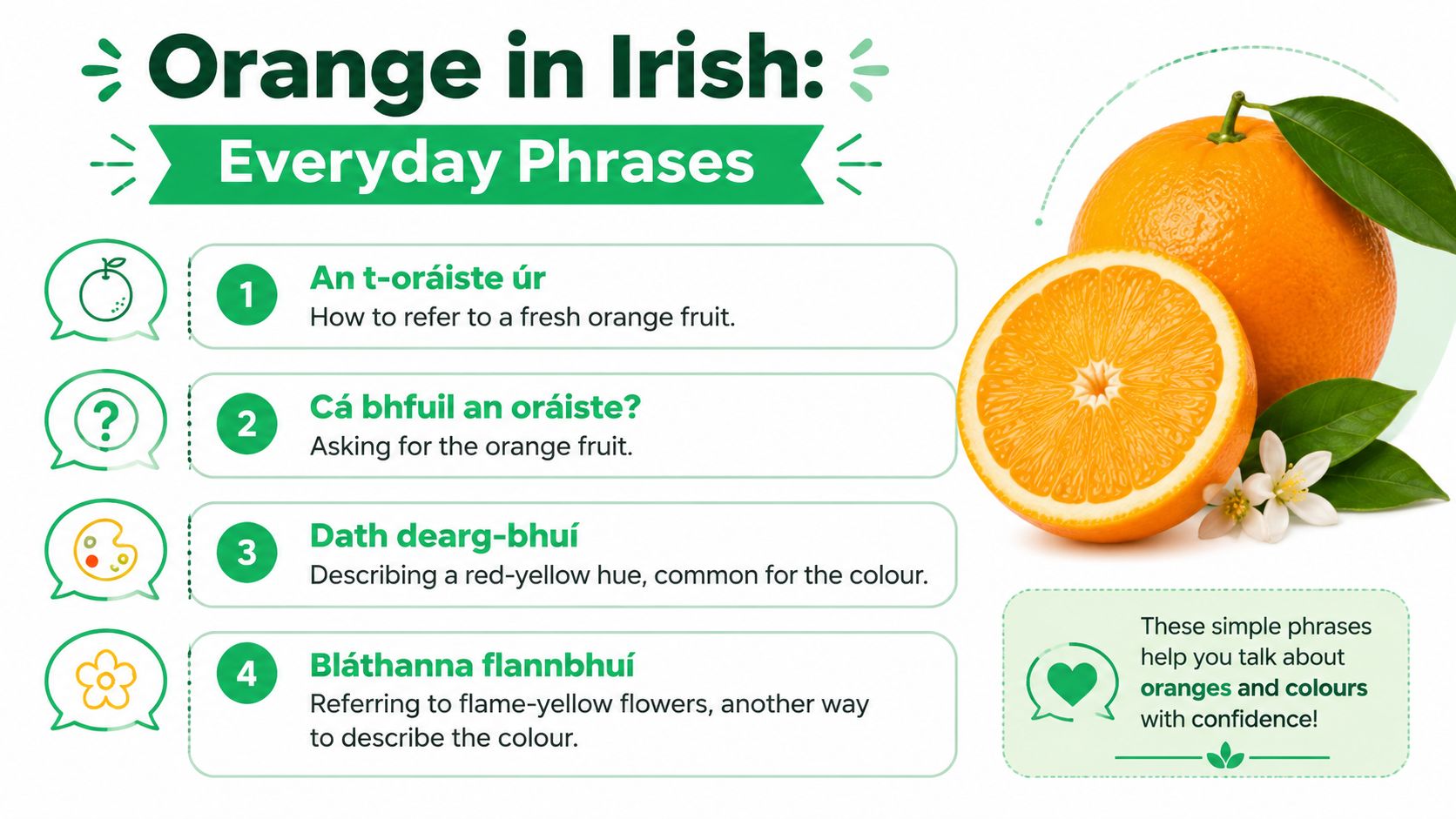
  • An t-oráiste úr
    Approx. pronunciation: un TOR-uh-shtuh oor
    “The fresh orange”

  • Cá bhfuil an t-oráiste?
    Approx. pronunciation: kaw will un TOR-uh-shtuh
    “Where is the orange?”

  • Ba mhaith liom sú oráiste
    Approx. pronunciation: buh wah lyum soo uh-RAW-shtuh
    “I would like orange juice”

  • Cheannaigh mé dhá oráiste
    Approx. pronunciation: HYAN-ee may ghaw uh-RAW-shtuh
    “I bought two oranges”

A visual guide illustrating four common phrases and terms for the colour orange and the fruit in Irish.

Colour phrases you'll meet in real life

Here the context matters more.

  • Tá carr oráiste aici
    Approx. pronunciation: taw kar uh-RAW-shtuh ah-kee
    “She has an orange car”

  • rabhadh aimsire oráiste
    Approx. pronunciation: RAH-wuh eye-mshuh uh-RAW-shtuh
    “orange weather warning”

  • bláthanna flannbhuí
    Approx. pronunciation: BLAW-hun-uh flan-vwee
    “orange-yellow flowers”

  • dath buí-dearg
    Approx. pronunciation: dah wee JAR-ug
    “a yellow-red colour”

How to choose in conversation

If you're speaking with other learners or using everyday modern Irish, oráiste for the colour will usually be the easiest choice. If you're in a class discussion, reading older material, or talking about traditional vocabulary, flannbhuí may be more informative.

A simple mental checklist helps:

  • Buying or naming fruit: use oráiste
  • Describing a modern object: oráiste is usually the most convenient choice
  • Talking about traditional colour language: bring in flannbhuí or explain the older buí connection

Use the word that helps you communicate clearly first. Add the traditional nuance as your confidence grows.

For active practice, some learners build these phrases into flashcards, some say them out loud while pointing at real objects, and some use conversation tools. Gaeilgeoir AI, for example, includes pronunciation support and scenario-based Irish practice, which can help learners rehearse colour and food vocabulary in short dialogues.

Start Practicing and Build Your Confidence

The big takeaway is simple. Oráiste is always safe for the fruit. For the colour, modern usage often accepts oráiste, while traditional Irish gives you extra insight through words like flannbhuí and the older connection with buí.

That means you don't need to panic when you see more than one answer. You're seeing two layers of the language living side by side. Once you accept that, orange in Irish stops being a trap and becomes a very memorable lesson in how Irish thinks.

Three short practice tasks

Try these today:

  • Name what you see: Look around the room and say three sentences with Tá sé oráiste.
  • Order something: Say Ba mhaith liom sú oráiste aloud a few times until it feels natural.
  • Describe nature: Talk about flowers, evening light, or clothing with flannbhuí to get used to the traditional shade word.

If you like structured review, pairing short daily speaking practice with memory tools works well. This guide to spaced repetition for language learning is a useful way to make words like these stick.

The key is repetition with context. Say the fruit word in food sentences. Say the colour word in description sentences. Keep the two lanes separate until they feel natural.


If you want guided Irish practice built around real conversations, pronunciation help, and beginner-friendly vocabulary, take a look at Gaeilgeoir AI. For a more hands-on start, you can begin at Learn Gaeilgeoir AI. Comments and pingbacks are disabled.
Irish Word for Girl: A Learner’s Guide to Cailín & More

You've probably done what most beginners do. You searched for the irish word for girl, found cailín, and then immediately hit a second question. How do I use it?

That's where Irish gets interesting. A simple dictionary answer helps, but it doesn't tell you when to say cailín, when to say an cailín, how to talk about more than one girl, or why a word that means “girl” behaves in a way that surprises learners. If you've ever wanted to use a sweet phrase, understand a family conversation, or reconnect with Irish in a way that feels real, those details matter.

Irish is full of small patterns that look tricky at first and then become satisfying once you see how they work. This guide keeps things simple. You'll learn the main word, how to pronounce it, how it differs from iníon for “daughter,” and the key grammar that helps you use it in real sentences instead of just memorising a translation.

Table of Contents

Your Guide to the Irish Word for Girl

The most common Irish word for girl is cailín. That's the word you'll want first if you're building everyday vocabulary.

But beginners usually need more than the one-word answer. They want to know questions like these:

  • How do I pronounce it?
  • Does it mean girl, young woman, or girlfriend?
  • What's the plural?
  • Why does the word change in some phrases?
  • Is it the same as daughter?

Those are smart questions. Irish often asks you to notice context in a way English doesn't.

What cailín usually means

In everyday use, cailín usually means girl or young woman. It isn't the same as bean, which means woman, and it isn't the same as iníon, which means daughter. That distinction is one reason this word shows up so early in beginner learning.

Practical rule: If you mean a female child or a young woman in a general sense, start with cailín.

You may also hear mo chailín, which can mean “my girl” and in some contexts can refer to a girlfriend. Context does the heavy lifting there, just like English does with “my girl.”

Why beginners get stuck after the translation

A dictionary gives you the front door. Real Irish starts when you try to make a sentence.

Here are the forms learners often need right away:

  1. cailín for “girl”
  2. an cailín for “the girl”
  3. cailíní for “girls”
  4. na cailíní for “the girls”

That little set is far more useful than memorising a single isolated word. Once you know those forms, you can begin reading, speaking, and noticing patterns instead of guessing.

A good beginner mindset

Don't aim for perfection on day one. Aim for recognition first.

If you can spot the difference between girl, the girl, and girls, you're already moving from lookup learning to real language use. That's the shift that makes Irish feel less like a puzzle and more like something you can speak.

Cailín The Foundational Word for Girl

The core irish word for girl is cailín. Historically, it's the Irish word most closely associated with “girl,” and it's described as a foundational beginner word that usually refers to a girl or young woman in this naming and language overview.

A young girl with long brown hair holding a blue book outdoors in a scenic Irish landscape.

How to pronounce cailín

A simple English-friendly guide is kah-LEEN.

The stress falls on the second part. That matters. If you flatten it out too much, it won't sound as natural. Irish spelling becomes much less intimidating once you stop trying to read every letter the way you would in English.

Try it in three steps:

  • Say “kah” softly
  • Say “leen” clearly
  • Stress the second part so it sounds like kah-LEEN

If you've ever seen the name Colleen, that's closely connected to cailín. If you're curious about that relationship and how the borrowed form developed, this short guide to Colleen in Irish is a useful next read.

What kind of word it is

In plain English, cailín is your everyday neutral word for a girl. It isn't stiff, formal, or poetic. That's part of why it belongs near the top of any beginner vocabulary list.

You can use it in simple statements such as:

  • Is cailín í.
    She is a girl.

  • An cailín.
    The girl.

  • Cailíní.
    Girls.

When a word appears often in family talk, beginner lessons, and names, it's worth learning deeply rather than quickly.

A note on meaning in context

Sometimes learners worry because one word seems to cover more than one idea. That's normal. Cailín can refer to a girl or a young woman, and in phrases like mo chailín, the meaning can shift depending on who's speaking and the situation.

Consider English words such as “girl” or “my girl.” The phrase itself is simple. The exact meaning comes from context, tone, and relationship.

A helpful way to remember it is this:

  • cailín = girl or young woman
  • bean = woman
  • iníon = daughter

That small contrast saves a lot of confusion later.

Cailín vs Iníon A Crucial Distinction

Many beginners mix up cailín and iníon. That's understandable, because both refer to female people and both appear early in learning. But they are not interchangeable.

Cailín means girl. Iníon means daughter.

If you wouldn't swap “girl” and “daughter” in English, don't swap them in Irish either. That one habit will keep your Irish much clearer.

The difference in everyday use

Use cailín when you mean a girl in general.

Use iníon when you mean someone's daughter.

That means these two ideas are different:

  • Sin an cailín.
    That is the girl.

  • Sin mo iníon.
    That is my daughter.

The first sentence identifies a girl. The second shows a family relationship.

A fast test helps. Ask yourself, “Could I replace this with daughter in English?” If yes, use iníon. If no, you probably want cailín.

Cailín vs Iníon at a Glance

Word Pronunciation Core Meaning When to Use It
Cailín kah-LEEN girl, young woman For a girl in general
Iníon in-EEN daughter For someone's daughter

Two common beginner mistakes

Learners often make one of these mistakes first:

  • Using iníon for any young female person
    That makes the meaning too specific. It adds a family relationship that may not be there.

  • Using cailín when talking about your daughter
    That removes the family meaning and sounds less precise than you intend.

Try these pairs and feel the contrast:

  • Tá cailín sa seomra.
    There is a girl in the room.

  • Tá m'iníon sa seomra.
    My daughter is in the room.

The room is the same. The relationship changes the word.

A memory trick that works

Think of iníon as belonging to the family-word group. It sits naturally beside words like “mother,” “father,” and “son” in your mental vocabulary.

Think of cailín as belonging to the social-word group. It's a general person word, like “boy,” “woman,” or “teacher.”

Once you sort the words that way, the distinction becomes much easier to keep straight.

Essential Grammar for Using Cailín Correctly

Most pages stop at the translation. That's exactly where beginners need help most. If you want to use the irish word for girl correctly, you need a few sentence-level patterns.

A diagram explaining the grammar rules for using the Irish word Cailin, meaning girl, in various contexts.

The most useful forms first

Start with the forms you'll meet again and again:

  • cailín = girl
  • an cailín = the girl
  • cailíní = girls
  • na cailíní = the girls

Those singular and plural forms matter because learners often only memorise the first one. A beginner grammar explainer highlights this exact gap around cailín, an cailín, and sentence use in this Irish learning page.

Here's the clean pattern:

English Irish
girl cailín
the girl an cailín
girls cailíní
the girls na cailíní

That table alone makes your vocabulary much more usable.

Why cailín surprises beginners

Here's the twist. Cailín is a masculine noun in grammar, even though it means girl. That's a key point many learners miss, and it affects how the word behaves in sentences.

This feels odd at first because English doesn't work that way. In Irish, grammatical gender and real-life sex don't always match. A noun can be grammatically masculine while referring to a female person.

Don't try to force Irish grammar to mirror English. Treat grammatical gender as a word pattern, not a statement about the person.

That mindset saves a lot of frustration.

One change you'll see often

A very common phrase is mo chailín for “my girl.” Notice that the c changes to ch.

That kind of initial change is one of the features that gives Irish its distinctive look and sound. Beginners often meet it early and think they've found a different word, when really they're seeing the same word in a different grammatical setting.

A useful habit is to learn words in mini-phrases, not alone:

  • cailín
  • an cailín
  • mo chailín
  • na cailíní

If you enjoy structured explanations of patterns like this, a broader article on mastering grammar for fluency can help you think about grammar as a tool rather than a list of rules.

Build phrases, not just vocabulary

Once you know the base word, the article form, and the plural, you can start noticing how Irish builds meaning through small shifts. That's also why topics like noun relationships become more important over time, including patterns connected to forms discussed in guides such as this one on the genitive case in Irish.

For now, keep your focus narrow:

  1. Learn cailín
  2. Add an cailín
  3. Learn cailíní
  4. Recognise mo chailín

That's enough grammar to start using the word with confidence instead of guessing.

Exploring Other Irish Words for Girl

Once you're comfortable with cailín, it helps to know that Irish has more than one way to express the idea of “girl.” The standard plural is cailíní, but dictionary-style resources also list alternatives such as girseach and gearrchaile in this Wiktionary entry on girl.

That doesn't mean you should replace cailín as a beginner. It means Irish has regional and descriptive richness, just like English has words such as “girl,” “lass,” and “young one” in different places and tones.

Which word should a beginner use

For most learners, the answer is simple:

  • Use cailín first because it's the standard, safest choice.
  • Recognise girseach if you come across it in dialect or informal material.
  • Treat gearrchaile as a context-specific variant, not your default beginner word.

That approach keeps your core vocabulary strong without pretending the language has only one option.

Irish rarely rewards a one-word-for-one-word mindset. It rewards noticing meaning, region, and tone.

Why this matters beyond one noun

This is part of what makes Irish feel alive rather than museum-like. A single English word can map onto a small group of Irish words depending on context.

You'll notice the same richness when you move into names and identity words. Many learners enjoy following that trail into personal names and their meanings, especially through collections of Irish names for girls, where sound, culture, and vocabulary often overlap.

For now, keep the hierarchy clear in your mind. Cailín is the everyday standard. The others are useful to recognise later.

Your Next Steps in Irish Learning

You now know more than just the irish word for girl. You know the form beginners need to use: cailín, its plural cailíní, the article forms, the difference between cailín and iníon, and the small grammar surprise that catches many new learners.

That's a strong start. It's also how good language learning usually works. One ordinary word opens the door to pronunciation, grammar, family vocabulary, and culture all at once.

A young woman hiking near the ocean in Ireland, looking off into the sunset with her backpack.

Follow the word into names and culture

Irish vocabulary often connects naturally to names. Naming traditions are one of the clearest signs that Irish is a living language. For example, Fiadh reached No. 1 for baby girls in Ireland in 2021 according to this Irish baby names overview.

That matters for learners because it shows these words and roots aren't just old textbook material. They still live in homes, schools, media, and everyday identity.

Keep your practice practical

A good next step is to practice in useful chunks instead of isolated vocabulary lists. Try reading and saying forms such as:

  • an cailín
  • na cailíní
  • mo chailín
  • mo iníon

That kind of small, repeated use builds confidence fast. If you're interested in how language tools fit into real learning tasks, this overview of translation use cases explained gives helpful context for thinking beyond word-for-word lookup.

The key is consistency. One well-understood word is more valuable than twenty half-memorised ones.


If you're ready to move from reading about Irish to using it, Gaeilgeoir AI is a great next step. It helps you practise real Irish from day one with guided conversation, pronunciation support, and everyday situations that make words like cailín stick naturally. You can also start directly at the Gaeilgeoir AI learning platform.

Oro Se Do Bheatha Bhaile Phonetic Guide

You've probably heard Óró, sé do bheatha ’bhaile in a pub, a film soundtrack, a session clip online, or from someone who seemed to sing it effortlessly. Then you tried to join in and hit the same wall most beginners hit. The spelling looks beautiful, but it doesn't sound the way an English speaker expects.

That's exactly why this phrase is such a good place to begin. It gives you a short, memorable line, a strong rhythm, and a chorus that repeats enough times to let your ear settle in. If you're searching for oro se do bheatha bhaile phonetic, you likely don't want a dictionary entry. You want to say it out loud, and maybe even sing it without tripping over every syllable.

This guide takes the phrase slowly, then puts it back into musical time so it feels natural in the mouth. Think of it as the kind of help a patient Irish tutor would give beside you at the table, one sound at a time.

Table of Contents

Why This Famous Irish Song is a Gateway to Gaeilge

A handsome man wearing a green sweater sitting thoughtfully near books about Irish history and culture.

You hear the chorus once at a session, in a video, or from a friend singing along, and suddenly you want to join in. The problem is familiar to many beginners. You can copy a rough phonetic spelling, but the line still feels stiff in your mouth and late against the beat.

That is why Óró, sé do bheatha ’bhaile is such a good doorway into Gaeilge. It gives you more than a set of sounds to copy. It gives you a short, memorable line with a pulse. You start to feel how Irish pronunciation lives inside rhythm, not only on the page.

Songs help beginners for a simple reason. Repetition does part of the teaching for you. A chorus comes back again and again, so your ear gets several chances to notice the same vowel length, the same soft consonants, and the same rise and fall of the phrase. In spoken drills, beginners often stop after every word. In singing, the phrase has to keep moving.

That movement matters.

Irish pronunciation can seem tricky at first because English-trained eyes expect letters to behave in English ways. A song loosens that habit. Instead of staring at spelling and trying to force each word out one by one, you listen for the shape of the whole line. Music works like a guide rope here. It carries you through the phrase at the right speed.

For many learners, this is the first time Gaeilge stops looking like a puzzle and starts sounding like a living language.

There is also a cultural reason this song stays with people. Óró, sé do bheatha ’bhaile is not just a classroom example. It is a traditional song with emotional force, public memory, and a chorus made to be voiced together. That gives the phrase a different kind of staying power. You are not only practicing pronunciation. You are stepping into a piece of Irish musical history.

If you want to connect the sound to the sense of the line, this guide to the meaning of Óró, sé do bheatha bhaile helps place the phrase in context.

A useful way to approach the chorus is to treat it like a small melody first and a reading exercise second. The goal is not perfect control of every letter on the first try. The goal is to say, then sing, the line in a way that feels natural and steady. Once the rhythm settles into your ear, the pronunciation becomes much easier to hold onto.

What Óró, Sé do Bheatha Bhaile Actually Means

Someone starts the chorus in a crowded room, and even if you do not know every word yet, you can feel what it is doing. It reaches outward. It sounds like a welcome given with feeling, not a flat label from a phrasebook.

At the simplest level, “Óró, sé do bheatha bhaile” means “oh-ro, you are welcome home” or more naturally, “welcome home.” For a beginner, that core meaning is enough. You are singing a greeting, and a warm one.

A phrase you can feel before you analyze it

The line carries warmth because of what it does, not only what it translates to. It calls someone in. It suggests return, belonging, and recognition. If you have ever heard a chorus where the whole room seems to open up on the same words, that is the effect this phrase has.

Óró works like a vocal call, the kind of opening sound that gathers energy before the rest of the line arrives. Then sé do bheatha bhaile gives the welcome itself. A learner does not need to master every grammar point on day one to hear the shape of that meaning.

If you want a fuller explanation of the wording and cultural background, this guide on the meaning of Óró, sé do bheatha bhaile is a useful companion read.

Why the meaning feels bigger than a literal translation

A literal translation gives you the doorway. The song gives you the room.

This refrain has lasted because it is more than a set of dictionary meanings. Over time, singers have used it in domestic, communal, and political settings. Earlier tradition connects it with welcoming someone home, and later versions gave that same chorus a broader public force. The words stayed simple enough to sing together, but rich enough to carry memory with them.

That helps explain a common beginner experience. You may understand “welcome home” quickly, yet still feel that the line means more when it is sung than when it is printed on a page. That is normal. Songs often hold emotion in their rhythm and repetition, and this one is a strong example.

So as you learn the phrase, keep both layers in mind. The plain meaning is “welcome home.” The lived meaning is a shared call of return, belonging, and celebration.

How to Pronounce Óró, Sé do Bheatha Bhaile

A visual guide explaining the phonetic pronunciation of the Irish song title Óró, Sé do Bheatha Bhaile.

You hear the chorus start in a session, you know the words on the page, and then the line arrives too quickly to catch. That is the usual beginner problem with Óró, Sé do Bheatha Bhaile. The challenge is not only the sounds. It is getting the sounds to sit inside the tune.

A good learner version is:

The quick phonetic answer

oh-roh shey duh VAH-ha WOL-yah

Use that as a starting point, not a final exam answer. Irish song pronunciation often becomes clearer when you say the line in one gentle sweep, almost like clapping a rhythm before learning all the notes.

For learners who want help hearing the wider sound patterns behind this refrain, this Irish pronunciation guide gives useful background. If you have learned sounds from other language traditions, even resources like K-12 Te Reo Māori learning materials can remind you that sound systems make more sense when you listen for rhythm, vowel length, and flow rather than forcing English spelling rules onto them.

Pronunciation guide table

Irish Phrase Simplified Phonetic Spelling IPA Notation
Óró oh-roh /oːˈɾˠoː/
shey /ʃeː/
do duh /d̪ˠə/
bheatha VAH-ha /vʲahə/ approximation
'bhaile WOL-yah [w]-like opening in casual pronunciation

The musical shape matters as much as the phonetic spelling. Óró usually feels like the lift at the start. Sé do moves more lightly. Bheatha bhaile carries the weight of the phrase, with VAH giving you the strongest landing point before the line releases at WOL-yah.

If it helps, treat it like a wave. The voice rises on oh-roh, settles briefly on shey duh, then rolls forward through VAH-ha WOL-yah without chopping each word apart.

A few habits make the line sound more natural:

  • Keep it connected: say the whole phrase in one breath if you can.
  • Hold the long vowels: oh and shey need a little space.
  • Let VAH lead the phrase: this is often the clearest stress point for beginners.
  • Finish with a glide: WOL-yah should taper off, not stop sharply.

First speak it slowly in time. Then repeat it with a gentle pulse, as if you are already joining the chorus.

Breaking Down Each Syllable and Sound

An educational infographic deconstructing the pronunciation of the Irish phrase Oro, Se do Bheatha Bhaile.

You may know the rough phonetic spelling already, then still freeze when the song starts. That happens because pronunciation on the page and pronunciation in rhythm are not quite the same skill. Irish song asks you to feel the phrase as a chain of small sound-units that travel together.

A good starting point is to hear the line in four musical chunks, not five separate words: Óró | sé do | bheatha | bhaile. Once those chunks feel steady, the spelling stops looking so intimidating.

Word by word breakdown

Óró
Give both syllables space. Ó is a long oh, and answers it with another rounded roh. Singers often give this pair a lifted, calling quality, almost like the phrase is opening a door.


Say shey, with a soft sh at the front. The vowel is held a touch longer than an English speaker might expect, which helps it sit properly in the tune.

do
Keep this one light and quick. It works like a passing note in music. You touch it and move on.

bheatha
Here the spelling looks heavy, but the sound is gentler. bh softens into a v-like opening, so the shape is closer to VAH-ha. Let the first syllable carry the weight, then let the second fall away lightly.

’bhaile
This is the part many beginners need to hear several times before it clicks. The apostrophe marks a shortened form of abhaile, and the opening sound can glide in with a w-like feel. A learner-friendly target is WOL-yah or WUH-lya, depending on the singer. The exact shade can vary, but the important thing is the movement. It should flow forward, not land like a hard English word ending.

Why these sounds are easier in rhythm than in isolation

Irish songs often teach pronunciation better than a printed guide does. The melody tells your mouth how long to hold a vowel, where to relax, and which syllable carries the phrase.

That is why many beginners improve faster when they clap or tap the line first. Teachers using K-12 Te Reo Māori learning materials often teach sound patterns through beat, repetition, and grouped syllables. The same habit helps here. Your ear learns the pattern before your eyes fully trust the spelling.

Try this practice ladder:

  1. Speak the chunks on a steady pulse
    oh-roh | shey-duh | VAH-ha | WOL-yah

  2. Tap once per chunk
    This keeps the phrase from turning into a string of separate English-style words.

  3. Stretch the long vowels slightly
    Give Ó and a little room, like notes that need time to ring.

  4. Sing the last two chunks together
    VAH-ha WOL-yah should feel like one flowing release, not two disconnected pieces.

One small tip helps a lot. If the full line feels too fast, loop only sé do bheatha until it feels natural in time, then add Óró at the front and bhaile at the end.

Learn the phrase like a melody first, then like a spelling pattern. For this song, the rhythm often teaches the sounds more clearly than the letters do.

Common Pronunciation Mistakes and How to Fix Them

A visual guide illustrating common Irish pronunciation mistakes and their corresponding corrections for clarity and improvement.

Most pronunciation problems with this line are completely normal. They usually come from English reading habits, not from lack of ability.

Four mistakes beginners make

  • Hard B in bheatha
    Don't say beh-ha.
    Say VAH-ha with a softened opening.

  • See instead of shey
    Don't flatten into an English long e.
    Give it that sh quality: shey.

  • Over-pronouncing each word
    Don't speak it like a list: oh-roh / shay / doh / vah-ha / wah-lee.
    Let it run together as one musical phrase.

  • Dropping the final movement
    Don't chop ’bhaile short.
    Let it travel. The end should glide, not stop dead.

A simple self-check routine

Use this quick check after each practice round:

If you hear this Try this instead
A hard b sound Soften the opening to v or w-like
A heavy English doh Reduce it to a light duh
A stiff, word-by-word rhythm Group the phrase into sound chunks
A clipped ending Let ’bhaile flow forward

One more fix helps almost everyone. Record yourself once speaking the phrase and once singing it. If the sung version sounds better, that's a clue that rhythm is helping you stop overthinking the spelling.

How to Practice and Master the Rhythm

A lot of guides stop once they've given you the phonetic spelling. That leaves out the part learners often need most. Existing coverage often treats the song as a lyric or translation problem, but there is little practical help for learners who want to sing it correctly and confidently in real time, especially around breathing, pace, and keeping rhythm while respecting Irish vowel length, as noted in this discussion of the pronunciation gap in song learning.

From speaking to singing

Start by speaking the chorus in a steady pulse. Don't rush because the song is often sung with energy. Fast versions only work if the vowels stay clear.

Then mark a tiny breath after each full line, not in the middle of sé do bheatha ’bhaile. If you breathe inside the phrase, the rhythm falls apart and the words start to sound choppy.

If you want to record your own repetitions cleanly on a phone or laptop, this elearning video audio recorder guide gives useful basics for setting up simple practice recordings. It's handy if you're comparing spoken and sung attempts side by side.

A short practice routine that works

Try this routine for a few minutes at a time:

  1. Speak on the beat
    Tap your hand on the table and say the phrase once per pulse group.

  2. Hum the contour first
    Hum the shape of the chorus before adding words. This reduces tension.

  3. Add the lyric in chunks
    Start with Óró. Then sé do bheatha. Then the final ’bhaile.

  4. Record one clean repetition
    Listen back for flow, not just individual sounds.

  5. Sing with context
    Reading about traditional Irish music culture and the seisiún can help you hear why this phrase is often carried with lift, energy, and communal timing instead of textbook neatness.

If you want structured speaking practice after working on this chorus, Gaeilgeoir AI offers guided Irish conversation practice, pronunciation support, and short interactive exercises that suit learners who want to move from memorized phrases into everyday spoken Gaeilge.


If you want a place to keep practicing after this phrase, try Gaeilgeoir AI. It's a simple next step for turning one famous chorus into real spoken Irish you can use again and again.

How to Say Happy Birthday in Irish: Pronunciation Guide

You've got a birthday card open, a text half written, or maybe a social post ready to go, and you want to add something more personal than plain English. You know there's an Irish phrase for “happy birthday,” but you're hesitating before you send it. Is it spelled right? Will you pronounce it oddly? Are you about to sound like you copied the first thing you found online?

That worry is normal. A short phrase can feel high stakes when it matters to the person receiving it, especially if you're reconnecting with Irish heritage or dusting off school Irish after years away.

A birthday message is a lovely place to start because it's warm, practical, and easy to use straight away. If you're also putting together a present and want ideas that feel thoughtful rather than generic, Govava's gift suggestions for teens are a handy companion resource for the occasion.

A Starbucks birthday card featuring an iced drink, with elegant white text on a green background.

This guide won't just hand you the words and leave you there. It'll help you say happy birthday in irish with more confidence, understand why the phrase works, and avoid the beginner mistakes that make people freeze up.

Table of Contents

A Birthday Wish to Remember

A birthday greeting in Irish often starts as a small idea. You want to add one line to a card for your dad, text your friend something a bit more meaningful, or post a message that feels connected to family history instead of copied from everyone else.

Then the doubt creeps in. Many beginners can recognise Irish when they see it, but speaking it aloud feels much harder. That's why birthday phrases are such a good entry point. They're short, affectionate, and useful in real life.

A simple greeting can do two jobs at once. It marks the occasion, and it gives you a natural way back into the language.

Irish also rewards understanding. When you learn how one birthday phrase is built, you're not just memorising a line for one day of the year. You're picking up word meanings, sentence structure, and a feel for how Irish addresses one person differently from a group.

That's where people usually gain confidence. Not from trying to sound perfect, but from knowing what they're saying and why they're saying it that way.

The Main Irish Birthday Greeting

The standard way to say happy birthday in irish is Lá breithe sona duit when you're speaking to one person. If you're addressing more than one person, the form is Lá breithe sona daoibh. That standard usage is explained in Bitesize Irish's breakdown of the birthday phrase.

Singular and plural matter

This is the first place beginners often get caught. English uses “happy birthday to you” whether you're talking to one person or several people. Irish doesn't.

Use these like this:

  • For one person. Lá breithe sona duit
  • For more than one person. Lá breithe sona daoibh

If you're writing to one friend, stay with duit. If you're speaking to siblings together, a whole family, or a group at a party, use daoibh.

Breaking down the phrase

The phrase becomes much easier when you stop seeing it as one long chunk.

Irish Word Meaning
day
breithe birth
sona happy
duit / daoibh to you

So the greeting is a direct grammatical construction, not a borrowed English-style phrase. That's useful because you can see the pieces working together.

A lot of learners remember it better when they think of it in parts:

  1. . Start with the noun “day.”
  2. breithe. Add “birth.”
  3. sona. Add “happy.”
  4. duit or daoibh. Finish with “to you,” depending on whether you mean one person or more than one.

Practical rule: If your message is for one birthday person, choose duit. If you're greeting several people together, choose daoibh.

That one distinction gives you more than a birthday greeting. It gives you your first glimpse of how Irish grammar works in everyday speech.

How to Pronounce It Confidently

You are at a birthday table, the candles are lit, and someone turns to you for the Irish version. That is the moment pronunciation matters. Not because you need to sound perfect, but because a calm, clear version will carry the meaning and your goodwill with it.

For the singular form, many beginner guides give a rough English-style prompt such as “Law breh-ha sun-ah ditch.” Use that as a starting point only. It helps you get the rhythm into your mouth, but it is not a letter-for-letter map, and Irish sounds do not always line up neatly with English spelling habits.

An infographic titled How to Pronounce It Confidently offering six steps to improve pronunciation skills.

Start with the rhythm, then refine the sounds

A good first goal is rhythm. Irish often becomes easier once you stop treating the whole sentence like one long word.

Say it in three parts:

  • Lá breithe
  • sona
  • duit

That works like learning a tune by phrase instead of trying to sing the whole song at once. Once the rhythm feels steady, the pronunciation gets much less intimidating.

Here is a simple way to practise:

  1. Say by itself and keep it open and clear.
  2. Add breithe slowly. This is the part many beginners rush.
  3. Say sona duit as one unit.
  4. Join the two chunks and keep an even pace.

If you want more help matching Irish spelling to sound, this Irish pronunciation guide for beginners gives a wider explanation of the patterns behind words like these.

The spots that usually trip beginners up

Breithe is often the hardest part. English speakers tend to over-pronounce every letter they see, but Irish does not reward that approach. It is better to aim for a smooth approximation than to force each consonant.

Duit can also feel surprising. On the page, beginners often expect a hard, obvious ending. In speech, the sound is softer and quicker than many learners expect.

That is why confidence grows faster when you practise the phrase as spoken music, not as spelling recitation.

Why you may hear different versions

Irish has real regional variation, so you may hear small differences from one speaker to another. The Irish Language Forum discusses this in a thread on Irish birthday pronunciation, including forms learners notice such as sounds closer to “dhuit” in some speech and “shona dhuit” in others.

That can unsettle beginners at first. It should reassure you instead.

The standard written phrase still gives you a strong, polite greeting. If your version is careful and clear, people will understand you. A slower, steady Lá breithe sona duit sounds far better than a fast version said with panic.

Aim for warmth, clarity, and a little practice. That is what makes it sound confident.

More Irish Birthday Wishes and Phrases

Once you've got the main greeting, you can make your message feel warmer with a few extra Irish expressions. You don't need a long, poetic paragraph. Even adding one short phrase can change the tone from “I found a translation” to “I meant this.”

A grid displaying six icons representing Irish themes: a shamrock, harp, cupcake, goblet, cauldron, and beer.

Phrases that add warmth

Here are a few expressions people often like alongside a birthday greeting:

  • Go mbeire muid beo ar an am seo arís
    A traditional sentiment meaning “May we be alive at this time next year.”

  • Comhghairdeas
    “Congratulations.” Useful when the birthday message also marks a milestone.

  • Sláinte
    “Health” or “cheers.” Good for a toast, a dinner, or a celebratory card.

If you want to build a wider bank of everyday expressions around birthdays, cards, and social messages, this collection of Irish greetings and phrases gives you more options without overwhelming you.

How people actually use them

A natural birthday card doesn't need to sound formal. It can be simple and affectionate.

For example:

Lá breithe sona duit. Sláinte agus sonas duit.

Or, for a toast at a table:

Lá breithe sona duit, agus go mbeire muid beo ar an am seo arís.

That second line has a lovely old-fashioned warmth to it. You don't have to use it every time, but it's memorable when you want the message to feel a little more rooted in tradition.

The key is restraint. One main birthday greeting plus one extra phrase usually sounds better than stuffing a message with expressions you don't fully understand.

Writing Your Birthday Message in Irish

You have the greeting in your head. Now you need to put it on a card, in a text, or under a photo without second-guessing every word. That part often feels harder than learning the phrase itself, but it gets much simpler once you make one choice first.

Are you writing to one person or more than one?

That single decision controls the form you use. Duit means “to you” for one person. Daoibh means “to you” for more than one. English hides that difference, so beginners often miss it. Irish does not. It works a bit like choosing between “you” and “you all,” except Irish builds that distinction right into the word.

Short templates you can copy

Use these as clear, natural starting points.

For a birthday card to one person

  • A chara [Name],
    Lá breithe sona duit.
    Le grá,
    [Your Name]

For a text message

  • Lá breithe sona duit, [Name]!

For a social media caption

  • Lá breithe sona duit, [Name]. Sláinte agus sonas duit.

For a group message to more than one person

  • Lá breithe sona daoibh!

If you are unsure which version fits, read the message as if you were handing it directly to the person. One friend. Use duit. Several people. Use daoibh. That quick check prevents a lot of beginner mistakes.

Typing Irish accents correctly

The fada matters. You can see it in words like and grá, and it is not decoration. It changes the written form of the word, so a birthday message looks much more confident when you include it properly.

If typing the fada slows you down, this guide to keyboard shortcuts for Irish accents can help.

One last tip. Keep the message short enough that you can understand every word you write. A simple Irish birthday message feels warmer than a longer one copied without confidence.

Practice Speaking with Gaeilgeoir AI

Reading a phrase in one's head and saying it to a real person are two different skills. Most learners know more Irish than they can comfortably speak because they haven't rehearsed the moment itself.

Why practice changes everything

A birthday greeting is short, but it carries pressure. You want to get the pronunciation close enough that you don't freeze, laugh nervously, or switch back to English halfway through.

That kind of confidence usually comes from repetition in context:

  • Say it aloud when you're alone first.
  • Record yourself and listen back.
  • Use it in a full sentence rather than as an isolated phrase.
  • Repeat it on different days so it feels familiar, not rehearsed.

A low-pressure way to rehearse

One option for that kind of practice is Gaeilgeoir AI. The platform is built around guided Irish conversations, pronunciation support, adaptive quizzes, and scenario-based speaking practice for everyday situations. That makes it a practical place to rehearse a birthday greeting before you use it with a friend, family member, or classmate.
If you prefer a self-study route, you can also practise by reading your card message out loud three or four times before writing it neatly. The method matters less than the repetition.

Confidence in spoken Irish usually starts this way. Not with a perfect performance, but with one phrase you've said enough times that it finally feels like yours.

Frequently Asked Birthday Questions

Is there an Irish happy birthday song

Yes. In everyday use, people usually sing the familiar English birthday tune and swap in the Irish words. That helps because you only have one new thing to manage at a time: the phrase itself, not a brand-new melody.

The version you will hear most often is:

  • Lá breithe sona duit
  • Lá breithe sona duit
  • Lá breithe sona duit, a [Name]
  • Lá breithe sona duit

If you add a name, pause very slightly before a [Name]. That little pause makes the line easier to say and easier to hear. For a beginner, that matters more than trying to sound fancy.

How do you say happy belated birthday in Irish

A simple way to say it is:

Lá breithe sona duit, cé go bhfuil sé déanach

This gives the sense of “happy birthday, though it is late.” If that feels long to say, write the Irish greeting first, then add one warm sentence in English. That still reads as thoughtful, especially if your goal is to use Irish with care rather than guess at wording you cannot pronounce confidently.

For example:

Lá breithe sona duit, cé go bhfuil sé déanach. Hope you had a lovely day.

That kind of mixed message is common among learners because it keeps the Irish accurate and the tone natural.

Is there a more formal version

For cards, texts, school settings, and messages to older relatives, the standard greeting is usually enough. Irish does not require a special “formal happy birthday” phrase in the way beginners sometimes expect.

The tone comes from the extra words around it. A respectful opening, neat spelling, and a short sincere line will do more than searching for a rare formal alternative. If you are unsure, simple is the safer choice.

Should I worry about dialect if I'm a beginner

No. Clear Irish in one form is better than hesitant Irish copied from three different dialects at once.

Pronunciation does vary across Connacht, Munster, and Ulster. You may hear small differences in rhythm or vowel quality. For a birthday greeting, though, the primary beginner trap is not dialect. It is losing confidence because you think there is only one perfect regional version. If your words are clear and your duit or daoibh matches the person you are addressing, you are doing the important part well.

What's the biggest mistake to avoid

The most common mistake is using the wrong ending for the listener, then rushing the whole phrase.

Use duit for one person. Use daoibh for two or more people. If you are saying it aloud, slow down on the last word, because that is where learners often blur the sound. A good rhythm is to treat the phrase like four small steps: Lá / breithe / sona / duit. Once each step is clear, the full greeting feels much easier to say with confidence.

If you want to move from recognising Irish phrases to saying them out loud, Gaeilgeoir AI gives you a practical way to practise through guided conversations, pronunciation support, and real-life speaking scenarios.

Go Raibh Mile Maith Agat in English: Go Raibh Míle Maith

“Go raibh míle maith agat” in English is usually “thanks a million” or “thank you very much.” Its literal sense is even lovelier: “may you have a thousand good things.”

If you're here, you've probably seen the phrase in a text, heard it in a song, spotted it on a card, or wanted a fuller answer than a quick dictionary gloss. That's a good instinct, because this is one of those Irish expressions that becomes more interesting the closer you look at it.

A lot of learners start with translation alone. They want the neat English equivalent and then move on. But with Irish, gratitude often carries a warmer, more generous feeling than a simple one-to-one swap of words. When you understand that, go raibh mile maith agat in english stops being just a phrase to memorize and starts feeling like a small doorway into how Irish expresses care, kindness, and goodwill.

Table of Contents

More Than Just Thank You The Heart of Irish Gratitude

You know that moment when plain “thanks” feels too small. Someone helps you find your way. A relative gives you something thoughtful. A friend goes out of their way for you. You want your gratitude to sound fuller, warmer, and more human.

That's where go raibh míle maith agat shines.

For many learners, the first surprise is that Irish often feels less transactional than English in these moments. The phrase doesn't just hand over a tidy verbal token of thanks. It carries the feeling of wishing something good back to the other person. That's part of why it sticks in memory so easily.

Irish gratitude often feels like a blessing turned outward, not just a social formula.

Language learning isn't only about swapping labels. It's also about noticing how a culture organizes feeling into words. That's the same reason translators often talk about choosing between translation and localization. A phrase can be translated correctly and still miss the atmosphere around it if you don't understand how people use it.

Why learners connect with this phrase

Some Irish expressions become popular because they're charming. Others last because they're useful. This one is both. It works in everyday life, but it also carries a poetic texture that many beginners don't expect.

If you've already come across expressions of Irish welcome, you may have noticed a similar warmth in phrases like céad míle fáilte. Irish often reaches for abundance when it wants to express hospitality or appreciation. That pattern makes the language feel generous, and that's part of its appeal.

What makes it memorable

A few things help this phrase stay with learners:

  • It sounds musical: Even before you master pronunciation, the rhythm is memorable.
  • It feels bigger than basic thanks: You can hear the emphasis in it.
  • It teaches culture as well as vocabulary: You aren't only learning what to say. You're learning how Irish frames gratitude.

That combination is why people come looking for the English meaning and end up wanting much more than a translation.

What Go Raibh Míle Maith Agat Actually Means

The most natural English translations are “thank you very much” and “thanks a million.” Historically, the phrase is a stronger, more emphatic version of everyday thanks, and the shorter go raibh maith agat is the standard everyday “thank you” to one person, as explained in Patrick Comerford's discussion of the phrase and its literal sense.

An infographic explaining the meaning and common translations of the Irish phrase Go Raibh Mile Maith Agat.

The everyday translation

If you need a quick answer for conversation, cards, captions, or a classroom exercise, use one of these:

  • Thanks a million
  • Thank you very much

Those are the closest natural English matches. They capture the tone better than a stiff word-for-word rendering would.

The deeper literal meaning

The literal gloss often given is this:

“May you have a thousand good things.”

That's the part learners tend to love. Instead of gratitude sounding like a simple exchange, the phrase turns outward as a wish for the other person's well-being. It has the shape of thanks, but also the spirit of goodwill.

For that reason, go raibh mile maith agat in english can't be fully captured by a single flat translation. The practical meaning is easy enough, but the emotional meaning is richer.

A simple word-by-word feel

You don't need a heavy grammar lesson to appreciate the structure. A learner-friendly way to feel the phrase is this:

Part Simple sense
go raibh may there be / may you have
míle thousand
maith good / goodness
agat at you / with you

This kind of breakdown is useful as a memory aid, not as something you need to recite every time. Think of it as the hidden framework beneath the phrase.

Main takeaway: the English translation gives you the social meaning, but the literal meaning gives you the cultural heart of the phrase.

Once you see that, the expression becomes much easier to remember. It isn't random. It's gratitude shaped like a generous wish.

A Simple Guide to Pronouncing Go Raibh Míle Maith Agat

Many beginners can understand this phrase long before they feel brave enough to say it out loud. That's normal. Irish spelling takes a little getting used to, but this phrase becomes manageable when you break it into small pieces.

A good first goal isn't perfect accent. It's confidence and clarity.

Pronunciation Breakdown

Irish Word Phonetic Spelling Sounds Like (English approximation)
Go guh like “guh” in a soft, quick way
Raibh rev close to “rev”
Míle MEE-leh “me” + “leh”
Maith mah like “ma” in “mama,” cut short
Agat AH-gut “ah” + “gut”

Put together, many learners use something close to: guh rev MEE-leh mah AH-gut.

That won't capture every regional nuance, but it gives you a solid starting point.

Where English speakers usually get stuck

Most hesitation happens in two places.

First, raibh doesn't look like “rev” to an English-speaking eye. Irish spelling and sound relationships follow different patterns, so this word often surprises people.

Second, maith can tempt learners into over-pronouncing the final letters. In normal learner-friendly speech, keep it short and clean rather than heavy.

Don't wait for perfect pronunciation before you use the phrase. A respectful attempt is how fluency begins.

A practice method that works

Try this in three passes:

  1. Chunk it in two parts: say go raibh and then míle maith agat.
  2. Slow it down: speak each word clearly once or twice.
  3. Smooth the rhythm: say the full phrase at natural speed without forcing it.

If pronunciation is your main hurdle, a dedicated Irish pronunciation guide for beginners can help you hear recurring sound patterns that show up far beyond this one phrase.

A gentle confidence rule

Irish learners often think they need to sound polished before they can use real phrases. You don't. If you can say it clearly enough to be recognized, you're already doing real language work.

The phrase is beautiful, yes. But it's also practical. Say it kindly, say it steadily, and let your pronunciation improve through repetition.

Essential Grammar Thanking One Person vs Many

This is one of the first grammar points that makes your Irish sound more natural right away. The ending changes depending on who you're thanking.

A conceptual image showing a single green marble in one hand and multiple marbles in both hands.

According to Bitesize Irish on polite phrases and common usage, go raibh maith agat is used to thank one person, while go raibh maith agaibh is used for more than one person and also as a respectful form. The same source also notes the widely used abbreviation GRMA in online Irish-language spaces.

The key contrast

Here's the simplest way to hold it in your mind:

  • go raibh maith agat for one person
  • go raibh maith agaibh for more than one person, or when you want a respectful tone

Irish pays close attention to who is being addressed. If you've studied other languages with singular and plural “you,” this may feel familiar.

A grammar-minded reader might enjoy seeing how small changes in wording shift effect and meaning. That same close reading skill shows up in literary study too, which is why resources that evaluate literary techniques with MasteryMind can sharpen your attention to form. In Irish, that attention pays off quickly.

Why agat and agaibh confuse beginners

English doesn't force this distinction in the same way, so learners often memorize one version and use it everywhere. That's understandable. But this is exactly the kind of small adjustment that makes your Irish sound much more aware and accurate.

If prepositional pronouns are new territory, this guide to mastering Irish prepositional pronouns helps explain why endings like these change.

Here's a quick listening aid before you practise the pair aloud:

The digital shorthand you'll see online

GRMA stands for go raibh maith agat. You'll spot it in messages, comments, and informal digital conversation.

Practical rule: learn the full phrase first, then recognize GRMA as a common shortcut rather than a replacement for proper speech.

That little detail reminds learners that Irish isn't frozen in old books. People text in it, shorten it, and use it in everyday online life.

When to Use Go Raibh Míle Maith Agat and How to Respond

The easiest way to choose this phrase is by feeling the weight of the moment. If ordinary thanks feels a bit small, go raibh míle maith agat is often the right fit. It's widely taught as the intensified Irish equivalent of English “thanks a million,” and IrishCentral also notes related forms such as buíochas, míle buíochas, and go raibh maith agaibh within the wider gratitude system in Irish, as described in their overview of thank you in Irish.

A close-up shot of two people shaking hands, wearing casual clothing, outdoors on a sunny day.

Natural situations for using it

Think about the emotional size of the interaction.

If someone passes you the salt, ordinary thanks will do. If someone helps you after you've been stuck, gives you a meaningful gift, or makes a special effort, the stronger phrase fits beautifully.

Here are a few natural examples:

  • After receiving help: You dropped your bag, someone helped gather everything, and you want to sound sincerely grateful.
  • After a thoughtful gift: A family member gives you something personal, not just polite.
  • After real kindness: A stranger explains directions carefully when you're lost.

Mini dialogues you can borrow

These are simple on purpose. Beginners learn fastest with short, reusable exchanges.

Gift situation

  • Person A: “I got this for you.”
  • You: “Go raibh míle maith agat.”

Help from one person

  • Person A: “No problem. I'm glad I could help.”
  • You: “Go raibh maith agat.”

Thanking a group

  • You: “Go raibh maith agaibh.”

How to respond when someone thanks you

Many learners stop short at this point. They learn how to say thanks, but not how to answer it. Keep your response simple at first.

A common response is:

“Tá fáilte romhat.”

That's the phrase many learners first meet for “you're welcome.” You don't need a long reply. In real conversation, a short, warm answer often sounds most natural.

Useful alternatives to know

It helps to recognize a few nearby expressions without trying to master everything at once.

  • Buíochas means thanks
  • Míle buíochas means many thanks
  • Go raibh maith agaibh is for thanking more than one person

If you want to move from phrase recognition into actual speaking practice, Gaeilgeoir AI offers guided Irish conversations, pronunciation support, and scenario-based exercises built around everyday situations like greeting people, asking for help, and using practical social phrases. That kind of practice helps expressions like this become active language instead of passive knowledge.

The true skill isn't just knowing what go raibh mile maith agat in english means. It's sensing when it fits, saying it naturally, and understanding the warmth it carries.

Start Your Irish Language Journey Today

Learning one phrase well can teach you more than a long vocabulary list half remembered. With go raibh míle maith agat, you've picked up an English translation, a literal meaning, a pronunciation pattern, and a small but meaningful glimpse of how Irish expresses gratitude.

That's what makes Irish so rewarding for beginners. Even a short expression can carry culture, relationship, and feeling. You aren't only learning what to say. You're learning how Irish speakers shape kindness into language.

What to hold onto

A few core ideas matter most:

  • Use the natural English sense: “thanks a million” or “thank you very much.”
  • Remember the deeper image: “may you have a thousand good things.”
  • Watch the audience: one person and more than one person don't take the same ending.
  • Stay practical: learn the phrase, say it aloud, and use it in real moments.

A phrase becomes yours when you understand both its meaning and its mood.

If you're returning to Irish after school, reconnecting with family roots, or starting from zero, this is exactly the kind of phrase that builds momentum. It's useful, memorable, and rich enough to remind you that Irish isn't distant or inaccessible. It's a living language full of texture.

The next step is simple. Keep going while your curiosity is awake.


If you'd like to turn phrases like this into real conversation, try Gaeilgeoir AI. It helps beginners and returning learners practise Irish through guided, real-world speaking scenarios, pronunciation support, and adaptive review so you can move from recognizing expressions to using them with confidence.


Start Speaking Irish Today — 25% Off
Use code START25

Learn real Irish for real life with guided practice, pronunciation support, and everyday conversations.

Get 25% off any plan with code START25

Start Speaking Irish Today — 25% Off